Terrorism and Literature

-
Select format
-
- Publisher:
- Cambridge University Press
- Publication date:
- 24 August 2018
- 13 September 2018
- ISBN:
- 9781316987292
- 9781108498241
- Dimensions:
- (229 x 152 mm)
- Weight & Pages:
- 0.87kg, 542 Pages
- Dimensions:
- Weight & Pages:
- Series:
- Cambridge Critical Concepts
Show more authors 
You may already have access via personal or institutional login
Book description
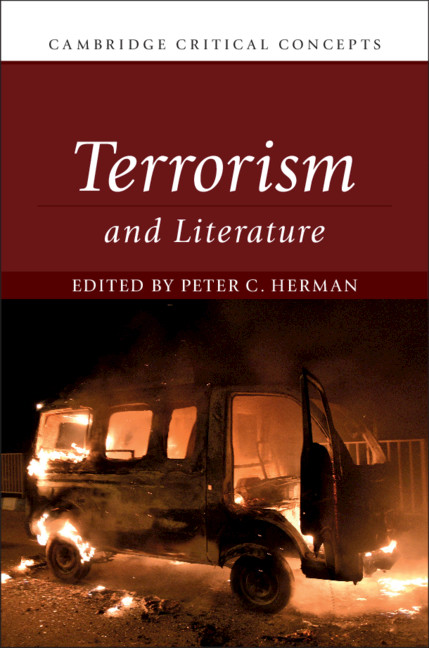
Terrorism has long been a major shaping force in the world. However, the meanings of terrorism, as a word and as a set of actions, are intensely contested. This volume explores how literature has dealt with terrorism from the Renaissance to today, inviting the reader to make connections between older instances of terrorism and contemporary ones, and to see how the various literary treatments of terrorism draw on each other. The essays demonstrate that the debates around terrorism only give the fictive imagination more room, and that fiction has a great deal to offer in terms of both understanding terrorism and our responses to it. Written by historians and literary critics, the essays provide essential knowledge to understand terrorism in its full complexity. As befitting a global problem, this book brings together a truly international group of scholars, with representatives from America, Scotland, Canada, New Zealand, Italy, Israel, and other countries.
Contents
Metrics
Altmetric attention score
Full text views
Full text views helpTotal number of HTML views: 0
Total number of PDF views: 0 *
 Loading metrics...
* Views captured on Cambridge Core between #date#. This data will be updated every 24 hours.
Usage data cannot currently be displayed.
Accessibility standard: Unknown
Why this information is here
This section outlines the accessibility features of this content - including support for screen readers, full keyboard navigation and high-contrast display options. This may not be relevant for you.
Accessibility Information
Accessibility compliance for the HTML of this book is currently unknown and may be updated in the future.