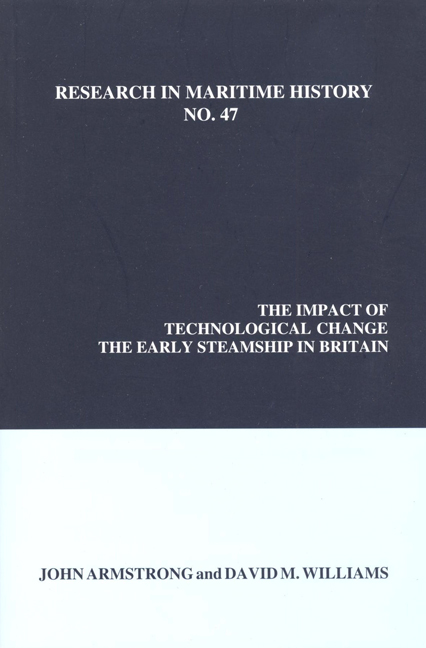
The Impact of Technological Change

-
The digital format of this book is no longer available to purchase from Cambridge Core. Other formats may be available.
-
Select format
-
- Publisher:
- Liverpool University Press
- Publication date:
- 27 April 2018
- 01 January 2011
- ISBN:
- 9781786948885
- 9780986497377
- Dimensions:
- Weight & Pages:
- Dimensions:
- Weight & Pages:
- Series:
- Research in Maritime History
You may already have access via personal or institutional login- Series:
- Research in Maritime History
Show more authors 
You may already have access via personal or institutional login
Book description
This book presents an in-depth study of the impact of the steamship on Britain during its first forty years, roughly between 1810 and 1850. It relates the early steamship to several industrial themes including diffusion; construction; modernisation; the role of government - particularly the difficult attempt to align laissez-faire politics with the greater need for public safety measures due to technological advance; business and finance; plus public reaction and tourism. The aim is to establish the significance of the steamship as a conduit of modernisation and societal change. It consists of a foreword, introduction, and fourteen chapters devoted to specific themes, structured to ensure each chapters build on the preceding chapter's progress. Collectively, they demonstrate that the development of both experience and enterprise with steam power both gained and refined during this period made the mid-century expansion of steamship technology across Britain possible. Ultimately, it establishes that steamship services began to adapt to oceanic routes, steam began to integrate into the world economy, and the age of sail began to draw to a close.
Contents
Contents
Metrics
Altmetric attention score
Full text views
Full text views helpTotal number of HTML views: 0
Total number of PDF views: 0 *
 Loading metrics...
* Views captured on Cambridge Core between #date#. This data will be updated every 24 hours.
Usage data cannot currently be displayed.
Accessibility standard: Unknown
Why this information is here
This section outlines the accessibility features of this content - including support for screen readers, full keyboard navigation and high-contrast display options. This may not be relevant for you.
Accessibility Information
Accessibility compliance for the PDF of this book is currently unknown and may be updated in the future.