
Skip to main content Accessibility help
×
  • Cited by 33
    • Show more authors
    • You may already have access via personal or institutional login
    • Select format
    • Publisher:
      Cambridge University Press
      Publication date:
      05 April 2013
      29 April 2013
      ISBN:
      9781139051392
      9780521897648
      9781107557543
      Dimensions:
      (228 x 152 mm)
      Weight & Pages:
      0.6kg, 327 Pages
      Dimensions:
      (229 x 152 mm)
      Weight & Pages:
      0.49kg, 334 Pages
    You may already have access via personal or institutional login
  • Selected: Digital
    Add to cart View cart Buy from Cambridge.org

    Book description

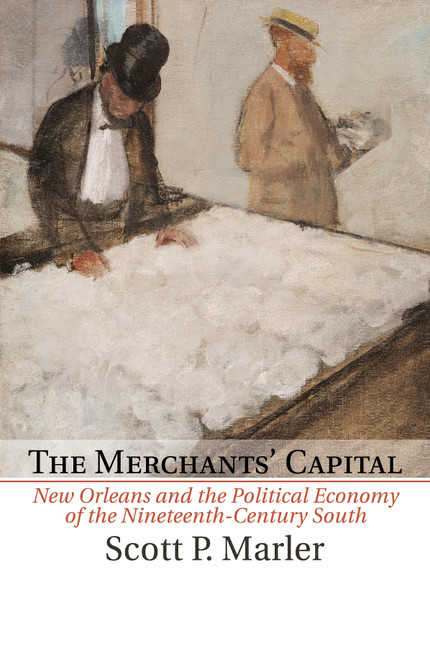
    As cotton production shifted toward the southwestern states during the first half of the nineteenth century, New Orleans became increasingly important to the South's plantation economy. Handling the city's wide-ranging commerce was a globally oriented business community that represented a qualitatively unique form of wealth accumulation - merchant capital - that was based on the extraction of profit from exchange processes. However, like the slave-based mode of production with which they were allied, New Orleans merchants faced growing pressures during the antebellum era. Their complacent failure to improve the port's infrastructure or invest in manufacturing left them vulnerable to competition from the fast-developing industrial economy of the North, weaknesses that were fatally exposed during the Civil War and Reconstruction. Changes to regional and national economic structures after the Union victory prevented New Orleans from recovering its commercial dominance, and the former first-rank American city quickly devolved into a notorious site of political corruption and endemic poverty.

    Reviews

    'This splendid book offers a meticulous historical study of merchant capitalism in … New Orleans, a unique port city in the South … This wonderful study contributes to both southern history and business history and should be required reading in undergraduate and graduate courses.'

    Elena V. Shabliy Source: Southern Historian

    'Prodigiously researched and elegantly argued, The Merchants' Capital deserves a wide readership.'

    Richard Follett Source: The Journal of Southern History

    Refine List

    Actions for selected content:

    Select all | Deselect all
    • View selected items
    • Export citations
    • Download PDF (zip)
    • Save to Kindle
    • Save to Dropbox
    • Save to Google Drive

    Save Search

    You can save your searches here and later view and run them again in "My saved searches".

    Please provide a title, maximum of 40 characters.
    ×

    Contents

    Bibliography

    I. Archival Sources

    Baker Library Historical Collections, Harvard Business School

    R. G. Dun & Company Credit Report Collections

    Library of Congress

    Abraham Lincoln Papers

    [R. G. Dun & Co.] Mercantile Agency Reference Books, 1866–1880 (semi-annual)

    Louisiana and Lower Mississippi Valley Collection, Louisiana State University

    J. M. Ellis Papers

    Samuel Haas Letterpress Copybook, 1887
    Lebret & Hearsey Record Books, 1838–1875
    Lebret Diary, 1858–61
    Mann, Fischer & Co. Account Books, 1869–1880
    Mercantile Agency Reference Book, Louisiana, 1890
    John McKowen Papers, 1830–1898

    Louisiana Division, New Orleans Public Library

    Administrations of the Mayors of New Orleans (typescript, 1931)
    Census of Merchants, 1854, City of New Orleans, Treasurer’s Office

    Fourth U.S. District Court (New Orleans) Records

    W[alter] Cox & Co. Letters, 1860–61

    Howard-Tilton Memorial Library, Tulane University

    • Jacob Barker Letters

    • Mrs. Frank M. Besthoff Collection

    • Joseph Slemmons Copes Papers

    • Cotton Trade Series

    • John G. Dunlap Correspondence

    • Rosamonde E. and Emile Kuntz Collection

    • New Orleans Cotton Exchange Collection

    • Standard Fruit & Steamship Company Papers

    Southern Historical Collection, Wilson Library, University of North Carolina at Chapel Hill

    • Jackson, Riddle & Company Papers

    • Wyche-Otey Family Papers

    • W. H. T. Squires Papers

    • Bruno Trombly Diary and Papers

    West Feliciana Parish Courthouse, St. Francisville, LA

    Mortgage Records, 1855–1878
    Conveyance Books, 1868–1885

    Williams Research Center, The Historic New Orleans Collection

    • Louisiana Manuscripts Collection (MSS 579)

    • Federal Occupation of New Orleans Collection (MSS 577)

    Woodson Research Center, Rice University

    Kuntz Civil War Collection

    Charles P. Leverich Papers, 1833–1851

    II. Contemporary Periodicals and Newspapers

    • Atlantic Monthly

    • Banker’s Magazine

    • Century Illustrated Magazine

    • De Bow’s Review

    • Harper’s New Monthly Magazine

    • Hunt’s Merchant’s Magazine

    • Port Record

    • Southern Literary Messenger

    [Appleton’s] American Annual Cyclopedia and Register of Important Events of the Year 1861(New York, 1870)
    [Appleton’s] American Annual Cyclopedia and Register of Important Events of the Year 1862 (New York, 1865)
    Gardner’s New Orleans City Directories, 1858–1878

    • [Alexandria] Louisiana Democrat

    • [Alexandria, LA] Red River Whig

    • Harrisonburg [LA] Independent

    • New Orleans Daily Picayune

    • New Orleans Daily Crescent

    • New Orleans Daily Delta

    • New Orleans Daily True Delta

    • New Orleans News-Letter and General Weekly Review

    • New Orleans Price Current

    • New Orleans Times

    • [St. Francisville, LA] West Feliciana Sentinel

    III. Government Publications

    [Israel D. Andrews], Report of Israel D. Andrews on the Trade and Commerce of the British North American Colonies, and Upon the Trade of the Great Lakes and Rivers, Senate Executive Document No. 112 (32 Cong., 1st Sess.) (Washington, DC, 1853).
    Eighth Census of the United States(1860), Vol. I: Population and Other Statistics (Washington, DC, 1864).
    Joseph Nimmo Jr., Report on the Internal Commerce of the United States, 48 Cong., 2d Sess., Ex.Doc. 7, Part 3 (Washington, DC, 1885).
    Official Journal of the House of Representatives of the State of Louisiana, Session of November 1861 (Baton Rouge, 1861).
    Official Records of the Union and Confederate Navies in the War of the Rebellion (Washington, DC, 1922).
    Report of the [House] Select Committee on the New Orleans Riots (Washington, DC, 1867).
    Statistical Abstract of the United States, No. 22 (1899; repr., New York, 1964).
    Report of the Joint Committee on the Conduct of the War, 38 Cong., 2 Sess. (3 vols., Washington, DC, 1865).
    “Report of the Special Commission” [Smith-Brady Report], September 23, 1865, Old Army Records (RG-94), Vol. 737 (microfilm, National Archives).
    Raphael P. Thian, comp., Reports of the Secretary of the Treasury of the Confederate States of America, 1861–65 (Washington, DC, 1878).
    Raphael P. Thian, Extracts from the Journals of the Provisional Congress and of the First and Second Congresses of the Confederate States of America on Legislation Affecting Finance, Revenue, and Commerce, 1861–65 (Washington, DC, 1880).
    U.S. Manuscript Census, 1850, Schedule I, Free Inhabitants, Town of Bayou Sara, West Feliciana Parish, Louisiana.
    U.S. Treasury Department, Bureau of Statistics, Monthly Summary of Commerce and Finance of the United States, January 1900 (Washington, DC, 1900).
    The War of the Rebellion: A Compilation of the Official Records of the Union and Confederate Armies (Washington, DC, 1900– ).

    IV. Published Primary Sources (Books and Articles)

    Horace Adams, ed., “Arkansas Traveler, 1852–1853: The Diary of John W. Brown,” Journal of Southern History 4 (August 1938).
    [Anonymous], New Orleans As It Is: Its Manners and Morals … (Utica, NY, 1849).
    Thomas Ashe, Travels in America Performed in the Year 1806 (London, 1809).
    Elliott Ashkenazi, ed., The Civil War Diary of Clara Solomon: Growing Up in New Orleans, 1861–1862 (Baton Rouge, 1995).
    Edward Bacon, Among the Cotton Thieves (Detroit, 1867).
    [Jacob Barker], Incidents in the Life of Jacob Barker, of New Orleans … from 1800 to 1855 (Washington, DC, 1855).
    James Bennet, The American System of Practical Book-Keeping…. (21st ed., 1842; repr., New York, 1976).
    Biographical and Historical Memoirs of Louisiana (2 vols.; Chicago, 1892).
    Biographical and Historical Memoirs of Northwestern Louisiana (Nashville and Chicago, 1890).
    Julian P. Boyd et al., eds., The Papers of Thomas Jefferson (Princeton, NJ, 1965– ).
    James E. Boyle, Cotton and the New Orleans Cotton Exchange: A Century of Commercial Evolution (Garden City, NY, 1934).
    John Crosby Brown, A Hundred Years of Merchant Banking: A History of Brown Brothers and Company (New York, 1909).
    Stuart Bruchey, comp. and ed., Cotton and the Growth of the American Economy, 1790–1860: Sources and Readings (New York and other cities, 1967).
    Clarence C. Buel, “The Degradation of a State; or, The Charitable Career of the Louisiana Lottery,” The Century Magazine 43 (February 1892), 618–33.
    Benjamin F. Butler, Butler’s Book: Autobiography and Personal Reminiscences of Major-General Benjamin F. Butler (Boston, 1892).
    George Washington Cable, Old Creole Days (1885 ed.; repr., New York, 1964).
    George Washington Cable, The Creoles of Louisiana (1884; repr., New York, 1970).
    John E. Cairnes, The Slave Power: Its Character, Career, and Probable Designs (1862; repr., Columbia, SC, 2003).
    [Salmon P. Chase], “Diary and Correspondence of Salmon P. Chase,” Annual Report of the American Historical Association for the Year 1902 (2 vols., Washington, DC, 1903).
    David Christy, Cotton Is King: or, The Culture of Cotton … (1855; 2nd ed., New York, 1856).
    Stephen Colwell, The South: A Letter from a Friend in the North, with Special Reference to the Effects of Disunion upon Slavery (Philadelphia, 1856).
    Stephen Colwell, The Five Cotton States and New York (Philadelphia, 1861).
    W. C. Corsan, Two Months in the Confederate States: An Englishman’s Travels Through the South, ed. Benjamin H. Trask (1863; repr., Baton Rouge and London, 1996).
    John F. Cowan, A New Invasion of the South: Being a Narrative of the Expedition of the Seventy-First Infantry, National Guard, Through the Southern States to New Orleans (New York, 1881).
    J. A. Dacus, A Guide to Success, with Forms for Business and Society (St. Louis, 1880).
    Robert M. Davis, The Southern Planter, the Factor, and the Banker (New Orleans, 1871).
    T. C. DeLeon, Our Creole Carnivals: Their Origin, History, Progress, and Results (Mobile, AL, 1890).
    John Richard Dennett, The South As It Is, 1865–1866, ed. Henry M. Christman (Athens, Ga., and London, 1986).
    E. J. Donnell, Chronological and Statistical History of Cotton (1872; repr., Wilmington, DE, 1973).
    J. W. Dorr, “A Tourist’s Description of Louisiana in 1860,” ed. Walter Prichard, Louisiana Historical Quarterly 21 (October 1938), 1110–79.
    Sarah A. Dorsey, Recollections of Henry Watkins Allen, Brigadier-General Confederate States Army [and] Ex-Governor of Louisiana (New York and New Orleans, 1866).
    J[ohn] F. Entz, Exchange and Cotton Trade between England and the United States (New York, 1840).
    Walter L. Fleming, ed., General W. T. Sherman as College President … 1859–1861 (Cleveland, OH, 1912).
    Paul Leicester Ford, comp. and ed., The Writings of Thomas Jefferson (New York, 1897).
    A. Oakey Hall, The Manhattaner in New Orleans; or, Phases of Crescent City Life (New York, 1851).
    M[atthew] B. Hammond, The Cotton Industry: An Essay in American Economic History. Part I: The Cotton Culture and the Cotton Trade (New York, 1897).
    Hinton Rowan Helper, The Impending Crisis of the South: How to Meet It, ed. George M. Fredrickson (1857; repr., Cambridge, MA, 1968).
    George H. Hepworth, The Whip, Hoe, and Sword; or, The Gulf-department in ’63 (Boston, 1864).
    Daniel R. Hundley, Social Relations in Our Southern States (New York, 1860).
    [Illinois Central Railroad], The Commercial, Industrial, and Financial Outlook for New Orleans (Cedar Rapids, IA, 1894).
    J. H. Ingraham, The Sunny South; or, The Southerner at Home…. (Philadelphia, 1860).
    Robert U. Johnson and Clarence C. Buel, eds., Battles and Leaders of the Civil War (4 vols., 1887; repr., New York, 1956).
    Thomas Prentice Kettell, Southern Wealth and Northern Profits (New York, 1860).
    Edward King, The Great South, eds. W. Magruder Drake and Robert R. Jones (1875; repr. Baton Rouge, 1972).
    William Kingsford, Impressions of the West and South during a Six Weeks’ Holiday (Toronto, 1858).
    Thomas W. Knox, Camp-Fire and Cotton-Field: Southern Adventure in Time of War (New York, 1865).
    Gazaway B. Lamar [ed.], Proceedings of the Bank Convention of the Confederate States Held at Richmond, Va., July 24th, 25th, and 26th, 1861 (Charleston, SC, 1861).
    Benjamin Henry Boneval Latrobe, Impressions Respecting New Orleans: Diary and Sketches, 1818–1820, ed. Samuel Wilson Jr. (New York, 1951).
    Samuel H. Lockett, Louisiana As It Is: A Geographical and Topographical Description of the State, ed. Lauren C. Post (orig. ms. 1869−72; Baton Rouge, 1969).
    James Longstreet, From Manassas to Appomattox: Memoirs of the Civil War in America (1896; repr., Bloomington, IN, 1960).
    [Daniel Lord], The Effect of Secession upon the Commercial Relations between the North and South, and upon Each Section (New York, 1861).
    Sidney A. Marchand, ed., The Flight of a Century (1800–1900) in Ascension Parish, Louisiana (Donaldsonville, LA, 1936).
    Don C. Marler, ed., The Carruth Journals, 1872–1902 (Woodville, TX, 1996).
    Jessie Ames Marshall, comp., Private and Official Correspondence of Gen. Benjamin F. Butler during the Period of the Civil War (5 vols..; Norwood, MA, 1917).
    Karl Marx, On America and the Civil War, ed. and trans. Saul K. Padover (New York, 1972).
    Karl Marx and Frederick Engels, The Civil War in the United States, ed. Richard Enmale (2nd ed.; New York, 1940).
    [John McDonogh], The Last Will and Testament of John McDonogh…. (New Orleans, 1851).
    Andrew Morrison, The Industries of New Orleans … Historical, Descriptive, Statistical (New Orleans, 1885).
    [William Mure], “Financial and Economic Disturbance in New Orleans on the Eve of Secession,” ed. Milledge L. Bonham, Louisiana Historical Quarterly 13 (January 1930), 32–6.
    [Eugène Musson], Letter to Napoleon III on Slavery in the Southern States, by a Creole of Louisiana (London, 1862).
    Vincent Nolte, The Memoirs of Vincent Nolte, or Fifty Years in Both Hemispheres, trans. Burton Rascoe (1854; repr., New York, 1934).
    Charles Nordhoff, The Cotton States in the Spring and Summer of 1875 (1876; repr., New York, 1971).
    Frederick Law Olmsted, The Cotton Kingdom: A Traveller’s Observations on Cotton and Slavery in the American Slave States, ed. Arthur M. Schlesinger (New York, 1953).
    Charles H. Otken, The Ills of the South (New York and London, 1894).
    James A. Padgett, ed., “Some Letters of George Stanton Denison, 1854–1866: Observations of a Yankee on Conditions in Louisiana and Texas,” Louisiana Historical Quarterly 23 (October 1940).
    [Reverend] B. M. Palmer, The Oath of Allegiance to the United States, Discussed in Its Moral and Political Bearings (Richmond, VA, 1863).
    James Parton, General Butler in New Orleans; Being a History of the Administration of the Department of the Gulf in the Year 1862 (New York, 1864).
    Samuel J. Peters, An Address to the Legislature of Louisiana, Showing the Importance of the Credit System on the Prosperity of the United States, and Particularly Its Influence on the Agricultural, Commercial, and Manufacturing Interests of Louisiana (New Orleans, 1837).
    Edwards Pierrepont, A Review by Judge Pierrepont of Gen. Butler’s Defense Before the House of Representatives in Relation to the New Orleans Gold (New York, 1865).
    G. W. Pierson, [ed.], “Alexis de Tocqueville in New Orleans,” Franco-American Review 1 (1936).
    James M. Phillippo, The United States and Cuba (London, 1857).
    Walter Prichard, ed., “The Origin and Activities of the ‘White League’ in New Orleans (Reminiscences of a Participant in the Movement),” Louisiana Historical Quarterly 23 (April 1940), 525–43.
    Whitelaw Reid, After the War: A Tour of the Southern States, 1865–1866 (1866; repr., New York, 1965).
    Henry Rightor, ed., Standard History of New Orleans (Chicago, 1900).
    James Robb, A Southern Confederacy: Letters from James Robb, Late a Citizen of New Orleans, to an American in Paris, and Hon. Alexander H. Stephens, of Georgia (Chicago, 1862).
    James Robertson, A Few Months in America (London, 1855).
    Clinton Rossiter, ed., The Federalist Papers (New York, 2003).
    Kate Mason Rowland and Mrs. Morris L. Croxall, eds., The Journal of Julia LeGrand: New Orleans, 1862–1863 (Richmond, VA, 1911).
    Robert Russell, North America: Its Agriculture and Climate (Edinburgh, 1858).
    William Howard Russell, My Diary North and South (Boston, 1863).
    J. E. Hilary Skinner, After the Storm; or, Jonathan and His Neighbours in 1865–6 (2 vols., London, 1866).
    Adam Smith, The Wealth of Nations, ed. Andrew Skinner (1776; New York and other cities, 1986).
    Robert Somers, The Southern States Since the War, 1870–71 (1871; repr., University, AL, 1965).
    Marion Southwood, Beauty and Booty: The Watchword of New Orleans (New York, 1867).
    James Spence, The American Union (London, 1861).
    Kate Stone, Brokenburn: The Journal of Kate Stone, 1861–1868, ed. John Q. Anderson (Baton Rouge, 1955).
    James Stuart, Three Years in North America (2 vols., 1828; rev. ed., Edinburgh, 1833).
    William Carter Stubbs, Handbook of Louisiana, Giving Geographical and Agricultural Features…. (New Orleans, 1895).
    Edward Sullivan, Rambles and Scrambles in North and South America (London, 1852).
    Alexis de Tocqueville, Democracy in America, introduction by Alan Ryan (New York, 1994).
    R. D. Turner, The Conspiracy Trials of 1826 and 1827: A Chapter in the Life of Jacob Barker (Philadelphia, 1864).
    Loretta Janeta Velazquez, The Woman in Battle: A Narrative of the Exploits, Adventures, and Travels of Madame Loretta Janeta Velazquez…. (Hartford, CT, 1876).
    Jon L. Wakelyn, ed., Southern Pamphlets on Secession, November 1860–April 1861 (Chapel Hill, 1996).
    H. C. Warmoth, War, Politics and Reconstruction: Stormy Days in Louisiana (New York, 1930).
    James L. Watkins, King Cotton: A Historical and Statistical Review, 1790 to 1908 (1908; repr., New York, 1969).
    Clyde N. Wilson and Shirley Bright Cook, eds., The Papers of John C. Calhoun, Vol. 26 (Columbia, SC, 2001)

    V. Secondary Sources: Books

    Jeffrey S. Adler, Yankee Merchants and the Making of the Urban West (New York and other cities, 1991).
    Jean-Christophe Agnew, Worlds Apart: The Market and the Theater in Anglo-American Thought, 1550–1750 (Cambridge, UK, and other cities, 1986).
    Charles H. Aiken, The Cotton Plantation South since the Civil War (Baltimore and London, 1998).
    Robert G. Albion, The Rise of New York Port, 1815–1860 (1939; repr., Boston and New York, 1967).
    Lee J. Alston and Joseph P. Ferrie, Southern Paternalism and the American Welfare State: Economics, Politics, and Institutions in the South, 1865–1965 (New York, 1999).
    Aaron D. Anderson, Builders of a New South: Merchants, Capital, and the Remaking of Natchez, 1865–1914 (Jackson, MS, 2013).
    O. D. Anderson and M. R. Perryman, eds., Time Series Analysis (New York, 1981).
    Perry Anderson, Spectrum: From Left to Right in the World of Ideas (New York, 2005).
    Ralph Andreano, ed., The Economic Impact of the Civil War (Cambridge, MA, 1962).
    Eric Arnesen, Waterfront Workers of New Orleans: Race, Class, and Politics, 1863–1923 (Urbana and Chicago, 1991).
    Elliott Ashkenazi, The Business of Jews in Louisiana, 1840–1875 (Tuscaloosa and London, 1988).
    John Ashworth, Slavery, Capitalism, and Politics in the Antebellum Republic, Vol. 1: Commerce and Compromise, 1820–1850 (New York, 1995).
    John Ashworth, Slavery, Capitalism, and Politics in the Antebellum Republic, Vol. 2: The Coming of the Civil War, 1850–1861 (New York, 2007).
    T. H. Aston and C. H. E. Philpin, eds., The Brenner Debate (New York, 1985).
    Jeremy Atack and Peter Passell, A New Economic View of American History from Colonial Times to 1940, 2nd ed. (New York, 1994).
    Lewis E. Atherton, The Southern Country Store, 1800–1860 (Baton Rouge, 1949).
    Edward L. Ayers, The Promise of the New South: Life after Reconstruction (New York and Oxford, 1992).
    H. Parrott Bacot, Sally Kittredge Reeves, and John H. Lawrence, Marie Adrien Persac: Louisiana Artist (Baton Rouge, 2000).
    Bernard Bailyn, The New England Merchants in the Seventeenth Century (1955; repr., New York, 1964).
    Douglas B. Ball, Financial Failure and Confederate Defeat (Urbana and Chicago, 1991).
    Edward J. Balleisen, Navigating Failure: Bankruptcy and Commercial Society in Antebellum America (Chapel Hill, NC, 2001).
    Frederic Bancroft, Slave-Trading in the Old South (Baltimore, 1931).
    Erik Banks, The Rise and Decline of the Merchant Banks (London, 1999).
    Harold Barger, Distribution’s Place in the American Economy since 1869. National Bureau of Economic Research, General Series No. 58 (Princeton, NJ, 1955).
    L. Diane Barnes, Brian Schoen, and Frank Towers, eds., The Old South’s Modern Worlds: Slavery, Region, and Nation in the Age of Progress (New York, 2011).
    William L. Barney, The Road to Secession: A New Perspective on the Old South (New York, 1972).
    William L. Barney, The Secessionist Impulse: Alabama and Mississippi in 1860 (Princeton, NJ, 1974).
    John M. Barry, Rising Tide: The Great Mississippi Flood of 1927 and How It Changed America (New York, 1997).
    Fred Bateman and Thomas Weiss, A Deplorable Scarcity: The Failure of Industrialization in the Slave Economy (Chapel Hill, 1981).
    James P. Baughman, Charles Morgan and the Development of Southern Transportation (Nashville, 1968).
    Charles A. Beard and Mary R. Beard, The Rise of American Civilization (2 vols.; New York, 1927).
    Sven Beckert, The Monied Metropolis: New York City and the Consolidation of the American Bourgeoisie, 1850–1896 (New York, 2001).
    Wyatt W. Belcher, The Economic Rivalry between St. Louis and Chicago, 1850–1880 (New York, 1947).
    Thomas Bender, ed., The Antislavery Debate: Capitalism and Abolitionism as a Problem in Historical Interpretation (Berkeley and Los Angeles, 1992).
    Thomas Bender, A Nation among Nations: America’s Place in World History (New York, 2006).
    Christopher Benfey, Degas in New Orleans: Encounters in the Creole World of Kate Chopin and George Washington Cable (Berkeley, CA, and other cities, 1997).
    Richard Franklin Bensel, The Political Economy of American Industrialization, 1877–1900 (Cambridge, UK, and other cities, 2000).
    Brian J. L. Berry, Geography of Market Centers and Retail Distribution (Englewood Cliffs, NJ, 1967).
    Carolyn Earle Billingsley, Communities of Kinship: Antebellum Families and the Settlement of the Cotton Frontier (Athens, GA, 2004).
    Robin Blackburn, The Making of New World Slavery: From the Baroque to the Modern, 1492–1800 (2nd ed.; New York, 2010).
    Mansel G. Blackford, A History of Small Business in America (New York, 1991).
    DeAnne Blanton and Lauren M. Cook, They Fought Like Demons: Women Soldiers in the American Civil War (Baton Rouge, 2002).
    Howard Bodenhorn, A History of Banking in Antebellum America (New York, 2000).
    Jefferson Davis Bragg, Louisiana in the Confederacy (1941; repr., Baton Rouge, 1997).
    Fernand Braudel, Civilization and Capitalism, 15th–18th Century, Vol. 2: The Wheels of Commerce, trans. Sian Reynolds (New York and other cities, 1982).
    T. H. Breen, Tobacco Culture: The Mentality of the Great Tidewater Planters on the Eve of Revolution (Princeton, NJ, 1985).
    Robert Brenner, Merchants and Revolution: Commercial Change, Political Conflict, and London’s Overseas Traders, 1550–1653 (Princeton, NJ, 1993).
    W. R. Brock, An American Crisis: Congress and Reconstruction, 1865–1867 (New York, 1963).
    William A. Brock and David S. Evans, The Economics of Small Businesses: Their Role and Regulation in the American Economy (New York, 1986).
    Marilyn R. Brown, Degas and the Business of Art: A Cotton Office in New Orleans (University Park, PA, 1994).
    Stuart Bruchey, ed., Small Business in American Life (New York, 1980).
    Steven C. Bullock, Revolutionary Brotherhood: Freemasonry and the Transformation of the American Social Order, 1730–1840 (Chapel Hill and London, 1996).
    Frank J. Byrne, Becoming Bourgeois: Merchant Culture in the South, 1820–1865 (Lexington, KY, 2006).
    T. J. Byres, ed., Sharecropping and Sharecroppers (London, 1983).
    Stephen A. Caldwell, A Banking History of Louisiana (Baton Rouge, 1935).
    Richard Campanella, Time and Place in New Orleans: Past Geographies in the Present Day (Gretna, LA, 2002).
    Richard Campanella, Bienville’s Dilemma: A Historical Geography of New Orleans (Lafayette, LA, 2008).
    Gerald M. Capers, Occupied City: New Orleans under the Federals, 1861–1865 (Lexington, KY, 1965).
    David L. Carlton, Mill and Town in South Carolina, 1880–1920 (Baton Rouge, 1982).
    David L. Carlton and Peter A. Coclanis, The South, the Nation, and the World: Perspectives on Southern Economic Development (Charlottesville, VA, 2003).
    Dan T. Carter, When the War Was Over: The Failure of Self-Reconstruction in the South, 1865–1867 (Baton Rouge, 1985).
    Willie Malvin Caskey, Secession and Restoration of Louisiana (Baton Rouge, 1938).
    Youssef Cassis, Capitals of Capital: A History of International Financial Centres, 1780–2005, trans. Jacqueline Collier (New York, 2007).
    Alfred D. Chandler Jr., The Visible Hand: The Managerial Revolution in American Business (Cambridge, MA, 1977).
    David R. Chesnutt and Clyde N. Wilson. eds., The Meaning of South Carolina History: Essays in Honor of George C. Rogers Jr. (Columbia, SC, 1990).
    Steven N. S. Cheung, The Theory of Share Tenancy, with Special Application to Asian Agriculture and the First Phase of Taiwan Land Reform (Chicago, 1969).
    John G. Clark, The Grain Trade of the Old Northwest (Urbana, II, 1966).
    John G. Clark, New Orleans, 1718–1812: An Economic History (Baton Rouge, 1970).
    Thomas D. Clark, Pills, Petticoats, and Plows: The Southern Country Store (1944; repr., Norman, OK, 1989).
    William Cohen, At Freedom’s Edge: Black Mobility and the Southern White Quest for Racial Control, 1861–1915 (Baton Rouge, 1991).
    Arthur C. Cole, Wholesale Commodity Prices in the United States, 1700–1861 (Cambridge, MA, 1938).
    Harry A. Corbin, The Men’s Clothing Industry: Colonial through Modern Times (New York, 1970).
    E. Merton Coulter, The Confederate States of America, 1861–1865 (Baton Rouge, 1950).
    Ruth Schwartz Cowan, A Social History of American Technology (New York, 1997).
    William Cronon, Nature’s Metropolis: Chicago and the Great West (New York, 1991).
    D. P. Crook, The North, the South, and the Powers, 1861–1865 (New York and other cities, 1974).
    James W. Daddysman, The Matamoros Trade: Confederate Commerce, Diplomacy, and Intrigue (Newark, DE, 1984).
    Adrian C. Darnell, ed., The Collected Economics Articles of Harold Hotelling (New York and other cities, 1990).
    Gene Dattel, Cotton and Race in the Making of America: The Human Costs of Economic Power (Chicago, 2009).
    Paul A. David and Kenneth M. Stampp, eds., Reckoning with Slavery: A Critical Study in the Quantitative History of American Negro Slavery (New York, 1976).
    Lance E. Davis and Douglass C. North, Institutional Change and American Economic Growth (Cambridge, UK, and New York, 1971).
    William C. Davis, The Pirates Laffite: The Treacherous World of the Corsairs of the Gulf (Orlando, FL, and other cities, 2005).
    Shannon Lee Dawdy, Building the Devil’s Empire: French Colonial New Orleans (Chicago, 2008).
    Steven Deyle, Carry Me Back: The Domestic Slave Trade in American Life (New York, 2005).
    Charles B. Dew, Bond of Iron: Master and Slave at Buffalo Forge (New York, 1994).
    Leonard Dinnerstein and Mary Dale Passon, eds., Jews in the South (Baton Rouge, 1973).
    Maurice Dobb, Studies in the Development of Capitalism (1947; rev. ed., New York, 1963).
    Don H. Doyle, New Men, New Cities, New South: Atlanta, Nashville, Charleston, Mobile, 1860–1910 (Chapel Hill and London, 1990).
    John N. Drobak and John V. C. Nye, eds., The Frontiers of the New Institutional Economics (San Diego and other cities, 1997).
    W. E. B. Du Bois, Black Reconstruction in America, 1860–1880 (1935; repr., New York, 1992).
    John Duffy, Sword of Pestilence: The New Orleans Yellow Fever Epidemic of 1853 (Baton Rouge, 1966).
    Sue Eakin, Rapides Parish: An Illustrated History (Northridge, CA, 1987),
    Clement Eaton, The Mind of the Old South (rev. ed., Baton Rouge, 1967).
    Stanley Elkins and Eric McKitrick, The Age of Federalism: The Early American Republic, 1788–1800 (New York and Oxford, 1993).
    Stanley L. Engerman, Philip T. Hoffman, Jean-Laurent Rosenthal, and Kenneth L. Sokoloff, eds., Finance, Intermediaries, and Economic Development (New York, 2003).
    D. A. Farnie, The English Cotton Industry and the World Market, 1815–1896 (Oxford, 1979).
    D. A. Farnie and D. J. Jeremy, eds., The Fibre that Changed the World: The Cotton Industry in International Perspective, 1600–1990s (Oxford and other cities, 2004).
    Drew Gilpin Faust, James Henry Hammond and the Old South: A Design for Mastery (Baton Rouge, 1982).
    Gail Feigenbaum [ed.], Degas and New Orleans: A French Impressionist in America (New Orleans, 1999).
    Lou Ferleger, ed., Agriculture and National Development: Views on the Nineteenth Century (Ames, IA, 1990).
    Albert Fishlow, American Railroads and the Transformation of the Ante-Bellum Economy (Cambridge, MA, 1965).
    Robert William Fogel and Stanley L. Engerman, Time on the Cross: The Economics of American Negro Slavery (New York, 1974).
    Fred E. Foldvary, ed., Beyond Neoclassical Economics: Heterodox Approaches to Economic Theory (Brookfield, VT, 1996).
    Richard J. Follett, The Sugar Masters: Planters and Slaves in Louisiana’s Cane World, 1820–1860 (Baton Rouge, 2005).
    Eric Foner, Free Soil, Free Labor, Free Men: The Ideology of the Republican Party before the Civil War (New York, 1970).
    Eric Foner, Reconstruction: America’s Unfinished Revolution, 1863–1877 (New York, 1988).
    Philip S. Foner, Business and Slavery: The New York Merchants and the Irrepressible Conflict (Chapel Hill, NC, 1941).
    Lacy K. Ford, ed., A Companion to the Civil War and Reconstruction (Malden, MA, 2005).
    Gaines M. Foster, Ghosts of the Confederacy: Defeat, the Lost Cause, and the Emergence of the New South (New York, 1987).
    Ray A. Foulke, The Sinews of American Commerce (New York, 1941).
    Elizabeth Fox-Genovese and Eugene D. Genovese, Fruits of Merchant Capital: Slavery and Bourgeois Property in the Rise and Expansion of Capitalism (Oxford and other cities, 1983).
    Elizabeth Fox-Genovese and Eugene D. Genovese, The Mind of the Master Class: History and Faith in the Southern Slaveholders’ Worldview (New York, 2005).
    John Hope Franklin, Reconstruction after the Civil War (Chicago and London, 1961).
    Walter J. Fraser Jr. and Winfred B. Moore Jr., eds., The Southern Enigma: Essays on Race, Class, and Folk Culture, eds. (Westport, CT, 1983).
    William W. Freehling, The Road to Disunion, Vol. I: Secessionists at Bay, 1776–1854 (New York, 1990).
    William W. Freehling, The Road to Disunion, Vol. II: Secessionists Triumphant, 1854–1861 (New York, 2007).
    Paul M. Gaston, The New South Creed: A Study in Southern Mythmaking (Baton Rouge, 1970).
    Eugene D. Genovese, The Political Economy of Slavery: Studies in the Economy and Society of the Slave South (New York, 1965).
    Eugene D. Genovese, The World the Slaveholders Made: Two Essays in Interpretation (1969; repr., Middletown, CT, 1988).
    Gary Gereffi and Miguel Korzeniewicz, eds., Commodity Chains and Global Capitalism (Westport, CT, and London, 1993).
    David T. Gilchrist and W. David Lewis, eds., Economic Change in the Civil War Era, eds. (Greeneville, DE, 1965).
    James Gill, Lords of Misrule: Mardi Gras and the Politics of Race in New Orleans (Jackson, MS, 1997).
    Thavolia Glymph and John J. Kushma, eds., Essays on the Postbellum Southern Economy (College Station: Texas A&M University Press, 1985).
    David Goldfield, Region, Race, and Cities: Interpreting the Urban South (Baton Rouge, 1997).
    Lawrence Goodwyn, Democratic Promise: The Populist Moment in America (New York and Oxford, 1976).
    N. S. B. Gras, Business and Capitalism: An Introduction to Business History (New York, 1939).
    Lewis C. Gray, History of Agriculture in the Southern United States to 1860 (2 vols., 1933; repr. Gloucester, MA, 1958).
    George D. Green, Finance and Economic Development in the Old South: Louisiana Banking, 1804–1861 (Stanford, CA, 1972).
    Jack P. Greene and Philip D. Morgan, eds., Atlantic History: A Critical Appraisal (New York, 2009).
    Robert H. Gudmestad, A Troublesome Commerce: The Transformation of the Interstate Slave Trade (Baton Rouge, 2003).
    Matthew Pratt Guterl, American Mediterranean: Southern Slaveholders in the Age of Emancipation (Cambridge, MA, 2008).
    Louis M. Hacker, The Triumph of American Capitalism (New York, 1940).
    Steven Hahn, The Roots of Southern Populism: Yeoman Farmers and the Transformation of the Georgia Upcountry, 1850–1890 (New York and Oxford, 1983).
    Steven Hahn, A Nation Under Their Feet: Black Political Struggles in the Rural South from Slavery to the Great Migration (Cambridge, MA, 2003).
    William Ivy Hair, Bourbonism and Agrarian Protest: Louisiana Politics, 1877–1900 (Baton Rouge, 1969).
    Bray Hammond, Banks and Politics in America from the Revolution to the Civil War (Princeton, NJ, 1957).
    Bray Hammond, Sovereignty and an Empty Purse: Banks and Politics in the Civil War (Princeton, NJ, 1970).
    David Hancock, Citizens of the World: London Merchants and the Integration of the British Atlantic Community, 1735–1785 (New York, 1995).
    J. Fair Hardin, Northwestern Louisiana: A History (3 vols.; Louisville, KY and Shreveport, LA, 1937).
    Louis Hartz, Economic Policy and Democratic Thought: Pennsylvania, 1776–1860 (1948; repr., Chicago, 1968).
    Thomas L. Haskell and Richard F. Teichgraeber III, eds., The Culture of the Market: Historical Essays (New York, 1993).
    John A. Heitmann, The Modernization of the Louisiana Sugar Industry, 1830–1910 (Baton Rouge, 1987).
    Ralph W. Hidy, The House of Baring in American Trade and Finance: English Merchant Bankers at Work, 1763–1861 (Cambridge, MA, 1949).
    Sam Bowers Hilliard, Hog Meat and Hoecake: Food Supply in the Old South, 1840–1860 (Carbondale, IL, 1972).
    Rodney J. Hilton, ed., The Transition from Feudalism to Capitalism (London, 1976).
    Arnold R. Hirsch and Joseph Logsdon, eds., Creole New Orleans: Race and Americanization (Baton Rouge, 1992)
    Eric Hobsbawm, The Age of Capital, 1848–1875 (New York, 1974).
    Eric Hobsbawm, On History (New York, 1997).
    James K. Hogue, Uncivil Wars: Five New Orleans Street Battles and the Rise and Fall of Radical Reconstruction (Baton Rouge, 2006).
    James G. Hollandsworth Jr., Pretense of Glory: The Life of Nathaniel P. Banks (Baton Rouge, 1998).
    James G. HollandsworthAn Absolute Massacre: The New Orleans Race Riot of July 30, 1866 (Baton Rouge, 2001).
    Michael F. Holt, The Rise and Fall of the Whig Party: Jacksonian Politics and the Onset of the Civil War (New York, 1999).
    Charles M. Hubbard, The Burden of Confederate Diplomacy (Knoxville, TN, 1998).
    James L. Huston, Calculating the Value of the Union: Slavery, Property Rights, and the Economic Origins of the Civil War (Chapel Hill, 2003).
    Samuel C. Hyde Jr., Pistols and Politics: The Dilemma of Democracy in Louisiana’s Florida Parishes, 1810–1899 (Baton Rouge, 1996).
    Samuel C. Hyde Jr., ed., A Fierce and Fractious Frontier: The Curious Development of Louisiana’s Florida Parishes, 1699–2000 (Baton Rouge, 2004)
    Harold M. Hyman, Oleander Odyssey: The Kempners of Galveston, Texas, 1854–1980s (College Station, TX, 1990).
    Thomas N. Ingersoll, Mammon and Manon in Early New Orleans: The First Slave Society in the Deep South, 1718–1819 (Knoxville, TN, 1999).
    Geoffrey Ingham, Capitalism Divided? The City and Industry in British Social Development (New York, 1984).
    Joseph E. Inikori, Africans and the Industrial Revolution in England: A Study in International Trade and Economic Development (Cambridge, UK, and other cities, 2002).
    Joy J. Jackson, New Orleans in the Gilded Age: Politics and Urban Progress, 1880–1896 (2nd ed.; Lafayette, LA, 1997).
    Gerald David Jaynes, Branches without Roots: Genesis of the Black Working Class in the American South, 1862–1882 (New York, 1986).
    Leland Hamilton Jenks, The Migration of British Capital to 1875 (New York, 1927).
    Charles S. Johnson, Edwin R. Embree, and W. W. Alexander, The Collapse of Cotton Tenancy: Summary of Field Studies and Statistical Surveys, 1933–35 (Chapel Hill, 1935).
    Emory R. Johnson, T. W. Van Metre, Grover G. Huebner, David Scott Hanchett, and Henry W. Farnam, History of the Domestic and Foreign Commerce of the United States (2 vols.; Washington, DC, 1915).
    Ludwell H. Johnson, Red River Campaign: Politics and Cotton in the Civil War (1958; repr., Kent, Ohio, and London, 1993).
    Paul E. Johnson, A Shopkeeper’s Millenium: Society and Revivals in Rochester, New York, 1815–1837 (New York, 1978).
    Richard Johnson, ed., Making Histories: Studies in History-Writing and Politics (Minneapolis, MN, 1982).
    Walter Johnson, Soul by Soul: Life Inside the Antebellum Slave Market (Cambridge, MA, and London, 1999).
    Fred Mitchell Jones, Middlemen in the Domestic Trade of the United States, 1800–1860 (Urbana, IL, 1937).
    Howard Jones, Union in Peril: The Crisis over British Intervention in the Civil War (Chapel Hill, 1992).
    Ari Kelman, A River and Its City: The Nature of Landscape in New Orleans (Berkeley, CA, and other cities, 2003).
    Richard H. Kilbourne Jr., Debt, Investment, Slaves: Credit Relations in East Feliciana Parish, Louisiana, 1825–1885 (Tuscaloosa, AL, and London, 1995).
    Samuel Kinser, Carnival, American Style: Mardi Gras at New Orleans and Mobile (Chicago and London, 1990).
    Herbert S. Klein, The Atlantic Slave Trade (New York, 1999).
    James T. Kloppenberg, Uncertain Victory: Social Democracy and Progressivism in American and European Thought, 1870–1920 (New York, 1986).
    Bertram Wallace Korn, The Early Jews of New Orleans (Waltham, MA, 1969).
    J. Morgan Kousser and James M. McPherson, eds., Region, Race, and Reconstruction: Essays in Honor of C. Vann Woodward (New York, 1982).
    Peter Kriedte, Peasants, Landlords, and Merchant Capitalists: Europe and the World Economy, 1500–1800 (Warwickshire, UK, 1983).
    Peter Kriedte, Hans Medick, and Jurgen Schlumbohm, Industrialization before Industrialization: Rural Industry in the Genesis of Capitalism (Cambridge, UK, and other cities, 1981).
    Richard Lachmann, Capitalists in Spite of Themselves: Elite Conflict and Economic Transitions in Early Modern Europe (New York and Oxford, 2000).
    Stuart O. Landry, History of the Boston Club (New Orleans, 1938).
    Stuart O. Landry, The Battle of Liberty Place: The Overthrow of Carpet-Bag Rule in New Orleans, September 14, 1874 (New Orleans, 1955).
    Peirce F. Lewis, New Orleans: The Making of an Urban Landscape (2nd ed., Santa Fe, NM, and Harrisonburg, VA, 2003).
    Alex Lichtenstein, Twice the Work of Free Labor: The Political Economy of Convict Labor in the New South (London and New York, 1996).
    Raimondo Luraghi, The Rise and Fall of the Plantation South (New York, 1978).
    Jay R. Mandle, The Roots of Black Poverty: The Southern Plantation Economy after the Civil War (Durham, NC, 1978).
    Jay R. Mandle, Not Slave, Not Free: The African American Economic Experience since the Civil War (Durham, NC, 1992).
    Susan Archer Mann, Agrarian Capitalism in Theory and Practice (Chapel Hill, 1990).
    Raymond J. Martinez, The Story of the River Front at New Orleans (New Orleans, 1955).
    Karl Marx, Grundrisse: Foundations of the Critique of Political Economy, trans. Martin Nicolaus (New York, 1973).
    Karl Marx, Capital, Vol. III, trans. David Fernbach (1981; repr., London, 1991).
    Robert E. May, The Southern Dream of a Caribbean Empire, 1854–1861 (Baton Rouge, 1973).
    Robert E. May, Manifest Destiny’s Underworld: Filibustering in Antebellum America (Chapel Hill, 2002).
    Peyton McCrary, Abraham Lincoln and Reconstruction: The Louisiana Experiment (Princeton, NJ, 1978).
    Roderick A. McDonald, The Economy and Material Culture of Slaves: Goods and Chattels on the Sugar Plantations of Jamaica and Louisiana (Baton Rouge, 1993).
    Robert D. Meade, Judah P. Benjamin: Confederate Statesman (New York, 1943).
    Joseph Karl Menn, The Large Slaveholders of Louisiana, 1860 (New Orleans, 1964).
    Augusto P. Miceli, The Pickwick Club of New Orleans (New Orleans, 1964).
    R. W. Michie, ed., Commercial and Financial Services (Oxford, 1994).
    Graeme J. Milne, Trade and Traders in Mid-Victorian Liverpool: Mercantile Business and the Making of a World Port (Liverpool, 2000).
    Reid Mitchell, All on a Mardi Gras Day: Episodes in the History of New Orleans Carnival (Cambridge, MA, 1995).
    Barrington Moore Jr., Social Origins of Dictatorship and Democracy: Lord and Peasant in the Making of the Modern World (New York, 1966).
    John Hebron Moore, The Emergence of the Cotton Kingdom in the Old Southwest: Mississippi, 1770–1860 (Baton Rouge, 1988).
    Phillip E. Myers, Caution and Cooperation: The American Civil War in British-American Relations (Kent, OH, 2008).
    National Bureau of Economic Research, Trends in the American Economy in the Nineteenth Century (Princeton, NJ, 1960).
    James D. Norris, R. G. Dun & Co. 1841–1900: The Development of Credit-Reporting in the Nineteenth Century (Westport, CT, 1978).
    Douglass C. North, The Economic Growth of the United States, 1790–1860 (1961; repr., New York, 1966).
    Justin A. Nystrom, New Orleans after the Civil War: Race, Politics, and a New Birth of Freedom (Baltimore, 2010).
    James Oakes, The Ruling Race: A History of American Slaveholders (New York, 1982).
    James Oakes, Slavery and Freedom: An Interpretation of the Old South (New York, 1990).
    Otto H. Olsen, ed., Reconstruction and Redemption in the South (Baton Rouge, 1980).
    Harry P. Owens and James J. Cooke, eds., The Old South in the Crucible of War (Jackson, MS, 1983).
    Ted Ownby, American Dreams in Mississippi: Consumers, Poverty, and Culture, 1830–1998 (Chapel Hill, 1999).
    Frank L. Owsley, King Cotton Diplomacy: Foreign Relations of the Confederate States of America (Chicago, 1931).
    Bruce Palmer, “Man Over Money”: The Southern Populist Critique of American Capitalism (Chapel Hill, 1980).
    Edwin J. Perkins, Financing Anglo-American Trade: The House of Brown, 1800–1880 (Cambridge, MA, and London, 1975).
    Christopher Phillips, Missouri’s Confederate Governor: Claiborne Fox Jackson and the Creation of Southern Identity in the Border West (Columbia, MO, 2000).
    Stuart Plattner, ed., Economic Anthropology (Stanford, CA, 1989).
    J. G. A. Pocock, Virtue, Commerce, and History (Cambridge, UK, and other cities, 1985).
    Sidney Pollard, European Economic Integration, 1815–1970 (London, 1974).
    Glenn Porter and Harold C. Livesay, Merchants and Manufacturers: Studies in the Changing Structure of Nineteenth-Century Marketing (Baltimore, 1971).
    David M. Potter, The Impending Crisis, 1848–1861, ed. Don E. Fehrenbacher (New York, 1976).
    Lawrence N. Powell, New Masters: Northern Planters during the Civil War and Reconstruction (New Haven, CT, and London, 1980).
    Lawrence N. Powell, The Accidental City: Improvising New Orleans (Cambridge, MA, 2012).
    Allan Pred, Urban Growth and City-Systems in the United States, 1840–1860 (Cambridge, MA, 1980).
    Jacob M. Price, Capital and Credit in British Overseas Trade: The View from the Chesapeake, 1700–1776 (Cambridge, MA, 1980).
    Roger L. Ransom and Richard Sutch, One Kind of Freedom: The Economic Consequences of Emancipation (2nd ed.; New York and other cities, 2001).
    Thomas G. Rawski, Jon S. Cohen, Susan B. Carter, Stephen Cullenberg, Donald N. McCloskey, Richard Sutch, Hugh Rockoff, and Peter H. Lindert, Economics and the Historian (Berkeley, CA, and other cities, 1996).
    Marcus Rediker, Between the Devil and the Deep Blue Sea: Merchant Seamen, Pirates, and the Anglo-American Maritime World, 1700–1750 (New York and other cities, 1987).
    Merl E. Reed, New Orleans and the Railroads: The Struggle for Commercial Empire, 1830–1860 (Baton Rouge, 1966).
    Robert C. Reinders, End of an Era, New Orleans 1850–1860 (New Orleans, 1964).
    E. E. Rich and C. H. Wilson, eds., The Cambridge Economic History of Europe. Vol. V: The Economic Organization of Early Modern Europe (London and New York, 1977).
    Armstead L. Robinson, Bitter Fruits of Bondage: The Demise of Slavery and the Collapse of the Confederacy, 1861–1865 (Charlottesville, VA, 2005).
    John C. Rodrigue, Reconstruction in the Cane Fields: From Slavery to Free Labor in Louisiana’s Sugar Parishes, 1862–1880 (Baton Rouge, 2001).
    Charles P. Roland, Louisiana Sugar Plantations during the American Civil War (Leiden, Netherlands, 1957).
    Adam Rothman, Slave Country: American Expansion and the Origins of the Deep South (Cambridge, MA, 2005).
    Dennis Rousey, Policing the Southern City: New Orleans, 1805–1889 (Baton Rouge, 1996).
    William G. Roy, Socializing Capital: The Rise of the Large Industrial Corporation in America (Princeton, NJ, 1997).
    Edward Royce, The Origins of Southern Sharecropping (Philadelphia, 1993).
    Robert Royal Russel, Economic Aspects of Southern Sectionalism, 1840–1861 (Urbana, IL, 1924).
    Malcolm Rutherford, Institutions in Economics: The Old and the New Institutionalism (New York, 1994).
    John M. Sacher, A Perfect War of Politics: Parties, Politicians, and Democracy in Louisiana, 1824–1861 (Baton Rouge, 2003).
    Robert Blair St. George, ed., Material Life in America, 1600–1860 (Boston, 1988).
    Warren J. Samuels, ed., Institutional Economics (3 vols.; Brookfield, Vt., 1988).
    William Kauffman Scarborough, Masters of the Big House: Elite Slaveholders of the Mid-Nineteenth Century South (Baton Rouge, 2003).
    Brian Schoen, The Fragile Fabric of Union: Cotton, Federal Politics, and the Global Origins of the Civil War (Baltimore, 2009).
    John Christopher Schwab, The Confederate States of America, 1861–1865: A Financial and Industrial History of the South during the Civil War (New York and London, 1901).
    Michael Schwartz, Radical Protest and Social Structure: The Southern Farmers’ Alliance and Cotton Tenancy, 1880–1890 (New York, 1976).
    Larry Schweikart, Banking in the American South from the Age of Jackson to Reconstruction (Baton Rouge, 1987).
    Larry E. Schweikart, ed., Banking and Finance to 1913 (New York, 1990).
    Loren Schweninger, Black Property Owners in the South, 1790–1915 (Urbana, IL, 1990).
    Rebecca J. Scott, Degrees of Freedom: Louisiana and Cuba after Slavery (Cambridge, MA, 2005).
    Louis Martin Sears, John Slidell (Durham, NC, 1925).
    Charles Sellers, The Market Revolution: Jacksonian America, 1815–1846 (New York, 1991).
    Robert P. Sharkey, Money, Class, and Party: An Economic Study of the Civil War and Reconstruction (Baltimore, 1959).
    Andrei Shleifer, Inefficient Markets: An Introduction to Behavioral Finance (New York, 1999).
    Roger W. Shugg, Origins of Class Struggle in Louisiana: A Social History of White Farmers and Laborers during Slavery and After (1939; repr., Baton Rouge, 1968).
    Silvana R. Siddali, From Property to Person: Slavery and the Confiscation Acts, 1861–1862 (Baton Rouge, 2005).
    J. Carlyle Sitterson, Sugar Country: The Cane Sugar Industry in the South, 1753–1950 (Louisville, KY, 1953).
    Mark M. Smith, Mastered by the Clock: Time, Slavery, and Freedom in the American South (Chapel Hill, 1997).
    Mark M. Smith, Debating Slavery: Economy and Society in the American Antebellum South (New York, 1998).
    Leon Cyprian Soulé, The Know Nothing Party in New Orleans: A Reappraisal (Baton Rouge, 1961).
    Anthony J. Stanonis, Creating the Big Easy: New Orleans and the Emergence of Modern Tourism, 1918–1945 (Athens, GA, 2006).
    Wendell Holmes Stephenson, Isaac Franklin: Slave Trader and Planter of the Old South, with Plantation Records (Baton Rouge, 1938).
    John F. Stover, The Railroads of the South: A Study in Finance and Control (Chapel Hill, 1955).
    Susan Strasser, Satisfaction Guaranteed: The Making of the American Mass Market (New York, 1989).
    Mark W. Summers, Railroads, Reconstruction, and the Gospel of Prosperity: Aid under the Radical Republicans, 1865–1877 (Princeton, NJ, 1984).
    David G. Surdam, Northern Naval Superiority and the Economics of the Civil War (Columbia, SC, 2001).
    Michael Tadman, Speculators and Slaves: Masters, Traders, and Slaves in the Old South (Madison, WI, 1989).
    George Rogers Taylor, The Transportation Revolution, 1815–1860 (1951; repr., New York, 1968).
    Joe Gray Taylor, Louisiana Reconstructed, 1863–1877 (Baton Rouge, 1974).
    Richard S. Tedlow, New and Improved: The Story of Mass Marketing in America (New York, 1990).
    Richard Cecil Todd, Confederate Finance (Athens, GA., 1954).
    Frank Towers, The Urban South and the Coming of the Civil War (Charlottesville, VA, 2004).
    Hans L. Trefousse, Ben Butler: The South Called Him Beast! (New York, 1957).
    Joseph G. Tregle Jr., Louisiana in the Age of Jackson: A Clash of Cultures and Personalities (Baton Rouge, 1999).
    Ted Tunnell, Crucible of Reconstruction: War, Radicalism, and Race in Louisiana, 1862–1877 (Baton Rouge and London, 1984).
    Frederick Jackson Turner, The United States, 1830–1860: The Nation and Its Sections (1935; repr., New York, 1950).
    James E. Vance Jr., The Merchants’ World: The Geography of Wholesaling (Englewood Cliffs, NJ, 1970).
    Thorstein Veblen, The Theory of the Leisure Class: An Economic Study of Institutions (1899; repr., New York, 1953).
    Richard C. Wade, Slavery in the Cities: The South, 1820–1860 (New York, 1964).
    Immanuel Wallerstein, The Modern World-System. Vol. II: Mercantilism and the Consolidation of the World Economy, 1600–1750 (San Diego and other cities, 1980).
    Immanuel Wallerstein, The Modern World-System. Vol. III: The Second Great Era of the Expansion of the Capitalist World-Economy, 1730–1840s (San Diego and other cities, 1989).
    Gary M. Walton and James F. Shepherd, eds., Market Institutions and Economic Progress in the New South, 1865–1900 (New York and other cities, 1981).
    Gary M. Walton and Hugh Rockoff, History of the American Economy, 9th ed. (Mason, OH, 2002).
    Harry L. Watson, Liberty and Power: The Politics of Jacksonian America (New York, 1990).
    Michael Wayne, The Reshaping of Plantation Society: The Natchez District, 1860–1880 (1983; repr., Urbana and Chicago, 1990).
    Max Weber, The Protestant Ethic and the Spirit of Capitalism, trans. Talcott Parsons (1904–5; repr., London and New York, 1992).
    Max Weber, Economy and Society, eds. Guenther Roth and Claus Wittich (2 vols.; Berkeley, CA, and other cities, 1978).
    Jonathan Daniel Wells, The Origins of the Southern Middle Class, 1800–1861 (Chapel Hill, 2004).
    Herbert Wender, Southern Commercial Conventions, 1837–1859 (Baltimore, 1930).
    Jonathan M. Wiener, Social Origins of the New South: Alabama, 1860–1885 (Baton Rouge, 1978).
    Martin J. Wiener, English Culture and the Decline of the Industrial Spirit, 1850–1980 (Cambridge, UK, and other cities, 1981).
    Eric Williams, Capitalism and Slavery (1944; repr., Chapel Hill and London, 1994).
    T. Harry Williams, P. G. T. Beauregard: Napoleon in Gray (1955; repr., Baton Rouge, 1995).
    T. Harry Williams, Romance and Realism in Southern Politics (1961; repr., Baton Rouge, 1966).
    John C. Willis, Forgotten Time: The Yazoo-Mississippi Delta after the Civil War (Charlottesville, VA, 2000).
    John D. Winters, The Civil War in Louisiana (Baton Rouge, 1963).
    Oscar O. Winther, The Transportation Frontier: Trans-Mississippi West, 1865–1890 (New York and other cities, 1964).
    Stephen R. Wise, Lifeline of the Confederacy: Blockade Running during the Civil War (Columbia, S.C., 1988).
    Harold D. Woodman, King Cotton and His Retainers: Financing and Marketing the Cotton Crop of the South, 1800–1925 (Lexington, KY, 1968).
    Harold D. Woodman, New South – New Law: The Legal Foundations of Credit and Labor Relations in the Postbellum Agricultural South (Baton Rouge: Louisiana State University Press, 1995).
    C. Vann Woodward, Origins of the New South, 1877–1913 (1951; repr., Baton Rouge, 1971).
    George Ruble Woolfolk, The Cotton Regency: The Northern Merchants and Reconstruction, 1865–1880 (New York, 1958).
    Gavin Wright, The Political Economy of the Cotton South: Households, Markets, and Wealth in the Nineteenth Century (New York, 1978).
    Gavin Wright, Old South, New South: Revolutions in the Southern Economy Since the Civil War (New York, 1986).
    Yuval P. Yonay, The Struggle Over the Soul of Economics: Institutionalist and Neoclassical Economists in America between the Wars (Princeton, NJ, 1998).
    Perry Young, The Mistick Krewe: Chronicles of Comus and His Kin (New Orleans, 1931).
    Nuala Zahedieh, The Capital and the Colonies: London and the Atlantic Economy, 1660–1700 (Cambridge, UK, and other cities, 2010).
    Richard Zuczek, ed., Encyclopedia of the Reconstruction Era (2 vols., Westport, CT, 2006).

    VI. Secondary Sources: Articles

    Berthold C. Alwes, “The History of the Louisiana State Lottery Company,” Louisiana Historical Quarterly 27 (October 1944), 933–1118.
    Lewis E. Atherton, “John McDonogh – New Orleans Mercantile Capitalist,” Journal of Southern History 7 (November 1941), 451–81.
    Lewis E. Atherton, “John McDonogh and the Mississippi River Trade,” Louisiana Historical Quarterly 26 (January 1943), 37–43.
    Lewis E. Atherton, “The Problem of Credit-Rating in the Antebellum South,” Journal of Southern History 12 (November 1946), 534–6.
    James P. Baughman. “The Evolution of Rail-Water Systems of Transportation in the Gulf Southwest, 1836–1890,” Journal of Southern History 34 (August 1968), 357–81.
    Sven Beckert, “Emancipation and Empire: Reconstructing the Worldwide Web of Cotton Production in the Age of the American Civil War,” American Historical Review 109 (December 2004), 1405–38.
    Henry Blumenthal, “Confederate Diplomacy: Popular Notions and International Realities,” Journal of Southern History 32 (May 1966), 159–67.
    Eugene A. Brady, “A Reconsideration of the Lancashire ‘Cotton Famine’,” Agricultural History 37 (October 1963), 156–62.
    William W. Brown and Morgan O. Reynolds, “Debt Peonage Re-examined,” Journal of Economic History 33 (December 1973), 862–71.
    Jacqueline P. Bull, “The General Merchant in the Economic History of the New South,” Journal of Southern History 18 (February 1952), 37–59.
    P. J. Cain and A. G. Hopkins, “Gentlemanly Capitalism and British Expansion Overseas I: The Old Colonial System, 1688–1850,” Economic History Review 2d ser., 39 (November 1986), 501–25.
    Rita Katherine Carey, “Samuel Jarvis Peters,” Louisiana Historical Quarterly 30 (April 1947), 439–80.
    David L. Carlton and Peter A. Coclanis, “Capital Mobilization and Southern Industry, 1880−1905: The Case of the Carolina Piedmont,” Journal of Economic History 49 (March 1989), 73–94.
    David L. Carlton and Peter A. Coclanis, “The Uninventive South? A Quantitative Look at Region and American Inventiveness,” Technology and Culture 36 (April 1995), 302–26.
    William W. Chenault and Robert C. Reinders, “The Northern-born Community of New Orleans in the 1850s,” Journal of American History 51 (September 1964), 232–47.
    John G. Clark, “New Orleans and the River: A Study in Attitudes and Responses,” Louisiana History 8 (Winter 1967), 117–35.
    James C. Cobb, “Beyond Planters and Industrialists: A New Perspective on the New South,” Journal of Southern History 54 (February 1988), 45–68.
    Peter A. Coclanis, “In Retrospect: Ransom and Sutch’s One Kind of Freedom,” Reviews in American History 28 (September 2000), 478–89.
    Michael P. Conzen, “The Maturing Urban System of the United States, 1840–1910,” Annals of the Association of American Geographers 67 (March 1977), 88–108.
    E. Merton Coulter, “The Effects of Secession upon the Commerce of the Mississippi Valley,” Mississippi Valley Historical Review 3 (December 1916), 275–300.
    E. Merton Coulter, “Commercial Intercourse with the Confederacy in the Mississippi Valley, 1861–1865,” Mississippi Valley Historical Review 5 (March 1919), 377–95.
    Leonard P. Curry, “Urbanization and Urbanism in the Old South: A Comparative View,” Journal of Southern History 40 (February 1974), 43–60.
    Thomas Ewing Dabney, “The Butler Regime in Louisiana,” Louisiana Historical Quarterly 27 (April 1944), 487–526.
    Douglas F. Dowd, “A Comparative Analysis of Economic Development in the American West and South,” Journal of Economic History 16 (December 1956), 558–74.
    Tom Downey, “Riparian Rights and Manufacturing in Antebellum South Carolina: William Gregg and the Origins of the ‘Industrial Mind,’” Journal of Southern History 65 (February 1999), 77–108.
    Elisabeth Joan Doyle, “Greenbacks, Car Tickets, and the Pot of Gold: The Effects of Wartime Occupation on the Business Life of New Orleans, 1861–1865,” Civil War History 5 (December 1959), 347–62.
    L. Tuffly Ellis, “The New Orleans Cotton Exchange: The Formative Years, 1871–1880,” Journal of Southern History 39 (November 1973), 545–64.
    Harry Howard Evans, “James Robb, Banker and Pioneer Railroad Builder of Antebellum Louisiana,” Louisiana Historical Quarterly 23 (January 1940), 170–258.
    Robert Evans Jr., “Some Economic Aspects of the Domestic Slave Trade, 1830–1860,” Southern Economic Journal 27 (April 1961), 329–37.
    Explorations in Economic History 38 (January 2001) [Special issue devoted to Ransom and Sutch’s One Kind of Freedom, 2d edition].
    Susan Feiner, “Factors, Bankers, and Masters: Class Relations in the Antebellum South,” Journal of Economic History 42 (March 1982), 61–7.
    Louis Ferleger, “Farm Mechanization in the Louisiana Sugar Sector after the Civil War,” Louisiana History 23 (Winter 1982), 21–34.
    Louis Ferleger, “Capital Goods and Southern Economic Development,” Journal of Economic History 45 (June 1985), 411–17.
    Louis Ferleger, “Sharecropping Contracts in the Late-Nineteenth-Century South,” Agricultural History 67 (Summer 1993), 31–46.
    Louis Ferleger, “The Problem of ‘Labor’ in the Post-Reconstruction Louisiana Sugar Industry,” Agricultural History 72 (Spring 1998), 140–58.
    Barbara J. Fields, “The Nineteenth-Century South: History and Theory,” Plantation Society in the Americas 2 (April 1983), 7–27.
    Julie Flaherty, “A Good Credit History, Indeed: Opening the Books on American Business, 1841–1891,” New York Times, August 21, 1999.
    Richard Follett, “‘Give to the Labor of America, the Market of America’: Marketing the Old South’s Sugar Crop, 1800–1860,” Revista de Indias 65 No. 233 (2005), 117–46.
    Lacy K. Ford, “Rednecks and Merchants: Economic Development and Social Tensions in the South Carolina Upcountry, 1865–1900,” Journal of American History 71 (September 1984), 294–318.
    Herman Freudenberger and Jonathan Pritchett, “The Domestic United States Slave Trade: New Evidence,” Journal of Interdisciplinary History 21 (Winter 1991), 447–77.
    Donna Gabaccia, “A Long Atlantic in a Wider World,” Atlantic Studies 1 No.1 (2004), 1–27.
    Robert E. Gallman, “Self-Sufficiency in the Cotton Economy of the Antebellum South,” Agricultural History 44 (January 1970), 5–23.
    Alison Games, “Atlantic History: Definitions, Challenges, and Opportunities,” American Historical Review 111 (June 2006), 741–57.
    Pierre Gervais, “Neither Imperial, Nor Atlantic: A Merchant Perspective on International Trade in the Eighteenth Century,” History of European Ideas 34 (December 2008), 465–73.
    William E. Highsmith, “Louisiana Landholding during War and Reconstruction,” Louisiana Historical Quarterly 38 (January 1955), 39–54.
    D. Clayton James, “The Tribulations of a Bayou Boeuf Store Owner, 1836–1857,” Louisiana History 4 (Summer 1963), 243–68.
    John A. James, “Financial Underdevelopment in the Postbellum South,” Journal of Interdisciplinary History 11 (Winter 1981), 443–54.
    Howard Palmer Johnson, “New Orleans under General Butler,” Louisiana Historical Quarterly 24 (April 1941), 434–536.
    Ludwell H. Johnson, “Northern Profits and Profiteers: The Cotton Rings of 1864–1865,” Civil War History 12.2 (1966), 101–15.
    Walter Johnson, “The Pedestal and the Veil: Rethinking the Capitalism/Slavery Question,” Journal of the Early Republic 24 (Summer 2004), 299–308.
    Lu Ann Jones, “Gender, Race, and Itinerant Commerce in the Rural New South,” Journal of Southern History 66 (May 2000), 297–320.
    Lane C. Kendall, “The Interregnum in Louisiana in 1861, Part I,” Louisiana Historical Quarterly 16 (April 1933), 175–208.
    Lane C. Kendall, “The Interregnum in Louisiana in 1861, Part II,” Louisiana Historical Quarterly 16 (July 1933), 374–408.
    Lane C. Kendall, “The Interregnum in Louisiana in 1861, Part III,” Louisiana Historical Quarterly 16 (October 1933), 639–69.
    Louis M. Kyriakoudes, “Lower-Order Urbanization and Territorial Monopoly in the Southern Furnishing Trade: Alabama, 1871−1890,” Social Science History 26 (Spring 2002), 179−98.
    Lawrence H. Larsen, “New Orleans and the River Trade: Reinterpreting the Role of the Business Community,” Wisconsin Magazine of History 61 (Winter 1977–78), 112–24.
    Stanley Lebergott, “Through the Blockade: The Profitability and Extent of Cotton Smuggling, 1861–1865,” Journal of Economic History 41 (December 1981), 867–88.
    Stanley Lebergott, “Why the South Lost: Commercial Purpose in the Confederacy, 1861–1865,” Journal of American History 70 (June 1983), 58–74.
    Alex Lichtenstein, “Right Church, Wrong Pew: Eugene Genovese’s Defense of Southern Conservatism,” New Politics, n.s. 6 (Summer 1997), 59–68.
    Alex Lichtenstein, “Proletarians or Peasants?: Sharecroppers and the Politics of Protest in the Rural South, 1880–1940,” Plantation Society in the Americas 5 (Fall 1998), 297–331.
    Nelson Lichtenstein, “The Return of Merchant Capitalism,” International Labor and Working-Class History 81 (March 2012), 8–27.
    E. E. Liebhafsky, “The Influence of Charles Sanders Peirce on Institutional Economics,” Journal of Economic Issues 27 (September 1993), 741–54.
    Diane Lindstrom, “Southern Dependence upon Interregional Grain Supplies: A Review of the Trade Flows, 1840–1860,” Agricultural History 44 (January 1970), 101–13.
    James H. Madison, “The Evolution of Commercial Credit Reporting Agencies in Nineteenth-Century America,” Business History Review 48 (Summer 1974), 167–76.
    James H. Madison, “The Credit Reports of R. G. Dun & Co. as Historical Sources,” Historical Methods Newsletter (September 1975), 128–31.
    Scott P. Marler, “Merchants in the Transition to a New South: Central Louisiana, 1840–1880,” Louisiana History 42 (Spring 2001), 165–92.
    Scott P. Marler, “Fables of the Reconstruction: Reconstruction of the Fables,” Journal of the Historical Society 4 (Winter 2004), 113–37.
    Scott P. Marler, “Après Le Déluge: New Orleans and the New Environmental History,” Journal of Urban History 32 (March 2006), 477–90.
    Scott P. Marler, “Stuck in the Middle (Class) with You,” Historical Methods 39 (Fall 2006), 154–58.
    Scott P. Marler, “Two Kinds of Freedom: Mercantile Development and Labor Systems in Louisiana Cotton and Sugar Parishes during Reconstruction,” Agricultural History 85 (Spring 2011), 225–51.
    Lawrence T. McDonnell, “The Janus Face of Fruits of Merchant Capital,” Labour/Le Travail 15 (Spring 1985), 185–90.
    George L. Mehren, “Market Organization and Economic Development,” Journal of Farm Economics 41 (1959), 1307−15.
    James M. Merrill, “Confederate Shipbuilding in New Orleans,” Journal of Southern History 28 (February 1962), 87–93.
    David R. Meyer, “The Industrial Retardation of Southern Cities, 1860–1880,” Explorations in Economic History 25 (1988), 366–86.
    Philip Mirowski, “The Philosophical Bases of Institutional Economics,” Journal of Economic Issues 21 (September 1987), 1001–38.
    Harry A. Mitchell, “The Development of New Orleans as a Wholesale Trading Center,” Louisiana Historical Quarterly 27 (October 1944), 933–63.
    J. Preston Moore, “Pierre Soulé: Southern Expansionist and Promoter,” Journal of Southern History 21 (May 1955), 203–23.
    Irene D. Neu, “J. B. Moussier and the Property Banks of Louisiana,” Business History Review 35 (Winter 1961), 550–7.
    Irene D. Neu, “Edmond Jean Forstall and Louisiana Banking,” Explorations in Economic History 7 (Summer 1970), 383–98.
    Arthur G. Nuhrah, “John McDonogh: Man of Many Facets,” Louisiana Historical Quarterly 33 (January 1950), 5–144.
    Thomas H. O’Connor, “Lincoln and the Cotton Trade,” Civil War History 7 (March 1961), 20–35.
    Rowena Olegario, “‘That Mysterious People’: Jewish Merchants, Transparency, and Community in Mid-Nineteenth-Century America,” Business History Review 73 (Summer 1999), 161–89.
    George S. Pabis, “Delaying the Deluge: The Engineering Debate over Flood Control on the Lower Mississippi River, 1846–1861,” Journal of Southern History 64 (August 1998), 421–54.
    Jane H. Pease, “A Note on Patterns of Conspicuous Consumption among Seaboard Planters, 1820–1860,” Journal of Southern History 35 (August 1969), 381–93.
    Lawrence N. Powell, “Reinventing Tradition: Liberty Place, Historical Memory, and Silk-Stocking Vigilantism in New Orleans Politics,” Slavery & Abolition 20 (April 1999), 127–49.
    Merl E. Reed, “Footnote to the Coastwise Trade: Some Teche Planters and Their Atlantic Factors,” Louisiana History 8 (Spring 1967), 191–7.
    Joseph D. Reid, “Sharecropping as an Understandable Market Response: The Post-Bellum South,” Journal of Economic History 33 (March 1973), 106–30.
    William L. Richter, “James Longstreet: From Rebel to Scalawag,” Louisiana History 11 (Spring 1970), 215–30.
    John C. Rodrigue, “More Souths?” Reviews in American History 30 (March 2002), 66–71.
    Charles P. Roland, “Difficulties of Civil War Sugar Planting in Louisiana,” Louisiana Historical Quarterly 38 (October 1955).
    Michael A. Ross, “Resisting the New South: Commercial Crisis and Decline in New Orleans, 1865–85,” American Nineteenth-Century History 4 (Spring 2003), 59–76.
    Morton J. Rothstein, “Antebellum Wheat and Cotton Exports: A Contrast in Marketing Organization and Development,” Agricultural History 40 (April 1966), 91–100.
    Morton J. Rothstein, “The New South and the International Economy,” Agricultural History 57 (Fall 1983), 385–402.
    Jerry Purvis Sanson, “White Man’s Failure: The Rapides Parish 1874 Election,” Louisiana History 31 (Winter 1990), 39–58.
    Judith Kelleher Schafer, “New Orleans Slavery in 1850 as Seen in Advertisements,” Journal of Southern History 47 (February 1981), 33–56.
    Louis B. Schmidt, “The Influence of Wheat and Cotton on Anglo-American Relations during the Civil War,” Iowa Journal of History and Politics 16 (July 1918), 400–39.
    Louis B. Schmidt, “Internal Commerce and the Development of [a] National Economy Before 1860,” Journal of Political Economy 47 (December 1939), 798–822.
    Larry Schweikart, “Secession and Southern Banks,” Civil War History 31 (June 1985), 111–25.
    Manisha Sinha, “Eugene D. Genovese: The Mind of a Marxist Conservative,” Radical History Review, No. 88 (Winter 2004), 4–29.
    Leon C. Soulé, “The Creole-American Struggle in New Orleans Politics, 1850–1862,” Louisiana Historical Quarterly 40 (January 1957), 54–83.
    Raleigh A. Suarez, “Bargains, Bills, and Bankruptcies: Business Activity in Rural Antebellum Louisiana,” Louisiana History 7 (Summer 1966), 189–206.
    Richard Tansey, “Southern Expansionism: Urban Interests in the Cuban Filibusters,” Plantation Society in the Americas I (June 1979), 227–51.
    Richard Tansey, “Bernard Kendig and the New Orleans Slave Trade,” Louisiana History 23 (Spring 1982), 159–78.
    E. P. Thompson, “Time, Work-Discipline, and Industrial Capitalism,” Past and Present 38 (December 1967), 56–97.
    Bennett H. Wall, “Leon Godchaux and the Godchaux Business Enterprises,” American Jewish Historical Quarterly 66 (September 1976), 50–66.
    Warren Whatley, “Southern Agrarian Labor Contracts as Impediments to Cotton Mechanization,” Journal of Economic History 47 (March 1987), 45–70.
    Kenneth Weiher, “The Cotton Industry and Southern Urbanization, 1880–1930,” Explorations in Economic History 14 (1977), 120–40.
    “West Feliciana[Railroad]: A Century Old,” Illinois Central Magazine (March/April 1931), 3–5.
    Jonathan M. Wiener, “Class Structure and Economic Development in the American South, 1865–1955,” American Historical Review 84 (October 1979), 970–1006.
    T. Harry Williams, “The Louisiana Unification Movement of 1873,” Journal of Southern History 11 (August 1945), 349–69.
    James Winston, “Notes on the Economic History of New Orleans,” Mississippi Valley Historical Review 11 (September 1924), 200–26.
    Harold D. Woodman, “Sequel to Slavery: The New History Views the Postbellum South,” Journal of Southern History 43 (November 1977), 523–54.
    Harold D. Woodman, “Post-Civil War Southern Agriculture and the Law,” Agricultural History 53 (January 1979), 319–37.
    Harold D. Woodman, “Postbellum Social Change and Its Effects on Marketing the South’s Cotton Crop,” Agricultural History 56 (January 1982), 215–30.
    Harold D. Woodman, “The Political Economy of the New South: Retrospects and Prospects,” Journal of Southern History 67 (November 2001), 789–810.
    Gavin Wright, “New and Old Views on the Economics of Slavery,” Journal of Economic History 33 (June 1973), 452–66.
    Michael Zakim, “The Dialectics of Merchant Capital: New York City Businessmen and the Secession Crisis of 1860–61,” New York History 87 (Winter 2006), 67–87.
    Jan Luiten van Zanden, “Do We Need a Theory of Merchant Capitalism?” Review 20 (Spring 1997), 255–67.

    VII. Unpublished Dissertations and Theses

    Floyd M. Clay, “Economic Survival of the Plantation System within the Feliciana Parishes, 1865−1880” (M.A. thesis, Louisiana State University, 1962).
    Elizabeth Joan Doyle, “Civilian Life in Occupied New Orleans, 1862–65” (Ph.D. diss., Louisiana State University, 1955).
    Peter W. FitzRandolph, “The Rural Furnishing Merchant in the Postbellum United States: A Study in Spatial Economics” (Ph.D. diss., Tufts University, 1979).
    Leslie A. Lovett, “From Merchant to Sugar Planter: The Rise and Success of Jacob Lemann and Son” (unpubd. honors thesis, Tulane University, 1990).
    Linda Kay Murphy, “The Shifting Economic Relationships of the Cotton South: A Study of the Financial Relationships of the South During Its Industrial Development, 1864–1913” (Ph.D. diss., Texas A&M University, 1999).
    Robert Earl Roeder, “New Orleans Merchants, 1800–1837” (Ph.D. diss., Harvard University, 1959).
    Joel M. Sipress, “The Triumph of Reaction: Political Change in a New South Community [Grant Parish, La.], 1865–1898” (Ph.D. diss., University of North Carolina at Chapel Hill, 1993).
    Van Mitchel Smith, “British Business Relations with the Confederacy, 1861–1865” (Ph.D. diss., University of Texas, 1949).

    Metrics

    Altmetric attention score

    Full text views

    Total number of HTML views: 0
    Total number of PDF views: 0 *
    Loading metrics...

    Book summary page views

    Total views: 0 *
    Loading metrics...

    * Views captured on Cambridge Core between #date#. This data will be updated every 24 hours.

    Usage data cannot currently be displayed.

    Accessibility standard: Unknown

    Why this information is here

    This section outlines the accessibility features of this content - including support for screen readers, full keyboard navigation and high-contrast display options. This may not be relevant for you.

    Accessibility Information

    Accessibility compliance for the HTML of this book is currently unknown and may be updated in the future.
