
Skip to main content Accessibility help
×
  • Cited by 2
    • You may already have access via personal or institutional login
    • Select format
    • Publisher:
      Intersentia
      Publication date:
      22 December 2020
      30 June 2020
      ISBN:
      9781780688435
      9781780688428
      Dimensions:
      Weight & Pages:
      Dimensions:
      Weight & Pages:
    You may already have access via personal or institutional login
  • Selected: Digital
    Add to cart View cart Buy from Cambridge.org

    Book description

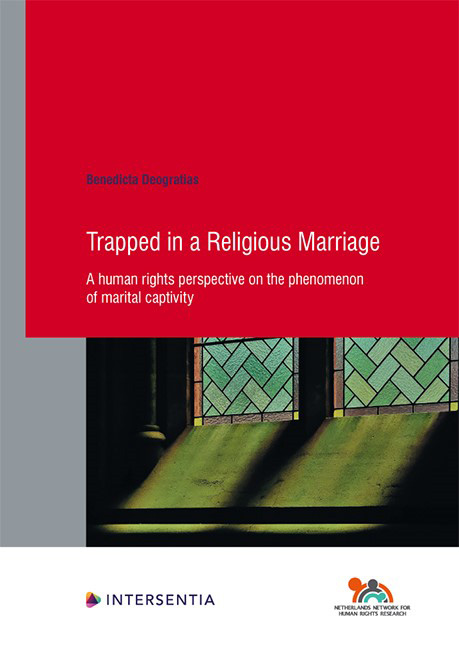
    This book offers a human rights perspective of the phenomenon of marital captivity within Christian, Jewish, Hindu and Muslim communities in both secular and non-secular States. Marital captivity is a complex social phenomenon that, predominantly, affects women. It involves a situation wherein the dissolution of a religious and/or legal marriage is obscured for religious reasons, consequently forcing the spouse(s) to remain in the marriage against their will. It involves multiple stakeholders (i.e. the trapped spouse, the opposing or recalcitrant spouse, the religious communities and one or more States). Within situations of marital captivity, all involved stakeholders have rights and interests which are often in conflict with one another. Unfortunately, holistic and effective solutions to end existing situations of marital captivity and prevent new situations from arising have yet to be developed. The human rights discourse advanced in this book shows that a human rights centred approach is imperative for the process of finding effective solutions to end marital captivity. Applying the human rights legal framework enables to objectively consider, balance and resolve the conflicting rights and interests inherent within situations of marital captivity. It also reveals how a select number of human rights and principles are affected within situations of marital captivity and offers an overview of States' positive obligations to protect and ensure these rights. The implied human rights obligations are discussed within the context of marital captivity so as to identify and formulate specific States' obligations to address marital captivity. This enables the author to produce guidelines for legal and non-legal measures that States should consider adopting in their efforts to combat marital captivity and to comply with their human rights obligations.

    Refine List

    Actions for selected content:

    Select all | Deselect all
    • View selected items
    • Export citations
    • Download PDF (zip)
    • Save to Kindle
    • Save to Dropbox
    • Save to Google Drive

    Save Search

    You can save your searches here and later view and run them again in "My saved searches".

    Please provide a title, maximum of 40 characters.
    ×

    Contents

    Metrics

    Full text views

    Total number of HTML views: 0
    Total number of PDF views: 0 *
    Loading metrics...

    Book summary page views

    Total views: 0 *
    Loading metrics...

    * Views captured on Cambridge Core between #date#. This data will be updated every 24 hours.

    Usage data cannot currently be displayed.

    Accessibility standard: Unknown

    Why this information is here

    This section outlines the accessibility features of this content - including support for screen readers, full keyboard navigation and high-contrast display options. This may not be relevant for you.

    Accessibility Information

    Accessibility compliance for the PDF of this book is currently unknown and may be updated in the future.
