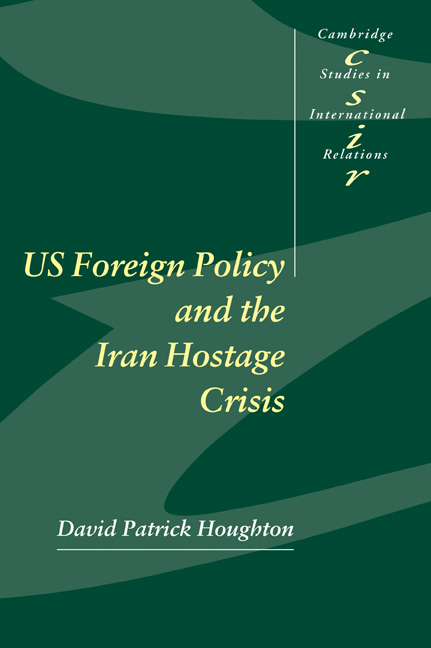
US Foreign Policy and the Iran Hostage Crisis

-
Select format
-
- Publisher:
- Cambridge University Press
- Publication date:
- 22 September 2009
- 21 May 2001
- ISBN:
- 9780511491399
- 9780521801164
- 9780521805094
- Dimensions:
- (228 x 152 mm)
- Weight & Pages:
- 0.543kg, 270 Pages
- Dimensions:
- (228 x 152 mm)
- Weight & Pages:
- 0.435kg, 272 Pages
You may already have access via personal or institutional login
Show more authors 
You may already have access via personal or institutional login
Book description
Why did a handful of Iranian students seize the American embassy in Tehran in November 1979? Why did most members of the US government initially believe that the incident would be over quickly? Why did the Carter administration then decide to launch a rescue mission, and why did it fail so spectacularly? US Foreign Policy and the Iran Hostage Crisis examines these puzzles and others, using an analogical reasoning approach to decision-making, a theoretical perspective which highlights the role played by historical analogies in the genesis of foreign policy decisions. Using interviews with key decision-makers on both sides, Houghton provides an analysis of one of the United States' greatest foreign policy disasters, the events of which continue to poison relations between the two states. The book will be of interest to students and scholars of foreign policy analysis and international relations.
Reviews
"Houghton has produced an excellent, in-depth study of the Iranian hostage crisis, making outstanding use of new material about policy/decision makers' perceptions...A superb book." CHOICE
"...the book provides a clear account of the analogical reasoning model and uses available sources well to provide an interesting description of the deliberations in the Carter administration surrounding the Iranian hostage crisis." Political Science Quarterly
"Well-organized and well-written, Houghton provides a clear and persuasive understanding of the Iran hostage crisis and the important role of cognitive-analogical reasoning." International Politics
"...Houghton has written an intersting and thought-provoking book on an important subject that raises a number of compelling questions for future research." American Political Science Review
Contents
Contents
Metrics
Altmetric attention score
Full text views
Full text views helpTotal number of HTML views: 0
Total number of PDF views: 0 *
 Loading metrics...
* Views captured on Cambridge Core between #date#. This data will be updated every 24 hours.
Usage data cannot currently be displayed.
Accessibility standard: Unknown
Why this information is here
This section outlines the accessibility features of this content - including support for screen readers, full keyboard navigation and high-contrast display options. This may not be relevant for you.
Accessibility Information
Accessibility compliance for the PDF of this book is currently unknown and may be updated in the future.