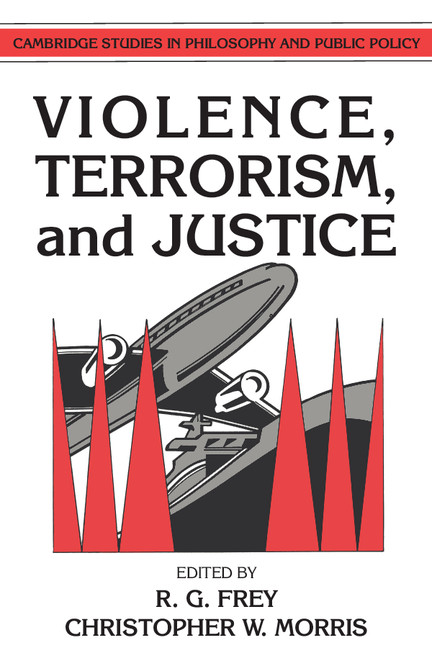
Violence, Terrorism, and Justice

-
Select format
-
- Publisher:
- Cambridge University Press
- Publication date:
- 05 June 2012
- 30 August 1991
- ISBN:
- 9780511625039
- 9780521409506
- Dimensions:
- Weight & Pages:
- Dimensions:
- (228 x 152 mm)
- Weight & Pages:
- 0.503kg, 332 Pages
You may already have access via personal or institutional login
Show more authors 
You may already have access via personal or institutional login
Book description
In this volume a group of distinguished moral and social thinkers address the urgent problem of terrorism. The essays define terrorism, discuss whether the assessment of terrorist violence should be based on its consequences (beneficial or otherwise), and explore what means may be used to combat those who use violence without justification. Among other questions raised by the volume are: what does it mean for a people to be innocent of the acts of their government? Might there not be some justification in terrorists targeting certain victims but not others? Might terrorist acts be attributed to groups or to states?
Reviews
"This book merits careful reading by anyone concerned with determining the moral foundations for the use of force. Not only will the reader be provoked to weigh a number of issues about state terrorism otherwise preempted by 'group think' pressures, but reconsideration of popular beliefs about appropriate responses to insurgent violence will also be found in order." Robert S. Ashmore, ASQ
Contents
Contents
Metrics
Altmetric attention score
Full text views
Full text views helpTotal number of HTML views: 0
Total number of PDF views: 0 *
 Loading metrics...
* Views captured on Cambridge Core between #date#. This data will be updated every 24 hours.
Usage data cannot currently be displayed.
Accessibility standard: Unknown
Why this information is here
This section outlines the accessibility features of this content - including support for screen readers, full keyboard navigation and high-contrast display options. This may not be relevant for you.
Accessibility Information
Accessibility compliance for the PDF of this book is currently unknown and may be updated in the future.