Vital Accounts

-
Select format
-
- Publisher:
- Cambridge University Press
- Publication date:
- 15 October 2009
- 16 September 2002
- ISBN:
- 9780511550041
- 9780521803748
- 9780521101233
- Dimensions:
- (228 x 152 mm)
- Weight & Pages:
- 0.528kg, 270 Pages
- Dimensions:
- (229 x 152 mm)
- Weight & Pages:
- 0.43kg, 272 Pages
You may already have access via personal or institutional login
Show more authors 
You may already have access via personal or institutional login
Book description
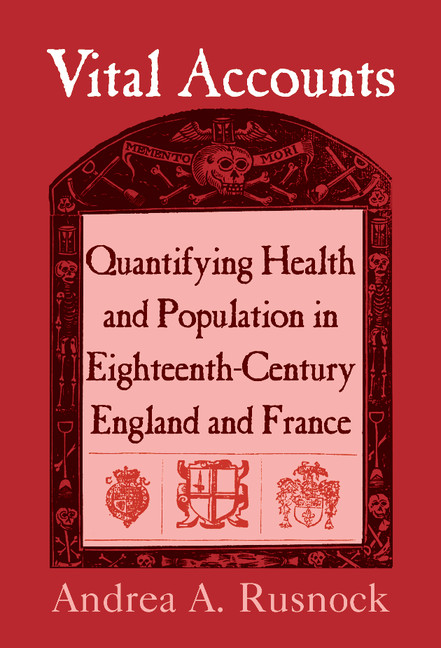
Why did Europeans begin to count births and deaths? How did they collect the numbers and what did they do with them? Through a compelling comparative analysis, Vital Accounts charts the work of the physicians, clergymen and government officials who crafted the sciences of political and medical arithmetic in England and France during the long eighteenth-century, before the emergence of statistics and regular government censuses. Andrea A. Rusnock presents a social history of quantification that highlights the development of numerical tables, influential and enduring scientific instruments designed to evaluate smallpox inoculation, to link weather and disease to compare infant and maternal mortality rates, to identify changes in disease patterns and to challenge prevailing views about the decline of European population. By focusing on the most important eighteenth century controversies over health and population, Rusnock shows how vital accounts - the numbers of births and deaths - became the measure of public health and welfare.
Reviews
"An excellent overview of a vital, though hitherto neglected , dimension of eighteenth-century history." The International History Review
"the wide range of issues raised by the author, and her ability to contextualize the complex web of interactions among science, institutions and social processes and to refute simplistic and essentialist views on 'the power of numbers', makes this a valuable contribution on the genesis of social statistics that any historian will benefit from reading." - Paul-Andre Rosental
"Rusnock's book will be of value to historians of medicine and quantification as well as to those interested in the sociology of knowledge and the history of sceince and its social context more generally. Of particular interest is her comparative focus, which allows the book to escape an oversimplified view that sees scientific innovations such as quantification succeeding largely because they were 'right'. The different trajectory of medical quantification in these two countires--so well described by Rusnock--is a powerful argument in favor of a more complex and multitextured explanation, one that can take into account the important differences in the communities of researchers who first used numbers to measure the health and vitality of populations." - Joshua Cole, University of Michigan
Contents
Contents
Metrics
Altmetric attention score
Full text views
Full text views helpTotal number of HTML views: 0
Total number of PDF views: 0 *
 Loading metrics...
* Views captured on Cambridge Core between #date#. This data will be updated every 24 hours.
Usage data cannot currently be displayed.
Accessibility standard: Unknown
Why this information is here
This section outlines the accessibility features of this content - including support for screen readers, full keyboard navigation and high-contrast display options. This may not be relevant for you.
Accessibility Information
Accessibility compliance for the PDF of this book is currently unknown and may be updated in the future.