White Chief, Black Lords

-
Select format
-
- Publisher:
- Boydell & Brewer
- Publication date:
- 09 May 2017
- 15 September 2010
- ISBN:
- 9781580467063
- 9781580463416
- Dimensions:
- Weight & Pages:
- Dimensions:
- Weight & Pages:
You may already have access via personal or institutional login- Subjects:
- Area Studies, African Studies, History, African History
Show more authors 
You may already have access via personal or institutional login
Book description
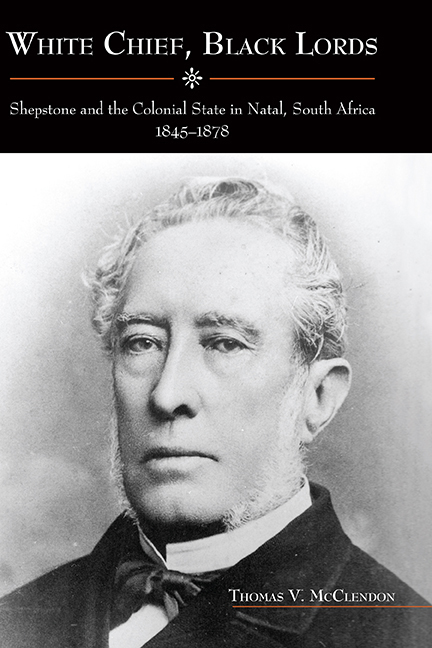
White Chief, Black Lords explores the tensions and contradictions between the British colonial civilizing mission and the practice of indirect rule. While the colonial imperative was to transform colonized societies and bring them within "civilized" norms, fiscal limitations frequently resulted in ruling through indigenous authorities and customs. In this book, Thomas McClendon analyzes this deep contradiction by looking at several crises and key turning points in the early decades of colonial rule in the British colony of Natal, later part of South Africa. He focuses a keen eye on the tenure of Theophilus Shepstone as that colony's Secretary for Native affairs, examining his interactions with subject African communities.
In a series of case studies, including high drama over rebellions by African "chiefs" and their followers and intense debates over the control of witchcraft, White Chief, Black Lords shows that these colonial imperatives led to a self-defeating conundrum. In the process of attempting to rule through African leaders and norms yet to discipline and transform African subjects, the colonial state inevitably was itself transformed and became, in part, an African state. McClendon concludes by spotlighting the continuing importance of these unresolved contradictions in post-apartheid South Africa.
Thomas McClendon is Professor of History at Southwestern University in Georgetown, Texas.
Contents
Contents
Metrics
Full text views
Full text views helpTotal number of HTML views: 0
Total number of PDF views: 0 *
 Loading metrics...
* Views captured on Cambridge Core between #date#. This data will be updated every 24 hours.
Usage data cannot currently be displayed.
Accessibility standard: Unknown
Why this information is here
This section outlines the accessibility features of this content - including support for screen readers, full keyboard navigation and high-contrast display options. This may not be relevant for you.
Accessibility Information
Accessibility compliance for the PDF of this book is currently unknown and may be updated in the future.