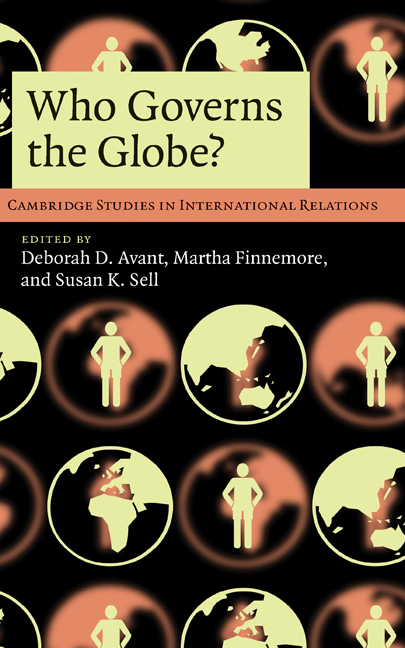
Who Governs the Globe?

-
Select format
-
- Publisher:
- Cambridge University Press
- Publication date:
- 05 June 2012
- 03 June 2010
- ISBN:
- 9780511845369
- 9780521198912
- 9780521122016
- Dimensions:
- (228 x 152 mm)
- Weight & Pages:
- 0.84kg, 456 Pages
- Dimensions:
- (228 x 152 mm)
- Weight & Pages:
- 0.73kg, 456 Pages
You may already have access via personal or institutional login
Show more authors 
You may already have access via personal or institutional login
Book description
Academics and policymakers frequently discuss global governance but they treat governance as a structure or process, rarely considering who actually does the governing. This volume focuses on the agents of global governance: 'global governors'. The global policy arena is filled with a wide variety of actors such as international organizations, corporations, professional associations, and advocacy groups, all seeking to 'govern' activity surrounding their issues of concern. Who Governs the Globe? lays out a theoretical framework for understanding and investigating governors in world politics. It then applies this framework to various governors and policy arenas, including arms control, human rights, economic development, and global education. Edited by three of the world's leading international relations scholars, this is an important contribution that will be useful for courses, as well as for researchers in international studies and international organizations.
Reviews
‘This path-breaking collaborative work illuminates complex social and political relationships that constitute governing authority in a changing world. New questions provoke deeper reflection than the term ‘global governance’ typically stimulates. Specialists need to read this fine book, and so do students.’
Louis W. Pauly - Canada Research Chair in Globalization and Governance, University of Toronto
‘This volume makes and illustrates an important fact about global governance today: it isn’t only or always the institutional form of actors - be they states, corporations, or NGOs - but their relationships with key constituencies and with one another that shape governance outcomes. Authority, the essence of governance, comes in many guises. I recommend this book highly.’
John Gerard Ruggie - Harvard University
Contents
Contents
Metrics
Altmetric attention score
Full text views
Full text views helpTotal number of HTML views: 0
Total number of PDF views: 0 *
 Loading metrics...
* Views captured on Cambridge Core between #date#. This data will be updated every 24 hours.
Usage data cannot currently be displayed.
Accessibility standard: Unknown
Why this information is here
This section outlines the accessibility features of this content - including support for screen readers, full keyboard navigation and high-contrast display options. This may not be relevant for you.
Accessibility Information
Accessibility compliance for the PDF of this book is currently unknown and may be updated in the future.