“Your Country should be your Temple. God at the summit; a People of equals at the base. Accept no other formula, no other moral law, if you do not want to dishonor both your Country and yourselves.”
“Fascism became, like Mazzini’s Giovane Italia, the faith of all Italians who disdained the past and longed for renewal.”
“The Fascist conception of life is a religious one, in which man is viewed in his immanent relation to a higher law, endowed with an objective will transcending the individual and raising him to conscious membership of a spiritual society. Those who perceive nothing beyond opportunistic considerations in the religious policy of the Fascist regime fail to realize that Fascism is not only a system of government but also and above all a system of thought.”
“Without clearly delimited faith, religiosity with its unclarity and multiplicity of form would […] be worthless for human […] By helping to raise man above the level of bestial vegetation, faith contributes in reality to the securing and safeguarding of his existence.”
“The Legion is more than a political organization (in the best sense of the word), for us Romanians, it is a Religion (if we could use that word to give it the necessary connotation of holiness). Who baptizes himself [in that religion] builds brotherhood ties with us, abandons the old life of politics and strives to strengthen himself in faith for becoming a proselytizer and a conqueror of humans.”
“Just as the Crusaders were imbued with the same faith, just as Marco d’Aviano preached here before Vienna ‘God wills it’ – so too do we look with strong confidence toward the future, in the conviction: God wills it!”
Introduction: Palingenesis and Fascism – A Historiographical Overview
Since the emergence of fascism, roughly a century ago, the intellectual roots of its ideology have been a matter of intense debate. Various scholars trace the origins of this radical ideology back to the Enlightenment period, to the cataclysm of the French Revolution and its aftermath (1789–1815), to the long nineteenth century – from the Romantic age to the intellectual ferment of the turn of the twentieth century – or to the upheaval of the Great War (Mosse Reference Mosse1961a; Reference Mosse1961b; Reference Mosse1964; Stern Reference Stern1974; Sternhell et al., Reference Sternhell, Sznajder and Ashéri1994). This exercise is not simply a matter of intellectual curiosity. Uncovering the roots of fascism illuminates its intellectual filiations and genealogies, but it is also key to understanding the nature of fascism and its relation to nationalism, religion, violence, and political modernity, in general.
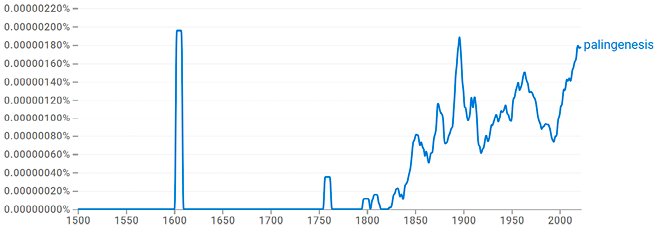
This Element approaches the intellectual origins of fascism from an apparently surprising and unfamiliar perspective: the multiple intellectual genealogies of the concept of palingenesis. It aims to advance a novel framework for studying the relationship among theories of social palingenesis in the eighteenth century, messianic nationalism in the Romantic period, and interwar and postwar fascism. Palingenesis, meaning renaissance, resurrection, or regeneration, originates from the composite Greek word παλιγγενισία (palingénésïa, action of rebirth), made up of πάλιν meaning “again” and γένεσι meaning “birth” or “creation” (English “palingenesis” or “palingenesia”; Latin: “palingenesia”; French: “palingénésie; Italian: palingenesi; German: “palingenese”; Romanian: palingenezӑ). It has a long and complex history, spanning from the Stoics to early Christianity, to white magic, alchemy, and science in the early modern period, to redemptive politics in the modern period. Coined by the Hellenistic Philosophical School of the Stoics in the third century BC, the concept was later embraced by early Christian writers. Long confined to theological studies, palingenetic thinking was revived in the seventeenth century, mainly in the context of alchemy. In the eighteenth and nineteenth centuries, palingenesis was employed in various disciplines, most notably in theology, philosophy, biology, and politics, as part of novel visions of rebirth and regeneration. These discourses culminated in the doctrine of social palingenesis, first formulated in the eighteenth century by the Swiss philosopher and scientist Charles Bonnet (1720–1793) in La Palingénésie philosophique (1769/70) and continued by the French philosopher Pierre-Simon Ballanche (1776–1847) in Essais de palingénésie sociale (2 vols., 1827–1829; also Reference Ballanche1833). After the French Revolution, the doctrine of social palingenesis was incorporated into a variety of modern political ideologies, resulting in Romantic, liberal, conservative, fascist, and socialist palingenetic doctrines of the regeneration of the body politic, in vogue since 1900 but reaching its heyday in the 1920s and 1930s (Figure 1).
Google Ngram: The frequency of the word palingenesis in books published in English, 1500 to 2022 (Google Books database). The trajectory points to an early modern spike around 1600, followed by renewed intensive use starting around 1750, with a peak around 1900 and two other upward trends in 1920–1945 and in the last decades.
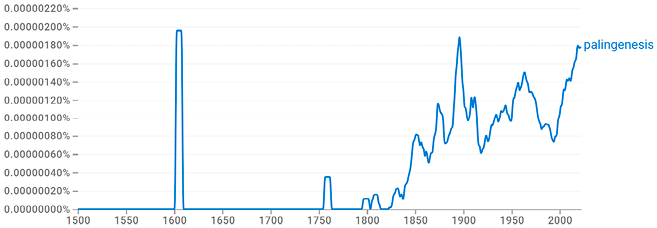
Although widely used in the early modern period and in the eighteenth and nineteenth centuries, palingenesis has fallen out of use in colloquial speech and political vocabulary after WWII, prompting some scholars to argue that the concept is now obsolete in English.Footnote 1 In the last decades, however, palingenesis has been at the forefront of new culturalist approaches to fascism. Breaking away from the dominant Stalinist dogma that viewed fascism as an anti-proletarian dictatorship of the grand capital, the new culturalist turn aimed “at taking fascism seriously” by studying it “from the inside out,” yet without rehabilitating it (Mosse Reference Mosse2000: L, x, 95, 112). George Mosse’s pioneering research agenda departed from the prevailing social history approaches to fascism. Arguing that “[c]lass analysis … cannot really capture the essence of fascism” (Reference Mosse2000: x). He proposed a cultural interpretation, seeking “to penetrate the fascist self-understanding.” His view of the fascist culture transcended the worldview proposed by political ideologies and referred to “life seen as a whole – a totality” (xi). Mosse highlighted that fascism was built on the “bedrock” of nationalism, defined as a “collective self-understanding through a belief system” (xi). The essence of the new style of politics was the aestheticization of politics, “the force which linked myths, symbols, and the feeling of the masses.” On this basis, he defined fascism as a revolutionary movement of change aiming at “a forceful reordering of society in the light of a projected utopia” (xii). Although Mosse did not employ the concept of palingenesis, he underscored that “[i]deas of regeneration, of sacrifice, and a vision of utopia were the staples of all of fascism, as was the need to triumph over ever-present enemies” (Mosse Reference Mosse2000: xv). He also argued that fascism had the propensity to become a civic religion, one based on “heightened nationalism” but also on racism with “scientific pretensions” Reference Mosse2000: xv).
The analytical core of the new culturalist approach to fascism is a new generic definition of the “fascist ideological minimum,” as a form of “palingenetic ultra-nationalism” (Griffin Reference Griffin1993: 38–39). The concept of palingenesis was introduced in fascist studies by Italian authors, first as a key term in fascist political discourses, and then as a central analytical category for defining the nature of fascist ideology. The Italian scholar Emilio Gentile played a pivotal role in bringing palingenesis to the forefront of fascist studies. In numerous works spanning several decades, Gentile developed an innovative theoretical framework based on the conceptual triad of totalitarianism, the sacralization of politics, and political religions (Reference Gentile1990; Reference Gentile1996; Reference 88Gentile2000; Reference Gentile2004; Reference Gentile2005a; Reference Gentile2005b). Gentile defines totalitarianism as a regime that:
“seeks the subordination, integration and homogenization of the governed based on the integral politicization of existence, whether collective or individual, interpreted according to the categories, the myths and the values of a palingenetic ideology, institutionalized in the form of a political religion, that aims to shape the individual and the masses through an anthropological revolution to regenerate the human being and create the new man [.].”
This perspective inspired the British historian Roger Griffin, who further elevated the concept of palingenesis from a mere characteristic of fascist discourse to a key feature of fascism’s “generic ideological core” (Reference Griffin1993: 13). Arguing that “the time is ripe in the social sciences for a new theory of the fascist minimum,” (13) Griffin posited that “[f]ascism is a genus of political ideology whose mythic core in its various permutations is a palingenetic form of populist ultra-nationalism” (32, 44). Griffin’s succinct definition of generic fascism, centered on the palingenetic myth of rebirth, has dynamized fascist studies. Following Griffin, the concept of palingenesis has become the foundation of a so-called “new consensus” in fascism studies (Griffin Reference Griffin2002a; Reference Griffin2002b). An impressive number of studies have documented the “palingenetic mythical core” of fascism, validating the concept’s importance for studying fascism and neofascism, as well as other totalitarian ideologies, such as communism. However, it is surprising that, despite its centrality, the history, genealogy, meanings, and analytical implications of this concept have never been the subject of rigorous scholarly scrutiny and remain fuzzy. It is telling in this respect that scholars of fascism refer to palingenesis as either an ideology, a doctrine, a myth, or simply a narrative or rhetorical style; some use the concept as a mere synonym for notions of “rebirth and regeneration” and emphasize its positive, redemptive side, while others see it as part of a larger, apocalyptic view of politics and also look at its dark, destructive side.Footnote 2 Overall, however, while palingenesis has become a buzzword in recent scholarship on fascism, it is not entirely clear what its meaning, role, and impact are in authoritarian modernist redemptive projects, in general, and in fascist salvific projects, in particular.
This Element proposes a new perspective on the palingenetic core of fascism, arguing that it provides the foundation for a new understanding of fascism as a political faith. To substantiate this claim, it explores the multiple intellectual genealogies of the Fascist palingenetic historical ideology of national salvation through sacrifice and violent cleansing. My approach builds on the aforementioned culture-oriented works that assert the core of fascist ideology was the palingenetic myth of the regeneration of the nation, best epitomized by Griffin’s definition of generic fascism. However, to enhance our understanding of the sacred components of nationalism in general and of fascism as a political faith in particular, I depart from Griffin’s use of the term palingenesis in several important ways.
First, although Griffin is well aware of the etymology and history of the term palingenesis, he picked it up not from original Romantic sources but from present-day Italian scholars of fascism, and he pays minimal attention to the concept’s original discursive context.Footnote 3 In contrast to Griffin, I do not examine fascist palingenetic visions in a vacuum, but locate them in time and space by linking them to pan-European Romantic theories of palingenesis and embedding them in their historical context. This is not merely an exercise in erudition; this Element reveals how the concept’s deep historical roots and legacy shaped fascist iterations of this myth.
Second, in constructing an ideal-typical analytical model of fascism, Griffin employs palingenesis metaphorically, thereby reducing it to the myth of regeneration as a universal archetype of human thought. In contrast, my approach distinguishes between generic ideas of regeneration and more complex, mystical, and often occult, Romantic palingenetic ideologies. By situating the fascist ideology within a concrete, long-term tradition of palingenetic thinking centered on salvation through the expiation of sins, I am able to unpack both the culturally specific forms taken by the palingenetic myth in various fascist movements and regimes and the complex constellation of adjacent, supporting myths that give it substance and coherence. I argue that the central myth of rebirth that defines fascism’s ultimate telos does not operate in isolation; this core but rather generic myth is supported by a vast symbiotic ‘ecosystem’ of nested myths that reinforce it and make it politically ‘concrete,’ such as the dogma of the original sin, providentialism and divine election, charismatic leadership, the idea of purification through expiation and violent sacrifice, the myth of Judeo-Bolshevik conspiracy, and the myth of final resurrection.Footnote 4 Long dismissed as bizarre or eccentric oddities in fascist ideology, these associate elements of the palingenetic myth are reassessed, in my approach, as integral to broader visions of the fascist revolution.
Third, although Griffin accepts that “the most obvious well-head of palingenetic myth in the wider sense is religion,” his approach is based on the premise that the fascist “secular palingenetic myth” does not originate from religious sources but it “is simply the expression of an archetype of the human mythopoeic faculty in secular form” (Reference Griffin1993: 33). In disagreement over this point, I argue that fascism inherited from Romantic thinkers a new conception of the “sacred,” one that can be documented through intellectual genealogies and affinities with theories of social palingenesis. More precisely, interwar fascist ideology was the heir to theological discourse on social palingenesis, which advocated collective regeneration through violent sacrifice, grounded in the reconceptualization of central themes of Christian dogma, such as the biblical metaphor of seed germination, or in analogous motifs in other religious traditions.
My challenging proposition is that Griffin’s pathbreaking approach is not just a culmination of a new research trend in studies of fascism, but also a new beginning, since it brings to the fore a plethora of pressing and still under-researched questions, such as: How were palingenetic ideologies of national regeneration articulated in different historical contexts? What were their specific sources and content? What was the relation between fascist palingenesis and earlier notions of palingenesis? How were rebirth and regeneration conceived of in fascist palingenetic visions? What role did violence play in these terrifying scenarios of salvation through cleansing? What was the relationship between fascist palingenesis and established religions? What was the impact of palingenetic ideologies of national regeneration on modern politics? To answer these questions, we need a plethora of theoretically and comparatively minded studies that examine the genealogy of this concept in various religious traditions and historical contexts at the global level.
To fill the glaring gaps in existing accounts of the genealogy of fascism as a palingenetic political faith, this Element revisits fascism’s origins by examining its matrix of thought. I argue that fascism has its roots in eighteenth-century social palingenesis, nineteenth-century Romantic national messianism, and social Darwinism and antisemitism, which largely developed from the second half of the nineteenth century to the outbreak of WWI. This approach fine-tunes the definition of fascism, not as simply ultranationalism, differentiated from more “benign” forms of nationalism only in terms of its violence and extremism, but as messianic nationalism. The Element documents multiple ways by which the rich and European-wide tradition of social palingenesis, centered on the myth of rebirth or regeneration of society, was reactivated in a more radical key in interwar Europe, stimulated by the sweeping mutations brought about by the upheaval of the Great War, the dissolution of multinational empires, and the waning of traditional authority. I see fascism as part of the great proliferation of “new faiths” in interwar Europe, many of them derivatives from traditional religions, such as art, escapist travel, socialism, and various forms of politicized myths and utopian visions (Ziolkowski Reference Ziolkowski2007: ix). I deliberately opt for “faith” over “religion” because this concept was amply used by fascists themselves (see “fede” in Italian, “politischen Glauben” in German, and “credinţӑ” in Romanian), and because I contest that fascism was a full-fledged religion, but a hybrid category, in-between traditional ideologies and established religions. While claiming key attributes of a religion, including the promise of salvation, their own messiah, an ethical code of behavior, and a pantheon of saints, heroes, and martyrs, political faiths are less elaborated than established religions but display an ad hoc, peculiar blending of political and religious elements. More importantly, they pledge earthly redemption rather than the transcendental, otherworldly salvation typically offered by traditional religions. In approaching fascism as a political faith, the Element explores novel ways to re-enchant politics through religious-like mechanisms and techniques of sacralization, focusing on the palingenetic myth of rebirth. Moreover, while current interpretations focus primarily on positive forms of regenerations of the self through spiritual rebirth, I point out that fascists imbued social palingenesis with a renewed radicalism by advocating new forms of dark palingenesis through violent cleansing, culminating in the Holocaust.
My approach to fascism is interdisciplinary, with an emphasis on sociocultural methodologies; integrative, clustering concepts that have been analyzed separately, such as social palingenesis, messianic nationalism, charisma, totalitarianism, and political religions; and comparative and transnational, with a focus on the history of transfers and entanglements among fascist movements and regimes. I also strive to “de-Westernize” the approach to the intellectual origins of fascism, moving away from the exclusive concentration on Germany and Italy to highlight other synchronic laboratories of radical politics, situated both within and outside Europe. The Element underscores the fact that, although the doctrine of social palingenesis first emerged in Western Europe, mainly as Catholic discourses arguing for a radical reformation of society originating outside the Catholic Church, it was influential in Central and Eastern Europe, as well as beyond them, inspiring discourses on regeneration in Catholic, Protestant, and Eastern Orthodox countries.
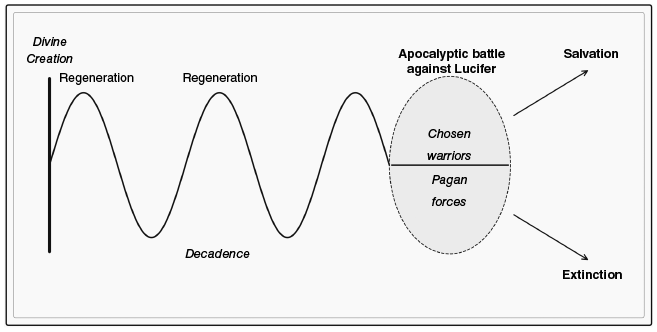
I define fascism as a revolutionary political faith, a form of charismatic nationalism aimed at the salvation and redemption of the patriarchal national community in this world. Fascist salvation was understood as the fulfillment of the national character through a return to the nation’s mythical origins, achieved through the charismatic leader’s terrestrial action and the paramilitary movement he organized. Fascists argued that this type of salvation can be achieved through a concerted set of actions at four interrelated levels: individual, collective, statal, and international. It entailed: (1) the rebirth and regeneration of the self through new forms of socialization based on a new ethical code of conduct meant to craft the new man, (2) the ethnic, racial, or religious purification of the nation through the removal of the unwanted “others,” (3) the reorganization of the state along totalitarian and corporatist lines, and (4) the emancipation of the status of the respective people in international affairs through an apocalyptic battle against archenemies. This definition differs from other definitions in the field in its claim that fascism is a salvific political faith, a theology of liberation centered on the myth of salvation from decadence; in the key importance assigned to the role played by the charismatic leader in forging the fascist community of sacrifice and in bringing salvation to the national community; and in its emphasis on the religious “technologies of the self” incorporated in the fascist “revolution of the self” meant to craft the new man through a sacrificial pedagogy.
This Element aims to unpack the concept of palingenesis – as the core of the fascist salvific faith – and a sum of key concepts that have been part of its semantic net, by pointing out the multiple ways in which these associated concepts have been articulated, understood, and translated into practice through rites, rituals, institutions, and violent actions. Methodologically, the Element approaches palingenesis from the perspective of the German school of Begriffsgeschichte (Koselleck Reference Koselleck1985, Reference Koselleck1988, Reference Koselleck2002; Richter Reference Richter1990), an approach that is surprisingly rare in studies of fascism. I argue that the history of palingenesis should be studied not merely etymologically or from the prism of the history of ideas, but as a basic concept – a dynamic, contested, yet “inescapable” term that structures political, social, and cultural experiences over time. As Reinhart Koselleck points out, historical concepts, as carriers of the social–political context, have a heuristic analytical utility that can “provide knowledge which is not obtainable from empirical study” (Reference Koselleck1985: 84). The Element explores both the “representational aspect” of the concept of palingenesis, examining its long and complex history and the semantic fields associated with it in various historical eras, as well as the “referential aspect,” considering its semantic changes and the sociopolitical contexts in which it was employed (on this distinction, see Ifversen Reference Ifversen2011: 70–76). My approach and main argument open a rich research agenda that can be pursued in various national contexts, as well as at the European and global levels.
Organization of the Element
The Element is organized into several interrelated parts. Following this critical incursion into the trajectory of the concept of palingenesis in fascism historiography, Section 1 provides a brief overview of antic and medieval approaches to rebirth and regeneration, with a focus on alchemy and the occult. Section 2 reviews pan-European Romantic ideas of regeneration, underscoring the reconceptualization of central religious themes in palingenetic theories of society and politics. It also illuminates the deep connection between the social doctrine of palingenesis and the emergence of revolutionary nationalism, as exemplified by the pan-European 1848 revolution and liberal plans for a united, democratic Europe. Section 3 examines the emergence of fascism following the Great War and documents fascist visions of palingenesis, encompassing individual, collective, and national rebirth. The analysis highlights the emergence of multiple laboratories of radicalization, including the Franco-Italian’ complex of ideas, the rise of national socialism in Germany and Austria, as well as other Central European cases, most notably Hungary, Romania, and interwar Yugoslavia. Section 4 focuses on the dark aspect of fascist palingenesis: projects of regeneration through violent cleansing. In Conclusions, I underscore the importance of studying the palingenetic dimension of fascism, its connection to religion and Romantic nationalism, and its violent nature. On this basis, I suggest more general conclusions about the relationship between palingenesis, religion, the sacralization of politics, and the current resurgence of neofascism worldwide.
1 Palingenesis: On the Genealogy of a Contested Concept
From Stoics and Alchemy to Social Palingenesis
Myths of rebirth (to a new existence or life phase) and/or regeneration (as the restoration or revitalization of an existing entity) in various individual, collective, geological, or temporal forms constitute a fundamental archetype of human thought, with an extraordinarily long and rich tradition across diverse religions and cultures. To illustrate this richness, the historian of religions Mircea Eliade noted the vast repertoire of rites, rituals, and beliefs focused on the “regeneration of time,” elaborated by various civilizations. An overwhelming number of cultures exhibit “new year” ceremonies of regeneration involving death and resurrection, leading to the restoration of “mythical and primordial time” through “a new birth, a new man” (Reference Eliade1959: 54):
At this point let us note that the beliefs, held almost everywhere, according to which the dead return to their families (and often return as ‘living dead’) at the New Year season (during the twelve days between Christmas and Epiphany) signify the hope that the abolition of time is possible at this mythical moment, in which the world is destroyed and re-created. The dead can come back now, for all barriers between the dead and the living are broken (is not primordial chaos reactualized?), and they will come back because at this paradoxical instant, time will be suspended, hence they can again be contemporaries of the living.
Although new anthropological research has disputed the universal character of regeneration ideas (Apffel-Marglin Reference Apffel-Marglin2005), it is evident that such scenarios and ritual practices are among the most widespread human traditions. In the Western world, a peculiar tradition of thinking of rebirth and regeneration is represented by theories of palingenesis. Given its long, rich, and variegated history, a systematic genealogy of this concept requires an exploration of ancient philosophy, cosmology, and religious studies. The concept of palingenesis is generally traced back to the Hellenistic Philosophical School of the Stoics, founded in the early third century BC on the Stoa Poikile of Athens by a Phoenician merchant, Zeno of Citium (c. 320–c. 250 BC). The doctrine of Stoicism became highly influential in the Roman Empire, particularly in Roman Greece, attracting adherents from diverse backgrounds, including enslaved people, scholars like Seneca and Epictetus, and even Roman Emperors such as Marcus Aurelius. As part of their complex worldview, combining insights from logic, monistic physics, and naturalistic ethics, Stoics used the concept of palingenesis in connection to their apocalyptic theory of eschatological destruction and renewal to denote the continual re-creation of the universe by the Creator.Footnote 5 Numerous prominent thinkers engaged with the concept of palingenesis, such as Philo, who spoke of a renovation or rebirth of the earth, Plutarch, who discussed the transmigration of souls, and Cicero (Frick Reference Frick1999; “Palingenesis” 2011: 634).
Although the Stoic Philosophical School was denounced as “pagan” by influential early Christian theologians, bishops, and writers (the so-called “Fathers of the Church”) and ultimately closed down in 529 AD by Emperor Justinian I, certain Stoic philosophical and cosmogonic concepts, among which that of palingenesis, were adapted to Christian theology.Footnote 6 Notably, the Greek translation of the New Testament employs palingenesia (παλιγγενεσία) twice to describe the regeneration of the world in connection with the Last Judgement (Matthew 19:28; Titus 3:3-5 KJV). The Gospel of Matthew attributes the following words to Jesus Christ to describe the Last Judgment preceding the regeneration of a new, divine world: “Truly I tell you, at the renewal of all things, when the Son of Man sits on his glorious throne, you who have followed me will also sit on twelve thrones, judging the twelve tribes of Israel.” (Matthew 19:28–30)
It should be noted that English translations of the Bible do not employ the word palingenesis but use various equivalents to stand for the act of Christian palingenesis, such as “at the renewal of all things,” “in the regeneration,” “in the renewal of all things,” “in the new world,” or “when the world is made new.”Footnote 7
The adoption of the concept of palingenesis had important long-term consequences for Christian theology. Emulating the biblical tradition, the idea of resurrection through palingenesis became a recurring theme in Christian theological treatises and teachings on the resurrection of the dead (Moreschini Reference Moreschini2018). In his first letter to the Christian community in Corinth, Apostle Paul compares the process of resurrection to the planting of a seed, emphasizing the divine agency in the transformation of the human body and the necessity of death for resurrection to occur:
But someone will ask, ‘How are the dead raised? With what kind of body will they come?’ How foolish! What you sow does not come to life unless it dies. When you sow, you do not plant the body that will be, but just a seed, perhaps of wheat or of something else. But God gives it a body as he has determined, and to each kind of seed he gives its own body.
In Christian theology, palingenesis was used to refer either to metempsychosis, the doctrine that the soul passes through a succession of rebirths, or to Christian spiritual rebirth symbolized by baptism (Baldwin Reference Baldwin1902: 254). For example, in his commentary on the thirteenth treatise of the Corpus Hermeticum, “On Palingenesis,” François Foix-Candale (1512–1594), the Catholic bishop of Ayre, interprets the hermetic palingenesis as a precursor of the Christian doctrine of rebirth and uses this argument against the Protestants (Moreschini Reference Moreschini2018: 68). He claims that, initially obtained through baptism but subsequently lost by the believer, this form of regeneration can be regained through the sacrament of the Eucharist and Communion with the body of Jesus Christ, who has saved us through “purification leading to regeneration, or baptism” (75, 72). Nevertheless, as Eliade notes, the adoption of palingenesis generated an underlying tension between the cyclical time of palingenesis, inherited from antiquity, on the one hand, and the linear time of the Christian Redemption, oriented toward salvation, which has the birth of Chris as a central axis and the Resurrection of humanity as finality, on the other:
But despite the reaction of the orthodox Fathers, the theories of cycles and of astral influences on human destiny and historical events were accepted, at least in part, by other Fathers and ecclesiastical writers, such as Clement of Alexandria, Minucius Felix, Arnobius, and Theodoret. The conflict between these two fundamental conceptions of time and history continued into the seventeenth century.
This tension continued to shape ‘Western’ notions of progress and eschatology in the modern period as well.
Alchemy, Palingenesis, and the Occult
Palingenetic thinking was also integral to the rich tradition of alchemy. Although at first sight this “pseudo-science” seems remote from fascism, I argue that alchemy was instrumental in perpetuating and amplifying palingenetic thinking and in further linking it with Christian theology and occultism. I also contend that the revival of occultist alchemy in the nineteenth century had a direct impact on the emergence of fascism, in general, and of National Socialism, in particular.
Alchemy is generally defined as “the art of liberating parts of the Cosmos from temporal existence and achieving perfection which, for metals, is gold, and for man, longevity, then immortality and, finally, redemption” (H. J. Sheppard, in Pereira Reference Pereira and Craig1998). The theory and practice of alchemy have a long and multifaceted history on several continents, drawing on disparate philosophical and religious traditions, from China and Taoism to India and the Dharmic religions (Hinduism, Buddhism, Jainism, and Sikhism), Egypt, and the Osiris cult, and the Arabic-Muslim world. European alchemy has its roots in the Greek philosophy of the Hellenistic period, particularly in Neoplatonism, supplemented by Arabic influences transmitted through Spain and the broader Mediterranean world.
In the medieval and early modern periods, alchemy developed in Western Europe as a branch of natural philosophy. It was later influenced by emerging mystical movements, such as Christian Kabbalah and Rosicrucianism. According to Holmyard, “there appears to have been no knowledge of alchemy in the West until it was introduced from Islam, a process beginning in the twelfth century” (Reference Holmyard1957: 102). Consequently, in the twelfth and thirteenth centuries, Western medieval alchemy relied heavily on the translations of Arabic treatises. The Dominican friar Albertus Magnus (c. 1200–1280) and Franciscan friar Roger Bacon (c. 1219–1292) played an important role in transferring and synthesizing the Arabic alchemical knowledge while also couching it in Aristotelian philosophy and the science of metals (Holmyard Reference Holmyard1957: 102–119; Brehm Reference Brehm1976; Witzel Reference Witzel1912; Pereira Reference Pereira and Craig1998). These translations and the rediscovery of Aristotelian philosophy generated a plethora of works on alchemy, so that, by the end of the thirteenth century, one could identify a comprehensive alchemical system of belief and practices, with its own visual and textual vocabulary, comprising cryptic ciphers and symbolism (Holmyard, Reference Holmyard1957: 149–160).
As a sacred “ars mechanica,” alchemy was based on both theory and practice. Practical alchemy was rooted in craftsmanship – especially in archaic metallurgy and its connection to religious rites – but also in goldsmithing, dyeing, and pharmacology. Alchemists tended to work in secrecy, in hidden laboratories, where they experimented with chemicals and theorized the way the universe operated. Their main aim was to purify and perfect certain “base” metals into “noble” ones (e.g., lead into gold through chrysopoeia or gold-making) (Pereira Reference Pereira and Craig1998). However, the alchemists were not only concerned with the natural world. In line with the macrocosm-microcosm theories of Hermes and the theory of the four elements (de Castilho Reference 86De Castilho2021), alchemists believed that the transmutation processes affecting minerals also affect the vegetal realm and the human body. They strove to discover an elixir of immortality, panaceas able to cure any disease, and, ultimately, the philosopher’s stone, allegedly leading to the perfection of the human body and soul through the laborious process known as the “magnum opus” or the “Great Work” (Pereira Reference Pereira and Craig1998). As an occult science, alchemy thus had a magical component. Its goals were religious as well as worldly; its techniques of self-purification and salvation were not simply laboratory experiments but concomitantly religious or mystical experiences, operating with religious categories such as the “pure” and the “impure,” leading to the “opposed states of pollution and purification” (Vikers Reference Vickers and Vickers1984: 32). In Western medieval philosophy, the religious-philosophical speculations that emerged as part of alchemy gave rise to a theory of matter, advanced by Albertus Magnus and Roger Bacon, and further developed by Paracelsus and the Rosicrucians (Pereira Reference Pereira and Craig1998). Their alchemical theories developed in close relation but also tension with Christianity. Bacon, for example, linked alchemy not only to natural philosophy, astrology, and soteriology but also to Christian theology (Reference Bacon and Bridges1897). His work employed key Christian concepts such as morality, salvation, and the prolongation of life into the theory of alchemy, thus linking “the alchemical process that produces the elixir of life to the soteriological path that leads through Christian morality to eternal salvation” (Brehms Reference Brehm1976). Bacon’s theory had a strong, if temporary, influence on the papacy (Clulee Reference Clulee and Vickers1984: 57–72). Alchemy’s confluence with Christian theology continued in the fourteenth century, when authors such as Petrus Bonus, John of Rupescissa, Raymond Lull, and Arnold of Villanova employed Christian imagery of death and resurrection in alchemical treatises (deVun Reference deVun2009: 104). Their alchemical philosophy propagated the belief that, by purifying – through “chemical marriage” – the two parts of man’s soul that were divided within himself after the fall of Adam, man could be reunited with God (Burckhardt Reference Burckhardt1967: 149–156).
During the Renaissance, alchemy flourished further, bifurcating into distinct medical, pharmaceutical, occult, and entrepreneurial branches. Alchemists also restored alchemy’s ancient, hermetic, platonic, and Pythagorean foundations, all central to Renaissance thought. This trend is exemplified by the establishment, in 1462, of the Platonic Academy of Florence by Cosimo de Medici, modeled on its antique counterpart (Hankins Reference Hankins1991; Kristeller Reference Kristeller1961). Ficino translated the first fourteen treaties of the Corpus Hermeticum and the works of Plato from Greek into Latin (Ficino Reference Ficino2023 [1471]). Humanism and Neoplatonism prompted alchemists to shift their focus from physics to humanity, viewing humankind as the primary “alchemical vessel.” In addition, new esoteric systems fused alchemy with magic, astrology, and Christian Kabbalah, resulting in occult hermeticism, as seen in De Occulta Philosophia, by Heinrich Cornelius Agrippa (1486–1535) (Magee Reference Magee2008: 30–33; Goodrick-Clarke Reference Goodrick-Clarke2008: 55–60). In Monas Hieroglyphica (1564), the astrologer and cryptographer John Dee (1527–1608) further emulated Agrippa’s occult tradition, portraying alchemy as a form of terrestrial astronomy and a “branch of natural magic,” linking it to angel summoning and divination (Clulee Reference Clulee, Newman and Grafton2001: 174, 177). In contrast, the influential Paracelsus (1493–1541) rejected Agrippa’s occultism and pioneered a “alchemically oriented theosophy”; further developed by the Protestant theologian and mystic Jacob Böhme, this branch was to have a strong influence on Western esoterism, especially the hermetic Naturphilosophie of German Romanticism (Hanegraaff Reference Hanegraaff, Kripal and Shuck2005: 30–31).
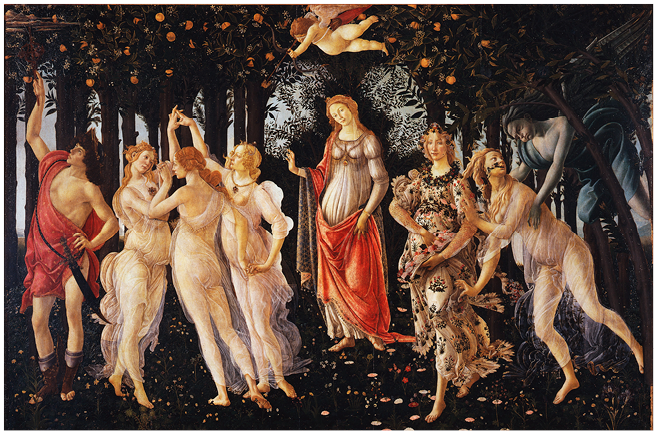
Palingenesis was a key concept in alchemical theories (Marx Reference Marx1973; Debus Reference Debus1973; Secret Reference Secret1979). Many alchemists asserted the similarities between the mineral, vegetal, and animal realms, focusing on the rebirth or “palingenesis” of plants or even animals, in line with the myth of the Phoenix bird (Marx Reference Marx1973: 284). In alchemy, “palingenesis” or “palingenesia” thus came to denote a “curious chemical doctrine” (Reference Marx1973: 275), specifically “the re-formation of plants, flowers, snakes, etc., from their ashes, usually by warming or cooling” (Williamson Reference Williamson1972: 304; for an example, see Browne Reference 85Browne1643) (Figure 2).
Primavera (The Spring), by Sandro Botticelli (cc. 1470–1480), Uffizi Gallery, Florence. Although the meaning of this painting is a matter of scholarly debate, its content clearly illustrates the centrality of the metaphor of the Spring in Renaissance views of rebirth, in line with Neoplatonic philosophy.
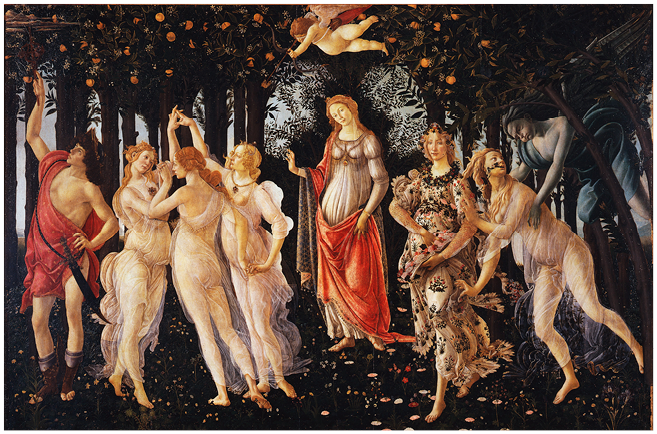
Figure 2 Long description
Primavera by Sandro Botticelli. The picture shows a lush orange grove filled with mythological figures from classical antiquity. At the center stands Venus, calm and slightly elevated, framed by arching branches. Above her, her son Cupid hovers blindfolded, aiming an arrow downward. On the right, the blue-skinned wind god Zephyrus chases the nymph Chloris, who transforms into Flora, scattering blossoms across the meadow. On the left, the Three Graces dance in a circle with flowing transparent garments, while Mercury stands at the far left, raising his staff to part the clouds. The scene is filled with delicate flowers, patterned fabrics, and soft, graceful gestures, creating a dreamlike celebration of spring and fertility.
Overall, although alchemist theories were informed by Christian theology and, arguably, pursued the same stated end goal – the salvation of humankind through its reunion with God – they were nevertheless heterogeneous constructions, combining pagan philosophies with Kabbalah and Christian teachings and thus diverging from mainstream Christian theology. No wonder, therefore, that alchemists faced recurrent accusations of blasphemy and were closely monitored and persecuted by the Inquisition. The practice of traditional alchemy declined in the eighteenth century, making room for the rise of modern chemistry and medicine (Eliade Reference Eliade1978: 9). Nevertheless, alchemy survived underground and was revived as an occult science in the early nineteenth century (Principe & Newman Reference Principe, Newman, Newman and Grafton2001: 387). The new esoteric or occultist school of the nineteenth century presented an advanced spiritual interpretation of alchemy as an art of spiritual Enlightenment or illumination, achieved through the self-transformation of the practitioner rather than the external world (Principe, Newman Reference Principe, Newman, Newman and Grafton2001: 388, 391). Since, from this new perspective, “the alchemical vessel is man himself” (Principe & Newman Reference Principe, Newman, Newman and Grafton2001: 391), new treaties offered allegorical guides to spiritual, moral, or mystical processes of inner transformation of the self, paving the way to twentieth-century ideological visions of crafting the New Man through inner transformation. Mary Anne Atwood and Ethan Allen Hitchcock’s esoteric views of alchemy were to influence authors of the occult revival such as Eliphas Levi, Arthur Edward Waite, and Rudolf Steiner (Principe & Newman Reference Principe, Newman, Newman and Grafton2001: 388, 391), the last one with a direct impact on the culture of interwar fascism.
Alchemy’s theory and practice of purification through destruction inspired fascist visions of national and anthropological regeneration against alleged decadence. The solutions proposed by these radical redemptive projects echo the mythic-alchemical archetype of transformation through ordeal; fascist ideologues appropriated esoteric and alchemical symbols, rites, and rituals, such as purification, hidden knowledge, and initiation, specific to warrior male societies (on these, see Eliade Reference Eliade1978: esp. 97–108), to construct their myths of racial superiority and rebirth. It can be argued that the “New Man” in fascism, set to become – through struggle and sacrifice – “agile as a greyhound, tough as leather, and hard as Krupp steel” (Hitler Reference Hitler1944: 399), mirrors the alchemical transmutation of base matter into “spiritual gold,” viewing destruction as a path to rebirth through purification. Incidentally, Eliade himself helped articulate this connection in his own youth writings and activism within the Legion “Archangel Michael.” Analogously, Julius Evola, the leading figure behind the “feared”Footnote 8 interwar esoteric-initiatic circle Gruppo di Ur, publishing the magazines UR (1927–1928), and KRUR (1929), and later a key neofascist ideologue, further radicalized the ideas advanced by René Guénon in Crisis of the Modern World [1927], explicitly linking hermetic–alchemical transformation to inner rebirth leading to the creation of the New Man (1931). He reinterpreted the hermetical–alchemical tradition as a “royal” rather than sacred and sacerdotal “art” (Ars Regis), a “real,” “concrete and ontological” science, offering “a practical and workable wisdom” as well as “the most direct and legitimate link to the unique, primordial Tradition” (1995a [Reference Evola1931]: xv, xvi–xvii). Evola also argued that, as a metaphysical process of regeneration, alchemy could be instrumental in crafting a new type of spiritual aristocracy capable of leading hierarchical societies (1995b [Reference Evola1934]; on alchemy and Fascism, see Eco (Reference Eco1995); for a literary critique of Evola’s “‘authoritarian” alchemy, leading to “occult” or “metaphysical” Fascism, see Eco Reference Eco1990).
2 A New Forma Mentis: Social Palingenesis and Romantic Nationalism
Palingenetic doctrines had a substantial impact on National Romanticism, pleading for the radical transformation of society. Combining deism and pantheism with the idolatry of the people (Schenk Reference 94Schenk1969: 121), Romantic thinkers merged religious faith, theological worldviews, and historical mindedness in original syntheses. As Anthony Smith points out, ethnic mythologies typically encompass ideas of regeneration and rebirth in various forms (Reference Smith1988: 192). Through Romantic “prophets of the nation” and “apostles of regeneration,” central themes of the palingenetic discourses on reforming society permeated national ideologies, serving as a potential foundation for radical ideologies in the twentieth century, such as fascism.
The Israeli historian Jacob Talmon argued that political Messianism originated in the French Revolution. He distinguished between two main ideological trends: liberal and totalitarian messianic democracies (Reference Talmon1952; Reference Talmon1960; Reference Talmon1979). Concerning the latter trend, he further differentiated between the “totalitarianism of the right,” based on glorifying the collective entity of the state, the nation, or the race, which culminated in fascism, and the “totalitarianism of the left,” which proclaimed the perfectibility of human nature and culminated in communism (Reference Talmon1952: 6–7). The conflict between the “empirical and liberal democracy” and “totalitarian Messianic democracy” has come to dominate modern politics (Reference Talmon1952: 1).
The evolution of the totalitarianism of the right unfolded in several stages: eighteenth-century (primarily French) political thought; national messianism in the first half of the nineteenth century; and exclusive, integral nationalism in the interwar era. Talmon documents the way totalitarian messianism “hardened into an exclusive doctrine represented by a vanguard of the enlightened, who justified themselves in the use of coercion against those who refused to be free and virtuous” (Reference Talmon1952: 5). In his view, political messianism “postulates a preordained, harmonious and perfect scheme of things, to which men are irresistibly driven” (Reference Talmon1952: 2). In doing so, “it widens the scope of politics to embrace the whole of human existence.” For the proponents of totalitarian democracy, politics is “the art of applying this philosophy to the organization of society” (Reference Talmon1952: 3).
My approach builds on Talmon’s claim that the matrix of the totalitarian attitude – and thus implicitly, of fascism – “was contained in the original and general eighteenth-century pattern of thought” (Reference Talmon1960: 3). To understand this, we need to grasp the implications of viewing fascism as a form of revolutionary nationalism. While this assertion seems to be commonplace, most scholars treat fascism as a new political ideology born in the interwar period, artificially separating it from its prewar roots. In line with Moses, I argue that we need to reconsider the “bedrock” of nationalism as a belief system and approach it from a long-term perspective. Following also Smith’s framework on ethnonational symbolism, my goal is to uncover the sacred roots of nationalism. I aim, nevertheless, to take Smith’s approach a step further by bridging his view on nationalism as a political religion with the literature on fascism as a totalitarian political religion (faith, in my understanding).
To understand nationalism as a political faith, we need to first account for the emergence of “revolutionary nationalism.” James H. Billington noted that revolutionary nationalism was “invented” by exile Francophone intellectuals from Poland and Italy, who waged violent guerrilla wars of national liberation (Reference Billington1980). The new form of nationalism spread primarily in societies that did not break with traditional forms of religious and political authority; in authoritarian Catholic countries, such as France, Italy, or Poland; and religious autocracies, like Lutheran Prussia or Orthodox Russia (Reference Billington1980: 5). The main innovations of revolutionary nationalism did not only consist of the birth of revolutionary language, symbols, and rituals but also in the creation of a new “matrix of politics,” expressed through “mythical histories, vernacular poetry, operatic melodrama” (Reference Billington1980: 4). This matrix of thoughts was first evident in Romantic palingenesis, which represented “secularized nineteenth century versions of the old Judeo-Christian belief in deliverance-through-history” (Reference Billington1980: 8).
In the first half of the nineteenth century, the concept of a special mission for the elect nation, combined with eschatological visions of universal salvation, gave rise to Romantic national messianism. In line with Andrej Walicki, I understand national messianism as the belief in a “unique, incomparable, messianic mission” of the nation as a divine category, “bringing about the universal salvation of mankind” (Reference Walicki1978: 1). The appropriation of the central religious category of salvation by political messianism accounts for its complex relation to established religions. From the French Revolution in 1789 to the pan-European Revolutions of 1848, messianic nationalism was disseminated across Europe and adapted to varying national contexts. Its evolution was studied mainly in Western Europe, with French social utopianism and German conservative romantics such as Franz von Baader, Friedrich Schlegel, and Adam Müller as primary case studies, and only to a lesser extent in Eastern Europe (Pekacz Reference Pekacz1995; Duncan Reference Duncan2000). Walicki explored the emergence of Polish national messianism and its entanglements with the French and Russian sociopolitical thought. To these, I add the case of the Romanian Principalities, situated in Southeastern Europe and building on Christian Orthodox traditions.
From Natural to Social Palingenesis
Theories of palingenesis and its associated concept, metempsychosis, were intensely revisited during the Romantic period. The resurgence of interest in palingenesis was fueled by new scientific discoveries, particularly in geology. These scientific “revelations” shook old-age temporal certainties and prompted novel perspectives on the world’s history, leading to new ideas about the ideal organization of society and enabling new spiritual and even religious horizons. To comprehend the evolution of ideas about regeneration and their transition from theological to scientific discourses, and then into broader societal debates on both the natural and social worlds, it is necessary to explore the intellectual lineages of Romantic theories of palingenesis.
The concept of palingenesis was introduced in modern science by Bonnet, with the dual sense of rebirth and regeneration (Reference Bonnet1769–1770). In La Palingénésie philosophique, Bonnet elaborated a developmental philosophy based on the idea of a series of resurrections caused by the successive unfolding of the “germes de restitution” (germs of restitution) called palingenesis (McCalla Reference McCalla1994: 423). To explain how the “nature” of living beings is passed down through generations, Bonnet advocated the preformationist idea of emboitement (encasement), which held that a being’s essence is contained in a “germ of restitution.” This transmission was not static but was subject to evolution: to account for progress, the preformationist explanation was supplemented by the theory of palingenesis, meaning rebirth and regeneration within a preformationist structure (Reference McCalla1994: 422). Bonnet argued that the Earth is periodically struck by global disasters, as a result of which most organisms die while the survivors progress to new heights through successive acts of rebirth.
Remarkably, although Bonnet offered a naturalistic explanation of resurrection, his theory of palingenesis was based on a “Christian anthropology.” First, in arguing that the locus of the soul lies in the “germ of restitution,” Bonnet emulated St. Paul’s metaphor of the seed in discussing the resurrection, reformulating it into scientific language (McCalla Reference McCalla1994: 423). Second, in Bonnet’s understanding, natural evolution was not a reaction to external environmental stimuli, as Darwin would later argue, but unfolded according to a providential master plan of “revolutions of the globe,” coordinated by the Creator himself. Third, inspired by the theology of revelation and resurrection, his theory of palingenesis regarded expiation and suffering as central to the divine scenario of unfolding progress. Writing at a time when theological and scientific discourses were part of a unified worldview, and being a deeply religious spirit himself, Bonnet reconceptualized Christianity in the language of biological preformationism. Bonnet’s “philosophical palingenesis” can thus be classified as a “scientific ideology,” since it employed an explanatory system specific to theology and applied it to the natural world (Reference McCalla1994: 429).
Bonnet’s theory of catastrophic change, asserting a “periodic rebirth of the entire natural world,” became very popular among the educated elites, since it “resonated with a generation raised on catastrophe” (Sharp Reference Sharp2004: 359). Spurred by the perception of social crisis and moral void in the aftermath of the French Revolution, notions of “regeneration” or “palingenesis” found their way into debates on society and the fate of humanity, acquiring fresh significance, denoting “rebirth in all its physical, moral, and, in particular, political forms” (de Baecque Reference De Baecque1993: 165). These concepts served as key “building blocks” for new forms of political discourse, promoting the ideal of the “New Man” (Ozouf Reference Ozouf, Furet and Ozouf1989: 790). Modeled on the behavioral pattern of imitatio Christi, the creation of the new man was conceived as a “second rebirth” and couched in theological vocabulary (Reference Ozouf, Furet and Ozouf1989: 783). At a time when society was “obsessed” with the idea of a radical break with the past, palingenesis became a key sociopolitical concept, a genuine forma mentis of new discourses on society.
Bonnet’s palingenetic theory of natural evolution as a progressive development of a preformed essence was further developed by Ballanche in Essais de palingénésie sociale. Written at a time of vast proliferation of Romantic metaphysical philosophies of history (McCalla Reference McCalla1994: 432), this work elaborated a highly influential theology of historical progress, expressing historical consciousness through Bonnet’s concept of palingenesis. Ballanche adopted all significant elements of Bonnet’s theological theory of natural palingenesis, such as the idea of preformationism of the human essence; the expiation of sins as to how the action of palingenesis or rebirth operates; the central role played by crisis in bringing about evolution by spiritual rehabilitation; and theodical concerns (Reference McCalla1994: 439). Yet, in a major innovation, Ballanche transplanted the theory of philosophical palingenesis from natural sciences to historical explanation, using “palingenesis” to refer to the progress of society through the successive rehabilitation of social institutions (437; on Ballanche’s early ideas on societal transformation, see Reference Ballanche1818). For Ballanche, progress was the result of acts of spiritual rehabilitation aimed at overcoming the original Fall, which occurred during ages of “crisis and renewal.” These redemptive acts required human cooperation, as only humans – unlike animals or nature – can assume their inner transformation. The key action leading to spiritual rehabilitation was the expiation of sins. Suffering, for Ballanche, was the way to overcome Fall and to emancipate humankind. In applying this theological explanatory system to the history of humanity, based on theodicy, Ballanche produced a historical ideology, “an explanatory system applied to human history but derived, via Bonnet, from theology” (439).
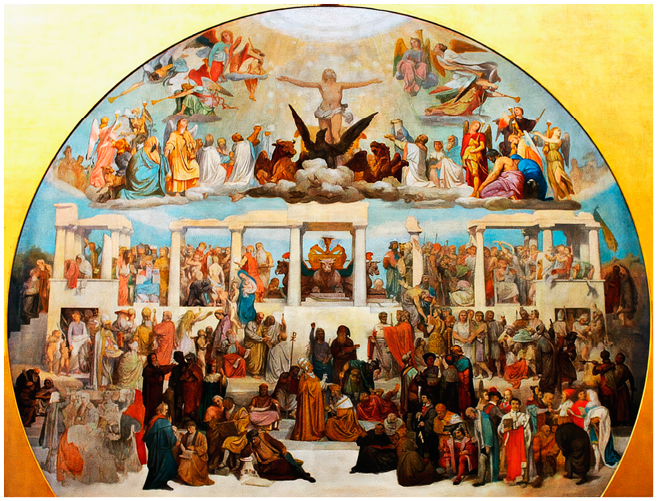
Disseminated by Ballanche and further expanded by Pierre Leroux and Jean Reynaud, historical ideologies grounded in theories of palingenesis became highly influential in the first half of the nineteenth century, shaping theories of social change in philosophy, political thought, literature, and music (Monti Reference Monti1809; Rapisardi Reference Rapisardi1868). In literature, palingenetic thinking shaped the early French Romantic movement, its representatives advancing “a version of Ballanchian palingenetic social progress” (McCalla, in Artes Reference Artes2010; Williams Reference Williams2001). In painting, palingenesis was given its most comprehensive visual representation by the Lyonnaise painter Paul Marc Joseph Chenavard. “A chief painter” of the Second Republic, on April 11, 1848, Chenavard received a commission from the Minister of Interior, Ledru-Rollin, to decorate the interior of the Church of Sainte-Geneviève, Paris, transformed since 1791 into the “Panthéon dedicated to Great Men” (Grünewald Reference Grünewald1981). The cycle was meant to set the Panthéon on par with other emblematic European monuments such as Westminster Abbey or Walhalla, while also transforming it into a “Temple of Mankind,” rivaling St. Peter’s Basilica in Rome (Sloane Reference Sloane1951: 240–258; Reference Sloane1955: 285–299). Inspired by the philosophy of Hegel and Ballanche, who also originated from Lyon, Chenavard’s cycle illustrates the new trend of “philosophic art” (Reference Sloane1955: 285–299). Chenavard intended to cover the walls of the Panthéon with immense paintings depicting the history of mankind from the Biblical Flood to Napoleon, representing main stages in palingenesis, described as “the progress of Mankind into the future through trials and tribulations and a cycle of ruin and rebirth.” Téophile Gautier summarized the central role assigned to the Panthéon as “the temple of Reason,” at a time when humanity is “launching itself towards the new future opened to it by modern inventions” and “the face of civilizations is going to be renewed.”Footnote 9
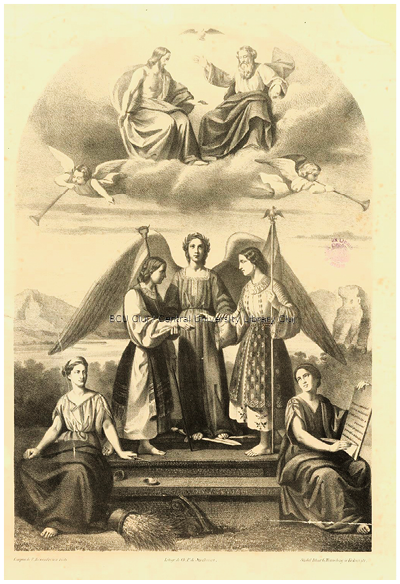
Figure 3 displays Chenavard’s preparatory work for the main mosaic, beneath the central cupola, entitled “Social Palingenesis,” following Ballanche. The monumental composition, featuring over 150 characters and symbols, was to be “the largest work of its kind carried out under the direction of one man in the entire history of western art” (Sloane Reference Sloane1955: 293). Following Vico’s cyclical vision of human history and Ballanche’s catastrophism, Chenavard advanced a palingenetic philosophy of history based on a genuine “theory of decadence.” From a pessimistic perspective, he represented humanity’s downward trend (marche descendante) toward catastrophe as a prelude to its second rebirth.Footnote 10
Paul Marc Joseph Chenavard, “Social Palingenesis,” Musée des Beaux Arts de Lyon.
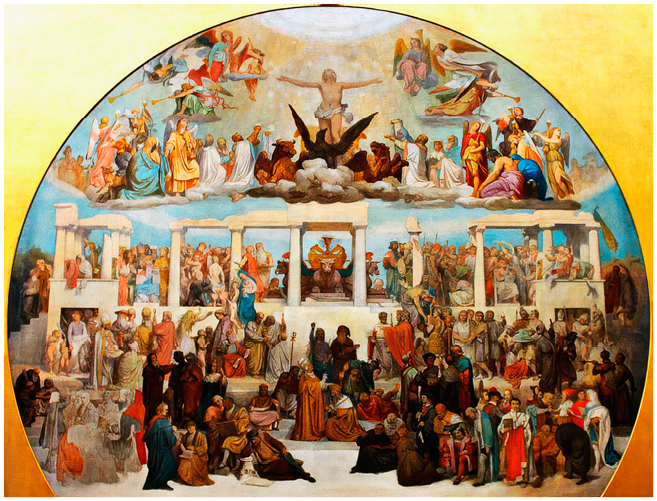
Figure 3 Long description
“Social Palingenesis” by Paul Marc Joseph Chenavard depicts a large allegorical gathering of human figures arranged across a broad, open landscape. Groups of men, women, and children appear in varied poses, some standing, others seated or kneeling, spread across terraces and steps that lead toward a luminous central area. At the center, a tall female figure stands upright, surrounded by people who turn toward her or gather nearby. Around her, clusters of figures interact in small groups: some converse, some embrace, and others gesture upward or outward. In the foreground, several reclining or resting figures lie on the ground, while others rise or move forward. The figures wear a mixture of classical drapery and simple garments, their pale forms contrasting with the darker earth tones of the landscape. The background opens toward a distant horizon and bright sky, bathing the scene in diffuse light and giving the composition a sense of breadth and calm expansiveness.
Historical ideologies based on palingenesis gained significant influence in politics and profoundly shaped theories of social change (Sharp Reference Sharp2004). They were advanced by an astonishing variety of thinkers, ranging from liberal or Catholic orientations, such as Louis de Bonald, Joseph de Maistre, François-René de Chateaubriand, and Félicité Robert de Lamennais, to pre-Marxist Christian socialists, such as Henry de Saint Simon and Charles Fourier, and republican socialist philosophers such as Leroux and Reynaud (Guchet Reference 89Guchet2004). Ideas of palingenetic social transformation were further developed and applied to the realm of politics by François Guizot, Émile de Girardin, and Marc Girardin. These thinkers aimed to devise the most suitable social structures that would facilitate a return to the pre-Fall human essence.
The most influential philosopher and preacher of the new mysticism in politics was Louis Claude de Saint-Martin. In Des Erreurs et de la Vérité (Reference Saint-Martin1775), Saint-Martin defined the Revolution as Christianity applied to politics and envisioned a natural and spiritual theocratic society. The book became highly influential, with numerous “Martinist” societies founded to study its doctrine and its applications to politics: “Liberty, Equality, Fraternity” – the sacred Ternary of the Martinists – served as a leading slogan of the French Revolution.
Religion, Palingenesis, and Metempsychosis
Ever since their emergence, palingenetic ideas have had a complex relationship with the doctrines and practices of established churches and religious traditions, in general, and with Christianity in particular. This relation was even more intricate in the Romantic period. Discourses on palingenesis – such as that articulated by Saint-Martin – were not expressions of “secularization” but part of an intricate religious revival following the French Revolution, accompanied by a transformation in the understanding of religion.
McCalla documents the sharp debates over religion among three major rival political-ideological blocs, the Idéologues, Catholic Traditionalists, and Liberals, that unfolded in French politics from the establishment of the Directory in 1794 to the July Revolution in 1830, a formative period that gave birth to “intellectual modernity” (Reference McCalla2023). He argues that, far from being overshadowed by discourses on “reason,” religion was at the heart of societal debates over “revelation,” “reason,” “religious transcendence,” “history,” and church-state relations, so that “[t]o theorize about religion in the post-revolutionary period was simultaneously to theorize about epistemology, history, society, and politics” (Reference McCalla2023: 5).
Traditionalist Catholic thinkers displayed a complex and ambivalent relation to Christianity and the Catholic Church. To cure their avowed spiritual crisis, the “malaise of the soul,” Romantics appealed to religion. They pleaded for the transformation of society through the cultural and spiritual emancipation of the masses and their moral regeneration based on Christian foundations (Schenk Reference 94Schenk1969: 85). As part of a widespread Catholic traditionalist reaction against the Enlightenment, Romantic writers reconceptualized the Christian doctrines of revelation, providence, theodicy, eschatology, and soteriology and redefined the category of the sacred (McCalla Reference McCalla1994: 27). In doing so, they departed from the official dogma of the Catholic Church and put forward anthropocentric forms of theology, emphasizing the emotional side of religion, the inevitable suffering inherent to the human condition, mysticism, ecumenism, religions reconciliation, and universal spirituality, often arguing for a return to “primitive Christianity.”
Unconventional versions of “transcendental Christianity” were accompanied by apocalyptic visions about the collapse of civilization and ideas about progress through metempsychosis,Footnote 11 referring to the immortality of the soul and its transmigration, at death, into another living creature (be it a human, animal, or even plant) or into an inanimate state. Metempsychosis has a long history, evolving as part of many systems of philosophic thought and religious beliefs, especially in India. In an Orientalist manner, the 1911 British Encyclopedia attributed the origins of palingenesis to “primitive cultures” and their “savage beliefs” (“Metempsychosis” 1911). It also assumed that the ideas of metempsychosis were first advanced by the “Orphic religion,” which originated in Thrace, on the “semi-barbarous” northeastern frontier of the Greek world. Its first proponents were the pre-Socratic philosophers, most notably the mythographer Pherecydes of Syros (sixth century BC) and his famous disciple, the Ionian philosopher and polymath Pythagoras of Samos (c. 570–c. 495 BC), who helped spread the Orphic doctrine of metempsychosis to the larger Greek world (Keith Reference Keith1909; Morrison Reference Morrison1956). Pythagoras’ ideas on metempsychosis influenced Pindar, Plato, and Aristotle (Cornelli Reference Cornelli2016; Bluck Reference Bluck1958).
Ideas of metempsychosis experienced a revival in seventeenth-century Europe. In “Metempsychosis,” the metaphysical poet John Donne writes that he “sing[s] of the progresse of a deathlesse soule” (Reference Donne1601: I). In Anatomy of Melancholy, Robert Burton pointed out that “the Pythagoreans defend Metempsychosis and Palingenesia, that souls go from one body to another, epotd prius Lethes undci, as men into wolves, bears, dogs, hogs, as they were inclined in their lives, or participated in conditions” (Reference Burton1628: 104). The books’ wide circulation popularized knowledge about metempsychosis and palingenesis.
Theories of metempsychosis reemerged in the 1820s and 1830s (Sharp Reference Sharp2004: 355–356). Romantics looked back to Plato and Pythagoras and to the theosophists of the eighteenth century but also revitalized ideas of metempsychosis from occult sources and “newly discovered” “oriental” religions, such as Buddhism, leading to an “oriental renaissance” (Clarke Reference Clarke1997) and applying them to the reformation and salvation of society. Further disseminated by Leroux and Reynaud’s Encyclopédie nouvelle (Reference Leroux and Reynaud1835–1841), ideas about metempsychosis became broadly accepted. Alphonse Esquiros, Eugène Sue, Gérard de Nerval, Charles Nodier, Alphonse de Lamartine, Eugène Sue, George Sand, Honoré de Balzac, Jules Michelet, and Victor Hugo, among others, expressed their belief in various forms of metempsychosis (Sharp Reference Sharp2004: 351). In the 1850s, these ideas ushered in a new spiritist movement as an alternative urban popular religion, situated outside of, and even in opposition to, French Catholicism, affirming belief in the supernatural while also upholding the values of liberalism and Republicanism (Sharp Reference Sharp1999; Reference Sharp2004: 377).
As Sharp argued, metempsychosis “was the key” to the Romantics’ search for a “new religion,” because it enabled them to “overcome the shortcomings of Christianity and yet provide moral and social guidance for a new society” (Reference Sharp2004: 365). A recurring theme in Romantic metempsychosis was the relationship between individuals and the collective. Although they paid great attention to the individual, the Romantics regarded metempsychosis as a form of social solidarity, envisioning the spiritual regeneration of the community rather than simply the individual (349–379). Overall, French Romantic “socialists and spiritists” challenged the dichotomy between secular reason and religion and articulated peculiar visions of a new spirituality based on reincarnation as a path to progress, often in close conversation with, but also in opposition to, the Catholic Church (Sharp Reference Sharp2006).
Given their unconventional nature, it is no surprise that palingenetic doctrines of social regeneration mainly developed outside established churches. While some of them had an impact on official Catholic dogma, most were condemned by the Church, as was the case with Bonnet’s “philosophical palingenesis” (McCalla Reference McCalla1994: 427).
Social Palingenesis, National Messianism, and the Romanticism of Charisma
French Romantic political thought had a profound impact on the emergence of national messianism throughout Europe and beyond. In the 1830s and 1840s, its messianic and millenarian tendencies ushered in a distinct trend of “revolutionary nationalism,” as reaction to authoritarian Catholicism (Billington Reference Billington1980: 4). It further extended as violent opposition to autocracies rooted in other Christian Confessions, in Lutheran Prussia, Orthodox Russia (Reference Billington1980: 4), and, I would add, the Orthodox Danubian Principalities. This new brand of nationalism was not nurtured by the Enlightenment rationalism but drew inspiration from the French political experience and republican ideology, as well as influences from occultism, German proto-romanticism, and pre-Christian antiquity, particularly the Pythagorean model of the “intellectual-turned-revolutionary” (Reference Billington1980: 3–4). Beyond France, exiled Francophile intellectuals from Poland and Italy played a pivotal role in internationalizing and spreading the new revolutionary faith. These “revolutionaries without power” crafted a belief system centered on “mythic histories, vernacular poetry, and operatic melodrama,” but they also invented “guerrilla violence and wars of national liberation” (Reference Billington1980: 4). However, the new revolutionary faith struggled to gain traction in predominantly Protestant regions that had developed a tradition of modern parliamentarism, such as Northern Europe and North America (Reference Billington1980: 5).
A first feature of the new “Promethean faith” was its palingenetic matrix of politics, based on the figure of Christ and imitatio Christi as a path to salvation through the expiation of sins. The prophets of the new faith regarded history as a “morality play” in the making (Billington Reference Billington1980: 8). They shared the belief “in an imminent, collective and terrestrial salvation, accomplished with the aid of supernatural divine agencies” (Walicki Reference Walicki1978: 2) through a future violent revolution that would overwrite the gloomy present, leading to the establishment of an earthly paradise. Their millennial expectation for the establishment of a perfect society was “a nineteenth-century version of the old Judeo-Christian belief in deliverance-through-history” as a restoration of a lost age. The second feature was the emphasis on the military as a primary instrument of regeneration. Thirdly, there was a commitment to historicism, the notion that the nation could achieve redemption within the course of history. The fourth aspect was the belief in the Providential Man, sent by God to redeem the nation. The idea of charismatic leadership had a prolonged incubation in modern politics. It was first expressed in the idea of collective charisma of the elect nation, intricately connected to national prophets. During the Romantic era, poets assumed the role of new prophets of the nation, followed in the interwar period by politicians who claimed a divine mission.
A fifth feature was the cult of saints, martyrs, and heroes dedicated to the national cause. National Romantics rejected the rationalism, utilitarianism, and individualism of the Enlightenment, replacing them with a national ethos centered on supreme duties, heroism, and self-sacrifice. The idea of a new covenant between God and the elect nation shaped messianic nationalism, inspiring their visions of transforming individuals and society. This transformation was not to be achieved through the church, which had traditionally held a monopoly on salvation, but through the agency and autonomous will of the chosen nation and its warriors. Messianic nationalists upheld the ideal of nation-states organized along ethnic lines, viewing them as the most modern, efficient, and legitimate God-given forms of organization – an apotheosis of human history. Messianic thinkers thus advocated the social and terrestrial salvation of humankind rather than religious salvation in the afterlife.
“Regeneration, Progress, a New Mission”: Giuseppe Mazzini, The Prophet of a New Salvific Faith
Outside the French context, a key figure of palingenetic discourses about the nation was Giuseppe Mazzini (1805–1872). One of the most influential political thinkers of the nineteenth century, Mazzini is unanimously regarded as a leading architect of Italian unification (Bonfiglio Reference Bonfiglio2021), known as Risorgimento (from risorgere “to rise again” or to “recalled to life”; also referred to as “regeneration,” see Patriarca Reference Patriarca2005: 381). Through his writings, speeches, and activism, Mazzini mobilized many Italians to join the struggle for national unification. His ideas on nationalism, democracy, republicanism, and ethical politics had a profound and lasting impact on European and global politics; his legacy was also invoked and reinterpreted by fascists in interwar Europe.
Much has been written about Mazzini’s political thought, his vision of international relations, his concept of the nation, the role of the arts and artists in politics, and his influence in Europe and beyond, mainly in the Americas and India (Bayly & Biagini Reference Bayly and Biagini2008). Less attention has, however, been paid to the core of Mazzini’s political thought, his palingenetic “religion of humanity.” In 1970, Frank J. Coppa highlighted the “religious basis” of Mazzini’s thought, centered on the idea of human regeneration. Coppa went as far as to call Mazzini not just “a unique figure in the nineteenth century,” but also an “architect of life” who put forward “a second Divine Comedy for Italians and all humanity,” “highlighting the path to national salvation” (Reference Coppa1970: 237–238). This line of thought was revived, more recently, by a new wave of scholarship that scrutinized Mazzini’s “political religion,” underscoring its impact on the birth of fascism. Riall called on researchers to approach the different aspects of Mazzini’s activities – as a journalist, head of a vast associational network, and political conspirator – as the expression of a unified political strategy (Reference Riall, Bayly and Biagini2008a). In a similar vein, Sullam explores “the nature of Mazzini’s nationalism by analyzing it as a ‘political religion’: a system of myths, symbols, and rituals that subordinates the collectivity to the supreme entity of the nation (in E. Gentile’s definition).” (Reference Sullam, Bayly and Biagini2008; see also Reference Sullam2015).
Influenced by his Jansenist upbringing and Christian socialism, most importantly by Saint Simon, Charles Fourier, and Lamennais (Faucci, Rancan Reference Faucci and Rancan2009), Mazzini believed that religion was the basis of life in human societies: “The religious element is universal and immortal: it binds men together in a universal brotherhood. Every great revolution is marked with its imprint and reveals it in its origin and aim” (Reference Mazzini1966: 174). Although grounded in the precepts of Christianity, Mazzini prophesied a peculiar type of salvific Christian faith, called Humanitarian Catholicism, as the basis of a revolutionary transfiguration of the world, a new moral palingenesis: “Heralds of a new world, we must find a moral unity, the Catholicism of Humanity” (Reference Mazzini1966: 174). For Mazzini, the new faith could only be based on a direct relationship with God:
God gave you life: God therefore gave you the law. God is the only Law-Giver to the human race. His law is the only law which you are obliged to obey. Human laws are only valid and good in so far as they conform to His law, explaining and applying it: they are bad whenever they contradict or disregard it; and it is then not only your right, but your duty, to disobey them and abolish them. He who best explains God’s law and applies it to human occasions is your legitimate head: love him and follow him. But you have not, and cannot have, any master but God, without being false and rebellious to Him.
Consequently, only “the paths of God and Humanity” could lead to salvation through spiritual rebirth and political emancipation (Reference Mazzini1966: 153). God’s precepts inspired the path to salvation: “We mutter by God’s inspiration the sublime words, regeneration, progress, a new mission, the future” (165). The main obstacle to achieving these divinely ordained goals was political degeneration due to loss of faith:
Yes; the peoples lack faith; not the individual faith, which makes martyrs, but the common, social faith, which gains victories; the faith which awakens the multitudes; that faith in their destiny, in their mission, in the mission of the Age, which illumines and rouses, prays and fights; which fearlessly advances along the paths of God and Humanity, bearing in its right hand the people’s sword, in its heart the people’s religion, in its soul the people’s future.
Consequently, “Your purpose should be a work of regeneration, of moral reform – for without this any political organization is barren,” argued Mazzini (168). The new faith of the age, first “preached by Lamennais, the high priest of the age,” was all-encompassing, but it did not fully reach the masses; therefore, it “should be translated by others in the terms of their own national life” (153).
The concept of collective regeneration, both national and universal, was central to Mazzini (Corner Reference Corner2012: 5–6, 13–22; Mannori Reference Mannori2018: 70, 75–76). He highlighted the importance of a shared national identity in fostering a sense of belonging and purpose: “Without Country, you have neither name, token, voice, nor rights, no admission as brothers into the fellowship of the Peoples. You are the bastards of Humanity” (53).
Mazzini’s concept of regeneration rested on ideas of spiritual and ethical rebirth, leading to the establishment of a democratic republic. He believed moral awakening was a prerequisite for political change. He also invoked the idea of a divine mission, arguing that Italy’s regeneration was part of a larger, providential redemptive plan: “Above and beyond the special mission which each of us is called to fulfill on earth, there is a common mission which embraces all Humanity” (149). Mazzini’s salvific faith was centered on the figure of the Savior:
He bent over the decaying world and murmured in its ear a word of faith. To that obscene thing which retained nought but the aspect and notions of a man, he uttered words unknown up to that day: love, self-sacrifice, celestial origin. The dead arose; a new life thrilled through that obscene thing which philosophy had tried in vain to bring to life. From it came forth the Christian world, the world of liberty and equality.
The path to salvation was therefore imitation Christi as a behavioral model: “we move encouraged by the holy promise of Jesus: we seek the new Gospel, of which He left us, He died, the immortal hope, and of which the Christian Gospel is the germ, as man is the germ of Humanity” (174). Mazzini issued a call for a new crusade:
Tomorrow, victory will crown your crusading banner. Onward in faith, and fear not. That which Christ did, Humanity can do. Believe, and you will conquer. Believe, and the peoples will end by following you. Believe, and act. Action is the Word of God …
Mazzini saw himself and the Republican Party as “Apostles of a faith which aims at construction” (146). The main elements of his campaign were “Preach! Fight! Act!” (150). He pleaded for a pan-European insurrection against monarchic rule: “Let the insurrection announce with its awful voice the decrees of God: let it clear and level the ground on which its own immortal structure shall be raised” (148).
In his political thought and activism, Mazzini advanced many innovations that came to define the modus operandi of the new type of revolutionary nationalism as a political faith. In 1831, he established “Young Italy” (Giovine Italia) as “an association of men holding the same faith,” namely, “to constitute Italy one free, independent, republican nation.” Conceived as “a brotherhood of Italians who believe in the law of Progress and Duty,” Young Italy was a clandestine organization that required total and perpetual allegiance. Each member took an oath of loyalty in the name of God, Italy, and “the martyrs of the Holy Italian cause,” pledging “to dedicate myself wholly and forever to the endeavor with them to constitute Italy one free, independent, republican nation.” The organization’s credo, under the motto “God and the People,” reflected the messianic nature of the new faith:
I, believing in the mission entrusted by God to Italy, and the duty of every Italian to strive to attempt its fulfillment; am convinced that where God has ordained that a nation shall be, He has given the requisite power to create it; that the people are the depositaries of that power, and that in its right direction for the people, and by the people, lies the secret of victory; convinced that virtue consists in action and sacrifice, and strength in union and constancy of purpose: I give my name to Young Italy, an association of men holding the same faith, and swear [.].
Mazzini promoted a charismatic type of politics, uniting the people, the youth, and the leader. First, he made the apology of the people, as the basis but also beneficiaries of popular democracy: “The people is what unites us; it is the collective entity that inspires us any time we think and speak about regeneration, or about the Italian revolution. By people, we mean the ENTIRETY OF HUMAN BEINGS THAT MAKE UP THE NATION” (2009: 48). Second, he saw the youth as the vehicle of God’s divine commands:
And for us, the young—for all those of us who share the same creed—it is a duty to further the sacred cause by all available means. [.] This new and powerful element of life, which is leading young Italy toward her regeneration, needs to be purified from every servile habit and every unworthy affection.
Third, Mazzini lamented “the lack of a man with a suitable reputation, virtue, and genius to direct our Italian regeneration” (Reference Mazzini, Recchia and N. Urbinati2009: 41) and emphasized the importance of the Apostles of the people as a new charismatic aristocracy of virtue meant to galvanize the masses:
In the name of the love you owe your country, you must peacefully but untiringly combat the existence of privilege and inequality in the land that gave you life. There is but one legitimate privilege, the privilege of Genius when it reveals itself united with virtue. But this is a privilege given by God, and when you acknowledge it and follow its inspiration, you do so freely, exercising your own reason and your own choice.
The march toward regeneration as fulfillment of God’s commands was inevitable since it was based on divine will: “The only thing that our enemies can achieve today is to delay, perhaps for some Peoples, the moment of their regeneration” (Reference Mazzini, Recchia and N. Urbinati2009: 61–62). That was because “[n]o human being can erase what God has written down. Only God himself could do so, with his power over life and death. But a Nationality can die only once it has borne all its fruits, and never before” (62). Mazzini’s political vision extended beyond Italy, advocating the liberation of all oppressed nations:
Another task now lies ahead of us: that of promoting the association of different Countries, an alliance of Nations that will make it possible for them to accomplish their mission on earth in peace and love. Free and equal Peoples will help one another; each will be able to benefit from the resources that others possess in the pursuit of their common civilization and progress. Having thrown off all chains, each People will march forward in freedom toward the realization of that part of God’s providence that has been set aside for their native land, and that appears inscribed in their traditions, their national language, and the shape of their territory.
Mazzini’s political philosophy was rooted in the concept of the nation-state. Mazzini criticized cosmopolitanism as a retrograde movement that wants “to force all human beings” into uniformity (Reference Mazzini, Recchia and N. Urbinati2009: 61–62). A staunch republican, Mazzini believed that universal aspirations toward freedom, equality, and international peace could best be realized through a network of democratic republics, as the best form of government. For him, the monarchy was “the reflection, the shadow of a life that has passed away” due to its opposition to God, Progress, the People, and Humanity (Reference Mazzini1966: 144). The republic, in contrast, “means association, a new philosophy of life, a divine Ideal that shall move the world, the only means of regeneration vouchsafed to the human race” (Reference Mazzini1966: 146).
Mazzini’s vision of Europe as a union of free and democratic nations boosted the revolutionary wave of the mid-nineteenth century. To further this cause, in 1834, Mazzini founded “Young Europe” (Giovine Europa), aimed at uniting under its aegis a network of republican nationalist movements, such as “Young Germany,” “Young Poland,” and “Young Switzerland.” Like the Carbonari, he supported the idea of a new international system, an alternative to the Vienna settlement, based on universal civilization, self-determination, popular sovereignty, and the right of international intervention to defend another country’s freedom (Reference Mazzini, Recchia and N. Urbinati2009). As such, Mazzini made a vital contribution to the development of modern liberal internationalist thought, being one of the founding figures of liberal Wilsonianism (Isabella Reference Isabella, Bayly and Biagini2008: 36–58).
The Christ of Nations: Polish and Romanian Romanticisms of Charisma
Polish intellectuals played a significant role in spreading revolutionary nationalism. Walicki explored the emergence of Polish National Messianism in the thought of the “Three Bards” or “Prophets of the Nation,” Adam Mickiewicz, Juliusz Słowacki, and Zygmunt Krasiński. He also highlighted the intimate connection between French and Polish political thought leading to the emergence of Franco-Slavonic messianism. Another line of comparison was between the Polish and the Russian sociopolitical thought, especially Slavophilism (Reference Walicki1978, Reference Walicki1982, Reference 96Walicki1991). Walicki differentiated between the Orthodox and “conservative utopia” of the Slavophiles, oriented toward the past, and the “chiliastic utopia” of the Polish national messianism, oriented toward the future (Reference Walicki1978: 2). For Walicki, the Slavophiles were “Romantics of tradition,” while Mickiewicz and Slowacki were “Romantics of charisma” (13). Polish messianic thinkers were thus closer to Mazzini’s national messianism, with the significant difference that, while Mazzini’s creed was a “quasi-religion,” a “secularized religion, “one devoid of the supernational element, lacking the authentic irreducible experience of ‘the sacred,’” the Polish diaspora was closer to the ideal-type religious prototypes of messianism (Reference Walicki1978: 3).
Romanian national messianism is another significant and yet untold episode in the history of European Romanticism, closely tied to the emergence of revolutionary nationalism and Christian socialism. A comparison with Polish national messianism reveals striking similarities. The Kingdom of Poland and the neighboring Principalities of Moldavia and Wallachia had an entangled relationship in the early modern period. The three states were located between empires and faced the perpetual danger of territorial disintegration. The three partitions of the Polish-Lithuanian Commonwealth in 1772, 1793, and 1795, at the benefit of Russia, Prussia, and the Habsburg Empire, led to the disappearance of the Polish state for over 120 years, until its reemergence in 1918. The trauma of the partitions was deepened by the failure of the “November Insurrection” (1830–1831) to overthrow Russian rule, prompting the exodus of thousands of Polish and Lithuanian intellectuals, known as the Great Emigration, and of the “Greater Poland Uprising” of 1848 against Prussia. Confronting partition and defeat, Polish militants in exile developed the doctrine of National Messianism, ascribing to the martyred Polish nation a pivotal role in the redemption of humankind through its struggles and sufferings. The experience of emigration generated a sense of displacement, fostering heightened self-importance, disenchantment, and disillusionment with conventional religions. Advancing forms of collective imitatio Christi, they envisioned the Poles not just as an elect nation, but as a collective “Christ of Nations” (Chrostowski Reference Chrostowski1991), martyred but destined for resurrection to renew Europe.
Unlike Poland, Moldavia and Wallachia managed to preserve their autonomy under Ottoman suzerainty, but experienced long periods of occupation, territorial losses, and unprecedented intrusion into their internal affairs under the so-called Phanariot regime (1716/18–1821). Overwhelmed at home by a foreign ruling class, occupied militarily by neighboring empires, and suffering heavy losses, the Moldavians and the Wallachians shared a sense of an imminent national catastrophe. After the disintegration of Poland, a primary channel of interaction between the political and intellectual elites of the two peoples was their shared association with France through their reform-minded diasporas. The Polish migration in France was larger, better integrated, more influential, and associated with higher social prestige in French intellectual circles. Yet the Polish movement of liberation failed repeatedly, in 1830–1831 and 1848, dashing the Poles’ hopes of fulfilling their universal mission. Contrary to the Poles, the Danubian Principalities consolidated their state autonomy after 1821; although temporarily forced into exile in the 1830s, their liberal elites returned home after participating in the 1848 Revolution in Paris, instrumentalized a successful uprising in Wallachia, installed a revolutionary government, and implemented a political program emulating French republicanism, as professed by Jules Michelet and Edgar Quinet. In Michelet’s vision, the Romanians symbolically replaced the Poles as the new “noble savages” (Durandin Reference Durandin1989).
The Polish and Romanian National Messianism shared pan-European trends but adapted them to their respective context. Both movements were Christian, universalistic, and ecumenic, focusing, in the spirit of palingenetic ideologies, on the figure of Christ and the redemption of the elect nation and humanity. Both had a pro-Western, mostly Philo-French and liberal orientation, with an emphasis on revolutionary change, representative government, sovereignty of the people, and contractual government. Both peoples claimed a “privileged” relationship with “the West,” but occupied ambiguous positions in Europe’s symbolic geography. As Roman Catholics, the Poles affirmed a “Latin” identity while being, at the same time, of Slavic origin. Romanians emphasized their Latin ethno-linguistic origin, yet they were Eastern Christians and had historical connections with the former Byzantine and Ottoman worlds. Capitalizing on their ambivalent relationship to the “West,” both Polish and Romanian messianic intellectuals claimed a historical mission to redeem humankind by reviving the lost values of European spirituality, corrupted by materialism in the West. The Romanian and Polish variants of Romantic nationalism were thus more than simple imitations of the French or Italian national messianism, but combined pan-European influences with local traditions in original versions.
A significant difference was that, due to foreign oppression, Polish national messianism remained mainly a diaspora phenomenon and could only resurface in Poland during the interwar period. In contrast, in the Principalities, national messianism had a lasting impact on nation-building. Although the 1848 Revolution in Wallachia was ultimately defeated, its agenda was implemented in the following decade, culminating in the union with Moldavia under a European Constitution, which laid the foundations of the Romanian modern nation-state. This explains, in part, the continuities in the matrix of Romanian nationalism, from Romanticism to integral nationalism.
Conclusions
In their magisterial overviews of messianic nationalism, Walicki, Talmon, and Billington concur in seeing the 1848 revolution as both the apotheosis and zenith of revolutionary nationalism based on the brotherhood of nations. Although the flame of revolutionary nationalism persisted in the 1850s and gained global reach through Mazzini’s Democratic Committee in London and Garibaldi’s fighting mission in Latin America, its aspirations faced setbacks in the 1860s. The military-, rather than parliamentary-driven unifications of Italy in 1860 and Germany in the 1960s and early 1970s, as well as the suppression of a new Polish uprising in 1863, marked the decline of revolutionary-nationalist fervor. Furthermore, the last quarter of the nineteenth century witnessed a shift from the “heroic insurrectionism” of Polish, Italian, Hungarian, and Romanian struggles for liberation to a new orientation – social revolution – that ultimately crystallized into ideologies such as communism, social syndicalism, and anarchism. Messianic nationalism retreated from mainstream politics, being overcome, as Walicki and Talmon pointed out, by a new form of exclusivist nationalism, shaped by Realpolitik laws of struggle for supremacy, rather than universalism. While agreeing with Talmon and Walicki on this point, I emphasize the multiple continuities between messianic nationalism and the new exclusivist nationalism, culminating in fascism. As this section amply illustrates, we cannot understand the roots of fascism without exploring the emergence of Romantic national messianism, its political legacy, and its connection to the sacralization of politics during the long nineteenth century. The fascists were keen to emphasize this long-term genealogy: “Fascism became, like Mazzini’s Giovane Italia, the faith of all Italians who disdained the past and longed for renewal,” claimed Giovanni Gentile (reproduced in Pugliese Reference Pugliese2001: 118). Section 3 will examine the impact of national messianism on the rise of the fascist doctrine of national salvation, centered on the charismatic cult of the charismatic leader.
3 Fascist Palingenesis: Salvation through National Rebirth
In The Myth of Eternal Return, Eliade contrasts “two types of humanity” in their relation to history: “the man of the traditional civilizations, who […] had a negative attitude toward history” and the “historical man (modern man), who consciously and voluntarily creates history” (Reference Eliade1959: 141). Eliade argues that, while archaic societies’ successful “defence against history” (156, 162) was based on the idea of “cyclical time and the periodic regeneration of history” (143), the modern man, in contrast, “is irremediably identified with history and progress, and to which history and progress are a fall, both implying the final abandonment of the paradise of archetypes and repetition” (162). The rapture between these types, the “traditional” versus the “modern man,” is not absolute, however. Eliade emphasized that “modern man” is a recent, not universal, phenomenon, as agricultural societies remain rooted in traditional archetypes. He also pointed out the revival of “cyclical theories in contemporary thought” through “the formulation, in modern terms,” of “archaic concepts of archetypes and repetition” (147, 154).
Modern political ideologies, continues Eliade, most notably fascism and Marxism, put forward “ideologies of salvation” (149, 152, 157): “Marxism and Fascism must lead to the establishment of two types of historical existence: that of the leader (the only really “free” man) and that of the followers, who find, in the historical existence of the leader, not an archetype of their own existence but the lawgiver of the gestures that are provisionally permitted them” (157). Eliade goes as far as to speak about “the terror of history,” which becomes “more and more intolerable” in the age of historicism (149):
Since the “invention” of faith, in the Judaeo-Christian sense of the word (=s for God all is possible), the man who has left the horizon of archetypes and repetition can no longer defend himself against that terror except through the idea of God. In this respect, Christianity incontestably proves to be the religion of “fallen man”: and this to the extent to which modern man is irremediably identified with history and progress, and to the extent to which history and progress are a fall, both implying the final abandonment of the paradise of archetypes and repetition. Fascism originated in the tradition of social revolutionaries, but as heirs of Proudhon rather than Marx, which ushered in a rich tradition of anarchists, populists, and syndicalists, and from a national to a social revolutionary cause.
As argued in the Introduction, I define fascism as a salvific faith that promoted a set of redemptive actions at four levels: individual, collective, statal, and international. Given the multiple levels of action and referent objects of salvation (the individual, the nation, and humanity), fascist discourses on rebirth did not consist of a fixed axiom; on the contrary, their fixation with this theme resulted in a plurality of discourses in various fields and contexts to which participated artists, scientists, politicians, and the clergy. Consequently, fascist discourses are not characterized by a single approach to rebirth, but by a cluster of themes. By and large, three main fascist approaches to rebirth can be delineated: (1) mystical discourses about regeneration as inner transformation of the self, aimed at crafting humans to forge the New Fascist Man and Woman; (2) scientific discourses about the physical betterment of the human race, leading to social Darwinist, eugenic, and racial policies; and (3) discourses on regeneration through the social transformation of society from above, through corporatism and social policies. These traditions were emulated, in multiple and overlapping forms, by various fascist movements, which appropriated and redefined the thrust of renewal, capitalizing on religion, pseudo-scientific racism, or social policy.
Palingenesis and the Transnational Genesis of Fascism
The palingenetic core of fascist ideology can be fully understood only by exploring its transnational character and focusing on issues of intellectual transfer, entanglement, creative adaptation, and the further dissemination of fascist ideology in/from various “laboratories” of radical politics. Although these intellectual and political developments were more pronounced in Europe, they were not restricted to the crisis of European modernity. Until recently, most historians have tended to view fascism as an exclusively European, primarily Western, phenomenon, arguing that fascism was due to a unique constellation found only in industrialized and politically advanced European societies. More recently, historians have highlighted the emergence of fascism in various contexts across Europe, and the metamorphoses of Romantic nationalism into conservative and fascist palingenesis. Hungary’s political culture, for example, provides a powerful illustration of the complex genealogies of palingenetic thinking in Central Europe. Ferenc Kölcsey’s poem Himnusz (1823, set to music in 1844) articulates a Romantic theology of redemptive suffering, portraying Hungary as an elect nation under imperial duress, whose future resurrection depends upon divine grace. This messianic conception of the nation shaped Hungarian national identity from its Romantic awakening in the early nineteenth century on: The Himnusz served as a de facto anthem of Hungary under the Dual Monarchy (1866–1918), through the interwar and even the late communist period, until its official adoption as the national anthem of the Third Republic in 1989. Hungarian Romantic nationalism employed predominantly Catholic iconography, such as the symbolism of the canonized founding king, Saint Stephen I; Virgin Mary as Patron Saint of medieval Hungary; and Archangel Gabriel as protector of modern Hungary. If under Dualism Hungarian political elites promoted a culture of victory, best epitomized by the 1896 Millennial Monument in the “Heroes’ Square” – which glorifies Hungary’s 1,000-year presence in Central Europe, under “divine protection” (see the statue of Archangel Gabriel on the central column, Figures 4 and 5), the dismemberment of the Kingdom of Hungary after the Great War gave birth to a “culture of defeat” informed by victimhood nationalism.
The 1896 Millennial Monument, “Heroes’ Square,” Budapest.
Statue of Archangel Gabriel on the central column, “Heroes’ Square,” Budapest.
The shock of dismemberment and the “Red Terror” under Béla Kun’s Hungarian Soviet Republic (1919) led to the prevalence of an authoritarian political culture, founded on paramilitarism, anti-communist repression (see the White Terror, 1919–1921), antisemitism, and territorial revisionism. The Magyar Hiszekegy (“Hungarian Creed”), composed in 1920 by Szeréna Sziklay Papp-Váry, in response to the Treaty of Trianon (1920), exemplifies this palingenetic revisionist culture. The poem reinterprets the Romantic notion of elect nation into an irredentist theology of regeneration. Like Kölcsey’s Himnusz, it frames national suffering as atonement for collective sin but also professes an unshaken belief in the nation’s resurrection as divine justice: “I believe in one God, I believe in one homeland, I believe in one divine eternal truth, I believe in the resurrection of Hungary” (see Figure 6). Recited in schools and public ceremonies and featured on irredentist monuments, the Magyar Hiszekegy became a national prayer of redemption, binding national messianism to the hope of territorial restoration. In October 1944, Szálasi assumed power with Nazi support as head of a “Government of National Unity”: He staged a propagandistic “March on Budapest” (mimicking the Fascist March on Rome), but he also took an oath of allegiance on St. Stephen’s Crown as “Leader of the Nation” (Nemzetvezeto˝) and unleashed a violent campaign of “purifying” Hungary of internal and external enemies.
Poster, Magyar Hiszekegy (“Hungarian Creed”), poem composed in 1920 by Szeréna Sziklay Papp-Váry.
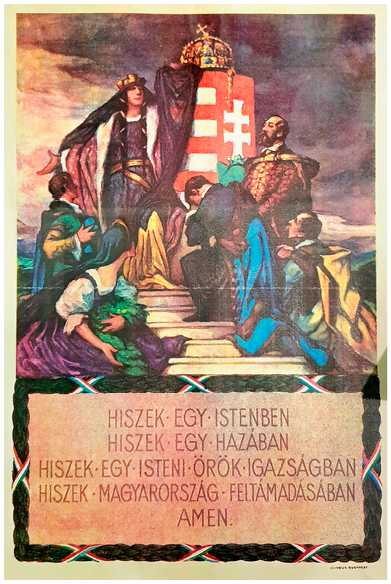
Myths of palingenetic rebirth were coupled with the idea of the charismatic savior. The cult of Admiral Miklós Horthy fused traditional monarchic and patriarchal authority – as regent of Hungary (1920–1944) – with new charismatic registers of mass politics. He was portrayed as a providential military leader and a unifier destined to restore the “Lands of the Crown of St. Stephen.” Horthy used a wide range of symbols to substantiate this conservative-authoritarian palingenetic ideology: He entered Budapest in 1919 and the reannexed Northwestern Transylvania in 1940 riding a white horse, thus reenacting the “sacred”’ figure of Árpád, the leader of the Hungarian conquest of the “Carpathian Basin.” A forma mentis of interwar Hungary, this irredentist political theology was further radicalized by an extensive gallery of far-right leaders who preached regeneration through territorial restoration, from Bethlen István (see the poster of his Party of Unity, Figure 7) to Gömbös Gyula and Zoltán Böszörményi. Ferenc Szálasi, the charismatic leader of the national-socialist Arrow Cross, developed this ideology into a more revolutionary, fascist vision of rebirth through cleansing, called Hungarism (Hungarizmus) (Reference Szálasi1935a; Reference Szálasi1935b).
The ideal of the resurrection of Historical Hungary animated Hungarian interwar politics: “For the Hungarian Resurrection,” The Party of Unity. Bethlen István’s Party (1931).
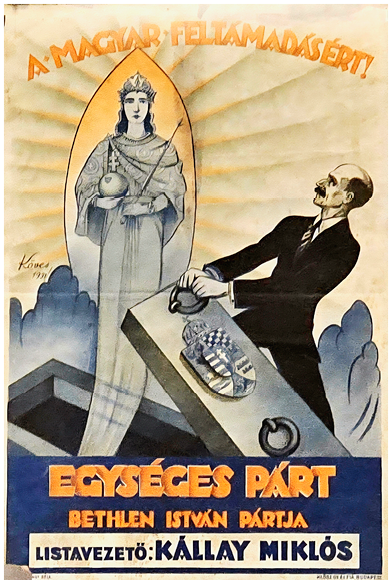
Ukrainian intellectual and political life illustrates a similar transition from Romantic to dark palingenesis. As M. Shkandrij shows, palingenesis was a popular motif in Ukrainian intellectual and cultural life in the late nineteenth century, functioning as a democratic, modernist ideal of “a spiritual-psychological transformation,” and advocating heroic continuity rather than revolutionary rupture (Reference Shkandrij2015: 158–159). Gradually, however, this language of regeneration was reconfigured into a more messianic and militant vision. Interwar Ukrainian nationalists promoted a “regenerative revolution” centered on an anti-Enlightenment myth of purification that justified the violent overthrow of existing institutions to forge a homogeneous, spiritually unified community (160–161). They drew on a variety of palingenetic themes, such as violent revolt, martyrdom, and commemorative ritual, and imagined rebirth in multiple registers, as heroic suffering, moral purification, and the restoration of Ukraine’s youthful vigor, independence, and historical grandeur (171). This darker trend culminated in the ideology and practice of the Organization of Ukrainian Nationalism during WWII (Carynnyk Reference Carynnyk2011; Himka Reference Himka2021).
While the European-wide spread of fascism as a historical phenomenon is by now well established – in Western as well as Central and Southeastern contexts – the global nature of fascism has received limited attention. I argue that the palingenetic nature of fascist ideology highlights the universal character of fascism. Discourses on palingenetic nationalism provide a comparative research framework for understanding the similarities among multiple global political “laboratories” that generated extremist politics both synchronically and diachronically. For example, many historians compared similar, in many ways related, anti-Enlightenment and anti-positivist revolts in the American South and fin-de-siècle Europe (Reyes Reference Reyes2019: 309; Steigmann-Gall Reference Steigmann-Gall2017: 94–119; Stern Reference Stern1974). Their similar discourses of victimization and attempts to combat decadence and degeneracy by promoting illiberal versions of modernity based on racism, elitism, and cultural pessimism “offer an excellent protofascist comparison that harbored palingenesis at its core” (Reyes Reference Reyes2019: 309). By comparing Southern and Völkisch intellectuals of late nineteenth-century Germany, Reyes highlighted that, after the Civil War, the US South “produced its own unique form of illiberal discourse in promoting palingenesis – a revolutionary national rebirth” (Reference Reyes2019: 308). Their “slavocratic revolution” (327) advocated nationalism and secessionism. It militated for the creation of an industrialized slave state, a nation “purged of liberal elements such as human rights, individualism, and democracy” and a social order based on slavery, elitism, and inequality (308). Reyes concludes that proto-fascist movements in the US during the antebellum period anticipated – but also stimulated, I would add – the emergence of “racist-fascism” in Nazi Germany.
It should be noted that, unlike Romantic nationalists, fascists did not directly employ the concept of palingenesis, but several synonyms and derivatives, such as rebirth, regeneration, renewal, purification, cleansing, and the like. These multiple synonyms, along with the numerous languages and discursive traditions in which these concepts were used, present a significant challenge for historians of comparative fascism, who must resort to context-specific conceptual history to reconstruct their usage and meaning. The diffused and multifaceted nature of these concepts should not obscure, however, the common intellectual tradition from which they originate. This Element highlights that fascist visions of palingenesis derive from a common matrix of thought on rebirth through catastrophe and recreation. Therefore, the fascist concept of palingenesis and its derivates should not be approached in isolation, but in the context of the semantic fields in which they were embedded and in close relation to the concepts on which their meaning depended, such as apocalyptic politics, decadence, damnation, salvation, revolution, violence, cleansing, sacrifice, war, the elect nation, mission, militarism, national messianism, charismatic leaders, and salvific faith, to name but a few. These concepts are linked to a larger conceptual cluster and should be studied together: A relational approach allows us to investigate how concepts are related to one another through direct or indirect connections, such as dependence, alliance, contrast, or opposition. To reconstruct their semantic net, we need to investigate the whole range of synonyms and antonyms associated with palingenesis. Moreover, since basic concepts, such as palingenesis, encompass multiple temporal layers (Zeitschichten) of meaning, both old and new, their meanings are never fixed. Historians of fascism thus need to explore the conceptual history of fascism as a battlefield of ideas. If we add to this problematique the relationship between ideas and practice, we have a broad field of historical investigation.
Due to space limitations, this Element cannot cover all fascist movements and regimes; therefore, I exemplify these traditions with the case studies of Italy, Germany, and Romania. The emergence of fascism in these countries was intimately linked to the process of nation- and state-building: The three countries managed to achieve territorial unification at roughly the same time, as a result of a Risorgimento-type of nationalism, which led to national unification through amalgamation of various historical provinces by a combination of referenda and military means. After unification, Risorgimento nationalism gave rise to integral nationalism, which sought to accelerate national integration and cultural homogenization.
Italian Fascism as a New Political Faith: D’Annunzio, Giovanni Gentile, and Mussolini
Postwar Italy became the first European country where a mass fascist militia party seized power, abolished democracy, and aimed to create a totalitarian state. As Emilio Gentile points out, this development resulted from a succession of radicalizing nationalist movements, from the Risorgimento to futurism and then Fascism (Reference Gentile2003). However, although rooted in previous nationalist and modernist currents, Fascism emerged as “a new type of revolutionary nationalism, stemming from the fusion of the myth of the nation with the myth of the revolution” (Reference Gentile2003: 7). Gentile argues that the new national revolution was conceived as “a process of national palingenesis, which was to radically innovate not only the political and social order” but also to promote an “anthropological revolution” aimed at “regenerating the ‘character of the Italians’ and creating a new Italian race” (Reference Gentile2003: 7). The defining features of the fascist regime in the making included totalitarianism, the sacralization of politics, the militarization of the state, and mass mobilization.
Fascist visions of palingenesis were rooted in the “myth of regenerative violence” through war and revolution. Fascism scholars have pointed out the paramount role of myths in politics and the idea of violent transformation, drawing on George Sorel’s pathbreaking and influential Reflections on Violence (1908). Yet, it is important to stress that, for Sorel, violence, while indeed the central mobilizing myth in politics, was not important “for its own sake” or simply as a form of social catharsis, but as a means leading to the “salvation of the world” through violent action: “It is to violence that socialism owes those high ethical ideals by means of which it brings salvation to the modern world,” states Sorel (Reference Sorel2004: 226, 251). The centrality of salvation in Sorel’s work, reminiscent of salvific palingenetic ideologies, and its reverberations in Italian and European politics, has been largely neglected in evaluations of his work.
Sorel’s view on the salvific power of revolutionary violence had a transformative impact on politics, influencing thinkers across a broad political spectrum, from socialists, Marxists, and revolutionary socialists to conservative nationalists, futurists, and, later, the emerging fascists (Sternhell et al., Reference Sternhell, Sznajder and Ashéri1994: 27). A main consequential idea that revolutionary syndicalists brought to the fore was the replacement of the working class with the nation as the primary agent of social change: “the ineffective proletariat would be replaced by the great rising force of the modern world, born of modernization, wars of independence, and cultural integration – that is, the nation” (Reference Sternhell, Sznajder and Ashéri1994: 27). The political synthesis between a new form of socialism, “which discovered the nation as a revolutionary agent,” on the one hand, and the nationalist movement, on the other, gave birth to Fascism (28, 30).
Around 1910, revolutionary syndicalism and integral nationalism merged with a novel avant-garde current, Futurism. Its proponents professed destruction and rebirth, seeking to annihilate tradition in the name of a utopian, mechanized future. Filippo Tommaso Marinetti, the “all-round demiurge of the Italian Futurist Movement” (Flint in Marinetti Reference Flint1972: 3), elevated the “morality of speed” to the rank of a “new religion” (Marinetti Reference Flint1972: 94–96). Animated by revolutionary ethos, the futurists were fixated on rebirth through technology (Berghaus Reference Berghaus2009), particularly manifest in their radical urbanistic plans. Marinetti, Umberto Boccioni, and architect Antonio Sant’Elia articulated futurism’s vision of annihilation and regeneration, violent destruction and utopian renewal, fueled by “fire, hatred and speed!” (Reference Flint1972: 44). Marinetti envisioned the “[f]orthcoming destruction of houses and cities, to make way for great meeting places for cars and planes” (Reference Flint1972: 96). Sant’Elia pleaded for total urban regeneration to match a mechanized future: “We must invent and rebuild the Modern city like an immense and tumultuous shipyard, agile, mobile and dynamic in every detail; and the Futurist house must be like a gigantic machine” ([1914] Reference Sant’Elia2007: 8; Apollonio Reference Apollonio2001: 170). The Founding and Manifesto of Futurism (1909) calls for the destruction of all repositories of the past (museums, libraries, and academia) to make way for the modern, industrial civilization:
8. […] Why should we look back when what we want is to break down the mysterious doors of the Impossible? Time and Space died yesterday. We already live in the absolute, because we have created eternal, omnipresent speed.
Likewise, the Manifesto of the Futurist Painters (1910) emphasizes regeneration through the embrace of modernity. On the one hand, it instigated a rebellion against “the cult of the past” in the name of “everything which is young.” On the other hand, it expressed confidence in Italy’s palingenesis: “But Italy is being reborn. Its political resurgence will be followed by a cultural resurgence. … The dead shall be buried in the earth’s deepest bowels! The threshold of the future will be swept free of mummies! Make room for youth, for violence, for daring! (Apollonio Reference Apollonio2001: 25, 27).” Reminiscent of the ancient Stoics, Marinetti went as far as to link Futurism to cosmic rebirth, through art and design. “We Futurists, Balla and Depero, seek to realize this total fusion in order to reconstruct the universe by making it more joyful, in other words, by an integral re-creation” (Apollonio Reference Apollonio2001: 197).
Just like revolutionary syndicalism, futurists praised violence and war for their cathartic potential. The Founding and Manifesto of Futurism stated brazenly and recklessly that “9. We will glorify war – the world’s only hygiene – militarism, patriotism, the destructive gesture of freedom-bringers, beautiful ideas worth dying for, and scorn for woman” (Marinetti Reference Flint1972: 42). Along the same lines, in 1911, the ideologue of revolutionary syndicalist Angelo Oliviero Olivetti promoted the “cult of the heroic” within a mythic and epic framework, highlighting the shared ideals of revolutionary syndicalism and Futurism – both seeking a “palingenesis through the burning crucible of struggle” (Gentile Reference Gentile2003: 58). During the Great War, the futurists forged the myth of modern war’s positive impact, claiming that the cataclysmic experience of bloody confrontations was the path to a new civilization. Drawing on the Heraclitean and Stoic notion of palingenesis by the Great Fire, Marinetti envisioned the war as a “conflagration” that would give rise to a futurist Italy, shaped by a heroic pedagogy emphasizing combat, sacrifice, discipline, and collective devotion (Gentile Reference Gentile2003: 58).
The synthesis between Sorelians, nationalists, and futurists led to the emergence of Fascism. Italian Fascism adopted the futurist ideas of cultural and political rebellion, as well as the glorification of energy, dynamism, and power (Sternhell et al., Reference Sternhell, Sznajder and Ashéri1994; Berghaus Reference Berghaus1996). Equally important, futurism endowed Fascism with a revolutionary aesthetic. As a new political faith, the fascist style of politics was rooted in aggressive action and war, as well as a new vision of culture, supported by a new ethical system.
Given its fast takeover of power, the movement phase of Italian Fascism was very short, lasting only three years and a half (1919–1922) from the establishment of the Italian Fasces of Combat (Fasci di combattimento) in Milan on March 23, 1919, to the creation of the National Fascist Party (Partito Nazionale Fascista, PNF) on November 7–10, 1921 and its establishment in power on October 31, 1922. PNF’s fulminant success was due to the complicity of traditional elites, but also, in large part, to its unconventional political style, aggressive deployment of paramilitary violence, and innovative propaganda and electoral strategies. Compared to the movement phase, Fascism’s regime phase was very long, lasting from 1922 to 1943, followed by an even more radical experiment in the Republic of Salò, 1943–1945. As Gentile (Reference Gentile1996) and Esposito (Reference Esposito2015) pointed out, the central axis of the fascist regime was palingenetic politics. The main stages in the sacralization of politics and the creation of the new national religion in fascist Italy were “the cult of the fallen” and the “cult of the lector.” This trend culminated in the fascist “Liturgy of Collective Harmony,” involving all Italians in rituals and mass demonstrations. Gentile argues that the new fascist religion possessed all the “fundamental constituents of any religion,” namely myth, faith, ritual, and communion; it aimed to transform the mentality, character, and way of life of Italians to create the fascist “New Man” (1996). In the following, we will focus on three major apostles of fascist palingenesis: Gabrielle D’Annunzio, Giovanni Gentile, and Benito Mussolini.
Gabrielle D’Annunzio: The Poet-Prophet of ‘Italian Greatness’
Mussolini’s actions and style of politics were prefigured and, in a way, also eclipsed by Gabrielle D’Annunzio’s seizure of Fiume in September 1919. A notorious and influential writer and public figure, D’Annunzio (1863–1938) articulated a new style of politics that combined aesthetics and politics, contributing to the emergence of Fascism. D’Annunzio’s artistic language elevated “beauty” as both an aesthetic and a political ideal, while rejecting conventional morality grounded in bourgeois norms. A central theme in D’Annunzio’s work is decadence, manifest in his exploration of sensuality, aestheticism, and emphasis on the decline of moral values. Novels such as The Child of Pleasure (Il Piacere) exemplify the “decadent” emphasis on individualism, sensual experiences, and the pursuit of beauty “for its own sake.” The theme of decadence was accompanied by its antithesis, national rebirth through violence. In unconventional prose poems such as the autobiographical The Notturno (Reference D’Annunzio2011[1921]), D’Annunzio propagated ideas of national rebirth and exalted a vision of virile heroism, glorifying war and ultimate sacrifice for the fatherland.
D’Annunzio’s political vision focused on an expansionist Italy. He argued for violent heroism to forge a new Italian national identity. To embody this ideal, his most spectacular postwar action was the rule of Fiume (today Rijeka), an Adriatic city designated a free port by the Paris Peace Conference but claimed by Italy as compensation for its war contribution. Although he was expelled from Fiume after a fierce siege by the Italian army, D’Annunzio’s fifteen-month political experiment (September 12, 1919 to December 29, 1920) had a powerful impact on the emergence of a new fascist style of politics, aiming to revitalize decadent Italian society through radical transformation. D’Annunzio rejected parliamentary democracy in favor of direct action and spectacle-driven politics, inspiring Fascism’s emphasis on mass rallies, propaganda, and the myth of national rebirth. Ledeen noted that many of the defining features of Mussolini’s regime – such as charismatic leadership, grand public rituals, balcony speeches, Roman salute, theatrical interactions with crowds, the cult of the martyrs, and the use of religious imagery, as well as corporatism – originated during D’Annunzio’s rule in Fiume (Reference 91Ledeen2002: xiii–xiv). His “new quasi-religious world view” “transcended the distinction between the sacred and the secular,” leading to “new form of liturgy in Fiume” (Ledeen Reference 91Ledeen2002: 9, 148). D’Annunzio’s main contribution to Fascism was thus the further articulation of a new, palingenetic political faith, both in theory and practice. Esposito argues that D’Annunzio’s vision of national palingenesis “sprang from the need to give meaning to the human sacrifices of the First World War” by “embedding sacrificial death in a ‘transhistorical’ horizon” (Reference Esposito2015: 114). Mussolini internalized D’Annunzio’s view, arguing “On the foundation of victory, it is necessary to begin a profound renewal [rinnovazione] of our national life” (Mussolini to D’Annunzio, 1919, in Esposito Reference Esposito2015: 114).
D’Annunzio’s political faith is reflected in the monumental estate he constructed on a hill overlooking Lake Garda between 1921 and 1938, entitled Il Vittoriale degli Italiani. Conceived as “the shrine of the victories [of the Italians]” and spanning nine hectares, the Vittoriale was not a simple residence but a vast assemblage – an intricate mosaic of D’Annunzio’s worldview, displaying his aestheticism, militarism, cult of heroism, and the theatrical staging of life as art. Established after D’Annunzio’s spectacular “failure” in Fiume, the estate, in a sense, became a “theater of memory” (Woodhouse Reference Woodhouse1998: 353–380) that recast his political “defeat” as spiritual and aesthetic triumph. Designed as “a book made of stone,” the site functions as a living text – narrating the life, deeds, and worldview. A fusion of house-museum, memorial, and symbolic “fortress,” the Vittoriale illustrates D’Annunzio’s self-fashioned personal mythology as a “poet-warrior” (Leeden Reference 91Ledeen2002: 67), a visionary demiurge who shapes history. The architectural complex presents a “sacred” narrative of Italian greatness, combining history, art, militarism, and charismatic leadership. Although D’Annunzio was ambivalent about Mussolini and never fully aligned politically with the Fascist Party, his palingenetic vision, flamboyant style, monumental aesthetics, celebration of heroic masculinity, glorification of death, and theatrical politics influenced early Fascist aesthetics and ideology. His legacy shaped the Fascist regime throughout the 1920s, the extravagant poet being held in esteem as “the John the Baptist of Italian Fascism” (Ledeen Reference 91Ledeen2002: vii). Just like the “first Duce” D’Annunzio, il Duce Mussolini envisioned a “new” grand Italy, aiming to forge, through violence, a heroic nation (Reference 91Ledeen2002: xvii). Although following a visit by Mussolini, the Vittoriale was officially classified as a national monument (Woodhouse Reference Woodhouse1998: 370), D’Annunzio’s vision, however, was deeply personal, idiocentric, and rooted in a mythical and poetic rather than bureaucratic or mass-political logic.
Redemption and the “Fascist Revolution”
Another key ideologue of Italian Fascism as a political faith was the philosopher Giovanni Gentile. A theorist of actual idealism (attualismo) or philosophy of praxis, Gentile elaborated the philosophical foundation of Fascism, emphasizing the “fusion” of the individual and the state, and rejecting liberal individualism and Marxist class struggle in favor of a corporatist and organic vision of society (Barandinelli Reference Barandinelli2025)
For Gentile, nationalism “was a new faith lit in the Italian soul” (Reference Gentile2002: 13). Fascism represented a natural continuation of Risorgimento liberalism but also a radicalization of the ideals of national unification and progress. Gentile denounced the “Old, decadent Italy,” made up of “Italians without faith and therefore absent” (45). He argued that, at a time when “[t]he spirit of the nation was prostrate,” Fascism managed to awaken “the spirit of the veterans who had wanted the war and who had fought it – who had sensed its value, and who had faith in their idea.”
Fascism was revolutionary “because it anticipated the construction of a new State.” Gentile praised Mussolini’s charismatic qualifications, as the embodiment of the Fascist Faith: il Duce was a “faithful interpreter [of the will of] the people of Italy,” and “a man who understood how to speak to the heart, who roused and mobilized all the passions invoked by bloody trenches and victorious combat” (Reference Gentile2002: 17). He was “a Mazzinian who argued for the sanctity of the Fatherland – [something that would be sacred] even for the working classes” (Reference Gentile2002: 18).
Many times, the Duce – with profound intuition of Fascist psychology – has affirmed this truth: we all respond to a sort of mystic sentiment. […] The faith that animates us as Fascists – that faith that has given us so much joy and so much satisfaction – which comforted us in our days of pain, when malign efforts were made to weaken our spirit – that faith in which we remained firm – was not an articulated doctrine. It was our very sense, our very being.
Religion holds a special place in Gentile’s philosophical system. For Gentile, the essence of religion was mysticism: The recognition that man can only truly become himself by identifying with God. Religion’s merit, then, was its ability to compel man to transcend his condition (Barandinelli Reference Barandinelli2025). In this sense, Gentile viewed Catholicism as a necessary, though preliminary, stage in the evolution of the nation and humanity, “a sort of antechamber to a more authentic civil religion” (Barandinelli Reference Barandinelli2025, my translation from Italian). As the most advanced civil religion, Fascism could only be religious, at personal as well as statal levels: “Our thoughts cannot fail to be religious. And […] our state should also be governed by a frank and deeply religious spirit” (Gentile, cited in Barandinelli Reference Barandinelli2025, my translation). This view explains Gentile’s ambivalent relationship to the Catholic Church – a mix of admiration, strategic support, and distrust. His “tactical” attitude aimed at absorbing some elements of Catholic tradition into the fascist faith, hence his defense of teaching Catholic religion in elementary schools (Reference Barandinelli2025). For Gentile, therefore, Fascism was not merely a political doctrine, but a total conception of life. Just as a devout Catholic applies religious principles to every aspect of existence, “so the Fascist, whether he goes to Parliament, or sits in the Fascio, writes in the newspapers or reads them, provides for his private life or converses with others, looks to the future or remembers his past and the past of his people, he must always remember that he is a Fascist!”
Gentile’s philosophy bore an inherently totalitarian character. Fascism demanded complete devotion; conversion to Fascism entailed renunciation of comfort and commitment to sacrifice. “Life,” wrote Gentile, “is toil, effort, sacrifice, hard work … Always before us stands an ideal to be realized – an ideal that gives us no rest.” This ideal had a redemptive, messianic urgency. Fascism was a race against time to rescue Italy through collective sacrifice:
We cannot lose time. Even asleep, we are responsible for the talents that we have been given. […]. We are now comforted by recent events in which Italian power has miraculously reemerged – when Italy, in its entirety, collected itself in one thought, in one sentiment, in one willingness to sacrifice.
The sense of duty extended to the memory of the fallen soldiers of WWI. Fascism was a moral response to “our six hundred thousand dead,” who served as spiritual witnesses: They “arise before us to admonish us that life must always be taken seriously, that there is no time to lose, that Italy must be made as great as they had envisioned it in their final vision – as great as Italy can, and will be, if we also sacrifice for her, every day, forever” (Reference Gentile2002: 57–58). Gentile was not only the official ideologue of Fascism but also a “philosopher in power,” uniquely positioned to translate his vision into practice (Barandinelli Reference Barandinelli2025). As Minister of Education, he spearheaded Fascist reforms of the Italian educational system, promoting a nationalist and state-centered political faith.
Fascism as a Political Faith
The 1925 “Manifesto of the Fascist Intellectuals,” authored by Gentile, advanced one of the first comprehensive definitions of Fascism as “the faith of all Italians who disdained the past and who longed for renewal.” The Manifesto was the outcome of the Conference of Fascist Culture, held in Bologna on March 29, 1925, and carried the signatures of 250 prominent right-wing intellectuals. It defined Fascism as an exclusive salvific faith for the fatherland:
It was a faith like other faiths that confront a fully constituted reality that must be destroyed, melted down into a crucible of new energies, and forged according to a new, ardent, uncompromising ideal. It was the very faith that had ripened in the trenches and in intense reflection on the sacrifice accomplished in the course of battle, a sacrifice for the only worthy goal: the vigor and greatness of the fatherland. It was an energetic, violent faith, unwilling to respect anything opposed to the fatherland’s vigor and greatness (reproduced in Pugliese 2001: 119).
The Manifesto was published in the National Fascist Party’s official newspaper, Il Popolo d’Italia, on April 21 – to coincide with the celebration of the mythical founding of Rome – “in order to address those in Italy and abroad who wish to better understand the National Fascist Party’s doctrine and policies.” On the 1st of May (International Labor Day), Benedetto Croce published a collective counter-manifesto in Giovanni Amendola’s newspaper, Il Mondo. The response of anti-fascist intellectuals confirms that religion became a contentious category, defined and redefined in political battles. To the anti-fascist intellectuals, the fascist “verbose manifesto” “brims over with half-baked notions worthy of a schoolchild” and is marred by “philosophical confusions and faulty reasoning.” The main problem was the vague and unoriginal nature of the would-be new faith of the Italians:
This verbose manifesto is of little help when it comes to explaining what this new gospel, this new religion, this new faith actually consists of. The manifesto itself, in its mute eloquence, confronts the unbiased reader with an incoherent, bizarre mish-mash of demagoguery and appeals to authority, vows of reverence for the law, ultramodern concepts and mildewed old rubbish, absolutist stances and Bolshevik tendencies, expressions of unbelief and flattery of the Catholic Church, blasts against culture, and sterile nods in the direction of a culture devoid of the necessary premises, mystical swoons, and cynical utterances (reproduced in Pugliese 2001: 123).
Notably, anti-fascist intellectuals did not reject the category of political faith but instead portrayed liberalism and anti-fascism as the truly democratic faith of the people, the only genuine continuation of the venerable Risorgimento tradition of the founding fathers.
The most elaborate definition of Fascism was put forward by Mussolini in his “Doctrine of Fascism,” published in the 1932 Enciclopedia Italiana. Reproduced in separate propagandistic editions (Mussolini Reference Mussolini1935) and translated into numerous languages, the essay aimed to elevate Fascism to the level of a major political ideology and to affirm its “universal vocation.” Mussolini argued that, after a decade of political consolidation, “Fascism is now clearly defined not only as a regime but as a doctrine,” mature enough to serve as “a norm to guide political and individual action in our daily life.” After underscoring Fascism’s negation of socialism, democracy, and liberalism, Mussolini made the eulogy of the Fascist State, claiming that it is “unique and original,” “not reactionary but revolutionary” because “it anticipates the solution of certain universal problems.” Mussolini took pride in the modern character of Fascism as a form of totalitarianism and “a new departure in history”: “Fascism is totalitarian, and the Fascist State – a synthesis and a unit inclusive of all values – interprets, develops, and potentates the whole life of a people.” Mussolini also asserted Fascism’s “imperialistic spirit – i.e., in the tendency of nations to expand [as] a manifestation of their vitality.” In his view, nations that “limit their interests to the home country are decadent, dying peoples.” In contrast, “people who (re-)arise are imperialistic.” To achieve these ambitious goals, fascists cultivated “a deep sense of duty and self-sacrifice.” Moreover, “the Fascist disdains an ‘easy’ life. It conceives of life as a struggle.”
Mussolini reiterated the fact that “Fascism is both action and thought.” That meant that “Fascism is not only a system of government” but also “fundamentally a conception of life.” Most importantly, Mussolini reinforced the already-entrenched idea that Fascism is a political faith: “Fascist is serious, austere, and religious.” He further elaborated on its religious nature, arguing that “the Fascist conception of life is a religious one, in which man is viewed in his immanent relation to a higher law, endowed with an objective will transcending the individual and raising him to conscious membership of a spiritual society.” This claim necessitated clarification of Fascism’s relationship to the Catholic Church. Tactically, Mussolini stated that fascists subscribe to the teaching of the Catholic Church but were quick to underline the exclusive nature of Fascism. As a self-contained political faith, Fascism was not subordinated to Catholicism or any other established religion; on the contrary, it was Catholicism that “completed” Fascism: “The Fascist state claims its ethical character: it is Catholic, but above all it is Fascist, in fact it is exclusively and essentially Fascist. Catholicism completes Fascism, and this we openly declare, but let no one think they can turn the tables on us, under the cover of metaphysics or philosophy.”
From Volkisch Thinking to Nazism: Palingenesis, Occultism, and Racial Cleansing in Germany
The concept of palingenesis is crucial for understanding the mass appeal of the National Socialist Party: Nazism promised not merely a political revolution but a comprehensive regeneration of society, leading to racial purity and the restoration of the glory of the Middle Ages. In essence, Nazism was a salvific project of national rebirth, aiming to restore a mythic golden past by purging all “undesirable” elements from the nation’s body.
The roots of the Nazi ideology can be traced back to the late nineteenth- and early twentieth-century Germany, a period marked by profound societal transformation and cultural upheaval. In reaction to an alleged sense of “alienation” brought about by the sweeping changes that accompanied the twin phenomena of industrialization and urbanization, a new Völkisch ideology emerged, rejecting modernity and its political “corollaries,” liberalism, free trade, and cosmopolitanism, and advocating instead for a society rooted in agrarianism and traditions.Footnote 12 The ideological foundation of Völkisch nationalism was laid by Paul de Lagarde’s agrarian-Romantic critique of modernity (1866; 1868; 1878–1881; 1887; on his work, see Lougee Reference Lougee1962; Stern Reference Stern1974: 3–94; Viaene Reference Viaene1996; Sieg Reference Sieg2013). Lagarde exposed the inherent weaknesses of Bismarck’s Reich; rejected liberalism, individualism, and parliamentary democracy; and proposed “a new religion, a new body politics, a new nobility, and a new education system” as basis for German rebirth (Stern Reference Stern1974: 33). Shaped by Lagarde’s “idealism of anti-modernity” (1974: 30), Völkisch-nationalism emerged as an “extreme” yet “widely accepted” integrative program of the German bourgeoisie based on a utopian vision of a Volksgemeinschaft as a blood-based Volk community, fears of degeneration, anti-capitalism, anti-Bolshevism, antisemitism, and rejection of aesthetic modernism (Tourlamain Reference Tourlamain2014: 23–24).
The Völkisch trend was part of a broader social movement in Wilhelmian Germany known as Lebensreformbewegung, the movement for the “reform of life,” which criticized the materialism of modern society and advocated a reform of the self through abstinence, vegetarianism, natural health, and strong rural communes to restore society to a more “authentic” state, in harmony with nature (Jefferies Reference Jefferies, Elley and Retallack2004: 93). This antimodernist reaction is best captured by the concept of “Geborgenheit,” implying the longing for a sense of security and “rootedness” and an organic conception of nature, in opposition to a rising “mechanistic rationalism” (Hakl Reference Hakl2014: 271). Agrarian “rootedness” was set in sharp contrast to both liberal “internationalism” and the “rootlessness” of “nomadic” peoples. While Lebensreform was a more varied movement, Völkisch thinkers accentuated some of its key traits, promoting a backward-looking utopia and romanticizing Germanic history, mythology, and folklore. They argued that every people is a God-given metaphysical entity endowed with its own “soul,” formed by its “racial” characteristics but also its interaction with its homeland (Hakl Reference Hakl2014: 271). In their view, personal salvation, therefore, was closely bound up with the salvation of the Volk (384, fnt. 92). Such visions paved the way for a powerful syncretism between Völkisch and esoteric-religious views, resulting in peculiar forms of “spiritual nationalism” (Wasserstrom Reference Wasserstrom1999: 4).
The concept of palingenesis and its corollaries, salvation, rebirth, resurrection, and revelation, were central to Völkisch nationalism. Lagarde redefined the doctrine of rebirth, shifting it away from its original Christian matrix to a mystical meaning applied to the realm of politics (Stern Reference Stern1974: 49–50). Influenced by Pietism, he rejected traditional Christianity in favor of a so-called “national religion,” a “Germanic-Christian faith” (3–4; 35–52), leading to the “renewal and rebirth of Germany” through the return to a perceived state of cultural purity by restoring national authenticity that had allegedly been pervaded by modernity (Tourlamain Reference Tourlamain2014: 25; also Lougee Reference Lougee1962: 143–149; 277–278). Volkisch ideology also entwined palingenesis with notions of racial purity based on the restoration of a mythical Aryan race and of an “organic” connection to the land. Lagarde (see Lougee Reference Lougee1962: 210–215, 245–252; Stern Reference Stern1974: 60–63), Julius Langbehn (Reference Langbehn1890), and Houston Stewart Chamberlain (Reference Chamberlain1899; Reference Chamberlain1913) – dubbed “Hitler’s John the Baptist” (Forman Reference Forman1978: 14) – attempted to provide “scientific” and historical justifications of the superiority of the Aryan race and antisemitism. They posited the existence of a continuous racial struggle between the Jews and the Aryans and emphasized the urgency of national rebirth. These ideas were further disseminated through various cultural channels, including literature and art, thereby permeating different social strata. In music, Richard Wagner, in particular, through operas like the “Ring Cycle” and in programmatic writings, epitomized this yearning for a heroic and mythic past while reaffirming Germany’s redemptive mission. Gradually, Lebensreform was turned into Lebensphilosophie, a “national-generative war-vitalism” fused with social Darwinism and eugenics (Frøland Reference Frøland2020: 96).
Occultism was integral to this vision of rebirth. The occult revival originated in Great Britain and the USA, as a reaction against the dominance of “materialist,” “rationalist,” and “positivist” ideas in utilitarian-industrial cultures. It was further stimulated by the rise of theosophy, an international sectarian movement that combined elements of Eastern religions, occultism, and esoteric Christianity. At a time when unprecedented technological progress and significant scientific discoveries challenged the traditional Christian dogma in fundamental ways – see Charles Darwin’s The Origin of Species (1859) – theosophy attempted to bridge the growing gap between science and religion in a novel way, and restore a sense of “dignity and purpose to humankind’s earthly life within a cosmic context” (Goodrick-Clarke Reference Goodrick-Clarke2008: 211; Frøland Reference Frøland2020: 94). Theosophy provided a framework for integrating exotic religions and mythology, appealing to those disenchanted with Christian dogma and churches. It brought together, in a peculiar synthesis, “the materials of Neoplatonism, Renaissance magic, Kabbalah, and Freemasonry, together with ancient Egyptian and Greco-Roman mythology and religion, joined by Eastern doctrines taken from Buddhism and Advaita Vedanta to present the idea of an ancient wisdom handed down from prehistoric times” (Goodrick-Clarke Reference Goodrick-Clarke2008: 211). Its cosmology included belief in reincarnation, karma, and the unity of all souls with the divine. Established in 1875 in New York by Helena Petrovna Blavatsky (Reference Blavatsky1877; Reference Blavatsky1888; Reference Blavatsky1889) and Henry Steel Olcott, The Theosophical Society popularized theosophy worldwide (Goodrick-Clarke Reference Goodrick-Clarke2008: 211). Its ideas of reincarnation attracted followers on all continents, leading to the “globalization of esotericism” (212).
In Austria-Hungary and Germany, occultism and theosophy were closely linked to the Lebensreform movement and Volkisch nationalism, contributing to the rise of radical ideologies. In Vienna, intellectuals like Friedrich Eckstein explored esoterism, blending it with local traditions. In 1887, at Blavatsky’s behest, Eckstein became the founding president of the first lodge of the Theosophical Society in Austria. In Germany, Wilhelm Hubbe-Schleiden established the Germania Theosophical Society in 1884, in the presence of Blavatsky, and the journal The Sphinx in 1886. The German occult revival, linked to the popularity of theosophy and based on the idea of the unity of the human souls with the divine, spread widely among the middle class.
At the turn of the century, a new generation of neo-Theosophists emerged, best represented by Rudolf Steiner (Goodrick-Clarke Reference Goodrick-Clarke2008: 219). In 1902, Steiner became General Secretary of the Theosophical Society’s German section, seeking to integrate Western esoteric traditions – particularly Rosicrucianism and Christian mysticism – into its predominantly Eastern-oriented teachings. In 1912, he left the Theosophical Society and founded the Anthroposophical Society, developing a distinct Christocentric spiritual framework. Steiner’s Christology diverged from both traditional Christianity and Theosophy’s syncretic approach. Rejecting Theosophy’s reliance on Tibetan Masters, Steiner reintroduced Christ as a central figure and emphasized Rosicrucian thought (230). Integrating concepts of reincarnation and karma, Steiner portrayed Christ as a cosmic being whose incarnation transformed human evolution (Steiner Reference Steiner1910). Steiner also claimed that, around 1880, the Archangel Gabriel-led epoch of materialism gave way to a new spiritual era, led by Archangel Michael, aimed at fostering an inward, Christ-centered spiritual renewal. This transformation necessitated the creation of a new esoteric Christian religion based on “Mystery knowledge” (Reference Steiner1924b). In line with this “Michaelic age,” Steiner’s new anthroposophical movement promoted a holistic philosophy encompassing education, medicine, agriculture, and social organization. A prolific writer and orator, Steiner advanced a new educational system, called Waldorf (inaugurated in 1919), promoted biodynamic farming and gardening, and pioneered new approaches to special education and social therapy (Goodrick-Clarke Reference Goodrick-Clarke2008: 230). The “Michaelic impulse,” opposing materialism, stimulated the imagination of fascist ideologues, too, who cultivated the symbolism of Archangel Michael as an eschatological redeemer, legitimizing and even “sacralizing” violence as a divinely sanctioned instrument of moral regeneration and purification.
In addition, figures such as Guido von List and Jörg Lanz von Liebenfels merged theosophy with Germanic mysticism and Volkisch nationalism, contributing to the emergence of early twentieth-century far-right movements (Goodrick-Clarke Reference Goodrick-Clarke1985: 5–6). List’s vision of a reborn German nation preached a spiritual awakening and a return to ancient Aryan virtues and social structures to cleanse and renew the German people (33–48; Mosse Reference Mosse1961b: 84–85). A new religious doctrine emerged, blending theosophy and Völkisch ideology, and emphasizing a mystical racial hierarchy aligned with German nationalism: initially called “Armanism” by List and “Theozoology” or “Ario-Christianity” by Lanz, the new religion came later to be known as Ariosophy, with a term coined by Liebenfels in 1915 (Goodrick-Clarke Reference Goodrick-Clarke1985: 91–96, 227).
Although the Völkisch ideology should not be fully equated with National Socialism, since it was an earlier, heterogeneous body of thought, in interwar Germany the two streams became conflated. Mosse demonstrated how key elements of the Völkisch ideology, with its emphasis on a romanticized, mystical, and racially pure Germanic past, became intertwined with mainstream German nationalism, culminating in Nazism, centered on national renewal (Reference Mosse1961b, Reference Mosse1964). Mosse argued that “the recovery of the unconscious,” which took place as a reaction to positivist ideologies, combined with German romanticism, “the mysteries of the occult,” and “the idealism of deeds, “laid part of the groundwork for the German form of twentieth-century dictatorship” (Reference Mosse1961b: 96). As a result, in National Socialist propaganda, Völkisch came to be used in a narrowly racist sense to denote an antisemitic form of racialized nationalism.
Goodrick-Clarke further explored the history of Ariosophy, including leading figures such as von List, and their connections to Nazism (Reference Goodrick-Clarke1985). He showed that the Nazis capitalized on the idea of a pure “Aryan” race that would rise from decadence to assume its rightful role in world history. Himmler patronized the Austrian Völkisch “practicing Nazi occultist” Karl Maria Wiligut. Hitler’s adherence to “Ariosophy,” as an avid reader of Liebenfels’s Ostara, is well documented, as well. Surely, the appropriation of occultism and esoterism in the Nazi ideology was selective. Although key aspects of Ariosophy, such as its descriptions of a prehistoric golden age and a gnostic priesthood, did not play a direct role in his political imagination, Hitler was nevertheless influenced by the millenarian and Manichaean motifs of Ariosophy, including its “semi-religious beliefs in a race of Aryan god-men,” the urgency of eliminating the “inferiors” as agents of degeneration, and a vision of a future German world domination (Reference Goodrick-Clarke1985: 203).
Until WWI, the ideological program of Völkisch nationalism was “integrative,” but had “fragmented,” “incoherent,” “inconsistent,” and “disunited” political manifestations (Tourlamain Reference Tourlamain2014: 25). Nazism continued the central tenets of Völkisch ideology, but appropriated and channeled them into a political movement: “Just as the fundamental principles of the National Socialist Movement are based on the völkisch idea, völkisch ideas are National Socialist,” claimed Hitler (Reference Hitler1944: 520). The Führer’s ability to fuse these esoteric, apocalyptic, and nationalistic ideas into a cohesive and aggressive political agenda was the driving force behind the success of Nazism. Kershaw’s research confirms that the Nazi vision of the future was built around the concept of national rebirth (Reference Kershaw1998a; Reference Kershaw1998b). The Nazis promoted a “charismatic” politics of “national salvation,” portraying Hitler as a providential savior. The regime’s propaganda was fixated on the “mysticism of national salvation and rebirth,” turning it into a “pseudo-religious belief.” Nazi Germany’s rise was presented as “a near-miracle – a work of redemption brought about by the unique genius of the Führer” (Reference Kershaw1998b), overcoming the national decline and “degradation” brought by the Great War. The spread of the new faith led to the widespread phenomenon of official resignation (Austritt) from leading denominations such as Catholic or Evangelical Lutheran in favor of Gottgläubig (having faith in a deity) by prominent Nazis such as Alfred Rosenberg, Heinrich Himmler, and Rudolf Hess (Flowers & Moynihan Reference Flowers and Moynihan2007).
In the pre-power stage, the values of the Nazi political faith were disseminated through propaganda aimed at forging an exclusive, all-encompassing Nazi subculture; in the regime phase, this subculture became a hegemonic national (but increasingly transnational) culture. An influential Nazi work that approaches national rebirth as regenerative violence against “decay and disintegration” and presents youth as the carrier of rebirth is Michael, a semi-fictional diary of a youthful protagonist, authored by Joseph Goebbels (Reference Goebbels1987: 3). Written in 1923, published first in 1929, and reprinted seventeen times until 1945, the novel integrates into a personal narrative of self-redemption through work and struggle a sum of key yet abstract palingenesis-related concepts, such as revolution, sacrifice, death, and resurrection, thus rendering them more tangible. Michael portrays war as a purifying rupture capable of reversing decadence and bringing about a new moral order. Following a blasphemous form of imitatio Christi, Nazis are portrayed as “Christ Socialists,” functioning as antisemitic antidotes to Judaism: “Christ is the genius of love, as such the most diametrical opposite of Judaism, which is the incarnation of hate” (65). In this “Michaelic” messianic narrative, suffering and death acquire redemptive value as acts of creative sacrifice, while blood is presented as “the best and the most enduring glue” for forging the resurrected Germany (65).
Another central propaganda theme, intimately connected to individual and collective rebirth, was fear of degeneration. Lagarde envisioned the nation as a mystical community that required purification from “alien” elements, most notably the liberals and the Jews (Lougee Reference Lougee1962: 194–197; 210–215; Stern Reference Stern1974: 60–64). German national rebirth necessitated a strong, charismatic leader (Führer), who was mystically connected to the people (Reference Stern1974: 58). Langbehn expanded upon Lagarde’s “call for rebirth” by introducing a biologized mysticism of blood, leading to racial antisemitism (Carr Reference Carr1938; Stern Reference Stern1974: 112, 143–144; on Langbehn’s relationship to Lagarde, see Lougee Reference Lougee1962: 237–245, 260). At the turn of the century, older fears of national and cultural decline merged with novel racial theories of degeneration, framing the nation’s perceived degeneration as a biological crisis. This led to calls of “racial improvement” through eugenics, targeting the Jews, the Roma/Sinti, and the so-called “dysfunctional” individuals and criminals (Weindling Reference Weindling, Bashford and Levine2010). Völkisch nationalism intensified after the Great War, fueling paramilitary violence. Arthur Moeller van den Bruck, a new leading figure of the conservative revolution, articulated a political prophecy envisioning the Third Reich as the embodiment of an “ideal Germany,” empowered to fulfill its redemptive mission ([1923] Reference Bruck2012; Stern Reference Stern1974: 183).
These ideas converged in Hitler’s racial ultranationalism, which conceived of history as a struggle among races for Lebensraum (living space). National Socialism was based on a “racial Weltanschauung”; its ultimate stated goal was “the salvation of the German people” (Hitler Reference Hitler1944: 94, 167, 308). Nazy Germany was to serve as “the beacon-light of a happier era, and show other nations, too, the way of salvation for struggling Aryan humanity” (721). In Mein Kampf, Hitler outlines a comprehensive program of racial regeneration, arguing that, without an urgent and radical intervention, Germany and the world would irremediably decay from “a race of homogeneous blood that was mentally and culturally superior” (Reference Hitler1944: 449) to a situation in which “people will be transformed, under the name of our ‘higher civilization’, into a motley of lazy and brutalized mongrels” (451–452). Hitler argued that “every racial mixture leads, of necessity, sooner or later to the downfall of the mongrel product, provided the higher racial strata of this cross-breed has not retained within itself some sort of racial homogeneity” (449). The only way out of that dangerous situation was that the higher stratum maintains “certain standards of homogeneous breeding” and ceases to “intermingles with the mongrels.” For Hitler, homogenous breeding was “the source of a slow but constant regeneration whereby all the poison which has invaded the racial body is gradually eliminated as long as there remains a fundamental stock of pure racial elements and there is no further inter-breeding” (449). This policy could succeed only if “the fecundity of the healthy portion of the nation were encouraged in a conscientious and methodical way” (453–454). The way forward was to “have at least the beginnings of a race from which all those germs would be eliminated which are today the cause of our moral and physical decadence” (454). Hitler argued that “it is the task of the Germanic States in particular to see to it that the process of bastardization is brought to a stop” (450).
Hitler promoted an apocalyptic style of politics, claiming that mankind was at a crossroads: “One thing is certain, namely, that our world is facing a great revolution. The only question is whether the outcome will be propitious for the Aryan portion of mankind or whether the everlasting Jew will profit by it” (478). The nation’s vitality could only be restored by a national revolution: “What will restore the national strength of the German people is the conviction that they will be able to regain their liberty, but this conviction can only be the final product of this same feeling in millions of individuals” (462).
National rebirth was to be an apocalyptic, zero-sum battle waged by the youth against decadence. Racial policy had to be, therefore, all-encompassing, involving policies of citizenship, colonization, education, and eugenic betterment, but also violent cleansing. The new Völkisch state had the duty to “develop that nucleus of the nation which is most valuable from the racial standpoint and thus increase its fecundity.” Colonizing newly acquired territory should not be “a haphazard policy” but implemented “under the guidance of definite principles” (454). The pioneers of this effort were to be “frontier colonies” “of the purest racial stock,” who “would possess the best qualities of the race” (454). Such colonies “would contain the nucleus which would ultimately bring about a great development of the nation and indeed of mankind itself” (454).
Hitler portrayed the Aryans as a superior race locked in an existential battle against Jews, whom he dehumanized as “vermin” to be eliminated: “The constructive principle of Aryan humanity is thus displaced by the destructive principle of the Jews. They are the ferment of decomposition among nations and races and, in a broad sense, the wreckers of human civilization” (503; see Figure 8). The work of education and hygiene was thus an urgent societal task: It had to begin with mothers but also involve the youth: “The völkisch State will have to see to it that a generation of men will arise fit to play its part in this supreme and final combat that will decide the destiny of the world. That nation will conquer which is the first to take this road” (478). Hitler’s discourse conveys fear of degeneration but also the uncertainty of salvation: “Either the German youth will one day create a new State founded on the racial idea, or they will be the last witnesses of the complete breakdown and death of the bourgeois world” (455).
The pyramid of Nazi racial “caste–ism,” presenting hereditary racial groupings, organized hierarchically between the “superior” Aryans (the Germans, Nordic, and Mediterranean people) and those of “inferior breed,” most notably the Jews and the Roma/Sinti. The strict segregation among these racial units was to be reinforced by occupational specialization in the Nazi “New Europe.” Nazi propaganda emphasized the dynamic character of this system: although “inferior races” could never transcend their subordinate status, they nevertheless acted as agents of the degeneration of the pure Aryans, who were in constant danger of corruption from below. Mind the deeply racist, highly invective and derogatory language that characterized Nazi political discourses.
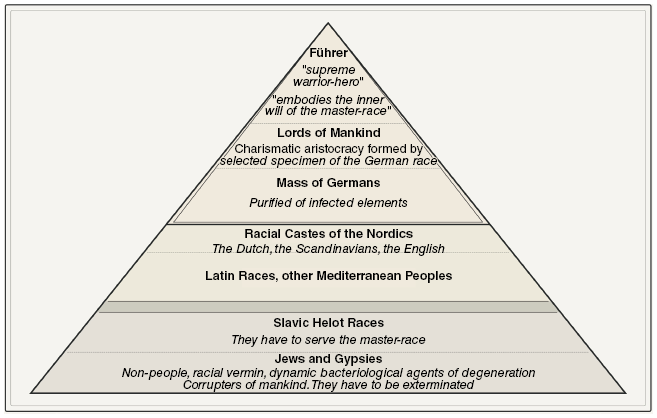
The Legion “Archangel Michael” in Romania
The Legion “Archangel Michael” provides another illustration of the palingenetic core of fascism, with roots in the Romanic ideology developed during the long nineteenth century. Elsewhere, I documented the direct link between the Legionary ideology and Romantic visions of palingenesis through at least three pre-1918 channels: (1) the tradition of national messianism, best epitomized by the Wallachian writer and politician Ion Heliade-Rӑdulescu’s theory of palingenesis, which redefined central Christian themes in the spirit of Evangelical-socialist discourses on regeneration; (2) the tradition of the sacralization of politics, having at its core the idea of the nation’s sacred homeland and divine mission; and (3) the conservative tradition of religious-patriotic militarism that shaped Corneliu Zelea-Codreanu’s education and, through him, the nature of the Legion (Iordachi Reference Iordachi2023). The main element of continuity with Romantic nationalism was the cult of the Wallachian Prince Michael the Brave (1595–1601) and his divine patron, the Archangel Michael. This “dual” cult encoded the myth of the nation’s palingenetic regeneration and served as the central axis of sacralizing politics in modern Romania.
The palingenetic ideology of “national awakening” was developed by Romantic writers in the second quarter of the nineteenth century, following the abolition of the onerous “Phanariot regime” in Moldova and Wallachia, under Ottoman suzerainty, the return to native rulers, and the consolidation of their internal autonomy (1821). This ideology was transmitted from teacher to disciple: from the Transylvanian scholar Gheorghe Lazӑr to Heliade-Rӑdulescu, and then to his student and revolutionary activist Nicolae Bӑlcescu. Its main elements included: the idea of messianic destiny of the Romanians, the codification of “predestined” national unity in the dual cult of Michael the Brave and Archangel Michael, rebirth and regeneration through the liberation of the national territory and the political unification of all Romanians, fears of degeneration caused by the loss of “national authenticity” due to the hostile actions of internal and external enemies, the cult of heroes, and the key role assigned to the military and militaristic values in the nation’s regeneration.
The term palingenesis was introduced into Romanian by Heliade-Rӑdulescu and quickly entered political and intellectual discourse. An 1862 dictionary defined palingenesis as the “alleged art of regenerating from its own fragments” (Dicţionar rumӑn, 1862: 290); a later dictionary derived it from the French palingénésie, meaning “rebirth, regeneration” (Dicţionariul 1876: 576). Romantic writers embraced the term and elaborated palingenetic visions of nationalism centered on national glory in the medieval period, followed by a decline caused by the betrayal and selfishness of the elites, and then rebirth through heroic self-sacrifice.
The pioneer promoter of palingenetic nationalism was Heliade-Rӑdulescu, who in the 1830s developed a “theological” form of palingenetic philosophy (Tomoiagӑ Reference Tomoiagӑ1971: 33, 36, 40). Based on regenerative ideas derived from the Gospel, this theology proposed an anthropological vision of humanity, centered on the perfectibility of human nature through suffering, following the behavioral model of Jesus Christ. The mythical core of this theology was the idea of the Romanians’ regeneration through unification into a single state, codified in the cult of Michael the Brave. This regenerative vision was encapsulated in his national epic Mihaida (Heliade-Rӑdulescu Reference Heliade-Rӑdulescu1848). In this poem, Heliade-Rӑdulescu provided a messianic vision of nationalism, establishing a symbolic link between Michael the Brave, the national hero of the Romanians, and Archangel Michael, the leader of the Lord’s heavenly army. Following Heliade-Rӑdulescu, this association became an integral part of the ruler’s cult, linked to another central theme of his palingenetic thinking: The national army as the main vehicle of regeneration. Convinced that Romanian history had entered “the period of palingenesis,” Heliade-Rӑdulescu aimed to institutionalize his “literary ideology of regeneration” (Popovici Reference Popovici1935) as a civil religion, with the poet playing the role of a demiurgic artist.
The 1848 Revolution and the union of Moldavia and Wallachia unfolded under the banner of palingenesis, an ideology further propagated by Bӑlcescu and the liberal politician I. C. Brӑtianu (Reference Brӑtianu1890: 746–761), among others. To revitalize the cult of Michael the Brave, Bӑlcescu authored a massive History of the Romanians under Michael the Brave (Reference Bӑlcescu1887). Bӑlcescu adhered to the core principles of social palingenesis and endowed Michael the Brave with a central role in Romania’s regeneration, portraying him as a predestined charismatic leader, not simply a glorious hero, “but also the symbol of the idea of life, the idea of salvation, the Symbol of their National Unity” (Reference Bӑlcescu1887: 212). For liberal nationalists, political union became a salvific myth, the path to national regeneration following divine providence: “The Holy Union is written in the heavens, / It is written in our hearts with celestial fire! / O, Romania! To your glory / The divine arm labors!” declaimed poet V. Alecsandri (Reference Alecsandri1889: 3). Painter Petre Alexandrescu visualized this palingenetic doctrine of national regeneration, depicting the unification of Moldavia and Wallachia as a divine plan for the chosen people (Figure 9).
Petre Alexandrescu “The Union of the Principalities” (1856). The principalities of Moldova and Wallachia are uniting under divine patronage, thus fulfilling their historical mission toward national and universal salvation.
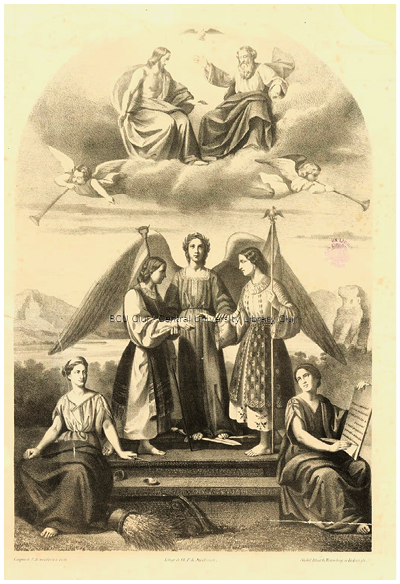
Following the Union of the Principalities in 1859, the establishment of a constitutional monarchy, and the enthronement of the Hohenzollern-Sigmaringen dynasty in 1866, the cult of Michael the Brave took on new political connotations. On November 8, 1874, on the feast of Saint Michael, a bronze equestrian statue of Michael the Brave was erected in front of the University Palace in Bucharest. The inauguration ceremony emphasized the collaboration between the Monarchy, the Army, and the Church in sacralizing politics, centering on the predestined role of King Carol I in achieving political unity. The cult of Michael the Brave gained new momentum at the beginning of the twentieth century, amid a broad public campaign for national unity. Its leading promoter, historian Nicolae Iorga, reiterated the romantic idea that the medieval ruler was a charismatic hero, “the man sent by God who, three hundred years ago, came to earth to unite all Romanians into a single body,” thus fulfilling a divine mission (Iorga Reference 90Iorga1901: 10; Reference Iorga1979). On the eve of WWI, palingenetic ideology was reformulated in a conservative variant by Nicolae Filipescu. The conservative politician merged elements of Heliade-Rӑdulescu’s palingenetic nationalism – particularly the cult of Michael the Brave as a predestined hero and the army as a vehicle for national regeneration – with conservative values such as monarchism, elitism, and the patriarchal organization of society. To these, he added modern political themes, such as the idea of regenerating the nation through the actions of a new young elite, educated in religious-military values. In 1912, Filipescu founded the Military High School at Dealu Monastery – an innovative experiment fusing conservatism with militarism and religion, grounded in the principles of progressive pedagogy (éducation nouvelle) imported from England and France. The school was meant to contribute to war preparations and keep the flame of messianic nationalism alive.
The coronation of King Ferdinand I in 1914 and Romania’s participation in WWI (1916–1918) were symbolically placed under the sign of Michael the Brave and his patron, Archangel Michael. Ferdinand I’s proclamation of August 28, 1916, announcing Romania’s entry into the war against Austria-Hungary, was imbued with messianic overtones, emulating palingenetic discourses of national regeneration through sacrifice. The “liberation war” was presented as a “sacred duty” and the path to “national rebirth,” restoring what Michael the Brave had accomplished for a fleeting moment: The unification of Romanians on both sides of the Carpathians.
Romania was one of the net beneficiaries of WWI: Through the incorporation of Bessarabia, Bukovina, Transylvania, and the Banat, it doubled its territory and population. Thus, while the Germans and Hungarians experienced the bitterness of defeat, and the Italians had to settle for minor territorial gains, Romania fulfilled the maximal territorial aspirations of the national program: The unification of all Romanians into a single state. As a result, “Greater Romania” became a complex state, characterized by multiple imperial legacies. Consequently, political elites faced the challenging task of integrating the newly annexed provinces. Upon the opening of the first Parliament of Unified Romania, Ferdinand I called for far-reaching reforms to ground the union on solid foundations. Like Heliade-Rӑdulescu and Bӑlcescu, the king linked the rebirth of united Romania to a democratic political project. The most significant reforms adopted were universal male suffrage (1918) and a major redistribution of agrarian property (1921). These reforms ensured the peaceful demobilization of soldiers and their transformation into active citizens, in a (still unconsolidated) parliamentary democracy.
The Legionary Palingenetic Project: Metempsychosis, Sacrifice, and Salvation
The Legion “Archangel Michael” was founded in June 1927 by a group of activists led by Corneliu Zelea-Codreanu and Ion I. Moţa as an elite nationalist organization. In contrast to traditional political parties, the Legion had no formal program but defined as its goal the salvation of the nation. Legionaries claimed that their emphasis on salvation differentiated Legionarism from both Italian fascism and German Nazism, as the only genuine political faith in interwar Europe: “Fascism venerates the state, Nazism the race and the nation. Our movement strives to fulfil the destiny of the Romanian people through salvation” (Polihroniade Reference Polihroniade1937: 1, Reference Polihroniade1933).
The Legionary ideology advanced a kenotic vision of palingenesis centered on regeneration through sacrifice, following the ideal of imitatio Christi. To this core, it added other components of Romantic theories of palingenesis, such as Christian eschatology, metempsychosis, the idea of ecumenical redemption of humankind, the predestination and divine mission of the Romanian people, and heroic Christianity through expiation of sins and martyrdom. In the spirit of ecumenism that characterized the Romantic Evangelical revival, the Legion saw salvation as the ultimate end of history. “The final aim is not life but resurrection. The resurrection of peoples in the name of the Saviour Jesus Christ …” (Codreanu Reference Zelea-Codreanu2003: 315).
Codreanu articulated ideas about metempsychosis, arguing that the soul is an immortal entity that passes from the body to an inanimate state. He defined the nation as a community of kin and posited that individual souls form a collective spiritual consciousness. He also envisioned the people as an entity “whose life continues beyond earth” (Reference Zelea-Codreanu2003: 313). For Codreanu, the nation was made up not simply of all living Romanians, but all past, present, and future generations (Reference Zelea-Codreanu2003: 2). The Legionary metempsychosis included a strong neo-pagan component, invoking the religion of the ancient Dacians and their leading God, Zamolxis, a former slave of Pythagoras (Eliade Reference Eliade1972).
To ensure the salvation of the nation as an organic but also spiritual entity, the Legionary ideology and ritual practice encompassed two axes, emulating the local tradition of sacralizing politics: the cults of the Archangel Michael and the ancestral land. These two vertical and horizontal axes united the “earthly” and the “divine”: “Here we are with the borders of our movements firmly fixed: With one side implanted in our ancestral land, and with the other in the sky: the Archangel Michael and The Ancestral Land.” The two axes stemmed from the Legion’s historicism, with roots in the Romantic palingenetic historical ideology: They were meant to fuse the pre-Christian (Dacian) roots of the Romanian people with its Christian manifest destiny, leading to redemption.
The Legionary palingenetic project was based on apocalyptic eschatology. Their vision employed the symbolism of the Old Testament, as interpreted by Romantic projects of regeneration, as well as modern political themes, such as antisemitism and anti-communism, drawn from the turn-of-the-century European cultural milieux and adapted to local culture. Following Heliade-Rӑdulescu’s philosophy of history, Legionarism identified two opposing developmental trends: A descending one leading to degeneration and an ascending one leading to redemption. In Heliade-Rӑdulescu’s vision, the two trends alternated cyclically; in the Legionary ideology, they were mutually exclusive and could prevail over each other by means of revolutions. The Legionaries posited that humankind was at a crossroads: individuals and peoples had to choose sides in the apocalyptic confrontation of good versus evil – identified with fascism versus communism – and thus work toward or against salvation: “If the country will not be set on the path of resurrection envisioned by integral nationalism, she will choose the other path, of Communist reform” (Moţa Reference Moţa1936: 95) (see Figure 10).
The Legion’s view of the palingenetic dynamics of decadence and regeneration leading to damnation or salvation.
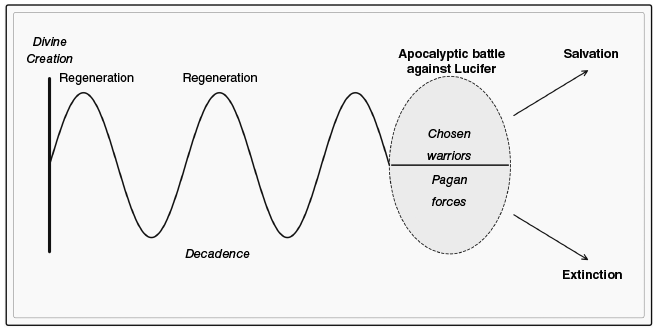
In the spirit of Romantic palingenesis, regeneration was envisioned as Christian salvation. Fears of national degeneration animated legionary eschatology. The powerful forces of decadence could be defeated only through the heroic action of a charismatic community of sacrifice. As a predestined leader, Codreanu advanced a guide to collective salvation through sacrifice, based on a code of conduct and a set of ideological commandments. The ethical code combined military discipline with religious asceticism. It contained nine commands (faith in God, self-discipline, dedication, rejection of politics, and love of death) and six fundamental rules: “discipline,” “work,” “silence,” “education,” “mutual help,” and “honor.” Proper Legionary conduct was to lead to salvation via two paths: The creation of the new man through spiritual rebirth “from within,” and ultimate sacrifice. In Codreanu’s view, “The new man, or the renewed nation, presupposes a great rebirth of the soul, a great spiritual revolution of the entire person, in other words, a fight against the spiritual direction of today” (1933, Point 69). He conceived the Legion as a school for forging the New Man, following the nouvelle pegadogie’s character-building program.
The essence of Legionary palingenesis was resurrection through martyrdom. As “recipients of the salvaging force,” the Legionaries sacrificed themselves to redeem the nation: “Somebody has to pay, with suffering, the sins that crumbled the people, somebody has to redeem through pain the salvation of tomorrow …” argued Moţa (Reference Moţa1936: 53, 59). The idea of expiation of sins through sacrifice stems directly from Bonnet’s concept of emboîtement des germes, transmitted via Heliade-Rӑdulescu: “So God wanted: the germ of renewal can grow only out of death, of suffering” (Reference Moţa1936: 74–75; note the striking similarity of terms). It also incorporated behavioral models of Church martyrdom and Romantic conceptions of heroic Christianity. The resurrection of the nation through expiation and sacrifice followed the model of Imitatio Christi: “Our Savior could not prevail without suffering and sacrifice … How would the Legionary be able to prevail by leading a life full of serene, cloudless days …?” (Reference Moţa1936: 58). Through this sacrificial pedagogy, common socialization, and paramilitary training, the Legion evolved into a fanatical totalitarian revolutionary movement of change, based on charismatic, oath-taking authority demanding unconditional submission to the leader. It also evolved into a mass political force: In 1937, at its political peak, it enrolled circa 270,000 members and garnered 478,000 votes in the parliamentary elections (16 percent of the total). Taking advantage of the gradual demise of the parliamentary regime, in September 1940, the Legion assumed power, together with the army and conservative elites, under the leadership of General Ion Antonescu, and built a totalitarian state based on repression and violent antisemitism (until its demise in January 1941).
4 Fighting Degeneration: Dark Palingenesis as Violent Cleansing
Our overview of three major fascist movements and regimes highlights the centrality of palingenetic visions of national rebirth as the backbone of fascism as a political faith. The following two subsections examine the centrality of two opposing concepts, closely linked to national rebirth in fascist discourses: decadence and degeneration versus heroic sacrifice.
A key concept of fascist ideology, used in close but antithetical correlation with regeneration, is that of decadence. Despite its centrality, the history and genealogy of the concept of decadence are under-researched, particularly regarding its use in fascist discourses and its practical implications. Just as with regeneration, the cultural meaning and political connotations of decadence are not fixed but fluctuate as a function of its referent object, the securitizing actors involved in defining it, and the context of a given discourse. If the Enlightenment fostered an optimistic narrative of “modernization” as unstoppable progress based on reason and science, the second half of the nineteenth century revived older fears of decadence. The Enlightenment’s sense of “progress” started to be denounced as decline, “the replacement of original, natural man with artificial man and factitious passions” (Morley Reference 92Morley, Desmarais and Weir2022: 670). Gradually, a “politics of decadence” emerged, promoted by eccentric figures such as Charles Baudelaire, Oscar Wilde, and D’Annunzio (673–74). The interwar era was, in many ways, the heyday of discourses on degeneration. These discourses continued a narrative inaugurated at the turn of the century, being thus more like “variations on a theme,” as “there was a constant recycling of decadent themes, tropes, and preoccupations across Europe and the United States” (Hawthorne Reference Hawthorne, Desmarais and Weir2022: 92).
In fascist discourses, the most common referent of decadence is the nation, seen as a divine, God-given entity; this concept is supplemented by family, society, or other local, regional, or rural “traditional” communities. Another key referent object of degeneration is the state, approached in its own right but also as a means to reshape the nation through radical policies. Fascist discourses on the state are often conflated with discourses on imperial decadence and revival of past glory, building on the legacy of various empires, civilizations, or historical eras (e.g., the Roman Empire, the Roman Empire of the German Nation, the Tsarist Empire, the Kingdom of Hungary, ancient Dacia, etc.). Degeneration is portrayed in negative terms as an alteration of an object’s inner nature through deterioration, deformation, deviation, corruption, alienation, and the like. Its content varies as a function of its referent object, being defined as decline (of states, empires, and institutions), decay (of mores, communities, civilizations, etc.), or the death of organic beings or anthropomorphized units (such as the nation), but also as the decline of values in society.
The cure was sought in various forms of “restoration” of the original, authentic qualities of the referent object, for example, the nation and traditional mores, norms, and values, through purification, regeneration, healing by amputation, or inner transformation, leading to a new beginning. The fascists did not have a premade, universal remedy for degeneration, but were in a continuous search for “urgent” or “exceptional” redemptive measures. However, if earlier discourses about the nation had focused on the positive aspects of regeneration, the fascists argued that regeneration could only result from a violent purification of the nation by removing its infected parts. For example, in Ustaša’s ideology, Croatia’s rebirth was presented as a multifaceted process encompassing (1) the revival of the Croatian state through violent secession from Yugoslavia; (2) the restoration of the national territory; (3) the creation of the New Man, as a warrior emulating the Poglavnik’s personality; (4) the restoration of the purity of the Croatian language, by purging it of foreign influences; and (5) the cleansing of the nation of racial and ideological “aliens.” The establishment of the Independent State of Croatia (ISC) was presented as the fulfillment of a divinely inspired mission of regeneration. On April 10, 1941, under the slogan “God and the Croats,” Slavko Kvaternik announced, in a radio address deliberately aired on Easter Sunday, the “resurrection of the Croatian State,” with the help of “God’s providence” (Hrvatski Narod, April 10, 1941). His speech linked the establishment of the ISC with the “resurrection of the Son of our God,” thus asserting imitatio Christi as the symbolic-ideological basis of the new regime. To gain popular support, Ustaša’s propaganda stressed the “constructive” aspects of its regenerative project: “The Ustaša is not an oppressor nor a barbarian, the Ustaša is not a destroyer. The Ustaša is a guardian of hard-won state independence, he is a defender of the hard-won works of his Poglavnik” (Ustaša 11 [July 3, 1941] 3: 2 in Jonjić Reference Jonjić2010: 231). Consequently, the regime engaged in a concerted campaign of linguistic and cultural homogenization. Yet despite attempts to obscure the destructive side of Ustaša’s ideology, its nation-building project centered on cleansing. In a radio address broadcast by the Italian radio on April 5, 1941, Pavelić urged the Croats to “rise up, so that we cleanse [očistimo] our homeland of enemies” (reproduced in Bzik Reference Bzik1942: 69). Pavelić pledged that, in the new Croatian state, “all weeds will be eradicated that were planted by the foreign hand of our enemies” (70). Consequently, his policies focused on identifying and eliminating internal and external enemies.
Although the idea of decadence was understood in utterly negative terms, it was also celebrated as the beginning of a new era. Like the Futurists, the fascists seemed to draw their destructive but also creative energies from the idea of imminent decline, since that gave them a mission, invested them with a sense of urgency, and enabled them to regenerate the nation through exceptional measures. Moreover, just like the Futurists, fascists glorified violence, militarism, and the regenerative potential of war as a means to attain purification. Consequently, the political trajectory of fascism was deeply intertwined with war. Fascism drew its vitality from the Great War; its emergence was prompted by processes of multidirectional polarization and radicalization, leading to a string of European civil wars. Lastly, most fascist regimes ended up in bloody military confrontations and defeat.
Fascist Sacrificial Discourse and the Politics of National Redemption
A central component of fascist palingenetic visions of national salvation was represented by the theme of (self-)sacrifice, as an antidote to decadence and thus the driving force behind the fascist political faith. The fascist ideas and practices of violent sacrifice are rooted in both religion (see the biblical metaphor of the seed) and nationalism, which routinely revere blood sacrifice as a path to individual, national, and universal regeneration. Fascist ideology incorporated religious concepts of atoning for sins through sacrifice: most of them embraced Christian sacrificial concepts and practices – drawn from the Catholic but, in some cases, also Eastern Christian dogmas. In line with nationalism’s primordialist cult of authenticity, various fascist movements also invoked pre-Christian pagan rites of human sacrifice, varying from the Germanic religion and eschatological myths to Dacian practices of self-sacrifice, to name but a few. However, for fascists, the primary role of self-sacrifice was not atonement of sins or communion with God, as in most established religions, but the creation of political martyrs, which in turn fueled the fascist political faith by providing tangible evidence of their commitment to, and aptitudes for, regeneration.
Fascists also built on nationalism’s long tradition of instrumentalizing sacrifice in warfare and its mourning for political mobilization. Nevertheless, fascists reinterpreted and expanded the myth of self-sacrifice by incorporating new forms of armed conflict and pushing the limits of socially accepted violence. Their models and practices of sacrifice drew on several sources: chivalric behavior influenced by Christian concepts of love and self-sacrifice, but also the discipline and ethos of Christian military orders (Frantzen Reference Frantzen2003; Iordachi Reference Ficino2023); the example of charismatic heroes, such as Garibaldi (Riall Reference Riall2008b); the cult of the soldiers fallen in the Great War (Fussell Reference Fussell1975; Gullace Reference Gullace2002); and political violence associated with guerilla actions and terrorism (Ventrone Reference Ventrone2003; Iordachi, Miljan Reference Iordachi and Miljan2026).
The fusion of these ideas and practices resulted in a peculiar fascist culture of martyrdom, deeply intertwined with established religious rites and rituals for atoning sins through sacrifice, mirroring practices of Imitatio Christi, but also infused with fascist paramilitancy and a fanatical crusading zeal. Fascist movements and regimes employed a variety of self-sacrificial practices, ranging from terrorist attacks against archenemies and punishing missions against traitors to voluntary death in armed combat (e.g., in the Spanish Civil War), or participation in fascist warfare. Fascism was very skillful in emulating modern practices of politicizing death that developed since the French Revolution, aligning them with their messianic ideology of salvation through violent purification. In their early phase, fascist movements employed suicide terrorism not just as a means for the radicalization of politics but also for creating martyrdom. For fascists, voluntary sacrifice was thus more than a mere combat tactic; it appealed to the original, Latin root of “sacrifice” (sacrificium), meaning “to make sacred.” Self-sacrifice was meant to “sacralize” the fascist community through martyrdom and thus “objectify” the fascist faith. Fascist fighters who died in action, whether as militants, terrorists, or victims of antifascist resistance, were exalted as martyrs and role models, as part of the new fascist pantheons in the making.
In addition, authorities in Fascist Italy (Janz, Klinkhammer Reference Janz and Klinkhammer2008; Foot Reference Foot2009: 44–53; Bregantin Reference Bregantin2010; Malone Reference Malone2022), Nazi Germany (Mosse Reference Mosse1979; Behrenbeck Reference Behrenbeck1996; Brands Reference Brands and Wolschke-Bulmahn2001), Franco’s Spain, and in Romania under the Legion’s rule (Iordachi Reference Iordachi2023: 187–237, 308–360), to give but a few examples, launched comprehensive campaigns of memory politics honoring the fallen soldiers in the Great War, trying to appropriate the cult of the dead and insert their own gallery of martyrs into the pantheon of national heroes. To this end, they exhumed the bodies of fallen soldiers on a massive scale, placing them in new ossuaries (Totenburgen) built on former battlegrounds, such as the ossuary on Monte Grappa, Italy, the Nazi-era mausoleum in Neukoelln, Berlin, Germany, the Valley of the Fallen, near Madrid, Spain, or the Predeal Cemetery, Romania. In addition, fascists acted as exclusive custodians of “proper” burial, reburial, and commemorations, linked to their “divine scenario” of national rebirth.
Political Faith in Stone: The Valley of the Fallen in Franco’s Spain
Franco’s cultural policies illustrate the intimate link between (civil) war, the cult of fallen soldiers, and the pedagogy of sacrifice in the forging of a palingenetic faith of national regeneration. During the Civil War, Franco launched a “Glorious Crusade” to fight national “degeneration” against both internal and external enemies. Born out of the violence of the Civil War, the Francoist regime proclaimed a policy of palingenetic renewal through destruction and purification (Richards Reference Richards1998: 46). The “New State” was built on repression: Spain was to be isolated from the outside world and purified through purges (34). A key concept in the regime’s propaganda, “purification” was invested with a multiplicity of meanings, borrowed from Catholic theology and aristocratic and imperialist discourses on “purity of the blood” (limpieza de sangre), but mostly from “the canon of pathological vocabulary which accompanied the purges” (28). The process of “purification” was seen as an imperious necessity to cleanse Spain of “sick bodies” and “unhealthy organisms” (34). Violence was central to this agenda of transformation: the Falangists called for “a new Revolution which could gather together the yearnings of all the revolutions and purify and sanctify them and stamp them with its sacred violence!” (28). The Republicans were to be eliminated, and their legacy wiped out: “We’ve got to kill and kill and kill, you understand,” stated cynically Gonzalo de Aguilera, one of Franco’s press officers (47). Motorized “Purification Brigades” (Brigadas de Depuracion) roamed villages and performed “executions of national salvation” to eliminate “enemies” (38).
In addition to physical violence, Franco’s regime made ample use of propaganda, memory politics, and the educational system to reshape the Spanish nation. The Valley of the Fallen (Valle de los Caídos, now Valle de Cuelgamuros), a massive memorial designed to celebrate the Nationalists’ victory in the Civil War, stands out as a powerful architectural representation of Francoist ideology of national salvation through violence. Built between 1940 and 1958 in the municipality of San Lorenzo de El Escorial, 55 km from Madrid, and opened in 1959, the complex comprises a memorial, a gigantic cross, an abbey, and a Catholic Basilica. In many ways, the complex is – mutatis mutandis – comparable with D’Annunzio’s Victoriale, with the mention that Franco’s imposing complex reflects the ideology of a long-lasting regime rather than a personal mythology.
The Valley of the Fallen is the largest burial site in Spain: Starting in the 1950s, the bodies of 33,383 Civil War combatants were exhumed all over the country and transferred there (out of which 12,410 are anonymous, Galloway Reference Galloway2021). Inaugurated at a time when Franco’s Spain was making efforts to overcome its isolation and build ties with European democracies, the monument was officially presented as a “national act of atonement,” based on feelings of forgiveness leading to regained unity and reconciliation (Moreno Garrido Reference Moreno Garrido2010: 32; Macho Reference Macho2021: 10–11). Nevertheless, although the funerary complex contains both Nationalist and Republican fallen soldiers (the latter estimated at between 5,000 and 12,000), the site promotes an officially endorsed Francoist version of historical memory of the Civil War (Ferrándiz Reference Ferrándiz2013: 41; Aguilar Reference Aguilar2000; Box Reference Box2010; Macho Reference Macho2021: 6), anchored in an authoritarian political doctrine based on a symbiosis of Church and state, called “National Catholicism” (Payne Reference Payne1984: 171). In Qué es lo nuevo?, José Pemartin, one of the regime’s leading ideologues, emphasized the importance of Catholicism for Franco’s regime, arguing that “fascism is, in brief, the Hegelian fusion of state and nation. Consequently, if Spain is to be national, and is to be fascist, the Spanish state must necessarily be Catholic” (Payne Reference Payne1984: 178). However, the regime instrumentalized Catholicism for articulating its own salvific ideology of national rebirth. The Valley of the Fallen is representative in this respect: In line with the regime’s doctrine of “blood pedagogy” (pedagogía de la sangre), the complex does not simply commemorate Christian death but reinterprets martyrdom as a path to both Christian salvation and national regeneration (Ferrándiz, Reference Ferrándiz2013: 40; Preston Reference 93Preston2012). To this end, key nationalist themes are superimposed over Catholic theological concepts, such as crusade, heroism, and martyrdom. It is telling that the seemingly political-neutral Catholic complex includes numerous symbols of the Francoist regime: The Francoist motto engraved in stone (Caídos por Dios y por España/Fallen for God and Spain), the coat of arms of the Falange and, until recently, the graves of its founder and first leader, José Antonio Primo de Rivera, executed by the Republican government in 1936, and of Franco himself, as undisputed leader (caudillo), victor and savior of Spain (see the following). The idea of reconciliation is further undermined by the fact that the monument was built using the forced labor of Republican political prisoners, while Republican relics were included in the memorial without the express consent of their families.
Architecturally, to underscore the Franco regime’s continuity with Spain’s imperial and Catholic heritage, the complex adopts the Neo-Herrerian style, a revival of Juan de Herrera’s architectural idiom, best exemplified by the nearby royal residence of El Escorial. The enormous scale of the monument and its stunning location in “one of the most beautiful corners of the Spanish geography”Footnote 13 align with the fascist aesthetics of grandeur, deliberately rivaling El Escorial in monumentality. Using peak Cerro de la Nava as a “pedestal,” reminiscent of Golgotha, the hill of crucifixion, the immense 150-meter-high granite cross, the largest in the world, dominates the landscape. A religious symbol of Christ’s triumph over death, the monumental cross is meant to assert the ideals of Franco’s “New Spain,” reborn triumphantly from the ashes of civil war, under the aegis of Integral Catholicism. The figures of the four evangelists and the four cardinal virtues (justice, fortitude, prudence, and temperance) at its base evoke the universality of salvation (Basilica 2025).
Beneath it, the large Basilica of the Holy Cross (262 meters long and up to 41 meters high) is carved into the rock, alluding to the ancient catacombs. Two “Angels of Paradise” with swords, made of bronze from war cannons, guard the entrance, evoking both spiritual salvation and military triumph. The interior merges Catholic iconography with militaristic and nationalist motifs, thus intertwining the Francoist salvific ideology with Spain’s religious heritage. On the sides of the nave, there are six chapels dedicated to different devotions of the Virgin as Patroness of the Armies. Behind each side chapel, and two additional larger chapels rest the remains of the fallen soldiers. Surrounding the presbytery are the towering bronze figures of four archangels, led by St. Michael, depicted wielding a sword as he defeats Satan’s rebellion. The militaristic aesthetic of sacrifice and martyrdom fuses Christian redemption with the nationalist glorification of the soldiers fallen for Franco’s “Crusade.” At the center of the basilica lay Franco’s tomb (from 1974 until his exhumation in 2019), placed near that of Primo de Rivera. Their insertion within a sacred Catholic space was another form of appropriating the message of Christian salvation in the service of the myth of nationalist martyrdom.
The long, dark entrance tunnel leads to a luminous central altar beneath the towering cross, which features a majestic, crucified Christ sculpted by Julio Beovide (Basilica 2025). The visitor’s itinerary, from darkness to light, evokes the Christian narrative of death and resurrection. The Pietà by Juan de Ávalos and other sculptures devoted to Christian martyrdom near the altar suggest that sacrifice in war mirrors Christ’s passion. A vast mosaic adorns the central dome: Its composition encapsulates the heroic history of Spain as a Catholic elect nation and the central axis of Christianity. The mosaic is dominated by the figure of Christ as Pantocrator, holding the book of life and displaying the motto Ego sum lux mundi (I am the light of the world). Under it, a group representing the Assumption of the Virgin is flanked by allegorical representations of the fallen in the Civil War. To the right of Christ stands a large group of Spanish saints led by St. James the Greater, while to his left, a group of Spanish martyrs is gathered under the patronage of St. Paul – the two Apostles credited with preaching in Spain. The mosaic celebrates salvation through collective suffering: Spain’s “redemption” through the Civil War is portrayed as a necessary sacrifice to restore a purified, unified Catholic nation, leading the way to universal Christian salvation.
In summary, the Valley of the Fallen merges Christian eschatology with Francoist ideology, presenting the Nationalist victory as a providential regeneration of Spain and humanity. The narrative of “sacrifice for the fatherland” emulates the Catholic ideal of Christ’s sacrifice, implicitly sanctifying the fascist cause. Although Spain’s new Law of Historical Memory (2007) broke the previous societal “pact of silence” and rebranded the Valley as a space of remembrance for all victims of the Civil War (Hadzelek Reference Hadzelek and Kirkby2012), the complex is still classified as “National Heritage” (González-Ruibal Reference González-Ruibal2020: 67). Despite these attempts to reframe it, the Valley remains, in essence, a political shrine to Francoism as a salvific political faith.Footnote 14
Conclusions: Dark Palingenesis, Redemptive Faiths, and Violence in the Age of Mass Politics
This Element reevaluates the importance of theories of social palingenesis for understanding the nature of fascism. It demonstrates that palingenesis has been a multifaceted concept throughout history, invested with multiple meanings and associated with a wide range of religious, cultural, and political practices. From this perspective, it argues that palingenesis qualifies as a basic concept, a Grundbegriff in a Koselleckian sense: It is semantically rich, politically charged and consequential, ideologically contested, and saturated with multiple historical temporalities. The concept’s political relevance and popular appeal lie in its capacity to offer a flexible and polyvalent framework within which leaders and communities can discursively articulate and even “perform” radical change, symbolically framed as an arduous journey from “crisis” and “decadence” to “redemption” and “salvation,” leading to individual, collective, institutional, or demographic transformations. In moments of (perceived, alleged, or manufactured) crises, palingenesis, and its synonyms – rebirth, regeneration, renaissance, renewal, and revolution – functioned as a symbolic “condensation” of the meanings of radical transformation as both rupture and continuity, promising a redemptive – yet potentially unpredictable – future while at the same time anchoring it in a familiar past, presented as a return to lost glory or authenticity. As a basic concept, palingenesis provides a paradigmatic illustration of Koselleck’s theory of modernity: Since it carries both backward- and forward-looking layers of meaning, the concept encapsulates but also bridges the central tension of modernity between past experiences and future expectations (see Koselleck’s concept of future pasts). Diachronically, the concept has transcended multiple semantic fields, including religious, cultural, and political, shifting from metaphysical, theological, and alchemical registers to ideological ones. Its semantic durability lies in its abstraction and malleability: Rebirth can signify progress but also return to a previous ideal state, spiritual renewal but also violent rupture. This flexibility has made rebirth a powerful and enduring concept, being reused, reinterpreted, and redeployed in various discursive contexts. Synchronically, in each political context, rebirth conflated elements of religion, myth, aesthetics, and politics. As such, it was instrumental in mobilizing powerful collective emotions (hope, resentment, and atonement), creating novel political frameworks (new beginning, awakening, and cleansing), and legitimizing radical actions (revolution, purges, ethnic cleansing, or racial “purification”).
The concept’s versatility accounts for its enduring relevance, highlighted in this Element. The etymological roots and first semantic net of palingenesis originated in the Greco-Roman antiquity. In Stoic philosophy, palingenesis denoted the cyclical rebirth of the cosmos, understood as a metaphysical rather than political renewal. In early Christianity, the concept acquired a soteriological meaning, referring to the spiritual rebirth of the individual through baptism and divine grace. This religious-temporal dimension – personal salvation anchored in eschatological expectation – enabled its politicizations by millennial movements. During the Renaissance, palingenesis was invoked to refer to the cultural and artistic renewal inspired by the rediscovery of classical antiquity (rinascita). In the era of mass politics, the term has been intensely used but also politicized. Following the French Revolution, palingenesis was nationalized as “national rebirth.” With the emergence of new political actors – the Citizen and its corollary, the sovereign nation – palingenesis became the leading political faith of the time, driven by myths of salvation through social and political emancipation. The meaning of palingenesis was not tied to a fixed, concrete event or referent object, but referred to ideas of renewal, transformation, or regeneration of various organic or nonorganic entities.
A first central claim of this Element is that fascist ideology is the heir of theological discourses on social palingenesis. The associations it unveils are not coincidental but reveal a common intellectual lineage. Is it anachronistic to compare Bӑlcescu’s History of Michael the Brave (1847) with Codreanu’s For My Legionaries (1936)? Both adopt a palingenetic framework; both regard the union of Romanians as a work of divine grace; both establish ethical laws of behavior leading to national and universal salvation. In other words, both operate within a palingenetic matrix of thought: the major difference is that Bӑlcescu worked in the service of a democratic political project, while Codreanu worked for a fascist one. Bӑlcescu saw the source of salvation in social emancipation, while Codreanu saw it in violent cleansing. Is it too daring to compare, mutatis mutandis, Chanevard’s palingenetic fresco with D’Annunzio’s Il Vittoriale and with the representations of integral Catholicism and military salvation in Franco’s Valle de los Caídos? Is it inappropriate to compare charismatic Romantic bards, such as Mickiewicz or Heliade-Rӑdulescu, with il Vate D’Annunzio, the new would-be national bard (Hughes-Hallett Reference Hughes-Hallett2013: 3), and then with interwar charismatic leaders who conceived of themselves as artist-politicians? I argue that these comparisons reveal both the common sources and the innovations interwar fascism introduced to theories of social palingenesis. Despite differences in historical contexts, agency, and political orientations, we can identify a palingenetic matrix of thought that runs through these grand schemes of collective salvation. This filiation shows that fascism is not an “alien other” but an integral part of the Western tradition of palingenetic thinking, from which it inherited practices of inner transformation (from alchemy to the political crafting of the New Man), charismatic leadership, and the idea of apocalyptic millennial salvation. The fascist redemptive project operated massive alterations to Romantic palingenesis, however, shifting from positive and ecumenical forms of individual and collective “universal” emancipation to dark palingenesis through violent cleansing.
A second key claim of the Element is that, as the central organizing myth in fascist ideology, palingenesis offers a narrative of salvation that connects conspiracy, crisis, violence, and identity into a single ideological structure. It shows that fascist palingenesis sits at the center of a dense semantic network that describes the historical cycle of decline, rupture, and rebirth through struggle. This network is made up of multiple, interrelated concepts, such as: crisis, decadence, and degeneration, predicated on the apocalyptic belief that the nation is in terminal decline and thus mortal danger due to the conspiratorial action of a malefic, evil force; mythic past or Golden Age, which provides a teleological framework, from fall to redemption; revolution, leading to a radical break with the immediate past; regeneration and renewal, understood not as mere restoration but as total transformation – moral, racial, cultural, and spiritual, through violence, sacrifice, and war, as means of salvation and redemption; the nation as an organic community and the primary referent of collective rebirth; charismatic leaders (Duce, Führer, Caudillo, Poglavnik, Cӑpitan, Országmentő), as predestined agents of palingenesis, embodying the national will and guiding the people through crisis, enabled by divine revelation and a new covenant; purification and cleansing, involving the destruction of internal and external “enemies”; and youth, molded into the “New Man” as the future fascist generation (Figure 11).
Google Ngram: the frequency of some of palingenesis’ associated concepts in English-language publications, 1700–2022 (Google Books database).
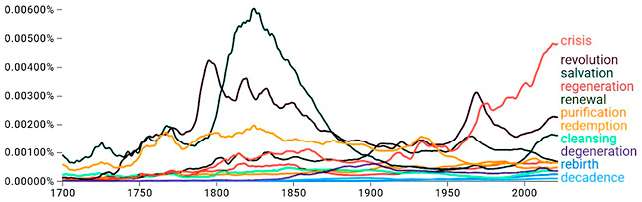
Finally, another main aim of the Element has been to “unpack” the core fascist myth of regeneration by exploring its concrete content, the multiple reference objects of salvation, the diverse religious and cultural components of local or national salvation myths, and the means employed to achieve this goal. I argue that fascist movements drew on a broad spectrum of regenerative myths – widely available in Christian as well as other world religious traditions (Jewish, Islamic, Buddhist, etc.) and further amplified in the Romantic and post-Romantic imaginary of their respective national or religious culture. Fascism’s palingenetic core was continuously defined and redefined, in a transnational exchange, by numerous intellectuals and politicians, who elaborated on the theme of the regeneration of the “organic nation” through political, ethnic, or racial purification, adding specific national colorings. The fascist dark palingenesis culminated in the Holocaust, as a transnational and cooperative cleansing project, initiated and led by Nazi Germany and involving a wide spectrum of allies and collaborators.
The New Obscurantism: Prophets of Regeneration Redivivus
The argument presented in this Element illuminates contemporary processes of radicalization, pointing out that the combination of messianic nationalism based on eschatological visions of violent cleansing, social militarism, and authoritarianism leads almost inevitably to violence. A century after the sudden but powerful emergence of fascism onto the political scene, the world is witnessing a striking revival of the family of authoritarians propagating salvific agendas, in a new key. Stimulated by the end of Cold War bipolarity, the radical right has shifted from overtly racist ideologies to cultural nationalism, framing immigration and globalization as threats to national identity. Alain de Benoist, in particular, promoted a new metapolitical strategy aimed at the cultural hegemony of the so-called Nouvelle Droite/New Right within a Gramscian logic of ideological influence, to be later converted into political power (Bar-On Reference Bar-On2007).
New Right narratives are often characterized by what Barkun calls “improvisational millennialism,” “a work of bricolage,” claiming to provide “holistic and comprehensive pictures of the world” while mixing together, in a peculiar “mélange,” vastly incompatible elements such as “Eastern and Western religions, New Age ideas and esotericism, and radical politics” (Reference Barkun2013: 19, 10–11). This “improvisational millenarian style” which, as documented in this Element, had already characterized the new faiths of the interwar era, including fascism, has been revived since the 1960s (Barkun Reference Barkun2013: 11, 21). Drawing on the legacy of figures such as Julius Evola and Savitri Devi, new Nazi occultist movements embrace Aryan mysticism, Nordic paganism, and aristocratic esotericism, and exercise a growing influence on neo-Völkisch groups, particularly in the United States and Europe (Goodrick-Clarke Reference Goodrick-Clarke2002). Especially since the 2008 Great Recession, far-right movements have resurged with vigor, triggered by certain structural factors but also greatly amplified by right-wing political entrepreneurs capitalizing on social anxieties generated by economic uncertainties, mass migration, the erosion of traditional social structures, and a growing legitimacy crisis in liberal democracies. Innovative technologies such as satellite television, the Internet, and global social media platforms enable these movements to bypass traditional political communication and expand their reach, spreading xenophobic and conspiratorial content through viral messaging. In this context, a plethora of prophets of the “New Obscurantism,” as Anne Applebaum called them, moved from the fringes of political life to the center:
The philosophers of the Enlightenment, whose belief in the possibility of law-based democratic states gave us both the American and French Revolutions, railed against what they called obscurantism: darkness, obfuscation, irrationality. But the prophets of what we might now call the New Obscurantism offer exactly those things: magical solutions, an aura of spirituality, superstition, and the cultivation of fear.
The resurgence of the New Obscurantism is a global phenomenon, from the quasi-religious QAnon movement in the US to Germany’s Alternative for Germany (AfD) and the postcommunist Central and Eastern Europe (Laruelle Reference Laruelle2006; Mudde Reference Mudde2017; Rydgren Reference Rydgren2018). Much like their historical predecessors, contemporary far-right movements promote salvationist fantasies rooted in messianic visions of national rebirth (Tismӑneanu Reference Tismӑneanu1998). Their ideology often blends ethno-nationalism, conspiracism, and esoteric mysticism with idolatrous forms of charismatic politics, seeking to restore an imagined golden age of racial and cultural purity. The recent instances of J.D. Vance challenging papal theological authority and Donald Trump’s blasphemous Papal and Christological AI-generated visual (self-)representations demonstrate how this new ‘messianic hubris’ can foster a Savior complex, instilling egocentric leaders with a dangerous delusion of divinity.
The ideal of purification through the elimination of the unwanted others, stigmatized as corrupt and parasitic, remains a core desideratum of the far right in Europe: “Would you put an end to parasitism? Then you, too, are a Jobbik voter!” Electoral Placate Jobbik Party, Hungary 2010.

In this climate, visions of dark palingenesis are thus not just a thing of the past; the reservoir of ideas and practices presented in this Element continues to inspire politicians, well after the military defeat of fascism (see Figure 12). Recent studies confirm the centrality of the narrative of rebirth within neofascist cultures (Durham Reference Durham2004), often through the appropriation of history, with reference to classical antiquity or the Middle Ages. Some of these discourses, as the ones promoted by CasaPound in Italy and Golden Dawn in Greece, invoke Graeco-Roman traditions to revive fascist mythologies of salvation and legitimize white supremacism (Ioannidou Reference Ioannidou2022). Once again, as in the interwar era, fears of national decline and cultural degeneration provide an ideological framework for movements preaching rebirth through violent cleansing. To some, neofascism might appear as post-fascism, a more benign form of radicalism, divorced from historical fascism and therefore a less violent, more culturally oriented rejection of universal citizenship, “sans Führer, sans one-party rule, sans SA or SS” (Tamás Reference Tamás2000). This Element warns that, behind the often-employed mask of “positive” purification through inner spiritual transformation (worn, by the way, by interwar fascists, as well), lies the terrifying matrix of dark palingenesis.
Series Editors
Federico Finchelstein
The New School for Social Research
Federico Finchelstein is University in Exile Research Professor and Professor of History at the New School for Social Research and Eugene Lang College in New York City. He is an expert on fascism, populism, and dictatorship. His previous books include The Wannabe Fascists, From Fascism to Populism in History and A Brief History of Fascist Lies.
António Costa Pinto
University of Lisbon
António Costa Pinto is a Research Professor at the Institute of Social Sciences, University of Lisbon. He is a specialist in fascism, authoritarian politics, and political elites. He is the author and editor of multiple books on fascism, including (with Federico Finchelstein) Authoritarianism and Corporatism in Europe and Latin America.
Advisory Board
Giulia Albanese, University of Padova
Mabel Berezin, Cornell University
Maggie Clinton, Middlebury College
Sandra McGee Deutsch, University of Texas, El Paso
Aristotle Kallis, Keele University
Sven Reichardt, University of Konstanz
Angelo Ventrone, University of Macerata
About the Series
Cambridge Elements in the History and Politics of Fascism is a series that provides a platform for cutting-edge comparative research in the field of fascism studies. With a broad theoretical, empirical, geographic, and temporal scope, it will cover all regions of the world, and most importantly, search for new and innovative perspectives.