Introduction
The sciences of premodernity had an outsized chronological and geo-cultural frame, encompassing roughly 3,600 years (2000 BCE to 1600 CE) and scattered across Asia, the Middle East, Africa, Europe, and parts of the Americas. Differences in intellectual contexts, ideational frameworks, and subjects of scientific disciplines preclude any sort of broad characterization of premodern science, and the same is true even within the ancient sciences of the Near East and Mediterranean, where fundamental differences also obtain in the cultures, methods, aims, and approaches to scientific objects of inquiry.
One example of discontinuity can be identified in the domain constructed for objects of inquiry as signs in two of the principal scientific traditions of antiquity, the Babylonian and the Greco-Roman.Footnote 1 Cuneiform texts, while specific about the phenomena they described as signs, approached the subject as the sole work of the gods and the divine determination of the order of things (Section 3.1). Setting apart the traditions that emerged outside of the cuneiform world, the shared conceptual scaffolding for the study of signs in Greek and Latin texts was an all-encompassing nature, and within that framework the debate arose as to whether the heavenly bodies could be physical causes.
Nevertheless, the ancient Greek and Greco-Roman physical theory within which the study of signs was a part of science can in no way be equated to our modern physicalism and its mechanistic foundation. The scope of Hellenistic Greek physics not only included but, in the case of Stoic physics, was also the very substance of divinity (Long and Sedley Reference Long and Sedley1987, vol. 1, pp.266–268; vol. 2, 43 A; Lehoux, Reference Lehoux, Harrison and Roberts2019). A.A. Long and David Sedley wrote: “Since the world is the ‘substance’ of god, and god is the ‘nature which sustains the world and makes things grow’ … physics, in the final analysis, is theology” (Long and Sedley, Reference Long and Sedley1987, p.267). The existence of the gods did not undermine the philosophy of nature or its causality but recast the relationship between the divine and the phenomena. Long and Sedley further note that Stoic philosophy included divination among the sciences (Long and Sedley, Reference Long and Sedley1987, p.263; and Section 2.1, Footnote note 9). In spite of the distinction between their respective approaches to the study of signs, and with respect to celestial signs in particular, as well as their different practices of astrology (Section 4.6), Greco-Roman and Babylonian traditions (and so too the Jewish and Christian traditions) each had significant roles for the divine in their study of signs and how prognostication from signs was understood.
In the Babylonian tradition, the domain of objects of scientific inquiry was not defined as such, but from the evidence of several thousand cuneiform texts dealing with phenomena as signs over the course of two millennia, we can discern objects of inquiry within a range of epistemic modality from actual to possible and conceivable phenomena. The abstract categories defining this range of modalities are modern, but they are implicit in the original texts (Section 5). The cuneiform scholar-scribes produced diverse knowledge corpora for the study of different sorts of phenomena as signs in what can be referred to as ṭupšarrūtu, “the art of the scribe,” from the Akkadian word for scholarship or scribal knowledge (Rochberg, Reference Rochberg2024, pp.40–50). The texts of ṭupšarrūtu afford us a sense of the broad domain of inquiry in the Babylonians’ phenomenal world (Section 1). This Element focuses on the celestial signs.
Celestial signs were organized into a seventy-tablet series, referred to by the scribes as “the series” (ÉŠ.GÀR = iškaru) and titled Enūma Anu Enlil, “When Anu, Enlil.” It begins:
When Anu, Enlil, and Ea, the great gods, by their decision established the designs of heaven and earth and (also) established that the creation of the day (and) the renewal of the month for humankind to see were in the hands of the great gods; (then) they saw the sun in (his) gate (and) they made (him) appear with firm regularity in heaven and earth.
Enūma Anu Enlil has yet to be fully reconstructed and edited,Footnote 2 and many of its sources are fragmentary, but its organization into four groups of celestial signs can be outlined as follows: (1) lunar phenomena, Tablets 1–22; (2) solar phenomena, Tablets 23–35; (3) atmospheric and weather phenomena, Tablets 36–49; and (4) the phenomena of the planets and fixed stars, Tablets 60–70 (Koch, Reference Koch2015, pp.167–179 lists the Tablets with their contents).
The series Enūma Anu Enlil thus arranged the appearances of the moon, sun, planets, fixed stars, and falling stars; optical light phenomena such as lunar halos and parahelia, flashes and rainbows, and increasing or decreasing radiance; atmospheric phenomena such as rain, thunder, and winds; astronomical phenomena such as eclipses and occultations; and appearances of celestial bodies in relation to one another. The prodigious number of celestial phenomena that were identified as signs by the Babylonian scribes should not be mistaken for an idea that everything occurring in the heavens was construed as an ominous sign. As discussed in Section 4, the scribes of Enūma Anu Enlil employed well-defined parameters for the identification of celestial phenomena as signs. Carefully worked-out parameters determined what out of the unsystematic morass of perceived phenomena was deemed significant and interpretable, thus making the phenomena intelligible.
From the sixth to the first centuries BCE nondivinatory texts for recording observations and predictions of celestial phenomena were introduced to the textual culture of ṭupšarrūtu. Neither the extensive observational archive (Diaries, see ADART) nor the Goal-Year texts (ADART, 2001, vol. 6) nor the mathematical astronomy for which the Babylonian scribes were justly renowned in antiquity (ACT; Neugebauer, Reference Neugebauer1975) can be explained solely or even primarily by the study of signs, but the new methods of observation and of mathematical prediction seem to have been fully integrated within the same textual culture as the study of celestial signs. The continuity of the cuneiform tradition of astral sciences is indicated by the fact that late-period astronomer scribes held the same professional title as their seventh-century predecessors, namely “scribe of Enūma Anu Enlil” (ṭupšar Enūma Anu Enlil).
Not only did the mathematical complexity of late Babylonian methods of astronomical prediction exceed anything required by contemporary astrological texts, including horoscopes (Section 4.6), but the theoretical dimension of the ephemerides also exceeded the astronomical schematization attested in earlier astronomical texts such as Enūma Anu Enlil Tablet 14 (al-Rawi and George, Reference al-Rawi and George1991/Reference al-Rawi and George1992) or Goal-Year texts (Brack-Bernsen, Reference Brack-Bernsen and Swerdlow1999). The objective of the late ephemerides to calculate the dates and positions of lunar and planetary synodic phenomena is not the same as that of a cuneiform horoscope, which was to obtain the positions of planets on a birth date, regardless of whether that date coincided with the date of any synodic phenomenon.Footnote 3 It is likely that astronomical data in horoscopes were not calculated directly, but were derived from other texts that recorded the desired planetary and lunar positions; calculation in some cases, however, cannot be ruled out.
The relationship between Babylonian mathematical astronomy and its contemporary astrology parallels the relationship between astrology and astronomy in the later Greco-Roman period (Rochberg, Reference Rochberg2004, pp.162–163). In their edition of the Greek horoscopes, Otto Neugebauer and H.B. van Hoesen noted that the arithmetical schemes used in Vettius Valens’ Anthology and in the Tetrabiblos of Ptolemy “belong to a period of astronomical theory which had been long surpassed at that time” (Neugebauer and van Hoesen, Reference Neugebauer and van Hoesen.1959, p.185). Similarly, the very character of the mathematical astronomy of late Babylonia shows the limits of celestial signs and astrology to define the whole of cuneiform astronomical science. One may well ask what other purpose beyond mathematical astronomy itself was served by the mathematical models, dates, and longitudes contained in those late table texts if not for astrological purposes. Very likely the predictive methods of mathematical astronomy were themselves of sufficient interest to the scribes for them to have developed and maintained this part of Babylonian astral science apart from celestial divination and horoscopy (Rochberg, Reference Rochberg2004, pp.276–286).
If astronomical theory came to be a goal in and of itself, this did not result in the “decommissioning” of celestial divination or astrology. Mathematical astronomy took its place alongside regular nightly celestial observation and the preservation of celestial divination as a part of the same preserve of scribal activity that was encompassed by ṭupšarrūtu. Observational astronomy, predictive astronomy (whether by schemata, Goal-Year methods, or by the arithmetical methods of the ephemerides), divination by celestial signs, and horoscopic astrology were the province of the scribes of the Seleucid temples and cities of Babylon and Uruk collectively. In the second half of the first millennium, Babylonian astral science was fourfold: observational, predictive (by a variety of methods), divinatory, and horoscopic. Each dimension had its own objective – no one invalidated another – but together they formed a multidimensional astral science.
A full understanding of the Babylonian study of celestial signs within the cuneiform scribal culture of science requires that we come to terms not only with the contents of all the complementary parts of astral science (observation, prediction, divination, and horoscopy), but with its background theological assumptions as well.Footnote 4 The relationship between the gods, the signs, fate and causality (Section 3), and the modality of signs, that is, a sign’s possible or conceivable observability (Section 5), points to some of the theological, indeed metaphysical dimensions of the corpus.
In all its dimensions the Babylonian inquiry into celestial phenomena as signs belongs to the history of science because this ancient study of signs reflects a particular idiom of science, distinct but also having certain kinship to other ancient, medieval, and even early modern sciences. In particular, it was the aim to make order and meaning amid the tangle and welter of phenomena that draws the Babylonian study of celestial signs to our attention as a form of inquiry with characteristics we recognize as scientific. This observation is not tantamount to a claim that divination in cuneiform antiquity was science in the same way medieval, early modern, or modern sciences are science. The Babylonian scribes did not speak of “science,” but it is of interest to us, and for the history of science in all its dimensions, to consider the Babylonian scribal knowledge culture in those terms. The cuneiform scribes’ formation of the several disciplines to do with celestial phenomena as objects of inquiry over the course of the two millennia from circa 2000 BCE to the beginning of the Common Era richly attests to that decidedly scientific aim to find regularity and order, and to establish a system within “the rhapsody of perceptions” of the phenomenal world.Footnote 5
1 Ancient Approaches to Signs
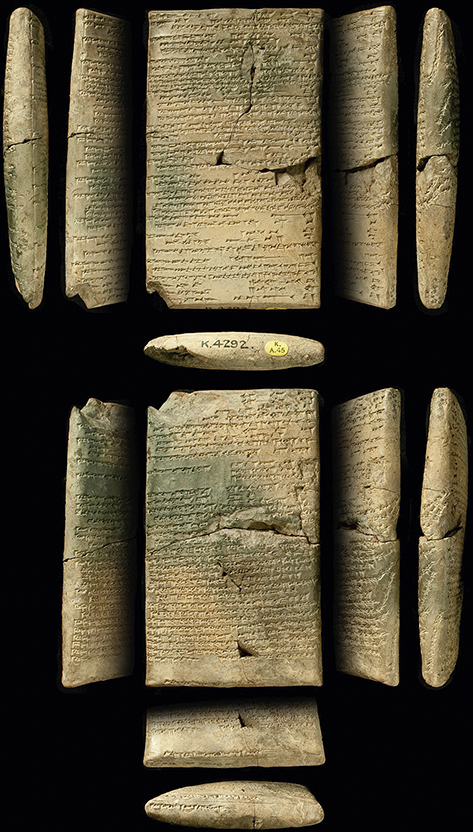
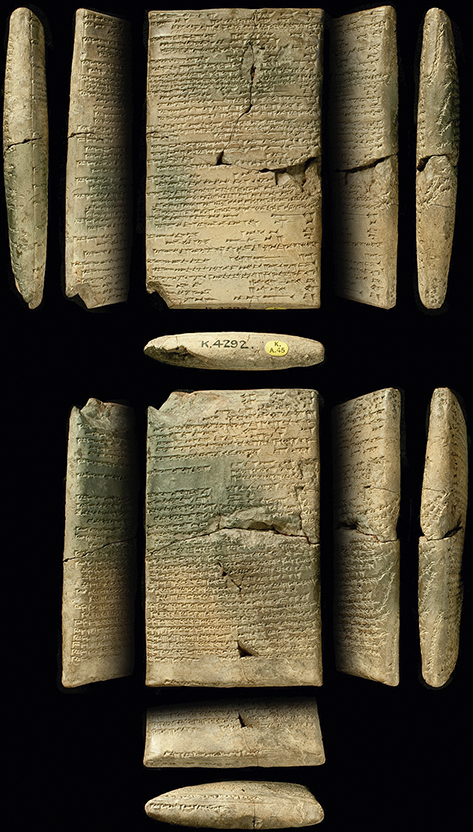
A wealth of evidence for the early focus on signs comes in the form of cuneiform clay tablets (see Figure 1) containing written compilations of Babylonian and Assyro-Babylonian omens from a wide range of phenomena and organized into discrete series by content.Footnote 6
Seventh-century copy of Enūma Anu Enlil Tablet 50 from Nineveh, Museum No. K.4292. Text published in Reiner and Pingree Reference Reiner and Pingree1981, 40–44, Text III.
Multiple series comprise many thousands of lines of extant text (many more lines are likely not extant, having broken away from their tablets), but separately their specialized content focuses on the following major groups of signs: celestial phenomena (the series Enūma Anu Enlil), features and marks on the sheep’s liver and other entrails of a sacrificed animal (the series Bārûtu), dreams (the series Zaqīqu), the appearance of malformed newborns or miscarriages (the series Izbu), signs on the human body and face (the series Alamdimmû), the behavior of animals and the various things (animate and inanimate) observable in a house or a field or in the city (the series Šumma ālu), and the outward signs symptomatic of illness (the series Sakikkû) (for a short descriptive summary of these series see Rochberg, Reference Rochberg2004, pp.44–96 and for details see Koch, Reference Koch2015).
All lists of ominous signs were formulated as correlations between the signs, from whatever realm of interest, and what they indicated, either for the political and economic concerns of the king, or for the health, wealth, and well-being of individuals. The compendia of signs were also unified by their standard formulation as indicative conditionals, or as is notated in modern propositional logic: If P, (then) Q (Cohen, Reference Cohen2012, pp.29–77 and 153–169), or P → Q. This formal aspect of the sign compendia lent coherence to the whole, despite the divisions among celestial, terrestrial, or other categories of signs (for further discussion of the conditional If P, Q, see Section 2.2).
Beyond the classification of signs by subject matter, Assyriologists have traditionally categorized Babylonian divinatory practices in accordance with the two kinds of divination defined in Book I of Cicero’s treatise De divinatione (Div. 1.6.12, 1.18.34, and 1.33.72). In these passages that draw upon Posidonius and Cratippus (Wardle, Reference Wardle2006, pp.31–36; Stojanović, Reference Stojanović2020, pp.6–7), Quintus Tullius Cicero, the younger brother of Marcus Tullius Cicero, makes the distinction between “natural” divination (divinatio naturalis), which was practiced by prophets, and “artificial” divination (divinatio artificiosa) as practiced by experts trained in the divinatory arts. This distinction originates with Plato, where it is traceable in Apology 22b–c in the comparison of poets to inspired oracle-givers who “know none of the things they say,” and/or in Meno 99b–d, where statesmen “have nothing more to do with wisdom than soothsayers and diviners; for these people utter many a true thing when inspired, but have no knowledge of anything they say” (Hankinson, Reference Hankinson1988, pp.127–128, citing Plato Phaedrus 244b).
In Greco-Latin contexts the artificial method of divination was available to one who studied and learned the techniques for interpretation of signs; the natural method, by contrast, was the result of direct reception of divine knowledge, as Plato had said, people who are “inspired, but have no knowledge of anything they say.” This distinction is paralleled in Akkadian cuneiform texts by the words for diviners, that is diviner-scribes as opposed to prophets or ecstatics.Footnote 7 A scribe who interpreted signs because he was trained in “the art” of scholarly omen literature was designated by the title tupšarru (LÚDUB.SAR or LÚA.BA) “scribe,” or ummânu (LÚUM.ME.A) “scholar” or “literatus”; the natural diviner, in the Ciceronian sense, was a “prophet” (raggimu, or “prophetess” raggintu), an “ecstatic” (mahhû and muhhūtu), or a “seer” (šabrû, CAD s.v. šabrû B “dream interpreter”). Cuneiform evidence for such direct prophetic or oracular communication with the divine, including via dreams, is well attested (Koch, Reference Koch2015, pp.291–311).
Another binary distinction well established in Assyriology divides signs from the divine given in response to questions posed by a diviner from signs observed without a specific request. Again, Ciceronian terminology has been adopted for what some Assyriologists, myself included, have called provoked omens (auguria impetrativa) and unprovoked omens (auguria oblativa) (Starr, Reference Starr1990, p.xxxii; Bottéro, Reference Bottéro1992, p.106; Guinan, Reference Guinan1996, pp.421–426; Rochberg, Reference Rochberg2004, pp.4–5, 47, 55, 65, and 84; Renzi-Sepe, Reference Renzi-Sepe2023, p.129 note 260 and p.259 note 396, but see my critical comments on this terminology in Rochberg, Reference Rochberg2016, pp.23–24). Ulla Koch correctly noted that the cuneiform omens of the compendia cut “across such distinctions as signa impetrativa and oblativa” (Koch, Reference Koch2015, p.2). A. L. Oppenheim introduced his own categories of “magical” and “operational” divination (Oppenheim, Reference Oppenheim1977, pp.207–209), where “magical” could encompass both provoked (as in extispicy) and unprovoked (most other omens), thereby allowing for the way cuneiform omens traverse Ciceronian categories. But Oppenheim’s operational divinatory techniques meant provoked omens obtained through the manipulation of oil (lecanomancy), smoke (libanomancy), and lots (cleromancy) and did not address whether the rationale behind such operations differentiated this form of divination from the rest.
Overriding the difference in divinatory techniques, signs obtained from the liver and exta, despite the fact that they were requested of the gods via oracle queries to the sun god (Starr, Reference Starr1990), or via divinatory questions posed to the two gods of divination, Šamaš and Adad (tāmītus, Lambert, Reference Lambert2007), also resulted in a written compendium (Bārûtu).Footnote 8 In the late Babylonian period, celestial signs and signs in the liver were brought together in something of a synthesis by scribes making correspondences between parts of the entrails and elements of astrological significance such as gods, months, zodiacal signs, as in “the path (of the liver) is Šamaš, Ajāru, Taurus; the gall bladder is Anu, Tašrītu, Libra” (Koch, Reference Koch2015, pp.30–31). The term used in liver omens for “sign” or “ominous part” (lit. “flesh” UZU = šīru) is found in a Seleucid astrological text to refer to ominous parts of zodiacal signs subdivided into microzodiacal parts called “the twelve-fold division of sign such-and-such” (12 UZU.MEŠ HA.LA ša …; Sachs, Reference Sachs1952, p.66).
Regarding the terminology “natural” and “artificial,” still found in Assyriological scholarship (Koch, Reference Koch2015, pp.15–16 and table 1, pp.17, 20 and table 2), and despite the parallel distinction between the scholarly and the prophetic, the terms “natural” and “artificial” have no cultural resonance in the cuneiform world. Thus the nature/culture dichotomy carried by the Ciceronian terminology is imposed at the risk of distorting Babylonian ideas. The parallel we observe in the distinction between provoked and unprovoked for Babylonian ominous signs also has its limits. The Latin terms and categories applied to the varieties of cuneiform signs, and their associated practices are less than ideal, even misleading.
What is misleading is that in Cicero’s De divinatione, in spite of presenting opposing positions on the validity of divination and the nature of causality and fate, the two Ciceros (Marcus and Tullius) share a common world framework of nature. The cuneiform texts do not share this, or the complex of Greco-Roman ideas built into the text of De divinatione. There is no dissenting voice within cuneiform sources concerning the validity of divinatory signs or methods. The Babylonian sufferer Šubši-mešrê-Šakkan lamented:
Every day my extispicies are confused and ambiguous (nuppuhu, i.e., filled with niphu- signs).Footnote 9 The omen of neither diviner nor dream interpreter decides my oracular decision.
But in no way did the sufferer imply that omens and divination were invalid. Rather, the passage highlights the ambiguity of signs in certain contexts (Rochberg, Reference Rochberg and Rochberg2026a), and as a result, the sufferer was not in doubt about divination, only desperate to obtain an unequivocal decision from the gods about his condition via an omen of some kind, whether from an extispicy or a dream.
If the goal is to understand the meaning of signs and divination in the cuneiform world, rather than to harmonize these practices and bodies of knowledge with Greco-Roman systems, Ciceronian terminology, clear though it is within its own context, does not transfer to the Assyro-Babylonian particulars.
2 The Intelligibility of Celestial Phenomena as Signs
What makes the world intelligible to us varies with historical and cultural context. Intelligibility, according to Peter Dear (Reference Dear2006, pp.173 and 194), was a goal of natural philosophy in the sense that explanation of natural phenomena demonstrated the inherent intelligibility of the natural world. This was a different approach to science from that of the cuneiform tradition, where the intelligibility of the world meant the meaning of phenomena as signs, not the meaning of nature. The changing approaches and standards for intelligibility are evidence of significant shifts in Western science over time. The present discussion seeks to define what made celestial phenomena intelligible to the cuneiform scholars and how intelligibility was rooted in the goals of scribal culture to understand the world – to make the world intelligible – across the entirety of the history of ṭupšarrūtu.
The systematic treatment of celestial phenomena as signs produced a textual corpus comprised not only of the omen compendium Enūma Anu Enlil itself, but also of multiple independent but interrelated texts: These are (a) excerpts (nishu “section of a series,” rikis girri “guide [to the text]”); (b) commentaries (such as mukallimtu “that which demonstrates,” the term for a written commentary, ṣâtu “extracted,” an explanatory word list based on extracted words, and other commented text types; see Frahm, Reference Frahm2011, pp.136–155); (c) the six-tablet mukallimtu series to the series Enūma Anu Enlil titled Šumma Sin ina tāmartīšu, “If the Moon at Its Appearance” (Koch-Westenholz, Reference Koch-Westenholz and Gyselen1999; Gelken, Reference Gehlken2007; Frahm, Reference Frahm2011, pp.155–160); and (d) two extant catalogues listing incipits of Tablets of Enūma Anu Enlil in sequence (Rochberg, Reference Rochberg and Steinert2018b). The collection and arrangement of celestial signs together with the commentary tradition to explicate their terminology reflects a commitment to making systematic sense of appearances of the moon, sun, planets, stars, and related heavenly phenomena.
But why did the heavenly phenomena come to be systematically scrutinized, and why were these phenomena identified as objects of such rigorous study that an entire discipline of scholarly divination developed around them? In other words, our justification of the study of signs as science is not solely because astronomical (or some other) phenomena were objects of inquiry; the fact that the phenomena became objects of inquiry points to an understanding of that phenomenal domain as one of regularity, sense, and therefore intelligibility, which makes for a kinship relation to later sciences in the Greek-derived traditions of Western and Islamic science. Once the phenomena were viewed as intelligible, they became worthy of systematic observation, description, and analysis, something we can relate to from our own orientation to natural science.
The source of the notion of the intelligibility of phenomena is found in the descriptive language of the scribes, not, however, in the omen compendia, but in royal inscriptions, prayers, and narrative texts. There the celestial phenomena were called “heavenly writing” or “heavenly text” (šiṭir šamê, šiṭirti šamāmi, šiṭir burūmê): Akkadian šiṭru means “text, document, inscription” and is written with the logogram SAR (šaṭāru) meaning “to write,” while šiṭirtu means “inscription, text” and is written with the logogram MUL (kakkabu) meaning “star”; the word burūmû, usually translated “firmament” and always plural, is a synonym of šamû “heavens” (also plurale tantum, and see CAD s.v. lexical section). In terms of cuneiform sign etymology, the writing of the logogram MUL, “star,” for šiṭirtu, “text,” the sign MUL (𒀯) is comprised of three star-shaped signs, originally pictographic, for the Sumerian word AN (𒀭), translated in Akkadian as ilu, “god.” The writing of the word “star” with the sign for the word “god,” which goes back to the origins of cuneiform writing itself, shows that embedded in the writing of the phrase šiṭirti šamāmi, “the heavenly text,” is the idea that what is referred to as a “text,” namely the starry sky, is written in a divine script.
The stars and planets were themselves the divine sources of signs, and they were, as the Babylonian creation poem Enūma Eliš 5.1–2 put it, “likenesses” of the gods:
The introduction to Enūma Anu Enlil Tablet 22 expresses the same idea:
When Anu, Enlil and Ea, the great gods, created heaven and earth and made manifest the celestial signs, they fixed the stations and established the positions of the gods of the night … they divided the paths of the stars and drew the constellations as their [the gods’] likenesses. They created night, day, abstruse omens(?), … ., month and year. They decided(?) the decisions(?) of heaven and earth.
From these passages we infer that the stars and planets were conceived not only as something seen in the day and night sky as though on a surface, or as representational images, but also as embodiments of gods (Rochberg, Reference Rochberg and Nevling Porter2009).Footnote 10
The marks appearing on the surface of the sheep’s liver as ominous signs were also conceived of as a divine script. The discipline of liver inspection, systematized as the bulk of the series Bārûtu, “the art of inspection,” referred to the liver as “the tablet of the gods” (ṭuppi ili). Both the heavens and the liver were thus described as divinely written texts; the heavenly phenomena above and the marks, fissures and holes on the liver below were graphemic signs written on their respective surfaces. The reciprocity and interconnectedness of signs above and below is indicated by the title of the Sixteenth Tablet of Bārûtu: “If the liver is a mirror of heaven” (CT 20 1:31) and a statement from the seventh-century tablet dubbed the “Diviner’s Manual” explains
the signs (idātu) on earth just as those in heaven bear (literally “wear”) sign(s) (ṣaddu) for us. Heaven and earth both produce omen(s) (giskimmu), though appearing separately, they are not separate (because) heaven and earth are interconnected.
All three Akkadian words for “sign,” that is, ittu, giskimmu, and ṣaddu (Section 2.1), occur in this passage from the Diviner’s Manual.
Conceptual metaphors for the intelligible world as a text begin with these Babylonian examples of the “heavenly inscription,” “heavenly writing,” and “tablet of the gods.” The cuneiform examples were followed by the Greek description of the stars as written letters of the alphabet, the grammata and stoicheia, and the Latin liber naturae, “book of nature.” In each one the conception of an intelligible world was based on principles of order discernible by means of reading. Indeed, it is noteworthy that Akkadian has no term to express the idea of “phenomenon” other than the word ittu, “sign” (Section 2.1). And because of the polysemous nature of the cuneiform script itself, the referent of the word for writing, whether it is šiṭru, “writing,” or šiṭirtu, “text,” can mean either the celestial entities and their appearances as script, or the entirety of the heavens as an inscription or text.
As discussed in Section 1, the interpretation of written signs, whether occurring in the heavens, on the liver, or in lists on cuneiform tablets, is not to be confused with prophecies or oracles obtained by means of direct contact with a divine source. Distinct though they were, the written/read omen and the spoken/heard oracle (of course preserved in written form) were each legitimate media conveying the divine will, as detailed in three seventh-century genres of divinatory practice: oracle queries to Šamaš, tāmītu texts (Section 1) addressed to Šamaš and Adad, and the reports of celestial signs (“reports of the scribes of Enūma Anu Enlil” uʾilāti ša ṭupšarrū UD AN dEN.LÍL, see Hunger, Reference Hunger1992). However, the expectation that the world is intelligible through phenomena as signs reflects a different orientation from that of the expectation that a god will “speak” directly to a prophet.
A full analysis of the three genres just mentioned (oracle queries, tāmītus, and reports) and how they relate to one another is beyond the present scope (Starr, Reference Starr1990; Koch Reference Koch2015, pp.67–132), but it is of interest here that the oracle query addressed to Šamaš had a formulaic closing statement saying, “will he who can see, see it? (and) will he who can hear, hear it?” (Starr, Reference Starr1990, p.xx). The oracular message, therefore, could come in the form of a visual sign or an aural message. Two further standard statements read (Starr, Reference Starr1990, xxviii):
(for omens) Be present (lit. “stand”) in this ram, place in it an affirmative answer, favorable designs, favorable, propitious omens of the oracular query by the command of your great divinity so that I may see (them).
And
(for an oracular message) May (this) query go to your great divinity, O Šamaš, great lord, and may an oracle be given as an answer.
In the queries to Šamaš for an oracle, ominous signs from the liver (or other exta) inspection are reported, but not celestial signs. In the tāmītu genre, only one concerns celestial signs, that is, lunar and solar eclipses, and other lunar signs, such as a lunar halo and stars in proximity to the moon (Lambert, Reference Lambert2007, pp.42–51, Text 2).
In the Hellenistic Babylonian period, in what is something of a hybrid of the two divinatory methods of visual sign and aural message, a medical astrological text presents instructions for two dream incubations, the first for “Gemini of Sagitarrius” in month III (Simanu = Gemini, the third zodiacal sign) and the second for “Cancer of Sagitarrius” in month IV (Du’ūzu = Cancer, the fourth zodiacal sign) (Hunger, Reference Hunger, Roth, Farber, Stolper and von Bechtolsheim2007, p.146). The first instruction is as follows:
Dream incubation is rarely attested in first-millennium cuneiform texts, but some texts describe rituals for obtaining a divine “decision” or “verdict” (EŠ.BAR/ purussû) as to the outcome or meaning of a sign, including, as Hermann Hunger noted, “the cleaning of the place of offerings and reciting incantations to the Big Dipper” (Hunger Reference Hunger, Roth, Farber, Stolper and von Bechtolsheim2007, p.148). The previously quoted Hellenistic Babylonian text, whose ritual instructions are based on astrological correspondences between months, zodiacal signs, and medicinal plants, aimed to elicit an aural communication from the gods of the night, the divinities of the constellations.
Nevertheless, the reading and interpretation of signs in the omen compendia, in both Enūma Anu Enlil and Barûtu, testify to the fact the Babylonian scholars did not view prognostication of the future solely as a matter of the gift of prophecy, but instead held a notion of the phenomenal world’s intelligibility, accessible by observation, study, and knowledge of reading signs. The idea of the heavenly phenomena and the signs in the exta as a script had to do with the belief that the gods imbued the phenomena with design and sense, intelligibility from the beginning of creation, encapsulated in the term “designs of heaven and earth” (uṣurāt šamê u erṣeti, CAD s.v. uṣurtu meaning 2).
If we are looking for continuities in the history of science, the notion of the intelligibility of the phenomenal world emerges as one such continuous feature of science as a historical phenomenon. The metaphor of the celestial phenomena as a divine script continued into later antiquity with Plotinus (Enneads 2.3.7 and 3.1.6; Gerson, Reference Gerson, Dillon, King, Smith, Wilberding and Gerson2018) and in Christian theology with Origen (Philocalia 23.15, quoted in Eusebius, Pr. ev. 6.11). Ultimately the intelligibility of natural phenomena through mathematical means was expressed through the metaphor of the book of nature (liber naturae) by Galileo in The Assayer (1623).
2.1 What Is a Sign?
In Akkadian, the following words had the meaning “sign”: ittu, giskimmu, and ṣaddu. The word ittu had four clusters of meaning and four distinct semantic contexts.Footnote 11 First is the complex “mark, sign, feature, characteristic, diagram,” second is “omen or ominous sign,” third is “password, signal, and inside information,” and in the fourth ittu takes on the meanings “notice, acknowledgment, or written proof” (CAD s.v. ittu.). In the meaning “omen, ominous sign,” ittu (plural GISKIM.MEŠ or Á.MEŠ = ittātu or, in Neo-Babylonian, idātu) can mean auspicious, propitious, favorable/unfavorable, ill-boding and harmful (lemuttu and lumnu), untoward (la dumqi), and other qualities such as “wrong, portending harm” (hāṭû), or “abnormal, ill-portending” (ahû).Footnote 12 In a ritual incantation against snake omens, the incantation is to be addressed to the sign itself (ittu/GISKIM) as though personified: “You, sign, that have occurred for me!” (Caplice, Reference Caplice1967, 32–33, line 16′, also cited in CAD s.v. ittu A meaning 2).
As an ominous sign, ittu referred to the many thousands of occurrences, appearances, and behaviors of all sorts of things compiled in lists with events connected to them by means of their conditional phraseology. In a letter to the Assyrian king, a scholar says, “I wrote down whatever signs (ittāte, written GISKIM.MEŠ) there were, be they celestial, terrestrial or of malformed births” (Parpola, Reference Parpola1993, p.4, Text 2: 6). The term ittu is used in the lunar eclipse omens of Enūma Anu Enlil Tablet 20 to denote the eclipse as a sign: “Thus (kīam) is its (the moon god’s) sign (ittu) (and) its prediction (lit. decision, or verdict) (Rochberg-Halton, Reference Rochberg-Halton1988, p.198: 9; p.209:9; p.211:9). Several seventh-century texts with celestial signs are discussed by Eckart Frahm (Reference Frahm2011, pp.166–167) as “GISKIM-texts,” so called because they share the summary phrase “these are the signs of …” (annītu ittu (GISKIM) ša …). He posits that these represent MUL.APIN Tablet III; however, the existence of a third tablet of MUL.APIN is rejected by Herman Hunger, David Pingree, and John Steele (Hunger and Pingree, Reference Hunger and Pingree1989, pp.8–9; Hunger and Steele, Reference Hunger and Steele2019, p.130), leaving the identity of the GISKIM-texts a puzzle (Horowitz, Reference Horowitz2020, pp.79–80). Two late Babylonian (ca. fifth century) astrological texts also referred to lunar and solar eclipses as a sign (ittašu “its [the moon’s] sign, see Ossendrijver, Reference Ossendrijver, Löffler, von Recklinghausen, Rickert and Ventker2025, p.790 Text A: 6, rev. 5 and 8; p.792; p.794 Text B: 2′, 4′–5′; 795: 8′).
Often written with the Sumerian logogram GISKIM, this writing gave rise to the derived learned Standard Babylonian and Neo-Babylonian Sumerian loanword giskimmu “sign,” attested in royal inscriptions and scholarly texts to mean “ominous sign,” as in the following from the reign of Esarhaddon:
good signs (idāte) were established for me in heaven and on earth concerning the refurbishing of the gods and the (re)building of shrines … in order to triumph (and) to show overpowering strength, he (the Babylonian god Marduk) revealed to me good omen(s) (giskimma) in heaven and on earth concerning the (re)entering of Esagil [the temple of Marduk in Babylon].
In much the same way, a sixth-century Babylonian king, Nabonidus, claimed that the moon god (Nanna/Sin) revealed his propitious sign (giskimmu) for the king to “all humankind” (adnāti) (YOS 1 45 i 2).
Less well attested is the word ṣaddu, defined in the CAD as “sign, signal.” Attestations of ṣaddu are most often in the context of celestial deities and the celestial omens they convey. In this case, the celestial body bearing the sign is expressed in Akkadian with the verbs našû “to bear” or (w)abālu “to carry”:
Mars, who produces omens (lit. decides decisions) for the Land of Amurru, carried his sign (ṣindašu) in the Path of Ea.
In the creation poem Enūma Eliš, Jupiter (MUL.BABBAR “the white star”), the planet of the Babylonian creator god Marduk, is given the epithet “bearer of a sign for all (the world)” (nāš ṣaddi ana kalama). The moon god is said to “reveal” a sign (ṣaddu):
Sin (the moon god), who constantly renews himself, the pure god who produces omens (lit. decides decisions) and reveals signs (ṣaddu).
An epithet of the sun god, Šamaš, from a Neo-Babylonian literary text is “the never-ceasing sign” (ṣaddu, CAD s.v. lexical section). Employing the same idiom, a Neo-Babylonian inscription of King Nabonidus was dedicated to the moon god, Nanna, who “bears a sign (nāš ṣaddi) and makes his sign (ittu) known for all the world” (YOS 1 45 i 7). Finally, an incantation prayer to the sky god, Anu, attests to the epithet “god of heaven, lord of the sign” (il šamê bēl ṣaddi):
In the incantation to Anu, who did not have a planetary manifestation, the epithet “lord of the sign” (bēl ṣaddi) may be warranted by his identity with heaven itself. Apart from the passage in the Diviner’s Manual quoted previously, ṣaddu refers to signs “borne” (našû) by celestial deities, namely Mars, Jupiter, the moon, the sun, and the sky itself.
Translating the Akkadian words for “sign” invariably brings English speakers into the conceptual heritage of Latin and Greek; English words derived from the Latin signum include “signal,” “designate,” “signify,” and “significant”; those derived from the Greek sēma and sēmeion include “semantic” and “semiotic.” The basic meaning of signum is “mark, sign, image,” of sēma is “sign,” and of sēmeion is “sign, mark, token”; the verb sēmeioûn means “to signal, to interpret a sign,” and sēmainein is “to show or indicate by a sign, signify, point out by a sign.” But the conceptual heritage inherent to the semantics of these words goes deeper into Greco-Roman philosophy.
The Greek philosophical definition of sēma and sēmeion and Latin signis is known from treatises on signs, such as that of the Epicurean Philodemus, On Signs and Sign Inferences (Περὶ σημειώσεων, Perì sēmeiōseōn, De Lacy and De Lacy, Reference Lacy, Phillip and De Lacy1978; Manetti, Reference Manetti2002, pp.279–297; Manetti, Reference Manetti2023), commonly referred to by its Latin title De Signis and dated to approximately 40 BCE. Other Greek or Latin texts with explicit discussion of the meaning of signs, sometimes but not always divinatory signs, are Cicero, De divinatione (Falconer, [1923] Reference Falconer1979) and De fato (Rackham, [Reference Rackham1942] Reference Rackham2001) from the first century BCE and the much later Sextus Empiricus, Pyrrhoneiai Hypotyposeis (PH) Book 2: 97–135 (Bury, Reference Bury1933).
From these and other texts we know the terms of a certain portion of what once must have been an extensive discourse across various schools of thought on signs and on divination in Hellenistic antiquity, some of which would have been contemporary with the continuation of Babylonian divination, especially in the form of astrology in late Babylonia (fifth to first centuries BCE). Unfortunately, many of the classical texts are known to us only as titles (such as Chrysippus’ work Perì mantikēs “On Divination,” mentioned by Diogenes Laertius in Lives Bk 7.149; Man, Reference Man2019b, p.156), and, especially when it comes to the Stoics, few primary sources are extant.Footnote 13
This is unfortunate because it was the Stoic philosophers who were closely associated with discussion of the logical connection between a sign and what it signified and with the application of their semiotic to divinatory signs. Moreover, Stoic philosophers regarded the connection expressed in sign-conditionals to be governed by certain structures of inference and principles of soundness, as well as by ideas about causation, fate, and necessity (Bobzien, Reference Bobzien1998, pp.87–96; Allen, Reference Allen2001, pp.147–188). In this context, divination is brought within the bounds of science by its underlying causal principles and aim to predict, or so we interpret what Cicero says of Chrysippus. Susanne Bobzien described the science of divination in the Stoic view based on an attribution to Chrysippus by Cicero:
The early Stoics considered divination as an art or expertise (τέχνη) or as a science (ἐπιστήμη). Chrysippus defined divination as “science which contemplates and interprets the signs which are given to human beings by the gods.”
Cicero was not the only writer to report on Chrysippus’ views, which makes the problem of Quellenforschung about Chrysippus all the more complex. Diogenes, Seneca, Eusebius, Plutarch, Alexander of Aphrodisias, and others all referred to Chrysippus, creating layers of philosophical and religious, specifically Christian, ideology and differences in interpretation of Stoic doctrine in what survives.
It may be difficult not to see an implicit connection between the way signs and human events were treated as a matter of regular recurrence and inductive inference in Stoic divinatory signs on one hand and in cuneiform divinatory texts on the other, and that the interest in signs in both contexts was intrinsically “scientific.” However, Bobzien said:
The regularities between signs and future events were collected by induction and tradition; and, once they were properly formulated, the Stoics called them “theorems” (θεωρήματα, Cic. Fat. 11–17). … It is noteworthy that divination, as viewed by the Stoics, thus had all the elements of an empirical science: data, induction, propositions of a type similar to “laws of nature,” explanation, and prediction. This philosophical upgrading of divination by lifting it on to a more abstract, theoretical, level may go back to Chrysippus – it certainly fits well with his … definition of scientific divination, his concern with the form of the divinatory theorems, and his view of the eternal predetermination of all events.
Since we cannot attribute any of these ideas about divinatory signs to do with theorems, truths, or “eternal predetermination” to the Babylonian scribes, the question is this: Is any part of the Greek philosophical discourse on signs of value for understanding the Babylonian science of signs? In view of extant evidence, we can neither reconstruct back from Stoic ideas to Babylonian ones, nor make any assessment about the extent of Babylonian influence on Greek philosophers in terms of the specifics of the Greek philosophical analysis of conditionals vis-à-vis causality, empiricism, and truth.
Nevertheless, the extant Greco-Latin discourse on signs has the value of being explicit about definitions where the Babylonian is not. Given the impact of Babylonian science and especially astrology upon Hellenistic (Greek and Roman) intellectual and scientific cultures, the ideas concerning signs from both sides, Greco-Roman and Babylonian, are worth discussing if only to clarify how the stakes of Hellenistic philosophers diverged from those of the Babylonians. The nature of signs is the opening subject in Cicero’s De fato, where he says:
It is also necessary to expound the meaning and the theory of propositions, called in Greek axiomata; what validity these have when they make a statement about a future event and about something that may happen or may not is a difficult field of inquiry.
What Cicero in the first century BCE thought of as propositional statements (ἀξιώματα) about future events did not emerge in a historical vacuum, but against the background of his own awareness of the long tradition of Babylonian and Assyrian celestial omen texts and astrology. At the outset of De divinatione Book 1, Cicero acknowledges the Assyro-Babylonian interest in the heavens:
the Assyrians,Footnote 15 on account of the vast plains inhabited by them, and because of the open and unobstructed view of the heavens presented to them on every side, took observations of the paths and movements of the stars, and, having made note of them, transmitted to posterity what significance they had for each person. And in that same nation the Chaldeans – a name which they derived not from their art but their race – have, it is thought, by means of long-continued observation of the constellations, perfected a science which enables them to foretell what any man’s lot will be and for what fate he was born.
Later in the book the Babylonians (Babylonios) are featured by Quintus (Div. 1.36) as he defends the entire scope of divinatory practices. The passage follows from Quintus’ long and sarcastic diatribe against those who would “by sophistry overthrow facts that antiquity has established,” citing examples where correct interpretation of signs was confirmed by actual events. He accepts that disasters have been forewarned by signs from lightning, earthquakes, and entrails, and because of this he will not “be persuaded that the whole Etruscan nation has gone stark mad on the subject of entrails” (Div. 1.35). Similarly, he will not “laugh at the soothsayers” or “brand them as frauds” any more than he can “scorn the Babylonians” who “observe the celestial signs and with the aid of mathematics follow the courses of the stars.” In the same passage he repeats the preposterous number of years of the Babylonian astronomical records, namely 470,000 years, a value (473,000) mentioned in the first century BCE by Diodorus Siculus and others (Diodorus Bib.hist.2.31; see Jones and Steele, Reference Jones, Steele, Crisostomo, Escobar, Tanaka and Veldhuis2018, pp.341, 349–350).
As in Diodorus’ Biblotheca Historica, the association of the ancients from the East with divination and astrology is emblematized in the widespread use of the term “Chaldean” (χαλδαῖος, Chaldaeus) among Hellenistic writers seeking to claim an authoritative source on astrology or other esoterica.Footnote 16 The following introduction to a Greek horoscope for one Anoubion, dated 137 CE, illustrates this with an invocation to the seven planetary gods and an enumeration of the sources of ancient wisdom for (presumably) interpreting the horoscope:
The seven gods: After examination of many books as it has been handed down to us from ancient wise men, that is the Chaldeans, and Petosiris and especially also King Necheus just as they themselves took counsel from our lord Hermes and Asclepius, that is Imouthes, son of Hephaestus.
Cicero saw divination as a universal among all peoples “however refined and learned or however savage and ignorant,” and called it “an ancient belief, handed down to us even from mythical times” (Cicero Div. 1.1–2). For Cicero, divination was universally “that signs are given of future events, and that certain persons can recognize those signs and foretell events before they occur.” He said the Greeks called the practice based on that belief mantikē (μαντική) “the foresight and knowledge of future events” (Cicero Div. 1.1).
The evidence for the Greek philosophical definition of a sign focuses on Stoicism, for which, as already noted, we rely on the discussions by non-Stoics such as Cicero or the Skeptic Sextus Empiricus, who attributed to the Stoics the following definition:
Sign: A sign is a proposition that is the leading antecedent in a sound conditional, revelatory of the consequent.
As discussed by Fabian Ruge (Reference Ruge2022, pp.11–13), the Stoic theory of signs is bound up with the idea of the inferential relation between two propositions or axiomata (ἀξιώματα), which term Cicero also used in the opening to De fato, quoted previously. The axiomata are propositions (Bobzien translates “assertibles”Footnote 18) and as such are elements of arguments that are either true or false, and thus carry truth-value (Bobzien, Reference Bobzien, Algra, Barnes, Mansfeld and Schofield1999, pp.94–96, and cited Ruge, Reference Ruge2022, p.12 Footnote note 4).
At stake for the Stoics, as Ruge states the case, was first the logical relation between the sign and what it signified within the frame of the conditional “if P, then Q,” and second what it meant for one proposition to reveal another. As he put it:
A special difficulty in answering these questions is whether for the Stoics a sign reveals that which it signifies merely in virtue of the fact that the sign implies the signified where the sign is already known and the signified [is] as yet unknown. Or is revelation itself a peculiar relation that cannot be reduced to implication?
Divinatory signs were an important part of the Stoic semiotic theory, but they also retained the idea that signs were given to human beings by the gods, at least according to Cicero Div. 2.130 quoted earlier.
The role of the gods is defined in Div. 1.118, where Quintus determines to “settle the principle on which these signs depend.” It was not, in his view, that the gods are concerned with this mark on the liver or that birdsong. Rather, it was that “the universe was so created that certain results would be preceded by certain signs,” including those on the liver and in the stars or in dreams (Div. 1.118.52). The divine will was thought to determine everything, including the sending of signs (Div. 1.121), and Quintus, in defending divination, proceeded to cite omens that preceded dramatic historical events as proof, such as the eclipse of the moon in Leo that indicated the defeat of the Persians by Alexander. He concludes at Div. 1.125 that “my opinion is that the power of divination exists” despite the inevitable “mistakes” made by diviners in either noticing or interpreting a sign.
The Babylonians too placed signs at creation, as stated in the conclusion to Enūma Anu Enlil Tablet 22:
When Anu, Enlil, and Ea created heaven and earth, they made known (uddû) the (celestial) signs (giskimmu).
Thus, at least in terms of the cuneiform scribes’ own conceptualization, the existence of signs was less a function of the logic of conditional propositions and more the result of the way the world itself was established by the gods, namely, that the gods set up a world order such that signs were “made known” (uddû) in the readable form of celestial (and other) phenomena.
There is no cuneiform evidence for an interest on the part of the scribes to analyze the logic of conditionals even though so many scholarly texts were structured as if-then statements. By virtue of the conditional formulation, the sign (P) and its consequent, or portent (Q) have a logical connection by implication from P to Q from a formal standpoint (P → Q). Nevertheless, the validity of a sign, its truth,Footnote 19 was not expressed as a function of the logic of inference or the truth functionality of an omen’s constituent clauses. In the context of extispicy, it was for the god of whom the “verdict” was requested to “put truth” in the lamb whose entrails would be inspected. When seen against the theology of divine “designs” (GIŠ.HUR.MEŠ/uṣurātu), divine “decisions” (EŠ.BAR.MEŠ/purussû), and divine “decrees/destinies” (NAM.TAR.MEŠ/šīmātu), the evidence points to a fully formulated divine causality (Section 3).
Given that an interest in the logic of conditionals cannot be seen at the forefront of the Babylonian inquiry into signs and their consequents, and moreover, that we cannot explain by logical analysis why the events of the antecedents are associated with those of the consequents, we should look to another way in which meaning was attributed to the phenomena that attained the status of signs. Here it becomes fruitful to turn to the father of the modern philosophy of the sign process or semiosis, C. S. Peirce.
Discussion of even the barest substance of Peirce’s semiotic is beyond the present scope, but one of its aspects is of the essence to a modern analysis of signs in the cuneiform context, namely that Peirce understood signs to be first and foremost representational. To convey the core representational nature of signs he coined the term representamen (for the form of the sign), of which there were three kinds, as outlined with extreme concision in the following passage of his “What Is a Sign?” (Peirce, Reference Peirce1998 [Reference Peirce1894], p.5, section 3).
There are three kinds of signs. Firstly, there are likenesses, or icons, which serve to convey ideas of the things they represent simply by imitating them. Secondly, there are indications, or indices, which show something about things, on account of their being physically connected with them. Such is a guidepost, which points down the road to be taken, or a relative pronoun. … Thirdly, there are symbols, or general signs, which have become associated with their meanings by usage.
In terms of Peircean taxonomy, the sign forms found by Babylonian scribes written upon the heavens in the divine script belong to the third kind: symbols.
Peirce’s definition of the symbol as carrying meaning by cultural usage places the emphasis on the conventional character of the sign form’s symbolic meaning. As modern interpreters conceptualizing the ominous signs (i.e., sign forms) as symbols, we have access to some of the ancient criteria (analogical, ideational, phonological, and etymographical) by means of which a sign (P) could be correlated with an event (Q). This correlation is one way the sign is found to make sense. Strictly speaking, the term “sign” in Peircean semiosis refers to the triadic interrelationship encompassing the sign form, its referent, and the sense it makes (i.e., its conventional meaning).
Within the broad spectrum of celestial signs, one of the clearest examples of the symbolic nature of a phenomenon as a sign is that of the eclipse. The darkening of one of the two luminaries, moon or sun, represented generally calamitous portents, misfortune and harm (lumnu), as expressed in the following passage from an incantation addressed to Ea, Šamaš, and Asalluhi, the gods responsible for the divine cosmic designs, the lots, and the case judgments of heaven and earth, and who could therefore annul or cancel the untoward consequences of bad signs:
I am afraid, I am upset, (I am) terrified of the ill-boding lunar eclipse, the ill-boding solar eclipse, the ill-boding stars of (the Paths of) Ea, Anu, and Enlil, (and of) the ill-boding of a planet that has approached the stars of the Paths.
The incantation places the ill portent (lumnu) in heaven with the moon or sun in eclipse, or indeed with the stars of the entire heaven from the north in the Path of Enlil to the south in the Path of Ea, or with a planet appearing in one of those paths.Footnote 20 Eclipses are referred to in incantations and rituals designed to annul their effects more often than any other celestial phenomenon among “ill-boding signs and omens” (idāt ittāti lemnēti Maul, Reference Maul1994, p.468: 14).
The terminology used in describing eclipses gives us access to some of the aspects of the symbolic, as opposed to the empirical or mathematical dimension of the Assyro-Babylonian understanding of these phenomena and their relation to the luminaries. The descriptive language in these cases goes directly to the personification of the celestial phenomena as signs. In lunar eclipse terminology, the expression lumun libbi, meaning “grief, mourning, sorrow” (lit. “distress of the heart”), means the moon is eclipsed.Footnote 21
If an eclipse occurs on the 14th, variant, the 15th, variant, 16th day and it disappears in “distress of the heart,” there will be famine, and the people will sell their children. … There will be a diminution of the population.
Both omen and ritual texts provide evidence for an understanding that the misfortune portended by an eclipse, the baleful deviation from the norm of the brilliant luminaries, was attributable to the “mind” (expressed with the Akkadian word libbu “heart” or “inside”), or rather the emotional state of the deity associated with the moon, that is the god Sin. This is vividly expressed in Sin’s cry of “ū’a libbī” (“woe my heart”) at the time of an eclipse (BRM 4 6:11; Linssen, Reference Linssen2004, pp.306, 310, and 318–319).
Consistent with the two senses of the principal verb used in eclipse omens, namely adāru, which means “to be dark” as well as “to be disturbed,” the construct “distress of the heart” (lumun libbi) has both denotative and connotative meanings, that is, denotatively the state of being dark, that is, “eclipsed” and connotatively the moon being stricken with “grief, sorrow, distress, or anger.” The goal of apotropaic magic in the event of an eclipse was precisely to rid the moon god of the grief and gloom of his mental distress. When the darkness cleared and the moon was bright again, the god returned to his normal condition and the terrible omen together with its dire portent was undone and removed. Omens for the case when the moon set (itbal “he disappeared”) before the eclipse cleared were particularly bad, presumably because his return to normal brightness could not be observed (Rochberg-Halton, Reference Rochberg-Halton1988, p.115).
With similar connotative meaning, weeping was said of the sun in solar eclipses:
If the sun weeps because of the decision of the Anunnaki, (and when) you observe the sky there is darkness, (and) Libra is surrounded by a green halo: Enlil will … a period of hostilities will come and one king will defeat another king […]
This omen is explained in a commentary (van Soldt, Reference Soldt1995, p.41 Text Ca rev. 11′) as an expression for a solar eclipse: “On the 28th of Abu the sun will be eclipsed and surrounded by a green halo” (van Soldt, Reference Soldt1995, p.36 Footnote note 4). The “decision of the Anunnaki” (the netherworld deities) causes the weeping of the sun at end of the month on the twenty-eighth day, when solar eclipses can occur.
A hymn addressed to the eclipsed sun god, Šamaš,Footnote 22 as in the omen for the solar eclipse, refers to the netherworld Anunnaki (text is restored here without indication of breaks in the tablet):
The foregoing excursus into the eclipse as a symbol illustrates the range and depth of meaning associated with celestial phenomena as signs. Heavenly appearances as representations of conventional meanings could in that way be read as one reads an inscription or text, hence the “heavenly writing.”
We are not able to explain very many other celestial signs to this same degree, but the symbolic nature of celestial signs is nevertheless clear in many of the ways these phenomena were interpreted as “revelatory” of their consequents by means of functional interpretative codes (Brown, Reference Brown2000, pp.45, 106, 139–153 and throughout; Koch, Reference Koch2015, pp.2, 28, 151, and 197; Rochberg, Reference Rochberg2016a, pp.106–107, 228, and 241). The “code” favored binaries (up/down, left/right, early/late, in front of [= to the west of, with respect to the diurnal rotation]/behind [= to the east of]) and schematic symmetries such as the cardinal points, or fixed patterns such as the enumeration of colors (black, white, red, yellow, and variegated).
One of the best examples of the interpretative schemata of cuneiform signs is found in the meanings attributed to left and right symbolism (Guinan, Reference Guinan1996). This and other examples of the interpretative code employed by the scribes also provides clear testimony to the mechanism of schematic and analogical reasoning in the symbolic reading of signs (Rochberg, Reference Rochberg2016a, pp.156–162).
2.2 If P: The Conditional Formulation and Other Formal Considerations
In the cuneiform omen corpus, if-then indicative conditionals were the standard form for statements establishing a correlation between two sets of events we can denote as P and Q: On the condition of the sign (P), which is a phenomenon or series of phenomena described in the antecedent or protasis, the set of circumstances named in the consequent or apodosis (Q) would be expected to occur. The omen statements begin with the subordinating conjunction “if,” most often written DIŠ (šumma), but a variety of other spellings are also attested (CAD s.v. šumma).Footnote 23
The omens of the compendia were systematic, organized statements, scholastic correlations between P and Q, whose connection can be understood as meaning “on the condition that P, Q” or “if P is the case, Q is the case.” Because the verb of the consequent is generally in the present/future aspect, we translate “if P occurs, Q occurs/will occur.”Footnote 24 The consequent is expressed as a subsequent occurrence, such as: “If (given, or on the condition that) Jupiter passes at the right of Venus: Guti will be conquered with a strong weapon” (Reiner and Pingree, Reference Reiner and Pingree2005, p.41 BM 35045 + 46236: 4). The prognostication of events from signs, as given in the compendium, such as in this example where the relation between Jupiter and Venus signals the conquest of Guti (a northern enemy people), was dependent upon a scholastic interpretative code invented to make rational sense of the phenomena identified as signs (see Brown, Reference Brown2000, pp.139–153 for the celestial signs of Enūma Anu Enlil; de Zorzi, Reference De Zorzi2011, esp. pp.52–59 for the anomalous births of Izbu, and more generally, see also Baragli and Kikuchi, Reference Baragli and Kikuchi2025).
The compendia Enūma Anu Enlil (celestial omens), Šumma Alu (terrestrial omens), Bārûtu (omens from entrails), etcetera compiled more or less standardized lists of if P, then Q statements. The omen statements provided in the lists instantiate the representational (i.e., symbolic) rules by which phenomena as signs were correlated with other events. We cannot reconstruct when exactly the correlations of P to Q were established, but Old Babylonian omen texts (ca. 1800 BCE) already attest to their systematic patterned relationships.
The compendia served as authoritative reference works for the identification of the signs and their expected consequences. This is clear from the scholarly correspondence noting what was “written in the series” versus oral tradition (ša pī ummânī lit. “from the mouth of scholars”) or from a source “outside” (ahû) the series, as in the following example from the scribe Ištar-šumu-ēreš, probably written to Esarhaddon:
And the matter of the planet Jupiter is as follows: If it turns back out of the Breast of Leo, this is ominous. It is written in the Series as follows: “If Jupiter passes Regulus and gets ahead of it, and afterwards Regulus, which it passed and got ahead of, stays within in its setting, someone will rise, kill the king, and seize the throne.” This aforesaid is the only area which is taken as bad if Jupiter retrogrades (lit. turns back) there. Wherever else it might turn, it may freely do so, there is not a word about it.
This passage illustrates the use of the compendium Enūma Anu Enlil, referred to by the scribes as “the Series,” to interpret the ominous meaning of Jupiter “getting ahead of,” that is appearing to the west of the “King star” (MUL.LUGAL = Regulus, or α Leonis).
From a structural perspective, in addition to the use of the indicative conditional introduced by “if,” omen texts also employed the devices we call paradigm and syntagm, based very loosely on the ideas of Ferdinand de Saussure and Roman Jakobson, who followed him. Assyriology is only one of many disciplines to adopt this terminology. These devices have been discussed and successfully applied by Abraham Winitzer to Old Babylonian extispicy omen text forerunners to Bārûtu (Winitzer, Reference Winitzer2017, pp.25–27 and throughout).
The paradigmatic relationship refers to the vertical patterned arrangement of signs whereby an element is selected and then replaced in sequence, as in the following list of antecedents (protases) from the planetary omens. These construct a paradigm not only of the named stars in relation to Jupiter, but also in what relation they were (to the front [= to the west of], behind [= to the east of], to the right and to the left):
As seen here, when the paradigm is completed, a new variable (in this case, a different fixed star) is introduced, and the paradigm is refreshed. New variables were introduced within the limits of the conceptual framework of a particular sign, or category of signs, in this example, the position of Jupiter with respect to stars.
The omen statements were also structured by horizontal syntagms, the relation that constituted the sign together with its correlation and formed the unit of meaning. The following omen contains two syntagms, constructed from the case where Scorpius rises heliacally before or after its expected month of heliacal rising (restored words from a break in the tablet are not indicated):
The Scorpion rises heliacally in month VIII, variant: month X; if this star rises early: the king of that land will go about proudly, he will subdue the kings his enemies; if this star rises late: the kings of all lands will start hostilities against the king of that land.
Either or both the antecedent and the consequent could be made up of compound clauses, as in the following example of a lunar eclipse omen from Tablet 20 of Enūma Anu Enlil:
If an eclipse occurs on the 14th of Nisannu, and the god (i.e., the moon), in his eclipse, becomes dark on the side south above, and clears on the side north below; he sets during the eclipse, and … ends.
… The prediction] is given for Agade and the king of Agade. The king of Agade, his city and his people will be well. The reign of Agade will fall into anarchy, (but) its future will be good.
The entirety of Tablet 20 utilizes the device of paradigms in which all the variables seen in this example produce variation: the day, the month, and the direction of darkening and clearing of the lunar disk. Syntagmatic changes also determine the all-important correlations in the consequents, for example that the direction of the eclipse shadow represents or is correlated with a certain country, where directions (or winds) and countries are organized into a schema, such as
The paradigms and syntagms generally also worked together, as in the following series of signs concerning Jupiter and its flare (ṣirhu):
The paradigm is constructed of Jupiter’s flare in the four directions and the three watches of night, which then generate the syntagm of the countries afflicted with rapādu disease.
3 Signs, Causality, Fate, and the Gods
The scholastic treatment of signs in the form of Babylonian omen series, excerpts, and commentaries is the backdrop to the later sciences of signs that emerged outside the cuneiform world, that is, in Hellenistic, late antique, medieval, and Renaissance philosophy and sciences. The later transformative ideas would focus on sign-inference and causation, fate and the role of the divine, whether conceived as the gods or God, and a debate on deterministic necessity, free will, and divine foreknowledge. Because a full exposition of this complex matrix of ideas in both the Babylonian and the Greco-Roman, let alone medieval and Renaissance traditions, is not possible in the present brief format, the following discussion is necessarily of a summary nature (for causality in cuneiform texts see Rochberg Reference Rochberg, Melville and Slotsky2010a, pp.19–30 on “fate”; pp.411–425 on divine causality; Reference Rochberg2016, pp.164–190, esp. pp.166–175 on constant conjunctions; see also Steinkeller, Reference Steinkeller, Drewnowska and Sandowicz2017). Questions of causation from the antecedents to the consequents in the Greek philosophical analysis of sign-conditionals (Hankinson, Reference Hankinson1998, pp.244–247), and of fate as related to the causal role of past to future events (Cicero Fat. 10.20–23; Hankinson, Reference Hankinson, Algra, Barnes, Mansfeld and Schofield1999, pp.526–531), show some of the significant changes that followed the textual traditions left by the cuneiform scribes.
3.1 Babylonian Divine Decree versus the Greek Chain of Causes
The creation of cuneiform compendia of sign-conditionals is inextricably tied to the various Babylonian practices of divination enumerated in Section 1 and to ideas about the role of the gods in establishing the signs themselves (Section 2.1). The causality underlying divination by signs, whether celestial, terrestrial, or in the exta was said to be divine, as opposed to a force or power attributed to the sign-phenomenon itself. Such a material force would emerge later in Greek astrology in the form of planetary rays (ἀκτίνες) that conveyed stellar influence down to the sublunary world (Ptolemy Tetr. 1.24; 3.10), but the view that the ominous signs were themselves causes for the Babylonians is thus far unsubstantiated (Rochberg, Reference Rochberg and Rochberg2026b). Similarly, any notion of fate as a force beyond the gods, explicitly stated in the second century CE by ps-Plutarch (De fato 568C, see Cacciatore, Reference Cacciatore, Jażdżewska and Doroszewski2024, p.142) as energeia (ἐνέργεια “activity”) and ousia (οὐσία “substance”), much less as a universal determinism (Section 3.1), is not discernible in cuneiform texts.
In the absence of material forces, then, what can be said about causality and what we call “fate” in the Babylonian idiom? A rich Akkadian vocabulary of divine decree, judgment, decision, and response to divinatory questions is encapsulated in the following words and phrases for actions carried out by divine agency: šīmta šâmu lit. “to decree the decree,” or “to determine the state of affairs,” purussâ parāsu “to decide a (judicial) verdict” lit. “to decide the decision”, dīna dânu “to judge the case,” alakta lamādu “to learn the oracular decision,” pišra pašāru “to interpret the interpretation,” amû/wamû “to say,” tāmītu “query for an oracle,” âru/têrtu “message, divine decree, extispicy,” and ṭēmu “divine will.”
The Sumerian logogram NAM.TAR, sometimes simply NAM, for Akkadian šīmtu “that which is decreed” or “determined order,” is significant for the semantic underpinnings of the Akkadian word and its conceptual framework (summarized in Polonsky, Reference Polonsky2002, pp.168–178). The Sumerian word nam-tar “to determine (decide or apportion) the determined (decided or apportioned) order” combines NAM “what is determined or allotted” and TAR “to decide/apportion (lit. “cut”)” (Polonsky, Reference Polonsky2002, pp.75–100).
Sumerian NAM.TAR gave rise to the Akkadian loanword namtaru “death (or lot),” also the name of the demon who brings death, dNAM.TAR/namtar(u), as well as the netherworld deity of the same name (Beltz, Reference Beltz2023). At the end of the cuneiform writing tradition, the Babylonian demon Namtar is preserved in Greek letters in a Graeco-Babylonian incantation mentioning “evil Namtar” (dNAM.TAR lemnu see Geller, Reference Geller1997, p.76 text No. 11 [BM 34816] obv. 2), rendered in Greek letters as [ναμθ]αρ λεμν (Geller, Reference Geller1997, p.77 text No.11 [BM 34816] rev. 4).
The term šīmtu is central to the ideational complex we translate as “fate” in cuneiform divinatory texts, as its meanings included the determined or allotted order of things as well as the future. Its association with purussâ parāsu “to decide a (judicial) verdict” relates the divine determination of the course of events to the process by which the consequents of signs were determined, namely by the handing down of “verdicts” (purussû) by a god or gods. As mentioned before, in a clear expression of divine causality, Enūma Anu Enlil Tablet 20 states categorically that the eclipse “is his (the moon god’s) sign and his decision.” Omens in the oil divination corpus insert the term šīmtu between antecedent and consequent, as if to indicate that the consequent is, in fact, that which is decreed to occur: “If when I drop oil into water it formed no edge and returned to an elongated shape(?), determination (šīmtu): the sick one will recover” (CT 3 2:3–5).
In consideration of these Akkadian terms and their usage, it should be clear that the translation “fate,” which to us connotes an inevitable, even inexorable future course of events as a force all its own, does not render the Akkadian terminology very well. Indeed, to speak of fate as a force beyond the gods is to speak within a Hellenistic Greek or Greco-Roman derived idiom, not a Babylonian one (for further discussion see Rochberg, Reference Rochberg, Melville and Slotsky2010a, pp.19–30; for another view, see Lawson Reference Lawson1994 and my review in Rochberg Reference Rochberg1999, pp.54–58).
The decreeing of the order of things denoted by the word šīmtu (plural šīmātu), moreover, was something that occurred at creation, and as such did not exist before the world and the gods were brought into being, as stated in the creation poem Enūma Eliš: enūma ilū lā šūpû manāma šuma lā zukkurū šīmāti lā šīmū “when none of the gods had yet been brought into being nor had they been named, nor had they decreed the order of things” (Enūma Eliš 1.7–8).Footnote 25 The implication is that it was the gods who decreed “that which was decreed,” that is the order of things, and thus before there were gods there was no order.
As reflected in the language of the omen texts, the gods were held to be the responsible agents producing ominous signs and/or their consequences. Typically, the moon god “brings about” the lunar eclipse (CAD s.v. šakānu meaning 2 usage i). Atypically, planets are said to “cause” an eclipse as a sign (ittu), as in bibbu šû … attalî Sin ultaškin “that planet … made the eclipse of the moon” (Ossendrijver, Reference Ossendrijver, Löffler, von Recklinghausen, Rickert and Ventker2025, p.790: 2′–4′) and, most likely referring to the consequence or divinatory meaning of the eclipse, the planets “give,” that is indicate (the meaning, positive or negative, of) the eclipse (⸢5 ᵈbibbu šu⸣ātu ⸢ittašu⸣ ana māti inamdin “those five planets will give its sign for the country,” see Ossendrijver, Reference Ossendrijver, Löffler, von Recklinghausen, Rickert and Ventker2025, p.792: 6′). Weather signs were regularly couched as the result of action by the storm god, Adad, who shouts (šasû), roars (ragāmu), rumbles (ramāmu), and, in an idiomatic expression for thunder, “casts out his voice” (rigma nadû). The following omen from Enūma Anu Enlil Tablet 45 conveys the idea of the causal role of both Adad, the storm god, and Ea, the god of cosmic sweet waters (Apsû): “If Adad shouts seventeen times, Ea will cause the fish to die” (Gehlken, Reference Gehlken2012, p.44: 18′). We must conclude that the notion of causality concerning the appearance and the meaning of signs was tied to the judicial decision-making and decree-giving agency of the gods, and as already noted, the term for the consequence of an omen was purussû “(divine) verdict.”
Babylonian expressions of divine causality raise the question of determinism as to the divine verdicts, and how the Babylonian rationale of divination relates to this question. An extensive genre of apotropaic texts termed namburbû collected appeals in the form of prayers to the divine judges to dispel untoward signs and their consequences (corpus edited in Maul, Reference Maul1994). The “universal namburbû,” addressed to Ea, Šamaš, and Asalluhi (Marduk), was a prayer against “all misfortune” (ka-inim-ma hul-meš dù-a-bi, Maul, Reference Maul1994, p.476: 12′). It opens with an invocation to the gods who decree the order of things:
The text adds specific mention of untoward celestial signs:
I, so-and-so, son of so-and-so … to whom bad signs and omens are repeatedly occurring, am scared, frightened and terrified … the misfortune (portended) by an eclipse of the moon, by an eclipse of the sun, the misfortune (portended) by the stars of Ea, of Anu, of Enlil, the misfortune (portended) by a planet which approached the stars of the paths … (from MS C) the misfortune (portended) by the moon, which was (already) seen (in its first visibility) on the 30th day of Ulūlu (month VI), the misfortune (portended) by Mars, which entered the constellation Cancer and then left it again, and moved into the constellation Leo, passing to the right and left, and in front of and behind the “King star” (MUL.LUGAL = Regulus, or α Leonis).
Calls for a namburbû following the appearance of celestial signs are frequent in the Neo-Assyrian scribal correspondence with the king. One such report follows the sighting of Jupiter in the halo of the moon (Hunger, Reference Hunger1992, p.42 Text 71:4). Another scribe reports: “This is a bad sign for all lands. Let the king my lord perform a namburbi ritual and so make its misfortune pass by” (Hunger, Reference Hunger1992, p.160 Text 288 rev. 8).
To dispel the dire consequences of an eclipse was the objective of the late Babylonian ritual in which the kalû priests played the kettledrum (lilissu) and other cultic personnel recited incantations and songs. This elaborate two-day ritual was to take place both during and after an eclipse (Linssen, Reference Linssen2004) and in the event of observed eclipses (Beaulieu and Britton, Reference Beaulieu and Britton1994, p.77; Brown and Linssen, Reference Brown and Linssen1997, pp.150–154) and predicted eclipses (Beaulieu and Britton, Reference Beaulieu and Britton1994) alike. As the ritual was to be performed during and on the day after the eclipse, the magic most certainly aimed to undo its untoward consequences and therefore the link between sign and consequent.
Just as apotropaic prayer was used to ask the gods to make untoward omens pass by and in so doing dispel dire portents, it was also possible to direct a request to the gods for propitious signs, as in this šuilla “hand-raising” prayer to “all the stars”:
The Akkadian terminology of divine decisions determining the future course of events connotes a form of causality unlike that of Greek heimarmene (εἱμαρμένη) “fate” or Latin (fatum) “fate”), which Cicero defined as follows:
Now by Fate I mean the same that the Greeks call εἱμαρμένη, that is, an orderly succession of causes wherein cause is linked to cause and each cause of itself produces an effect. That is an immortal truth having its source in all eternity. Therefore nothing has happened which was not bound to happen, and, likewise, nothing is going to happen which will not find in nature every efficient cause of its happening.
He further argued that “even if it be admitted that nothing can happen without an antecedent cause, what good would that be unless it maintained that the cause in question is a link in an eternal chain of causation?” (Cicero Fat.15).
It was not enough, according to Cicero, for everything to be linked to an antecedent cause, but the nature of causality defined by heimarmene was as a continuous eternal string (εἱρμός), or chain of causes (εἱρμὸν αἰτιῶν). This, what is in effect a universal determinism, has been attributed to Stoic philosophy (Gould, Reference Gould1974; Meyer, Reference Meyer and Salles2009). R. J. Hankinson (Reference Hankinson, Algra, van der Horst and Runia1996), on the other hand, argued that heimarmene was not as deterministic as is often assumed, but rather closer to ideas of Aristotle and Epicurus, who were not determinists. As Hankinson remarked, “It is one thing to accept that every event is caused, quite another to believe that the nature and sequence of all events is rigidly fixed for all eternity” (Hankinson, Reference Hankinson, Algra, Barnes, Mansfeld and Schofield1999, p.513). Deterministic or not, the ground under which fate and causality were understood in Greek philosophy had already transformed from what we read in the cuneiform sources to something with an ineluctable “transitive metaphysical dependence” of the future upon the past (Hankinson, Reference Hankinson, Algra, van der Horst and Runia1996, p.203).
3.2 Sign-Inference and Causation
In Section 2.1 it was suggested that the ominous signs were “revelatory” of their consequents by virtue of a system of symbolic representation and correlation, not of direct or necessary causation from event P to event Q. Moreover, the correlation between P and Q was not binding. Because the link between P and Q was one of correlation not causation, the undoing of that link was possible by means of apotropaic ritual (namburbû). The so-called Diviner’s Manual, addressed to the seventh-century diviners of the royal court, stated this case:
When you look up a sign (in the omen collections) be it one in the sky or one on earth and if that sign’s untoward portent is confirmed(?) … check the date of that sign and should no sign have occurred to counteract that sign, should no cancellation have taken place, one cannot make it pass by, its harm cannot be removed. It [the harm] will approach.Footnote 26
The Manual implies that some signs can counteract or cancel the ill portent of other signs; if no cancellation occurs, the sign-inference remains, complete with its unfortunate consequent. Much the same is echoed later in De divinatione by Quintus, who, in reference to an “awful disaster which befell the Roman people,” said, “But even if the augury had been false it could not have been the cause of the disaster; for unfavourable auguries – and the same may be said of auspices, omens, and all other signs – are not the causes of what follows: they merely foretell what will occur unless precautions are taken” (Cicero Div. 1.16.30).
The cuneiform evidence does not justify an understanding of the relationship between sign and consequent in terms of a material or causal connection as in heimarmene, nor of “constant conjunction” in the manner of Humean causality (Rochberg, Reference Rochberg2016, pp.166–167, 173–175). Nor does what can be said about the causality of signs in the Greek philosophical analysis apply to its Babylonian counterpart, as Hankinson explained:
What is at issue here is the nature of the divinatory sign. … In the case of a certain type of sign, the so-called indicative sign, the sign-event is such that it is more than materially tied to that which it signifies. The sign is a sign in virtue of a determinate causal relationship which holds between it and what it signifies.
It is of critical importance to make this distinction so as not to fall into assumptions about ominous signs as causes in cuneiform texts (e.g., Fincke, 2006–2007, p.140 and Fincke, Reference Fincke and Fincke2008, p.3).
Testimony to the interest in the logic of sign-inferences, and their epistemic modality regarding possibility and truth was first attributed to Diodorus Cronus (mid fourth century BCE) by the Stoic Epictetus around the turn of the Common Era (Discourses, 2, 19, 1–5; see Long and Sedley, Reference Long and Sedley1987, vol. 2, pp.232–233). Epictetus reconstructed Diodorus’ investigation of a trilemma (three conflicting propositions) about statements concerning the future, calling it the Master (or ruling) Argument (κύριος λόγος). The argument claims that P is possible if and only if it is either true now or will be true in the future.Footnote 27 As such it had implications for the validity of divination, which interested Cicero in De fato 6.12–8.16, in what is sometimes called the Fabius Argument. There, in an oblique allusion to Babylonian-style natal omens, Cicero raised the problem of negated conjunctions:
Well then, here is a specimen of the observations of the astrologers: “If (for instance) a man was born at the rising of the dogstar, he will not die at sea.” Keep a good lookout, Chrysippus, so as not to leave your position undefended; you have a great tussle about it with that stalwart logician Diodorus. For if the connexion of propositions “If anyone was born at the rising of the dogstar, he will not die at sea” is true, the following connexion is also true, “If Fabius was born at the rising of the dogstar, Fabius will not die at sea.”Footnote 28
Such negated conjunctions are never found in the consequent clauses of cuneiform omen texts. Cicero, however, in using the propositions concerning Fabius, his birth at the rising of the dogstar, and his not dying at sea, used the natal omen as a vehicle for an argument about fate and divination and an exercise in predicate logic (Marko, Reference Marko2020). The passage juxtaposes the views of Diodorus and Chrysippus on possibility, impossibility, and necessity, making the case for Chyrsippus’ inconsistencies (Cicero Fat. 7). He concludes his Fabius Argument by saying:
There are many ways of stating a proposition, and none is more twisted round than this one, which Chrysippus hopes that the Chaldeans will accommodate the Stoics by accepting. Yet none of the Chaldeans really use that sort of language, for it is a bigger task to familiarize oneself with these contorted modes of expression than with the risings and settings of constellations.
The discussion of signs and sign-inference vis-à-vis possibility, truth, and the relation of past to future events in Greek philosophy, touches only obliquely on aspects relevant to our investigation of the study of celestial (and other) signs in the cuneiform world. However, the modal epistemology of possibility and impossibility, actuality and conceivability regarding Babylonian phenomena as signs remains an under-theorized aspect of the Babylonian material (Section 5). The cuneiform scribes remained attached to divine causality and did not venture into questions of the logic of the conditionals they had established and preserved for centuries as a canon of the science of signs.
4 Features of the Visible Astronomical Phenomena as Signs
Seeing stars in the night sky is not the same as individuating them within a systematic realm of things, denoting, classifying, and recognizing their regular or anomalous behavior. The ability to define a phenomenon as distinct from a random object or event, or even first to have the desire to make such a distinction, requires experience and a specific focus upon the object or event of interest at which point the object/event becomes a phenomenon. Recognition of the morning star and evening star as phenomena of the same planet, Venus, is a prime example. The aim of the present section is to illustrate in all brevity the major features of celestial phenomena as signs, as they were described in cuneiform texts.
A good indication of the individuation of celestial phenomena in the Babylonian context is the establishment of multiple reference systems by which to denote them, from the construction of constellations as images of mythological or religious figures (Steele, Reference Steele, Brentjes, Brentjes and Mastorakou2024) to areas designated for the observation of constellations (the Paths of Ea, Anu, and Enlil) to sets of fixed stars against which to follow the planets and luminaries – from the Stars in the Path of the Moon (harrān Sîn, written KASKAL dSin, see Hunger and Steele, Reference Hunger and Steele2019, p.195 MUL.APIN I iv 33 – I iv 37), to the so-called Normal Stars, or “counting stars” (kakkabū minâti, written MUL.ŠID.MEŠ). In the final construction of a celestial reference system circa 400 BCE, the zodiac was devised of twelve equal thirty-degree arcs along the circle of the ecliptic (the sun’s path against the fixed stars over the course of a year). The zodiacal signs were called LU.MAŠ/lumāšu in the late period, based on an older term for star (Fincke and Schreiber, Reference Fincke and Schreiber2026).
That celestial or any other set of phenomena came to be objects of inquiry in the cuneiform scribal tradition is inseparable from their original construction as signs. In the main, a reference to the appearance of a celestial phenomenon (tāmartu “appearance,” “observation,” or “visibility,” see CAD s.v.) is a reference to a sign (ittu, see CAD s.v. meaning 2a and b). In late Babylonian astronomical procedure texts specific phenomena are constructed with the verbs “to observe” (as in “in order for you to observe x” x ina amārika, e.g., ACT p.468 s.v. amāru = igi), and “to predict” (as in “you predict x” ana x taqabbi, e.g., ACT p.472 s.v. e = qabû), but without indication that the phenomenon is a sign.
Sections 4.1 to 4.6 set out the major themes of celestial phenomena as signs: (1) cyclically recurring phenomena of the moon, sun, planets, and fixed stars; (2) optical phenomena such as brightness and dimness, colors, haloes, flares, parhelia, and paraselenae; (3) calendrical phenomena given with reference to days and months of the ideal calendar; (4) positional relationships of the luminaries, of one planet to one another, or to the luminaries or to stars, or with respect to the cardinal points; this includes such phenomena as occultations, approaches of planets to stars or to the moon, and the conjunction of the moon with fixed stars; and (5) atmospheric and weather phenomena such as cloud formations, mist, fog, rain, and earthquakes (also considered part of the “meteorological” phenomena). Finally, (6) the situation of the heavens on the date of a birth taken all together as a “sign” or a complex of signs became the goal of the nativity or horoscope.
4.1 Cyclically Recurring Phenomena
Cyclically recurring phenomena are the bedrock of historical astronomy. Parameters such as the length of planetary and lunar or luni-solar periods enabled the development of predictive astronomical science and the establishment of a regulated calendar. Understandably, considering the evidence of ominous signs from periodic phenomena in the cuneiform tradition coupled with the stunning computational models for planetary and lunar synodic phenomena developed by the fourth century, some have looked to Babylonian celestial divination as a first step on a progressive path to the science of astronomy. Despite the quantitative advance of mathematical astronomical prediction, the importance of cyclical phenomena in the ancient study of signs anchors the predictive project in the earliest stages of divinatory sciences.
The divinatory interest in cyclically recurring synodic phenomena of the moon and planets (Venus, Jupiter, Mars, Mercury, and Saturn) emerged in Old Babylonian lunar eclipse omens, and in early systematic astronomical texts such as MUL.APIN prior to 500 BCE. After the sixth century, periodic phenomena became the focus of mathematical astronomy, whose goal was to predict the dates and positions of their synodic occurrences in the zodiacal circle. The synodic phenomena occur when a celestial body (fixed stars near the ecliptic, planets, or the moon) returns to a certain position relative to the sun from the standpoint of the observer. The early astronomical texts, namely MUL.APIN (Hunger and Steele, Reference Hunger and Steele2019) and the “Three Stars Each” or Astrolabes (Horowitz, Reference Horowitz2014), show a particular interest in the synodic phenomena of heliacal risings and settings (Hunger and Pingree, Reference Hunger and Pingree1999, pp.74–75), as well as in the duration of visibility and invisibility, although values are not precise (Hunger and Pingree, Reference Hunger and Pingree1989, pp.148–149; Hunger and Steele, Reference Hunger and Steele2019, pp.205–207).
Synodic appearances as signs go back to what is presumed to be the Old Babylonian period (ca. eighteenth century BCE) in the development of the compendium Enūma Anu Enlil. The appearances of Venus in its synodic cycle comprised the substance of Tablet 63 of Enūma Anu Enlil, sometimes called the Venus Tablet of Ammiṣaduqa.Footnote 30 Of the six synodic phenomena of the planet Venus, four are identified as signs in this text: (1) first visibility in the West (Evening First, which is the heliacal setting as the evening star after superior conjunction); (2) last visibility in the West (Evening Last, which is the heliacal setting of the evening star before inferior conjunction); (3) first visibility in the East (Morning First, which is the heliacal rising as the morning star after inferior conjunction); (4) last visibility in the East (Evening Last, which is the heliacal setting as the morning star before superior conjunction).
Enūma Anu Enlil Tablet 63 is evidence that the five synodic cycles of the appearances of Venus (as evening and morning star, i.e., evening rise and set and morning rise and set) were known to occur every eight years (that is, every ninety-nine Babylonian months minus four days). The omens of Enūma Anu Enlil Tablet 63 are constructed from the sequence of these four synodic phenomena of Venus over a period of twenty-one years (the length of the reign of Ammiṣaduqa) in the following form:
If on the 15th of Month XI (Šabaṭu) Venus disappeared in the West (Evening Last), remained invisible 3 days, and reappeared in the East on the 18th day of Month XI: Springs will open; Adad will bring rains, Ea will bring floods, one king will send greetings to another king.
Because brightness was interpreted as a favorable and propitious quality in celestial bodies, Venus, the brightest planet, was an object of regular observation from an early period. The synodic behavior of Jupiter was also of interest, doubtless because of its brightness.
Fixed stars near the ecliptic also have synodic cycles, and the heliacal risings of stars in the Path of the Moon were systematically presented in MUL.APIN, giving the number of days between the rising of one star and another. Enūma Anu Enlil 51 Text IX attests to the heliacal risings as signs:
The Field (α, β, and γ Pegasi with α AndromedaeFootnote 31) rises heliacallyFootnote 32 in month I; if this star rises early: [ … ] if this star is late and passes by its month and rises [ … ]
The Bristle (the Pleiades) rises heliacally in month II; if this star rises early: the gods will give good counsel to the land; if this star is late and passes by its month and rises [ … ]
Rules for regulating the calendar by the heliacal risings of fixed stars are known from the Diviner’s Manual, mentioned in Section 2.1. The passage in question states:
Twelve are the months of the year. Three hundred and sixty are its days. Bear in mind (lit. take into your hand) the expected time of the zagmukku (beginning of the year). Investigate thoroughly the day of disappearance of the moon, the dates of the first appearances of the stars, their time periods, the correspondence (mithurtu) of the beginning of the year and the (constellation) Field …
The intercalary rule established on the correspondence of the Field’s heliacal rising with the New Year was the basis for assessing its normal or anomalous occurrence and what the meaning of its being on time, early, or late would be as a sign. Enūma Anu Enlil Tablet 51 (IX 1 and IX 16, X 1 and XII 1; see Reiner and Pingree, Reference Reiner and Pingree1981, p.52) states: “The Field rises heliacally in Nisannu (I); if this star rises early: [ … ]; if this star is late and passes by its month and rises [ … ].”
Prominent among signs from cyclically recurring lunar phenomena were phenomena such as the moments of first and last visibility, “opposition,” when the moon and sun were seen on opposite sides of the horizon, and eclipses.Footnote 33 Opposition is usually expressed as the moon (d30) and sun (d20), or “the gods” being “seen together” (ahameš innamrū), or that they “look at each other” (šutātû), or “are in balance” (šitqulu), invariably a favorable sign. The conventional date for opposition was the fourteenth day:
If on the 14th day the moon and sun are seen together: reliable speech, the land will become happy; the gods will remember Akkad favorably; joy among the troops; the king will become happy; the cattle of Akkad will lie in the steppe undisturbed.
If the moon and sun are in balance: the land will become stable; reliable speech will be placed in the mouth of the people; the king of the land will make his throne last long.
A commentary text explains:
If the solar disk and the moon are in opposition: on the 14th day, one god will be seen with the other (ilu itti ili).
A few of the earliest extant Diaries, e.g., –651 and –567, refer to opposition using the terminology of the omens, that is, “one god was seen with the other”:
Diary: The 14th, one god was seen with the other. (Sachs and Hunger 1988, 42, No. −651: 6)
Omen: On the 14th (and) the 15th, one god was not seen with the other (Verderame, Reference Verderame2002, 44:13′)
Signs from eclipses filled thirteen tablets of Enūma Anu Enlil (Tablets 15–22 for lunar eclipses and Tablets 31–35 for solar eclipses). Eclipses were carefully watched and anticipated, and ultimately the attention to the occurrences of eclipses produced the Saros cycle of eighteen years + ~eleven days that brings the return of eclipses of similar nature. The Saros period was used for calculating eclipse possibilities and for eclipse prediction in late Babylonian mathematical astronomy. Already in the compendium of signs the scribes knew to watch for an eclipse around the date of opposition, taken to be the fourteenth day as a standard reference, as in the following examples from Enūma Anu Enlil Tablet 16 and the more elaborate Tablet 20, respectively:
If an eclipse occurs on the 14th of Duʾūzu and begins and clears in the south: A great king will die.
If an eclipse occurs on the 14th day of Nisannu, and the god, in his eclipse, becomes dark on the side south above, and clears on the side north below; the west wind blows while he is eclipsed, and in the last watch (the eclipse) ends; in his šurinnuFootnote 34 Venus enters within him (the moon): the son of the king will enter the throne of his father, variant, the house of his father.
The awareness of the occurrence of lunar eclipses in the middle of the month is already attested in Old Babylonian eclipse omens, forerunners of Enūma Anu Enlil Tablets 17 and 18 (George, Reference George2013; George and Taniguchi, Reference George and Taniguchi.2024).
4.2 Optical Phenomena
Many celestial phenomena of interest to the scholar-scribes had to do with luminosity and brightness. Radiance and brilliance were a characteristic of divinities, and thus of the heavenly bodies as “likenesses of the gods.” As a result, the relative brightness of stars, planets, and the luminaries, Šamaš and Sin, was of considerable importance in the study of signs.
Brightness and light made for propitious signs whereas darkness or dim phenomena were unpropitious. The eclipsed luminaries, representing the darkening of the brightest bodies in the heavens, were thus unpropitious signs. For similar reasons, when Venus and Jupiter, the two brightest planets, were bright, the sign was generally positive. Mars, for its red or dark color, generally indicated untoward events, such as death in the herds.
In the following passage from an inscription of King Esarhaddon, the bright appearance of Jupiter signaled the gods’ approval of his entry into Babylon to restore the temple and make peace (restorations from breaks in the tablet are not indicated as they are confidently restored from parallel passages):
They (the gods) constantly revealed good omen(s) to me concerning the (re)population of the city and the temple. Bright Jupiter, the giver of decisions on Akkad (meaning Babylonia) came near in Simānu (the third month) and stood in the place where the sun shines. It was shining brightly (and) its appearance was red. Its rising was as complete as the rising sun. (This signaled) the reconciliation of the angry gods with Akkad; there were copious rains (and) regular floods in Akkad.
Ultimately Venus and Jupiter would become the benefic planets in late Babylonian natal astrology. (Rochberg, Reference Rochberg, Melville and Slotsky2010a, pp.115–116, 135–142) The brightness of the benefics was a good sign, but a bad sign when dim. Conversely, the malefics (Mars and Saturn) when bright were signs of misfortune, and when dim a (relatively) good fortune.
Optical phenomena related to luminosity can refer to an independent phenomenon, such as šarūru “radiance, brilliance,” ṣalummû “fireball” or “meteor,” and ṣirhu “flare” or “sudden luminosity” (CAD s.v. ṣirhu B). Another luminous flare of some kind is mišhu (CAD s.v. mišhu A), often said of stars. Any one of these terms can be associated with comets, according to Reiner and Pingree (Reference Reiner and Pingree1981, sub 2.2.5, where they translate all these terms as “mirage”). Another luminous phenomenon, said of Venus and the moon, is the “wearing of a crown” (agâ apir), common in descriptions of the full moon (Enūma Anu Enlil Tablet 3, Verderame, Reference Verderame2002, p.60, III.3.1.2), and especially said of the moon is the “shining appearance” (ṣētu in Enūma Anu Enlil Tablet 1, see Verderame, Reference Verderame2002, p.6, I.3.5).
Colors were a common optical feature describing planets, eclipses, and stars. Planetary signs limit the colors to black, green, and red (Reiner and Pingree, Reference Reiner and Pingree1981, pp.19–20, 2.2.6); the full moon’s crown is bright, white, dark, and red (Verderame, Reference Verderame2002, p.66), but lunar eclipses are described most often as red or reddish. Enūma Anu Enlil Tablets 16 and 17 introduced a color schema for eclipses, frequently seen in noncelestial omen texts, viz. white, black, red, yellow and variegated (Rochberg-Halton, Reference Rochberg-Halton1988, pp.55–58, especially p.56).
In a different paradigm of colors, a passage from a commentary to Enūma Anu Enlil Tablet 61 reinterprets the colors of the crown Venus “wears” (agâ aprat) to explain these signs:
The commentary reinterprets the colors of the crown of Venus as referring to other planets standing in relation to Venus.
The appearance of sunrise and sunset can be counted among optical phenomena as they concern mostly colors, but also the appearance of clouds and stars (Enūma Anu Enlil Tablet 26, see von Soldt, Reference Soldt1995, pp.68–84; Tablet 27, see Gehlken, Reference Gehlken and Graziani2000; for Tablet 29 [30], see von Soldt, Reference Soldt1995, pp.114–138).
The optical phenomena as signs also include parhelia and paraselene, both termed šamšatu (written AŠ.ME) “disk,” or, in this case, “mock” sun (in the day) or moon (at night) (see CAD s.v. šamšatu, meaning 2 a and b and discussion section p.334). The following examples illustrate these phenomena:
Parhelion:
If a normal (solar) disk is present and one disk (parhelion) stands to the right (and) one to the left: if the king treats the city and his people kindly for reconciliation and they become reconciled, the cities will start vying with each other, city walls will be destroyed, the people will be dispersed.
Paraselene:
If a disk (a paraselene) stands above or below the moon: the foundation of the throne of the king of the land will be secure, variant: [the king will be present for justice].
If a disk (paraselene) rises during the middle watch of the night and a star stands in front of it: the vegetation will dry up, country will experience famine.
Finally, the lunar halo was the subject of many omens, as in:
If the moon is surrounded by a halo and the True Shepherd of Anu stands within it: the high-lying grounds of the land will prosper.
See also CAD s.v. tarbaṣu (written TÙR) meaning 2 “halo” around the sun (usage a), moon (usage b), stars and planets (usage c) and supūru “halo,” for a large halo around the moon (CAD s.v. meaning 2 and see Rochberg Reference Rochberg, Melville and Slotsky2010b, pp.348–351).
4.3 Calendrical Phenomena
The organization of celestial phenomena by date of occurrence is with respect to dates in the ideal or schematic calendar. This calendar was a 360-day year of twelve 30-day months attested from the earliest periods for purposes of accounting (Brack-Bernsen, Reference Brack-Bernsen and Steele2007), then adopted for scholastic texts, as seen in the Diviner’s Manual mentioned in Section 4.1.
Lunar eclipse signs were generally given for the fourteenth day of the ideal month:
If an eclipse occurs on the 14th of Nisannu in the evening watch and is red; it begins and clears in the north: the king of Akkad is well on account of that red eclipse (but) there will be famine in that land.
Solar appearances on days of the ideal calendar year are typically as follows:
If the sun ditto (i.e., rises early) on the 25th day and (on that day) dust storms blow: there will be a defeat of an enemy force in the country, variant: the king of Akkad.
Solar eclipse omens are mostly based upon the month and day of occurrence. Two sequences are attested in Enūma Anu Enlil Tablets 31–32 and 33–34 respectively. The first (days in parentheses do not occur in every month section) is: The 1st day, the 9th, 11th, 13th, 14th, 15th, 16th, (18th), 19th, 20th, 21st, 28th, 29th, 30th, and on a day when no eclipse was expected, from the 1st to the 30th. The second sequence runs: The 1st day, the 9th, 11th, (12th), 13th, 14th, 15th, 16th, (17th), 18th, (19th), 20th, 21st, 28th, 29th, 30th, from the 1st to the 30th, and at an unexpected time (Section 5.3 discusses nonoccurring solar eclipses on some of these dates).
4.4 Positional Relationships
Positional relationships, either between the luminaries, between one planet and another, or to the luminaries or to stars, are the feature of the ominous signs that point toward the kind of lunar and planetary astronomy for which the Babylonians would ultimately be famed. The terminology is generally that of a celestial body “standing” (GUB = izzaz), for example “Mercury stands in PA.BIL.SAG (= Sagitarrius)” (Reiner and Pingree, Reference Reiner and Pingree1981, p.41 Enūma Anu Enlil Tablet 50–51 III 6a) or “a planet stands at the left horn of the moon” (Hunger, Reference Hunger1992, p.198 Text 350: 1). Enūma Anu Enlil Tablet 27 contains a series of omens in which various stars “stand” (GUB) in “the position” (GIŠGAL = gisgallu) of the sun at sunset, for example:
If the sun sets and the Wagon star (= Ursa Major) stands in its position.
The positional relationship between the luminaries mostly focused on the date of opposition, expressed as “the moon and sun are seen together,” or “are in balance,” meaning they are on opposite sides of the horizon, usually on the fourteenth, fifteenth, or sixteenth day.
A rich vocabulary of positional relationships involving stars includes the terms “to approach” (ṭehû, written TE) and “to reach” (kašādu, written KUR). Reiner and Pingree explained that “the object of these verbs in our texts is almost always a constellation, but the subject can be either a planet or a constellation” (Reiner and Pingree, Reference Reiner and Pingree1981, p.20, 2.2.8.2, and see table VII for bodies “approaching” and “reaching”). Additional terms for positional relationships are “to come near” (sanāqu, written DIM4), “to come close” (qerēbu, written syllabically), to “leave behind” (ezēbu, written TAK4) and “to pass by” (etēqu, written DIB). Reiner and Pingree suggested that these terms had “special technical meanings when applied to constellations (and perhaps, in some or all cases, to planets)” (Reiner and Pingree, Reference Reiner and Pingree1981, p.20). This reinterpretation would be necessitated by the signs worded in the following examples: “If the Bow comes close to UD.AL.TAR (= Jupiter)” (Reiner and Pingree, Reference Reiner and Pingree1981, p.67 Text XIII: 8) and “If the Old Man (= Perseus) leaves the Crook (= Auriga) behind” (Reiner and Pingree, Reference Reiner and Pingree1981, p.73 Text XV 8) and “If the True Shepherd of Anu (=Orion) comes close to the right side of the Bristle (= Pleiades) (Reiner and Pingree, Reference Reiner and Pingree1981, p.79 Text XVIII 7 and 8).
After the invention of the zodiac, the relative positions of the planets to one another carried significance as positive or negative signs in a new way. A few late Babylonian texts refer to the zodiacal sign of the benefics and malefics during a lunar eclipse, for example:
If the moon is eclipsed in Leo … Jupiter does not stand (in) the eclipse; Saturn and Mars stand in Aries or in Sagittarius or The Field (= α, β, γ Pegasi and α Andromedae).
In this case the relationship represents the Babylonian version of trine aspect, a triplicity (or trigon) constituted by the signs Aries, Leo, and Sagittarius. In the Babylonian system, trine aspect devised four groups of three zodiacal signs. They also recognized quartile aspect, or three groups of four quadruplicities, attested in late Babylonian astrology and medicine (Rumor, Reference Rumor2021; Brack-Bernsen, Reference Brack-Bernsen2022). Later, Greek astrology would construct the aspects in terms of the angles between signs in the zodiacal circle, 120 degrees for trine aspect, 90 degrees for quartile, 60 degrees for sextile, and 180 degrees for opposition.
4.5 Atmospheric and Weather Phenomena
Atmospheric and weather phenomena were an important subject in Enūma Anu Enlil, which devoted fourteen tablets (Tablets 36–49; see Gehlken, Reference Gehlken2005, pp.258–259, and Tablets 44–49; see Gehlken, Reference Gehlken2012) to these events. The scribes who compiled the astronomical Diaries also closely monitored atmospheric and weather phenomena, both because they frequently obscured or prevented the observation of astronomical phenomena, and because it seems that the potential for a periodic understanding of weather events and the potential for predicting rains and floods were being explored (Hunger, Reference Hunger1976, pp.237–242). For example:
When, at the beginning of the cold season, i.e., in Ulūlu or Tešrītu, Mercury or Venus rises in the east, there will be rain this year. (If) at the beginning of the warm season, (i.e.) in Addaru or Nisannu, Mercury or Venus rise in the west, there will be floods this year.
For the use of planetary periods to predict rain and flood, see Brack-Bernsen and Hunger Reference Brack-Bernsen and Hunger2002, pp.16 and 22, TU 11 §23: “In order for you to calculate (lit., ‘make’) rain and flood: 72 of Jupiter; 64, variant: 16, of Venus; 46, variant: 13, of Mercury; 59 of Saturn; 79, variant: 47, of Mars.”
The ancient conception of phenomena belonging to meteorology, in Mesopotamia as well as in the Greek and Greco-Roman worlds, included phenomena that Aristotle defined as taking place above, “in the region which borders most nearly on the movements of the stars” Aristotle Mete. 1.1) and on the earth below (“There follows the investigation of the causes of winds and earthquakes” Aristotle Mete. 1.1). Much as in Greek and Roman μετεωρολογία/ meteorologia (Taub Reference Taub2003, 2), Enūma Anu Enlil counted in this category such atmospheric and weather phenomena as haze and mist, various kinds of clouds, thunder, lightning, rainbow, rains, fog, mudslides, and earthquakes. As mentioned in Section 3.1, atmospheric and weather omens were attributed to the storm god Adad (dIŠKUR). Similarly, the classical Greek poets attributed the weather to Zeus and called the weather phenomena “signs from Zeus” (Διοσημίαι).
The omens attributed to Adad sometimes prognosticated other weather phenomena, as in:
If Adad thunders at sunrise, on that day rain will fall, the weather will be bad, variant: showers will come and (then) cease, there will be sick people in the land.
Adad omens also correlated meteorological phenomena to political and economic events:
If Adad thunders like a kettledrum, the crown prince will revolt against his father.
If Adad shouts fifteen times, the harvest of the land will prosper for three years.
Omens from thunder, earthquakes, and mudslides were combined with lunar eclipse omens in Enūma Anu Enlil Tablet 22 Part II (Rochberg-Halton, Reference Rochberg-Halton1988, pp.262–269).
In Seleucid texts from Uruk, meteorological phenomena were subjects for prediction based on planetary synodic positions, for example:
At opposition of Jupiter in Leo and Mars in Aquarius: copious rain; in Pisces and Virgo, the same
Jupiter becomes stationary in Pleiades while Mars stands in Scorpius: massive high water.
In the Greek and Greco-Roman traditions, a different practice emerged termed astrometeorology, in which weather signs were systematically associated with cyclically recurring fixed star phases. Such correlations are found on parapegmata (παραπήγματα; see Lehoux, Reference Lehoux2007), public stone monuments inscribed with cyclical astronomical events and their associated weather events to be indicated by pegs inserted into predrilled holes, as in: “○The Pleiades set in the evening and indicate hail. ○○○” (circles indicate holes for pegs; see Mourelatos, Reference Mourelatos2005, p.282). A third-century BCE parapegma from Hellenistic Egypt (P. Hibeh 27, see Lehoux, Reference Lehoux and Ruggles2014, pp.1626–1627 with previous literature) combined the dates of stellar phases with both weather and Egyptian religious festivals.
The systematic correlation of dates, cyclical astronomical phenomena, weather and mundane events, however similar this was in its separate elements, was quite a different project from that of the meteorological omens of Enūma Anu Enlil. A useful summary of the extensive Greek and Latin sources for weather signs is found in Sider and Brunschön (Reference Sider and Wolfram Brunschön.2007, pp.5–29). Worthy of special note are the treatises of Theophrastus De Signis in the fourth to third century BCE (Sider and Brunschön, Reference Sider and Wolfram Brunschön.2007), Ptolemy Tetr. 2.11–13 and the Phaseis (Phases of the Fixed Stars and Collection of Weather Signs) in the second century CE (for the Arabic version, Neugebauer, Reference Neugebauer1971).
The tradition of omens from thunder in the form of the brontologion (βροντολόγιον) spread beyond the cuneiform world to first-century CE Qumran (4Q318, see Geller, Reference Geller, Lubetski, Gottlieb and Keller1998, pp.224–227; Jacobus, Reference Jacobus2015, pp.177–259), to the Hellenistic Greek and the Etruscan worlds (Turfa Reference Turfa2012) and to Byzantium and further to the Eastern Roman Empire, where there is a brontologion in a Georgian manuscript from circa 1700 (Grove, Reference Grove2021, pp.148–162).
4.6 The Situation of the Heavens as a Complex of Signs: Horoscopes
After many centuries of a scribal tradition in which phenomena were studied as signs, natal astrology (genethlialogy) appeared in the early fifth century BCE in Babylonia, approximately 300 years before the first Greek horoscope (for Greek horoscopes, see Neugebauer-van Hoesen, Reference Neugebauer and van Hoesen.1959, pp.161–162; Jones, Reference Jones1999, vol. I, pp.46–47, 249–295, vol. II pp.372–445; Greenbaum, Reference Greenbaum, Bowen and Rochberg2020; Heilen, Reference Heilen, Bowen and Rochberg2020). The cuneiform horoscopes range in date from the oldest at 410 BCE, which is very close to the earliest date we can assign to the invention of the zodiac, to the youngest at 69 BCE (Rochberg, Reference Rochberg1998, pp.25–26 lists the extant horoscope texts with their dates).Footnote 35
In this late form of Babylonian celestial divination, the situation of the heavens was expressed by means of the zodiacal positions of the five planets and the luminaries on a certain date of birth. This astronomical situation became the basis on which the future of the individual born on the date in question could be forecast, giving the impression that the assembled astronomical data were interpreted as a complex of signs, or perhaps one complex sign.
The new late Babylonian genre of astral scientific texts is referred to in the scholarly literature as horoscopes (Neugebauer and van Hoesen, Reference Neugebauer and van Hoesen.1959; Rochberg, Reference Rochberg1998) or proto-horoscopes (Pingree, Reference Pingree1997, pp.22–24; Jones and Steele, Reference Jones and Steele2011 Footnote note 37; Brown et al., Reference Brown, Ben-Dov and Falk2018, pp.13, 17, 397–399 and throughout). The decisive criterion for this terminological difference is the presence or absence of the astrological ascendant (or horoscopus, Greenbaum and Ross, Reference Greenbaum, Ross., Bareš, Coppens and Smoláriková2010, pp.146–148; Greenbaum, Reference Greenbaum, Bowen and Rochberg2020, pp.444–446),Footnote 36 which to date has not been shown to be present in cuneiform texts. In spite of the absence of the ascendant in the cuneiform texts, the remaining contents of Babylonian horoscopes differentiate them from celestial omens, qualifying them as direct forerunners to Greek horoscopy.
What is at stake for the present discussion is not the comparative difference between cuneiform and Greek horoscopes, but the differences between cuneiform horoscopes and the study of the celestial phenomena as signs in Enūma Anu Enlil. First is the formal presentation of astronomical data, and the kinds of data presented. Horoscope documents begin with a statement about the length of the month prior to the birth: “MN, (the previous month being) full/hollow, night of the nth, the child was born.” The positions of the planets in the zodiac follow (some with degrees of longitude and some as zodiacal signs only), as well as a number of lunar and solar data, for example, eclipses, equinoctial and solstitial dates, dates of lunar visibility durations in the middle and end of the month, and data on lunar latitude (Rochberg, Reference Rochberg1998, pp.39–46; Rochberg, Reference Rochberg, Melville and Slotsky2010a, 257–270).
The principal difference in aim between cuneiform horoscopes and Enūma Anu Enlil was the interpretation of the situation of the heavens as the positions in the zodiac of the five planets and two luminaries (and other data) for the life of the person born on the date, not the fortunes and misfortunes of the king, the population, the economy, the military, and neighboring states. Forecasts for an individual, though rare, are still formulated as omen apodoses, as in the following horoscope:
… he will return (?) [to?] his place [ … ] … He will be lacking property … His food will not [suffice(?)] for his hunger(?). The property which he had acquired in his youth(?) will not [last(?)]. The 36th year (or: 36 years) he will have property. (His) days will be long. His wife, whom people will seduce(?) in his presence, will …
The meaning of celestial signs moved from the large scale of king and kingdom in Enūma Anu Enlil to the small scale of the individual in horoscopes, while the basis for the forecasts moved from the individual sign – the celestial signs as detailed earlier in this Element – in the compendium Enūma Anu Enlil to that of the entire heavens on the date of a birth.
A third-century horoscope was written for the Urukean scribe Anu-bēlšunu, born in 249 BCE. (Beaulieu and Rochberg, Reference Beaulieu and Rochberg1996; Rochberg, Reference Rochberg1998, pp.79–81) The horoscope document was likely written by Anu-bēlšunu himself at the height of his activities as a kalû priest (Pearce and Doty, Reference Pearce, Doty and Marzahn2000, p.339 note 33) and scribe of Enūma Anu Enlil (Pearce, and Doty Reference Pearce, Doty and Marzahn2000, p.338 note 34) between the years 194 and 188 BCE, when Anu-bēlšunu was between the ages of fifty-five and sixty-one. Anu-bēlšunu, the son of Nidintu-Anu, and descendant of Sin-leqe-unninni, was a member of a prominent family of scribes of Enūma Anu Enlil and his own son, Anu-aba-utēr, was another well-known scribe of Enūma Anu Enlil, as well as being a kalû, like his father. Anu-bēlšunu’s horoscope reads as follows (broken passages are enclosed in square brackets):
Year 63 (Seleucid Era), month Ṭebētu, evening of (?) day 2, Anu-bēlšunu was born. That day, the sun was in 9;30o Capricorn, the moon was in 12o Aquarius: his days will be long. [Jupiter] was in the beginning of Scorpius: someone will help the prince. [The child ?] was born [i]n? Aquarius with/ (or “in the region of”) Venus: he will have sons. [Merc]ury was in Capricorn; Saturn was in Capricorn; [Mars] in Cancer.
The structure of the forecasts in the manner of an omen apodosis adds to the impression that horoscopes compiled phenomena conceived of as signs, albeit combined to represent in one composite “sign” all the planetary positions whether they were visible (above the horizon) or not.
The innovative nature of Babylonian natal astrology is twofold. In addition to introducing the individual to the conceptual matrix of gods, divine decrees, phenomena as signs, and the phenomenal world, cuneiform horoscopes also reflect the significant changes in astronomy and astronomical methods evident in new genres of astronomical texts during the second half of the first millennium BCE. The astronomy of Enūma Anu Enlil is summarized in MUL.APIN, but the astronomy of the horoscopes reflects the introduction of astronomical methods and goals of observation, schematization, and prediction not generally attested prior to circa 600 BCE, with some exceptions (Steele, Reference Steele and Rochberg2026). The new astronomy is reflected in Diaries, Goal-Year texts, Almanacs, Normal-star Almanacs, and ephemerides (ADART; Neugebauer, Reference Neugebauer1975, p.351). These are the sources for the astronomical data in horoscopes, mostly derived from Diaries, Goal-Year texts, and likely ephemerides for the horoscopes giving degrees of planetary, lunar, and solar longitude (Rochberg, Reference Rochberg1998, pp.21–22 and Table 2.2; Steele, Reference Steele2000, pp.132–135). Demonstrable proof of a thoroughgoing interdependence of the horoscopes with several of the late Babylonian astronomical text genres (Rochberg, Reference Rochberg2004, pp.145–163) establishes a synthesis within Babylonian astronomy and astrology in the Hellenistic period, much as a synthesis can be shown between the astronomy of Enūma Anu Enlil and MUL.APIN in the period prior to circa 500 BCE.
The interdependence of the various branches of astral sciences during the last half of the first millennium was due to the conscious effort of the scribes to maintain tradition during periods of innovation. According to Noel Swerdlow (Reference Swerdlow1998, p.17), the Diaries connect the study of celestial signs to the development of mathematical astronomy. Names of scribes of Enūma Anu Enlil are not cited in the Diaries because colophons to these texts are extremely rare. A fourth-century Diary (from 322 BCE, ADART, 1988, vol. 1, p.288), however, mentions the scribe Bēl-apla-iddin, who may be the same Bēl-apla-iddin who wrote a procedure text for Mercury (colophon to ACT 816, see ACT, pp.16 and 24; Ossendrijver, Reference Ossendrijver2012, p.215 lower edge).
Evidence of the connection between the study of signs and the activities of mathematical astronomers is exemplified in the third-century horoscope of Anu-bēlšunu. As just discussed, this horoscope attests to connections of the new astrology both to old celestial omens and new astronomical methods, with planetary positions given in degrees of zodiacal signs combined with forecasts (apodoses) in the style of Enūma Anu Enlil. One hundred and fifty years after Anu-bēlšunu’s birth, evidence from a court-protocol text (CT 49 144; see Rochberg, Reference Rochberg, Marzahn and Neumann2000, pp.369–370, 373–375), only sixty years before the last extant astronomical Diary of 61 BCE, indicates that the scribes of Enūma Anu Enlil were responsible for maintaining the practice of regular astronomical observation preserved in the extensive corpus of astronomical Diaries.
The scribes of Enūma Anu Enlil carried out all the aspects of cuneiform astral sciences, from the study and interpretation of signs to the observation and recording of celestial phenomena night by night, calculating these phenomena and even constructing horoscopes (Ossendrijver, 2023). The textual evidence of Seleucid copies of the omen texts of Enūma Anu Enlil makes clear that divination from the celestial phenomena as signs, or at least the preservation of the textual tradition of Enūma Anu Enlil, continued throughout the period of the practice of mathematical astronomy in Babylon and Uruk, and the nightly watch of the phenomena in Babylon until, or very near to the end of cuneiform writing itself.
5 The Modality of Celestial Phenomena as Signs
A modal classification of phenomena as signs is never made explicit in the cuneiform texts. Indeed, actual and nonactual phenomena are not distinguished in Enūma Anu Enlil. However, given the descriptions of sign phenomena across the genres of astral scientific texts, we can derive modal categories of actuality, possibility, and conceivability with respect to celestial phenomena. To be clear, the modal categories of interest in this section are modern; the ancient scribes did not define or distinguish them by terminology. The modern modal categories are of interest both to metaphysics and the philosophy of realism, but their traces can be detected in cuneiform texts. The categories in question are (1) actual observed phenomena, (2) potentially observable or possible phenomena, and (3) nonactual but conceivable phenomena. In cuneiform texts these modal categories can be found in the context of most sign phenomena, but the brevity of this presentation necessitates that discussion is limited to the celestial phenomena.
The first category (actual observed phenomena) is found in seventh-century BCE letters (Parpola, Reference Parpola1993) and reports of the scribes of Enūma Anu Enlil (uʾilāti ša ṭupšarru UD AN dEN.LÍL; Hunger, Reference Hunger1992), datable Diaries and eclipse reports (Huber and de Meis, Reference Huber and de Meis2004; ADART 2001, vol. 5), whereas the second and third categories (the possible and conceivable phenomena) are found in the compendium Enūma Anu Enlil without any overt distinction between them. All together these categories, viz., the actual, the possible, and the conceivable, can be subsumed under a broader (again modern) category of observables (Section 6) in Babylonian astral science.
5.1 Actual Phenomena
In the introduction to their volume on conceivability and possibility, Tamar Gendler and John Hawthorne remarked that “our faculty of perception reveals to us what is actual,” and this is because “our perceptual mechanisms are sensitive to features of the actual world” (Gendler and Hawthorne, Reference Gendler and Hawthorne2002, p.3). In the aforementioned groups of cuneiform texts, namely Neo-Assyrian letters of the royal scholars, the astrological reports (uʾilātu),Footnote 37 the Diaries, called “the regular watch” (naṣāru ša ginê),Footnote 38 and the designated eclipse observation reports (Huber and de Meis, Reference Huber and de Meis2004), we are afforded access to phenomena that were actually observed. In many cases we can date these phenomena. These records of celestial observation reflect an entirely different exercise from that of the omen compendium, which lists exempla of possible and conceivable phenomena (discussed in Sections 5.2 and 5.3). The collective effort and organized program of observation throughout the Assyrian Empire are reflected in the following letter from a scholar:
Now there are clouds everywhere; we do not know whether the eclipse took place or not. Let the lord of kings write to Assur and all the cities, to Babylon, to Nippur, to Uruk and Borsippa; maybe they observed it in these cities. The king should constantly listen.
A typical report of celestial phenomena as signs begins with quotations from Enūma Anu Enlil. (Signs from abnormal births and other events such as sightings of snakes and falcons, are quoted, but less often; see Hunger, Reference Hunger1992, p.xviii.) Many reports only quote omens, but these imply that the phenomenon in question has been observed, such as this report made when the moon was observed on the thirtieth day:
If the moon becomes visible on the 30th day: there will be frost, variant: rumor of an enemy. If the moon becomes visible in Sivan (III) on the 30th day: the Ahlamû will devour the wealth of the Westland. From Rašil, the older, servant of the king.
Hunger remarked that when the Neo-Assyrian reports of celestial signs only quote from the compendium, “in principle, no other information is required, since the protasis of a celestial omen always implies an observation. There would seem to be no need to explicitly repeat what was observed” (Hunger, Reference Hunger1992, p.xvi).
Other reports state that an observation has been made:
We kept watch; on the 29th day we saw the moon. May Nabû and Marduk bless the king my lord! From Nabû’a of Assur.
As signs lunar and solar eclipses are attested as early as the second millennium BCE (lunar eclipse omens in George, Reference George2013, Texts 13 and 14; George and Taniguchi, Reference George and Taniguchi.2024; solar eclipse omens in Dietrich, Reference Dietrich1996). Later, the attention to eclipses produced texts designated for reporting on observed eclipses, both lunar and solar, from a chronological span of nearly 750 years, from the middle of the eighth century (747 BCE) to the end of the first century (10 BCE) (Huber and de Meis, Reference Huber and de Meis2004, p.1).
Observational reports on lunar eclipses show a striking continuity from the exempla of eclipses in Enūma Anu Enlil. The contents of eclipse reports show their continued attention to the time of onset of eclipse, the direction of the shadow and clearing, duration of the eclipse, and the presence or absence of planets (and sometimes stars), all of which were included in various tablets of the lunar eclipse omens although the terminology differs in the various attested eclipse reports (Huber and de Meis, Reference Huber and de Meis2004, shows the evolution of observational practice [pp.8–9] and discusses terminology [pp.10–14]; Rochberg-Halton, Reference Rochberg-Halton1988, pp.49–63 discusses the content and terminology of eclipse omens).
The astronomical Diaries archive contains observations of actual phenomena from 652 to 61 BCE. These include the position of the moon, sun, and planets with respect to ecliptical stars and other important visibilities (see ADART, 1988, vol. 1, pp.13–19 for discussion), as in the following example from a Diary of 464 BCE:
Month VI, the 1st (of which followed the 30th of the preceding month); sunset to moonset: 18°. The 1st, the 2nd, the 3rd, and the 4th, the sun [rose? (or: set)) in a [ …. ] The 5th, Jupiter’s first appearance behind γ Virginis [ …. ] Around the 12th or the 13th, Mercury’s [last] appearance in the east in Virgo. [ …. ] Night of the 14th, sunset to moonrise: 3° 30’. Night of the 15th, …. [ …. the river level] rose 4 cubits. Night of the 17th, last part of the night, the moon was behind the Ch[ariot … ] Night of the 21st, one …. gave birth to [ …. Night of the 22nd, last part of the night, the moon was] balanced 3 cubits below (α Leonis. Night of the [ …. ] (Saturn’s) first appearance, behind Virgo, Saturn being 1 cubit high to the north. [ …. ]
To the category of actual phenomena we can also add the predicted phenomena in the ephemerides of mathematical astronomy (Neugebauer ACT). Because the dates and positions of these phenomena are mathematically generated, they do not represent observations. Nevertheless, the tabulated dates and longitudes of synodic phenomena in the mathematical astronomical ephemerides refer to actual phenomena.
5.2 Possible Phenomena
Just as our faculty of perception “reveals to us what is actual,” our “faculty of conception reveals to us what is possible” (Gendler and Hawthorne, Reference Gendler and Hawthorne2002, p.3). As no distinction between the actual and the nonactual is made in the celestial omen compendium itself, the category of possible phenomena comprises the totality of the phenomena collected there as signs. By far most omens in the compendium, because they focus on appearances and visibilities, stem from phenomena in the perceptual experience of those educated in observing the heavens.
The appearances of all the possible phenomena were described according to the conceptual parameters of the schematic paradigms discussed in Section 2.2. Paradigmatic themes were tied to the practice of sign interpretation such as right-left, the four directions, three watches, colors, and so on. Thus, the possibilities were not entirely open-ended or limitless and the criterion for possibility was not the constraints of nature, but the thematics of paradigmatic structures used in the lists.
5.3 Conceivable Phenomena
Whereas most of the signs collected in the compendium refer to visible phenomena in the conceptual realm of possibility, some conflict with our sense of reality, but nevertheless were entered into the list. The following examples illustrate the problem:
1. Lunar eclipses on calendar days when no eclipse can occur, such as lunar eclipses on days 19, 20, and 21 when only the days around opposition are possible, most often (in the omens) on the fourteenth day (Rochberg-Halton, Reference Rochberg-Halton1988, pp.38–40).
2. The lunar eclipse shadow beginning on the west (the right) side of the lunar disk (Rochberg-Halton, Reference Rochberg-Halton1988, pp.51–55 and tables 4–5). Due to the west to east travel of the moon relative to Earth, it is not possible (in the Northern Hemisphere) to see the eclipse shadow pass from the right to the left side of the moon.
3. Solar appearances at night. The solar disk (šamšatu) is said to rise at night in the omen. “If a (solar?) disk rises during the middle watch of the night, and a star stands in front of it” (AŠ.ME ina EN.NUN MURUB4.BA KUR-ma ana IGI-šá MUL GUB; see van Soldt, Reference Soldt1995, p.27 EAE Tablet 24(25) III 23). The šamšatu (written AŠ.ME) is a writing for the solar disk but also for a parhelion (see CAD s.v.), which as a nighttime phenomenon does not help make this omen any more realistic. Another omen for the nighttime appearance of the sun, using the writing MAN (or 20) for Šamaš, the usual way of rendering “sun,” reads: “If the sun comes out in the night and the country sees its light everywhere” (MAN ina GE6 È-ma KUR UR.BI UD.DA-su IGI; see van Soldt, Reference Soldt1995, p.52 EAE Tablet 25(26) I 1. Note that van Soldt translated “a sun” in order to mitigate the unreality of the sun “coming out” at night).
4. Solar eclipses on calendar days when the sun is not near conjunction, usually on days from the twenty-seventh to the twenty-ninth, and most often occurring on the twenty-eighth. Such omens fill most of EAE 32 (ACh Šamaš 9), such as “If on a day when there should not have been an eclipse a solar eclipse occurs” (šumma ūm la adārišu attalû iškunma, see K.9225+: 33′, courtesy the Trustees of the British Museum) and the similar omen from EAE 33: “If it is eclipsed on an unexpected day” (šumma ina la minâtišu adir, ACh Š 10, K.2214: 9).
5. The occultation of Venus during a lunar eclipse. This cannot occur because Venus will never be in opposition to the sun; its maximum solar elongation is 47 degrees to 48 degrees (Rochberg-Halton, Reference Rochberg-Halton1988, pp.62–63 and note 147), making it impossible to ever be occulted by the moon during a lunar eclipse.
6. The appearance of Jupiter in or near constellations where it cannot be seen, such as the Wagon [= Ursa Major] which, as a circumpolar star, is too far from the ecliptic. Jupiter is said to pass to the front, to the rear, to the right, and to the left of the Wagon Star (Reiner and Pingree, Reference Reiner and Pingree2005, p.32 and see page 75 Group D B M 47688: 12‘–15‘). Other omens for Jupiter coming close to certain constellations may also be impossible, but the omens are not detailed enough for us to decide (cf. Reiner and Pingree, Reference Reiner and Pingree2005, p.28).
7. The appearance of certain stars in the position of the setting sun. These omens are found in Tablet 27: 13‘–27’ (Gehlken, Reference Gehlken and Graziani2000, pp.347–348), beginning with the Wagon (= Ursa Major) which as a circumpolar star will never be in the position of the sun at sunset. Noncircumpolar stars are also mentioned in this section, which, for reasons of their distance from the ecliptic, cannot be seen near the setting sun.
8. Occultation of Sirius in the position of the moon during an eclipse (Rochberg-Halton, Reference Rochberg-Halton1988, p.133 Enūma Anu Enlil Tablet 17, section VI.7), a most unlikely occurrence given Sirius’ declination far below the ecliptic.
Most of the nonoccurring signs can be explained by the expansion to the extremes of paradigmatic schemata (here of days and directions), even though the scribes knew well how unlikely they were to occur. Others, such as the occultation of Venus or Sirius by the eclipsed moon, and the appearance of Jupiter in or near constellations it cannot reach due to their distance from the ecliptic, or the stars standing in the position of the setting sun, while not extensions of paradigmatic schemata, can nevertheless be rationalized in relation to analogous phenomena that can occur and be observed. These nonoccurring phenomena belong to the extremes of the modal imagination but were conceivable within the established parameters of celestial signs, namely dates of occurrence, characteristic appearances (bright/dim, colors), and relative positions of celestial bodies.
6 Observables: The Index of Babylonian Celestial Science
Celestial phenomena as signs held a place within contexts of astral sciences from cuneiform antiquity into the late antique period and remained a part of medieval and early modern sciences of astrology. Outside the cuneiform world, signs would be conceptualized in terms of deviations in the order of nature, or as miracles circumventing natural order and inextricably bound up with divine communication (Daston and Park, Reference Daston and Park2001, p.52 and throughout). It is important to emphasize that Babylonian signs were not conceived of by the scribes in terms of disruptions in the order of nature, and some signs were in fact regular, even cyclical occurrences, as discussed in Section 4.1. The order of nature, conceived as the domain of physical phenomena, had no explicit boundaries in cuneiform texts. Instead, the project of the Babylonian scribes to apprehend various kinds of signs was developed within parameters established for the observable phenomena, whether (in terms of our modern modal categories) possible or conceivable. Those parameters were determined by the scribes’ engagement with the phenomenal world as they saw it and motivated by the desire to make ordered sense of its numerous possibilities.
For modern analytical purposes, modal categories of astronomical phenomena (actual, possible, and conceivable) may be construed as subcategories of observables, borrowing the term from the historical epistemology of Marx Wartofsky: “What is observable, in the pragmatist view, is what a community of speakers and inquirers takes to be observable” (Wartofsky, Reference Wartofsky1968, p.117). My usage of the term (Rochberg, Reference Rochberg2004, pp.250, 254, and 259–261) is meant to cover the entire range of celestial phenomena the scribes took to be observable, which encompassed the full range of potentiality, from the actual to the possible to the conceivable, all of which seem – if we take the compendia at face value – to have been conceived of as existing in potentia in the phenomenal world.
The point could be extended beyond the domain of celestial signs to all phenomena identified as signs, both possible and conceivable, appearing in the protases (P) of the omen compendia, celestial and otherwise. This entire range of phenomena affords us, as interpreters of the sources, a glimpse not only into what the Babylonian scribes considered observable, but also what they considered to exist in the phenomenal world. These phenomena were what Willard Van Orman Quine called “cultural posits,” which “enter, and we may add exit, our conceptual framing of things as structures with which to manage the flux of experience” (Quine, Reference Quine1951, p.41).Footnote 39 These posits of the Babylonian scribes represent both what was known and what existed within the cultural framework of cuneiform science, both to manage the “flux of experience” (Quine’s term) and to organize the “rhapsody of perceptions” (Kant’s term).
The phenomena as signs described in the omen compendia, therefore, were a matter not only of epistemological orientation, but also of ontological commitment. The observable was, in that way:
the index of the whole framework of science, or of the standard beliefs of the scientific community … if the sense of observable shifts from one to another framework, it may also be seen that the frameworks of science also shift, historically, so that the standard “observables” of one period are either augmented or replaced by those of another.
In this sense, the signs, compiled in systematic cuneiform compendia and reported in letters from scholars, comprise an index of Babylonian science.
Across the long history of the cuneiform tradition, observables can be seen to shift and, in the realm of celestial phenomena, become more defined, as was the case for the lunar and planetary phenomena after the fifth century BCE. The category of the observable is useful for our analysis of cuneiform scientific texts because in granting the observability of phenomena denoted as signs in the ancient texts, we are challenged to set aside our own classification of the more limited range of observable phenomena in accordance with modern epistemic and ontological standards.
That the category of historically variable observables becomes useful for analysis of cuneiform science in general can be illustrated with the following remarks of John Norton that bear obliquely on the question of what constitutes an appropriate domain of scientific inquiry, in particular what it is that is observed. His remarks were concerned with the reliability of scientific methods, but they have implications for the objects of scientific inquiry as well. He noted that an acceptance of certain methods carries more than “just our belief that the method is reliable,” because, as he put it, “That belief is not only about the method. It is also about the world. For it incorporates the belief that the world is such that these methods can work reliably” (Norton, Reference Norton2003, p.258, my emphasis). He then stated that
We should have little hope in the prognostications of an entrail reader, no matter how expertly the best methods of entrail reading have been followed. The real world does not admit prediction through reading of entrails, except perhaps for the health of the flock from which the sacrificed animal was drawn.
Norton makes an implicitly ontological (and unintentionally ahistorical) point here, because a world is comprised not only of what is known of it, but also of what is thought to exist in it and what the nature of existent things is. In his example, the objects of inquiry are signs drawn from extispicy, which, ontologically speaking, are not entities accepted in our modern world as valid objects of scientific inquiry. Such signs do not exist, according to him/us, within the range of phenomena we include in our world as observables, which then justifies his statement that signs from entrails do not produce portents in “the real world.”
I may be unfairly using Norton’s statement on method to make my point, as his point was philosophical, not historical. But if the entrail reading in question is written in a cuneiform text of 2,500 years ago, the assessment that the “the real world” does not admit such methods or objects of inquiry is ahistorical. Not only does it imply that the Babylonians completely misapprehended the real world, but it also measures the success of a method in one world by the standards of another in which the method would not be successful (for counterarguments, see Rochberg Reference Rochberg2024, pp.69–72, 105–132).
The Babylonian commitment to the existence of signs and to methods of divination (extispicy, celestial divination, physiognomy, and other forms of divination by signs) as viable and reliable, entailed certain ontological claims about the world. What we believe exists does not (necessarily) suffice to describe or explain the Assyro-Babylonian ontology of signs. We can, however, determine that in the realm of celestial phenomena, the compendium Enūma Anu Enlil systematized phenomena as signs deemed worthy of observation, providing (for us) an index to the Babylonian science of celestial signs.
Conclusion
Our understanding that the Babylonian study of celestial signs comprised a large part of early science stems not from Cicero or Diodorus or any other secondary or tertiary reports on the interests of Babylonian and Assyrian scholar-scribes, diviners, and late Babylonian priestly scholars, astrologers, and astronomers, but from the primary texts written by and for Babylonian and Assyrian cuneiform scribes over the course of two millennia. The phenomena upon which those scribes focused their observations, calculations, and interpretations, the observables mentioned in their texts, remain the primary index of this Babylonian science.
In seventh-century BCE Nineveh, Assyrian and Babylonian scribes of Enūma Anu Enlil copied the compendium of celestial signs, kept watch for the phenomena identified as signs, and reported their observations and interpretations to the Assyrian monarchs. Centuries later, in colophons to mathematical astronomical ephemerides, scribes holding the same title as their Neo-Assyrian predecessors, scribes of Enūma Anu Enlil, composed or copied astronomical tables as well as other texts of astronomical and astrological interest.Footnote 40
Signs were the mainstay of Babylonian science. As one of the essential parts of cuneiform scribal scholarship, the study of signs was not an evolutionary precursor to science; it was science. The science of signs, whether practiced in ancient Babylonia, Hellenistic Greece or Rome, or in medieval Europe (where from the twelfth century the ordo scientiarum included prognostic disciplines such as astrology and divination, Fidora, Reference Fidora2014), and whether framed as the work of the gods or of nature, reflected the idea of an intelligible world. The intelligibility of the world’s phenomena has been highlighted as a “hallmark of natural philosophy” (Dear, Reference Dear2006, p.173) as it is of modern science, but it was clearly also a signature of the cuneiform study of celestial signs.
Abbreviations
- ACh
Virolleaud, Charles. 1908–1910. L’astrologie chaldéenne: Le livre intitulé “enuma (Anu)ilu Bêl.” 2 Suppléments. Paris: Paul Geuthner.
- ACT
Neugebauer, Otto. 1955. Astronomical Cuneiform Texts. 3 vols. London: Lund Humphries.
- ADART
Abraham J. Sachs and Hermann Hunger, Astronomical Diaries and Related Texts from Babylonia. Vienna: Österreichische Akademie der Wissenschaften.
Abraham J. Sachs and Hermann Hunger (1988) Vol. 1: Diaries from 652 BC to 262 BC.
Abraham J. Sachs and Hermann Hunger (1989) Vol. 2: Diaries from 261 BC to 165 BC.
Abraham J. Sachs and Hermann Hunger (1996) Vol. 3: Diaries from 164 BC to 61 BC.
Abraham J. Sachs and Hermann Hunger (2022) Vol. 4: Hermann Hunger, including materials by Abraham J. Sachs, Undated Diaries and Addenda.
Abraham J. Sachs and Hermann Hunger (2001) Vol. 5: Hermann Hunger and Abraham J. Sachs, Lunar and Planetary Texts, with an Appendix by John M. Steele.
Abraham J. Sachs and Hermann Hunger (2006) Vol. 6: Hermann Hunger, including materials by Abraham J. Sachs, Goal Year Texts.
Abraham J. Sachs and Hermann Hunger (2014) Vol. 7: Almanacs and Normal Star Almanacs.
- BM
Museum siglum of the British Museum, London.
- BRM
Babylonian Records in the Library of J. Pierpont Morgan (New Haven 1917 ff.).
- CAD
The Assyrian Dictionary of the Oriental Institute of the University of Chicago. 21 vols. 1956–2010.
- CASPO
Lenzi, Corpus of Akkadian Šuila-Prayers. www.shuilas.org.
- CDLI
Cuneiform Digital Library Initiative https://cdli.earth/CT Cuneiform Texts from Babylonian Tablets in the British Museum.
- K
Museum Siglum of the British Museum in London (Kuyunjik).
- TDP
R. Labat, Traité Akkadien de Diagnostics et Pronostics Médicaux. Paris and Leiden 1951.
- TU
Tablettes d’Uruk, see Thureau-Dangin (= TCL 6, 1922).
- VAT
Museum siglum of the Vorderasiatisches Museum, Berlin, Vorderasiatische Abteilung, Tontafeln.
- YOS
Yale Oriental Series, Babylonian Texts (New Haven 1915 ff.).
Acknowledgments
I am most grateful to Liba Taub, series editor for Ancient Science, Technology and Medicine, for suggesting this project and for many helpful discussions. I thank my colleagues Mark Geller and Alan Bowen for the inestimable help of enjoyable discussions of the material. Sincere thanks are also due Jerrold Cooper and Lis Brack-Bernsen for answering questions about problems in the textual evidence. Finally, I thank the British Museum for permission to use the image included here.
Liba Taub
University of Cambridge
Liba Taub is Director of the Whipple Museum of the History of Science and Professor Emerita of History and Philosophy of Science at the University of Cambridge. She is the author of Ancient Meteorology (2003), Aetna and the Moon: Explaining Nature in Ancient Greece and Rome (2008), and Science Writing in Greco-Roman Antiquity (Cambridge, 2017), and editor of The Cambridge Companion to Ancient Greek and Roman Science (Cambridge, 2020).
About the Series
Cambridge Elements in Ancient Science, Technology and Medicine explores scientific, medical and mathematical learning in the ancient world, including Babylonian, Egyptian, Greek, Roman, Chinese, Indian and other early cultures of inquiry. The authors interrogate compelling questions and offer fresh interpretations to readers, including scholars, students, modern practitioners and the wider public.