


1 Introduction
This Element presents a construction grammar (CxG) approach to clausal syntax in Swedish. We propose a network model of Swedish syntax, in which clausal and phrasal constructions at different levels of generality interact with argument structure constructions and other syntactic structures. While the model as such is particular to Swedish, the proposal also weighs in on some general questions regarding the treatment of clausal syntax from a constructionist perspective. Our basic point of departure may be summarized by the following quote by Charles Fillmore:
The grammar of a language can be seen as a repertory of constructions, plus a set of principles which govern the nesting and superimposition of constructions into or upon one another.
This “repertory of constructions” has later been dubbed a constructicon (by Jurafsky Reference Jurafsky1991).Footnote 1 Over the decades, this conception has evolved from a ‘structured inventory of constructions’ to a ‘dynamic association network’ (Diessel Reference Diessel2019, Reference Diessel2023). The principles of “nesting and superimposition of constructions” may be called constructional syntax (our own suggestion, not to be confused with ‘syntactic constructions’). This aspect of construction grammar has traditionally been addressed in terms of ‘unification’ (Kay & Fillmore Reference Fillmore and Kay1995; Sag et al. Reference Sag, Boas, Kay, Boas and Sag2012) and ‘coercion’ (e.g., Michaelis Reference Michaelis2004), and more recently in terms of ‘conceptual blending’ (e.g., Herbst & Hoffmann Reference Herbst and Hoffmann2024; Hoffmann & Turner Reference Hoffmann and Turner2026) but has in general received little attention in the constructionist literature.
In accounting for clausal syntax in Swedish, we have to do a bit of both. On the one hand, we address a portion of the constructicon, namely clausal and related constructions; on the other hand, we deal with the combination of constructions into clauses, that is, constructional syntax. Together, this amounts to what may be called a syntax model for Swedish. Within the syntax model we propose, one may distinguish four, highly integrated objectives:
a comprehensive account of clausal constructions in Swedish, ranging from the most general and schematic to the highly specific
accounts of major clause forming constructions, such as verb phrase constructions and argument structure constructions, in particular the argument structure of verbs
accounts of network relations between the constructions
an account of how constructions are combined to form larger units, such as utterances and, in the case at hand, clauses.
Central to all of them is a conception of clausal structure in terms of constituency and/or dependency, that is, a coherent idea of which syntactic units/constructions are being combined to form clauses. In the present conception of clause structure, we combine a constructionist view of language with the Swedish syntax tradition. Thus, we incorporate insights from topographic sentence schemas (Diderichsen Reference Diderichsen1946; Platzack Reference Østbø Munch1987; Teleman et al. Reference Teleman, Hellberg and Andersson1999) and “not too hierarchical” phrase structure grammar (cf. Engdahl, Börjars & Andréasson Reference Engdahl, Andréasson, Börjars and Karlsson2004; Andréasson Reference Andréasson, Butt and King2007a) into a CxG setting. The approach is an attempt to accommodate an abstract model of a syntactic system with a usage-based view of language.
Swedish is a Germanic language, typologically considered an SVO language, but not consistently so. In terms of word order, one may distinguish three types of Germanic languages:
consistent SVO languages, such as English, where subjects generally precede verbs which precede objects
V2 + OV languages, such as German and Dutch, in which the finite verb typically occupies second place in declarative clauses (V2), but verbs in most other contexts are clause final (thus, after objects: OV)
V2 + VO languages, such as Swedish and other Nordic languages, with the finite verb in second position (V2) and verbs generally preceding objects (VO)
These features are illustrated in (1–3), based on the sentence in (1a) contrasted to relevant paraphrases in Swedish and translations to English and German. Example (1a) is excerpted from Max dockvagn, a picture book for small children (Lindgren & Eriksson Reference Lyngfelt1986). Throughout the text, we use this sentence, as is and with adaptations, to demonstrate Swedish clause structure.
a.

Vovven hämtar kakan dog-def fetch-prs cookie-def ‘Doggie fetches the cookie’ ‘Der Hund holt den Keks’ b.
Nu hämtar vovven kakan now fetch-prs dog-def cookie-def ‘Now doggie fetches the cookie’ c.
Jetzt Holt der Hund den Keks now fetch-prs def dog def cookie ‘Now doggie fetches the cookie’
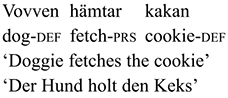
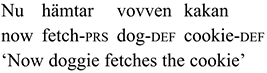
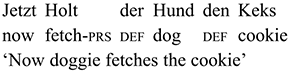
As shown in (1a), all three languages display SVO order in simple, subject-initial declarative clauses. In the case of an initial adverbial, both Swedish (1b) and German (1c) keep the finite verb in second position, yielding so-called subject-verb inversion. English, on the other hand, maintains the SVO pattern. Thus, the two V2 languages systematically display inversion, which in English is a more marginal phenomenon, restricted to auxiliaries.Footnote 2
In the case of non-finite verbs, however, Swedish patterns with English rather than German, as shown in (2). In both English and Swedish the verbs precede the object (VO), but in German the non-finite verb is clause-final, thus occurring after the object (OV). In subordinate clauses (3), this alignment applies to both finite and non-finite verbs, which both occur at the end of the clause in OV languages like German, but precede the object in VO languages like English and Swedish.
a.
Vovven har inte hämtat kakan dog-def have-prs neg fetch-sup cookie-def ‘Doggie has not fetched the cookie’ b.
Der Hund hat den Keks nicht geholt. def dog have-prs def cookie neg fetch-pstp ‘Doggie has not fetched the cookie’


a.
att vovven inte har hämtat kakan sbjn dog-def neg have-prs fetch-sup cookie-def ‘that doggie has not fetched the cookie’ b.
dass der Hund den Keks nicht geholt hat sbjn def dog def cookie neg fetch-pstp have-prs ‘that doggie has not fetched the cookie’


Note that the V2 principle does not apply to the subordinate clauses in (3), neither in Swedish nor German. In Swedish, the finite verb follows the negation, as in (3a), whereas it precedes the negation in main clauses, as in (2a). In German, the finite verb in subordinate clauses is clause-final, see (3b).
The V2 pattern, which is typologically rare, is a challenge to linguists and language learners alike, as is the pervasive word order difference between main and subordinate clause types. By developing a constructionist syntax model of Swedish, we aim to make a contribution to both construction grammar and to the understanding of Swedish syntax. On the one hand, CxG accounts of general clausal syntax are rare, and those who exist mainly pertain to English (e.g., Fillmore & Kay Reference Fillmore and Kay1995; Sag Reference Sag, Boas and Sag2012; Hoffmann Reference Hoffmann2023). We therefore contribute to the theoretical development of CxG by proposing a syntax model designed to handle somewhat different kinds of syntactic patterns than existing English-based models do. Hopefully, some features of our overall approach to constructionist syntax may also be applicable to other languages than Swedish.
On the other hand, we aim to shed new light on Swedish syntax by exploiting the multigranular and multidimensional capacity of construction networks. In particular, we highlight the interrelations between more general and more specific clause patterns, as well as the interplay between clausal patterns and argument structure.
Finally, there is also a secondary, practical purpose in that the model is intended for application to the Swedish Constructicon (Lyngfelt et al. Reference Lyngfelt, Bäckström, Borin, Ehrlemark, Rydstedt, Lyngfelt, Borin, Ohara and Torrent2018a). Such application, however, will require a bit of adaptation to meet the concerns of applied constructicography, such as user-friendliness and tailoring to the particular purposes of the resource (cf., e.g., Lyngfelt & Torrent Reference Lyngfelt, Bäckström, Borin, Ehrlemark, Rydstedt, Lyngfelt, Borin, Ohara and Torrent2026). Consequently, the applied implementation will have to be a simplified version of the model. The present proposal is a contribution to construction grammar first and to applied constructicography second.
This Element is structured as follows: in Section 2, we briefly review previous constructionist accounts of clausal syntax in relation to our own approach to Swedish. Sections 3–4 provide an overview of clausal patterns in Swedish; Section 3 focuses on the most basic and general structures, whereas Section 4 addresses word order variation. Section 5 introduces the overall syntax model, presents a few central constructions, and discusses key aspects of the theoretical approach. In Section 6, the model is applied to a variety of clausal constructions and verb phrase constructions, ranging from highly general types to some highly particular structural patterns. In Section 7, we round up the Element with a concluding discussion, addressing network relations between constructions, combination of constructions, and how the approach relates to usage-based linguistics.
2 Constructionist Perspectives on Clausal Syntax, from a Swedish Point of View
Clause formation may be seen, foremost, as a combination of argument structure, on the one hand, and various clausal and phrasal constructions, on the other. In this section, we focus on these two components – leaving tense, lexical constructions, and so on, aside for now. Argument structure constructions are treated in Section 2.1, and clausal and phrasal constructions are addressed in Section 2.2, mainly in relation to the traditional Berkeley CxG model (Fillmore & Kay Reference Fillmore and Kay1995), further developed in Sign-Based CxG (Sag Reference Sag, Boas and Sag2012). In Section 2.3 we turn to constructional syntax: how constructions are combined to form utterances.
The CxG literature on these matters is predominantly English-oriented. In many respects, it is applicable to Swedish, in other respects, not. Consequently, the following review, although usually taking its point of departure in English data, is conducted from the viewpoint of Swedish and with regard to the syntax model proposed in this Element.
2.1 Argument Structure
Argument structure is surely the most extensively treated syntactic phenomenon in the constructionist literature, following the seminal work of Goldberg (Reference Goldberg1992, Reference Goldberg1995), who introduced the notion of argument structure constructions (ASCs).Footnote 3 Basically, ASCs are configurations of heads and their arguments, of which we are primarily concerned with ASCs where the head is a verb.Footnote 4 They range from fully schematic to highly specific, as illustrated in Table 1 for ditransitive constructions.
Traditionally, argument structure is treated in terms of lexical valency, whereby the set of arguments and their morphosyntactic realization are presumably specified by the head/verb. Although usually accurate, the problem with this approach is how to account for argument structures that clash with the valence pattern of the verb. A couple of examples of such expressions are given in (4) (examples from Goldberg Reference Goldberg1995: 152):
a.
They laughed the poor guy out of the room. b.
Frank sneezed the tissue off the table.


The solution proposed by Goldberg is that the sentences in (4) are licensed by a general ASC, in this case caused motion,Footnote 5 despite not matching the lexical valency of laugh or sneeze, respectively. General ASCs of this kind have been criticized for overgenerating, and there is a long discussion in the CxG literature on the interplay and division of labor between ASCs of different generality (e.g., Boas Reference Boas2003; Croft Reference Croft, Cuyckens, Berg, Dirven and Panther2003; Goldberg Reference Goldberg2019). Presumably, they are ordered in a multigranular network, where an instance of a particular ASC is also an instance of all its superordinate ASCs. Thus, a sentence like He told his daughter a bedtime story instantiates all the ASCs in Table 1.
| Ditransitive | Subj verb IO DO |
|---|---|
| General | ‘Agent[subj] transfer Theme[DO] to Recipient[IO]’ |
| Communication Event | ‘Speaker[subj] communicate Message[DO] to Listener[IO]’ |
| Tell | ‘Speaker[subj] tell Message[DO] to Listener[IO]’ |
| tell a bedtime story | ‘Caretaker[subj] tell Story[DO] to Child[IO]’ |
It should be noted that an ASC at the lexical level, where the verb is a particular lexeme, is still not the same thing as the lexical valence pattern of the verb. The same verb may instantiate several different ASCs, just as schematic ASCs may be instantiated by several different verbs. Boas (Reference Boas2003) has proposed the term mini-constructions for conventional pairings of a particular lexeme and a particular argument structure.
For the purposes of this Element, the level of generality of an ASC is in principle inconsequential. What matters is that the argument configuration of a verbal ASC may be combined with a clausal construction, thus forming a clausal construct. This does not, however, mean that any ASC fits with any type of clausal construction, since certain combinations may be disfavored due to conflicting properties. Even if not outright rejected, such combinations may cause accommodation effects (see the discussion of coercion in Section 2.3). Compare, for example, the sentence pair in (5):
a.
She got robbed in New York. b.
Don’t get robbed in New York!


In both sentences, the predicate get robbed instantiates a passive ASC, assigning an undergoer role to the subject. In the (5b) version, however, the subject is also ascribed a degree of control over the situation, most likely due to the imperative clause construction. Such accommodation effects – both that of laugh and sneeze in the caused motion construction and that of get robbed in the imperative clause construction – are typically addressed in terms of coercion (see Section 2.3).
2.2 Clausal and Phrasal Constructions
To the extent there is a standard overall approach to clausal syntax in CxG, it is a constituency-based top-down approach, in the tradition of phrase structure grammars (e.g., Fillmore & Kay Reference Fillmore and Kay1995). This perspective has been criticized by Diessel (Reference Diessel2019) and others, who instead advocate a bottom-up approach in accordance with usage-based linguistics. We sympathize with both, and the approach pursued in this Element is an attempt to combine a system-oriented perspective with a usage-based view of language. This is an aim we share with the CASA model of Herbst & Hoffmann (Reference Herbst and Hoffmann2024; Constructionist Approach to Syntactic Analysis). While the discussion of these matters has mainly been English-centered, cross-linguistic perspectives are brought to the fore in the typology-based model of Croft (Reference Croft2022).
The approach based on phrase structure grammars follows the original CxG model that is now called Berkeley Construction Grammar (BCG, e.g., Fillmore & Kay Reference Fillmore and Kay1995; Kay & Fillmore Reference Fillmore, Hoffmann and Trousdale1999; Fillmore Reference Fillmore, Hoffmann and Trousdale2013) and further elaborated in Sign-Based Construction Grammar (SBCG; Sag 2011; Boas & Sag Reference Sag, Boas and Sag2012; Michaelis Reference Michaelis2013, 2024). It has mainly been developed with respect to English, but to some extent it has also been applied to other languages (e.g., Lorenzi et al. Reference Lyngfelt2023 for Brazilian Portuguese).
On this approach, basic formation of clauses and phrases is accounted for by general constructions such as subject-predicate, modifier-head and head-complement (Fillmore & Kay Reference Fillmore and Kay1995). These constructions correspond to phrase structure rules such as S → NP, VP (subject-predicate) and VP → V, NP (head-complement). Although their conceptual status is quite different, since the constructions are not procedural formation rules but rather generalized structural templates (Hilpert Reference Hilpert2019:70), they do account for the same basic phenomena in a very similar way. These constructions have remained cornerstones in CxG conceptualizations of clausal syntax.
However, clausal syntax involves more than basic phrase structure. In fact, the limitations of phrase structure grammar were one of Chomsky’s (Reference Chomsky1957) main arguments for launching transformational grammar. Thus, he and others proposed transformations such as topicalization, subject-auxiliary inversion, and so on, to account for clauses that do not simply consist of the pairing of an NP with a VP. Strikingly, subject-auxiliary inversion constructions also feature extensively in the CxG literature (e.g., Fillmore Reference Fillmore, Hoffmann and Trousdale1999; Goldberg & Del Giudice Reference Goldberg and Del Giudice2005; Goldberg Reference Goldberg2006), although movement transformations are explicitly rejected by CxG theory.
Let us review the key subject-predicate construction. This construction was originally proposed for English but is commonly assumed as a general clause-forming construction for other languages as well. A subject-predicate construction can fairly straightforwardly account for clauses with an NP+VP structure, such as The climate can’t wait, Sheena is a punk-rocker, and One flew over the cuckoo’s nest. It is not, however, sufficient to handle inversion structures like What do you want?, Never would I do that!, Do androids dream of electric sheep?, and May the force be with you, where the order between the subject and the auxiliary verb is reversed.
For English, where word order is relatively strict and inversion is mostly restricted to auxiliaries, clausal syntax based on a subject-predicate construction is arguably still tenable if one assumes that auxiliaries, interrogative phrases, and so on are added on top of a basic NP+VP structure. Thus, roughly simplified, Do is presumably added to [androids dream of electric sheep], and May is added to [the force be with you]; on such an account, these clausal structures are accounted for by subject-predicate + various additional constructions. This is not entirely unproblematic, and there are several associated issues to resolve. Nevertheless, this kind of solution is feasible for a language like English, and such accounts have been proposed within SBCG (e.g., Sag 2011; Reference Sag, Boas and Sag2012).
In Swedish, however, word order and phrase structure do not map as closely as they do in English. As mentioned in the introduction, Swedish is a so-called V2 language, with the finite verb in the second position of the clause. This means that whenever the subject is not clause-initial, it is preceded by the finite verb, even if this is the main verb, thus yielding an XVSO order. This is illustrated in example (6).
(6)
Därför hämtade vovven inte kakan. therefore fetch-pret dog-def neg cookie-def ‘Therefore, Doggie didn’t fetch the cookie. / That’s why Doggie didn’t fetch the cookie’

As shown in (6), inversion is not an exceptional feature restricted to auxiliaries in Swedish but an integral part of clausal fundamentals. Consequently, an accurate account of Swedish clausal syntax cannot take a basic NP+VP structure as its point of departure. We do not, however, abandon the constituency-based approach of Fillmore & Kay (Reference Fillmore and Kay1995) altogether. We merely adapt it to Swedish, in accordance with the “not too hierarchical” model of Börjars et al. (Reference Börjars, Engdahl, Andréasson, Butt and King2003), only assuming constituents that are supported by basic constituency tests applied to relevant Swedish data. This approach is outlined in Section 5.
The top-down approach and formal representation of BCG and SBCG has been criticized from the viewpoint of usage-based linguistics as being too static and not reflecting the dynamic character of language (e.g., Diessel Reference Diessel2019). On a usage-based view of language, linguistic structures are shaped and continuously reshaped by usage, as generalizations over concrete usage-events (e.g., Langacker Reference Langacker, Barlow and Kemmer2000; Barlow & Kemmer Reference Barlow and Kemmer2000). In principle, this view calls for a bottom-up approach to linguistic generalization, where low-level patterns are given primacy over more general ones, mirroring how language acquisition presumably takes place (cf. Tomasello Reference Tomasello2003). While we both sympathize with and subscribe to this view of language, the task at hand in this Element has a different focus. Our object of study, the overall syntactic system of clausal syntax in standard Swedish, is an idealization in itself, like any conception of a standard language necessarily is. As such, it does not easily lend itself to a strictly bottom-up approach.
In other words, we adopt what van Trijp (Reference Tomasello2024) has dubbed an aggregate perspective, “which works on an idealized state of a language”, in contrast to what he calls a population perspective, “which focuses on the dynamics of situated communicative interactions, and how these interactions may impact the community language.”Footnote 6 van Trijp declares that these two views are suited for different purposes:
Both perspectives are important. The aggregate perspective is well-suited for tasks for which its idealizations are useful, such as the development of reference grammars, crosslanguage comparisons, or language teaching. The population perspective is better suited for answering questions that involve processes such as language learning, language change, and language usage.
Similarly, Boas et al. (Reference Boas, Leino and Lyngfelt2024) propose the antonym pair system-oriented and usage-oriented linguistics, as endpoints on a scale where different approaches may be system-oriented or usage-oriented to different degrees and in different respects, depending on the perspective of the particular study in question. They argue that most, if not all, work in CxG is more or less usage-based (although it varies greatly how this notion is defined and, even more so, applied). Therefore, they suggest that a scalar organization might be better suited to characterize the range of constructionist approaches to language than a dichotomy between usage-based and non usage-based CxG is.
In devising a general constructionist model of Swedish syntax, meant to be incorporated in the Swedish Constructicon (which may be seen as a CxG counterpart to a reference grammar; cf. Herbst Reference Herbst2019; Lyngfelt Reference Lyngfelt2018), we assume a system-oriented, aggregate perspective. We would argue that the approach, while system-oriented, is nonetheless usage-based, in that:
the structural patterns proposed are well attested in authentic usage and solidly grounded in empirical research
the model applies to general and specific patterns alike
contextual factors are taken into account wherever relevant to the syntactic patterns at hand
the analyses proposed are conceived as generalized usage patterns, not as sets of constraints in a generative system
the theoretical conception of the syntax model aligns with usage-based theory (this is discussed in Section 5.4).
Thus, the approach is an attempt to account for an abstract linguistic system, at the aggregate level of standard Swedish, in a way that is consistent with usage-based theory. This is an aim we share with the CASA model of Herbst & Hoffmann (Reference Herbst and Hoffmann2024; Constructionist Approach to Syntactic Analysis). CASA is designed for pedagogic purposes and employs a somewhat simpler formalism than our model; it is also primarily designed for English. Nevertheless, the two models have much in common. In particular, CASA is an important source of inspiration for our treatment of constructions in combination, which is the topic of the next section. The overall theoretical orientation of the syntax model proposed in this Element is discussed in Section 5.4.
2.3 Constructions in Combination
Turning to the combination of constructions into constructs, this has primarily been treated by two kinds of mechanisms: unification and instantiation (e.g., Fillmore & Kay Reference Fillmore and Kay1995). Cases of accommodated mismatch are typically addressed as coercion (e.g., Michaelis Reference Michaelis2004; Höder Reference Höder, Coussé, Höder, Lyngfelt and Prentice2023). A cognitively oriented alternative, pursued in CASA (Herbst & Hoffmann Reference Herbst and Hoffmann2024), is to treat the combination of constructions as conceptual blending (cf. Fauconnier & Turner Reference Fauconnier and Turner2002). In the following, we address these notions in turn, after which we illustrate the matter at hand with a CASA style analysis of a sentence construct.
Unification, in this context, pertains to the combining of one construction with another. For example, a noun phrase construction may be unified with the subject slot of a clausal construction, thus combining the two constructions. Note that it is not the two constructions that are unified in this case, but one construction that is unified with a construction element in the other. Formally, unification may be defined as follows: “Unification is an operation on two feature structures which maps them onto a third, which combines the two original structures” (Fillmore & Kay Reference Fillmore and Kay1995: 46).
The relation between a construction – as a conventional, stored pattern – and a concrete instance of that construction is called instantiation. The concrete instances themselves are called constructs. Instantiation is also a taxonomic network relation between more general constructions and the more specific subtypes instantiating it. At any level in a multigranular taxonomy (except the topmost), a construction instantiates all its superordinate constructions. In principle, the concrete realizations, the constructs, are simply the extreme end of such a chain of instantiation.Footnote 7
As mentioned in relation to Table 1, the ditransitive tell construction (‘somebody tells someone something’) may be seen as an instance of the communicative ditransitive construction, which in turn is an instance the general ditransitive construction. A construct like I told him a bedtime story instantiates all of them. The overall concept of instantiation also includes phenomena such as implicit realization of elements (null instantiation) and two different roles being instantiated by the same element (co-instantiation); see Section 5.3. For an extensive account of instantiation, see Fillmore & Kay (Reference Fillmore and Kay1995).
Sometimes construction elements are instantiated by expressions that do not quite match the conventional properties of the structure. For example, motion constructions are typically headed by motion verbs, as in The cart rolled down the street, where the verb encodes the manner of motion. In the similar sentence The cart rattled down the street, the verb rattle is not a conventional motion verb but nonetheless accommodated as the head of a motion construction, yielding the interpretation ‘the cart moved down the street, rattling’. Such cases of accommodated mismatch are usually treated in terms of coercion (e.g., Michaelis Reference Michaelis2004). As the term suggests, coercion involves a measure of resistance, which may be reflected by atypical combinations being more difficult to process or considered less acceptable (cf. Olofsson & Prentice Reference Olofsson2023 on effects in L2 acquisition of Swedish). By continued usage, however, the resistance may wear off, and the combination may get conventionalized as a particular subtype. Regarding the example at hand, Olofsson (Reference Olofsson2018) recognizes a subtype of motion construction with sound-emitting verbs in Swedish.
An alternative to the unification-based approach is pursued in the CASA model (Herbst & Hoffmann Reference Herbst and Hoffmann2024) and by Hoffmann & Turner (Reference Hoffmann and Turner2026). Building on the blend theory of Fauconnier & Turner (Reference Fauconnier and Turner2002), they treat the combination of constructions as conceptual blending. Blending is the general cognitive mechanism of combining different mental structures. The resulting blend is an emergent structure, neither reducible to its input structures nor incorporating all of the information from them. Thus, in the above rattle down the street example, the interpretation of ‘making a rattling sound while moving’ emerges from the combination of the verb and the motion construction – that is, the blend. Furthermore, only the sound-making aspect of rattle is brought into play, not the full meaning potential of the word (cf. Norén & Linell Reference Norén and Linell2007).
In the syntax model proposed here, we follow Herbst & Hoffmann (Reference Herbst and Hoffmann2024) and Hoffmann & Turner (Reference Hoffmann and Turner2026) in treating the combining of constructions as a form of conceptual blending. This approach accommodates the more or less partial overlap between the constructions and elements being combined, as well as the emergent character of the resultant structure. Unification, on the other hand, is a more rigid formal mechanism mapping non-conflicting structures onto each other, capturing neither emergence nor partial overlap (at least not straightforwardly) and requiring additional mechanisms to handle the accommodation of non-matching features. Whereas unification is a feature of formal systems, conceptual blending is based on insights about human cognition and aligns well with the dynamic nature of language use.
A particularly attractive feature of the CASA model is its application to full-sentence analysis. Using a layered, FrameNet-inspired format, the constructions instantiated in a sentence are represented in a construction grid, as illustrated in Figure 1.
CASA construction grid for I will always love you.
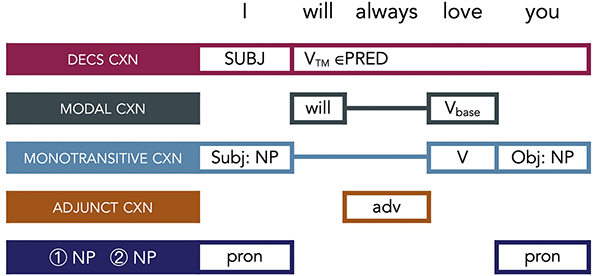
As shown in Figure 1, the sentence I will always love you may be analyzed as consisting of a declarative cxn, a modal cxn, a monotransitive cxn, an adjunct cxn and two NP cxns. The cxns are represented one cxn per line, distinguishing the cxn elements included in each of them and showing construction overlap by linear alignment.
This style of constructional sentence analysis is also applicable to other models and other languages, including our own syntax model for Swedish. In Section 7.2 we illustrate this compatibility by presenting an analysis of a Swedish sentence in a CASA construction grid.
3 Basic Syntactic Patterns in Swedish Clauses
This section gives an overview of basic syntactic patterns in Swedish clauses. First, in Section 3.1, we present the major word order patterns in main clauses and show that speech act interpretation depends on the first element of the clause. In 3.2, subordinate clause word order is introduced, and a comparison between the typical word order in generic main clauses and subordinate clauses is made. These word order patterns are illustrated with topographical sentence schemas, in the tradition of Diderichsen (Reference Diderichsen1946). Section 3.3, finally, addresses constituency and verb phrases.
3.1 Main Clause Word Order and the Sentence Schema
Word order in Swedish is fairly regular, with systematic patterns of variation. As shown in previous sections the V2 pattern in Swedish causes the subject to appear following the finite verb in declaratives, whenever it is not in the first position, so-called inversion, as previously mentioned. In (7) we present a couple of examples of word order variation in the first position of declarative main clauses.
a.
Vovven har inte hämtat kakan idag. dog-def have-prs neg fetch-sup cookie-def today ‘Doggie hasn’t fetched the cookie today.’ b.
Idag har vovven inte hämtat kakan Today have-prs dog-def neg fetch-sup cookie-def ‘Doggie hasn’t fetched the cookie today.’ c.
Kakan har vovven inte hämtat idag. cookie-def have-prs dog-def neg fetch-sup today ‘As for the cookie, doggie hasn’t fetched it today.’



In example (7a), the subject is in first position, an SVO word order, which is predominant in declaratives, about 64 percent in non-fiction texts and about 70 percent in fiction (Westman Reference Westman1974:155 for non-fiction; Teleman & Wieselgren Reference Teleman and Wieselgren1970:119 for fiction). However, other elements of the clause may appear in the first position, as illustrated by the adverbial idag, ‘today’, and the object kakan, ‘the cookie’, in (7b) and (7c), respectively. This causes the subject to follow the auxiliary har ‘have’, thus maintaining the typical V2 word order of a Swedish declarative clause. These alternations in word order where elements other than the subject appear in the first position are generally caused by information structure. In (7b) the topicalized adverbial is a scene-setting topic, and in (7c) the fronted full NP object is most oftenly interpreted as having a contrastive meaning (cf. Lambrecht Reference Lambrecht1994: 118, 125; Chafe Reference Chafe and Li1976: 50f.; Andréasson Reference Andréasson, Butt and King2007b).
The beginning of the main clause is also important for distinguishing between different speech acts. If the element in the first position in a V2 structure is an interrogative element, as in (8a), the structure is interpreted as a content question. When a main clause is verb initial, V1, the form of the finite verb and the presence of a subject distinguish between polar questions, (8b), and directive clauses, (8c).
a.
Varför har vovven inte hämtat kakan idag? why have-prs dog-def neg fetch-sup cookie-def today ‘Why hasn’t doggie fetched the cookie today?’ b.
Har vovven inte hämtat kakan idag? have-prs dog-def neg fetch-sup cookie-def today ‘Hasn’t doggie fetched the cookie today? c.
Hämta inte kakan idag! fetch-imp neg cookie-def today ‘Don’t fetch the cookie today!’


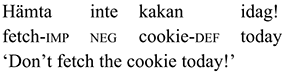
In examples (7) and (8) it is shown that the first element in V2 clauses may vary, and that the beginning of both V2 and V1 clauses indicate the speech act of main clauses. Furthermore, the examples show that the elements following the finite verb manifest a systematic pattern, with the subject and an adverbial following the finite verbform and the object and another adverbial following the non-finite verb form.
Systematic word order patterns like these may be captured by basic topographic sentence schemas (field schemas), and such schemas are often used to describe Swedish clause structure. Diderichsen (Reference Diderichsen1946) created a sentence schema for Danish that later became a model for corresponding schemas adapted to Norwegian and Swedish (cf. Faarlund, Lie & Vannebo Reference Faarlund, Lie and Vannebo1997 for Norwegian; Platzack Reference Østbø Munch1987 and Teleman et al. Reference Teleman, Hellberg and Andersson1999 for Swedish; Hansen & Heltoft Reference Hansen and Heltoft2019 for Danish). Figure 2 shows a sentence schema covering the major types of main clauses in Swedish, illustrated by the examples from (7–8).
Sentence schema for typical main clauses in Swedish, also called the FA schema.
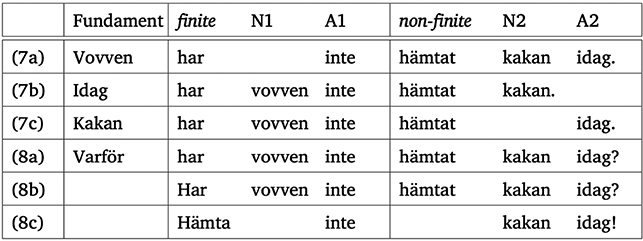
The V2 pattern of declaratives and content clauses is captured by the schema by there being only one position, Fundament (‘foundation’), preceding the position of the finite verb. In V1 clauses – imperatives and polar questions – this position is empty. Common to both V2 and V1 clauses, distinguishing them from the word order of most subordinate clauses, is that the finite verb consistently precedes sentence adverbials (A1 in the schema), and hence the schema in Figure 2 has been labeled FA clause schema (Finite before Adverbials) (Teleman et al. Reference Teleman, Hellberg and Andersson1999, vol. 4:7ff.). The non-finite position hosts non-finite verbs, as well as verb particles and reflexives strongly associated with the verb. We return to the naming of these positions in the following section, in relation to subordinate clause word order in Swedish.
Note that whenever a clause does not contain an object, adverbial, and so on, the corresponding position is empty, as is the canonical position of whatever element occurs in the Fundament. In the examples in (7–8), most of the positions are filled to illustrate the regular relative order between elements, but more often than not there are fewer elements in the clause, leaving several positions unoccupied. Thus, the schema depends on the assumption of potentially empty positions.
The positions marked by N and A need more of an in depth explanation. The sentence schema illustrates that nominal constituents, such as subjects, objects, etc., generally appear in N-marked positions, preceding adjuncts and oblique arguments in the A-marked positions. When the subject is not clause initial, as in examples (7b–c) and (8a–b), it appears in the N1 position. This position only hosts subjects. The negation is in the A1 position, a position where other adverbials may appear; sentence adverbials in general, and negations in particular, tend to occupy this position. Objects and predicative complements appear in N2, while oblique arguments and adjuncts appear in A2.
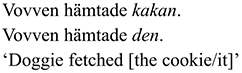
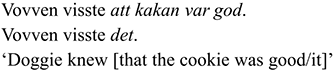
Thus, the N and A positions of the sentence schema accounts for a systematic syntactic difference between nominal argument functions (henceforth nom+), such as subjects, objects and predicative complements, on the one hand; and non-nominal functions (henceforth nom–), including oblique arguments and adjuncts, on the other. Nominal functions may be substituted with a pronoun, while non-nominal functions may not. Example (9) illustrates how an NP object (9a), a clausal object (9b), and a predicative complement (9c) may all be substituted by pronouns. AdvP adjuncts (9d), adjunct clauses (9e), and NPs with an adverbial function (9e ), on the other hand, may be substituted by adverbs, but not by pronouns. In general, nom+ elements tend to precede nom− elements, as reflected by the relative order between N and A positions in the sentence schemas.
a.
Vovven hämtade kakan. Vovven hämtade den. ‘Doggie fetched [the cookie/it]’ b.
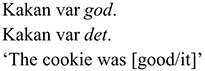
Vovven visste att kakan var god. Vovven visste det. ‘Doggie knew [that the cookie was good/it]’ c.
Kakan var god. Kakan var det. ‘The cookie was [good/it]’ d.
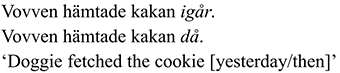
Vovven hämtade kakan igår. Vovven hämtade kakan då. ‘Doggie fetched the cookie [yesterday/then]’ e.
Vovven hämtade kakan när han såg den. Vovven hämtade kakan då. ‘Doggie fetched the cookie [when he saw it/then]’ f.
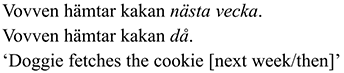
Vovven hämtar kakan nästa vecka. Vovven hämtar kakan då. ‘Doggie fetches the cookie [next week/then]’

In this section, we have outlined general word order patterns in Swedish main clauses. The beginning of the clause distinguishes between different speech acts, of which declaratives and content questions are V2, while polar questions and declaratives are V1. In the rest of the clause the word order is quite similar, which makes analyses with sentence schemas possible. We have noted that sentence adverbials, especially negations, appear in a position following the finite verb, so-called FA order (Teleman et al. Reference Teleman, Hellberg and Andersson1999, vol. 1:169). Lastly the distinction between nominal and non-nominal functions has been introduced.
We now turn to word order patterns typical of subordinate clauses.
3.2 Subordinate Clause Word Order and the FA–AF Distinction
Subordinate clauses in Swedish form a diverse group, yet with many properties shared by at least most of them. Common to most subordinate clause types, setting them apart from typical main clauses, is that the finite verb occurs later in the clause, consistently following both subjects and sentence adverbials. This structural pattern has been labeled AF word order (Adverbial before Finite verb), in contrast to the FA order. Some examples of AF clauses are presented in (10):
a.
Narrative clause Max vet [att vovven inte har hämtat kakan idag]. Max know-prs [sbjn dog-def neg have-prs fetch-sup cookie-def today] ‘Max knows that doggie hasn’t fetched the cookie today’ b.
Temporal clause Max blev förvånad [när vovven inte ville hämta Max become-pret surprised [when dog-def neg want-pret fetch-inf kakan]. cookie-def] ‘Max got surprised when doggie didn’t want to fetch the cookie’ c.
Conditional clause [Om vovven inte vill hämta kakan] måste [if dog-def neg want-prs fetch-inf cookie-def] must Max hämta den. Max fetch-prs it ‘If doggie doesn’t want to fetch the cookie, Max must fetch it’ d.
Indirect polar question Max undrade [om vovven inte ville hämta kakan]. Max wonder-pret [if dog-def neg want-pret fetch-inf cookie-def] ‘Max wondered if doggie didn’t want to fetch the cookie’ e.
Indirect content question Max undrade [varför (som) vovven inte har hämtat Max wonder-pret [why (sbjn) dog-def neg have-prs fetch-sup kakan] cookie-def]. ‘Max wondered why doggie didn’t want to fetch the cookie’ f.
Relative clause Kakan [(som) vovven inte ville hämta] var gammal. cookie-def [(sbjn) dog-def neg want-pret fetch-inf] be-pret old ‘The cookie that doggie didn’t want to fetch was old’ g.
Relative clause (non adnominal) Vovven åt upp kakan genast, [vilket inte förvånade Max]. dog-def eat-pret up cookie-def immediately [which neg surprise-pret Max] ‘Doggie ate the cookie immediately, which didn’t surprise Max’

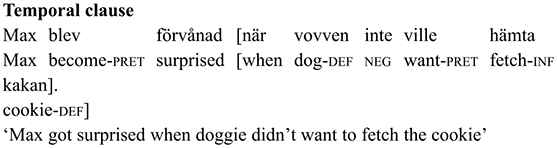
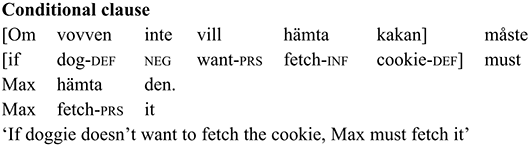

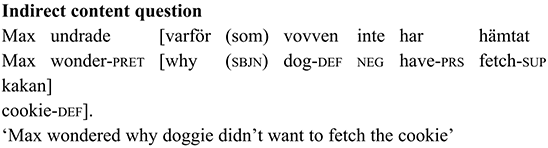


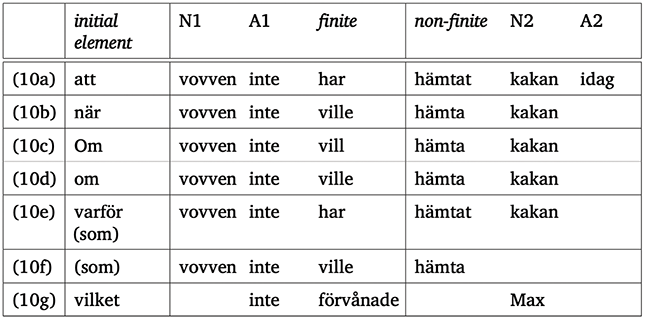
Narrative (10a) and adverbial (10b–c) clauses are structurally prototypical AF clauses, generally beginning with a subjunction, followed by the subject and any occurring sentence adverbials before the finite verb. (10d–e) are indirect questions, of which indirect polar questions (10d) correspond to polar questions and have the same form as conditional clauses (10c). Indirect content questions (10e) correspond to content questions and begin with an interrogative phrase, in this case varför ‘why’. Relative clauses may begin with the subjunction som (10f), which is often optional, or with a relative pronoun (10g).Footnote 8
As shown by these examples, the structural differences between different kinds of AF clauses mainly pertain to the beginning of the clause. From the subject onward, they are generally similar. The overall AF pattern that they all share is represented by the sentence schema in Figure 3. Compared to FA clauses, and V2 clauses in particular, it can be noted that the later position of the finite verb and the lack of a clause-initial Fundament position, leaves less leeway for variation in AF clauses.
Sentence schema for typical subordinate clauses in Swedish, also called the AF schema.
Traditionally, the schemas in Figures 2 and 3 are called the main clause schema and the subordinate clause schema, respectively. There are, however, both subordinate clause types with FA structure (11) and main clause types with AF structure (12).
a.
[Hämtar Vovven inte kakan] blir jag sur. [fetch-prs dog-def neg cookie-def] become-prs I grumpy ‘If doggie doesn’t fetch the cookie, I’ll get grumpy.’ b.
Jag hörde att [idag hämtade vovven inte kakan.] I hear-prs sbjn [today fetch-pret dog-def neg cookie-def] ‘I heard that doggie didn’t fetch the cookie today’


(12)
Att vovven inte kan hämta den där kakan! sbjn dog-def neg can-prs fetch-inf that there cookie-def ‘Why can’t doggie ever fetch that cookie!’

In (11a), the initial conditional clause follows the same V1 pattern as polar questions (cf. 8b), displaying both FA order and subject-verb inversion. Similarly, in the object clause in (11b), the subjunction att ‘that’ is followed by an FA clause with the same V2 structure as declaratives (so-called embedded V2, cf. 7b), with an adverbial in the Fundament and hence subject-verb inversion.Footnote 9 Conversely, the exclamative main clause in (12) has the same AF structure as narrative clauses. Note that this is generally not a matter of mixed patterns; some clause types use the FA pattern, and other types use the AF pattern. Thus, most types of main clauses and some types of subordinate clauses use the FA pattern, whereas most types of subordinate clauses and some types of main clauses use the AF pattern.
Consequently, in order to avoid confusion between form and function, the Swedish Academy Grammar (Teleman et al. Reference Teleman, Hellberg and Andersson1999, vol. 1:151, 169) coined the labels FA schema/clause and AF schema/clause for the structural word order patterns, reserving the terms main clause and subordinate clause for functional categorization only. In the present text, we adhere to this terminology.
While the FA schema and the AF schema differ systematically, they are also strikingly similar, the main general difference between them arguably being the position of the finite verb (there are also differences with respect to the beginning of the clause, but such differences hold within the two patterns as well). Hence, Platzack (Reference Østbø Munch1987) proposed a joint schema, incorporating both patterns. In this joint schema, the position of the finite verb in FA clauses is equated with the position of subjunctions and corresponding clause-initial elements in AF clauses. This position is labeled the type place, since it indicates the clause type; and the joint schema, which is shown in Figure 4, is therefore called the type place schema.
The type place schema.
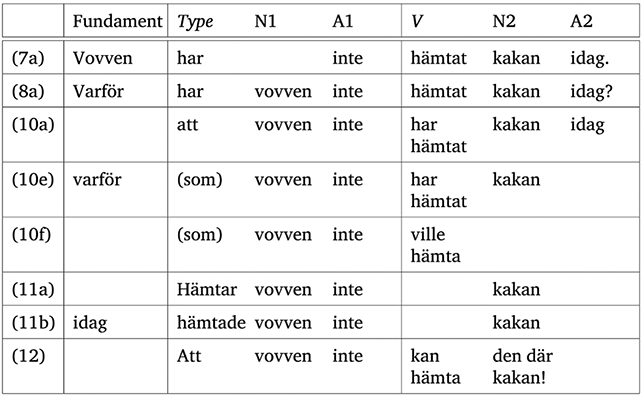
The type place schema captures the parallels between the FA pattern and the AF pattern, as well as the main difference. The finite verb is placed in the type position is FA clauses and in the V position together with non-finite verbs in AF clauses, where the type position is instead occupied by the subjunction. Note how (11a–b), which are subordinate clauses fit the FA pattern (V1 and V2, respectively), whereas the main clause in (12) fits the AF pattern.
The type place schema, unlike the traditional AF schema, also captures a significant structural difference between indirect content questions (10e) and other AF clauses, namely that the former has an element preceding the subjunction, specifically, an interrogative phrase. In this regard, indirect content question pattern with the (FA) content questions they correspond to (cf. 8a).
All in all, sentence schemas are a useful tool to illustrate frequent word order patterns. However, they draw a somewhat simplified picture of Swedish clause structure. On the one hand, the linear ordering of positions suggests that the sentence structure is relatively flat, with all grammatical functions on the same level. This is adressed in the next section. On the other hand, there are more possibilities for word order variation in Swedish than the sentence schemas can accommodate, especially in FA clauses with a simple predicate, which we address in Section 4.
3.3 Constituency and (Infinitival) Verb Phrases in Swedish
While a conception of basic clause structure as NP+VP does not apply well to Swedish (cf. Section 2.2), VPs are nontheless quite common in Swedish, occurring as complements of control verbs (13a), infinitival subjects (13b), and so on. Since they are phrases, they may be coordinated, as in (13c), which cannot be handled by the sentence schemas introduced in the previous section.
a.
Vovven gillar [att hämta kakor] dog-def likes [im fetch-inf cookie-pl] ‘Doggie likes fetching cookies.’ b.
[Att hämta kakor] är roligt. im fetch-inf cookie-pl be-prs fun-neut ‘Fetching cookies is fun.’ c.
Vovven vill [hämta kakan] och [äta den] genast. dog-def want-prs [fetch-inf cookie-def] and [eat-inf it] immediately ‘Doggie wants to fetch the cookie and eat it immediately.’
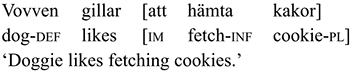


In addition to the obvious cases where a VP serves a particular grammatical function, as in (13a) and (13b), we argue that they also occur as complements of auxiliaries. Indeed, the coordinated VPs in (13c) co-occur with the modal auxiliary vill (’want’). Phrasal hierarchy should not, however, be assumed frivolously. As mentioned in Section 2.2 we adopt a restrictive approach to phrase structure, only assuming constituents that are supported by standard constituency tests. In this, we adhere to the so-called “not too hierarchical” model of Swedish syntax (Börjars et al. Reference Börjars, Engdahl, Andréasson, Butt and King2003; Engdahl et al. Reference Engdahl, Andréasson, Börjars and Karlsson2004; Andréasson Reference Andréasson, Butt and King2007a). Two standard tests for constituency are substitution and topicalization (Larson Reference Larsson2010), which both support the assumption of VPs after auxiliaries in Swedish, as shown in (14a–c).
a.
Vovven vill inte [hämta kakan]. dog-def want-prs neg [fetch-inf cookie-def] ‘Doggie doesn’t want to fetch the cookie.’ b.
Vovven vill inte [det]. c.
[Hämta kakan] vill vovven inte. d.
*Hämta vill vovven inte kakan.




In sentences with auxiliaries, the complement of the auxiliary is a non-finite VP that may be substituted with a pronoun or appear in the first position. In example (14a) the infinitival verb hämta forms an infinitival VP with the complement kakan: hämta kakan ‘fetch the cookie’. This VP may be substituted with the pronoun det, ‘that’; see (14b). Furthermore, the infinitival VP may appear in the first position, as demonstrated in (14c ), thus satisfying the so called topicalization test. Separating the infinitive, the head of the infinitival VP, from its complement kakan, however, is ungrammatical, as shown in example (14d ), since the infinitive and its complements form a syntactic unit.
Further evidence that non-finite VP is a syntactic constituent is provided by the substitutions in example (15). This example shows how infinitival VPs can be nested within a superordinate VP, which is demonstrated by the possibility of pronominalization of each VP in (15b–d).
a.
Vovven måste [vilja [kunna [hämta kakan]]]. dog-def must [want-inf [can-inf [fetch-inf cookie-def]]] ‘Doggie must want to be able to fetch the cookie.’ b.
Vovven måste [det]. c.
Vovven måste vilja [det]. d.
Vovven måste vilja kunna [det].




Within the infinitival VP the constituent order is constrained. Both objects and predicative complements (nom+) follow the verb, but they precede all types of obliques, arguments as well as adjuncts (nom–). A structural schema for the VP is presented in (16).
(16)
VP: Vinf > nom+* > nom–*

The VP is headed by an infinitive verb followed by any nominal functions and after these any non-nominal functions. In the type place schema this corresponds to the V, N2, and A2 positions, respectively. The Kleene star indicates that there may be zero or more of both nom+ and nom− functions.
The relative ordering of nom+ complements is the most rigid; for example, in ditransitive clauses an indirect object always precedes a direct object in the VP; see (17).
a.
Vovven ville [ge Max kakan]. the dog wanted [give-inf Max cookie-def] ‘Doggie wanted to give Max the cookie.’ b.
??Vovven ville [ge kakan Max]. the dog wanted [give-inf cookie-def Max] ‘Doggie wanted to give the cookie Max.’ c.
Vovven ville [ge kakan till Max]. the dog wanted [give-inf cookie-def to Max ‘Doggie wanted to give the cookie to Max.’



In (17a), Max, the indirect object, is interpreted as the recipient of the theme, kakan. In (17b) however, where the ordering between the two nom+ complements is reversed, the reader interprets the first nom+ complement, kakan, as a cognitively very unexpected recipient of a theme, the young boy Max. For the recipient to appear following the theme, the recipient must be embedded as the object of a preposition: till Max ‘to Max’ as in (17c ). This PP is an oblique, nom–, which generally follow nom+ arguments in VPs.
Examples (18b) and (18c ) demonstrate that neither the oblique till Max ‘to Max’ nor the adjunct genast ‘right away’ can precede the object kakan ‘the cookie’ within the VP.Footnote 10
a.
Vovven vill [ge kakan till Max genast]. the dog wants [give-inf cookie-def to Max right-away] ‘Doggie wants to give Max the cookie right away.’ b.
Vovven vill *[ge till Max kakan genast]. c.
Vovven vill *[ge genast kakan till Max]. d.
Vovven vill [ge kakan genast till Max].




The ordering between oblique arguments and adjuncts in the VP is not as fixed as for the nominal GFs, as is shown in (18a) and (18d ) (cf. Goldberg Reference Goldberg2006: 42f).
Thus, the assumption of structural VPs in clauses with auxiliaries is supported both by constituency tests and by word order restrictions. As shown in this section, the word order is stricter in clauses with an infinitival VP than in FA clauses with a simple predicate. In the latter, by contrast, there are no VPs according to constituency tests, and there is considerably more word order variation. The possibilities for word order variation in Swedish FA clauses are addressed in the following section.
4 Word Order Variation in Swedish Clauses
This section is concerned with word order variation in Swedish, in particular with structures that challenge the traditional sentence schemas. As mentioned in Section 3, the sentence schemas leave room for some word order variation. For instance, the fundament may host either a nom+ or a nom− constituent, and some adverbials may appear in either the A1 or the A2 position.
There are, however, also word order patterns that do not fit the schemas, especially in FA clauses with a simple predicate. Subjects and objects may appear preceding or following sentence adverbials and other adverbials, and on rare occasions an object may even precede a subject. The constituent order in these cases is regulated by non syntactic factors such as information structure, scope and various semantic restrictions (cf. Teleman et al. Reference Teleman, Hellberg and Andersson1999; Sells Reference Sag, Boas, Kay, Boas and Sag2001; Engdahl et al. Reference Engdahl, Andréasson, Börjars and Karlsson2004; Andréasson Reference Andréasson, Butt and King2007a).
In this section, we address two kinds of word order variation that are not covered by the generalizations of the schemas. In Section 4.1 we deal with the phenomenon of subject-adverbial intermingling, where a subject may appear after or inbetween adverbials. Section 4.2 addresses so-called object shift, where a pronominal object appears preceding a sentence adverbial, and – on rare occasions – preceding a subject, so-called long object shift.
4.1 Subject-Adverbial Intermingling
Whenever the subject appears following the finite verb in FA clauses, or generally in AF clauses, there is a very strong tendency for it to precede any adverbial constituent in this area of the clause, as demonstrated by the order between N1 and A1 in the sentence schemas in Figures 2–4. In both the FA clause (19a) and the AF clause (19b) the subject vovven precedes the adverbial faktiskt ‘actually’ and the negation, just as the N1 position precedes the A1 position in the sentence schema in Figure 5.
a.
Därför hämtade vovven faktiskt inte kakan. therefore get-pret dog-def actually neg cookie-def ‘That’s why doggie actually didn’t fetch the cookie.’ b.
Max visste [att vovven faktiskt inte hämtade kakan]. Max knew [sbjn dog-def actually neg get-pret cookie-def] ‘Max knew that doggie actually didn’t get the cookie.’


Subject preceding sentence adverbials.
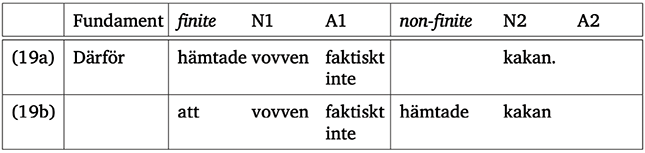
Nevertheless, in both FA and AF clauses subjects may also appear after sentence adverbials – see (20) – in conflict with the generalizations of the sentence schemas.
a.
Därför hämtar inte vovven kakan. therefore fetch-prs neg dog-def cookie-def ‘That’s why doggie doesn’t fetch the cookie.’ b.
… att inte vovven hämtar kakan. sbjn neg dog-def fetch-prs cookie-def ‘ … that doggie doesn’t fetch the cookie.’


In both (20a) and (20b) the negation inte precedes the subject. This is not an uncommon constituent order when the subject is not in the first position in the clause. When a subject and at least one sentence adverbial appears following the finite verb in an FA clause, the sentence adverbial precedes a subject in this area of the clause in as much as approximately 18 percent of the instances (Andréasson Reference Andréasson, Butt and King2007a:134).Footnote 11 Adverbials appearing before subjects in AF clauses is much rarer; only 5.5 percent of the subjects in Andréassons investigation appears following an adverbial.Footnote 12
This subject-adverbial intermingling is triggered by factors such as the subject being part of the nontopical part of the clause, having constrative focus, or being in the semantic scope of the negation (cf. Andréasson Reference Andréasson, Butt and King2007a, b; see also Sells Reference Sag, Boas, Kay, Boas and Sag2001; Svenonius Reference Sommerer, Van de Velde, Fried and Nikiforidou2002; Østbø Munch Reference Østbø Munch2013).
4.2 Pronominal Object Shift
Another possibility for word order variation is restricted to FA clauses with a simple predicate: an unstressed pronominal object may precede sentence adverbials, as in (21a) where the object den ‘it’ precedes the negation inte ‘not’.Footnote 13
a.
Vovven hämtade den inte. dog-def fetch-pret it neg ‘Doggie didn’t fetch it.’ b.
*Vovven hämtade kakan inte. dog-def fetch-pret cookie-def neg c.
*Vovven vill den inte hämta. dog-def want-prs it neg fetch-inf d.
*[…] att vovven den inte hämtade. sbjn dog-def it neg fetch-pret
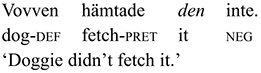



This phenomenon is called pronominal object shift and has received a lot of attention since Holmberg (Reference Holmberg1986, Reference Holmberg1999; for a comprehensive overview, see Thráinsson Reference Teleman, Hellberg and Andersson2001 or Vikner Reference Vikner, Everaert and van Riemsdijk2006; cf. also Josefsson 2003, Reference Josefsson2010; Andréasson Reference Andréasson, Butt and King2008, Reference Andréasson2013; Andréasson, Bentzen & Engdahl Reference Andréasson2013). There are some restrictions on object shift. Non-pronominal objects, like kakan ‘the cookie’ in (21b), may not shift in Swedish although this is grammatical in Icelandic (Thráinsson Reference Teleman, Hellberg and Andersson2001). Furthermore, neither FA clauses with an auxiliary, (21c ) nor AF clauses, (21d ), allow object shift (cf. Holmberg’s generalization, Holmberg Reference Holmberg1986, Reference Holmberg1999). For object shift to be possible the V position in the type place schema must be empty; in other words, the predicate consists of a single verb, positioned in the type place.
When an object pronoun is case marked, as henne ‘her’ is marked for object function as well as for singular feminine, it may under certain, “rather elusive restrictions” (Vikner Reference Vikner, Everaert and van Riemsdijk2006:432) even precede a non-pronominal subject, see (22a).
a.
Därför hämtade henne vovven genast therefore fetch-pret her dog-def right-away ‘That’s why doggie fetched her right away.’ b.
*Därför hämtade den vovven genast. therefore fetch-pret it dog-def right-away *‘That’s why doggie fetched it right away.’


In (22a) the object henne precedes the subject vovven. This word order is possible because the pronoun henne ‘her’ is case marked for object function and must be interpreted as the object. The pronoun den ‘it’ is not case marked and therefore it cannot be interpreted as an object in (22b).
This phenomenon is called long object shift (Heinat Reference Heinat2005) and it is very rare.Footnote 14 Nonetheless, it is a productive word order pattern in Swedish, as illustrated by the authentic examples in (23a), from a Google search 2024, and (23b) from Språkbankens Korp.Footnote 15
a.
[…] då slog mig en märklig tanke. Then strike-pret me a strange thought ‘Then a strange thought struck me’ b.
Också dit förföljde honom förtalet, de anonyma Also there follow-pret him slander-def, the-pl anonymous-pl breven och hoten. letter-pl.def and threat-pl.def ‘There too, the slander, the anonymous letters and the threats pursued him.’

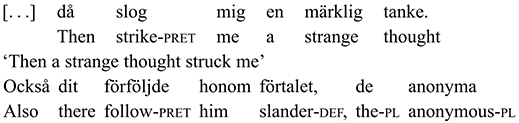

In example (23a) the case marked object pronoun mig ‘me’ precedes the subject en märklig tanke ‘a strange thought’, and in (23b) the case marked object pronoun honom ‘him’ appears preceding the subject förtalet, de anonyma breven och hoten ‘the slander, the anonymous letters and the threats’. Even though this phenomenon is rare, examples of this word order are not difficult to find, and native speakers do not find them ungrammatical. However, neither object shift nor long object shift fit the sentence schemas.Footnote 16
In summary, although Swedish displays some quite rigid configurational patterns, the language also demonstrates a flexibility in word order, especially in FA clauses with a simple predicate. In the following sections, we present a constructionist syntax model to handle both aspects.
5 Basic Syntax Model
We now turn to the syntax model itself, which provides a constructionist account of clausal syntax in Swedish, addressing the phenomena outlined in Sections 3 and 4 – the variability as well as the regularities. We draw inspiration from the simplicity of the traditional sentence schemas (Diderichsen Reference Diderichsen1946; Platzack Reference Østbø Munch1987; Teleman et al. Reference Teleman, Hellberg and Andersson1999) and the hierarchical accuracy of the “not too hierarchical model” (Börjars et al. Reference Börjars, Engdahl, Andréasson, Butt and King2003), incorporated in a constructionist setting and combined with ASCs, construction networks, and other elements from the CxG toolbox. While system-oriented and formal in character, the model is designed in accordance with a usage-based view of language, as will be addressed and elaborated in Section 5.4.
In this section we introduce the model as such, focussing on a few basic constructions, after which we apply it to a wider range of clausal patterns in Section 6. Section 5.1 addresses basic clause formation and introduces the formalism, as applied to a couple of simple declarative clauses. In Section 5.2, we shift the perspective from clausal constructs to clausal constructions, going from the declarative clause cxn to the general supertype fa clause cxn. Section 5.3 introduces more phrasal hierarchy, by bringing verb phrase cxns into the picture. Finally, in Section 5.4, we discuss the theoretical assumptions implemented in the model from a more general perspective, revisiting the topics of Sections 1–2.
The constructions are displayed in a modified Berkeley-style nested boxes formalism. For ease of exposition, all formal representations are somewhat simplified in that we include only details that are relevant for the presentation.
5.1 Basic Clause Formation
Basically, we treat clause formation as a result of the combination of a clausal construction with an argument structure cxn (ASC). Thus, we assume the main components of our starting example (1a) Vovven hämtar kakan (‘Doggie fetches the cookie’) to be a combination of a declarative clause construction with a monotransitive ASC.
Let us start with the ASC, specifically as instantiated with the verb hämta ‘fetch’.Footnote 17 It is presented in Figure 6, using a Goldberg (Reference Goldberg1995) style formalism and representing the meaning in terms of FrameNet frames (https://framenet.icsi.berkeley.edu/).
Agentive monotransitive ASC with the verb hämta ‘fetch’.
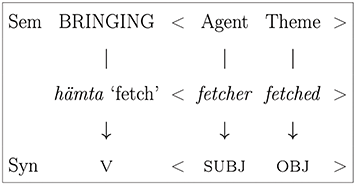
The ASC in Figure 6 represents a monotransitive realization of the verb hämta ‘fetch’, evoking the Bringing frame.Footnote 18 In this configuration, the frame elements Agent and Theme (corresponding to the verb-specific participant roles ‘fetcher’ and ‘fetched object’) are expressed as subject and object, respectively.
By combining this ASC with a declarative clause cxn, one may form the sentence construct Vovven hämtar kakan. A basic formal representation of the resultant structure is shown in Figure 7.
Box representation of the sentence construct Vovven hämtar kakan ‘Doggie fetches the cookie’.
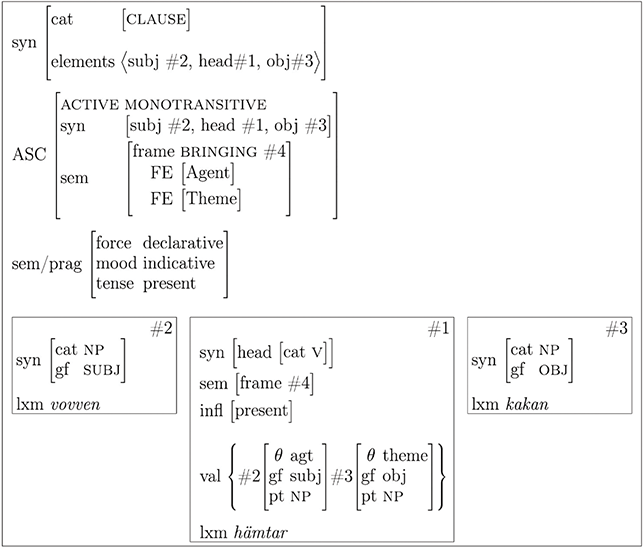
In the box analysis in Figure 7, the outer box represents the sentence construct as a whole, displaying its syntactic and semantic/pragmatic features, as well as the ASC. The inner boxes represent the construct elements (CEs).Footnote 19
Starting with the syn(tax) feature in the outer box, the syntactic category of this construct is clause, and there are three syntactic elements listed: a subject (Vovven), the syntactic head (hämtade) and an object (kakan). Each of these elements is co-indexed with one of the three inner boxes, where properties of the individual CEs are presented, and the ordering of the elements list corresponds to the order of the CEs.
ASC is a mandatory feature for clauses, since there can be no clause without an argument structure. The presentation of the agentive monotransitive asc is divided into two parts: the syntactic arguments of the asc are listed, each with their indices; and the semantic frame of the ASC, in this case bringing, is presented with its Frame Elements (FEs). Lastly, the semantic/pragmatic features of the construct as a whole are displayed. The illucutionary force of the clause is declarative, the mood is indicative, and the clause is in the present tense.
The inner boxes represent the construct elements (CEs) of the clause: in this case a verbal head, hämtar, indicated with #1, the NP subject (#2), vovven, and the NP object (#3), kakan. The indices associate the CEs both with the elements list and the ASC of the outer box, and with the valence elements associated with the verb hämta ’fetch’, located in the verbal head CE. The respective lexemes (lxm) are presented at the bottom of each box.
Note that the overall structure of the clause follows from the interplay between the ASC and the clausal construction. Combining the same ASC with, say, a polar question cxn could yield a sentence like Hämtar vovven kakan? (‘Does Doggie fetch the cookie?’). By combining a declarative cxn with a ditransitive ASC, one could form Vovven ger Max kakan (‘Doggie gives Max the cookie’). And so on, and so forth.
The sentence Vovven hämtar kakan is obviously a very basic syntactic SVO structure, and such sentences are easy to analyze in almost any syntactic framework, as well as in traditional school grammar. As discussed in Section 4, however, there are also frequent syntactic patterns in Swedish that pose more of a challenge. We address these challenges in turn in later sections, but to begin with, let us illustrate how the model applies to a declarative sentence with subject-verb inversion and object shift.
(24)
Därför hämtar vovven den inte. therefore fetch-prs dog-def it neg ‘That’s why Doggie doesn’t fetch it.’
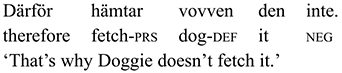
In example (24), the adverbial Därför ’therefore’ is in the initial position of the clause, leading to subject-verb inversion (the verb hämtade preceding the subject vovven) due to the pervasive V2 pattern. Furthermore, there is an unstressed object pronoun den which appears before the negation inte, an instance of so-called object shift, see Section 4.2. In this construct, just as in the basic SVO sentence in (1a), the same agentive monotransitive ASC is combined with a declarative clause cxn, see Figure 8.
Box representation of the sentence construct Därför hämtar vovven den inte ‘That’s why Doggie doesn’t fetch it’.
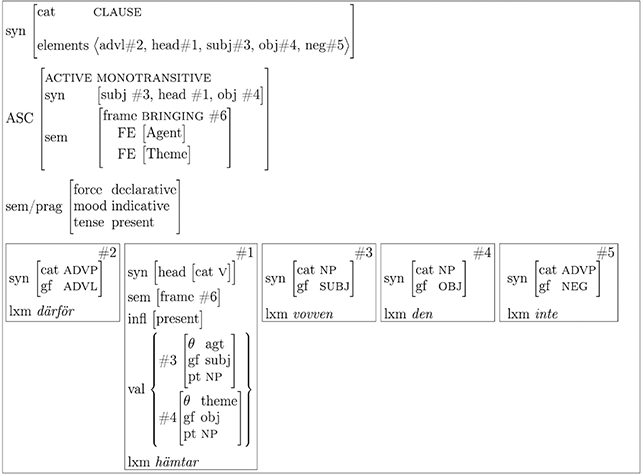
Figure 8 represents the construct Därför hämtade vovven den inte (‘That’s why Doggie didn’t fetch it’). In the outer box of the construct, one may notice several similarities to the basic SVO sentence Vovven hämtade kakan. Both are declarative clauses in the indicative mood and present tense. The same monotransitive ASC applies, including the head hämtade (#1), the subject vovven (#3), and the object, here the pronoun den (#4). In the elements list, however, there are also two elements that are not included in the ASC, namely the adverbial därför (#2) and the negation inte (#5). In this box representation it becomes apparent that the elements are presented in the order that the CEs appear in the clause.
Obviously, the sentences in (1a) (Vovven hämtar kakan) and (23), and hence Figures 6 and 7, differ in several respects, regarding both the number and the relative order of the CEs (and also the form of the object CE, which has to be a pronoun for the object shift structure in 7 to apply). This potential for variation has to be accounted for by the design of the declarative clause cxn and more generally by the superordinate fa clause cxn, which are presented in the next section.
5.2 Clausal Constructions: Declaratives and General FA Clauses
Now let us turn to the constructions that lie behind the sentence structures that were presented in the last section: first the declarative clause construction, and then the general fa clause construction of which the declarative clause cxn is a subtype.
As mentioned in Section 1, declarative clauses in Swedish are V2 structures; the finite verb is the second element of the clause. A minimal declarative clause therefore consists of a subject followed by an intransitive finite verb, as in (25a). If another element than the subject is clause-initial, as in (25b), the verb still occurs in second position and the subject, therefore, follows it. This potential for variation is captured by the declarative clause cxn outlined in Figure 9.
a.
Vovven sover. dog-def sleep-prs ‘Doggie sleeps.’ b.
Inatt sover vovven. tonight sleep-prs dog-def ‘Tonight, Doggie sleeps.’
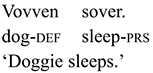
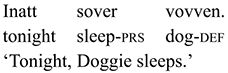
declarative clause cxn.
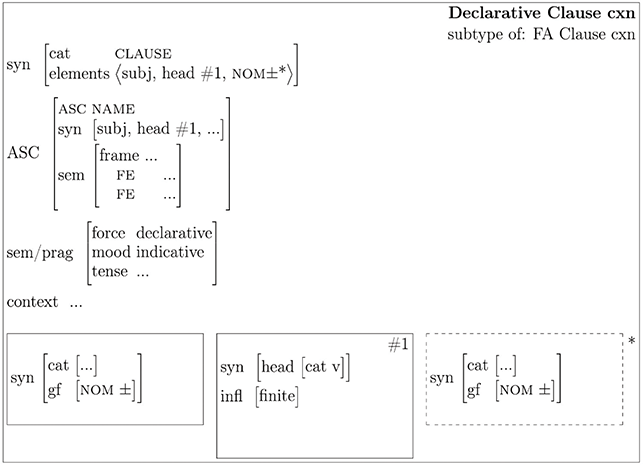
Like the sentence constructs we discussed in the previous section, the outer box of the declarative clause cxn contains features of the construction as a whole. As this is a clausal construction, the syntactic category of the cxn is clause. There are two mandatory elements of the clause: the verbal head and the subject. The third – and optional – element listed is nom± followed by a Kleene star (*). This indicates (here and henceforth) that there may be zero or more elements in the clause, and that each of these may be either nominal (nom+) or non-nominal (nom–).
The ASC feature is to be specified by an argument structure construction, representing the basic content of the clause. It is an independent feature, not subsumed under either syn or sem/prag but carrying both syn and sem features of its own. Turning to the sem/prag feature, the declarative illucutionary force and the indicative mood are integral properties of the cxn. The value for tense, on the other hand, is unspecified.
The inner boxes of the construction, representing the construction elements (CEs), are either solid line boxes or dashed boxes. Any solid line box represents a mandatory element while dashed boxes represent elements that are optional at this general level.
As mentioned in the introduction section, a declarative clause has a V2 structure, which means there is exactly one element preceding the finite verb. Which element is in the first position, however, is not specified at this level of generality (specific subtypes are presented in Section 6). Hence, the verbal head, with cat v, is the second CE, while the cat and gf values of the first CE are unspecified. Both CEs are displayed as solid line boxes, indicating that they are mandatory parts of the cxn. After the finite verb there is a dashed box followed by a Kleene star, indicating that zero or more nom± elements may appear following the finite verb, mirroring the overall elements list.
It is important to notice that while the outer box stipulates that a subject and a finite verb are mandatory in the cxn, and the inner boxes specify that there must be an element preceding the finite verb, this does not entail that the mandatory subject is the element in the first position. If an adverbial is in the first position, as in (25b) above (Inatt sover vovven) the dashed nom±* box after the finite verb hosts the subject. If the declarative only has a subject and a finite verb (Vovven sover) the dashed box is not in use.
Let us now turn to the more general FA clause cxn of which the declarative clause cxn is a subtype. As mentioned in Section 3.2 the characteristic of FA clauses is that the finite verb (F) precedes sentence adverbials (A). There are four main types of FA clauses, as listed in Figure 10.
Main FA Clause types.

The examples in (26) illustrate the clause types in Figure 10. The negation inte is included to show the characteristic FA aspect of the word order.
a.
Declarative Vovven hämtar inte kakan. dog-def fetch-prs neg cookie-def ‘Doggie doesn’t fetch the cookie.’ b.
Content clause Varför hämtar vovven inte kakan? ‘Why doesn’t doggie fetch the cookie?’ c.
Polar question Hämtar vovven inte kakan? ‘Doesn’t doggie fetch the cookie?’ d.
Imperative Hämta inte kakan! fetch-imp neg cookie-def ‘Don’t fetch the cookie!’
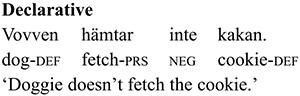
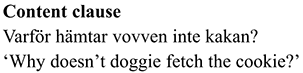
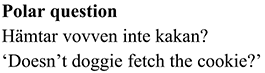
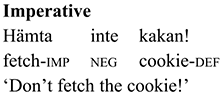
In the declarative V2 structure in (26a) the subject Vovven precedes the finite verb hämtar, while in the V2 content question (26b) the question word Varför ‘why’ is clause initial, and the subject appears following the verb. The polar question in (26c) is a verb initial (V1) FA clause, just as the imperative in (26d). All four types are covered by the overall FA clause cxn in Figure 11.
FA clause cxn.
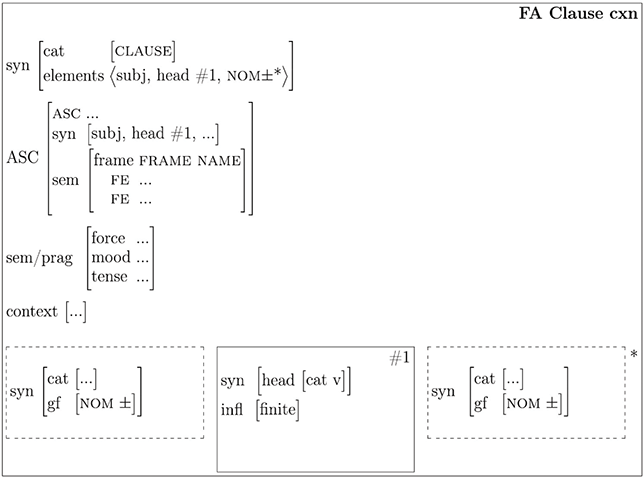
While there are many similarities between the declarative clause cxn, Figure 9, and the superordinate FA clause cxn in Figure 11, there are also some major differences: Firstly, the illocutionary force and the mood are not specified in the FA clause cxn, which allows for interrogative and directive clauses (as well as some other, less common types of FA clauses). Secondly, the initial construction element is not represented by a solid but by a dashed box, thus allowing for both V1 and V2 FA clause types.
The basic properties of of content question-, polar question- and imperative clause cxns are addressed in Section 6. In the next section, we turn to clauses containing (non-finite) verb phrases.
5.3 Moderate Phrasal Hierarchy and Verb Phrase Constructions
So far, we have treated the basic structure of simple sentences. In this section, we address somewhat more complex structures, specifically those including verb phrases. Let us begin with an example headed by the so-called control verb vilja (‘want to’):
a.
Vovven vill [hämta kakan nu]. dog-def want-prs fetch-inf cookie-def now ‘Doggie wants to fetch the cookie now.’ b.
Vovven vill [det]. dog-def want-prs it ‘Doggie wants to do it (=fetch the cookie now)’

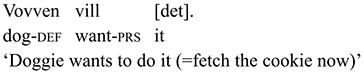
In both variants in (27), the verb vill is combined with an Experiencer subject and an eventive object, presumably evoking the desiring frame, as shown in Figure 12. In (27a), the object Event is realized as a verb phrase and in (27b) as a corresponding pronoun. The fact that the subordinate verb hämta (‘fetch’), its object kakan (‘the cookie’) and the adverbial nu (‘now’) may collectively be substituted by the pronoun det ‘it’, supports the assumption that they form a syntactic constituent in (27a): a (non-finite) verb phrase.
monotransitive control ASC with the verb vilja ‘want’.
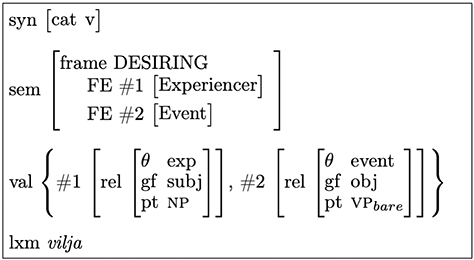
The argument structure of the clauses in (27) is illustrated in Figure 12, representing a monotransitive control ASC. Note that the phrase type of the VP object is specified as VPbare in this case. In many other contexts, infinitival VPs typically include an infinitival marker, but VP objects of vilja are generally bare (as shown later in this section, this is also the case with auxiliaries). A representation of the bare infinitival VP construction is given in Figure 13.
bare infinitival VP cxn
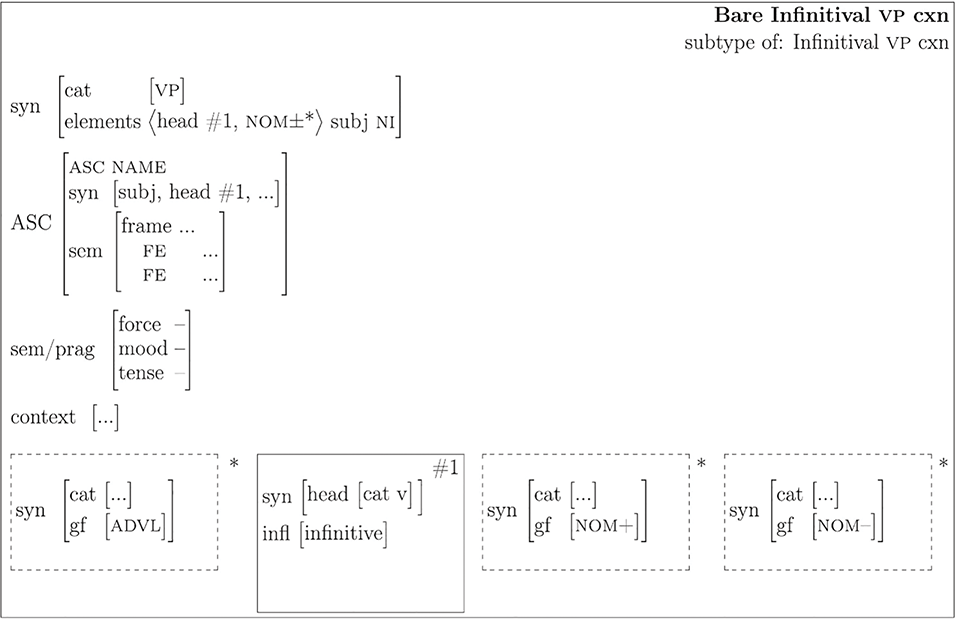
The outer box of the bare infinitival VP cxn contains many of the same attributes as the clausal constructions presented in the previous section. Instead of a finite verb, however, the head of the VP is an infinitive verb; and the subject is implicit, as indicated by its being outside the angle brackets surrounding the list of syntactic CEs and by the specification NI (for null instantiation).
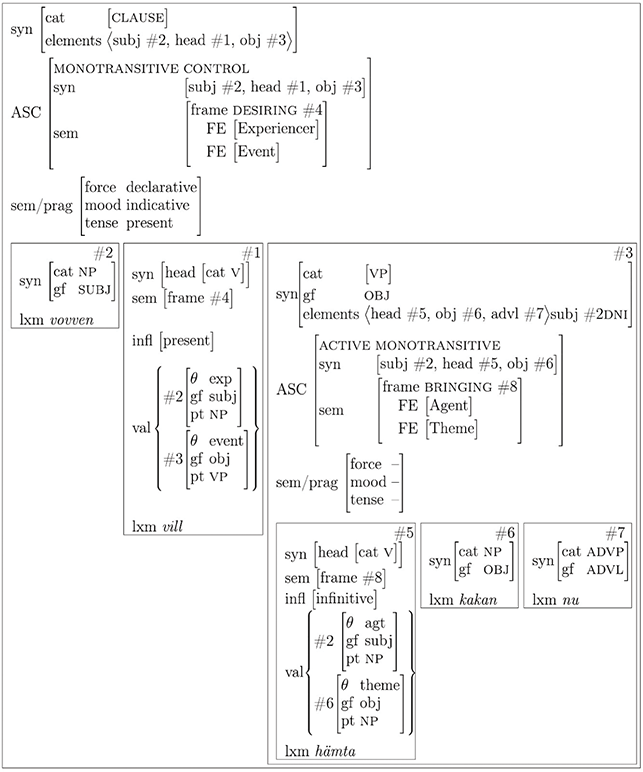
The interpretation of the implicit subject depends on the context of the VP. In (27a), the implicit subject of the VP is coreferent with the subject of the matrix verb. We return to this matter in relation to Figure 14.
Box representation of the sentence construct Vovven vill hämta kakan nu ‘Doggie wants to fetch the cookie now’.
As for the sem/prag attributes force, mood and tense, they are not merely unspecified but lacking a value altogether, as indicated by “–”.
When it comes to construction elements, only one construction element is mandatory in the bare infinitival vp cxn, namely the infinitival verb represented by a solid line box. Unlike the clausal constructions, the possibility to include more elements after the verb is represented by two separate dashed boxes: the first for zero or more nom+ elements, the next for zero or more nom− elements. This indicates that, following the verb, nominal elements generally precede non-nominal elements. Thus, the analysis captures the fact that word order is less variable in verb phrases (and, hence, in complex clauses) than in simple clauses (see Sections 3.3, 4.2, and the discussion of auxiliaries later in this section).
There is also an optional position before the verb, restricted to the grammatical function adverbial.Footnote 20 In this position adverbials that take scope solely over the infinitival VP appear. An example of this is presented in (28):
(28)
[…] nya kärntekniska lösningar kan fungera, new-pl nuclear-pl solution-pl can-prs work-inf men de kan också [inte fungera].Footnote 21 but they can-prs also [neg work-inf] ‘New nuclear solutions may work, but they may also not work.’

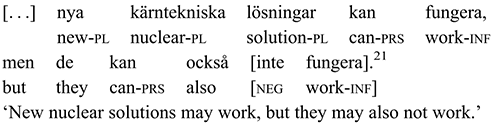
In example (28) the negation inte scopes over the infinitival verb (phrase) fungera ‘to work’ but not over the modal auxiliary kan ‘may’. The preceding adverbial också ‘also’ is a positive polarity item (ppi) in Swedish (cf. Nilsen Reference Michaelis2004; Szabolcsi Reference Stroh Wollin2004; Andréasson Reference Andréasson, Butt and King2007a), which makes the interpretation of inte having scope solely over the VP the only available; that is, ‘it is possible that they don’t work’ rather than ‘it is not possible that they work’.
The infinitival vp construction, of which the bare infinitival vp cxn is a subtype, differs from the latter in one respect: it may include an initial infinitival marker, att ‘to’. As an optional element, the infinitival marker is represented by a dashed box before all the other elements. This is shown in Figure 17 in Section 6.2.1.
To further illustrate the bare infinitival VP cxn, we now return to the full sentence construct in (27a): Vovven vill [hämta kakan nu], which is represented in Figure 14.
The outermost box represents a monotransitive declarative clause in the present tense with three construction elements: the subject Vovven (#2), the verbal head får (#1) and the object VP hämta kakan nu (#3). The VP has the semantic role Event, as indicated by both the ASC of the clause, and the valency of the verb, presented in the verbal head construction element (#1).
The VP object (#3) is headed by the verb hämta ‘fetch’. There are three construction elements in the VP: the head (#5), the object NP kakan (#6) and an adverbial AdvP nu (#7). The (locally) implicit subject is coreferent with the subject of the clause (#2) in this context, which is marked by co-indexation; the same index also applies to the Agent of the ASC of the VP, as well as the subject/Agent in the valency of the verb hämta (#5). Furthermore, the NI label is specified to DNI (Definite Null Instantiation) in the elements list of the VP, since the referent is given by the context.
Note that the co-indexation is not to be interpreted as unification but as blending (see Section 2.3). The experiencer of vilja ‘want’ and the agent of hämta ‘fetch’ are instantiated by the same element in this example, but the relation between them is not identity. Although both roles are filled by the same referent, they remain two conceptually distinct roles. Consequently, we treat the coreference relation between the co-indexed elements as a case of conceptual blending (cf. Fauconnier & Turner Reference Fauconnier and Turner2002; Herbst & Hoffmann Reference Herbst and Hoffmann2024; Hoffmann & Turner Reference Hoffmann and Turner2026), as per the treatment of combinations of constructions.
The situation where two roles are instantiated by the same element, in this case the clausal subject, has been labeled co-instantiation (Fillmore & Kay Reference Fillmore and Kay1995). More generally, the coreference relation between the implicit subject of a VP and whatever element in the context that provides its interpretation is usually called control (for an overview introduction to control phenomena, see Lyngfelt Reference Lyngfelt, Brisard, Östman, Verschueren, Östman and Verschueren2009a). In the present case, the control relation follows from properties of the matrix verb, which is why vilja (‘want to’) is considered a control verb. We will not delve into the complexities of control relations and null (or co-) instantiation here.Footnote 22
The same basic analysis applies to analogous structures such as clauses with auxiliaries, as shown in (29) with the modal auxiliay få (‘may’):
a.
Vovven får [hämta kakan nu]. dog-def may-prs [get-inf cookie-def now] ‘Doggie may fetch the cookie now.’ b.
Vovven får [det]. dog-def may-prs it ‘Doggie may do it (=fetch the cookie now)’

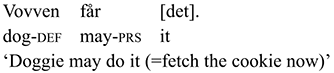
Again, the non-finite verb, the object and the final adverbial may be collectively substituted by a pronoun, which indicates that they constitute a VP object of the auxiliary verb få. We therefore treat auxiliaries anaologously to control verbs: as heads of argument structure constructions (ASCs) with a subject argument and a non-finite VP object argument.
While this is a standard analysis of control verbs, it is less widely applied to auxiliaries. The traditional (school grammar) analysis is a flat clause structure, with hämta as the main verb of the predicate får hämta (‘may fetch’), which is also reflected in the sentence schema analyses presented in Sections 3–4. However, our VP object analysis of auxiliary structures follows the Swedish Academy grammar (Teleman et al. Reference Teleman, Hellberg and Andersson1999, vol. 2:538f.), which may be considered the modern standard in Swedish linguistics. Also, in contrast to English, where there is a longstanding controversy on whether to treat auxiliaries as syntactic heads taking VP complements or as grammatical modifiers of the main verb (cf. van Trijp Reference van Trijp2017 for a CxG oriented discussion), it should be noted that Swedish auxiliaries generally behave more like ordinary verbs than English auxiliaries do.
In any case, assuming auxiliaries to take VP objects is not a stipulation; it follows from our overall approach to constituent structure. Furthermore, and crucially, the VP analysis accounts for the word order differences between clauses with simple and split predicates, that is, those with only a finite verb and those with both finite and non-finite elements. For instance, as discussed in Section 4.2 and exemplified in (30), object shift is only possible in clauses with a simple predicate.
a.
Object in canonical position Vovven hämtar inte kakan/den. dog-DEF fetch-prs neg cookie-def/it ‘Doggie doesn’t fetch the cookie/it.’ b.
Object shift Vovven hämtar den inte. dog-def fetch-prs it neg ‘Doggie doesn’t fetch the cookie’ c.
Object in canonical position Vovven får inte hämta kakan/den. dog-def may-prs neg fetch-inf cookie-def/it d.
Object shift disallowed *Vovven får den inte hämta. dog-def may-prs it neg fetch-inf ‘Doggie may not fetch it.’
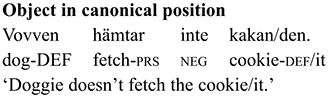
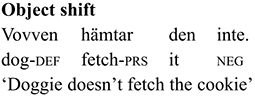

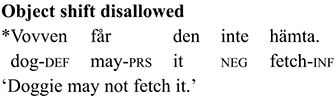
In clauses with a simple predicate, unstressed object pronouns may precede negations, as illustrated in (30b). In structures containing a non-finite verb, however, they may not, as indicated by the star before (30d). This difference aligns well with a non-finite VP analysis, where the non-finite verb and its object form a constituent: [hämta kakan/hämta den]. By contrast, this is not captured by the flat sentence schema analysis, in which the structure in (30b) does not fit (without postulating a number of extra positions, cf. Hansen and Heltoft Reference Hansen and Heltoft2011:1587).
Verb phrases are versatile structures that may serve many other functions that that of grammatical object. Some of that versatility is addressed in Section 6.2, which deals with the family of non-finite VP constructions.
5.4 Some Theoretical and Analytical Considerations
Let us now zoom out and discuss the proposed approach from a more general theoretical perspective. The syntax model presented here aims to give a comprehensive account of clausal syntax in Swedish in a way that aligns with a usage-based view of language. So how does it do that? The model is obviously system-oriented and quite formal in appearance; yet there are fundamental conceptual differences from typical formal grammars. In the following, we discuss the overall theoretical approach in Section 5.4.1 and its practical implementation in Section 5.4.2.
5.4.1 Overall Theoretical Alignment of the Present Approach
Following Newmeyer (Reference Michaelis1998; cf. also Lyngfelt et al. Reference Lyngfelt, Bäckström, Borin, Ehrlemark, Rydstedt, Lyngfelt, Borin, Ohara and Torrent2017), theoretical approaches to language and linguistics may be grouped according to two basic distinctions:
formalist vs. functionalist
generative vs. usage-based.
Although all of these labels are more or less polysemous, and the various senses commonly confused, they may still be helpful in sorting out fundamental theoretical choices and thus positioning the present approach in an overall theoretical landscape.
Formalist approaches, as opposed to functionalist ones, are concerned with grammatical well-formedness in principle independently of meaning or function. This tradition builds on Chomsky’s (Reference Chomsky1957:15) famous example “Colorless green ideas sleep furiously”, which is allegedly well-formed without making sense. In contrast, functionalist approaches incorporate meaning and function, which means all constructionist approaches are inherently functionalist.
Formalist, in this sense, is not to be confused with ‘formalized’. The notion of formal involved in the latter concept does not pertain to one’s conception of language but rather to the metalanguage employed to express it, as expressed by, for example, Joan Bresnan (see also van Trijp Reference Tomasello2024:327):
A formal theory of grammar | … | is not of itself a substantive linguistic theory. Rather, it is a language for precisely expressing descriptive rules and universal postulates of grammar.
Consequently, any linguistic conception – functionalist, formalist or whatever – may be formalized. This is not to say that the choice of formalization or metalanguage does not matter to linguistic theory. On the contrary, metalinguistic choices shape the perspective applied and thus crucially influence and constrain what may be said about language. This, however, depends on how the formalization is designed, not on formalization per se. The question is not whether to formalize but how to do it, since “formalization is not a binary concept, it is a matter of degree” (van Trijp Reference Tomasello2024:327).
In short, the syntax model we propose is formal in the sense of ‘formalized’ but not in the sense of ‘formalist’. As any constructionist model, dealing with form-function pairings, it is clearly functionalist.
Turning to the generative versus usage-based distinction, both these notions have evolved over the decades. In Newmeyer’s (Reference Michaelis1998) dichotomy, generative approaches maintain a sharp distinction between grammar and usage (or between competence and performance), whereas usage-based approaches do not. There are, however, more than one way this distinction may be interpreted.
The term generative stems from Chomsky (Reference Chomsky1957) and originally refers to a grammar as “a device that generates all of the grammatical sequences of [a language] and none of the ungrammatical ones” (Chomsky Reference Chomsky1957:13). Such a generative device needs expressive power, but it also has to be constrained in order not to overgenerate. In this spirit, linguistic research in the Chomskyan tradition aims to delimit the grammatical from the ungrammatical, both universally and with respect to particular grammars.
A construction grammar cannot be a generative device in this sense, given that constructions are conventional patterns, learned and established by usage. Nevertheless, some CxG variants have been labeled generative, such as BCG (Fillmore & Kay Reference Fillmore and Kay1995; Kay & Fillmore Reference Fillmore, Hoffmann and Trousdale1999; Fillmore Reference Fillmore, Hoffmann and Trousdale2013) and SBCG (Boas & Sag Reference Sag, Boas and Sag2012; Michaelis Reference Michaelis2024), due to their aim to account for all and only the grammatical expressions in a language.Footnote 23 They aim to do so, however, not by some generative device but by an inventory of constructions, accounting for grammaticality in terms of licensing (cf. Michaelis Reference Michaelis2024, to appear). In the words of Arnold Zwicky:
An expression is syntactically well-formed if its phonological form is paired with its semantics as an instance of some syntactic construction. It follows that an expression is ungrammatical only because there is no combination of constructions that license it, not because there is some cross-constructional filter that rules it out.
Consequently, in a generative construction grammar, constructions are conventional templates licensing linguistic expressions. Since the constructions are conventional, that is, established by usage, this view is compatible with usage-based linguistics in that regard. Yet, the distinction between grammatical and ungrammatical remains a binary one, not quite making room for the dynamic character of language (although not by disagreement with UBL but simply by a different focus).
Therefore, instead of licensing, we address the way linguistic usage is based on conventional constructions in terms of motivation, in the cognitive linguistics sense of the term (e.g., Lakoff Reference Lakoff1987; Panther Reference Østbø Munch2021). The role of established constructions is presumably that of patterns, recipes or templates. Concrete expressions are motivated by constructions to the extent that they adhere to them. Deviations may be perceived as variations of the pattern, as clashes with the pattern (i.e., ungrammaticality), or as novel expressions, depending on the degree of deviation and on one’s point of view.Footnote 24 Thus, motivation is a gradual notion, whereas licensing may be seen as the case where an expression is fully motivated by previously established constructions.
Turning from assumptions to claims, both generative and usage-based theories are ultimately theories of how the mind works. Strictly speaking, our proposed syntax model is not. It is an account of conventional usage patterns in standard Swedish – which is itself an idealization. Thus, it abstracts away from what is going on in the minds of individual language users, addressing language structure at an aggregate level. One may say that our account of syntactic patterns as such is a piece of theoretically informed language description, whereas our account of network relations and of how constructions combine goes beyond language description by addressing Swedish syntax as a system. In that, it is a model not of the cognitive reality of language users but in accordance with a constructionist and usage-based conception of it.
5.4.2 Constructions as Patterns and the Treatment of Variability
In this section, we discuss how the stance outlined in the previous section is implemented in the proposed formalism. Since grammatical formalisms tend to be based on discrete cateogories and hard constraints, whereas usage-based linguistics treats language as inherently dynamic, the challenge at hand is how to accommodate these two somewhat conflicting traditions.
Generative models typically, if not necessarily, build on discreteness: an expression is either grammatical or not, either a member of a linguistic category or not, either predicted by the theory or not. The associated descriptive apparatus tends to be devised accordingly, featuring hard constraints, etc. Usage-based theories, on the other hand, advocate more dynamic categorization, based on, for example, prototypes and family resemblance. Even so, both traditions make use of notions such as ‘noun’ and ‘clause’, although they define them somewhat differently.
In applied language description, lexicography tends more toward prototype descriptions, whereas grammaticography, and syntax in particular, tends more toward discrete definitions. This is partly due to tradition, partly due to the different objects of description. Stereotyping a bit, lexical meanings, being context dependent and more or less flexible, are often difficult to capture by discrete definitions and better accounted for by prototype descriptions and the like. Syntactic relations like word order, on the other hand, are arguably discrete by nature, constituent A either following or preceding constituent B. This is of course not to say that the gradualness of language development does not apply to syntax, but it is often a matter of relative frequencies of discrete alternatives.
Be that as it may, construction grammar, accounting for conventional combinations of form and function, is concerned with both vagueness and discreteness. The difference is not always, however, or even commonly, represented explicitly. The basic formalism we propose here is effectively underspecified between the two, aiming to provide a precise but nonetheless approximate account of conventional usage patterns. Accordingly, the construction descriptions we present are conceived of as just that: patterns, recipes.
Most actual utterances consist of expressions that follow the recipes, that is, are fully motivated (cf. licensed) by some combination of established constructions. As for expressions that do not follow the recipe to the letter, these may, as mentioned in the previous section, be perceived as (a) variations of the pattern, (b) clashes with the pattern, or (c) something else, not instantiating the pattern (including novel expressions and instances of other constructions). Since the distinction between these three outcomes depends on the utterance context and may vary between individual speakers, it is not explicitly addressed in the proposed formalism, which accounts for construction patterns at aggregate level (cf. Section 2.2). There is, however, room for accommodation of such factors in the constructional syntax, that is, the combination of constructions. As mentioned in Section 2.3, we view combination of constructions as cases of conceptual blending (cf. Fauconnier & Turner Reference Fauconnier and Turner2002), which allows for a dynamic treatment of varying degrees of mismatch. The larger or more salient the deviation from the pattern, the more difficult to accommodate the blend.
Variation within the constructional patterns is accounted for at a level of abstraction corresponding to that of the construction. Optionality is represented by dashed lines around CE boxes and by a Kleene star for an unspecified number of elements of a certain type. Other kinds of variation are indicated by variable features and in some cases by variable values of features (e.g., nom±, different values for tense, etc.). As for word order variability, a good deal of it follows from other aspects of the description, including the interplay between subtypes and supertypes (see section 6). Only in a few cases have we found a need to explicitly represent word order variability as such, namely regarding adverbial intermingling in AF clauses, which is indicated by a backslash between the alternating CEs (see Section 6.3.1).
Word order is an underdeveloped area in CxG (Leino Reference Leino2019). Some constructions have a fixed order, others are unordered, yet others are partially ordered. However, even the fixed ones may vary under certain circumstances, and the unordered ones typically have a default order that is more common than the alternatives. Hence, a binary distinction between fixed and variable word order, however indicated, is often more or less misleading.Footnote 25
What can be straightforwardly indicated, however, are conditions on certain word order variants, which we do at lower levels of generality. In the case of declarative clauses, for example, where the first position is variable, we posit particular subtypes with the associated information structural properties indicated (see Section 6.1). Furthermore, since word order correlates with other properties, a good deal of variation, or lack of it, follows from the specification of construction elements. Compare, for example, the clausal constructions in Figures 8 and 10 (Section 5.2) with the infinitival verb phrase cxn in Figure 12 (Section 5.3) with respect to the order of elements after the finite verb. In the verb phrase construction, nom+ elements precede nom− elements, whereas the elements following the verb in the clausal constructions are underspecified (nom±), thus indicating the lack of a designated order between them.
Regarding the representation of variability, there seems to be a principled difference between compatibility issues, on the one hand, and ostensibly binary issues, on the other. Compatibility issues pertain to filler-slot relations (e.g., Diessel Reference Diessel2019), that is, the blend between a CE and a construction instantiating it. In the case of a mismatch between the two, the accommodation of the blend depends on its motivation and on the degree and nature of the mismatch, as outlined above.
Ostensibly binary issues pertain to phenomena like optionality and word order variability. A certain CE is represented as either mandatory or optional, and a certain order of sequence is represented as either fixed or variable. Unless there is some account of the relative strength or different conditions on the options, marking a structure as optional or variable suggests that the alternatives are equally available. In actual usage, however, there is usually one default variant, and the alternatives are more or less marked or restricted. Hence, representing something as optional or variable may be as misleading as not doing it.
It is important to bear in mind that the construction descriptions proposed here are not intended as discrete definitions based on hard constraints, but as (precise) approximations of usage patterns. Thus, even if a word order sequence is not marked as variable or a CE not marked as optional, there is still often some leeway for variability, typically induced by a blend with other constructions.Footnote 26
5.4.3 The Role of Argument Structure Constructions
Finally, let us consider the role of argument structure constructions (ASCs). Given the extensive use of co-indexation in the analyses, the relations between grammatical functions and frame elements are represented both in the ASC and in the (verbal) head element. Such redundancy begs the question how the ASCs contribute to the model. After all, argument structure is attributed to the lexical head in most non-constructionist frameworks, and also in lexicalist CxG variants such as BCG (Fillmore & Kay Reference Fillmore and Kay1995) and SBCG (Boas & Sag Reference Sag, Boas and Sag2012). The main motivation for ASCs, as convincingly shown by Goldberg (Reference Goldberg1995), is that argument structure and lexical valency do not always match. Consider, for example, the following sentence (from Sjögreen Reference Sjögreen2015:11):
(31)
Kan man äta bort sin huvudvärk? can-prs one eat-inf away 3p.sg.com.refl headache ‘Can you eat your headache away?’

Example (31) instantiates an indirect causative bort cxn (Sjögreen Reference Sjögreen2015:120ff.; bort ≈ ‘away’), which is an ASC expressing the event that ‘the activity of the verb cause the Theme object to disappear’. While the basic valence pattern of äta ‘eat’ consists of an Agent (ingestor) subject consuming a Theme (ingestibles) object, the object in (31) is clearly not referring to the ingestibles being consumed. Instead, its role, indicated by the ASC, is that of something caused to disappear by the ‘eating away’ event; and whatever is being ingested is null instantiated. Thus, there is a mismatch between the ASC of the verb phrase and the valence of the verb, as illustrated in the box analysis in Figure 15.
Box representation of Kan man äta bort sin huvudvärk? ‘Can you eat your headache away?’
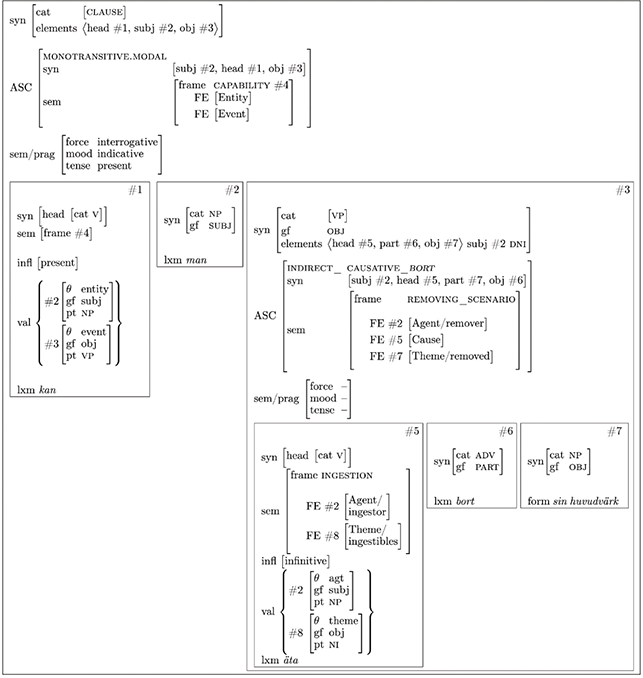
As shown in Figure 15, the indirect acusative bort cxn is instantiated as the ASC of the verb phrase complement of the modal verb kan ‘can’. The mismatch between the bort ASC and the valence of äta ‘eat’ is most clearly visible in the frame descriptions. The verb and the ASC evoke different frames, where the Ingestion frame evoked by the verb corresponds to (is blended with) the Cause FE of the Removing_scenario frame evoked by the ASC.Footnote 27 Furthermore, the Theme FE of the verb (the ingestibles) is not coinstantiated with that of the ASC and the object of the VP, but is instead null instantiated.Footnote 28 In the matrix clause, by contrast, the ASC of the overall sentence and the valence of the finite modal kan ‘can’ match perfectly.
Thus, the role of ASCs is more visible when the ASC does not match the lexical valence of the head.Footnote 29 In the majority of cases when they match, the added information is largely redundant, strictly speaking. Nonetheless, there are several linguistic phenomena that correlate with argument structure characteristics at higher levels of generality than individual verbs – passive, for example – which makes the more general ASCs relevant both for combinatory possibilities and for network relations. There is also the fact that the same verb may be associated with several different argument structures. Furthermore, the ASC representation provides a structural overview that aligns well with the research tradition in CxG. The ASCs are not included in the analyses because they are required for the formalism to work, but because they reflect a theoretical conception of clause structure.
6 Extension to More Specific Clausal and Phrasal Constructions
The constructions proposed in the previous section are pieces of an extensive and intricate network of clausal and phrasal constructions in Swedish. In this section we give an overview of how the approach extends to more specific types of FA clause constructions, as well as to other types of verb phrase constructions than bare infinitivals and, finally, to the diverse set of AF clauses.
As mentioned in Section 3, there are four major types of FA main clauses: declaratives, imperatives, content questions, and polarity questions.Footnote 30 They are all subtypes of the general FA construction proposed in 5.1, each specified for clausal function plus associated formal properties, as roughly illustrated in Table 2.
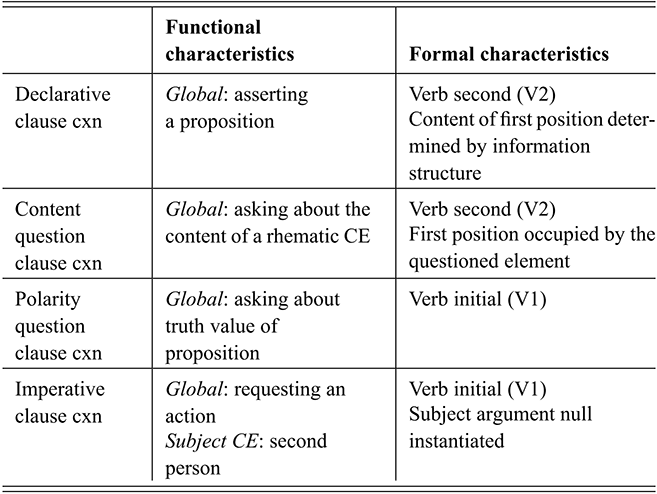
Table 2 Long description
The declarative clause construction has the following functional characteristics: Global: asserting a proposition. It has the following formal characteristics: Verb second (V2). Content of first position is determined by the information structure. The content question clause construction has the following functional characteristics: Global: asking about the content of a rhematic construction element. It has the following formal characteristics: Verb second (V2); first position occupied by the questioned element. The polarity question clause construction has the following functional characteristics: Global: asking about truth value of proposition. It has the following formal characteristics: Verb initial (V1). The imperative clause construction has the following functional characteristics: Global: requesting an action. Subject C E: second person. It has the following formal characteristics: Verb initial (V1). Subject argument null instantiated.
The functional properties of these constructions are straightforward: they correspond to particular types of speech acts.Footnote 31 We will not go into the details of those here. The formal differences between them mainly pertain to the first position of the clause: declarative clauses and content questions have a CE slot before the finite verb, whereas polar questions and imperative clauses do not. Other structural characteristics, such as subject-verb inversion (see Section 3), follow from this.
In the following, we zoom in on (subtypes of) declarative clauses in Section 6.1. First, we address word order variation due to information structure, focusing on variation in the beginning of the clause, and then we highlight a couple of idiosyncratic clause structures grounded in particular lexical items. In Section 6.2 we give an overview of the family of non-finite VP constructions, and Section 6.3 briefly addresses the variety of AF clauses.
6.1 Particular Word Order Patterns in Declarative Clauses
In Sections 3 and 4 we illustrated some general patterns of word order variation in Swedish. In this section we address how this variation depends on information structure. In particular, we show how the initial position in declarative clauses, which is generally unspecified for grammatical function, is determined by specific combinations of grammatical function and information status, a sketched in Figure 15.
The most common pattern is SVO (cf. Westman Reference Westman1974:155; Teleman & Wieselgren Reference Teleman and Wieselgren1970:119), that is, with the subject in clause-initial position. This is also the default structure in the sense that there are no information structural constraints on clause-initial subjects, although topic is by far the most common information status. Clause-initial subjects may even be expletives, bearing no information status at all. For any other element to occupy first position, there are particular constraints with respect to informative status.
The second most common pattern is Advl-VSO, that is, a clause-initial adverbial followed by subject verb inversion. Adverbial adjuncts, when occurring in first position, are typically scene-setting adverbials. Other elements than subjects or adverbials first are both strikingly less frequent (below 5 percent, taken together; ibid) and information structurally restricted. For objects and other non-subject arguments to occur in first position, this CE needs to be discourse prominent, either topical or contrastive. This includes arguments of embedded predicates, as illustrated in example (32), where the sentence-initial, focused element den kakan ‘that cookie’ is the object of hämtat ‘fetched’ in the embedded clause.
(32)
Den kakan visste Max att vovven inte hade hämtat. that cookie-def know-pret Max sbjn dog-def neg have-pret fetch-sup ‘Max knew that doggie hadn’t fetched THAT cookie’

The constructions corresponding to these three patterns are sketched in Figure 16.Footnote 32
Simplified sketches of a few subtypes of the declarative clause construction.
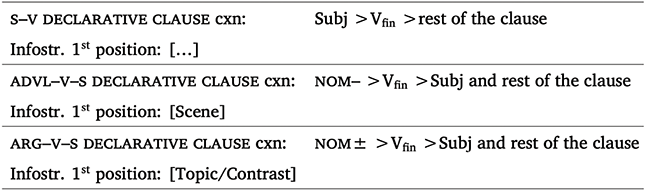
The relevance of constructional patterns at this level of generality is supported by evidence from L2 acquisition. Subject-verb inversion is a well-known problem for L2 learners of Swedish, but it does not apply uniformly across structure. As shown by Ganuza (Reference Ganuza2008), the main problem concerns adverbial-initial clauses, where there is a tendency for learners to use an Advl-SV structure instead of the standard Advl-VS where the subject is inverted. The Arg-VS construction is less of a problem, not because learners master it but because they hardly use it at all (until later in their aquisition). This should not come as a surprise, given that Arg-VS is not very common in the target language either. However, such differences between (non-subject) argument-initial and adverbial-initial clauses are often overlooked. The so-called V2 rule (the finite verb in second position) is a nice generalization that captures all the structures in Figure 16 – including the noninverted, and nonproblematic, S-V pattern – but it tends to obscure differences between the specific subschemas covered by it.
Furthermore, Ganuza (Reference Ganuza2008) also shows that even more specific patterns seem to matter for word order acquisition. In Swedish, the highly polyfunctional word så (‘so’) may be employed as a kind of border marker, positioned between clause-initial adverbials and the finite verb,Footnote 33 as illustrated in (33). In this position, så does not fill any other function and does not occupy any CE slot; hence, its occurrence before the finite verb is not considered a violation of V2. Its closest synonym, of sorts, would be a comma or a pause.
(33)
Om jag säger det så menar jag detFootnote 34 if I say-prs it so mean-prs I it ‘If I say it, I mean it’

Interestingly, Ganuza (Reference Ganuza2008) finds that this adjunctional så makes a difference with respect to L2 use of inversion. In sentences where the clause-initial adverbial is followed by så, the next element is generally the finite verb, resulting in a correct Advl-så-VS structure. The so-called V2 violations, with a nonstandard *Advl-SV structure, mainly occur in sentences without så. Possibly, since adjunctional så is invariably followed by a finite verb in standard Swedish, learners may pick up the particular [X + så + Vfin] structure, even if they have not yet mastered the general Advl-VS pattern. Note, however, that this adjunctional så is considered an informal feature, traditionally frowned upon in normative grammar.
Another particular sentence pattern, highlighting the syntactic relevance of specific constructions in addition to more general sentence schemas, is the rather unexpected behaviour of the adverb kanske ‘maybe’ in declarative clauses in Swedish, see example (34).
a.
Vovven hämtar kanske kakan. dog-def fetch-prs maybe cookie-def ‘Maybe Doggie fetches the cookie’ b.
Vovven kanske hämtar kakan dog-def maybe fetch-prs cookie-def ‘Maybe Doggie fetches the cookie’
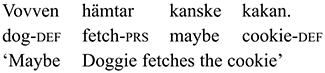
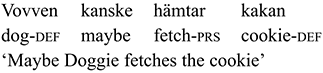
In example (34a) kanske behaves as any other sentence adverbial in an FA clause structure; it follows the finite verb hämtar, where sentence adverbials generally appear in FA clauses. In the equally grammatical declarative in (34b), however, the adverb appears in the second position of the clause, the position of the finite verb in V2 clauses. This is a particular characteristic of kanske, and it has its origin in the the adverb’s history.
The adverb kanske ‘maybe’ developed through a grammaticalization process from a clause with the predicate kan ske: the auxiliary kan ‘can’ and the infinitive verb ske ‘happen’, as in example (35) from 1528:
(35)
thet kan skee at tu seer tin nästa synda j daghFootnote 35 it can-prs happen-inf sbjn you see-prs your next sin-inf in day-indef ‘Maybe you will see your neighbour sin today’

Many other languages exhibit adverbs with similar historic backgrounds, cf. English maybe (from the predicate may be); Danish måske (from må ske); French peut-être (from peut être). The difference between Swedish kanske and the other adverbs mentioned here is that it seems to have retained some of its former verbal properties, allowing it to appear in a position normally reserved for the finite verb in V2 structures, as in (34b).
In a manner of speaking, the verbal history of the adverb kanske sometimes cathes up with it in declarative clauses and allows it to play the role of the finite verb. And kanske is not some kind of maverick element that may turn up in different places in a clause. Often, kanske behaves like any other modal adverb, but in declaratives, it may appear in the position of the finite verb, in the V2 position. Only one element may precede kanske when it appears in this position.
a.
Kakan kanske vovven hämtar. cookie-def maybe dog-def fetch-prs b.
Nu kanske vovven hämtar kakan. now maybe dog-def fetch-prs cookie-def c.
*Nu vovven kanske hämtar kakan. now dog-def maybe fetch-prs cookie-def



In example (36a) the object kakan precedes kanske, and in (36b) an adverbial, nu, appears in the first position. Putting several clausal elements before kanske is not possible, see the ungrammatical (36c). When kanske appears in the verbal position in declaratives it occurs in a kanske clause construction which is a subtype of the declarative clause construction, where the finite verb appears later in the clause than in FA-clauses in general.Footnote 36
The sentence patterns illustrated in this section constitute a partial taxonomy, from the very general FA construction to the highly specific så- and kanske-clauses. The constructions for declarative and imperative clauses, content- and polar questions (Table 2) are FA subtypes specified for sentence function, along with associated formal traits. The S-V, Advl-VS, and Arg-VS structures in Figure 16, in turn, are subtypes of the declarative construction with additional specifications of information structure. The particular sentence constructions with så and kanske are examples of lexically grounded sentence patterns within the multigranular network for Swedish sentence constructions. Thus, various case studies with a more usage-oriented approach may be incorporated within the overall system-oriented model.
6.2 The Family of Non-Finite VP Constructions
In Section 5.3 we presented one type of non-finite verb phrase: a bare infinitival VP cxn, which typically occurs as a verb complement, particularly as a complement to an auxiliary verb. In this section we extend the scope to a wider family of non-finite verb phrase constructions, mainly focusing on infinitivals, since they are particularly common in Swedish and often used in contexts where other languages would use a gerund or the like.
In the following, we present an overview of infinitival VPs in Section 6.2.1, focusing on the interplay between formal and functional variation. In Section 6.2.2 we address so-called supine VPs, which derive from (perfect) participial VPs and are employed in perfective tenses. Section 6.2.3, finally, is a brief remark on finite VPs.
6.2.1 Formal and Functional Variation in Infinitival VPs
Infinitival VPs are a highly versatile category, serving the same kinds of grammatical functions as noun phrases, including subjects, objects, predicative complements, objects of prepositions, and post-modifiers of nouns and adjectives. Formally, they may occur with or without infinitival markers (IM), depending on the syntactic context. Some of these structures are exemplified in (37):
a.
Complement of auxiliary verb Vovven vill hämta kakan. dog-def want-prs fetch-inf cookie-def ‘Doggie wants to fetch the cookie.’ b.
Object of control verb Max ber Vovven (att) hämta kakan. Max ask-prs dog-def (im) get cookie-def ‘Max asks doggie to fetch the cookie.’ c.
Object of preposition Vovven kommer tillbaka utan att hämta kakan. dog-def come-prs back without im get-inf cookie-def ‘Doggie comes back without fetching the cookie.’ d.
Post-modifier of adjective Vovven är redo att hämta kakan. dog-def be-prs ready im fetch-inf cookie-def ‘Doggie is ready to fetch the cookie.’ e.
Extraposed subject Det är roligt att hämta kakor. it be-prs fun-neut im fetch-inf cookie-pl ‘It’s fun to fetch cookies.’
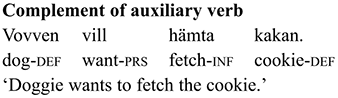
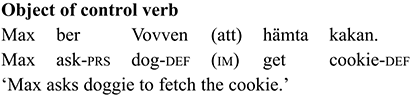

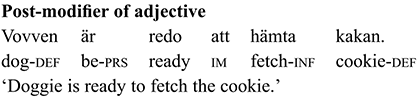
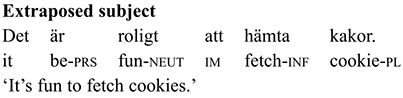
In infinitival complements of verbs, the presence or absence of an infinitival marker (IM) mainly depends on the matrix verb, IM being mandatory with some matrix verbs, optional for others and barred by still others; for instance, it is optional in complements to be ‘ask’ (37b). Auxiliaries generally occur without IM (37a). In objects of prepositions (37c ), post-modifiers of nouns and adjectives (37d ), and extraposed subjects (37e ), IM is mandatory.
Related patterns of variation apply to the meaning side, particularly with respect to control, that is, the interpretation of the implicit subject of the infinitive (cf. Lyngfelt Reference Lyngfelt2002, Reference Lyngfelt2009a,b). Generally, the interpretation depends on the matrix head, if there is one. Some verbs take subject control, that is, the implicit subject of the infinitival complement VP is co-instantiated with the subject of the matrix verb; this applies to virtually all monotransitive verbs, including auxiliaries as in (37a). Most ditransitives take object control, as in (37b). This dependence on the matrix verb applies to infinitival objects and oblique complements alike. Post-modifiers of nouns and adjectives are similarly dependent on their matrix heads. In the case of (37d ), for example, the controller of the infinitival subject is the base of predication of the head adjective redo ‘ready’.
Adverbial adjuncts are more independent, both syntactically and semantically. Usually, the controller is the matrix subject, especially when it is topical and precedes the adverbial PP as in (37c ), but otherwise the controller may be any pragmatically salient referent, depending on the context (cf. Lyngfelt Reference Lyngfelt, Brisard, Östman, Verschueren, Östman and Verschueren2009a,b). Still, there is a controller, as opposed to cases of so-called arbitrary or generic control, illustrated in (37e ). Note, however, that even generic statements like (37e ) are contextually grounded and usually associated with a pragmatically salient referent (most likely Vovven in the context at hand). Furthermore, there is a systematic connection between co-occurring pragmatically interpreted elements, since they are interpreted with respect to the same context. Thus, the implicit subject of the infinitive in (37e ) is coreferent with the Experiencer of roligt ‘fun’, the predicative complement in the same sentence.
From a constructional viewpoint, these patterns of variation are not determined by the infinitival constructions per se (except allowing for some variation) but rather follow from the constructions they co-occur with. As for their internal properties, their structure is analogous with that of narrative AF clauses (cf. Section 6.3.1), except for lacking a finite verb and a subject. They may occur with or without an infinitival marker, and their implicit subject calls for an interpretation, but which interpretation and which formal variant depends entirely on the syntactic and pragmatic context. Thus, they all conform to the general infinitival VP construction presented in Figure 17 (differing from the bare infinitival subtype presented in Figure 13 only with respect to the optional infinitival marker).
As shown in Figure 17 and exemplified in (38a), the verb may be preceded by an adverbial, in analogy with AF clauses (38b) and in contrast to FA clauses (38c), where it follows the (finite) verb.
a.
att inte hämta kakan im neg fetch-inf cookie-def ‘not to fetch the cookie’ b.
att vovven inte hämtar kakan sbjn dog-def neg fetch-prs cookie-def ‘that doggie doesn’t fetch the cookie’ c.
Vovven hämtar inte kakan dog-def fetch-prs neg cookie-def ‘Doggie doesn’t fetch the cookie.’
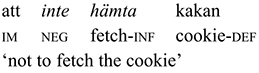
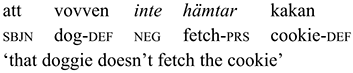
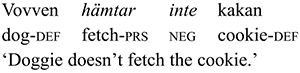
Infinitival VP construction.
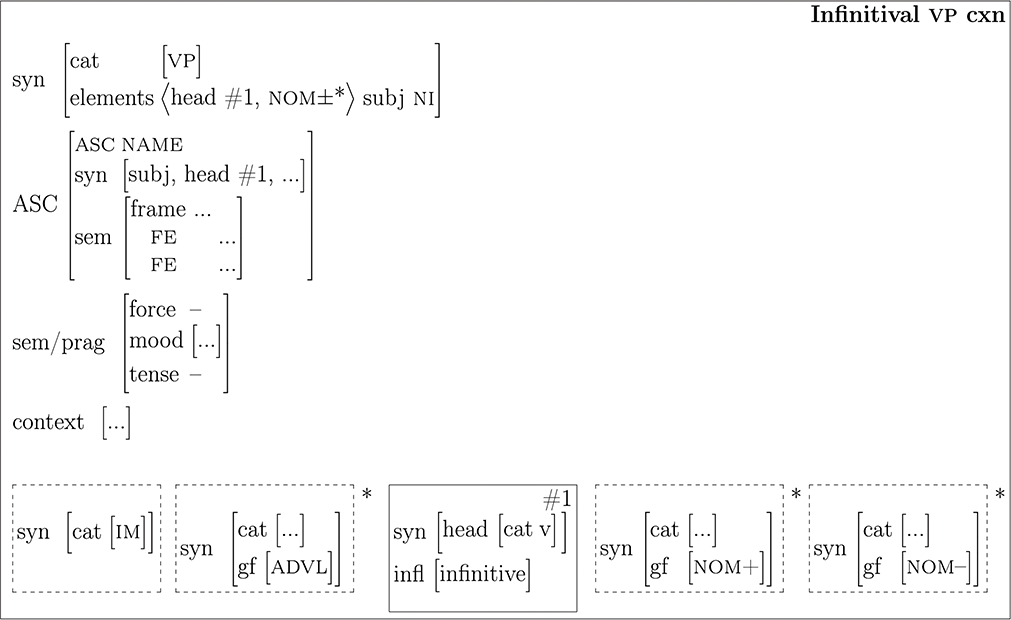
6.2.2 Supine VPs
A verbal construction particular to Swedish, different from even the neighboring languages Danish and Norwegian, is the so-called supine. Developed from the perfect participle (cf. Larsson Reference Larsson2009), it is used to form perfect tenses in combination with the auxiliary ha ‘have’. If differs from perfect participles with respect to both verb form and auxiliary, as illustrated in (39), as well as distribution (unlike participles, the supine is not used attributively, for example).
a.
Perfect tense Vovven har redan ätit upp kakan. dog-def have-prs already eat-sup up cookie-def ‘Doggie has already eaten the cookie.’ b.
Pluperfect tense Vovven hade redan ätit upp kakan. dog-def have-pret already eat-sup up cookie-def ‘Doggie had already eaten the cookie.’ c.
Perfect participle Kakan är redan uppäten. cookie-def be-prs already up-eat-pstp ‘The cookie is already eaten.’
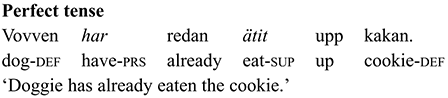
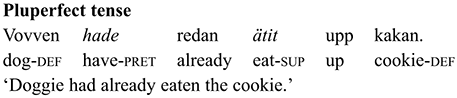
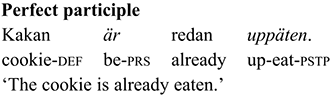
Like infinitives, supine verbs are predicate heads of VPs, which are complements to the temporal auxiliary, as supported by the constituency test in (40). Pronouns corresponding to supine VPs often co-occur with a supine expletive verb (gjort in 41b).
a.
Vovven har hämtat kakan. dog-def have-prs fetch-sup cookie-def ‘Doggie has fetched the cookie.’ b.
Vovven har (gjort) det. (det = ‘hämtat kakan’) dog-def have-prs (do-sup) it (it = ‘fetched the cookie’) ‘Doggie has done it.’
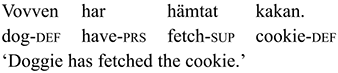

Structurally, supine VPs differ from infinitivals in having neither any subjunction-like initial marker nor a slot for adverbials before the verb. Syntactically, their most striking feature is that they, despite being the non-finite part of perfective tenses, may under certain syntactic conditions do without their temporal auxiliary. Finite ha may be omitted in AF clauses, both subordinate (41a) and main (41b) (see Section 6.3), but not in FA clauses (41c), whereas non-finite ha may be omitted in various particular contexts, for example in VP complements of auxiliaries (41d) (Bäckström Reference Bäckström2020).
a.
Vovven åt upp kakan som han (hade) hämtat. dog-def eat-pret up cookie-def that he (have-pret) fetch-sup ‘Doggie ate the cookie he had fetched’ b.
Att vovven inte (har) hämtat kakan än! sbjn dog-def neg (have-prs) fetch-sup cookie-def yet ‘How come doggie hasn’t fetched the cookie yet!’ c.
Vovven *(hade) redan ätit upp kakan. dog-def *(have-pret) already eat-sup up cookie-def ‘Doggie had already eaten the cookie’ d.
Vovven kunde (ha) ätit massor av kakor dog-def can-pret (have-inf) eat-sup lot-pl of cookie-pl om han (hade) fått. if he (have-pret) be-allowed-sup ‘Doggie could have eaten lots of cookies if he had been allowed to’




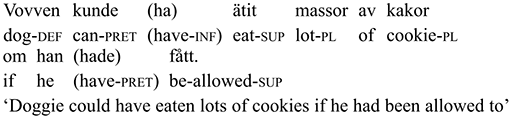
Thus, the temporal auxiliary ha is optional in a variety of embedded syntactic contexts, but mandatory as a finite verb in ordinary (FA) main clauses. Or, put differently, supine VPs may occur without a preceding auxiliary under the same circumstances.Footnote 37 In contexts where ha is optional, there are no obvious functional differences between instances with and without it. It should be noted, however, that supine VPs themselves do not express tense, only anteriority. Hence, clauses with a bare supine predicate, that is, without a finite auxiliary, are underspecified with respect to the distinction between present perfect and pluperfect. Instead, the temporal interpretation is inferred from the context, usually aligning with the tense of the matrix clause, as in (41a) and (41d).
From a constructional viewpoint, it can be noted that this variation does not pertain to the supine VP construction per se but follows from interaction with tense constructions. The present perfect, the pluperfect (or preterite perfect) and the infinitival perfect, as well as supine VPs without a preceding temporal auxiliary, are all construed using the same basic supine VP construction.
6.2.3 A Brief Note on Finite VPs
Swedish also employs finite verb phrases. These are typically placed clause-initially, accompanied by the expletive verb göra ‘do’ in second position in accordance with the V2 requirement, as illustrated in (42). Regular constituency tests apply.
a.
Dricker kaffe gör jag bara på morgonen. drink-prs coffee do-prs I only on morning-def ‘I only drink coffee in the morning’ b.
Det gör jag bara på morgonen. (det = ‘dricker kaffe’) it do-prs I only on morning-def (it = ‘drink coffee’) ‘I only do it in the morning’ c.
Vovven gillar kakor och det gör Max också. (det = ‘gillar kakor’) dog-def like-prs cookies and it do-prs Max too (it = ‘likes cookies’) ‘Doggie likes cookies and so does Max’



To what extent there is reason to assume finite VPs in other contexts depends on the syntactic analysis. On some models, there is a finite VP in every finite clause. According to a restrictive treatment of constituency, however, such as the present approach, finite verb phrases are relatively uncommon in Swedish. The perhaps most viable candidates apart from topicalized VPs occur in coordinations, which, for reasons of space, are not addressed in this Element.
6.3 The Family of AF Clauses
So far, our account has mainly addressed FA clauses. In this section we turn to the other main structural clause type in Swedish: AF clauses. The set of clauses with an AF word order in Swedish is both formally and functionally diverse, comprising most types of subordinate clauses but also some main clauses, such as exclamatives. Interestingly, there are also some striking parallels between different subtypes.
The explicitly defining formal feature of AF clauses is the position of the finite verb (F), which is consistently preceded by both subjects and non clause-final adverbials (A), hence the label AF (see Section 3.2). Other characteristic features, shared by most if not all AF clause types in a family resemblance manner, are:
mostly functioning as subordinate clauses (except for exclamatives)
beginning with a subjunction (usually mandatory, in some cases optional)
no construction element preceding the subjunction (except for indirect content questions)
no subject-verb inversion or object shift (due to the AF word order)
the temporal auxiliary ha ‘have’ may be omitted, even when finite
consistent word order following the verb, mirroring the order in verb phrases (V > nom+ > nom−).
These characteristics are illustrated by the examples in (43), contrasting an FA structure (43a) to an AF narrative subordinate clause (att clause, cf. that clause) in (43b), an AF relative clause embedded in an NP (43c), an indirect content question (43d) and two types of exclamative AF clauses (43e–f).
a.
Declarative clause, FA Därför har vovven inte hämtat kakan än. therefore have-prs dog-def not fetch-inf cookie-def yet ‘That’s why doggie hasn’t fetched the cookie yet.’ b.
Narrative subordinate clause, AF Max vet [att vovven inte (har) hämtat kakan än]. Max know-prs sbjn dog-def neg have-prs fetch-sup cookie-def yet ‘Max knows that doggie hasn’t fetched the cookie yet.’ c.
Subject relative clause in NP, AF vovven [som inte (har) hämtat kakan] dog-def sbjn neg have-prs fetch-sup cookie-def ‘the doggie that hasn’t fetched the cookie’ d.
Indirect subject question, AF Max undrade [vilken vovve som inte (hade) hämtat kakan]. Max wonder-pret which dog sbjn neg have-pret fetch-sup cookie-def ‘Max wondered which doggie hadn’t fetched the cookie.’ e.
Exclamative att clause, AF Att vovven inte (har) hämtat kakan än! sbjn dog-def neg have-prs fetch-sup cookie-def yet ‘How come doggie hasn’t fetched the cookie yet!’ f.
Subject exclamative clause, AF Vilken duktig vovve som inte (har) ätit kakan! which good dog-def sbjn neg have-prs eat-sup cookie-def ‘What a good doggie who hasn’t eaten the cookie!


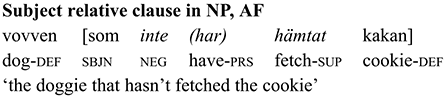


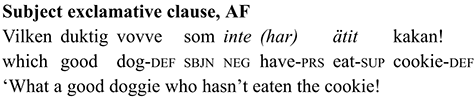
In all the examples in (43), the negation inte ‘not’ and the finite verb forms are in italics, to demonstrate the FA (43a) and AF (43b–f) distinction in word order. In addition, subordinate clauses are marked by squared brackets. The possibility of auxiliary omission is shown in (43b–f), where the auxiliay har ‘have-prs’ is optional (in contrast to 44a). Examples (43e–f) illustrate exclamative clauses, which are main clauses with an AF structure. Note that there is no particular exclamative clause structure. Instead, these clauses are structurally analogous to other AF clause types, (43e) resembling the narrative in (43b), and (43f) recruiting the structure of indirect content questions, see (43d).
One may distinguish four main types of AF clauses: “vanilla” AF clauses (6.3.1), indirect content questions (6.3.2), relative clauses (6.3.3), and exclamative clauses (6.3.4). The overall category of AF clauses as a family of constructions is discussed in Section 6.3.5.
6.3.1 “Vanilla” AF Clauses
Starting with the “vanilla” AF clauses, these are the most typical members of the AF clause family in that they manifest all the structural characteristics mentioned in the introduction to this section. Example (44) illustrates three types of “vanilla” AF clauses: narrative clauses (44a–b) an indirect polar question (44c), and two adverbial clauses (44 d–e).
a.
Narrative clause, extraposed subject Det är förvånande [att vovven inte har it be-prs surprising sbjn dog-def neg have-prs hämtat kakan än]. fetch-sup cookie-def yet ‘It is surprising that doggie hasn’t fetched the cookie yet.’ b.
Narrative clause, object Max trodde [(att) vovven inte ville hämta kakan än]. Max believe-pret sbjn dog-def neg want-prs fetch-inf cookie-def yet ‘Max thought that doggie didn’t want to fetch the cookie yet.’ c.
Indirect polar question, object Max undrade [om vovven inte ville hämta kakan nu]. Max wonder-pret if dog-def neg want-prs fetch-inf cookie-def now ‘Max wondered whether doggie didn’t want to fetch the cookie now.’ d.
Conditional clause, adverbial [Om vovven inte hämtar kakan nu] blir Max orolig. if dog-def neg fetch-prs cookie-def now become-prs Max worried ‘If doggie doesn’t fetch the cookie now, Max will get worried.’ e.
Causative clause, adverbial Max blev irriterad [eftersom vovven inte hämtade Max become-pret irritated because dog-def neg fetch-pret kakan genast]. cookie-def immediately ‘Max got irritated because doggie didn’t fetch the cookie immediately.’

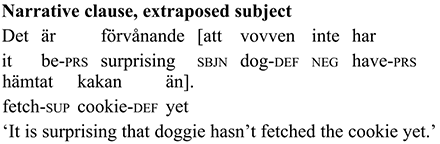




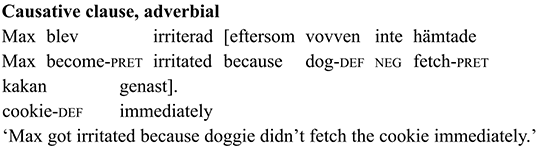
As illustrated in (44) all these AF clauses have a very similar structure. They are subjunction initial (att, om, eftersom), both the subject and the negation follow the subjunction but precede the finite verb (hämtar/hämtade/ville), and the object and the adverbial follow the verb, in that order (V > nom+ > nom–). The subjunction is generally mandatory in “vanilla” AF clauses, except in narrative object clauses, where it is sometimes optional, depending on the matrix verb (cf. 45b).
While very similar in form, these clause types differ all the more with respect to their functions. Narrative clauses (44a–b) serve all nominal functions (nom+), such as subject, object, predicative complement, object of preposition, and so on. Indirect polar questions are more restricted, occurring only as object, object of preposition or adnominal complement (45a). Most other vanilla AF clause types are adverbials (44d–e). Some of these clause types may modify nouns (45a), and narratives may also modify adjectives (45b). Furthermore, it should be noted that a vanilla AF structure is also employed in some types of exclamative main clauses, as illustrated in (43e) above.
a.
frågan [om vovven hämtade kakan] question-def if dog-def fetch-pret cookie-def ‘the question whether doggie fetched the cookie’ b.
Fåglarna var glada [att vovven inte hämtade kakan] birds-pl.def be-pret happy-pl sbjn dog-def neg fetch-pret cookie-def ‘The birds were happy that doggie didn’t fetch the cookie.’


Let us now turn to our CxG analysis of the “vanilla” AF clauses. To illustrate the basic characteristics, we start by looking at a box analysis of a narrative clause construct.
Figure 18 represents the construct att vovven inte hämtar kakan ‘that Doggie doesn’t fetch the cookie’ (the extraposed subject clause in example (44a)). In the outer box of the construct, the values of the attribute syn specify that the category of this construct is a clause with five elements, a subjunction, a subject, a negation, the head and an object. The ASC is the same active monotransitive cxn as in the declarative constructs in Figures 6 and 7, including the head hämtade (#1), the subject vovven (#3), and the object, kakan (#4).
Box representation of the narrative subordinate clause att vovven inte hämtar kakan ‘that Doggie doesn’t fetch the cookie’.
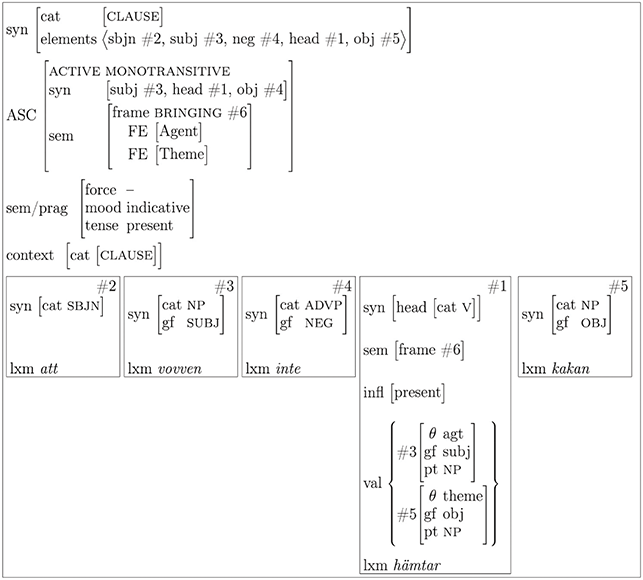
There are some differences compared to the declarative constructs. The value “–” of the attribute sem/prag shows us that this subordinate clause does not have an illucutionary force, and the value of the attribute context specifies that the clause is part of a matrix clause in example (44a).
The five construction elements are represented by five boxes, first the subjunction (#2) followed by the subject (#3). The negation (#4) precedes the verbal head (#1), i.e., AF word order. Lastly, the object kakan follows the verb (#5).
The construction behind this construct is the Narrative Clause cxn, outlined in Figure 19.
narrative clause cxn.
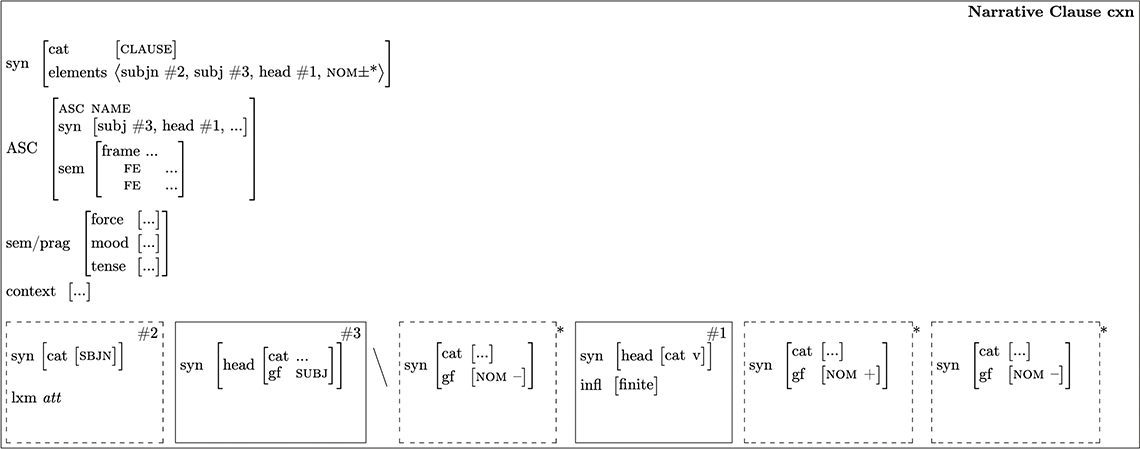
The outer box of the narrative clause construction in Figure 19 reveals that the construction is a clause, and that a subjunction, a subject and a head are the main elements in the clause. There is also an optional nom±* element where the Kleene star indicates that zero or more additional nominal and/or non-nominal construction elements may be part of the construction. The context feature is not limited to some specific value in the construction, since narrative clauses may occur in different kinds of matrix structures: clauses, APs, NPs, and PPs.
The first CE box is dashed to illustrate the possibility to leave out the subjunction att. The solid line subject box indicates that the subject is mandatory in narrative AF clauses, and it is followed by a dashed box indicating that zero or more non-nominal elements may appear here. The backslash sign between these two boxes signifies that the ordering between non-nominal elements and the subject is not fixed, subject-adverbial intermingling; see Section 4.1.
The head of the clause is in a solid line box followed by two dashed boxes, the first a position where nom+ elements may appear and the second a position for nom– elements. The ordering illustrates the similarity between AF clauses and VPs in the area following the verbal head (cf. the beginning of Section 6.3 and Section 5.3).
Other kinds of “vanilla” AF clauses, such as indirect polar questions (44c), conditionals (44d) and causative clauses (44e), differ from narratives mainly with respect to their functions. Formally, all “vanilla” AF clauses are very similar, except for having different subjunctions.
The exclamative in (43f), while otherwise structurally very similar, differs from the others in being an independent clause. Hence, it has illocutionary force (exclamative) but no syntactic matrix structure (i.e., no syntactic value for context; we will not go into contextual conditions for independent clauses here). We return briefly to exclamative AF clauses in Section 6.3.4.
6.3.2 Indirect Content Questions
Indirect content questions differ from the vanilla AF structure in that they begin with an interrogative element representing a grammatical function in the clause, as per main clause (FA) content questions. If there is a subjunction, som, it follows this initial element. There is a structural difference between indirect subject questions (46a) and indirect non-subject questions (46b) in that the subjunction is mandatory in the former, but optional and often left out in the latter (Teleman et al. Reference Teleman, Hellberg and Andersson1999, vol. 3:486, 555f.; Stroh Wollin Reference Stroh Wollin2002). Indirect subject questions also differ from most other AF clauses (including indirect non-subject questions) in that the subject, being clause-initial, does not occur between the subjunction and the finite verb (46a).
a.
Indirect subject question Max undrade [vilken vovve som inte hämtade kakan]. Max wonder-pret which dog sbjn neg fetch-pret cookie-def ‘Max wondered which doggie didn’t fetch the cookie’ b.
Indirect non-subject question Max undrade [vilken kaka (som) vovven inte hämtade]. Max wonder-pret which cookie-def (sbjn) dog-def neg fetch-pret ‘Max wondered which cookie doggie didn’t fetch’


As these two clause types are structurally different, and space is limited, we present a box analysis of only one of them: the indirect subject question in (46a), as shown in Figure 20.
Box representation of the indirect subject question clause vilken vovve som inte hämtade kakan ‘which doggie didn’t fetch the cookie’.
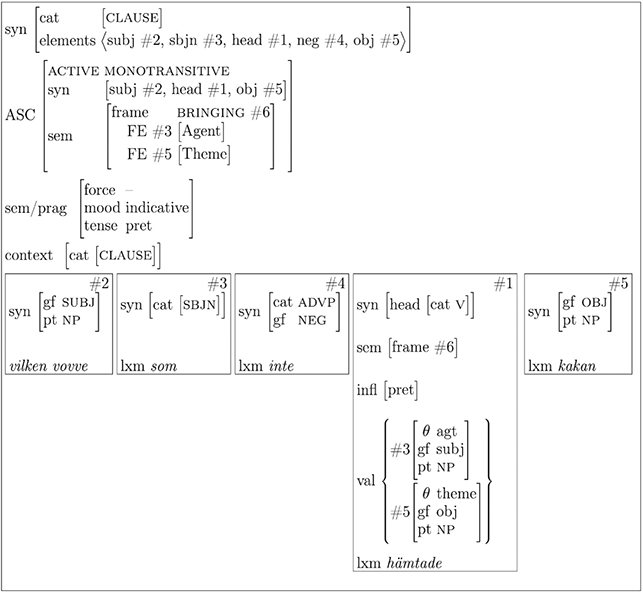
Figure 20 represents the construct vilken vovve som inte hämtade kakan ‘which doggie didn’t fetch the cookie’. It is mostly similar to the narrative clause construct in Figure 18, except for the interrogative subject, vilken vovve, preceding the subjunction. This construct is an instance of the indirect subject question cxn., which is presented in Figure 21.
indirect subject question cxn.
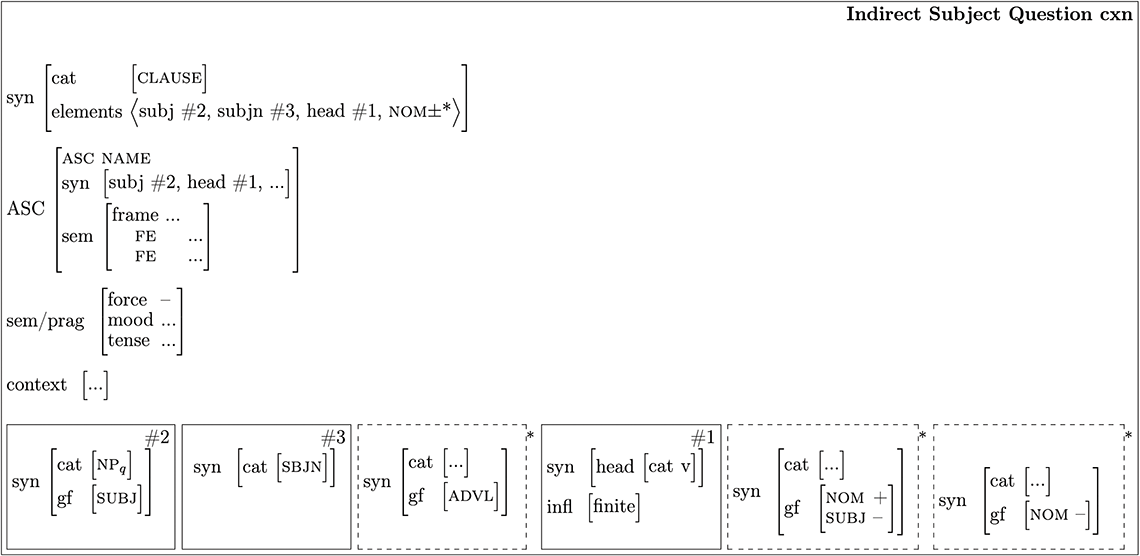
In the indirect subject question cxn there are three boxes with solid lines. The initial box represents the position of the subject, which must have the category NPq, where the subscript q stands for ‘interrogative’, such as the NP vilken vovve where there is an interrogative determiner, or an interrogative pronoun such as vem ‘who’.
The corresponding indirect non-subject question cxn (not shown here) differs from Figure 21 in three regards. First, the initial CE would have the category XPq, to allow for more phrase types than NPs to be the initial construction element, and a subj– value for grammatical function. Second, the subjunction box would be dashed indicating it being optional, and third, there would be a solid line box for the subject after the subjunction box, similar to the narrative clause cxn in Figure 18.
6.3.3 Relative Clauses
Relative clauses are a somewhat diverse family in themselves. The most common type is adnominal, subjunction-initial and contains a (locally) null instantiated element corresponding to the matrix head noun, the so-called correlate. as illustrated in (47). There is also a version initiated by a relative pronoun or adverb, as illustrated in (48).
a.
vovven [som […] inte hämtade kakan] dog-def sbjn neg fetch-pret cookie-def ‘the doggie that didn’t fetch the cookie’ b.
kakan [(som) vovven inte hämtade […]] cookie-def sbjn dog-def neg fetch-pret ‘the cookie that doggie didn’t fetch’


a.
kakan [vilken vovven inte hämtade] cookie-def which.com.sg dog-def neg fetch-pret ‘the cookie which doggie didn’t fetch’ b.
trädgården [där vovven inte hämtade kakan] garden-def there dog-def neg fetch-pret cookie-def c.
Vovven åt kakan genast, [vilket inte förvånade Max]. dog-def eat-pret cookie-def immediately which neg surprise-prt Max ‘Doggie ate the cookie immediately, which didn’t surprise Max’



Starting with the subjunction type in (47), the null instantiated element (indicated by […] in the examples) is coreferent with the correlate, of which the relative clause is a modifier. Parallel to indirect content questions, the subjunction som is mandatory in subject relatives (47a) but optional in non-subject relatives (47b).
In the relative clauses in (48), on the other hand, there is no null instantiated element. Instead, the CE corresponding to the correlate is realized as a clause initial relative pronoun (48a,c) or adverb (48b). Unlike the subjunction som, the relative pronoun agrees with the correlate in gender and number (common gender singular in (48a)) and is always mandatory. Relative clauses with a neuter pronoun are not restricted to adnominal functions but may also be adjoined to a clause, as in (48c), taking the clause as its correlate. While adnominal use of relative pronoun clauses is stylistically marked as somewhat formal, som clauses (with or without som) being overwhelmingly more common, this neuter clause-adjoined variant is stylistically neutral and quite common.
Figure 22 shows a box analysis of the construct som inte hämtade kakan ‘who didn’t fetch the cookie’ from example (47a).
Box representation of the subject relative clause som inte hämtade kakan ‘that didn’t fetch the cookie’.
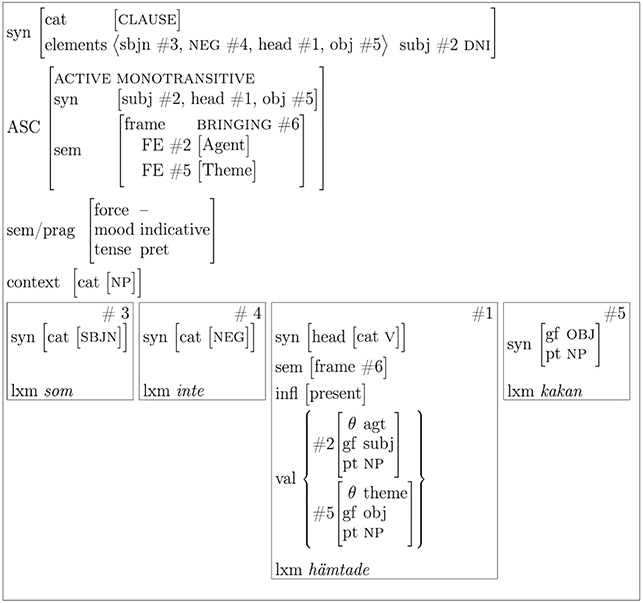
The construct in Figure 22 is a subject relative clause in an NP vovven som inte hämtade kakan ‘the doggie that didn’t fetch the cookie’. It is very similar to the indirect subject question construct in Figure 20, except for the subject being null instantiated, and that there is no element preceding the subjunction som. Since the clause is adnominal, it has the context value NP, and the DNI subject of the relative clause is coreferent with the head of that NP (the correlate).
The subject relative clause cxn, of which the construct in Figure 22 is an instance, is presented in Figure 23.
subject relative clause cxn.
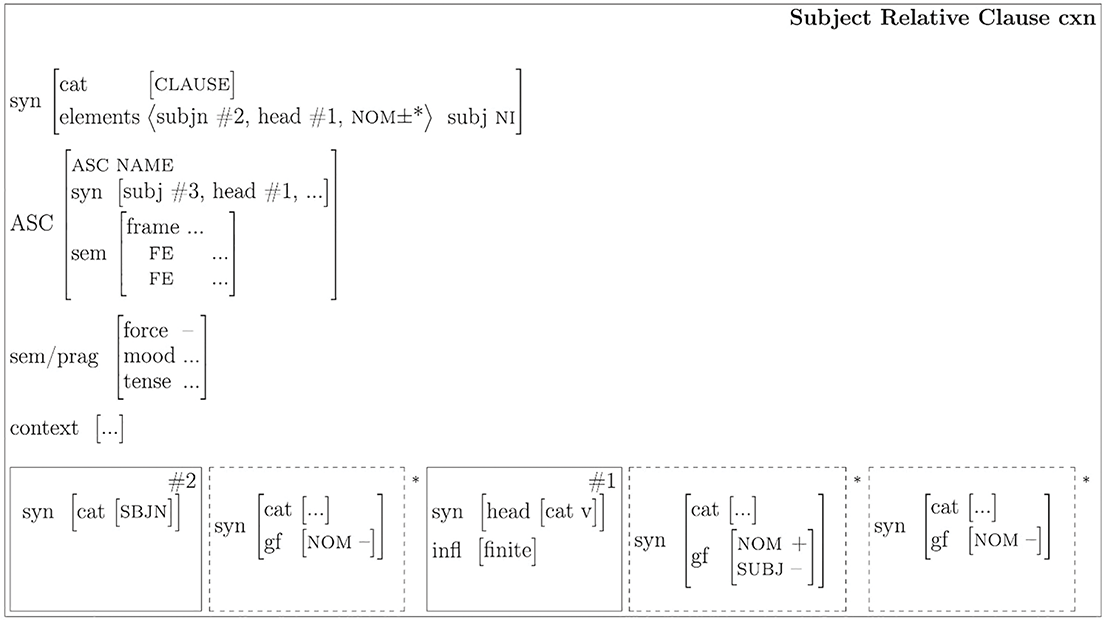
As shown in Figure 23, there are two mandatory elements in the subject relative clause cxn: the subjunction som and the verbal head. The subject is null instantiated, as discussed in relation to Figure 22. In other respects, this construction very much follows the same pattern as the indirect subject question cxn in Figure 21, albeit without the initial box for the subject. Constructions for non-subject relatives would have other elements null instantiated and a solid line box for subjects (c.f. narrative clause cxn in Figure 19).
6.3.4 A Brief Note on Exclamative AF clauses
Exclamative clauses stand out in the AF family by being main clauses, but there is no particular structural clause type for exclamatives. Instead, these clauses recruit the structure of other AF clauses:
a.
Att vovven inte har hämtat kakan än! sbjn dog-def neg have-prs fetch-sup cookie-def yet ‘How come doggie hasn’t fetched the cookie yet!’ b.
Vilken duktig vovve som inte har ätit kakan! which good dog-def sbjn neg have-prs eat-sup cookie-def ‘What a good doggie who hasn’t eaten the cookie! c.
Om vovven ändå kunde hämta kakan någon gång! if doggie-def still can-pret fetch-inf cookie-def some time ‘If only doggie could fetch the cookie some time soon!’ d.
Som vi skrattade den gången! sbjn we laugh-pret that time-def ‘How we laughed that time!’



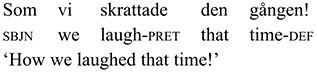
Example (49a) patterns with narrative (att) clauses and (49b) with indirect content questions. The variant in (49c), based of AF conditionals (om), is sometimes distinguished as a clause type of its own, so-called desiderative clauses (Teleman et al. Reference Teleman, Hellberg and Andersson1999, vol.1:162). The type in (47d), while initiated by the subjunction som, differs from relative clauses in not having a null instantiated CE, instead patterning with vanilla AF clauses.
6.3.5 Is There a General AF Construction?
We now turn to the overall family of AF clauses. Given the recognition of two major clause types in Swedish, FA clauses and AF clauses, and given that we propose a general FA clause construction, one might expect the model to contain a general AF clause construction as well. However, given the range of variation between different types of AF clauses, as shown in the previous sections, one might not.
Let us first review the variety of AF clause types, as tentatively outlined in Figure 24.
A tentative taxonomy of AF clauses.
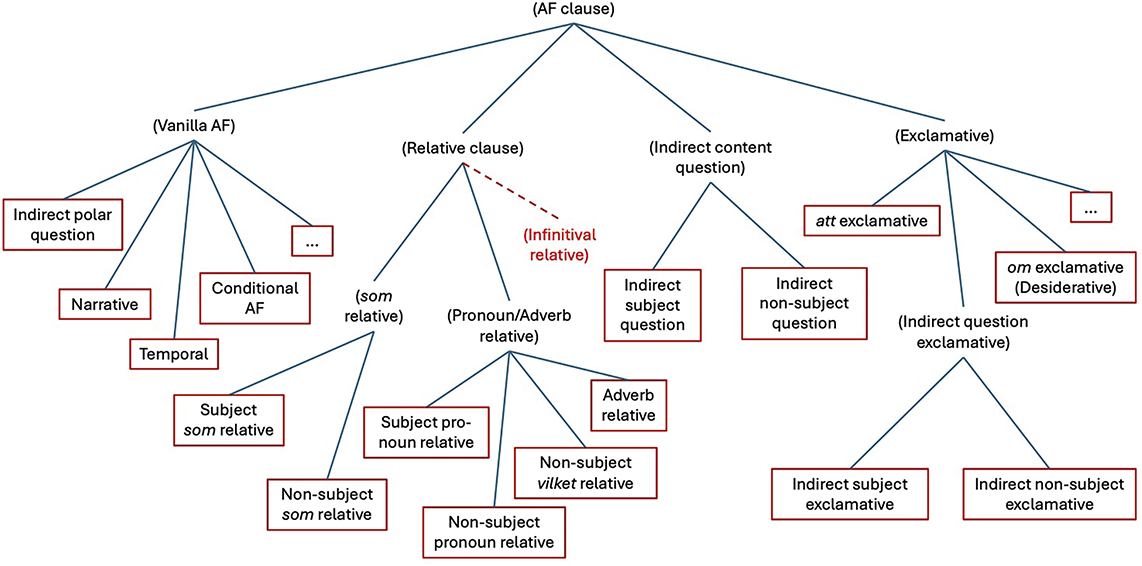
As a taxonomy of AF clause types, an organization along the lines of Figure 24 would make sense, although one can always discuss some details. Whether it corresponds to a taxonomy of AF clause constructions, however, is a different matter. From a constructionist point of view, constructions are the basic units of language, and a construction is a pairing of a formal pattern with an associated function. The boxed clause types in Figure 24 are plausible constructions in this sense, tangible morphosyntactic structures with well-established functions.
The superordinate categories in parentheses are generalizations capturing similarities between more specific clause types. Some, like Exclamative, capture a functional similarity between formally different structures. Others, like “Vanilla” AF, mainly pertain to form. Indirect content question is a better construction candidate, based on both a shared function and formal similarities between its subtypes, but there are also substantial structural differences between them, making a shared representation quite abstract. Relative clauses, in turn, form a category of family resemblance, distinguished by both formal and functional properties, but none of which apply to all subtypes.Footnote 38
Furthermore, there are both similarities and differences that cut across the groupings. All types of exclamatives recruit the form of other AF clause types, such as narratives and indirect content questions. So-called desiderative exclamatives (Teleman et al. Reference Teleman, Hellberg and Andersson1999, vol. 4:770 f.) have the same form as both conditionals and indirect polar questions (all with the subjunction om ‘if/whether’ and conforming to “vanilla” AF). At the same time, the structural contrast between subjects and non-subjects recurs, with some variation, in som relatives, pronoun relatives, indirect content questions (and thus indirect question exclamatives), as well as in FA content questions and declaratives.
A particularly intriguing parallel concerns conditional clauses and polar questions. In addition to conditional AF clauses (50a), there are also V1 conditionals (50b), with the same structure as FA polar questions (50c). At the same time, indirect polar questions (50d), which are the subordinate counterpart of polar questions, have the same form as conditional clauses.
a.
Om vovven inte hämtar kakan blir Max orolig. if dog-def neg fetch-prs cookie-def become-prs Max worried ‘If doggie doesn’t fetch the cookie, Max will get worried’ b.
Hämtar vovven inte kakan blir Max orolig fetch-prs dog-def neg cookie-def become-prs Max worried ‘If doggie doesn’t fetch the cookie, Max will get worried’ c.
Hämtar vovven inte kakan? fetch-prs dog-def neg cookie-def ‘Doesn’t doggie fetch the cookie?’ d.
Max undrade om vovven inte ville hämta kakan. Max wonder-pret if dog-def neg want-pret fetch-inf cookie-def ‘Max wondered whether doggie didn’t want to fetch the cookie’


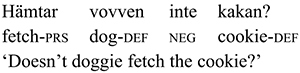

All in all, the intricate combination of differences and cross-cutting parallels between the various AF clause types (as well as some FA clause types), points in the direction of a multidimensional network (e.g., Diessel Reference Diessel2019, Reference Diessel2023; Hilpert et al. Reference Hilpert, Lyngfelt and Torrent2026; Sommerer & Van de Velde Reference Sommerer, Van de Velde, Fried and Nikiforidou2025) rather than a top-down taxonomy.
Would it still make sense to posit a general AF construction accounting for the properties that are shared between AF clauses, distinguishing them from FA clauses? While it is certainly feasible, the case for positing such a construction is somewhat weak. First of all, there is no functional property that all AF clauses share, except that of denoting a proposition, which all finite clauses do. The majority of them are subordinate clauses (which, in turn, constitute a diverse set of functions); but the fact that not all of them are, and that not all subordinate clauses have an AF structure, is the reason why AF clauses were recognized as a category in the first place (cf. Teleman et al. Reference Teleman, Hellberg and Andersson1999, vol. 4:537ff., 647f.). As regards formal structure, they all share the AF word order and thus a consistent SV order, but otherwise the CE setup before the verb(s) varies substantially in terms of both content and relative order. The only consistently mandatory element is the finite verb, and even that may be omitted in perfect tenses; yet no subordinate clause type consists of only a verb.
In summary, the variety of AF clauses do not seem to correspond to a plausible superordinate construction in the sense of a form-function pattern. Instead, the substantial structural similarities that in fact hold between different types of AF clauses are more of a family resemblance kind. Therefore, they are probably better accounted for by network relations.
Since we do not posit a general AF clause construction, why do we still posit a superordinate construction for FA clauses (Figure 10, Section 5.2)? Simply put, it is a somewhat stronger case, with less messy patterns of variation between its subtypes and, importantly, a shared function: FA clauses in general express illocutionary force.Footnote 39 There is not, however, anything in the proposed syntax model that depends on the existence of an FA clause construction. The FA clauses make up a construction family as well, with an intricate web of interrelations beteeen different FA clause types. On the same grounds, one may also distinguish a construction family of main clauses and one of subordinate clauses, which overlap with the FA and AF families in interesting ways. On a multidimensional network model, taxonomic relations are just one relation type among many (Diessel Reference Diessel2023, and others; see Section 7.1.2).
7 Discussion
In this Element, we present a constructionist syntax model for (standard) Swedish, focusing on clausal constructions and clause formation. These two aspects of syntax are mutually dependent in that you cannot reliably account for the structure of clausal constructions without an idea of how other constructions are combined to form them. Conversely, you cannot reliably account for the constructions and processes involved in clause formation without an idea of what overall structures they add up to.
The clause formation part of the model concerns both which constructions are being combined, the construction elements of the clause; and how they are combined, which may be called constructional syntax. On the model proposed here, clause formation is basically a matter of the combination of a clausal construction and an argument structure construction (ASC), as well as their respective construction elements. The combination of constructions is treated as conceptual blending (cf. Fauconnier & Turner Reference Fauconnier and Turner2002; Herbst & Hoffmann Reference Herbst and Hoffmann2024; Hoffmann & Turner Reference Hoffmann and Turner2026).
This account of clausal syntax in Swedish contributes to both the development of construction grammar (CxG) and to Swedish linguistics:
The model provides an overall CxG account of clausal syntax, for a language other than English. Except for argument structure, overall CxG accounts of general syntactic patterns, let alone constructional syntax, are rare and mainly pertain to English (e.g., Fillmore & Kay Reference Fillmore and Kay1995; Sag Reference Sag, Boas and Sag2012).Footnote 40 Hence, a syntax model for Swedish, which addresses structures and phenomena not covered by existing English models, extends the coverage and may hopefully benefit related approaches to other languages as well.
The model is an attempt to provide a consistent overall account of clausal syntax that is in line with usage-based linguistics. This is worth emphasizing, since there are several varieties of constructionist approaches (see, e.g., Ungerer & Hartmann Reference Tomasello2023). While the different CxG variants agree in most respects and differ mainly with respect to their foci, there seems to be a fairly widespread perception of formalized accounts of general syntax being incompatible with usage-based linguistics (see Boas et al. Reference Boas, Leino and Lyngfelt2024). The present approach is an attempt to bring the two somewhat closer together.
As for Swedish syntax, the model builds on existing accounts, nuancing the picture rather than proposing a radically different view. Swedish is a well-documented language (cf. Teleman et al. Reference Teleman, Hellberg and Andersson1999 in particular), and the present model contributes constructionist insights, for example, by exploring network relations and highlighting the importance of semi-general syntactic patterns, as well as bringing a diverse set of phenomena together in a coherent model in line with modern theoretical advances.
The model is designed to be implemented in the Swedish Constructicon (e.g., Lyngfelt et al. Reference Lyngfelt, Bäckström, Borin, Ehrlemark, Rydstedt, Lyngfelt, Borin, Ohara and Torrent2018a), thus contributing to applied constructionist description of Swedish and, by extension, to constructicography in general.
By providing an overall constructionist account of general clausal syntax in Swedish, the model offers a platform for further constructionist investigations of Swedish syntax. Several syntactic phenomena are difficult to account for without reference to the more general structures to which they apply, and the previous lack of a relevant syntax model has been an impediment to progress in this area.
Obviously, the model is not complete, as if it ever could be, and it will surely be subject to modification as more constructions are brought into the picture. Nonetheless, we are fairly confident that it provides a robust account of key syntactic phenomena in Swedish and a firm base for future development.
In the following, we address the proposed construction network in Section 7.1, including a comparison with traditional sentence schemas (7.1.1). In Section 7.2, we discuss constructions in combination and full-sentence analysis, in particular in relation to CASA style construction grids (Herbst & Hoffmann Reference Herbst and Hoffmann2024), and give a brief preview of how the syntax model may be integrated with interactional linguistics (Section 7.2.1). Section 7.3 provides an outlook and some concluding remarks, commenting on the model with respect to usage-based perspectives.
7.1 Swedish Clause Patterns as a Network of Constructions
In this Element, we account for a portion of a constructicon of standard Swedish. We present an extensive network of clausal constructions, in the form of a comprehensive taxonomy of so-called FA clauses and a more heterogeneous family of AF clause constructions. To a lesser extent, we address verb phrase constructions, substantiating our treatment of constituent structure, and give a few examples of argument structure constructions, illustrating our approach to clause formation. In this section, we first compare the proposed syntax model to the topological sentence schemas traditionally employed for description of Swedish clause structure and then briefly address the network relations between the constructions.
7.1.1 Comparison to Sentence Schemas
Topological sentence schemas (e.g., Teleman et al. Reference Teleman, Hellberg and Andersson1999) represent conventional linear order between grammatical functions (see Section 3). They come at two different levels of generality, either as separate schemas for AF and FA clauses (following Diderichsen Reference Diderichsen1946) or as a joint schema incorporating both patterns (Platzack Reference Østbø Munch1987), as shown in Figure 25.
Topological sentence schemas.
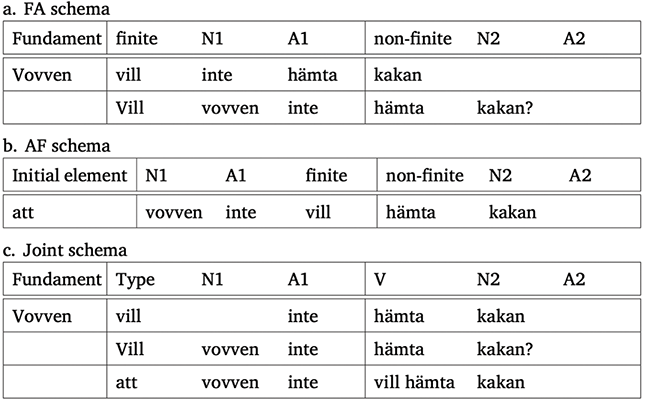
Since the main difference between the FA schema (a) and the AF schema (b) is the position of the finite verb they may be fused inte the joint schema (c), in which the second position (called Type for clause type) is occupied by the finite verb in FA clauses and by subjunctions in AF clauses. If the finite verb is not in the Type position, it occupies the V slot together with non-finite verbs.Footnote 41
These schemas are very powerful tools in that they cover most clausal structures in Swedish in a clear and illustrative manner. They do have their limitations, however, as shown in Sections 3–4 above. In addition, their descriptive power relies heavily on empty positions, since most actual clauses do not make use of all seven slots, and also on some flexibility regarding the functions of certain positions (especially regarding FA clauses, where almost any grammatical function may occur in the first position).
The most obvious difference between the schemas and our constructionist analyses is that of complexity. The sentence schemas are simpler, focusing on linear order, whereas the box analyses are richer in information, also taking other kinds of properties into account, and hence more complex. Also, as discussed in Section 5, our constructionist syntax model can handle at least some of the variation that is not covered by the sentence schemas. One may ask, however, whether our model still captures all the descriptive power of the schemas. Apart from the simplicity, we think it does, although somewhat differently for FA and AF clauses.
Let us first consider FA clauses, which we cover by a taxonomy of FA clause constructions. Although the FA clause cxn is highly underspecified, the regularity from the non-finite verb onward follows from the verb phrase construction(s). Thus, the model captures the high degree of word order regularity in clauses with complex predicates while at the same time allowing for more variability in FA clauses with a simple predicate. The key is the interplay between ASCs and the moderately hierarchical constituent structure.
The sentence schemas cannot handle such distinctions and associated kinds of variation, since the position of the non-finite verb is always there. Theoretically, this difference between the approaches boils down to the conceptual difference between positions in a schema and elements in a construction (both of which may be called slots). Positions may be filled or empty but remain invariably present, whereas optional construction elements are only present in those constructs where they are actually realized.Footnote 42
Another important difference is the multigranular character of the constructionist approach. Whereas the sentence schemas pertain to the highest levels of generality, our taxonomy of clause constructions ranges from the highly abstract fa clause construction, over functional clause types such as declarative-, imperative-, and narrative clause cxns, to highly particular constructions such as kanske clause cxns and adjunctional så cxns (see Section 6.1).
Admittedly, taxonomies may be recognized in any framework, but there is a general tendency in favor of the highest levels of generality. In CxG, by contrast, multigranular networks are part and parcel of what the theory is all about. Hence, constructionist models are more inviting and hospitable to the recognition and highlighting of particular and semi-general patterns.
Furthermore, construction networks go beyond mere taxonomies by also distinguishing other kinds of network relations.
7.1.2 Network Relations
A constructicon is a conception of the set of constructions in a language.Footnote 43 It is typically pictured as a multidimensional network (e.g., Diessel Reference Diessel2019, Reference Diessel2023; Hilpert et al. Reference Hilpert, Lyngfelt and Torrent2026; Sommerer & Van de Velde Reference Sommerer, Van de Velde, Fried and Nikiforidou2025). Although the network relations dealt with in the present text are predominantly taxonomic relations, we certainly have a more multidimensional construction network in mind.
One may distinguish network relations within as well as between constructions, and also relations between construction elements and associated constructions (so-called filler-slot relations, for example the association between the verb slot of the ditransitive cxn and the commonly co-occuring verb (lexical construction) ge ‘give’). For an overview of network relations, see Hilpert et al. (Reference Hilpert, Lyngfelt and Torrent2026), and for a presentation of the network model of the Swedish Constructicon, with which the present syntax model is strongly associated, see Blensenius & Lyngfelt (Reference Blensenius, Lyngfelt, Dannélls, Blensenius and Borin2025).
Narrowing down to relations between constructions, these are typically divided into on the one hand (vertical) taxonomic relations between subordinate and superordinate constructions, and on the other hand (horizontal) associations between constructions sharing various kinds of properties (cf., however, Ungerer Reference Ungerer2024). Following the categorization of the Swedish Constructicon, such associations may concern:
grammar: connections between constructions that share morphosyntactic properties; for example, noun phrases, infinitival verb phrases and narrative clauses share the property of being associated with nom+ functions like subject and object.
semantics/pragmatics: connections between constructions with a shared meaning or function, e.g., contrast, causation, or aspect.
element: connections between constructions that share a particular type of construction element, such as a reflexive, an expletive or a verb particle.Footnote 44
other: predominantly extra-linguistic associations, such as connection to certain genres or particular relevance for L2 education.
Relations such as these apply within groups of related constructions, also called construction families (e.g., Ziem & Willich Reference Vikner, Everaert and van Riemsdijk2023), but may cut across radically different kinds of constructions as well; focus, for example, may be signalled by word order, by cleft constructions, or by stress alone.
Looking at the families of constructions treated in this Element – mainly FA clause cxns, AF clause cxns, (infinitival) verb phrase cxns, and argument structure cxns – these are interrelated by complex combinations of similarities and differences, within and across families. Most of the similarity relations may be accounted for within the system of associations listed above (contrasts between constructions, on the other hand, are currently not modeled). Some relation types will need to be added, for sure, and some existing ones may have to be modified, as part of the ongoing development of the constructicon. The overall system is designed to be able to accommodate such modifications.
7.2 Constructions in Combination
As mentioned (and hopefully shown) throughout the text, it is not sufficient to account for the constructions, a functioning syntax model must also handle their combination into utterances; not only the relevant part of the constructicon but also constructional syntax. On the present model, constructions are combined by conceptual blending, and the core process of clause formation is the blending of a clausal construction with an argument structure construction.
An appropriate test of the model, as well as a useful utility, is to apply it to full sentence analysis. We have done this throughout the text using the same box representation format as for the construction descriptions, thus illustrating in detail how the model works out in analytic practice (e.g., Figures 7, 14, and 15). Yet another sample analysis is given in Figure 26, representing the example sentence in (51).
(51)
Därför ville vovven inte hämta kakan idag therefore want-pret dog-def neg fetch-inf cookie-def today ‘Therefore, doggie didn’t want to fetch the cookie today’

Box representation of the declarative sentence construct Därför ville vovven inte hämta kakan idag ‘Therefore, doggie didn’t want to fetch the cookie today’, example (51).
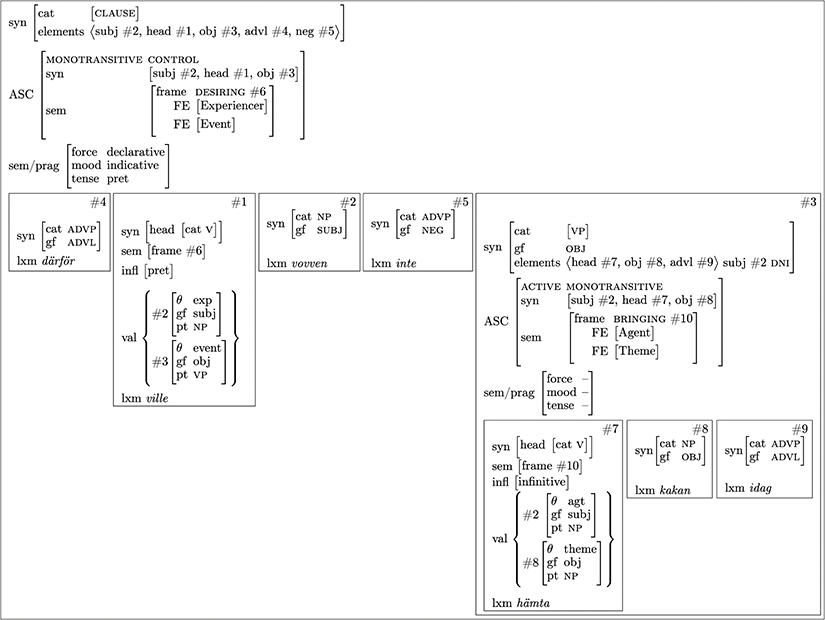
The box format provides a precise and highly explicit representation of the conctruct, its CEs, and their interrelations. The respective feature analyses may be elaborated or simplified to suit the desired level of detail. For instance, phonological, morphological, information structural, and other features may be included if relevant to the analysis at hand. In other cases, however, a simpler representation than a box analysis may be sufficient. A considerably simpler illustration format are construction grids in the style of CASA (Herbst & Hoffman Reference Herbst and Hoffmann2024).Footnote 45 A grid analysis of example (51) is shown in Figure 27.
Grid analysis of Därför ville vovven inte hämta kakan idag.
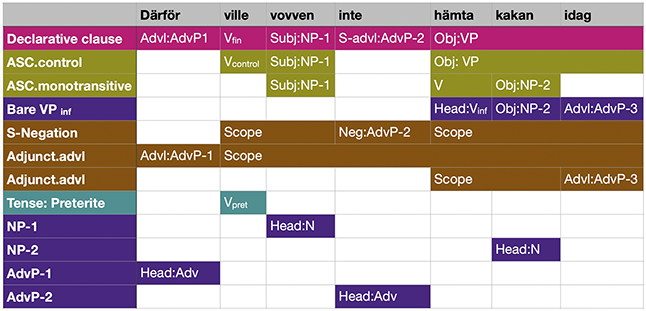
The grid analysis shown in Figure 27 is basically equivalent to the more detailed box analysis in Figure 26, only simplified. The main components are the same: in this case, a declarative clause cxn (specifically an advl-v-s-declarative, see Figure 16) combined with a control ASC, which in turn takes a verb phrase complement with a monotransitive ASC, and so on. It displays the constructions in use and their elements, but abstracts away from other features, especially the semantics. An added piece of information, however, is that the scope of the adjuncts is stated explicitly; in the box analyses, by comparison, it follows from the representation of constituent structure.
While grid analyses are both easier to read and simpler to perform than more explicit box representations, they still require a working syntax model and must accord with accurate construction descriptions. Thus, the simplification applies to the construct representations only, and the grids have to be translatable into a more explicit representation. This is the case with the CASA model (Herbst & Hoffmann Reference Herbst and Hoffmann2024) and the present model alike; the construction grids have to be – and in both cases actually are – grounded in more explicit construction descriptions and a coherent syntax model.
Construction grids may also be useful in other regards. On the one hand, their convenient application to full-sentence construction analysis makes them viable for full-text annotation of constructions. Hence, they may be useful for, for example, identification of constructions in need of coverage and, in a longer perspective, for the development of construction-annotated corpora. On the other hand, their underspecified format makes construction grids compatible with, and thus applicable to, different variants of construction grammar. Therefore, they may perhaps serve as a constructionist lingua franca of sorts, for comparing or translating between construction analyses using different frameworks, potentially bridging the diversity of constructionist approaches. One must never forget, however, that the cross-framework applicability comes only in part from shared assumptions and in part from the underspecified format. The specific details that the construction grids abstract away from must still be taken into consideration.
7.2.1 Beyond Syntax
Combining constructions is not only about syntax, of course. There are several dimensions of linguistic phenomena involved, from phonetics to discourse, not all of which may be incorporated straightforwardly in a box representation. The box structure, while very rich, is ultimately a two-dimensional constituent structure, (recursively) representing a mother construct(ion) and its constituent CEs. Hence, any structure incorporated has to be represented as a feature either on the mother or on one of the CEs. This is basically why ASCs are represented as features of clausal constructions on the current model, for example, and other CE overlapping structures may be represented similarly. To go beyond traditional syntax, however, one eventually has to go beyond (syntactic) trees/boxes, at least in the representation of constructs.
Let us for example consider how to expand the syntax model to handle interactional structure, thereby incorporating nonclausal utterances and interactional patterns such as turn construction units (TCUs; cf. Lindström Reference Lyngfelt2008; Strandberg Reference Strandberg2021; 2026). While written standard text consists of sentences, typically main clauses, spoken interaction is presumably organized around TCUs. Therefore, interactional linguistics tends to focus on TCUs rather than clausal syntax, although TCUs are to a large part made up by clauses (e.g., Lindström Reference Lyngfelt2008). Incorporating both perspectives in one coherent model is a highly desirable research objective itself, and the basic setup of the present model should be well suited to handle such incorporation.
Consider, for instance, the spoken example (52), taken from Strandberg (Reference Sommerer, Van de Velde, Fried and Nikiforidou2026):Footnote 46
(52)
Skulle någon säga så till mig, jag hade ba shall-pret anyone say-inf so to me I have-pret just ”Vad menar du?” what mean-prs you ‘Should anyone say that to me, I had just “What do you mean?”’
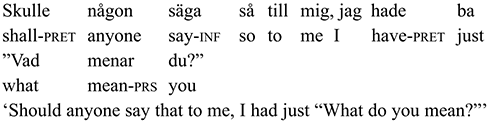
Syntactically, (52) consists of a declarative clause with a pre-posed adjunct. Note that the initial adjunct does not trigger V2 inversion here but rather precedes the whole declarative clause structure as a so-called annex (cf. Strandberg Reference Strandberg2021; 2026; Teleman et al. Reference Teleman, Hellberg and Andersson1999, vol. 4: 438 ff.). From an interactional perspective, however, the contribution is arguably not the whole declarative clause, but merely the actual quote (cf., e.g, Strandberg Reference Sommerer, Van de Velde, Fried and Nikiforidou2026). The preceding part of the matrix clause – the subject, the verb and the marker ba ‘just’ – is thus part of the contextualization, framing the quote. This is illustrated by the grid analysis in Figure 28, including a Quotation construction based on Strandberg (Reference Sommerer, Van de Velde, Fried and Nikiforidou2026).
A partially unaligned blend between a TCU and a declarative clause construction.
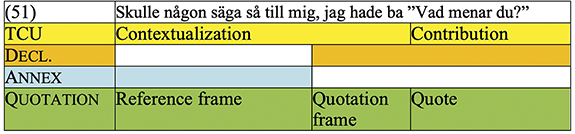
As shown in Figure 28, the combination of interactional and syntactic structure in (52) may be treated as a blend between different kinds of constructions. In this case, however, the declarative clause does not correspond to a particular CE in the TCU, instead overlapping partially with both the Contextualization and the Contribution CEs. While such a partial overlap is difficult to account for in a strictly constituency-based analysis, it is straightforwardly captured by the construction grid in Figure 28. Hence, a layered grid format seems to be better suited to represent the overall construct than a constituency-based box analysis would, simply because the joint analysis incorporates more dimensions. Nonetheless, each construction by itself is presumably made up of a set of CEs, that is, a constituency-based structure. Hence, the construction descriptions should still benefit from the more detailed box representation format.
In summary, while interactional TCU analyses and syntactic sentence analyses belong to different linguistic disciplines, they may fruitfully be combined in a constructionist approach, thus illustrating the interplay between syntax and interaction. Steps in this direction have been suggested by Strandberg (Reference Sommerer, Van de Velde, Fried and Nikiforidou2026). A hint of what we have in mind is shown in Figure 28. The details of such a combined account, however, remain to be worked out – based on authentic interaction data.
7.3 Outlook and Concluding Remarks
The constructicon part of the syntax model presented here mainly accounts for FA clauses and, to a lesser extent, for verb phrases, AF clauses and argument structure constructions. Consequently, a natural direction for future work would be increased coverage of the latter three construction types, as well as noun phrase constructions, and so on. Of particular interest are coordination structures, especially coordination of verb phrases, which is something that traditional sentence schemas cannot handle at all, but the present model is designed to accommodate. Another exciting topic is verb particle constructions, since verb particles affect clausal structure in interesting ways (e.g., Teleman et al. Reference Teleman, Hellberg and Andersson1999; Toivonen Reference Teleman and Wieselgren2003).
Such topics would be difficult to address without prior access to an overall syntax model such as the one proposed here. In fact, one of the purposes of the model is to serve as a host for further investigation of various syntactic constructions. In particular it is meant to benefit the investigation of constructions whose characterization depends on their interplay with an overall syntactic context, such as cleft constructions, long distance dependencies and various kinds of so-called dislocation phenomena. As the empirical coverage grows, we are also aiming to explore the network connections further; even among the constructions already described, there is certainly more to say about network relations (cf. Section 7.1.2). Furthermore, both the construction descriptions and their network connections are to be implemented in the Swedish Constructicon (e.g., Lyngfelt et al. Reference Lyngfelt, Bäckström, Borin, Ehrlemark, Rydstedt, Lyngfelt, Borin, Ohara and Torrent2018a; Blensenius & Lyngfelt Reference Blensenius, Lyngfelt, Dannélls, Blensenius and Borin2025).
In a wider perspective, a full construction grammar of Swedish would have to cover more than a constructicon and a syntax model, for instance morphology and discourse structure. As mentioned in the previous section, steps are being taken to combine the syntax model with interactional perspectives. Not only is the interplay between syntax and speech-in-interaction a worthy research objective in itself, incorporating interactional structure would also bring more of a usage-based approach to the present model.
It is a primary goal of the syntax model we propose to provide a precise, formalized overall account of clausal syntax that is in line with usage-based linguistics (UBL). As recounted by Michaelis (Reference Michaelis2024), one of the main reasons for the transition from Berkeley CxG (BCG) to Sign-Based CxG was the formal limitations of the former. The present model, on the other hand, is a move in a different direction, adapting a BCG inspired formalism to better suit the concerns of UBL. Thus, it is designed to be precise enough to provide an adequate model of Swedish syntax, and at the same time dynamic enough to be compatible with usage-based linguistics. Hopefully, this contribution may help to bring formalized syntax and usage-based construction grammar a little closer together (on the diversity of constructionist approaches, see, e.g., Ungerer & Hartmann Reference Tomasello2023; Boas et al. Reference Boas, Leino and Lyngfelt2024).
We are well aware that the proposal is not a mainstream usage-based approach, dealing with patterns of variation in language use or the finer nuances of language acquisition and change. Instead, it is a system-oriented account of general clausal syntax in Swedish, at aggregate level (see Sections 2.2 and 5.4.1; cf. van Trijp Reference Tomasello2024). Arguably, this is not at odds with UBL. On the contrary, presuming that language as a whole is usage-based, there is call for UBL associated accounts all the way up to the most general patterns, and this is what we aim to provide.
Although the box representations may appear similar to generative constituency-based models, one should not judge the book by its cover. Firstly, the proposed construction descriptions represent dynamic usage patterns rather than discrete categories and hard constraints. Secondly, we take a restrictive approach to the positing of abstract structures. Thirdly, combination of constructions is treated as conceptual blending, reflecting (a) the partial realization of the meaning potential of the constructions being combined and (b) how part of the meaning emerges from the context and the combination. Thus, the model presents an idea of what a usage-based linguistic system may look like in the domain of clausal syntax. It also provides a framework that should serve as a useful setting for usage-based studies of Swedish syntax.
Abbreviations
- COM
common gender
- DEF
definite
- INDEF
indefinite
- IM
infinitival marker
- IMP
imperative
- INF
infinitive
- NEG
negation
- NEUT
neuter gender
- P
person
- PL
plural
- PRET
simple past tense; preterite
- PRS
simple present tense
- PSTP
past participle
- REFL
reflexive
- SBJN
subjunction
- SG
singular
- SUP
supine
Acknowledgments
We are grateful to Linnéa Bäckström, Kristian Blensenius, Elisabet Engdahl, Steffen Höder, Peter Ljunglöf, Henrik Rosenkvist, Viktoria Strandberg and an anonymous reviewer for helpful comments on earlier versions of this text. We also wish to thank the audiences at ICCG12 in Prague (2023), CxGN3 in Kiel (2022), Grammatik i fokus 37 in Lund (2023), a grammar seminar in Gothenburg (2024), Svenskans beskrivning 40 in Stockholm (2025), and CxGN4 in Berlin (2025) for constructive feedback on oral presentations of the syntax model proposed here. The research presented here is funded by the Swedish Tercentenary Foundation (grant P21-0473).
Thomas Hoffmann
Catholic University of Eichstätt-Ingolstadt
Thomas Hoffmann is Full Professor and Chair of English Language and Linguistics at the Catholic University of Eichstätt-Ingolstadt. His main research interests are usage-based Construction Grammar, language variation and change and linguistic creativity. He has published widely in international journals such as Cognitive Linguistics, English Language and Linguistics, and English World-Wide. His monographs Preposition Placement in English (2011) and English Comparative Correlatives: Diachronic and Synchronic Variation at the Lexicon-Syntax Interface (2019) were both published by Cambridge University Press. His textbook on Construction Grammar: The Structure of English (2022) as well as an Element on The Cognitive Foundation of Post-colonial Englishes: Construction Grammar as the Cognitive Theory for the Dynamic Model (2021) have also both been published with Cambridge University Press. He is also co-editor (with Graeme Trousdale) of The Oxford Handbook of Construction Grammar (2013, Oxford University Press).
Alexander Bergs
Osnabrück University
Alexander Bergs joined the Institute for English and American Studies at Osnabrück University, Germany, in 2006 when he became Full Professor and Chair of English Language and Linguistics. His research interests include, among others, language variation and change, constructional approaches to language, the role of context in language, the syntax/pragmatics interface, and cognitive poetics. His works include several authored and edited books (Social Networks and Historical Sociolinguistics, Modern Scots, Contexts and Constructions, Constructions and Language Change), a short textbook on Synchronic English Linguistics, one on Understanding Language Change (with Kate Burridge) and the two-volume Handbook of English Historical Linguistics (ed. with Laurel Brinton; now available as five-volume paperback) as well as more than fifty papers in high-profile international journals and edited volumes. Alexander Bergs has taught at the Universities of Düsseldorf, Bonn, Santiago de Compostela, Wisconsin-Milwaukee, Catania, Vigo, Thessaloniki, Athens, and Dalian and has organized numerous international workshops and conferences.
About the Series
Construction Grammar is the leading cognitive theory of syntax. The present Elements series will survey its theoretical building blocks, show how Construction Grammar can capture various linguistic phenomena across a wide range of typologically different languages, and identify emerging frontier topics from a theoretical, empirical and applied perspective.
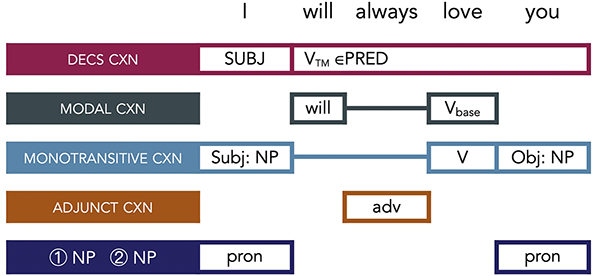
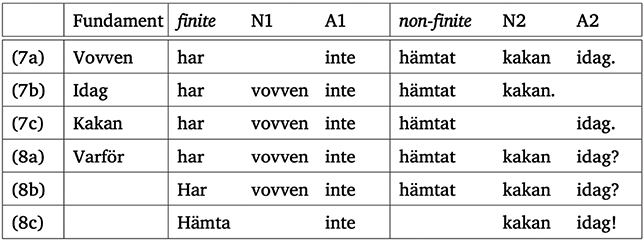
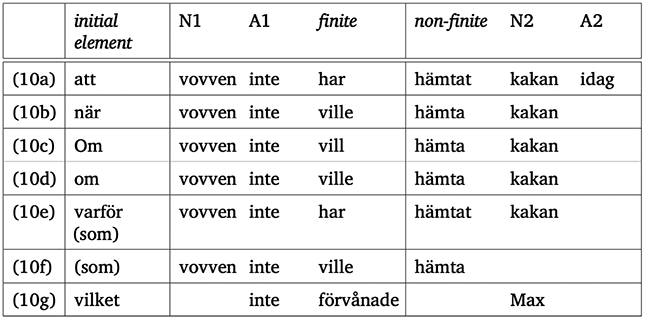
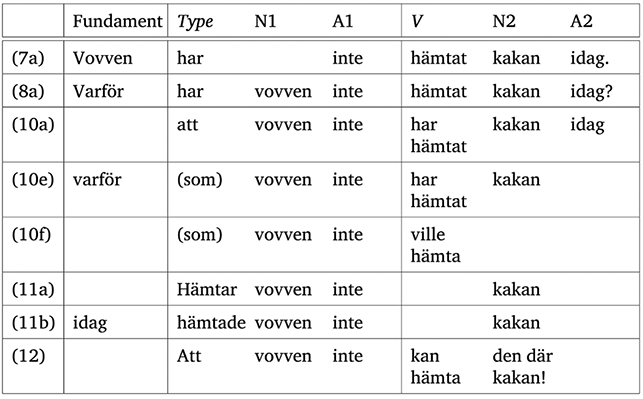
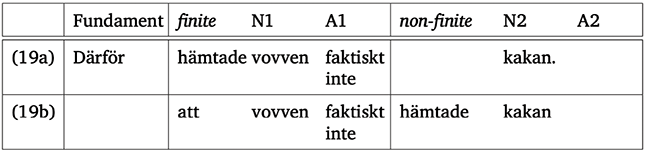
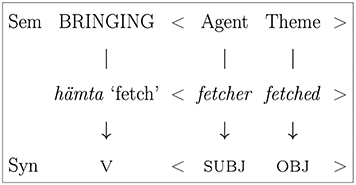
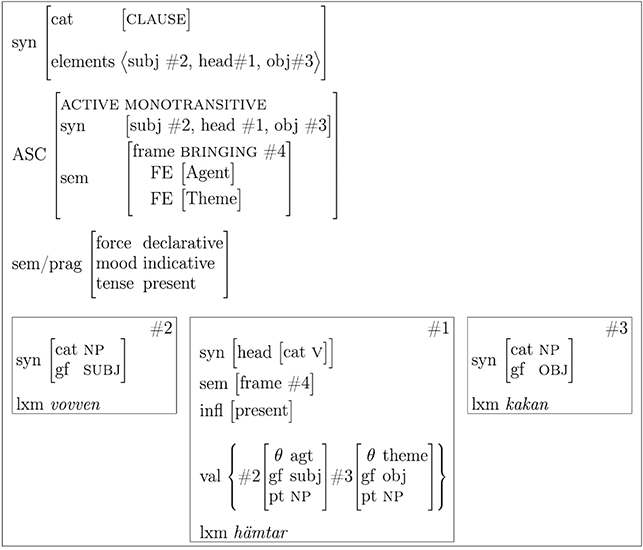
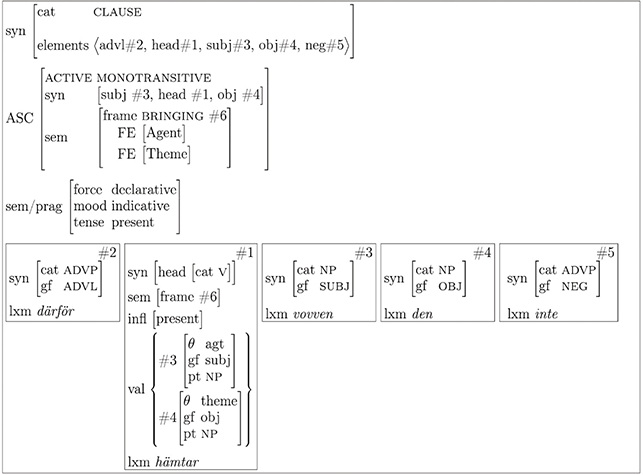
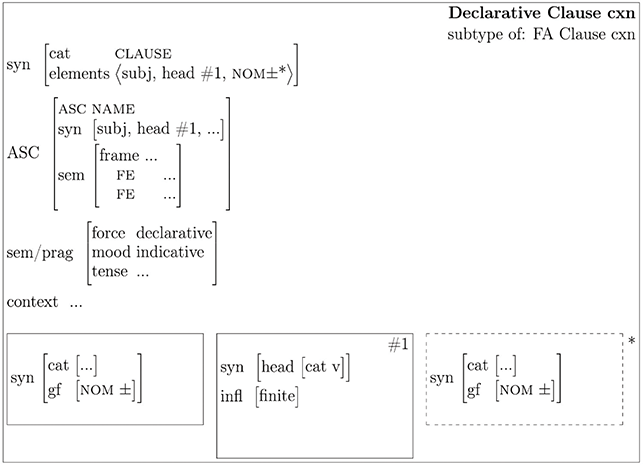

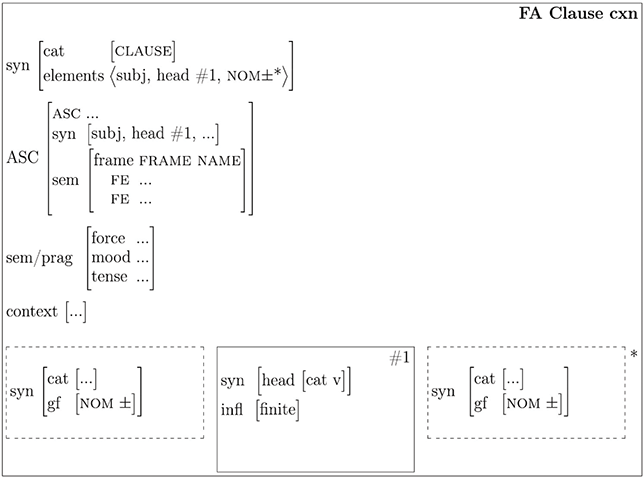
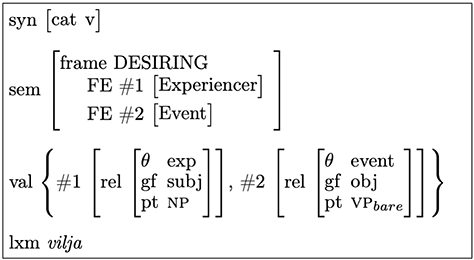
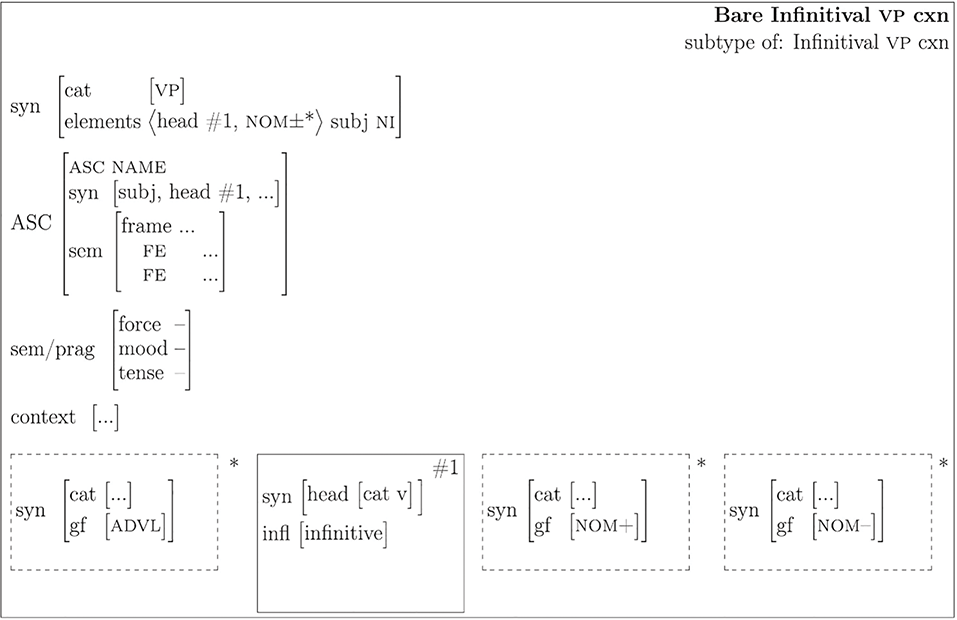
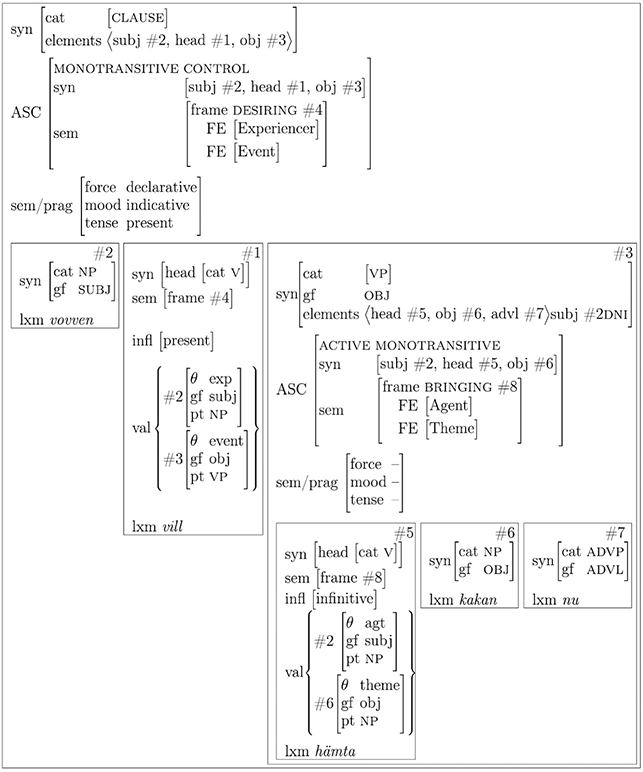
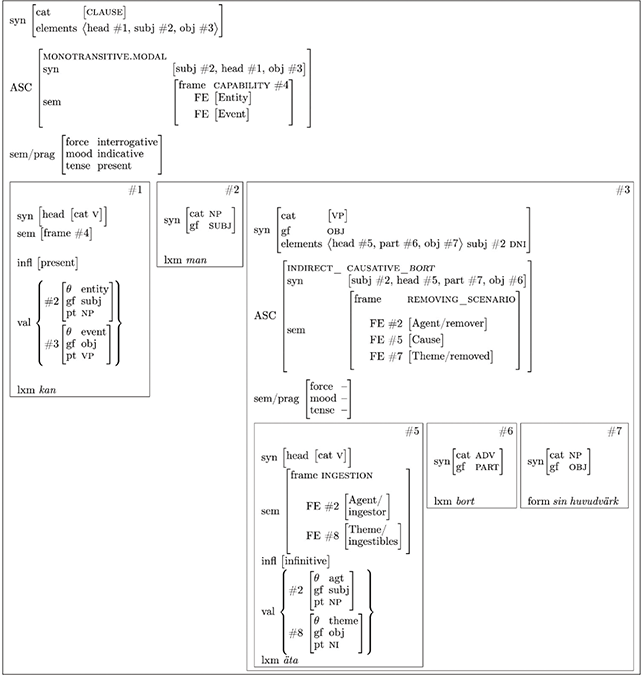
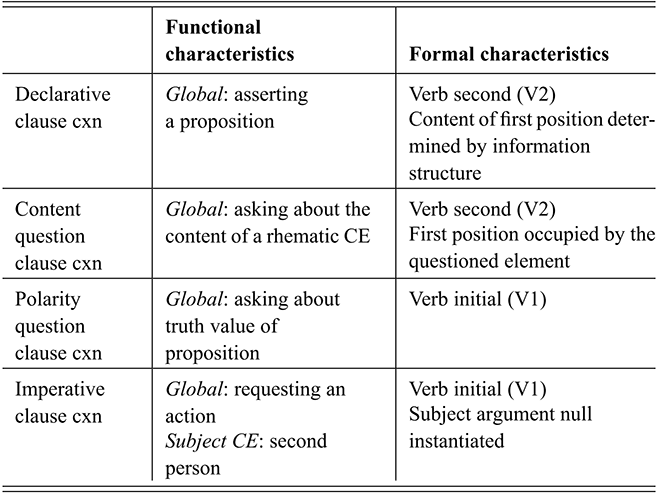
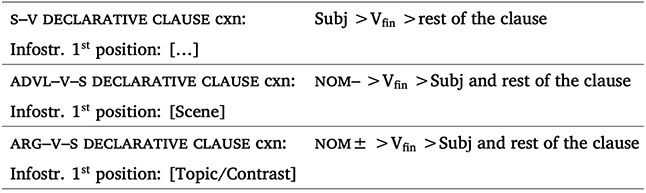
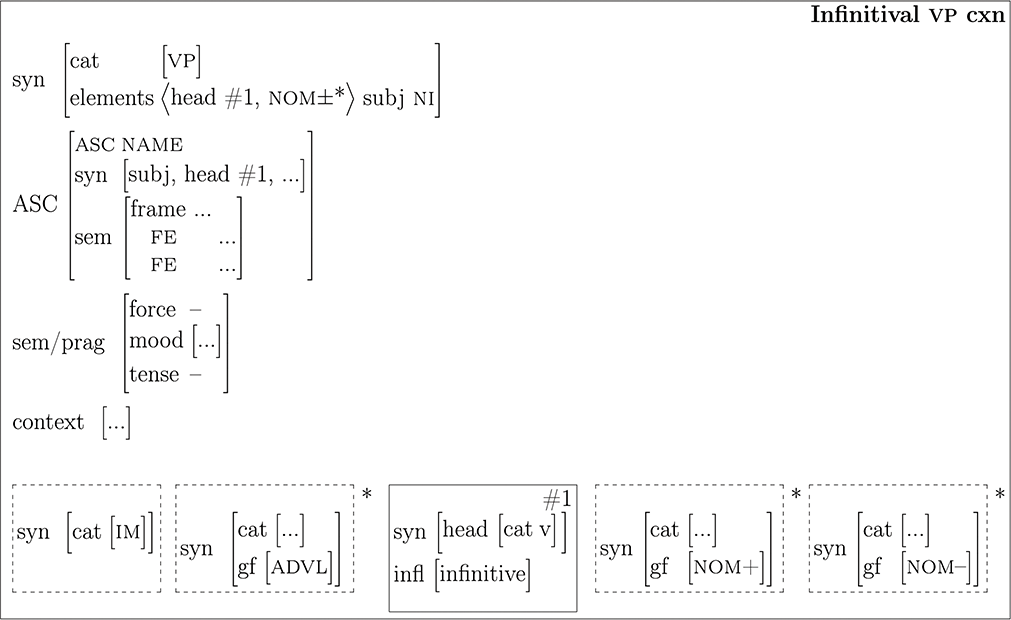
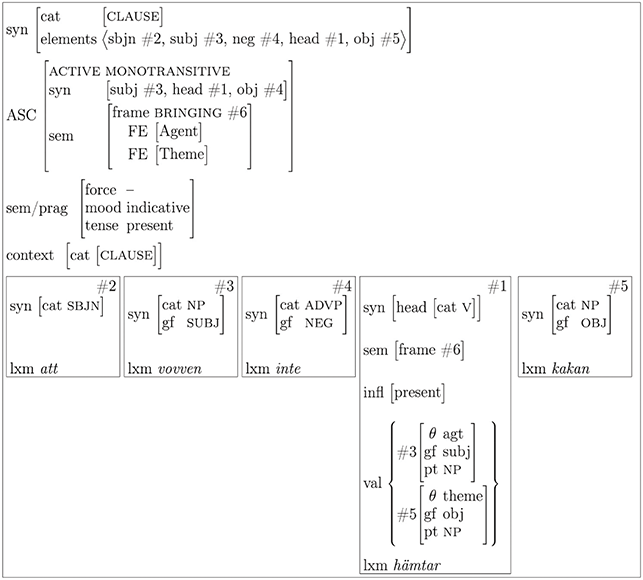
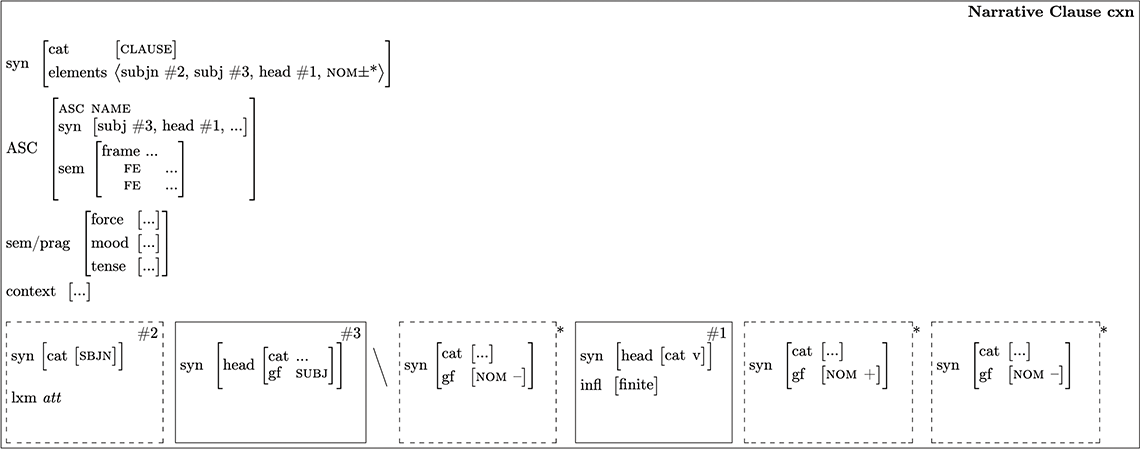
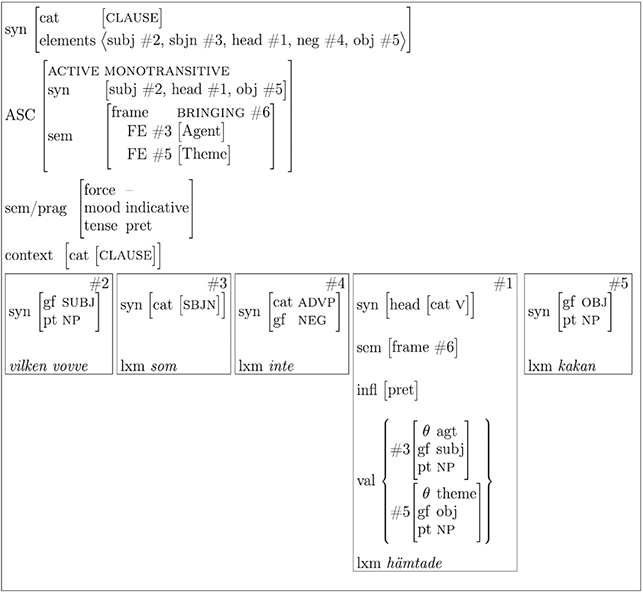
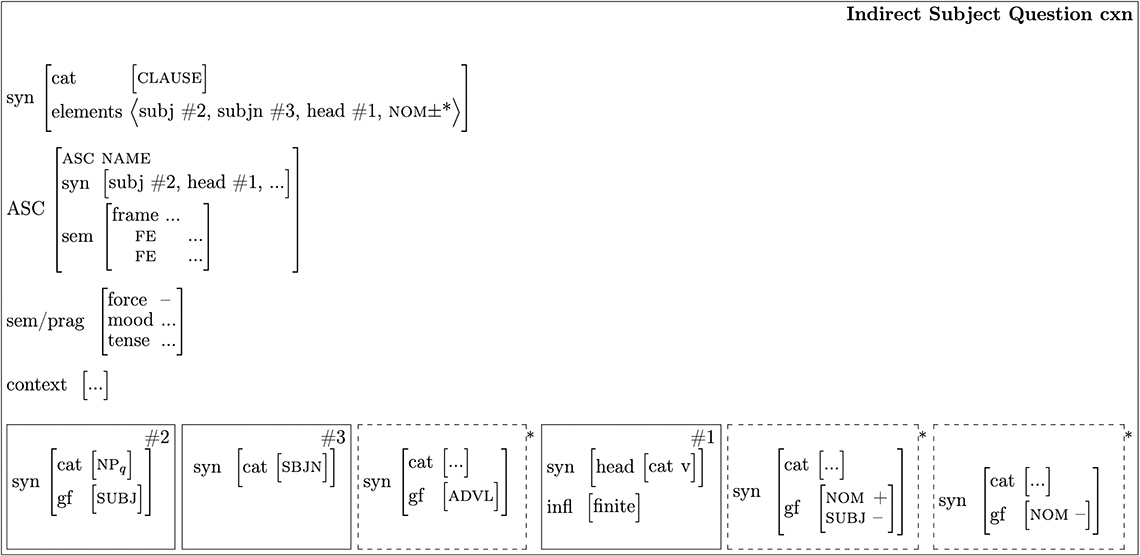
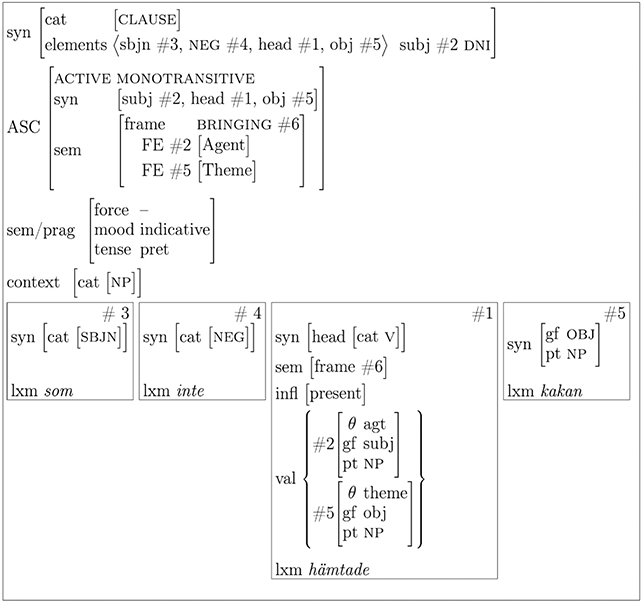
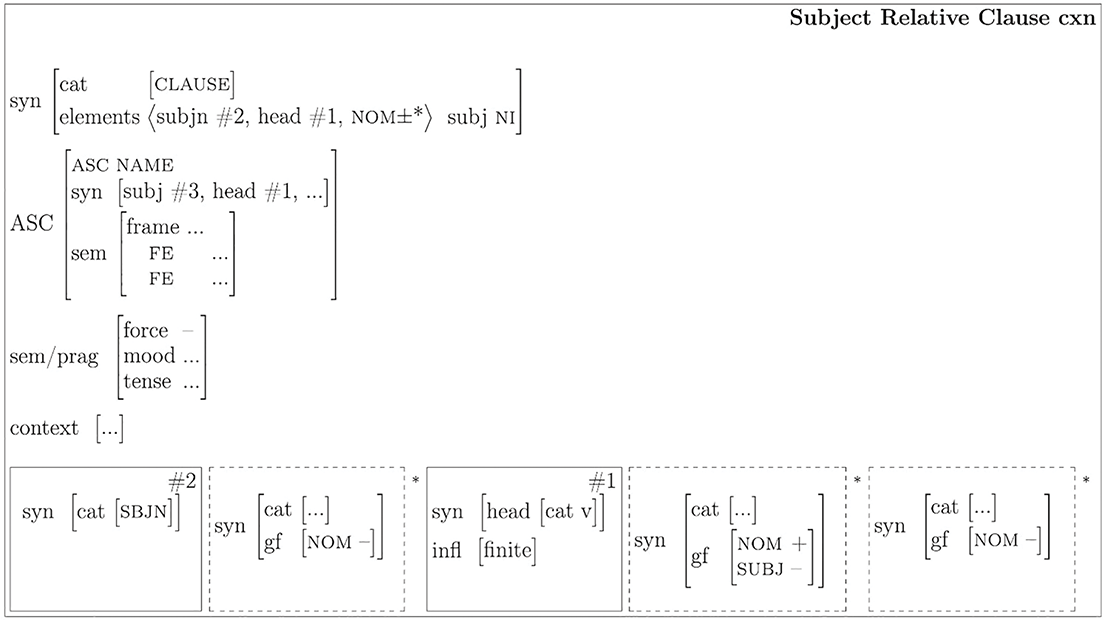
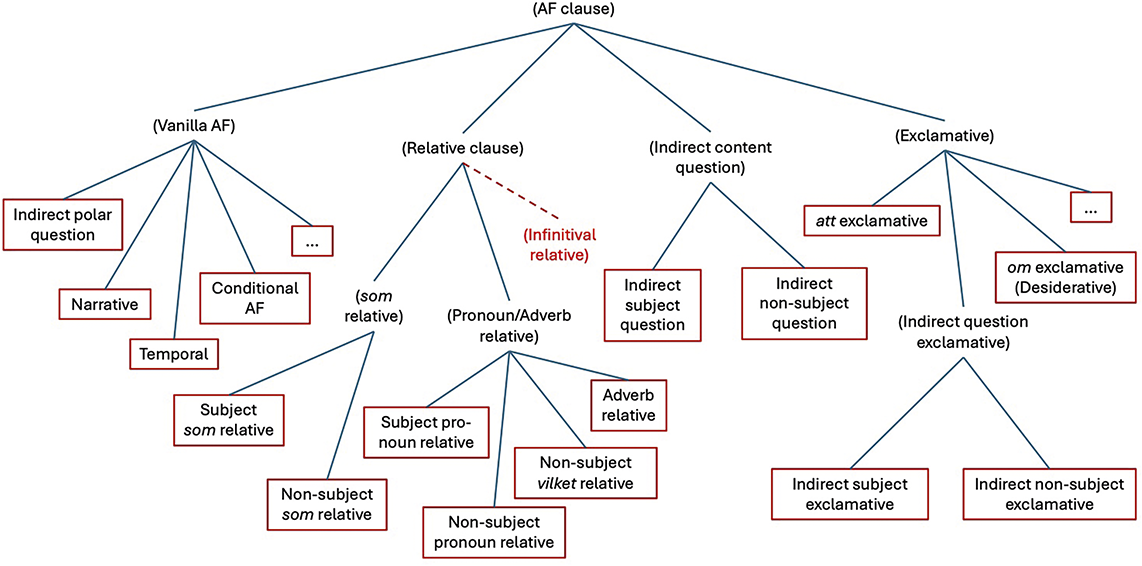
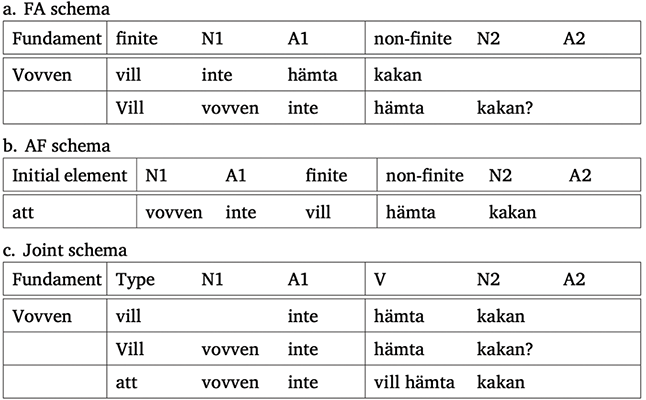
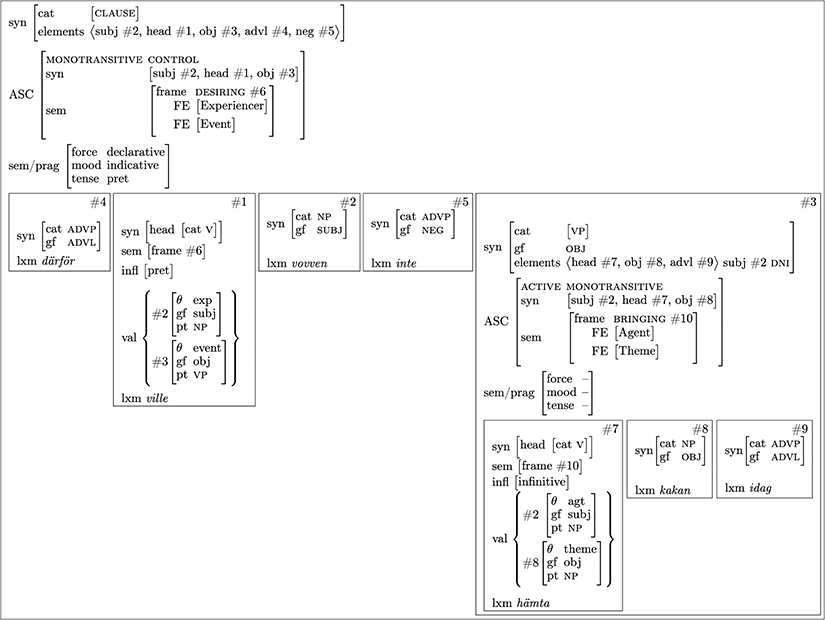
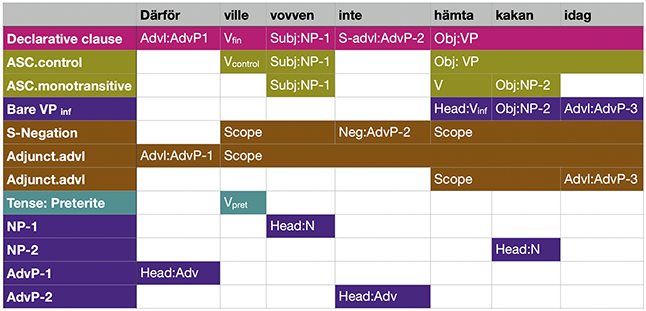
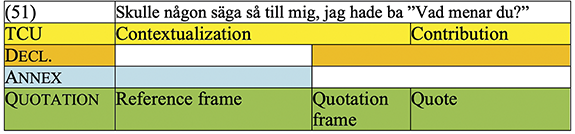

 Open access