1 Introduction
In March 2022, Slovakia’s National Criminal Agency arrested three people for divulging classified information to Russia. Among them were a colonel from the Ministry of Defense, a member of the Slovak Information Service – the country’s intelligence agency – and Bohuš Garbár. Garbár was a freelance journalist and a frequent contributor to Hlavné správy, “the flagship news source for spreading Russian narratives” in Slovakia.Footnote 1 A couple of days after the arrest, journalists released a video of Garbár accepting payment from Sergey Solomasov, the deputy military attaché of the Russian Embassy in Slovakia.
Four years before Garbár’s arrest, a Russian national, Yevgeni Paltsev, started writing for Hlavné správy under the pseudonym Eugen Rusnák, “uncritically adopting hard-line Russian views.”Footnote 2 While a pseudonym and Russian citizenship do not suggest direct links to the Kremlin, frequent visits to the Moscow-based Russian state-owned news agency Sputnik certainly do.Footnote 3 As of 2025, Paltsev writes for Zem a Vek, another medium widely considered to espouse pro-Kremlin disinformation narratives.
In the neighboring Czech Republic, Kremlin influence efforts are also widespread. In perhaps the most drastic example, six Russian military intelligence (GRU) agents destroyed ammunition depots in the Czech town of Vrbětice in 2014, killing two people. The ammunition was to be sold to Ukrainian forces fighting in the Donbas (Kundra and Spurný, Reference Kundra and Spurný2022). Unsurprisingly, Kremlin influence is not confined to overt sabotage. As in Slovakia, the Kremlin directly funds the spread of pro-Russian narratives in the Czech Republic. In 2025, the Czech government expelled Natalia Sudliankova after the Czech Security Information Service determined that Russia’s GRU paid her to solicit and write articles critical of Czech non-governmental organizations and Czech support for Ukraine.Footnote 4
While the Kremlin often relies on local agents like Garbár and Sudliankova, it also pursues more direct forms of informational influence. For example, following Russia’s full-scale invasion of Ukraine in 2022, the Czech government – in alignment with EU-wide sanctions – blocked access to Sputnik. A year later, during the 2023 Czech presidential election campaign, neČT24 – a Telegram channel believed to be Sputnik operating under a new name – circulated a doctored video of Petr Pavel, the eventual election winner, calling for Czech military intervention in Ukraine. The video was widely shared and garnered over 100,000 views on X (formerly Twitter) alone (Demagog, 2023).
Disinformation – false narratives deliberately produced to mislead (Zhou and Zafarani, Reference Zhou and Zafarani2020, 3) – is perhaps the most pervasive form of Russian influence in CEE (Bokša, Reference Bokša2019; Conley et al., Reference Conley, Mina, Stefanov and Vladimirov2016, 5; Krekó et al., Reference Krekó, Győri, Dunajeva, Janda, Kundra, Mesežnikov, Mesík, Szylar and Shekhovtsov2016, 6; Orenstein, Reference Orenstein2019, 36). According to the EU’s External Action Service, Russia spread over 17,000 pro-Kremlin disinformation narratives in the EU between 2015 and 2024.Footnote 5 This tally almost certainly captures only a fraction of Russia’s disinformation output. Leaked internal documents indicate that the Social Design Agency – a Moscow-based, Kremlin-linked technology firm – created and disseminated almost 40,000 pieces of pro-Russian content in the first four months of 2024 alone (Radio Free Europe, 2024).
The Kremlin disseminates disinformation in Central and Eastern Europe (CEE) in pursuit of its broader foreign-policy objectives. While observers may disagree about the determinants of these objectives (e.g., McFaul, Reference McFaul2020; Tsygankov, Reference Tsygankov2016, 234), there is a broad consensus that a central goal of Russia’s foreign policy is to challenge U.S.-led unipolarity and reassert Russian interests in the post-Soviet space and on the global stage (Donaldson and Nadkarni, Reference Donaldson and Nadkarni2018, 379; Laruelle, Reference Laruelle, Kolstø and Blakkisrud2016, 276; Tsygankov, Reference Tsygankov2018). Hampering the EU’s and NATO’s capacities to act swiftly, cohesively, and decisively helps Russia advance this goal (Lucas and Pomeranzev, Reference Lucas and Pomeranzev2016; Karlsen, Reference Karlsen2019). Disinformation offers a means of doing so.
Disinformation relativizes the truth by offering rival interpretations and alternative frames, thereby creating contexts in which the legitimacy of objective news is more easily contested and questioned (Splidsboel Hansen, Reference Splidsboel Hansen2017). More specifically, Kremlin-linked disinformation: (1) produces proactive and responsive counter-narratives that legitimize or defend Russian actions and interests; (2) generates widespread scepticism about the benefits of international cooperation; (3) strategically exploits geopolitical and domestic divisions to impede coordinated responses both within and among countries; and (4) constructs favorable narratives about Russia while undermining the credibility of Western institutions and their supporters (Cižik, Reference Čižik2017). Through these tactics, disinformation exacerbates polarization and erodes public trust, undermining societal resolve and institutional credibility – and thus the ability of EU and NATO members to act cohesively.
Disinformation is particularly pervasive in CEE because Russia considers the region a weak spot within the Euro-Atlantic political structure (Bokša, Reference Bokša2019, 2; Juhász and Szicherle, Reference Juhász and Szicherle2017; Zgut et al., Reference Zgut, Charycka, Ivanovà, Stanek, Skalická, Pavelová, Losekoot Szymanska, Bystřická, Győri and Berkes2023). In CEE, disinformation finds a ready-made audience – one divided over geopolitical commitments, sociocultural values, and even fundamental questions of democracy (Enyedi, Reference Enyedi2020; Vachudova, Reference Vachudova2019). These societal divisions, along with concomitant high levels of polarization, combine with willing allies that reproduce Russian narratives (Snegovaya, Reference Snegovaya2022; Wondreys, Reference Wondreys2023), a still-nascent institutional capacity to combat disinformation (Eberle and Daniel, Reference Eberle and Daniel2023; Laputska and Yeliseyeu, Reference Laputska and Yeliseyeu2024), high rates of conspiratorial thought (Blackington and Cayton, Reference Blackington and Cayton2024; Marinov and Popova, Reference Marinov and Popova2022), and low levels of political trust (Rose, Reference Rose2009) to make the region vulnerable to disinformation narratives.
Cross-national quantitative measures highlight disinformation’s pervasiveness in the region. The Digital Society Project (DSP) (Mechkova et al., Reference Mechkova, Pemstein, Seim and Wilson2024), in partnership with V-Dem (Coppedge et al., Reference Coppedge, Gerring, Knutsen, Lindberg, Teorell, Altman, Angiolillo, Bernhard, Cornell, Fish, Fox, Gastaldi, Gjerløw, Glynn, Good God, Grahn, Hicken, Kinzelbach, Marquardt, McMann, Mechkova, Neundorf, Paxton, Pemstein, von Römer, Seim, Sigman, Skaaning, Staton, Sundström, Tannenberg, Tzelgov, Wang, Wiebrecht, Wig and Ziblatt2025), assesses the extent to which foreign governments disseminate false information in a given country on a 0 (“extremely often”) to 4 (“never, or almost never”) scale. In 2024, the average score for the eleven CEE EU member states was 2.09, compared to 3.12 for the remaining EU members.
Yet, within CEE, the extent to which the Kremlin disseminates disinformation narratives and the degree to which these narratives are echoed by domestic media vary cross-nationally (Dragomir et al., Reference Dragomir, Rúas-Araújo and Horowitz2024). Moreover, the extent to which individuals consume and believe disinformation and the degree to which disinformation affects public opinion vary not only between countries but also between individuals within countries (Porter et al., Reference Porter, Scott, Wood and Zhandayeva2024; Vegetti and Mancosu, Reference Vegetti and Mancosu2020; Wenzel et al., Reference Wenzel, Stasiuk-Krajewska, Macková and Turková2024). Given these variations, this monograph asks:
(1) Why does disinformation prevalence vary cross-nationally?
(2) What explains individual-level variation in the consumption of and belief in disinformation?
(3) To what extent is disinformation effective in shaping public opinion?
(4) Do the factors that explain disinformation consumption and belief, as well as disinformation’s capacity to shape attitudes, generalize across countries?
To answer these questions, I situate disinformation within a supply-and-demand framework. I start with the stylized premise that, if unconstrained, the Kremlin would spread disinformation with equal effectiveness across CEE. However, supply is constrained by demand – the extent to which country- and individual-level factors make certain countries and individuals more or less susceptible to disinformation. Structural factors such as party-system ideological polarization, the presence of a Russian minority, or the effectiveness of government counter-disinformation policies can shape disinformation supply. Similarly, at the individual level, variations in ideological convictions – for example, those related to sociocultural issues or geopolitics – and in the propensity to engage in analytical reasoning can shape engagement with, belief in, and responses to disinformation. Importantly, it remains an open question whether the same individual-level factors shape disinformation consumption and belief consistently across national contexts. For example, sociocultural conservatism may predict disinformation consumption in CEE countries where party competition is strongly polarized along the cultural divide (e.g., Poland); conversely, in countries with greater political consensus on sociocultural issues (e.g., the Czech Republic), the predictive purchase of sociocultural conservatism may be weaker.
To evaluate this framework, I draw on multiple types of data. With time-series, cross-national data from the DSP and V-Dem (Coppedge et al., Reference Coppedge, Gerring, Knutsen, Lindberg, Teorell, Altman, Angiolillo, Bernhard, Cornell, Fish, Fox, Gastaldi, Gjerløw, Glynn, Good God, Grahn, Hicken, Kinzelbach, Marquardt, McMann, Mechkova, Neundorf, Paxton, Pemstein, von Römer, Seim, Sigman, Skaaning, Staton, Sundström, Tannenberg, Tzelgov, Wang, Wiebrecht, Wig and Ziblatt2025; Mechkova et al., Reference Mechkova, Pemstein, Seim and Wilson2024), I evaluate the relationship between ideological polarization and disinformation supply in CEE. I complement this analysis with survey data on perceived disinformation exposure from Eurobarometer and nearly seventy semi-structured elite interviews conducted in the Czech and Slovak Republics. The interviews illustrate the mechanisms behind the large-N analysis, demonstrating how polarization limits the ability of governments to build anti-disinformation capacity.
Three original surveys with embedded experiments – one conducted in the Czech Republic (2024), and two conducted in Slovakia (2021 and 2024) – offer comprehensive evidence on individual-level engagement with disinformation and on how disinformation narratives shape public opinion. First, the surveys assess individual consumption of disinformation media and how individuals evaluate disinformation content, focusing on narratives related to the EU’s propagation of liberal sociocultural values and those that seek to undermine support for Ukraine. Second, the embedded experiments offer causal evidence of how exposure to these narratives shapes public opinion.
The comparative analysis focuses on the Czech Republic and Slovakia. While both countries are post-state-socialist EU member states exposed to similar disinformation narratives, they differ across multiple structural conditions that may shape disinformation supply and demand. Variations include the strength of ideological polarization on sociocultural issues, the degree to which domestic elites reinforce pro-Kremlin narratives, and public attitudes toward Russia. Given these differences, comparing the two countries provides leverage for assessing whether individual-level engagement with and attitudinal responses to disinformation operate similarly across differing national contexts. While two cases cannot definitively isolate which structural factors drive cross-national differences, the Czech-Slovak comparison can provide some ideas about scope conditions. Due to their differences, the Czech Republic and Slovakia are broadly representative of two distinct clusters of CEE countries. The Czech Republic shares key structural features with Estonia, Latvia, and Poland: proactive counter-disinformation efforts, weaker sympathies with Russia, and relatively high institutional trust. Slovakia more closely resembles Bulgaria and Hungary: pro-Russian political elites, limited anti-disinformation capacity, energy dependence on Russia, and lower institutional trust. Insights from these two cases may therefore illuminate dynamics across a wider range of CEE countries facing similar structural conditions.
1.1 Disinformation
Disinformation is false or misleading content deliberately produced and disseminated to deceive (Zhou and Zafarani, Reference Zhou and Zafarani2020). “Weaponized” disinformation – the focus of this monograph – is disinformation strategically deployed to achieve political or ideological ends (Benkler et al., Reference Benkler, Faris and Roberts2018; Krekó et al., Reference Krekó, Győri, Dunajeva, Janda, Kundra, Mesežnikov, Mesík, Szylar and Shekhovtsov2016). Intentionality separates disinformation from misinformation. While misinformation is false or misleading, it is not necessarily spread for the explicit purpose of deception. Disinformation may or may not be presented as news, distinguishing it from fake news, which has a news-like appearance. Disinformation is empirically verifiable as false, and thus distinct from rumors, which are characterized by ambiguous evidentiary standards, uncertain veracity, and social transmission dynamics (Berinsky, Reference Berinsky2017). And, while disinformation may build upon or incorporate elements of conspiracy theories, it is not necessarily predicated on explanations involving the secretive plots of powerful individuals or organizations (Douglas et al., Reference Douglas, Uscinski, Sutton, Cichocka, Nefes, Ang and Deravi2019).
Even following these criteria, classifying disinformation is challenging. Attributing specific disinformation narratives to Kremlin influence efforts or classifying an outlet as Kremlin-linked presents an even greater challenge. Verification typically occurs in two ways: (1) source verification – whereby all content from a non-credible source is considered disinformation; or (2) content verification – whereby fact-checkers evaluate individual content to adjudicate whether it is disinformation (Golovchenko, Reference Golovchenko2020, 4). I rely on both strategies, drawing on the expertise of third-party expert fact-checkers from the Czech and Slovak Republics (see Online Appendix A). These fact-checkers identify disinformation narratives, characterize disinformation-disseminating outlets, and conduct investigative work that traces narratives back to Russia or establishes connections between news outlets and the Kremlin. Nonetheless, much of the disinformation in CEE (and elsewhere) is not directly attributable to the Kremlin, but is nonetheless ideologically aligned with the Kremlin’s objectives. Thus, I use the term “Kremlin-linked” when evidence of direct connections to the Kremlin exists, and “pro-Kremlin” when narratives and media outlets are ideologically aligned with the Kremlin’s interests but lack verified connections.
1.2 Understanding Disinformation Consumption and Disinformation’s Effects on Public Opinion
I rely on theories of directionally motivated reasoning and dual-process cognition to explain individual-level disinformation consumption as well as disinformation’s effects on public opinion. Motivated reasoning theory suggests that individuals do not always seek to arrive at objectively correct or accurate conclusions. Rather, they may prefer “directional” conclusions (Kunda, Reference Kunda1990) – those that reaffirm preexisting beliefs, identities, or preferences (Druckman and McGrath, Reference Druckman and McGrath2019, 113). Directionally motivated reasoning can bias information processing at multiple stages: exposure, evaluation, and memory. Directional motivations lead individuals to preferentially seek out attitude-consistent media (Stroud, Reference Stroud2008). These motivations also lead individuals to judge congenial information as more credible and to recall confirming evidence more readily than disconfirming evidence (Taber and Lodge, Reference Taber and Lodge2006). In the context of disinformation, directionally motivated reasoning would suggest that individuals select into disinformation exposure and believe disinformation because it reaffirms preexisting attitudes and ideological commitments (Altay et al., Reference Altay, Berriche and Acerbi2023; Flynn et al., Reference Flynn, Nyhan and Reifler2017; Guess et al., Reference Guess, Nagler and Tucker2019).
Importantly, this phenomenon is not disinformation-specific. Media consumption more broadly is driven by self-selected exposure (Arendt et al., Reference Arendt, Northup and Camaj2019; Knobloch-Westerwick, Reference Knobloch-Westerwick2015). In turn, self-selected exposure leads to reinforcement effects, whereby exposure can maintain or strengthen preexisting attitudes (Arendt et al., Reference Arendt, Northup and Camaj2019, 465; Levendusky, Reference Levendusky2013, 613). Thus, media consumption tends to reinforce existing attitudes rather than persuade individuals to change them. However, given disinformation’s false nature, selection and belief may depend on individual-level cognition – specifically, the degree to which analytical reasoning can interrupt or override directionally motivated processing.
Dual-process cognition theory suggests that information processing occurs through both System 1 processing, which is fast, automatic, and intuitive, and System 2 processing, which is slow, analytical, and reflective. Motivated System 2 Reasoning (MS2R) accounts suggest that individuals with a greater propensity to engage in System 2 processing are also more likely to use these cognitive resources to arrive at attitude-consistent conclusions (Kahan, Reference Kahan2013; Knobloch-Westerwick et al., Reference Knobloch-Westerwick, Mothes and Polavin2020). In contrast, classical reasoning accounts contend that a greater propensity to engage in System 2 processing leads individuals to evaluate information more critically, making them less likely to form misperceptions (Pennycook and Rand, Reference Pennycook and Rand2019). As such, the two theories have different empirical implications for individual belief in disinformation. According to MS2R, analytical reasoning propensity amplifies – rather than attenuates – motivated reasoning. Consequently, among individuals whose ideological predispositions align with disinformation content, higher levels of analytical reasoning are expected to increase the likelihood of believing disinformation. Conversely, classical reasoning predicts that, regardless of attitudinal priors, individuals with a greater propensity for analytical reasoning will be less likely to believe disinformation.
Ideology matters for understanding individual-level information processing. As such, understanding which disinformation narratives are likely to resonate – and with whom – requires mapping the ideological cleavages that structure public opinion and political competition. Initially, in CEE, the transition from state socialism to democracy and market capitalism structured political competition around both a distributive economic dimension and an identity-based sociocultural dimension (Kitschelt, Reference Kitschelt1995). Through the early 2000s, the normative aspiration of “returning to Europe” and the material incentives of formal EU accession tempered the electoral viability of the most radical forms of nationalist conservatism and democratic backsliding (Haughton, Reference Haughton2014; Vachudova and Hooghe, Reference Vachudova and Hooghe2009). However, post-accession, sociocultural and geopolitical issues (re)emerged as the dominant axis of political competition (Vachudova, Reference Vachudova2021, 473). The expansion of cross-border economic exchange, increases in migration flows, deepening international integration, and mobilization of historically marginalized groups generated sociostructural changes with stark distributive and symbolic consequences (Kriesi, Reference Kriesi2012).
Citizens who gained from globalization and European integration – primarily the affluent, educated, and urban – embraced cosmopolitan values and inclusive definitions of national identity. Meanwhile, those experiencing economic dislocation or perceiving threats to traditional cultural norms increasingly rejected supranational governance and multiculturalism, demanding the reassertion of national sovereignty. Issue entrepreneurs amplified and politicized this emerging cleavage, compelling mainstream parties to take positions on questions of national identity, immigration, and sovereignty (Hobolt and De Vries, Reference Hobolt and De Vries2015). The result was a transformed political landscape where political competition increasingly centered on conflicts over identity, borders, and belonging. On one side of the divide, socially conservative, Eurosceptic, Russia-tolerant, anti-immigrant parties with largely left-leaning economic positions garner support from those disadvantaged by globalization (Lancaster, Reference Lancaster2022) or threatened by shifting group-based hierarchies (Buštíková, Reference Buštíková2019). On the other side, mainstream parties with centrist or socially liberal programs and pro-Euro-Atlantic commitments are supported by those with more inclusive, cosmopolitan national identities (Vachudova, Reference Vachudova2021, 473). Understanding these divisions helps explain: (1) the content of Kremlin-linked disinformation; (2) which countries are more or less susceptible to disinformation; and (3) which individuals are most likely to consume and believe disinformation narratives.
1.3 Monograph Layout
The remainder of this monograph is organized into seven sections. Section 2 situates disinformation within CEE’s ideological conflicts and details how motivated information processing and dual-process accounts of cognition explain individual reactions to disinformation. The section concludes by discussing the value of the Czech-Slovak comparison for analyzing Kremlin-linked disinformation. Section 2 uses time-series, cross-national data to analyze country-level predictors of disinformation “supply.” The analysis underscores that ideological polarization on the sociocultural dimension drives disinformation prevalence in CEE. Section 4 draws on sixty-eight in-depth interviews to illustrate how elite-level ideological conflicts over disinformation shape anti-disinformation policy in the Czech Republic and Slovakia. Section 5 examines disinformation demand, focusing on how widely individuals recognize, read, and trust disinformation media. Although disinformation outlets are less read and trusted than mainstream outlets, once ideological selection into news consumption is accounted for, readership rates and trust levels do not meaningfully differ between the two types of media. Section 6 focuses on evaluations of disinformation headlines, reaffirming the directionally motivated foundations of disinformation belief. This analysis also shows that analytical reasoning can buffer against misperceptions, but only among those not ideologically predisposed to agree with disinformation content. Section 7 evaluates disinformation’s effects on public opinion. Across six experiments and various attitudinal outcomes, disinformation either caused attitudinal backlash or had little effect. Section 8 discusses how findings contribute to academic and policy debates on disinformation.
2 Understanding Disinformation in Central and Eastern Europe
To understand Kremlin-linked disinformation in CEE, it is important to understand: (1) disinformation as a tool of Russian foreign policy; (2) the salient social and political divisions that shape disinformation’s content and effectiveness; and (3) the cognitive processes that determine how individuals consume and respond to disinformation. Doing so provides a basis for understanding disinformation supply – the prevalence of pro-Kremlin disinformation – and demand – the extent to which individuals consume and believe disinformation and the extent to which it shapes attitudes. To these ends, I first discuss disinformation as a weaponized tool of Russian foreign policy. Second, I underscore how disinformation is situated in the wider social and political realignments of the region. I conclude by discussing how theories of directionally motivated reasoning and dual processing explain individual engagement with and responses to disinformation.
2.1 Disinformation: A Weaponized Tool of Foreign Policy
A central objective of Russia’s foreign policy is to prevent the collective West from challenging Russia’s ability to assert its interests in its near abroad and further afield (Laruelle, Reference Laruelle, Kolstø and Blakkisrud2016; Lucas, Reference Lucas2014; Tsygankov, Reference Tsygankov2018). More specifically, Russia aims to challenge “U.S. and Western dominance of the international and democratic liberal order, restore Russia’s historic sphere of influence, and return Russia to a critical position as a coequal with the United States” (Conley et al., Reference Conley, Mina, Stefanov and Vladimirov2016, 4). The Kremlin not only seeks to hamper the ability of Euro-Atlantic institutions (i.e., the EU and NATO) to act against Russia, but it also attempts to portray Russia as the civilizational choice opposing the current, “Western,” liberal international order (Börzel and Zürn, Reference Börzel and Zürn2021, 295–296; Makarychev, Reference Makarychev2018).
Russia uses various tactics in pursuit of these objectives. As one Slovak security expert remarked, “Russian influence is here, it has many pathways, and the reasons why it is here are numerous.”Footnote 6 Examples include ties with cultural organizations (particularly those commemorating World War II), paramilitary groups, and pro-Russian politicians, as well as coercive energy diplomacy, strategic economic investments, and cyber attacks (Conley et al., Reference Conley, Mina, Stefanov and Vladimirov2016; Krekó et al., Reference Krekó, Győri, Dunajeva, Janda, Kundra, Mesežnikov, Mesík, Szylar and Shekhovtsov2016; Shekhovtsov, Reference Shekhovtsov2017). While some tactics – like cyber attacks – directly undermine a state’s capacity to counter Russia, many strategies rely on empowering actors who are antagonistic to the EU and NATO, sympathetic to Russia, or both. By empowering these actors, Russia strengthens their ability to shape public debate on Euro-Atlantic commitments and the legitimacy of Russia’s actions. These tactics not only sow discord within states, but also hamper their ability to collectively coordinate on the international stage.
Of the many foreign-policy tools at Russia’s disposal, disinformation is perhaps the most frequently used (Van Herpen, Reference Van Herpen2015; Yablokov, Reference Yablokov2015). Weaponized disinformation relativizes truth for political or ideological ends – that is, creates narratives that offer plausible alternative interpretations of facts. The proliferation of alternative narratives fosters an inability or unwillingness to critically evaluate information and corrodes shared standards of truth (Paul and Matthews, Reference Paul, Matthews, Baines, O’Shaughnessy and Snow2016; Pomerantsev, Reference Pomerantsev2014). Simultaneously, disinformation narratives amplify contentious issues, deepening polarization and weakening belief in official government communications, mainstream media reporting, and other authoritative information sources. Practically, Kremlin disinformation undermines Western democratic institutions, legitimizes Russian actions, erodes faith in global governance, exacerbates domestic and international divisions, and enhances Russia’s global image (Bennett and Livingston, Reference Bennett and Livingston2018; Cižik, Reference Čižik2017). Disinformation efforts also benefit from domestic reproduction. Declining trust in mainstream media, the rise of social networks as primary news sources, financial incentives created by engagement-driven algorithms, and ideologically aligned – or opportunistically motivated – actors create an environment where false narratives can circulate widely without direct Kremlin intervention. Disinformation offers a low-cost, adaptable, and plausibly deniable way to sow discord and legitimize Russian interests abroad (Giles, Reference Giles2016, 36–40).
CEE is of particular interest for Russian foreign policy – and consequently a primary target of disinformation efforts. Russia perceives the region as a weak spot within both the EU and NATO, one that can be exploited to undermine these institutions from within (Juhász and Szicherle, Reference Juhász and Szicherle2017). There are multiple reasons for CEE’s vulnerability: historical and cultural proximity to Russia, low levels of media literacy and trust, under-developed anti-disinformation capabilities, high rates of conspiratorial thinking, and political elites who willingly legitimize Russian narratives (Laputska and Yeliseyeu, Reference Laputska and Yeliseyeu2024; Marinov and Popova, Reference Marinov and Popova2022; Štětka et al., Reference Štětka, Mazák and Vochocová2021). Variations in these factors help explain why some – though certainly not all – CEE states offer Russia a path of least resistance for creating discord within Euro-Atlantic institutions (Bokša, Reference Bokša2019; Reference Zgut, Charycka, Ivanovà, Stanek, Skalická, Pavelová, Losekoot Szymanska, Bystřická, Győri and Berkes2023). Disinformation is most effective when it focuses on topics or issues of high societal salience – that is, issues that command public attention and are subject to political contestation. Focusing on these issues ensures that disinformation narratives have resonance in public discourse and thus gain traction. As such, understanding disinformation in CEE requires understanding the region’s ideological landscape.
2.2 The Ideological Context of Disinformation
Central and Eastern Europe’s transition from state socialism was a concomitant transition to the market and to democracy. As such, in the 1990s, political contestation revolved not only around capitalism and redistribution, but also around state- and nation-building. While the exact nature of these debates differed across countries, they ultimately revolved around three competing visions: how to deal with communist legacies, who belongs to the national community, and the degree to which democratic institutions should protect individual (minority) rights (Pytlas, Reference Pytlas2015, 6). Consequently, political competition was not only structured around an economic dimension, but a sociocultural one as well (Kitschelt, Reference Kitschelt1995). Variations in communist regime type, federalist center-periphery arrangements, experiences with territorial loss, and ethnic demography determined the relative salience of sociocultural divisions across countries (Buštíková and Kitschelt, Reference Buštíková and Kitschelt2009; Minkenberg, Reference Minkenberg2017; Rovny, Reference Rovny2014). In countries where the boundaries of state and nation were clearly established and where religious-secular conflicts were absent, political competition centered primarily around the economic dimension. Where these issues were less settled, the sociocultural cleavage tended to predominate (Evans and Whitefield, Reference Evans and Whitefield1998, 117–121). Importantly, unlike in Western Europe, the economic and sociocultural cleavages tended to reinforce one another, pitting socioculturally liberal proponents of rapid market liberalization against conservative traditionalists favoring a stronger redistributive role for the state (Sitter, Reference Sitter2002, 436–437).
The normative appeal and material incentives of returning to Europe – both in the form of EU accession and NATO membership – tempered the most radical forms of nationalist conservatism (Haughton, Reference Haughton2014; Vachudova and Hooghe, Reference Vachudova and Hooghe2009). Post-accession, however, divisions over sociocultural issues, commitments to international institutions, and liberal democracy would (re)emerge to structure political competition (Enyedi, Reference Enyedi2020, 374; Orenstein, Reference Orenstein2019, 126–127; Vachudova, Reference Vachudova2021, 474). The increasing salience of sociocultural and geopolitical issues was driven by a backlash to the distributive and symbolic consequences of globalization, increasing levels of migration, and the institutional advancement of minority rights (Guasti and Buštíková, Reference Guasti and Buštíková2023; Kriesi, Reference Kriesi2012). Increasing levels of free trade, the movement of people across borders, deepening international integration, and the advancement of gender, ethnic, and sexual minority rights led to economic and cultural concerns among members of dominant groups.
Over time, debates over sociocultural and geopolitical issues became increasingly intertwined with contestation over the nature of the regime. Voters, increasingly alienated from mainstream parties and threatened by sociostructural change, shifted their support to illiberal parties that fused cultural conservatism with economic populism (Binev, Reference Binev2023; Snegovaya, Reference Snegovaya2024). As populist challengers and radicalized mainstream parties grew in electoral appeal and won office, illiberal governments became increasingly “hostile to checks and balances, state neutrality, and the ability of the mass media and civil society to hold decision-makers accountable” (Enyedi, Reference Enyedi2023, 12). Democratic backsliding and growing threats to liberal institutions provided a powerful basis for civic counter-mobilization among pro-democracy actors (Guasti and Michal, Reference Guasti and Michal2025; Vachudova et al., Reference Vachudova, Dolenec and Fagan2024). These dynamics gradually crystallized into an autocracy–democracy cleavage, pitting parties that embrace illiberal majoritarianism against those defending pluralist institutions, judicial independence, and the rule of law. This regime dimension adds another layer onto existing ideological debates over sociocultural issues and geopolitics, with illiberal actors typically aligned with nationalist-conservative positions on identity and sovereignty, and pro-democratic forces generally oriented toward liberal-cosmopolitan values and Western institutional commitments.
In CEE, these ideological divisions operate against a backdrop of weak party-voter linkages and widespread distrust of politicians (Ceka, Reference Ceka2013). While partly a product of the region’s communist legacy (Pop-Eleches and Tucker, Reference Pop-Eleches and Tucker2011), the more proximate cause underpinning weak linkages and distrust is voter frustration with elite-level corruption (Engler, Reference Engler2016). This frustration creates opportunities for political entrepreneurs to use anti-establishment appeals and position themselves as outsiders challenging the corrupt status quo (Hanley and Sikk, Reference Hanley and Sikk2016; Haughton and Deegan-Krause, Reference Haughton and Deegan-Krause2015). Consequently, novelty becomes an electoral asset, while governing experience may signal complicity in corruption rather than competence. Thus, party birth, death, and re-branding are common, and electoral volatility remains high (Gyárfášová et al., Reference Gyárfášová, Hlatky and Slosiarik2024; Haughton and Deegan-Krause, Reference Haughton and Deegan-Krause2020). Despite this volatility, however, CEE political competition is ideologically structured (Rovny and Polk, Reference Rovny and Polk2017). Corruption is largely a valence issue, and thus populist appeals rooted in opposing corrupt elites can be found across the ideological spectrum, including at the center (Engler et al., Reference Engler, Pytlas and Deegan-Krause2019).
Just as Kremlin-linked disinformation capitalizes on the ideological salience of sociocultural and transnational issues, it also exploits widespread mistrust of established parties and political elites. When it comes to the former, disinformation narratives often focus on issues like migration, gender “ideology,” LGBTQ+ rights, and multiculturalism, depicting them as foreign ideas imposed on CEE by the EU or the “West.” As for the latter, narratives exploit widespread disillusionment with the post-communist transition by framing European integration and liberal democratic reforms as projects that benefited political and economic elites rather than ordinary citizens. Critically, widespread distrust of political elites and institutions creates a double vulnerability: It strengthens the credibility of these narratives while simultaneously limiting the government’s ability to effectively counter disinformation.
The COVID-19 pandemic further intensified these dynamics. Across CEE, governments had to manage the health crisis and communicate public guidance amid low levels of public trust. Citizens were affected not only by the health risks of the virus but also by government measures such as lockdowns, mask mandates, and vaccination campaigns. This environment created fertile ground for conspiracies (Marinov and Popova, Reference Marinov and Popova2022, 237), which disinformation news sources exploited to spread disinformation about the pandemic’s origin and severity, and the legitimacy of government public-health efforts. Opposition nationalist and populist politicians amplified these narratives, capitalizing on public frustration to present themselves as defenders of national sovereignty and individual freedom. New anti-system movements, many of which would eventually coalesce into political parties, formed to protest perceived government overreach. Thus, the pandemic was an additional catalyst – one that intensified preexisting sociocultural divisions, mobilized new actors, and gave disinformation media novel content to exploit (Guasti, Reference Guasti2020).
Just as the pandemic was receding, Russia’s full-scale invasion of Ukraine and the resulting arrival of over six million Ukrainian refugees in Europe introduced new – and arguably existential – questions to CEE politics. Initially, there was broad support for both Ukraine’s war effort and for Ukrainian refugees; however, consensus did not last. As the war continued, populist radical parties, already sceptical of commitments to the EU and NATO, grew increasingly opposed to military aid for Ukraine and to resettlement aid for Ukrainian refugees (Hooghe et al., Reference Hooghe, Marks, Bakker, Jolly, Polk, Rovny, Steenbergen and Vachudova2024; Kamenova, Reference Kamenova2025). Public opinion shifted in a similarly sceptical direction (Hlatky, Reference Hlatky2026). Disinformation campaigns soon exploited these growing divisions, aiming to weaken Western support for Ukraine. Narratives depicting Ukraine as a failed state, governed by fascists who persecute Russian-speaking minorities, spread rapidly (Polegkyi, Reference Polegkyi2023, 100). More generally, Kremlin-linked disinformation increasingly focused on: undermining perceptions of Ukraine’s legitimate right to defend its own territory, eroding support for Western military and humanitarian aid, and justifying the Russian invasion (Erlich and Garner, Reference Erlich and Garner2023, 10). Simultaneously, Kremlin-linked messaging exploited public frustration over refugee resettlement, portraying refugees as a societal burden.
In sum, Kremlin-linked disinformation capitalizes on broader societal divisions and contentious political issues. This focus explains why certain individuals – namely sociocultural conservatives with anti-Western geopolitical commitments – may be ideologically predisposed to seek out disinformation narratives and find them credible.
2.3 Motivated Reasoning, Dual Processing, and Disinformation
Individuals seek out and believe disinformation when disinformation narratives resonate with their preexisting ideological commitments or political attitudes (Altay et al., Reference Altay, Berriche and Acerbi2023, 8; Batista Pereira et al., Reference Batista Pereira, Bueno, Nunes and Pavão2022, 2196; Guess et al., Reference Guess, Nagler and Tucker2019, 2; Vegetti and Mancosu, Reference Vegetti and Mancosu2020, 686; Zimmermann and Kohring, Reference Zimmermann and Kohring2020, 3). In other words, disinformation consumption and belief are a product of selective exposure and directionally motivated reasoning. According to motivated reasoning theory, information processing is not always guided by accuracy motivations: the desire to arrive at factually correct conclusions. Rather, individuals often process political information with directional aims – that is, for the purpose of arriving at specific conclusions. Individuals engage in directionally motivated reasoning to protect their identity and group standing, or to avoid the cognitive discomfort of revising firmly held beliefs (Druckman and McGrath, Reference Druckman and McGrath2019; Kunda, Reference Kunda1990; Taber and Lodge, Reference Taber and Lodge2006). As such, directional goals tend to override accuracy goals when political information implicates salient group identities or involves politicized, ideologically divisive issues – all features common to disinformation narratives. Moreover, directionally motivated reasoning leads individuals not only to seek out and accept information that confirms their preexisting attitudes, but also to discount or over-scrutinize information that challenges said attitudes. Thus, exposure to and belief in Kremlin-linked disinformation narratives should be systematically correlated with ideological agreement with disinformation content.
More generally, the dual-process theory of information processing suggests that information processing occurs through two systems. System 1 cognitive processing is fast, intuitive, and operates unconsciously. System 2 cognitive processing is analytical, reflective, and involves conscious reasoning, logic, and evaluation. Individuals vary in their tendency to rely on System 1 versus System 2 processing (Frederick, Reference Frederick2005), with important downstream implications for motivated reasoning. The MS2R account suggests System 2 processing – the tendency of an individual to engage in explicit, analytical cognitive reflection and deliberation when processing information – leads to stronger motivated reasoning (Kahan, Reference Kahan2013; Knobloch-Westerwick et al., Reference Knobloch-Westerwick, Mothes and Polavin2020). In other words, individuals who are predisposed to think analytically and reflectively about the information that they consume deploy these analytical capabilities to arrive at conclusions consistent with their preexisting beliefs. Thus, when disinformation accords with an individual’s ideological convictions, analytical reasoning can actually strengthen belief in false content. In contrast, “classical” accounts of reasoning suggest that analytical and deliberate reasoning (System 2) leads to more accurate judgments and conclusions than intuitive, autonomous, non-reflective reasoning (System 1) (Pennycook and Rand, Reference Pennycook and Rand2019, 40). Thus, the propensity to engage in analytical reasoning and the related deployment of cognitive resources should decrease an individual’s susceptibility to believing disinformation (Bago et al., Reference Bago, Rand and Pennycook2022; Erlich et al., Reference Erlich, Garner, Pennycook and Rand2023; Pennycook et al., Reference Pennycook, McPhetres, Bago and Rand2022; Tappin et al., Reference Tappin, Pennycook and Rand2020).
Directionally motivated reasoning also suggests that disinformation’s attitudinal effects depend on how narratives align with recipients’ preexisting attitudes. When disinformation reinforces existing attitudes, it may persuade – that is, cause individuals to move their attitudes in the direction of attitude-congruent information (Levendusky, Reference Levendusky2013). Conversely, exposure to counter-attitudinal disinformation may trigger defensive responses that produce backfire effects, moving attitudes in the opposite direction of the intended message. Though empirical evidence of attitudinal backlash is generally limited (Broockman and Kalla, Reference Broockman and Kalla2025; Guess and Coppock, Reference Guess and Coppock2020; Wood and Porter, Reference Wood and Porter2019), recent research suggests that polarization does occur when topics are salient and emotionally charged (Velez and Liu, Reference Velez and Liu2025, also see Levendusky, Reference Levendusky2013, 617) – characteristics that tend to define disinformation narratives. Finally, entrenched attitudes may prevent any form of attitudinal updating, especially when considering one-shot instances of disinformation exposure.
2.4 The Czech Republic and Slovakia in Comparative Perspective
While portions of this monograph explain disinformation supply by analyzing cross-national data from CEE, much of the empirical evidence comes from two cases: the Czech Republic and Slovakia. Comparing individual-level disinformation demand across the two countries provides analytical leverage for establishing scope conditions – that is, assessing the extent to which individual-level mechanisms operate consistently across contexts. The two countries vary substantially along multiple dimensions plausibly associated with how individuals engage with and respond to disinformation. If individual-level mechanisms are robust, similar patterns of motivated reasoning and selective exposure should emerge despite these structural differences. Conversely, if mechanisms are context-dependent, we should observe systematically different relationships between individual characteristics and disinformation consumption across the two cases. While an analysis of two cases has limited external validity, the Czech Republic and Slovakia represent sufficiently different contexts to provide indicative evidence about whether individual-level mechanisms of disinformation engagement operate similarly across the region.
Slovakia is deeply divided over both sociocultural and geopolitical issues (Mesežnikov and Gyárfášová, Reference Mesežnikov and Gyárfášová2018), and in recent years these divisions have taken on a regime-level dimension, with polarization increasingly extending to questions related to the rule of law and independent institutions. These divisions are reflected in an increasingly fragmented media landscape and hostile relationships between some politicians and many mainstream media outlets. Many of these same elites also openly advocate for cooperative ties with Russia and reinforce pro-Kremlin narratives (Lintner et al., Reference Lintner, Diviák, Nekardová, Lehotský and Vašecka2023). At the same time, while these elites rarely question Slovakia’s EU or NATO membership outright, they have shown little hesitation in politicizing both institutions for electoral gain. Elite endorsement of Russia, coupled with the de-legitimization of Euro-Atlantic institutions, lends credibility to disinformation outlets and narratives. Furthermore, institutional trust in government and mainstream media is low. Slovakia’s institutional infrastructure for countering disinformation also remains underdeveloped, and the country’s energy dependence on Russia further exacerbates vulnerability. Collectively, these conditions – polarization, elite endorsement of pro-Kremlin narratives, low institutional trust, and weak counter-disinformation capacity – position Slovakia as one of the most disinformation-vulnerable countries in CEE (Laputska and Yeliseyeu, Reference Laputska and Yeliseyeu2024).
In contrast, the Czech Republic is generally less polarized on both sociocultural and geopolitical issues. While migration and environmental policies are divisive, questions related to gender and sexuality rights are less salient and Czech society remains broadly sceptical of Russia. Although radical parties on both the left and the right have called for withdrawal from the EU and NATO, public support for both institutions remains relatively high and mainstream elites have largely reaffirmed the Czech Republic’s commitment to both institutions. While the 2025 parliamentary election raised questions related to the rule of law and liberal democracy, the Czech Republic has not experienced the erosion of independent institutions seen in Slovakia, and Czechs generally report higher levels of institutional trust than Slovaks. Importantly, Czech political elites and policymakers recognized disinformation as a national security challenge relatively early, and thus invested in counter-disinformation capabilities. Elite-level endorsements of disinformation outlets and narratives remain rare. Political stability and effective governance – at least relative to Slovakia – reinforce Czech resilience to foreign influence operations.
3 Disinformation Supply in Central and Eastern Europe
This section focuses on the supply-side of disinformation and suggests that the prevalence of Kremlin-linked disinformation is associated with higher levels of ideological polarization over sociocultural and geopolitical issues. One of the Kremlin’s primary foreign-policy objectives is to hamper the ability of the EU and NATO to act collectively against Russian interests. To this end, Kremlin-linked disinformation seeks to undermine support for these institutions while also legitimizing Russia’s actions on the world stage. One way to achieve these aims is to inflame existing societal divisions related to sociocultural and geopolitical issues. Doing so not only directly undermines support for Western institutions, but also constrains the ability of governments to pursue pro-EU and pro-NATO policies.
Disinformation related to sociocultural issues – for example, migration or LGBTQ+ rights – depicts “Western” liberal values as a threat to “traditional” CEE societies. On the geopolitical front, disinformation works to erode public support for Western responses to Russian aggression, whether by providing narratives that justify Moscow’s actions or by casting doubt on the legitimacy of Western policy itself. Moreover, ideological polarization is associated with media fragmentation (Davis and Dunaway, Reference Davis and Dunaway2016), greater demand for ideological news (Stroud, Reference Stroud2010), the proliferation of fake news (Osmundsen et al., Reference Osmundsen, Bor, Vahlstrup, Bechmann and Petersen2021), and the elite reproduction of misinformation (Mosleh and Rand, Reference Mosleh and Rand2022). Thus, disinformation supply should be higher in ideologically polarized countries. Specifically, I predict:
Hypothesis 1: Greater ideological polarization on sociocultural and geopolitical issues is associated with higher levels of disinformation supply.
3.1 Ideological Polarization and Country-Level Disinformation Supply
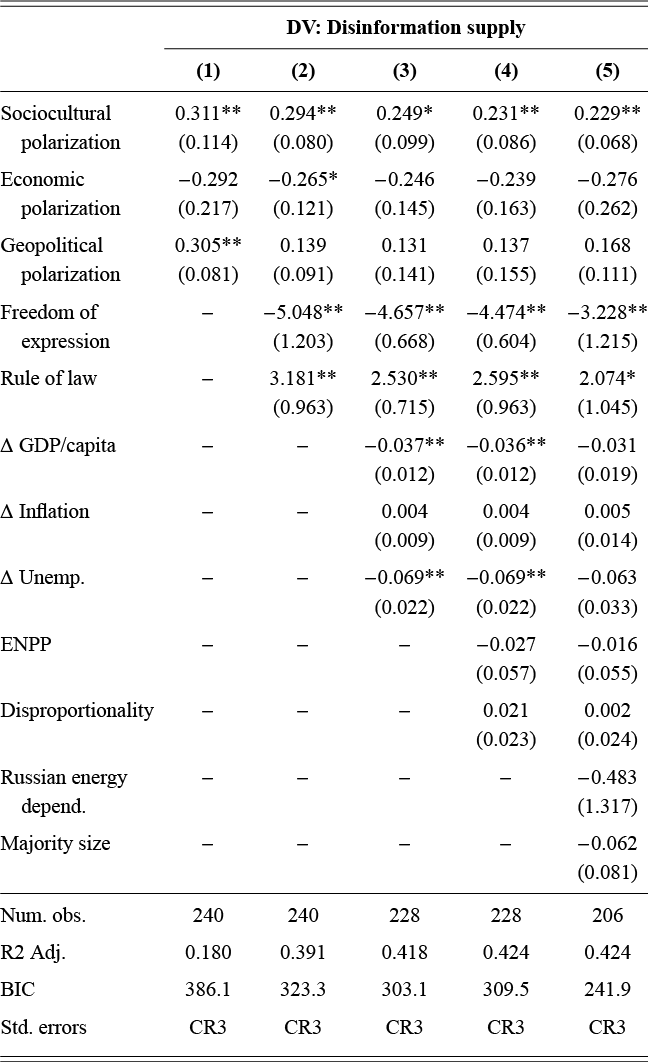
For the first test of Hypothesis 1, I assess the relationship between party-system ideological polarization and disinformation supply. To operationalize disinformation supply, the dependent variable, I use V-Dem’s v2smforads measure. The measure asks country experts to evaluate the extent to which “foreign governments and their agents use social media to disseminate misleading viewpoints or false information to influence domestic politics” (Coppedge et al., Reference Coppedge, Gerring, Knutsen, Lindberg, Teorell, Altman, Angiolillo, Bernhard, Cornell, Fish, Fox, Gastaldi, Gjerløw, Glynn, Good God, Grahn, Hicken, Kinzelbach, Marquardt, McMann, Mechkova, Neundorf, Paxton, Pemstein, von Römer, Seim, Sigman, Skaaning, Staton, Sundström, Tannenberg, Tzelgov, Wang, Wiebrecht, Wig and Ziblatt2025, 337). Experts provide their assessments on a 0 (“extremely often”) to 4 (“never, or almost never”) scale. This measure is available annually for all CEE countries between 2000 and 2024. For regression analyses, I use the interval measure from V-Dem’s measurement model, which aggregates ratings across experts, taking into account uncertainty, disagreement, and measurement error. I reverse code the scale so that higher values indicate greater disinformation supply. The resulting scale ranges from −2.489 to 3.276, where 0 represents the sample mean across all country-years included in V-Dem’s dataset.
I measure ideological polarization at the party-system level. I do so for three reasons. First, party-system ideological polarization can be measured systematically across countries and over time using standardized expert surveys or manifesto data on party positions. Moreover, a party-system-level measure can capture polarization along multiple ideological dimensions – economic, sociocultural, and geopolitical – allowing comparison of which societal divides are most strongly associated with disinformation supply. Second, voters take cues from their preferred parties when forming opinions (Slothuus and Bisgaard, Reference Slothuus and Bisgaard2021), suggesting that the ideological positions of parties may shape mass polarization (Abramowitz and Saunders, Reference Abramowitz and Saunders2008; Moral and Best, Reference Moral and Best2023). As such, party-system polarization both reflects and drives the ideological divides that structure mass political attitudes. Third, party-system polarization distinguishes between latent and politically mobilized social divisions. Public opinion can be polarized on various issues, but only some are divisive enough to structure electoral competition. Party-system polarization thus identifies which issues have become high-stakes political battlegrounds worthy of targeted disinformation campaigns. To operationalize party-system polarization, I use the weighted standard deviation formula proposed by Dalton (Reference Dalton2008):
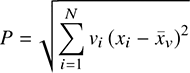 (3.1)
where
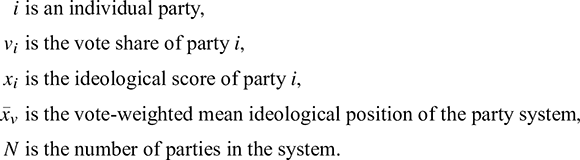
The index measures party-system ideological dispersion by calculating the vote-weighted standard deviation of party positions from the system’s mean. The index is calculated by taking the square root of the sum of squared distances between each party’s ideological position and the vote-weighted system average ideological position, with distances weighted by the party’s vote share. Consequently, polarization increases both as parties diverge further from the ideological center of the system and as electorally larger parties occupy more distant positions from the system mean.
I identify parties’ ideological positions using the Chapel Hill Expert Survey (CHES; Jolly et al., Reference Jolly, Bakker, Hooghe, Marks, Polk, Rovny, Steenbergen and Vachudova2022; Rovny et al., Reference Rovny, Polk, Bakker, Hooghe, Jolly, Marks, Steenbergen and Vachudova2025), an expert survey on political party positioning. CHES provides expert assessments of CEE parties for all elections between 2000 and 2024 (with the exception of Croatia, where parties were first evaluated for the 2011 election). To measure sociocultural polarization, I use expert assessments of party positions on the GAL/TAN dimension (0–10, “libertarian/postmaterialist”–“traditional/authoritarian”). I proxy for geopolitical positioning with parties’ positions toward EU integration (1–7, “strongly opposed”–“strongly in favor”). Finally, I measure polarization on economic issues with assessments of party positions on the traditional left-right economic dimension (0–10, “extreme left”–“extreme right”). For comparability, I rescale the European integration measure to 0–10. The polarization indices can range from 0 (all parties at identical positions) to 5 (two equally-sized parties at opposite extremes of the 0–10 scale). However, in the data, polarization ranges from 0.28 to 3.61, with standard deviations ranging from 0.58 to 0.67.
The unit of analysis is the country-year. However, CHES only provides data on party positions for country-election-years. To merge the V-Dem and CHES data, I first calculate polarization indices for each country-election-year; then, I forward-fill each country’s polarization values from each country-election-year through subsequent non-election years until the next election (when the polarization score is updated). I then merge these data with V-Dem’s country-year indicator of disinformation supply. The resulting dataset is an unbalanced panel of 240 country-year observations covering 11 CEE countries from their first available election in the CHES (between 2000 and 2002 for all countries except Croatia) through 2024.
To estimate correlations, I use a linear model with country fixed effects, which control for time-invariant country characteristics. Associations are estimated from within-country variation in polarization over time. I estimate all models with jackknife-based cluster-robust (CR3) standard errors. All right-hand-side variables are lagged by one year to mitigate simultaneity bias. Across different model specifications, I control for V-Dem’s freedom of expression and alternative sources of information index, V-Dem’s rule of law index, annualized changes in GDP/capita, inflation, and unemployment, proportionality (using the Gallagher least squares index), the effective number of parliamentary parties, the share of total domestic energy consumption supplied by Russian fossil fuel imports, and ethnic majority group size. Online Appendix A discusses the choice of control variables in greater detail.
3.1.1 Results
Table 1 presents results. Model 1 only includes the three polarization indices, while Models 2–5 sequentially add control variables. Across all models, sociocultural polarization has a statistically significant association with disinformation supply. Based on the estimates of Model 5, a one-standard-deviation (0.611) increase in sociocultural polarization is associated with a 0.140 increase in disinformation supply – which amounts to around ten percent of the outcome’s standard deviation. In other words, the association is fairly substantial in magnitude. There is limited statistical evidence that economic and geopolitical polarization are associated with disinformation supply.

Unstandardized coefficient estimates with cluster-robust standard errors in parentheses; *  , **

To assess robustness, I reestimate all models using two alternative polarization measures from V-Dem. The first measure (v2cacamps) captures the extent to which differences in political opinion affect personal relationships, while the second (v2smpolsoc) measures whether differences of opinion exist on a few or multiple issues and the severity of these differences. As such, these measures more closely capture affective and mass polarization than the party-system measures used in the preceding analysis. However, they are not dimension-specific, and thus cannot identify which divisions drive polarization. Online Appendix A presents results, which confirm a positive association between both measures and disinformation supply.
3.2 Ideological Polarization and Individual-Level Disinformation Exposure
I also test Hypothesis 1 with individual-level survey data from Eurobarometer. Doing so helps triangulate – determine whether aggregate-level results replicate at a lower unit of analysis with a different measure of disinformation supply. Flash Eurobarometer 464, fielded in 2018, asked respondents to evaluate how often they “come across news or information” that is “false” or “misrepresent[s] reality.” Responses were measured on a four-point scale ranging from “every day or almost every day” to “seldom or never.” Flash Eurobarometer 2832 assessed disinformation exposure by asking respondents to indicate how often they have been “exposed to disinformation and fake news over the last 7 days.” Respondents answered on a five-point scale, ranging from “very often” to “never.” To create a common scale, I collapse “every day or almost every day” and “at least once a week” from the 2018 survey and “very often” and “often” from the 2022 survey into one response category; “several times a month” (2018) and “sometimes” (2022) into another; and “seldom or never” (2018), “rarely” (2022), and “never” (2022) into a third. While this introduces measurement imprecision, it enables consistent analysis across survey years. In the resulting three-point scale ( ;
 ), higher values indicate greater disinformation exposure.
The polarization indices remain the primary predictors of interest. However, I decompose the measures into between-country means and within-country deviations. This decomposition distinguishes cross-sectional differences in polarization across countries from temporal changes within countries, allowing for the estimation of both between- and within-country effects while accounting for unobserved country-level heterogeneity. I control for the same lagged country-level covariates used in the previous analysis, with the exception of majority group size, which is largely time invariant between 2018 and 2022. I also include year fixed effects (2018 vs. 2022) to account for survey-year-specific shocks. At the individual level, I control for trust in mainstream media and frequency of social media use, two important confounders driving both polarization and disinformation exposure (Tokita et al., Reference Tokita, Aslett and Godel2024). Additional individual-level controls include age, gender, education, and locality size. Online Appendix A presents full item wording, response scales, and descriptive statistics. Given the hierarchical data structure, I estimate associations using multilevel models with country-level random intercepts.
3.2.1 Results
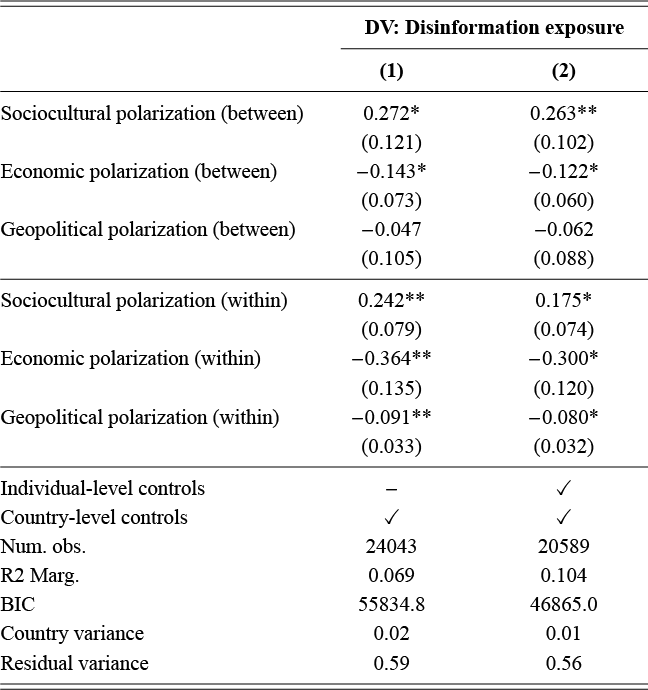
Table 2 presents results. Model 1 presents the results of a multilevel model estimated with only country-level covariates, while Model 2 adds all individual-level controls. Although the intraclass correlations for both models are low, indicating limited residual country-level clustering after controlling for country-level covariates, the multilevel specification allows for the decomposition of within- and between-country variation in polarization and accounts for the nested structure of the data.
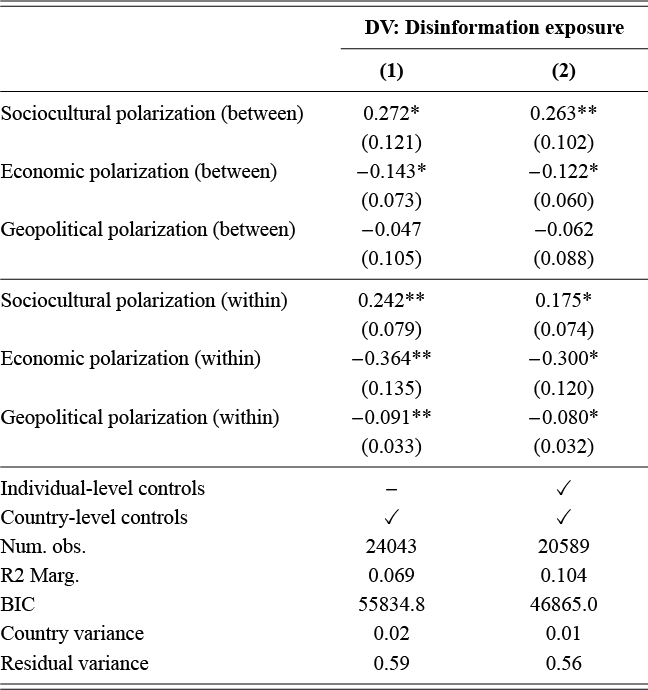
Unstandardized coefficient estimates with standard errors in parentheses; *  , **
 ; Full results in Online Appendix A.
Both within-country changes and between-country differences in sociocultural polarization are positively associated with disinformation exposure. Per Model 2, association sizes are substantive – amounting to between 22 percent (within) and 33 percent (between) of disinformation exposure’s standard deviation. Both between- and within-country differences in economic polarization are negatively associated with disinformation exposure, with between-country differences substantively more consequential than within-country changes. Unlike in the country-level results, geopolitical polarization exhibits a negative over-time, within-country association with disinformation exposure, though the association is relatively modest, amounting to 10 percent of the outcome’s standard deviation.
More generally, within-country variation in polarization is the more consequential predictor of disinformation exposure. Across both models, all within-country polarization measures are statistically significant. However, within-country increases in sociocultural polarization are associated with greater exposure, while increases in economic and geopolitical polarization are associated with less exposure. Between countries, only sociocultural and economic polarization remain significant predictors, while geopolitical polarization is not associated with disinformation exposure. These results largely reaffirm the aggregate country-level findings, which also showed that within-country increases in sociocultural polarization were associated with greater disinformation supply. Importantly, however, the individual-level data also highlight that when party competition revolves around economic issues, citizens are less likely to report disinformation exposure – suggesting that economically structured political conflict may be less conducive to the spread of disinformation than polarization along sociocultural lines.
3.3 Discussion
Aggregate country-level and individual-level survey data indicated that party-system polarization over sociocultural issues is positively associated with disinformation supply – both across countries and within countries over time. In contrast, ideological divisions over economic issues and geopolitics exhibited less consistent – and generally negative – associations with disinformation prevalence. Taken together, these findings suggest that the growing salience of sociocultural issues and the subsequent reorientation of party competition around the sociocultural cleavage have created the conditions necessary for disinformation to spread. Disinformation is not only more prevalent in socioculturally polarized countries, but its prevalence also increases as sociocultural polarization deepens within countries. Moreover, divisions over economic issues do not appear to create the same conducive environment for disinformation. Rather, disinformation proliferates when political competition revolves around contested values, norms, and group identities. Importantly, while the analyses operationalized disinformation supply in two different ways – expert assessments and self-reported exposure – neither operationalization explicitly measured pro-Kremlin or Kremlin-linked disinformation. Unfortunately, such measures with comparable cross-national and temporal coverage are not readily available.
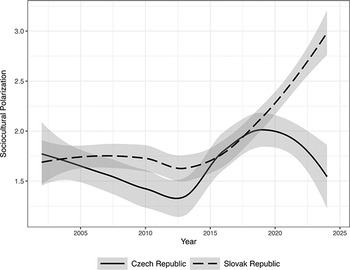
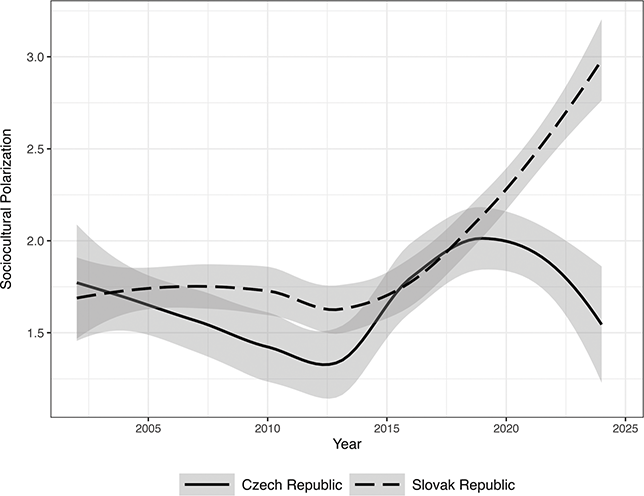
These findings also motivate the selection of the Czech Republic and Slovakia as comparative cases. As Figure 1 shows, Slovakia exhibits markedly higher levels of party-system polarization over sociocultural issues compared to the Czech Republic. This variation can shape disinformation supply through multiple mechanisms. Polarization may shape the Kremlin’s strategic incentives, motivating it to disseminate disinformation where it may have the largest impact. Likewise, polarization may increase demand for ideological or partisan news, creating a niche for outlets that disseminate pro-Kremlin disinformation. Polarization may also shape elite behavior around disinformation, incentivizing the reproduction of false narratives for political gain and reducing willingness to identify disinformation as a societal threat. These elite-level variations may in turn shape the degree to which governments prioritize building anti-disinformation capacity. The next section evaluates these claims through a comparison of Czech and Slovak elite-level perspectives on disinformation.
Sociocultural polarization in the Czech and Slovak Republics
4 Disinformation: Elite-Level Perspectives
Elites play a consequential role in shaping public opinion. Elite cues – informational signals that convey a stance or position – serve as cognitive shortcuts that tell both partisan supporters and opponents what they should think about a given issue (Broockman and Butler, Reference Broockman and Butler2017; Leeper and Slothuus, Reference Leeper and Slothuus2014; Lenz, Reference Lenz2012; Slothuus and Bisgaard, Reference Slothuus and Bisgaard2021). Elite cues are consequential for disinformation supply and demand in two ways. First, political elites can echo (and thus validate) ideologically aligned disinformation outlets or narratives, signaling to their supporters that such sources are legitimate parts of the media ecosystem and that disinformation content is credible (Mosleh et al., Reference Mosleh, Pennycook, Arechar and Rand2021; Zhang et al., Reference Zhang, Chen and Lukito2023). Elite reproduction of disinformation narratives increases supply, while the legitimization of disinformation media can spur demand.
Second, political elites also shape disinformation supply and demand by taking positions on the issue of disinformation itself – whether it exists and, if so, to what extent it poses a threat. On the one hand, politicians can acknowledge that disinformation is a threat that requires institutional response. This acknowledgment signals to citizens not only that disinformation exists but also that it merits concern. On the other hand, politicians can dismiss disinformation – that is, downplay its salience and the need for an institutional response. In the most extreme cases, political elites can dispute the existence of disinformation entirely, and frame any efforts to define or combat disinformation as ideologically motivated. Commonly, these strategies rely on framing anti-disinformation efforts as partisan censorship of free speech, or on relativizing truth by portraying objective falsehoods as matters of opinion (Farhall et al., Reference Farhall, Carson, Wright, Gibbons and Lukamto2019). These decisions are consequential for how the public thinks about disinformation.
Given that political elites play a central role in determining which issues command attention and resources (Green-Pedersen and Walgrave, Reference Green-Pedersen and Walgrave2020; Hobolt and De Vries, Reference Hobolt and De Vries2015), their positions on disinformation also matter for the disinformation-related policy agenda. If elites consider disinformation a societal challenge, they can establish the impetus behind anti-disinformation policies and guide their effective implementation (Hanzelka and Pavlíková, Reference Hanzelka and Pavlíková2021; Saurwein and Spencer-Smith, Reference Saurwein and Spencer-Smith2020). Alternatively, if elites discount or reject the threat posed by disinformation, they are unlikely to invest in anti-disinformation policies. In other words, elite perspectives matter for the types of policies governments put into place to address disinformation-related challenges. Importantly, these decisions also shape public opinion by signaling which problems matter and by framing different solutions as more or less appropriate. Elites that reject anti-disinformation policies signal to publics that disinformation is not a societal challenge worthy of attention. Conversely, elites that actively invest in counter-disinformation capabilities signal to citizens that disinformation is a threat that demands collective action and public resources. In sum, the positions elites take on disinformation matter because they shape both how ordinary citizens understand the problem and how effectively states can develop and implement counter-disinformation policies.
As CEE has grown more polarized, disinformation itself has become a contentious issue – one subject to ideological dispute and partisan competition. In some countries, elite debates largely center around the most effective ways to combat disinformation; in others, elites disagree about whether disinformation exists at all. Disinformation – like migration, LGBTQ+ rights, or energy independence from Russia – has become one of the constituent issues of the sociocultural and geopolitical divides shaping CEE politics. Ideological polarization around disinformation not only amplifies the influence of elite cues on how the public thinks about the problem, but also complicates efforts to develop disinformation resilience. Effective disinformation resilience depends on elite consensus, which serves two critical functions: (1) enabling political agreement on resource allocation and institutional design; and (2) shaping public perceptions of disinformation’s severity – and, by extension, the legitimacy of institutional responses. In polarized contexts, sustaining elite consensus becomes increasingly difficult.
Electoral turnover between conflicting ideological camps further undermines resilience by creating institutional instability (Dahlström and Holmgren, Reference Dahlström and Holmgren2019). When new governments consider previous anti-disinformation efforts as ideological overreach, they may dismantle the institutions their predecessors built. Budgets may be cut, personnel may be reassigned, or entire government offices may be eliminated. These changes create operational challenges for bureaucrats working in disinformation resilience, who must navigate shifting organizational structures and political expectations (Richardson, Reference Richardson2019). Thus, even when effective institutions are created, government turnover in polarized contexts can undermine their effectiveness. Ultimately, polarization undermines disinformation resilience not only by making elite consensus harder to sustain, but also by making institutional continuity contingent on which side of the divide holds power.
In light of this discussion, I ask four related questions. First, how do political elites think about disinformation, and to what extent do they consider it a threat? Second, how do these perceptions relate to politicians’ ideological convictions, and to what extent do views on disinformation align with broader sociocultural and geopolitical ideological divides? Third, how do these views shape decisions about the disinformation-related policy agenda? Finally, how do the decisions of political elites shape the day-to-day and long-term work of those responsible for building disinformation resilience? To answer these questions, I analyze the perspectives of politicians and of appointed officials, bureaucrats, and non-governmental experts working in the field of disinformation resilience in the Czech and Slovak Republics.
4.1 Data and Methods
I analyze in-depth semi-structured elite interviews conducted between September 2019 and April 2020, May and July 2023, and September and December 2024. All interviews were conducted in person, with the exception of four respondents who preferred to provide written answers and three respondents who were interviewed through online video conferencing. All interviews were conducted in Czech or Slovak. To recruit politicians, I contacted members of parliament who had committee assignments related to the topics – for example, foreign affairs or defense – and central party offices/secretariats. To recruit government officials and bureaucrats, I contacted government offices responsible for disinformation-related policies. Additionally, I reached out to non-governmental organizations – for example, civil-society initiatives and policy organizations – working on disinformation resilience. In total, I interviewed sixty-eight respondents: thirty-seven in the Czech Republic and thirty-one in Slovakia. Table 3 details the number of interview respondents by position and country.
| Position | Czech Republic | Slovakia |
|---|---|---|
| Political representative | 26 | 14 |
| Government official | 5 | 8 |
| Non-governmental organizations | 6 | 9 |
To analyze the interviews, I rely on thematic analysis. Thematic analysis identifies larger patterns of meaning or core ideas within and across respondent answers. The method allows for a nuanced and detailed assessment of elite-level perspectives, relying on interviewees to describe their views in their own words with the contextual depth they deem sufficient. In thematic analysis, a theme is composed of smaller “building blocks” known as codes (Clarke and Braun, Reference Clarke and Braun2017, 297). I took an iterative strategy, combining both deductive and inductive approaches to identifying codes. Such an approach “involves the application of an explicit theoretical framework” while also focusing on “the generation of themes from the data” (Proudfoot, Reference Proudfoot2023, 310). First, I open-coded all interviews. Second, I consolidated the codes, sorting them into emerging themes. Third, I defined each theme for re-coding. Fourth, I re-coded the interviews, keeping only themes that appeared in multiple interviews and were afforded extended discussion by participants.
4.2 Results
Thirteen themes related to the four research questions emerged. Where relevant, I highlight how themes varied across: politicians from different ideological camps; the Czech Republic and Slovakia; and the three fieldwork time periods. I begin with politicians’ assessments before turning to the perspectives of government officials and non-governmental experts involved in anti-disinformation efforts.
4.2.1 General Perceptions of Russian Influence
Table 4 presents the three themes, along with example codes and quotes, that emerged among politicians when they were asked about Russian influence efforts. These questions were asked prior to any questions about disinformation, and the themes tend to reflect bigger-picture assessments of Kremlin influence efforts in the Czech Republic and Slovakia.
| Theme | Example code | Example quote |
|---|---|---|
| The Battle Between East and West | Russia: Great power | “Russia is a great power, whether people like it or not. We have to cooperate with them …”Footnote 7 |
| A Western/Liberal Invention | Lack of evidence | “I do not know what Russian influence is … what would they gain with this influence? Everyone talks about it, but I am still searching for what this Russian influence is.”Footnote 8 |
| Acknowledging Vulnerability | Institutional weakness | “To resist you have to have strong institutions, and public trust in those institutions. We do not have that.”Footnote 9 |
The first theme that emerged was The Battle Between East and West: the general evaluation that countries like the Czech Republic and Slovakia are geopolitically vulnerable to the interests of stronger states around them. This assessment would often be the very first point made by respondents when asked about Russian influence. One Czech respondent – from an increasingly conservative populist party – started the interview with: “the conflict between the West and the East is never-ending. We have Great Powers. On one side we have Russia, on the other side we have the USA. Everyone wants their influence and their might. It is a never-ending struggle.”Footnote 10 Another respondent from a left-wing, conservative Slovak party started by saying: “Of course they are here, of course they function here. Russia functions here, America functions here, China too. We are in a geopolitical race. It is realpolitik.”Footnote 11 As these quotes illustrate, many respondents considered Russian influence an inevitable outcome of their country’s position in the international system. Other respondents also used the term “Great Power” to refer to Russia, though some also noted Russia’s societal, economic, and political difficulties. As one respondent put it: “Few people dream about living in Russia.”Footnote 12 Respondents interviewed in 2023 and 2024 also noted that Russia’s failure to quickly force Ukraine’s capitulation damaged the Kremlin’s ability to portray itself as a geopolitical counterweight to the West.
Conservative politicians, however, were quick to point out that Russian influence was defensive – a response to Western, primarily American, threats to Russia’s sovereignty. One conservative Slovak respondent – on the more extreme end of the ideological spectrum – even stated that “the larger hybrid threats are from the West rather than the East.”Footnote 13 Another respondent remarked that the United States supported Euromaidan in Ukraine, prompting Russia to react: “It is a reaction to the fact that the Americans poured five billion dollars to overthrow the regime … they did it in Kyiv and Russia reacted.”Footnote 14 Slovak liberals, however, were more pessimistic than their Czech counterparts – particularly about Slovakia’s capacity to withstand geopolitical pressure: “it [Russian influence] threatens democratic stability in Slovakia, and our geopolitical orientation is increasingly being re-evaluated in favor of the East.”Footnote 15 These same politicians often went on to note how geopolitics was becoming a major ideological division in Slovak politics:
Now, you have politicians and parties that are anti-European and anti-NATO or at least they want to signal to the people that they are … all in the name of Slovak sovereignty. And then you have us, the ones who now have to convince people that good relations with Russia are not a solution, and then we must also persuade our European partners that these parties do not represent all of Slovakia.Footnote 16
The next theme, A Western/Liberal Invention, was only salient among the most radical subset of conservative respondents. These respondents refuted the idea that influence – of any sort – exists. As the example quote in Table 4 illustrates, some respondents mentioned a lack of evidence, arguing that little conclusive proof exists to substantiate the existence of Russian hybrid threats. Other respondents questioned Russia’s motives on cultural grounds: “Slovaks and Russians are brothers … we are Slavic nations. That is a fact … why would they want to control things here?”Footnote 17 Many radical respondents were also quick to suggest that the concept of hybrid threats was a fabrication created by “liberal propaganda [that] seek[s] to profit from ideological polarization and discredit conservative views.”Footnote 18
Respondents challenged follow-up questions about specific instances of Russian influence on conceptual grounds. They did not deny that these events occurred; instead, they rejected that these were instances of Russian influence. To substantiate these rejections, respondents argued that these events were only considered Russian influence because liberal politicians and liberal media depicted them as such. In other words, Russian influence was a product of ideologically motivated framing. As one respondent noted: “I do not think anything like that exists here … they depict anything that is ideologically different or even a different opinion as a hybrid threat.”Footnote 19 Another remarked that “just because I do not agree with the official, mainstream position does not make me a Russian louse or Putin’s agent, but they portray it that way.”Footnote 20 Another respondent, referring to when the editor of a Slovak pro-Kremlin news source (Zem a Vek) visited the Russian embassy, remarked: “So what? Would we react the same way if it was the American or British Embassy? These things are all so one-sided.”Footnote 21 Another politician aptly summarized this position: “liberal propaganda has just convinced everyone that Russia means bad, but the world is not black or white.”Footnote 22
In sum, respondents who were sympathetic to Russia or held ideological convictions aligned with pro-Kremlin disinformation content consistently questioned the existence of Russian influence. Many suggested that hybrid threats were a concept created by liberal politicians and media. One Slovak politician even suggested that anti-influence efforts undertaken by the OL’aNO-led governments (2020–2023) were actually a guise to “persecute and surveil” conservative opposition candidates.Footnote 23 In other words, for these respondents, Russian influence was not a geopolitical threat that needed to be mitigated, but rather a partisan fabrication, engineered by their ideological opponents.
These views stood in stark contrast to the assessments of the government officials and bureaucrats involved in anti-influence operations. These respondents repeatedly Acknowledged Vulnerability – that is, not only recognized Russian influence as a problem, but also acknowledged how domestic vulnerabilities exacerbated its severity. One respondent summed up Slovakia’s situation:
When we have a war across our border, when we have a refugee crisis, when someone tries to anger, to polarize our population, that is when we find out that we do not have any coordination capacity, that we do not have resources, that the state does not know how to effectively communicate with its citizens. These are long-term, unsolved problems, which are only even more evident now because we are in crisis mode as there is a war, inflation, a migration wave …Footnote 24
Although this was perhaps the starkest acknowledgment of vulnerability, other respondents voiced similar sentiments. A Slovak expert interviewed in 2023 welcomed that the 2021 Security Policy of the Slovak Republic [Bezpečnostná stratégia SR] “finally designated Russia as a hybrid threat.” Yet, she also lamented that policies alone were not sufficient for changing the “mentality of state institutions.”Footnote 25 Assessments of vulnerability were shared by centrist and liberal politicians. As part of a longer evaluation of current government efforts to fight Russian influence, one Czech respondent started his answer with: “Well, considering that no one really knows how to fight it, I actually do not know if I can even judge whether the steps are sufficient.”Footnote 26 Similar remarks – “it is not sufficiently handled,”Footnote 27 “it is certainly a problem,”Footnote 28 and “the hybrid war runs on all cylinders here”Footnote 29 – were common.
Compared to their Slovak counterparts, Czech respondents were more optimistic about the state’s capacity to deal with Russian influence. The Czech 2016 National Security Audit (Audit národní bezpečnosti) set the stage for sustained institution building, including the creation of the Centre Against Terrorism and Hybrid Threats (Centrum proti terorismu a hybridním hrozbám) and the Office for Cyber and Information Security (Národní úřad pro kybernetickou a informační bezpečnost). Many Czech politicians pointed to these institutions as sources of resilience: “We managed to build up some infrastructure so that we can fight this … so I think we are moving in a positive direction.”Footnote 30 Nonetheless, while Czech politicians were quick to applaud institution building, non-governmental experts evaluated the situation somewhat differently. The spokesperson of Čeští elfové – a Czech civic movement that maps, analyzes, and combats foreign disinformation – summarized the efforts of Petr Fiala’s government (2021–2025):
The new government came in with high expectations. They said the right things, they supported it rhetorically. But practically, they did very little. There were some attempts, like they had a government commissioner, but they gave him no resources … he could not do anything. Formally, the government wants to check off all the boxes, but they do not actually dedicate any real resources.Footnote 31
The quote refers to the Government Commissioner for Media and Disinformation, a position created by Fiala’s government in 2022 that existed for less than a year before the agenda was transferred to the Prime Minister’s advisor for national security. This assessment was shared by other Czech experts – many acknowledged the strong institutional capacities of the Czech Republic “on paper,”Footnote 32 but lamented that implementation was often lacking. Respondents interviewed in 2019–2020 blamed the pro-Russian communist party (Komunistická strana Čech a Moravy, KSČM), which provided confidence and supply to Andrej Babiš’s second government (2018–2021), and former president Miloš Zeman: “Zeman questioned everything, for him it became about a new type of censorship.”Footnote 33 According to these assessments, actors with pro-Russian ideological views effectively served as veto points, undermining anti-influence efforts. With the 2021 change in government, political opposition was no longer the primary problem. Rather, institutional efforts to combat Russian influence still lacked centralized leadership and dedicated resources – “someone or some office that would take the reins, take responsibility for this whole problem of hybrid threats, and coordinate the various mechanisms and institutions that we do have.”Footnote 34
Slovaks were more pessimistic than their Czech counterparts, and their assessments varied dramatically across 2019–2020, 2023, and 2024. In 2019–2020, pessimism was largely a product of Slovakia’s under-developed institutional capacity. Many respondents pointed to a longstanding lack of political will as the primary cause: “The ‘middle management’ of these ministries is people who are great at what they do, they are committed. They are professionally prepared and oriented, but they run into the ceiling that they have some deputy or some director above them who is there for X years as a political appointee and has little interest in doing anything.”Footnote 35
After the 2020 election, the OL’aNO-led governments – and particularly Defense Minister Jaroslav Nad’ – prioritized hybrid threats. One Slovak respondent commented that the people in the Ministry of Defense were “sufficiently – and maybe I will exaggerate a little – militantly anti-disinformation.”Footnote 36 One politician remarked that “for the first time, we [Slovakia] were cooperating with European institutions and other states to effectively combat hybrid threats.”Footnote 37 Many of the non-governmental experts I interviewed in 2019–2020 had taken up official government positions in these new institutions, primarily located within the Ministries of Interior and Defense. For the first time, Slovakia was making sustained progress in its fight against hybrid threats and disinformation.
Smer’s victory in the September 2023 parliamentary elections reshaped assessments of Slovakia’s vulnerability. By 2024, many experts-turned-government-officials were, once again, experts (or members of the opposition). When asked to retrospectively evaluate government efforts between 2020 and 2023, these respondents reaffirmed that important steps had been undertaken but that, after winning the election, “Smer systematically de-prioritized the fight against hybrid threats.”Footnote 38 For example, the Centre for Countering Hybrid Threats, built with European funds under the OL’aNO governments, saw its staff significantly reduced. Many departures were “voluntary,” motivated by the new government’s ideological position on hybrid threats.Footnote 39 Similar departures occurred at the Ministries of Defense and Foreign Affairs. Moreover, the government terminated its contract with Gerulata, a private Slovak firm providing technological capacity to monitor online disinformation.Footnote 40 The new government justified the decision by stating that these capacities should be “entirely in the hands of the state and [that] there is no reason to involve private companies or non-governmental organizations.”Footnote 41
4.2.2 Perceptions of Kremlin-Linked Disinformation
This section turns to perceptions of Kremlin-linked disinformation. Table 5 presents the three themes that emerged as respondents discussed disinformation. The first theme, All Media Is Propaganda, encapsulates the views of conservatives who acknowledged the existence of disinformation in the Czech and Slovak Republics. However, at the same time, these respondents suggested that the distinction between mainstream media and disinformation is a false one. For them, all media serve political ends, and disinformation media is only labeled as such because it presents conservative views. As one respondent remarked: “Everyone tries to influence public opinion. Russia does it, America does it, but we only call this disinformation if it comes from Russia. It is all disinformation.”Footnote 45 Thus, these respondents stressed that while disinformation exists in both liberal and conservative forms, only conservative narratives are labeled disinformation.
| Theme | Example code | Example quote |
|---|---|---|
| All Media Is Propaganda | Liberal media bias | “It is a naive fairy-tale, that one is a golden prince, who only tells the truth, and the other is an evil dragon, who only tells lies – it is unbelievably naive.”Footnote 42 |
| Domestic Reproduction | A politician’s tool | “As long as Robert Fico keeps making disinformation mainstream, we have no chance of defeating it.”Footnote 43 |
| Societal Susceptibility | Anti-system public | “We have 10–15% of people who are, let us say, radical, who will always believe Russian disinformation, who are always anti-system and always have to rebel, and my opinion is that you cannot work with them.”Footnote 44 |
Much of the logic underpinning these perceptions is closely tied to assessments related to The Battle Between East and West. Almost without fail, if a conservative respondent acknowledged Russian disinformation, statements related to American propaganda immediately followed: “OK, yes, we have Russian propaganda, certainly. But we also have very strong American propaganda, and I will even say that American propaganda is stronger than Russian propaganda.”Footnote 46 Often, respondents also explicitly designated mainstream media outlets as propagators of American disinformation:
“Mainstream media is overwhelmingly pro-Brussels and pro-American. It does not present balanced views. It brainwashes Slovaks … We are against the spreading of any disinformation – including by the mainstream media.” Footnote 47
The perspective that disinformation was a political tool used by mainstream media to further liberal, pro-West interests was common. Many conservative respondents also noted that they only received “fair treatment from the so-called alternative media.”Footnote 48 One respondent directly accused Czech mainstream media of producing “biased content” about the COVID-19 pandemic and the Ukraine war “in order to support the [Czech Republic’s pro-West] government.”Footnote 49 This respondent then went on to question why no one considered these narratives disinformation. Some respondents noted that this was an inevitability of being a small state caught between great powers: “We cannot prevent this, we have to be cognizant that disinformation comes from both sides, but unfortunately, we are so small, that we cannot really do much about this.”Footnote 50
Liberal respondents identified Domestic Reproduction as a concern. For liberals, the culprits behind the spread of disinformation were domestic politicians. Some of these actors were deemed “useful idiots,” but other respondents rejected this categorization, stating that “such a label ignores the real political will behind their actions.”Footnote 51 This political will took two forms. First, some politicians – primarily from the radical left and radical right – had always supported Russia and held ideological positions that aligned with pro-Kremlin disinformation content. As disinformation became more widespread, actors with aligned ideologies adopted pro-Kremlin talking points, while disinformation outlets provided them with platforms to reach wider audiences. Second, respondents accused some politicians – mainly from radicalized mainstream parties – of reproducing pro-Kremlin narratives as a cynical strategy to win votes. As evidence, respondents mentioned that these parties only adopted these positions in response to the electoral success of radical parties, and that their engagement with disinformation media was an electoral strategy to win over the voters of these parties.
Many interviewees added that domestic reproduction had become more of a problem as social media and alternative news channels became established platforms for communicating with voters. As one participant stated, “they do not even need to have access to the mainstream media, they can go on Facebook, they can go to one of these disinformation portals, like ExtraPlus, and manage to create equivalent influence.”Footnote 52 Participants suggested that such steps legitimize not only disinformation narratives, but also the medium through which the narratives are conveyed. As one respondent put it: “they created legitimate sources of information from obscure media that should never have had such reach.”Footnote 53
Domestic reproduction was particularly salient in Slovakia, where interviewees often noted the sheer number of domestic political actors who legitimized disinformation narratives. One respondent working in disinformation resilience lamented: “How can I do my job? How can I do my job effectively when the next day, some politician from X party shows up and gives the outlet an interview?”Footnote 54 By 2024, Slovak opposition parties consistently voiced concerns about the Smer-led government’s increasing reliance on alternative media to reach voters.
In the Czech Republic, assessments of domestic reproduction largely focused on smaller, radical parties. One respondent interviewed in 2020 noted that the Czech Republic was “lucky” that the Prime Minister at the time, Andrej Babiš, “has several firms in the West, which holds him to at least a somewhat pro-Western orientation.”Footnote 55 By 2023, COVID-19 and the Russo–Ukrainian War had dampened some of these positive assessments, and respondents voiced concerns about the extent to which domestic actors had adopted pro-Kremlin narratives in order to capitalize on “voter frustration against the government.”Footnote 56 More generally, Czech respondents pointed to the pandemic and the Russo–Ukrainian War as watershed events that legitimized disinformation media in the country: “You had a segment of society that was pissed off, pissed off about COVID, pissed off about Ukrainians. Some politicians realized this, and even if they do not go and give interviews to these portals, they say a lot of the same things, and that is problematic.”Footnote 57
The final theme to emerge was Societal Susceptibility: assessments of why regular citizens are susceptible to Kremlin-linked disinformation. As the example quote in Table 5 illustrates, some respondents had completely given up on working with these “misled” segments of the population, or at least with the most extreme among them. A politician indicated that his party “tries, and tries consistently, to convince these voters that we are safer in the EU and NATO, but it has become increasingly difficult.”Footnote 58 Many other respondents increasingly accepted the ideological segmentation of the electorate: centrist and liberal parties appealed to one set of voters, radical parties to another, and successfully persuading voters to move between blocs was unlikely. Employing similar reasoning, some politicians emphasized that combating disinformation should not focus on convincing those who are already consumers; instead, efforts should prioritize education, critical thinking, and media literacy “as barriers to prevent the vulnerable audience from expanding.”Footnote 59
4.2.3 Policy Approaches to Combating Disinformation
Table 6 presents themes that emerged when politicians were asked about anti-disinformation policies. These themes were based on retrospective and prospective assessments – what had worked well, what had not, and how they would approach future policies.
| Theme | Example code | Example quote |
|---|---|---|
| Free Speech And Its Limits | Indiv. rights | “Freedom of speech is sacred, but the law is just as sacred.”Footnote 60 |
| Building Societal Resistance | Education | “Critical thinking, some capability to work with information, is nowhere. It is not taught. It does not exist.”Footnote 61 |
| Building Institutions | Lack of capability | “In Slovakia, perhaps where we most need it, we do not have the institutions ready to fight this influence.”Footnote 62 |
The most salient theme, noted in different ways by both liberal and conservative respondents, was Free Speech And Its Limits. This theme emerged when discussing policy solutions that involved content moderation or removal. Respondents emphasized that any proposed policy must carefully balance restricting harmful content with protecting free speech. However, liberal respondents would often qualify these statements with the warning that fighting disinformation was not “the opposite of the freedom of speech,”Footnote 63 and that policies should be carefully crafted so that “everyone has the right to say what they like, but that they will then also be responsible for what they say.”Footnote 64 One respondent suggested financial penalties as the best solution for this dilemma: “I think fines would solve everything. If someone says something that is clearly disinformation, then they pay a fine, but we are not going to lock anyone up just for saying something.”Footnote 65
To get a better sense of respondents’ concrete policy views, I asked about the Czech and Slovak governments’ decisions to block access to Kremlin-linked disinformation sites shortly after the escalation of Russian aggression in Ukraine. One Slovak respondent admitted it was a “controversial decision [within the coalition], perhaps on the border of impinging on free speech.”Footnote 66 Several representatives of parties in government at the time also noted these decisions were quickly politicized by the opposition, “supporters of the war,” and other anti-system, extremist actors.Footnote 67 One respondent remarked that this was worthwhile as it finally “started an interesting conversation about what the approach to fighting disinformation should look like.”Footnote 68
When further probed about the pros and cons of such policies, liberal respondents did not offer much detail besides pivoting back to checks and balances, and stating that such policies should be designed so that independent institutions (e.g., courts) would have the ability to review any decisions made by political representatives. A Slovak government official offered this summary:
Blocking access to these websites was very controversial. However, it is not the blocking itself that worries me. Instead, it was the process. The National Security Authority [Národný bezpečnostný úrad (NBÚ)] could almost make these decisions unilaterally, without publicizing any evidence. Proposed reforms were headed in the right direction. Give the decision to the courts, make them show their evidence, and that way there can be few questions about transparency or some politicized process. That is the right way to do it.Footnote 69
In sum, many centrist and liberal respondents were cognizant of how anti-disinformation policies built around content restrictions could impinge on the freedom of speech. They were also aware that these policies were contentious and could thus easily be politicized: “We have to be careful with policies like this. The opposition, many of whom can thank disinformation for their popularity, would quickly tell their voters that this is liberal censorship.”Footnote 70 Nonetheless, respondents made sure to caveat these concerns with the idea that the freedom of speech has limits and that independent institutions could adjudicate these limits effectively and transparently.
Representatives of nationalist-conservative parties had different views. For them, any anti-disinformation policies were violations of free speech. In fact, three respondents quoted Voltaire’s biographer Evelyn Beatrice Hall: “I disapprove of what you say, but I will defend to the death your right to say it.”Footnote 71 One of these respondents even added that liberal actors have transformed the quote into “I disapprove of what you say, so I am going to make sure that we can shut you up.”Footnote 72 Two other respondents indicated that current efforts in the Czech Republic paralleled the Ministry of Truth from George Orwell’s 1984. Another respondent even went as far as to label these policies as fascist: “We see that under the guise of battling conspiracies or battling disinformation, you can shut down your political opponent and that is a clear fascist practice.”Footnote 73 More moderate critics acknowledged these efforts might identify disinformation but argued that banning content was not the answer:
If I do not like what someone is saying, if I even buy that it is disinformation, I should argue and debate. I should not ban this person, or label someone with a different opinion as a desolate [dezolát], xenophobe, or extremist. What I should do is rationally substantiate why they are wrong.Footnote 74
In sum, though politicians across the ideological spectrum prioritized freedom of speech, they had very different views on whether anti-disinformation initiatives violated this freedom. Details about technical policy implementation were largely absent – liberal politicians offered platitudes about institutional safeguards, while the representatives of more radical parties pontificated about the value of argumentation. Finally, this theme was much more salient in 2023 and 2024 than in 2019–2020; the Russo–Ukrainian War was the first time either country had put such restrictive, albeit temporary, anti-disinformation policies into place.
A second set of policy solutions, discussed only by centrist and liberal respondents, involved Building Societal Resistance. To build resistance, interviewees proposed education and media literacy programs that would decrease individual susceptibility to disinformation. In follow-up questions probing implementation, many respondents shifted responsibility to the non-governmental sector: “We need to educate the population, we need to increase media literacy. However, the government is not so good at this. Here, I see a big role for NGOs.”Footnote 75 Another respondent directly praised non-governmental actors: “We have excellent people working on disinformation, the civil sector is mobilized, activated, and has described the problem  our academics and journalists too.”Footnote 76 Another lamented that the government should have started these programs much earlier: “These types of programs are just not a priority. We should have worked this out long ago, but there was never enough support.”Footnote 77 Non-governmental actors generally agreed that outreach and educational initiatives were where they could be most effective. One respondent described his organization’s goals: “We try to convince young people to think critically, to verify the facts that are shared, to identify half-truths and false claims.”Footnote 78
Another proposed solution concerned strategic communication or StratCom. By StratCom, respondents meant not only direct communication between the government and the public about disinformation, but also communication coordinated across various government institutions and agencies about their policy objectives and strategic aims. Many politicians considered StratCom as indispensable because it did not require legal or administrative reform – and thus was not subject to partisan contestation. Instead, it simply required having a “dedicated team that would be ready to counter prevailing disinformation narratives.”Footnote 79 In moments of crisis, such a team could present the official government assessment and give the public a “clear, concise, and united” way to interpret information.Footnote 80
In 2019–2020, StratCom was considered an area of improvement in both the Czech and Slovak Republics. By 2023 and 2024, Czech respondents noted that Fiala’s government had at least put some structures into place, including the Department of Strategic Communication within the Office of the Government and a strategic communication unit within the Ministry of Foreign Affairs. In 2023, Slovak respondents were equally optimistic – the Slovak Republic had passed the first Conception of Strategic Communication of the Slovak Republic in 2023. However, much of this optimism had died down by 2024. The new Smer-led government had reworked the entire document, removing any mentions of Russia and non-governmental partners.
Finally, political party representatives often noted that Building Institutions was a necessary step in combating disinformation. Here, assessments between Czech and Slovak respondents differed substantially. In the Czech Republic, centrist and liberal respondents were generally satisfied with the country’s institutional capacity. Much of this satisfaction stemmed from the steps undertaken in response to the 2016 National Security Audit – which explicitly identified foreign influence and disinformation as a national security threat. One respondent even offered a laundry list of institutions that had been created to spearhead anti-disinformation efforts: “We have the Center Against Terrorism and Hybrid Threats at the Ministry of Interior. Then we have the Ministry of Defense who deals with cyber-defense. And then we have the Ministry of Foreign Affairs, where strategic communication is handled, so I see real movement in this direction.”Footnote 81
In Slovakia, institution building was largely absent in 2019–2020. In fact, one respondent summarized the situation as follows: “even if the government wanted to do something, mobilize its institutions against some hybrid threat or against disinformation, I do not think they could.”Footnote 82 Again, centrists and liberals – largely in the opposition at the time – blamed the conservative, nationalist positions of the Smer-led government for a policy agenda they characterized as “ambivalent, at best.”Footnote 83 In 2023, institutions finally seemed to be getting off the ground, and there was significant optimism that the OL’aNO governments were making some progress. However, Smer’s 2023 return to power, coupled with the party’s increasing radicalization, resulted in the dismantling of much of the newly built institutional capacity.
4.2.4 The Reality of Combating Disinformation
Thus far, this analysis has focused on the views and assessments of politicians. This section shifts the unit of analysis to those directly involved in the day-to-day and long-term work of building disinformation resilience: government officials and experts from non-governmental organizations (Table 7).
| Theme | Example code | Example quote |
|---|---|---|
| Mapping the Threat | Monitoring actors | “Our core ‘business’ is being aware of the information environment, but also of the whole hybrid sphere.”Footnote 88 |
| Political Leadership | Reluctance | “Our political situation is rather complicated. Government stakeholders do not want to, or cannot agree that they should name these things [Russian influence] what they are. So we lost the opportunity to build our resistance.”Footnote 89 |
| Culture of Resilience | Changing mindsets | “To fight disinformation, we need to change the political culture.”Footnote 90 |
| Institutional Silos | Lack of coordination | “You have all of these institutions all over the place, and no office, perhaps under the Office of the Government to coordinate them.”Footnote 91 |
Both government officials and non-governmental experts saw information provision as their first and primary responsibility – that is, they were in charge of Mapping the Threat. One respondent, working in a Slovak institution, described the responsibility as follows:
Our work is building or sustaining situational awareness … identify emerging narratives, trends, or actors … synthesizing this information, creating analytical briefs for various audiences, for the leadership of ministries, for the members of the Security Council [bezpecňostnà rada].Footnote 84
A Czech respondent added that an essential component of mapping the disinformation environment is public engagement: “It is important to be seen, it is important for the public to see what we do. It is important for politicians to see that we are an actor who has a say in this debate.”Footnote 85 Another respondent from Slovakia noted that the creation of a “situational center and analytical team” was the first official competence granted to Slovak institutions after the government officially identified disinformation as a threat in the 2018 Concept for the Battle Against Hybrid Threats [Koncepcia pre boj Slovenskej republiky proti hybridným hrozbám].Footnote 86 Non governmental organizations echoed these perspectives. As the representative of Čeští elfové put it: “We are dedicated to observing, describing, and analyzing.”Footnote 87
Although government officials had the resources and political support to effectively provide informational and analytical support, they lacked the “ability to react to disinformation.”Footnote 92 Respondents remarked they were constrained by institutional protocols and legal limitations. Often, they had to rely on politically appointed superiors to approve public communication. Thus, while politicians stressed the importance of strategic communication, they did not necessarily afford anti-disinformation institutions the latitude to independently engage in such efforts. Non-governmental organizations possessed greater flexibility in outreach activities and dissemination of research-based analytical reports. However, these organizations lacked the resources and legitimacy of state institutions. In sum, state institutions had credibility and capacity but lacked autonomy, while non-governmental actors had autonomy but lacked legitimacy and resources – leaving a substantial gap in anti-disinformation public outreach. As such, many respondents noted that elected politicians ultimately had the greatest capacity – and “responsibility” – to communicate with the public about disinformation.Footnote 93
In other words, building disinformation resilience required Political Leadership: the backing and support of political elites. When I spoke to individuals working in Slovak anti-disinformation efforts in 2019–2020, they praised the policy agenda outlined in the 2018 Concept. However, they also noted the government’s ambivalent stances on Russian influence made their jobs “more difficult.”Footnote 94 More generally, interviewees suggested they were doing what they could, and the government had taken some steps in a positive direction, but without engaged, proactive, staunch support, their capacities were limited. These limitations were not only related to resources or personnel. Respondents emphasized it was difficult to do their jobs in polarized environments where segments of the political elite would “make a political debate” out of disinformation.Footnote 95 Put differently, anti-disinformation efforts were impeded not only by governmental indifference but also by polarized elite discourse that portrayed disinformation as an ideological issue rather than as a collective societal challenge.
By 2023, assessments had become more positive. One non-governmental expert commented that Slovakia “finally had a government where no party would block anti-disinformation efforts from reaching the highest levels and from getting into actual policies.”Footnote 96 With the government change, one official commented that anti-disinformation efforts finally “reached the minds of politicians, decision-makers, ministers. They realize it is an important topic; they want to dedicate time to it. This was not the case two or three years ago.”Footnote 97 Nonetheless, officials remained aware of how subsequent elections could impact their work. One respondent mentioned that if Smer won the next election, he could not envision the current leadership of Slovakia’s anti-disinformation institutions remaining.Footnote 98 Indeed, after Smer returned to power in 2023, large-scale personnel turnover – and reductions – in Slovakia’s anti-disinformation institutions occurred.
In general, Czech respondents were less concerned about a lack of political support, though some did note that the legitimization of disinformation narratives by political elites could complicate their work. Instead, government officials and non-governmental representatives applauded that Czech politicians recognized disinformation as a potential issue early on, and thus invested in anti-disinformation institutions and did not interfere with their work. In other words, Czech institutions functioned effectively and independently. However, some respondents remarked that supportive politicians would fail to match rhetoric with concrete actions or resources. In other words, the government had a tendency to over-promise and under-deliver: “Even if the government says all the right things, you cannot always expect them to follow up on all of it.”Footnote 99 Respondents often brought up the multiple strategies, concepts, and action plans that had been written since 2016 as examples. One Czech respondent offered this assessment: “We have all of these policies, and on paper, they are very detailed. They say a lot. If you just looked at these documents, we would be one of the most prepared countries in the world. Unfortunately, reality does not always match.”Footnote 100
When discussing this reality, government officials offered two interrelated criticisms. First, respondents stressed that building government institutions is only half the challenge; cultivating a Culture of Resilience is equally essential. Second, respondents highlighted that the anti-disinformation agenda is dispersed across multiple state institutions and ministries that lack a central coordinating body, resulting in limited cooperation and the emergence of Institutional Silos.
Slovak officials were significantly more pessimistic about building a culture of resilience than their Czech counterparts. Pessimism was largely related to Slovakia’s late start in institution building. One policy expert described the problem as follows: “It is not possible in such a short time to change how people think, and I do not mean only the public, I also mean within the state bureaucracy.”Footnote 101 Such comments were common, though many respondents would add the caveat that attitudes within state institutions depended heavily on signals from political leadership. One respondent mentioned that the “middle management” in these institutions is professionalized and possesses the necessary expertise to do their jobs properly; however, their ability to effectively do so is often curtailed by politically appointed leadership.Footnote 102 The same respondent went on to say that these internal barriers prevent large-scale reforms and create stasis, whereby institutions largely continue in the same holding pattern despite changes in legislation and policy.
In the Czech Republic, the “culture” criticism was less common. In fact, many officials (and politicians) applauded a widespread culture of combating disinformation. However, criticisms related to a lack of coordination among government institutions were common. The direct term used by many respondents was “resort-ism” [rezortismus]: “One center is under the Ministry of Interior, so it only concerns itself with themes relevant to the Ministry of Interior, and so on for the Ministry of Defense and for the Office of the Government.”Footnote 103 In other words, there was substantial potential for expanding cross-institutional cooperation. Indeed, some respondents remarked that this was one of the last necessary conditions for building effective disinformation resilience. In practical terms, such cooperation would require a centralized body with strong political backing to coordinate the counter-disinformation agenda across multiple institutions and agencies. Between 2021 and 2024, the ODS-led government took steps in this direction – for example, by creating a Government Commissioner for Media and Disinformation. However, this institution lasted about a year before being dissolved and having its responsibilities reassigned. The Czech Republic still lacks a “single, permanent, centralized authority that has the necessary competences to take on the responsibility of combating disinformation.”Footnote 104
In Slovakia, anti-disinformation efforts received meaningful political support only in 2021, meaning that institutional silos had less opportunity to form than in the Czech Republic. Respondents were generally pleased that disinformation-resilience initiatives were finally underway. Consequently, fostering institutional cooperation and coordination was considered a productive next step rather than a current shortcoming. With the 2023 change in government, however, Slovak respondents began to raise similar concerns to those of their Czech counterparts, underscoring that personnel changes and shifting political objectives presented a substantial barrier to promoting inter-institutional cooperation.
4.3 Discussion
This section offered a comprehensive consideration of how politicians in the Czech and Slovak Republics think about both disinformation and the policies intended to build disinformation resilience. Moreover, the analysis explored how elite-level views shape the work of the government officials and non-governmental experts responsible for the technical implementation of anti-disinformation efforts. Disinformation is subject to political contestation between conflicting ideological camps. These conflicting perspectives align with the wider sociocultural and geopolitical divisions shaping political competition in both countries. While many liberal and centrist politicians identified disinformation as a clear problem and acknowledged their country’s vulnerabilities, conservative politicians suggested that the threat of disinformation was exaggerated. The most radical respondents argued disinformation was a politicized fabrication, created to disparage alternative, conservative views.
Politicians’ views on disinformation shaped both short- and long-term implementation of anti-disinformation policies. Clear country differences emerged. In the Czech Republic, due to greater ideological consensus, anti-disinformation capacities were built early and have not faced the same degree of politicization as in Slovakia. Thus, despite the lack of a centralized coordinating mechanism and rhetoric rarely matched by committed resources, government officials and non-governmental representatives acknowledged the incremental yet meaningful steps taken to build disinformation resilience. In contrast, Slovakia’s anti-disinformation efforts only began in earnest in 2020, and while respondents positively assessed the work done, worries about durability were pervasive. With Smer’s 2023 electoral victory, government priorities shifted away from disinformation resilience. Strategic policy documents were rewritten to de-emphasize foreign threats, resources and personnel were reallocated or cut, and government officials largely stopped publicly addressing disinformation and other hybrid threats. With the change of government, Slovakia’s disinformation resilience suffered a significant setback.
Ultimately, this analysis emphasizes that the battle against disinformation in both countries is far from over. Disinformation remains a deeply politicized and ideologically divisive issue. Ideological polarization not only undermines the credibility of anti-disinformation efforts but also creates an environment where legitimate concerns about information manipulation can be dismissed as partisan rhetoric. Building disinformation resilience thus remains a significant challenge, hampered by limited resources, fragmented responsibilities across multiple actors, and polarized elite discourse. These systemic challenges have direct implications for how individuals consume and respond to disinformation – the focus of the next section.
5 Disinformation Media Consumption
This section focuses on individual-level consumption of disinformation media. Specifically, I: (1) measure individual-level recognition, readership, and trust in disinformation media; (2) compare the consumption of disinformation media to the consumption of mainstream media; (3) identify the individual-level correlates of disinformation consumption; and (4) assess whether and to what extent the same factors predict disinformation consumption in the Czech and Slovak Republics.
I rely on two original surveys fielded in 2024, one in the Czech Republic, the other in Slovakia. I recruited participants from online panels managed by 2muse, a Slovak market research agency. Samples were recruited to mirror their respective national populations in age, gender, education, region, and size of settlement. In the Czech Republic, 2,406 respondents correctly answered a pretreatment attention check (120 failed) and completed the survey. In Slovakia, 2,409 respondents did the same (190 failed). The 2024 Slovak sample, due to its size, skews more educated and more female than the national population (Online Appendix B presents sample demographics and complete survey questionnaires). Although 2muse employs both online and offline recruitment methods to construct its panels, online samples likely differ from the national population in systematic ways, even if panels (and resulting samples) are constructed to mirror the population on key observable characteristics. For example, online respondents tend to skew younger, more educated, and urban. Additionally, online opt-in respondents are, by definition, active internet users. As such, relative to the broader public, their media diets may skew more heavily toward digital sources. Given that disinformation spreads predominantly through online channels, online samples may overestimate exposure to disinformation.
To measure media consumption, participants indicated whether they recognized (yes, no), read/watched (yes, no), and trusted (1–5 scale) various disinformation and mainstream news sources. Czech respondents evaluated eleven disinformation and sixteen mainstream media, while Slovak respondents evaluated ten disinformation and eleven mainstream outlets. To be classified as a disinformation outlet, a given medium had to either have been identified as such by two or more of the expert sources listed in Online Appendix A, or the medium’s stories had to have appeared in one of the fact-checking databases more than once. From this pool of outlets, I chose the final set of media to be broadly representative of the Czech and Slovak disinformation scenes. To this end, the chosen outlets range from media that maintain a professional appearance and blend disinformation with factual reporting (e.g., Hlavné správy and Parlamentní listy) to sensationalist, conspiratorial websites (e.g., Tadesco and Badatel). In other words, there is substantial variation in quality and adherence to journalistic standards across these outlets, and a medium’s categorization as a disinformation outlet does not mean that it does not publish true stories.
Mainstream media were also chosen to be broadly representative of the media ecosystem in each country. To this end, I include public broadcasters (Český rozhlas and STVR), the most-read political dailies (Mladá fronta Dnes and Sme), the most-visited news websites (Novinky and Aktuality), as well as entertainment tabloids (Blesk and Plus JEDEN DEŇ). As a whole, the chosen mainstream sources represent the most-consumed media in both countries as measured by print circulation, website visits, and/or television viewership. I provide a list of all media in Online Appendix B. Given higher levels of ideological polarization, elite reproduction, and lower levels of institutional trust, I predict:
Hypothesis 2: The consumption of disinformation media – the extent to which it is recognized, read, and trusted – will be greater in Slovakia than in the Czech Republic.
5.1 Recognition, Readership, and Trust of Disinformation News Sources
To evaluate Hypothesis 2, Figure 2 plots the percentage of respondents who recognized (light gray) and read (dark gray) at least one, two, or four disinformation outlets in the Czech Republic and Slovakia. The number of respondents who recognized and read at least one mainstream outlet is plotted on the left. Disinformation outlets were widely recognized in both countries. However, recognition was slightly higher in Slovakia. 76 percent of Czechs and 82 percent of Slovaks recognized at least one disinformation source but, as the threshold increased (to two or more outlets and to four or more outlets), differences in recognition became larger. In the Czech Republic, only 42 percent of respondents recognized two or more disinformation sources, and just 13 percent were aware of four or more. In Slovakia, the corresponding rates were 62 percent and 36 percent.
Media recognition and readership
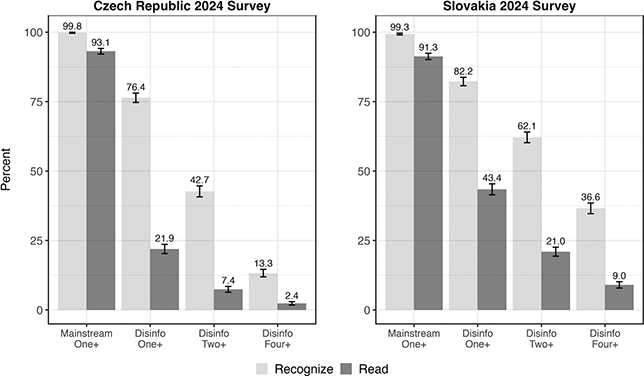
Both Czechs and Slovaks read disinformation outlets less frequently than mainstream media. Twenty-two percent of Czechs reported reading one or more disinformation news source. The rate in Slovakia was 43 percent – nearly twice as high. Again, the gap between countries increased substantially at higher thresholds: It was nearly three times as large for two or more sources and nearly four times as large for four or more. This descriptive analysis provides indicative evidence for Hypothesis 2: Slovaks consume disinformation media at substantially higher rates than Czechs. Perhaps the more important takeaway, however, is that a substantial portion of individuals in both countries consume disinformation, indicating that disinformation has achieved significant penetration in both media environments.
Next, I take a descriptive look at trust in mainstream and disinformation outlets. Figure 3 plots average trust (and associated 95 percent confidence intervals) in mainstream and disinformation outlets conditional on recognition (gray) and conditional on both recognition and readership (black).
Media trust
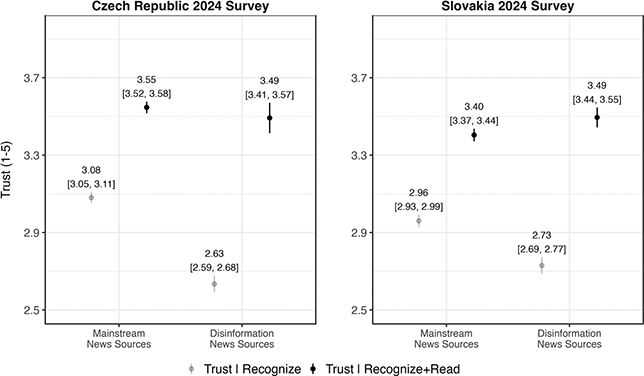
Conditional on recognition, Czechs and Slovaks demonstrated significantly greater trust in mainstream than in disinformation media. In the Czech Republic, the difference was around 0.5 on the five-point scale. In Slovakia, the difference was about half the size. The difference-in-differences estimate – that is, the extent to which the trust gap between mainstream and disinformation outlets differed across the countries – was 0.21 and significant at  . Importantly, both lower levels of trust in mainstream media and higher levels of trust in disinformation outlets among Slovaks account for this difference.
Respondents expressed more trust in outlets they read than in sources they only recognized. This readership “premium” was substantially smaller for mainstream news sources than for disinformation outlets. In both countries, trust in mainstream sources was approximately 0.45 points higher among readers than non-readers. For disinformation sources, the difference was 0.86 in the Czech Republic and 0.76 in Slovakia. This difference in trust between readers and non-readers statistically differed across media type ( ,
 ); however, it did not differ between countries – that is, the triple difference-in-differences was not statistically significant (
 ,
 ). In other words, the size of the trust premium afforded to disinformation outlets by readers, while greater than that afforded to mainstream outlets, did not differ between countries.
These results provide mixed evidence for Hypothesis 2. Slovaks were less trusting of mainstream media than Czechs, and showed greater trust in disinformation outlets they recognized but did not necessarily read. However, conditioning on readership eliminated these differences: Czechs and Slovaks were equally trusting of disinformation outlets they read. Substantively, while disinformation audiences differ in size across the two countries, once self-selection is accounted for, the two audiences do not exhibit meaningfully different levels of trust in disinformation media. An additional analysis in Online Appendix B disaggregates evaluations by outlet and underscores that there are substantial variations in trust across disinformation outlets in both countries.
5.2 Predictors of Disinformation Readership and Trust
Next, I identify the correlates of disinformation readership and trust, and assess whether they differ across the two countries. The first dependent variable, Readership, takes on a value of 1 if a respondent reported reading at least one disinformation news source and 0 otherwise. Readership is not conditional on recognition – that is, the analysis focuses on the differences between those who read disinformation and those who do not, no matter the latter group’s reasons for not being consumers. The second dependent variable, Trust, measures the average level of trust a respondent expressed toward recognized disinformation outlets (1–5 scale).
For each outcome, I estimate three models. I start with a baseline set of demographic and cognitive covariates: age, education (primary, secondary, university), sex, locality size, political knowledge, and cognitive reflection test (CRT) scores. Political knowledge is a binary measure coded as 1 if respondents answered at least two of three EU-related factual questions correctly, and 0 otherwise. The CRT measures an individual’s propensity to engage in System 2 analytical reasoning (Pennycook et al., Reference Pennycook, Cheyne, Koehler and Fugelsang2016). The questions are designed to present an intuitive, seemingly correct answer that is actually incorrect. I use the expanded seven-item CRT (Thomson and Oppenheimer, Reference Thomson and Oppenheimer2016), which adds non-numeracy-related questions to the original three-item inventory (Frederick, Reference Frederick2005). The CRT shows marginally acceptable reliability in both the Czech Republic (0.65) and Slovakia (0.67), with no improvement possible by removing items. CRT scores range from 0 to 7 based on the number of items answered correctly. The second model adds geopolitical alignment (should the Czech Republic/Slovakia belong to the West, East, or between), radical and populist party support (0, 1; parties identified as radical-left, radical-right or populist with the PopuList dataset; Rooduijn et al., Reference Rooduijn, Pirro, Halikiopoulou, Froio, Van Kessel, De Lange, Mudde and Taggart2024), trust in government (1–4), and trust in mainstream media (1–4). A final model replaces these measures with respondents’ self-placements on the left-right and liberal-conservative ideological dimensions (0–10).
Three estimands are of interest: the association between each covariate and the outcome in (1) the Czech Republic and in (2) Slovakia; and (3) the difference between these two associations. To recover these estimands, I interact all covariates with an indicator variable for country (Czech Republic serves as the reference). I estimate readership using logistic regression and trust using OLS, using HC2 robust standard errors (see Online Appendix B for full regression results).
5.2.1 Readership
Figure 4 presents results from the first readership model as group-average marginal effects (with 95% confidence intervals). Brackets show the magnitude of cross-country differences in estimates and associated p-values. Older individuals are more likely to be disinformation consumers in both countries, and though the cross-country difference in this estimate is statistically significant, it is substantively negligible. In Slovakia, women are about five percentage points more likely than men to consume disinformation, while in the Czech Republic the pattern flips. The roughly ten-point gap between countries is statistically significant. Slovaks with a university degree are about 20 percentage points less likely to consume disinformation than those with only a primary education, and roughly six points less likely than those with a secondary education. In contrast, education has a statistically negligible association with disinformation readership in the Czech Republic. Locality size had little association with disinformation consumption in either country. CRT scores had no relationship with disinformation readership in the Czech Republic, but were negatively associated with readership in Slovakia. Each additional correct answer on the CRT predicted approximately a three-percentage-point decrease in the probability of reading disinformation news sources. Finally, political knowledge was linked to disinformation readership in both countries, with associations of similar magnitude. The politically knowledgeable were six to nine percentage points more likely to be disinformation readers. This finding is worth emphasizing as it suggests disinformation readership is not simply explained by a lack of political knowledge. Instead, other factors – such as motivated reasoning, media distrust, or active information-seeking behavior – may lead the politically knowledgeable to consume disinformation.
Demographics, cognitive reflection, political knowledge, and disinformation readership
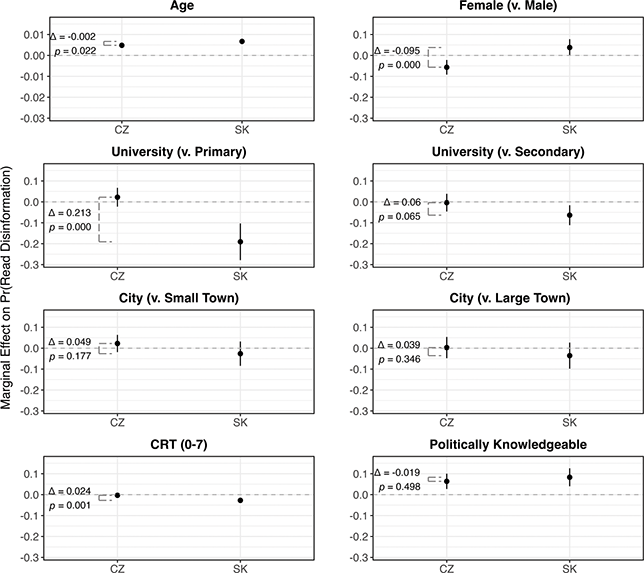
Figure 5 presents group-average marginal effects estimated from the second model. While trust in government had little association with disinformation readership in the Czech Republic, it had a positive association in Slovakia. The positive relationship likely reflects the ideological convictions of supporters of the economically left-wing but socially conservative (Smer-led) governing coalition in power at the time of the survey. Trust in mainstream media was negatively associated with disinformation readership among Czechs, but showed no significant association among Slovaks. Populist voters in both countries were also more likely to consume disinformation than the supporters of non-populist parties. The size of the association – about 10 percentage points – was statistically indistinguishable between the two countries. Finally, geopolitical attitudes were also substantively associated with disinformation readership. Individuals who believed their country belongs to the West were less likely to consume disinformation than those favoring alignment with the East or somewhere in between. In Slovakia, this difference ranged from 12 (between vs. West) to 15 percentage points (East vs. West), while in the Czech Republic it ranged from three to nine percentage points.
Institutional trust, populist support, geopolitics, and disinformation readership
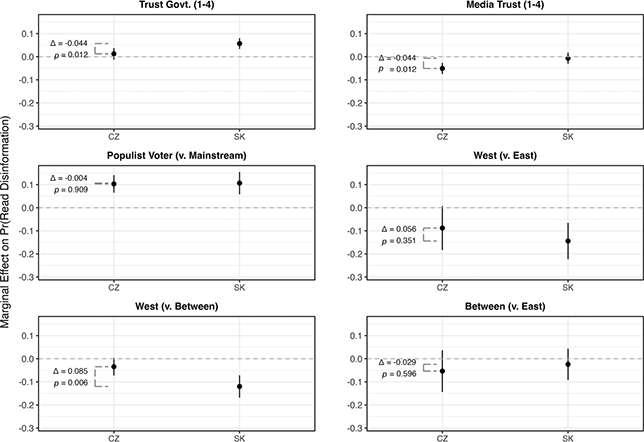
Figure 6 presents associations between self-placements on the economic and sociocultural dimensions and disinformation readership. In the Czech Republic, both dimensions had statistically significant associations with disinformation readership. Individuals with right-leaning economic views were less likely to consume disinformation. A one-unit shift toward right-leaning economic positions decreased the probability of being a disinformation reader by just over one percentage point. Conversely, each one-unit shift toward social conservatism increased the probability of consuming disinformation by more than three percentage points. In Slovakia, left-right economic positioning was not associated with disinformation readership. However, each one-unit shift toward social conservatism was associated with a nearly four-percentage-point increase in the probability of being a disinformation reader. Overall, sociocultural conservatism was the stronger predictor of disinformation readership in both countries. The negative association between right-leaning economic positions and disinformation consumption in the Czech Republic may reflect the fact that socioculturally liberal Czech parties tend to maintain right-leaning economic programs.
Ideology and disinformation readership
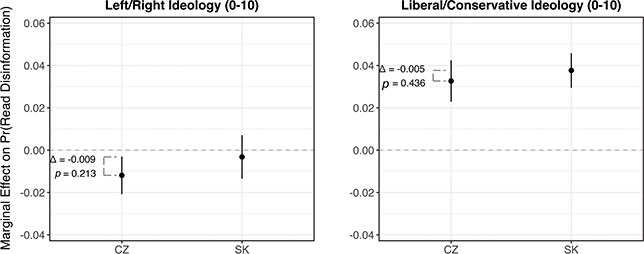
5.2.2 Trust
I follow the same analytical strategy to assess predictors of disinformation trust. Figure 7 presents the first set of results. Age had a statistically significant and positive association with trust in disinformation in Slovakia, but not in the Czech Republic. However, the association was substantively small: A ten-year increase in age corresponded to only a 0.15-point increase in trust. In both countries, women were more likely than men to trust disinformation, and the association was of similar magnitude. Having a university education was associated with lower trust in disinformation news sources. However, in the Czech Republic, this was only the case relative to primary education, whereas in Slovakia, university-educated respondents trusted disinformation less than both those with primary and secondary education. Moreover, the negative association between university education (relative to primary education) and disinformation trust was substantively larger in Slovakia – approximately 0.45 compared to 0.15 in the Czech Republic. In both countries, respondents from larger cities were less trusting of disinformation than those from smaller cities and towns. While each additional correct CRT answer was associated with a 0.08-point decrease in disinformation trust in Slovakia, CRT performance had no association with trust in the Czech Republic. Finally, political knowledge had little association with trust in disinformation in either country.
Demographics, cognitive reflection, political knowledge, and disinformation trust
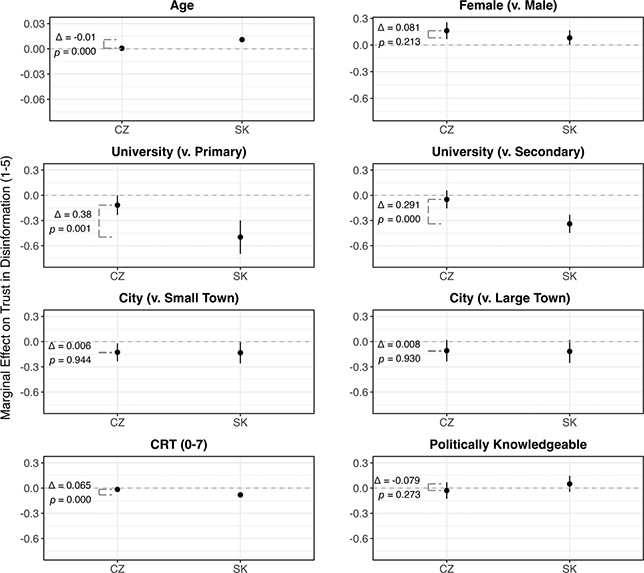
Figure 8 presents group-average marginal effects for the second set of covariates. Trust in government is predictive of trusting disinformation in Slovakia, but not in the Czech Republic. However, each one-unit increase in trust in mainstream media was associated with a rise in trust in disinformation: 0.08 in the Czech Republic and 0.15 in Slovakia. In the Czech Republic, the difference in disinformation trust between populist and non-populist voters was substantively large at 0.31. In Slovakia, the association was both substantively and statistically smaller – approximately half the magnitude. In Slovakia, geopolitical orientation had a pronounced association with trust in disinformation, with a 0.45 difference in disinformation trust between those who viewed Slovakia as belonging to the West relative to those who thought Slovakia should belong to the East or somewhere in-between. In the Czech Republic, the relationship between geopolitical views and trust in disinformation was less clear-cut. Individuals who thought the Czech Republic should belong to the West were neither more nor less trusting of disinformation than those who thought it should belong to the East. However, this null finding may reflect limited statistical power, as only 105 respondents selected the East option. Supporting this interpretation, respondents with geopolitically Western-leaning views exhibited significantly lower trust in disinformation than those who placed the country somewhere in between. Finally, in both countries, there was little evidence of statistically significant differences in disinformation trust between individuals who favored the East versus those who preferred a position in between East and West.
Institutional trust, populist support, geopolitics, and disinformation trust
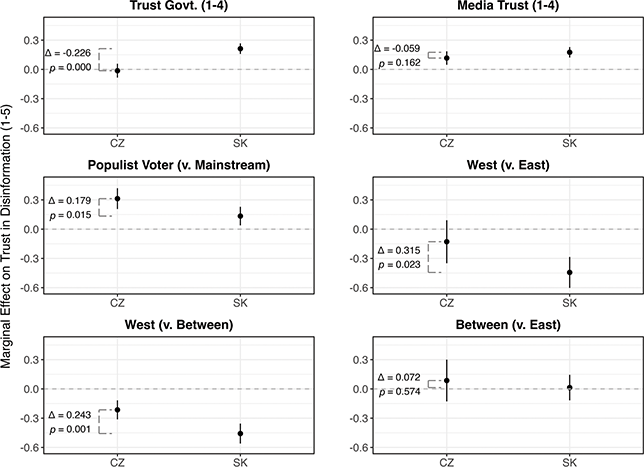
Finally, Figure 9 shows that left-right and liberal-conservative ideology both have substantive, statistically significant relationships with trust in disinformation outlets, and that these relationships are largely similar across the two countries. First, every one-unit shift toward the right decreases trust in disinformation by 0.06 in the Czech Republic and 0.04 in Slovakia. Second, conservatives were more trusting of disinformation than liberals. The association was substantively larger than that of left-right economic ideology, with a one-unit shift toward conservatism corresponding to a 0.09 increase in trust in the Czech Republic and 0.075 in Slovakia.
Ideology and disinformation trust
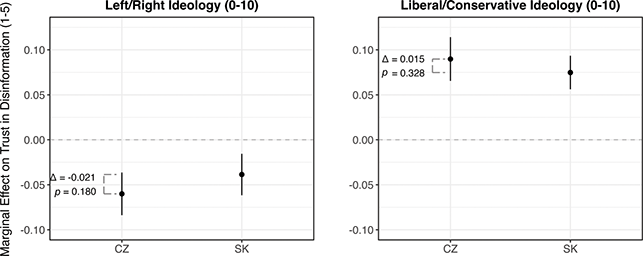
5.3 Discussion
Disinformation media are less recognized and read than mainstream media; yet, over 20 percent of Czechs and over 40 percent of Slovaks still report reading at least one disinformation news source. While disinformation sources are generally less trusted than mainstream sources, this difference disappears among actual consumers. In other words, individuals who read disinformation and those who read mainstream media have similar levels of trust in the sources they consume. Importantly, trust among disinformation readers did not differ significantly between the two countries, suggesting that selection into disinformation produces similar effects on trust across diverse national contexts.
Analyzing the predictors of disinformation readership and trust provides correlational evidence for ideologically motivated selection into news consumption. Conservative, populist voters who believe that their country should belong to the East were more likely than their liberal counterparts to be disinformation readers. The substantial predictive purchase of sociocultural and geopolitical attitudes underscores that individuals trust disinformation because it accords with their preexisting ideological commitments. More substantively, trust in media is not necessarily a function of its objective credibility, but rather of the extent to which it produces content that affirms ideological and partisan convictions.
Most predictors show similar directional relationships with disinformation readership and trust in both the Czech Republic and Slovakia. However, the magnitude of these associations often varies. This pattern suggests that while the politically motivated underpinnings of disinformation consumption operate consistently across contexts, variation in factors that make a given country more or less susceptible to disinformation – for example, ideological polarization, anti-disinformation capacity, elite reinforcement – may amplify or attenuate these individual-level processes. In other words, individuals across countries select into disinformation for the same reasons: doing so affirms their preexisting ideological and attitudinal convictions. However, differences in countries’ political environments condition the strength of this relationship, as well as the extent to which “protective” factors like education and analytical reasoning influence disinformation readership and trust.
In the broader context of CEE, the Czech-Slovak comparison suggests that conservative sociocultural positions and anti-Euro-Atlantic orientations are likely to correlate with disinformation consumption across the region. However, the findings also suggest that the relationship between individual attitudes and disinformation consumption may be stronger in countries resembling Slovakia – those characterized by high ideological polarization, electorally successful radical populist parties, and weak institutional capacity for countering disinformation.
Several limitations are worth highlighting. First, the survey did not measure readership frequency. Although the question was phrased to suggest regular engagement – using “do you read/watch” rather than “have you ever read/watched” – capturing habitual consumption is essential for understanding belief in disinformation (Arendt et al., Reference Arendt, Northup and Camaj2019; Pennycook et al., Reference Pennycook, Cannon and Rand2018). Second, the survey measured disinformation consumption by focusing on readership of disinformation media outlets. While disinformation media are certainly one prominent pathway through which disinformation is disseminated, they are by no means the only pathway. Disinformation also spreads through social media, on podcasts, and in interpersonal conversations. Though it is unlikely that the predictors of disinformation consumption differ dramatically across these channels, future research may wish to account for both the frequency of consumption and the different channels of consumption. Third, the survey relied on an online, opt-in panel of respondents. Given the potential threats to representativeness – especially as it pertains to media diets – future studies may wish to replicate these analyses with samples recruited using face-to-face methods.
6 Evaluations of Disinformation Headlines
The previous section analyzed disinformation demand from the perspective of individual-level engagement with disinformation news outlets. This section shifts the focus to how individuals assess disinformation news headlines. For empirical evidence, I rely on the two surveys detailed in the previous section, as well as an additional quota-representative survey fielded in Slovakia in 2021 ( , after excluding 204 attention check failures).
Each survey included one to three preregistered experiments, which participants completed after answering the question batteries detailed in the preceding section. The experiments aimed to identify how exposure to Kremlin-linked disinformation shapes public opinion on several key issues. The 2021 survey included one experiment investigating disinformation about the EU’s propagation of liberal sociocultural values. Two experiments included in both the 2024 Czech and Slovak surveys focused on disinformation related to the Russo–Ukrainian War and Ukrainian refugee resettlement. An additional experiment, fielded only in the 2024 Czech Republic survey, focused on disinformation related to the European Green Deal. For surveys with multiple experiments, experiment order was randomized.
In the experiments, respondents were randomly assigned to one of four – or, in the 2024 Czech Green Deal experiment, five – conditions. Three conditions were common across all experiments: a control condition where participants only answered post-treatment measures; a false condition where participants read a set of Kremlin-linked disinformation headlines about a given topic; and a true condition where participants read a set of true headlines similar in theme and content to the disinformation headlines. All false headlines had appeared in Czech or Slovak media sources and were identified by experts as either originating from pro-Kremlin sources or having documented links to Russian disinformation campaigns. The fourth condition (and, in the Green Deal experiment, the fifth condition) varied across experiments, presenting either a combined set of true+false headlines, a fact-checking intervention, or a prebunking intervention (proactively inoculating respondents against disinformation by explaining manipulation techniques before disinformation is encountered). Across treatment arms, participants evaluated four to six headlines in a randomized order, with the exact number depending on the experiment. In a given experiment, the false, true, fact-check, and prebunking conditions contained an equal number of headlines while, if included, the combined true+false condition always had double this number. I detail the results of these experiments in the next section. In this section, I analyze how respondents evaluated the true and false headlines.
To mirror one way individuals encounter disinformation in the real world, headlines were presented to respondents as Facebook posts. Figure 10 presents examples of true and false headlines from the Green Deal experiment. For each headline, participants evaluated the extent to which they thought the headline was true (1–4); whether they would share the headline on social media (1–4); whether the headline was familiar to them (1–4); and whether they wanted to register to receive more information about the headline (no, yes). In the 2024 experiments, participants also indicated certainty in their assessment of whether the headline was true or false (0–100). If respondents indicated that the headline was “completely false” (1) or “likely false” (2), this measure was multiplied by −1; if participants evaluated a headline as “likely true” (3) or “completely true” (4), the measure was kept positive. This adjusted belief score ranges from −100 (complete certainty that a headline is false) to 100 (complete certainty that a headline is true), and distinguishes between firmly held beliefs and guesses (Graham, Reference Graham2023). To ensure that participants read the headlines, each was repeated in plain text prior to the evaluation questions. At the end of the survey, participants were debriefed. For participants exposed to disinformation headlines, the debrief noted which headlines were false and provided fact-checks.
Examples of true and false headlines
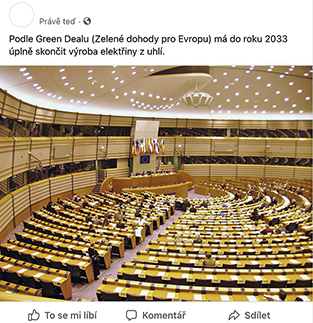
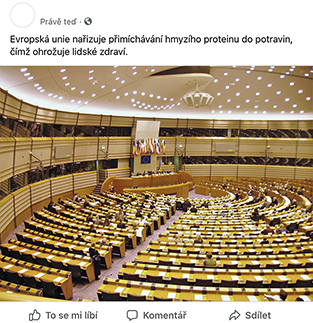
6.1 Belief in True and False Headlines
Across all false treatment arms, Czech respondents evaluated sixteen false headlines, while Slovak respondents evaluated fourteen. Table 8 presents the most credible false headlines in the Czech Republic, while Table 9 does the same for Slovakia. For Slovakia, the analysis includes headlines from both the 2021 and 2024 surveys. While changes in the information environment between the surveys may limit the comparability of belief evaluations, the ranking still provides a useful overview of which disinformation narratives Slovaks found most and least credible.
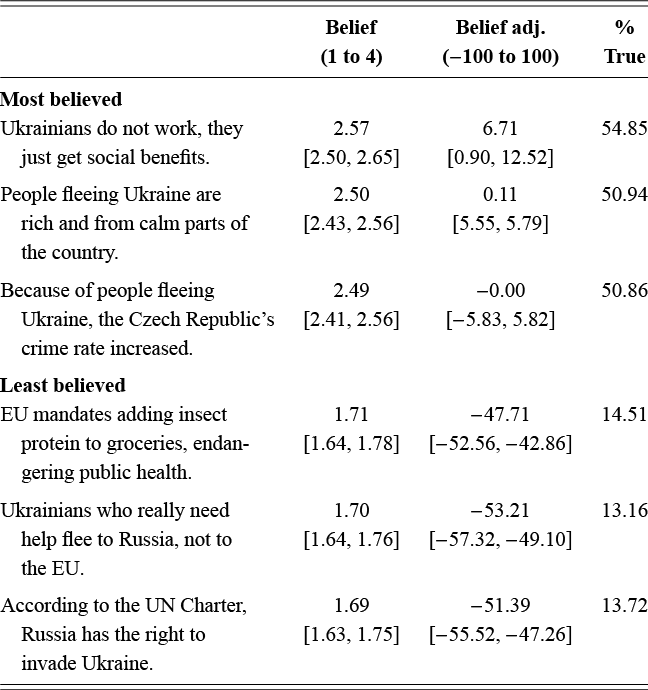
Note: Means presented with 95% confidence intervals; % True indicates percent of respondents who indicated that a headline was “likely” (3) or “completely true” (4).
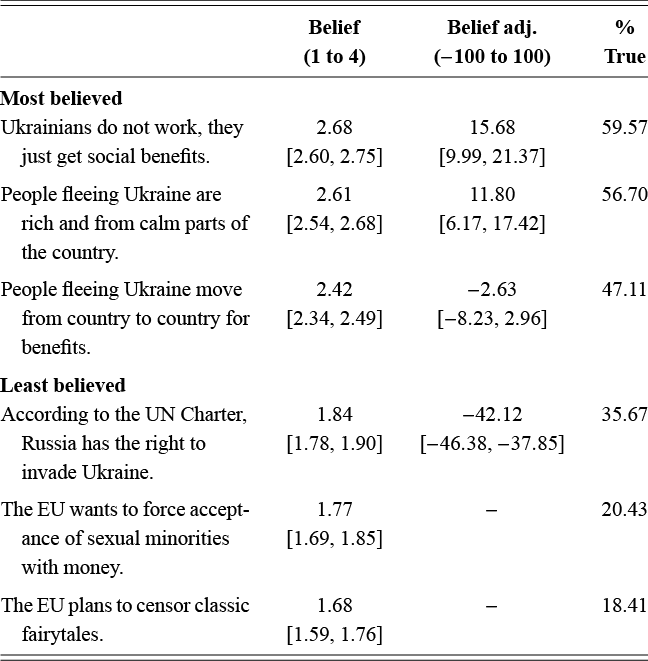
Note: Means with 95% confidence intervals; % True indicates percent indicating a headline was “likely” (3) or “completely true” (4); Belief adjusted for certainty was not asked in 2021 Slovakia survey; if ranking by adjusted belief the least-believed category includes “Ukrainians who really need help flee to Russia, not to the EU.” (-39.34) and “There is no war in Kyiv. People there live normally and peacefully.” (−19.11).
In both countries, the most widely believed disinformation headlines related to Ukrainian refugees. In the Czech Republic, the three most-believed headlines were assessed as likely true or true by over 50 percent of respondents. Evaluations were similar in Slovakia, where only the third-most-believed headline dipped below 50 percent. Mean belief scores averaged around 2.5, the scale’s midpoint. When adjusted for certainty, belief scores in the Czech Republic hovered around zero, indicating substantial uncertainty about the truthfulness of even the most-believed headlines. In Slovakia, the two most believed headlines had adjusted belief scores of 15.68 and 11.80, suggesting more certainty. The third-most believed headline in both countries had a negative adjusted belief score, indicating that respondents, while uncertain, leaned toward believing the headline to be false. More importantly, despite some uncertainty, respondents assessed the remaining thirteen headlines in the Czech Republic and the remaining eleven headlines in Slovakia as more false than true.
In the Czech Republic, the least-believed headline related to the Russo–Ukrainian War. Headlines about Ukrainians seeking refuge in Russia and the EU adding insect protein to groceries rounded out the bottom three. Belief scores for these headlines averaged around 1.70, adjusted belief scores hovered around −50, and only 13 to 15 percent of respondents considered the headlines likely or completely true. In Slovakia, the two least-believed headlines (both from the 2021 survey) focused on the EU’s interference with traditional values and its promotion of LGBTQ+ rights. The third least-believed headline was the same as the Czech Republic’s least-believed claim: Russia’s purported right to invade Ukraine. Comparing the least-believed headlines in the 2024 surveys indicates that Czechs were more certain about the falsity of headlines than Slovaks. Ranking by adjusted belief (and thus excluding the 2021 EU-related headlines), Slovakia’s three least-believed headlines all had higher belief ratings than the Czech Republic’s three least-believed headlines.
Next, I test whether respondents evaluated true and false headlines differently, and whether showing true and false headlines together influenced these evaluations – an important test of ecological validity, as individuals’ real-world news consumption entails exposure to both true and false narratives. Three of the six experiments included a combined true+false condition, enabling: (1) a within-subjects analysis of how respondents assessed false versus true headlines; and (2) a between-subjects analysis comparing evaluations of false headlines presented in isolation with evaluations of false headlines presented together with true headlines. I preregistered the following hypotheses:
Hypothesis 3a: Respondents will evaluate true headlines as more true than false headlines.
Hypothesis 3b: Respondents will evaluate false headlines presented in isolation as more true than false headlines presented alongside true headlines.
To test Hypothesis 3a, I construct three analytical samples from respondents assigned to the three true+false treatment arms present in the experiments. This arm was included in the 2021 Slovakia EU experiment ( ), the 2024 Czech Republic Russo–Ukrainian War experiment (
 ), and the 2024 Slovakia Ukrainian refugee experiment (
 ). I restructure the data so the unit of analysis is the respondent-headline evaluation: eight evaluations per respondent in the 2021 experiment and ten per respondent in the 2024 experiments. I then create an indicator for headline type (true vs. false). I model belief (as well as the other evaluations) using a linear mixed model with random intercepts for respondents and headlines, and random slopes for headline type across respondents. Respondent intercepts allow each individual their own baseline evaluation and account for within-person correlation; headline intercepts account for inherent differences in believability across headlines. Random slopes allow the effect of headline type to vary across respondents.
Figure 11 presents the standardized effect of a headline being false (relative to true) on evaluations. The left panel analyzes headlines related to the Russo–Ukrainian War in the Czech Republic, and shows that respondents expressed less belief in false headlines than in true ones. Substantively, the difference amounted to 0.75 standard deviations in both the unadjusted and adjusted belief measures. The middle panel focuses on EU-related headlines in Slovakia. There was little evidence that respondents evaluated true and false headlines differently (though conclusive evidence is limited by the absence of the adjusted belief measure). Finally, the third panel, focused on refugee-related headlines in Slovakia, provides mixed evidence. Unadjusted belief did not differ between true and false headlines at conventional levels of statistical significance; however, there was a statistically significant difference in adjusted belief evaluation (with the effect size amounting to just over one-third of a standard deviation). Importantly, there was little evidence that headline type influenced willingness to share, recognition, and registration intent. In sum, the analysis provides mixed evidence in support of Hypothesis 3a. Importantly, since the combined true+false treatment arm was present in only three of the six experiments, findings are limited to the three corresponding disinformation topics. Given the mixed findings, future research may wish to evaluate generalizability by replicating this design across additional topics.
False headline effects (v. true) on evaluations
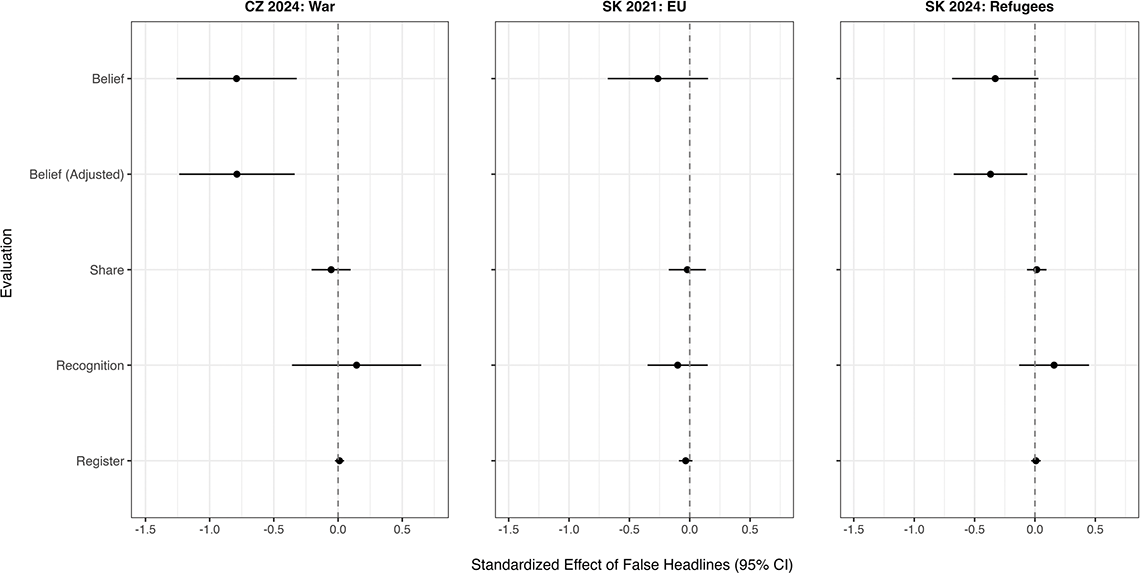
To evaluate Hypothesis 3b, I compare respondents’ belief in false headlines presented in isolation to respondents’ belief in false headlines that are presented together with true headlines. I pool respondent evaluations of false headlines in the false group and the true+false group, respectively. The random assignment of respondents to these between-subjects conditions allows me to estimate how evaluations change when true and false headlines are presented together (note that fatigue effects may bias this estimate given the greater number of evaluations in the true+false condition). I assess statistical differences using unpaired t-tests with Benjamini–Hochberg corrected p-values (adjustments based on four tests in SK 2021 and five tests in CZ 2024 and SK 2024). Across all three topics, respondents evaluated false headlines presented in isolation similarly to false headlines presented together with true headlines (Table 10). In fact, only one statistically significant difference emerged: Slovak respondents evaluated false headlines about Ukrainian refugees as less familiar in the combined condition than when the same headlines were presented in isolation.
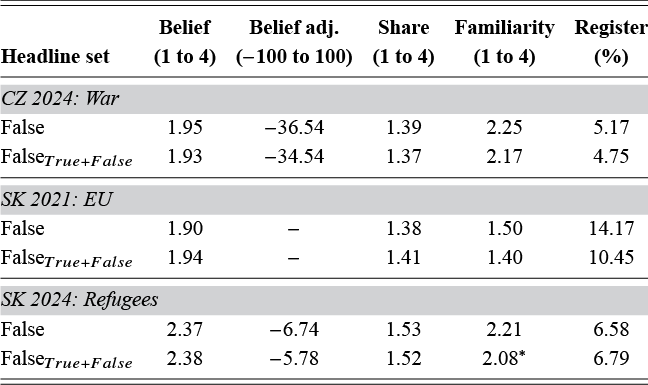
Note:  indicates difference from False at
 ; p-values adjusted with Benjamini–Hochberg correction (5 tests for 2024 experiments; 4 tests for 2021 experiment);
 , 598, 344, 323, 605, 595.
6.1.1 Motivated Reasoning, Analytical Reasoning, and Headline Evaluations
Individuals are more likely to believe disinformation when it confirms their preexisting attitudes and ideological commitments (Batista Pereira et al., Reference Batista Pereira, Bueno, Nunes and Pavão2022; Mazepus et al., Reference Mazepus, Osmundsen, Bang-Petersen, Toshkov and Dimitrova2023; Vegetti and Mancosu, Reference Vegetti and Mancosu2020). However, whether a stronger propensity to engage in analytical reasoning (as measured by performance on the cognitive reflection test) exacerbates or attenuates directionally motivated reasoning is unclear (Bago et al., Reference Bago, Rand and Pennycook2022; Pennycook and Rand, Reference Pennycook and Rand2019; Tappin et al., Reference Tappin, Pennycook and Rand2020 versus Roozenbeek et al., Reference Roozenbeek, Maertens, Herzog, Geers, Kurvers, Sultan and van der Linden2022a). Evidence in this debate largely comes from the American context. However, recent cross-national studies (Gehle et al., Reference Gehle, Hameleers, Tulin, de Vreese, Aalberg, Van Aelst, Cardenal, Corbu, van Erkel, Esser and Halagiera2024; Tulin et al., Reference Tulin, Hameleers, de Vreese, Aalberg, Corbu, Van Erkel, Esser, Gehle, Halagiera, Hopmann and Koc-Michalska2024), as well as evidence from Hungary (Faragó et al., Reference Faragó, Krekó and Orosz2023) and Ukraine (Erlich et al., Reference Erlich, Garner, Pennycook and Rand2023), also suggest that analytical reasoning is associated with a better ability to identify disinformation. Given this debate, I preregistered the following hypotheses:
Hypothesis 4: Respondents will express stronger belief in false headlines when the disinformation content aligns with their ideological convictions.
Hypothesis 5: Respondents with lower cognitive reflection scores will express stronger belief in false headlines than respondents with higher cognitive reflection scores.
As before, I test these hypotheses with the sample of respondents randomly assigned to the true+false experimental conditions. As a first test of Hypothesis 4, I consider whether variations in attitudes toward Russia influence evaluations of disinformation related to the Russo–Ukrainian War in the Czech Republic ( ). I measure these attitudes with a pretreatment question – that is, one asked before exposure to the headlines – about stances toward the Russian Federation. Answers were measured on a 1 to 4 scale, ranging from “strongly negative” to “strongly positive.” I collapse the “negative” answers (1 and 2) and the “positive” answers (3 and 4) into two categories. I then estimate the same linear mixed model as above, but add an interaction between headline type and the binary Russia attitudes measure. I calculate p-values using the Benjamini–Hochberg adjustment for multiple comparisons. The estimand of interest is the difference in evaluations of the same headline set between attitudinal subgroups – for example, the difference in evaluations of false headlines between individuals with anti-Russia and pro-Russia attitudes.
Figure 12 displays results as predicted values, with the gray brackets and text indicating the size of the difference between subgroups and the (adjusted) p-values. Results indicate clear evidence of ideological moderation. Pro-Russia respondents exhibited greater belief in false headlines than anti-Russia respondents. The difference was substantively large – amounting to over one point on the belief scale, and over 75 points on the adjusted belief scale. While there was a statistical difference in adjusted belief evaluations of the true headlines, it was substantively small and did not replicate with the unadjusted belief measure. Respondents evaluated true headlines similarly, regardless of their positions on Russia. The other evaluations also provide evidence of ideologically motivated information processing. Respondents with more positive attitudes toward Russia were more likely than anti-Russia respondents to share both disinformation and true headlines. Likewise, these respondents indicated that they were more familiar with both headline sets.
War headline evaluations across Russia attitudes (Czech Republic)
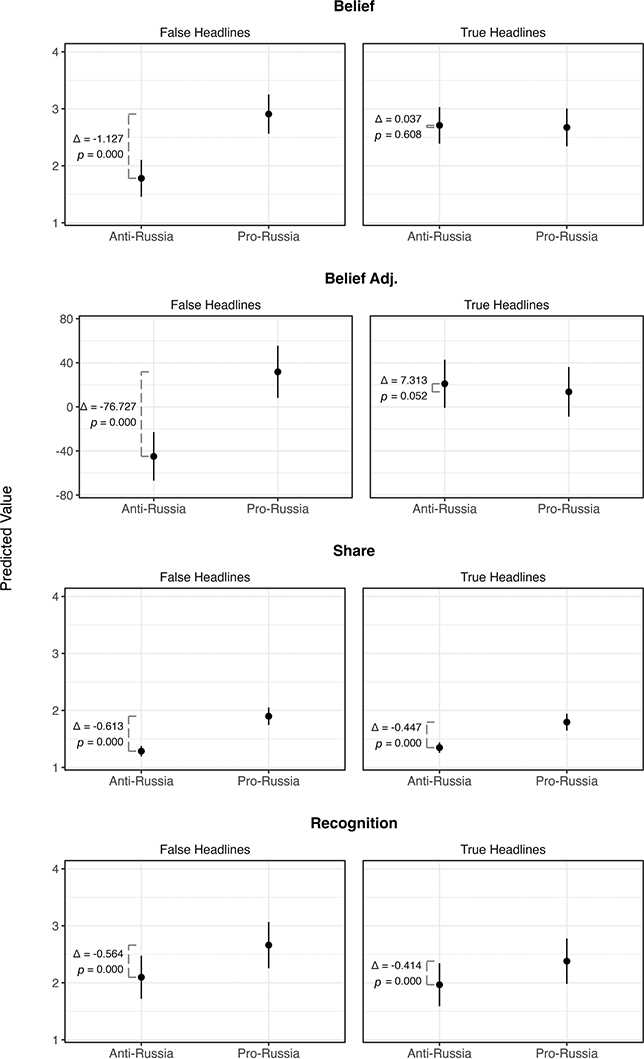
Next, I consider whether ideologically motivated information processing also conditions belief in headlines related to Ukrainian refugees in Slovakia ( ). As the relevant ideological moderator, I use a pretreatment measure of immigration attitudes. The measure asked respondents to evaluate the influence of immigrants on Slovakia (1 = “very negative” to 4 = “very positive”) and was dichotomized to create anti-immigration and pro-immigration subgroups.
Figure 13 mirrors the previous analysis. Individuals with attitudinal predispositions aligned with disinformation content – in this case, individuals with anti-immigrant views – were more likely to believe false headlines. Differences were substantial in magnitude, amounting to 0.71 and 53 points on the respective belief scales. Pro-immigration respondents were slightly more likely to believe true headlines than anti-immigration respondents, though the difference was substantively small. Unlike with the Russo–Ukrainian War headlines, preexisting attitudinal commitments did not condition the extent to which individuals were willing to share or recognized the different headline sets.
Refugee headline evaluations across immigration attitudes (Slovakia)
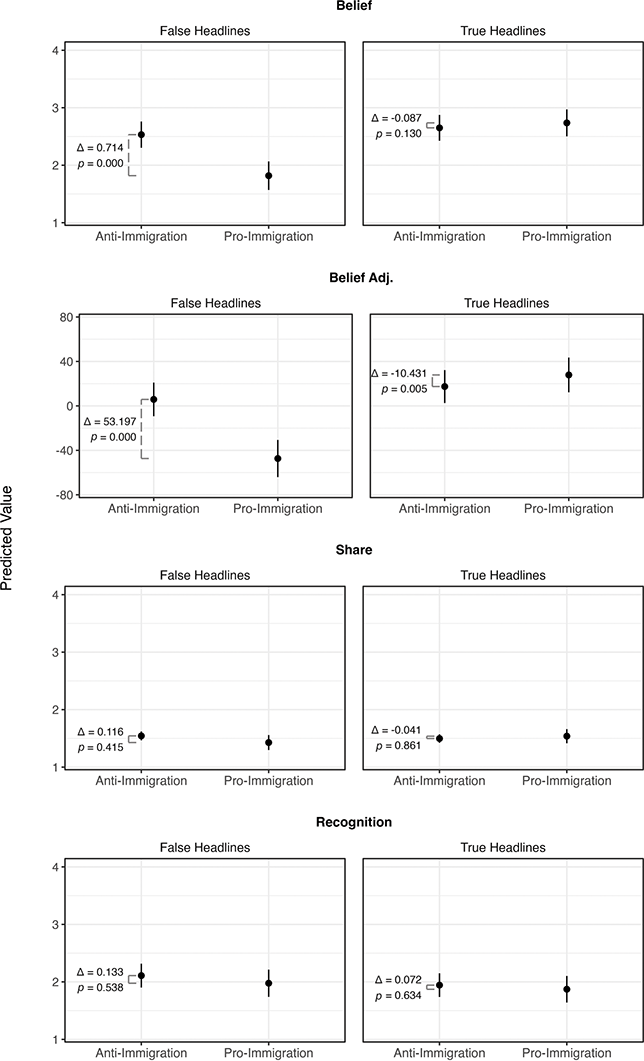
Next, to test Hypothesis 5, I evaluate the relationship between analytical reasoning and belief in false headlines. I also explore how analytical reasoning interacts with ideologically motivated information processing. While the existing literature agrees that analytical reasoning matters for how individuals consume and respond to disinformation, it has yet to come to a conclusion about how analytical reasoning conditions the effects of directionally motivated reasoning. On the one hand, System 2 analytical reasoning may amplify motivated reasoning because individuals deploy their analytical capabilities to arrive at attitude-consistent conclusions. On the other hand, if individuals rely on System 2 reasoning rather than System 1 intuitive information processing, they may be more discerning consumers of information, and thus more able to distinguish between true and false content (Pennycook and Rand, Reference Pennycook and Rand2019).
I again rely on the subsample of respondents assigned to the true+false condition in the 2024 Czech and Slovak surveys. Using the same linear mixed model setup, I regress belief evaluations on binary indicators for false versus true headlines and for attitude consistency versus inconsistency, and CRT scores. To identify conditional relationships, I include a three-way interaction between these variables, along with all constituent two-way interactions. For robustness, I model both belief measures. Two estimates are of interest. First, the interaction between headline type and CRT scores tests Hypothesis 5. Second, the three-way interaction between headline type, attitudinal commitments, and CRT scores tests how analytical reasoning and preexisting attitudes jointly condition headline evaluations. Table 11 presents results.
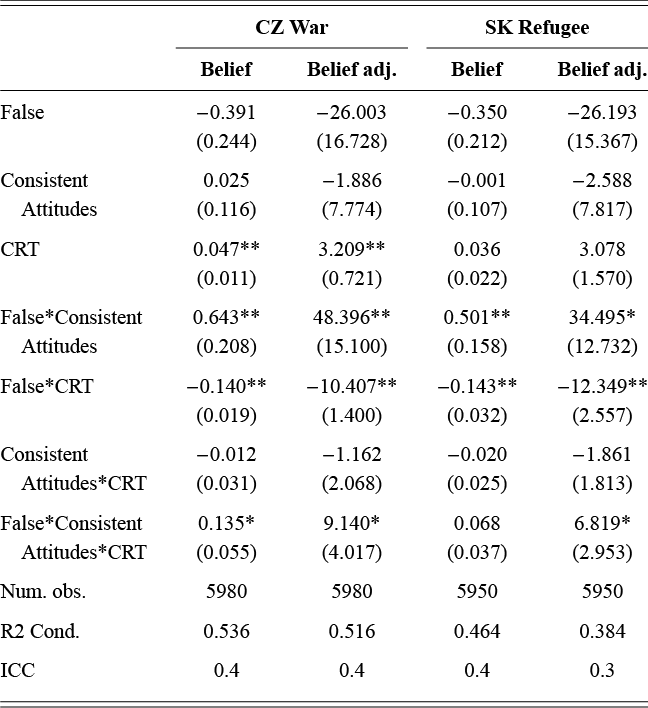
DV: Belief (1 to 4), Adjusted Belief (−100 to 100); *  ; **
 ;
 -values adjusted with Benjamini–Hochberg correction (32 tests)
Analytical reasoning clearly shapes belief in disinformation headlines. The statistically significant and negative interaction term between false headlines and CRT indicates that as cognitive reflection scores increase, the gap in belief between false and true headlines widens. Or, in simpler terms, higher cognitive reflection guards against believing disinformation. Substantively, in the Czech sample, a one-unit increase in cognitive reflection scores enhances discernment between false and true headlines by roughly 36 percent for unadjusted belief and 40 percent for adjusted belief. In the Slovak sample, the effects are even larger at 41 and 47 percent, respectively.
The triple interactions – which account for how preexisting attitudes moderate the relationship between cognitive reflection and belief in false headlines – suggest that the “protective” effect of cognitive reflection is stronger among individuals whose preexisting attitudes conflict with disinformation content. In other words, analytical reasoning is a stronger protective buffer against believing false headlines when preexisting attitudes do not align with the headline’s content. Substantively, among individuals with attitudes inconsistent with disinformation content, each additional point on the CRT reduces belief in false headlines by 0.09 points on the unadjusted belief scale. For those whose attitudes align with disinformation, cognitive reflection has virtually no effect (−0.005 points).
To clarify substantive quantities, I plot conditional predicted values of belief estimated from the Czech (Figure 14) and Slovak (Figure 15) unadjusted belief models. Left panels plot predicted belief in false headlines across CRT scores, while right panels do the same for belief in true headlines. Dashed lines indicate respondents whose preexisting attitudes were inconsistent with the headlines, while solid lines indicate respondents with attitudes consistent with the headlines. The left panels show that belief in false headlines decreases as a function of CRT scores among respondents for whom disinformation is attitude inconsistent. In both countries, a one-unit increase in CRT scores corresponds to roughly a 0.09 decrease in predicted belief. Finally, the right panels show that CRT scores and preexisting attitudes have little association with predicted belief in true headlines.
Predicted belief: Attitude consistency and CRT (Czech Republic)
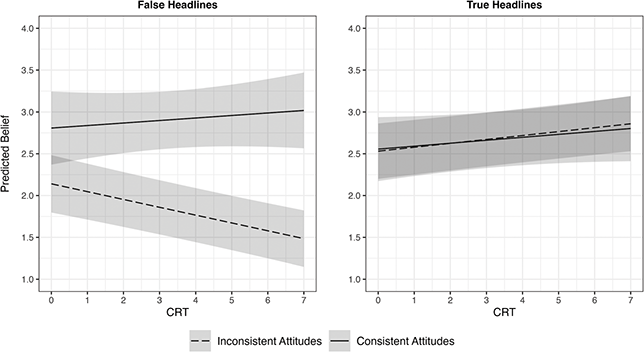
Predicted belief: Attitude consistency and CRT (Slovakia)
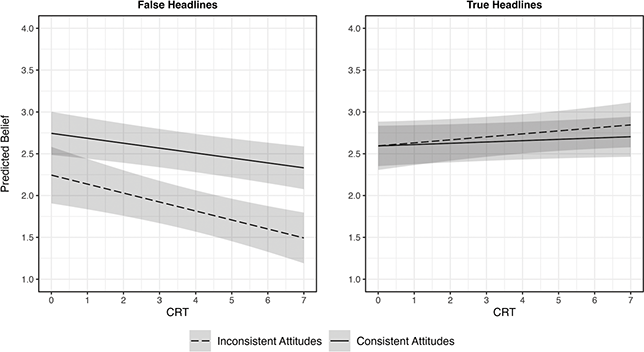
6.2 The Effects of Fact-Checking
The preceding analyses focused on the extent to which individuals believe disinformation news headlines and on the individual-level characteristics associated with this belief. This section investigates whether fact-checking and prebunking can correct misinformed beliefs. Fact-checking and prebunking can reduce misperceptions (e.g., Martel and Rand, Reference Martel and Rand2023; Roozenbeek et al., Reference Roozenbeek, van der Linden, Goldberg, Rathje and Lewandowsky2022b), though questions about the durability of effects (Carey et al., Reference Carey, Guess, Loewen, Merkley, Nyhan, Phillips and Reifler2022) and ideologically asymmetrical responses remain (DeVerna et al., Reference DeVerna, Guess, Berinsky, Tucker and Jost2024). Importantly, recent work has also broadened the study of these interventions to multiple contexts (e.g., Arechar et al., Reference Arechar2023; Porter and Wood, Reference Porter and Wood2021), occasionally finding limited correction effects (Altay et al., Reference Altay2025; Batista Pereira et al., Reference Batista Pereira, Bueno, Nunes and Pavão2022; Porter et al., Reference Porter, Scott, Wood and Zhandayeva2024).
To assess, two experiments – one in the 2024 Czech survey and one in the 2024 Slovak survey – included a fact-checking condition. This condition included the same headlines as the false condition, but also presented detailed fact-checks. These fact-checks combined labeling – warning individuals that independent fact-checkers have identified a given piece of information as false (Brashier et al., Reference Brashier, Pennycook, Berinsky and Rand2021) – with corrections – information that explains why the information is misleading (Porter et al., Reference Porter, Scott, Wood and Zhandayeva2024). The fact-checks were sourced from the third-party fact-checking organizations listed in Online Appendix A. Using real-world fact-checks ensures that the experiment measures responses to actual anti-disinformation efforts being deployed in both countries. I preregistered the following hypothesis:
Hypothesis 6: Respondents will express weaker belief in fact-checked false headlines than in false headlines.
In the experiments, Czechs evaluated anti-Ukrainian refugee disinformation, while Slovaks evaluated disinformation related to the Russo–Ukrainian War. These topics were selected to investigate the efficacy of fact-checking on the most salient disinformation issue in each country. While anti-Ukrainian refugee sentiment is on the rise in both countries, the issue is more contentious in the Czech Republic (Jelínková et al., Reference Jelínková, Plaček and Ochrana2024, 2), where far-right politicians openly question state support for refugees. In Slovakia, attitudes toward the War are more contested, and sympathies for Russia are among the strongest in Europe (Učeň, Reference Učeň2023). Figure 16 presents examples of the fact-check stimulus alongside the false stimulus from both countries.
False and fact-checked headlines
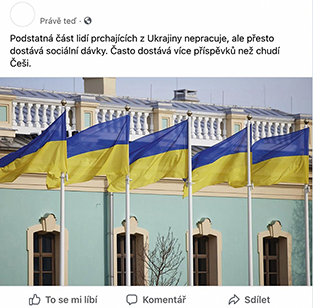
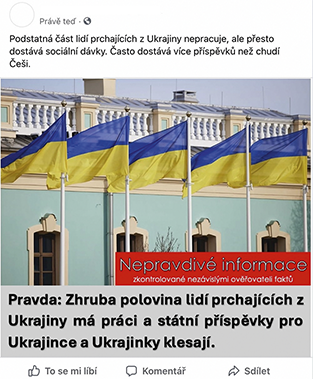
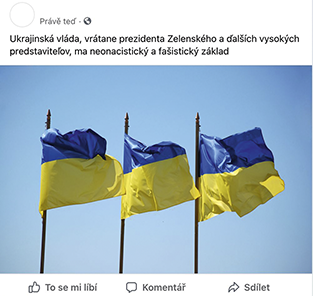
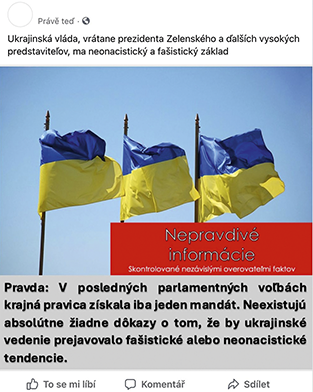
Table 12 compares headline evaluations for the false and fact-check conditions in both experiments. Fact-checking had little impact. The sole exception was in the Czech Republic, where fact-checks reduced participants’ expressed familiarity with the false headlines. An additional analysis, presented in Online Appendix C, analyzes fact-checking at the headline level, confirming the pooled analysis. Fact-checks did not reduce belief in any of the ten headlines presented across the two experiments.
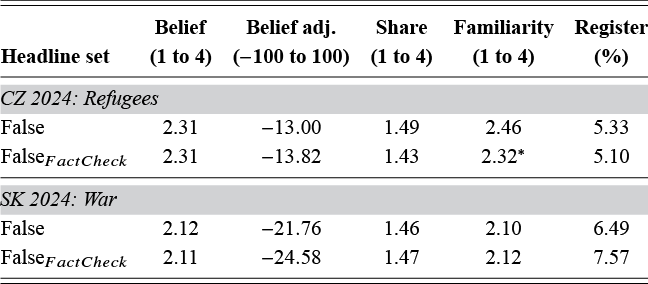
Note:  indicates difference from False at
 ; p-values adjusted with Benjamini–Hochberg correction (5 tests);
 , 596, 605, 595.
6.3 The Effects of Prebunking
Prebunking is also an effective intervention for increasing disinformation resilience (e.g., Roozenbeek et al., Reference Roozenbeek, van der Linden, Goldberg, Rathje and Lewandowsky2022b). Prebunking is motivated by inoculation theory – the idea that preemptive warnings about disinformation strategies can reduce individuals’ vulnerability to misleading narratives (Cook et al., Reference Cook, Lewandowsky and Ecker2017). Importantly, while prebunking can effectively lower belief in false headlines, it may also increase scepticism of true headlines (Hoes et al., Reference Hoes, Aitken, Zhang, Gackowski and Wojcieszak2024). Thus, I predicted:
Hypothesis 7a: Respondents will express weaker belief in prebunked false headlines than in false headlines.
Hypothesis 7b: Respondents will express weaker belief in prebunked true headlines than in true headlines.
To test, the Green Deal disinformation experiment in the 2024 Czech survey included five between-subject conditions: the standard control, false, and true conditions, plus two additional prebunking conditions where a prebunking message appeared prior to either the false or true headlines. The prebunking warning was adopted directly from content used by the Czech Centre Against Hybrid Threats (Figure 17).Footnote 105 The warning defines disinformation and offers several tips for identifying potentially misleading content.
Prebunking stimulus: Czech Centre Against Hybrid Threats
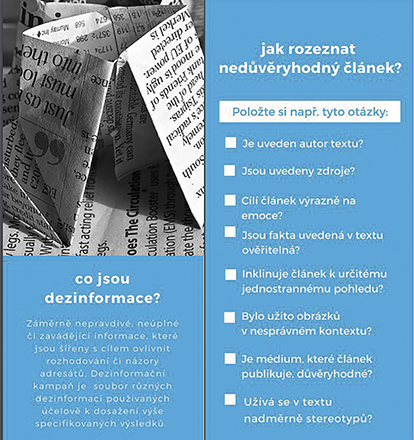
Table 13 presents evaluations pooled across headlines within each condition. As in the other experiments, respondents had little difficulty distinguishing between false and true headlines. However, there was little evidence that the prebunking intervention influenced headline evaluations. Respondents who evaluated false headlines provided statistically equivalent assessments regardless of whether they received the prebunking warning. More optimistically, the prebunking warning did not make respondents more sceptical of true headlines, which were also evaluated similarly with and without the warning. I confirm these results using respondent-headline-evaluations as the unit of analysis in Online Appendix C.
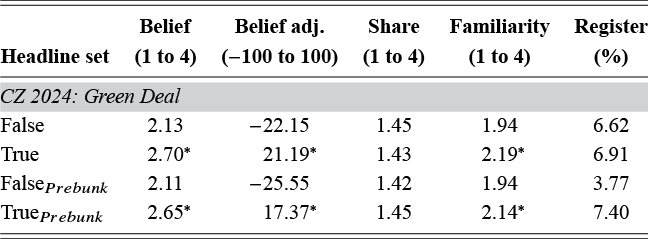
Note:  indicates a difference from False at
 ; p-values adjusted with Benjamini–Hochberg correction (20 tests);
 , 470, 491, 484.
6.4 Discussion
Across two countries, two time periods, and multiple disinformation topics, this analysis explored how individuals evaluate disinformation headlines. Individuals were generally adept at distinguishing between false and true headlines. However, some narratives were much more believed than others. This variation is likely a product of issue salience and politicization. For example, the most believed disinformation headlines in both the Czech Republic and Slovakia concerned Ukrainian refugees – a salient, politically polarized issue. Importantly, these assessments did not differ based on whether false headlines were presented in isolation or blended together with thematically similar, but completely true, headlines.
Preexisting attitudinal and ideological commitments played an important role in how individuals evaluated headlines. Individuals for whom disinformation was attitude-consistent demonstrated significantly higher levels of: (1) belief in false headlines, (2) willingness to share such content, and (3) familiarity with the disinformation than individuals for whom disinformation was attitude-inconsistent. These patterns were consistent across countries and occurred regardless of differences in baseline beliefs across disinformation topics. In other words, no matter the disinformation topic or how believable or unbelievable the claims were, ideological and attitudinal alignment consistently predicted higher levels of belief. In sum, these findings provide compelling evidence in support of directionally motivated information processing.
The analyses also evaluated how analytical reasoning influences headline evaluations, both independently and in conjunction with directionally motivated information processing. On average, higher levels of System 2 analytical reasoning were associated with lower belief in false headlines. More importantly, these effects were almost entirely localized to individuals whose preexisting attitudes conflicted with disinformation content. Individuals ideologically predisposed to agree with false headlines believed the headlines regardless of their analytical reasoning capacity. In sum, analytical reasoning does not uniformly guard against disinformation, nor does it amplify belief in congenial falsehoods. Rather, the relationship is asymmetric: analytical reasoning reduces belief in attitude-incongruent disinformation but has little effect when prior attitudes align with false content. Preexisting ideological commitments attenuate the protective benefits of analytical reasoning.
Finally, the analyses explored the effectiveness of fact-checking and prebunking as potential strategies for reducing belief in false headlines. In both the Czech Republic and Slovakia, and across two different disinformation topics, fact-checking had little effect on respondent assessments. Likewise, prebunking, tested only in the Czech Republic, also did not influence respondent evaluations. As such, these results echo a small set of studies documenting mixed or limited effects of fact-checking beyond the commonly studied Western contexts (Batista Pereira et al., Reference Batista Pereira, Bueno, Nunes and Pavão2022; Porter et al., Reference Porter, Scott, Wood and Zhandayeva2024). There are several potential explanations for the null findings. First, the disinformation used in the fact-checking experiments covered highly salient topics. Thus, the fact-checks may not have presented sufficiently novel information to alter beliefs (Ecker and Ang, Reference Ecker and Ang2019; Tulin et al., Reference Tulin, Hameleers, de Vreese, Aalberg, Corbu, Van Erkel, Esser, Gehle, Halagiera, Hopmann and Koc-Michalska2024). Second, the surveys did not measure individuals’ levels of trust in fact-checkers, which is an important determinant of fact-checking’s effectiveness (Bruns et al., Reference Bruns, Dessart, Krawczyk, Lewandowsky, Pantazi, Pennycook, Schmid and Smillie2024; Martel and Rand, Reference Martel and Rand2024). Finally, fact-checking and prebunking are most effective when used in combination (Pennycook et al., Reference Pennycook, Berinsky, Bhargava, Lin, Cole, Goldberg, Lewandowsky and Rand2024; Roozenbeek et al., Reference Roozenbeek, van der Linden, Goldberg, Rathje and Lewandowsky2022b). Thus, in isolation, the prebunking and fact-checking interventions may not have been strong enough to alter respondents’ beliefs.
7 The Effects of Disinformation on Public Opinion
This section turns to the primary purpose of the experiments: identifying whether disinformation headlines affect public opinion. While an extensive body of work explores why individuals believe and share disinformation, evidence about disinformation’s impact on attitudes remains sparse. The evidence that we do have suggests that disinformation can change attitudes but may not necessarily do so consistently across all topics and contexts (Huang, Reference Huang2017, 297; Zerback et al., Reference Zerback, Töpfl and Knöpfle2021, 1090). Work specifically focused on CEE and on pro-Kremlin disinformation topics also finds mixed evidence (Porter et al., Reference Porter, Scott, Wood and Zhandayeva2024, 6). As such, it remains essential to understand disinformation’s attitudinal effects – especially in CEE, where Kremlin-linked disinformation efforts are widespread (Gregor and Mlejnková, Reference Gregor and Mlejnková2021; Rechtik and Mareš, Reference Rechtik and Mareš2021; Wenzel et al., Reference Wenzel, Stasiuk-Krajewska, Macková and Turková2024; Zilinsky et al., Reference Zilinsky, Theocharis, Pradel, Tulin, de Vreese, Aalberg, Cardenal, Corbu, Esser, Gehle and Halagiera2024).
After random assignment, participants answered several post-treatment attitudinal questions measuring the opinions that the disinformation headlines were designed to influence. For example, in the Russo–Ukrainian War experiment, questions measured support for Ukraine and attitudes toward Russia. The true condition, present in all experiments, helps disentangle priming effects (where topic exposure alone shifts responses) from attitudinal change attributable to disinformation.
For all analyses, I estimate treatment effects using linear models with HC2 robust standard errors in an intent-to-treat framework. All analyses exclude pretreatment attention check failures, except for the 2021 Slovakia experiment, where the attention check was administered post-treatment and failures are therefore retained. For the 2024 experiments, simulation-based power analyses indicated that a sample size of 2,400 would be adequately powered ( ) to detect average treatment effects ranging from
 to
 standard deviations (see Online Appendix D). I present experimental results by topic, starting with the 2021 Slovakia experiment. Preregistrations, a deviation report, experimental materials, balance tables, representativeness checks, and analyses with attention-check failures included (or excluded in the 2021 experiment) are in Online Appendix D.
7.1 Does Disinformation Influence Attitudes?
The experiment fielded in the 2021 Slovakia survey focused on disinformation related to the EU’s propagation of socioculturally liberal values and policies ( , attention check failures included). The experiment considers effects on three attitudinal outcomes: (1) Euroscepticism; (2) generalized outgroup prejudice; and (3) nationalist policy preferences. Each outcome represents a core public opinion target for Kremlin-linked disinformation: support for the EU, identity-based grievances with non-dominant groups, and support for those who seek to reaffirm the rights of the titular majority (and also tend to be sympathetic toward Russia).
I operationalize each outcome as a preregistered mean index of several questions. For EU-related attitudes, respondents indicated what feelings the EU evokes for them, whether Slovakia should leave the EU, and whether Slovakia benefits from EU membership (1–4; Cronbach’s  ). Three questions asked respondents about the extent to which they agree that some groups or cultures are better than others and operationalize generalized outgroup prejudice (1–4;
 ). Finally, for nationalist policy preferences, four questions asked whether respondents think that the rights of Slovaks should be privileged over the rights of other groups (1–4;
 ). Higher values indicate stronger preferences – that is, more positive EU attitudes, stronger outgroup prejudice, and stronger nationalist policy preferences. I preregistered the following hypothesis:
Hypothesis 8: All treatments will increase Euroscepticism, outgroup prejudice, and nationalist policy preferences, relative to the control condition, with the true+false treatment producing the largest effects, followed by the false condition, and then the true condition.
Figure 18 presents intent-to-treat effects associated with the false, true, and true+false headline sets. The control group serves as the reference category. Across all three outcomes, false headlines evoked attitudinal backlash, though the effect on EU attitudes only approached conventional levels of statistical significance (p = 0.066). In other words, relative to the control group, individuals exposed to disinformation messages were more pro-EU, indicated lower support for nationalist policy preferences, and were less prejudiced. Standardized effect sizes (Cohen’s d) range from small (0.15) to moderate (0.32). True headlines had similar backfire effects for outgroup prejudice, but not for EU attitudes or nationalist policy preferences. Finally, there was little statistical evidence that the combined true and false headlines influenced EU attitudes and nationalist policy preferences. However, the combined headline set did weaken outgroup prejudice. In sum, false headlines, whether presented in isolation or together with true headlines, tended to cause attitudinal backlash rather than achieve their intended persuasive effect.
Effects of EU-related disinformation (Slovakia)
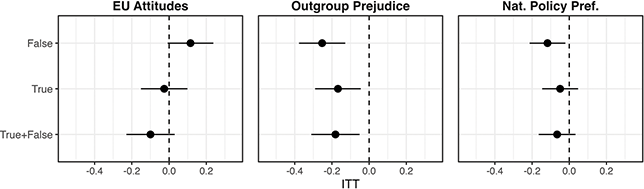
Next, I analyze the effects of disinformation related to the Russo–Ukrainian War. Specifically, I consider whether headlines affected the extent to which respondents thought their country should support the Ukrainian war effort, whether respondents saw Russia’s aggression as justified, and whom they blamed for starting the war. To measure the first two outcomes, I use two preregistered indices (Cronbach’s  and 0.89 in the Czech Republic, and 0.85 and 0.90 in Slovakia), with higher values indicating stronger pro-Ukraine positions. The final outcome is a preregistered binary indicator of whom respondents blame for the war (“the West/NATO” or “Ukraine” coded as 0; “Russia” coded as 1). Higher values for all measures indicate stronger pro-Ukrainian positions. I preregistered the following hypotheses:
Hypothesis 9a: Respondents exposed to the true headlines will express stronger pro-Ukraine positions than respondents in the control group.
Hypothesis 9b: Respondents exposed to the false headlines will express weaker pro-Ukraine positions than respondents in the control group.
Hypothesis 9c: Respondents exposed to the combined set of headlines will express stronger pro-Ukraine positions than respondents in the control group (Czech Republic only).
Hypothesis 9d: Respondents exposed to the fact-checked headlines will express stronger pro-Ukraine positions than respondents in the control group (Slovakia only).
Figures 19 and 20 present results for the Czech ( ) and Slovak (
 ) samples. There is little statistical evidence of false headlines impacting attitudes in the Czech Republic, and none of the headline sets influenced attitudes in Slovakia. However, in the Czech Republic, both true headlines and the combined set of true and false headlines pushed attitudes in a pro-Ukraine direction. While these effects were substantively small – ranging from 0.10 to 0.15 of the outcomes’ standard deviations – they indicate that exposing individuals to factual information about the war can bolster support for Ukraine.
Effects of Russo–Ukrainian War disinformation (Czech Republic)
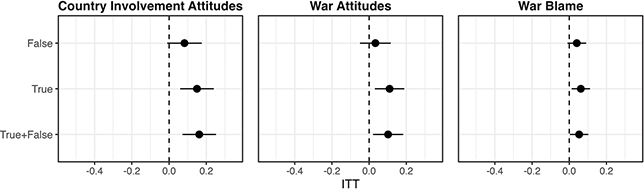
Effects of Russo–Ukrainian War disinformation (Slovakia)
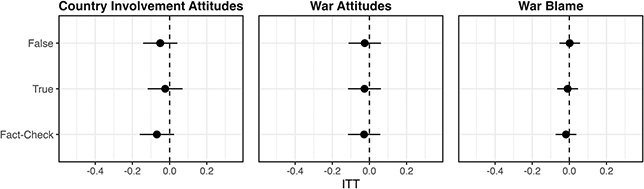
The next set of results focuses on disinformation related to Ukrainian refugees. For these experiments, I measured effects on three preregistered outcomes: an index that measures the extent to which Ukrainian refugees are a burden or benefit for the Czech Republic/Slovakia (1–4;  in the Czech Republic and Slovakia), a single-item measure of cultural distance between Ukrainians and Czechs/Slovaks (1–4), and a single-item feeling thermometer measuring personal evaluations of Ukrainian refugees (0–100). I preregistered that:
Hypothesis 10a: Respondents exposed to the true headlines will express stronger pro-refugee positions than respondents in the control group.
Hypothesis 10b: Respondents exposed to the false headlines will express weaker pro-refugee positions than respondents in the control group.
Hypothesis 10c: Respondents exposed to the fact-checked headlines will express stronger pro-refugee positions than respondents in the control group (Czech Republic only).
Hypothesis 10d: Respondents exposed to the combined set of headlines will express stronger pro-refugee positions than respondents in the control group (Slovakia only).
Figures 21 and 22 plot intent-to-treat effects. As with the war disinformation headlines, results indicate evidence of attitudinal backlash, not direct persuasion. Compared to respondents in the control group, respondents in the false headline group considered Ukrainians more of a benefit to their host country (Czech Republic p = 0.029, Slovakia p = 0.047) and indicated warmer feelings toward them (Czech Republic p = 0.011, Slovakia  ). However, there was little evidence that the false headlines shaped perceptions of cultural distance. Backlash was also present in the Czech fact-checking condition (burden versus benefit p = 0.022; thermometer p = 0.051), and in the Slovak true+false condition, but only for the thermometer outcome (p = 0.008). Standardized effect sizes were substantively small, hovering around 0.15 for the burden versus benefit outcome, and between 0.15 and 0.20 across the different conditions for the feeling thermometer. Finally, there was little statistical evidence that true headlines affected attitudes.
Effects of Ukraine refugee disinformation (Czech Republic)
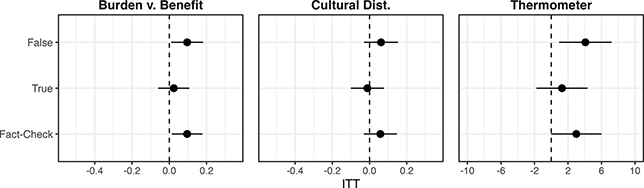
Effects of Ukraine refugee disinformation (Slovakia)
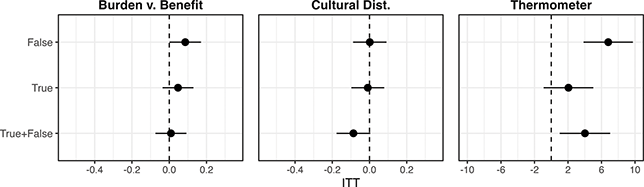
The last experiment focuses on the effects of disinformation related to the European Green Deal in the Czech Republic. I evaluate effects on three preregistered attitudinal indices: (1) EU attitudes ( ); (2) perceptions of whether the Czech Republic has a say in EU policymaking (
 ); and (3) a climate change assessment index that captures individuals’ beliefs about the occurrence of climate change, their perceptions of its negative impacts, and their evaluations of whether current responses are adequate to prevent adverse effects (
 ; adapted from de Graaf et al., Reference de Graaf, Stok, de Wit and Bal2023). I preregistered the following hypotheses:
Hypothesis 11a: Respondents exposed to the true headlines will express stronger pro-EU positions and less climate scepticism than respondents in the control group.
Hypothesis 11b: Respondents exposed to the false headlines will express weaker pro-EU positions and more climate scepticism than respondents in the control group.
Hypothesis 11c: Respondents exposed to the prebunking + true headlines will express stronger pro-EU positions and less climate scepticism than respondents in the control group.
Hypothesis 11d: Respondents exposed to the prebunking + false headlines will express stronger pro-EU positions and less climate scepticism than respondents in the control group.
Figure 23 presents intent-to-treat effects. Across all attitudinal outcomes and experimental conditions, effects are precisely estimated near zero. In other words, headlines about the European Green Deal – whether true, false, or accompanied by a prebunking warning – had a statistically negligible impact on attitudes toward the EU, assessments of whether the Czech Republic has a say in EU policymaking, and climate change scepticism.
Effects of EU Green Deal disinformation (Czech Republic)
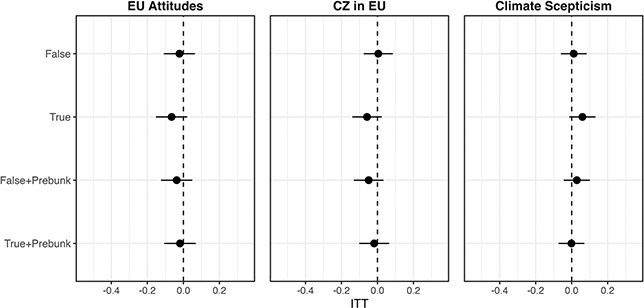
A final set of analyses examines whether directionally motivated reasoning and analytical thinking explain these results. For each experiment, I test whether treatment effects are moderated by respondents’ prior attitudes and their performance on the CRT. I present results in Online Appendix D. Overall, there is little evidence that preexisting attitudes or analytical reasoning shape how individuals respond to disinformation headlines. While some interactions reach conventional levels of statistical significance, there are few clear patterns across either disinformation topics or countries. Moreover, most p-values would exceed 0.05 if adjusted for multiple comparisons, and the interaction analyses – especially those considering the triple interaction between treatment, ideology, and analytical reasoning – are likely underpowered. Thus, while the evidence suggests that preexisting attitudes and analytical reasoning have little impact on how disinformation shapes public opinion, future research is necessary to confirm this conclusion.
7.2 Discussion
These results underscore that attitudinal backlash to disinformation is much more common than direct persuasion. Disinformation headlines moved public opinion in the opposite of the intended direction in three out of six experiments. Disinformation linking the EU to liberal policies on migration and LGBTQ+ rights made individuals less Eurosceptic, less nationalist, and more tolerant of outgroups; likewise, false narratives about Ukrainian refugees strengthened tolerance. In the other three experiments, there was little evidence that disinformation headlines had any effect.
Additional analyses indicate that these effects do not differ as a function of individual ideology or analytical reasoning. These findings do not necessarily mean that disinformation is ineffective. The experiments focus on a narrow component of disinformation exposure: immediate reactions to potentially clear instances of disinformation. While measuring these immediate reactions is important for understanding disinformation’s effects, disinformation is likely to shape attitudes through less drastic exposures that occur over longer periods of time and across multiple channels. Perhaps more importantly, the disinformation narratives also focused on highly salient topics widely covered by both mainstream and disinformation media. As such, it is likely that public opinion on these issues is crystallized, preventing attitudinal updating. More generally, disinformation’s attitudinal effects may be most pronounced on topics or issues where opinions are not yet crystallized. In other words, effective counter-disinformation efforts may require proactively addressing emerging controversies and exploitable events before they become politicized.
8 Conclusion
Understanding disinformation in CEE is important from a substantive perspective. A free, open, and truthful media keeps citizens informed and allows them to hold political elites accountable – two important conditions for a well-functioning, stable, and representative democracy (Aalberg and Curran, Reference Aalberg and Curran2012; Carpini and Keeter, Reference Carpini and Keeter1996). Whether the modern media ecosystem continues to fulfill this function is, however, debatable. While various facets of modern media consumption – for example, algorithms, the increasing consumption of news through social media, and the concentration of media in corporate hands – may be problematic, disinformation poses a particularly important challenge. Disinformation increases cynicism and apathy (Balmas, Reference Balmas2014), mistrust of factual reporting (Altay et al., Reference Altay, Lyons and Modirrousta-Galian2024), and can shape vote intentions (Zimmermann and Kohring, Reference Zimmermann and Kohring2020). In CEE – where disillusionment with the West and democracy, distrust of politicians and institutions, and ideological conflicts over sociocultural and geopolitical issues create fertile ground for Kremlin-linked disinformation campaigns – the adverse consequences of disinformation may be especially pronounced.
Given these concerns, this monograph provided a comprehensive overview of Kremlin-linked disinformation in CEE. Cross-national evidence indicated that differences in disinformation prevalence are driven by sociocultural polarization. Compared to debates over economics, the identity-based nature of sociocultural conflict appears to create an environment particularly conducive to the spread of disinformation. Thus, across CEE, disinformation supply may increase as radical parties succeed and force mainstream competitors away from the center of the sociocultural dimension.
Interviews with Czech and Slovak elites underscored that polarization directly constrains disinformation resilience. Both the Czech Republic and Slovakia face significant Kremlin-linked disinformation threats, yet stronger elite consensus in the Czech Republic has enabled the development of stronger counter-disinformation institutions. In Slovakia, elite-level polarization over disinformation itself – including debates about whether it exists at all – limits the political will necessary to develop counter-disinformation infrastructure. Moreover, even after such institutions are established, ongoing political contestation and the continued reproduction of disinformation narratives by segments of the elite limit their effectiveness. For the broader region, elite consensus is a prerequisite for building disinformation resilience. The robustness of anti-disinformation institutions in countries such as Poland and Estonia – where sociocultural divisions persist but elites share a common threat perception of Russia – shows that sociocultural polarization alone is not a barrier. Difficulties arise when sociocultural and geopolitical cleavages align, creating conditions that impede the development of effective counter-disinformation institutions.
Survey data from the Czech and Slovak Republics indicated that disinformation news outlets were widely read – especially in Slovakia, where over 40 percent of individuals reported reading at least one disinformation news source. Moreover, in both countries, readers of disinformation media trusted these outlets as much as, or even more than, mainstream media. Ideology drove both engagement with these sources and belief in the headlines that they circulate. Those ideologically predisposed to believe disinformation content – sociocultural conservatives with anti-Western geopolitical orientations – not only selected into disinformation consumption, but also failed to differentiate between true and false headlines. Attempts to correct these misperceptions through fact-checks or prebunking were largely ineffective.
Importantly, despite varying levels of polarization and elite disinformation reproduction, the individual-level characteristics associated with disinformation consumption and belief were similar across the two countries. These similarities underscore that preexisting ideological commitments shape disinformation consumption and belief independently of structural supply-and-demand factors. Perhaps more importantly, analytical reasoning guards against belief in disinformation – but only among those ideologically predisposed to disagree with disinformation content. In contrast, analytical reasoning ability makes little difference among individuals with views that ideologically align with disinformation content. These individuals believe disinformation at similar rates regardless of their reasoning capacity. Finally, ideological convictions may themselves reflect underlying analytical reasoning and cognitive flexibility (Zmigrod et al., Reference Zmigrod, Rentfrow and Robbins2020). If so, fostering these skills through education early in the political socialization process could be the most effective approach to reducing susceptibility to disinformation.
Finally, this monograph’s findings underscore the need for disinformation research to focus on disinformation’s attitudinal effects. Understanding effects is complex and requires accounting for individuals’ ideological beliefs, analytical thinking tendencies, existing factual knowledge, and exposure patterns. The experiments in this monograph – spanning two countries, two time periods, and four disinformation topics – suggest that immediate exposure does not lead to direct persuasion. In some cases, it produces attitudinal backlash; in most cases, it fails to shift attitudes at all.
How do we reconcile the substantial size of the disinformation audience and conservatives’ strong belief in disinformation headlines with these results? Disinformation may not win over hearts and minds because individuals predisposed to agree with disinformation content are already firm believers. They read the outlets, they believe the headlines, and their attitudes align accordingly. Conversely, when disinformation conflicts with individuals’ existing attitudes, they either dismiss the information or become more entrenched in their original beliefs. On balance, in both countries, it seems that this latter group of individuals still predominates. Intuitively, this makes sense – Kremlin-linked disinformation is predicated on inflammatory narratives that politicize salient issues in ways that would strain credibility for most individuals. Even the most widely believed narratives – those about Ukrainian refugees – reveal a divided society, with individuals roughly evenly split between belief and rejection. It is worth considering whether these individuals are genuinely misinformed or simply endorse disinformation as a way to express their grievances (Graham, Reference Graham2026). Regardless of which is true, perhaps the most effective approach to combating disinformation is not to fight it directly, but to address the underlying societal divisions that make individuals susceptible in the first place.
Maria Popova
McGill University
Maria Popova is an Associate Professor of Political Science at McGill University. Her work explores rule of law and democracy in the post-Communist region and, most recently, judicial reform in Ukraine, the politics of corruption prosecutions in Eastern Europe, and conspiracies and illiberalism.
Lenka Buštíková
University of Florida
Lenka Buštíková grew up in Prague. She is Professor of political science at the University of Florida and Director of the Centre of European Studies. Before coming to the University of Florida, she taught at the University of Oxford and at Arizona State University. Her research focuses on polarization, party politics and democratic erosion.
Petra Guasti
Charles University Prague
Petra Guasti is an Associate Professor of Democratic Theory at Charles University in Prague and has served on the Executive Committee of the European Consortium for Political Research (ECPR) since 2024. Her research examines the reconfiguration of the political landscape, with a particular focus on political representation, democratization, populism, and polarization. Her work has been published in Democratic Theory, Democratization, Communist and Post-Communist Studies, European Political Science, East European Politics and Societies, Politics and Governance, Government and Opposition, among other journals.
Gergana Dimova
Northeastern University London
Gergana Dimova is an Associate Professor in Politics at Northeastern University London. Her scholarship approaches the study of Eastern European and Russian politics through a number of thematic and analytical lenses, such as democracy, blame games, uncertainty, accountability and the media. She is the author of Democracy beyond Elections (Palgrave 2020) and Political Uncertainty: A Comparative Exploration (Ibidem 2023). She is an associate editor of Democratic Theory.
About the Series
Delivering theoretically innovative and empirically rich scholarship on current and long-standing developments from Central Europe to Central Asia, this Elements series advances knowledge through nuanced understanding of local context and by forging links to major debates in political science and international relations across regional specialization.