Introduction
This Element was inspired by the expanding research on international assignees (IAs) and host country nationals (HCNs), two key groups of employees whose interactions are vital to the success of multinational organizations. In an era marked by increasing worker mobility and migration, understanding the dynamics between these actors has become more critical than ever. Despite substantial progress in this field, much of the existing literature remains fragmented, often examining IAs and HCNs separately. Our aim is to offer a comprehensive and integrative analysis that addresses this gap, providing new insights into the complex relationships between IAs and HCNs.
In this Element, we examine how language proficiency, cultural understanding, and communication practices, among others, shape these interactions and their outcomes. Drawing on an extensive review of over 200 empirical studies spanning three decades, we adopt a mixed-methods approach, combining bibliometric analysis with qualitative thematic and content analysis. This methodology not only allows us to capture the intellectual structure of the field but also to identify key trends, influential contributors, and emerging research areas.
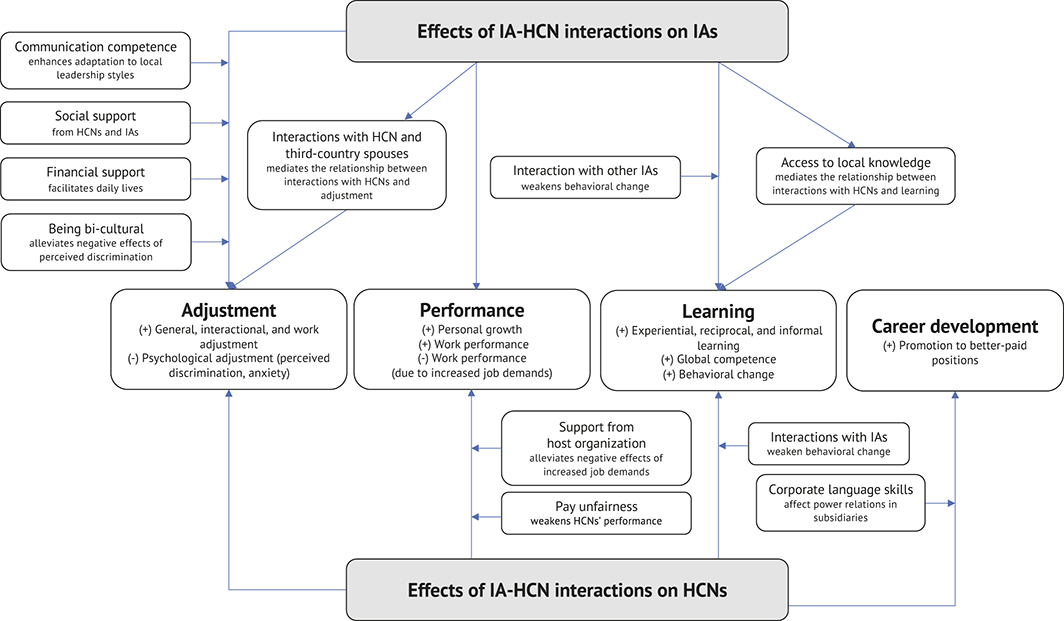
The Element is organized to take readers through the progression of research on international assignees–host country nationals (IA–HCN) interactions, from the field’s intellectual roots to its current state, and finally to future research directions. Section 1 introduces the study of IA–HCN interactions and outlines our integrative research methodology, incorporating bibliometric, thematic, and content analysis. Section 2 traces the field’s intellectual development, addressing the WEIRD (Western, Educated, Industrialized, Rich, and Democratic) bias by highlighting over- and underrepresented countries in empirical research, and examining the thematic evolution of IA–HCN studies. Section 3 reviews the state-of-the-art across three key research streams: cultural adjustment, language and communication, and IA–HCN relationships. Building on influential studies, Section 4 presents a conceptual model that illustrates the effects of IA–HCN interactions on various outcomes, including cultural adjustment, work performance, learning, and career development. Lastly, Section 5 identifies knowledge gaps revealed throughout the research and suggests ways to address inconsistencies in findings on the impact of IA–HCN interactions. Importantly, it also offers practical implications for organizations, managers, and educators.
While conducting this research, we were motivated by the need to address the inconsistencies in the literature, particularly concerning the outcomes of IA–HCN interactions. Our findings suggest that, although these interactions often have positive effects, they can also present challenges, especially when power imbalances, cultural differences, or language barriers are involved.
We hope this publication serves as a valuable resource for scholars, practitioners, and anyone interested in the dynamics of multicultural and multilingual work environments. By highlighting gaps in the current literature and proposing new avenues for future research, we aim to contribute to the ongoing discourse on global mobility and intercultural interactions in multinational organizations.
We would like to express our deepest gratitude to our colleagues and the research community for their invaluable insights during the development of this Element. We extend special thanks to the anonymous reviewers, as well as the discussants at the 2023 conferences of the International Research Group on Management & Language (GEM&L), the Academy of International Business (AIB), and the Academy of Management (AOM). We are also deeply appreciative of the authors whose studies we reviewed, as their important work provided the foundation for this exploration of IA–HCN interactions.
1 International Assignee–Host Country National Interactions
1 Overview
This section introduces research on interactions between international assignees (IAs) and host country nationals (HCNs), emphasizing the significance of language proficiency and intercultural communication in shaping the experiences of these key stakeholders crucial to organizational success. We also outline the methodology of our research, detailing the aims and approach of our integrative research methodology, which includes bibliometric, thematic, and content analysis.
1.1 Introduction
International workplaces offer multiple arenas for intercultural interactions. In multinational corporations (MNCs) and other multilingual organizations, interactions take place through a variety of channels (Hocking et al., Reference Hocking, Brown and Harzing2007) between organizational actors with different cultural backgrounds, whose role is strategic to the organization’s success. Among these actors are international assignees (IAs) and host country nationals (HCNs). In this study, we adopt Reiche and Harzing’s (Reference Reiche, Harzing, Harzing and Pinnington2010, p. 188) definition of the IA as “any person that is relocated internationally” for work reasons, which covers a wide range of international assignments. This definition of IAs bears a close resemblance to the related term expatriate/expat, which refers to “an individual who moves to another country while changing the dominant place of residence and executes legal work abroad” (Andresen et al., Reference Andresen, Bergdolt, Margenfeld and Dickmann2014, p. 2308). HCNs, on the other hand, are local employees in MNCs’ international subsidiaries (Michailova et al., Reference Michailova, Fee and DeNisi2023).
IAs foster organizational development by sustaining internal contact (Barner-Rasmussen & Björkman, Reference Barner-Rasmussen and Björkman2005) and contributing to a company’s global competitive advantage (Cole, Reference Cole2011). HCNs, in turn, constitute the largest group of organizational members critical to the organization’s success, thanks to their local knowledge and skills (Varma et al., Reference Varma, Aycan and Budhwar2016). They play an important liaison role, uniquely contributing to effective knowledge transfer and impacting knowledge acquisition throughout the organization’s foreign operations (Vance et al., Reference Vance, Andersen, Vaiman and Gale2014).
Relationships between IAs and HCNs can take various forms, such as assistance, social support, and even friendship (Peltokorpi, Reference Peltokorpi2020). However, social and work contacts between IAs and HCNs require interactions (Caligiuri, Reference Caligiuri2000), and these interactions are complicated by cultural differences, communication, and the languages in use (Froese et al., Reference Froese, Peltokorpi and Ko2012; Peltokorpi, Reference Peltokorpi2022; Zhang & Harzing, Reference Zhang and Harzing2016). Language, as a form of social action (Kramsch & Hua, Reference Hua2016), therefore serves both to transmit knowledge and to convey social and cultural identities in these encounters.
Intercultural communication is understood as the relational process of sharing meanings among individuals with diverse cultural backgrounds (Piller, Reference Piller2011). In this process, cultural and linguistic differences are treated as salient features of the interaction (Baker Reference Baker2022, Reference Baker2024; Zhu, Reference Zhu2019). Although the terms intercultural communication and cross-cultural communication are sometimes used interchangeably in fields such as cross-cultural management, they differ conceptually. Cross-cultural communication typically refers to communication patterns characteristic of particular cultural groups (e.g., national styles, culture-specific professional communication), as studied in comparative scholarship by, among others, Hall, Hofstede, Lewis, or Trompenaars (for a review, see Hurn & Tomalin, Reference Hurn and Tomalin2013). Intercultural communication, by contrast, refers to the dynamic, negotiated process of meaning-making between people from different cultures. Interactions between IAs and HCNs are therefore best described as intercultural communication.
Communication interactants bring their languages and cultural resources to interaction and must negotiate between them, including competing identities and meanings (e.g., nationality, profession, gender) (Baker, Reference Baker2024). Effective meaning-making therefore requires not only language proficiency but also broader communicative and intercultural competencies (Byram, Reference Byram and Jackson2011). IA–HCN intercultural communication involves foreign-language proficiency – the skill allowing individuals to effectively manage communication in a second language (Gallagher, Reference Gallagher2013), such as the corporate language, local language, or a lingua franca. Intercultural competence, in turn, is the general ability to interact effectively with people from cultures other than one’s own (Byram, Reference Byram2000, p. 297), and underpins successful negotiation of meaning in these settings.
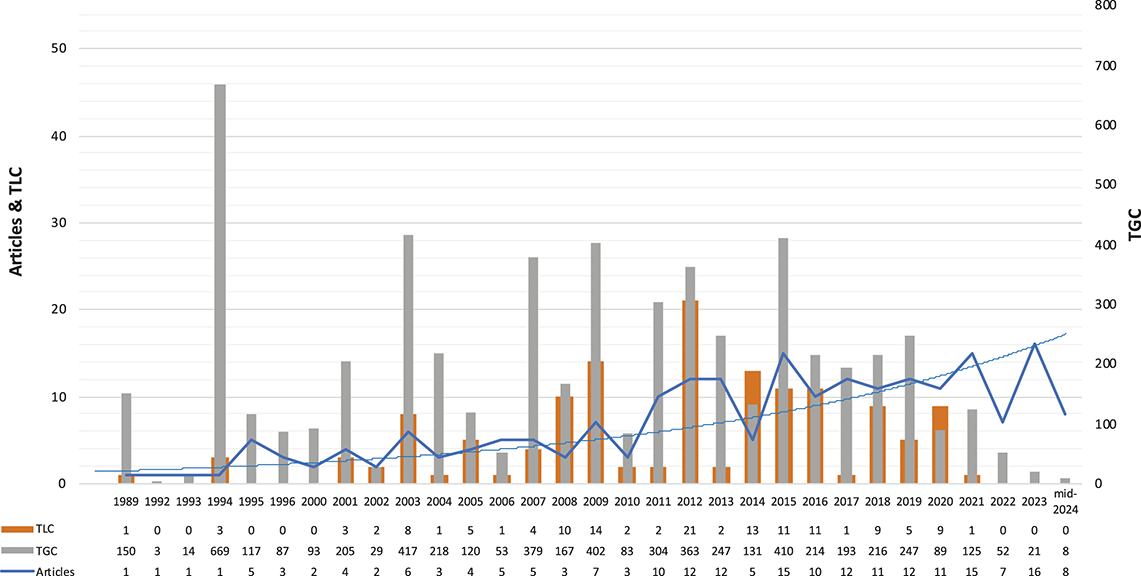
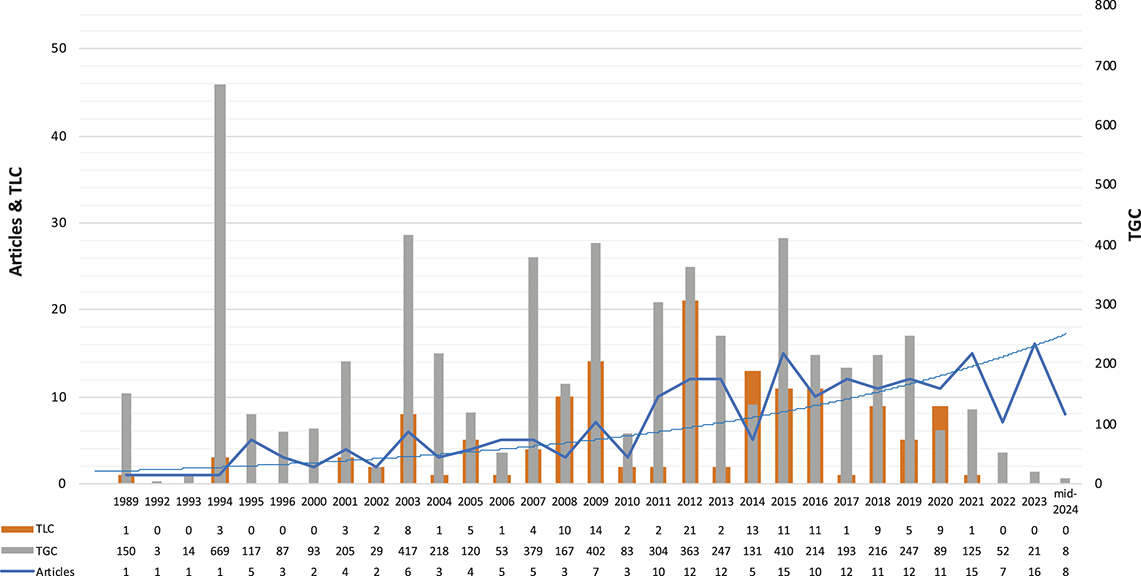
The increasing number of studies on IA–HCN interactions (see Figure 1) indicates that the literature in this field has significantly developed over the last three decades. Our aim is to contribute to the ongoing debate on IA–HCN interactions by adopting an integrative approach involving both IAs and HCNs, and conducting a systematic review of empirical research on IA–HCN interactions in diverse organizational contexts, thus combining the literature on IAs and HCNs. Through our current review research (Kunisch et al., Reference Kunisch, Denyer, Bartunek, Menz and Cardinal2023), we add to the body of work that recognizes the importance of IAs and HCNs as key stakeholders.
Yearly publication of articles on IA–HCN interactions. Note: All indices retrieved from HistCite; TLC: Total local citations; TGC: Total global citations; Articles: Number of articles published on IA–HCN interactions.
Using a unique mixed-methods review technique, we analyze and synthesize a substantial sample of empirical research on IA–HCN interactions, expanding the scope of existing literature. Previous research has either focused primarily on the outcomes of IA–HCN interactions for IA adjustment or performance, which are critical to organizational success (van Bakel, Reference van Bakel2018), or exclusively synthesized research on HCNs in MNCs (Michailova et al., Reference Michailova, Fee and DeNisi2023). This publication addresses the limitations of earlier works by offering a comprehensive overview of the IA–HCN interactions field, focusing on outcomes for both actors. It seeks to answer the following overarching research questions:
1) What constitutes the field of IA–HCN interaction research?
2) What are the effects of IA–HCN interactions on IAs and HCNs?
3) What are fruitful avenues for future research on IA–HCN interactions?
To answer these research questions, we will review 209 articles from 133 journals published on IA–HCN interactions over the last three decades (1989–mid 2024). Our research stands out methodologically by combining a variety of quantitative bibliometric tools with qualitative thematic and content analyses to establish the intellectual structure of the field and offer avenues for future development.
Our approach also offers a nuanced perspective on intercultural communication by critically exploring relationships between IAs and HCNs. By adopting an integrative approach of both IAs and HCNs, and conducting a systematic review of empirical research on IA–HCN interactions in diverse organizational contexts, we challenge simplistic views of culture and identity in the workplace. We underscore the reciprocal influences between IAs and HCNs, stressing the importance of language, communication, and rapport in different environments and settings. The insights we obtain through our mixed-method approach reveal how these interactions influence factors such as cultural adjustment, work performance, and learning both for IAs and HCNs.
In the following section, we will present the methodology that we have used to obtain the results we present in this publication.
1.2 Data and Methods
1.2.1 Data Extraction
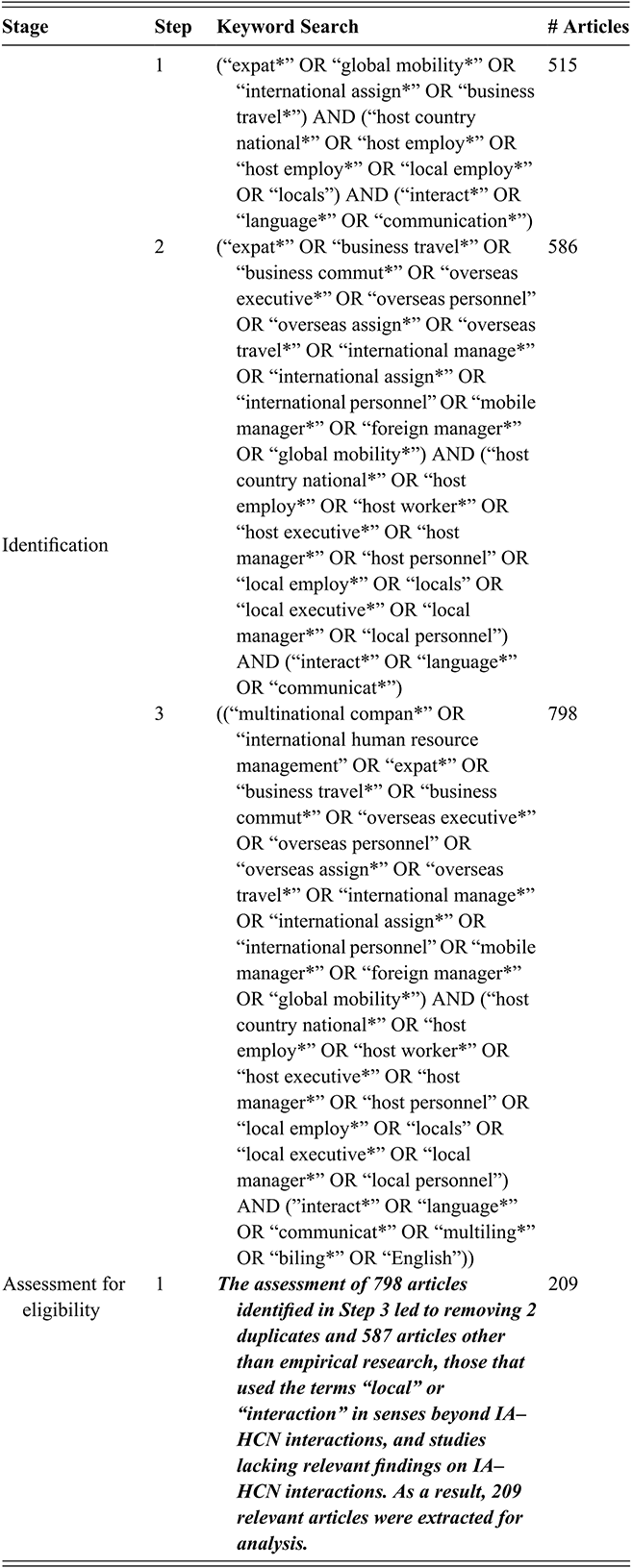
We extracted the bibliographic data from Scopus database (Elsevier, 2023) through the two-stage data extraction approach (Bretas & Alon, Reference Bretas and Alon2021; Wilczewski & Alon, Reference Wilczewski and Alon2023) presented in Table 1.

Table 1 Long description
Table 1 outlines the multi-stage procedure used to build the dataset for the review. It has four columns: Stage, Step, Keyword Search, and # Articles. Under the Identification stage, Step 1 shows an initial Boolean query combining expatriate/assignment terms, host country/locals terms, and interaction/language/communication terms, yielding 515 records. Step 2 expands the expatriate and host-country terms, returning 586 records. Step 3 further broadens the search by adding multinational-company and multilingualism-related terms, resulting in 798 records. Under the ‘Assessment for eligibility’ stage, a single step explains that the 798 records were screened to remove duplicates and non-empirical or irrelevant items, leaving 209 empirical articles on IA–HCN interactions for analysis. A brief narrative in the last row describes the exclusion criteria and confirms that 209 relevant articles were extracted.
First, in Step 1, we used a combination of keywords that would best capture research on (a) IAs, (b) HCNs, and (c) interaction between the two groups. In Step 2, we broadened the search by adding more keywords describing IAs and HCNs. In order to identify potentially missing keywords, we ran an initial authors’ keywords analysis in Biblioshiny, which prompted the inclusion of two more keywords (Step 3), thereby expanding the search to 798 records for quality assessment.
In the second stage, both authors assessed the abstracts of all 798 records. If the abstracts did not contain information on IAs, HCNs, or interactions between them, we examined the whole article and discussed its inclusion or exclusion. As a result, we excluded duplicates and publications that did not offer any empirical findings. We did, however, include IAs from all organizational contexts such as teachers, academics, and nurses.
The assessment process yielded 209 articles for analysis; the dataset containing bibliometric data is attached as Supplementary Material. We subsequently obtained full versions of all 209 papers, which we consulted to acquire additional information about the studies’ theoretical foundation, methods, findings, and suggestions for future research. We limited our search to publications written in English, which nevertheless led us to include two publications written in Russian and French but with English abstracts.
It is important to note that our focus on Scopus‑indexed empirical articles may structurally favor international business and management outlets over, for example, contributions from psychology, communication and linguistics (e.g., multilingualism, workplace discourse), or (higher) education. Our objectivized mapping of the field therefore primarily reflects how IA–HCN interactions are conceptualized within workplace‑oriented scholarship, while also revealing where other disciplinary perspectives are underrepresented and where future, more interdisciplinary research is needed.
1.2.2 Bibliometric, Thematic, and Content Analysis
We used a mixed-method approach to review research on IA–HCN interactions. Specifically, we conducted quantitative bibliometric analyses such as co-citation analysis and conceptual thematic mapping, as well as qualitative thematic and content analyses to explore the research questions (Bretas & Alon, Reference Bretas and Alon2021; Wilczewski & Alon, Reference Wilczewski and Alon2023).
Bibliometric methods use bibliographic data to identify the structures of scientific fields (Zupic & Čater, Reference Zupic and Čater2015) and leading trends in the literature in terms of themes, highly cited papers, authors, or countries (Mas-Tur et al., Reference Mas-Tur, Roig-Tierno and Sarin2021). Using these rigorous methods for discovering and analyzing large amounts of data (Sharma et al., Reference Sharma, Kraus, Srivastava, Chopra and Kallmuenzer2022), we can create an objective view of the literature by making the search and review process transparent and reproducible (Bretas & Alon, Reference Bretas and Alon2021). The article is the unit of analysis in bibliometric analysis. Its goal is to show the interconnections between articles by measuring how many times a given article is co-cited by other articles (Bretas & Alon, Reference Bretas and Alon2021), within and beyond the dataset extracted.
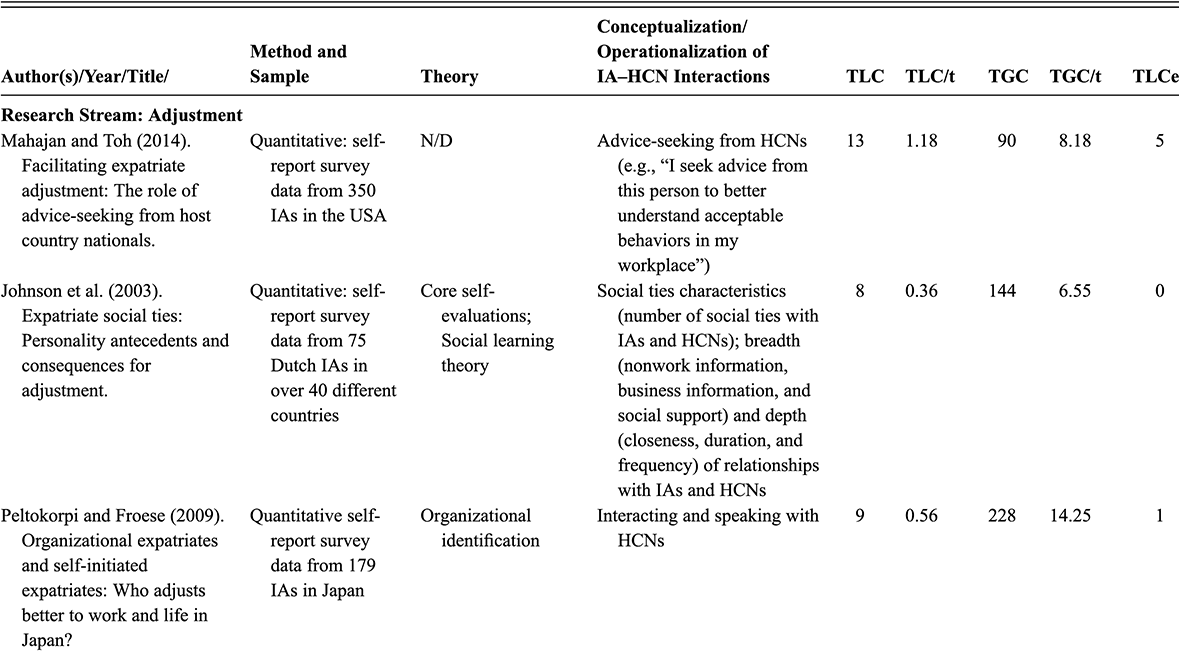
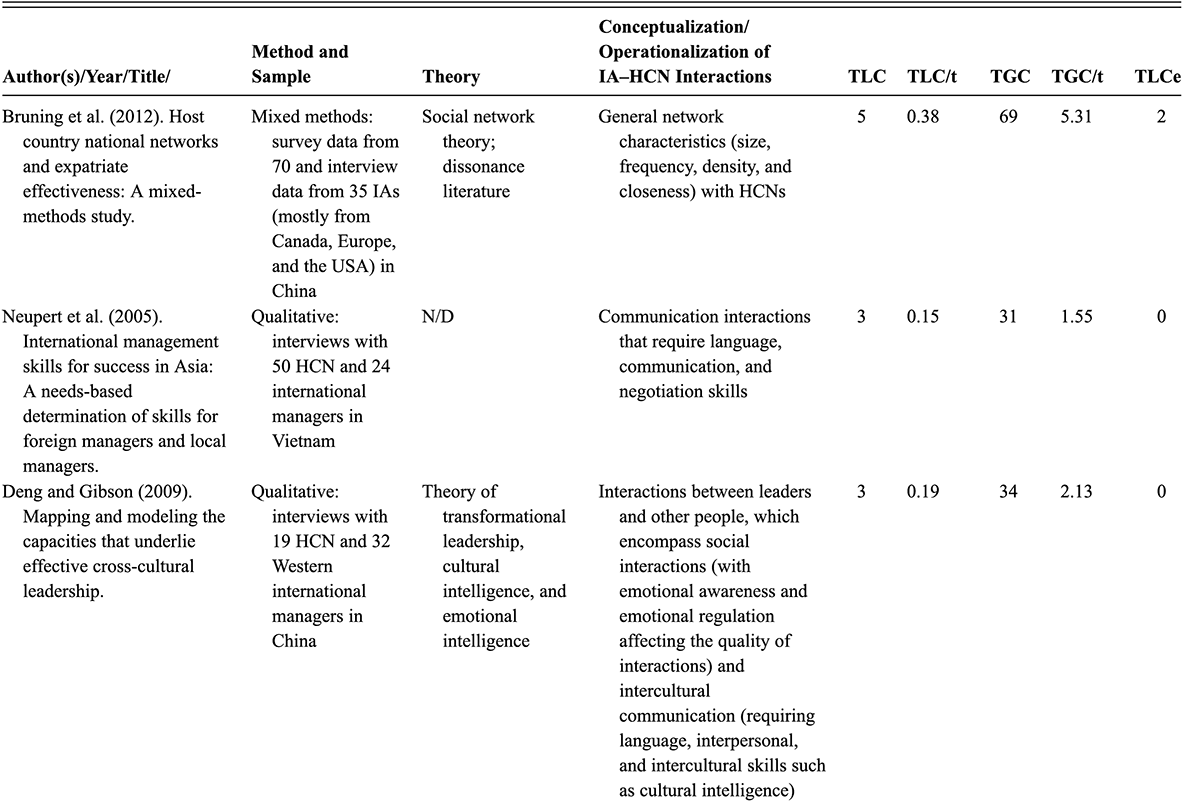
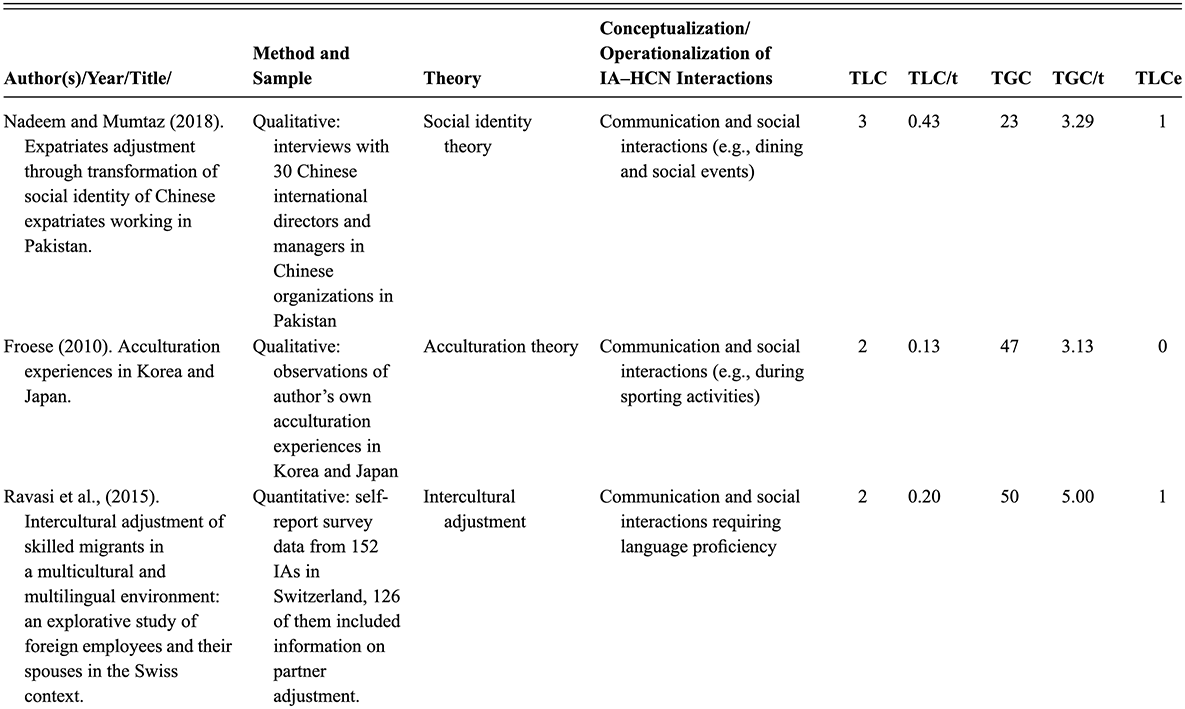
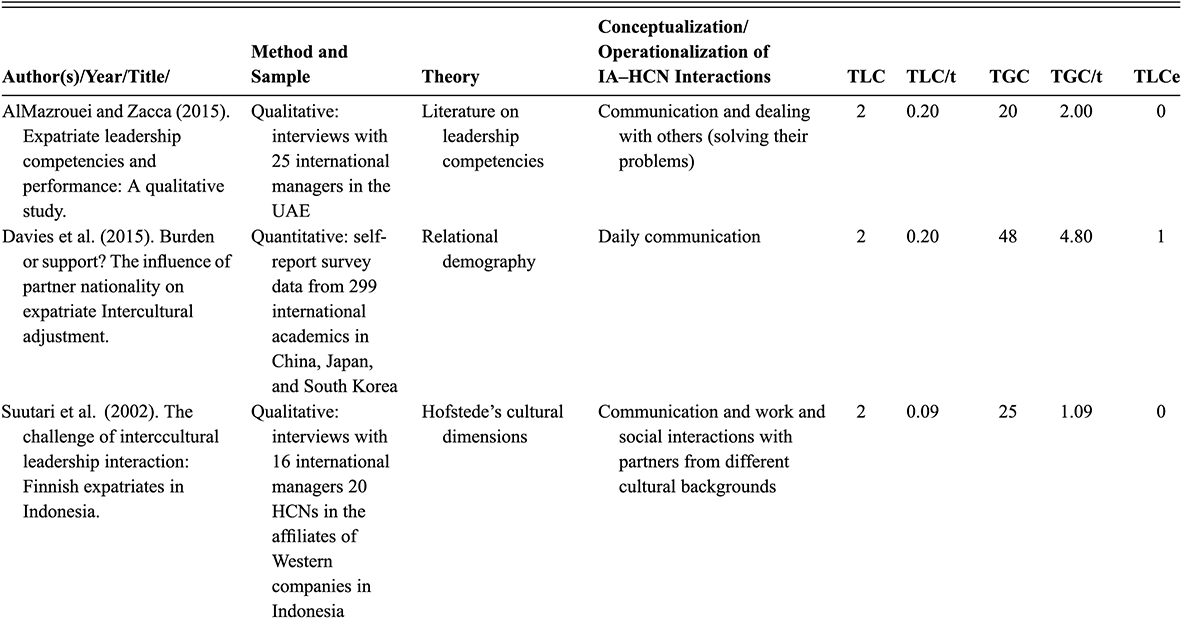
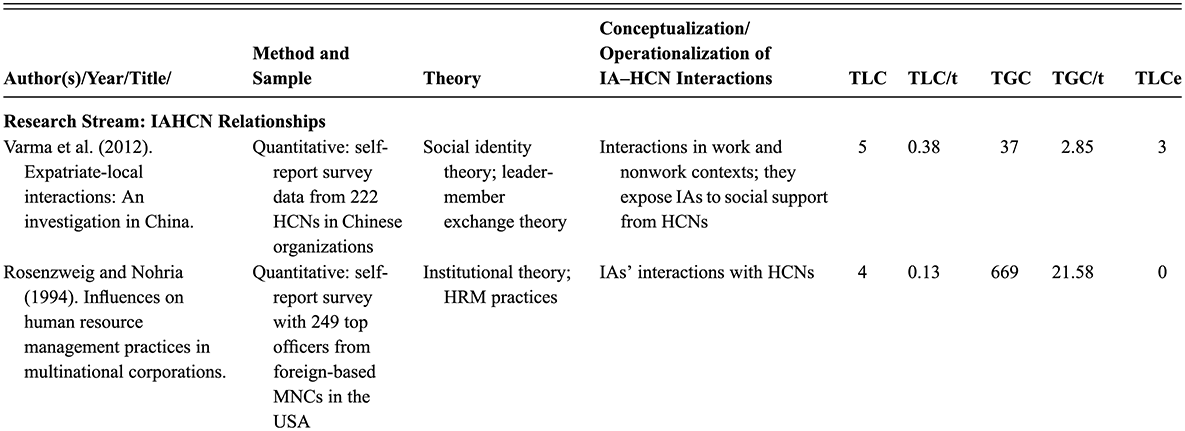
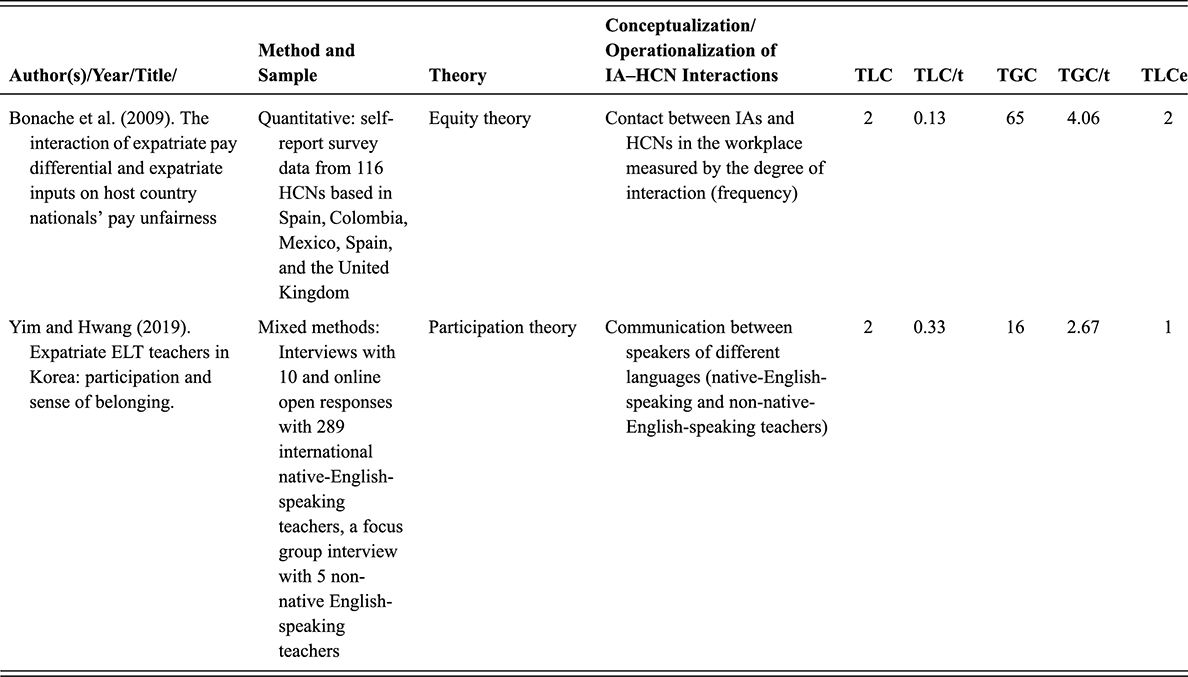
Our selection of analytical methods is guided by the research questions. First, we used HistCite to identify the most impactful journals, countries, authors, and articles. This software identifies the key literature in a research field, reconstructs its development, and analyzes publication productivity and citation rates (Garfield et al., Reference Garfield, Paris and Stock2006). We retrieved the following scores: total local citations that each article received in our dataset (209 articles) overall (TLC) and per year (TLC/t), to determine its local impact – total global citations received by each article in the entire Scopus database overall (TGC) and per year (TGC/t), to determine its global impact – total citation score (TLCe) at the end of the year covered in the study (2022), to determine the driving force of the field – as this score rewards articles with more citations within the last three years (2022–2024) (Alon et al., Reference Alon, Anderson, Munim and Ho2018). Additionally, we retrieved authors’ h-index from Scopus.
To reveal collaborations between countries, we used CiteSpace – a visual analytic application to analyze patterns and trends in a knowledge domain. Modularity measure (Q) was used to assess the structure of the collaboration network. Q values close to 1.00 indicate that the network can be divided into distinct groups, while values below 0.3 indicate many between-cluster links (Chen, Reference Chen2016).
Second, we combined different citation mapping techniques with qualitative thematic analysis to establish the thematic structure of the field. In order to establish major research streams, we performed bibliographic coupling using Visualization of Similarities (VOSviewer). This software creates bibliometric maps by illustrating items of interest (such as articles, authors, or keywords) and links between them (van Eck & Waltman, Reference van Eck and Waltman2022). The value of a link between two items is defined as the link strength that represents, for example, the number of references shared by two items in bibliographic coupling links. Bibliographic coupling occurs when two documents from the same dataset cite the same third reference (Kessler, Reference Kessler1963), which indicates a subject similarity between the two citing documents (Maseda et al., Reference Maseda, Iturralde, Cooper and Aparicio2022; Mas-Tur et al., Reference Mas-Tur, Roig-Tierno and Sarin2021). For citation mapping in VOSviewer, LinLog/modularity was applied to normalize links between items (van Eck & Waltman, Reference van Eck and Waltman2022).
Moreover, we performed thematic mapping analysis based on authors’ keywords using Biblioshiny (Aria & Cuccurullo, Reference Aria and Cuccurullo2017), which is part of the R bibliometrix-package. This scientific mapping analysis identifies motor, basic, niche, and emerging or declining themes in the field (Callon et al., Reference Callon, Courtial, Turner and Bauin1983). The identified themes represent clusters derived from the authors’ keywords.
We report the frequency of each cluster, which indicates the number of occurrences of a particular theme within the dataset. This metric reveals how often a specific set of related keywords (forming a theme or cluster) appears across the analyzed publications. Higher cluster frequency signifies a more prevalent or significant theme within the dataset. This approach helps in identifying dominant themes and trends within the research field.
To increase the validity of the results, we complemented bibliometric methods with qualitative methodology. Consistent with recent studies (Sharma et al., Reference Sharma, Kraus, Srivastava, Chopra and Kallmuenzer2022), we performed a thematic analysis of authors’ keywords organized by Biblioshiny into thematic clusters (first-order concepts). This analysis allowed us to establish second-order themes and overarching themes/research streams, following Gioia methodology (Gioia et al., Reference Gioia, Corley and Hamilton2013). For a more contextualized understanding of first-order concepts, we analyzed sample studies sharing the same clusters of keywords.
Third, we used qualitative content analysis, which enables the identification of relatively objective message characteristics (Neuendorf, Reference Neuendorf2002), to synthesize empirical findings from the most impactful articles within each research stream and suggest avenues for future research (Alon et al., Reference Alon, Anderson, Munim and Ho2018; Wilczewski & Alon, Reference Wilczewski and Alon2023). We also combined this technique with thematic analysis to examine the effects of IA–HCN interactions on both IAs and HCNs, as well as define the meaning of clusters established through citation mapping by analyzing articles grouped by bibliometric software. By integrating the results of bibliometric, thematic, and content analyses, we provide a state-of-the-art overview of existing IA–HCN interaction research, which also guides the way for future research.
1.3 Structure
In the remaining four sections, we will present the results of our analyses, providing a systematic review of a specific field of intercultural communication, namely IA–HCN interactions. The findings are organized as follows: In Section 2, we start by outlining the evolution of research on IA–HCN interactions, including the most impactful journals, authors, and international collaborations, as well as geographical representation in data collection; and thematic structure of the field. In Section 3, we present the research structure of the field, comprising three main streams: adjustment, language and communication, and IA–HCN relationships. Through thematic and content analyses, we present the current state-of-the-art within each research stream. We then turn the focus to empirical findings obtained from the studies in our sample, as we in Section 4 introduce a conceptual model illustrating the effects of IA–HCN interactions on both IAs and HCNs, based on the most influential studies in the field. Finally, in Section 5, we identify gaps in the existing literature based on insights from previous sections within the three research streams – adjustment, language and communication, and IA–HCN relationships. We offer concrete suggestions as to how the field of IA–HCN interactions can address these gaps and move forward by stating explicit research questions rooted in our mixed-methods analyses. We end this Element with some final reflections and concluding remarks.
2 Intellectual and Thematic Evolution of International Assignee–Host Country National Interactions
2 Overview
This section presents the evolution of research on IA–HCN interactions. Using bibliometric data from 209 empirical research articles, we analyze the intellectual landscape of the field, identifying influential journals, authors, and international collaborations. Our sample of research articles consists of publications from a wide variety of journals and disciplines, which gives us a comprehensive perspective on IA–HCN interactions. This approach not only allows for identifying the major “players” in the IA–HCN interactions field but also addresses the WEIRD (Western, Educated, Industrialized, Rich, and Democratic) bias by exploring which countries are over and underrepresented in empirical research. Additionally, we trace the thematic development of the field, examining motor themes, established themes, emerging/declining topics, and niche areas.
2.1 Most Impactful Journals, Authors, and Countries
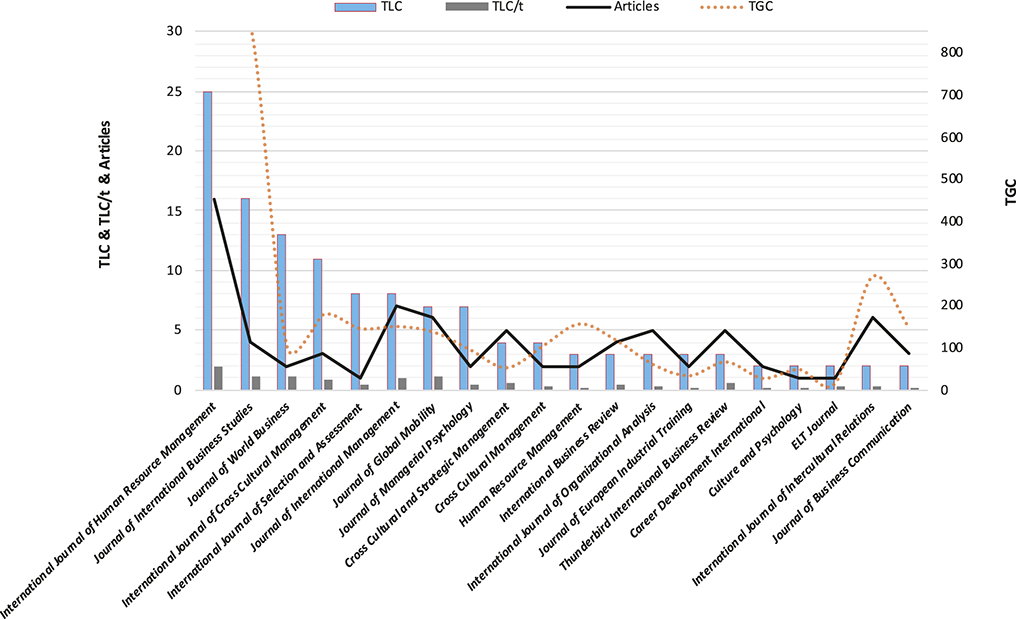
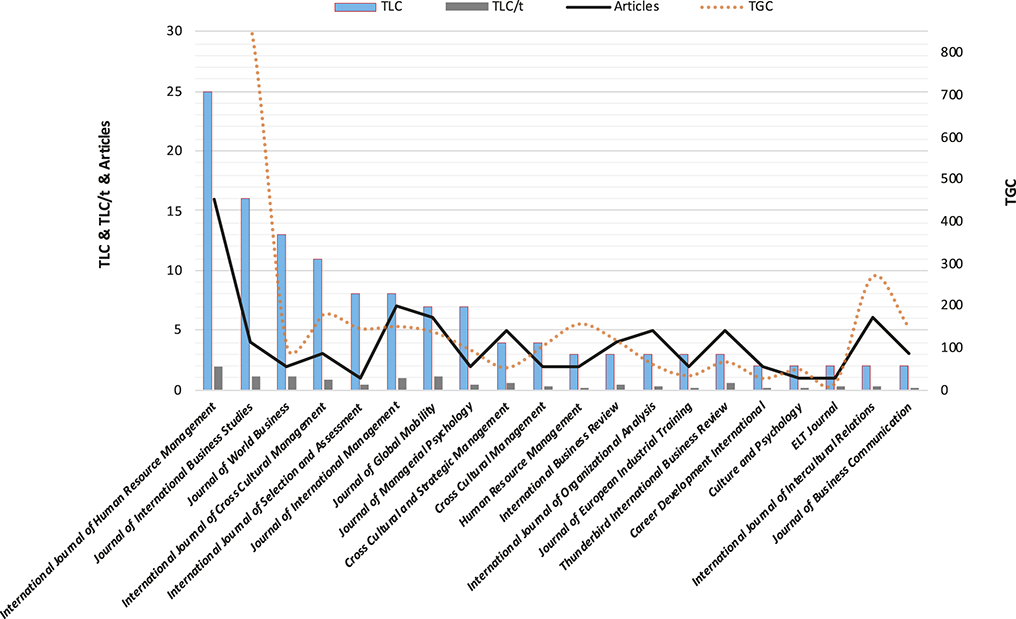
Figure 2 shows the twenty most impactful journals publishing in the field. The three most influential journals in terms of the number of local (TLC) and global citations (TGC) were: International Journal of Human Resource Management (TLC = 25, TGC = 906), Journal of International Business Studies (TLC = 16, TGC = 861), and Journal of World Business (TLC = 13, TGC = 99).
Top 20 journals publishing on IA–HCN interactions (sorted by TLC).
Note: All indices retrieved from HistCite; TLC: Total local citations; TLC/t: Total local citations per year; TGC: Total global citations; Articles: Number of articles published on IA–HCN interactions.
Out of 406 authors in our dataset, the 10 top authors have published between one and seven articles on IA–HCN interactions. As shown in Table 2, Peltokorpi and Lauring published the highest number (7 each) of articles on the topic, while Peltokorpi’s papers received the most local (25) and global citations overall (481) and per year (43.81). In turn, Mahajan and Toh were top authors in terms of trending citations (4 each).
| Rank | Full Name | Country | h-index | Articles | TLC | TLC/t | TGC | TGC/t | TLCe |
|---|---|---|---|---|---|---|---|---|---|
| 1 | Peltokorpi, Vesa | Japan | 32 | 7 | 25 | 2.08 | 481 | 43.81 | 1 |
| 2 | Fee, Anthony | Australia | 30 | 4 | 13 | 2.31 | 89 | 15.00 | N/D |
| 3 | Mahajan, Ashish | Canada | 8 | 2 | 13 | 1.18 | 90 | 8.18 | 4 |
| 4 | Toh, Soo-Min | Canada | 15 | 2 | 13 | 1.18 | 93 | 9.68 | 4 |
| 5 | Froese, Fabian Jintae | South Korea | 34 | 2 | 11 | 0.70 | 275 | 17.38 | 1 |
| 6 | Lauring, Jakob | Denmark | 32 | 7 | 11 | 0.73 | 255 | 20.31 | 1 |
| 7 | De Pater, Irene E. | Australia | 21 | 1 | 8 | 0.36 | 144 | 6.55 | 0 |
| 8 | Johnson, Erin C. | USA | 4 | 1 | 8 | 0.36 | 144 | 6.55 | 0 |
| 9 | Klein, Megan R. | USA | 1 | 1 | 8 | 0.36 | 144 | 6.55 | 0 |
| 10 | Kristof-Brown, Amy L. | USA | 24 | 1 | 8 | 0.36 | 144 | 6.55 | 0 |
| 11 | van Vianen, Annelies E.M. | Netherlands | 39 | 1 | 8 | 0.36 | 144 | 6.55 | 0 |
| 12 | Vaara, Eero | UK | 50 | 1 | 7 | 0.54 | 93 | 7.15 | 0 |
| 13 | Zhang, Ling E. | UK | 8 | 1 | 7 | 0.78 | 64 | 7.11 | 2 |
| 14 | Gray, Sidney J. | Australia | 33 | 2 | 6 | 0.91 | 60 | 9.20 | 1 |
| 15 | Bruning, Nealia S. | Canada | 14 | 1 | 5 | 0.38 | 69 | 5.31 | 2 |
| 16 | Budhwar, Pawan S. | UK | 58 | 2 | 5 | 0.38 | 49 | 5.85 | 2 |
| 17 | Heizmann, Helena | Australia | 9 | 1 | 5 | 0.71 | 49 | 7.00 | 2 |
| 18 | Kupferer, Shannon | USA | 2 | 1 | 5 | 0.38 | 37 | 2.85 | 3 |
| 19 | Pichler, Shaun M. | USA | 23 | 1 | 5 | 0.38 | 37 | 2.85 | 3 |
| 20 | Sonpar, Karan | Ireland | 11 | 1 | 5 | 0.38 | 69 | 5.31 | 2 |
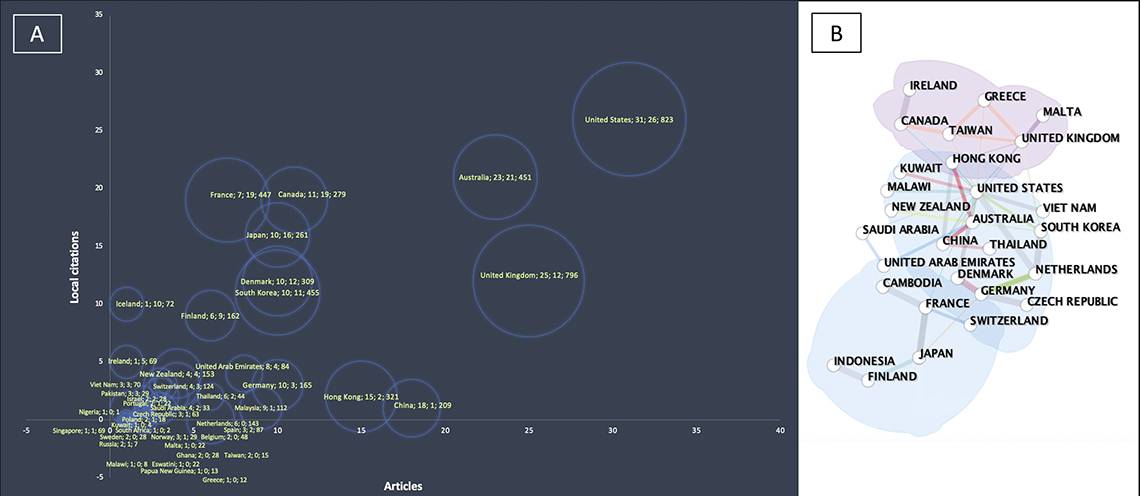
Figure 3 illustrates the distribution of articles on IA–HCN interactions according to the country where the author is located (Part A), as well as collaborations between countries (Part B). The top five countries in terms of the number of articles were the USA (31), the UK (25), Australia (23), China (18), and Hong Kong (15); in terms of local citations – the USA (26), Australia (21), Canada and France (19 each), and the UK and Denmark (12 each); while in terms of global citations – the USA (823), the UK (796), Australia (451), South Korea (455), and France (447).
Distribution of articles on IA–HCN interactions by country (n = 47). (A) Articles, local citations, and global citations per country by HistCite; the values listed by each country signify the number of articles, local citations, and global citations, respectively, while the bubble size is computed by global citations. (B) Collaboration between countries by CiteSpace; modularity Q = 0.459.
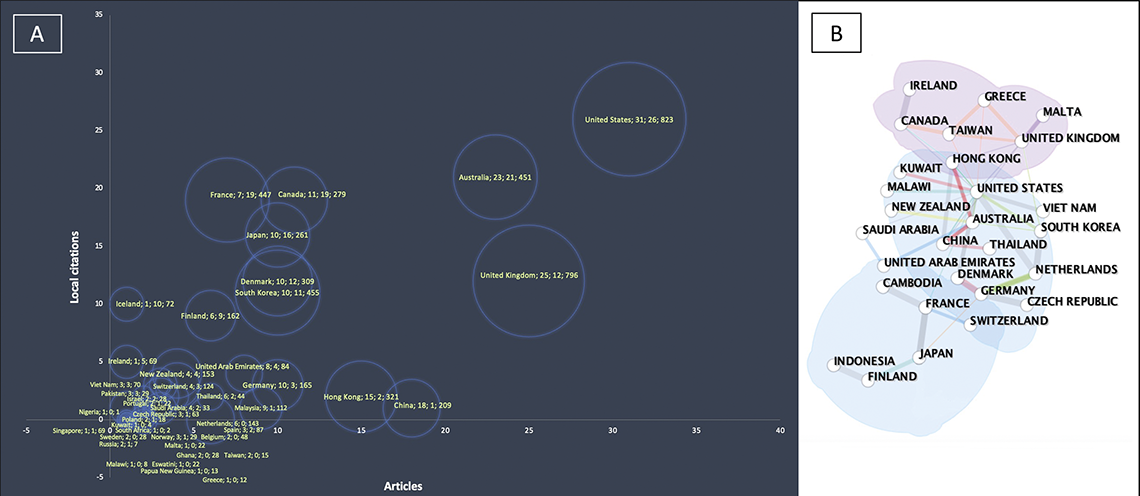
Part B of Figure 3 shows three main clusters of international collaborations, with central countries such as the USA (28 links), Australia (22 links), and China (18 links) (cluster 1), the UK (20 links) and Canada (10 links) (cluster 2), and Japan (10 links) and France (9 links) (cluster 3). The modularity index (Q = 0.459) indicates that the three clusters were relatively distinct. The collaboration index was 2.33, which means that on average 2.33 authors collaborated on a multi-authored article (Koseoglu, Reference Koseoglu2016).
2.2 Geographic Representation
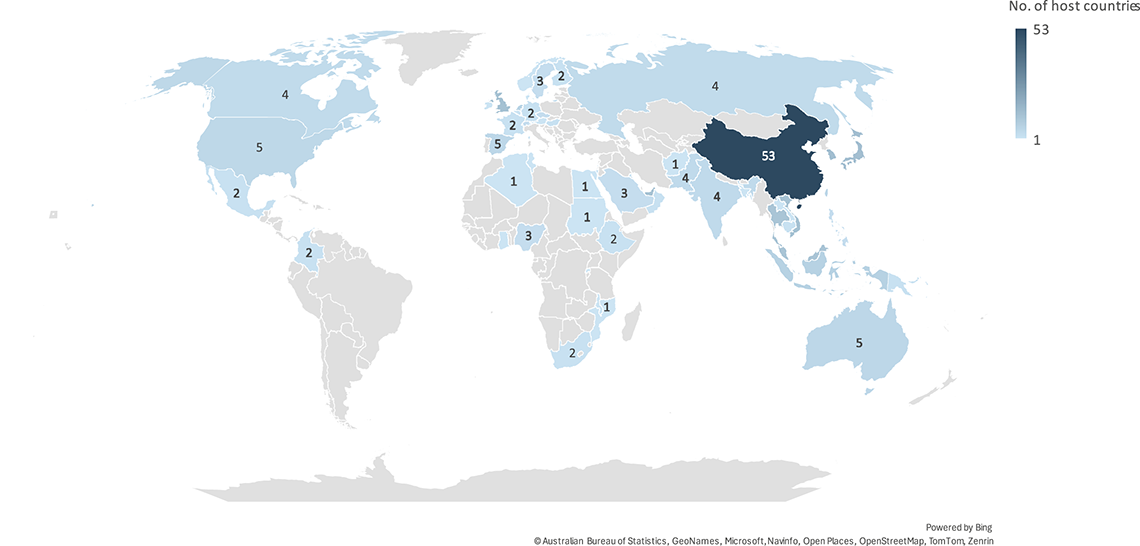
In order to assess the geographical distribution of the studies, we mapped the host country location of the data collection where this was explicitly stated, that is, the country where the empirical data were collected. We were able to obtain the host countries of 186 research articles (89%) included in our sample. In the remaining twenty-three studies, the host country was not clearly stated (i.e., either omitted entirely or referred to by continent or region), or the study included an incomplete list of countries (e.g., some of the countries were mentioned as examples). We also excluded studies that presented data from twelve or more host countries, as the host country context in these cases was absent or underdeveloped in the findings. Still, approximately 12 percent of the sample (25 articles) comprised studies that presented data from two or more (up to a maximum of 11) host countries. All mentions of host countries were counted separately, yielding a total of 253 counts of host countries across the 186 articles. In total, fifty-eight different host countries were represented in our sample. The geographical distribution of these countries is presented in Figure 4.
Host countries for data collection mapped by number of mentions (N = 253). Map chart created in Excel.
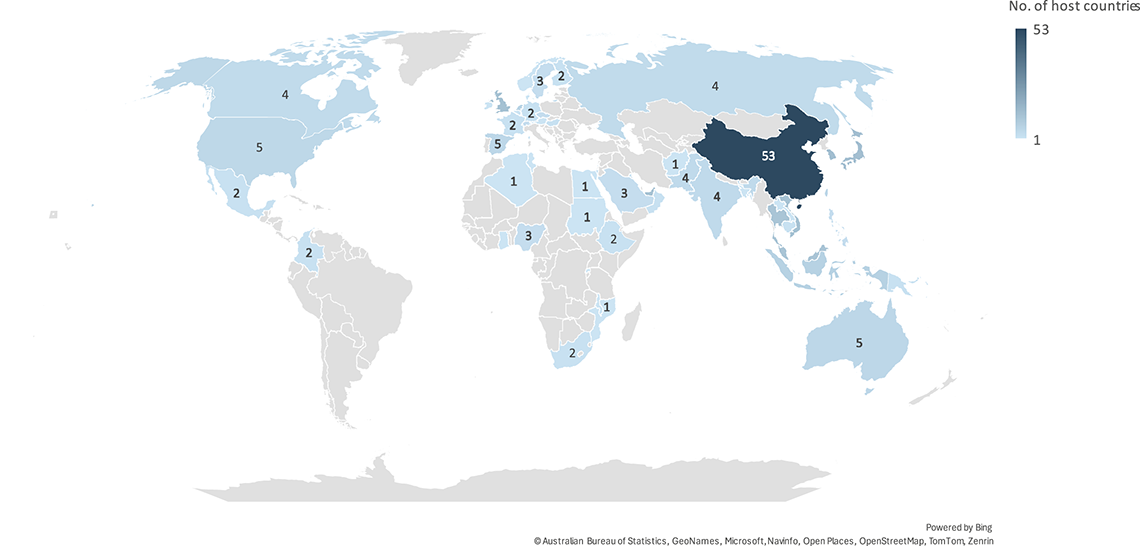
The findings from this analysis reveal that China, including Hong Kong, by far was the most used host country for collecting empirical data, with fifty-three studies drawing on data from this region. The second most used host countries were Japan and South Korea, both mentioned in thirteen studies. The UAE, UK, and Vietnam appear in twelve studies; Malaysia and Thailand in eleven; Indonesia in seven; and the Netherlands in six. Notably, eight out of the ten most frequently used host countries are located in Asia.
In total, twenty-three (twenty-four with Russia) of the fifty-eight countries included in our analysis were located in Asia, accounting for just over 40 percent of the sample of host countries. In comparison, there were seventeen European countries (eighteen with Russia), accounting for around 30 percent, in our sample. African countries made up 19 percent (eleven countries) of the sample; North America 5.3 percent (three countries); Oceania 3.5 percent (two countries), while only one country, Colombia, was located in South America.
The results allow us to address the WEIRD bias by identifying countries that are over- and underrepresented in empirical research. On the one hand, it is not surprising that China, including Hong Kong, and the UAE are well represented, given the large number of IAs in these regions. In 2019, the UN estimated that international migrants made up around 40 percent of the total population in China, Hong Kong SAE, and as much as 88 percent in the UAE (United Nations, 2019). However, another country close to the UAE, namely Qatar, where migrants also are in the majority accounting for around 79 percent of the total population, was not included in our sample. This observation demonstrates that there are some biases in terms of host country representation also within the same geographical region.
On the other hand, there is clearly potential to advance the study of IA–HCN interactions by including empirical data from other regions and continents. South America, for example, is notably underrepresented in our sample, although we acknowledge that the proportion of IAs in this region is lower compared to other regions, with IAs averaging 1.8 percent of the total population. Still, some countries, like Argentina, where IAs account for nearly 5 percent of the population, could be valuable research sites. Including such locations could provide additional, more nuanced insights into the study of IA–HCN interactions from an intercultural perspective.
More research originating from African countries would also be welcome, in particular countries like Gabon (with around 19 percent IAs), and Equatorial Guinea (17 percent IAs) (United Nations, 2019). The same can be said about Eastern European and South European countries, which also are underexplored in our sample.
2.3 Thematic Structure
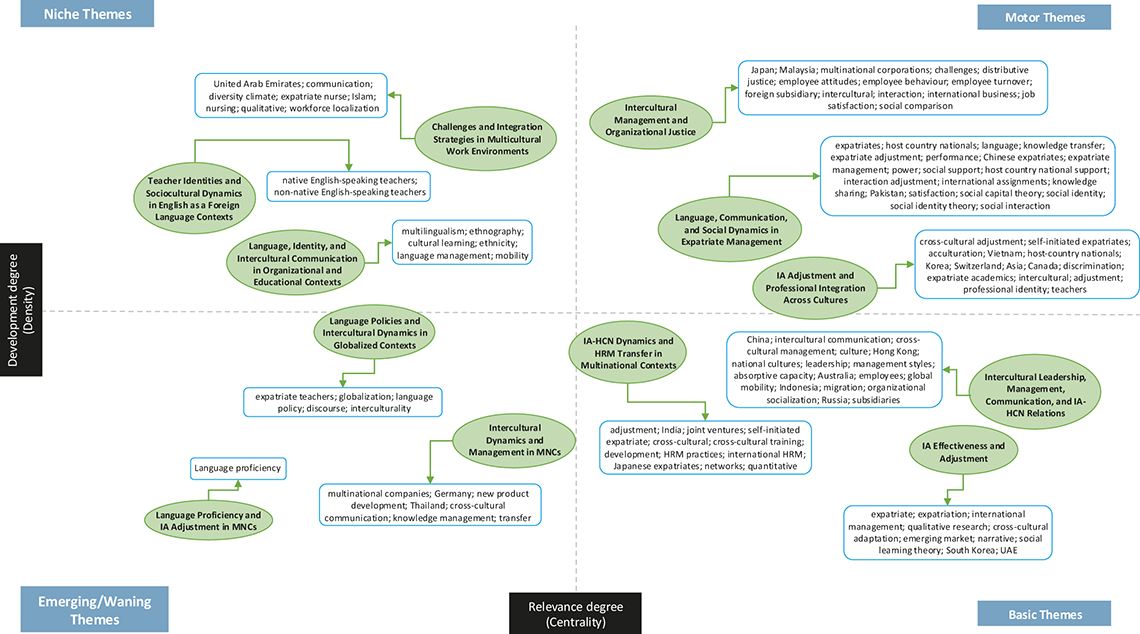
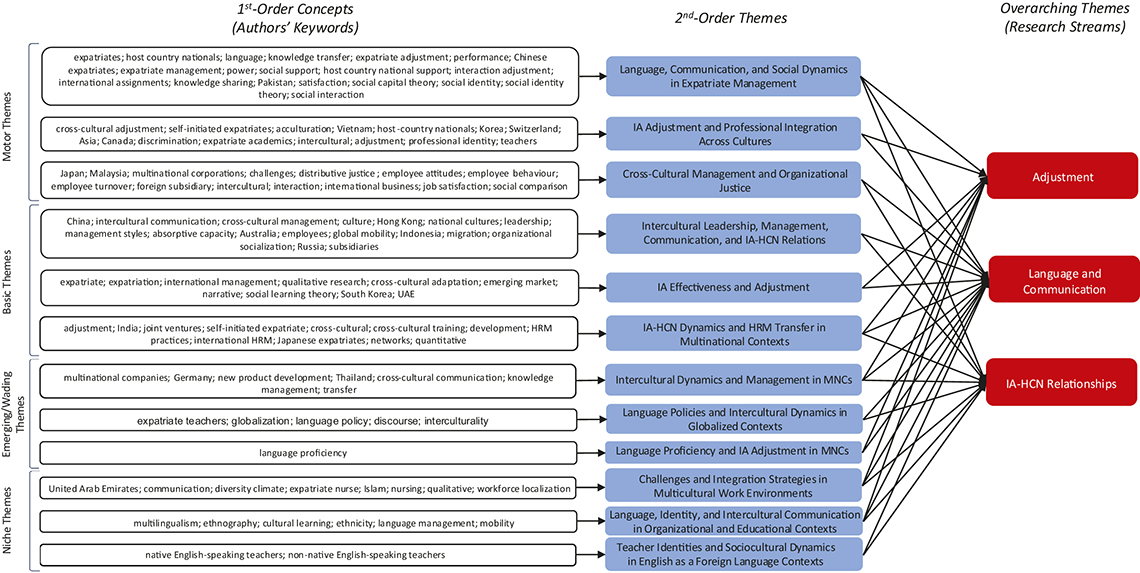
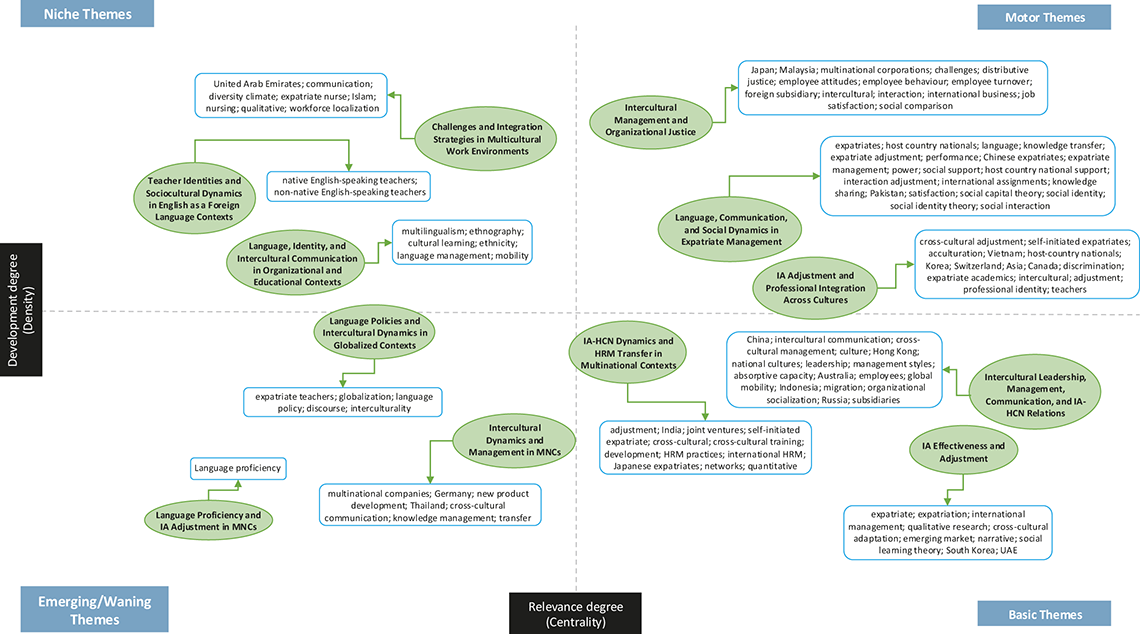
Based on the authors’ keywords, we plotted a conceptual map (see Figure 5) to illustrate the development of the themes in the IA–HCN interactions field over time (1989–mid 2024). This longitudinal analysis allowed us to better understand the expansion and internal dynamics of the field (Sharma et al., Reference Sharma, Kraus, Srivastava, Chopra and Kallmuenzer2022). Thematic mapping analysis identified twelve themes shown in ovals in Figure 5, which we defined through a thematic analysis of twelve clusters of keywords (first-order concepts) listed in rounded rectangles in Figure 5. Specifically, we defined (second-order) themes (see also Figure 6 in Section 3) by referring to studies clustered through thematic mapping analysis, for a more contextualized understanding of those concepts. This was especially useful for clusters with a low number of keywords (e.g., articles in the cluster with the keyword “language proficiency” were conceptually linked by the theme of Language Proficiency and IA Adjustment in MNCs).
Thematic map based on authors’ keywords.
Development of research streams based on thematic analysis of authors’ keywords.
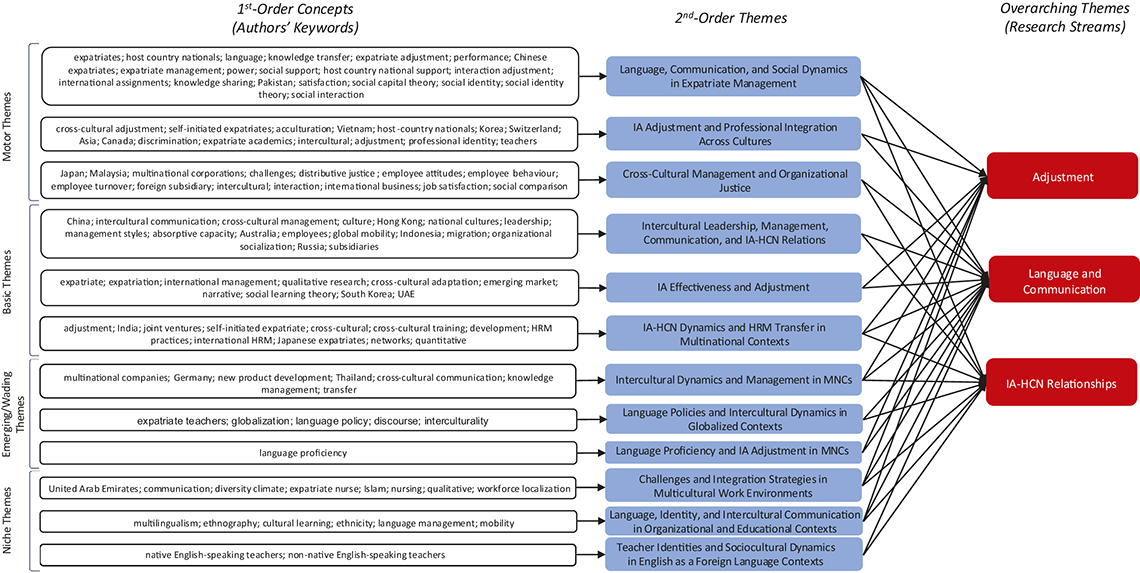
The twelve subsequent themes are mapped on two dimensions: (1) Callon’s centrality, which indicates the relevance of the themes by quantifying the degree of interaction between them; and (2) Callon’s density, which indicates the degree of development of the themes by quantifying their internal strength (Callon et al., Reference Callon, Courtial, Turner and Bauin1983). These dimensions form four quadrants: (a) motor themes (high density and high centrality) that are significant and well-developed, (b) basic themes (low density and high centrality) that are significant but underdeveloped, (c) niche themes (high density and low centrality) whose significance is marginal, and (d) emerging/declining themes (low density and low centrality) that are poorly developed and less significant (Bretas & Alon, Reference Bretas and Alon2021; Sharma et al., Reference Sharma, Kraus, Srivastava, Chopra and Kallmuenzer2022).
2.3.1 Motor Themes
The motor themes, which are driving the IA–HCN interaction field, include language, communication, and social dynamics in expatriate management, IA adjustment and professional integration across cultures, and intercultural management and organizational justice.
Language, Communication, and Social Dynamics in Expatriate Management
The most frequent cluster (frequency = 96) within the field of IA–HCN interactions comprises studies focusing on the multifaceted aspects of expatriate management, particularly the critical role of language and social dynamics in fostering successful international assignments and improving interactions between IAs and HCNs.
Research highlights the importance of corporate language proficiency (Peltokorpi, Reference Peltokorpi2015a), social interactions (Ewers, Reference Ewers2013), relationship-building, and effective communication through managing anxiety and uncertainty (Hsu et al., Reference Hsu, Chen, Chiang and Shaffer2024). For example, exploring the power dynamics associated with language and translation in MNCs, Logemann and Piekkari (Reference Logemann and Piekkari2015) explored the power dynamics associated with language and translation in MNCs, finding that language proficiency and the strategic use of translation can significantly influence organizational processes and employee interactions. Similarly, Heizmann et al. (Reference Heizmann, Fee and Gray2018) demonstrated the critical role of power and communicative relations in facilitating or hindering knowledge sharing between IAs and HCNs in Vietnam.
Furthermore, studies showed how language and communication barriers influence staffing decisions, such as the choice to send IAs or hire locals for foreign subsidiary CEO positions, underscoring the impact of effective communication on managerial effectiveness across geographically dispersed teams (Goodall & Roberts, Reference Goodall and Roberts2003; Tenzer et al., Reference Tenzer, Schulz, Klier and Schwens2020) and for maintaining managerial effectiveness across geographically dispersed teams. HCNs often act as boundary spanners, filling the semantic void in communication due to superior local language skills (Kuki et al., Reference Kuki, Kirk and Ridgway2021).
Cultural aspects also play a significant role in knowledge transfer processes. Jannesari et al. (Reference Jannesari, Wang, Brown and McCall2016) linked knowledge transfer with culturally dependent self-construal (i.e., independent vs. interdependent views of self), finding that IAs and HCNs in China with a more interdependent self-construal tend to be more successful in the knowledge transfer process. This sense of belonging via attachment to high-quality relationships was emphasized as a critical factor in shaping successful IA–HCN interactions.
Next, gender differences in IA adjustment were explored by Cole and McNulty (Reference Cole and McNulty2011), who found that female IAs often fit in better than their male counterparts due to higher levels of self-transcendence, facilitating smoother integration into the host country.
Furthermore, Detzen and Loehlein (Reference Detzen and Loehlein2018) investigated linguistic tensions between global Englishization and local multilingualism in highly multilingual professional contexts in Luxembourg, suggesting that language can create cohesion and division within firms. Social support has been shown to play a crucial role in shaping IAs’ adjustment, with advice from locals enhancing understanding and integration into the host culture (Bayraktar, Reference Bayraktar2019; Mahajan & Toh, Reference Mahajan and Toh2014). Organizational support is more effective when IAs perceive low social costs in seeking advice from HCNs (Mahajan & Hassan, Reference Mahajan and Hassan2024), and language skills are essential for gaining social support and enhancing work engagement (Abdul Malek et al., Reference Abdul Malek, Rahim Jaguli and Rizal Palil2013).
However, not all organizational support benefits IA–HCN interactions. Huang et al. (Reference Huang, Liu, Huang and Ding2020) revealed that creating a unique workplace environment similar to the IAs’ home country can generate cultural barriers that limit IA–HCN communication, causing cultural clashes and hindering project progress. Additionally, perceived favoritism towards IAs can lead to social comparisons, affecting workplace interactions (Kuki et al., Reference Kuki, Kirk and Ridgway2021; Yusuf et al., Reference Yusuf, Fontinha and Haak-Saheem2022).
Trust development through IA–HCN interactions is crucial for learning and work performance. Fee and Michailova (Reference Fee and Michailova2020) found that mutual trust is a prerequisite for HCNs’ learning, which occurs informally through interactions with IAs. Mumtaz and Nadeem (Reference Mumtaz and Nadeem2023) found that trust and intercultural communication positively impact group memberships between Chinese IAs and HCNs in Pakistan.
Perceptions also shape IA–HCN interactions. Bonache et al. (Reference Bonache, Sanchez and Zárraga-Oberty2009) showed how significant pay differences affect HCNs’ perceptions of pay fairness, leading to feelings of unfairness and adverse effects on workplace harmony and collaboration. In turn, Wyant and Kramer (Reference Wyant and Kramer2021) demonstrated how HCNs’ perceptions and expectations of IAs shape intercultural workplace dynamics, with discrepancies between expectations and observations leading to negative interpretations of IAs’ roles.
Moreover, perceived value similarity between IAs and HCNs and ethnocentrism can impede effective intercultural interactions and adjustment (Varma et al., Reference Varma, Pichler, Budhwar and Kupferer2012), while perceived similarity in beliefs can boost identity transformation and adjustment (Nadeem & Mumtaz, Reference Nadeem and Mumtaz2018). However, excessive adjustment may have negative implications for work relationships in the long run, as shown by an inverse U-shaped relationship between adjustment and trust/intercultural communication in Pakistan (Mumtaz & Nadeem, Reference Mumtaz and Nadeem2020), as well as a reversed relationship between IA adjustment and the development of a common social identity (Mumtaz & Nadeem, Reference Mumtaz and Nadeem2023). These counterintuitive empirical findings call for further research, to which we return in Section 5.
Language also moderates organizational actors’ perceptions. Lauring et al. (Reference Lauring, Vulchanov and Stoermer2023) found that high common organizational language (English as a lingua franca, ELF), but not the local language, can compensate for a weaker perceived reputation in predicting collaboration performance, highlighting the importance of linguistic capital in intercultural collaborations.
Finally, the frequency and quality of communication between HCNs and IAs are critical.
Jannesari et al. (Reference Jannesari, Wang and Zheng2021) found that communication frequency mediates the relationship between HCNs’ openness/extraversion and performance, emphasizing the role of intercultural communication in a multicultural workplace. Wang & Toh (Reference Wang and Toh2023) established the importance of interaction quality for successful international assignments in Taiwan. (Elo et al., Reference Elo, Silva and Vlačić2023) showed that the possibility to communicate with both HCNs and co-nationals is an important factor affecting international nurses’ satisfaction and shaping their global mobility patterns.
IA Adjustment and Professional Integration Across Cultures
The second cluster (frequency = 50) comprises research revolving around the themes of intercultural adjustment, IA experiences, and the professional integration of IAs in various international and multicultural contexts, as reflected by the occurrence of keywords with country names.
Studies have explored a range of factors shaping IA adjustment and IA–HCN interactions, including individual factors like language skills (Arseneault, Reference Arseneault2020), personality (Jannesari et al., Reference Jannesari, Wang, McCall and Zheng2017), culture-specific leadership orientation (task-/people-orientation), communication and conflict resolution skills (high/low-context culture), and power relationship styles (high/low power distance) (Wong et al., Reference Wong, Wong and Li2006). Other factors include beliefs about the ethnicity of IAs and HCNs (Fan & Kashima, Reference Fan and Kashima2022); prior international experience (Chen, Reference Chen2022; Yan et al., Reference Yan, Sautman and Lu2019); familial factors such as the impact of a spouse’s nationality on IA adjustment (Davies et al., Reference Davies, Kraeh and Froese2015; Ravasi et al., Reference Ravasi, Salamin and Davoine2015); organizational factors (Chen, Reference Chen2022; Konanahalli et al., Reference Konanahalli, Oyedele, von Meding, Spillane and Coates2012); and host-country factors like culture-specific communication styles, cultural dimensions (individualism/collectivism, hierarchical differences) (Arseneault, Reference Arseneault2020), political environment, and corporate policies (Yan et al., Reference Yan, Sautman and Lu2019).
Konanahalli et al. (Reference Konanahalli, Oyedele, von Meding, Spillane and Coates2012) emphasized the critical role of organizational support, such as training, social support, and mentoring, before and during assignments. Jannesari et al. (Reference Jannesari, Wang, McCall and Zheng2017) further found that supportive supervisor relations enhance adjustment by moderating the relationship between SIEs’ proactive personality and psychological availability (i.e., an individual’s belief that they are physically, cognitively, and emotionally ready or confident to engage the self with their colleagues).
Social networks and online support also play a role in IA adjustment. Froese (Reference Froese2010) showed how high-skilled Western migrants (e.g., bicultural and biracial individuals) leverage language skills and social networks to cope with discrimination in Korea and Japan, while enjoying the advantage of being foreigners to whom superior knowledge and skills are ascribed. Lakshman et al. (Reference Lakshman, Lakshman and Gok2020) linked biculturalism with adjustment through higher attributional accuracy, while Furusawa and Brewster (Reference Furusawa and Brewster2019) developed a model showing that boundary-spanning behavior is enhanced by knowledge of the host language and culture, social capital, and global career opportunities.
Lüdi (Reference Lüdi2013) discussed how receptive multilingualism can be a strategy for effective communication and resource sharing among social network members in Swiss workplaces. Hofhuis et al. (Reference Hofhuis, Hanke and Rutten2019) found that while social network contact with home-country relations provides online support, it may also lead to alienation and homesickness, as IAs place more emphasis on their own cultural heritage. By contrast, contact with host-country relations predicts participation in the host culture and social interaction, and strengthens friendships with locals.
Gender differences in IA adjustment were also observed in studies within this cluster. Salamin and Davoine, (Reference Salamin and Davoine2015) found higher international adjustment among female IAs in Switzerland, although no gender-based differences were seen in general adjustment.
Identity construction and diversity management in multicultural workplaces are other key areas of research, especially in international educational contexts (Eusafzai, Reference Eusafzai2015; Nguyen, Reference Nguyen2017; Schnurr & Zayts, Reference Schnurr and Zayts2012). For example, Nguyen (Reference Nguyen2017) showed how professional identity develops within IA and local teacher communities, while (Eusafzai, Reference Eusafzai2015) highlighted the social and cultural empowerment of students through localized pedagogy. In turn, Shin and Gress (Reference Shin and Gress2018) found that language deficiency diminishes the positive perceptions of international academics by local university managers in Korea.
Research also focuses on management and professional skills in international business contexts, with Park and Choi (Reference Park and Choi2014) highlighting the importance of communication and cultural skills for success in international business for both international and local managers (Neupert et al., Reference Neupert, Baughn and Dao2005).
Intercultural Management and Organizational Justice
The third motor cluster (frequency = 30) encompasses a research agenda on organizational justice and work outcomes in multicultural settings (Ahmad & Scott, Reference Ahmad and Scott2021; Hassan & Hashim, Reference Hassan and Hashim2011; Leung et al., Reference Leung, Wang and Smith2001; Peltokorpi et al., Reference Peltokorpi, Sekiguchi and Yamao2021), diversity management practices (Malik et al., Reference Malik, Madappa and Chitranshi2017; Shimoni, Reference Shimoni2011), and factors affecting the operations and integration of foreign subsidiaries (Ahmad & Scott, Reference Ahmad and Scott2021; Peik Foong & Richardson, Reference Peik Foong and Richardson2008; Peltokorpi, Reference Peltokorpi2015b), as well as IA commitment and retention (Akhimien & Adekunle, Reference Akhimien and Adekunle2023; Nguyen et al., Reference Nguyen, Felfe and Fooken2014).
Research on organizational justice and work outcomes shows the significant impact of perceived fairness in salary disparities between IAs and local employees (organizational justice) on job attitudes and satisfaction impacts job attitudes and satisfaction (Leung et al., Reference Leung, Wang and Smith2001). Managers’ practices that support IA–HCN relationships help mitigate HCNs’ negative perceptions (Ahmad & Scott, Reference Ahmad and Scott2021; Nguyen et al., Reference Nguyen, Felfe and Fooken2014). In higher education, organizational justice plays a crucial role in shaping teaching faculties’ job satisfaction, commitment, and turnover intentions (Hassan & Hashim, Reference Hassan and Hashim2011).
Language proficiency is pivotal in shaping perceived justice and work outcomes. In foreign subsidiaries in Japan, HCNs’ fairness perceptions, influenced by their English proficiency, affect their trust in IAs. High levels of English proficiency foster stronger IA–HCN relationships (Peltokorpi et al., Reference Peltokorpi, Sekiguchi and Yamao2021), in line with Anxiety/Uncertainty Management Theory (Gudykunst, Reference Gudykunst and Gudykunst2005) employed in Peltokorpi and colleagues’ study.
Studies on diversity management reveal the hybridization of local management cultures within MNCs, showing how global practices are adapted, resisted, or blended with existing local norms (Shimoni, 2011). They also examine how intercultural communication between IAs, HCNs, and other stakeholders, such as customers in the tourism and hospitality sectors, is managed and negotiated in everyday organizational practice (Malik et al., 2017).
Various factors influence international operations and integration in MNC subsidiaries. These include language policies and the nationality of top managers (Peltokorpi, Reference Peltokorpi2015b), language and communication problems perceived by HCNs (Ahmad & Scott, Reference Ahmad and Scott2021; Peik Foong & Richardson, Reference Peik Foong and Richardson2008), as well as cultural challenges, service quality, and operational dynamics (Ahmad & Scott, Reference Ahmad and Scott2021).
The commitment and retention of Western IAs in Vietnam are influenced by several work conditions, including job autonomy, leader support, and remuneration (Nguyen et al., Reference Nguyen, Felfe and Fooken2014). Additionally, perceived social support systems can buffer the adverse effects of cultural distance on IAs’ adjustment (Akhimien & Adekunle, Reference Akhimien and Adekunle2023).
2.3.2 Basic Themes
The basic themes, which are significant but underdeveloped, cover the following issues: intercultural leadership, management, communication, IA–HCN relations, IA effectiveness and adjustment, IA–HCN dynamics, and HRM transfer in multinational contexts.
Intercultural Leadership, Management, Communication, and IA–HCN Relations
This cluster (frequency = 69) focuses on leadership, management, and intercultural interactions in multicultural workplaces. It examines culture-specific leadership styles and IA–HCN intercultural interactions that facilitate access to local knowledge. Studies highlight how leadership and management practices are shaped by cultural contexts (Vora & Kainzbauer, Reference Vora and Kainzbauer2020; Yu & Huat, Reference Yu and Huat1995; Zhou et al., Reference Zhou, Lu and Jiang2005), addressing challenges and dynamics of intercultural leadership and competencies (Deng & Gibson, Reference Deng and Gibson2009; Suutari et al., Reference Suutari, Raharjo and Riikkilä2002; Wong et al., Reference Wong, Wong and Heng2007). Research also explores how IAs adapt to local management styles (Ferguson et al., Reference Ferguson, Nesta and Storey2007; Suutari et al., Reference Suutari, Raharjo and Riikkilä2002) and the role of social support in mediating the relationship between IAs’ psychological capital and burnout (Fu & Charoensukmongkol, Reference Fu and Charoensukmongkol2022).
Research investigates the adverse effects of cultural distance (Qin et al., Reference Qin, Ramburuth and Wang2008) and how it, combined with communication barriers, impacts knowledge transfer, as well as the positive effects of learning orientation and absorptive capacity (Ojo & Raman, Reference Ojo and Raman2015; Situmorang & Japutra, Reference Situmorang and Japutra2024).
Intercultural communication is another significant topic, examining nuances and challenges in multinational settings. Studies explore everyday interactions, such as small talk (Mak & Chui, Reference Mak and Chui2013) and stress from insufficient English competence and information shortage (Okamoto & Teo, Reference Okamoto and Teo2011). Research demonstrates how intercultural communicative skills help IAs overcome cultural difficulties and integrate with local employees (Djatmika et al., Reference Djatmika, Santosa and Wibowo2024). A common language and noncompetitive relationships between IAs and local employees foster a community of practice and social capital, providing IAs with access to local knowledge (Urzelai & Puig, Reference Urzelai and Puig2019).
Other studies reveal culture-based communication problems and differences in styles (Jonasson & Lauring, Reference Jonasson and Lauring2012; Zi & Linke, Reference Zi and Linke2021), including misinterpretations, misperceptions, misunderstandings, and strategies for effective intercultural IA–HCN interactions (Abdulai et al., Reference Abdulai, Ibrahim and Mohammed2017). Moreover, research examines the effects of IA–HCN communication on other organizational actors, such as students (Wong & Oh, Reference Wong and Oh2023), and on processes like brand internalization across borders (Tarnovskaya & de Chernatony, Reference Tarnovskaya and de Chernatony2011).
This cluster also addresses the HR challenges and IA–HCN relations, highlighting value gaps between IAs and local employees that affect management relations, community building, transparency, and planning horizons (Wong & Oh, Reference Wong and Oh2023; Zi & Linke, Reference Zi and Linke2021). Empirical data sometimes contradicts cultural predictions about intercultural relationships, such as the notion that East Asians are people-oriented and prefer high-context power relationships while Westerners are task-oriented and prefer low-context power relationships. For instance, Wong et al. (Reference Wong, Wong and Heng2007) found these predictions to be less accurate in intercultural interactions within multicultural workplaces.
IA Effectiveness and Adjustment
This cluster (frequency = 40) focuses on factors influencing IA effectiveness and adjustment, including the role of host language proficiency and communication with HCNs (AlMazrouei et al., Reference AlMazrouei, Zacca, Bilney and Antoine2016; Pekerti et al., Reference Pekerti, van de Vijver, Moeller, Okimoto and Edwards2021; Peltokorpi & Pudelko, Reference Peltokorpi and Pudelko2021; Siljanen & Lämsä, Reference Siljanen and Lämsä2009; Wilczewski et al., Reference Wilczewski, Søderberg and Gut2018), support from HCNs (often bearing costs for HCNs) (Fee, Reference Fee2020), informal ties and affective networks (Horak & Yang, Reference Horak and Yang2016), and IAs’ motivations and host cultural factors (Farcas & Gonçalves, Reference Farcas and Gonçalves2017),
Low host-language proficiency is seen as a significant obstacle to local knowledge, learning, decision-making processes, and IA interactional adjustment. It often leads to exclusion, social isolation, stress, frustration, and negative attitudes toward collaboration with local personnel (Wilczewski et al., Reference Wilczewski, Søderberg and Gut2018). Surprisingly, however, contrary to the assumption that higher language skills lead to better interactional adjustment, Peltokorpi and Pudelko (Reference Peltokorpi and Pudelko2021) found a curvilinear U-shaped relationship, where high proficiency increases outgroup categorization due to identity threat. Thus, these findings challenge the belief that higher language proficiency automatically improves relationships with local employees.
Similarly, Siljanen and Lämsä (Reference Siljanen and Lämsä2009) questioned the prevailing assumption that communication with HCNs leads to higher cultural adjustment. Their qualitative study found that factors like career advancement, local host community, and ideology might be more significant for IA adjustment in Israeli–Palestinian contexts.
Horak and Yang (Reference Horak and Yang2016) uncovered that culture-distinctive social ties, such as Yongo networks in South Korea, hinder IA adjustment, limiting their effectiveness. Studies explore how these elements contribute to or limit IAs’ success.
Factors influencing IAs’ success include intercultural skills, cultural intelligence (CQ), and contextual factors that constrain the application of these skills (Moon et al., Reference Moon, Choi and Jung2013; Wang et al., Reference Wang, Fan, Freeman and Zhu2017). Importantly, home-developed intercultural skills (among others, self-maintenance, interpersonal, and communication skills) may not always be transferable in host countries with different social expectations (Wang et al., Reference Wang, Fan, Freeman and Zhu2017). Research (Moon et al., Reference Moon, Choi and Jung2013) also finds positive associations between CQ and factors like self-monitoring, perception of promotion opportunities, prior international work experience, and interaction with HCNs.
IA–HCN Dynamics and HRM Transfer in Multinational Contexts
This cluster (frequency = 36) addresses the transfer of HRM practices in MNCs (Gamble, Reference Gamble2003; Hollinshead, Reference Hollinshead2017; Singh et al., Reference Singh, Pattnaik, Lee and Gaur2019), IA adjustment and performance (Bruning et al., Reference Bruning, Sonpar and Wang2012; Fu et al., Reference Fu, Hsu, Shaffer and Ren2017; Furusawa & Brewster, Reference Furusawa and Brewster2019; Harrison & Michailova, Reference Harrison and Michailova2012), IA–HCN interactions (Lauring et al., Reference Lauring, Guttormsen and McNulty2019; Varma et al., Reference Varma, Mathew, Wang, Budhwar and Katou2021), challenges faced by IAs such as structural inequalities (Botelho, Reference Botelho2021; Van Zolingen et al., Reference Van Zolingen, Essers and Vermeer2012), and the impact of local culture and institutional contexts on IA adjustment (Atay et al., Reference Atay, Bayraktaroglu and Chew2024; Mathew & Burgess, Reference Mathew and Burgess2023).
Regarding HRM practices, Singh et al. (Reference Singh, Pattnaik, Lee and Gaur2019) explore how cultural friction, especially the presence of parent-country nationals (PCNs) in foreign subsidiaries, affects subsidiary performance. Hollinshead (Reference Hollinshead2017) examines the micro-political complexities of operating over institutional distances in the pharmaceutical industry, emphasizing power, resistance, ethnicity, and language issues in HRM practice transfer.
Research on IA adjustment and performance highlights the important role of social ties and support (Harrison & Michailova, Reference Harrison and Michailova2012). However, Bruning et al. (Reference Bruning, Sonpar and Wang2012) noted a paradox where high network ties improve performance but hinder adjustment. In turn, Varma et al. (Reference Varma, Mathew, Wang, Budhwar and Katou2021) illustrate the unfolding of IA–HCN interactions over time, emphasizing perceived categorization and value similarity in securing HCN support and facilitating IA adjustment.
Challenges faced by IAs include structural inequalities, as seen in Botelho’s (Reference Botelho2021) study of Scandinavian IAs in Mozambique, who, by insisting on equality and autonomy as the basis for social interactions, engage in building social enclaves that reinforce structural inequalities by using domestic labor while refusing to recognize the implication of this structurally unequal employment in the local context. Finally, Mathew and Burgess (Reference Mathew and Burgess2023) use a case study of Toyota in India to demonstrate how disrespect by international managers toward local employees can lead to long-term industrial unrest and conflict due to clashes between global management practices and local norms.
2.3.3 Emerging/Waning Themes
The emerging and waning themes in this section cover intercultural dynamics and management in MNCs, language policies and intercultural dynamics in globalized contexts, and language proficiency and IA adjustment in MNCs.
Intercultural Dynamics and Management in MNCs
This cluster (frequency = 28) focuses on various aspects of MNCs and their operations in diverse cultural and geographical contexts. Most studies within this cluster have received a small number of local citations (TLC ≤ 1) and local citations within the last three years (TLCe ≤ 1), indicating that this theme appears to be waning than emerging, with the exception of Angouri (Reference Angouri2013) that has a TLCe = 1.
Key topics include knowledge management (Beaverstock, Reference Beaverstock2004), knowledge transfer (Awang et al., Reference Awang, Hussain and Malek2013), and HRM policies (Dickmann, Reference Dickmann2003) across regions. Studies also explored the role of language and IA–HCN interactions in forming transnational communities (Beaverstock, Reference Beaverstock2004; Urzelai & Puig, Reference Urzelai and Puig2019) and enhancing HCNs’ adjustment, ultimately impacting team performance and relationships among team members (Darawong & Igel, Reference Darawong and Igel2012).
Language policy and practices in MNCs are also examined. Angouri (Reference Angouri2013) explored language policy and language practices in a consortium of three MNCs, emphasizing a flexible, pragmatic approach to language use and the importance of multilingualism in workplace interactions. This study highlights the strategic (non)implementation of language policies and the interaction between local languages and English as the official corporate language.
Other studies focus on intercultural communication skills (Abugre, Reference Abugre2018) and their impact on IA adjustment, work outcomes, and locals’ adjustment (Darawong & Igel, Reference Darawong and Igel2012). Additionally, research explores local culture-specific communication and leadership styles (Vora & Kainzbauer, Reference Vora and Kainzbauer2020) and strategies for the effective transfer of HR practices, including factors such as cross-border communication, trust, and power distribution (Dickmann, Reference Dickmann2003).
Moreover, studies link communication with conflict management, showing how intercultural communication affects personal and relationship conflicts in multinational projects and MNCs. These studies highlight the importance of intercultural communication skills and understanding differing cultural patterns for managing interpersonal conflicts and improving relationships between IAs and local managers (Abugre, Reference Abugre2018; Darawong et al., Reference Darawong, Igel and Badir2016; Darawong & Igel, Reference Darawong and Igel2017).
Language Policies and Intercultural Dynamics in Globalized Contexts
This cluster (frequency = 14) explores the complexities of language, cultural integration, and professional dynamics in both educational and industrial settings, emphasizing the interplay between local and global influences and the unique challenges faced by IAs. Given the absence of trendy studies in this cluster (TLCe = 0) and the low number of overall local citations (TLC ≤ 3), these topics appear to be waning rather than emerging.
For example, Peltokorpi and Vaara (Reference Peltokorpi and Vaara2012) examine the recontextualization of language policies in foreign subsidiaries and the various models of integration and adaptation these policies undergo. This includes the emergence of hybrid language practices, the role of key actors, and the power implications of these policies.
International teachers in international schools face cultural and educational challenges, intercultural interactions, and professional development implications. Studies focus on interaction strategies and their impact on relationships between teachers and the perceptions of their roles by students and colleagues (Bridges & Emerald, Reference Bridges and Emerald2013; Bunnell & Poole, Reference Bunnell and Poole2022; Golis, Reference Golis2024; Shi, Reference Shi2017).
Research also explores local relations in the context of globalization, highlighting challenges for MNCs and local communities (Anderson & Delgado, Reference Anderson and Delgado2023; Léonard & Dion, Reference Léonard and Dion2003). For example, Anderson and Delgado (Reference Anderson and Delgado2023) examine the discursive construction of interculturality in the culturally hybrid Mexican city of San Miguel de Allende, emphasizing the dominant discourse of Americanization and resistant discourses from both locals and migrants, which problematize this hybridity in terms of its social and economic impacts on local communities.
Language Proficiency and IA Adjustment in MNCs
This cluster (frequency = 3) covers various aspects of language skills influencing IAs’ experiences and effectiveness in MNCs. This cluster exemplifies an emerging theme due to a relatively higher number of local and trendy citations (TLC ≤ 7, TLCe ≤ 2).
Studies in this cluster examine the critical role of language proficiency in shaping IA–HCN communication patterns and dynamics across different language-based communication zones (Babcock & Du-Babcock, Reference Babcock and Du-Babcock2001). They also explore the impact of IAs’ host language proficiency on IA–HCN interactions, social support, and adjustment (Zhang & Peltokorpi, Reference Zhang and Peltokorpi2016), and the role of local language proficiency in the development of organizational identification within MNCs, which influences IAs’ adaptation to the subsidiary (Ishii, Reference Ishii2012).
2.3.4 Niche Themes
Niche themes in this section include cultural and communication dynamics in multicultural work environments, language, identity, and intercultural communication in global organizational and educational contexts, and teacher identities and sociocultural dynamics in English as a foreign language (EFL) contexts.
Challenges and Integration Strategies in Multicultural Work Environments
The cluster (frequency = 23) primarily addresses the challenges and dynamics of communication, learning, and integration within diverse, multicultural, and IA-dominated environments. Key topics include barriers to managerial learning and adjustment, such as social identity vulnerabilities (Simon & Davies, Reference Simon and Davies1996); organizational communication in fostering a positive diversity climate, where Goby et al. (Reference Goby, Nickerson and David2015) highlight the need to re-establish indigenous communication practices to aid the integration of locals into the IA-dominated workforce; the language, communication, and relationship-building barriers of internationally educated nurses (Lum et al., Reference Lum, Dowedoff and Englander2016; Oakley et al., Reference Oakley, Grealish and Coyne2020) and IA-local nurse collaboration and challenges in knowledge sharing (Tjoflåt et al., Reference Tjoflåt, Karlsen and Sætre Hansen2016); barriers to information sharing caused by IA’s reluctance to share information with local employees in Dubai’s private sector (Goby et al., Reference Goby, Ali, Lanjawi and Al Haddad2017); and the role of home- and host-country mentors in Western IAs’ coping in the UAE (Tahir, Reference Tahir2021).
Moreover, Thomas (Reference Thomas2024) has linked the professional identities, language use, and cultural selves of English-speaking migrants in the UAE, emphasizing their propensity toward transnationalism, due to their transient and impermanent status. This indicates the need for further research on the sociolinguistic complexities of migrant populations.
Language, Identity, and Intercultural Communication in Global Organizational and Educational Contexts
The cluster of studies (frequency = 15) encompasses topics related to language, identity, and intercultural communication in globalized organizational and educational settings. Within the MNC context, a study on the relationship between language and social identity (Lauring, Reference Lauring2008) found that the relationship between language and social identity is negotiated in IA–HCN intercultural interactions, and that language is used symbolically in identity-making processes, leading to both polarization and accommodation between groups. Other topics include strategies to solve language and communication problems within MNCs (Nekvapil & Sherman, Reference Nekvapil and Sherman2009), IAs’ intercultural learning and the development of intercultural competence along various acculturation stages (Fernandez et al., Reference Fernandez, Mutabazi and Pierre2006), the impact of IAs’ cultural learning on IA–HCN collaboration (Wilczewski et al., Reference Wilczewski, Søderberg and Gut2019), and language ideologies and organizational relationships (Kim & Angouri, Reference Kim and Angouri2023), which show how linguistic differentiation is used to negotiate power dynamics and group membership, offering insights into the complex linguistic landscape of multinational workplaces.
Beyond MNCs, research has focused on the intercultural competences needed for effective intercultural interactions in NGOs (Charleston et al., Reference Charleston, Gajewska-De Mattos and Chapman2018), and the role of multilingualism in defining organizational members as “expats” versus “locals” and constructing mobile humanitarians’ privilege within the Red Cross (Garrido, Reference Garrido2017).
In higher education contexts, studies explore correlates such as linguistic abilities and educational experiences that contribute to intercultural communication competence in multilingual student populations (Al-Sumait et al., Reference Al-Sumait, Tryzna, Alkazemi and Boone2022) and the experiences of international English language teachers in Hong Kong, focusing on their adaptation and mobility patterns (Lam, Reference Lam2013).
Teacher Identities and Sociocultural Dynamics in English as a Foreign Language Contexts
This cluster (frequency = 4) explores the dynamics of native English-speaking (NES) and non-native English-speaking (NNES) teacher identities and sociocultural influences in English as a Foreign Language (EFL) contexts. Specifically, Cheng and Zhang (Reference Cheng and Zhang2021) found that EFL teachers’ language and sociocultural backgrounds impact their pedagogical practices in written feedback provision, showing significant differences between NES and NNES teachers at a Chinese university.
In turn, Yim and Hwang (Reference Yim and Hwang2019) examined the identities of NES and NNES primary school teachers in South Korea, identifying two different types of symbolic capital shaping hegemonic relations that construct an antagonistic collective habitus between international and local teachers: “native-speakerism” and “qualified tenured teacher.” They found that intercultural relationships characterized by power fluctuations shape teachers’ professional identities, increasing their dissatisfaction with their current roles.
3 Research Structure of International Assignee–Host Country National Interactions
3 Overview
This section outlines the research structure of the IA–HCN interactions field as identified through our analysis, comprising three main streams: adjustment; language and communication; and IA–HCN relationship. These streams intersect with disciplines such as communication, linguistics, psychology, human resource management, and international business. Through thematic and content analyses, we present the current state-of-the-art within each stream, highlighting key studies that have contributed significantly to our understanding of IA–HCN interactions.
3.1 Identification and Validation of Research Streams
We combined thematic and content analysis to establish the research streams of the IA–HCN interactions field. Figure 6 shows the development, through Gioia methodology (Gioia et al., Reference Gioia, Corley and Hamilton2013), of three major research streams: adjustment; language and communication; and IA–HCN relationships. These streams were derived from the first-order concepts identified through thematic mapping, as discussed in Section 2.3. The figure also details the motor, basic, emerging/waning, and niche themes associated with each stream.
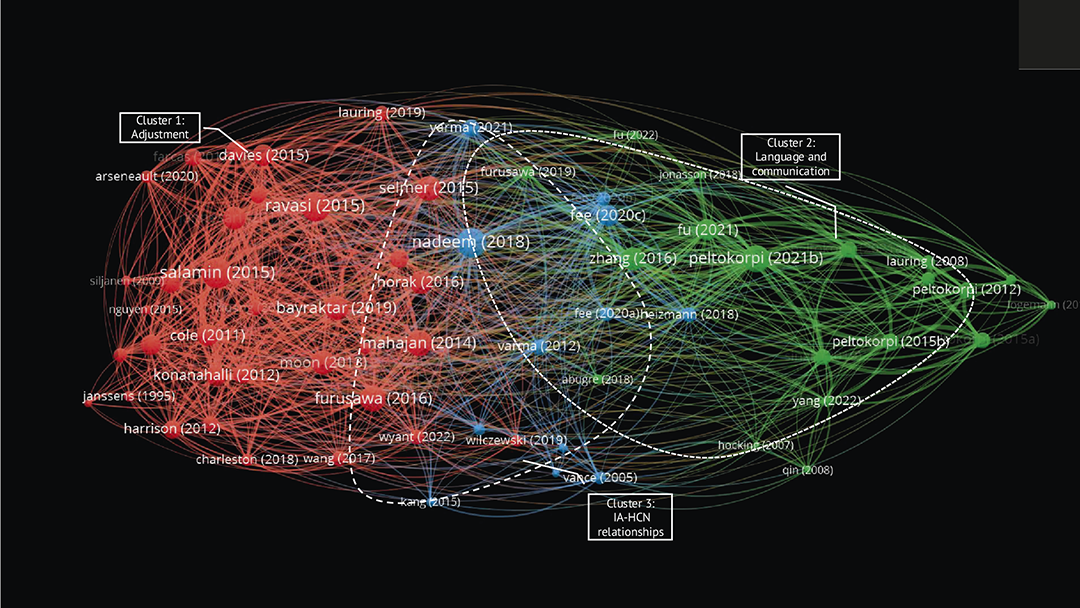
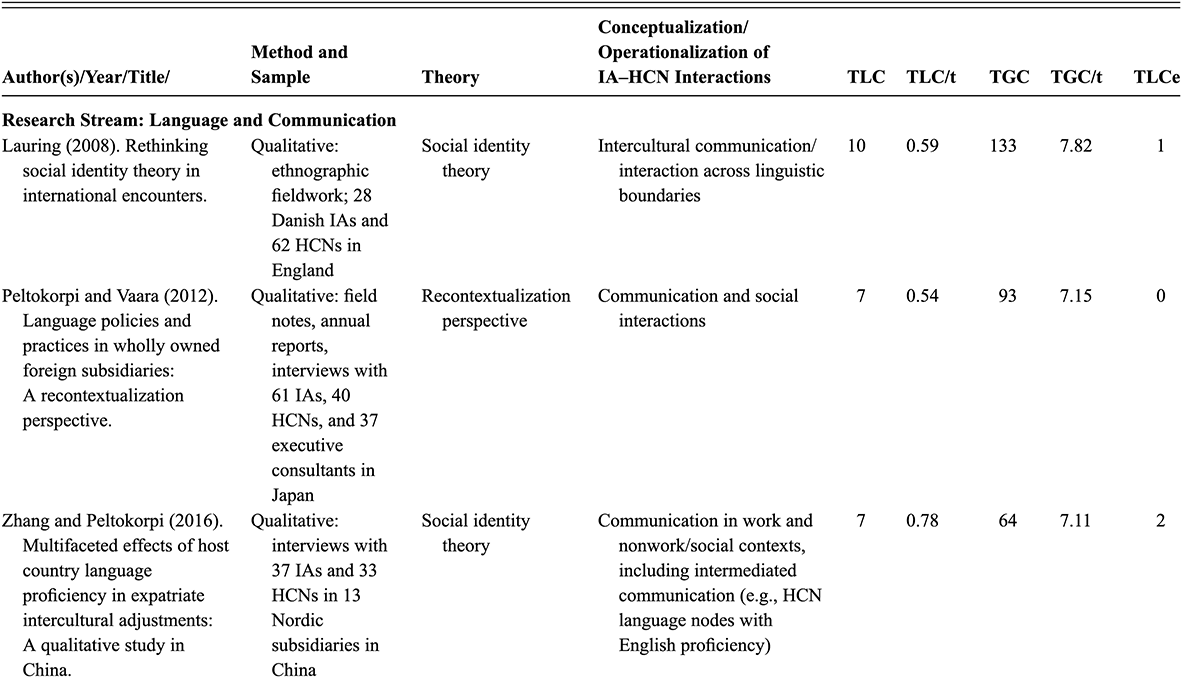
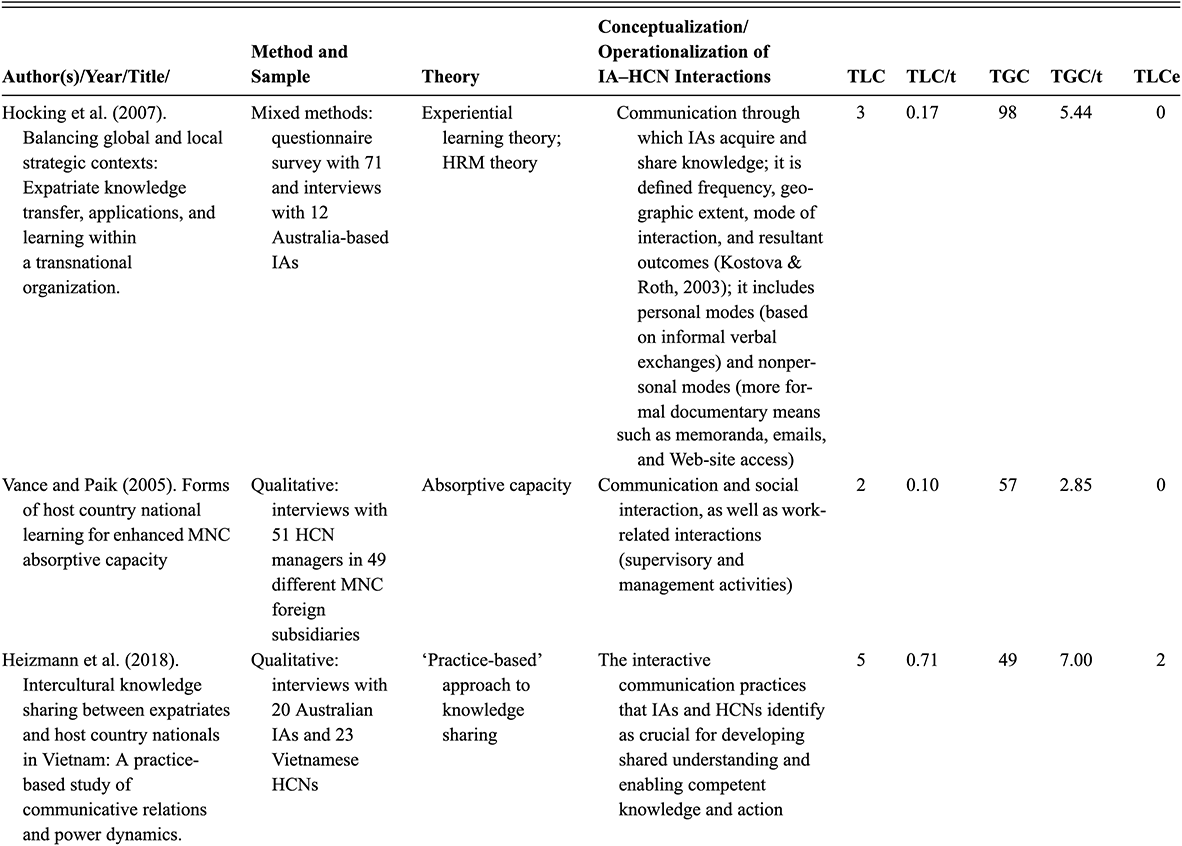
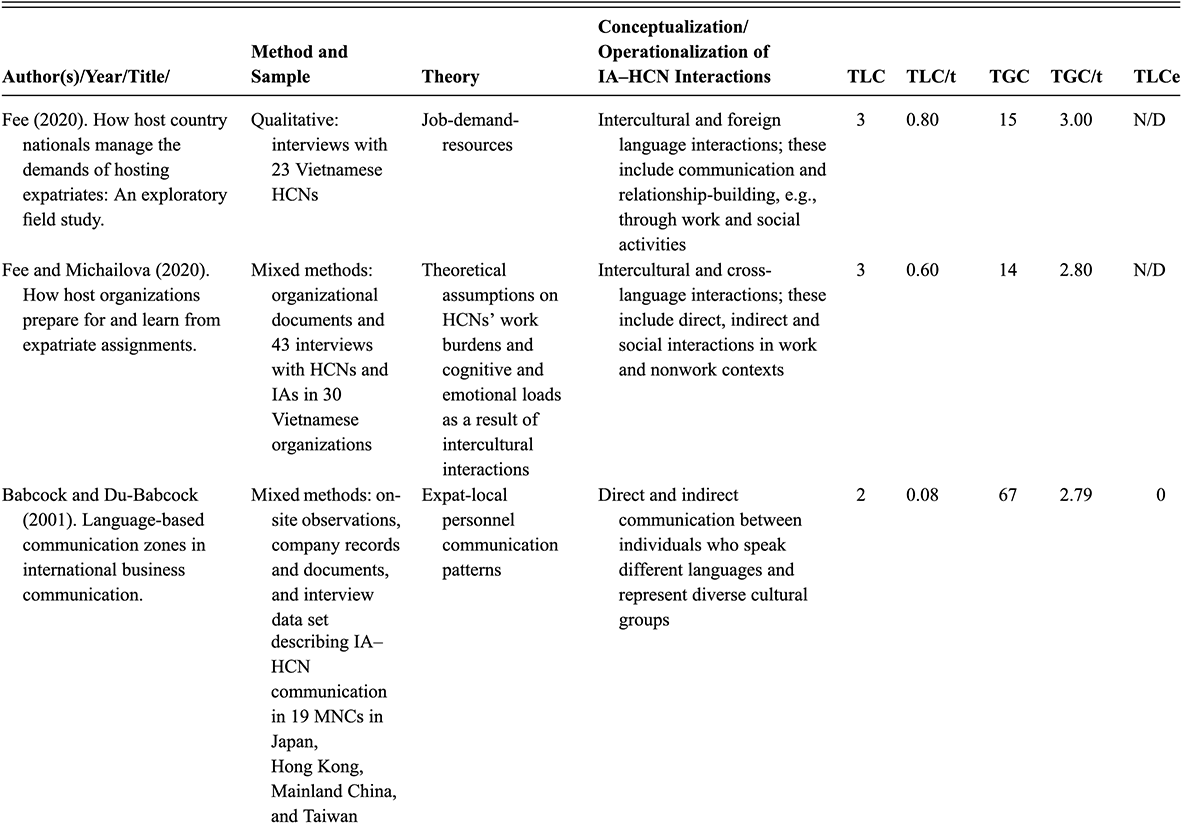
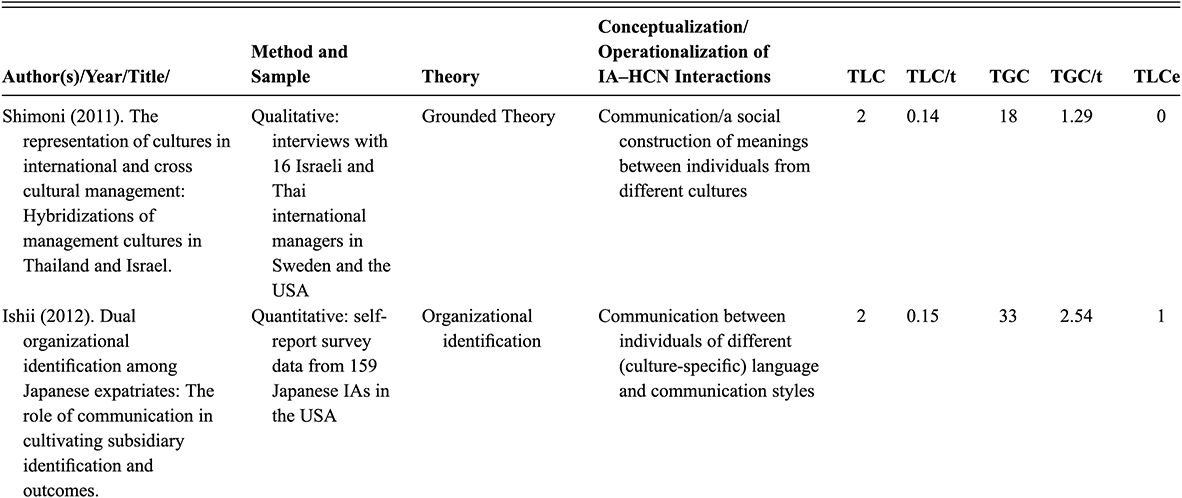
To further validate the streams, we performed bibliographic coupling analysis of 139 most impactful documents in terms of the number of citations (≥ 5) and links with other documents (≥ 50) (see Figure 7) as well as content analysis of the most impactful articles (see Table 3), which confirmed the number and meaning of the streams.
Bibliographic coupling of documents (Source: VOSviewer).
Note: Citations of the document ≥ 5; link strength ≥ 50.
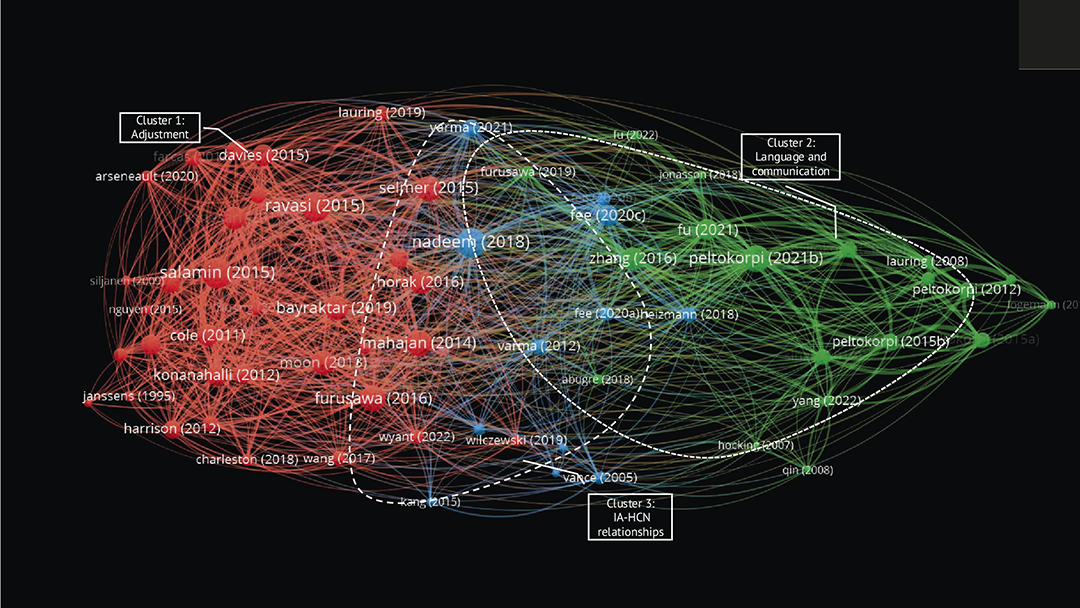
Figure 7 Long description
This dense network diagram illustrates bibliographic coupling among documents, marked with labels showing author/year. Three major clusters are visible: Cluster 1 (red), labeled “Adjustment,” on the left; Cluster 2 (green), labeled “Language and communication,” on the right; and Cluster 3 (blue), labeled “IA–HCN relationships,” at the bottom center. The diagram shows substantial within‑cluster cohesion, as well as multiple cross‑cluster links, indicating intellectual overlap between the clusters.
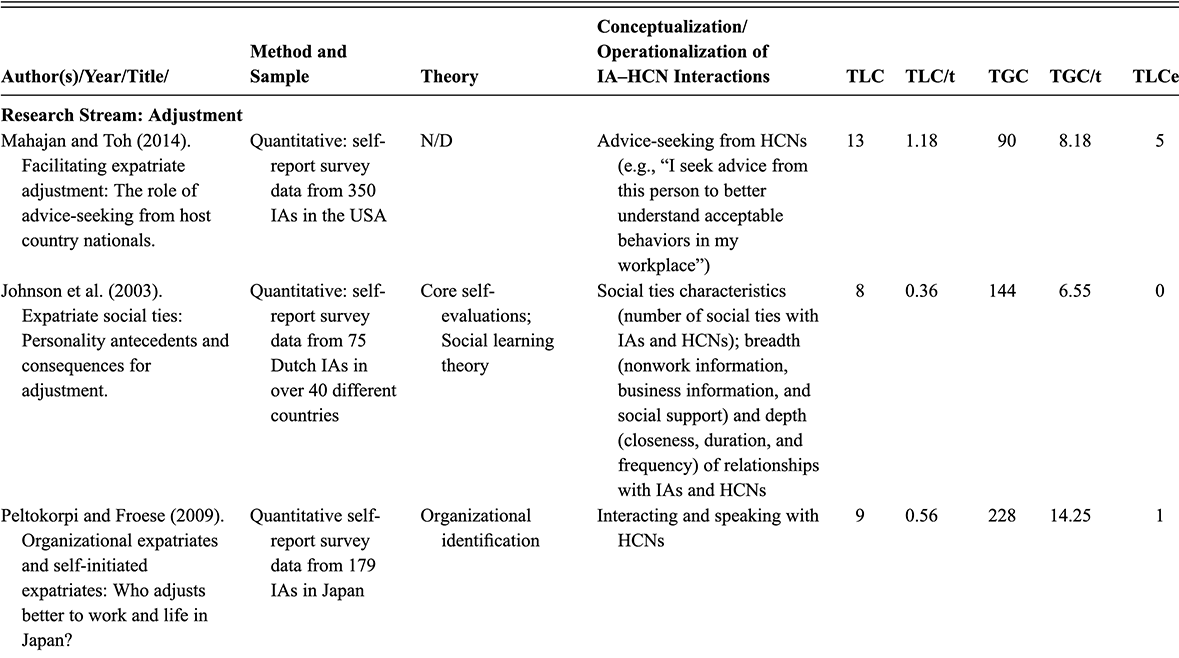
Table 3a Long description
Table 3a (page 34) presents the heading ‘Table 3. The twenty-seven most impactful articles (TLC ≥ 2) within three research streams (sorted by TLC)’ and the first articles in the list. Columns report: (1) Author(s)/year and method and sample; (2) Corresponding IA–HCN interaction research stream (Adjustment, Language and Communication, or IA–HCN Relationships); (3) Theory used; and (4) bibliometric indicators TLC, TLC/t, TGC, and TGC/t. The entries on this page include highly cited foundational studies that focus mainly on adjustment and language/communication, using qualitative, quantitative, or mixed methods, and drawing on theories such as social learning and social identity. Citation values are relatively high compared to later rows, reflecting these papers’ influence.
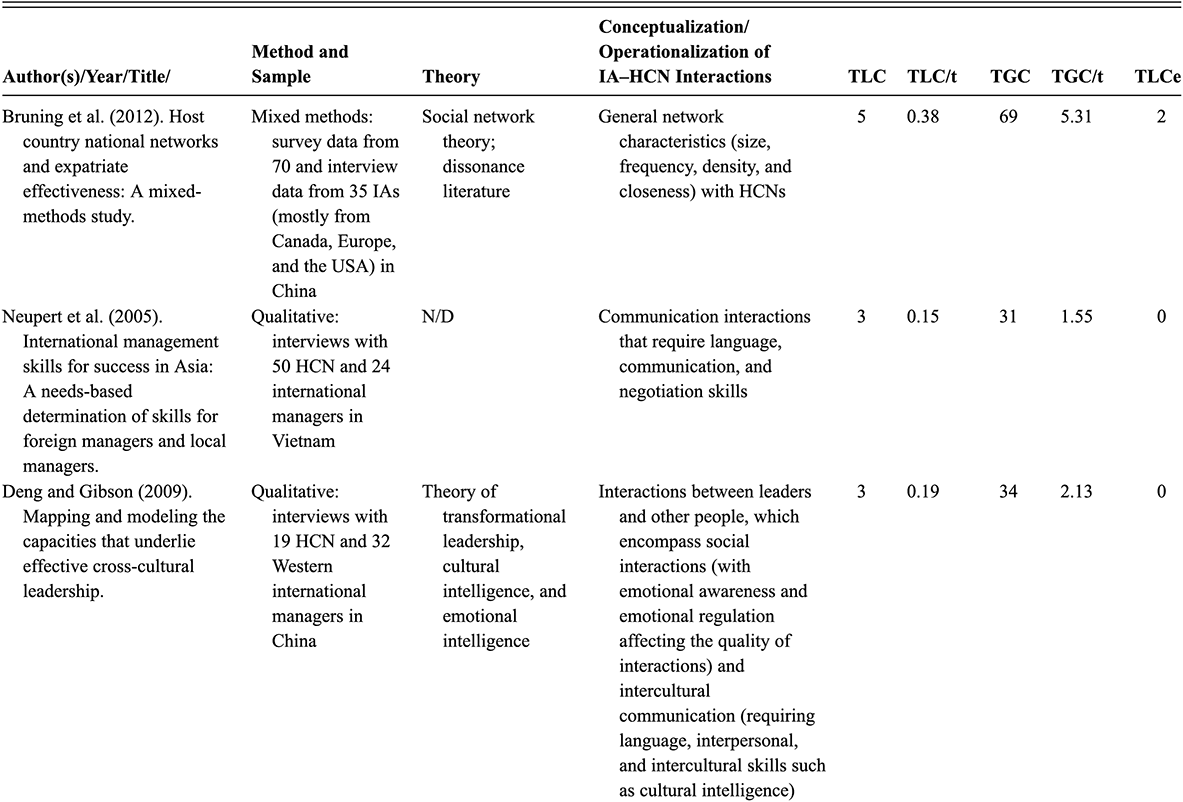
Table 3b Long description
Table 3b (page 35) continues Table 3, adding more rows of articles ranked by total local citations. The same columns are shown: authors/year with method and sample; research stream; theory; and four citation indicators. This segment contains articles that still rank relatively high but generally have slightly lower local and global citation scores than those on the previous page. The studies cover a range of topics within the three streams, including adjustment, IA–HCN relationships, and language/communication, often based on field surveys or case-based qualitative designs.
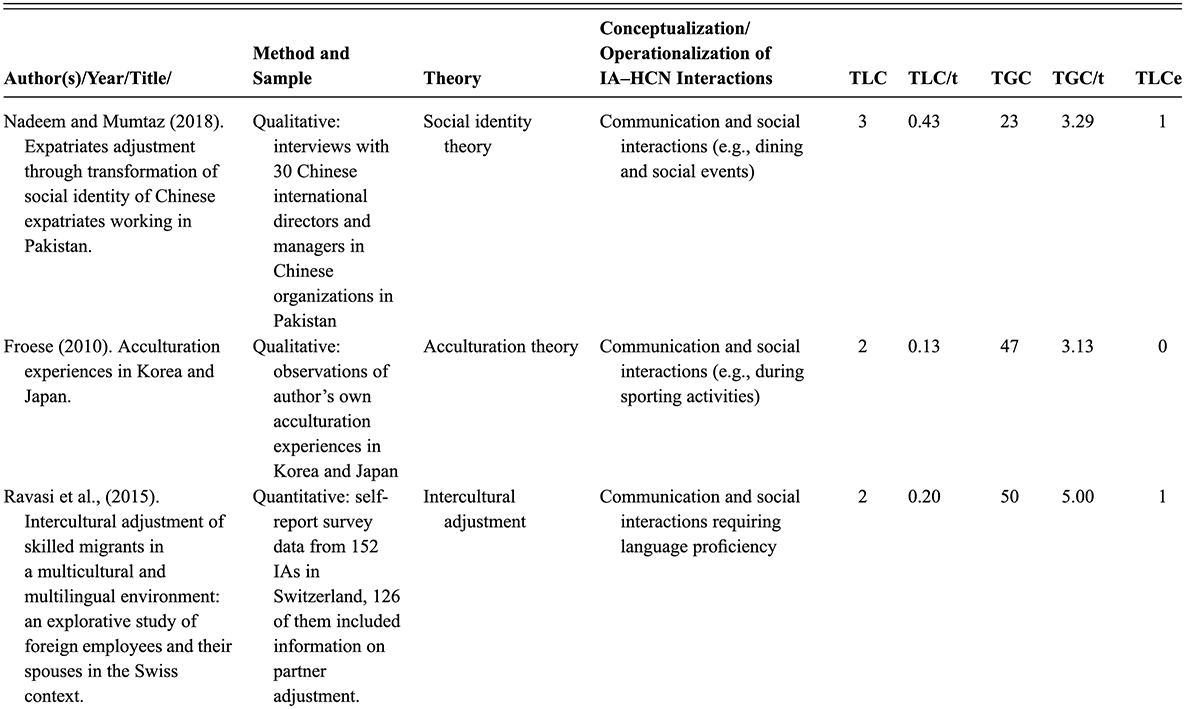
Table 3c Long description
Table 3c (page 36) is labeled ‘Table 3 (cont.)’ and lists additional articles from the same ranked set. The columns remain identical: author(s)/year and method/sample; corresponding research stream; theory; and bibliometric metrics (TLC, TLC/t, TGC, TGC/t). The papers on this page represent mid-ranked contributions that extend the three streams into more specific contexts (e.g. particular host countries, sectors, or role configurations), with modest but notable citation counts. Methods include both quantitative surveys and qualitative fieldwork, and the theoretical lenses range from organizational justice to intercultural communication and knowledge transfer.
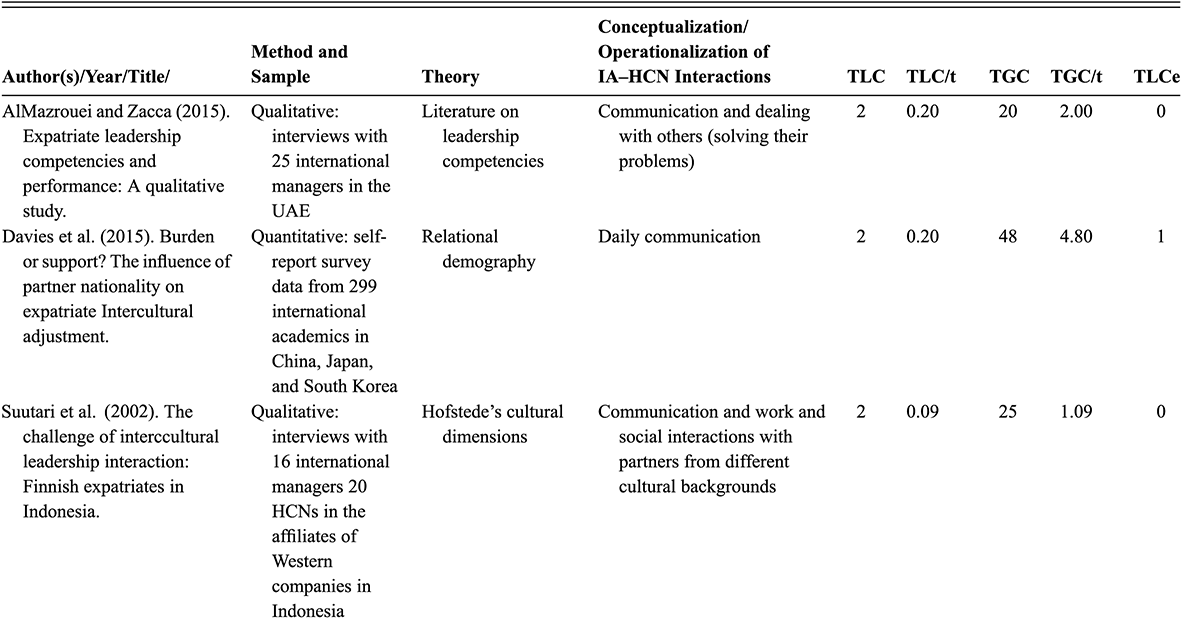
Table 3d Long description
Table 3d (page 37), again marked ‘Table 3 (cont.)’, adds further rows for impactful IA–HCN interaction articles. The structure is unchanged: for each study, the table records who conducted it and when, how the research was carried out and with which sample, which of the three research streams it belongs to, which theoretical framework was applied, and its local and global citation counts and per-year averages. The entries on this page mainly represent solid but not top-tier citation impact within the dataset, and they illustrate diverse empirical foci, from expatriate adjustment and intercultural leadership to HRM transfer and IA–HCN relationship dynamics.
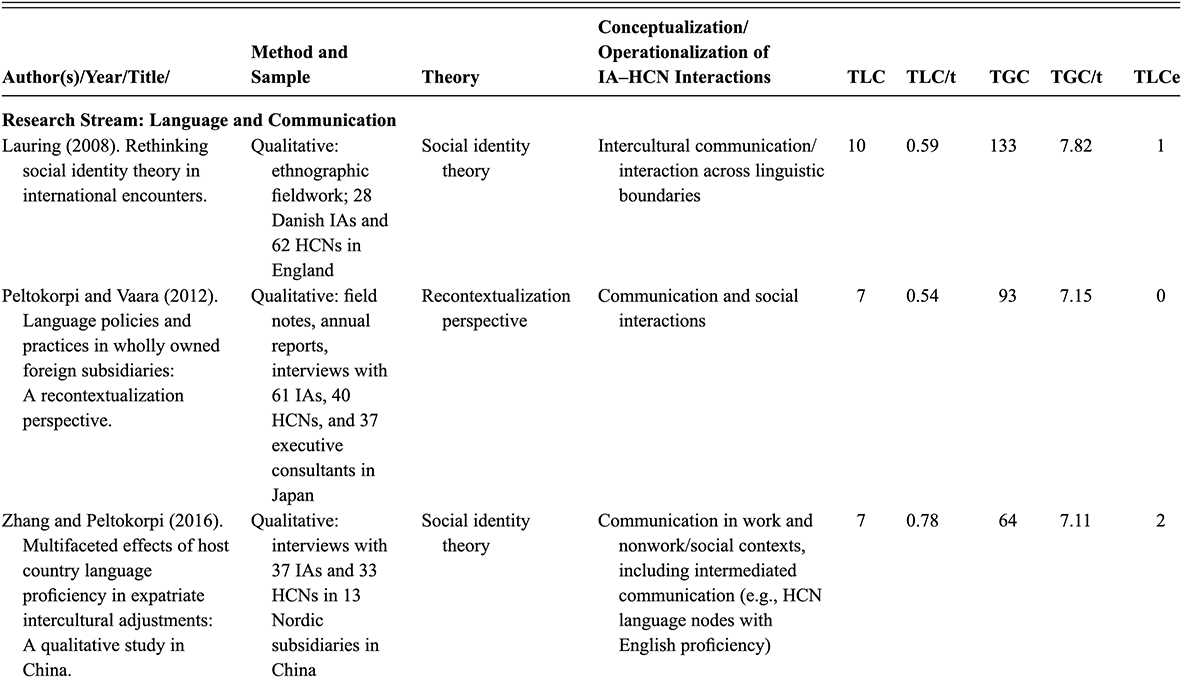
Table 3e Long description
Table 3e (page 38), also headed ‘Table 3 (cont.)’, presents more mid- to lower-ranked articles in the sample of 27. Each row provides the author(s) and year, a brief description of method and sample, the assigned research stream (Adjustment, Language and Communication, or IA–HCN Relationships), the main theoretical basis (e.g. social capital, intercultural communication, knowledge management), and the four HistCite citation metrics. Papers on this page have smaller TLC and TGC scores but still meet the TLC ≥ 2 threshold and contribute to the conceptualization of IA–HCN interactions in various organizational contexts.
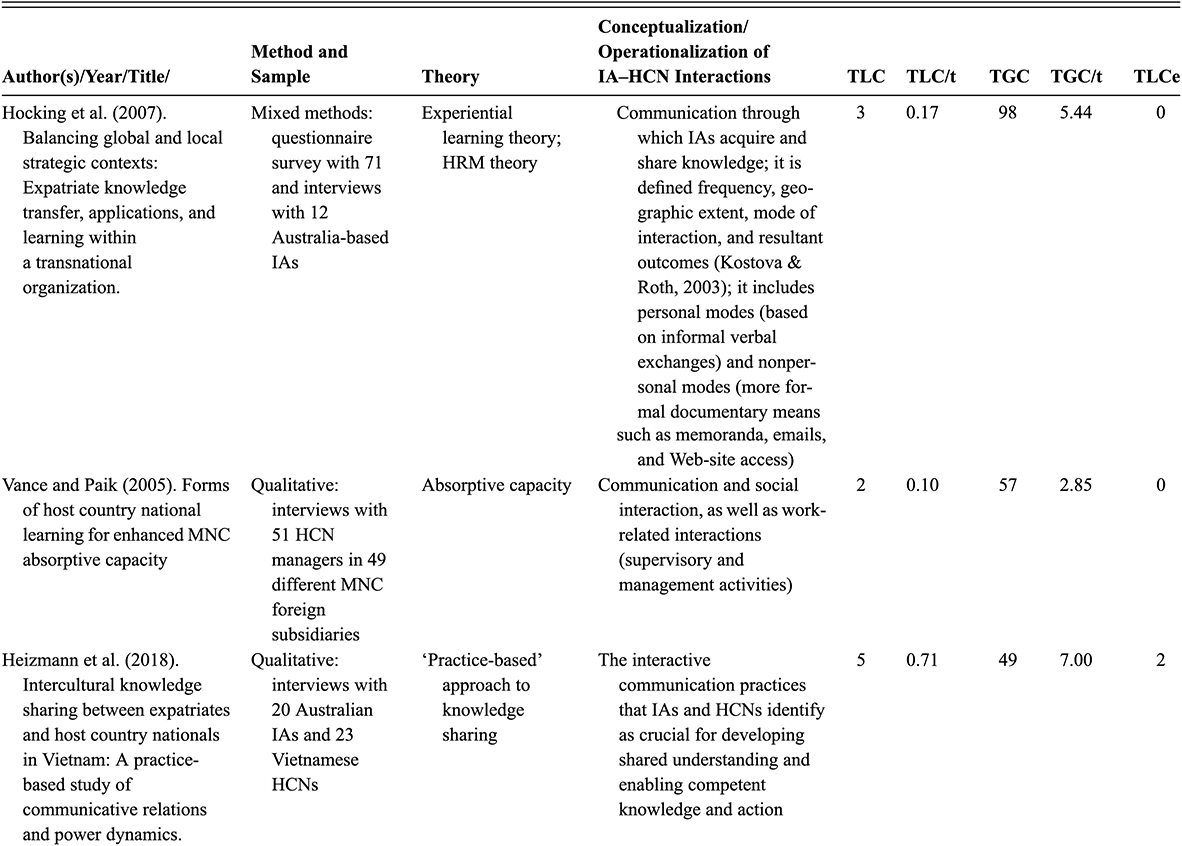
Table 3f Long description
Table 3f (page 39), labeled ‘Table 3 (cont.)’, extends the list to include further studies with relatively lower but still significant local citations. As before, each row shows the article’s bibliographic details, method (e.g. quantitative survey, qualitative case study, or mixed methods), the research stream category, the theoretical lens (such as acculturation or intercultural management), and citation indicators. This section showcases work that refines or extends the three streams, often dealing with more specific populations (e.g. particular professional groups or regions) and adding empirical nuance to earlier, more highly cited contributions.
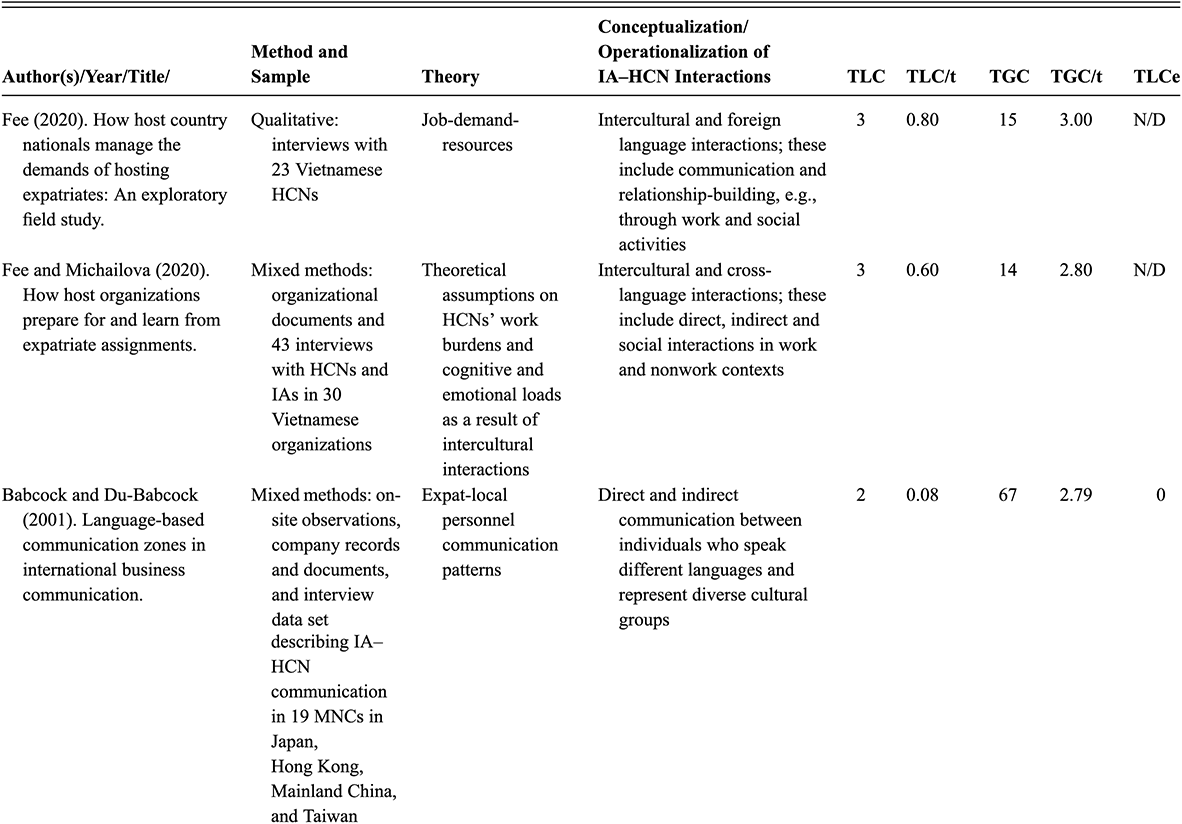
Table 3g Long description
Table 3g (page 40 and the first row on page 41), marked ‘Table 3 (cont.)’, contains a small set of rows toward the lower end of the 27-article ranking. It follows exactly the same structure: author(s)/year and method/sample, research stream category, theory, and the four citation metrics. On page 40, several articles are fully listed; the first row on page 41 completes the last of these entries, ensuring the reader sees the full description and citation statistics. These studies typically have TLC values just above the cutoff (e.g. 2–3), with correspondingly modest global citation counts, but they round out the sample by covering under-represented contexts or more emergent topics inside the three streams.
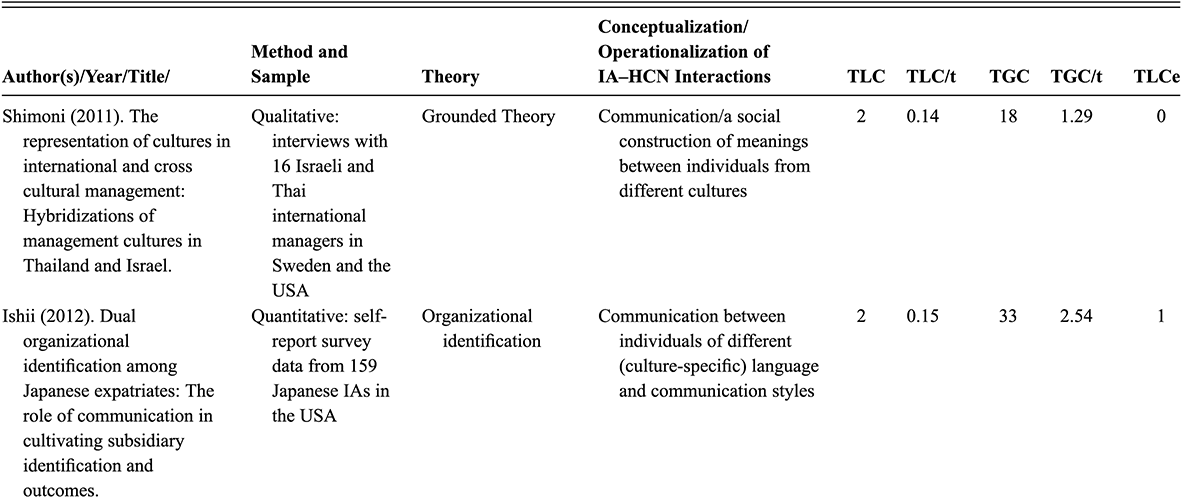
Table 3h Long description
Table 3h (page 41, second and third rows) shows the final article rows that appear on that page. Each of these entries follows the same column pattern: it identifies the article (author/year) and its empirical method and sample, assigns it to one of the three research streams, notes the primary theoretical framing, and lists TLC, TLC/t, TGC, and TGC/t values. These are among the least cited of the 27 most impactful papers (but still TLC ≥ 2), illustrating how the tail end of the ranked distribution includes smaller, focused contributions to IA–HCN adjustment, communication, or relationship research.
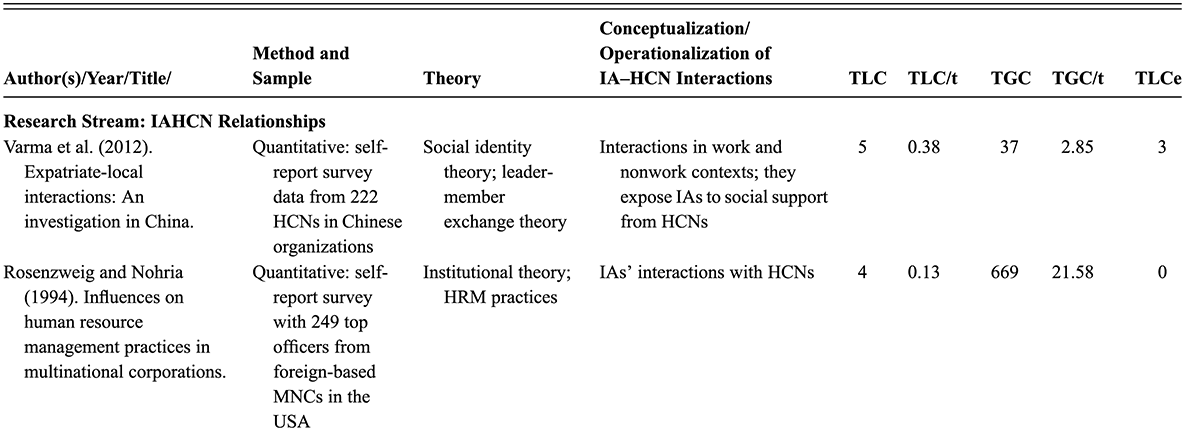
Table 3i Long description
Table 3i (page 42), labeled ‘Table 3 (cont.)’, presents the final full batch of article rows before the table’s concluding notes. The layout and content remain consistent: each article is identified by author and year, method and sample description, placement in one of the three research streams, theoretical underpinning, and four citation measures from HistCite. These entries typically have the lowest citation counts within the 27 selected studies but are included because they still exceed the TLC ≥ 2 threshold and contribute distinct evidence or perspectives to the IA–HCN field.
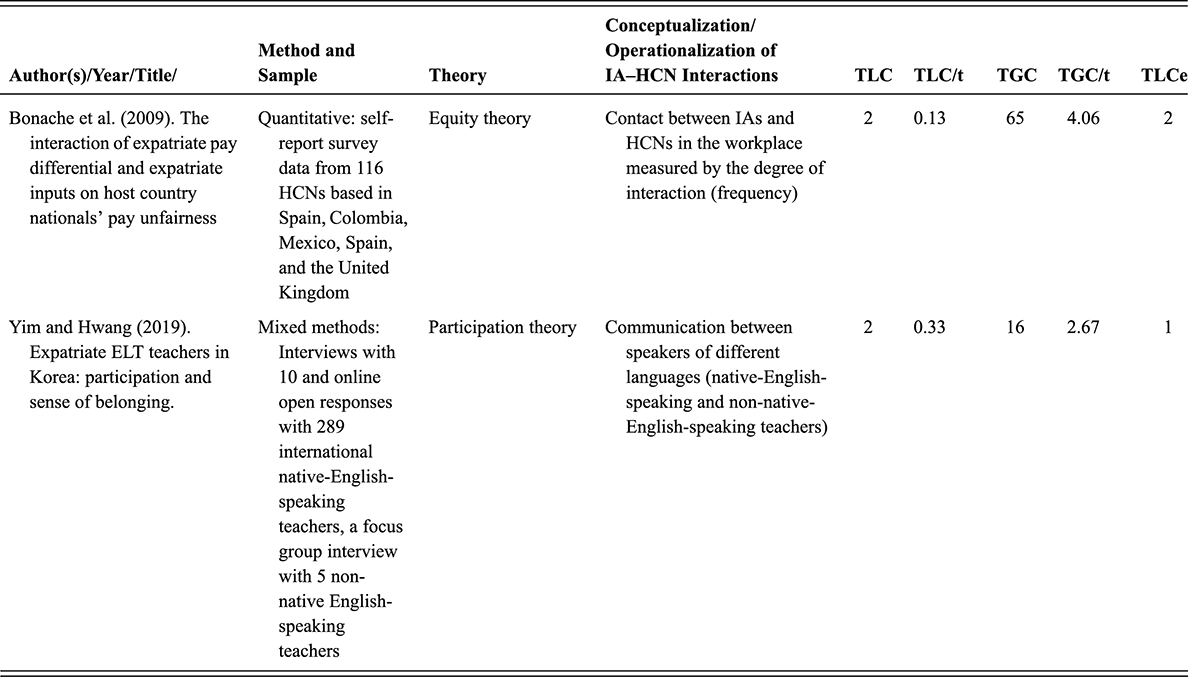
Table 3j Long description
Table 3j (page 43) completes Table 3. It includes the remaining article row(s) from the ranked list, formatted with the same columns—authors/year and method/sample, research stream, theory, and citation metrics—followed by two table notes. Note 1 explains that all indices (TLC, TLC/t, TGC, TGC/t, TLCe) were retrieved from HistCite and clarifies that TLC is total local citations, TLC/t is average local citations per year, TGC is total global citations, and TGC/t is average global citations per year; TLCe refers to trending local citations at the end of the study period. Note 2 spells out abbreviations used throughout the table: IA stands for international assignee and HCN for host country national. This final segment closes the presentation of the 27 most impactful IA–HCN articles.
Note 1: All indices retrieved from HistCite: TLC = Total local citations; TLC/t = Average local citations per year; TGC = Total global citations; TGC/t = Average global citations per year; TLC/e = Trending local citations at the end of the period covered.
Note 2: IA = international assignee, HCN = host country national.
3.2 Major Research Streams in IA–HCN Interactions
In this section, we briefly describe the research streams based on the content analysis of the most impactful papers listed in Table 3. We limited the analysis to articles with local citations ≥ 2 to produce meaningful results that would not trade depth for breadth in our large dataset (209 articles). This search yielded twenty-seven most frequently cited articles (13 percent of the dataset), thus driving the field; this number corresponds with numbers suggested in the methods literature (Garfield et al., Reference Garfield, Paris and Stock2006).
The content analysis of the most impactful articles (see Table 3) revealed three streams of studies that differ in terms of methods, samples, theories, and impact on the development of the field as measured by local, global, and trending citation scores. Furthermore, these articles present varying conceptualizations of IA–HCN interactions, which will be discussed in greater detail in Section 4, focusing on the effects of these interactions.
The first research stream was defined as adjustment as it focuses on various aspects of adjusting to a new environment, including antecedents and outcomes of adjustment. The second research stream, language and communication, covers language use and communication practices between IA and HCNs. The third research stream concerns the nature and implications of IA–HCN relationships.
The majority of articles (thirteen) employed qualitative methods, followed by quantitative (nine) and mixed-research method designs (five). Half of the articles explored interactions in Asian countries, followed by Anglo-Saxon countries (seven articles), Indonesia, Pakistan, Sweden, and the UAE (one article each). Only two impactful articles (Johnson et al., Reference Johnson, Kristof-Brown, Van Vianen, De Pater and Klein2003; Vance & Paik, Reference Vance and Paik2005) used cross-national samples. The theoretical landscape was broad as the majority of articles used distinct theoretical perspectives. However, we found that social identity theory, which states that group membership constitutes a fundamental part of one’s feeling of belonging (Tajfel & Turner, Reference Tajfel, Turner, Jost and Sidanius2004), was most commonly applied to explain IA–HCN interactions (e.g., support from HCNs) (Varma et al., Reference Varma, Pichler, Budhwar and Kupferer2012) and links between language, social identity, and IA adjustment (Lauring, Reference Lauring2008; Nadeem & Mumtaz, Reference Nadeem and Mumtaz2018; Zhang & Peltokorpi, Reference Zhang and Peltokorpi2016).
In terms of impact, the most locally cited article (TLC = 13) was a study by Mahajan and Toh (Reference Mahajan and Toh2014), who found that IAs seeking advice from HCNs showed higher levels of work and interactional adjustment. This study was also most locally cited per year (TLC/t = 1.18) and was the most trending article (TLCe = 5), which suggests a growing interest in locals as a source of support for IAs. A study by Rosenzweig and Nohria (Reference Rosenzweig and Nohria1994), which revealed the significant effects of IA–HCN interactions on local human resource practices in MNCs, was most globally cited overall (TGC = 669) and per year (TGC/t = 21.58).
3.2.1 Adjustment
The first research stream was defined as adjustment as the publications within this stream focus on various adjustment domains (Black et al., Reference Black, Mendenhall and Oddou1991) as well as antecedents and outcomes of adjustment. Research into IA adjustment points to a variety of factors during the adjustment process, highlighting both similarities and differences in the findings.
Several studies have examined the role of individual skills and social ties in IA adjustment. Neupert et al. (Reference Neupert, Baughn and Dao2005) linked IAs’ and HCNs’ individual skills (e.g., professional, personal, and interpersonal skills, language and communication skills) and competencies (e.g., cultural understanding and awareness) with their adjustment. In their study of international management in Vietnam, both Vietnamese and international managers valued professional development, communication and cultural skills, and basic business skills in international business roles. For international managers, training in the local culture helped IAs become more efficient through understanding and awareness.
Similarly, in AlMazrouei and Zacca’s (Reference AlMazrouei and Zacca2015) study of international managers working within the UAE, communication ability, team-building qualities, and the ability to interact with HCNs were found to have a significant effect on IA adjustment. In cases with a low degree of IA adjustment, the same factors may explain the challenges, as in the case of Ravasi et al.’s (Reference Ravasi, Salamin and Davoine2015) study of IAs in Switzerland. Here, Ravasi et al. (Reference Ravasi, Salamin and Davoine2015) observe how inadequate language skills and inability to speak the local language as well as cultural distance led to difficulty establishing contacts with locals, which again explains low interaction adjustment for IAs.
Professional competencies, especially intercultural competencies, can be particularly important for successful adjustment for IA managers. In Deng and Gibson’s (Reference Deng and Gibson2009) study of Western international managers and local Chinese managers working in Australian businesses in China, findings showed how transformational leadership and emotional intelligence can contribute to effective leadership in multicultural environments. Hence, Deng and Gibson (Reference Deng and Gibson2009) emphasize the importance of intercultural leadership competencies for successful international leadership. Similarly, Suutari et al. (Reference Suutari, Raharjo and Riikkilä2002) found that when Western IA managers in Indonesia adapted to local norms, their local subordinates perceived their leadership as comparable to that of host country national (HCN) managers in most aspects.
In terms of interactional factors, Johnson et al. (Reference Johnson, Kristof-Brown, Van Vianen, De Pater and Klein2003) showed that IAs’ social ties with other IAs and HCNs predict their adjustment, confirming social learning theory and the idea that individuals acquire new behaviors by observing and modeling the actions of others (Caligiuri, Reference Caligiuri2000). As observed by Johnson et al. (Reference Johnson, Kristof-Brown, Van Vianen, De Pater and Klein2003), individual core self-evaluations – which consist of factors like self-esteem, generalized self-efficacy, emotional stability, and locus of control – help IAs form ties with other IAs and locals, impacting both general and work adjustment.
In general, IAs’ social networks are valuable sources for adjustment (Froese, Reference Froese2010). This is particularly true for social networks including HCNs, as they promote higher IA adjustment as compared to social ties with third-country nationals and home-country partners (Davies et al., Reference Davies, Kraeh and Froese2015). Interactions with HCNs can even lead to social identity changes for IAs, as observed by Nadeem and Mumtaz (Reference Nadeem and Mumtaz2018) in their study of Chinese IAs’ adjustment in Pakistan. However, this research also found that while IAs’ behaviors and work habits often change in response to their new environment, their core beliefs and values remain typically less affected.
Furthermore, in their study of IAs in the USA, Mahajan and Toh (Reference Mahajan and Toh2014) found that IAs’ who sought advice from HCN coworkers reported higher levels of both work and interaction adjustment. These findings call for active participation from IAs in seeking out advice needed to solve problems they experience. An important clarification is that HCNs are not the only or most important source of advice, but HCNs can be a significant resource and socializing agent when IAs allow them to take on this role.
However, the picture of IAs’ social networks is more nuanced, as some empirical research indicates mixed effects of HCNs on their adjustment. For instance, Bruning et al.’s (Reference Bruning, Sonpar and Wang2012) investigation of IAs in China found that although HCN colleagues may provide instrumental support to increase IAs’ job performance, they may not provide the sufficient emotional support needed to enhance IAs’ overall adjustment. This leads to a paradoxical situation where stronger network ties with HCN colleagues are positively associated with IAs’ performance, but negatively associated with IAs’ adjustment to their host-country environment.
While IAs’ interactions with HCNs at the workplace have been found to directly affect IAs’ adjustment, the effects of IAs’ personal interactions with partners appear to be more indirect. The role of partners in IA adjustment has been analyzed by Davies et al.’s (Reference Davies, Kraeh and Froese2015) study of international academics in China, Japan and South Korea. Here, findings showed that the foreign academics’ adjustment was not based on the nationality of their partners per se, but there was an interaction effect of partner nationality and the length of the stay in host country. IAs with HCN partners perceived the highest increase in intercultural adjustment over time, followed by those with third country national partners. In comparison, IA with home country partners did not experience any increase in intercultural adjustment.
Ravasi et al.’s study (Reference Ravasi, Salamin and Davoine2015) also considered partner adjustment in their above-mentioned study of IAs in Switzerland. Interestingly, when studying the effects of intercultural and language training programs offered to IAs and their partners, findings showed that these support practices were more strongly correlated with the adjustment of the IAs’ spouse than with the adjustment of the IA themselves.
Finally, the type of IA assignment has also been explored in terms of IA adjustment. Peltokorpi and Froese (Reference Peltokorpi and Froese2009) compared how self-initiated expats (SIEs) and organizational expats (OEs) adjusted to Japan as a new host-country environment. Results showed that SIEs were more adjusted to general cultural aspects of Japan, but that there was no statistically significant difference between the two groups in terms of work adjustment.
In conclusion, the research on IA adjustment reflects a complex mesh of personal attributes, cultural factors, professional skills, and personal relationships. It is clear that IA adjustment relies on a range of skills and the ability to negotiate social interactions both professionally and personally within the new cultural context.
3.2.2 Language and Communication
The second research stream was defined as language and communication. Research in the field of language and communication in IA–HCN interactions has, among other things, examined the importance of host-language proficiency in these exchanges. Zhang and Peltokorpi (Reference Zhang and Peltokorpi2016) highlight how host-country language proficiency has multifaceted effects on IAs’ interactions, social support, and adjustment. Command over the local language enables IAs to foster personal relationships with HCNs, aiding their integration. This underscores the linguistic boundary that exists between IAs and HCNs and its influence on both professional and nonprofessional settings.
Host-language proficiency can also be important for IAs’ development of organizational identification, in line with social identity theory, which states that group membership constitutes a fundamental part of an individual’s feeling of belonging (Hogg & Terry, Reference Hogg and Terry2000). Ishii’s (Reference Ishii2012) study of Japanese IAs in the USA demonstrated the significance of local language proficiency in the development of identification with the subsidiary. In turn, Ishii (Reference Ishii2012) found that local organizational identification was related to IAs’ stress level in their international assignments. As argued by Lauring (Reference Lauring2008), identity-making may be actualized by competition for resources and recognition within an organization. As such, language can be used strategically to facilitate these identity-making processes.
As demonstrated by Peltokorpi and Vaara (Reference Peltokorpi and Vaara2012), language practices within MNCs are complex, and shaped by a combination of firm-specific factors, social interactions, individual competencies, and social positions. Through observations of IAs in Japan, Peltokorpi and Vaara (Reference Peltokorpi and Vaara2012) found that language practices in the subsidiary emerged from the interplay of HQ strategies and local responses, rather than through top-down transfer from HQ or other MNC units. Within large, geographically dispersed organizations, different communication practices can be thought of as different communication zones (Babcock & Du-Babcock, Reference Babcock and Du-Babcock2001).
Research has found that IA–HCN interactions are instrumental in optimizing the MNC’s foreign operations by, among others, enhancing relationship building and knowledge generation and flow throughout the MNC (Heizmann et al., Reference Heizmann, Fee and Gray2018; Vance & Paik, Reference Vance and Paik2005). In terms of relationship-building between IAs and HCNs, Heizmann et al. (Reference Heizmann, Fee and Gray2018) provide a model involving three discrete phases of IA–HCN relationships, namely initial relationship-building, reciprocal learning, and knowledge co-construction. According to Heizmann et al. (Reference Heizmann, Fee and Gray2018), these stages articulate specific communicative practices of both IAs and HCNs that are vital for productive knowledge-sharing relationships.
Importantly, Vance and Paik (Reference Vance and Paik2005) established IAs’ and HCNs’ strategic liaison role in managing cultural conflicts and contributing to the company’s absorptive capacity (i.e., the overall ability to exploit external knowledge). Based on their observations of HCNs, Vance and Paik (Reference Vance and Paik2005) introduce a taxonomy of twelve forms of HCN learning, including areas like MNC predominant language, home country intercultural awareness, and more. Their investigation suggests that such learning can foster enhanced absorptive capacity, facilitating mutually beneficial knowledge exchange between IAs and HCNs.
Hocking et al. (Reference Hocking, Brown and Harzing2007) also discuss learning between IAs and HCNs in their study of Australian-based IAs, but their findings are somewhat different. In Hocking et al.’s (Reference Hocking, Brown and Harzing2007) study, IAs preferred to consult their extended international networks rather than HCNs, who they felt were often insufficient sources of information. In contrast to Vance and Paik (Reference Vance and Paik2005), who emphasize reciprocal learning between IAs and HCNs, Hocking et al. (Reference Hocking, Brown and Harzing2007) focus on how diverse communication can enhance an organization’s innovative capacity.
While some publications (e.g., Heizmann et al., Reference Heizmann, Fee and Gray2018; Vance & Paik, Reference Vance and Paik2005) emphasize the positive aspects of interactions between IAs and HCNs, other studies are more focused on the negative sides of these interactions. In Fee’s (Reference Fee2020) study of Vietnamese HCNs, the findings reveal how HCN struggle with a number of hidden costs associated supporting IAs. HCNs support toward IAs often exceeds their intercultural capabilities, leading to stressful interpersonal interactions and counterproductive coping responses. In a similar vein, Fee and Michailova’s (Reference Fee and Michailova2020) analysis, also in Vietnam, identifies five key themes in the management of IA by host organizations, namely host organizations’ preparedness to learn from IAs; HCNs adjustments and burden during IAs’ placements; trust between IAs and HCNs; informal learning between IAs and HCNs; and, finally, active management of IA–HCN relationships.
Another negative aspect of IA–HCN interactions has been observed by Shimoni (Reference Shimoni2011), through interviews with Thai and Israeli IAs. Evidence from this study shows the way IAs use group workshops to impose values and practices of their own management cultures on the local offices. Shimoni (Reference Shimoni2011) argues that the cultural hybridism identified in the subsidiaries represents a global business system that is culturally shaped by MNCs with worldwide structures.
Brought together, the studies in this stream of research illustrate the complexities of language and communication dynamics between IAs and HCNs. The studies collectively highlight the importance of local language proficiency, building constructive relationships between IAs and HCNs, and mitigating the negative effects of power dynamics in facilitating successful IA–HCNs interactions.
3.2.3 IA–HCN Relationships
The third research stream includes studies focusing on the nature and implications of IA–HCN relationships. Research on interactions between IAs and HCNs has in various ways investigated how IA and HCNs interact with one another, and how these interactions contribute to shape their relationships in the workplace.
IAs often hold leadership positions where they lead HCN subordinates, which can put IAs in a dominant position (Rosenzweig & Nohria, Reference Rosenzweig and Nohria1994). However, their effectiveness largely depends on the quality of their relationships with HCNs. For example, Varma et al. (Reference Varma, Pichler, Budhwar and Kupferer2012) studied the influence of different ties between IAs and HCNs on IAs’ effectiveness, analyzing data from HCNs in Chinese organizations. Insights from their study show how HCNs’ ethnocentrism, dogmatism, and perceptions of values similarity with IAs determine HCNs’ willingness to provide support to their foreign colleagues. Interestingly, Chinese HCNs were more likely to provide help to Indian IAs than American IAs, which suggests that cultural background and perceived similarity play an important role in IA–HCN relationships.
Work relationships between IAs and HCNs have been found to be of importance also outside MNCs, specifically in English teaching communities, as studied by Yim and Hwang (Reference Yim and Hwang2019). In their study of native English-speaking teachers and non-native English-speaking teachers in Korea, Yim and Hwang (Reference Yim and Hwang2019) observed that native English-speaking teachers’ participation and sense of belonging to the local English-teaching community were heavily dependent on the extent of interaction and professional relationships with non-native English-speaking teachers.
Lastly, Bonache et al. (Reference Bonache, Sanchez and Zárraga-Oberty2009) raise a noteworthy concern in the relationship between IAs and HCNs. As discussed by Bonache et al. (Reference Bonache, Sanchez and Zárraga-Oberty2009), HCNs are typically compensated at lower levels than IA, even when they hold similar jobs and possess similar qualifications. Based on survey data from HCNs in Spain, Colombia, Mexico, and the UK, Bonache et al. (Reference Bonache, Sanchez and Zárraga-Oberty2009) show how pay differentials between HCNs and IAs provoke feelings of unfairness among HCNs. On the other side, this study also identifies several factors that may offset or attenuate the negative influence of pay differentials. Among these are awareness of IAs contributions to the organization, IAs interpersonal sensitivity towards HCNs, and HCNs contact with IAs, which again demonstrates the importance of positive IA–HCN relationships.
In sum, these empirical findings shed light on the relationships between IAs and HCNs, for example, by showing the effects of IA’s advice-seeking behavior and HCNs response to this behavior. However, the findings in this research stream also show some inconclusive evidence surrounding IA–HCN relationships and IA adjustment and performance, which suggests the need for further investigation.
4 Impact of International Assignee–Host Country National Interactions
4 Overview
This section introduces a conceptual model illustrating the effects of IA–HCN interactions on both IAs and HCNs. Building on empirical findings from key studies in the field, we begin by presenting how the literature conceptualizes these interactions. Following this, we examine the direct, moderated, and mediated effects of IA–HCN interactions on important outcomes for both IAs and HCNs respectively, as well as their contact with each other. Furthermore, we discuss the darker side of IA–HCN interactions stemming from power imbalances caused by, among others, language, culture, and organizational hierarchy.
4.1 Conceptualization of IA–HCN Interactions
Before analyzing the outcomes of IA–HCN interactions, it is important to first consider how these interactions are understood in the empirical literature. Based on the content analysis of the most impactful articles (see Table 3), we identified recurring patterns in how IA–HCN interactions are conceptualized, particularly highlighting their multifaceted nature.
A significant portion of studies (e.g., AlMazrouei & Zacca, Reference AlMazrouei and Zacca2015; Davies et al., Reference Davies, Kraeh and Froese2015; Fee, Reference Fee2020; Heizmann et al., Reference Heizmann, Fee and Gray2018; Neupert et al., Reference Neupert, Baughn and Dao2005; Ravasi et al., Reference Ravasi, Salamin and Davoine2015; Zhang & Peltokorpi, Reference Zhang and Peltokorpi2016) emphasize communication as a central component of IA–HCN interactions. This includes both direct and indirect communication in professional and social settings (Babcock & Du-Babcock, Reference Babcock and Du-Babcock2001; Fee, Reference Fee2020; Fee & Michailova, Reference Fee and Michailova2020; Suutari et al., Reference Suutari, Raharjo and Riikkilä2002; Vance & Paik, Reference Vance and Paik2005; Varma et al., Reference Varma, Pichler, Budhwar and Kupferer2012; Zhang & Peltokorpi, Reference Zhang and Peltokorpi2016).
Many of these studies examine IA–HCN interactions through the lens of intercultural communication, as such interactions inherently involve individuals from diverse cultural backgrounds, or cross-linguistic communication, where participants must navigate linguistic boundaries and varying cultural norms (Babcock & Du-Babcock, Reference Babcock and Du-Babcock2001; Fee, Reference Fee2020; Fee & Michailova, Reference Fee and Michailova2020; Ishii, Reference Ishii2012; Lauring, Reference Lauring2008; Shimoni, Reference Shimoni2011; Yim & Hwang, Reference Yim and Hwang2019). Effective communication in these contexts requires language proficiency, interpersonal skills (e.g., emotional awareness), and intercultural competencies, such as cultural intelligence (Deng & Gibson, Reference Deng and Gibson2009; Fee, Reference Fee2020; Fee & Michailova, Reference Fee and Michailova2020; Ishii, Reference Ishii2012; Neupert et al., Reference Neupert, Baughn and Dao2005; Ravasi et al., Reference Ravasi, Salamin and Davoine2015). Moreover, since many of these interactions take place in workplace settings, negotiation skills are also crucial (Neupert et al., Reference Neupert, Baughn and Dao2005).
The social dimension of IA–HCN interactions is another important aspect highlighted by the literature (Deng & Gibson, Reference Deng and Gibson2009; Froese, Reference Froese2010; Nadeem & Mumtaz, Reference Nadeem and Mumtaz2018; Peltokorpi & Vaara, Reference Peltokorpi and Vaara2012; Ravasi et al., Reference Ravasi, Salamin and Davoine2015; Suutari et al., Reference Suutari, Raharjo and Riikkilä2002). While some studies conceptualize these interactions as a social construction of meaning between individuals from different cultural backgrounds (Shimoni, Reference Shimoni2011), others focus on the importance of social events beyond the workplace (e.g., Froese, Reference Froese2010; Nadeem & Mumtaz, Reference Nadeem and Mumtaz2018; Peltokorpi & Vaara, Reference Peltokorpi and Vaara2012; Suutari et al., Reference Suutari, Raharjo and Riikkilä2002; Zhang & Peltokorpi, Reference Zhang and Peltokorpi2016).
It is important to note that not all work-related interactions involve direct communication. For instance, Vance and Paik (Reference Vance and Paik2005) differentiate between communication and social interactions, and purely work-related interactions such as supervisory or managerial activities. Several studies (e.g., Fee & Michailova, Reference Fee and Michailova2020; Suutari et al., Reference Suutari, Raharjo and Riikkilä2002; Vance & Paik, Reference Vance and Paik2005) highlight the importance of work-related interactions, including supervisory and managerial tasks, as essential components of IA–HCN exchanges. These work interactions often overlap with social interactions, contributing to knowledge sharing and the overall effectiveness of expatriates.
Moreover, IA–HCN social interactions often extend beyond the workplace, exposing IAs to social support from HCNs (Varma et al., Reference Varma, Pichler, Budhwar and Kupferer2012). The social dimension of IA–HCN interactions is particularly emphasized in studies focusing on the role of social networks in supporting IAs. These studies operationalize IA–HCN interactions through social ties characteristics, including the number of social ties with IAs and HCNs (Bruning et al., Reference Bruning, Sonpar and Wang2012; Johnson et al., Reference Johnson, Kristof-Brown, Van Vianen, De Pater and Klein2003), breadth (nonwork information, business information, and social support) (Johnson et al., Reference Johnson, Kristof-Brown, Van Vianen, De Pater and Klein2003), and depth (closeness, duration, and frequency) of relationships with IAs and HCNs (Bonache et al., Reference Bonache, Sanchez and Zárraga-Oberty2009; Bruning et al., Reference Bruning, Sonpar and Wang2012; Johnson et al., Reference Johnson, Kristof-Brown, Van Vianen, De Pater and Klein2003). Moreover, studies also measure network density, that is, the ratio of existing ties in one’s social network over the maximum possible ties (e.g., Bruning et al., Reference Bruning, Sonpar and Wang2012)
Another important area of research focuses on the practical outcomes of IA–HCN interactions. These are often conceptualized as communication exchanges through which IAs acquire and share knowledge (Heizmann et al., Reference Heizmann, Fee and Gray2018; Hocking et al., Reference Hocking, Brown and Harzing2007), develop a shared understanding (Heizmann et al., Reference Heizmann, Fee and Gray2018), or seek advice and learning opportunities (Mahajan & Toh, Reference Mahajan and Toh2014; Vance & Paik, Reference Vance and Paik2005). For instance, IAs may seek advice from HCNs to better understand culturally acceptable behaviors and norms in both professional and social contexts.
4.2 Effects of IA–HCN Interactions
We addressed RQ2 concerning the effects of IA–HCN interactions on both IAs and HCNs by analyzing the findings of the most impactful articles in the field (see Table 3). We used qualitative content analysis to extract empirical findings from the twenty-seven most impactful articles specifically concerning the ways in which IAs and HCNs were affected by interactions with the other group, that is, either IAs or HCNs.
The results of our analysis point to positive and negative consequences of IA–HCN interactions in four main areas, namely adjustment, performance, learning, and career development, as illustrated in Figure 8. We discuss the effects of IA–HCN interactions separately for IAs and HCNs in the following two subsections.
Direct, moderated, and mediated effects of IA–HCN interactions on adjustment, performance, learning, and career development.
Note: (+) and (−) signs denote the positive and negative effects of IA–HCN interactions, respectively.
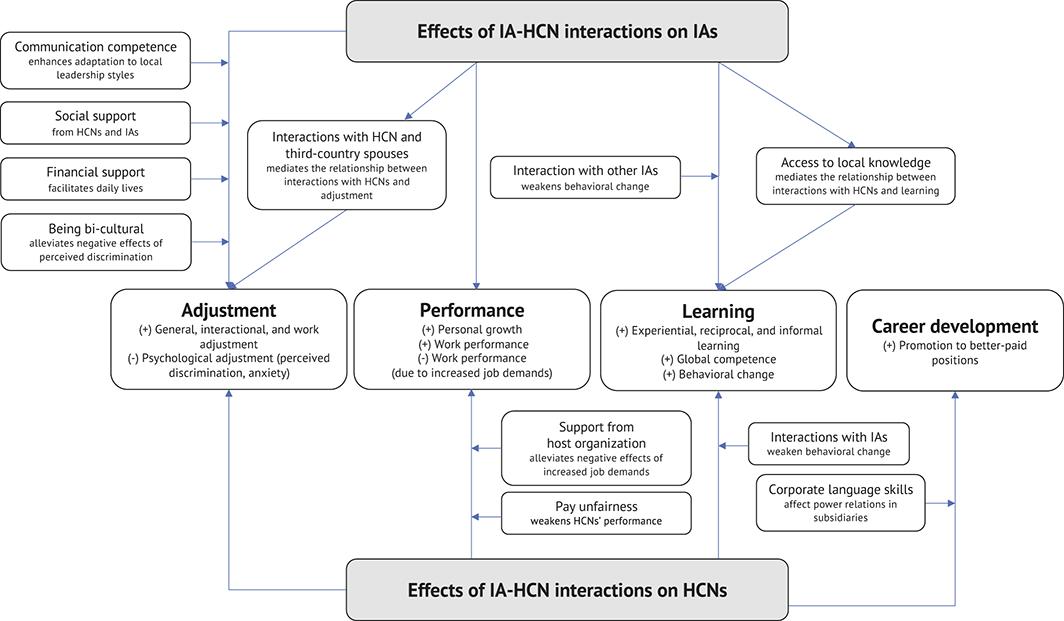
4.2.1 Effects of Interactions with HCNs on IAs
As illustrated in Figure 8, we find that IA–HCN interactions affect IAs in three main ways, namely in terms of adjustment, performance, and learning. Out of these three topics, IA adjustment is the topic that has received the most attention within the sample of most impactful publications.
Adjustment
Several studies have found positive effects of IA–HCN interactions on IAs in terms of IAs’ adjustment. Most research shows positive effects of interactions with HCNs on general, interactional, and work adjustment (Johnson et al., Reference Johnson, Kristof-Brown, Van Vianen, De Pater and Klein2003; Peltokorpi & Froese, Reference Peltokorpi and Froese2009), moderated by communication competence, social support, financial support, IAs’ cultural status, and spouses’ adjustment. In what follows, we briefly present how IAs’ adjustment is moderated by these five factors.
Communication competence refers to the ability to express oneself clearly, effectively, and appropriately in different situations. It consists of a wide range of skills, including language skills, interpersonal skills, cultural understanding, and listening skills (Neupert et al., Reference Neupert, Baughn and Dao2005). Communication competence, including language skills, has been identified as a key factor in IAs’ adjustment to their host environment (Ishii, Reference Ishii2012; Suutari et al., Reference Suutari, Raharjo and Riikkilä2002). As demonstrated by AlMazrouei and Zacca’s (Reference AlMazrouei and Zacca2015) study of IA managers in the Gulf region, communication competence played a significant role in the adjustment and success of IA leaders. By effectively engaging with HCNs, IAs can better understand and adapt to local ways of conducting business. Communication becomes a means to connect with locals, understand their perspectives, and develop effective responses or strategies which are crucial for achieving success in their new environment. This also enables IAs to be sensitive towards the societal and cultural norms of their host country, thereby helping to improve their overall adjustment process.
Results are inconclusive concerning HCNs as a source of social support facilitating IAs’ adjustment. Zhang and Peltokorpi’s (Reference Zhang and Peltokorpi2016) qualitative study reports such an effect, while quantitative research highlights the importance of social ties with other IAs rather than HCNs (Johnson et al., Reference Johnson, Kristof-Brown, Van Vianen, De Pater and Klein2003). Social ties with other IAs can provide significant social support, yet ties with HCNs offer similarly valuable access to information. Mahajan and Toh (Reference Mahajan and Toh2014) found that the greater the breadth and total number of relationships with HCNs, the better IAs tend to adjust to their new host-country environment.
Conversely, Bruning et al. (Reference Bruning, Sonpar and Wang2012) present inconsistent results in their study of HCN networks in China, showing that interactions with local colleagues can negatively affect IAs’ general adjustment. They argue that while HCNs may not provide the emotional support needed to enhance IAs’ adjustment, they can provide IAs with the informational and instrumental support needed to perform their job tasks. Despite these mixed results, the prevailing consensus in the literature underscores the positive impact of IA–HCN interaction on IAs’ adjustment, albeit in different ways.
Results regarding the effects of financial support from employers on IA adjustment are less debated. According to Ravasi et al. (Reference Ravasi, Salamin and Davoine2015), financial support practices, such as relocation support packages, can significantly assist foreign employees in their daily lives. These packages may include elements like housing allowances, living adjustment remuneration, various types of insurance, and cultural training, among others, allowing IAs to allocate less time and resources to practical matters. Consequently, they can focus their cognitive resources on adjusting to cultural differences and engaging with their new social and work environment.
In terms of cultural acceptance and tolerance, IAs with a deeper understanding of both their home culture and that of the host country typically navigate intercultural challenges more adeptly. IAs’ cultural background can therefore be an important factor when it comes to adjusting to a new cultural environment. According to Froese (Reference Froese2010), bicultural employees are in a favorable position as they typically excel at understanding and adjusting to the cultural nuances and social norms of their host country. Their deeper cultural insight allows them to be more sensitive to the perspectives and behaviors of locals, fostering smoother interpersonal relations. This sensitivity is particularly important in intercultural interactions with HCNs, where misunderstandings can easily occur, leading IAs to experience feelings of discrimination or exclusion. Bicultural IAs are more likely to focus on the intent behind actions and words, reducing the likelihood of perceived discrimination.
Furthermore, the positive impact of IA–HCN interactions on IAs’ adjustment may be mediated by interactions with their spouses. For example, Davies et al. (Reference Davies, Kraeh and Froese2015) found that the nationality of the spouse played a decisive role in the IAs’ cultural adjustment process. In their study of 299 expatriate academics in China, Japan, and South Korea, the findings revealed that IAs with a spouse from the host country experienced the most significant increase in intercultural adjustment over time. Spouses from the host country can bridge understanding of local languages and cultural nuances, providing continuous learning and adjustment opportunities. Moreover, those with spouses from a third country also showed improvement in adjustment, but at a slower rate, possibly due to shared experiences of being foreigners and jointly navigating a new culture, without the advantage of having a partner with inherent local knowledge. Meanwhile, IAs whose partners are from their home country showed no significant increase in adjustment, likely due to limited exposure and engagement with the new culture and a tendency to stay within their comfort zone.
Performance
Moving on to the second area where IA–HCN interactions affect IAs’ performance (see Figure 8) we observe that IAs’ work performance is often linked to their adjustment. The extent to which IAs perform at work has also been linked to their interactions with HCNs. HCNs hold valuable local knowledge and can act as a source of information, helping IAs comprehend and adhere to business practices and social norms in the new environment (Bruning et al., Reference Bruning, Sonpar and Wang2012; Johnson et al., Reference Johnson, Kristof-Brown, Van Vianen, De Pater and Klein2003; Mahajan & Toh, Reference Mahajan and Toh2014; Varma et al., Reference Varma, Pichler, Budhwar and Kupferer2012; Zhang & Peltokorpi, Reference Zhang and Peltokorpi2016). Such insights can positively shape both IAs’ practical job performance and their adjustment.
These findings imply that HCNs can play an instrumental role in IAs’ ability to perform their job effectively in their new location. From an organizational perspective, it can be beneficial to select IAs who share cultural similarities with HCNs, as this can improve the likelihood of HCNs offering support. Varma et al.’s (Reference Varma, Pichler, Budhwar and Kupferer2012) study of IAs in China demonstrates this: Chinese HCNs were more willing to offer social support to Indian IAs than to US IAs because they perceived Indian IAs as culturally similar, sharing a spiritual heritage and geographical proximity. This decreased perception of cultural differences fostered a more cooperative atmosphere between HCNs and IAs.
Learning
The final area where we observe the effects of IA–HCN interactions on IAs is in terms of IAs’ learning. Learning is a multi-stage process that can be studied from different perspectives. Heizmann et al. (2008), in their study of knowledge-sharing practices between Australian IAs and Vietnamese HCNs, focus on intercultural knowledge-sharing relationships. Based on their findings, Heizmann et al. (2008) identified three stages of development of knowledge-sharing relationships, namely relationship building, reciprocal learning, and knowledge co-construction. In the first phase, relationship building, it is crucial that both IAs and HCNs lay a solid foundation of trust and mutual respect. In the subsequent phase of reciprocal learning, the dynamic evolves into a two-way educational flow where each party learns from the other, broadening perspectives and enriching professional practice on both sides. Finally, the phase of knowledge co-construction embodies a synergistic culmination of this relationship, where combined insights lead to innovative solutions and practices that can benefit the organization on a larger scale.
When analyzing the effects of IA–HCN interactions on IAs’ learning experiences, we observed mixed, and partially inconclusive results. Empirical findings indicate that engaging with HCNs contributes positively to IAs’ experiential and reciprocal learning, as it provides IAs with access to local knowledge (Heizmann et al., Reference Heizmann, Fee and Gray2018; Hocking et al., Reference Hocking, Brown and Harzing2007). Experiential learning involves acquiring knowledge through experiences and directly applying this knowledge within the context in which it was learned. As noted by Hocking et al. (Reference Hocking, Brown and Harzing2007), such learning is derived from frequent access to host-country knowledge which is adapted to a global corporate setting. Fostering situations where IAs can immerse themselves in local practices and knowledge helps IAs acquire nuanced skills and understanding unique to the local situation. This is also beneficial for the organization, as communication between individuals with diverse backgrounds and knowledge can enhance the organization’s capacity for innovation. However, the positive effects of IA–HCN interactions on IAs’ learning weaken if IAs rely too heavily on HCNs. Overreliance on local colleagues can inadvertently limit IAs’ choices and sources of knowledge application as repeated interactions with HCNs over time may lead to knowledge redundancy. This, in turn, can restrict IAs’ ability to generate new ideas and hinder their creative thinking (Hocking et al., Reference Hocking, Brown and Harzing2007).
Another potential challenge with IAs learning from IA–HCN interactions is the IAs’ motivation to engage with HCNs. In Nadeem and Mumtaz’ (Reference Nadeem and Mumtaz2018) study of Chinese IAs in Pakistan, the authors noted how interactions with HCNs prompt changes in IAs’ behavior and work practices. These changes were related to IAs’ perceptions of host country groups, attraction to these groups, and similarity in beliefs. However, IAs’ transformation weakened when they prioritized interactions with other IAs over local colleagues. In particular, Nadeem and Mumtaz (Reference Nadeem and Mumtaz2018) found that IAs who predominantly socialized with other IAs at work, limiting their engagement with HCNs, had fewer opportunities for personal and professional change.
4.2.2 Effects of Interactions with IAs on HCNs
We now shift focus away from IAs to examine how HCNs are affected by IA–HCN interactions. As shown in Figure 8, we find that IA–HCN interactions affect HCNs in three areas similar to IAs, namely in terms of adjustment; performance; and learning, but we also observe a fourth area which is unique to HCNs, namely career development. We discuss these four areas below.
Adjustment
As discussed earlier, IA–HCN interactions generally have a positive effect on IAs’ adjustment, albeit in different ways. In contrast, empirical studies focusing on the HCNs’ perspective often highlight negative effects on their own adjustment. As observed by Fee (Reference Fee2020) and Fee and Michailova (Reference Fee and Michailova2020), HCNs face a complex set of challenges when interacting with IAs, which can significantly influence their own cultural adjustment and professional roles. Fee (Reference Fee2020) notes the “hidden costs” associated with supporting IAs, including additional role demands that often surpass HCNs’ intercultural competencies. This can result in complex, often stressful interpersonal dynamics, prompting coping responses such as withdrawal from IA colleagues. These withdrawal behaviors reflect the significant personal and professional impact that IA placements can have on HCNs.
Additionally, Fee and Michailova (Reference Fee and Michailova2020) depict a pattern of the “host organization lifecycle,” which shows the evolving attitudes of HCNs toward IAs. The lifecycle begins even before IAs arrive, as host organizations prepare for learning opportunities. When IAs arrive, HCNs experience dramatic adjustments and burdens due to the presence of IAs. Over time, however, as mutual trust is built, HCNs can learn from informal interactions and observation of IAs at work. Still, the additional stress and responsibilities placed on HCNs highlight the need for organizations to actively manage IA–HCN relationships throughout the lifecycle.
While there are learning opportunities for HCNs, the stress, anxiety, and extra-role demands associated with IA placements can negatively affect HCNs’ psychological adjustment (Fee, Reference Fee2020). Building mutual trust, fostering informal learning, and providing organizational support are crucial for successful IA–HCN integration and the well-being of HCNs.
In sum, this dual-sided interaction implies that while the presence of IAs can create additional work and personal strain for HCNs, it also sets the stage for significant intercultural exchange and professional development, assuming that the relationships are managed effectively and constructively. With appropriate organizational support, such as transparent communication, cultural training, and active relationship management, the challenges faced by HCNs can be mitigated, allowing both IAs and HCNs to benefit from enriched learning experiences, improved performance, and expanded career opportunities. This balance is essential to maximizing the positive potential of IA–HCN interactions.
Performance
When it comes to performance, studies offer a more nuanced picture of the effects of IA–HCN interactions for HCNs compared to IAs. While IA–HCN interactions generally enhance IAs’ performance (see Hocking et al., Reference Hocking, Brown and Harzing2007), HCNs often experience increased job demands as a result of supporting IAs, which can decrease their work performance (Fee, Reference Fee2020; Fee & Michailova, Reference Fee and Michailova2020; Mahajan & Toh, Reference Mahajan and Toh2014). However, these negative effects of increased job demands can be alleviated through organizational support, such as language or cultural training for HCNs prior to IAs’ arrival, or active management of IA–HCN relationships during the assignment period (Fee & Michailova, Reference Fee and Michailova2020).
Furthermore, Bonache et al. (Reference Bonache, Sanchez and Zárraga-Oberty2009) highlight the issue of pay differentials between IAs and HCNs, which often lead to feelings of unfairness among HCNs. In a study of 116 HCNs, Bonache et al. (Reference Bonache, Sanchez and Zárraga-Oberty2009) found that even when IAs and HCNs have similar qualifications, HCNs frequently receive lower wages. This perceived inequity can negatively impact HCNs’ performance and increase turnover rates. However, factors like HCNs’ understanding of the specific contributions of IAs, IAs’ interpersonal sensitivity, and transparent communication can reduce these negative perceptions. Organizations are encouraged to manage pay disparities carefully to avoid adverse effects on HCN morale and performance.
Although the existing literature points to several negative effects of IA–HCN interactions on HCNs’ performance, there are also important positive effects that should not be overlooked. Interaction with IAs can provide HCNs with access to information beyond their formal organizational roles, broadening their understanding of the company’s operations, culture, and practices. Interaction with IAs can provide HCNs with access to information beyond their formal organizational roles, broadening their understanding of the company’s operations, culture, and practices, and enhancing their performance and personal growth. Peltokorpi and Vaara (Reference Peltokorpi and Vaara2012) emphasize that such exposure can enhance HCNs’ language skills and decision-making abilities, improving their overall work performance in international settings.
Learning
Similar to IAs, HCNs can also benefit from learning opportunities that arise from IA–HCN interactions. Vance and Paik (Reference Vance and Paik2005) argue that HCNs’ learning needs are often overlooked, which can hinder the optimization of foreign subsidiary performance. HCNs have significant potential to learn from IAs, as these interactions facilitate informal learning by enhancing language skills, intercultural awareness, and offering valuable insights into the global organization (Fee & Michailova, Reference Fee and Michailova2020; Vance & Paik, Reference Vance and Paik2005). Recognizing this potential can increase an organization’s absorptive capacity – the ability to harness external knowledge and apply it commercially, which is critical for innovation and competitive advantage (Sharkie, Reference Sharkie2003).
In their study of fifty-one HCN managers across six countries, Vance and Paik (Reference Vance and Paik2005) proposed a taxonomy of twelve forms of HCN learning, such as new employee orientation, job skills development, MNC predominant language acquisition, intercultural awareness, supervision, technical operations management, expatriate coaching, and MNC strategy and culture. This learning can enhance absorptive capacity by equipping HCNs with the skills needed to better utilize IA expertise and integrate external knowledge into the organization.
Furthermore, Vance and Paik (Reference Vance and Paik2005) suggest that HCN learning could foster greater alignment between HCNs and IAs, potentially improving HCNs’ receptiveness to IAs. This effect is crucial, as studies (e.g., Varma et al., Reference Varma, Pichler, Budhwar and Kupferer2012) indicate that HCNs tend to be selective in providing social support. As discussed in Fee and Michailova’s (Reference Fee and Michailova2020) “host organization lifecycle,” mutual trust and engagement between IAs and HCNs are key for successful learning, as trust forms the foundation for these knowledge-sharing relationships.
Career Development
Career development is an area identified in the most impactful research in our dataset, where HCNs experience unique effects from IA–HCN interactions. However, this does not mean that IAs do not benefit career-wise, as some studies in our dataset suggest, for example, the developmental role of host‑country mentors for IAs’ adjustment and careers (Zhuang et al., Reference Zhuang, Wu and Wen2013). However, the clearest documented advantages concern HCNs.
Corporate language skills, such as proficiency in English in organizations that use it as a common corporate language, can elevate certain HCNs into “language nodes.” These language nodes are employees who, due to their language abilities, can control and facilitate information flows between HCNs with limited English proficiency and other employees with insufficient local language skills (Peltokorpi & Vaara, Reference Peltokorpi and Vaara2012; Zhang & Peltokorpi, Reference Zhang and Peltokorpi2016). This phenomenon illustrates how language policies and practices can shape power dynamics between HCNs and IAs in multinational subsidiaries.
HCNs who leverage their language skills to manage communication channels may benefit from career advancement opportunities. By acting as essential intermediaries within the organization, these HCNs gain increased visibility and recognition, which can lead to more influential roles and greater opportunities for career progression (Peltokorpi, Reference Peltokorpi2022). In this way, language competence not only aids in bridging cultural and communication gaps but also serves as a valuable asset for career development within multinational corporations.
Interactions with IAs are especially beneficial for bilingual HCNs in terms of their career development as they are more likely to be recruited and promoted to better-paid positions, especially in globally integrated subsidiaries (Peltokorpi & Vaara, Reference Peltokorpi and Vaara2012).
5 Future Research Directions in the Field
5 Overview
The previous sections addressed two overarching research questions concerning, first, the contours of IA–HCN interaction research and, second, the effects of IA–HCN interactions on IAs and HCNs. Building on these insights, this section addresses the final question by outlining fruitful avenues for future research on IA–HCN interactions. Specifically, we identify gaps in knowledge across three key research streams: adjustment, language and communication, and IA–HCN relationships. We propose pathways to address inconsistencies in research findings regarding the effects of IA–HCN interactions on outcomes such as cultural adjustment and work performance.
5.1 Avenues for Future Research
Building upon the approach taken in previous bibliometric reviews (Kryszak et al., Reference Kryszak, Świerczyńska and Staniszewski2021; Paltrinieri et al., Reference Paltrinieri, Hassan, Bahoo and Khan2019; Sharma et al., Reference Sharma, Kraus, Srivastava, Chopra and Kallmuenzer2022), we have combined findings from bibliometric, thematic, and content analysis to identify knowledge gaps and formulate research questions (RQs) within each of the three research streams. As such, we aim to contribute with concrete suggestions as to how this expanding field of IA-HCN interactions can move forward in a manner that builds on existing research while addressing the gaps and inconsistencies currently present in the existing body of work.
In the following, we outline several directions for future research, specifically focusing on the motor and basic themes (Figure 5) that hold the potential to drive advancements in the field of IA–HCN interactions. We also address the need to investigate inconsistent findings regarding the outcomes of these interactions (Figure 8). Furthermore, we provide guidance for intercultural collaborations aimed at deepening our understanding of IA–HCN interactions across various contexts. Our analysis in this section leads to three sets of research questions, corresponding to each research stream, as presented in Tables 4, 5, and 6.
| Research Question | Source |
|---|---|
| 1. How do blue-collar and white-collar IAs differ in terms of adjustment processes? | Nadeem & Mumtaz (Reference Nadeem and Mumtaz2018) |
| 2. What type of help do IAs seek from IA peers vs. HCN coworkers, under what circumstances, and how does it foster/inhibit advice seeking from HCNs? | Mahajan & Toh (Reference Mahajan and Toh2014) |
| 3. What new competencies have IA leaders developed in their current position and how do they enhance the ability to better manage staff? | AlMazrouei & Zacca (Reference AlMazrouei and Zacca2015) |
| 4. Using longitudinal research and multisource data from various contexts, what is the influence of a partner’s nationality on IAs’ cultural adjustment? | Davies et al. (Reference Davies, Kraeh and Froese2015) |
| 5. What is the role of English as the corporate language in IAs’ adjustment in non-anglophone countries? | Authors |
| 6. How do the cultural composition and language practices within a multicultural team affect the adjustment of team members? | Authors |
| Research Question | Source |
|---|---|
| 7. How do identity-making processes influence virtual communication tools and internal identity making (e.g., in multicultural teams)? | Lauring (Reference Lauring2008) |
| 8. Using longitudinal research, how is language proficiency related to IAs’ and HCNs’ career advancement? | Peltokorpi & Vaara (Reference Peltokorpi and Vaara2012) |
| 9. What is the relationship between individual- and organizational-level knowledge transfer within MNCs? | Hocking et al. (Reference Hocking, Brown and Harzing2007) |
| 10. To what degree do differences in IAs’ and HCNs’ motivations and cultural orientations affect intercultural knowledge sharing dynamics? | Heizmann et al. (Reference Heizmann, Fee and Gray2018) |
| 11. What is the relationship between communication accommodation skills and organizational identification with those who possess high local-language skills? | Ishii (Reference Ishii2012) |
| 12. How does language differentiation in the organization, foreign-language skills (English as a lingua franca, the corporate language, the local language) and language practices affect intercultural communication, power-related dynamics, reciprocal learning and knowledge sharing between IAs and HCNs? | Authors |
| Research Question | Source |
|---|---|
| 13. Which contextual factors (e.g., hierarchical employment, organizational type, nationality) affect IA–HCN relationships? How does the IA’s cultural background affect the HCN’s willingness to support them? | Varma et al. (Reference Varma, Pichler, Budhwar and Kupferer2012) |
| 14. How does national culture affect fairness perceptions to HCNs’ reactions to pay differentials? | Bonache et al. (Reference Bonache, Sanchez and Zárraga-Oberty2009) |
| 15. How do HCNs’ preparation activities prior to IAs’ arrival impact HCNs’ work productivity and/or performance? | Fee & Michailova (Reference Fee and Michailova2020) |
| 16. How can underrepresented national contexts deepen our understanding of IA–HCN relationships? | Authors |
| 17. How are pandemics (e.g., COVID‑19) and related global mobility restrictions affecting IA–HCN relationships in the workplace? | Authors |
| 18. How are global conflicts affecting IA–HCN relationships at the workplace, especially in countries hosting war refugees? | Authors |
5.1.1 Adjustment Stream
Publications within the adjustment stream focused on various adjustment domains (Black et al., Reference Black, Mendenhall and Oddou1991) as well as antecedents and outcomes of adjustment. Our review suggests that research in this area can be advanced by opening up for a more diverse research context, such as comparing adjustment trajectories for blue-collar and white-collar IAs (RQ1). More contextually focused research is essential for addressing inconsistent results regarding the effects of IA–HCN interactions, as these effects can vary depending on factors like cultural context, the type of IA, and the nature of interactions (Selmer et al., Reference Selmer, Lauring, Normann and Kubovcikova2015). Comparing and contrasting these experiences could reveal trends or disparities in their respective adjustment trajectories. Additionally, employing diverse research methods that account for varying social and cultural contexts would aid in clarifying the current inconsistencies around the influence of IA–HCN interactions. These findings can change drastically, contingent on factors like cultural surroundings, the nature of the IA position, and interaction types.
Based on our thematic analysis (Figure 5), one motor and one basic theme emerged in relation to IA adjustment: the motor theme of IA adjustment and professional integration across cultures, and the basic theme of IA effectiveness and adjustment. The type of help that IAs seek and the source from which they seek it have been found to affect their adjustment to the host country’s environment (Bruning et al., Reference Bruning, Sonpar and Wang2012; Mahajan & Toh, Reference Mahajan and Toh2014). However, empirical findings remain inconsistent regarding whether IAs benefit more from support provided by IA peers or HCN coworkers. For this reason, future research is needed to clarify how IAs’ ability to seek help can facilitate their adjustment processes (RQ2).
Our findings strongly suggest the need for further investigations into mutual learning between IAs and HCNs (RQ3), as well as the effects of their interactions, including the factors that impact these effects, such as the IA’s partner’s nationality (RQ4). The inconsistent findings regarding the adjustment of both parties (see Figure 8), particularly the tension between sociocultural and psychological adjustment, highlight a gap that future research must address (Berry, Reference Berry2005; Kim, Reference Kim and Gudykunst2005). Research in these areas can lead to a more integrative and coherent theoretical framework for cultural adjustment.
Furthermore, investigations into the role of English as the corporate language in non-anglophone countries (RQ5) and the impact of the cultural composition of multicultural teams and their language practices on team members’ adjustment (RQ6) could shed light on how cultural diversity and language dynamics within teams affect individual adjustment processes. Such research could be instrumental in creating well-functioning teams where communication fosters the adjustment and integration of team members.
5.1.2 Language and Communication Stream
Research within the stream of language and communication has focused on various aspects of IA–HCN interactions, but our analyses revealed several inconclusive results and underdeveloped areas. We believe these gaps could be remedied by collecting additional empirical data. The following research avenues may help advance this stream of research.
First, while the impact of foreign-language proficiency on IA–HCN interactions has been examined (e.g., Zhang & Peltokorpi, Reference Zhang and Peltokorpi2016), the link between language proficiency and social identity-making remains underexplored, especially in multicultural teams (RQ7). Further investigation into identity-making processes could enhance our understanding of how these processes can promote a more inclusive, equitable, and competent global workforce. Similarly, the effects of foreign-language proficiency on the career advancement of IAs and HCNs (RQ8) warrant further exploration. As noted in our analysis of IA–HCN interaction effects (Figure 8), bilingual HCNs often benefit from interacting with IAs, with potential career advancements and higher-paying positions (Peltokorpi & Vaara, Reference Peltokorpi and Vaara2012). However, the long-term effects of foreign language skills on career progression remain largely unmapped.
To advance our understanding of knowledge sharing, future research could consider different levels of analysis (RQ9), as well as the motivations and cultural orientations of organizational members when interacting (RQ10). Foreign language skills, personal motivations, and cultural orientations are likely to shape communication, collaboration, and knowledge sharing between IAs and HCNs (RQ9, RQ10, RQ12). However, these topics remain underexplored in the current body of IA–HCN research.
Future research should also explore how communication between IAs and HCNs is affected by their communication accommodation skills (RQ11), for example, by examining the influence of mutual accommodation on IA–HCN interactions. Insights from this research could be valuable in training programs aimed at improving intercultural awareness and promoting more effective intercultural communication in the workplace.
Finally, our review indicates the need for a deeper exploration of foreign-language proficiency, communication patterns, intercultural communication, and collaboration in IA–HCN interactions. This includes investigating the use of English as a corporate language in non-anglophone countries (RQ12), particularly in power-related dynamics, reciprocal learning, and knowledge sharing between IAs and HCNs.
5.1.3 IA–HCN Relationships Research Stream
Language, communication, and social dynamics in expatriate management, intercultural leadership, management, and IA–HCN relations represent motor and basic themes (Figure 5) with significant potential for advancing the field of IA–HCN interactions. A common topic embedded in these themes relates to the contextual factors that affect IA–HCN relationships. To comprehensively understand the organizational and cultural dynamics of IA–HCN interactions, it is crucial to focus on factors that influence these relationships (RQ13). For example, the IA’s cultural background plays a role in shaping HCNs’ willingness to offer assistance, as noted by Varma et al. (Reference Varma, Pichler, Budhwar and Kupferer2012). This dynamic invites deeper exploration into how cultural backgrounds mediate assistance and support within intercultural communication.
Another critical factor impacting IA–HCN relationships is the pay differentials between IAs and HCNs. As Bonache et al. (Reference Bonache, Sanchez and Zárraga-Oberty2009) found, such discrepancies can provoke perceptions of unfairness among HCNs. Future research could investigate how IAs’ cultural background may moderate HCN perceptions of these pay gaps (RQ14), which could provide further insights into intercultural tensions within organizations.
Furthermore, more insights into the management of IA–HCN relationships could provide valuable data on the dynamics of these relationships, especially regarding preparatory measures for receiving and hosting IAs (RQ15). Studies suggest that the anticipation of intercultural interactions can lead to anxiety and adjustment challenges (Fee & Michailova, Reference Fee and Michailova2020). Investigating these preparatory steps could yield valuable insights into reducing these challenges and improving the quality of IA–HCN relations.
Exploring IA–HCN relationships in underrepresented country contexts (RQ16) is another promising research avenue. In Section 2.2, we analyzed the geographical distribution of empirical data on IA–HCN interactions. We found that Asian and European countries were most commonly used as host countries, but that there were large variations within the same geographical regions. Consequently, we would encourage researchers conducting future empirical studies to consider locations that have not yet been covered in existing research. Instead of choosing the most commonly used host countries (China, Japan, South Korea, etc.), a neighboring country may be just as relevant in terms of IA population but underexplored in empirical data collection. Underrepresented regions such as South America, parts of Africa, and South-East Europe offer untapped potential for advancing research into IA–HCN relationships, potentially uncovering unique intercultural dynamics not captured in current studies.
This geographic imbalance also extends to the distribution of research by author location. The distribution of articles by country (Figure 3) revealed that 53 per cent of the dataset (105 articles) were authored by scholars located in the USA, the UK, Australia, China, and Hong Kong. While authors in these countries have contributed significantly to the field, there remains untapped potential for empirical research in other countries with a high share of international migrant workers in the workforce. According to the International Labor Organization (ILO, 2021), there were 169 million international migrant workers in 2019, representing 69 per cent of the global international migrant population. International academic assignees are included in these figures and contribute to the total proportion of international assignees in their populations in countries such as the UAE (87.9%), Saudi Arabia (38.3%), and Kazakhstan (20.0%) (United Nations, 2019). However, our dataset included no authors based in these countries. More geographically diverse cross-border collaborations between researchers in the field, especially those coming from countries beyond the dominant clusters of Anglo-Saxon countries, China, Japan, and France, could bring new perspectives and promote a richer understanding of IA–HCN interactions across various contexts.
This is particularly important in a world characterized by changing social and political realities, exemplified by the recent pandemic (Piekkari et al., Reference Piekkari, Tietze, Angouri, Meyer and Vaara2021), the Russian war in Ukraine (Anghel & Jones, Reference Anghel and Jones2022), and the Israeli–Palestinian conflict. Investigating the effects of ongoing global crises and conflicts (RQ17, R18) could shed light on how HCNs can provide critical support to IAs during these disruptions, enhancing their adjustment (Hofhuis et al., Reference Hofhuis, Hanke and Rutten2019) and fostering more resilient intercultural support systems in times of crisis. The recent COVID-19 pandemic has notably impacted IAs, especially those affected by restrictions and lacking adequate support structures, as noted by Végh et al. (Reference Végh, Jenkins and Claes2023) (RQ15, RQ17). This concern extends to interactions between IAs and HCNs in organizational settings involving actors from conflicting countries (RQ16, RQ18).
5.2 Final Thoughts
This Element systematically reviews three decades of empirical research on interactions between IAs and HCNs, using a range of analytical methods. Our analyses identify major research streams in the field of IA–HCN interactions, outline thematic structures, and highlight key findings from existing empirical research, while also proposing future research directions. The conclusions and research gaps we identify should be understood as emerging from a specific corpus of Scopus‑indexed, predominantly English‑language, and highly cited empirical articles, most of which are situated in international business, HRM, and management. They therefore reflect how IA–HCN interactions have been conceptualized within this influential but partial segment of the wider intercultural communication scholarship.
Within these boundaries, we have mapped a field of IA–HCN research that has significantly developed over the last three decades. Our contribution to the ongoing debate lies in an integrative approach that systematically examines and synthesizes workplace‑based empirical studies, and in presenting both IAs and HCNs as equally important actors in intercultural workplace interactions.
Methodologically, our research stands out by combining a variety of quantitative bibliometric tools with qualitative thematic and content analyses, allowing us to establish the intellectual structure of the field. We use these findings to identify knowledge gaps and formulate research questions that can drive advancements in the field of IA–HCN interactions.
While our data extraction procedure aimed to create a high-quality dataset for varied analyses, it has limitations that warrant attention in future research. First, focusing only on empirical studies may restrict potential research directions that could be informed by conceptual work. Second, extracting articles from a single quality database (Scopus) could have overlooked some studies indexed in other international databases. Third, our set of articles does not contain other potentially relevant empirical research published in books, chapters, or conference proceedings. Lastly, we limited our search to publications written in English, although we included two in Russian and French with English abstracts. Had we deliberately broadened our search to include publications written in languages other than English, we would likely have ended up with a larger sample. Thus, the results of the current study should be validated using different types of research in the growing field of IA–HCN interactions. We would especially welcome future studies that rely on more varied publications published in different outlets, extracted from different databases, and where results are communicated in languages other than English.
In addition, the disciplinary composition of our dataset constitutes an important limitation. The majority of the 209 empirical articles are published in international business, HRM, and management journals, with fewer contributions from psychology, communication and linguistics, and education/higher education. This imbalance likely reflects our reliance on Scopus‑indexed empirical articles and citation-based indicators of “impact,” which may structurally favor business-oriented outlets over, for example, applied linguistics or critical intercultural communication in educational and workplace studies. As a result, our mapping of “the field” and identification of gaps primarily capture how IA–HCN interactions have been conceptualized within business/management scholarship, while other disciplinary perspectives are present but underrepresented. Therefore, our calls for further research on language, identity, power, and interactional processes should be treated not as an exhaustive assessment of those peripheral fields but as an invitation to deeper interdisciplinary engagement, including stronger contributions from linguistics, communication, and education.
Beyond database and language restrictions discussed before, our reliance on citation‑based indicators of “impact” (TLC, TGC, TLCe) introduces an additional bias that merits a critical reflection. Citation counts are not neutral measures of quality, as they are embedded in global hierarchies of knowledge production that privilege Anglophone, Eurocentric, Northern, and management‑oriented outlets, and marginalize scholarship published in other languages, local or regional journals, and monographs and book chapters. Decolonial perspectives on academic publishing have highlighted how such hierarchies shape what is visible as “the field” and whose experiences and theoretical contributions are recognized (Nimführ, Reference Nimführ2022; Tripathi, Reference Tripathi, de Guevara, Kaczmarska, Kurowska, Poopuu and Warnecke2025). Accordingly, our mapping of IA–HCN interactions largely reflects influential Anglophone business and management scholarship, and cannot be viewed as a comprehensive representation of all relevant knowledge on IA–HCN interactions. The research gaps and recommendations we formulate thus pertain to this impactful, Scopus‑indexed corpus, while different or additional gaps might emerge from alternative reviews that foreground less–cited, non‑English, or non‑indexed work. For example, critical intercultural communication, discourse-analytic, and decolonial studies – often published outside highly cited international business and HRM outlets – may already address issues that our corpus frames as “emerging” or “under-researched,” such as power, inequality, racism, or language ideologies in IA–HCN encounters. To address the power imbalances inherent in traditional knowledge production systems and create a more inclusive and equitable view of the IA–HCN field, future research should therefore embrace a plurality of perspectives, including non‑Anglophone scholarship and work grounded in Global South contexts and epistemologies.
Indeed, our results reveal that many influential intercultural communication traditions, such as critical, poststructural, and decolonial approaches, are weakly represented in the impactful IA–HCN literature we analyzed. While our corpus occasionally draws on concepts such as anxiety/uncertainty management and acculturation, it rarely engages with critical intercultural communication, ethnography of communication, interactional sociolinguistics, discourse–analytic work on workplace talk, or decolonial critiques of global mobility. Future research could use these perspectives to re‑examine IA–HCN interactions as sites where inequalities in terms of race, class, gender, colonial histories, and language ideologies are produced, negotiated, and resisted in everyday workplace communication.
Specifically, naturally occurring IA–HCN interactions (e.g., meetings, email, chat) could be analyzed using conversation analysis, discourse analysis, or ethnography of communication to uncover fine–grained patterns of meaning–making. These methods, long established in intercultural communication and sociolinguistics, would deepen the understanding of how “culture,” “identity,” and “power” are enacted turn‑by‑turn, rather than treated as static background variables, contesting functionalist assumptions that still underpin much IA–HCN work. In turn, decolonial and Global South perspectives on global mobility could critically inspect core categories in IA–HCN research (e.g., “expat” vs. “migrant,” “host” vs. “home” country) and challenge the Eurocentric framing of who is mobile for whose benefit. Empirical work grounded in African, Latin American, Middle Eastern, and Asian epistemologies – often published in local languages and outlets – would be particularly valuable in rebalancing the current, largely WEIRD and management‑centric evidence base identified in our analysis.
Importantly, this critical reflection informs intercultural communication-driven research questions that extend the research avenues defined in this analysis. Within the adjustment stream, research could explore how adjustment and cultural “fit” are discursively constructed in IA–HCN communication, whose norms of behavior are privileged at the workplace, and with what consequences for intercultural interactions. Such communication-focused research would extend prior leadership- and knowledge-management-based studies within the global mobility literature (Hsu et al., Reference Hsu, Chen, Chiang and Shaffer2024; Kennedy, Reference Kennedy2018). Within the language and communication stream, research could investigate how language ideologies (i.e., beliefs, assumptions, and attitudes around language) concerning English and other lingua francas, native-speakerism, and accent (Humphreys, Reference Humphreys2026; Raheja, Reference Raheja2023; Samuell, Reference Samuell2024) shape organizational members’ participation rights and expertise claims in IA–HCN encounters. Finally, within IA–HCN relationships stream, research could explore how IAs and HCNs narrate their relationships in ways that reproduce or contest colonial hierarchies, especially in MNC work settings. Moreover, more research is needed on the role of language diversity in multicultural workplaces and on IAs and HCNs as boundary spanners bridging multicultural teams (Kalra & Szymanski, Reference Kalra and Szymanski2023).
Despite the limitations discussed above in Section 5.2 Final Thoughts, our study offers several key contributions to the literature. First, it broadens the scope of prior literature reviews that focused mainly on the outcomes of IA–HCN interactions for IA adjustment or performance (van Bakel, Reference van Bakel2018) or on HCN-related literature (Michailova et al., Reference Michailova, Fee and DeNisi2023). We adopt a critical perspective on intercultural communication, emphasizing the nuanced and complex relationships between IAs and HCNs in multicultural and multilingual workplaces. Rather than reproducing essentialist or functionalist framings that treat culture as fixed, group-level variables (e.g., high vs. low context; individualism vs. collectivism) and seek causal effects on communication (Hua, Reference Hua2016; Wilczewski, Reference Wilczewski2019), our analysis foregrounds the contingent, negotiated, and relational nature of IA–HCN intercultural communication. We show that individual variation, situational contingencies, organizational norms, power dynamics, and interlocutors’ agency (their ability to adapt, learn, and hybridize practices) shape communicative outcomes in ways that reductionist “cross-cultural” communication models fail to capture because they reduce complex, context-dependent interactions to fixed, group-level traits and measurable dimensions (Bjerregaard et al., Reference Bjerregaard, Lauring and Klitmøller2009). Our findings highlight the dynamic interactions and mutual impacts between IAs and HCNs, emphasizing the significance of language, communication, and relational aspects in multinational workplaces.
Second, this is the first review to integrate bibliometric and qualitative methods to sketch an objective picture of the field. By combining quantitative bibliometric tools with qualitative thematic and content analyses, we introduce an innovative approach to delineate the intellectual structure of the field of IA–HCN interactions. By combining these rigorous approaches, we offer a transparent and reproducible analysis of the literature, allowing for visualization and validation of results across multiple techniques. This methodological framework effectively identifies research gaps and sets the stage for future developments in the field.
Third, we expand the organizational context of IA–HCN interactions by incorporating settings beyond MNCs. Our results reveal the effects of intercultural interactions between IAs and HCNs across various domains, demonstrating the relevance of our topic in all organizational settings. By embracing diversity in our study of IA–HCN interactions, we capture the intricate dynamics of these relationships more effectively.
We hope this Element serves as a foundation for more inclusive, interdisciplinary, and nuanced future investigations into intercultural communication, advancing our understanding of the complexities that define today’s global workplace shaped by intercultural interactions.
5.3 Practical Implications
The effects of IA–HCN interactions on adjustment, performance, learning, and career development (Figure 8) point to actionable implications for organizations, managers, and educators. The suggestions in this section follow directly from the three research streams – adjustment, language and communication, and IA–HCN relationships. The implications emphasize that IA–HCN interactions are not an automatic by‑product of international assignments but an organizational resource that should be carefully cultivated and equitably supported. The findings of our analysis provide robust evidence for such interventions, which can be used to design practices that enhance intercultural workplace interactions between IAs and HCNs.
5.3.1 Implications for Organizations
First, organizations should recognize and support HCNs as key stakeholders, not just “support staff” for IAs. Our review shows that HCNs provide important informational and social support to IAs and often act as boundary spanners and “language nodes” (Fee & Michailova, Reference Fee and Michailova2020; Peltokorpi & Vaara, Reference Peltokorpi and Vaara2012; Zhang & Peltokorpi, Reference Zhang and Peltokorpi2016), while bearing substantial “hidden costs” (Fee, Reference Fee2020). Hosting and mentoring IAs should therefore be explicitly acknowledged in HCN job descriptions and performance criteria, accompanied by appropriate workload adjustments, formal recognition, and, where relevant, financial or career rewards for those who undertake intensive IA‑related roles.
Second, IAs’ adjustment and performance are influenced by organizational practices such as training, relocation support, and language policies, as well as by IA–HCN ties (Konanahalli et al., Reference Konanahalli, Oyedele, von Meding, Spillane and Coates2012; Ravasi et al., Reference Ravasi, Salamin and Davoine2015). HR should provide pre‑departure and in‑country support not only to IAs but also to their partners whose adjustment has demonstrable spillover effects (Davies et al., Reference Davies, Kraeh and Froese2015; Ravasi et al., Reference Ravasi, Salamin and Davoine2015). Rather than creating “simulated home” environments that isolate IAs and hinder IA–HCN contact (Huang et al., Reference Huang, Liu, Huang and Ding2020), organizations should foster structured opportunities for meaningful engagement with local colleagues and communities.
Third, pay differentials between IAs and HCNs are a recurring source of perceived unfairness and strained relationships (Bonache et al., Reference Bonache, Sanchez and Zárraga-Oberty2009; Leung et al., Reference Leung, Wang and Smith2001). Organizations should communicate transparently the rationale for IA compensation packages and the specific value IAs are expected to add to the organization. Monitoring mechanisms (e.g., joint IA–HCN feedback channels) should be put in place to identify and address perceived injustices early.
Finally, language policies and practices shape knowledge flows, identity, and justice perceptions (Kim & Angouri, Reference Kim and Angouri2023; Peltokorpi & Vaara, Reference Peltokorpi and Vaara2012; Peltokorpi et al., Reference Peltokorpi, Sekiguchi and Yamao2021). Language should therefore be viewed strategically as both a resource and a potential risk. Organizations can clarify the role of English as a corporate language vis‑à‑vis local languages and avoid “one‑size‑fits‑all” monolingual policies. They can offer language training to both IAs and HCNs and recognize language work (translation, mediation) carried out by language nodes as real work. At the same time, they should be attentive to the double–edged nature of high foreign‑language proficiency: while it often facilitates interaction, very high skills can also trigger identity threats and out‑grouping (Peltokorpi & Pudelko, Reference Peltokorpi and Pudelko2021).
5.3.2 Implications for Managers
Our results have direct implications for managers, IAs, and HCNs who wish to better exploit the potential of IA–HCN interactions. Managers can foster reciprocal advice‑seeking and support by encouraging IAs to seek advice from HCNs on local norms and practices, which enhances IAs’ work and interaction adjustment (Mahajan & Toh, Reference Mahajan and Toh2014), while also legitimizing HCNs’ right to set boundaries on the support they provide. They can promote reciprocal learning relationships (Heizmann et al., Reference Heizmann, Fee and Gray2018; Vance & Paik, Reference Vance and Paik2005), in which both sides share expertise rather than framing HCNs only as “helpers” or IAs only as “experts.”
Managers can also encourage IAs to build diverse networks by balancing ties with fellow expatriates and HCNs. Both IAs and HCNs benefit from social ties, but over‑reliance on co‑national or expat enclaves can limit adjustment and learning (Froese, Reference Froese2010; Hocking et al., Reference Hocking, Brown and Harzing2007; Nadeem & Mumtaz, Reference Nadeem and Mumtaz2018). HCNs, in turn, can be encouraged to access global networks through IAs. Managers can actively design cross‑cultural project teams, mentoring groups, and informal activities that routinely include both groups.
In light of the paradoxical findings that very high adjustment or language skills can increase social distance or identity threat (Mumtaz & Nadeem, Reference Mumtaz and Nadeem2020; Peltokorpi & Pudelko, Reference Peltokorpi and Pudelko2021), managers, coaches, and mentors should avoid presenting adjustment as unilateral assimilation of IAs into host norms. Instead, they should support negotiated, two‑way accommodation. Both IAs and HCNs can be encouraged to reflect on identity tensions (e.g., perceived loss of professional status or threats to “native” expertise) and to manage them through open dialogue rather than through power struggles, silence, or indifference.
5.3.3 Implications for Training
In terms of training, studies underscore that outcomes depend less on static cultural “knowledge” and more on communicative, relational, and reflexive skills (Deng & Gibson, Reference Deng and Gibson2009; Djatmika et al., Reference Djatmika, Santosa and Wibowo2024; Neupert et al., Reference Neupert, Baughn and Dao2005). Therefore, training programs for IAs and HCNs should move beyond “cross-cultural training” focused on between-country comparisons. Instead, they should prioritize the development of intercultural sensitivity, cultural intelligence, and intercultural communication skills. In particular, IAs and HCNs could be trained on negotiating meaning, managing misalignment, and handling conflict. Training can make use of critical incidents, narratives, and role plays based on IA–HCN scenarios (e.g., advice‑seeking, feedback, pay discussions, or boundary spanning) to practice real dilemmas.
Importantly, organizations should consider HCN‑focused and joint IA–HCN training. Joint workshops can help surface expectations, negotiate roles, and co‑construct norms for collaboration. Traditionally, organizational training has targeted IAs, yet HCNs face substantial burdens and learning demands (Fee, Reference Fee2020; Fee & Michailova, Reference Fee and Michailova2020; Vance & Paik, Reference Vance and Paik2005). Educators and corporate trainers could therefore design modules specifically for HCNs on hosting IAs, managing power asymmetries, and using IA presence for their own learning and career development.
Our results also indicate that critical and decolonial intercultural communication perspectives are underused in IA–HCN research. We propose that HRM programs and higher education curricula in global mobility, intercultural management, and communication embed such perspectives. Educators can problematize categories such as “expat” versus “migrant,” “home” versus “host” country, and “local” versus “global” talent, and discuss case studies (e.g., Botelho, Reference Botelho2021; Mathew & Burgess, Reference Mathew and Burgess2023) that expose structural inequalities and prompt students and practitioners to reflect on the ethics of IA–HCN arrangements.
5.3.4 Implications for Policy and Crisis Planning
Finally, organizations should ensure that mobility, language, and diversity policies are aligned. Our findings show that these domains intersect in IA–HCN interactions. For instance, language policies affect justice perceptions and knowledge flows, while diversity policies affect who becomes an IA or a language node (e.g., Malik et al., Reference Malik, Madappa and Chitranshi2017; Peltokorpi et al., Reference Peltokorpi, Sekiguchi and Yamao2021; Shimoni, Reference Shimoni2011). Global mobility, language, and diversity/inclusion policies should therefore be developed in dialogue, with explicit consideration of IA–HCN dynamics. IA–HCN relationship quality and mutual learning outcomes could, for instance, be incorporated into performance indicators for international assignments.
Fee and Michailova’s (Reference Fee and Michailova2020) notion of the “host organization lifecycle” suggests that IA–HCN attitudes and burdens change over time. Policies that support IA–HCN interactions should consequently include regular check‑ins (e.g., surveys or focus groups) with both IAs and HCNs at different assignment stages. Feedback from these check‑ins can be used to adjust support and address emerging tensions early.
Work on COVID‑19 and global crises (Piekkari et al., Reference Piekkari, Tietze, Angouri, Meyer and Vaara2021; Végh et al., Reference Végh, Jenkins and Claes2023) further highlights the vulnerability of IA–HCN relationships under mobility restrictions and political conflict. Organizations should develop contingency plans that explicitly consider IA–HCN communication and support (e.g., virtual mentoring and maintaining local networks when travel is restricted). They should also recognize and support HCNs’ roles in stabilizing operations and providing local support to IAs in times of crisis.
This research was supported by the Narodowe Centrum Nauki (grant no. 2023/49/B/HS2/00412) awarded to Michał Wilczewski.”
University of Southampton
Will Baker is Director of the Centre for Global Englishes and an Associate Professor of Applied Linguistics, University of Southampton. His research interests are Intercultural and Transcultural Communication, English as a Lingua Franca, English medium education, Intercultural education and ELT, and he has published and presented internationally in all these areas. Recent publications include: Intercultural and Transcultural Awareness in Language Teaching (2022), co-author of Transcultural Communication through Global Englishes (2021), co-editor of The Routledge Handbook of English as a Lingua Franca (2018). He is also co-editor of the book series ‘Developments in English as Lingua Franca’.
University of New South Wales, Australia
Troy McConachy is Senior Lecturer in the School of Education at University of New South Wales. His work aims to make interdisciplinary connections between the fields of (language) education and intercultural communication, focusing particularly on the role of metapragmatic awareness in intercultural communication and intercultural learning. He has published articles in journals such as ELT Journal, Language Awareness, Intercultural Education, the Language Learning Journal, Journal of International and Intercultural Communication, Journal of Intercultural Communication Research, and others. His is author of the monograph Developing Intercultural Perspectives on Language Use: Exploring Pragmatics and Culture in Foreign Language Learning (Multilingual Matters), and he has co-edited Teaching and Learning Second Language Pragmatics for Intercultural Understanding (with Tony Liddicoat), and Negotiating Intercultural Relations: Insights from Linguistics, Psychology, and Intercultural Education (with Perry Hinton). He is also Founding Editor and former Editor-in-Chief (2017–2024) of the international journal Intercultural Communication Education (Castledown).
University of Southampton
Sonia Morán Panero is a Lecturer in Applied Linguistics at the University of Southampton. Her academic expertise is on the sociolinguistics of the use and learning of English for transcultural communication purposes. Her work has focused particularly on language ideologies around Spanish and English as global languages, English language policies and education in Spanish speaking settings and English medium instruction on global education. She has published on these areas through international knowledge dissemination platforms such as ELTJ, JELF, The Routledge Handbook of English as a Lingua Franca (2018) and the British Council.
Editorial Board
Zhu Hua, University of Birmingham
Ali Abdi, The University of British Columbia
Tomokazu Ishikawa, Tamagawa University
Ron Darvin, The University of British Columbia
Anne Kankaanranta, Aalto University
Xiaodong Dai, Shanghai Normal University
Sender Dovchin, Curtin University
Phan Le Ha, University of Hawaii and Universiti Brunei Darussalam
Jose Aldemar Alvarez Valencia, Universidad del Valle
About the Series
This series offers a mixture of key texts and innovative research publications from established and emerging scholars which represent the depth and diversity of current intercultural communication research and suggest new directions for the field.