

1 Epistemic Leadership for Democratic Intelligence
In today’s complex and contested world, schools face a profound challenge: how to prepare young people not only for academic success but also for participation in democratic life under conditions of epistemic strain. Across democratic societies, fragmented information environments, rising polarisation, and algorithmically amplified misinformation are corroding trust, distorting public reasoning, and legitimising harmful forms of action – from vaccine refusal and climate-change inaction to the normalisation of misogyny and xenophobia (Jennings et al., Reference Jennings, Valgarðsson, LMcKay, Stoker, Mello and Baniamin2023; Jerome et al., Reference Jerome, Kisby and McKay2024; Over et al., Reference Over, Bunce, Baggaley and Zendle2025). If schools are to fulfil their civic mission, however, their response to this crisis cannot be confined to a narrow focus on individual reasoning skills. It must also attend to the wider conditions under which ideas are encountered, evaluated, and acted upon in educational and civic life.Footnote 1
The central challenge, therefore, is not simply whether individuals are supported to exercise sound judgement, but whether the structures that surround them also allow reasoned arguments to be examined, taken up, and made consequential at the collective level. In many societies, ideas no longer travel through shared standards of evidence, dialogue, and accountability. Instead, they circulate unevenly, gain authority unpredictably, and often fail to support collective judgement or action. Responding to this challenge thus requires a systemic way of thinking about how ideas become credible, contestable, and consequential in public life. This Element advances such an account. Its central contribution is to conceptualise this system-level functionality as democratic intelligence: the capacity of a society to reason, learn, and act wisely in conditions of complexity and change.Footnote 2
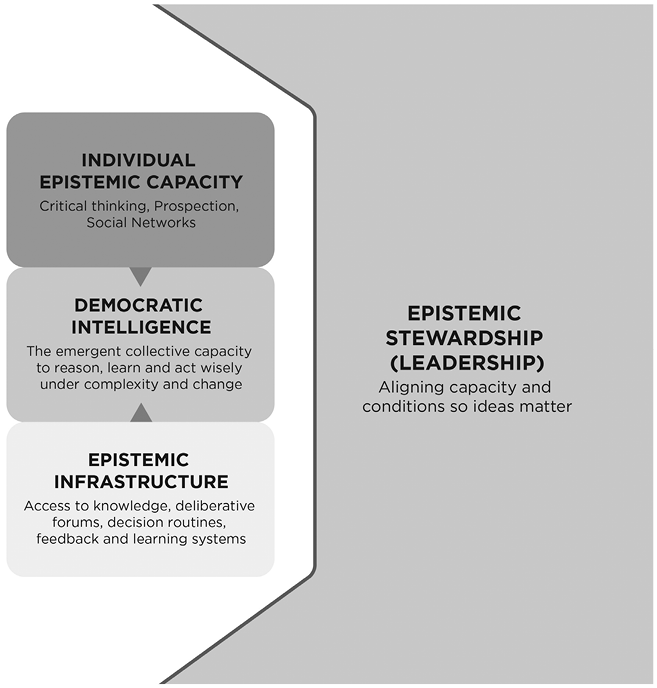
Democratic intelligence depends on the alignment of two distinct but interdependent components. At the level of individual epistemic capacity, the central concern is how people engage with ideas: whether they can exercise sound judgement by discerning between claims of differing quality, thinking beyond the immediate present, and drawing productively on their social networks. These capacities enable informed participation, but on their own they remain fragile. They are vulnerable to cognitive bias, misinformation, and short-termism, and they are unevenly distributed across individuals and social groups. Epistemic infrastructure addresses a different but complementary challenge: not whether individuals can judge well, but whether judgement can become shared, consequential, and durable. It refers to the institutional and organisational conditions through which ideas circulate and are examined, contested, and translated into collective action. This includes access to trustworthy knowledge, forums for reasoned dialogue, routines for decision-making, and feedback systems that support learning and adaptation over time. Where such infrastructures function well, they allow societies to coordinate action on the basis of shared understanding and to revise course in light of new evidence. Where they degrade, the risks shift from individual error to systemic failure: epistemic exclusion, polarisation, fragmentation, and institutional inertia.
Although democratic intelligence emerges from the interaction between individual epistemic capacity and epistemic infrastructure, this interaction does not occur automatically. It must be deliberately shaped and sustained. Aligning people’s capacity to engage well with ideas with the conditions that allow those ideas to matter is therefore not simply a technical task, but a leadership one. Epistemic stewardship names this responsibility: the work of ensuring that ideas are taken seriously, accessed equitably, tested rigorously, and used well (see Figure 1). In education, this responsibility falls most clearly to school leaders. Schools sit at the intersection of individual learning and wider societal knowledge systems, making them among the first places where people learn not only what ideas are, but how ideas are discussed, challenged, and acted upon. Through epistemic stewardship, school leaders can enable students to develop these habits of engagement, while ensuring that teachers’ individual judgements are translated into shared understanding, coordinated action, and cumulative improvement. Far from being peripheral, this work is a core responsibility of educational leadership in fragmented democratic societies.
Democratic intelligence as an emergent system
Democratic intelligence is a system-level achievement. It emerges only when people’s capacity to engage with ideas is aligned with the institutional conditions that allow those ideas to be tested, shared, and acted upon – a task that requires deliberate epistemic stewardship.
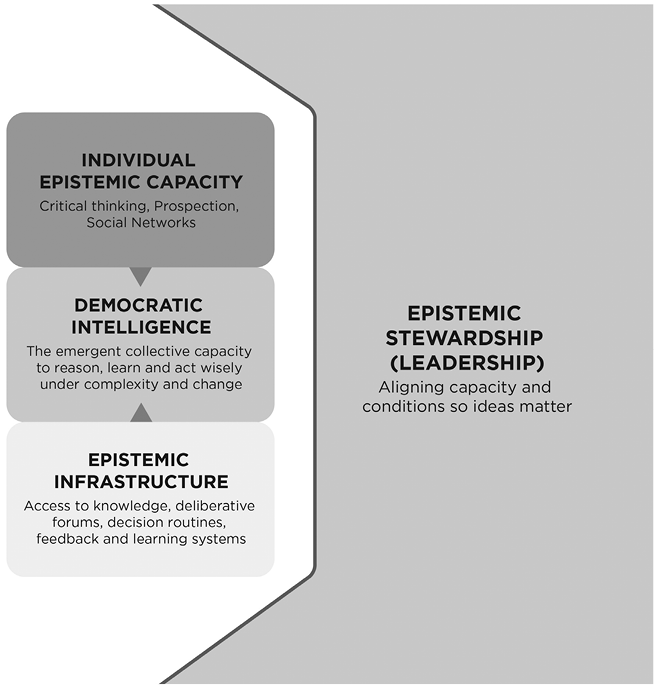
Yet if democratic intelligence is to be translated from a concept into workable school practice, its core components must be specified with greater clarity. School leaders cannot steward what has not been defined. This Element therefore begins by clarifying democratic intelligence as a framework for understanding how societies reason and learn under conditions of complexity and fragmentation. While the focus of this section is conceptual, its purpose is practical: to provide the foundations upon which leaders can enact epistemic stewardship in their daily work. Subsequent sections then build on this foundation by examining how school leaders can enact epistemic stewardship via the decisions they make, the routines they establish, and the cultures they sustain. The first step, however, is to examine the object at the centre of this framework – ideas themselves – because leadership in fragmented times begins with clarity about what kinds of ideas deserve authority, how they acquire credibility, and under what conditions they shape action.
Constructive Ideas vs. Corrosive Ideas
At the heart of democratic intelligence is how we engage with and use ideas. Ideas shape beliefs, decisions, and actions, but they are not inherently benign. Some ideas support human flourishing; others cause measurable harm. It is therefore necessary to distinguish between constructive ideas – those grounded in trustworthy knowledge, coherent reasoning, and moral purpose – and corrosive ideas, which violate these criteria (Brown, Reference 79Brown2018). As can be seen in Table 1, constructive ideas involve a combination of factual validity, logical consistency, and ethical intent; they produce beneficial outcomes and command consensus among credible stakeholders. Corrosive ideas, by contrast, distort evidence, manipulate emotion, or prioritise ideological loyalty over truth (Brown, Reference 79Brown2018).Footnote 3 Examples of constructive ideas include health campaigns grounded in scientific research or pedagogical innovations supported by robust evaluation (e.g., Andrino et al., Reference Andrino, Grasso and Llaneras2022; Campbell, Reference Campbell2023; EEF, 2023). Corrosive ideas encompass conspiracy theories, science denial, and populist narratives that substitute trustworthy knowledge for intuition (e.g., Ball, Reference Ball2024; Craig, Reference Craig2020; French, Reference French2024). What unites them is not their topic but their epistemic quality: corrosive ideas are those that resist scrutiny and demand allegiance rather than understanding.
| Dimension | Constructive ideas | Corrosive ideas |
|---|---|---|
| Definition | Ideas grounded in trustworthy knowledge that enhance decision-making and lead to beneficial outcomes for individuals and society | Ideas that distort or reject trustworthy knowledge, leading to sub-optimal or harmful outcomes |
| Evidence base | Grounded in robust and credible research or established facts | Weak, distorted, or absent knowledge; often rely on ‘alternative facts’ |
| Reasoning | Supported by strong, coherent arguments or clear theories of change | Appeal to emotion, identity, or grievance rather than rational deliberation |
| Moral/social imperative | Framed around collective well-being, justice, or sustainability | Often divisive, scapegoating, or short-termist |
| Endorsement | Credible stakeholders (e.g., scientists, educators, and civic leaders) | Fringe actors, populist leaders, or network influencers |
| Examples | Public health advice (e.g., limit alcohol, vaccinate against disease…), climate-change mitigation, human rights frameworks | The flat-Earth theory, anti-vaccine myths, climate-change denial, populist rhetoric undermining institutions or promoting exclusion |
The spread of corrosive ideas has accelerated in the digital era, not simply because misinformation is more abundant, but because contemporary information environments reward certainty, emotional resonance, and group alignment over evidence and nuance (e.g., Clack, Reference Clack, Brown and Handscomb2025; Commission into Countering Online Conspiracies in Schools, 2025). Algorithmic amplification and online echo chambers increasingly frame disagreement as a threat, reinforcing belief systems rather than testing them. The consequences are visible across democratic societies: from vaccine refusal and climate scepticism to resurgent misogyny and xenophobia. Corrosive ideas matter not only because they mislead individuals but also because, once widely circulated, they corrode democratic intelligence itself: undermining the shared epistemic norms that make collective reasoning possible. Understanding why they take hold is therefore essential.
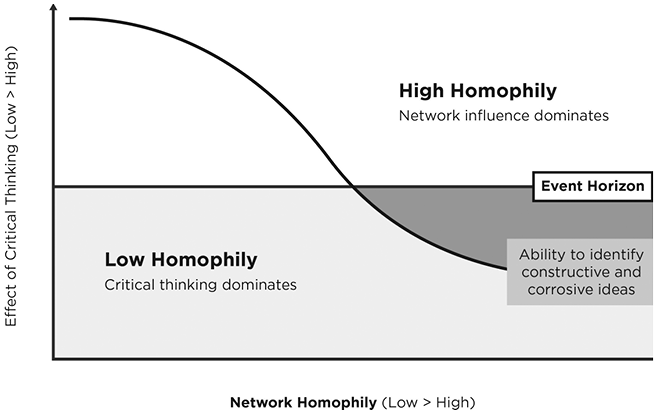
While critical thinking can help individuals identify corrosive ideas, its effectiveness depends on the epistemic conditions within which ideas are encountered. Drawing on data from 7,000 respondents across Europe, one of my own studies identifies what I term the social network event horizon (Brown et al., in press). This horizon marks a systemic threshold: the point at which homophilyFootnote 4 within a person’s network becomes so pronounced that the core functions of epistemic infrastructure begin to fail. Beyond this threshold, access to trustworthy knowledge narrows; forums for reasoned dialogue give way to affirmation; decision-making becomes driven by loyalty rather than shared standards; and feedback loops capable of correcting error weaken or disappear. Ideas are no longer tested through evidence and reciprocal justification but instead operate as markers of identity and belonging. The result is the formation of epistemic enclaves (Sunstein, Reference Sunstein2017) in which even demonstrably false claims (such as the ‘flat-Earth’ theory) can acquire credibility – not because they withstand scrutiny, but because scrutiny itself has lost social or institutional support (see Figure 2).
The social network event horizon
The social network event horizon marks the point at which homophily overwhelms evidential evaluation and epistemic infrastructures cease to function effectively. Beyond this threshold, ideas gain authority through identity and belonging rather than scrutiny, enabling even false claims to circulate unchallenged and weakening democratic reasoning at both individual and collective levels.
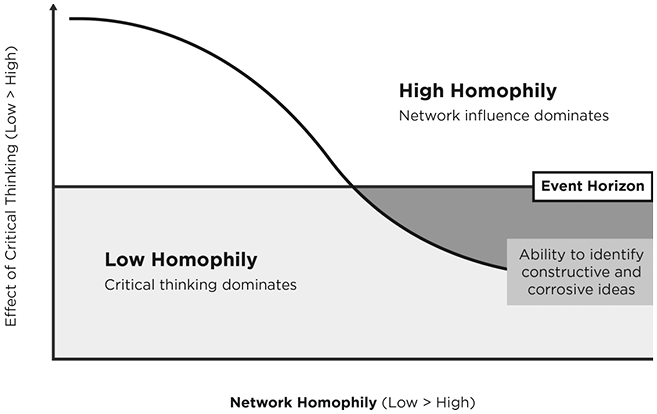
The concept of the social network event horizon thus demonstrates that democratic intelligence is fundamentally a system-level achievement. Even where individuals possess strong critical-thinking skills, their capacity to reason well is compromised if epistemic infrastructures can no longer provide open access to knowledge, support structured dialogue across difference, coordinate decision-making routines, and establish mechanisms for adaptation over time. When these supports erode, ideas cease to be collectively examinable and instead become socially protected. The question, therefore, is not simply how individuals think, but how the conditions that make shared reasoning possible can be restored and sustained. To address these twin issues in detail, the section first examines the individual side of democratic intelligence: what enables people to engage effectively with ideas, and why this capacity varies so markedly across contexts. The section then turns to the system-level role of epistemic infrastructure and how it can be strengthened.
Individual-Level Epistemic Capacity – The Effective Engagement with Ideas
Within the broader framework of democratic intelligence, individual-level epistemic capacity concerns whether people engage with ideas well. For school leaders, this dimension matters because it shapes what students and staff are able to do with the knowledge they encounter. This capacity involves not only possessing relevant dispositions and skills but also the motivation to engage thoughtfully and reflectively. Crucially, however, it should also lead to epistemic discernment: the ability to judge between ideas of differing quality. It is this capacity that determines whether ideas contribute to human flourishing or instead give rise to misunderstanding, manipulation, and harm (e.g., Andrino et al., Reference Andrino, Grasso and Llaneras2022; Franco et al., Reference Franco, Sousa and Viera2019; Global Agenda Council on Informed Societies, 2013; Pinker, Reference Pinker2021; Putnam, Reference Putnam2000). Drawing on representative samples totalling approximately 13,000 adults across seven European countries and 5 U.S. states, analysis by myself and colleagues identifies 3 core determinants of this capacity: (1) the quality of individuals’ critical-thinking skills; (2) the presence of a forward-looking, prospective mindset; and (3) the structure of their social networks (e.g., Brown, Luzmore, & Wang, Reference Brown, Luzmore and Wang2025). Together, these determinants provide a practical agenda for leadership: they indicate where schools can intervene deliberately to strengthen the foundations of democratic intelligence.
Drivers of Effective Engagement: Critical Thinking
As a core component of individual-level epistemic capacity, critical thinking has long been understood as central to citizens’ ability to engage responsibly with ideas (Freire, Reference Freire1970; Plato, 2007; Dewey, Reference Dewey2016). Viewed this way, critical thinking is best understood as a form of epistemic cognition: the reflective process through which individuals examine not only what they believe but also the justification, reliability, and limits of those beliefs (Cramer et al., Reference Cramer, Brown and Aldridge2023; Greene & Yu, Reference Greene and Yu2016). It draws together curiosity, scepticism, and humility in a balanced intellectual temperament. To think critically is to engage actively with ideas rather than passively consume them; to test claims against evidence; and to remain open to revision when confronted with better arguments. Research on critical thinking typically highlights a set of interrelated dispositions and skills, which are foundational to democratic intelligence:
Intellectual humility (epistemic stance): effective engagement with ideas begins with a reflexive moral orientation. Intellectual humility involves recognising the fallibility of one’s own knowledge while respecting alternative viewpoints (Krumrei-Mancuso et al., Reference Krumrei-Mancuso, Haggard, LaBouff and Rowatt2020). It is closely linked to intellectual honesty – confronting one’s own biases (Facione, Reference Facione1990) – and intellectual empathy, the capacity to take others’ perspectives seriously (Linker, Reference Linker2011). Together, these dispositions prevent reasoning from becoming defensive or identity-protective and enable principled belief revision.
Epistemic curiosity and sophistication (orientation to knowledge): curiosity motivates sustained inquiry (Markey & Loewenstein, Reference 85Markey, Loewenstein, Linnenbrink-Garcia and Pekrun2014), while epistemic sophistication recognises that knowledge is provisional and open to revision (Grossnickle Peterson, Reference Grossnickle Peterson2020). Combined, they foster an exploratory but disciplined approach in which questioning is guided by an understanding of how claims are constructed and refined.
Analytical and informational competence (cognitive tools): information literacy enables the location and evaluation of sources while recognising bias (UNESCO, 2005). Analytic reasoning supports the interpretation of data and assessment of arguments (Bago et al., Reference Bago, Rand and Pennycook2020). These skills allow ideas to be judged on epistemic quality rather than emotional appeal.
Imaginative, ethical, and affective judgement (wise application): creativity generates alternative interpretations (Wegerif et al., Reference Wegerif, Li, Kaufman, Wegerif, Li and Kaufman2017); ethical reasoning weighs competing values under uncertainty (Sternberg, Reference Sternberg, Wegerif, Li and Kaufman2017); and affective awareness recognises how emotion and belonging shape judgement (Higgins, Reference Higgins, Wegerif, Li and Kaufman2017). Together, they ensure reasoning is contextually wise and socially responsible.
Combined, these capacities create a mindset that privileges evidence over assertion, coherence over ideology, and dialogue over dogma.Footnote 5 They are part of the antidote to the credulous acceptance of ‘corrosive ideas’ – conspiracy, prejudice, and populist oversimplification – and form the bedrock of civic and professional judgement.
Drivers of Effective Engagement: Prospection
If critical thinking grounds engagement in the present, prospection connects it to the future. At the heart of meaningful engagement with ideas lies the ability to think beyond the present moment – to imagine futures that are both possible and preferable, and to act purposefully towards them. This quality, known as prospection, underpins our capacity to plan, to innovate, and to sustain commitment to long-term goals, even in the face of uncertainty. A particular form of forward thinking, pragmatic prospection, describes the deliberate consideration of actions and their likely consequences, with the aim of producing desirable outcomes while avoiding undesirable ones (Baumeister & Lim, Reference Baumeister, Lim and Glӑveanu2022). Pragmatic prospection is thus a mindset oriented towards the future, grounded in the recognition that today’s decisions are part of a longer arc of consequence.
In empirical terms, pragmatic prospection has been shown to influence how individuals value and engage with ideas. In an experimental study conducted by myself and a colleague, involving 515 UK adults, participants were exposed to a short, twice-weekly intervention that encouraged them to think about future goals (Brown & Groß Ophoff, Reference Brown and Groß Ophoff2022). The result was a statistically significant increase – almost nine percentage points – in the importance they attached to staying informed and engaging with new ideas. A comparison group that received curiosity-focused activities, by contrast, exhibited no such change. What this indicates is that when people are prompted to think ahead, they begin to see the value of ideas as the raw material for planning and self-direction. Prospection, in this sense, is not merely about imagining futures; it is about using ideas to prepare oneself intellectually and emotionally to inhabit them.
As a consequence, a prospective mindset also helps people to align their behaviour with ideas that promise durable, collective benefit, rather than immediate gratification. Through a process sometimes described as mental time travel, individuals can project themselves into possible futures, anticipate the outcomes of different courses of action, and then adapt their conduct accordingly (Atance & O’Neill, Reference Atance and O’Neill2001). Such capacity mitigates what psychologists term temporal discounting: the tendency to overvalue short-term rewards and undervalue long-term gains (Bixter & Luhmann, Reference Bixter and Luhmann2021). People who engage in future-oriented reflection are, for example, more likely to invest in education, save for retirement, or adopt sustainable lifestyles, recognising that the benefits of patience and learning accrue over time.
Developing a prospective mindset is therefore a prerequisite for sustained and meaningful ideas engagement. Without it, people remain confined within the horizons of immediate necessity and the emotional gravity of the present. With it, they acquire the ability to orient knowledge towards purpose: to use ideas as instruments for constructing preferable futures – both for themselves and for others – rather than simply as responses to existing problems. In this sense, prospection is the psychological soil in which both wisdom and action can take root.
Drivers of Effective Engagement: Social Networks
Social networks form the external scaffolding of effective ideas engagement: the web of relationships through which information, norms, and influence circulate. Our connections to others shape not only what we know but also how we think about what we know and whether we act upon it. No individual becomes ideas engaged in isolation: the capacity to exchange perspectives, challenge assumptions and access diverse forms of knowledge, depends upon the social structures in which we are embedded. In its simplest definition, a social network is a pattern of relational ties among individuals – whether maintained face-to-face or through digital platforms (Castells, Reference Castells2010; Granovetter, Reference Granovetter1973). These ties allow the circulation of social and intellectual resources: information, trust, time, friendship, and, crucially, ideas (Putnam, Reference Putnam2000). The richness of these exchanges depends on three structural properties of networks: size, centrality, and density.
First, the size of a network influences the potential range of ideas to which individuals are exposed. Larger networks, particularly those incorporating a diversity of perspectives and experiences, are more likely to include novel information and alternative viewpoints (Christakis & Fowler, Reference Christakis and Fowler2010). Second, centrality – the degree to which one is directly connected to others – shapes influence. Those in central network positions enjoy privileged access to information and are more likely to be treated favourably by others within the network (Christakis & Fowler, Reference Christakis and Fowler2010). Third, density describes the degree of interconnectedness among members. In dense networks, everyone tends to know everyone else; trust and shared norms are high, but innovation can stagnate. Sparse networks, by contrast, have fewer internal ties but greater potential for novelty, as new ideas can enter and spread without being immediately filtered by consensus (Neal, Reference Neal2013). An optimal configuration lies between these extremes: networks that retain sufficient density to support trust while incorporating weak ties that bridge otherwise disconnected groups. As Granovetter (Reference Granovetter1973) famously argued, the strength of weak ties lies in their capacity to introduce new ideas without dissolving the social fabric that allows those ideas to take hold.
Another key dynamic shaping network influence, however, is homophily: the tendency for people to connect with others who are similar to themselves in background, belief, or occupation (Christakis & Fowler, Reference Christakis and Fowler2010). Homophily fosters cohesion, but it also restricts access to difference. In socially or economically uniform communities (as the notion of the social network event horizon illustrates), ideas can become self-reinforcing; while dissenting or novel perspectives struggle to gain traction. As such, within such homophilous networks, prevailing beliefs – whether progressive or regressive – can circulate with little challenge. At the extreme, the result is the formation of epistemic bubbles, which amplify confirmation bias, privilege local norms over external evidence and, at scale, fragment the public sphere. Conversely, more heterogeneous networks, where individuals are exposed to difference and contradiction, tend to produce richer forms of reasoning and more complex understanding (Erisen & Erisen, Reference Erisen and Erisen2012). In this way, the architecture of connection becomes an architecture of cognition.
Achieving Democratic Intelligence Through Epistemic Infrastructure
Previous analysis undertaken with colleagues (e.g., Brown, Wang, & Luzmore, Reference Brown, Wang and Lumore2025) shows that capacity for effective ideas engagement is unevenly distributed across society. Distinct population segments differ systematically in their levels of critical thinking, prospection, and – crucially – the structure of their social networks. At one end are ideas-positive citizens (around one in six adults),Footnote 6 who combine strong critical thinking and pragmatic prospection with open, diverse networks. This group demonstrates what we term epistemic agility: the capacity to move across information sources, evaluate credibility, and translate ideas into forward-looking action. For them, ideas engagement is habitual, supported by both motivation and opportunity.
At the other end are ideas-negative citizens (around a quarter of adults), whose lower levels of critical thinking and prospection are coupled with dense, highly homophilic networks. In such environments, beliefs circulate with limited exposure to challenge; with identity and belonging beginning to outweigh evidential evaluation. Structurally, this group sits closer to the social network event horizon – the threshold at which epistemic infrastructures cease to function effectively and ideas become socially insulated rather than publicly examinable. Between these poles lies a large middle segment whose resilience or vulnerability is contingent on the epistemic conditions surrounding them.
For educators and policymakers, this segmentation highlights how unevenly the foundations of effective reasoning are distributed. Yet these differences do not determine democratic intelligence in a mechanistic way. Even where individual capacity is limited, democratic intelligence can be strengthened by epistemic infrastructures that widen access to trustworthy knowledge, sustain structured dialogue across difference, coordinate collective action, and embed feedback over time. Conversely, even populations rich in critical thinkers will struggle to reason together if the surrounding infrastructure is weak, fragmented, or distorted. Democratic intelligence, therefore, depends not only on individual capability but also on whether schools, media systems, digital platforms, research institutions, civic forums, and governments function as infrastructures that enable citizens to access, test, share, and act on knowledge responsibly. In educational settings, this becomes a question of how deliberately the epistemic conditions of the school are designed to support collective reasoning rather than fragmentation. To better understand this, it is necessary to examine what epistemic infrastructures do – and why their design and stewardship are central to coordinated understanding.
Epistemic Infrastructures as Conditions for Collective Reasoning
Epistemic infrastructures matter because they do more than transmit information; they shape how knowledge is produced, validated, circulated, and acted upon. Work in social epistemology has long emphasised that reasoning is not simply an individual cognitive achievement, but a collective and institutional one, mediated by social norms, authority relations, and credibility judgements (Goldman, Reference Goldman1999; Longino, Reference Longino2002; Fricker, Reference Fricker2007). From this perspective, institutions such as schools, media organisations, research bodies, and digital platforms function as epistemic actors in their own right: they influence not only what people know, but which claims are heard, which are treated as authoritative, and how disagreement is managed. In educational settings, these patterns are not accidental; they are deliberately shaped through leadership decisions about curriculum, evidence use, professional dialogue, and organisational norms.
Democratic theorists make a closely related argument in relation to public reasoning. Deliberative democracy depends not merely on citizens’ capacities to reason, but on the presence of institutionalised forums and norms that require reasons to be offered, challenged, and justified (Habermas, Reference 83Habermas1996; Dryzek, Reference 81Dryzek2000; Mansbridge et al., Reference Mansbridge, Bohman, Chambers, Parkinson and Mansbridge2012). Where such institutional arrangements are weak or absent, disagreement is less likely to take the form of deliberation and more likely to collapse into assertion, polarisation, or withdrawal. In this sense, epistemic infrastructures – including schools – are not passive venues for democratic reasoning; they constitute the structural conditions that make shared judgement possible.
Insights from organisational learning further reinforce this claim. Research on learning organisations, for example, shows that even highly capable individuals struggle to generate improvement where system level feedback loops are weak, error is penalised, or reflection is not embedded in organisational routines (Argyris & Schön, Reference Argyris and Schön1996; March, Reference March1991; Senge, Reference Senge1990). Learning, in these accounts, is a property of systems rather than persons: it depends on whether schools and other institutions create structured opportunities for inquiry, sense making, and revision over time. The same logic applies at societal scale. Without epistemic infrastructures that support the testing, coordination, and adaptation of ideas, even populations rich in critical thinkers will find it difficult to reason together or to sustain intelligent collective action.
Contemporary digital environments further intensify the importance of epistemic infrastructure. Algorithmic systems increasingly shape what knowledge is encountered, whose voices are amplified, and how disagreement is framed (Sunstein, Reference Sunstein2017; Gillespie, Reference Gillespie2018; Napoli, Reference Napoli2019). In the absence of countervailing infrastructures – such as trusted public institutions, transparent decision-making processes, and spaces for reasoned dialogue – these systems can accelerate epistemic fragmentation rather than collective learning. Democratic intelligence, therefore, depends not only on individual discernment, but on the deliberate design and stewardship of the infrastructures through which ideas circulate.
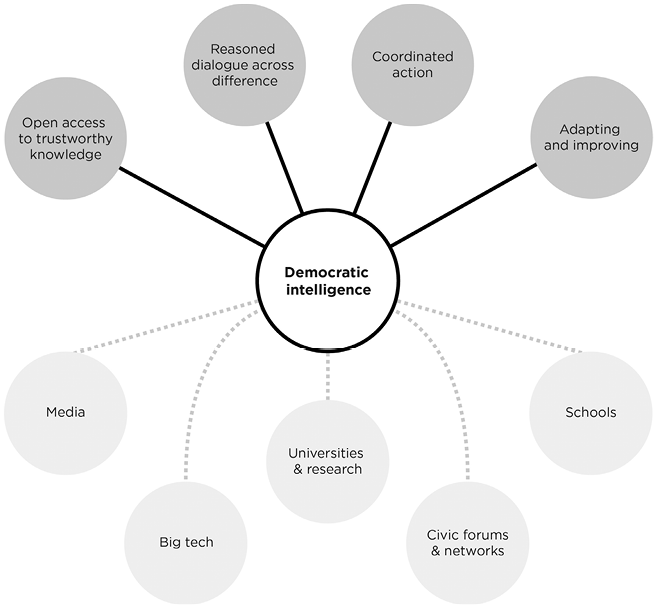
From this perspective, all epistemic infrastructures – schools included – are required to support four interdependent functions in order to facilitate democratic Intelligence (Brown et al., in press). When these functions operate effectively, public discourse is robust yet constructive; when they degrade, misinformation, polarisation, and cynicism spread:
1. Open access and engagement with trustworthy knowledge: the first function concerns the organisation of epistemic access: ensuring that all citizens – children and adults alike – are not merely exposed to information, but are able to encounter knowledge that is credible, intelligible, and open to scrutiny. Institutions actively shape the informational landscape within which individual and collective judgement becomes possible (e.g., Goldman, Reference Goldman1999; Longino, Reference Longino2002; Fricker, Reference Fricker2007). Further, work on public trust in science highlights that access to knowledge is inseparable from the social conditions under which expertise is rendered trustworthy and accountable (Oreskes, Reference Oreskes2019). Without such institutional shaping, informational abundance fails to result in understanding, and pluralism quickly collapses into epistemic inequality.
2. Engagement in reasoned dialogue across difference: the second function is to normalise structured disagreement. Democratic intelligence requires arenas in which competing claims are surfaced, reasons are demanded, and positions are revised through reciprocal justification rather than imposed through authority or rhetorical dominance. Deliberation, in this sense, is not spontaneous; it is institutionally scaffolded (Habermas, Reference 83Habermas1996; Dryzek, Reference 81Dryzek2000; Mansbridge et al., Reference Mansbridge, Bohman, Chambers, Parkinson and Mansbridge2012). Productive contestation thus depends on norms governing how disagreement is interpreted and managed (Bondy & Godden, Reference Bondy and Godden2021). Where such norms are absent, difference becomes polarisation; where they are embedded, diversity instead becomes a resource for collective learning.
3. Coordination of action based on shared understanding: third is functionality that supports all communities and institutions to translate knowledge into collective problem-solving. Understanding alone does not produce change. Democratic intelligence depends on whether institutions and communities possess routines, decision architectures, and relational trust sufficient to convert judgement into collective implementation (March, Reference March1991; Argyris & Schön, Reference Argyris and Schön1996; Senge, Reference Senge1990). Research on improvement science demonstrates that coordinated action requires shared problem definition, disciplined inquiry, and structured cycles linking evidence to intervention (Bryk et al., Reference Bryk, Gomez, Grunow and LeMahieu2015). In this sense, epistemic infrastructures must not only host dialogue but also stabilise it into patterns of practice capable of producing cumulative effect.
4. Adaption and improvement in light of new evidence: the fourth function concerns reflexivity over time. Democratic intelligence is sustained only where institutions are able to detect error, incorporate feedback, and revise commitments in light of new evidence. This requires more than informal reflection; it depends on embedded feedback loops, psychological safety, and organisational routines that legitimate learning rather than punish it (Senge, Reference Senge1990; March, Reference March1991). Empirical work on learning organisations and schools as learning organisations highlights that sustained adaptation depends on cultures that combine inquiry, data use, and collective responsibility for improvement (Kools et al., Reference Kools, Stoll, George, Steijn, Bekkers and Gouëdard2020). Where such conditions are present, revision becomes normal rather than destabilising; where they are absent, institutions drift towards inertia or defensive closure.
The Role of Schools in Supporting Democratic Intelligence
To clarify the distinction between individual epistemic capacity and epistemic infrastructure – and how each contributes to democratic intelligence – Table 2 summarises their respective foci, mechanisms, risks, and leadership implications. Figure 3, meanwhile, illustrates why schools are especially significant within this framework: they are among the few institutions where the development of individual epistemic capacity and the enactment of epistemic infrastructure occur simultaneously and in everyday practice. At the level of individual epistemic capacity, schools are responsible for developing students’ and educators’ ability to engage thoughtfully with ideas. This matters because such capacity is not evenly distributed – neither among students and their families, nor among teachers and leaders themselves – requiring schools to attend deliberately to the learning and epistemic development of all participants in the school community.
| Dimension | Individual epistemic capacity | Epistemic infrastructure |
|---|---|---|
| Primary focus | How individuals engage with ideas | How ideas circulate, are tested, and used collectively |
| Core question | Can people exercise sound judgement? | Can judgement become shared, consequential, and durable? |
| Key mechanisms | Critical thinking, prospection, social networks | Access to knowledge, deliberative forums, decision routines, feedback, and learning systems |
| Unit of analysis | Individuals and small groups | Institutions, platforms, and organisational systems |
| Main risks | Cognitive bias, misinformation, short-termism | Epistemic exclusion, polarisation, fragmentation, institutional inertia |
| Contribution to democratic intelligence | Enables informed participation | Enables collective reasoning, coordination, and adaptation |
| Leadership implication | Develop individual capability | Design, protect, and steward epistemic conditions |
Epistemic infrastructure
Epistemic infrastructure comprises the organisations and institutions through which ideas are produced, validated, circulated, and put to use in collective life, including schools, media, research bodies, digital platforms, civic forums, and governance systems. Together, these infrastructures support four core functions of democratic intelligence: access to trustworthy knowledge, reasoned dialogue across difference, coordinated action, and adaptation in light of new evidence. When they function well, individual judgement becomes shared and consequential; when they degrade, democratic reasoning is weakened at the system level.
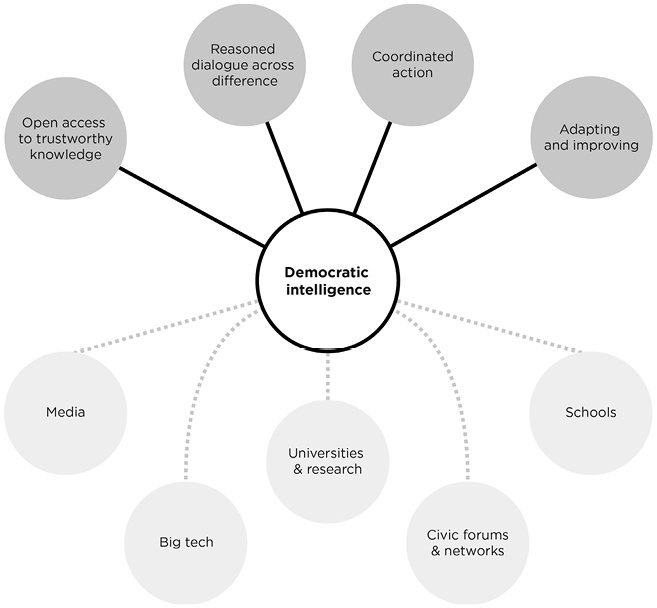
At the level of epistemic infrastructure, schools enact democratic intelligence at a micro-scale through their organisational routines, decision-making practices, and cultures of inquiry. In doing so, they can provide open access to trustworthy knowledge, establish shared expectations about how evidence, disagreement, and authority should operate, and create structured opportunities for reasoned dialogue and evidence-informed debate among both students and educators. When schools organise themselves around shared understanding – rather than individual discretion alone – they are also able to coordinate action and adapt practice in light of new evidence, ensuring that teaching and learning remain robust in the face of polarisation, uncertainty, and rapid change.
Crucially, the contribution of schools to democratic intelligence need not be confined within their own organisational boundaries. By building epistemic capacity on the ground – through active and sustained engagement with students, families, and community partners – schools can extend these same principles into the wider communities they serve. Further, place-based approaches that align schools with local agencies, services and civic actors, enable shared diagnosis of educationally relevant challenges, coordinated responses to disadvantage, and collective learning about what works for children and young people in specific contexts. In doing so, schools can cultivate democratic intelligence not only for future citizens but also in the present: strengthening the local conditions under which ideas are accessed, tested, and translated into action. This dual role – developing individual capacity amongst communities, while anchoring epistemic infrastructure locally – is central to both the expansion and the long-term sustainability of democratic intelligence.
The Role of School Leaders as Epistemic Stewards
The role of school leaders as epistemic stewards is to operate at the boundary between individual epistemic development and institutional epistemic infrastructure. When effective ideas engagement at the individual level is supported by coherent epistemic conditions at the organisational level, schools become environments in which democratic intelligence can be enacted locally and sustained over time. In practice, the work of epistemic stewardship unfolds through five interconnected leadership practices. Together, they reflect leadership at both levels: cultivating individual epistemic capacity and constructing the institutional conditions under which that capacity becomes collectively consequential:
1. Cultivating vision and culture: Epistemic stewards articulate education’s moral purpose as the pursuit of truth and the betterment of society. They embed values of honesty, fairness, and curiosity into everyday routines, establishing shared expectations about how knowledge, evidence, and disagreement should be treated.
2. Supporting effective ideas engagement: Stewards actively cultivate the cognitive and social conditions that enable both teachers and students to engage with ideas critically and constructively. This includes embedding critical thinking, prospective mindsets, and attention to the quality of social networks within curricula, professional learning and everyday practice.
3. Modelling deliberative leadership: In decision-making, epistemic stewards practice transparency, invite dissent, and reason publicly from evidence. By modelling curiosity and reflective questioning, leaders normalise uncertainty as a condition of learning and demonstrate how disagreement can be handled productively: providing a lived example of democratic deliberation for staff and students alike.
4. Designing epistemic infrastructure: Stewards create and sustain systems – such as professional learning communities, inquiry cycles, teacher juries, and partnerships with universities – that support collective reasoning, coordinated action, and ongoing improvement. Through these infrastructures, schools ensure open access to trustworthy knowledge and widen their epistemic networks so that diverse, credible perspectives can enter, circulate, and inform practice.
5. Extending civic reach: Finally, epistemic stewards position the school as part of a wider knowledge commons. By engaging families, local authorities, and community organisations, they support place-based coordination around shared educational priorities, counter misinformation, and contribute to the development of democratic intelligence beyond the school itself.
In times of fragmentation, epistemic stewardship is an act of moral courage. It requires leaders to defend truthfulness and empathy amid polarisation, and to keep schools open to evidence even when political pressures demand closure. The steward’s authority derives not from certainty, but from integrity: the capacity to hold complexity without retreating into dogma. Through such leadership, schools become spaces where young people and adults alike can encounter ideas safely yet critically, and where disagreement is handled through reason rather than rhetoric. In turn, these microcosms help to strengthen the democratic fabric beyond the school gates.
Conclusion: From Stewardship to Action
This opening section has argued that the future of democratic education depends on how well schools cultivate and steward ideas. It has introduced democratic intelligence as arising from the interaction between two interlocking components: effective ideas engagement and the epistemic infrastructures within which ideas are accessed, tested, and used. In doing so, it has shown that schools must not only develop students’ and educators’ capacities for critical thinking, prospection, and social networks, but also ensure that these capacities can be exercised productively – within schools and beyond them – to improve individual and collective outcomes. School leaders are, therefore, positioned as epistemic stewards, responsible for shaping both individual capability and the institutional and civic conditions that allow it to matter.
The remainder of Leading for a Fragmented World develops this argument across three dimensions aligned with core functions of democratic intelligence. For reasons of practicality, the Element is organised around epistemic infrastructures rather than individual epistemic capacities. In schools, leaders are not choosing between developing individual capability and shaping institutional conditions; they are required to do both simultaneously, while also attending to how schools connect with families, communities, and wider knowledge systems. Structuring the sections around epistemic infrastructures – such as access to knowledge, dialogue, and collective learning – provides a clearer way, however, to show how everyday leadership decisions, routines, and systems support the development and use of individual epistemic capacity in practice, and how this work can extend beyond the school as a civic institution. Correspondingly, the next section (Section 2) focuses on open access to trustworthy knowledge, examining how school leaders can enable teachers and students to identify credible sources, evaluate competing claims, and navigate distorted or misleading information environments. It shows how leadership choices about curriculum, professional learning, and information use shape whether ideas are encountered as objects of inquiry or accepted uncritically, and how schools can act as local anchors of epistemic integrity.
Section 3 then turns to reasoned dialogue across difference, exploring how schools can become sites of deliberation in which disagreement is treated as a resource for learning rather than a threat to cohesion. It examines the organisational conditions, routines, and norms that allow diverse perspectives to be surfaced, tested, and refined through structured dialogue – both within schools and in their engagement with parents, partners, and local communities. The final section (Section 4) brings these strands together by examining coordinated action, adaptation, and improvement. It shows how inquiry-oriented leadership translates shared understanding into collective action within schools, and how this capacity can be extended through place-based collaboration to address locally salient educational challenges. In doing so, it demonstrates how schools can contribute not only to their own improvement but also to the cultivation and long-term sustainability of democratic intelligence in the communities they serve. Together, these sections show how school leaders can strengthen individual epistemic capability while deliberately designing and extending the institutional environments in which ideas become collectively consequential.
2 Openly Accessing and Engaging with Trustworthy Knowledge
This section opens by examining two interconnected challenges. The first is the growing divergence in information environments, with young people relying heavily on algorithmically curated social media platforms, while adults turn mainly to traditional media. This gap fuels informational asymmetry, where students are exposed to conspiracies such as flat earth claims, the moon landing hoax, Covid-19 microchip theories, the ‘great replacement’, or narratives promoted by social media influencers; while teachers and parents may not even be aware of these circulating ideas (Gamote & Hyman, Reference Gamote and Hyman2025). Even when pupils do not fully believe such conspiracies, exposure shapes behaviour, influencing classroom interactions, peer relationships, and trust in institutions. While younger teenagers often place strong trust in adults, teachers and parents are themselves not immune to misinformation – highlighting that adulthood does not automatically confer expertise. And although they are widely regarded as the most credible intervention point, many teachers and parents lack clarity or confidence about how to respond effectively when misinformation arises (Commission into Countering Online Conspiracies in Schools, 2025; Gamote & Hyman, Reference Gamote and Hyman2025).
The second challenge lies in the rising expectation that teachers, across schools and school systems, demonstrate sustained and skilled engagement with research and data in order to inform and refine their professional practice. Yet teachers encounter persistent and compounding barriers when attempting to do so. Many educators lack the time, training, and confidence to recognise when research is high quality and trustworthy and when it simply perpetuates unsupported pedagogical claims, or to interpret and analyse data meaningfully. Limited professional development in evidence literacy has been identified as a cross-cutting weakness across many school systems globally (Malin et al., Reference Malin, Brown, Ion, van Ackeren, Bremm, Luzmore, Flood and Rind2020; Rickinson et al., Reference Rickinson, Walsh, Gleeson, Cutler, Plant, Boulet, Hall, Cirkony and Salisbury2025). Access inequities further compound these challenges, with research often paywalled, overly technical, or perceived as irrelevant to local contexts. School cultures and institutional norms also constrain engagement, as high-stakes accountability, policy overload, and heavy workloads create pressures that squeeze out space for sustained professional inquiry (e.g., Brown et al., Reference Brown, MacGregor, Flood and Malin2022). As a result, teachers in many settings rely more on intuition, experience, word of mouth, or external mandates than on research (Walker et al., Reference Walker, Nelson, Bradshaw and Brown2019). This risks teaching quality becoming uneven, improvement efforts remaining ad hoc, and education practice becoming more vulnerable to fads, biases, and ineffective pedagogy.
Taken together, both challenges reveal a common issue facing contemporary education: the growing expectation that students and teachers navigate complex and rapidly shifting information environments, often in the absence of sufficiently developed epistemic capacities. On one hand, students must learn not only to distinguish between established facts, well-supported theories, probabilistic knowledge, and speculation, but also to engage in reasoned judgement: drawing on trustworthy evidence effectively in order to make thoughtful decisions, especially when certainty is limited. Such judgement is especially important in online spaces where misinformation circulates rapidly and often invisibly. On the other hand, teachers are expected to model these same epistemic practices by developing the capacity to locate, interpret, and appraise high-quality research and data: integrating external evidence with their professional judgement to inform decisions about teaching and learning.
Both groups thus face parallel demands: identifying trustworthy sources, interpreting evidence appropriately, recognising uncertainty and limitations, exercising reasoned judgement, and resisting misleading or manipulative ideas. These shared demands ultimately converge on a broader capability: the capacity to integrate evidence, causal reasoning, values, and legitimacy when making decisions under uncertainty. Later in the section, I refer to this integrative capacity as optimal rationality. By examining the skills, literacies, and conceptual frameworks that underpin such critical appraisal, this section lays the groundwork for understanding how schools can cultivate the epistemic resilience needed for effective learning, responsible engagement with knowledge, and the development of sound reasoning in complex informational environments.
Understanding the Types and Boundaries of Knowledge
To help students meet the complex realities of today’s contemporary knowledge landscape – where they encounter conspiracies ahead of adults, are exposed to contradictory claims, and must make sense of knowledge of uneven reliability – we must situate the development of their critical thinking skills within a coherent framework that clarifies what different types of knowledge exist and the reasoning abilities needed to evaluate them. Students cannot meaningfully evaluate online content or public claims without appreciating how certainty, evidence, risk, and speculation differ, nor can they form sound judgements without recognising how emotions shape their responses to information. Feelings such as fear, outrage, or belonging can amplify misinformation or distort rational appraisal, while the absence of emotional awareness can make students vulnerable to manipulation (French, Reference French2024; Kahneman, Reference Kahneman2011). Providing a structured way of distinguishing what is known, what is uncertain, what requires deliberation, and what is purely conjecture enables students to judge when information can be trusted, when further investigation is needed, and when heightened scepticism is warranted. Such a framework also supports a more confident, reflective, and emotionally aware engagement with ideas: an increasingly urgent need in an era of AI-generated text, images, and deepfakes that can simulate expertise and fabricate plausibility with alarming precision (Campbell, Reference Campbell2025).
What Can We Know?
The question of what can and cannot be known – and therefore what we can and cannot reason about – lies at the heart of both science and modern societies (Oreskes, Reference Oreskes2019). To clarify this, it is useful to distinguish between the following four categories of knowledge, and how each feature within a framework of rational decision-making (Brown, Reference Brown2013; Reference 79Brown2018):
1. Definite facts are claims established beyond reasonable doubt because they are demonstrable, replicable, and open to falsification (the Earth’s curvature, for instance, can be verified through simple observation). Such facts function as epistemic anchor points for public reasoning – yet even settled knowledge may be resisted when it conflicts with identity commitments or provokes strong emotional responses. Empirical robustness alone does not guarantee acceptance; facts must also remain socially and institutionally protected if they are to serve as shared reference points.
2. Well-supported theories subject to revision: other forms of knowledge – such as theories about gravity or the structure of the universe – are robust yet open to refinement as new data emerge. Kuhn’s (Reference 84Kuhn1962) work on paradigm shifts shows that this revisability is a strength of scientific inquiry. Students therefore need support to manage the discomfort of uncertainty and to develop epistemic humility: the ability to accept that knowledge evolves without viewing this as instability. Understanding that revision typically improves explanations, rather than increasing risk, can build students’ confidence when engaging with provisional knowledge.
3. Probabilistic knowledge requiring judgement: Some areas involve high-confidence claimsFootnote 7 that still require interpretation, risk assessment, and deliberation to guide action: for example, climate science or pandemic modelling. Decisions here demand weighing probabilities, considering potential harms, and integrating moral or social imperatives. Because emotions strongly shape perceptions of risk, students must learn to interrogate not only what the evidence shows but also how their feelings influence the way they interpret it.
4. Speculation: Finally, some claims remain imaginative but unsubstantiated: for example, conjectures about alien visitors or conspiracy theories that rely on emotional appeal rather than evidence. Such ideas often spread because they provoke strong feelings or create a sense of insider belonging, but emotional impact is not a marker of truth. Until supported by robust evidence, these claims belong in the realm of hypothesis rather than belief or action. AI-produced deepfakes and synthetic narratives now complicate this further by providing speculative ideas with an artificial veneer of credibility.
Navigating the Borderland of Knowledge
Despite this plurality of knowledge types, most political and social dilemmas fall within the third category. Here knowledge is strong but not absolute, and risks, values, emotional responses, and questions of legitimacy must be integrated to form rational frameworks for action. This domain requires the interpretation of probabilities, the weighing of consequences, and the negotiation of trade-offs, alongside awareness of how affect shapes both risk perception and moral judgement. Crucially, where certainty is partial rather than complete, the credibility of how knowledge claims are advanced becomes especially significant. In such situations, evaluating a given claim entails looking beyond its surface content to the institutional architecture that governs its production and dissemination. The question is not only what is being asserted but also who produced it, within what systems of review and accountability, and how it can be challenged or corrected.
A first crucial dimension in evaluating knowledge claims concerns the credibility of those who advance them. Such judgements often begin with the visible properties of individuals: their expertise, track record, professional role, and the degree to which their work is recognised within relevant communities of practice. Yet individual credibility alone is rarely sufficient. Trust also depends on the institutional environments within which claims are produced, scrutinised, and revised. As work in social epistemology demonstrates, reliable knowledge typically emerges within systems that institutionalise accountability, evidential transparency, and mechanisms for correction over time (Goldman, Reference Goldman1999; Oreskes, Reference Oreskes2019). For instance, platforms and publications that operate within robust oversight systems – including editorial review, peer review, fact checking, and formal correction procedures – embed mechanisms for error detection and revision. These processes do not eliminate mistakes, but they increase the probability that inaccuracies are identified and rectified. Such safeguards are particularly vital in probabilistic and speculative domains, where misinformation can distort judgement on matters of public health, climate policy, or civic decision-making (Oreskes, Reference Oreskes2019).Footnote 8 In contrast, environments where ‘anyone can post without consequence’ – including unmoderated social media platforms, anonymous forums, or influencer-driven channels – lack such safeguards. In these spaces falsehoods can circulate unchecked, emotionally charged content spreads more rapidly than accurate information, and algorithms reward engagement rather than truth (Oreskes, Reference Oreskes2019).
If credibility depends both on the qualities of the claimant and the institutional conditions under which a claim is advanced, students must be equipped with practical tools to evaluate these features. One way to support this is through five sets of interrelated questions:
1. Position and epistemic standing: Who produced this content, and what places them in a position to comment? What is their role, background, or institutional affiliation, and how does this situate them in relation to the claim being made?
2. Expertise and track record: Do they possess recognised expertise, sustained engagement, or a demonstrable record of reliable work in this field? Has their prior contribution been regarded as rigorous and accurate?
3. Evidential transparency: Do they provide accessible and relevant evidence to support their claims? Are sources cited clearly, and can those sources be independently verified?
4. Accountability and revisability: Is there reason to believe they would correct themselves if shown to be wrong? Do they operate within systems that encourage transparency, peer scrutiny, and engagement with counter-evidence?
5. Motivational structure: What incentives might shape how this information is presented? Are the primary goals to inform, persuade, entertain, sell, or advance a political or ideological position – and how might these motivations influence framing, emphasis, or selectivity?
Together, these dimensions shift students’ attention from surface plausibility to the deeper credibility architecture underpinning a claim, helping them evaluate not only what is said but also why it warrants belief.
Optimal Rationality
Developing sensitivity to evidential strength and source credibility enables appropriately calibrated scepticism: neither dismissing information because it is unfamiliar nor accepting it because it is confidently expressed. Judgement instead becomes structured around two linked evaluations: whether a claim is epistemically well supported, and whether it emerges from a credibility architecture capable of scrutiny, revision, and accountability. The further step, however, is integration. Discrimination alone is insufficient; reasoned judgement requires synthesising multiple dimensions of reasoning that together guide action under conditions of uncertainty. I refer to this integrative capacity as optimal rationality (Brown, Reference 79Brown2018): the ability to reach decisions that maximise longer-term individual and collective well-being. Optimal rationality involves integrating four interrelated considerations: trustworthy knowledge, theories of action, normative imperatives, and legitimacy conditions for collective action. Each plays a distinct role in structuring rational judgement.
First, optimal rationality begins with identifying the most secure knowledge available in a given domain – those claims supported by strong, convergent evidence and produced within accountable, transparent, and revisable knowledge systems – and distinguishing these claims from areas of genuine uncertainty. Trustworthiness, in this sense, refers not only to evidential robustness but also to the institutional conditions that protect claims from distortion and enable correction over time. Second, rational judgement requires evaluating competing theories of action: explicit accounts of how and why particular choices are expected to produce certain outcomes, what causal mechanisms they assume, and what risks or trade-offs they entail. Third, because such judgements invariably involve values as well as facts, decision-making must clarify the normative imperatives at stake: the pragmatic necessities that constrain action, the ethical commitments that guide it, and the socially embedded priorities that shape collective direction. Finally, durable action depends on legitimacy. Decisions must be framed in ways capable of generating sufficient consensus to sustain implementation over time, since without shared authorisation even well-evidenced policies can fragment under resistance, misinterpretation, or withdrawal of support. The interaction of these elements can be illustrated through a simplified example of how optimal rational reasoning operates when societies confront complex and uncertain public challenges (see Box 1).
Public controversies such as environmental policy, pandemic response, or immigration illustrate the complexity of optimal rational reasoning. In such domains, individuals must weigh empirical evidence, probabilistic projections, normative commitments, and emotional responses simultaneously, often under conditions of urgency and media amplification. For example, during the Covid-19 pandemic, governments faced decisions about lockdowns, vaccination programmes, and public-health messaging. Reaching sound decisions required integrating evolving scientific evidence about transmission and risk, competing theories about how interventions might influence behaviour and outcomes, ethical considerations such as protecting vulnerable populations while limiting economic harm, and the need to maintain public legitimacy and trust in order to sustain compliance.
Where the elements of optimal rationality are integrated coherently, debate can move towards shared understanding and coordinated action. Where they are not – or where shared standards of evidence are deliberately undermined – polarisation and fragmentation intensify (Hales, Reference Hales2014; Mann, Reference Mann2018). Deep disagreements further complicate matters. When actors operate from fundamentally incompatible worldviews, they lack common criteria for evaluating evidence or adjudicating competing claims (Bondy & Godden, Reference Bondy and Godden2021). In such cases, the challenge is not merely informational but structural: the erosion of shared, institutionally protected standards regarding what counts as evidence and how it should guide action. Optimal rationality, therefore, depends not only on individual cognitive skill but also on the presence and maintenance of common epistemic norms capable of sustaining collective judgement over time.
Embedding Epistemic Literacy in Classroom Practice
Having outlined the components of optimal rational judgement, the next task is to consider how schools cultivate these capacities in practice. Here, epistemic stewardship should focus on strengthening critical thinking, shaping epistemically healthy networks, and fostering pragmatic prospection. To strengthen critical thinking, educators must make explicit the distinctions between different forms of knowledge outlined earlier, thus stabilising the epistemic environment in which students reason. This clarifies what is secure, what remains open to refinement, and where uncertainty calls for humility rather than certainty. Educators are also required to foreground the role of affect, helping students recognise how fear, outrage, belonging, or hope may distort evidential appraisal. Crucially, however, critical thinking must reach beyond judging whether a claim sounds convincing. It must enable students to trace how a claim came to be: the expertise behind it, the norms governing its scrutiny, and the routes through which it may be challenged or revised. In this way, critical thinking establishes the discrimination necessary for calibrated scepticism, orienting judgement not only towards evidential strength but also towards the epistemic safeguards that sustain reliable knowledge over time.
Second, ideas are encountered through social and informational networks that structure exposure and reinforcement. As discussed in Section 1, highly homophilous networks – whether friendship groups or algorithmically curated digital spaces – can amplify confirmation bias and shield claims from scrutiny. Epistemic stewardship, therefore, involves widening students’ exposure to diverse and credible perspectives, creating classroom norms in which disagreement is expected and structured rather than avoided, and enabling engagement with voices beyond immediate peer groups (Biesta, Reference Biesta2021). Networks that combine the trust of strong ties with the novelty of bridging ties are more likely to sustain reflective engagement with ideas.Footnote 9 Third, pragmatic prospection introduces temporal depth into reasoning – a capacity that teachers and school leaders must actively cultivate. By designing learning experiences that require students to imagine plausible futures, anticipate consequences, and weigh long-term trade-offs, educators shift engagement from reactive interpretation towards anticipatory judgement. When students are guided to consider how present commitments shape future outcomes – for themselves and for others – they are more likely to interrogate evidence carefully and resist emotionally compelling but short-sighted narratives (e.g., Craft, Reference Craft, Wegerif, Li and Kaufman2017; Sternberg, Reference Sternberg, Wegerif, Li and Kaufman2017; Wegerif et al., Reference Wegerif, Li, Kaufman, Wegerif, Li and Kaufman2017). In this way, prospection aligns evidential evaluation with projected well-being over time and embeds responsibility for future consequences within present reasoning.
When these three drivers interact, the preconditions for optimal rationality are established. Students are better able to identify secure knowledge, evaluate competing theories of action, clarify normative imperatives, and consider the legitimacy conditions necessary for durable collective action. By modelling how evidence is weighed, uncertainty interpreted, risks assessed, and emotion acknowledged, educators render judgement visible as a structured, reflective, and revisable process rather than a matter of intuition or assertion. Table 3 operationalises this framework by identifying its core components, the epistemic risks that arise in their absence, and the forms of educational practice through which they may be strengthened. The cumulative effect is a shift from passive information consumption towards disciplined intellectual self-regulation – the same epistemic orientation that underpins effective inquiry and democratic participation alike.
| Component of optimal rationality | Epistemic focus | Risks if absent | How teachers can support development |
|---|---|---|---|
| Trustworthy Knowledge (Baseline Judgement) | Distinguishing secure knowledge from uncertainty and recognising the institutional safeguards that render claims trustworthy | False equivalence; treating settled knowledge as debatable; emotional override of evidence | Explicitly classify knowledge types (fact, revisable theory, probabilistic claim, speculation); model evidence-weighing aloud; anchor discussion in credible sources |
| Theories of Action (Consequential Reasoning) | Articulating and evaluating causal accounts of how actions are expected to produce outcomes, including risks, trade-offs, and underlying assumptions | Short-termism; policy naïveté; emotionally driven risk perception | Use scenario analysis, structured problem-framing, and comparison of alternative pathways; surface assumptions explicitly |
| Normative Imperatives (Value Clarification) | Identifying pragmatic needs, ethical commitments, and socially embedded priorities | Moral confusion; rhetorical manipulation; hidden value conflicts | Encourage articulation of underlying principles; distinguish empirical claims from value claims; surface tensions openly |
| Legitimacy & Consensus (Collective Authorisation) | Framing decisions in ways that generate legitimate collective authorisation and sustain coordinated action over time | Polarisation; fragmented implementation; identity-protective resistance | Structure dialogue for reason giving; require interpretive charity; cultivate intellectual humility |
| Epistemic Network Curation | Diversifying exposure to credible and accountable knowledge sources beyond homophilous echo chambers | Epistemic enclaves; confirmation bias; motivated reasoning | Introduce bridging voices; facilitate cross-group dialogue; map information sources |
| Pragmatic Prospection | Integrating temporal depth into judgement; evaluating long-term consequences | Reactive reasoning; present bias; susceptibility to emotionally salient narratives | Use future-oriented framing, projected outcome modelling, and reflective risk analysis |
The Power of Authenticity
Even strong cognitive skills and well-curated networks only become sustained habits of rational engagement when students experience them as personally meaningful. Rationality thus endures not through instruction alone, but when it aligns with identity. This is where the notion of authenticity becomes pivotal. Students are far more likely to persist in evidence seeking, reflective judgement, source checking, and open dialogue when these behaviours feel consistent with who they are – or who they aspire to become. Authenticity refers to the felt experience of acting in ways that align with one’s ‘true self’: a sense of coherence, autonomy, and value congruence rather than compliance with external pressure (Rivera et al., Reference Rivera, Christy, Kim, Vess, Hicks and Schlegel2019). It is not a fixed essence but a subjective state that arises when actions express personally held beliefs and commitments. When behaviour feels disconnected from those values, motivation weakens.
Research links authenticity to greater resilience, intrinsic motivation, well-being, and sustained commitment to meaningful goals (Schlegel et al., Reference Schlegel, Hicks, Davis, Hirsch and Smith2013; Kim et al., Reference Kim, Christy, Schlegel, Donnellan and Hicks2017). Similarly, civic engagement research shows that people persist longer in civic activity when their actions feel authentic (Maffly-Kipp et al., Reference Maffly-Kipp, Holte, Stichter, Hicks, Schlegel and Vess2022). By analogy, when students see reasoned engagement with ideas as part of the kind of person they want to be – thoughtful, independent, and socially responsible – they are more likely to sustain the practices of evaluating evidence, questioning claims, and weighing competing perspectives. Authenticity thus strengthens both the motivation and durability of ideas engagement. Teachers and school leaders can cultivate this by valuing questioning, connecting knowledge and ideas engagement to students’ lived aspirations, and modelling how intellectual engagement reflects deeply held values. When adults demonstrate that disciplined reasoning is not merely academic but identity relevant, students can begin to experience it as part of who they are becoming.
Exploring Teacher and Organisational Inquiry
Just as students require epistemic structures and motivational conditions to think well, teachers require organisational structures and cultural conditions to engage in disciplined inquiry. As highlighted at the beginning of the section, teachers are increasingly expected to engage with trustworthy knowledge on an ongoing basis. Across many contemporary school systems, this expectation has become a central component of policy discourse: teachers are required to use research, data, and evidence-informed reasoning to refine instructional practices and improve student outcomes. Yet despite widespread endorsement of the value of evidence use, teachers continue to encounter entrenched and mutually reinforcing barriers that hinder meaningful engagement (Malin et al., Reference Malin, Brown, Ion, van Ackeren, Bremm, Luzmore, Flood and Rind2020; Rickinson et al., Reference Rickinson, Walsh, Gleeson, Cutler, Plant, Boulet, Hall, Cirkony and Salisbury2025). Time scarcity, limited training in understanding and applying research, a lack of confidence in data analysis, and the inaccessibility of academic literature all constrain teachers’ capacity to draw on evidence in sophisticated ways (Brown et al., Reference Brown, MacGregor, Flood and Malin2022).
These challenges are compounded by organisational cultures that often prioritise efficiency, compliance, or rapid action over slower, more deliberative forms of inquiry. Accountability pressures and workload intensification further diminish the temporal and cognitive space required for sustained critical reflection. As a result, teachers may endorse the principle of using evidence to improve their practice while struggling to enact it in any substantive sense (Rickinson et al., Reference Rickinson, Walsh, Gleeson, Cutler, Plant, Boulet, Hall, Cirkony and Salisbury2025). These constraints reveal that commitment alone is insufficient; what is required is a disciplined architecture for professional reasoning. Integrating a clear conception of evidence-informed practice (EIP) within an overarching cycle of inquiry provides such an architecture, structuring improvement in systematic, theory-informed, and contextually grounded ways (Poortman & Brown, Reference Poortman and Brown2023).
Evidence-Informed Practice as an Integrative Decision-Making Approach
Evidence-informed practice refers to teachers’ deliberate assessment and integration of diverse forms of evidence – formal research, school- and classroom-level data, and practitioner expertise – in order to improve professional decision-making (e.g., Malin et al., Reference Malin, Brown, Ion, van Ackeren, Bremm, Luzmore, Flood and Rind2020). As Table 4 illustrates, each of these sources performs a distinct epistemic function. EIP, therefore, involves not the mechanical ‘application’ of research to practice, but the reasoned and iterative synthesis of multiple evidence streams. Central to this process is the development and refinement of theories of action that specify how and why a chosen approach is expected to address an identified problem within a particular context (see Box 1, Section 4). Such reasoning presupposes capabilities in research literacy, data literacy, and contextual judgement, issues considered later in this section. In response to these complexities, cycles of inquiry offer a practical structure through which EIP can become manageable, teachable, and actionable in everyday professional practice.
| Evidence source | What it contributes |
|---|---|
| Research evidence | Provides theoretical and empirical insights that assist teachers in reframing problems, understanding causal mechanisms, and identifying potentially efficacious approaches. |
| Data | Offer granular information about learner performance, participation, and classroom processes that can guide pedagogical decisions and support robust evaluation. |
| Professional judgement | Rooted in practitioner expertise, professional judgement ensures that evidence is interpreted and adapted in ways that remain sensitive to local context, learner diversity, and the practical exigencies of classrooms. |
Cycles of Inquiry: A Structured Mechanism for Individual Professional Learning
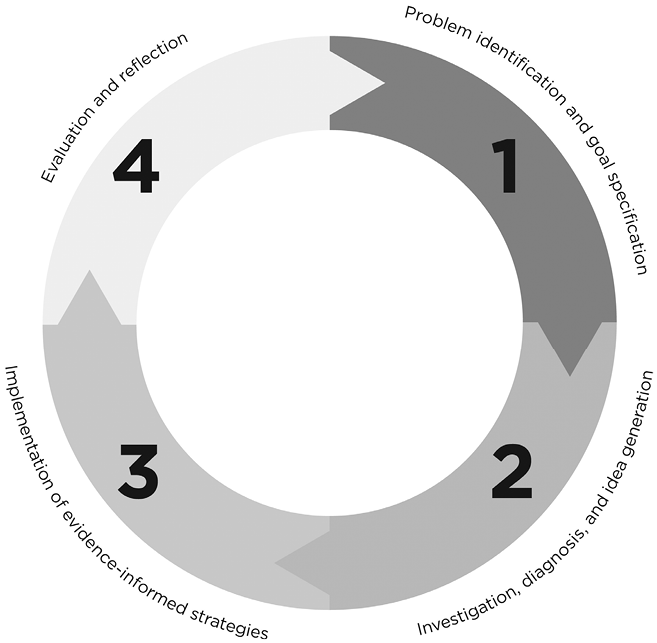
Cycles of inquiry provide a disciplined, iterative process through which educators investigate a defined problem, draw on evidence to generate and test improvement strategies, and evaluate the outcomes of their actions. As Poortman and Brown (Reference Poortman and Brown2023) observe, such cycles allow teachers to learn, and innovate their teaching practice, through generating and testing ideas based on a combination of research literature and data. While specific models vary, such cycles typically involve four interrelated stages:
1. Problem identification and goal specification: Teachers use data and professional observation to define a precise improvement focus.
2. Investigation, diagnosis, and idea generation: Research evidence, additional data, and professional judgement are used to explore possible causes and develop hypotheses about what might improve the situation.
3. Implementation of evidence-informed strategies: An evidence-informed strategy is trialled, guided by an explicit theory of action and adapted appropriately to context.
4. Evaluation and reflection: Teachers examine both implementation and impact, using evidence to refine, scale, or reconsider the approach.
Further, as Figure 4 illustrates, these stages are circular rather than linear: and teachers will also move back and forth between them as new information emerges. Over time, inquiry becomes embedded as a professional habit of disciplined reasoning. When combined with EIP, this process provides a coherent mechanism for sustained teacher learning.
The cycle of inquiry
The cycle of inquiry illustrates how evidence-informed practice is structured as an iterative process of problem identification, investigation, action, and reflection. Rather than a linear sequence, inquiry operates as a continuous loop in which new evidence prompts refinement, adaptation, or reframing of practice.
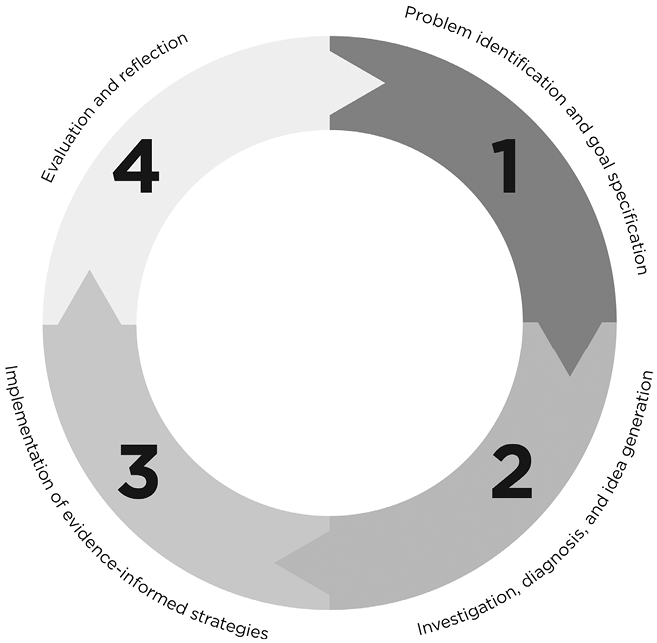
Yet the process of teachers integrating EIP within cycles of inquiry also develops capabilities that extend beyond instructional improvement. First, the analytic demands of inquiry strengthen critical thinking, requiring teachers to interrogate the quality of research and data, evaluate causal claims, compare alternative explanations, and revise prior assumptions. Second, designing and testing improvement strategies serves to strengthen prospection: the capacity to imagine desired future states and develop plausible pathways to achieve them. At the same time, inquiry encourages teachers to broaden the range of research and data sources they draw upon, expanding their epistemic networks. In this sense, inquiry cycles do more than structure professional learning: they cultivate the epistemic dispositions required to navigate complex knowledge environments – dispositions that teachers subsequently model and transmit to their students.
Leadership Conditions Enabling Individual Teacher Inquiry
Although it’s individual teachers that engage in inquiry, their success depends fundamentally on the extent to which school leaders cultivate the conditions that make such work possible. Inquiry is a demanding professional practice: it requires time, specialised expertise, cognitive space for reflection, and access to trustworthy knowledge. None of these conditions arise spontaneously within schools; indeed, many are systematically eroded by competing demands, administrative pressures, or cultures that prioritise immediate solutions over deeper learning. For this reason, leadership plays a pivotal role in establishing the structural, cultural, and epistemic supports that render inquiry feasible, meaningful, and professionally rewarding (e.g., Malin et al., Reference Malin, Brown, Ion, van Ackeren, Bremm, Luzmore, Flood and Rind2020).
A core leadership responsibility must therefore be the deliberate development of teachers’ capability for inquiry. Teachers require a constellation of interconnected knowledge, skills, and dispositions if they are to diagnose problems with precision, interpret evidence effectively, generate plausible causal hypotheses, design and implement interventions, and evaluate their impact. One key aspect of this capability is research literacy. Teachers must be able to locate credible research, interpret methodological terminology, assess evidence quality, and synthesise insights across studies. Without such literacy, teachers either dismiss research as irrelevant to their context or accept it uncritically, applying strategies without understanding the mechanisms that underpin them (Cain et al., Reference Cain, Brindley, Brown, Jones and Riga2019; Gough Reference Gough2021). Likewise, teachers require access to high-quality knowledge: this requires leaders to broker relationships with universities, researchers, and Research Schools, maintain reliable data systems, while also ensuring teachers have access to credible research repositories. Without epistemic access, inquiry is constrained to what is already known within the school, limiting its capacity for transformation (Nutley et al., Reference Nutley, Walter and Davies2007).
Data literacy constitutes a second essential domain. Effective inquiry requires teachers to frame meaningful questions using existing data, to collect and interpret additional evidence about student learning, and to distinguish between superficial patterns and substantive trends. Data must be used not simply for accountability reporting but as part of a reasoning process about causes, effects, and improvement. Leadership, therefore, needs to ensure that school data systems are coherent, accessible, and not excessively burdensome, while also providing training that helps teachers analyse patterns confidently and connect these patterns to their theories of action (e.g., Poortman & Brown, Reference Poortman and Brown2023; Hubers, Reference Hubers2016).
Related to both research and data literacy is the need for diagnostic skill and causal reasoning. Teachers often feel pressure to ‘fix’ problems rapidly, which can lead to premature solutions that address symptoms rather than underlying mechanisms. Sound inquiry depends on the capacity to explore alternative causal explanations, to consider what might be driving an observed pattern, and to articulate hypotheses that can be tested with evidence. Leaders can support this aspect of inquiry capability by introducing tools such as causal maps or logic models, facilitating professional understanding in terms of learning mechanisms, and modelling a diagnostic approach in their own leadership practices. Teachers also require competence in designing and adapting interventions. They must be able to align a proposed strategy to their causal diagnosis, anticipate barriers to implementation, and consider how to preserve the core mechanism of an approach while adapting it to their classroom context. Leadership can nurture these capabilities by providing exemplars of well-constructed intervention plans, offering coaching grounded in implementation science, and ensuring teachers can access the necessary pedagogical expertise when designing new approaches (Bryk et al., Reference Bryk, Gomez, Grunow and LeMahieu2015; Hubers, Reference Hubers2016).
A final capability domain concerns reflective dialogue. Inquiry is both a metacognitive and social activity: it requires teachers to articulate their reasoning, listen to alternative viewpoints, challenge assumptions, and recognise the cognitive biases that shape their interpretations. Teachers therefore need the skills to engage in structured learning conversations that open up, rather than foreclose, inquiry. Leadership can support these capacities by training staff in evidence-focused discussion protocols, modelling reflective talk in meetings, and creating spaces where uncertainty is normalised rather than penalised. Reflective dialogue in the form of learning conversations is explored in more detail in the next section. Related but equally important to this section, however, is the cultivation of psychological safety (Edmondson, Reference Edmondson1999; Reference Edmondson2019; Lee & Louis, Reference Lee and Louis2019). Inquiry requires teachers to expose uncertainties, acknowledge gaps in understanding, and test unproven ideas. Leaders must therefore model non-judgemental inquiry, dismantle blame cultures, and frame classroom visitation and peer dialogue as developmental rather than evaluative.
In addition to developing capability, leaders must also ensure that teachers have the temporal conditions required for inquiry. Time is the indispensable resource for deep professional learning. Teachers need regular opportunities to gather and analyse data, engage with literature, plan interventions, observe student learning, and reflect on their own reasoning and practice. Without protected time, inquiry quickly becomes an aspirational ideal: something teachers value in principle but cannot enact in practice, given the pressures and immediacy of everyday school life (Darling-Hammond et al., Reference Darling-Hammond, Hyler and Gardner2017). Leaders can protect time for inquiry by integrating inquiry cycles into scheduled meetings, replacing lower-value administrative tasks with evidence-focused activities, embedding inquiry within annual planning processes, and structuring timetables to allow individual or collaborative inquiry sessions. Time also carries symbolic weight: when leaders protect time for inquiry, they signal that it is part of core professional work rather than a peripheral endeavour to be fitted in ‘when time allows’.
When these conditions are in place, inquiry becomes increasingly normalised as part of professional identity, embedded within appraisal, professional development pathways and role expectations. Conversely, without enabling leadership, individual inquiry remains fragile, isolated, or sporadic. Enabling individual teachers to engage in inquiry, however, is only part of the task. Sustainable improvement depends on the design of the school as an organisational system in which inquiry is embedded within strategy, structure, and culture rather than dependent on individual initiative. At the organisational level, leadership involves establishing a shared direction that positions inquiry as integral to the school’s core purpose. This requires improvement priorities to be collectively defined, strategically aligned, and translated into coherent programmes of work. Without such alignment, inquiry risks becoming fragmented, episodic, or disconnected from long-term aims (e.g., Bryk et al., Reference Bryk, Gomez, Grunow and LeMahieu2015).
This systemic orientation must then be reinforced through deliberate structural design. Meeting architectures, planning cycles, team configurations, and facilitation roles need to be organised around inquiry rather than administration. Dedicated inquiry communities, embedded cycles within annual planning processes, and clear coordination mechanisms ensure that disciplined professional reasoning becomes part of the school’s operating logic rather than an optional add-on (e.g., Schildkamp et al., Reference Schildkamp, Poortman and Handelzalts2016). Organisational coherence also depends on a robust epistemic infrastructure. Here, reliable data systems, accessible research repositories, agreed routines for evidence use, and transparent decision-making protocols create the procedural stability within which inquiry can function predictably. Further, evaluation, adaptation, and knowledge mobilisation processes ensure that learning is not confined to isolated teams but circulates across the organisation, supporting cumulative improvement over time (Hubers, Reference Hubers2016; Nutley et al., Reference Nutley, Walter and Davies2007).
The Symbolic Dimension of Inquiry and Evidence Use
Inquiry, however, is not only a structural or cognitive process; it is also a cultural and symbolic one. Just as authenticity motivates students to engage with knowledge when inquiry resonates with their sense of identity, the symbolic meanings attached to evidence use profoundly shape teachers’ engagement. Signification refers to what an action symbolises within a culture. Teachers’ decisions to engage (or not engage) with research and data are therefore shaped not only by practical considerations but also by what such engagement communicates about their identity, professionalism, and status. Drawing on earlier work that applies Baudrillard’s (Reference Baudrillard1968) semiotic theory to the research–practice gap, teachers’ engagement with evidence can be understood as influenced not only by its use value but also by its sign value: the professional meaning attached to being recognised as a research-engaged practitioner (Brown et al., Reference Brown, MacGregor, Flood and Malin2022). When evidence use is culturally coded as thoughtful, credible, and professionally aspirational, teachers are more likely to engage deeply and critically. When it is coded as technocratic, burdensome, or disconnected from authentic practice, engagement declines.
School leaders therefore shape not only the structural conditions that make inquiry possible but also the symbolic landscape within which it occurs. A culture of collaborative professionalism – characterised by trust, openness, shared responsibility, and routine discussion of teaching and learning – helps embed inquiry within collective identity (Lee & Louis, Reference Lee and Louis2019). Even when inquiry is enacted locally, these shared norms determine whether it is experienced as marginal or mission-critical. By modelling evidence-engaged practice, celebrating research-informed successes, providing shared language for inquiry, establishing rituals that foreground evidence use, and allocating protected time for research engagement, leaders signal that disciplined inquiry lies at the heart of professional work. In doing so, they elevate critical appraisal from a technical task to a culturally meaningful norm, transforming inquiry from something teachers merely do into something that signifies who they are as professionals.
Conclusion
Taken together, the arguments developed throughout this section show that, if schools are to genuinely support democratic intelligence, they must guarantee open access to trustworthy knowledge while cultivating the capacity – among both students and teachers – to engage with that knowledge critically, responsibly, and deliberatively. For students, this requires not only structured opportunities to interrogate claims, understand different categories of knowledge, evaluate evidence, and recognise the emotional and algorithmic forces that shape their beliefs in increasingly complex information environments but also systematic teaching that positions critical knowledge work as both a discrete area of learning and a set of epistemic competencies embedded across subject disciplines. Crucially, students must learn how to integrate these elements into coherent reasoned judgements: weighing evidence, assessing uncertainty, considering alternative explanations, and determining what conclusions or actions are warranted. This, in turn, depends on explicit instruction in how knowledge is produced, validated, contested, and revised over time, as well as opportunities within each subject area to practise disciplinary forms of inquiry: whether evaluating scientific claims, interpreting historical sources, analysing literary arguments, or appraising probabilistic reasoning in mathematics.
Teachers, in parallel, must be able to locate, interpret, and integrate research and data with professional judgement so that they can model the intellectual integrity, epistemic humility, and reasoning strategies that students require. Yet these capabilities cannot develop in isolation. They depend on school leaders who intentionally build the epistemic infrastructure – open research and knowledge access, coherent data systems, partnerships with credible knowledge institutions – and who establish the cultural and structural conditions that sustain disciplined inquiry, reflective dialogue, and psychological safety. Leaders must protect time for evidence-engaged work, provide sustained training in research and data literacy, and shape the symbolic environment so that critical engagement with knowledge becomes not only an expected practice but also an identity-affirming norm for both staff and students.
When these structural, cultural, curricular, and identity-related supports align, schools function as epistemic communities in which knowledge is both widely accessible and actively interrogated. In such environments, teachers become skilled stewards of evidence, students become confident, and discerning thinkers able to navigate an increasingly complex knowledge landscape. As well as fostering such effective ideas engagement, the school as a whole develops the collective capacity for adaptive learning, reasoned judgement, and coordinated action – capacities at the very heart of democratic intelligence.
3 Engaging in Reasoned Dialogue Across Difference
If Section 2 focused on how students and teachers can engage responsibly with knowledge, the concern here is how such engagement is sustained when reasoning occurs across difference. Disagreement is a normal and inescapable feature of democratic life. People bring different experiences, values, identities, and interests to public questions; so it would be odd if they did not sometimes diverge in their conclusions (Gutmann & Thompson, Reference Gutmann and Thompson2004; Sen, Reference Sen2002). Indeed, as argued in the last section, diverging opinion can serve vital civic and educational purposes when it is accompanied by curiosity, openness, and respect for evidence: thus, it is through deliberation across difference that collective intelligence develops (Dewey, Reference Dewey2016). The problem facing contemporary societies – and, by extension, schools – is not disagreement itself, therefore, but the way it increasingly manifests as polarisation, mistrust, and epistemic fragmentation (Castells, Reference Castells2010; Putnam, Reference Putnam2000; Quilter-Pinner et al., Reference Quilter-Pinner, Statham, Jennings and Valgarðsson2021).
Instead of being a tool for mutual learning, disagreement in the modern era has increasingly become a signal of moral inferiority or group betrayal. In such conditions, dialogue closes down, identities harden, and the search for truth gives way to the search for confirmation (Smith, Reference Smith2020; Hales, Reference Hales2014; Krumrei-Mancuso et al., Reference Krumrei-Mancuso, Haggard, LaBouff and Rowatt2020). In response, this section advances a design-oriented account of democratic intelligence. It argues that disagreement should be understood not simply as a matter of individual cognition or civic virtue, but as an infrastructural outcome shaped by institutional norms, leadership practices, and governance arrangements. From this perspective, whether differences in judgement or opinion become educative or corrosive depends less on personal goodwill than on how schools organise dialogue, authority, and decision-making over time.
Recent research indicates a contraction in the quality and scope of structured argumentation within schools. Evidence from the report Inside the Mind of a 16-Year-Old (Gamote & Hyman, Reference Gamote and Hyman2025), for example, documents how debate and discussion have been progressively constrained by structural pressures, intensified workloads, and expanding safeguarding and compliance requirements. Teachers responsible for Citizenship and Personal, Social, Health and Economic (PSHE) education frequently report limited preparation for facilitating complex or sensitive dialogue, despite these subjects being the spaces where such conversations are most likely to arise. Subject teachers, meanwhile, often prioritise content coverage in response to accountability demands, while tutor periods are typically too brief to sustain extended deliberation. Under such conditions, schools may adopt increasingly risk-averse approaches – avoiding contentious issues altogether or addressing them through tightly controlled assemblies rather than open, dialogic inquiry.
Students recognise this dynamic. As Gamote and Hyman observed, boys in particular often feel that attempts to articulate their views on contentious issues – including perspectives shaped by online communities and social media – are shut down rather than explored. Teachers, anxious about safeguarding, inspection, and impartiality requirements, may implicitly reward ‘on-message’ responses, while discouraging contributions that fall outside perceived orthodoxy. Laudable efforts to protect vulnerable students, including girls, can inadvertently result in the narrowing of legitimate conversational space for all learners. The effect is to reinforce epistemic echo chambers rather than disrupt them – precisely the opposite of what schools should be doing if they are to function as infrastructures of collective sense making.
A similar pattern can occur among teachers and leaders. Section 2 introduced the notion of psychological safety: a climate in which individuals feel able to admit error, raise concerns, and challenge assumptions without fear of ridicule or sanction (Edmondson, Reference Edmondson1999; Reference Edmondson2019). Such climates promote learning and reduce the likelihood of groupthink (Gube & Sabatini Hennelly, Reference Gube and Sabatini Hennelly2024). Yet even in schools that espouse openness, dissent may in practice be discouraged when it threatens established routines, professional identities, or leaders’ sense of competence. Leaders may verbally welcome ‘honest feedback’, only to react defensively when that feedback implies the need for complex or uncomfortable change. Over time, this teaches staff that silence is safer than candour: weakening precisely those deliberative capabilities that epistemic stewardship requires.
When Disagreement Works and When It Doesn’t
Because teachers and school leaders often fear that disagreement will turn hostile rather than educative, it is important to understand why it takes the form it does. Hugo Mercier and Daniel Sperber’s (Reference Mercier and Sperber2011) influential Argumentative Theory of Reasoning provides a powerful lens for doing so. The core claim of these authors challenges a long-standing assumption about human rationality: that reasoning evolved primarily as a tool for solitary truth seeking. Instead, they argue that reasoning is fundamentally social in origin, shaped by the demands of communication and cooperation.
Central to Mercier and Sperber’s thesis is that human societies depend on the exchange of information, yet communication is inherently risky. Speakers may be mistaken, biased, or deliberately misleading. To manage this risk, humans developed forms of epistemic vigilance: cognitive mechanisms for assessing the reliability of both claims and claim makers. Reasoning supports this system in two complementary ways. When individuals produce arguments, they tend to search for reasons that support their own position, enabling persuasion by linking new claims to beliefs already held by others. When individuals evaluate arguments, however, they are typically more critical, scrutinising claims for weaknesses and inconsistencies. Reasoning, on this account, is asymmetrical: biased towards confirmation when defending one’s own views, yet more exacting when appraising the views of others.
In the right epistemic environment, this asymmetry is not a flaw but a feature. In groups where differences in viewpoints are tolerated and evaluation is encouraged, the confirmatory tendencies of speakers are checked by the critical scrutiny of listeners. Collective reasoning can therefore outperform individual judgement, allowing groups to converge on better judgements through argument and counter-argument. Disagreement, far from being an obstacle to rationality, becomes one of its enabling conditions. This delicate balance depends, however, on social norms that reward evaluation as much as persuasion. When those norms erode, reasoning’s social function becomes distorted. In highly polarised environments, epistemic vigilance no longer tracks competence or evidence, but identity. Trust is extended selectively to in-group members, while out-group claims are dismissed without evaluation. Motivated reasoning then ensures that coherence is checked not against reality, but against the dominant narratives of the group. The persuasive side of reasoning – rhetoric, emotional appeal, identity signalling – remains powerful, while the evaluative side collapses.
Viewed in this light, the contemporary rise of corrosive ideas, as outlined in Section 1, represents not a rejection of reasoning, but a pathological expression of it. Disagreement persists, but its truth-related value is hollowed out. Argument becomes a means of reinforcing allegiance rather than testing claims; persuasion is rewarded, while critique is punished. The result signifies not the absence of judgement, but its ultimate decoupling from learning. Crucially, Mercier and Sperber’s conclusion enables us to reframe disagreement not as a failure of individual judgement or civic virtue, but as a problem of design. Disagreement becomes corrosive primarily because the environments in which reasoning occurs systematically reward identity defence over evaluation, persuasion over inquiry, and certainty over revision. The challenge, therefore, is ensuring that the expression of difference retains epistemic value. This insight matters, because the knowledge-related capacities developed in Section 2 – that of critical appraisal, sensitivity to uncertainty, and the pursuit of optimally rational judgement – do not operate in isolation. They only become socially consequential when they are exercised together, through dialogue. And yet, without supportive dialogic conditions, even well-developed knowledge-related skills are easily overwhelmed by motivated reasoning, affective polarisation, and group loyalty.
How Might We Get Back to Effective Argumentation?
This design-oriented argument is further anchored in Glen Smith’s Disagreeing Agreeably (Reference Smith2020), which provides a normative blueprint for structuring disagreement without undermining collective reasoning. Writing within the deliberative democratic tradition, Smith shifts attention from why disagreement collapses to how it can be structured so that it becomes epistemically productive. Drawing on insights echoed in Mercier and Sperber’s work, Smith positions the contemporary breakdown of argumentation as driven less by the presence of divergence than affective clustering: situations in which disagreements become moralised and personified (i.e., treated as judgements about people’s character or values rather than their ideas). At the cognitive level, naïve realism: the implicit belief that I see the world objectively, also comes into play; leading to the assumption that those who disagree must be ignorant, biased, or ethically compromised. When this is combined with motivated reasoning – the tendency to seek confirmation and defend prior commitments – contestation is no longer experienced as a normal feature of pluralistic judgement making; rather, it is viewed as a personal or moral threat – stripping it of its truth-seeking value.
Smith’s response is not to suggest that we must reduce disagreement, however, but that we must improve how it is conducted. The civic value of discussion lies in its capacity to function as shared inquiry under conditions of difference, rather than as persuasion or identity protection. When discussion is civil and genuinely plural, it clarifies the sources of divergence, exposes assumptions, and refines judgement. When it is uncivil or confined to like-minded groups, confidence hardens, hostility escalates, and learning shuts down. According to Smith, what ultimately distinguishes civil from uncivil disagreement is intellectual humility; identified in Section 1 as a key component of critical thinking. Humility involves recognising the partiality of one’s knowledge, the fallibility of one’s sense making, and the possibility of being wrong – without abandoning conviction or commitment. What it resists is not belief, but arrogant certainty. Where humility is present, differences in perspective are more likely to be experienced as inquiry rather than threat; where it is absent, disagreement becomes corrosive. In this sense, humility functions as the key psychological condition that determines whether divergence in viewpoints strengthens or undermines democratic intelligence.
Practical Guidance for Disagreeing Well
Yet, if disagreement turns corrosive when certainty hardens and identities are threatened, then it is clear that improving the quality of disagreement cannot depend on exhortation alone. Appeals to openness, civility, or humility are unlikely to succeed unless they are embedded in the ways discussion is routinely conducted. Whether disagreement functions as inquiry or threat thus depends on the practical norms that govern how claims are challenged, how viewpoints are exchanged, and how participants respond to being questioned or corrected. This premise is represented by a set of disciplined practices through which humility becomes visible in action (detailed in Table 5). These practices do not suppress divergence or require consensus. Instead, they shape how it is interpreted and managed, enabling participants to hold strong views while remaining open to revision, critique, and learning. In this way, humility is operationalised not as personal virtue but as a collective accomplishment, brought into being through repeated patterns of exchange.
| Discipline | Description |
|---|---|
| Not taking disagreement personally | Separating critique of ideas from critique of self-worth, so that being challenged is experienced as part of shared inquiry rather than as a threat to belonging or professional identity |
| Avoiding partisan ‘team-sport’ thinking | Avoiding situations where political or professional identity becomes fused with ego, so that changing one’s mind does not feel like a loss of face or loyalty |
| Rejecting ad hominem attacks | Engaging with the claim rather than the person, ensuring that disagreements remain focused on evidence and reasoning rather than on character, motive, or status |
| Assuming others are intelligent and sincere | Entering discussion with interpretive charity, which makes it more likely that alternative viewpoints are explored rather than dismissed as ignorance or bad faith |
| Accepting the real possibility of being wrong | Holding beliefs firmly but humbly, treating revision in light of better reasons as a marker of epistemic integrity rather than weakness |
| Resisting the misuse of anecdote to disprove general evidence | Recognising that social science deals in probabilities, so that individual stories are used to illuminate patterns rather than to negate them |
| Clarifying one’s goals for discussion | Prioritising learning and understanding over ‘winning’, so that dialogue remains oriented towards collective judgement rather than rhetorical victory |
| Listening deeply | Seeking to hear and understand the strongest versions of opposing views, creating the conditions under which genuine belief revision becomes possible |
Applying These Principles to Educational Practice
The challenge is also a practical one: what structured initiatives or approaches might enable teachers and school leaders to embed Smith’s practices in the everyday life of schools? How do we move from signalling good intent – calls for openness, civility, and humility – to the design of organisational processes, roles, and cultures that actually make such behaviours possible? A core contention of this Element is that schools can and should operate as epistemic infrastructures. They do not simply transmit knowledge; they shape the conditions under which claims are questioned, justified, challenged, and revised. Dialogue, on this view, is not an optional pedagogical technique or leadership add-on, but a core mechanism through which democratic intelligence is either strengthened or weakened over time. When discussion is constrained, superficial, or unsafe, democratic intelligence contracts. When dialogue is deliberately structured, supported, and treated as intellectually serious, it expands.
What is required, therefore, is not simply more dialogue, but dialogue that is purposefully organised so that humility is enacted in practice rather than merely advocated. This is where facilitation becomes central. Structured moderation of dialogue ensures that evidence is engaged with, that participation is balanced, and that divergence remains oriented towards inquiry rather than defence or withdrawal. In teacher-to-teacher dialogue, facilitation may be provided by someone within the group or by an external actor. In both cases, it is essential for maintaining momentum, safeguarding inclusion, and striking a productive balance between psychological safety and epistemic challenge (Stoll, Reference Stoll2012). Evidence from professional learning networks and inquiry-based improvement approaches (e.g., see Poortman & Brown, Reference Poortman and Brown2023; Warmoes et al., Reference Warmoes, Brown, Decabooter and Consuegra2025) shows that unstructured interaction rarely produces sustained learning or change. Collaborative spaces are vulnerable to domination by confident voices, passive compliance, or the reproduction of existing hierarchies. In such conditions, talk may be frequent but epistemically thin. Facilitation addresses this problem by embedding reason-giving, challenge, and evidence use into routine interaction, thereby stabilising the conditions under which humility can be exercised.
Citizen Juries
One powerful family of practices which utilise the type of facilitated discussion envisioned earlier are Citizen Jury models. Emerging originally from participatory democracy movements in Germany and the United States, citizen juries rest on the belief that ordinary people are capable of complex reasoning when given time, support, and access to trustworthy knowledge. Participants are invited not to advocate narrow self-interest but to deliberate for the common good. They receive relevant evidence, question experts, and then work collaboratively towards shared recommendations. Research suggests such processes deepen civic participation and improve deliberative quality (Azaola, Reference Azaolain press; Kenyon et al., Reference Kenyon, Hanley and Nevin2001; Prior et al., Reference Prior, Mather, Ford, Bywaters and Campbell2020). These methods have clear resonance for education. For example, as described by Rey and Gaussel (Reference Rey and Gaussel2016), consensus conferences in France use systematic research syntheses – including multiple language sources – to frame deliberation about education policy questions such as grade retention. Participants are trained to interpret different research designs, listen to expert witnesses, and reflect critically before supported to deliberate privately and arrive at public recommendations. This model blends rigour and participation: research evidence anchors debate, while practitioner experience and professional judgement ensure relevance.
Azaola (Reference Azaolain press) describes a similar approach used among teachers in Mexico to deliberate about school belonging. During a process lasting three days, participants combined their lived practice with external research and used structured tools such as dot-voting to identify and decide on collective priorities. Crucially, this process served to counter the domination of the loudest voice and ensure equal participation. Teachers who engaged reported moving from individual grievance or structural complaint towards shared commitment to feasible, student-centred action. Initiatives such as these illustrate how dialogue becomes decision relevant rather than purely expressive – a vital feature of democratic intelligence.Footnote 10
Learning Conversations as Everyday Dialogic Practice
Alongside more extensive mechanisms, schools require everyday dialogic routines through which educators can be supported to explore evidence, surface assumptions, and co-construct understanding. Stoll (Reference Stoll2012) describes these as Learning Conversations: structured, inquiry-driven dialogues grounded in trust, curiosity, and respectful challenge. These conversations differ markedly from casual professional chatter. They are oriented towards purposeful knowledge-building, frequently drawing upon data, research evidence, practitioner insight, and external expertise. For Learning Conversations to function well, key aspects of intellectual humility are essential: enquiry mindedness, openness to challenge, willingness to expose uncertainty, and readiness to shift long-held views when better reasons emerge. Fuller detail on aspects of and requirements for Learning Conversations can be found in Table 6.
| Characteristic | Description |
|---|---|
| A clear and shared focus on evidence and/or ideas | Learning Conversations are anchored in something that can be examined together: pupil work, assessment data, lesson observations, research findings, or a clearly framed improvement problem. This prevents meetings drifting into anecdote or opinion-trading and turns talk into inquiry. |
| The productive integration of experience with external knowledge and theory | There is permeability between the school and the wider knowledge system. This means making time for teachers to engage with research, external expertise, network partners, and professional reading – and then designing meetings where such knowledge is used to interrogate local practice. |
| Structured dialogue supported by protocols and tools | High-quality Learning Conversations are often strengthened by the use of well-designed protocols (e.g., evidence-review routines, problem-analysis frameworks, and inquiry questions) that distribute participation and discipline reasoning. This prevents domination by confident voices and protects the epistemic quality of the group’s judgement. |
| Skilled facilitation that balances openness and challenge | Leaders either act as, or provide, skilled facilitators who keep discussion focused, inclusive, and intellectually demanding. Facilitation ensures that disagreement stays oriented towards learning rather than status, and that evidence is engaged with rather than bypassed. |
Psychological Safety as the Basis for Dialogue
Psychological safety is foundational to the quality of dialogue required of teachers engaging in practices such as Citizen Juries or Learning Conversations. Where individuals anticipate embarrassment, sanction, or reputational damage, inquiry narrows and disagreement is managed through silence rather than sense making (Edmondson, Reference Edmondson1999). As Edmund Burke (Reference Burke1757/1990) observed, few emotions negatively impact human judgement as effectively as fear. In schools where staff experience fear as a background condition of participation, questions go unasked, uncertainty is concealed, and deliberation is displaced by compliance, performance, or strategic conformity. Under such conditions, dialogue ceases to function as inquiry and instead becomes a mechanism for risk management.
It is school leaders, however, who will play the decisive role in shaping whether the perceived risks of candour outweigh the risks of silence. In psychologically safe schools, leaders consistently signal that questioning, dissent, and the admission of error are not only tolerated but expected. They model intellectual humility, respond to challenge with curiosity rather than defensiveness, and treat mistakes as sources of collective learning rather than individual blame. Further, when leaders protect time for inquiry, provide skilled facilitation and professional learning opportunities, and when they ensure that dialogue is not crowded out by compliance or performative accountability, they convert safety from aspiration into routine practice.
From Dialogue to Decisions
Yet sustaining high-quality dialogue is only part of the institutional task. If schools are to function as genuine epistemic infrastructures, dialogue must also be connected to authoritative and timely decision-making. Civil disagreement cannot remain indefinitely open-ended. Institutions must act, allocate resources, set direction, and respond to risk. The challenge is not simply how to encourage discussion across difference, therefore, but how different forms of decision might appropriately result from different modes of discussion. Without this translation, discussion risks becoming decoupled from action: educative, perhaps, but politically and organisationally inconsequential. This leads directly to the question of governance – how schools can design decision-making processes that preserve the epistemic value of pluralism while enabling coordinated, legitimate action under conditions of uncertainty.
An Adaptive Governance Approach
Schools are complex institutions. They operate under conditions of value pluralism, overlapping accountabilities, persistent time pressure, and unavoidable uncertainty (e.g., Bryk et al., Reference Bryk, Sebring, Allensworth, Luppescu and Easton2010, Reference Bryk, Gomez, Grunow and LeMahieu2015). Decisions vary widely in their scope, urgency, and consequences, and no single mode of governance can be appropriate in all circumstances. Attempts to resolve this complexity through fixed rules – we always decide like this – risk either suppressing the expression of difference where it is epistemically valuable, or overextending participation where decisive action is required. In response, adaptive governance is offered as a way of matching decision-making processes to the nature of the decision at hand. Rather than prescribing a single decision-making model, an adaptive governance approach treats the form of decision-making as something to be deliberately matched to the nature of the decision at hand. Drawing on deliberative democratic theory, scholarship on disagreement and intellectual humility, and traditions of organisational learning (e.g., Gutmann & Thompson, Reference Gutmann and Thompson2004; Smith, Reference Smith2020; Argyris & Schön, Reference Argyris and Schön1996), such an approach seeks to preserve the epistemic value of surfacing multiple perspectives, while ensuring that institutions remain capable of legitimate and timely action.
For adaptive governance to operate in practice, leaders require more than a menu of possible decision-making modes. They need a principled way of judging which mode is appropriate in a given situation, and of doing so in a manner that neither defaults to authority nor collapses into deliberative paralysis. This requires attention to three diagnostic dimensions. First is impact: how widely and deeply a decision will affect the school community, and over what time horizon. Decisions that shape curriculum architecture, assessment frameworks, or institutional mission are likely to have long-lasting and far-reaching consequences, increasing the epistemic value of exposure to disagreement. Second is urgency: the degree of temporal constraint under which a decision must be taken. Some decisions permit extended deliberation; others – particularly those involving safeguarding, health, or operational risk – require rapid response. Third is revisability: the extent to which a decision can be revisited, adjusted, or reversed once enacted. Where decisions are difficult to undo, greater care and deliberation are warranted; where they are provisional or developmental, iterative learning may be more appropriate.
Taken together, these dimensions guide leaders in selecting among different decision-making modes, shifting schools away from rule-based governance towards principle-based judgement. The core principle is simple: decision processes should fit the problem. On this basis, four broad modes of decision-making can be distinguished, with Table 7 summarising their distinguishing features:
| Mode | Description |
|---|---|
| Mode A:Deliberative Jury/Assembly | For high-impact, low-urgency, harder-to-reverse decisions (e.g., assessment frameworks, curriculum architecture, institutional mission), schools are best served by structured deliberation with representative participation and explicit perspective giving. Because such decisions shape the institution for years, extended deliberation is a form of democratic due care. Within this mode, conclusions emerge through the disciplined weighing of evidence, experience, and competing interpretations, with collective judgements expressed as a majority preference that has been reached as a result of reason giving, challenge, and the search for solutions that can command broad and informed assent |
| Mode B:Negotiated, Iterative Co-Design (characterised by Learning Conversations) | For practice change that is revisable and developmental (e.g., pedagogy, inquiry approaches), governance should emphasise joint problem definition, experimentation, and refinement. The goal is not permanent consensus, but ongoing renegotiation within shared moral purposes, consistent with organisational learning traditions. Within this mode, conclusions take the form of working agreements that are designed to be tested through shared inquiry, trial, and feedback, with commitments continually adjusted in light of emerging evidence about what improves learning and practice |
| Mode C:Consultative Executive Decision | For operational decisions with moderate impact and real urgency (e.g., timetables, deployment, and resources), governance is best served by meaningful consultation followed by clear and transparent executive judgement. Because these decisions require timely coordination but benefit from local knowledge, this mode balances participation with decisiveness. Within this mode, conclusions take the form of an executive decision informed by consultation, in which leaders draw on the perspectives, experiences, and evidence provided by others while retaining responsibility for making and communicating the final call |
| Mode D:Immediate Executive Authority | For urgent, risk-critical matters (e.g., safeguarding, health and safety), leaders should act rapidly and decisively, followed by reflective review to support organisational learning. Because delay in such cases carries significant harm, decisiveness is itself a form of ethical responsibility: nonetheless, it is still imperative that learning occurs so that the outcomes of future decisions can be optimised |
Normative Commitments Underpinning Adaptive Governance
This typology is grounded in three normative commitments that translate the section’s epistemic claims into governance principles. First, divergence has epistemic value, particularly for high-stakes decisions. Where decisions are consequential, long lasting, or difficult to reverse, exposure to contestation should be treated not as a cost to be minimised but as a resource to be cultivated. Diverse perspectives surface blind spots, challenge premature closure, and improve the robustness of collective judgement under uncertainty.
Second, intellectual humility should be institutionalised. Decisions are treated as provisional responses to incomplete knowledge rather than final verdicts. Designing decision processes that allow for revision in light of new evidence or unintended consequences reframes belief revision as a marker of epistemic integrity and organisational learning, rather than weakness or inconsistency. Third, that building democratic intelligence requires the right participation at the right time, not participation everywhere. Inclusive deliberation is essential, but indiscriminate participation can be counterproductive, especially under conditions of urgency or operational constraint. Democratic intelligence capacity is strengthened when participation is calibrated to the nature of the decision – broad and deliberative where impact is high and time allows, more focused or executive where urgency demands.
Limits and Implications
Of course, none of these approaches will completely eliminate conflict, guarantee consensus, or insulate schools from wider political, social, or media dynamics. Nor do they remove the need for authority, judgement, or difficult trade-offs under conditions of uncertainty. Their value lies instead in increasing the likelihood that disagreement remains educative rather than corrosive within the institutional spaces schools can realistically shape and control. Democratic intelligence, on this account, is not a destination that can be secured once and for all, but a fragile institutional achievement that must be continually designed for, sustained, and renewed.
The adaptive governance approach does, however, reframe leadership as the curation of conditions under which reasoning, learning, and decision-making productively interact. Teachers are positioned as co-participants in institutional life rather than passive recipients of decisions or perpetual deliberators. This avoids both the romanticisation of participation and the over-valorisation of hierarchy, ensuring that dialogue and decision-making reinforce rather than undermine one another. We will return to the adaptive governance model in Section 4, where the focus shifts from design principles to epistemic stewardship in action: examining how leaders can enact these commitments through the everyday systems of coordination, reflection, and continuous improvement that enable schools to translate democratic learning into sustained institutional and inter-institutional practice.
Dialogic Practice for Students
The preceding sections of this section argued that disagreement becomes hostile not because people fail to reason, but because sense making is increasingly shaped by identity defence, naïve realism, and motivated cognition. Smith’s (Reference Smith2020) analysis shows that a divergence in opinions turns corrosive when it is moralised, personalised, and detached from shared epistemic norms. This raises a second design question for schools: if young people are to learn how to disagree well, how can they too experience disagreement as a structured, disciplined, and ethical practice, rather than an affective contest or a performance of allegiance. If schools are to act as the incubators of democratic intelligence, then the habits and dispositions associated with civil disagreement cannot be confined to staffrooms or leadership spaces. They must also be deliberately taught, modelled, and practised by students themselves. This points directly towards dialogic approaches to pedagogy as a means of embedding Smith’s (Reference Smith2020) discursive guidelines – intellectual humility, interpretive charity, reason giving, and openness to revision – into the everyday life of classrooms.
Extending Dewey’s view of education as collaborative inquiry (e.g., see Dewey, Reference Dewey2016), Alexander’s conception of dialogic teaching (e.g., Alexander Reference Alexander2020) provides a foundational framework for such work. In dialogic classrooms, talk is not primarily a vehicle for transmitting settled knowledge; it is the medium through which knowledge is constructed, interrogated, and refined. Students and teachers work collaboratively to explore ideas, provide perspectives, examine evidence, and respond thoughtfully to one another’s contributions. Crucially, this alters the meaning of disagreement. Differences of view are surfaced as normal features of inquiry rather than treated as threats to authority or belonging. In this sense, dialogic teaching operationalises Smith’s (Reference Smith2020) insistence that contestation should be separated from judgements about character or motive. Students learn that to challenge a claim is not to attack a person, and that being challenged is not a sign of disrespect but an invitation to think more carefully.
Dialogic teaching is therefore both communicative and epistemic. It attends to how students speak and listen, and to how they learn to value evidence, recognise assumptions, and justify claims. Because reasoning is made visible through talk, teachers gain insight into how students are thinking, enabling feedback that is responsive rather than merely corrective. Simultaneously, dialogue becomes a shared knowledge task, governed by norms rather than power or persuasion. To guide practice, Alexander (Reference Alexander2020) identifies six governing principles of dialogic teaching – set out in Table 8. These credos ensure that dialogue is not reduced to free expression or opinion sharing, but remains oriented towards learning. Combined, they define dialogic teaching as a moral–intellectual stance: a commitment to treating students as partners in inquiry, accountable both to one another and to standards of reason.
| Characteristic | Description |
|---|---|
| Collective | Learning is treated as shared inquiry rather than parallel individual performance. Understanding is constructed through interaction, with thinking made visible and shaped by engagement with others |
| Supportive | The classroom is psychologically safe for intellectual risk taking. Uncertainty and partial understanding are normalised so that challenge can occur without threat to belonging |
| Reciprocal | Contributions are taken up, examined, and built upon. Dialogue is cumulative rather than competitive, with ideas treated as resources for shared understanding |
| Deliberative | Claims are supported with reasons and evidence. Talk remains oriented towards justification, coherence, and epistemic standards rather than opinion or status |
| Cumulative | Discussion builds over time, explicitly linking ideas so that understanding deepens rather than resets with each exchange |
| Purposeful | Dialogue is guided by clear learning intentions, ensuring that discussion advances conceptual, disciplinary, or ethical understanding |
Specific dialogic traditions make these commitments concrete by embedding norms of inquiry, humility, and reason-giving into the everyday conduct of classroom talk. Philosophy for Children (P4C) (e.g., Gorard et al., Reference Gorard, Siddiqui and See2015; Lipman, Reference Lipman2003), for example, organises classroom dialogue around shared questioning rather than teacher exposition or debate between fixed positions. Carefully structured questions – often generated collectively and refined through discussion – are used to surface assumptions, explore underlying values, and examine the implications of different claims. Importantly, divergence is treated as a condition for collective inquiry: with students invited to articulate reasons, respond to one another’s thinking, and remain with uncertainty where questions cannot be easily settled. Over time, this normalisation of provisionality and open-ended inquiry weakens naïve realism and reduces the tendency to treat one’s own perspective as uniquely objective. Disagreement, in this sense, becomes a shared intellectual puzzle rather than a personal or moral affront.
The Thinking Together framework (e.g., Dawes, Mercer, & Wegerif, Reference Dawes, Mercer and Wegerif2004; Phillipson & Wegerif, Reference Phillipson and Wegerif2017) extends this orientation by foregrounding the linguistic norms that make collective reasoning possible. At its core is the cultivation of exploratory talk: a mode of dialogue in which claims are advanced provisionally, reasons are made explicit, and positions remain open to scrutiny and revision. Accountability is shared rather than individualised: participants are expected to justify their contributions, listen actively, and build cumulatively on the ideas of others. These norms directly counter the dynamics identified by both Smith (Reference Smith2020) and Mercier and Sperber (Reference Mercier and Sperber2011) as undermining to disagreement: rhetorical point scoring, identity signalling, and the collapse of evaluation into persuasion. Crucially, Thinking Together treats such dialogic norms not as natural dispositions but as learned practices. They must be named, modelled, and reinforced over time, with teachers facilitating the conversational environment so that turn taking, justification, and collective sense making become routine features of classroom interaction.
From Individual Reasoning to Collective Intelligence
Section 2 argued that democratic intelligence depends on students developing the capacity for optimally rational judgement: the ability to evaluate evidence probabilistically, recognise uncertainty and bias, weigh competing explanations, and revise beliefs in light of better reasons. This section has taken that epistemic capacity as its starting point, but has shifted the focus from what individuals conclude to how those conclusions are held, expressed, and negotiated with others. The aim of dialogic approaches is not to identify winners and losers in argument, but to enable students to engage with rival judgements in ways that preserve inquiry, dignity, and learning. Dialogic pedagogies provide the institutional machinery through which this becomes possible.
By requiring students to give reasons, listen to alternatives, and examine consequences, dialogic interaction not only strengthens their capacity to negotiate optimally rational judgements in collaboration with others but also develops students’ shared prospective capacity – the ability to jointly and systematically consider what different courses of action are likely to bring about. At the same time, dialogic approaches facilitate epistemic network curation: helping learners recognise the importance of engaging with perspectives beyond the safety of peer groups or algorithmically filtered information environments. For this to work, leaders must actively design the conditions under which dialogue can flourish. This means equipping teachers to facilitate structured, evidence-anchored discussion, and ensuring that schools are psychologically safe environments in which uncertainty, dissent, and belief revision are treated as normal rather than threatening.
Conclusion: From Disagreement to Democratic Intelligence
Disagreement is not a failure of democratic life, nor a problem to be eliminated. It is an unavoidable feature of pluralistic societies and, under the right conditions, a vital resource for learning, judgement, and collective intelligence. The central challenge for schools, therefore, is not whether disagreement occurs, but whether it is organised so that it continues to serve epistemic rather than identity-protective functions. As this section has shown, disagreement becomes corrosive not because people stop reasoning, but because reasoning becomes socially misdirected: when epistemic vigilance is reoriented from evidence to identity, persuasion overwhelms evaluation, and the social machinery of learning breaks down. Drawing on Mercier and Sperber’s (Reference Mercier and Sperber2011) theory of reasoning and Smith’s (Reference Smith2020) analysis of civil disagreement, this section has thus reframed polarisation as a problem of epistemic design: arguing that human reasoning becomes increasingly more reliable when embedded in environments that require justification, enable challenge, and reward revision. Section 2 showed how individuals can learn to reason well; this section has shown why those capacities only become democratically meaningful when they are exercised through structured dialogue across difference.
Dialogic pedagogies provide one of the most powerful institutional responses to this problem. By making reasons visible, requiring students to listen, respond, and revise, and treating the presence of divergence as the basis for shared inquiry rather than a contest, dialogic teaching converts individual rationality into collective sense making. As well as building intellectual humility, a dialogic approach also expands students’ prospective capacity – their ability to reason about the likely consequences of alternative courses of action – likewise, students’ capacity for epistemic network curation; exposing them to viewpoints beyond their immediate peer groups and algorithmically filtered information environments. In this way, dialogic classrooms become training grounds for democratic intelligence: places where young people learn not just about content, but how to think together under conditions of uncertainty and difference.
Crucially, these same dialogic principles must also shape how teachers and leaders reason together. Approaches such as Learning Conversations and Citizen Jury-style deliberations provide institutionalised spaces in which educators can bring evidence, experience, and competing interpretations into disciplined collective inquiry; mirroring for adults the same epistemic work expected of students – surfacing assumptions, testing claims from different groups and stakeholders, weighing consequences, and revising judgements in light of better reasons. In this way, dialogic practice becomes a whole-school epistemic infrastructure rather than a classroom technique, enabling schools not only to teach democratic intelligence, but to enact it in their own decision-making about curriculum, pedagogy, inclusion, and improvement.
But it is also clear that, for disagreement to remain educative rather than destabilising, it must be supported by psychological safety and by institutional leadership that treats uncertainty, dissent, and belief revision as assets rather than threats. Leaders act as epistemic stewards when they protect time for inquiry, invest in facilitation, and model intellectual humility in the face of challenge. In such environments, speaking openly is safer than staying silent, and disagreement retains its capacity to improve judgement rather than fracture community.
Finally, democratic intelligence requires that dialogue be connected to decision-making. Schools cannot deliberate indefinitely; conclusions must be reached and actions taken. The adaptive governance framework introduced in the section shows how different forms of discussion should culminate in different forms of decision, depending on impact, urgency, and revisability. By matching deliberation to the nature of the problem, institutions preserve the epistemic value of disagreement while retaining the capacity for coordinated and legitimate action.
Seen in this way, democratic intelligence is neither a trait of individuals nor a rhetorical aspiration of institutions. Rather, it is an emergent property of well-designed epistemic environments – classrooms, staffrooms, and governance structures in which dialogue, judgement, and action are deliberately aligned. Taking this analysis one step further, Section 4 next turns to epistemic stewardship in practice, examining how leaders sustain these conditions through the everyday systems of coordination, reflection, and improvement that enable schools to think, learn, and decide together in a fragmented world.
4 Coordinated Action, Adaptation, and Improvement
Across contemporary education systems, the challenge facing schools is no longer simply how to help individuals reason well, but how to ensure that reasoning becomes collectively consequential. As earlier sections have argued, fragmented information environments, rising epistemic strain, and widening social complexity place increasing demands on individuals’ capacity to engage critically with ideas. Yet even when such capacity exists, it does not follow automatically that societies – or schools – will act wisely. The central problem is not a deficit of judgement alone, but the absence of reliable pathways through which judgement is translated into shared understanding, coordinated action, and sustained improvement (Argyris & Schön, Reference Argyris and Schön1996; March, Reference March1991).
This is where democratic intelligence becomes decisive. Democratic intelligence refers to the collective capacity of institutions and communities to reason, learn, and act well under conditions of uncertainty and difference (Brown et al., in press). Crucially, it is tested not in moments of agreement, but in situations that require coordination despite disagreement, adaptation in the face of incomplete knowledge, and learning when prior assumptions prove inadequate (Dewey, Reference Dewey2016; Dryzek, Reference 81Dryzek2000; Mansbridge et al., Reference Mansbridge, Bohman, Chambers, Parkinson and Mansbridge2012). Without these capacities, even high-quality ideas-engagement risks remaining inert: good arguments circulate, but fail to shape practice; evidence is acknowledged, but not acted upon; reflection occurs, but improvement stalls (Kools et al., Reference Kools, Stoll, George, Steijn, Bekkers and Gouëdard2020; Nutley at al., Reference Nutley, Walter and Davies2007).
The purpose of this final section is to complete the argument developed throughout the Element, by showing how epistemic stewardship enables democratic intelligence to manifest in action. Building on earlier discussions of effective ideas engagement and epistemic infrastructure, the section focuses on how schools – and those who lead them – can ensure that reasoning becomes consequential through deliberate forms of coordination, adaptation, and collective learning. In doing so, it treats epistemic stewardship not as an abstract philosophical commitment, but as a practical leadership responsibility: the work of aligning people’s capacity to engage with ideas with the institutional conditions that allow those ideas to guide decisions and shape outcomes over time.
Collective Epistemic Architectures
Democratic intelligence emerges when individual capacities to engage well with ideas are aligned with epistemic infrastructures that allow judgement to become shared, durable, and consequential (Brown et al., in press). These infrastructures include access to trustworthy knowledge (covered in Section 2), norms and routines for reasoned dialogue across difference (Section 3), and organisational processes that support coordinated action and adaptation over time. It is this final element that this section takes up. The question is no longer whether people can reason well together, but whether that reasoning reliably shapes decisions, guides action, and supports institutional and/or societal learning over time. This section, therefore, focuses on how collective judgement is organised, authorised, and carried forward: how schools can act together without waiting for consensus, how they can adapt when evidence is partial or contested, and how improvement can be sustained through shared inquiry rather than episodic reform.
If democratic intelligence is to become consequential, it must be instantiated through concrete organisational forms that link collective reasoning to decision-making (Brown et al., in press). Collective judgement does not occur in the abstract, nor does it translate automatically into action; it is mediated by the routines, roles, and relational structures through which evidence is interpreted, disagreement is worked through, and commitments are endorsed and enacted. For this reason, epistemic stewardship involves affording attention to the collective epistemic architectures that determine who gets to decide what, on what grounds, and with what scope for revision. Within education systems, three organisational arenas are especially important for translating collective reasoning into action: professional communities and networks of teachers, structured deliberative spaces for students, and place-based partnerships linking schools with their local communities. (Stoll et al., Reference Stoll, Bolam, McMahon, Wallace and Thomas2006; Gutmann & Thompson, Reference Gutmann and Thompson2004; Dyson et al., Reference Dyson, Kerry, Raffo and Wigelsworth2012; Poortman & Brown, Reference Poortman and Brown2023). Each provides a distinct but complementary mechanism for organising collective judgement. Taken together, they show how democratic intelligence is institutionalised through decision-making processes that support coordination, adaptation, and sustained improvement.
Power, Legitimacy, and Epistemic Stewardship
Yet, the design of collective epistemic architectures cannot be treated as a purely technical matter. Because such arrangements shape how collective judgement is formed, authorised, and carried forward, epistemic stewardship necessarily involves sustained attention to power within decision-making processes (Argyris & Schön, Reference Argyris and Schön1996; Little, Reference Little1990; Lukes, Reference Lukes2005). Decisions about which knowledge counts as trustworthy, whose expertise is recognised, and how evidence is interpreted are also decisions about authority and legitimacy. Access to dialogue alone does not guarantee epistemic influence. Without deliberate design, initiatives intended to support collective reasoning can reproduce existing hierarchies of voice, expertise, and recognition – determining whose knowledge is treated as credible, whose experiences are taken seriously, and whose judgements ultimately shape action.
Work on epistemic injustice (Fricker, Reference Fricker2007) clarifies the stakes. Testimonial injustice arises when some speakers are granted less credibility because of identity or status; hermeneutical injustice occurs when shared interpretive frameworks fail to make sense of certain experiences. Both dynamics can manifest in schools. Senior leaders or policy-aligned actors may be afforded automatic epistemic weight, while early-career teachers, students, or marginalised communities struggle to have their knowledge recognised as legitimate. In such contexts, collective reasoning risks stabilising asymmetry rather than contesting it.
At the same time, as Section 2 argues, democratic intelligence is not served by flattening expertise into relativism. Trustworthy knowledge, robust research, and professional knowledge matter. The challenge is not to eliminate epistemic authority but to render it accountable and revisable. Authority becomes legitimate when its evidential grounds are transparent, when normative trade-offs are acknowledged, and when decisions remain open to refinement in light of new evidence or unintended consequences. Epistemic stewardship therefore depends on procedural fairness, epistemic transparency, and structured revisability (Wolthuis et al., Reference Wolthuis, Post-Hubers, van Veen and de Vries2021). Under these conditions, power does not disappear; it becomes visible and contestable. For this reason, the section turns first to professional learning communities and networks as foundational examples of how collective judgement can be organised so that authority is shared, knowledge is integrated, and reasoning is translated into coordinated yet revisable action.
Teachers: Professional Learning Communities and Networks
Professional learning communities (PLCs) emerged in the late twentieth century as a response to the structural isolation of teaching and the limitations of individualised professional development. Early formulations emphasised shared values, collective responsibility for student learning and reflective dialogue (e.g., Little, Reference Little1990; Hord, Reference Hord1997); positioning PLCs as a cultural alternative to the egg-crate organisation of schools (ibid.). Over time, this work converged with research on inquiry-based improvement, EIP, and learning organisations, strengthening the epistemic dimension of PLCs beyond collegiality alone (Poortman & Brown, Reference Poortman and Brown2023).
A useful way of sharpening what makes PLCs more than ‘teachers meeting together’ is to regard them as deliberately designed epistemic infrastructures: sets of routines and norms that make professional judgement visible, contestable, and cumulative. Stoll et al. (Reference Stoll, Bolam, McMahon, Wallace and Thomas2006) identify a cluster of characteristics associated with effective PLCs, which can be summarised as:
Shared purpose guiding decisions: PLCs are organised around a shared vision for improving outcomes for children, with common values providing a basis for making decisions collectively and acting in ethically consistent ways.
Joint responsibility for outcomes: Responsibility for student learning is held collectively, with decisions about teaching, support, and improvement leading to shared commitments and coordinated action rather than individual discretion.
Collaboration as a condition for action: Members work together in sustained and substantive ways – such as joint planning, review, and feedback. This means improvement depends on collective effort and agreed courses of action.
Collective sense making: Teachers interpret evidence, data, and experience together, developing shared judgements that inform common decisions and align action across the community.
Inquiry leading to change: Professional inquiry is used to examine practice openly, test new approaches and adapt strategies, ensuring that learning is translated into collective decisions and practical improvements in teaching and then learning.
These characteristics matter because PLCs fail in predictable ways when any of them is missing: they become either sociable but epistemically thin (high collegiality, low learning), or technically busy but culturally brittle (data meetings that produce compliance rather than insight). Seen through the lens of democratic intelligence, the distinctive contribution of a well-functioning PLC is that it converts individual critical thinking, first into collective judgement, and then into shared action.
Cycles of inquiry coupled with learning conversations provide the core mechanism by which this conversion occurs. As set out in Figure 4 (reproduced for ease of reference), inquiry cycles structure EIP as an iterative sequence of problem identification, investigation and diagnosis, implementation, and evaluation/reflection (Poortman & Brown, Reference Poortman and Brown2023). Meanwhile, learning conversations (outlined in Section 3) are structured, inquiry-driven dialogues focused on collective knowledge building. Such conversations are grounded in trust and respectful challenge, and informed by evidence, data, and expertise. When jointly embedded within a PLC, these processes combine to enable teachers to collectively specify a problem of practice; draw on research, data, and professional knowledge to diagnose plausible causes; generate and select improvement strategies via the use of explicit theories of action (see Box 2); trial those strategies in classrooms;Footnote 11 and then return with evidence to evaluate impact, surface unintended consequences, and decide what to refine, scale, or stop. In this sense, inquiry cycles turn ‘talk’ into a disciplined learning process that produces provisional, actionable commitments, rather than simple general agreement.
In evidence-rich environments, teachers and leaders can easily accumulate good ideas without a clear account of why a particular approach should work in this context. Theories of action provide a disciplined way of linking professional reasoning to coordinated improvement by making causal assumptions explicit and open to collective scrutiny (Wenger et al., Reference Wenger, Trayner and de Laat2011).
A theory of action requires a group to specify:
the problem to be addressed;
the mechanism through which change is expected to occur;
the actions to be taken;
the assumptions on which those actions rest; and
the indicators that signal whether the theory is unfolding as intended: these can be used to subsequently measure both baseline and impact.
This form of causal specification makes professional judgement inspectable. Rather than asking only ‘did it work?’, groups are able to ask more powerful questions: what seems to be working, for whom, under what conditions, and why? In doing so, theories of action support learning without blame and enable disagreement to be treated as inquiry rather than evaluation.
Crucially, theories of action also support adaptive translation. When practices are taken up across different classrooms, year groups, or schools, the underlying mechanism – the why – can be preserved, while the how of implementation is refined to fit local conditions (Brown, Reference Brown2019). In this way, theories of action help ensure that collective reasoning does not remain abstract, but is carried forward into coordinated, revisable improvement.
The design of collective epistemic architectures is not neutral or technical. By structuring how people meet, deliberate, and decide, it determines whose reasoning counts, how collective judgement is authorised, and which decisions can legitimately be taken. The adaptive governance framework introduced in Section 3 makes this explicit by matching different kinds of problems to appropriate forms of decision-making authority. Within this framework, PLCs that incorporate learning conversations are best suited to pedagogical problems that are complex and revisable – where improvement depends on professional judgement, inquiry, and iterative learning, rather than compliance or rapid executive action. PLCs should therefore function, not only as sites of learning but also as sites of legitimate authority over particular classes of decisions: chiefly those concerned with teaching, routines, and the design of improvement work.
In this context, school leaders play a crucial facilitative role: not by directing pedagogical decisions themselves, but by enabling PLCs to operate as sites of collective judgement and action. This involves legitimising PLCs as decision-making forums, protecting time and relational space for inquiry, and resourcing the work of collective reasoning through access to evidence, analytical support, and skilled facilitation. Leaders also ensure that PLC activity is formally linked to school priorities, routines, and improvement processes, allowing professional judgement to travel into collective implementation (Stoll et al., Reference Stoll, Bolam, McMahon, Wallace and Thomas2006). Through distributed leadership, leaders also deliberately devolve authority to those closest to practice, while maintaining coherence by clarifying decision boundaries, expectations for evidence use, and processes for review and adaptation (Hairon & Goh, Reference Hairon and Goh2015; Supovitz & Tognatta, Reference Supovitz and Tognatta2013). In doing so, they align professional judgement with organisational structures so that collective reasoning within PLCs is able to result in coherent, revisable action, rather than isolated experimentation or informal consensus.
Professional learning networks (PLNs) extend the epistemic logic of PLCs beyond the boundaries of individual schools (Castells, Reference Castells2010; Poortman & Brown, Reference Poortman and Brown2023; Wenger et al., Reference Wenger, Trayner and de Laat2011). While PLCs operate primarily within institutions, PLNs connect educators across schools, organisations, and, in some cases, sectors. Their emergence reflects a growing recognition that many of the most persistent challenges facing education systems – such as inequality, curriculum reform, inclusion, and learner transitions – cannot be addressed through solutions generated within single organisational settings (Castells, Reference Castells2010), but require learning through difference across contexts, roles, and institutional conditions.
Engagement with PLNs, however, is not self-sustaining. It depends on leadership that actively authorises participation, creates permeability between the school and the network, and ensures that external learning is treated as a collective resource rather than individual enrichment. This involves prioritising network work within organisational routines, selecting participants with both epistemic credibility and mobilisation capacity, and establishing clear pathways through which network insights are brought into professional dialogue, inquiry, and decision-making within schools (Poortman & Brown, Reference Poortman and Brown2023). When supported in this way, PLNs function as system-level epistemic infrastructures: they extend professional judgement across boundaries while remaining anchored in local structures capable of interpretation, adaptation, and coordinated action. It is through this form of leadership – focused less on control than on alignment and mobilisation – that learning generated in one place is able to travel, shape practice elsewhere, and contribute to improvement at scale.
Students: Structured Epistemic Communities
Much educational discourse has focused on developing students’ individual critical-thinking skills, typically framed as cognitive dispositions or competencies possessed by learners (Facione, Reference Facione1990; Greene & Yu, Reference Greene and Yu2016). Far less attention, however, has been paid to the collective epistemic conditions under which those skills are exercised (Wegerif et al., Reference Wegerif, Li, Kaufman, Wegerif, Li and Kaufman2017). Yet democratic intelligence cannot be reduced to individual discernment alone. It depends on the capacity of groups to deliberate, to weigh evidence collectively, to manage disagreement productively, and to reach judgements that inform action under conditions of uncertainty. Structured epistemic communities for students address this gap by providing institutionalised spaces in which collective judgement is practised and made consequential.
Historically, participatory arrangements such as student councils, project-based learning, mock parliaments, and civic education initiatives have sought to give students a voice in school life and public issues (Dewey, Reference Dewey2016; Gutmann & Thompson, Reference Gutmann and Thompson2004). However, their epistemic potential has often been constrained by an emphasis on representation or expression rather than reasoning. Voice has too often been treated as an end in itself, with limited attention given to how claims are evaluated, how evidence is weighed, or how disagreement is adjudicated (Biesta, Reference Biesta2021). As a result, many such arrangements have remained symbolic: students speak, but collective judgement is weakly formed and rarely linked to decision-making.
More recent work has begun to reframe student participation as a form of disciplined epistemic engagement (Greene & Yu, Reference Greene and Yu2016; Wegerif et al., Reference Wegerif, Li, Kaufman, Wegerif, Li and Kaufman2017). From this perspective, structured epistemic communities are characterised by four features. They are problem-oriented, engaging students with substantive and often contested issues; evidence-rich, requiring the evaluation of multiple sources and explicit justification of claims; deliberative, treating disagreement as a resource for learning; and decision-linked, so that deliberation leads to provisional judgements or actions that are open to review and revision. Examples include deliberative forums, student juries, inquiry-led civic projects, and evidence-informed student governance structures (Jerome et al., Reference Jerome, Kisby and McKay2024). In each case, students are positioned not merely as learners or representatives, but as members of a collective charged with reaching judgements under conditions of incomplete information.
The decisions taken within such communities need not be large scale to be educationally or democratically significant. They may involve recommendations on curriculum themes or inquiry questions, judgements about school policies affecting learning, well-being, or inclusion, or collective decisions about civic or community projects. What matters is that these decisions are treated as real: that they carry recognised authority within defined boundaries, and that their consequences are visible to those involved. It is through this link between reasoning and action that students experience how ideas travel from claims to commitments and how collective judgement acquires practical force.
Crucially, structured epistemic communities also create opportunities for learning through impact and revision. When students are supported to examine what followed from their decisions – whose experiences were affected, what outcomes emerged, and where unintended consequences arose – deliberation becomes a recursive process rather than a one-off event. Explicit routines for reviewing impact, revisiting assumptions, and revising earlier judgements allow students to experience democratic reasoning as provisional and improvable. In this respect, student epistemic communities mirror the logic of inquiry found in PLCs: action becomes a form of learning, disagreement a resource for improvement, and revision a marker of epistemic strength rather than failure. Through repeated cycles of decision, evaluation, and adjustment, students not only learn how to reason together but also how collective reasoning gains authority, accountability, and durability in democratic life.
Communities: Place-Based Co-Construction
Democratic intelligence is not realised in the abstract, but under conditions shaped by place: by local histories, institutional relationships, patterns of inequality, and the distribution of trust, authority, and resources within and across communities. As Section 1 showed, these conditions are increasingly marked by epistemic fragmentation: uneven access to trustworthy knowledge, declining confidence in institutions, polarised public discourse, and weakened pathways through which collective judgement can travel from reasoning to action. Many of the challenges confronting education systems – such as persistent disadvantage, inclusion, learner transitions, and declining civic trust – are therefore produced and experienced locally, even when their causes and consequences extend beyond any single institution. Schools encounter these problems not as abstract policy issues, but as lived realities: visible in contested interpretations of need, fragile relationships between institutions and communities, and tensions over whose knowledge counts in defining problems and solutions.
Addressing such challenges, therefore, requires forms of coordination that operate across organisational, professional, and sectoral boundaries, while remaining sensitive to local context (Fitzgerald, Avirmed, & Battulga, Reference Fitzgerald, Avirmed and Battulga2025; Raffo, Dyson, & Kerr, Reference 86Raffo, Dyson and Kerr2014). For this reason, the capacity of schools to support democratic intelligence also depends on how effectively they can engage with – and reason alongside – actors beyond their institutional borders. Place-based forms of co-construction provide one such mechanism, extending collective inquiry beyond the school while retaining a focus on shared judgement, coordinated action, and learning over time.
The intellectual roots of place-based co-construction lie in traditions of area-based reform, community schooling, and network governance, all of which challenge the assumption that schools can operate as self-contained engines of improvement (Gilbert, Reference Gilbert2017; Raffo et al., Reference 86Raffo, Dyson and Kerr2014). Instead, schools are understood as embedded within local civic ecosystems, where learning, well-being, and opportunity are co-produced through the interaction of families, services, community organisations, and wider socio-spatial conditions. From the perspective of democratic intelligence, this embeddedness is not incidental: it shapes whose knowledge is visible, whose experiences inform problem definition, and how collective judgement is formed and authorised.
At its core, place-based co-construction is distinguished by several key characteristics. First, it is place sensitive rather than programme driven. Interventions are grounded in an analysis of how disadvantage, opportunity, and aspiration are produced and reproduced within a specific locality, recognising place as a social dynamic rather than a fixed geographic boundary. Second, it is multi-actor and cross-sectoral. Schools work alongside families, health and social care services, local authorities, employers, and voluntary organisations; each contributing distinct forms of professional, institutional, and experiential knowledge. Third, it is epistemically collaborative. Improvement is framed as a shared inquiry in which problems are jointly defined, evidence is collectively interpreted, and potential responses are developed through dialogue rather than imposed hierarchically. Finally, place-based co-construction is long term and developmental, requiring not only shared purpose but also explicit arrangements for decision-making, learning, and revision over time; thus acknowledging that meaningful change in complex local systems depends on sustained coordination, trust building, and iterative learning.
Empirical examples of such approaches can be seen in a range of area-based reforms and educational landscape initiatives. Community schooling models, for instance, integrate educational provision with health, social, and family support, aligning services around the needs of children and young people in particular neighbourhoods (Dyson et al., Reference Dyson, Kerry, Raffo and Wigelsworth2012). Educational landscape initiatives in Germany similarly seek to connect formal, non-formal, and informal learning opportunities across a locality, often with a focus on transitions, inclusion, and social participation (Brown, Tulowitzki, & Bremm, Reference Brown, Tulowitzki and Bremm2021; Freytag & Mössner, Reference Freytag, Mössner, Freytag, Lauen and Robertson2022). Large-scale initiatives such as the Harlem Children’s Zone illustrate how cradle-to-career pipelines can be constructed through coordinated action across schools, community organisations, and public services (Brown et al., Reference Brown, Tulowitzki and Bremm2021; Dyson et al., Reference Dyson, Kerry, Raffo and Wigelsworth2012). Despite their diversity, these examples share a common logic: educational improvement is pursued not through isolated institutional reform, but through ongoing collective sense making and coordinated action within a given place – precisely the conditions under which democratic intelligence can be sustained in the face of social fragmentation and complexity.
What distinguishes more effective forms of place-based co-construction from weaker partnership working is whether they are genuinely inquiry driven and epistemically coordinated. Initiatives built around pre-specified programmes or externally defined solutions may align activity, but they rarely sustain learning or adapt to contested local realities of need, risk, and responsibility. By contrast, inquiry-oriented approaches treat improvement as a collective problem of judgement. Problems are jointly defined, evidence is interpreted together, and action is taken with the explicit expectation that it will be examined and revised. Shared data, collaborative diagnosis, and iterative learning cycles are used not to validate prior decisions, but to test assumptions about what might make a difference in this place, at this time.
This work cannot be sustained by goodwill alone, however. It depends on epistemic coordination: shared agreement on what counts as a problem, which forms of evidence are legitimate, and how decisions will be authorised, enacted, and revisited. Governance is therefore not a technical afterthought, but a central epistemic concern. More effective place-based initiatives adopt adaptive governance arrangements that combine shared purpose with distributed responsibility, embed feedback loops across organisational and community boundaries, and make learning publicly visible (e.g., Argyris & Schön, Reference Argyris and Schön1996; Kools et al., Reference Kools, Stoll, George, Steijn, Bekkers and Gouëdard2020; Mansbridge et al., Reference Mansbridge, Bohman, Chambers, Parkinson and Mansbridge2012; Raffo et al., Reference 86Raffo, Dyson and Kerr2014). In doing so, they prevent collaboration from fragmenting into parallel activity or symbolic alignment, and instead build durable local capacity to decide, act, and adapt together in the face of ongoing uncertainty.
For school leaders, place-based co-construction represents a distinctive form of epistemic stewardship with an explicit moral dimension. Leadership is exercised through convening, brokering, and boundary spanning rather than control, rooted in an obligation to ensure that those affected by the consequences of educational decisions are not systematically excluded from how problems are defined, evidence is interpreted, and action is authorised. This involves creating the conditions under which diverse actors can reason together productively in contexts marked by inequality, mistrust, and contested knowledge, while maintaining connections to wider knowledge systems so that local inquiry does not become insular or parochial. When grounded in shared inquiry and supported by adaptive governance, place-based co-construction extends democratic intelligence beyond the school, embedding reasoned dialogue, coordinated action, and collective learning within the civic fabric of local communities. In doing so, it offers a practical response to contemporary societal fragmentation: not by suppressing disagreement, but by recognising collective reasoning as a matter of social imperative and building local capacities to reason, decide, and adapt together.
Epistemic Stewardship as the Work of Coordination and Alignment
As earlier work has shown, informal but sustained engagement with ideas can give rise to distinctive local epistemic cultures, or ‘scenes’, in which shared ways of reasoning, using evidence, and deciding what to do next begin to take hold (Brown, Reference Brown2016).Footnote 12 In schools, these scenes most often form within PLCs, student deliberative forums, or local partnerships focused on improvement priorities. They can be powerful: staff develop common language for problems of practice, students learn how to justify claims and weigh evidence, and partners align around shared concerns. Yet because these arrangements are typically local, informal, and shaped by immediate relationships, they rarely scale or endure without deliberate leadership attention (Malin et al., Reference Malin, Brown, Ion, van Ackeren, Bremm, Luzmore, Flood and Rind2020). Left unconnected, inquiry can thrive in pockets while decisions elsewhere pull in different directions: one team innovates, another waits; evidence informs discussion, but not resourcing; and promising practices stall when issues cut across departments, phases, or organisations. A central task of epistemic stewardship is thus not simply to encourage good reasoning in multiple places, but to ensure that judgements formed in one arena are recognised, authorised, and acted upon beyond it.
This challenge is often underestimated in practice. School leaders frequently assume that if teams engage well with evidence and dialogue, coordination of action will naturally follow. In reality, breakdowns tend to occur precisely when decisions become consequential: when priorities compete in improvement planning, when time or staffing must be reallocated, or when different groups draw on the same evidence to justify divergent courses of action (e.g., March, Reference March1991; Lukes, Reference Lukes2005). Democratic intelligence is tested at these junctures. It lies less in the quality of individual meetings or inquiries and more in whether the system can sustain decisions over time on the basis of shared – but provisional – understanding.
Epistemic stewardship names the leadership work required to bridge this gap. It involves deliberately linking inquiry across teachers, students, and communities; ensuring that improvement work undertaken in one space informs decisions taken in others; and embedding evidence-informed judgement into routines where real choices are made. In practice, this might mean synchronising inquiry cycles across PLCs and PLNs so that findings feed into school improvement planning; connecting student deliberation to decisions about curriculum or well-being; or ensuring that insights from community partners shape institutional priorities rather than sitting alongside them. The aim is not agreement on every issue, but coherence: different actors recognising common problems, reasoning in compatible ways, and committing to action that makes sense across the organisation.
Crucially, this work extends beyond individual schools. While headteachers and senior leaders act as local epistemic stewards, their efforts are shaped by system-level structures. Trusts, local authorities, networks, and policymakers influence whether alignment is possible by defining where authority sits, how resources flow, and what kinds of evidence ‘count’ (Ehren & Godfrey, Reference Ehren and Godfrey2017; Malin et al., Reference Malin, Brown, Ion, van Ackeren, Bremm, Luzmore, Flood and Rind2020). Where systems prioritise short-term performance, compliance, or narrow metrics, local inquiry struggles to translate into sustained action. Where they protect time for collective learning, encourage cross-school collaboration, and tolerate uncertainty, decision-making becomes more coherent and resilient. Here, accountability arrangements are particularly influential. When metrics privilege immediacy, individual attribution, or procedural compliance, they can weaken the link between collective reasoning and collective decision-making. This is not an argument against accountability, but for a shift in its purpose: from enforcing certainty to supporting learning (Ehren & Godfrey, Reference Ehren and Godfrey2017). Systems that value democratic intelligence use accountability to surface variation, generate feedback, and inform future decisions, rather than to close down inquiry.
Finally, coordination does not require consensus. In complex school systems, waiting for full agreement often results in delay rather than legitimacy. As Box 3 illustrates, democratic intelligence is strengthened when institutions develop shared processes for making provisional decisions in the presence of disagreement – decisions that are authorised, enacted, and deliberately revisited as evidence accumulates. Epistemic stewardship lies in sustaining these processes so that reasoning reliably moves into action and learning over time, rather than remaining trapped in discussion.
A central misconception about collective decision-making in democratic contexts is that coordination requires consensus. In practice, waiting for agreement often results in inertia, particularly in environments characterised by uncertainty, plural values, and contested evidence. Democratic intelligence offers a different way forward. Rather than eliminating disagreement, it enables groups to act together despite it, by establishing shared standards for how evidence is weighed, how trade-offs are acknowledged, and how decisions remain open to revision.
In schools, coordinated action without consensus is most clearly realised through disciplined cycles of inquiry and learning conversations within PLCs. Such processes do not require participants to agree on every interpretation of evidence or every theory of change. Instead, they provide a structured process through which provisional agreement can be reached about what to try next, based on the best available knowledge at a given moment. By committing to action as a form of learning – rather than as a final verdict – groups are able to move forward while retaining epistemic humility. Disagreement is not resolved in advance, but carried into practice, where it can be tested, refined, or challenged through evidence.
This distinction matters because many educational systems default to either top-down compliance or endless deliberation (Malin et al., Reference Malin, Brown, Ion, van Ackeren, Bremm, Luzmore, Flood and Rind2020). In the former, coordination is achieved by authority but often at the expense of professional judgement and learning. In the latter, dialogue proliferates but action is deferred. Democratic intelligence charts a middle course: coordination through shared inquiry, where actors agree on the process by which decisions will be made, even if they do not fully agree on the content of those decisions. Over time, this creates procedural rather than ideological coherence – alignment around how to reason and learn together, rather than what to believe.
Epistemic stewardship is critical in sustaining this mode of action. Leaders must ensure that inquiry cycles are linked to real decisions about practice, resourcing, and priorities and that space for dissent is actively protected. When participants can see that their reasoning informs action – and that action remains open to evaluation – trust in collective processes is strengthened, even when outcomes are uncertain.
Adaptation, Learning, and the Capacity to Change Course
If coordinated action is one test of democratic intelligence, the capacity to adapt is another (Brown, Reference Brown2019). In complex educational and social systems, even well-reasoned actions will sometimes fail to produce the intended outcomes. New evidence emerges, contexts shift, and unintended consequences surface. Democratic intelligence, therefore, depends not on getting decisions ‘right’ first time, but on whether institutions are able to recognise when their assumptions no longer hold and to change course accordingly. Adaptation is not a secondary phase of improvement; it is its defining condition.
Within schools, adaptation is most clearly enabled through inquiry cultures that treat practice as a site of continuous learning rather than fixed implementation. Cycles of inquiry provide a disciplined mechanism for this work, often structured through explicit theories of action that make assumptions about change visible and testable. As Figure 4 shows, by linking action to evidence, and evidence back to reflection, cycles of inquiry embed feedback loops into everyday professional activity. Decisions are evaluated not only in terms of compliance or completion but also in relation to their effects on learning, experience, and understanding of the issue in question. This allows schools to move beyond episodic reform towards sustained improvement grounded in cumulative understanding (Brown, Reference Brown2019; Poortman & Brown, Reference Poortman and Brown2023; Wenger et al., Reference Wenger, Trayner and de Laat2011).
Such adaptive capacity is inseparable from the organisational conditions under which inquiry takes place. Research on learning organisations and schools as learning organisations emphasises that adaptation requires structures and cultures that normalise reflection, experimentation, and revision (Senge, Reference Senge1990; Kools et al., Reference Kools, Stoll, George, Steijn, Bekkers and Gouëdard2020). In these settings, learning occurs at multiple levels – individual, team, and organisational – and is supported by routines that enable knowledge to circulate rather than remain siloed (Poortman & Brown, Reference Poortman and Brown2023). Democratic intelligence is strengthened when schools see themselves not as stable delivery mechanisms, but as evolving systems capable of learning from their own practice. Psychological safety plays a crucial role in sustaining this orientation. Adaptation depends on the willingness of individuals and groups to surface uncertainty, acknowledge error, and discuss what is not working. Where such safety is absent, failure is hidden, innovation declines, and improvement becomes performative rather than substantive. By contrast, when leaders model epistemic humility and make it legitimate to question assumptions, schools are better able to learn from mistakes and to respond constructively to new evidence (Edmondson, Reference Edmondson1999; Reference Edmondson2019).
At a system level, adaptive capacity also requires that learning be shared across organisational boundaries. Professional learning networks play a critical role here by enabling schools to learn from variation: testing ideas in different contexts, comparing outcomes, and refining practice collectively (Poortman & Brown, Reference Poortman and Brown2023). This distributed experimentation strengthens democratic intelligence by preventing local failures from being repeated elsewhere and by accelerating collective learning. Adaptation thus becomes a shared endeavour, supported by networks that allow insight to travel and evolve over time rather than being locked within individual institutions.
Adaptive capacity is also strengthened when similar feedback loops operate within student epistemic communities and place-based forms of co-construction. In structured epistemic communities for students, adaptation occurs when collective judgements about issues, policies, or projects are revisited in light of their consequences, enabling learners to experience revision not as failure but as responsible democratic practice. Likewise, in place-based partnerships, adaptation depends on shared mechanisms for learning across agencies and communities: using local data, lived experience, and professional knowledge to reassess priorities, refine interventions, and respond to changing conditions over time. In both cases, democratic intelligence is exercised not only through participation or dialogue but also through the capacity of groups to learn from action and to change course together when initial assumptions prove inadequate.
Taken together, these processes underline a central feature of democratic intelligence: reasoning is inherently provisional. Judgements are made with the expectation that they may need to be revised; actions are taken with the understanding that learning continues. Epistemic stewardship, in turn, is the leadership work of sustaining these conditions over time – ensuring that feedback is taken seriously, that learning informs future action, and that improvement remains a collective, ongoing project, rather than a finite destination.
Conclusion: Learning Our Way Forward Together
This Element has argued that the central challenge facing education in fragmented democratic societies is not simply how individuals learn or reason well, but how reasoning becomes consequential in practice. Across the first three sections, democratic intelligence was shown to depend on the interaction between individual ideas engagement and the collective architectures through which judgement is organised, authorised, and carried forward. Critical thinking, prospection, and networked learning provide essential foundations, but without shared routines for inquiry, dialogue, decision-making and feedback, these capacities struggle to shape practice. Democratic intelligence emerges when institutions align people’s capacity to reason with organisational conditions that allow that reasoning to inform real decisions – about teaching, resourcing, priorities, and improvement – while remaining open to revision as evidence accumulates.
This final section has shown how such alignment can be achieved in practice. Through PLCs and networks, structured epistemic communities for students, and place-based forms of co-construction, it has demonstrated how collective judgement can be embedded within concrete organisational forms. These arrangements matter not because they eliminate disagreement, but because they provide disciplined processes for acting together despite it. When inquiry is linked to decision-making authority, when provisional decisions are authorised and deliberately revisited, and when feedback loops connect action to learning, reasoning becomes durable rather than episodic, and improvement becomes cumulative rather than performative.
To lead in this context is to accept a clear responsibility: not to eliminate uncertainty or manufacture consensus, but to ensure that institutions can make provisional decisions, act on the best available understanding, and learn their way forward together. Epistemic stewardship names this responsibility. It places ideas, dialogue, coordinated action, and collective learning at the centre of leadership practice and reframes schools not only as sites of instruction but also as institutions capable of sustaining democratic intelligence in a fragmented world.
Crucially, epistemic stewardship also requires recognition of the limits of what any single school can achieve alone. Schools may act as engines of local democratic intelligence, but their efforts only become durable and scalable when supported by wider systems that value learning over compliance, coordination over fragmentation, and adaptation over certainty. Sites of epistemic vitality – within schools, networks, or communities – demonstrate what is possible. Yet without deliberate alignment they remain bounded and vulnerable, dependent on individual commitment rather than systemic design. Democratic intelligence provides the connective tissue through which such local capacities are stabilised, extended, and made consequential beyond their immediate context.
The implications of this work therefore extend beyond individual schools. Trusts, networks, local authorities, and governments are not peripheral to this task; they are decisive. Policies that privilege short-term performance, narrow metrics, or procedural compliance systematically weaken democratic intelligence, regardless of local effort. By contrast, systems that protect time for inquiry, legitimise evidence-informed experimentation, and support learning across organisational boundaries make coordinated action and adaptation possible. The task ahead is not to add more initiatives, frameworks, or reforms, but to steward the conditions under which reasoning can travel – across roles, institutions, and time – and reliably shape collective action. In stewarding these conditions, education can become not merely a response to fragmentation, but a generative force for renewing the collective capacity to reason, decide, and act together under conditions of uncertainty.
5 Stewarding Democratic Intelligence: A Summary Framework
For students, education must do more than transmit knowledge: it must equip them to navigate uncertainty, disagreement, and competing claims in ways that build judgement rather than confusion or cynicism. For teachers, professional reasoning must be treated as consequential – able to shape decisions about curriculum, pedagogy, and support – rather than reduced to compliance with externally imposed solutions. The central claim of this Element is that meeting these demands requires building democratic intelligence.
Yet, democratic intelligence cannot be delivered through technical fixes or discrete interventions. It emerges only when individuals’ capacity to engage well with ideas is aligned with institutional conditions that allow those ideas to be examined, contested, acted upon, and revised over time. This alignment does not happen by accident. It requires deliberate epistemic stewardship: sustained attention to how knowledge is accessed and engaged with, how disagreement is organised, how decisions are authorised, and how learning is carried forward under conditions of uncertainty.
The framework that follows distils the Element’s core arguments into a guide for epistemic stewardship. It is not a checklist for compliance, but a tool for reflection – designed to help school leaders, system leaders, and policymakers identify whether the conditions are in place for reasoning to become consequential rather than inert.
Openly Accessing and Engaging with Trustworthy Knowledge (Sections 1 and 2)
Democratic intelligence is not secured by the sheer volume or accessibility of information. It depends on whether schools and systems have practical ways of judging the quality of ideas they encounter, and on whether access to high-quality knowledge is organised as a shared resource rather than left to individual initiative. Where these conditions are weak, research evidence, data, professional experience, and opinion circulate unevenly: some voices are amplified, others marginalised; some claims carry authority by position or confidence rather than warrant; and decisions are shaped as much by habit, hierarchy, or convenience as by epistemic strength.
1 Are students, teachers, and leaders supported to distinguish between settled facts, well-supported but revisable theories, probabilistic knowledge requiring judgement, and speculative claims?
2 Are there equitable pathways to high-quality research, data, expertise, and different perspectives, or do barriers of time, access, confidence, or institutional position restrict who can engage meaningfully with evidence?
3 Do organisational routines reward epistemic humility and careful judgement, or do they privilege certainty, speed, and confident assertion over reflective reasoning?
Engaging in Reasoned Dialogue Across Difference (Section 3)
Reasoning shapes collective action only when disagreement is handled as a problem to be explored, rather than a risk to be managed or avoided. Democratic intelligence depends less on achieving agreement than on having routines that require claims to be justified, evidence to be examined, and alternative interpretations to be taken seriously. Where such conditions are absent, disagreement is either suppressed – through deference, politeness, or fear of conflict – or it becomes performative, with positions asserted but rarely tested. In both cases, talk proliferates but judgement does not: meetings are busy, voices are heard, yet decisions remain unchanged and learning stalls.
Are there structured forums in which disagreement is expected, protected, and treated as a resource for learning?
Do norms of dialogue support challenge, dissent and minority viewpoints, or do they implicitly reward conformity and risk avoidance?
Is skilled facilitation in place to ensure that participation is balanced, evidence is engaged with, and discussion remains oriented towards understanding rather than persuasion or identity defence?
Coordinating Action Without Consensus (Section 4)
In complex school systems, waiting for full agreement often means that no decision is taken at all. Democratic intelligence is tested not when everyone aligns, but when institutions have clear processes for deciding what to do next in the presence of disagreement. Where such processes are weak, discussion substitutes for action: evidence is reviewed, concerns are noted, and competing views are acknowledged, but decisions are postponed or diluted. Disagreement then becomes a reason to defer commitment rather than a resource for disciplined, provisional action.
Where does legitimate decision-making authority sit for different kinds of problems, and how clearly are these boundaries understood?
Are inquiry cycles, deliberative forums, and collective reasoning processes connected to real decisions about practice, resources, and priorities?
How are provisional decisions authorised, enacted, and protected from paralysis, while remaining open to revision in light of new evidence?
Adapting and Improving Over Time (Section 4)
Democratic intelligence is sustained not by getting decisions right the first time, but by whether institutions routinely examine what followed from the decisions they made. Adaptation depends on having explicit feedback loops – data, professional judgement, and lived experience – built into improvement processes, so that assumptions can be tested, revised, or abandoned without blame. Where such routines are absent, action still occurs, but its effects are rarely examined systematically; practice continues by momentum rather than learning, and organisations struggle to adjust when conditions change.
Are there routines that make the impact of decisions visible and discussable?
Do accountability and improvement systems support learning and adjustment, or do they lock in early assumptions and discourage course correction?
Is revision framed as a marker of epistemic strength and responsibility, or as evidence of weakness or error?
Series Editor
Jianping Shen
Western Michigan University
Jianping Shen is a professor of (a) Educational Leadership and (b) Evaluation, Measurement, and Research at Western Michigan University, where he holds the John E. Sandberg Professorship of Education and the Gwen Frostic Endowed Chair in Research and Innovation. He has published more than 120 journal articles and several books on school renewal, educational leadership, and policy analysis. Among his notable contributions, he and his colleagues developed and validated the School Renewal Model. In recognition of his scholarship, Dr. Shen received the 2025 American Educational Research Association Division A Excellence in Research Award. His most recent book is School Renewal in the Bifurcated Educational System (Cambridge University Press, 2026).
Advisory Board
Amanda Datnow, University of California at San Diego
Jason Grissom, Vanderbilt University
Qing Gu, University College London
David Gurr, University of Melbourne
Alma Harris, Cardiff Metropolitan University
Meredith I. Honig, University of Washington
Kenneth Leithwood, University of Toronto
Constance A. Lindsay, University of North Carolina at Chapel Hill
Gerardo R. López, Michigan State University
Yongmei Ni, University of Utah
April Peters-Hawkins, University of Houston
Donald J. Peurach, University of Michigan
Chen Schechter, Bar-Ilan University
Jingping Sun, University of Alabam
Jiangang Xia, University of Nebraska–Lincoln
About the Series
Cambridge Elements in Educational Leadership provides a timely synthesis and accessible dissemination of the field’s knowledge base. Each volume presents up-to-date empirical research on a crucial topic in PK–12 educational leadership, with significant implications for researchers, instructors, and practitioners.