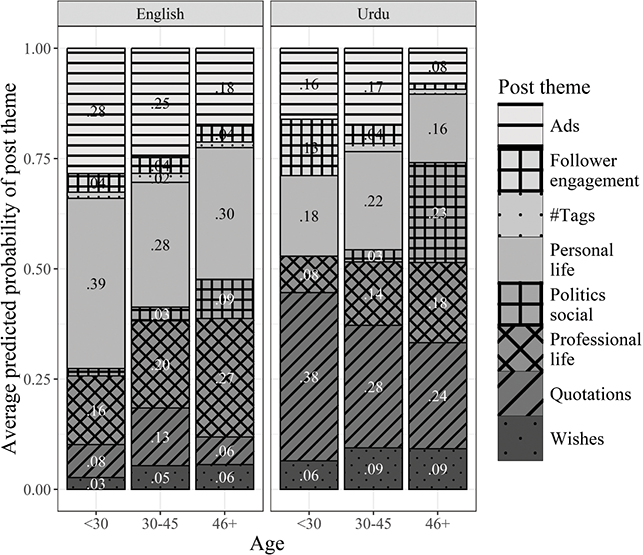
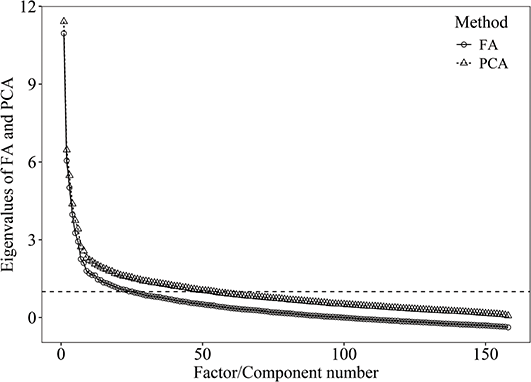
1 Introduction
1.1 Pakistan
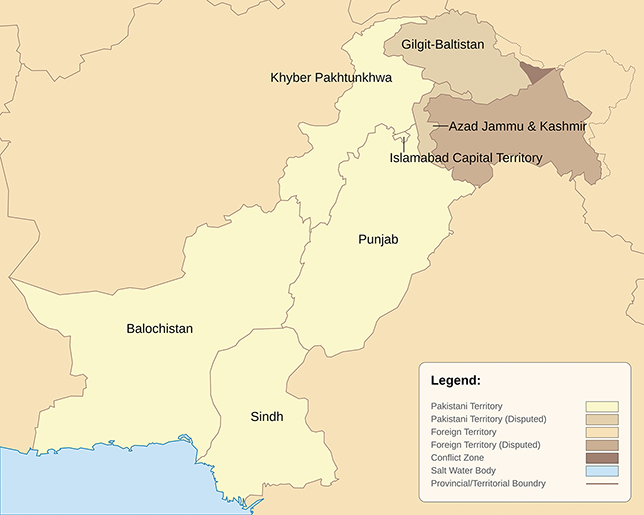
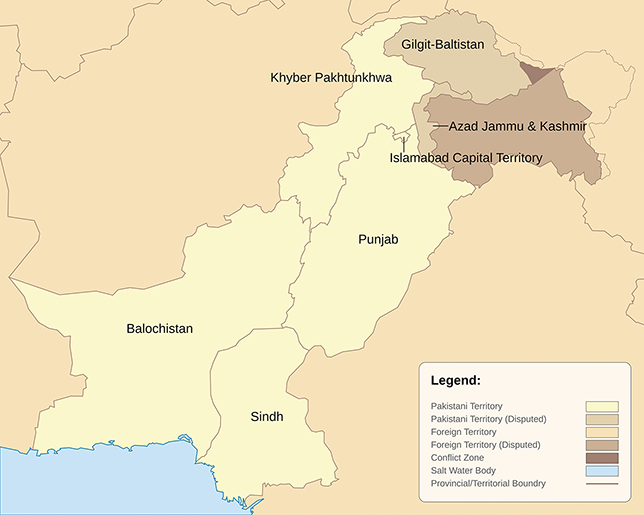
Pakistan is located in South Asia, as shown in Figure 1. On the eastern side, it has a long land border with India, while on the western side, it shares mountainous border areas with Afghanistan and towards the south with Iran. China is located on the northern side of Pakistan across the Himalayan mountains. According to the 2023 digital census, Pakistan has a population of 241 million people (Anonymous 2023: 124). Administratively, the country has four provinces (Balochistan, Khyber Pakhtunkhwa (KPK), Punjab, and Sindh) and a federal capital territory – Islamabad. Additionally, there are two autonomous regions (Azad Jammu and Kashmir (AJK) and Gilgit & Baltistan), which, according to United Nations Security Council (UNSC) resolutions, are disputed territories with India. Punjabi, Pushto, Sindhi, Saraiki, Urdu, and Balochi are the main languages, along with many smaller ones (Anonymous 2023: 138). According to Ethnologue, there are sixty-eight indigenous languages spoken in Pakistan (Anonymous 2025); many very small and endangered languages are spoken in the north-west of the country in Gilgit & Baltistan (GB) and KPK.
Geographical map of PakistanFootnote 1
1.2 English and English Language Teaching in Pakistan
Like other postcolonial countries in South Asia, Pakistan also inherited the English language from the British after its independence in 1947. Throughout Pakistan’s history, it has remained an important language as we briefly explain.
Until 1971, the use of English continued in various government bodies, the military, and education (Abbas Reference Abbas1993: 150). Recommendations were made to promote Urdu as the medium of instruction in primary and secondary schools during this time period, but these efforts were thwarted due to various political issues (Shamim Reference Shamim2008: 237–238). Thus, a two-stream system (elite private English-medium and public sector Urdu-medium schools) continued during this era. After the separation of East Pakistan (now Bangladesh) in 1971, during the first relatively stable democratic period until 1977, regional languages like Sindhi, Saraiki, and Punjabi were recognised and promoted through government bodies like Institute of Folk Heritage (Abbas Reference Abbas1993: 150). However, severe linguistic riots between Urdu-speaking muhajirs (‘immigrants’) from India living in Karachi and the Sindhi-speaking population occurred in Sindh in this period. This established the status of English as a neutral and ‘functional language’ instead of a colonial legacy (Abbas Reference Abbas1993: 150). During the second martial law in 1978–1989, the military dictator promoted Urdu and Urdu-medium instruction. The National Language Authority was established at the federal level to develop and standardise Urdu (Shamim Reference Shamim2008: 238). Schools (mainly the public sector ones) were instructed to shift to Urdu-medium instruction. At the same time, Pakistan received massive teacher training grants from British and American agencies (British Council and USAID, respectively) to promote English-medium instruction (Abbas Reference Abbas1993: 150–151). Thus, the Urduisation project of this era did not succeed much.
After 1988, English language teaching was progressively extended by introducing the language as a compulsory subject from grade three and then, in the third martial law period (1999–2008), from grade one (Shamim Reference Shamim2008: 238–239). Subsequent education policies, for example, National Education Policy 2017 (Anonymous 2017), aim for English teaching as a compulsory subject from grade one. English is the medium of instruction in the majority of elite and non-elite private schools. Public sector schools (usually until grade ten) in Punjab were converted to English-medium instruction in 2009 (Bashir & Batool Reference Bashir and Batool2017: 14), though Urdu-medium textbooks are also available for students, and the question papers in examinations are bilingual (i.e. English and Urdu). In KPK’s public schools, math and science textbooks are only available in English. Public sector schools in other provinces (including those under the federal government) also offer English-medium textbooks and exams. Most education from grade eleven onwards is in English medium.
The co-official status of English in government, the judiciary, the military, and higher education has not only remained largely unchanged, as noted by Haque (Reference Haque1983), but also strengthened due to more exposure to English through media like the internet. In the mid-2010s, the Supreme Court ruled that Urdu should be implemented as the official language, as is prescribed in the constitution (Raj Reference Raj2017). However, a decade after this ruling, not much has changed in practical terms. The higher courts now more often publish Urdu translations of their judgements. Urdu also remains an option on government portals and mobile applications. Apart from these, English (along with Urdu and regional languages) is a very normal part of billboards and hoardings in markets and bazaars.
Pakistani youth – 50% Pakistanis are under thirty-five years of age (Anonymous 2023: 110) – have increasingly chosen to move abroad for study and work. The students (including masters and doctoral students) seek scholarships like German Academic Exchange Service, Ministry of Education, Culture, Sports, Science and Technology (Japan), Erasmus, Fullbright, and so forth (Qamar & Khurshid Reference Qamar and Khurshid2018). The job seekers are mostly skilled workers (e.g. IT professionals, engineers). Both of these groups prefer to move to Europe, English-speaking countries (Australia, Canada, New Zealand, UK, US), and more recently to China and South Korea as well. This trend has given birth to a host of locally and internationally owned private institutions that teach English and prepare students for language tests like International English Language Testing System and Test of English as a Foreign Language (Memon & Umrani Reference Memon and Umrani2016). Thus, the motivations to teach and learn the English language have also increased.
1.3 Previous Research and the Present Study
Pakistani English (PakE) has been studied since the 1990s. There are book length studies like Rahman (Reference Rahman2015), first published in 1991, and several research papers from the same decade, for example, Baumgardner (Reference Baumgardner1995). Since the late 2000s, several researchers have published on various aspects of PakE based on a corpus linguistics approach (Muhammad Asim Mahmood Reference Mahmood2009; Rashid Mahmood Reference Mahmood2009; Shakir & Deuber Reference Shakir and Deuber2019). Despite these specialised research studies, a concise and descriptive account of PakE is still needed in the twenty-first century for the benefit of the research community in World Englishes and students interested in learning about PakE. In the present Element, we precisely aim to do the same by providing descriptive accounts of the attitudes towards English and learning English, a brief description of the features of the variety at various levels (phonology, lexis, and grammar), and a brief look at various uses of English by Pakistani internet users in various online domains.
The Element is structured as follows. The second section presents a study of attitudes towards English, Urdu, and regional languages based on a large survey conducted in each of the four provinces and two regions of Pakistan. The subsequent section, that is, number three, describes various features of PakE. The fourth section is dedicated to documenting the uses of English on the internet, especially on the social media platforms Facebook, Instagram, and Twitter. The last section concludes the Element by reflecting on the findings of the previous sections and by discussing the implications of these findings in the light of the Dynamic Model (Schneider Reference Schneider2007) and the Extra- and Intra-territorial Forces (EIF) Model (Buschfeld Reference Buschfeld, Buschfeld and Kautzsch2020).
2 Attitudes towards English, Urdu, and Regional Languages in Pakistan
The aim of the section is to identify and report on uses and attitudes towards various regional languages, Urdu – the national language, and English at the end of the first quarter of the twenty-first century. We start the section with a review of a few selected and relevant studies about language attitudes in Pakistan from the 1990s to the 2020s. Then we present the methodology and data collection procedure of our own study. Finally, we present the results and discussion.
2.1 Previous Relevant Research on Language Attitudes in Pakistan
Attitudinal research on English and other languages in Pakistan dates back to the 1990s or even earlier. One of the earliest studies is that of Baumgardner (Reference Baumgardner1995), based on several questionnaire surveys conducted between 1989 and 1992. His participants include English newspaper journalists, English teachers, and university or college students from Lahore (the provincial capital of Punjab) and Islamabad (the federal capital of Pakistan). The respondents – especially teachers – most probably include people from many different parts of the country, as some of the surveys were conducted at teacher training courses (Baumgardner Reference Baumgardner1995: 262). Thus, the conclusions made by Baumgardner can be considered representative of general perceptions about the English language in Pakistan in the 1990s.
Baumgardner’s (Reference Baumgardner1995) surveys include questions related to perceptions about PakE as a variety, as well as about the acceptability of various grammatical structures that – as per the author’s observation – are the hallmarks of the local English variety. The two questions related to perceptions about (Pakistani) English as a variety are: ‘What variety of English do you speak?’ and ‘What variety of English do you think Pakistanis should learn?’ (Baumgardner Reference Baumgardner1995: 263). In the case of the former, about one-third (33%) of the respondents report that they speak ‘Pakistani English’ and about 10% say they speak a mixture of PakE and another variety (British or American English (AmE)). On the question ‘which variety should be spoken’, about 80% of the participants advocate for an external model of English speech instead of the local variety (British English (BrE) followed by AmE). Hence, one can see that only a small proportion of the participants acknowledges the existence of a ‘Pakistani English’, and a very high majority still wants to learn a foreign standard instead of the local variety that they may be speaking.
In the past three decades, Pakistani universities have increasingly introduced the departments of ‘English Linguistics’ or ‘Applied Linguistics’ along with the already present ‘Department of English’ where traditionally English literature would be taught. Additionally, linguistics and its subdisciplines have also been introduced to purely literary programs (i.e. bachelors or masters in English Literature). This has led to an increased awareness of language variation and varieties of English, including PakE. Studies whose participants include students of such programs, for example, Jabeen, Mahmood, and Rasheed (Reference Jabeen, Mahmood and Rasheed2011) and Parveen and Mehmood (Reference Parveen and Mehmood2013), report a higher awareness about PakE. Jabeen, Mahmood, and Rasheed’s (Reference Jabeen, Mahmood and Rasheed2011) 100 participants include 50 university students, among them 25 students of MA English, while Parveen and Mehmood (Reference Parveen and Mehmood2013: 659) report that all of their 25 participants, who are MA English students at University of Education in Lahore, have conceptual knowledge of World Englishes and sociolinguistics. The participants in both studies acknowledge the existence of ‘Pakistani English’. In their view, the local variety is the best way to express creativity and communication by Pakistanis who do not have contact with foreigners (Jabeen, Mahmood, & Rasheed Reference Jabeen, Mahmood and Rasheed2011: 116). However, learning ‘Standard English’ is also important because it is the means of ‘prestige and success’ in the world (Parveen & Mehmood Reference Parveen and Mehmood2013: 662). A more recent study of attitudes towards AmE, BrE, and PakE has been conducted using the matched guise technique (MGT) followed by semi-structured interviews by Gul and Channa (Reference Gul and Channa2023). Their results from the MGT show that university students in Balochistan have highly positive attitudes towards a BrE accent (Gul & Channa Reference Gul and Channa2023: 8). The thematic analysis of interviews indicates a negative attitude towards a nativised Pakistani accent. Many of them feel an inferiority complex due to their non-native accent (Gul & Channa Reference Gul and Channa2023: 10–11). Gul and Channa’s (Reference Gul and Channa2023) study shows that students – even from disciplines unrelated to English studies – have some awareness of a Pakistani way of speaking English, but the attitudes towards the accent remain largely negative and unchanged since the 1990s.
In addition to the studies mentioned previously in Section 2.1, many studies have looked at the motivations of learning English and attitudes to the English language among Pakistani students of various levels. Kahlid (Reference Khalid2016) and Abbas and Iqbal (Reference Abbas and Iqbal2018) are two studies that have been conducted in Lahore, Pakistan. Khalid’s (Reference Khalid2016: 5) participants are sixteen-year-old male students of English-medium public and private schools. Abbas and Iqbal (Reference Abbas and Iqbal2018: 205) include a larger population of 445 university students from five different universities in Lahore, where students from other rural and urban areas of Pakistan also come for study. Both studies include questions related to motivations and attitudes towards English as well as towards local languages (Urdu, or Urdu and Punjabi). Khalid (Reference Khalid2016: 8) finds that Pakistani learners have positive attitudes towards English and learning this language, and these are not at the expense of Urdu. Instead, English learning is mainly for utilitarian and instrumental reasons. In Kahlid’s (Reference Khalid2016: 12) view, Pakistani students are additive bilinguals where English is not a threat to the first language, Urdu. Similarly, Abbas & Iqbal (Reference Abbas and Iqbal2018: 209) conclude that English is considered important as a global language and their participants are motivated to learn it due to instrumental reasons (i.e. better jobs, economic advantage, and importance for career). Urdu and Punjabi, on the other hand, hold ‘integrative motivation’ as sources of shared community feelings, making friends, and a strong community connection.
Lastly, we review two additional studies on motivations and attitudes of undergraduate learners towards English that include participants from the South of Pakistan, from the provinces of Balochistan and Sindh. Soomro’s (Reference Soomro2016: 42) PhD study includes 300 university students aged eighteen to twenty-one from one university each from Balochistan and Sindh. Rasool & Winke’s (Reference Rasool and Winke2019) 229 participants are from three universities in Quetta, Balochistan, with an age range of eighteen to twenty-five and an almost equal gender distribution. Soomro’s (Reference Soomro2016: 105–109) participants are motivated to learn English as it helps internationally (e.g. admission at a foreign university, moving abroad), provides access to a wider range of information, and is a source of entertainment due to English language media. Similar findings are made by Rasool & Winke (Reference Rasool and Winke2019: 58), that is, learning English is important to succeed academically and professionally. Undergraduates from both provinces also feel that English is not a threat to their mother tongue and local culture (Soomro Reference Soomro2016: 67). Instead, it is an additional language which does not affect their mother tongue that has its own place in their lives (Soomro Reference Soomro2016: 73). Both of these studies reach similar conclusions regarding the motivations and attitudes to English learning and the language itself, and its relation with local languages.
The discussion on the selected studies on language attitudes shows that recognition of variation in English, especially with regard to PakE, may have increased since 1990s. However, highly positive attitudes towards ‘Standard’ and BrE accents remain largely unchanged. Additionally, Pakistani learners are motivated to learn English for better career and job, as well as due to the international and global power associated with the English language. At the same time, most learners of English do not see any effect of English on their mother tongues (or the national language, Urdu), showing positive attitudes to learning and using English. The studies, however, do not cover all provinces and language groups in Pakistan. They generally include questions related to domains of language use associated with English, Urdu, and regional languages (including mother tongues), but the situations made available by the internet (e.g. social media, email) have not been included in these studies. This section, hence, aims to cover most of the regions and provinces of Pakistan, and the main language-speaking groups to record and report their attitudes towards English, Urdu, and regional languages and the usage patterns associated with these languages.
2.2 Data Collection and Demographic Details
The data for this study have been collected using a questionnaire created using Microsoft Forms (shown in Appendix A). It was designed by following previous similar studies, for example, Khalid (Reference Khalid2016); Labade, Lange, and Leuckert (Reference Labade, Lange, Leuckert and Buschfeld2020). The first five questions are related to background information: age, gender, education, occupation, and place of residence. The sixth question asks whether the participants moved from somewhere else in Pakistan. This question was deemed ambiguous at the time of analysis, because it does not specify if the move of residence is happening between two provinces or within the same province. Hence, anyone who selected yes in the response to this question was excluded from the final analysis to keep only native participants of a given region in the study. Questions seven and eight are related to mother tongue and any additional (regional, national, or other) language learned by the participants. Both questions include an option for English, as well as an option to add their own reply if the language was not already listed. Question nine asks about language proficiency in English, Urdu, the main regional language (mother tongue) and any additional regional language participants may have learned. A response scale was provided with the options being ‘none’, ‘beginner’, ‘intermediate’, ‘fluent’, or ‘advanced’.
Questions ten, eleven, and twelve are related to the use of three languages (mother tongue, Urdu, and English) in various situations: family, friends, colleagues, strangers (shopkeeper, bazaar), social media (personal), social media (professional), and email (personal or professional). The response to these three questions is recorded on a scale with options ‘never’, ‘sometimes’, ‘often’, ‘usually’, and ‘always’. The last question consists of a set of nine statements related to motivations and attitudes towards learning English (1, 2), attitudes about PakE (3, 4), attitudes towards the use of Urdu (5, 6, 7), attitudes towards the use of mother tongue (8), and identifying with the language community who speak the mother tongue (9). Responses were to be given on a five point Likert scale with the options ‘I strongly disagree’, ‘I disagree’, ‘Indifferent’, ‘I agree’, or ‘I strongly agree’.
The data were collected in the first half of 2025 in multiple stages. The sampling approach can be described as convenience sampling. In the first step, colleagues (i.e. university lecturers and professors) all over Pakistan were approached by the first and the third authors. They were requested to forward the online survey link to their colleagues and university students. This strategy helped in data collection from Punjab, Sindh, AJK, and to a certain extent from Balochistan. The second strategy was to post in various Facebook groups affiliated with Pakistani universities in different provinces, for example, Bacha Khan University Charsadda – BKUC. In parallel, the first author hired freelance assistants through Upwork.com from various provinces and regions of Pakistan. Their place of residence was confirmed from their Upwork.com profiles. Each freelancer was given the task to get fifty respondents by disseminating the survey link to their connections (college or university students, school/ college/university teachers, or other professionals) in their native province (or region), for example, Balochistan, GB. In some cases, more than fifty responses were collected from only one freelancer. For example, in the case of GB, a university lecturer working as a part-time freelancer was hired, who helped in data collection from his students and colleagues at a university in GB and in AJK. This way, two or more freelancers per province or region were used to ensure a diverse pool of participants. In total, more than 1,500 responses were collected. After removing problematic cases, for example, participants who had moved (see the discussion on the sixth question), we aimed to select 200 random cases from each province/ region. The final data table consists of 1,092 individuals.
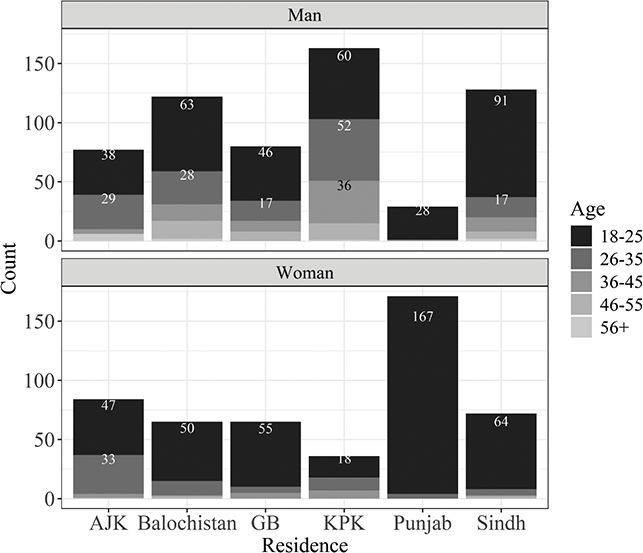
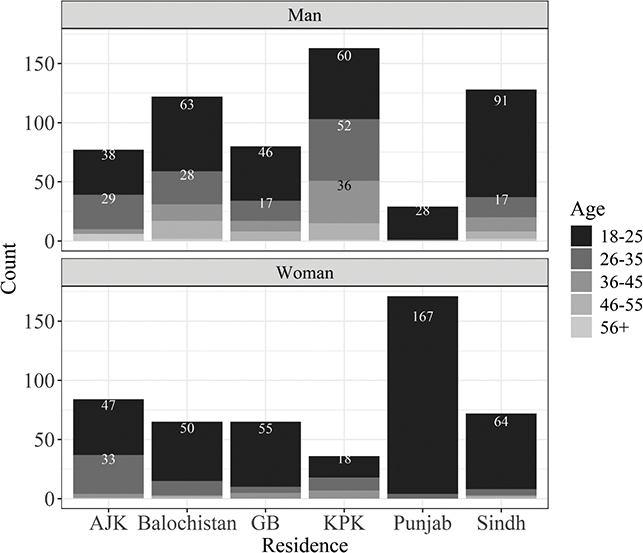
The demographic details related to age, gender, and residence are shown in Figure 2. The figure shows that apart from Punjab and Sindh, other provinces (KPK and Balochistan) and regions (AJK and GB) did not reach the target of 200 individuals, as many responses were discarded (see the previous paragraph). The lower panel shows that the highest number of women is in Punjab, followed by AJK and Sindh. Balochistan and KPK have a higher number of male participants than females. The top section in each bar shows that the participants are mainly eighteen to twenty-five years old in most provinces, followed by the age group of twenty-six to thirty-five. Older age groups are more prominent in males and in KPK, followed by Balochistan, Sindh and other provinces and regions. Other demographic details (not shown in the figure) are related to profession, education, and mother tongue. In terms of profession, the majority of the young participants are students, followed by teachers of any subject (mainly in KPK and Balochistan), and small proportions of journalists (in GB) and doctors (in AJK). Younger participants (as in Punjab) have ten years or twelve years of education. Older participants (e.g. twenty-six to thirty-five) indicate their education as fourteen years or sixteen years of education. These levels are present in all provinces. MPhil and PhD levels of education are mainly present in AJK, Balochistan, and KPK. The main languages spoken by the participants include Balochi, Balti, Hindko, Pahari/Pothwari, Pashto, Punjabi, Saraiki, Shina, Sindhi, and Urdu, along with some less spoken ones like Hazargi from Balochistan. Some respondents from AJK and Punjab (apart from the regional mother tongues) also indicate Urdu as their mother tongue, with the proportion of women being higher than men. The same is the case with Sindh, but that is expected due to the mohajir population of Karachi – Urdu-speaking Muslim immigrants from India who came to Karachi after the 1947 partition. Lastly, the main additional languages learnt by the participants are English and Urdu, followed by regional languages like Sindhi.
Demographic details with respect to age, gender, and residence
2.3 Data Analysis and Findings
In this subsection, we summarise the main trends in terms of language proficiency, language use in different situations, and responses to different statements in the last question of the survey. We construct ordinal regression models using the polr function from the package MASS (Venables & Ripley Reference Venables and Ripley2002) in the R programming language (R Core Team 2025). The final model is selected using the stepAIC function from the same library with the option direction=‘both’. For marginal effects plots we use the marginaleffects package by Arel-Bundock, Greifer & Heiss (Reference Arel-Bundock, Greifer and Heiss2024) with the option newdata= ‘balanced’ to account for unequal group sizes in several demographic variables. We also use the car::Anova (Fox & Weisberg Reference Fox and Weisberg2019) function and the emmeans (Lenth Reference Lenth2025) package to construct analysis of deviance tables and find out significant contrasts based on the regression model objects (see Appendix B onwards).
2.3.1 Language Proficiency in English, Urdu, and Regional Languages
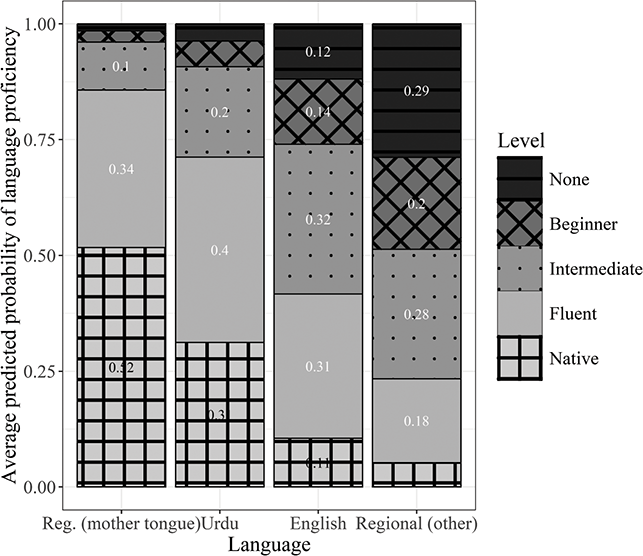
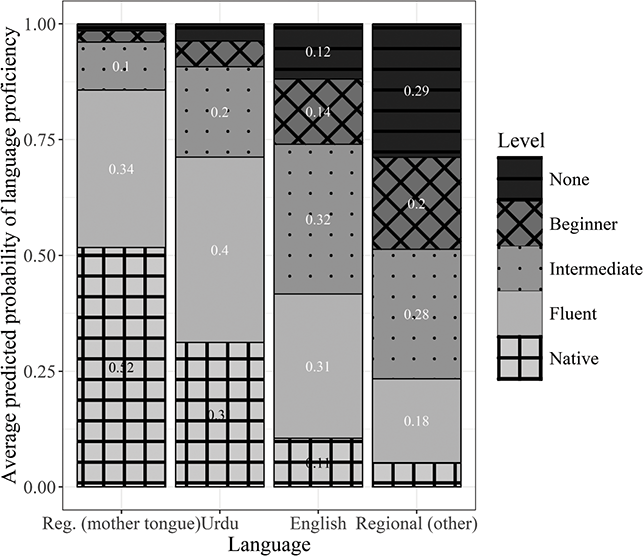
Overall language proficiency for regional languages, Urdu, and English is shown in Figure 3 in descending order of proficiency. Unsurprisingly, the participants indicate the highest proficiency for the regional languages that are mother tongues, followed by Urdu and English. Additional regional languages have the lowest proficiency. For English proficiency ‘native’ and ‘fluent’ get a combined probability of 43%, while intermediate proficiency has a 32% probability. The final model included gender, residence, education, occupation, mother tongue, and an interaction of gender, occupation, and mother tongue with the four languages as predictors. Marginal effects based on different demographic variables (not shown in the figure) show that education has a positive impact on language proficiency in English, Urdu, and both types of regional languages. Men report slightly higher language proficiency for English as compared to women, but the comparison is non-significant. The proficiency in an additional regional language is significantly better in men as compared to women irrespective of residence or mother tongue, which can be attributed to culturally more independent roles assigned to males, who are more likely to travel across Pakistan and learn other regional languages. Teachers and other professionals report higher proficiency in English, Urdu, and mother tongues in comparison to students. In terms of mother tongues, the speakers of Pahari/Pothwari, Punjabi, and Urdu indicate a higher proficiency in Urdu. The speakers of Balochi, Pashto, Sindhi, and smaller languages, on the other hand, report lower proficiency in Urdu, showing significant differences from some language-speaking groups (see Appendix B). English proficiency remains unaffected by mother tongue-based groups.
Language proficiency in English, Urdu, and regional languages
2.3.2 Use of Mother Tongue in Different Situations
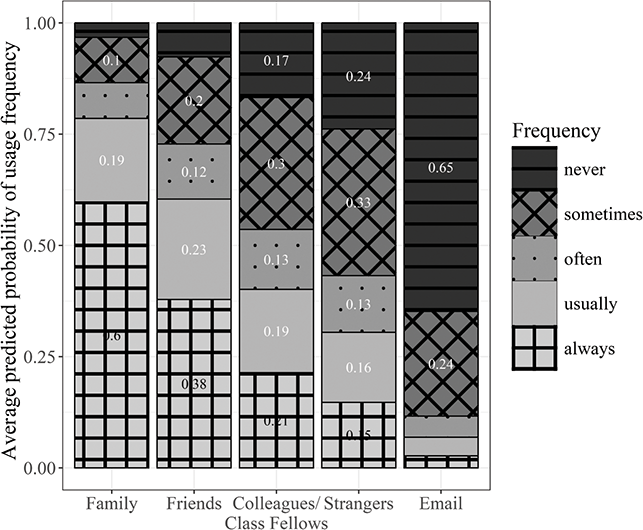
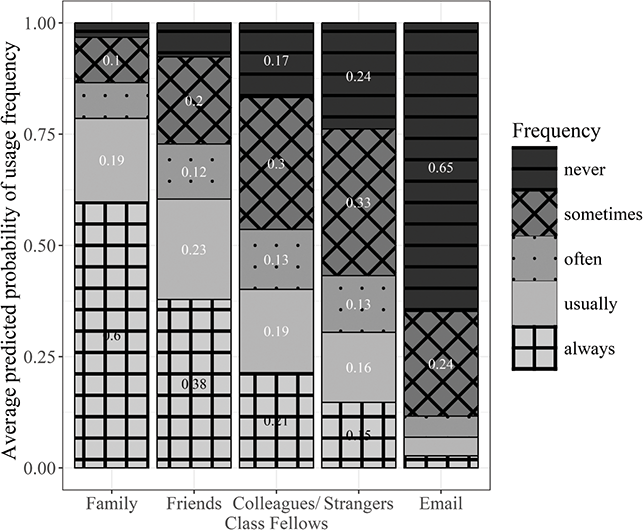
We use a separate ordinal logistic regression model for the situational uses of the mother tongues because a lower number of situations are available for this question due to a spelling error in the two situations related to social media. The final model for situational use of mother tongues includes gender, residence, education, occupation, mother tongue, and situation as predictors of usage frequency, while gender, residence, and mother tongue are also included as interactions with situation. We do not include interactions of grouping variables like age and gender due to zero occurrences in certain categories, which lead to warnings by the MASS:: polr function. The overall usage frequency in Figure 4 shows that mother tongue is more likely to be used with family with a 79% combined probability of ‘always’ and ‘usually’. The usage frequency decreases as the face-to-face (F2F) situations become more formal, as can be seen with higher probability of ‘never’ (24%) and ‘sometimes’ (33%) in the case of strangers (including with shopkeepers and in bazaar). The only internet situation included here is emails, and the participants are highly likely to select ‘never’ and ‘sometimes’ (a combined probability of about 89%). The use of the mother tongue on social media for responses where the spelling mistake mentioned at the beginning of this paragraph was corrected before the survey distribution also shows that a combined probability of 70% (personal social media) and 78% (professional social media) for the two options ‘never’ and ‘sometimes’. Thus, overall the mother tongues are more likely to be used with family and friends.
Usage frequency of mother tongue in different situations
Different participant groups also use the mother tongues significantly differently from each other. In other words, gender, residence, and mother tongue have significant interactions with the five situations (see Appendix C for the contrasts, but we do not include the relevant marginal effects plots due to space restrictions). Apart from family-related situations, women are significantly less likely to use the mother tongue in all other situations when compared to men. These gender-related differences are generally stable across residence and mother tongue-based groups, with no reverse trends found in any subgroup. Residents of AJK, Balochistan, and Punjab are less likely to use the mother tongue with colleagues and class fellows. KPK respondents stand out as they are more likely to use the mother tongue with friends, colleagues/class fellows, and strangers (including with shopkeepers and in bazaar): they select ‘always’, ‘often’, or ‘usually’ in 50% or more cases. Pashto (the main language of KPK and parts of Balochistan) and Sindhi (especially the main language of rural Sindh) speakers are more likely to use the respective mother tongue with colleagues/class fellows and strangers as compared to the other regional languages, but these contrasts are not significant. Urdu native speakers are obviously more likely to use their mother tongue (i.e. Urdu) with friends, colleagues, and strangers. Punjabi and Saraiki speakers are significantly different from Urdu speakers in most of these situations, that is, instead of their mother tongues they most probably use Urdu with friends, colleagues/class fellows, and strangers.
2.3.3 Use of English and Urdu in Different Situations
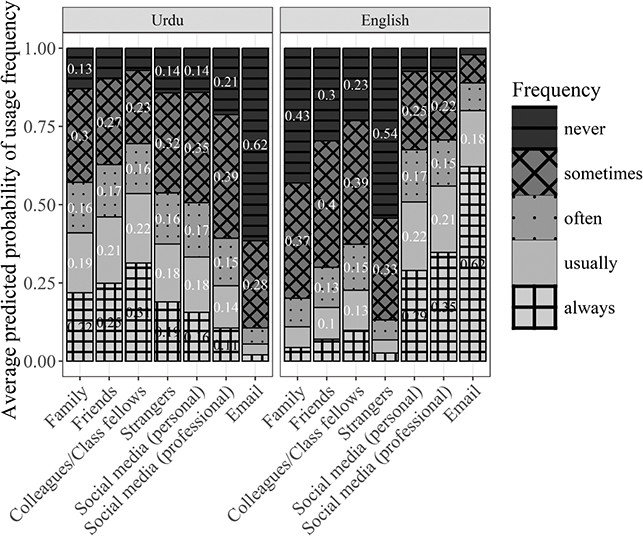
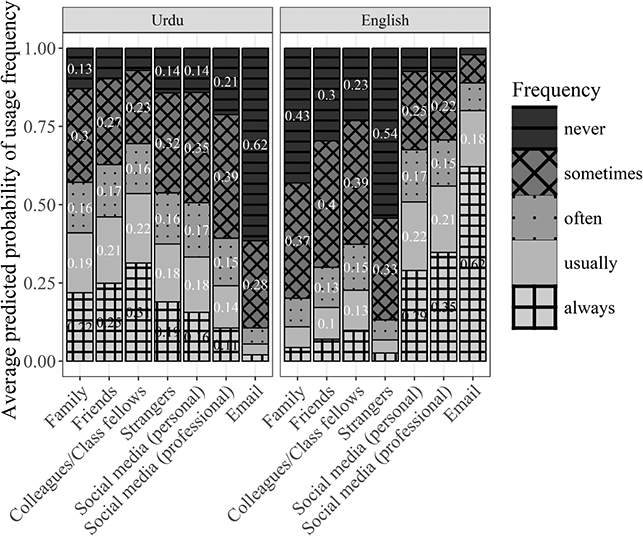
The responses for situational uses of Urdu and English were pooled in one model to enable better comparisons, where language and situation were used as interaction effects for all other demographic grouping variables. The Analysis of Variance (ANOVA) table based on the model is available in Appendix D, while the marginal effects plot of overall usage for the two languages is shown in Figure 5. As it is clear from the panel ‘Urdu’, the Urdu language is most likely to be used with colleagues/class fellows, a rather formal situation. The probability assigned to ‘always’, ‘usually’, and ‘often’ in friends and family-related situations is higher than the situations involving strangers (which includes shopkeepers and bazaar as well). The use of mother tongue (especially by Pashto and Sindhi speakers as mentioned in Section 2.3.2) in the situations related to strangers may be one reason of an overall lower use of Urdu in this situation (see Section 2.3.3, paragraph 3). In the three internet-related situations, the use of Urdu decreases as the formality increases. Hence, Urdu is more likely to be used in personal social media posts, followed by professional posts, and least likely in emails. This is opposite and significantly different as compared to the usage of English in these three situations. This usage also includes Roman Urdu – a practice of writing Urdu in Roman letters. This kind of Urdu is more likely to be mixed with English words, as it is easier to spell English words in Roman letters in comparison to the native Perso–Arabic script of Urdu.
Usage frequency of Urdu and English in different situations
The use of Urdu among different subgroups also shows variation. The eighteen to twenty-five year olds are significantly more likely to use Urdu in emails in comparison to all other age groups, with men leading women in this age group as well, as discussed later in this paragraph. This ever so slightly higher likelihood of using Urdu could be due to the use of Roman Urdu among the younger generation. However, nothing conclusive can be said based on the current data. A more meaningful contrast is between males and females, where women are more likely than men to use Urdu in more formal F2F situations (friends, colleagues/class fellows, and strangers including with shopkeepers and in bazaar). The first two contrasts (i.e. friends and colleagues/class fellows) are also significantly different in both groups (see Appendix D). On the contrary, males are significantly more likely to employ Urdu in the internet-related settings of professional social media and emails. The residents (especially women) of AJK, Punjab, and in some cases those of GB are more likely to use Urdu in F2F situations, while those of Balochistan and KPK are among the least likely to employ Urdu especially with colleagues/class fellows and strangers (including in bazaar and with shopkeepers). This is in line with the higher likelihood of using the mother tongue by these groups in similar situations, as noted in Section 2.3.2. Similar usage patterns can be assigned to relevant language-speaking groups: a higher likelihood to use Urdu in different F2F situations (e.g. friends, colleagues/class fellows) can be assigned to Punjabi and Pahari/Pothwari speakers (the residents of Punjab and AJK, respectively), while Balochi (one of the main ethnolinguistic groups from Balochistan) are less likely to use Urdu with friends and strangers. Some of these subgroups are significantly different from other subgroups, as shown in the three-way contrasts in Appendix D.
These trends of regional and mother tongue-based groups generally show the historical patterns of (dis)favouring the use of Urdu. The residents of Punjab (Punjabi, Saraiki, and partially Pahari/Pthowari speakers in these data) have been more open to adopt Urdu, even from the era of the British India (Singh Reference Singh1997). Punjabis giving lesser prestige to Punjabi in comparison to Urdu is a well-documented phenomenon, for example, Abbas & Iqbal (Reference Abbas and Iqbal2018: 210). Urdu has been the official language of AJK since 1968 (Anonymous 2002). This factor and many similarities between Punjab and AJK (e.g. the Pahari/Pthowari language-speaking group in these data, their geographical proximity) may also be the cause of similar results here. The historical relationship of Pashto and Sindhi-speaking communities with Urdu has not been as smooth. Pashto has been associated with Pashtun nationalism and a closer relationship of such movements with Afghanistan (where a sizeable Pashto speaking population resides). Even in the British Raj, the imperial officers preferred Urdu on Pashto in a bid to amalgamate the then North West Frontier Province (NWFP) better with the rest of British India (Rahman Reference Rahman1995: 156). After the creation of Pakistan and the inclusion of NWFP (now KPK) in the country, a strong nationalist movement involving Pashto and Pashtun identity has remained throughout Pakistan’s history. On the other hand, Sindhi has been used in formal situations (e.g. courts) since even before 1947 (Rahman Reference Rahman1999: 25). After the partition, the influx of Urdu-speaking Muslim immigrants (muhajirs) from central India in urban Sindh increased the nationalistic sentiment of local Sindhi-speaking population. Sindhi is taught in primary schools, Sindhi and Urdu are co-official languages of the provincial government, and Sindhi is one of very few regional languages in Pakistan in which a master’s degree can be obtained (Rahman Reference Rahman1999). Due to these historical and political reasons, Pashto and Sindhi speakers (and the corresponding provinces of Pakistan) are more likely to prefer their respective mother tongues instead of Urdu even in formal situations.
Overall, the use of English is more likely with friends and colleagues/class fellows in F2F situations (Figure 5, English). One reason could be that the interlocuters in situations related to family and strangers (including in bazaar and with shopkeepers) are less likely to be proficient in English (e.g. parents, other elders, shopkeepers); hence mother tongue or Urdu and more appropriate choices. English is much more likely to be used on the internet, where a probability of only 25% or lower is associated with ‘sometimes’ and ‘never’.
Just like mother tongues and Urdu, various demographic groupings also show variation in (dis)preference of English in the seven situations. In terms of age, younger participants (eighteen to twenty-five) assign higher probability to ‘always’ and ‘usually’ in relation to the use of English in F2F situations related to family, friends, and colleagues/class fellows. This age group is significantly different from the age groups of twenty-six to thirty-five and thirty-six to forty-five at least in family-related situations. This shows an overall lowering barrier of formal language use: English might be taking the place of Urdu, and Urdu of the regional languages (mother tongues) in at least some parts of the society (also indicated by a comparatively higher use of Urdu in formal F2F situations by women as mentioned in Section 2.3.3, paragraph 2). Apart from that, on the internet the use of English increases with age. This is most probably because of a higher level of education that also increases with age in these data (see below in this paragraph). In terms of gender, women are ever so slightly more likely to use English in F2F situations of friends and colleagues/class fellows. Men indicate a very small preference for English usage with strangers (also significantly different from women; see Appendix D), but this contrast requires more in depth investigation (e.g. interviews with those who indicated positive responses). The residents of Punjab (in all three internet settings) and GB (in personal social media) are less likely to use English on the internet. Punjab is also significantly different from some other provinces and regions (e.g. Sindh) in email and professional social media. One reason may be a higher percentage of younger participants belonging to Punjab. Education does not show significant contrasts, but generally higher education (just like age) is associated with a higher likelihood of English usage, for example, MPhils and PhDs grouped in the education group of eighteen year plus. Lastly, Balochi speakers stand out in comparison to most other language speaking groups by showing a high dispreference for English in most F2F situations.
2.3.4 Attitudes towards Various Statements about English, Urdu, and Regional Languages
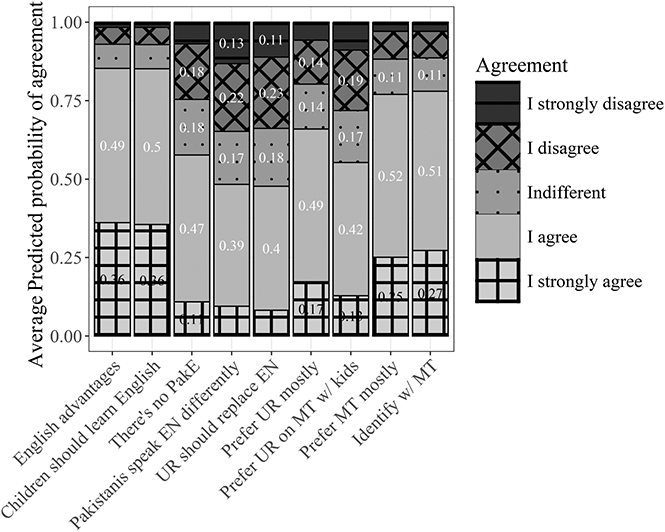
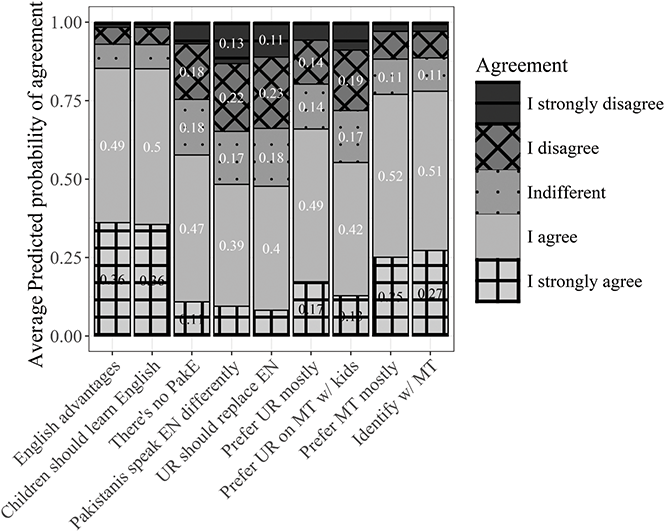
The attitudes of the Pakistani respondents about various statements on language use and language identity are shown in the form of (dis)agreement probability in Figure 6. Like the previous models, this one also included all demographic variables and one variable related to the nine questions as an interaction effect with all other predictors. The ANOVA table based on the model is shown in Appendix E. The overall comparison in Figure 6 shows that Pakistanis are highly in favour of advantages associated with English and children learning English at school (86% probability for the first two positive statements). About 25% probability is assigned to ‘disagree’ and ‘strongly disagree’ in response to the third statement, the negative statement about PakE, which shows that most of the participants are not aware of PakE as a variety – a conclusion similar to that of Baumgardner (Reference Baumgardner1995). The more general statement that ‘Pakistanis speak differently’ is more likely to be agreed with by a little less than 50%, which shows some general perception about the distinctiveness of the local speech. Statements 5–7 are related to the use of Urdu and show varying attitudes towards Urdu as the official language, and its use with kids and in different situations. These responses are explored in more detail in the next paragraph. The last two statements about the mother tongues show that the participants generally have highly positive attitudes about their mother tongues, which are expected from most language speaking groups.
Attitudes towards various statements about languages
Apart from the overall attitudes, there are also interesting differences among different demographic groups within the predictor variables. In terms of age, the youngest respondents (eighteen to twenty-five and twenty-six to thirty-five) are significantly different from the respective older groups in recognising the distinctive English speech of Pakistanis. Moreover, the same two groups also have higher probability for ‘(strongly) agree’ in response to ‘I prefer Urdu in most situations’, indicating that younger participants prefer Urdu over the regional mother tongues (eighteen to twenty-five are significantly different from forty-five years and older groups; the differences are slightly less pronounced between twenty-six to thirty-five and thirty-six to forty-five old women). Men and women significantly differ from each other on four statements: Women are more likely to (strongly) agree with the first two statements (advantages and learning English); They also prefer English by disputing ‘Urdu should replace English’ more often than men (male responses are slightly more varied across regions); Women indicate lesser preference for the mother tongue by disputing ‘Prefer mother tongue mostly’ more often than men. Other professionals (including journalists and doctors) are significantly less likely to agree with ‘Pakistanis speak differently’ and with ‘Urdu should replace English’ when compared with teachers. This shows that Pakistanis not involved in teaching are less aware of speech differences Pakistanis have, and that they favour English potentially due to its practical use in their respective fields. In terms of language speaking groups Balochi, Pashto, Sindhi, and small language speakers (e.g. Shina, and the ones categorised under Other) are more likely to dispute the statement 7 (‘prefer to use Urdu over mother tongue with kids’), while Punjabi, Saraiki, and Urdu speakers are more likely to agree with it. Balochi and Pashto speakers are also more likely to agree with the statement 8 related to the use of the mother tongue (see significant contrasts in Appendix E).
2.3.5 Summary of Findings
The main trends related to age group, gender, residence, and mother tongue-based groups, and profession in three types of languages (regional mother tongues, Urdu, and English) can be summarised as follows.
The mother tongues are primarily used at home with family members, and are least likely to be used on the internet. KPK residents employ their mother tongue in a wider variety of situations. Pashto (spoken in KPK and Balochistan) and Sindhi (from Sindh) speakers prefer mother tongue even in formal situations like colleagues/class fellows where Urdu may be employed by other language speakers (e.g. Punjabi and Saraiki speakers from Punjab). Women are less likely to use mother tongue outside of home and family. In other words, men use mother tongue in more diverse situations. Most participants say they prefer mother tongue in most situations and also strongly identify with the relevant ethnolinguistic group. Balochi, Pashto, and smaller language speakers are more likely to do so.
The findings related to Urdu show that it is mainly associated with friends and work-related situations, and less likely to be used in professional social media and email. Respondents from AJK and Punjab and the ethnolinguistic groups in these areas (Pahari/Pothwari, Punjabi, Saraiki) indicate more preference for Urdu; for example, some report Urdu as their mother tongue, and others indicate a higher proficiency in Urdu. In contrast, the residents of KPK, Sindh, and Balochistan (speakers of Balochi, Pashto, Sindhi, etc.) indicate a lower proficiency in Urdu, are more likely to disprefer Urdu in formal F2F situations, and dispute statements related to the use of Urdu (‘prefer to use Urdu over mother tongue with kids’). Women are more likely than men to employ Urdu in formal F2F situations. They also indicate Urdu as their mother tongue in AJK and Punjab more often than men. Younger participants indicate a higher preference of using Urdu over the regional mother tongues, even in family-related situations.
Lastly, the use of English mainly occurs in friends and work-related F2F situations and on the internet. The majority of participants does not agree with the statement that there is a PakE. However, a little less than 50% participants show awareness about the English speech differences of Pakistanis. Proficiency in English increases with age and education. Younger participants also indicate the use of English in some F2F situations. Most participants agree with the advantages associated with English and the need to teach English to kids, with women more likely to do so than men. Women also slightly prefer English in formal F2F situations compared to men, and disagree more often with the statement about replacing English with Urdu in official functions.
2.4 Discussion and Conclusion
We have presented the results of a language use and attitudes survey from more than 1,000 participants across different provinces and regions of Pakistan. The participants are not balanced across various demographic groups, especially with regards to gender, residence, and mother tongue speakers. Nevertheless, we hope to have uncovered and shown stable trends regarding the use of different languages and attitudes towards them across these demographic groupings. These trends can be broadly discussed under two main themes: the relationship, use of, and attitudes towards the regional mother tongues versus Urdu; the use of and attitudes towards English.
The detailed findings in Section 2.3 and their summary in Section 2.3.5 show that the use of regional mother tongues differs across various demographic groups, where certain groups favour the use of Urdu in place of regional mother tongues while others resist it. Younger participants, women, and residents of AJK, Punjab (Punjabi, Saraiki, Pahari/Pothwari speakers) generally favour lowering the barrier of the use of Urdu in more informal, intimate family-related situations. These findings are in line with the observations made by the three authors of Pakistani origin in this study and the previous research and discussion presented in Sections 2.1 and 2.3.3. On the other hand, men, older participants, and the residents of Balochistan, KPK, and Sindh (along with relevant language-speaking groups) are more conservative and favour the use of mother tongues for the historical and political reasons discussed in Section 2.3.3. Two additional highly relevant demographic contrasts not included in these data but worth mentioning are: urban versus rural (where the urban class favours Urdu) and lower/working class versus upper social strata (where the middle class favours Urdu). In short, Urdu is increasingly taking the place of the regional mother tongues in certain demographics of Pakistani society.
In terms of perceptions about English, not many Pakistanis are aware of the concept of a ‘Pakistani English’, though many acknowledge that they speak English differently, which demands more policy level guidelines to increase such awareness. Nonetheless, Pakistanis are in favour of teaching English to school going kids and acknowledge the instrumental value associated with English in professional settings, a finding that also echoes previous research. The global power of English may as well be the reason that many participants disfavour the suggestion to replace English with Urdu as an official language. This has not happened in the second half of the twentieth century. It looks even less likely at the end of the first quarter of the twenty-first century, now that Pakistanis have been using the internet for the past two decades. English, being the language of technology, internet, and the graphical user interfaces (GUIs) of the software used by the majority of Pakistanis (Urdu or any regional language as the GUI language is an exception rather than a norm) most probably reinforces its hegemony even in non-internet domains. Also, the internet has given rise to many new situations and domains where English is highly likely to be used by Pakistanis, as is clear from higher likelihoods of English use in the three internet-related settings. This finding has been confirmed previously through corpus-based research (e.g. Shakir & Deuber Reference Shakir and Deuber2019). However, previous attitudinal studies (see Section 2.1) on PakE generally do not list the internet as a significant context of English use.
To conclude this section, we have provided a comprehensive overview of English use by Pakistanis in various situations and their attitudes towards English and the various languages they speak in addition to English. In the next sections we further explore various features of PakE, and also focus on English use on the internet.
3 Phonology, Lexis, and Grammar
After presenting the attitudes of Pakistanis towards the English language, now we turn to a brief description of selected features of PakE. We focus on distinctive phonological aspects, orthographic patterns, and selected lexical as well as grammatical features. In this process, we compare the variety with AmE and BrE as appropriate. In the following subsection we start with the phonological description (Section 3.1). The Section 3.2 describes the corpora used for the orthographic, lexical, and grammatical analyses, and the Sections 3.3, 3.4 and 3.5 in turn present the findings.
3.1 Phonological Features
The present study examines two complementary audio corpora: a controlled reading corpus of sixty university lecturers and MPhil candidates (see Appendix F for the reading passage), and a naturalistic corpus of fifty plus YouTube recordings of the public broadcaster Pakistan TV. A majority of these videos are political talk shows, interviews, morning shows, and so forth. The audios of the controlled reading corpus were listened to and analysed by the third author, and the presence or absence of distinctive PakE pronunciation features was marked. Afterwards example words were selected (e.g. technology, better for retroflexion) and audio clips containing these were extracted from the audios of the YouTube Pakistan TV corpus due to its studio quality data (one example word per unique speaker). Then, Google Gemini 3.1 Pro was used to obtain a narrow phonetic transcription of each word in the resulting 930+ clips of the 130+ speakers – the clip length was two to ten seconds and could contain multiple words. We performed a validation of Gemini’s narrow transcription by selecting one example word (e.g. think) from five randomly selected speakers (eighty-three examples in total) and listened to the audio to confirm the presence or absence of the transcribed features. The validation results were mixed. While the human reviewer overwhelmingly agreed with Gemini on features like th-stopping, there was a large disagreement in the results related to retroflexion and monophthongisation. In the two cases involving disagreement, we provide evidence from previous acoustic studies (retroflexion) or conduct our own analysis to determine the presence or absence of the feature (monophthongisation). We show that the phonological characteristics of educated PakE arise primarily from systematic transfer from Urdu (the national language and usual medium of early schooling) and secondarily from regional languages such as Punjabi, Sindhi, and Pashto. The result is a highly homogeneous and an instantly recognizable accent of PakE.
3.1.1 Consonantal Features
Th-stopping, retroflexion, de-aspiration, and rhoticity are the main consonantal features that reflect substrate influences and are present in educated speech. Th-stopping represents the most invariant marker of PakE: the interdental fricatives /θ/ and /ð/, absent from Urdu, are overwhelmingly replaced by dental stops [t̪] and [d̪]. Gemini transcribed 71% cases of think (Audio 1_think.mp4. Audio of think. Audio file available at https://doi.org/10.1017/9781009665308) with [t̪] and 90% cases of this (Audio 2_this.mp4.. Audio of this. Audio file available at https://doi.org/10.1017/9781009665308) with [d̪] in the YouTube audio corpus, which is consistent with prior documentation of these features (Mahboob & Ahmar Reference Mahboob, Ahmar, Kortmann and Schneider2004; Rahman Reference Rahman1991; Shahid et al. Reference Shahid, Bilal, Mirza and Raza2024).
Retroflexion of alveolar /t/ and /d/ to [ʈ] (as in /ˈbe.ʈər/ (Audio 3_better.mp4. Audio of better. Audio file available at https://doi.org/10.1017/9781009665308)) and [ɖ] (as in /ɖuː/ Audio 4_do.mp4. Audio of do. Audio file available at https://doi.org/10.1017/9781009665308), respectively, has been confirmed through acoustic studies of PakE (Syed, Bibi, & Shafi Reference Syed, Bibi and Shafi2024: 69). It occurs especially intervocalically and across morpheme boundaries. In our YouTube corpus, Gemini identified 5%–30% instances of /t/ and /d/ as retroflex stops depending on their position (start, middle, or end) in words like do, top, end, fast. A majority was identified as dental stops ([t̪] and [d̪]), which was deemed incorrect by the human reviewer. Since previous acoustic studies have confirmed this feature in PakE, the present results need further investigation.
The neutralisation of /v–w/ merges the English contrast in favour of a labial approximant [w] or [ʋ], reflecting Urdu phonology, which is found in 35% examples of very (Audio 5_very.mp4. Audio of very. Audio file available at https://doi.org/10.1017/9781009665308) in our data transcribed by Gemini.
The voiceless plosives /p/, /t/, and /k/ in positions where AmE (General American or GA) and BrE (Received Pronunciation or RP) demand strong aspiration are regularly de-aspirated, a finding supported by acoustic analyses of voice onset time in PakE (Yasir et al. Reference Yasir, Bashir, Jahan, Zamir and Ahsan2021). The variety is fully rhotic, that is, postvocalic /r/ is always pronounced, while /l/ remains clear [l] in all environments; velarized [ɫ] does not occur often (Jadoon & Ahmad Reference Jadoon and Ahmad2022). Gemini found a majority of the example words pronounced in this way, that is, de-aspirated [p] in points (Audio 6_points.mp4. Audio of points. Audio file available at https://doi.org/10.1017/9781009665308), rhotic [r] or [ɹ] in far (Audio 7_far.mp4. Audio of far. Audio file available at https://doi.org/10.1017/9781009665308), and clear [l] in all (Audio 8_all.mp4. Audio of all. Audio file available at https://doi.org/10.1017/9781009665308) – see Table 1 for a comparison with RP and GA.
| Word | RP | GA | PakE |
|---|---|---|---|
| Think | /θɪŋk/ | /θɪŋk/ | /t̪ɪŋk/[Audio 1_think.mp4] |
| This | /ðɪs/ | /ðɪs/ | /d̪ɪs/[Audio 2_this.mp4] |
| Better | /ˈbetə(r)/ | /ˈbetər/ | /ˈbɛ.tər/ or /ˈbe.ʈər/[Audio 3_better.mp4] |
| Do | /duː/ | /duː/ | /ɖuː/[Audio 4_do.mp4] |
| Very | /ˈveri/ | /ˈveri/ | / ʋɛri/ or / ʋe.ri/[Audio 5_very.mp4] |
| Points | /pɔɪnts/ | /pɔɪnts/ | /pɔɪnts/ (no aspiration)[Audio 6_points.mp4] |
| Far | /fɑː(r)/ | /fɑːr/ | /faːr/[Audio 7_far.mp4] |
| All | /ɔːl/ | /ɔːl/ | /ɔːl/ (clear l)[Audio 8_all.mp4] |
Note: RP and GA transcriptions are taken from Oxford Advanced Learner’s Dictionary, PakE transcriptions are based on our impressionistic analysis and Gemini 3.1 Pro.
3.1.2 Vocalic Features
Monophthongisation of closing diphthongs is among the most systematic vocalic processes: goat (/əʊ/ ~ /oʊ/) is almost invariably [oː] (e.g. Audio 10_social.mp4. Audio of social. Audio file available at https://doi.org/10.1017/9781009665308), while face (/eɪ/) is regularly [e] (e.g. Audio 9_education.mp4. Audio of education. Audio file available at https://doi.org/10.1017/9781009665308), though slightly more variable (see Table 2 for a comparison with RP and GA). Monophthongisation of these vowels has been observed in earlier empirical work on PakE as well (Jadoon & Ahmad Reference Jadoon and Ahmad2022; Mahboob & Ahmar Reference Mahboob, Ahmar, Kortmann and Schneider2004; Shahid et al. Reference Shahid, Bilal, Mirza and Raza2024), and also matches typological descriptions of diphthong simplification in new Englishes, for example, Bobda (Reference Bobda2007). The absence of low front /æ/ results in trap being raised or backed to [ɛ] or [a], which is also documented across studies of PakE vowel systems (e.g. Yasir et al. Reference Yasir, Bashir, Jahan, Zamir and Ahsan2021).
| Lexical set | Word | RP | GA | PakE |
|---|---|---|---|---|
| face | Education | /ˌedʒuˈkeɪʃn/ | /ˌedʒuˈkeɪʃn/ | /ɛdʒuˈkeːʃ(ə)n/[Audio 9_education.mp4] |
| goat | Social | /ˈsəʊʃl/ | /ˈsəʊʃl/ | /ˈsoːʃ(ə)l/[Audio 10_social.mp4] |
For monophthongisation, Gemini identified most instances of the goat and face vowels as diphthongs, which was disputed in all example cases in the human review. Thus, a short analysis of relevant words (e.g. so, make) on the same data was run by calculating F1 and F2 values at onset 20% and offset 80% using WebMaus and the praat-parselmouth library in Python (Jadoul, Thompson, & De Boer Reference Jadoul, Thompson and De Boer2018; Boersma & Weenink Reference Boersma and Weenink2026). The results show that the Pakistani speakers monophthongise both goat and face vowels in a majority of cases (see Figure 19 in Appendix F).
3.1.3 Prosodic and Suprasegmental Features
Three features are notable at the suprasegmental level. Firstly, syllable-timed rhythm characterises all 100+ sources across both audio corpora, with roughly equal syllable duration and minimal reduction of unstressed vowels. This contrasts sharply with the stress-timed rhythm of RP and GA and represents perhaps the most immediately salient characteristic of PakE, which has also been documented in previous perceptual and acoustic studies (Asgher, Kashif Shahzad, & Hanif Reference Asgher, Shahzad and Hanif2023; Jadoon & Ahmad Reference Jadoon and Ahmad2022; Rahman Reference Rahman1991; Shahid et al. Reference Shahid, Bilal, Mirza and Raza2024). Secondly, lexical stress shows a strong tendency towards penultimate prominence in polysyllabic words, which reflects Urdu patterns and is documented consistently across empirical investigations (e.g. Yasir et al. Reference Yasir, Bashir, Jahan, Zamir and Ahsan2021). Thirdly, intonation is characterised by narrower pitch range and frequent level or rising terminals on declaratives, where RP and GA would employ falling pitch (Mahboob & Ahmar Reference Mahboob, Ahmar, Kortmann and Schneider2004).
3.2 Corpora Used for Spelling, Lexis, and Grammar
We use two corpora of PakE for the analyses in the remainder of Section 3. The first one is the Pakistani Written English (PWE) corpus compiled by Muhammad Asim Mahmood (Reference Mahmood2009) and Rashid Mahmood (Reference Mahmood2009). The corpus consists of approximately 2.1 million words of standard written and edited PakE published mainly in the 2000s. The corpus includes press-related registers (columns, editorials, letters to the editor, news) as well as magazine articles from local English magazines like The Mag. Other notable registers include various types of books (including English textbooks written and published locally), business letters, legal decisions, interviews, literary registers (novels, English short stories, translations of Urdu short stories), fatawa or opinions of Islamic scholars on Islamic law, research papers, PhD theses, and texts from various websites (e.g. introductions from the ‘About us’ pages). The corpus includes most of the registers of the Brown family corpora, but the proportions are different, as the overall size also indicates. We use the complete corpus for the study of spelling variation and lexis. However, for comparative analyses of grammatical features (e.g. passive voice), we only use three register categories – editorials (newspaper columns, editorials, that is, columns by the newspaper editorial staff, and letters to the editor), news reports and research papers – from PWE that have equivalent categories in the AmE and BrE corpora (see Section 3.2, last paragraph).
As a secondary, more contemporary and informal source of data, we use the South Asian Online Englishes (SAOnE) corpus compiled by Shakir & Deuber (Reference Shakir and Deuber2023). The corpus contains various Computer-Mediated Communication (CMC) registers – newspaper comments, tweets, text messages, web forums, and websites – where English is the main language and comprises comparable data from six countries (Bangladesh, India, Pakistan, Sri Lanka, UK, and US). Each register category includes one million words, except text messages, with only 500,000 words for the four South Asian (SA) countries. For the analyses of spelling variation and lexis, we utilise the Pakistani component of the corpus, which comprises approximately 4.5 million words. We also selectively use the other sub-components of the corpus to confirm the presence of a certain feature in the other five varieties of SAOnE. For the analyses related to grammatical features, we use the AmE, BrE, and PakE components from the 10% sample of SAOnE used by Shakir (Reference Shakir2024) consisting of fifty text files each from comments, tweets, web forums, and websites. This dataset was manually spellchecked, which makes Part of Speech (POS) tagging and parsing more reliable.
For the two native varieties of English, we use the Crown (AmE) and China-Lancaster-Oslo-Bergen (CLOB) (BrE) corpora compiled by Xu and Liang (Reference Jiajin and Liang2009). Both corpora consist of 1 million words each and follow the structure of the Brown family corpora. The data were collected between the years Reference Jiajin and Liang2009 and 2012. For comparisons with PWE, we use three categories: ‘A’ (press reportage or news reports), ‘B’ (press editorials), and ‘J’ (learned that mainly includes research publications). The corpora were selected because the compilers very kindly shared the text files with us, which enabled us to tag and parse the data for the present analyses, which would not have been possible with the AmE06 and BrE06 corpora available only through the CQPWeb platform of Lancaster University.
3.3 AmE versus BrE Spellings in PakE
AmE versus BrE spelling patterns have been previously described in detail, for example, Totti (Reference Tottie2008). We adopted the spelling search patterns used by Deuber and Hänsel (Reference Deuber, Hänsel, Wiegand and Mahlberg2019: 74) based on Totti’s description, excluding variants that required manual filtering using Keyword in Context (KWIC) (e.g. check vs cheque). The spelling patterns were extracted by using the spellcheckers (both for AmE and BrE) provided by the Python library pyenchant and a Python script (Merejkowsky Reference Merejkowsky2025; Python Core Team 2025). The words on the given pattern were first searched and then English Word Net was used to check if both words refer to the same concept, if yes they were extracted. At the end, we obtained 333 spelling pairs for PWE and 390 pairs for SAOnE-PK, the difference being largely attributable to the latter’s larger size. Table 3 presents the results of the main patterns, followed by miscellaneous patterns represented by a single item only. The last two rows show the total raw frequency for each variety (first with s–z variants, and then without).
| Corpus (Variety) ➔ | PWE (AmE) | PWE (BrE) | SAOnE-PK (AmE) | SAOnE-PK (BrE) |
|---|---|---|---|---|
| Pattern ↓ | – | – | – | – |
| <-ense> vs <-ence> (e.g. defense vs defence) | 59 | 414 | 358 | 513 |
| <-gram> vs <-gramme> (e.g. program vs programme) | 186 | 477 | 751 | 233 |
| <-iz-> vs <-is-> (e.g. finalize vs finalise) | 3099 | 1524 | 4053 | 1798 |
| <-l-> vs <-ll-> (e.g. labeled vs labelled) | 125 | 248 | 353 | 725 |
| <-ll-> vs <-l-> (e.g. enrollment vs enrolment) | 74 | 77 | 153 | 85 |
| <-log> vs <-logue> (e.g. catalog vs catalogue) | 5 | 2 | 13 | 196 |
| <-or> vs <-our> (e.g. favor vs favour) | 265 | 1182 | 856 | 1463 |
| <-ter> vs <-tre> (e.g. meter vs metre) | 141 | 428 | 588 | 522 |
| <-yz-> vs <-ys-> (e.g. analyze vs analyse) | 89 | 105 | 90 | 111 |
| Cozy vs Cosy | 5 | 5 | 8 | 6 |
| Gray vs Grey | 21 | 46 | 29 | 175 |
| Tire vs Tyre | 7 | 13 | 64 | 114 |
| Skeptic vs Sceptic | 8 | 14 | 9 | 20 |
| Sum overall | 4084 | 4535 | 7325 | 5961 |
| Sum without s-z variants (Percentage) | 891 (23.5%) | 2901 (76.5%) | 3174 (44%) | 4046 (56%) |
The results from PWE confirm Muhammad Asim Mahmood’s (Reference Mahmood2009: 116–119) study based on the same corpus, albeit using a broader set of spelling patterns than the ones used here. He found that BrE spellings were more frequently used but only with a ratio of 1:1.66, that is, for each AmE spelled word there were 1.66 BrE variants used in the text. The higher frequency of AmE variants was partly due to the <-z-> versus <-s-> variants, as is also observable in the current results for both corpora (Table 3, row 5). As also noted by Deuber and Hänsel (Reference Deuber, Hänsel, Wiegand and Mahlberg2019: 49), the <-z-> variants are also used in BrE and in their data of Caribbean newspapers the frequency of these variants is much higher than the <-s-> variants. Setting aside the s/z alternation, we see that British conventions account for 76.5% in PWE and 56.0% in SAOnE-PK (Table 3, last row). The categories <-ense> versus <-ence>, <-log> versus <-logue>, <-or> versus <-our>, and <-ter> versus <-tre> show a marked preference for BrE variants in either or both corpora. However, the dominance of BrE spelling decreases when SAOnE-PK is considered, which can be interpreted in two ways: (a) Informal English CMC and AmE defaults in smartphones promote AmE spellings, and (b) Younger Pakistanis (e.g. Gen Z) are more open to AmE spellings.
The corpus-based results are also confirmed by attitudinal studies of Pakistani students on AmE versus BrE spellings. For example, Ali, Ishtiaq, & Shahid (Reference Ali, Ishtiaq and Shahid2020) conduct a survey with sixty-six students from Kohat University of Science and Technology and the National University of Modern Languages. They report a clear preference for American forms (68% of the participants), while the rest (32%) report a preference for British spellings (Ali, Ishtiaq, & Shahid Reference Ali, Ishtiaq and Shahid2020: 103). A Reference Shahid, Bilal, Mirza and Raza2024 survey of 500 Pakistani graduates from the University of Gujrat and GIFT University, Gujranwala, finds that 60% of respondents prefer American over British forms (40%), and attribute this to American media saturation and the US global position (Azam, Shaheen, & Jahan Reference Azam, Shaheen and Jahan2024: 1641). To sum up, it can be said that certain BrE spelling variants (e.g. <-our>) are still dominant in PakE, especially in formal and written English. Otherwise, AmE spellings are making their way in informal English communication (e.g. on the internet), and the younger generation generally prefers AmE spellings, especially the <-z-> variants.
3.4 Lexical Features
This subsection deals with neologisms (using suffixes -ism, -ian), reduplication, and cultural vocabulary (adjectives and nouns) in productive patterns (bigrams of Urdu + Urdu and Urdu + English words).
3.4.1 Productive Patterns with English Suffixes
The use of English suffixes to form new nouns has been reported by Rashid Mahmood (Reference Mahmood2009: 255–257) based on PWE. One of the unique patterns he observes is the suffix -ism to create neologisms like adhocism, red-tapism, landlordism, militantism, and technocratism that use English stems. There are also examples where the stem comes from Urdu, for example, bradarism (i.e. the practice of, e.g., voting collectively as a community based on caste). Additional examples of -isms from SAOnE-PK include:
(1) fawadism: behaving like a Pakistani cricketer, Fawad Alam, who focused on his performance instead of PR to get selected in the national team.
(2) bhuttoism: The way of Zulfiqar Ali Bhutto and his daughter Benazir Bhutto, two assassinated members of a prominent Pakistani political family.
(3) wadera-ism, jagirdari-ism, chaudhri-ism: feudalism
(4) patwarism: Based on patwari, a negative political slang referring to supposedly illiterate followers or voters of Pakistan Muslim League (Nawaz), a local political party.
(5) mullahism, mullaism: The dominance of religious leaders
More recently it has been observed that Pakistani internet users employ the English suffix -ian to create adjectives that refer to the membership of an educational institute or a (political) organisation. The examples from SAOnE-PK (Tweets) include:
(6) insafian: a member or supporter of Pakistan Tehreek-e-Insaaf
(7) youthian: a negative slang to refer to the supporters of the same political party
(8) xxxxx_nedian: a student of the Nadirshaw Edulji Dinshaw (NED) university
(9) ex-uetian: a former student of University of Engineering and Technology (UET)
(10) xxxxxxxxcomsian: a student of COMSATS university
Example (11) shows the use of -ian with the name of Iqbal (the national poet and philosopher of Pakistan) to refer to his philosophy.
(11) Thus, the Iqbalian ‘self’ is an entity in which the body and the soul have to work together (PWE, Books).
3.4.2 Reduplication
Reduplication is a very common process in Urdu and the regional languages of Pakistan. Word reduplication is used to create emphasis as well as to convey certain particular meaning. The present analysis has been conducted on PWE and SAOnE-PK to identify cases of reduplication and explore the influence of Urdu and the regional languages on the PakE communication. PWE has a very few cases of reduplication. These include adjectives (e.g. bad bad), adverbs (e.g. far far, chupke chupke ‘secretly secretly’), and interjections (e.g. dammit dammit). The examples show that emphasis is the main reason for reduplicated lexical items, whether English or borrowed from Urdu. These items occur in the magazine articles, press reportage, and English short story sections of the corpus. SAOnE-PK has a larger variety of such items due to the informal CMC data and its larger size. In the remainder of this subsection, we describe various types of reduplication in this dataset.
Table 4 presents an overview of the reduplicated lexical items in SAOnE-PK that occur in otherwise English sentences. We also checked if the reduplicative use was attested in the other regional components of SAOnE. Hence, the column ‘English (shared with UK, US)’ shows the items found in SAOnE-PK that were also attested at least once in the UK and/or US data along with the other three SA varieties. The number of tokens and unique types shown in the table, however, are only based on the SAOnE-PK data. This column has the largest number of reduplicated items in terms of tokens and types, with the main categories being adjectives (e.g. deep deep, long long, naughty naughty), adverbs (e.g. much much, really really, very very), and discourse items (e.g. ok ok, please please, yes yes). This shows that reduplication (especially for emphasis) occurs in most varieties of English present in SAOnE.
| POS | English (shared with UK, US) | Non-words and interjections | English (unique to PK, South Asia) | Borrowed items (e.g. from Urdu) | Total |
|---|---|---|---|---|---|
| adjective | 283 (35) | 0 | 30 (28) | 4 (4) | 317 (67) |
| adverb | 247 (30) | 0 | 10 (9) | 6 (6) | 263 (45) |
| affix | 7 (1) | 0 | 0 | 0 | 7 (1) |
| discourse items | 184 (26) | 0 | 26 (10) | 55 (24) | 265 (60) |
| idiom | 73 (12) | 0 | 0 | 0 | 73 (12) |
| interjection | 4 (3) | 218 (35) | 0 | 12 (2) | 234 (40) |
| negation | 51 (2) | 0 | 0 | 8 (6) | 59 (8) |
| noun | 76 (15) | 0 | 46 (26) | 16 (9) | 138 (50) |
| verb | 21 (13) | 0 | 29 (23) | 0 | 50 (36) |
| Total | 946 (137) | 218 (35) | 141 (96) | 101 (51) | 1406 (319) |
Note: The cells show number of Tokens and Types (in brackets). Spelling variants (e.g. soooo, so) were considered separate types.
Furthermore, the column ‘Non-words and interjections’ shows the second highest frequency items (thirty-five types occurring 218 times), which are generally used in CMC irrespective of language, for example, laughter-related interjections (ha ha, he he, lol lol), and other interjections (blah blah, *cough cough*, *clap clap*, eh eh, tch tch, tsk tsk, uff uff). The examples with asterisks around are the CMC way to show the supposed sound or action the writer makes/does while typing the message. More familiar interjections were tagged separately, for example, wow wow is English specific (listed under the column ‘English (unique to PK, South Asia)’), while its equivalent in meaning wah wah is an Urdu borrowed item that is categorised under interjections in the column ‘Borrowed items (e.g. from Urdu)’. Overall, reduplication in SAOnE-PK occurs most frequently in tweets, followed by web forums, text messages, comments, and websites.
The columns ‘English (unique to PK, South Asia)’ and ‘Borrowed items (e.g. from Urdu)’ contain reduplicated items specific to Pakistan (in addition to the SA region). The former column shows ninety-six types (total frequency 141) that are English reduplicated words, but only found in SAOnE-PK or the PK, as well as SA data only. These include auxiliary verbs such as must in (12) or lexical verbs like see see, send send, and so forth. (13) has an adjective reduplicated, while congrats (a discourse item) is used two times in (14). In all of these cases, the purpose is to emphasise or intensify the meaning. In (15), the noun condition is reduplicated as the object of the verb play. This structure also occurs with other nouns: playing Dr Dr, playing Twitter Twitter, playing Kashmir Kashmir. In each case, the meaning is satirical, and the writer wants to emphasise that someone is making a mockery of a serious issue. This construction is a literal translation from Urdu. Similarly, numbers can be reduplicated in Urdu for emphasis, and the same can be seen in (16) with two.
The column ‘Borrowed items (e.g. from Urdu)’ shows fifty-one Urdu reduplicated lexical items that were found in English sentences. Discourse-related words are the most common category, for example, Mashallah ‘Praise be to God’ in (17) is on the same pattern as Congrats in (14), showing the tendency of reduplicating discourse items. The noun parchi (‘receipt’) is reduplicated in (18) to refer to the irregular selection of a cricketer in the national cricket team based on the reference of their father, who is an ex-cricketer, instead of a merit-based selection. Other examples include interjections like chee chee (‘eww eww’), the discourse marker jee jee (‘yes yes’), and negation like nahe nahe (‘no no’). The examples and discussion show that reduplication is a productive process in the data of PakE analysed here.
(12) We all must must work together to bring peace in the whole region …. (SAOnE-PK, Comments)
(13) we have whatsapp group nd members full there so our honarable honarable admin make fb group […] (SAOnE-PK, Text messages)
(14) Congrats Congrats Well played
 (SAOnE-PK, Tweets)
(15) When our reserves were going down during first six months and Asad Umar was playing condition condition with IMF. (SAOnE-PK, Web forums)
(16) […] whether she was elected for one term or two two, does not matter. (SAOnE-PK, Tweets)
(17) Mashallah Mashallah blue shirt with black
(SAOnE-PK, Tweets)(18) Parchi Parchi (‘receipt receipt’), An Ex-Cricketer Father’s Parchi (‘receipt’). (SAOnE-PK, Tweets)
 (SAOnE-PK, Tweets)

 (SAOnE-PK, Tweets)
3.4.3 Productive Combinations of Local Nouns and Adjectives in English CMC
The aim of the present subsection is to explore the use of cultural vocabulary in the form of noun + noun and adjective + noun combinations in PakE CMC. These combinations can be Urdu (i.e. both items are Urdu but used in English sentences) and English–Urdu mixed (i.e. Urdu adjectives and nouns in combination with English nouns). Using a frequency list from SAOnE-PK, Google Gemini was asked to classify the words that may be relevant to Pakistan’s history, geography, politics, culture, religion, food, flora, fauna, clothing, and local languages. Then, we used the Multi-Feature Tagger of English (MFTE) (Le Foll & Shakir Reference Foll, Elen and Shakir2023; Le Foll & Shakir Reference Shakir2024) to extract productive two-word combinations tagged as Noun Compound (NCOMP) (i.e. compound nouns) where one item was from the selected vocabulary list. Finally, we selected those combinations that were used in an English sentence, resulting in 460 such bigrams. After manually checking the bigrams and their KWIC, we selected fifty-eight most interesting items, of which some occur only in one combination (e.g. dheet ‘audacious’ only occurs once in dheet people) and others are highly productive (e.g. Eid occurs in dozens of different combinations like Eid offer, Eid prayer, Eid day, Eid vibes, Eid selfie, etc.). At the same time, we classified each bigram according to different thematic categories and language (English, Urdu, mixed).
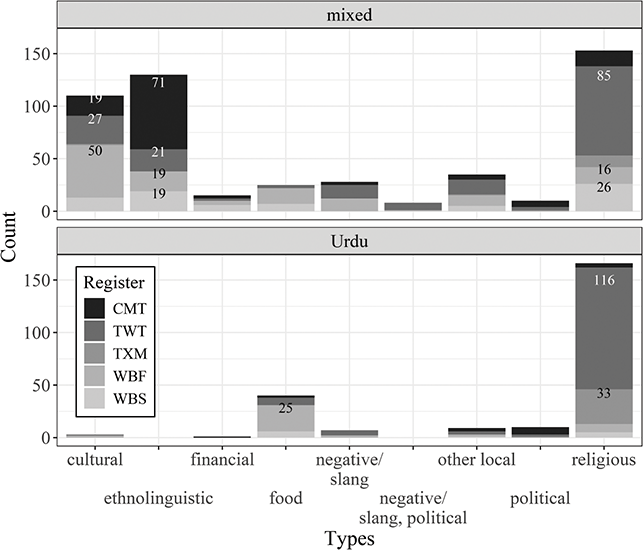
Figure 7 shows the thematic categories along with the language (Urdu or mixed) and their proportions in different registers of SAOnE-PK. The only locally relevant English word is an abbreviation Computerised National ID Card (CNIC), which occurs in bigrams like CNIC number, CNIC copy, CNIC card, and CNIC condition as in (19). The bigrams with mixed English and Urdu words are more frequent and diverse in terms of themes. One of the most frequent Urdu (also Hindi) words in the cultural category is desi (‘native’ or ‘indigenous’), which occurs with many English words, for example, desi parents, desi food, desi liberals, desi community, desi shampoo. Ghairat (‘honour’) is comparatively more specific to Pakistani culture, occurring as ghariat brigade and ghairat brigades (‘groups(s) of people who like to morally police others’). Another culturally relevant word is rishta (‘marriage proposal’), which occurs in bigrams like rishta process, rishta lady (‘the professional agent who mediates the process’): (20) shows the use of the latter.
Thematic categories of local noun + noun and adjective + noun combinations in SAOnE-PK
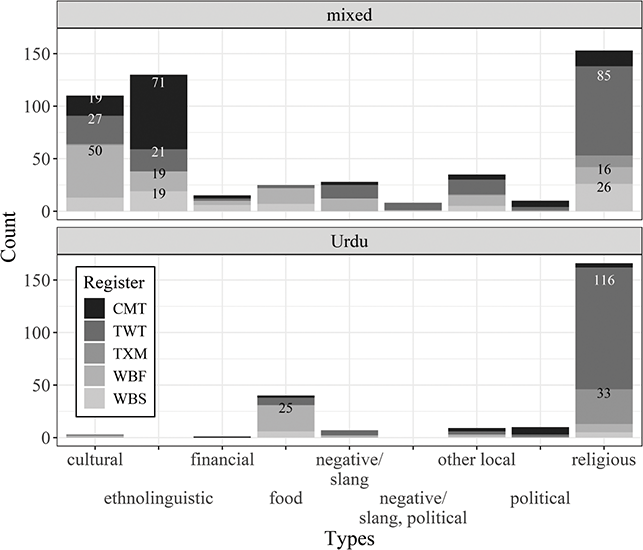
Ethnolinguistic words are adjectives referring to different ethnolinguistic groups in Pakistan, for example, Baloch/Baluch (the main ethnolinguistic group from Balochistan), Mohajir (Urdu-speaking immigrants, see Section 2.2), Pashtoon/Pukhtoon (the Pashto-speaking ethnolinguistic community). These are used in bigrams like Baloch people, Baloch tribes, Mohajir identity, Pashtoon belt, and so forth. In (21), the bigram Pukhtoon revenge refers to the tradition of revenge in Pashto speakers. The negative/slang category and political slang are thirty-six in number and are mainly used in Twitter. These include Urdu adjectives like bakwas (‘crap’) player, ghunda (‘rascal’) police, jaahil (‘illiterate’) leader, youthia mentality (mentality of Pakistan Tehreek-e-Insaaf (PTI) supporters), patwari league (Pakistan Muslim League Nawaz), and so forth. The word lifafa literally means envelope; in (22), it refers to journalists that supposedly accept bribe cash in envelopes. The category of ‘other local’ includes adjectives like Lahori (‘someone from Lahore’) as in Lahori blogger, Lollywood (Hollywood-inspired name of Pakistani film industry), as in Lollywood movies, Lollywood way, Lollywood icon, and gora (‘white’) as in (24). Lastly, religious bigrams include examples like haram (‘forbidden’) money, Jihadi (‘religious militancy’) tendencies as in (23), Iftar (‘breaking fast’) time, Nikah (‘marriage vows’) dress, and so forth.
(19) Mr.Zaidi introduced CNIC condition for business at just Rs.50,000/- …(SAOnE-PK, Comments)
(20) We got the rishta through a rishta lady and they’ve been talking for awhile. (SAOnE-PK, Web Forums)
(21) APS Pukhtoon children massacre was your fatal mistake. The famous Pukhtoon revenge will come. (SAOnE-PK, Comments)
(22) They All are lifafa Journalists and Media Groups. (SAOnE-PK, Tweets)
(23) Such jingoism led us to Jihadi tendencies which became the tenth fault line. (SAOnE-PK, Web Forums)
(24) Grew up avoiding street food for questionable hygiene and a gora vlogger comes and calls that shit better than KFC.
. (SAOnE-PK, Tweets)
 . (SAOnE-PK, Tweets)
The bigrams that are completely in Urdu mainly consist of religious and food-related nouns. The most common bigram in the former category is Eid Mubarak (‘happy Eid’), which mainly occurs in tweets and text messages. Food-related bigrams (e.g. garam masala, chaat masala, tikka ‘BBQ’ masala, gosht ‘meat’ masala) are mainly present in web forums where cooking recipes are posted by the forum members. In (25), dabbul roti (‘box bread’) refers to sandwich bread that is usually baked in a metal box. Other local Urdu nouns can be used as is in English sentences, for example, Chai wala (‘tea maker’) in (26). The word jalsa (‘political gathering’) is used a few times in comments, text messages, and tweets. In (27), such a meeting in Lahore is mentioned.
(25) It is dabbul roti … (SAOnE-PK, Web Forums)
(26) You have a monster Chai wala next door … (SAOnE-PK, Web Forums)
(27) The Lahore jalsa was a failure […] (SAOnE-PK, Comments)
This subsection has shown that Urdu nouns and adjectives are frequently employed by Pakistani users in informal English communication, and that some of these lexical items are highly productive.
3.5 Grammar
In this subsection, we discuss four grammatical features of PakE. Three of these (i.e. relativisers that vs which, passive voice (be and get), (semi-)modal verbs of obligation) are related to ongoing change in English (Deuber et al. Reference Deuber, Hackert and Hänsel2022). These can help gauge the extent of change happening in PakE and its orientation to AmE or BrE. The fourth one (i.e. noun phrase (NP) complexity) may be helpful to uncover L2 features of PakE (e.g. use of phrases vs clauses as NP modifiers, as we show in Section 3.5.4).
3.5.1 Relative Clauses with That and Which
Leech et al. (Reference Leech, Hundt, Mair and Smith2009: 227) observe a decline in the frequency of which relatives – as in (28) – and an increase in that relative clauses – for example, (29) – in written AmE and BrE using the Brown family corpora from 1960s to 1990s. They attribute the increase of that relatives to colloquialisation (Leech et al. Reference Leech, Hundt, Mair and Smith2009: 234). In their analysis, the tendency of replacing which with that relativiser is more pronounced in the AmE corpora (Brown & Frown), than the British ones (Lancaster-Oslo-Bergen (LOB), Freiburg-LOB (FLOB)). Deuber and Hänsel (Reference Deuber, Hänsel, Wiegand and Mahlberg2019: 54) note that the relatively higher frequency of which relative clauses in BrE (including in the press language) can be a good indicator of a variety’s inclination towards AmE or BrE. Hence, the aim of the present subsection is to determine the frequency of that versus which relative clauses in PakE as compared to AmE and BrE using the written and CMC corpora as described in Section 3.2.
The data were tagged (POS, Named Entity Recognition or NER) and parsed (constituency, dependency) with the stanza (Qi et al. Reference Peng, Zhang, Zhang, Bolton and Manning2020) library. Then, we followed the criteria adopted by Hinrichs, Szmrecsanyi, and Bohmann (Reference Hinrichs, Szmrecsanyi and Bohmann2015: 814–815) and by Deuber and Hänsel (Reference Deuber, Hänsel, Wiegand and Mahlberg2019: 54–55) to extract only restrictive relative clauses using a rule-based approach and a Python script. We excluded clauses that were marked by a comma before the relativiser which, pied piping relative clauses involving which, clauses where the antecedent was that and the relativizer was which, clauses with a human noun (PERSON tag in the NER tags) as the antecedent and the relativiser was that, and where the clause could function as adjunct (i.e. that was replaceable by when, where, how). For the last case, a list of adjunct nouns was used (day, time, year, place, reason, way, date) and the clause was excluded from final count where such a noun was the head of the antecedent NP and the relativiser was that. We also excluded the clauses marked as ‘obl’ or oblique (i.e. adjunct clauses) by the stanza dependency parser. For examples of these cases, please refer to Deuber and Hänsel (Reference Deuber, Hänsel, Wiegand and Mahlberg2019) and Deuber et al. (Reference Deuber, Hackert and Hänsel2022: 284).
As a further step, we checked for complement clauses incorrectly extracted as relatives using Google Gemini 2.5 Pro. This last step removed 1–10% clauses from the total (the highest number was from PWE): (30) shows such a clause identified by our script as a relative clause but flagged by Gemini. The overall accuracy of relative clause identification (based on a 2.5% sample of the data) remains around 96% in both datasets.
(28) He pointed out the United States had committed a blunder which would further deteriorate law and order situation in Iraq. (PWE, News)
(29) It was clearly a failure that needs to be looked at and, if possible, addressed. (Crown, Press reportage)
(30) One can infer from this brief discussion that Saras ingenious literary expression consists in the blending of some deviant patterns into non-deviant patterns in her language. (PWE, Research papers)
Figure 8 shows the per million word frequencies and proportions of the two types of relative clauses in the three varieties. The normalised frequencies of both types of relative clauses are much lower in both modalities of PakE, though the regional difference is less pronounced in CMC. The overall lower frequency of relative clauses might be attributable to the use of phrasal features (i.e. prepositional modifiers) instead of clausal modifiers in NPs, as also noted in Section 3.5.4 (last paragraph). The written English registers (news, editorials, and research papers) indicate that which relatives are the least prevalent in AmE, confirming previous studies on the Brown family corpora. The proportion of which relatives in PakE is higher than in both of the native varieties, and the differences are statistically significant based on overall chi-square comparisons using raw frequencies in both modalities (Written: χ² (2, N = 4496) = 332.04, p < 0.001; CMC: χ² (2, N = 3910) = 383.69, p < 0.001). Subsequently, PakE was also found significantly different when compared with both native varieties one by one (PK vs UK, PK vs US) using the function pairwiseNominalIndependence in the R package rcompanion (Mangiafico Reference Mangiafico2025; R Core Team 2025). Overall, the results show that these PakE registers (both in CMC and written) are different from their counterparts in AmE and BrE in the use of relative clauses.
Relative clauses in written and CMC corpora of the three varieties of English
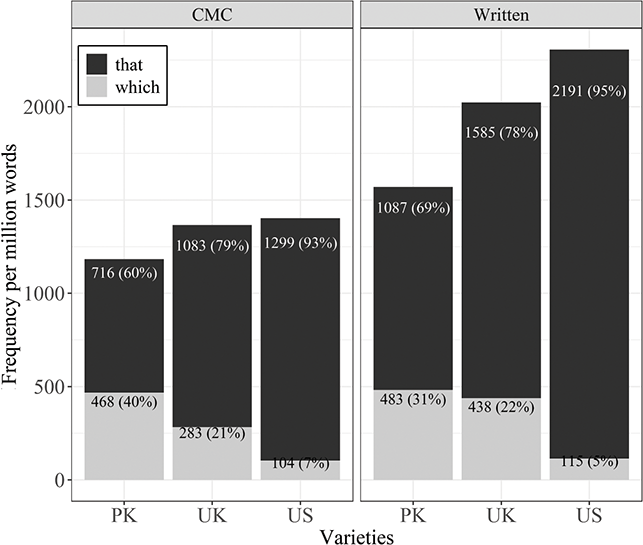
3.5.2 Be and Get Passive
In the past two decades, corpus-based research on passive voice in AmE and BrE has shown that the be passive, for example, (34), is declining in frequency, more in AmE and a little less in BrE, for example, Leech et al. (Reference Leech, Hundt, Mair and Smith2009: 149, 156). At the same time, another variant of the passive voice, the get passive, as shown in (33), is very gradually increasing in frequency. Bohmann et al. (Reference Bohmann, Müller, Honkanen and Neuhausen2025) have conducted a comprehensive analysis of be and get passive in varieties of English using very large corpora, for example, the Corpus of Historical American English (COHA) and the Global Web Based Englishes (GloWbE) corpus. Their results confirm previous observations that get passive has become more frequent with time (Bohmann et al. Reference Bohmann, Müller, Honkanen and Neuhausen2025: 129). This is especially true for central get passives, that is, the ones that are not formulaic as in example (31) or adjectival in nature, for example as in (32). The construction – though still mainly used in informal contexts – is also being increasingly used in formal contexts (Bohmann et al. Reference Bohmann, Müller, Honkanen and Neuhausen2025: 131). In terms of varieties, AmE leads with the highest proportion of get versus be (Bohmann et al. Reference Bohmann, Müller, Honkanen and Neuhausen2025: 163–164). PakE is among the varieties with the lowest proportion of get passives in their GloWbE data.
(31) […] there’s a chance you might actually enjoy it once you get used to it and gain some competency. (SAOnE, UK Web forums)
(32) But don’t get carried away. (CLOB, Press editorials)
(33) The film’s release also got pushed back from July 2014 to April 2015. (SAOnE, US Websites)
(34) However, he was dispatched without grace to Saudi Arabia immediately after landing. (PWE, Newspaper columns)
The aim of the present subsection is to explore the use of be and get passives in the three varieties using the corpora described in Section 3.2. These datasets include three written (editorials, news, research papers) and four CMC (comments, tweets, web forums, websites) registers. Hence, these are relatively more diverse than the web-based data used by Bohman et al. (Reference Bohmann, Müller, Honkanen and Neuhausen2025). We have used MFTE (Le Foll & Shakir Reference Foll, Elen and Shakir2023; Le Foll & Shakir Reference Shakir2024) to extract the frequencies of the relevant tags PASS (be passive) and PGET (get passive) from the corpora. We then used Google Gemini 2.5 Pro to classify the get passive instances according to the six way classification of Collins (Reference Collins1996: 45–49): central as in (33), psychological (e.g. ‘got frustrated’), reciprocal (‘get married’), adjectival as in (32), formulaic as in (31), and complex reflexive (e.g. ‘Don’t get yourself killed’). A 10% sample of the get passives was used to check the accuracy of MFTE and subsequent classification by Gemini 2.5 Pro. The accuracy of passive recognition by MFTE was 98.85%, while the accuracy of Gemini’s classification of central versus non-central get passive was found to be 90%.
Figure 9 shows the words per million frequencies of be and get passives in the three varieties and two modalities. The get passive is slightly more frequent in CMC as compared to the three written English registers. AmE leads in the use of get passive in both modalities, which confirms previous studies. The PakE data trails the AmE and BrE data in CMC in the use of get passive. However, due to a slightly higher frequency of this variant in Pakistani newspaper columns, the frequency is overall higher than in BrE in the written medium. Otherwise, the main variant of the passive voice in PakE is be passives. It is either higher than in both of the native English varieties (in CMC) or near the BrE frequencies (in the three written registers). Deuber et al. (Reference Deuber, Hackert and Hänsel2022: 282) find a similar trend in Indian English. The differences in the use of be versus get passive in the written modality are not statistically significant among the three varieties (χ² (2, N = 15271) = 5.03, p = 0.081). However, these varieties do show significant differences in CMC (χ² (2, N = 11778) = 27.69, p < 0.001). Subsequent comparisons of PakE with AmE and BrE are also statistically significant in CMC – performed using the function pairwiseNominalIndependence (Mangiafico Reference Mangiafico2025). Overall, passive voice and especially be passive appears to be comparatively more common in PakE.
Be and get passives in written and CMC corpora of the three varieties of English
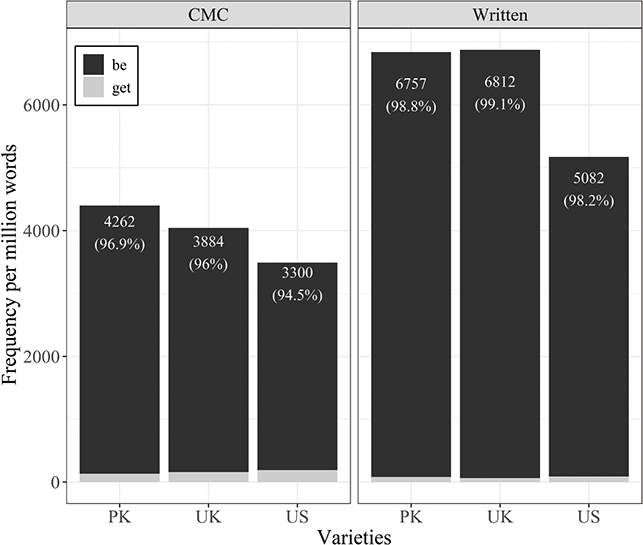
3.5.3 Modal Verbs of Obligation
Shakir (Reference Shakir2025) has conducted a study on the (semi-)modal verbs of obligation must, have to, (have) got to, and need to using the public registers (i.e. comments, tweets, web forums, and websites) in the SAOnE corpus. Like the other three SA varieties (Bangladeshi, Indian, and Sri Lankan Englishes), PakE has a higher preference for must, particularly in comments and tweets. The main use of must is in the root meaning to express personal opinions, referred to as ‘discourse internal obligation’ by the author. Example (35) shows the use of must from the SAOne corpus used by Shakir (Reference Shakir2025). The two native varieties (i.e. AmE and BrE) mainly employ need to for this purpose. PakE (along with the other SA varieties), however, uses need to as well as must. The author attributes the higher usage of must (especially on Twitter) to the presence of political activists who express their opinion using this verb. The number of unique lexical verbs used with must is also significantly higher in PakE (143) as compared to AmE (91) and BrE (72) (Shakir Reference Shakir2025: 10–11). The semi-modal need to has the highest frequency in the Pakistani data (Shakir Reference Shakir2025: 9). The author also finds epistemic uses of the verbs (have) got to and have to, as in (36) and (37).
(35) Pakistan must revive PSM. It is serious and major matter. (SAOnE-PK, Comments)
(36) Excellent … This has got to be the first one … (SAOnE-PK, Tweets)
(37) And look at their achievements, Bangladesh (i know raw was created in ‘68 but there has to be some sort of agency before that). (SAOnE-PK, Web forums)
3.5.4 Noun Phrase Complexity
The past two decades saw the rise of research on NPs to explore syntactic complexity and its impact across registers. Early linguists like Aarts (Reference Aarts1971) identified that ‘light’ (non-modified) NPs bear a specific relationship with spoken texts and subject positions, while ‘heavy’ (modified) NPs are associated with written texts and non-subject positions. NP complexity arises through the addition of modifiers – either pre-modifying or post-modifying the head noun (Quirk et al. Reference Quirk, Greenbaum, Leech and Svartvik1985). Biber et al. (Reference Biber, Johansson, Leech, Conrad and Finegan1999: 578) found that complex (i.e. pre- and post-modified) NPs occur more frequently in academic writing and news reports as opposed to spoken conversations.
Several studies have also been conducted on NP complexity in varieties of English. For example, Brunner (Reference Brunner2014) comparatively analyses British, Singaporean, and Kenyan NP patterns using the respective International Corpus of English (ICE) components. He attributes the differences across the three varieties to the structural uniqueness of each substrate language. Hence, Singaporean English employs straightforward pre-modification reflecting Sinitic head-final typology, while Kenyan English exhibits considerable Bantu patterns favouring more post-modification (Brunner Reference Brunner2014: 37). Brato’s (Reference Brato2020: 391) diachronic analysis of Ghanian English shows that NP complexity increases over time, which is attributable to increased education and proficiency in English, instead of language contact or substrate influence. Schilk and Schaub (Reference Schilk and Schaub2016: 81) analyse ICE components of Hong Kong, Singapore, Jamaica, India, and Canada. Their findings show that syntactic function of the NP (subject vs other) is the strongest predictor of complexity, while variety and register only become relevant in interaction effects. For example, they show that Indian English academic writing shows a strong tendency towards simple NPs (Schilk & Schaub Reference Schilk and Schaub2016: 78).
No analysis of NP complexity is available for PakE, so our aim in this subsection is to conduct a preliminary study on NP complexity in PakE in comparison to AmE and BrE. Since the NP types are highly dependent on registers, we limit ourselves to the three comparable written registers from PWE (i.e. editorials, news, and research papers) and their counterparts from Crown and CLOB. We use Schilk and Schaub’s (Reference Schilk and Schaub2016: 63) definitions to identify four types of NPs:
Simple: (Det) + Noun, for example, (The) book, UN.
Pre-modified: (Det) + Adjective(s) + Noun, as in (The) original book.
Post-modified: (Det) + Noun + Prepositional phrase/relative clause, as in (The) book that you read/of Mathematics.
pre- and post-modified: (Det) + Adjective (s) + Noun + Prepositional phrase/relative clause, as in (The) old book that you sent me/of Mathematics.
NPs with complex pre-modification (e.g. good A and B, good A and bad B) were also included in the last type, as proposed by Schilk and Schaub (Reference Schilk and Schaub2016: 63–64). The NPs were extracted from the tagged (POS and NER) and parsed (constituency and dependency) data using stanza (Qi et al. Reference Peng, Zhang, Zhang, Bolton and Manning2020) and the SuPar parser (Zhang, Li, & Min Reference Zhang, Zhenghua and Min2020; Zhang, Zhou, & Li Reference Zhang, Zhou and Li2020). The latter tool was selected because it performed slightly better than the built-in parser of stanza in constituency parsing. We used custom scripts written in Python to extract NPs from subject and other positions (e.g. object). NPs in stand-alone prepositional phrases were ignored. After extracting the NPs, we selected 100 random sentences (and the corresponding NPs) from each register category and each corpus. This generated about 420 NPs from each category and corpus, making a total of about 3700 NPs. These were manually checked for accuracy and false positives were discarded. The final dataset includes 3204 NPs.
The results are plotted with respect to the syntactic function (subject vs other) in the three varieties and three registers in Figure 10. The proportions show that there is hardly any difference in the use of NP types among the varieties under consideration. As shown in previous research, syntactic function shows the most visible differences in the use of NP types, where simple NP types are more common in subject position, while complex pre- and post-modified types are more frequent in all non-subject (i.e. other) positions. Nonetheless, two slight variations in PakE registers can be noted. Firstly, Pakistani research papers employ simple unmodified NPs more often when compared with both AmE and BrE, as depicted in the bottom panel ‘Research Papers’ under the panel titled ‘subject’. An example of such an NP is presented in (38). This finding is in line with Schilk and Schaub’s observation about Indian English, another SA L2 variety of English. Secondly, Pakistani news reports show a higher proportion of post-modified NPs in non-subject (i.e. other) positions, which is visible in the panel ‘News’ under the vertical panel ‘other’. As per our random sample, the post-modifiers in these NPs are mainly prepositional phrases, as shown in (39). In our mixed effects multinomial regression model (np_type ~ variety * register_category * np_position), the variables ‘register category’ and ‘NP position’ (subject vs other) are statistically significant predictors of NP type, but variety is not significant.
(38) The teacher acts as a facilitator of their learning. (PWE, Research papers, Syntactic function: subject)
(39) Speaking on the occasion, Tahir Iqbal said that […] these are essential for […] disseminating the message of peace and fraternity. (PWE, News, Syntactic function: other)
NP complexity according to syntactic function in the three varieties and selected registers
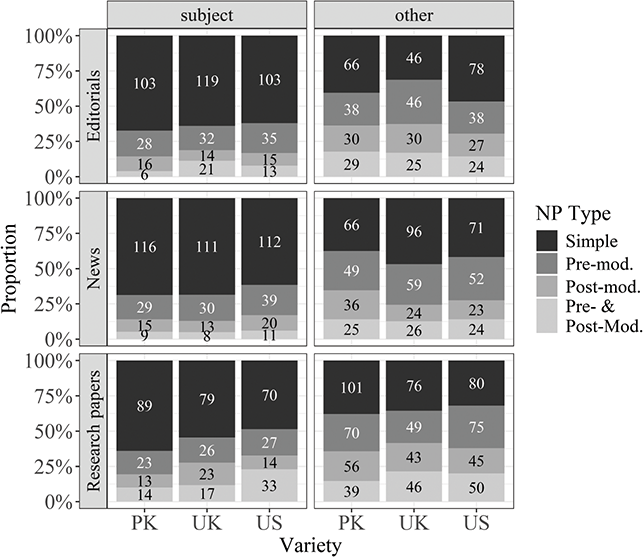
3.6 Section Summary
In this section, we have presented features of PakE on the phonological, orthographic, lexical, and grammatical levels. The phonological features (e.g. de-aspiration, retroflexion) are the result of substrate influence in the educated speech of Pakistanis and give them a distinct accent. The analysis of spelling variation has shown that Pakistani users of English follow BrE norms in formal contexts, but AmE is not far behind (especially in informal CMC registers and among young Pakistanis). The analysis of lexical features has demonstrated that Pakistanis use existing English resources productively (e.g. adjectives with -ian) as well as create new expressions by using borrowed vocabulary (e.g. local nouns and adjectives) and linguistic processes (i.e. reduplication). The four case studies of grammatical variation depict that PakE is relatively conservative compared to AmE and BrE (e.g. the use of which relatives, be passive, and the modal must). Additionally, it also shows features found in other new English varieties (e.g. reduplication patterns shared with other SA Englishes, the use of simple NPs in academic writing).
4 PakE on the Internet
The attitudes survey in Section 2 has indicated that the use of English is more likely in the situations associated with the internet, that is, social media (personal or professional) and email. Email communication is mostly relevant to professional settings (e.g. between different departments of a university). Moreover, it is a private register, so the data collection is not as straightforward as it is for public registers like blogs and social media. In the present section, we explore the use of English by Pakistani netizens in various public registers. We start with a brief overview of the earliest use cases in various kinds of blogs. Afterwards, we present individual examples of English usage in various settings on Facebook. Lastly, we conduct two case studies based on larger datasets, showcasing the use of English on Instagram and Twitter.
4.1 PakE Blogs and Bloggers
This overview of PakE blogs is based on previous research (Shakir Reference Shakir2020; Shakir & Deuber Reference Shakir and Deuber2019) and some more recent observations. The earliest English blogposts available in Shakir’s (Reference Shakir2020) dataset of PakE blogs are from 2004 (e.g. the post from Pakhana which can be found at https://pakhaana.blogspot.com/2004/01/flirting-with-disaster.html). As noted by Shakir and Deuber (Reference Shakir and Deuber2019: 13), many of these blogs are of the personal diary type (Grieve et al. Reference Grieve, Biber, Friginal, Nekrasova, Mehler, Sharoff and Santini2010) where the bloggers talk about their day-to-day lives. By the mid-2010s most of these blogs were abandoned, while at the same time social media platforms like Facebook and Twitter were gaining popularity among these users. A look at the contemporary multi-writer blogs, for example, metro blogs (https://web.archive.org/web/20051224175750/http:/lahore.metblogs.com/), shows that these bloggers were most probably from urban centres of Pakistan (Karachi, Lahore, and Islamabad) and belonged to the millennial generation, who would have been in their teens or early twenties at that time.
In late 2000s and 2010s, individual and multi-writer blogs gave way to various thematic types (Grieve et al. Reference Grieve, Biber, Friginal, Nekrasova, Mehler, Sharoff and Santini2010) of English blogs, including news blogs on English newspaper and news channel websites as well as stand-alone blog sites on topics like technology, internet gossip, celebrity news, and so forth. At the time of writing, the thematic blogs in the form of news and opinion blogs are still active on news websites (e.g. the Express Tribune found at https://tribune.com.pk/blogs) or other platforms (e.g. PakPositive found at https://www.pakpositive.com/opinion/). Technology blogs, which were written in the informal and personal style of blogs in the beginning, have now become full-fledged news media outlets, focusing not only on technology but many more topics – see Shakir (Reference Shakir2020: 160–164) on the diachronic development of literate features in Pakistani technology blog ProPakistani.com. Along with these blog types, there are online magazine-type blogs – Shakir (Reference Shakir2020: 100–101) labels these as ‘new media blogs’– that feature content about Pakistani celebrities (including their Instagram posts and stories) in English.
4.2 English on Facebook
Facebook is one of the oldest and most widely used social media platforms in Pakistan. One of the main reasons for its popularity is that a text-based version of Facebook (i.e. no images or videos are downloaded) can be used without any cost on many mobile phone networks (e.g. on Ufone found at https://web.archive.org/web/20260112171500/https:/www.ufone.com/free-facebook/). This makes the use of Facebook on smartphones very attractive in rural areas, where internet is only accessible through Edge, 3G, or in some cases 4G mobile networks. There are thousands of pages on Facebook made by Pakistani users that represent individuals, including writers or celebrities, particular cities, districts or subdistricts, businesses, including news outlets, (online) brands, local governments, government officials, public sector departments, universities, other educational institutes, and so forth. These pages post updates in the form of text and multimedia (i.e. images or videos mostly made by smartphones). Depending on the type of the page, the text accompanying these posts can be in Urdu (in majority of the cases), as well as in regional languages and English. The present subsection discusses some of these posts and their context to highlight various settings on Facebook where English is used by Pakistani Facebook users.
The text shown in Figure 11 is from a page named Sialkot District. This page is mostly dedicated to news updates from the district of Sialkot in the province of Punjab. The majority of the posts on this page are in Urdu, but English posts like the one shown in the figure are also possible. As the last line indicates, the post is not written by the page admin(s), but by another Facebook user and was sent as a private message to them. The writer is apparently a delivery boy and wants to complain about the behaviour of the local franchise of an international food chain. This is most probably one of the reasons why the post and most of the 800+ comments on the post are in English. The post language exhibits the usual social media conventions, for example, no space after period or no marking of sentence boundaries (third last line of the main paragraph). Additionally, it also shows some features of PakE and the local culture, for example the use of progressive they are insulting us and the show of respect an humble request. Features like absence of subject verb agreement in when customer call and plural marking in Foodpanda official indicate that it could be classified under mesolectal PakE (variety C) used by middle/lower middle class Pakistanis educated through public sector schooling system (Rahman Reference Rahman2015: 22).
A complain-related post about a local branch of an international food chain
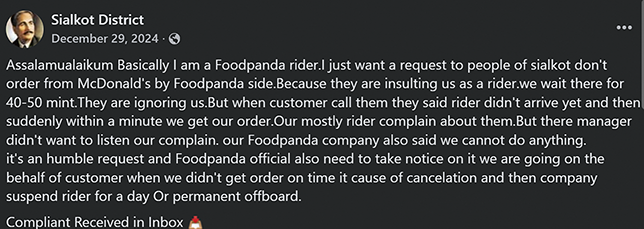
Apart from Facebook pages of different kinds, English is also employed in Facebook groups by Pakistani internet users. Though this phenomenon has been documented in previous research (e.g. Shakir Reference Shakir2020), we present some additional cases which have not been covered yet. The part of a post shown in Figure 12 is by a Pakistani woman married to a Pakistani man living and working in a European country. She is supposed to be waiting for a family reunion visa. The post tells about the unfortunate end of their marriage in divorce due to the very long waiting time required to get such a family visa. Though it is a very personal topic, the selection of English instead of Urdu shows the extent Pakistanis are able to employ this language in non-professional contexts. Another probable reason is the distancing and shielding provided by selecting a more formal language.
A paragraph from a post in a family reunion visa-related Facebook group
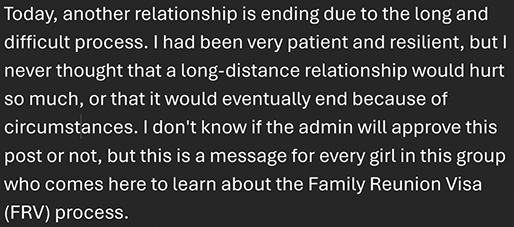
Overseas Pakistanis (living in English-speaking as well as other countries like Belgium, Germany, Spain, etc.) frequently use English among themselves and with their countrymen living in Pakistan when communicating through Facebook groups and other such platforms. This is another reason why the post in Figure 12 is in English. A similar non-professional context where English is employed very frequently by Pakistanis is the search for a life partner through Facebook groups created only for this purpose – possibly also applicable to WhatsApp and other such platforms. Pakistanis living within Pakistan as well as abroad are members of such rishta (‘marriage proposal’) groups. Candidate profiles are mainly posted in English, though Urdu posts also exist. The text contains information related to age, gender, education, caste, ethnicity, profession, current residency, hobbies, (dis)preferences in a potential life partner, and so forth. These texts, which are written once and only edited for minor details later, can be posted in multiple groups. Other group members can comment (mostly in English) on the posts to show their interest. Subsequent communication through messaging services like Facebook Messenger usually occurs in Urdu or other local languages, though.
The last example of English use on Facebook is a post in a diaspora Pakistani group in which a graduate of a religious seminary in Pakistan is advertising her online teaching services (Figure 13). The post is written in plain English with no punctuation marks. It employs religious terminology: namaz (‘prayer’), tajweed (rules of Quranic recitation), and kalmas (basic declarations of Islamic faith). It should be noted that such graduates are traditionally more proficient in Arabic and Urdu instead of English. However, the context (advertising and Pakistani diaspora in a non-English-speaking European country) has triggered the use of English instead of Urdu which would be equally understandable to the audience but may not be as effective. The use of English in social media advertisements is not limited to diaspora context, but is also common within Pakistan whether it is by bigger business establishments, individual online business owners, or Pakistani celebrities (see Section 4.3).
Business promotion post by a local Pakistani in a diaspora Pakistani group
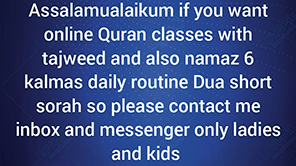
To summarise, in this subsection we have presented some situations on Facebook where the use of English by Pakistani netizens is more likely. These involve professional contexts (e.g. complaining about a business or advertising one’s business) as well as non-professional ones like posting a marriage proposal. The interlocutors may reside within the country or live abroad.
4.3 The Use of English on Instagram by Pakistani Celebrities
The purpose of this subsection is to explore various uses of English and/or Urdu by Pakistani TV actors and celebrities in Instagram posts. The data have been extracted from post captions. We do not include the accompanying images or videos in this analysis. This is due to the time and resources that would be required to conduct multimodal analyses, and also due to the difficulties in obtaining such data, which can lead to several gigabytes of downloaded content and cause account blocking by Meta (Instagram’s parent company). The original dataset is much larger with sometimes several hundred or a thousand plus posts per account. The present data consists of randomly sampled posts (100 per celebrity or less if not enough posts are available) of 72 (36 each) male and female Pakistani celebrities. The accounts are mainly run by the celebrities themselves, though some are run by professional media management agencies/individuals. Figure 14 shows the age, gender, number of words, and post length of each demographic sub-category in the data.
Demographic details, number of words, and post length in sub-categories
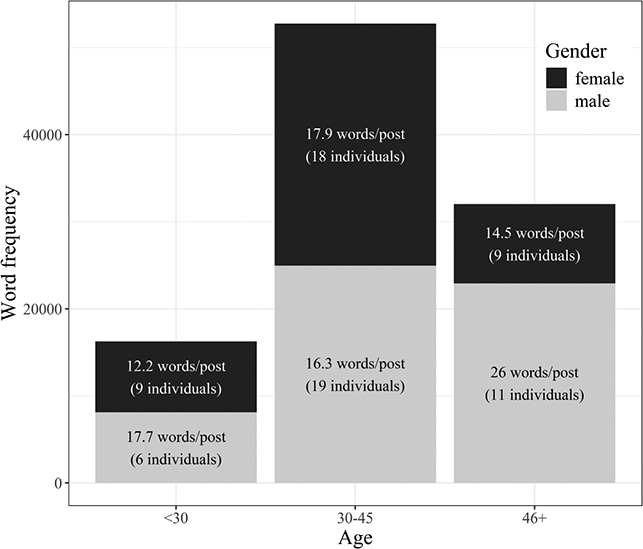
Figure 14 Long description
The under 30 group has the lowest word count (around 18,000 words, 9 females and 6 males), with almost equal word count in male and female posters. Males post on average longer posts. The 30 to 45 group has the largest word count (nearing 50,000 words), where females (18 individuals) posting a little higher word count than males (19 individuals). Females also post longer posts on average. The group 46 and above has 11 males and 9 females (overall approx. 30000 words). Males in this group post more frequently (and longer posts) as compared to females.
The celebrities are mainly actors; very few of them have multiple professions listed on their Instagram profiles (e.g. director, producer, content creator, public figure). To keep the sample as consistent as possible, we have tried to exclude artists who are singers, songwriters, and so forth. Many of the celebrity accounts in these data write only ‘Actor’ in their bio. While there are also ‘pure’ Insta and Tiktok celebrities present in Pakistan, the ‘traditional’ celebrities are TV and film stars (many of the film stars are now TV drama actors due to almost a dead film industry). These may include people from families that have been in performing arts for more than one generation or newcomers that made their way to TV and media through talent, luck, or a mixture of both. Such celebrities used to be interviewed by film journalists for magazines in Urdu and English (or traditional newspapers’ Sunday magazines in both languages). That role has now been taken over by online news outlets in English (see Section 4.1) or Urdu, and social media. These news outlets also feature the Instagram posts of these celebrities as news or gossip. Hence, Instagram has become a very important source for these celebrities to connect with the traditional media as well as directly with their fan base. Many of them have Facebook and possibly also TikTok accounts as well, but we concentrate only on Instagram for this analysis. Instagram is a visual platform, in that pictures and images are first-class content here. Reels (vertical format videos) are a later innovation to compete with TikTok. Pakistani celebrities can use Instagram to post their latest snaps (especially model-cum-actors in both genders), updates about their on-air or in-production projects, post about themselves, family or work, advertise for brands, or comment on social/political issues. English is a very useful and prominent tool in their linguistic repertoire. They also use Urdu to connect with their audience and followers, but English is more formal and many times deemed appropriate for the occasion. The following subsections explore these uses of English.
4.3.1 Data Annotation
The posts have been annotated for theme and language through Google Gemini 2.5 Pro. Gemini was not provided with an explanation of the thematic categories. Instead, a 10% random stratified sample (approximately ten posts from each Instagram account) of the selected data was manually annotated for the nine categories listed as follows. Then Gemini was instructed to tag additional data (including the manually annotated posts) using the given scheme:
Ads: Promotions of film/drama projects (of the celebrity) or of local/international brands and businesses (clothes, beauty products, housing societies, etc.).
Follower engagement: Asking a question and/or for feedback about a TV show, or otherwise engaging with the followers.
Hashtags: Just hashtags with no other theme deducible from the hashtags.
Personal life: Posting about self, family, and friends, including travels or simply selfies with some text.
Professional life: Posting about career, job, colleagues, professional relationships, drama/film projects (e.g. back the stage updates).
Politics/social: Posting on local or international political or social issues, including the ones that may affect the actor community.
Quotations: Motivational quotations or posts that address the audience in general, song lyrics or poetry verses in Urdu or English, or a funny quotation.
Unclear: Posts with no text including emojis, or posts that are hard to fit in any of the other categories.
Wishes: On holidays, to colleagues or family members on birthdays, anniversaries, and simple prayers.
The data were also annotated for language using the same model. Code-switching was defined at phrase or clause level (two or more words) to make separation more realistic and hopefully get more accurate chunks of each language.
4.3.2 Validation of Annotated Data
The thematic annotation was completed in multiple runs to improve accuracy. Initially, the Large Language Model (LLM) was given a list of fourteen categories and brief explanations to annotate the data. A random sample of 100 posts indicated about 90% accuracy in theme and language annotation. Later on, a 10% sample (as described in Section 4.3.1) was manually tagged and compared with the LLM-based annotation. The comparison showed a 0.63 Kappa (unweighted for two raters: human vs machine). The accuracy was 69%. In the second run, the human-annotated data were used as examples for re-annotation of the complete dataset. The Kappa for the 10% sample (human vs machine) was 0.89, and the accuracy was 90%. The language annotation resulted in a Kappa of 0.46 in the first run, and 0.51 on the 10% sample in the second attempt. It was mostly mixed language posts that caused disagreement.
To understand the overall trends in the thematic categories, the 10% human-annotated sample and the overall dataset tagged by Gemini have been compared side by side in Figure 15. The bar charts show that Gemini tends to annotate social/political posts and wishes less frequently as compared to the hand-annotated data. The lack of cultural understanding required beyond the post text appears to be the main cause of this discrepancy. However, the three most frequent thematic classes (i.e. ads, personal life, and professional life) have almost similar proportions in both datasets.
Percentage comparison of thematic annotation (machine vs human)
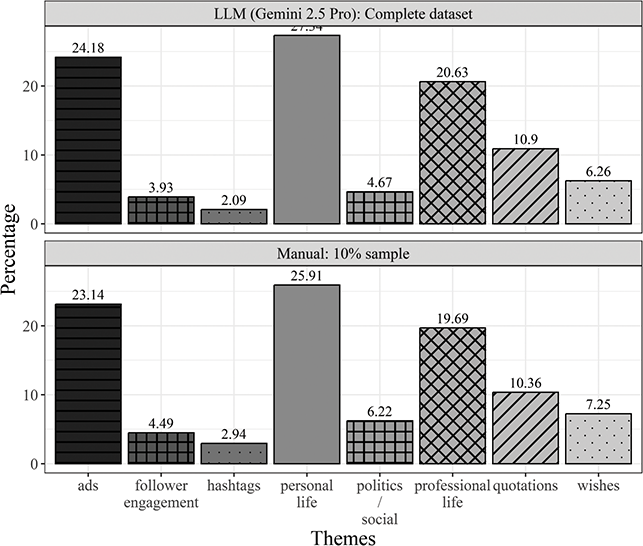
4.3.3 Data Analysis
The data have been analysed for the effect of age, gender, and language on the post theme. The posts annotated by the LLM for English (74%) and Urdu (8%) were retained for the final analysis. Mixed posts (approx. 15%) and unclear cases were removed to reduce incorrectly annotated cases. Multinomial regression model from nnet::multinom was applied to the data, and the final model was selected using the Mass::stepAIC function (Venables & Ripley Reference Venables and Ripley2002) using R (R Core Team 2025). The model shows that all three explanatory variables interact with each other, with the interaction of language and gender being the weakest. The results have been visualised in the form of bar plots with average predicted probability of the eight thematic categories with respect to the selected explanatory variables. These marginal effects have been calculated using the marginaleffects package (Arel-Bundock, Greifer, & Heiss Reference Arel-Bundock, Greifer and Heiss2024) with the option newdata=‘balanced’ in the function avg_predictions to account for unequal subgroups in age, gender, and language.
Figure 16 shows the average predicted probabilities of post theme as per age groups and gender. The likelihood of professional life-related posts increases with age in both genders, while personal life-related posts remain almost steady in females, with a decrease in older males. Example (40) shows a professional life-related post where a female celebrity is talking about an old drama she performed in. A post captioned with my family has been given the category of personal life, as in (41). Posting ads (own drama/file project or a brand’s advertisement) decreases with age. The highest probability appears to be in younger female celebrities. Example (42) shows the advertisement of a clothing brand without clarifying that it is an ad. Example (43) is a much more clearly phrased advertisement of a brand. The promotion of own drama project in (44) is an ad, but it also shows why it is difficult to annotate for language even for a capable model like Gemini 2.5 Pro. This is especially the case when post text is shorter. Lastly, posts about social/political issues are more likely in older age groups in both genders, as shown in (47) and (48).
(40) Blast from the past
throwback. AROOSA days with the most amazing Fatima Surraya Bajia (May her soul rest in peace Ameen). What a personality. Am so lucky to have worked with such a stalwart. #xxxxxxxxx #xxxxxxxxxxxxxxxxxx #ptv #ptvhome #pakistanicelebrities (female, 46+, professional life)(41) My Family
MashaAllah [Family, Support System, Love, Farooqui Brothers, twins, Xxxxxx Farooqui, Xxxxx Farooqui, Bleesed] (male, 30–45, personal life)(42) Dark feminine Wearing @xxxxxxxxxxxxxx
(female, <30, ads)(43) Check out the amazing LUXURY LAWN COLLECTION 2022 by @xxxxxxxxxxx well known for introducing remarkable luxurious and demanding articles with high quality fabric. Shop Now: <URL> (female, <30, ads)
(44) SHAMI KI SHADI (‘Shami’s wedding’) A tale of love, laughter, and unexpected chaos! Starting from 29th August Every Thursday at 9:00PM Only on @aurlifeofficial Staring @xxxxxxxxxxxxxxxxxx @xxxxxxxx @xxxxxxxxxxxxxxxxxxxx Writer: @xxxxxxxxxxxxxx & @xxxxxxxxxx Director: @xxxxxxxxxxxxxxxxxxxx Makeup Artist: @xxxxxxxxxxxx DOP: @xxxxxxxxxx #xxxxfilmsproduction (male, 30–45, ads) The interaction of age and language to explain the post theme has been depicted in Figure 17. Urdu posts are only a small fraction of the total dataset. Nonetheless, the data show some interesting patterns. Urdu posts have been mostly tagged as quotations, especially in younger people (less than 30), and as political/social commentary mostly in older people of both genders. Example (45) shows Hindi/Urdu song lyrics posted by a male celebrity. Follower engagement-related posts in under thirty males in Urdu are more likely. An example of such a post with a simple question is shown in (46). Two posts in the category of social/political are shown in (47) and (48) in Urdu and English, respectively. Posts related to personal wishes (e.g. a birthday) or holiday wishes (e.g. Eid) can occur both in English and Urdu, but the latter is slightly more favoured. Two such examples are shown in (49) and (50). Furthermore, it can be seen in the figure that professional life and advertisement-related posts are less likely to occur in Urdu; especially the under thirty and thirty to forty-five age groups are more likely to use English for such posts. This shows that even if the content they create is in Urdu (e.g. dramas), they prefer to talk about their professional life and promote the content in English. Lastly, post captions where personal life and family are discussed, as in (41), are also preferably written in English.
(45) Andhere ko baahon main leke (‘Taking darkness in its arms’)
Ujaale ne ghar basaya hay (‘The light has built a home’)
Churaya tha jo chukaya hay!!! (‘It has paid back what it had stolen’) (male, <30, quotation, Hindi/Urdu Bollywood song lyrics)
(46) Kiya bolti hai public? (‘what does the public say?’) (male, <30, follower engagement, Urdu)
(47) Kash social media logoon ko Jordta …. (‘Wish social media would unite people’)
Kash social media kay chaudry pages chalanay kay liay mohabat pahlatay na kay nafrateen. […] (‘Wish the elites of social media promoted love instead of hate.’) (male, 46+, social/political, Urdu)
(48) 2020 just keeps getting worse and worse but I cannot comprehend such a great loss. Not just for me but for all of us. Sister Ruth Lewis, your service to mankind has been and always will be one that no words can do justice to. […] (female, 46+, social/political, English)
(49) Happy birthday to my very old friend @xxxxxxxxxxx
You hold a very special place in my heart. God bless you and always stay happy and healthy. […] (female, 30–45, wishes, English)
(50) Chaand raat Mubarak
[…] (‘Happy moon night’: refers to the night before Eid) (female, <30, wishes, Urdu)


 […] (‘Happy moon night’: refers to the night before Eid) (female, <30, wishes, Urdu)
To summarise this subsection, we have presented background and analysis of Instagram posts of Pakistani celebrities (mainly actors) from two genders and different age groups. The post themes and language have been automatically tagged through an LLM, which may have inaccuracies as shown by the comparisons in Section 4.3.2. However, the overall trends for thematic categories are approximately the same in the human-annotated sample and the machine-annotated complete dataset. The results show that Pakistani celebrities use English for posts belonging to such themes like ads, personal life, and professional life. Urdu and mixed language posts also occur, but they are only a small portion of their online content. This shows that Pakistani celebrities embrace English as the dominant language on the internet while communicating with their fans within Pakistan as well as with those living abroad, and possibly also with the international audience of Pakistani dramas that may reside in other SA countries (e.g. Bangladesh) or elsewhere.
Average probability of post theme according to age and gender
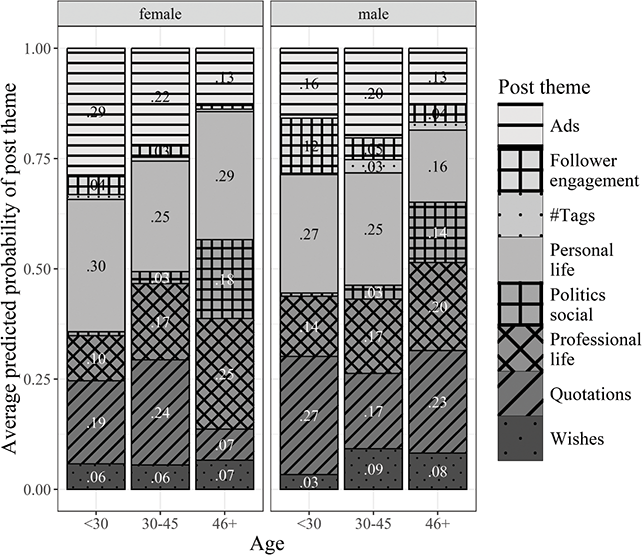
Average probability of post theme according to age and language
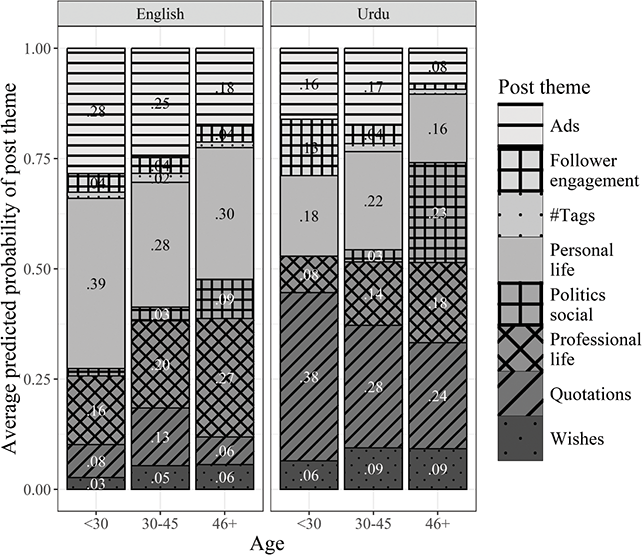
4.4 The Use of English on Twitter
Twitter is also one of the most popular social media platforms among Pakistani netizens. Its wider adoption started in the late 2000s and early 2010s when blogs were being replaced with social media platforms. Around the same time, a new political party (Pakistan Tehreek-e-Insaaf, PTI) started gaining popularity among the urban middle class. The party’s popularity started spreading with a powerful political show in Lahore on 30 October 2011 (Web Desk Reference Desk2011). Over the next few years, young Pakistanis (especially those under thirty years) increasingly started using Twitter to show their support for PTI and voice their political views. The effectiveness of social media (especially Twitter) in politics was already proven by Barack Obama in the US presidential elections of 2008 and 2012 (Pew Research Center 2012). PTI and its leader Imran Khan also employed Twitter along with other platforms like Facebook to campaign against the political elites of Pakistan. They were helped by scores of political activists posting on their behalf or voluntarily on Twitter and other social media in Urdu as well as in English. Even after Imran Khan’s four-year term as a prime minister (2018–2022), Twitter has remained a symbol of resistance and political organisation among his supporters. The platform was blocked for some time in Pakistan in 2024, but in late 2025 it is again accessible. Against this backdrop, our aim for this subsection is to explore the main themes and discourses that occur in English communication of Pakistani users of Twitter.
4.4.1 Data and Methodology
The data for the present analysis are based on the SAOnE corpus (see Section 3.2). The tweets category includes one million words in 500 text files (one Twitter user/file; 100+ tweets per user) from each of the six countries. The users’ profiles were manually checked to confirm their country of origin. The data were collected in 2021, so most of the tweets were posted in this year or a couple of years earlier. During the compilation phase of SAOnE and while conducting studies on parts of these data (Shakir Reference Shakir2024; Shakir Reference Shakir2025), it was observed that Pakistani tweets include political discussions. Hence, this dataset is well-suited to explore main themes and discourses in English tweets of Pakistani users.
Lexical Multidimension Analysis (LMDA) proposed by Sardinha and Fitzsimmons-Doolan (Reference Sardinha and Fitzsimmons-Doolan2025: 26–27) is employed for this study. LMDA is inspired by Multidimensional Analysis (MDA) propagated by Biber (Reference Biber1988) and many other studies who followed him. An MDA starts with the selection of functionally relevant lexico-grammatical features (e.g. adverbs and their kinds, verbs and their semantic classes, types of that complement clauses). Normalised per-1,000-word frequencies of these features are obtained from a representative corpus. Then a dimensionality reduction statistical technique like Exploratory Factor Analysis (EFA) or Principal Component Analysis (PCA) is applied to obtain clusters of co-occurring linguistic features. These groups of features are then functionally interpreted by taking into account the data included and the situational characteristics of the register categories in the data. LMDA uses content words (i.e. nouns, verbs, adjectives, and adverbs) and excludes function words like prepositions as well as structural features like clause types. LMDA builds on the concept of keyword analysis – which produces a list of statistically significant words by comparing one corpus to another (Baker Reference Baker2023: 165) – to find clusters of keywords that co-occur and may uncover underlying discourses and themes in a clearer way (Clarke, McEnery, & Brookes Reference Clarke, McEnery and Brookes2021; Sardinha & Fitzsimmons-Doolan Reference Sardinha and Fitzsimmons-Doolan2025: 13–26).
For the present analysis, we identify keywords by comparing the Pakistan tweets sub-corpus from SAOnE to the tweets of the five other countries included in the corpus. The corpus analysis tool AntConc (Anthony Reference Anthony2024) has been used for this purpose. The data are tagged and lemmatised with the stanza (Qi et al. Reference Peng, Zhang, Zhang, Bolton and Manning2020) package in Python (Python Core Team 2025). As a pre-processing step, we remove # and @ from Twitter handles and hashtags, respectively. This way proper nouns can be easily identified by the tagger and later included in the keyword analysis. We use the dispersion-based keyness computation method proposed by Egbert and Biber (Reference Egbert and Biber2019), which is available as an option in AntConc. This way, we are able to identify a list of 1735 lemmas that are used in many text files, and by extension by the Pakistani Twitter users. The normalised per-1,000-word frequencies are calculated for these features and compiled in a table. As a further step before LMDA, we remove 170+ function words based on the list from Dang and Webb (Reference Dang, Webb and Nation2016: 188–189) to keep only the lemmas of content words for further analysis. Additionally, we remove any lexical items with zero frequency in 80% or more documents. We also remove features which have very low correlation (<|0.1|) to any other feature, communalities of less than 0.2 as recommended by Egbert and Staples (Reference Egbert, Staples, Berber-Sardinha and Pinto2019), or a Kaiser–Meyer–Olkin (KMO) value of less than 0.5. Lastly, we apply signed-log transformation to the frequency table to reduce the impact of skewed frequencies (Neumann & Evert Reference Neumann, Evert, Seoane and Biber2021: 155). For dimensionality reduction, we use PCA with no rotation – see Shakir (Reference Shakir2024: 377–379) for a discussion on this. Figure 18 shows that about six dimensions can be extracted through both EFA and PCA.
Scree plot of data (EFA and PCA)
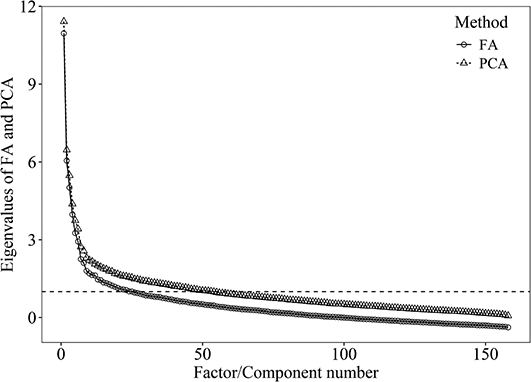
We include four dimensions in our analysis here, as the fourth and sixth dimensions are not interpretable. The final analysis has seventy-five keywords with an overall KMO value of 0.80 (‘Meritorious’), which shows the suitability of the data for EFA or PCA (Egbert & Staples Reference Egbert, Staples, Berber-Sardinha and Pinto2019). The variance explained by the PCA solution is 35%. The cumulative variance explained by the first dimension is the highest, and it drops with subsequent dimensions. Only those lemma keywords are retained which have a communality of |0.295| on either dimension, as shown in Table 5. The table also shows the interpreted thematic labels for each of the four principal components.
| Dim | +/-Label | Keywords |
|---|---|---|
| Dim1 + | Issues related to Pakistani politics | election (0.55), PTI (0.54), leader (0.52), Khan (0.51), Nawaz (0.51), Imran (0.5), govt (0.49), Minister (0.49), ImranKhanPTI (0.49), Pakistan (0.49), ppp (0.48), corruption (0.47), corrupt (0.47), court (0.46), political (0.45), media (0.44), minister (0.44), nation (0.44), Kashmir (0.41), law (0.4), force (0.39), country (0.39), Muslim (0.38), Sindh (0.37), Asad (0.37), politics (0.36), HamidMirPAK (0.36), Army (0.36), fawadchaudhry (0.36), Pakistani (0.36), MaryamNSharif (0.36), BBhuttoZardari (0.35), PPP (0.35), stand (0.35), Umar (0.34), PTIofficial (0.33), terrorist (0.33), innocent (0.33), citizen (0.33), foreign (0.32), imrankhanpti (0.32), US (0.32), Shah (0.31), ik (0.3), shame (0.3), action (0.3), issue (0.3), state (0.3) |
| Dim2 + | PPP Sindh vs | BBhuttoZardari (0.57), PPP (0.54), Sindh (0.54), Karachi (0.45), visit (0.36), ppp (0.34), regard (0.3) |
| Dim2- | regional issues | country (-0.3), Pakistani (-0.31), Army (-0.32), foreign (-0.34), terrorist (-0.37), force (-0.39), Kabul (-0.49), US (-0.54), Afghan (-0.62), Taliban (-0.63), Afghanistan (-0.67) |
| Dim3 + | Prayers and blessings | bless (0.63), Allah (0.62), prayer (0.49), stay (0.46), Ameen (0.44), peace (0.42), 🇵🇰 (0.41), beautiful (0.35), soul (0.33), recovery (0.32), Muslim (0.3) |
| Dim3 - | – | Umar (-0.38), Asad (-0.4) |
| Dim4 + | Citizen issues and pleadings to govt. officials | action (0.38), Sir (0.37), official (0.36), citizen (0.34), issue (0.33), city (0.31), road (0.31) |
| Dim4 - | – | Khan (-0.31), Nawaz (-0.32), Imran (-0.34) |
4.4.2 Themes and Discourses in PakE Tweets
The first principal component consists of forty-eight keywords. It is the biggest dimension in terms of lemma keywords loaded and the variance explained in the PCA model (8% of the cumulative variance explained). The keywords can be grouped in various categories. There are proper nouns that are either names of Pakistani politicians (e.g. Nawaz, Umar, Khan) or their Twitter account handles (e.g. ImranKhanPTI, MaryamNSharif, BBhuttoZardari). Other proper nouns are related to party names (e.g. ppp, PTI), famous journalist names or Twitter handles (e.g. HamidMirPAK) or place names (e.g. Kashmir, a region disputed with neighbouring India). Some of these proper nouns may also occur as hashtags. Common nouns such as election, leader, govt., corruption, court, nation, minister, law, force, citizen, shame, action, issue, state show that a common theme of politics with various aspects (e.g. corruption) is present in these tweets. The adjectives political, terrorist, innocent, foreign also strengthen this interpretation as they cover various internal and external political and social challenges that may be under discussion in English tweets of Pakistanis. This dimension appears to represent ‘Issues related to Pakistani politics’ on Pakistani Twitter.
As mentioned in Section 4.4.1, these tweets are from 2021 when Mr Imran Khan was still the prime minister of Pakistan. The Twitter accounts active at that time and included in these data are not only PTI-affiliated activists but also from other parties. In (51) and (52) most probably a sympathiser of or a social media account of another political party, Pakistani Muslim League Nawaz (PMLN), is alleging the same corruption charges that would be levelled against Mr Nawaz Sharif (the PMLN leader) by PTI-affiliated and sympathiser accounts. In (53), the governance abilities of Pakistan People’s Party (PPP), which is in power in the province Sindh, are being called into question. Examples (54) and (55) are from a PTI-affiliated account and the same discourse of corruption is now being wielded against PMLN and PPP leaders (Zardari) in Sindh. Along with politicians the tweets may also mention army – which can refer to Pakistan’s army or another foreign army – and other security challenges like terrorism. On the whole, this dimension confirms previous observations that the most dominant discourse or theme on Pakistani Twitter revolves around various political issues, and a sizeable part of it is communicated in English as well.
(51) ImranKhanPTI Imran Khan never take any action Janhangir corruption. (PK-TWT135.txt)
(52) I condemn Imran Khan PTI chairman to open first offshore company with out name for the purpose to evade Tax and wealth. (PK-TWT135.txt)
(53) BBZ Why Afghan influx in Sindh is not checked by Sindh govt. (PK-TWT300.txt)
(54) ArifAlvi ImranKhanPTI ImranIsmailPTI Asad Umar: Zardaris Sindh Police criminally assaulting Karachites & enforcing unannounced Curfew. (PK-TWT-025.txt)
(55) You bulldozed the artificial majority of corrupt N- League Mafia- that’s like a real roaring tiger of PTI. (PK-TWT025.txt)
The second dimension has eighteen keywords with seven on the positive side and eleven on the negative side. The keywords on the positive side are again from one political party, that is, PPP, and its affiliated accounts, where they tweet about various activities of the Sindh provincial government, for example, (56). On the negative side, the keywords are related to regional and international security, and political issues. Hence, there are country names (US, Afghanistan), foreign groups and political forces (Afghan, Taliban), and adjectives like terrorist, showing that these accounts are more interested in tweeting about international and regional affairs. This is also relevant because the US was preparing to leave Afghanistan in this time period, so this theme emerges as a concern for Pakistan. Examples (57) and (58) present example sentences from the tweets of two different Pakistani accounts. Both of them are either concerned about a Taliban-led government or the future of foreigners in Afghanistan (here most probably referring to the Americans who would soon leave the country). The themes related to terrorism are in line with other such studies on different datasets originating from Pakistan; for example, Gries (Reference Gries2025: 16) finds terror and relevant keywords based on English newspaper data collected around 2020. Combining both the positive and negative sides, the second dimension can be labelled as ‘PPP Sindh vs regional issues’.
(56) Spokesperson Sindh Govt murtazawahab1 and Minister Information SyedNasirHShah condolence with PLF G S Sindh Arshad Naqvi on sad demise of his father in clifton karachi. (PK-TWT392.txt)
(57) This is interesting: Though Taliban reportedly cancelled inauguration ceremony but Russia it will not attend any inauguration of Taliban govt. (PK-TWT247.txt)
(58) These foreign stooge have no future in Afghanistan. (PK-TWT208.txt)
The third dimension has eleven keywords on the positive side and two on the negative side. The positive keywords appear to be non-political (e.g. bless, prayer, Allah, recovery, soul) and rather religious. However, as (59) and (60) show, many such tweets are from the same politically affiliated accounts that may praise their respective leaders or wish them good health. The two negative keywords (Asad, Umar) make the name of a prominent PTI politician Asad Umar. The negative loadings of these keywords suggests that they are absent from the text files where the positive – seemingly less political – keywords occur. Thus, the majority of dimension 3 is related to themes where political issues are not under discussion but prayers and blessings for others (including politicians). Hence, it can be named as ‘Prayers and blessings’.
(59) GetWellSoonMaryamNawaz May Allah bless you with a long and healthy life and […] (PK-TWT265.txt)
(60) Our Shah Jee always relish our minds & hearts by posting beautiful roses. (PK-TWT225.txt)
The last dimension consists of seven keywords on the positive side (common nouns action, official, citizen, issue, city, road and the address form Sir) and three on the negative side (politician names). The keywords on the positive side along with examples (61) and (62) show that certain Pakistani Twitter users try to engage with public officials to lodge their complaints or plead for help on issues like road repair. Such accounts probably do not or less often tweet about political leaders, which is shown by the negatively loaded politician names (Khan, Nawaz, Imran) that are the hallmark of politically affiliated accounts. This dimension can be interpreted as ‘Citizen issues and pleadings to govt. officials’. It is noteworthy that this tendency to use social media and viral posts is not limited to Twitter. In recent years, smartphone captured videos of incidents (e.g. of police brutality) have been used to get the attention of relevant authorities to seek justice. The language of such videos is mostly not English, but the examples here show that English in also used in this context along with other local languages in Pakistan.
(61) Thanks for sharing the information’ many people will be saved from fraudulent messages’ hope action will be initiated against such fake and fraudulent peoples. (PK-TWT459.txt)
(62) HyderabadDeputy Dear sir, great initiative by ur kind, one request to ur gdself, plz repair road or make paver block from citizen colny to bhittai nagar road whch z in bad condtion since three years no repair work done. (PK-TWT384.txt)
To summarise, the LMDA has shown that politics and political issues is the main theme of PakE tweets. Pakistani netizens on Twitter appear to be either active members of a political party, paid by them, or are their sympathisers. It is also noteworthy that already in 2021 other political parties had tried to catch up to PTI, the main party who successfully utilised social media to advance their narrative and gained power in 2018. Thus, we have seen the discourse of corruption being used both for and against PTI. The other themes discussed on Twitter are regional and security issues, and lastly some users try to connect with public sector officials and departments to get their local issues solved. This analysis reveals how, on social media, English – along with other languages like Urdu – is employed in communication about a highly local issue, that is, politics, where the interlocutors are also locals. This is despite the fact that Urdu (the national language and lingua franca) and the regional languages are the main vehicles of communication for politics in most other mediums like face-to-face conversations or electronic media.
4.5 Section summary
The section has highlighted four different domains related to the internet where English has become an important tool for Pakistanis in the twenty-first century. The first subsection briefly reviewed the use of English in different blogs, the earliest use case of English by Pakistanis on the internet. Then, in part two, the section explored the use of English in various settings on Facebook, including public pages and public/private Facebook groups where individuals may post on topics like divorce, marriage proposals, and for advertisement. It also showed how overseas Pakistanis may also motivate local Pakistanis to use English in these settings. Thirdly, we explored the use of English by Pakistani celebrities on Instagram who may use English to post about their personal and professional life, and promote their own work as well as other brands, among other uses. Lastly, we have shown that one of the unique aspects of PakE tweets is to propagate various political discourses and talk about internal/local issues, which would be discussed in Urdu and the regional languages otherwise.
5 Conclusion
In the previous sections, we have provided a detailed descriptive account of PakE at the end of the first quarter of the twenty-first century. In the first section, we briefly described the history of the country with special attention to English policy and English teaching and learning in the country. Then, we looked at the attitudes of Pakistanis towards English in relation to Urdu and other local languages of Pakistan. In Section 3, we described various features of PakE ranging from phonology to spelling, lexis, and grammar. In the second last section, we presented an overview of the use of English in various domains on the internet. In the present section, we synthesise our findings to discuss the place of English in Pakistani society, the perceptions regarding the variety, its distinct linguistic features, and its evolutionary status within the framework of World Englishes. Finally, we put forward directions for future research.
5.1 Place of English in Pakistani Society
Previous research (e.g. Khalid Reference Khalid2016; Abbas & Iqbal Reference Abbas and Iqbal2018) as well as our own findings in Section 2 show that Pakistanis have a very positive attitude towards learning and using English. It is a co-official language along with Urdu and a compulsory subject from day one at schools. It is also increasingly the language of instruction in the private sector and an optional medium of instruction in public sector schools, while higher education is almost always in English. The motivation to learn English remains largely instrumental; English is viewed as a prerequisite for educational success and professional upward mobility. These positive perceptions are also fuelled by the trend (mainly increased in 2010s and 2020s) among the youth of moving abroad for study or work where English proficiency for scholarships and employment in Europe, North America, and beyond is very important.
The influence of and domains created by the internet are another catalytic factor. As per the survey results in Section 2, Pakistanis are more likely to use English in email communication. We have also shown how English is used in web-based registers (i.e. blogs) and social media for purposes like looking for marriage proposal on Facebook, posting about personal and professional life on Instagram, and talking about local politics on Twitter. The attitudes study has furthermore indicated that the younger generation and women (in comparison to men) may be more attracted to English than other demographic groups. Pakistanis, hence, appear to have integrated English in their linguistic repertoire more than at any point in the past and employ this language in an increasingly expanding set of domains along with Urdu and the regional languages.
5.2 Perceptions about PakE
Despite the expanding domains of the language use, the perception of the local variety (i.e. ‘Pakistani English’) as a distinct and legitimate form of English remains elusive and contradictory to the usage patterns and localised features (see Section 5.3). Previous research from the 1990s (Baumgardner Reference Baumgardner1995) and early 2010s (Jabeen, Mahmood, & Rasheed Reference Jabeen, Mahmood and Rasheed2011) have indicated that a majority of Pakistanis consider ‘standard English’ important – the ‘standard’ being BrE or AmE and/or both. Only limited recognition of the local variety was found. This has not changed as per our findings in Section 2. The majority of our respondents show no clear indication of variety recognition. However, they do acknowledge the presence of local speech patterns, which may be accent differences as well as lexis and grammar. Other recent research has shown that localised accents may attract negative attitudes among Pakistani students (Gul & Channa Reference Gul and Channa2023). Hence, while there is a strong motivation to learn and use English, the recognition of the local variety of English is not clear at the attitudinal level.
5.3 Features of the Variety
The features of PakE described in the previous sections broadly stem from three sources: language contact with Urdu and the regional languages, AmE and BrE influences, and a combination of conservativism and possibly variety-internal innovations. We discuss these one by one.
PakE, like other postcolonial Englishes in the region and around the world, exists in a language contact situation with the local languages – Urdu to the greatest extent but also with the regional Pakistani languages. Language contact-related features are highly visible at the levels of phonology and lexis. The distinct patterns of pronunciation at the consonantal, vocalic, and suprasegmental levels are influenced by the sound systems of Urdu and the regional languages. Furthermore, sometimes speakers of different regional languages (e.g. Punjabi vs Pashto) may also show differences in their pronunciation of English words due to the influence of the respective mother tongue. The contact with Urdu also introduces a host of borrowed items which also occur in productive patterns with English nouns in adjective + noun and noun + noun combinations (e.g. ghairat brigade, rishta lady). Moreover, we have also shown the application of reduplication – which is a very productive process in the local languages of Pakistan – in informal CMC. Thus, there are patterns literally translated from Urdu like play X X (e.g. playing condition condition) as well as reduplication of English lexical resources for emphasis (e.g. must must). Some of these items are shared with AmE and BrE CMC, but others are specific to South Asia or even just PakE.
Traces of competing norms and influences are also visible in the features discussed in Section 3. This competition is apparent in the selection of spelling variants. The spelling standard of the historical input variety BrE (dubbed as a ‘super-central variety’ by Mair Reference Mair2013) are taught at schools and preferred in formal contexts. Hence, we have seen the dominance of BrE spellings in PWE (the written English corpus). However, the hyper-central variety (Mair Reference Mair2013), that is, AmE, is not far behind in this regard. A substantial amount of spellings in PWE (especially the <-z-> variants) are those of AmE, and these variants become dominant if the CMC registers from SAOnE-PK are considered. The preference of AmE spellings is catalysed by the default spellchecker settings in American word processors, browsers, social media platforms, and smartphone operating systems used by Pakistanis. Also at the attitudinal level, the younger generation prefers AmE variants, considering them easier, as shown by the survey studies cited in Section 3.3. On a whole, BrE spellings are preferred for certain patterns (e.g. flavour vs flavor), while AmE variants are preferred in cases like analyze versus analyse. The influence of both native varieties is also visible at the grammatical level, for example, the use of semi-modals have to, (have) got to, and need to, as noted in Shakir (Reference Shakir2025).
Along with the contact-induced features and competing norms of AmE and BrE, the variety also exhibits locally preferred norms that either originate from conservativism (and/or resistance to change) or possibly through local innovations. At the grammatical level, a higher percentage of which relatives, a higher frequency of be passives (at least in CMC in these data), and the frequent use of the modal verb must (Shakir Reference Shakir2025) can be listed as candidate features that have declined in the two native Englishes rapidly over the years, but are still more frequently employed in PakE. The infrequent use of get passives (also noted by Bohmann et al. Reference Bohmann, Müller, Honkanen and Neuhausen2025) can also be considered in this connection. At the lexical level, the use of English suffixes to create new nouns (e.g. patwarism, insafian) exemplifies local innovations. The use of the progressive (‘they are insulting us’) where AmE and BrE would prefer simple present tense could be a local innovation and/or a contact-induced feature as well. Other grammatical features can be considered local innovations or tied to the domains of use of PakE as a formal and L2 variety. The use of simple NPs in academic writing – also shared with regional varieties like Indian English – is an example of L2 features linked to the typical functions of English in Pakistan. The presence of post-modified NPs (especially prepositional phrases as modifiers) in news reports may be attributable to phrasal discourse (as opposed to clausal discourse) and a preference for more informational features, as has been observed by numerous MDA studies of the variety (e.g. Shakir & Deuber Reference Shakir and Deuber2019; Shakir Reference Shakir2020; Shakir Reference Shakir2024).
From a regional perspective, these features show that PakE has many commonalities with other SA varieties (i.e. Bangladeshi, Indian, and Sri Lankan Englishes) on different levels, but also distinct features of its own. The influence and borrowing of Hindi/Urdu shared features is one of the main reasons of the similarity with Indian English, for example, at the phonological level Hindi/Urdu sounds [ʈ] and [ɖ] and at the lexical level words like desi as noted in Section 3.4.3, and yaar (‘friend’) and na (‘no’) as noted by Shakir & Deuber (Reference Shakir and Deuber2023: 130–131). At the grammatical level, we have mentioned the comparatively frequent use of simple NPs in the previous paragraph. Similarly, common grammatical features have been observed in other studies, for example, the frequent use of the modal must in PakE and the three SA varieties (Shakir Reference Shakir2025). Also, at the functional level a more informational discourse (as noted by Shakir Reference Shakir2024) is a common feature with the other SA varieties. Examples of features specific to PakE are borrowed lexical items like ghairat and borrowed patterns like play X X. Furthermore, a relatively higher frequency of the semi-modal need to distinguishes PakE from the other three varieties (Shakir Reference Shakir2025). Thus, PakE shows similarities as well as differences from its regional peers at various levels.
5.4 Evolutionary Status of the Variety
Based on the discussion in Sections 5.1, 5.2, and 5.3, PakE shows signs of evolution related to more than one stages of Schneider’s (Reference Schneider2007) Dynamic Model. At the attitudinal level, there is little evidence to support the recognition of inward or local standardisation. The users generally look outwards to BrE and/or AmE for standards, but a considerable number of them also recognises the local speech patterns. At the same time, intra- and extra-territorial forces (Buschfeld Reference Buschfeld, Buschfeld and Kautzsch2020) – in this case the force of globalisation through the internet and sociodemographic developments due to moving abroad and the diaspora’s contact back home through English – appear to be playing an important role too. Structural features and the expanding use cases show that the variety has an increasingly important and most probably stabilised status in Pakistani society. Language contact-related innovations at the lexical level have been documented for decades now, also using corpus-based studies like Rashid Mahmood (Reference Mahmood2009). Our case studies in Section 3.4 have shown that these features are used as functional adaptations for local expression by Pakistanis. Grammatically, the variety displays autonomy in certain aspects through its specific mixture of conservative traits (e.g. the modal verb must and the relative pronoun which) and follows the path taken by the two native varieties in other aspects (e.g. the use of semi-modal verbs like need to). Functionally, it is used in formal domains, and MDA studies have indicated the use of informational discourse that matches, with its function as an L2 variety. Taking all of this together, at the attitudinal level, the variety could be placed in the phase of late ‘exonormative stabilisation’ (phase 2) or early ‘nativisation’ (phase 3). Some norm dependence at the feature level (e.g. the use of semi-modals) can be taken as supportive evidence in this regard. Simultaneously, the variety exhibits (strong) characteristics of ‘nativisation’ if conservative traits and communicative functions are considered. This view is further supported by the widespread local use of the language in traditional formal contexts (government, judiciary, higher education, etc.) and in new domains on the internet, and various features shared with other regional varieties (e.g. see Section 5.3, last paragraph). Overall, we propose that PakE is in the ‘nativisation’ phase.
5.5 Future Research Directions
While this Element covers various aspects of PakE, it was constrained in many aspects due to its short and introductory nature. Further research is required to complete the picture of PakE. The impressionistic description of the sound system of PakE needs to be followed up by a detailed phonetic analysis of vocalic and consonantal features using a representative speech dataset. A wider and closer look at NP complexity in additional registers also warrants further investigation. Moreover, there is a need to analyse spoken registers. Compiling an ICE-like corpus of PakE could provide a useful basis for this purpose. This study looked at contact-induced lexical features; future studies could expand this by focusing on syntactic features that may be contact-induced.
Appendix A Survey Questions
Use of English, Urdu, and regional languages in Pakistan
Background information
1 Age
☐ 18–25 ☐ 26–35 ☐ 36–45 ☐ 46–55 ☐ 56+ 2 Gender
☐ Man ☐ Woman 3 Education
☐ Matric/O Levels/High school (10 years) ☐ Inter FA/FSc/ICs/Associate Engineer Diploma/A Levels (12 years or equivalent) ☐ BA/BSc (14 years) ☐ MA/BS Hons (16 years) ☐ M Phil/MS (18 years) ☐ PhD ☐ Other: _______ 4 Occupation
☐ Teacher (School) ☐ Teacher (College/University) ☐ Student ☐ Other: ________ 5 In which part of the country are you residing?
☐ Azad Jammu & Kashmir ☐ Balochistan ☐ Gilgit Baltistan ☐ Islamabad (Capital Territory) ☐ Khyber Pakhtunkhwa ☐ Punjab ☐ Sindh 6 Did you move to your current place of residence from somewhere else in Pakistan?
☐ No ☐ Yes 7 Which language is your mother tongue?
☐ Balochi ☐ Balti ☐ Brahwi ☐ Burushaski ☐ Domaaki ☐ English ☐ Hindko ☐ Khowar ☐ Ladakhi ☐ Pashto ☐ Punjabi ☐ Purgi ☐ Saraiki ☐ Shina ☐ Sindhi ☐ Urdu ☐ Wakhi ☐ Other_________ 8 Which additional languages have you learned apart from your mother tongue?
☐ Balochi ☐ Balti ☐ Brahwi ☐ Burushaski ☐ Domaaki ☐ English ☐ Hindko ☐ Khowar ☐ Ladakhi ☐ Pashto ☐ Punjabi ☐ Purgi ☐ Saraiki ☐ Shina ☐ Sindhi ☐ Urdu ☐ Wakhi ☐ Other_________ 9 What is your proficiency in these languages?
None Beginner Intermediate Fluent Native English ☐ ☐ ☐ ☐ ☐ Urdu ☐ ☐ ☐ ☐ ☐ Regional language (mother tongue) ☐ ☐ ☐ ☐ ☐ Regional language (other) ☐ ☐ ☐ ☐ ☐ 10 Please indicate how frequently you use your (main) regional language in the following contexts.
The regional language that is your mother tongue (as indicated in question 7). If no regional language is your mother tongue the regional language of Pakistan that you know best (as indicated in question 8). Use never if you don’t know any regional language.
Never Sometimes Often Usually Always Talking with family ☐ ☐ ☐ ☐ ☐ Talking with friends ☐ ☐ ☐ ☐ ☐ Talking with colleagues/ class fellows ☐ ☐ ☐ ☐ ☐ Talking with strangers (e.g. shopkeeper, someone in bazaar) ☐ ☐ ☐ ☐ ☐ Writing an email (personal or professional) ☐ ☐ ☐ ☐ ☐ 11 Please indicate how frequently you use Urdu (or Roman Urdu on computers and smartphones) in the following contexts.
Never Sometimes Often Usually Always Talking with family ☐ ☐ ☐ ☐ ☐ Talking with friends ☐ ☐ ☐ ☐ ☐ Talking with colleagues/ class fellows ☐ ☐ ☐ ☐ ☐ Talking with strangers (e.g. shopkeeper, someone in bazaar) ☐ ☐ ☐ ☐ ☐ Writing a personal text message/ social media post ☐ ☐ ☐ ☐ ☐ Writing a professional text message/ social media post ☐ ☐ ☐ ☐ ☐ Writing an email (personal or professional) ☐ ☐ ☐ ☐ ☐ 12 Please indicate how frequently you use English in the following contexts.
Never Sometimes Often Usually Always Talking with family ☐ ☐ ☐ ☐ ☐ Talking with friends ☐ ☐ ☐ ☐ ☐ Talking with colleagues/ class fellows ☐ ☐ ☐ ☐ ☐ Talking with strangers (e.g. shopkeeper, someone in bazaar) ☐ ☐ ☐ ☐ ☐ Writing a personal text message/ social media post ☐ ☐ ☐ ☐ ☐ Writing a professional text message/ social media post ☐ ☐ ☐ ☐ ☐ Writing an email (personal or professional) ☐ ☐ ☐ ☐ ☐ 13 Please read through the following sentences. Do you agree with the following statements?
I strongly agree I agree Indifferent I disagree I strongly disagree English offers advantages in seeking good job opportunities. ☐ ☐ ☐ ☐ ☐ All children should be required to learn English at school. ☐ ☐ ☐ ☐ ☐ There is no ‘Pakistani English’ in Pakistan. ☐ ☐ ☐ ☐ ☐ Pakistanis speak English differently than other countries. ☐ ☐ ☐ ☐ ☐ Urdu should replace English in government, judiciary, and higher education in Pakistan. ☐ ☐ ☐ ☐ ☐ I prefer using Urdu in most situations whenever possible. ☐ ☐ ☐ ☐ ☐ I prefer to talk to my kids in Urdu instead of my regional language (mother tongue). ☐ ☐ ☐ ☐ ☐ I prefer using my regional language (mother tongue) in most situations whenever possible. ☐ ☐ ☐ ☐ ☐ I strongly identify myself with my regional language (mother tongue) and the group that speaks it. ☐ ☐ ☐ ☐ ☐


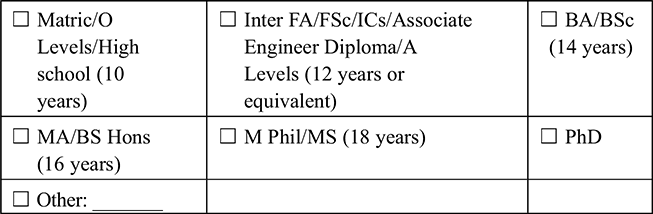

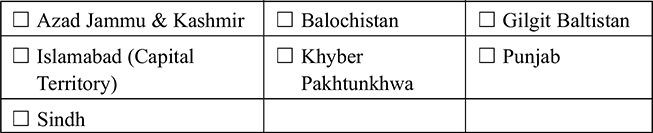



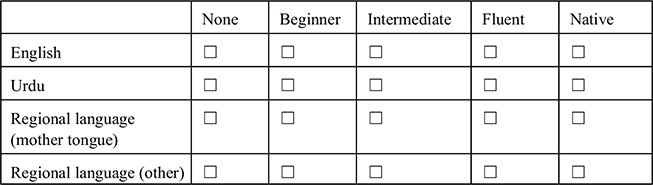
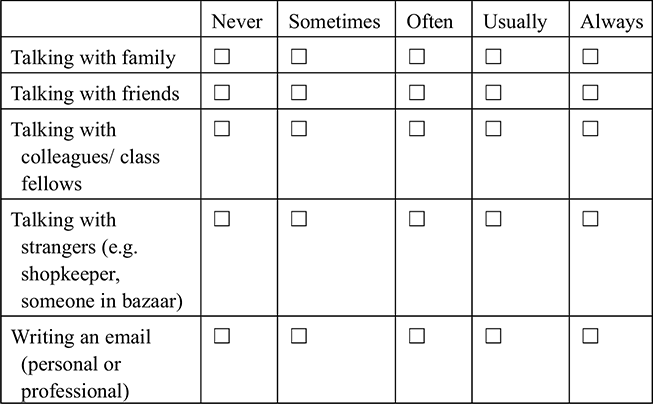
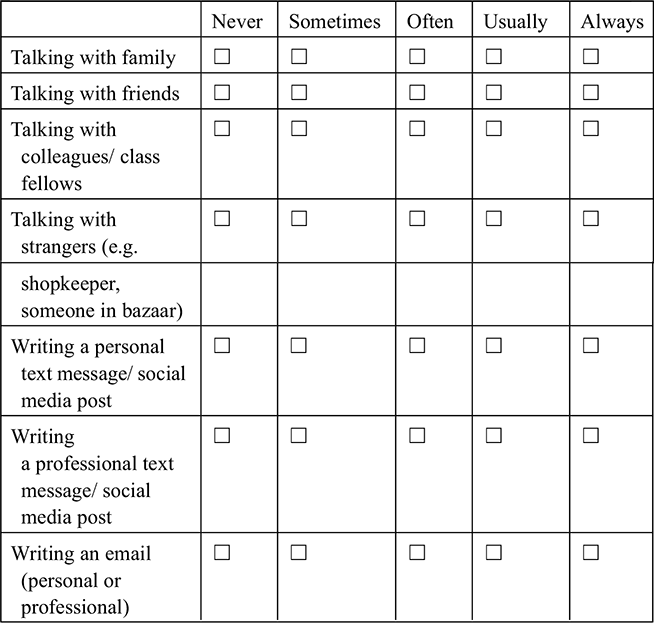
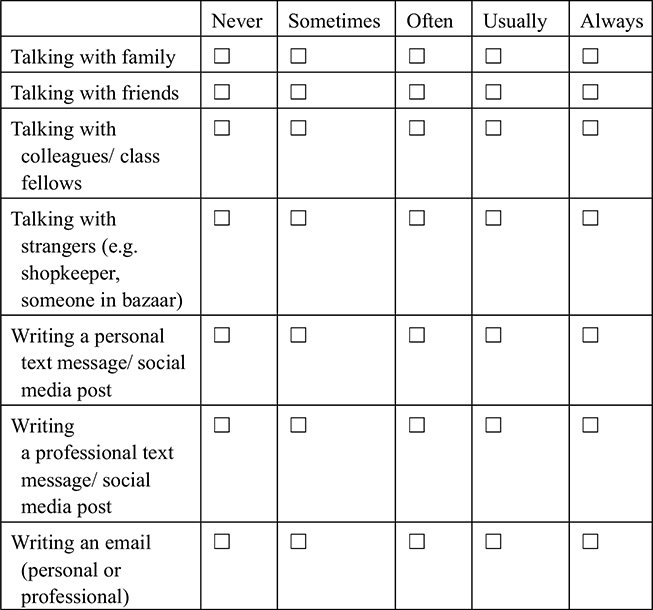
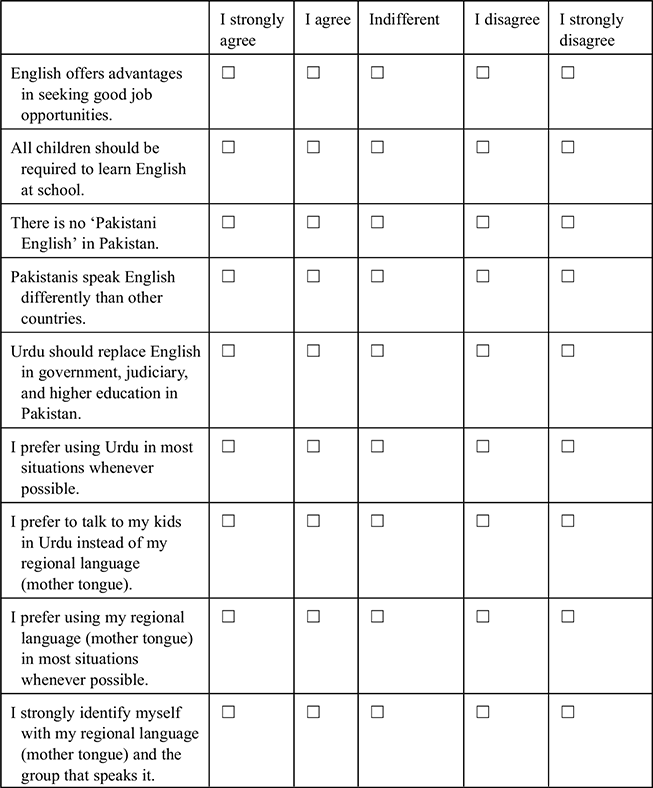
Appendix B Table 6 ANOVA Results for Language ProficiencyFootnote 1
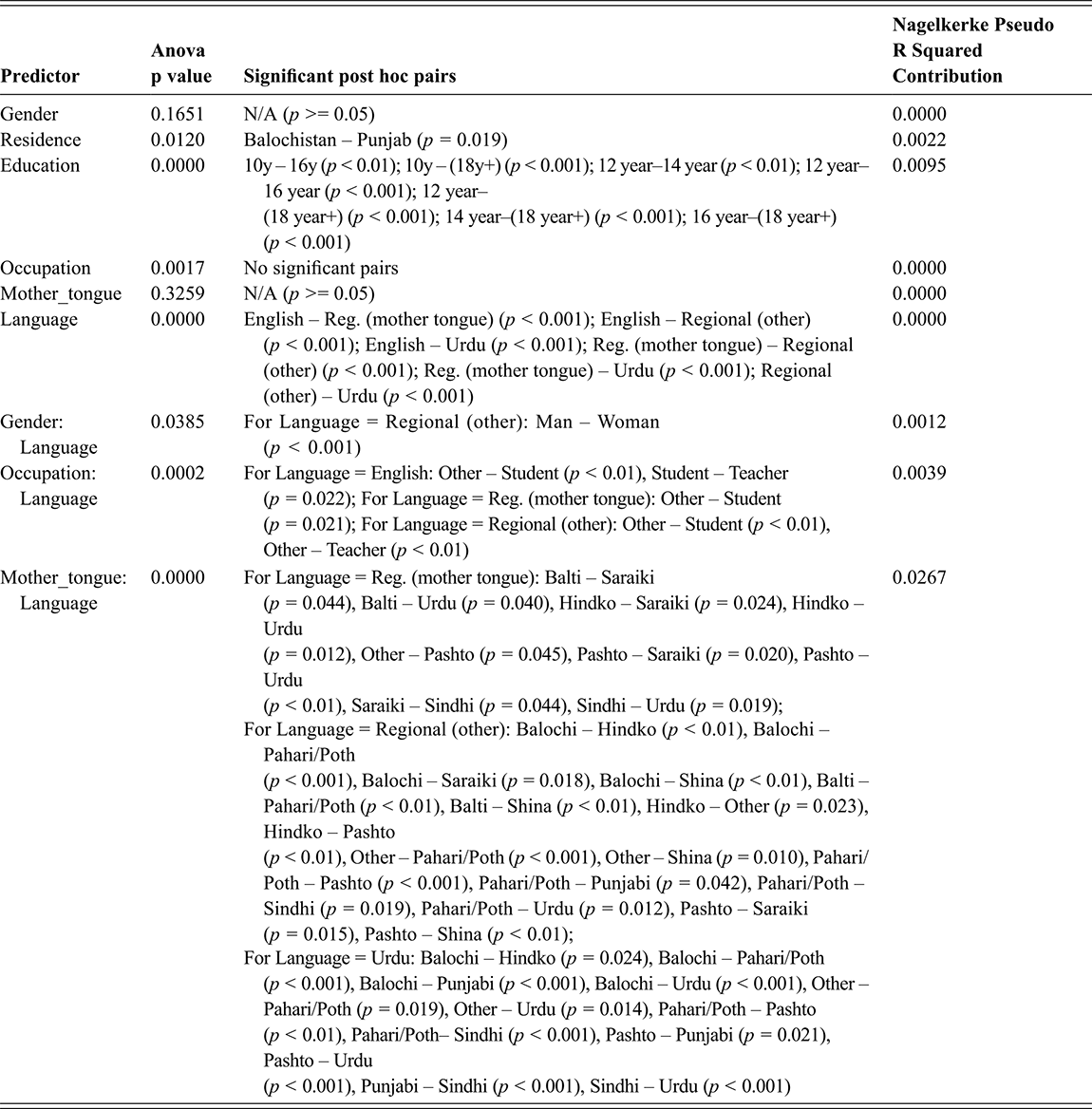
Table B.01 Long description
The table assesses nine predictors of language proficiency (Gender, Residence, Education, Occupation, Mother Tongue, Language and the interactions of Language with the other predictors) across four columns: Predictor, Anova p-value, Significant posthoc pairs, and Nagelkerke Pseudo R-Squared Contribution (effect size). For most variables, including Residence, Education, Language, and interactions of Language with Gender, Occupation, and Mother Tongue, there is a statistically significant effect on proficiency. The interaction of Mother Tongue and Language provides the highest effect size (0.0267) and the largest number of significant posthoc pairs. Conversely, the independent predictors of Gender, Occupation, and Mother Tongue show the lowest effect sizes (0.0000). Gender and Mother Tongue display no significant posthoc pairs, whilst Occupation has no significant pairs despite a low p-value (0.0017).
Appendix C Table 7 ANOVA Results for Situational Use (Mother Tongue)
The table assesses seven predictors against their ANOVA p-values, significant post-hoc pairs, and Nagelkerke Pseudo R-Squared contributions (effect size). The analysed variables include Gender, Residence, Education, Occupation, Mother tongue, Situation, and their interactions with Situation. Overall, almost all predictors and interactions are highly statistically significant (p-values less than 0.01), resulting in significant post-hoc pairs across regions, education levels, and language groups. However, the Nagelkerke Pseudo R Squared contributions are overall very low across, ranging from 0.0000 to a maximum of 0.0106. The single exception is Gender, which is not statistically significant (p-value 0.4681) and has no significant post-hoc pairs. The interaction between Gender and Situation yields the overall R-Squared contribution at 0.0023.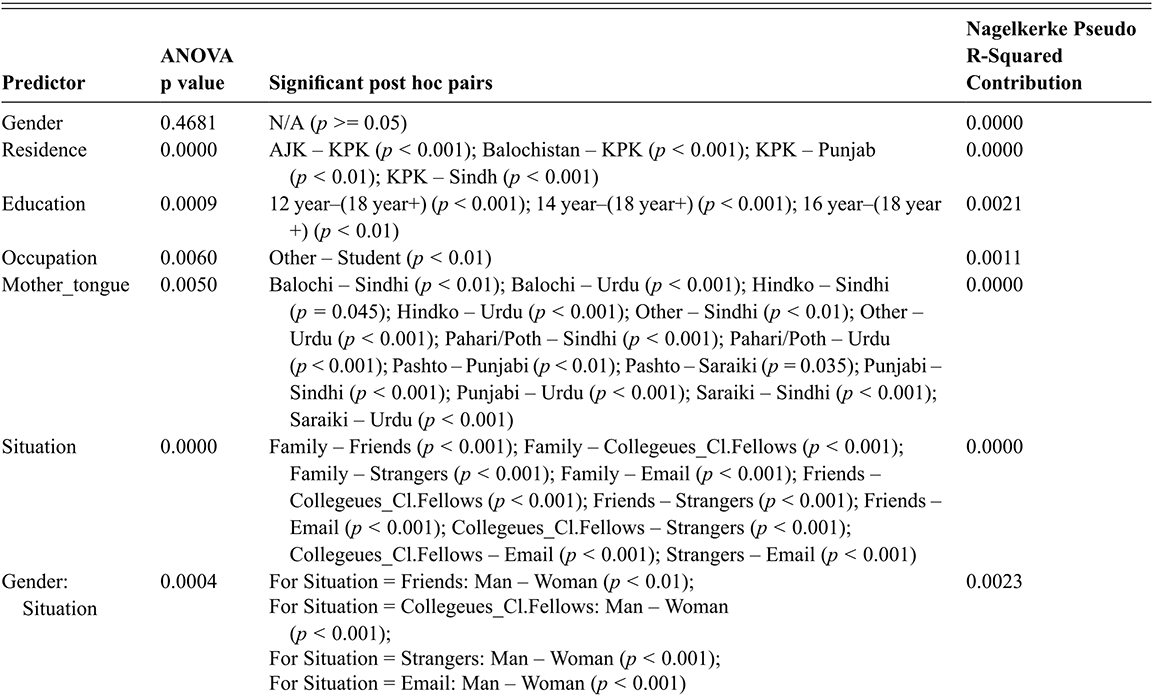
Table C.01 Long description

Table C.02 Long description
The table assesses two predictors against their ANOVA p-values, significant post-hoc pairs, and Nagelkerke Pseudo R Squared contributions (effect size). The analysed variables include Residence and Mother tongue, and their interactions with Situation. The interaction between Residence and Situation yields the overall R-Squared contribution at 0.005. The interaction between Mother tongue and Situation yields the highest overall R-Squared contribution at 0.0106.
Appendix D Table 8 ANOVA Results for Situational Use (Urdu, English)
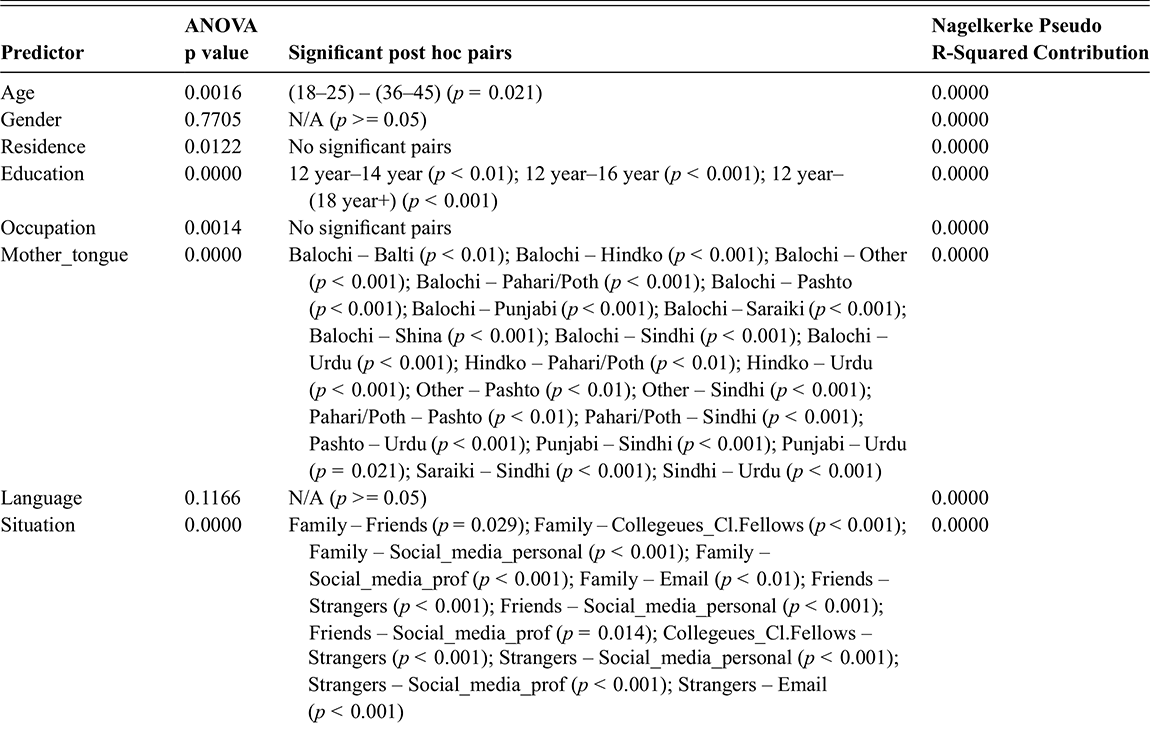
Table D.01 Long description
The table presents ANOVA p-values, significant posthoc pairs, and Nagelkerke Pseudo R-Squared contributions (effect size) for demographic predictors and their interactions regarding the situational use of English and Urdu. The predictor variables include Age, Gender, Residence, Education, Occupation, Mother tongue, and their two- and three-way interactions with Situation and Language. The main trend shows significant differences between the use of English and Urdu across all examined social situations, including family, friends, colleagues, strangers, social media, and email. Language has several three-way interactions with Situation and another variable (Age, Gender, Residence, and Mother Tongue) that are highly significant (p < 0.001), showing that the preference for English or Urdu in these settings is heavily influenced by demographics. Mother tongue shows the most significant variations, indicating highly diverse English and Urdu usage patterns across different situations among speakers of Balochi, Sindhi, Punjabi, and other regional languages.

Table D.02 Long description
The table presents ANOVA p-values, significant posthoc pairs, and Nagelkerke Pseudo R-Squared contributions (effect size) for demographic predictors and their interactions regarding the situational use of English and Urdu. The predictor variables include Age, Gender, Residence, Education, Occupation, Mother tongue, and their two- and three-way interactions with Situation and Language.
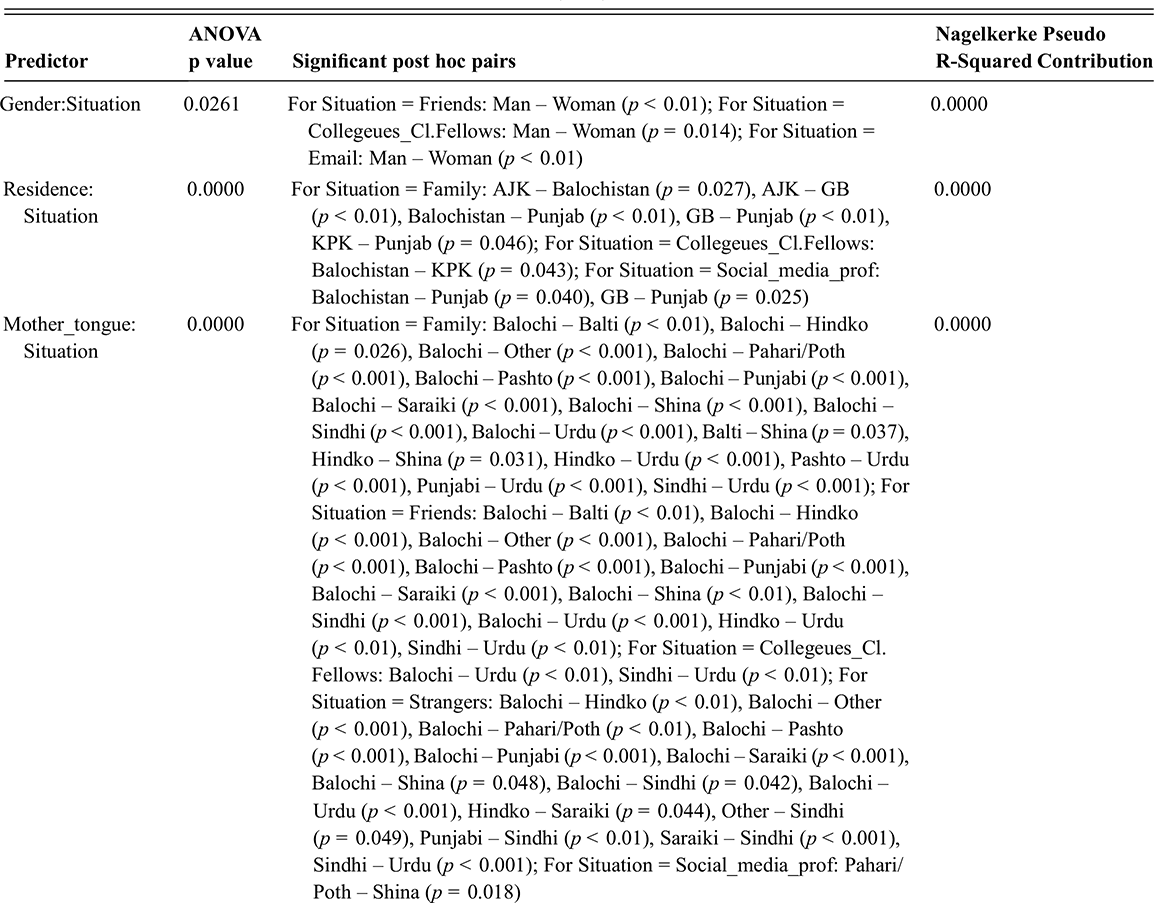
Table D.03 Long description
The table presents ANOVA p-values, significant posthoc pairs, and Nagelkerke Pseudo R-Squared contributions (effect size) for demographic predictors and their interactions regarding the situational use of English and Urdu. The predictors shown in this part of the table include the two way interactions of Situation with Residence and Mother tongue. The latter (that is, Mother tongue) shows the most significant variations, indicating highly diverse English and Urdu usage patterns across different situations among speakers of Balochi, Sindhi, Punjabi, and other regional languages.

Table D.04 Long description
The table presents ANOVA p-values, significant posthoc pairs, and Nagelkerke Pseudo R-Squared contributions (effect size) for demographic predictors and their interactions regarding the situational use of English and Urdu. The predictors shown in this part of the table include the interaction of Language with Situation, as well as three way interactions of Language and Situation with Age and Gender, respectively.

Table D.05 Long description
The table presents ANOVA p-values, significant posthoc pairs, and Nagelkerke Pseudo R-Squared contributions (effect size) for demographic predictors and their interactions regarding the situational use of English and Urdu. The predictors shown in this part of the table include three way interactions of Language and Situation with Residence and Mother tongue. Most significant differences occur in Mother tongue sub-groups (that is, different language groups like Balochi, Sindhi and so forth) with respect to different levels of Situation (for example, Email) and Language (that is, English and Urdu).
Appendix E Table 9 ANOVA Results for Attitudes towards Various Statements
The table presents ANOVA p-values, significant posthoc pairs, and Nagelkerke Pseudo R-Squared contributions (effect size) for demographic predictors Age, Gender, Residence, Education, Occupation, and Mother tongue. Overall, in terms of Question statements, there are widespread differences in views on English advantages, replacing English with Urdu, and preferring Urdu or Mother Tongue (MT).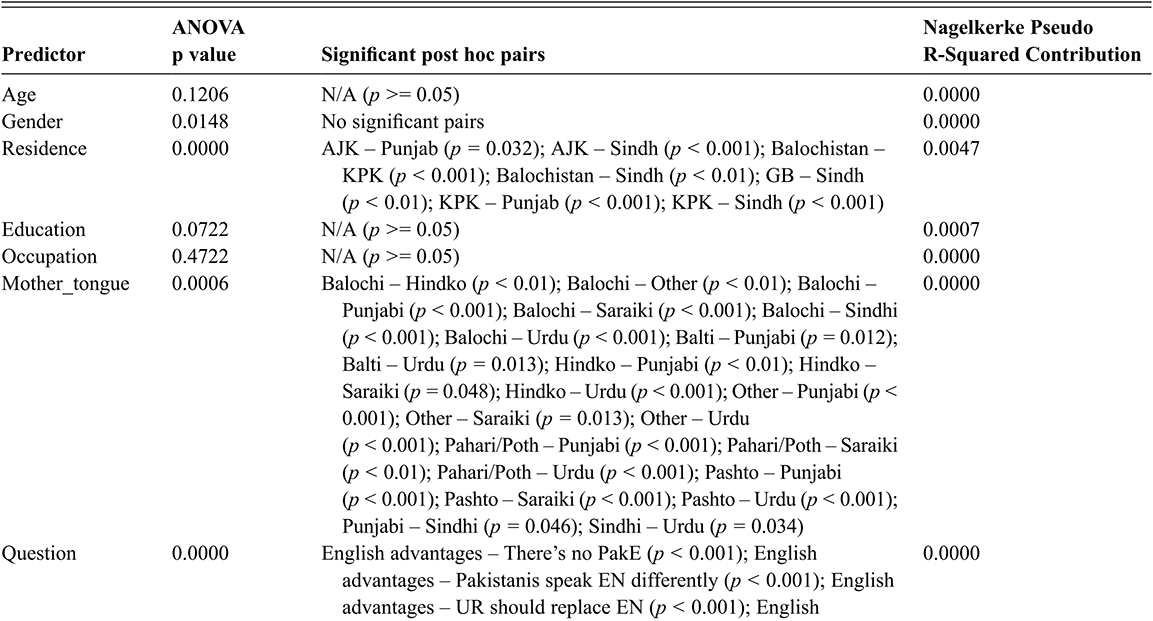
Table E.01 Long description

Table E.02 Long description
The table presents ANOVA p-values, significant posthoc pairs, and Nagelkerke Pseudo R-Squared contributions (effect size) for demographic predictors Question (i.e. linguistics statements) and Age and the interactions of the demographic variables with Question. Overall, in terms of Question statements, there are widespread differences in views on English advantages, replacing English with Urdu, and preferring Urdu or Mother Tongue. For Age and Question, responses vary significantly between the youngest cohort (18 to 25) and older groups on whether Pakistanis speak English differently, replacing English with Urdu, and preferring Urdu.
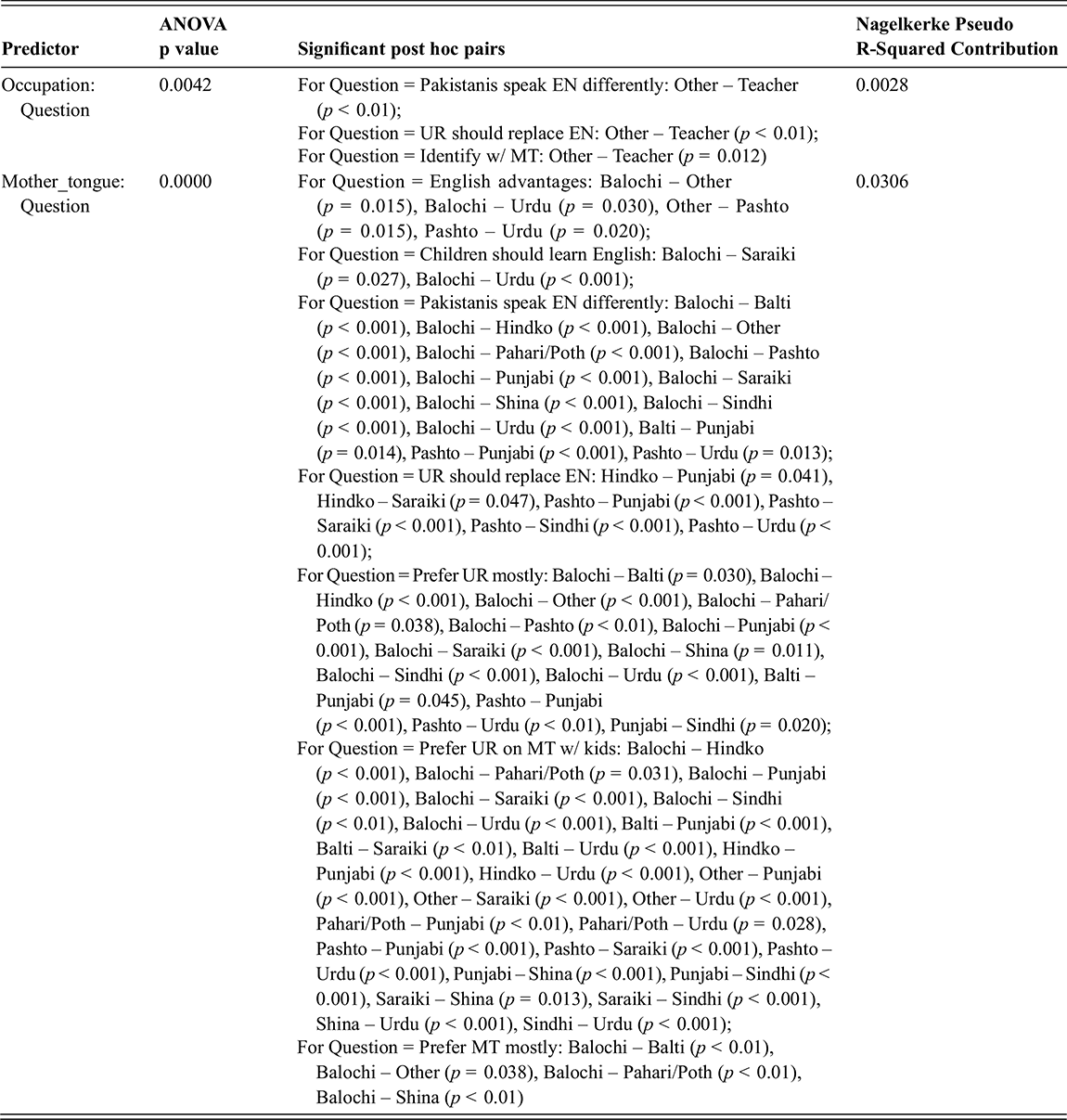
Table E.03 Long description
The table presents ANOVA p-values, significant posthoc pairs, and Nagelkerke Pseudo R-Squared contributions (effect size) for demographic predictors Age, Gender, Residence, Education, Occupation, Mother tongue, and the interactions of the demographic variables with Question. For Gender and Question, men and women differ significantly on English advantages, children learning English, and replacing English with Urdu. For Occupation and Question, teachers differ from Other occupations on whether Pakistanis speak English differently and replacing English. For Mother tongue and Question, speakers of different languages (e.g., Balochi, Pashto, Hindko) show the most extensive differences in attitudes across most of the statements.
Appendix F Reading Passage and Diphthongs Plot
On a warm Thursday evening, a young university teacher named Zara walked through the wide, white hall towards her office. She was writing a review on the value of communication and the way people around Pakistan usually speak English. In her notebook, she wrote that many visitors wondered whether the weather in Lahore was ever this humid. While waiting for a colleague, she quietly began reading a long article about cultural change, global challenges, and modern technology. At the end of the page, she noticed a short question: ‘Should we think about the future, or should the future think about us?’ Then she laughed gently, knowing that the answer wasn’t simple at all.
Vowel onset distributions and formant trajectories (20% to 80%) for face and goat vowels in the PakE YouTube data
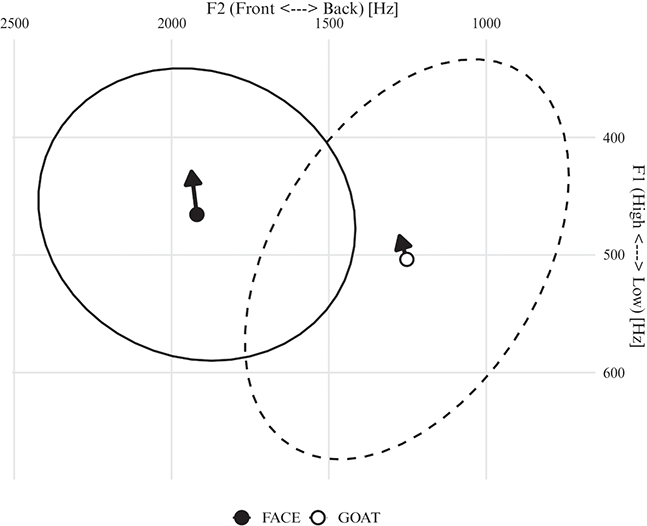
Figure 19 Long description
A vowel plot mapping the F1 and F2 vowel space for the FACE and GOAT lexical sets using the PakE YouTube data. The x-axis represents the F2 formant (front-to-back) and the y-axis represents the F1 formant (high-to-low). Standard deviation ellipses show the distribution of vowel onsets, with FACE clustered in the mid-high front region and GOAT in the mid-high back region. Inside each ellipse, a thick arrow indicates the mean formant trajectory from the 20% to 80% duration mark. Both mean arrows are extremely short, showing monophthongisation of these vowels by the speakers.
University of Regensburg
Edgar W. Schneider is Professor Emeritus of English Linguistics at the University of Regensburg, Germany. His many books include Postcolonial English (Cambridge, 2007), English around the World, 2e (Cambridge, 2020) and The Cambridge Handbook of World Englishes (Cambridge, 2020).
Editorial Board
Alexandra D’Arcy, University of Victoria
Kate Burridge, Monash University
Paul Kerswill, University of York
Christian Mair, University of Freiburg
Christiane Meierkord, Ruhr University
Raj Mesthrie, University of Cape Town
Miriam Meyerhoff, Victoria University of Wellington
Daniel Schreier, University of Zurich
Devyani Sharma, Queen Mary University of London
Sali Tagliamonte, University of Toronto
Bertus van Rooy, University of Amsterdam
Lionel Wee, National University of Singapore
About the Series
Over the last centuries, the English language has spread all over the globe due to a multitude of factors including colonization and globalization. In investigating these phenomena, the vibrant linguistic sub-discipline of “World Englishes” has grown substantially, developing appropriate theoretical frameworks and considering applied issues. This Elements series will cover all the topics of the discipline in an accessible fashion and will be supplemented by on-line material.