1 Introduction
1.1 The Cognitive Ground of Intentionality in Politics
This Element edition offers a fundamental theoretical and methodological contribution to political discourse analysis by taking a structural and cognitive approach to register the dynamics of discourse spaces. The focus lies on the pragmatics of politically motivated communication and how relations are reshaped to solicit legitimacy for certain courses of action. Political communication not only seeks to construct a worldview that guides intentions for action to mobilise support for politically and ideologically motivated actions, but also organises and regulates political and economic forces by framing them in an Us–Other dichotomy that maximises perceived advantages for ‘Us’ and prevents the materialisation of potential threats caused by the ‘Other’. Political discourse necessarily uses such persuasive strategies to establish a shared worldview with shared interests from which political goals and actions emerge according to a rational path of thought (cf. Jowet & O’Donnel, Reference Jowett and O’Donnell2018). The cognitive and socio-cognitive turn in critical discourse studies, thus, aims to unravel the cognitive ground on which worldviews are constructed to explain the subjectivity of rationales that justify specific political relations and motivate actions in context (Hart, Reference Hart2011; van Dijk, Reference Van Dijk, Wodak and Meyer2016). From a cognitive perspective, worldviews are constructed on the generic spatial principle of cognition, which allows for configurations of contexts in relevant time and space frames that affect sentiments that guide decisions for action from a particular point of view.
However, worldview constructions need to be adaptive to accommodate cognition of changing circumstances and also to assess possible situations which the spatial nature of cognition accommodates. When circumstances change, the configuration can be adapted in a way that fits the time–space frame so that it makes sense in relation to a point of view, or deictic centre (DC). This flexibility is fundamentally an affordance of the mechanisms of spatial cognition. It allows us to evaluate situations and possible future consequences as well as why they may or may not require interventions for personal or social purposes. Thus, the coherent, but subjective, positioning in a frame of reference creates a powerful persuasive configuration to attract support for politically motivated goals and actions that ‘fit’ the frame.
Cognition is a fundamental, natural, spatial organising principle for all hunter-gatherer creatures (Tomasello, Reference Tomasello1999) that enables the mental evaluation of situations from a self-determined point of view situated in a relative space and time frame. This seemingly simple configuration is the link between existential experience and reasoning. It facilitates complex deliberation that may trigger action. For example, the spatial cognitive model grounds predictions of possible futures to make sense of change and to make decisions on the desirability and the need to maintain a situation or to take action. This evaluative mode of reasoning is performed on the dynamic, scalar positioning principle of spatial cognition. Its geometric properties have directive and attentional functions that affect linguistic aspects of discourse. Spatial positioning provides the ground for making sense in thought and in language use (Chilton, Reference Chilton2014). Linguistic approaches thoroughly explore cognitive linguistic aspects whilst also taking up methodology for socio-cognitive discourse studies that address the relationship between meaningful linguistic constructions and the mental construction of non-linguistic aspects of social experience (van Dijk & Kintsch, Reference Van Dijk and Kintsch1983; Searle, Reference Searle1995; Hart, Reference Hart2011; Chilton, Reference Chilton2004, Reference Chilton2014; Cap, Reference Cap2013; Kaal, Reference Kaal, Filardo-Llamas, Hart and Kaal2016, Reference Kaal2023). The way we use language and other means of communication sheds light on experiences whilst also providing a means to share reflections on change.
The spatial nature of human cognition is particularly relevant in critical discourse studies as its generic nature and its flexibility provide a stable ground for comparison across languages and cultures. Several critical-discourse approaches and methods have been developed for qualitative as well as quantitative research, which are addressed in Section 2. In this Element, we present a qualitative Scalar Deictic Space approach to track variation and the dynamics of change in political discourse by focusing on the cognitive configuration of positioning in space and time frames-of-reference and how these configurations evolve with changing contexts and intentions. The aim is to find patterns and directions of change in the fundamentally spatial cognitive construction of politically motivated rationales that establish social identity, sentiments, goals and collective intentions for political action. In that sense, the approach examines shifts in the textual parameters of the whereabouts of the speaker, based on pragmatic cognitive-linguistic markers of temporal and spatial deictic positioning and framing in politically motivated texts.
Following a pragmatic approach to the rhetorical relationship between language use and social interaction (Austin, Reference Austin and Urmson1962; Searle, Reference Searle2010), cognitive discourse studies is concerned with how socio-cognitive aspects dialectically organise the context and how that establishes common goals and encourages cooperation. SDS’s approach complements cognitive-linguistic analysis by focusing on the universal rhetorical properties of deixis through temporal and spatial manoeuvres, particularly in the Medial phase. Its aim is to identify patterns and shifts in discursive configurations that encode communicative aspects of language by taking into account the contextual parameters that guide meaning-making (Marmaridou, Reference Marmaridou2000). In doing so, it adds a dynamic experiential aspect to cognitive lexical, semantic, and grammatical structural approaches. For example, systemic-functional linguistics (Halliday, Reference Halliday1985), Talmy’s semantic concept-structuring systems (Reference Talmy2000), generative linguistics (Chomsky, Reference Chomsky1957), and Levinson’s (Reference Levinson2003) work on variation in spatial language and cognition. As for literature in discourse analysis, we refer, to Van Dijk’s socio-cognitive approaches, for example, for defining ‘us/them’ positioning, Cap’s Proximisation Theory (Reference Cap2013) and Chilton’s Deictic Space Theory (DST) and the conceptual geometry of linguistic meaning (Reference Cap2013), Hart’s functional and cognitive perspectives (Reference Hart2014), and Chilton and Kopytowska’s (Reference Chilton and Kopytowska2022a) approach to shifts in deixis. They provide typologies and tangible evidence of verbal constructions of position, agency, and degrees of intentionality and force. The SDS approach concerns the fundamental semiotic level of worldview construction and its temporal and spatial dynamics. It aims to identify shifts in the ground on which meaning is constructed with rhetorical potential and to identify diachronic linearities in the deictic dynamics of positioning that is manifested in the active medial cognitive space.
1.2 The Politics of Language Use
In principle, the spatial nature of human cognition affords orientation, and similar worldviews afford constructive, peaceful social interaction. However, when communities clash, protective mechanisms emerge, and communication becomes political. The globalisation of communication requires a fundamental dynamic approach to political discourse studies and needs to reach beyond traditional concepts of variation in political ideologies. The concept of ideology has become obscure, as political points of view and frames of reference are continuously on the move and reach out beyond local cultural concepts and ideologies, driven by realism or opportunism. Therefore, the Scalar Deictic Space approach (SDS) is designed to reveal trends in the dynamism of spatial discursive patterns found in political worldview constructions to expose covert relationships between presentations of a dynamic world over time. Its aim is to reveal how such patterns may affect social and political relationships and sentiments that may lead to action. From a critical point of view, SDS reveals how spatial and temporal spaces and patterns give direction to stance-taking. The dynamics of framing and positioning establish (political) us/them relationships in terms of relative and conceptual proximity and distance to predict future developments that may or may not require intervention. The fluidity of the geometric conceptual time–space patterns enables us to make sense of political relations through embodied deictic concepts such as distance, timing and direction that regulate intentionality and prompt agency as well as a sense of urgency.
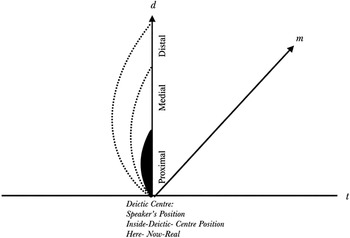
The spatial nature of making sense is an individual and a socio-cognitive scalar process. In SDS, we distinguish three scales: proximal, medial, and distal. Its anchor is the Deictic Centre (DC), in the here and now that is experienced as a known reality. It forms the basis for the proximal scale positioning in which joint agency and intentionality take place. In the medial scale, various scenarios for future agencies are evaluated and predicted in the context of lopsided power relations. The distal stage is marked by an absence of material action, goals, and intentionality to achieve them. This scalar cognitive approach provides indications of the trajectory of the rationale: from knowing where we are to considering what the future might bring and whether it is desirable, to ‘knowing’ what needs to be done (and what is possible) to protect or develop the future world we live in. As Foucault explains, language and power are inextricably connected in the construction of knowledge with a sense of ‘truth’ (Reference Foucault1970, Reference Foucault1971) that is needed to make SDS, therefore, investigates variation and change in geometric conceptual patterns, as bearers of ‘truth’ through positioning strategies that are fundamental to creating worldview ontologies with direction that lie at the bedrock of building political relationships that justify political interventions. As Foucault explains, language and power are inextricably connected in the construction of knowledge with a sense of ‘truth’ (Reference Foucault1970, Reference Foucault1971). SDS investigates variation and change in geometric conceptual patterns, as bearers of ‘truth’. Such positioning strategies are fundamental to creating worldviews and ontologies that lie at the bedrock of building relational networks that justify political intervention.
To illustrate the SDS approach, we focus on political discourse and the dynamic spatial-cognitive principles and consequences of shifting frames and points of view. The cognitive framework organises the spatial configuration of actors and objects, which allows us to communicate, negotiate, and establish common ground and consequent intentions for collective action (Searle, Reference Searle2010; Duranti, Reference Duranti2015). The trajectory is performed in a subjective time and space frame that borrows the epistemic quality of Real space (R) that offers ‘a secure understanding that there is a single unifying principle to that ontology’ (cf. Searle, Reference Searle2010, p. 7). Nevertheless, experienced space and time are nothing more than subjective ontological markers that express a reality of sentiment and experience by analogy with real space (and time). In this way, the human mind maps situations and events on a space and time frame from or towards a particular point of view to express a secondary reality (R’) of a subjective, experienced, deictic worldview that can be shared as ‘our’ world and provides a framework for collective medical evaluations and distal projections. The socialising aspect of spatial cognition presents both an opportunity and a challenge for political parties in democratic systems. In order to establish a common viewpoint, they must deploy persuasive strategies to create an ontologically sound space, beginning with effective framing and positioning, to reduce cognitive overload and guide public attention towards ideologically preferred solutions. On the other hand, some populist parties tend to increase cognitive overload and create confusion, inertia, and general dissatisfaction with ‘reality’ without offering solutions.
A focus on the dynamic but systematic primacy of spatial cognition in political discourse studies provides an analytic tool to evaluate and gauge variation and change in perceived events. The goal of the approach is to provide insights into the background mechanisms of political positioning and how they contribute to justifying goals and actions with the support of an electorate. The persuasive factor lies in the presentation of a cohesive ‘worldview’ that is situated in space and time, providing a point of view and a scope of attention around the presumed beneficiaries. It functions as a momentary ontological conceptualisation in which political issues, goals and actions are made to fit comfortably.
1.3 Cognition: Knowing, Wanting, Agency
The fundamental trick of creating a sense of ‘truth’ or ‘reality’ relies on the cognitive ability to map real space onto experienced social spaces by framing events in relation to a selective point of view, for example, to configure a potential threat and urgency for a response (Entman, Reference Entman1993). The analogy between real space and experienced space and time is the result of the primary properties of spatial cognition, which is reflected in thought and language (cf. Levinson, Reference Levinson2003): it is the way we think and relativise. Worldview framing is based on cutting out a time and space frame that is deemed relevant from a particular point of view. This is necessary from a pragmatic point of view to make sense, because we cannot know or consciously experience the entire ‘reality’ of the world at once (Kaal, Reference Kaal, Filardo-Llamas, Hart and Kaal2016).
At the same time, framing and positioning regulate the appreciation of perception, values, events, participants, and developments that form the rationale of goals, urgency, and action. The fundamental, generic principle of temporal and spatial cognition is therefore the essence of social interaction. More specifically, its persuasive power is most obvious in politically motivated discourse that requires persuasion to motivate citizens to collectively share goals and accept policies by inertia or consent or by force. The scalar temporal and spatial deictic approach reveals positioning patterns and manoeuvres that are indicative of rationales for action.
The persuasive socio-cognitive move is to first establish a presumed common ground, or shared worldview perspective, that pre-empts projections of future developments, their relation to the present, and ways to manage them for a ‘better’ future. Such logic assumes the Speaker’s legitimate authority over individual and collective behaviours within an established political entity, the in-group. It also assumes relations with other political entities that may be positioned as on a scale from benign to hostile. From a critical-discourse point of view, the assumption of having power to make a difference is not a hard fact, but a rhetorical argument to legitimise action that will benefit an assumed in-group. The spatial premise therefore prompts critical questions as to how and with what intention are such worldviews constructed, and how and why are these constructions configured discursively to conceptualise goals? The scalar approach therefore aims to address the classical questions of the where and when of the present to get an understanding of the who, what, why and how. The where and when give direction to an imaginary future considering the dynamics of their configuration. In political discourse, worldviews are strategically shaped to match political actors’ ideological worldview from which political relationships and actions emerge towards a ‘privileged’ future (Dunmire, Reference Dunmire2011). Such worldviews are subjective constructions of positions and roles of individuals, social, economic, and material entities, and carry values that define identities as well as possible directions to manage the future.
Politically motivated frames and directions are rhetorically persuasive in that they impose classificatory frameworks that direct and shape interpretations of identity, access to power, and capacity for agency as well as urgency. Importantly, the institutional authority of political entities to impose such a framework is typically rooted in the authorised speakers’ epistemic, moral, and institutional authority. In that sense, political framing and positioning function as a key to gaining and fostering public consent for the exertion of power. However, as Foucault notes, public consent may be gained through oppression, but it also requires a positive promise for the future, particularly in democracies. Power by oppression would ‘lead to death’ and therefore it needs to be balanced by the positive semiotic concepts of ‘biopower’ and ‘fostering life’ (Foucault, Reference Foucault and Hurley1978, Ch. 5). Another rhetorical strategy to recruit public support for a particular worldview is to stage opposition from ‘other voices’ to mitigate or justify action by contrasting their otherness in the sense of ‘reality’ or worldview (Fairclough & Fairclough, Reference Fairclough and Fairclough2012).
In politics, in particular, discourse needs to be persuasive in order to earn political authority. This requires a complex configuration of a point of view placed in a particular time and space frame that will resonate with the people concerned. Strategies used to influence worldviews for political purposes rely on this kind of positioning of individuals and their relation to social entities to construct a common ground in which relations, roles, agency, and action can be identified and shared collectively (Davies, Reference Davies1989). For example, when a political representative labels a group of political actors either as an ally or an enemy, they assign to them a politically motivated identity, asserting their institutional legitimacy to exercise agency on friend or foe in an appropriate way. To give a more detailed example, during his reign, the then Iranian Supreme Leader, Ayatollah Khamenei, has persistently employed the war metaphor in his rhetoric to assign a distinctly ideologically shared identity to pro-Islamic Republic of Iran (IRI) and Basiji University students who are associated with the Basij paramilitary Islamic Revolutionary Guard Corpse. They are addressed as: ‘the Officers of the Soft War’ (Example 1.1) to ascribe their agency and to encourage their responsibility to be openly critical of the government:
1.1 Of course, I am addressing everyone, not just the individuals in this meeting. I constantly say to all intellectual, thinking jihadi and cultural nuclei throughout the country that each of them should work in an independent manner. As is said in military arenas, “fire at will” whenever they want to. Of course, during a war, there is a command centre which issues orders, but if the command cannot contact other bases and centres, the commander issues the “fire at will” order … Well! You are the officers of the soft war. You are supposed to be the officers of the soft war. Whenever you feel that there is something wrong with the central organisation and that it cannot work properly, you are free to fire at will. Under such circumstances, you are free to decide, to think, to move and to act. (Ayatollah Khamenei, 7 June 2017; italics added for emphasis)
Labelling Basiji students as ‘officers of the soft war’ creates a discursive space that legitimises ideological intervention by students against state policies and authorities when they feel that policies diverge from the Supreme Leader’s intentions or from the ideological line of his apparatus. Unexpectedly, in this example, the Supreme Leader’s rhetoric functions to legitimise and empower these students to act independently and freely and to challenge the government and authorities whenever their policies conflict with his ideological directives. This soft war frame authorises the students to ‘fire at will’, giving them the role to exercise ‘soft’ political agency, enabling them to verbally criticise state actions as allies of the Leader’s preferred ideology. Example (1.1) shows identity and agency ascription at a certain point in time (Davies & Harré, Reference Davies and Harré1990), relying on established roles of the participants and suggesting that the leader builds a shadow political system, streamlining actions, forces, and directives to prevent and undermine the non-conforming policies of the Government.
In this example, the Supreme Leader’s positioning expresses an unexpected stance towards the established governments, especially the reformists and pro-western ones. He invites his critics to join a leader-centred ‘Us’ group by granting them a sense of power in freedom of speech. However, the assumed position also asserts the Leader’s dominant power in the wider context. This example shows that by foregrounding possible distal socio-political consequences of discursive positioning, the strategy affects medial social conceptualisations, especially in the context of constraining or empowering civil groups and institutions. In this case, the students are proximised into the Leader’s world as a shared space with shared responsibilities under his uncontested leadership.
Critical-discourse approaches have been developed to investigate texts for the dynamics of variation in identity ascription, power allocation, and capacities for agency that underpin the force and urgency for certain actions, for example, Chilton’s vector schema (Reference Chilton2014). Over the past two decades, discourse studies have developed in socio- and cognitive-linguistic approaches to analyse the dynamics of change and variation that go beyond identifying roles or ‘groups’ as static discourse elements. As the world turns, and political shifts and technological innovations enter our daily lives at the speed of light, discourse studies require a fundamental and adaptable analytical model to make sense of variation and change in positioning patterns that reflect developments in the trajectory of building identity, power, and agency representations. The dynamic Scalar Deictic Space approach builds on those developments and the generic premise of the primacy of spatial cognition. In order to map diachronic cognitive ‘movements’ in positioning and framing, SDS proposes an approach to trace developments in the interplay of cognitive aspects of shaping and reshaping identity, power, agency, and desirability by monitoring the dynamics of positioning in space and time, direction and force. The evidence for such movements is drawn from content analysis, framing, as well as linguistic lexical-semantic and grammatical markers of the spatial nature of worldview construction.
1.4 Scalar Deictic Space
The Scalar Deictic Space approach is designed to examine dynamic positioning strategies by exposing the inherently fluid spatial nature of identity construction. The primacy of spatial cognition provides a stable deictic anchor to a dynamic context and can reveal aspects of reasoning towards a goal. The genre of political discourse provides a rich source for examples of spatial manoeuvring with intentions for action because of the overlapping cognitive relationship between real space and the subjective space and time frame that socially feels ‘real’ in a coherent context. The challenge in political discourse analysis is to pay tribute to the ambiguous and dynamic context in which participants and their agency are positioned. It is therefore fruitful to see how roles and agency are positioned and how that affects their status and agency identity.
Whilst contexts are fluid, the identity-agency construct can easily be reconfigured by changing legitimacy, voice, and power. This is illustrated in Example (1.2). In his State of the Union speech (2002), President Bush mentioned the relationship between the US and Afghanistan at that moment:
1.2 America and Afghanistan are now allies against terror. We’ll be partners in rebuilding that country. (Bush, 29 January 2002)
In this example, Bush positions ‘Afghanistan’ as an ally of the US in two key areas that require action: anti-terrorism and the intention to support the national development of Afghanistan. In this excerpt, we see how his positive relational framing constructs Afghanistan as a worthy and capable partner, that is, a proximate ‘we’. However, two-and-a-half years later the framing of the Afghan identity was quite different in the eyes of same President’s Republican Party:
1.3 We applaud President Bush’s announcement of U.S. support for five new initiatives that will help the Afghan people achieve the peace, stability, and prosperity they deserve – through support for the development of democracy, educational assistance, cultural exchanges, enhanced bilateral economic ties, and increased economic opportunity for women. (Republican Party Platform, 30 August 2004)
This time, the relationship had changed from an equal ‘we’ ally and partner to framing Afghanistan as vulnerable and implying that their aspirations were dependent on US intervention: they need ‘help’ to achieve ‘peace, stability, and prosperity’, presenting Afghanistan in a passive role. However, lexically, this assessment does not entirely strip the Afghan people of agency. Rather, their capacity to act is depicted as potentially contingent but dependent on American ‘help’ and ‘support’, thus ascribing their dependency on the US to move forward. This development in Bush’s positioning of the US relationship with Afghanistan moves from a shared DC as partners in Example (1.2) to a one-way DC with Afghanistan as the object of US aid in Example (1.3). The shift in the point of view shows how power and agency differentials are produced discursively and how, over time, the relationship with Afghanistan was shifted from proximate to medial, taking a particular point of view that puts the Afghan people in a dependency frame whilst presenting the US as the superior actor and saviour.
In the spatio-temporal configurations of positioning, the flexibility of frames and the point of view facilitate other perspectives and evaluations to establish relationships based on interests and political and strategic considerations. In principle, cognitive flexibility allows for other perspectives to be shaped and evaluated and to eventually share worldviews and establish a common sense, or ignore or reject it. The spatial nature of deictic evaluation is an essential capacity that enables social interaction on the basis of shared spatial configurations of making sense. However, a neutral presentation of space can also be employed rhetorically for persuasive purposes by giving direction to abstract spatial configurations to capture and gauge internal relationships between Us and Others entities, without actually needing to be explicit, as long as the configuration seems ontologically sound.
In discourse studies, the focus is on the pragmatics of how we experience ‘the world’ and how that triggers possible projections and intentions for action, which requires communication. A strong motive for a better and safer experience is to have agency and power to control. The focus is therefore on means of communication in political discourse as an obvious persuasive domain towards regulation and action. As for human language and other modes of communication, they cannot be structured any other way than spatially because spatial cognition regulates meaning in perception, modality, and thought. Modality is directly related to the relationship between vicinity and distance positioning and movement, that is encoded in terms of space and time, ranging from the known here-and-now to projections of the there-and-then that guide deliberations in medial position.
1.4.1 Spatial Cognition and Discursive Positioning: A Scalar Deictic Space Approach
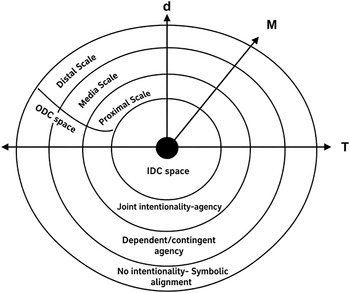
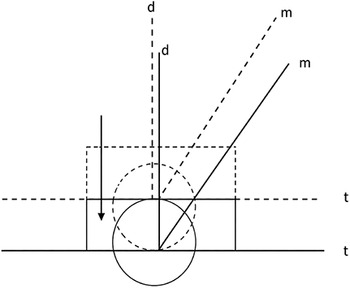
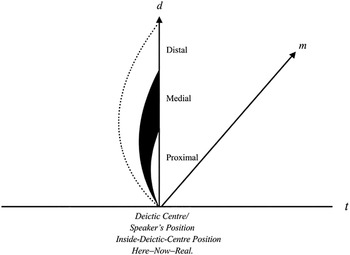
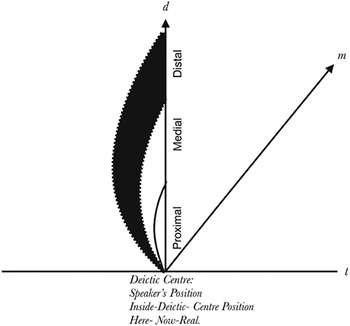
Political positioning must be understood as a dynamic individual as well as a socio-cognitive operation; one that continuously evaluates epistemic plausibility, desirability, goal alignment, urgency, and the perceived feasibility of action. To trace how political positioning unfolds over time, the proposed dynamic Scalar Deictic Space approach offers a framework for detecting variation and diachronic shifts in frames of reference and points of view that affect intentionality. It explores and demonstrates how discursive temporal and spatial framing and positioning strategies in political discourse ascribe force and direction to goals and actions to achieve those goals. In Section 2, we discuss theory and methods from cognitive, linguistic, and discourse approaches to framing and positioning based on the primacy of spatial cognition and its endless flexibility to make sense and its dynamics. This dynamic but systematic affordance of spatial cognition provides an analytic tool to evaluate and gauge perceived social and political events, their development and reasoning as to how to direct their course. To make sense, the modality is gauged by the weight of the need, desirability, and urgency of political intentions, which relies on the scope of the frame that is deemed relevant vis-à-vis the position of the DC. The scalar approach distinguishes three zones of attention and awareness on the space axis, starting from the core position of the DC, proximal, medial, and distal. This abstract, experiential, scalar model gives insights into epistemic aspects of attributing ‘reality’ or ‘truth’ to abstract ideas and worldviews. The characteristics of the DC are discussed in Section 3. SDS distinguishes three indiscrete contingent scales on the time and space axes: proximal, medial, and distal that are discussed in detail in Sections 3, 4, and 5. In addition to the three scalar zones, SDS incorporates the DC as the point of view in the scalar zone ( Section 3). The DC represents the intersection of spatial, temporal, and epistemic orientations from the speaker’s ‘here–now–real’ point of subjective experience. It provides the cognitive–discursive anchor from which all other entities are positioned and evaluated. Within this configuration, SDS distinguishes between two forms of positioning: Inside Deictic Centre (IDC) positioning, where discourse entities are incorporated into the speaker’s subjective centre that reflects their identity features; and Outside Deictic Centre (ODC) positioning, where discourse entities are located beyond the DC and distributed across proximal, medial, and distal scalar zones. In SDS, discourse entities refer to any individual, group, institution, value, object, event, place, policy, threat, aspiration, or imagined future that is introduced, activated, represented, or positioned in and through discourse. The primary analytical significance lies in how they are located within the deictic space and how they are assigned varying degrees of identity, agency, proximity, dependency, or distance. The DC therefore functions as the ontological and epistemic reference point from which scalar relationships, identity assignments, and agency ascriptions are constructed.
Proximal positioning concerns a perceived here and now. It features an epistemic sense of shared intentionality and joint agency, triggered by a particular in-group identity constructed around intimate political relations such as alliance, partnership, and friendship, as well as shared language and culture.
Medial positioning concerns a spatial-cognitive zone that envelopes the proximate zone at a moderate, less immediate distance from the DC. It grants or considers in-group membership to essentially different entities from the home-camp, which may be useful as allies. It involves a cautious amount of openness to ‘other’ influences and intentionalities.
Distal positioning signals an absence of intentionality and agency, an Alice in Wonderland experience into the uncertainty of the future and other spaces. It requires courage, evaluation, self-reflection, and imagination. What ties a discourse entity to distal position within the Us camp is the desire to expand shared ground of identity for more security and perhaps to expand power.
In the SDS model, modality enters as the evaluative dimension of spatial and temporal positioning that triggers political intentionality. Although the Scalar Deictic Space model builds on spatial and temporal cognition, it does not assume a fixed or deterministic correspondence between scalar positioning and modal appreciation. In other words, modality plays an evaluative role, and it does not measurably modify spatial or temporal positioning, but it determines how these scalar positions are understood, endorsed, questioned, or intensified and how they present relations with the ‘other’. Spatial proximal, medial, and distal scales provide insight into relational proximity, identity, and agency, whereas modality expresses the speaker’s evaluative stance towards those relationships.
The temporal dimension partly complements the spatial dimension to represent a timespace that regulates the sense of importance or urgency (see Figure 1 on p. 16). Because these cognitive domains are both dynamic, they can operate jointly or independently. Political speakers can, and usually do, combine proximal positioning with low epistemic commitment (‘X could be our ally’) and medial positioning with strong epistemic certainty, as in Examples 1.2 and 1.3 (‘They will certainly succeed if we assist them’). Such apparent mismatches are not exceptional, but they are rhetorically meaningful: they are precisely the mechanism through which speakers test new identities, stabilise uncertain alliances, legitimise intervention, or create strategic ambiguity. SDS therefore treats modality as a flexible overlay that can reinforce, attenuate, or contradict scalar positioning. The analytical value of SDS lies in tracing how these non-isomorphic combinations encode the language of political reasoning, identity construction, and the justification of action.
The research focus of this scalar approach is on discovering how power is constructed on the basis of the primacy of spatial cognition and how it is reconstructed through the dynamics of scalar discursive positioning and its spatial-cognitive nature. In that sense, the SDS approach does not intend to give direct answers to political questions, but rather it investigates the foundations of the rationale for political positions, and the trajectory of decisions and actions from the premise of generic spatial cognition. It offers a background for pragmatic interpretations of lexical-semantic and grammatical properties, as well as rhetorical properties of other modes of communication. It contributes to distinguishing political movements by revealing patterns of making sense in a given context, and to finding flaws and inconsistencies in argumentation. It offers a method to understand persuasive effects of the structural, cognitive aspects of framing and positioning of political issues and actors to ground urgency, to justify action and delineate the scope of effectivity. By investigating the systematic cognitive properties and the dynamics of positioning with political intentions, the SDS model extends discourse-space studies with a fundamental cognitive approach that tracks the dynamics of the scaffolding of political discourse by unmasking the rationale of persuasive strategies.
2 From Theory to Practice
2.1 Language, Cognition, Discourse, Politics, and Power
The cognitive turn in discourse studies builds on philosophy, cognitive science, sociology and cognitive linguistics. Critical discourse studies focuses on studying language use to reveal intentional and unintentional consequences of the configuration of ‘our’ world that express and affect our behaviour in social interaction. It therefore combines various approaches to studying social behaviour using language and other forms of human communication as a tangible source of investigation.
The significance of time and space goes back to early philosophy, starting with philosophy of time. Plato describes the connection between time as motion and space as the place where things happen. Einstein, Wittgenstein, Saussure, Peirce, Foucault, Bourdieu, Habermas, Laclau, Mouffe, and many other philosophers build on structure to construct relations in physics and social relations and their dynamic complexity. They focus on structure or architecture (Foucault, Reference Foucault1975) as a semiotic meta-function (Halliday, Reference Halliday1985) that signifies meaning in context. How else can people understand things?
Neuroscience and cognitive science have established a scientific basis for the primacy of spatial cognition as a fundamental format to make sense of complex everyday issues and their developments. Cognition concerns mental processes to organise perception to make sense through thought and experience. Therefore, language and other forms of communication are anchored in spatial cognition, which facilitates social interaction and forming communities. Cognitive linguistic studies demonstrate the universal nature of spatial cognition in thought and communication patterns in all animals, including humans (Tomasello, Reference Tomasello2008). Experimental research and anthropological studies (e.g., Brown & Levinson, Reference Brown and Levinson1993) argue that the spatial principle of cognition makes it possible to make sense of the bit of the world we experience by framing it and allocating temporal and spatial properties to make sense of position and change. This ability to focus on a particular part of reality is necessary to function in the world because our brain is not designed to comprehend the whole world at once, nor its dynamics in time and space. From a pragmatic point of view, the cognitive foundation of social interaction relies on framing and positioning to direct and consolidate the need for social interaction. The ‘translation’ or ‘mapping’ of real space (and time) (R) onto experienced space and time (R’) provides an epistemic shift from reality to a subjective reality. Framing the position of the DC is a necessary means to regulate the scope of attention and focus that forms the ground argument that regulates desirability and urgency to act. It is a powerful persuasive instrument as it implicitly provides a background configuration of ‘a world’ in the image of The World in which certain sentiments appear to fit, and others do not. The power of spatial construction is that it creates an arbitrary internal ontology that mirrors reality on the reduced version of ‘our world’ reality (Searle, Reference Searle2010).
In ‘our’ world we have embodied experiences that are regulated within its time and space frame on a third, experiential, dimension of modality, which is equally fluid as it shifts with every change in space and time perceptions. These are the main factors of how we do things with words (Austin, Reference Austin and Urmson1962). We set a scene to evaluate what happens towards deciding if something needs to be done, either conservatively to secure ‘our world’ or progressively by including or excluding ‘other worlds’. Owning and managing a spatial framework is a rhetorical trope and a powerful political instrument. The cognitive view aligns with and extends Foucault’s concept of power as repressive in one space whilst it can be productive in another (Foucault, Reference Foucault1975). It also resonates with Bourdieu’s notion of symbolic power (Bourdieu, Reference Bourdieu1991) that has the implicit capacity to impose a certain worldview and its contextual meaning, relying on a shared frame of reference.
Cognitive linguistics projects the cognitive spatial model on linguistic structures to reveal syntactic structures that constitute meaning. Whilst cognitive linguistics relies on stable syntactic and semantic premises, cognitive discourse studies requires a dynamic approach that directly links discursive structures with behavioural patterns to expose complex and fluid social aspects of constructions of the social world, that is, by examining framing and deixis in social contexts in which syntax and semantics become functional in a particular context (cf. Halliday, Reference Halliday1985, systemic-functional linguistics). For example, the linguistic aspects of presentations of ideologies and actors’ roles can help to categorise their functional role in their social context. Cognitive linguistics also provides a methodology to get a grip on linguistic aspects of subjectivity in the context of social interaction. It contributes to finding evidence of rhetorical figures and the fluidity of framing and positioning in dynamic discursive contexts. It sheds light on the ground for attitudes, which can help us understand explicit and implicit projections of worldview constructions that ground political positions and predictions of future developments (Dunmire, Reference Dunmire2011). Consequently, the ground rationale will justify the need and direction of possible interventions and acts to manage the future. In politics, framing and positioning in time and space is crucial to the legitimation and urgency of political intervention.
2.2 Spatial Cognition in the Social World: Logic and the Experience of Social Reality
The notion of the spatial origin of ‘logic’ goes back to Aristotle, whilst time has been a topic of philosophy since the ancient Egyptians. Both time and space have been the subject of philosophical investigations ever since, as a force in human interaction. Social interaction requires a form of consensus and discipline set in a time and space frame. As Michel Foucault points out, power cannot be restricted solely to suppressive and institutional surveillance of a sovereign power; it requires consent. His notions of biopower and power over life propose that, apart from sovereign and disciplinary control, there is also a positive power to ‘foster life’ and to serve the public (Foucault, Reference Foucault and Hurley1978, p. 140). In Discipline and Punish, Foucault (Reference Foucault1975) maintains that control over language use is key to the exertion of power. It regulates what can be said, where and when, who has authority to speak and act, and what knowledge is foregrounded as ‘real’. Depending on the political system and local culture, different types of argumentation are required to foster consent. In democracies, consent has to be earned to attract votes. Its argument strategy is different from authoritarian governance because the voice of the people is required rather than submergence.
The cognitive aspect of persuasive strategies is to construct a discursive framework that resonates with public sentiments and supports particular positioning by shaping a preferred worldview. In other words, political aims are presented spatially in relation to a particular point of view in which politically motivated intentions for action ‘fit’ and make sense. From a critical-discourse point of view, this concept of ‘fit’ is debatable as we can negotiate and adopt different points of view and different frames of reference that can lead to alternative needs and intentions. Political power in general is therefore understood as a subjective construction that inherently imposes identities and establishes authority and legitimates agency whilst regulating access to meaning-making and power-producing resources. Power operates relationally and symbolically and is exercised through the allocation of roles, the assignment of legitimacy, and spatial and temporal framing of a particular social ‘reality’. The fluidity of political discourse requires a fluid methodology to keep track of change in positioning, which is the purpose of the SDS approach.
Social and language structure are both bound by the cognitive patterns of the mind (van Dijk & Kintsch, Reference Van Dijk and Kintsch1983). Levinson’s anthropological investigations into variation in the relation between languages in the function of temporal and spatial framing demonstrate its generic functional nature of thought and making sense: ‘we are so good at thinking spatially that converting non-spatial problems into spatial ones seems to be one of the fundamental tricks of human cognition’ (Levinson, Reference Levinson and Arbib2013, p. 16). He also shows that there are significant cultural differences in the meta-function of language to make sense. The spatial premise of thought is super flexible as it allows constant framing and reframing fields of attention and positioning the DC that represents a community’s identity. We cannot collectively ‘know’ the entire world at once (Searle, Reference Searle2010) in the same way because we live and have to survive in different dynamic and not always predictable circumstances. But our cognitive affordance is that we can evaluate situations, even as they change, to form instances of awareness, individually and collectively, that may lead to action. Moreover, we can exchange views on real contexts thanks to the ‘single unifying principle’ of spatial cognition (Searle, Reference Searle2010). Therefore, the SDS approach is most interested in the medial scale.
Cognitive discourse studies have developed into a firm set of such fundamental structural approaches in social, political, and other fields (cf. Hart, Reference Hart2011, Reference Hart2014). Chilton’s work (Reference Chilton2004, Reference Chilton2014) emphasises the temporal and spatial nature of positions and positioning by proposing a vector system that is anchored in a DC. His schematic representation shows the configurations of the conceptual ground of individual and collective reasoning from a particular DC in a dynamic space and time frame.
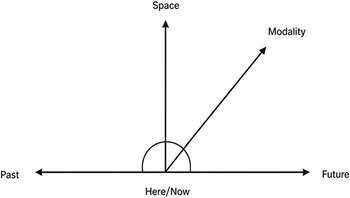
Chilton’s (Reference Chilton2014) DST proposes a basic three-dimensional deictic model to explore spatial conceptualisations of the experienced world along the triadic axes of space (d-axis), time (t-axis), and modality (m-axis) (Figure 1).
Deictic Space model for time, space, and attitude configurations.
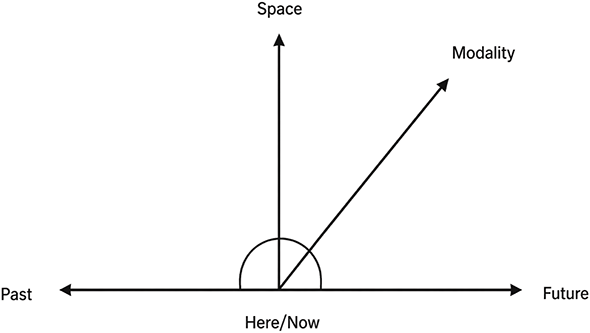
The d-axis has a central significance since it provides a mental location for different discourse entities and their relation to the DC of the Speaker. The positioning on time (t) and space (d) axes represents the attention frame-of-reference, the attitudinal weight of which is recorded on the Modality axis (m) in relation to the delineated space and time frame as the focus of attention. In this way, the cognitive ‘single unifying principle’ (Levinson, Reference Levinson and Arbib2013) of time and space provides a secure basis, or reason, for modal positioning which can potentially trigger intentions for action. Chilton’s model allows for discourse analysis to illustrate variation and change in deictic framing that has proven to be useful, particularly in the analysis of persuasive discourse, such as in politics. In that sense, it offers a discursive approach that can be matched with linguistic aspects of positioning and attitude. The dynamic deictic-space approach provides an insight into the fluidity of the cognitive foundations of creating a sense of ‘fit’ and ‘belonging’ in a social reality. Whilst this subjective reality of a discourse world may seem real to its participants, it remains a relative reality that will never be absolute (cf. Searle on directions of fit, Reference Searle2010, pp. 12–13).
Cap (Reference Cap2013) employs a similar spatial cognitive system to conceptualise deictic space in terms of periphery-centre positioning, or proximisation manoeuvres, that have a rhetorical effect on argumentation. Proximisation legitimises threat and confirms/establishes power relations that trigger intentions for action towards deciding to take action. The scalar approach is also inspired by Cap’s (Reference Cap2013) Proximisation Theory. It presents a two-dimensional configuration of deictic space in terms of a centre-periphery scale. The primary affordance of spatial cognition is that it allows for a wide range of subjective positions on a scale from identity (us) to dichotomy (us vs. other) and vice versa. The focus on proximisation refers to the conceptual relationship between a peripheral discourse entity between an ‘Us’-group and the Speaker. The compelling aspect of Proximisation Theory to political discourse analysis is the idea that the proximisation of the peripheral entity towards the DC suggests the possibility of a potential threat to the ‘Us’ group because something unpredictable approaches the DC. Proximisation Theory allows for systematic and typological discourse analysis of peripheral threat that causes discomfort inside the ‘Us’ group. It focuses on lexico-grammatical and pragmatic-cognitive analytical frameworks that can account for a spatial, temporal, and an axiological proximisation typology. The approach is used to explore fear-inducing rhetoric in persuasive and legitimising discourses with a focus on incompatible Us–Other dichotomies.
In the shadow of these and other cognitive discourse approaches, the proposed Scalar Deictic Space (SDS) approach offers a dynamic, scalar, extension to Chilton’s DST (Chilton, Reference Chilton2014) and Cap’s (Reference Cap2013) Proximisation Theory, with a focus on political discourse. Its purpose is to refine these approaches, particularly for diachronic analyses of change in spatial configurations and their consequences for political interventions. Over time, the coordinates of frames of reference and the position of the DC will naturally change to adapt to internal and external influences and developments that affect the attention frame-of-reference and the deictic space. The time–space–DC approach provides a schematic format to unravel diachronic developments, based on the spatial nature of cognition that allows for conceptualising complex, dynamic matters. The dynamics of the time and space scales are intrinsically connected with the evaluative modality scale, as described in Chilton’s DST and Cap’s Proximisation Theory, on which the Scalar Deictic Space approach is based.
2.3 Us and Otherness
Because a worldview always exists in relation to other worldviews and other interests, we argue that identity and role construction is a dynamic spatial process that concerns variation in the bidirectional relationships between Us and Other groups, thus suggesting or negotiating inner and outer deictic centre (IDC/ODC). In other words, dichotomy is not written in stone nor is it considered to move only in the proximising direction. As far as identity is concerned, there is no ‘Us’ without an ‘Other’ (van Dijk, Reference van Dijk1998). It is a relationship in which ‘other’ is an imaginary representation of an outsider whose position may require measures to protect the established power and its interests, as Foucault would put it. To unravel and evaluate developments in such relationships, the Scalar Deictic Space approach is based on the fundamental cognitive principle of schematically (re-)presenting positions and positioning manoeuvres within a time and space frame of reference, or attention field.
The sense of ‘Us’ as a shared identity between Us and the Speaker (Davies & Harré, Reference Davies and Harré1990) involves a scalar proximal dialogical relation between Speaker–Us as well as between Us–Speaker. When they converge, it establishes a relatively shared space and a shared point of view as to roles and goals of an ‘us’ group that legitimates roles and agency of the Speaker with the promise of producing effects in the collective interest of the virtual ‘Us’ space (cf. Fairclough, Reference Fairclough1989, Ch. 2). Such power configurations presuppose that the Us-group considers the role of agency of the Speaker to be legitimate, with the promise and expectation to produce the intended effects to the benefit of the ‘Us’ group (Duranti, Reference Duranti and Duranti2004).
2.3.1 Us and Other Identity Scale
‘Othering’ is a frequent trope in political discourse. It indicates who belongs and who does not belong in the ‘Us’ group; for example, the citizens of a country that have endorsed their government or leader can be marked as a coherent ‘Us’-group. Framing ‘Us’ and ‘Other’ and positioning ‘Other’ in relation to ‘Us’ is clearly a spatial matter in that it differentiates Otherness from Us-ness, indicating degrees of inclusion and exclusion. The nuance is that Otherness can be positioned on an appreciation scale ranging from Us-ness to distant Other-ness. Scalar positioning signals that ‘Us’-space is primarily based on contrasting with ‘other’ space, but they are not conceived as discrete homogenous categories, because Us-ness and other-ness may be experienced in different degrees of familiarity. The Us-group is not necessarily all-inclusive, but refers to those who have a close relationship with the Speaker, which may change over time. Scalar positioning indicates a relational scale of Us and Other groups that assesses the benign–hostile relationship with the Speaker. Both groups may consist of various internal groups that can be assessed on a scale of proximity and distance to/from the Speaker’s DC. The scale is indicative of corresponding roles and their power and capacity for positive–negative agency. The ‘Us’–‘Other’ scale therefore represents a rhetorical argument to justify the necessity, urgency, and effectivity of change and action (Davies & Harre, Reference Davies and Harré1990). In addition, it helps to assert the Leader’s legitimacy to exert dominant power.
2.4 Introducing the Scalar Deictic Space Approach
The dynamic-scalar approach extends Chilton’s (Reference Chilton2014) DST as well as Cap’s Proximisation Theory (Reference Cap2013) and Chilton & Kopytowska (Reference Chilton and Kopytowska2022b) by adding a dynamic aspect of change to include evaluative processes of taking and contrasting various perspectives. It allows tracking the journey of perspectives over time in relation to contextual developments.
The aim is to expose the mechanisms of relational variation and change, thus providing a more dynamic, interactional model beyond the conventional binary model of Us–Other representations. The dynamic approach also reveals internal power dynamics and scalar positioning in time and space fields that represent an Us-group identity whilst explicitly or implicitly positioning ‘Others’ outside that frame. Both categories are fluid, and therefore the positioning strategy of the DC and its peripheries is a dynamic two-way frame to delineate a subjective attention space that represents an ‘us’ space. Its delineation can justify the exclusion of ‘others’, that is, by positioning them outside the given DC. The fundamental systematicity of time and space positioning and framing is the source of inclusion, creating a secure space, a community, whilst exclusion creates an unpredictable environment and may be perceived as a threat.
The Scalar Deictic Space approach addresses variation and changes in framing and positioning, as will be illustrated in the following sections with examples and comparisons that draw on a diverse set of political discourses from the US and some occasional examples from Ukraine, Iran, and the UK, offering globally relevant and timely insights that are relevant across cultures and languages. More specific descriptions and examples are provided in the following three sections.
We distinguish three indiscrete zones of proximal, medial, and distal positioning for functional purposes and modal inferences. The dynamic deictic space principle is not restricted to governmental politics but should apply to any negotiation towards collective action. Nevertheless, politics is the prime domain to serve as an example of persuasion and motivation for action. The interdisciplinary appeal of the SDS approach – bridging social cognition, cognitive linguistics, political discourse analysis, and critical theory – may appeal to scholars across disciplines. Moreover, it introduces and provides a tool for diachronic and comparative studies of how we communicate and interact and to critically evaluate how political discourses relate to each other and evolve over time. The focus on the power dynamics of temporal and spatial cognitive manoeuvring and positioning provides a critical framework for analysing persuasive strategies, for example, how inclusion and ideological alignment are strategically manufactured within group identities and how they explicitly or implicitly exclude ‘others’ for political gain, particularly in democratic countries and institutions that require interaction with the public to gain support. It provides a fundamental cognitive approach to political text analysis, in search of the ground for political reasoning and persuasion towards social action.
The theoretical background provided in this section raises several critical lines of inquiry that should be considered with regard to the analogical relationship between real time and space (R), and subjective, dynamic frames of reference that shape the world as it is experienced (R’) and subsequently form the basis of shared intentionality and action. This distinction must be kept in mind when applying the approach as complementary to DST.
1. By applying SDS, one cannot assume to get exact results, because the frames and the movements within them are fluid and relate quite unpredictably to changes in the context. However, on the basis of the cognitive ground of political argumentation, it gives insights into the background construction of goals and intentionality. SDS provides a methodology to map dynamic scalar positioning manoeuvres between political entities as well as diachronic developments in discourse frames and directions. This approach is useful to get a picture of past directions of change in political positioning to predict future scenarios. And simultaneously, it provides insights into variation in the positioning of political entities, for example, at election time when parties also need to create a distinctive identity in their manifestos that are repeated by political speakers. None of it is definitive, but we can find patterns to learn from the indefiniteness of political positioning by (1) reframing proximity/distance, (2) tracing direction, distance and force, (3) change over time, and (4) delineating attention frames. In DST, recognising proximity/distance positions of discourse entities in terms of attentional focus does not aim to provide a definable scale for the deictic modality axis or d-axis. When distance is solely interpreted by its attentional basis of distal position in relation to the DC-, it will not reflect to what extent a discourse entity is definably appreciated. This also applies to the proximal, medial, and distal scales on the time and space axes since they are barely indicative of the subjective appreciation, neither of the speaker nor of the audience. Moreover, insofar as political communication is concerned, DST’s limitation in offering definable positioning is a certain political and ideological implicitness that needs to be addressed in the analysis of positioning in political discourse. This is mainly because the evaluation of distance is based on attentional grounds with a focus on the cognitive organisation of linguistic conceptualisations rather than their ideological deployment. In that sense, DST renders a descriptive rather than an explanatory account.
2. In DST, distance and direction are basically indicators of momentary experiences and visual-perceptual worldview borders. The study of relationships between Speaker and other discourse entities and their developments in positioning over time can be projected in the scalar SDS version of DST.
3. SDS contributes an approach to investigate trajectories of distance direction, and as for space, it adds a way to gauge how the direction affects the distance between the DC of the discourse referent and the speaker’s position. This can reveal how the direction of an event, as expressed by the speaker, can affect or underpin a ‘distance’ of a discourse entity and its subjective appreciation.
4. The SDS method extends DST by its scalar dimension for distance and attention to identify the speaker’s appreciation of Us and Other camps.
DST research provides data for comparison to track variation between participants’ positions in time, space, and attitude as well as diachronic changes over time in positioning and modality as markers of underlying cognitive processes that may or may not warrant intentions for action. Further interpretations of change over time can be enhanced with a focus on the discursive relationship between real-world facts and discourse world’s assumed reality, or worldviews, that are constructed in the image of real-world facts. Such secondary facts have an effect on priming intentions for action (Searle Reference Searle2010, p. 32). Tracking variation and change provides useful information on the differences between and directions taken by political entities. The focus of SDS is therefore on variation and change in the (1) scalarity, (2) dynamics, and (3) constructed realities in worldview frames and their DCs combined with scalar expressions of attitude. Scalar Deictic Space analysis intends to bridge the indeterminacy of interpreting DST positioning due to the contextual and dynamic nature of interpretation.
Scalarity addresses the dynamic spatial nature of discourse, subsuming semi-definable Proximal, Medial, and Distal (PMD) scales of positioning or distancing from the Speaker/DC. The scalarity also concerns the concept of chronotope, where time and space function as one timespace unit that evolves simultaneously (Bakhtin, Reference Bakhtin and Holquist1981; Blommaert, Reference Blommaert2015) to distinguish types of agency in a conceptual timespace context in terms of validity, authority, and identity. Each of the PMD scales is defined by a distinctive conceptual framework, and together they reveal an implicit or hidden ideological predisposition of political discourses. Following Blommaert (Reference Blommaert2015), these scales of cognitive positioning provide a lens on the fundamental logic in constructing and (re)constructing socio-political realities. The following sections will elaborate on the four elements of the dynamic deictic space model:
1. Deictic Centre (Section 3) is the conceptual reference point of the cognitive coordinate system of time, pace, and modality that provides a point of view in perception and thought. In SDS, DC is reconceptualised as a multidimensional coordinate system that hosts a wide spectrum of activated knowledge. This includes not only the immediate spatial and temporal information but also more complex political, ideological, historical, cultural, economic, and strategic data that affect deixis to pragmatically trigger intentions for action. Within this system, the DC functions as a fluid cognitive-ideological field in which meanings are continuously organised, relativised, and evaluated along multiple scalar dimensions of space, time and epistemic anchoring.
2. Proximal positioning concerns a perceived here and now. It features a sense of shared intentionality and joint agency, triggered by a particular identity constructed around intimate political relations such as alliance, partnership, and friendship (Section 4).
3. Medial positioning concerns a spatial-cognitive location at a moderate, less immediate distance from the DC, where discourse entities are construed and identified as dependent on the speaker’s or DC’s intentionality. These discourse entities are granted contingent status, power and/or agency to perform an action in alignment with the speaker’s goals. It represents a space of evaluation of the relationship between the proximal position and the unpredictable distal position (Section 5).
4. Distal positioning concerns the relationship between the Us space and the world beyond it, which can be ‘foreign’ and/or in the future. The affiliation between the DC and the distal unknown is speculative. It relies on the shared deictic ground of the Us-group, shared goals, and matching projections of the future. This affiliation is often established semiotically through symbolic alignment or discursive inclusion, but it does not translate into transactive involvement or material agency. Entities in this position are included in a discourse more from an ideological point of view than as an active participant (Section 6).
The consequences of the PMD positioning in relation to the DC relate to the dynamic nature of politics and the continuously adapted ‘realities’ that are presented.
Dynamics – discourse worlds are grounded in time and space frames and their DC from which distance, duration and direction evolve Chilton (Reference Chilton2014). In addition to grounding time and space frames and their relation to the DC, SDS also pays attention to explaining the connection between the direction of events and actions in discourse and a particular historical timespace, or chronotope that is invoked (Blommaert, Reference Blommaert2015, p. 2). This is meaningful because the invocation of a chronotope triggers the direction in construing events and actions. It represents an assumed relationship between a speaker and a discourse entity, affecting the distance and point of positioning in time, space and modality. Using semantic-pragmatic methods to gauge implications and the force of activation of background information. Moreover, in SDS, the notion of DC is not solely defined as the ‘zero-point of the spatiotemporal co-ordinates’ of what Lyons (Reference Lyons1977, p. 638) refers to as deictic context, but rather it involves other components that are purely external observational terms (Lyons, Reference Lyons1977, p. 570), serving as an anchoring point imposed on the production and interpretation of discourse (Chilton, Reference Chilton2004, p. 56). In political discourse, SDS holds that such an anchoring point depends on cognitive frames that embody ideological stances, strategic considerations, and political–economic priorities, all of which shape our understanding of social structures, groups, and relations between events (Chilton, Reference Chilton2004, p. 56). Based on this epistemological grounding, the DC is the discursive anchor that offers possibilities for alternative perceptions and understandings of reality. In SDS, DC not only establishes the speaker’s epistemic and moral authority, but at the same time serves to accommodate certain groups of individuals’ socio-political and ideological values and positions in political discourse. This means that a DC itself becomes a positioning point for any kind of discourse entity whose ontological and epistemological existence affects speaker’s evaluation of the position of ‘other discourse entities’ referred to in discourse.
Constructed realities are presented by positioning entities on PMD scales that dialectically represent a politically and/or ideologically motivated reality.
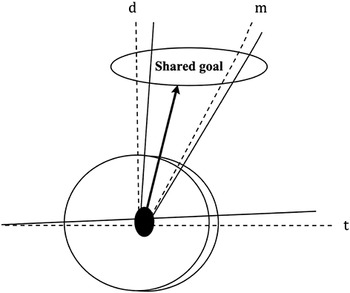
To detect the foundation of worldview constructions and their influence on human interaction, the focus is on the relationship between spatial cognition, language use, positioning, and intentions for action. Concepts of common interests, agency (Duranti, Reference Duranti and Duranti2004; Searle Reference Searle2010), and collective or social intentionality (Levinson, Reference Levinson2003; Searle, Reference Searle2010; Tomasello, Reference Tomasello2014) provide a functional/distinctive conceptual framework for PMD scales to reveal differences and shifts in the ‘logic’ of worldview constructions. And by offering projections of the future politically motivated discourses are also considered as a means to prompt and justify ideologically motivated goals and actions that fit in a particular worldview.
2.5 Doing Scalar Deictic Space Analysis
Following on the principles of spatial cognition and discourse-space theories, SDS provides a fundamental, systematic, multi-scalar analytical framework to expose the dynamics of temporal and spatial contextualisation in which words become meaningful and politically relevant. The framework for SDS unfolds across four sections (Sections 3 to 6), each dedicated to a specific scalar level of positioning within a dynamic deictic space: DC positioning, proximal positioning, medial positioning, and distal positioning. The purpose is to offer a dynamic perspective on critical discourse analysis with a method to investigate how discourse grounds referents, actions, and values at varying cognitive and ideological distances in the speaker’s point of view, and to trace the trajectory of change over time to register processes of repositioning in political discourse.
The scalar structure of SDS reflects a trajectory from local acts of communication to the formation of broader and more nuanced Us–Other worldviews that underpin intragroup identities, relations, and reasoning for political action. In this connection, DC positioning embodies the speaker’s epistemic and moral authority, whilst also accommodating certain groups of individuals whose socio-political and ideological values are construed as part of the speaker’s own subjective centre. These entities are positioned IDC insofar as they are represented as sharing the speaker’s ontological, epistemological, and axiological ground. By contrast, other discourse entities may remain ODC whilst still being located within the broader scalar configuration of the Us space. Their positioning is therefore not determined by exclusion from the Us camp, but by the degree and quality of their proximity, agency, dependency, or distance in relation to the DC. In order to identify these variations in positioning, SDS distinguishes three indiscrete and contingent scales on the time and space axes: PMD.
1. Proximal positioning features assumed shared intentionality and joint agency, triggered by a particular identity constructed around intimate political relations such as alliance, partnership, and friendship.
2. Medial positioning introduces a spatial-cognitive location at a moderate, less immediate distance from the DC, where discourse entities are construed and identified as dependent on the speaker’s or DC’s intentionality. These discourse entities are granted contingent status, power, and/or agency to perform an action in alignment with the speaker’s goals. Medial positioning can be understood as the most dynamic zone within the scalar configuration because it is the space in which positioning is actively negotiated, deliberated, and reconfigured. Unlike the proximal scale, which represents the relatively stable domain of what is construed as known, shared, and jointly agentive, the medial scale accommodates entities whose status is not fully settled. These entities may have previously belonged to an Other space, or may have occupied an uncertain position, but are discursively brought into the Us camp through the attribution of contingent agency by the speaker/IDC entity. In this sense, medial positioning often presupposes future-oriented prediction and planning, since the speaker evaluates whether and how the positioned entity can act, develop, or be enabled to fulfil particular goals. However, the temporal projection does not define the medial scale by itself. Rather, it supports a more fundamental cognitive-discursive process: the construction of transitional agency, dependency, and enablement within an unstable field of political possibility.
3. Distal positioning signals lack of intentionality and agency, neither attributed by the speaker nor enacted by the discourse entity itself. What ties a discourse entity to distal position within Us camp is a shared ground of identity with the speaker/DC. This affiliation is often established semiotically through symbolic alignment or discursive inclusion, but it does not translate into transactive involvement or material agency. Entities in this position are included in a discourse more from an ideological point of view than as an active participant.
Together, these scalar levels discursively coordinate a shared perspective, configure political distance, and ultimately mobilises intentions for action. The dynamics of deliberation and stance are marked by viewpoint shifts on the time and space axes (Chilton, Reference Chilton2005). SDS applies this model to register the dynamics of the scalar properties of political discourse to get a grip on developments in directions and shifts in political argumentation. The application of the SDS model offers a unified framework for analysing how discourse strategically structures the ingredients of intentions for action by constitutively presenting identity, power, and agency on the ground of the fundamental cognitive framework of time, space, and modality. It reveals the micro-level mechanisms of mental positioning whilst also explaining how those mechanisms scale into macro-level cognitive maps of legitimacy and agency in contemporary political discourse.
Nevertheless, it is important to note that the SDS approach does not treat linguistic and lexico-grammatical constructions as the determining foundation of scalar positioning. Rather, it conceptualises IDC and ODC positioning primarily through cognitive–discursive and sociosemantic configurations that organise relations of identity, agency, intentionality, dependency, and distance. This theoretical orientation is necessary because scalar positioning is not always realised through stable or typologically transferable linguistic forms. Although certain linguistic tendencies, such as transitivity patterns, modality, deixis, nominalisation, causative verbs, and verbs of support or perception. Although these structures may instantiate particular scalar relations, they should be understood as indicative rather than constitutive of the framework. Therefore, the analytical priority is placed on the underlying image-schematic and sociosemantic structures through which discourse entities are positioned and evaluated. This also allows SDS to move beyond textual analysis and account for visual and multimodal discourse, where scalar relations are realised through spatial arrangement, gesture, gaze, composition, and other semiotic resources.
The following sections present and discuss examples to demonstrate what can be achieved with SDS to get a grip on future projections and on building intentionality for action. The data were drawn from political discourses in the US, Iran, and Ukraine. These three geopolitical contexts are marked by global visibility, ideological war, and directive narratives. This comparative, multilingual selection highlights both the contemporary relevance and the cross-contextual applicability of the SDS framework. However, where necessary, we approached some pieces of data from other geopolitical contexts to indicate that the SDS analytical approach can be applied in a variety of contexts.
2.6 Summary of the Section
The scalar properties of deictic positioning demonstrate how discourse builds a shared perspective, configures political distance, and ultimately mobilises intentions for action. The dynamics of deliberation and stance are marked by viewpoint shifts on the time and space axes (Chilton, Reference Chilton2005). SDS applies this model to indicate the dynamics of the scalar properties of political discourse to get a grip on developments in directions and shifts in political argumentation and intentionality. The application of the SDS model offers a unified framework for analysing how discourse rhetorically structures the ingredients of intentions for action by constitutively presenting identity, power, and agency on the ground of generic aspects of spatial cognition. It reveals the background mechanisms of mental positioning whilst also explaining how those mechanisms scale into cognitive maps of legitimacy, and agency in contemporary political discourse.
3 Deictic Centre Positioning
3.1 Introduction
The dynamic aspect of the Scalar Deictic Space approach concerns the positioning of a DC in relation to an equally dynamic PMD space and sense of time. From a cognitive point of view, a DC is the conceptual reference point of the cognitive coordinate system of time, space, and modality that provides a point of view in perception and thought. The primacy of spatial cognition is analogical to real space and time and borrows its epistemic value to make sense, create meaning and understand each other in communication (Levinson, Reference Levinson and Arbib2013, pp. 16–17). The DC functions as a reference or vantage point from which referential discourse entities are positioned around a point of view in a deictic frame of reference. In this mental organisation, entities are given a ‘place’ in a virtual time–space of attention. It provides identity and agency in relation to other entities that are positioned in the same frame of reference. Positioning actors in a time–space model also accounts for degrees of status and legitimacy to act authoritatively in the social world. Identifying the DC, or point of view, as the core of perspectivisation is crucial to discourse analysis from a point of view, beyond linguistic parameters, as it focuses on the spatial-cognitive configuration of discourse elements that preempts semantic meaning in context.
The DC is situated on the intersection of temporal, spatial, and epistemic points that together define a position representing a speaker’s subjective centre of experience – their ‘here-now-real’ known and experienced spacetime in the moment of utterance. This assumed point of view, also known as Origo (Bühler, Reference Bühler1983; Reference Bühler1934), serves as the perspectival anchor point for deixis, providing the cognitive and perceptual position from which a speaker takes perspectives and attributes meaning and value to referential discourse entities.
From a dynamic point of view, deixis functions as a cognitive mechanism that facilitates the mental act of relativisation of states-of-affairs and events from a DC, allowing meaning to shift according to changes in viewpoint, time, or participant role. Referential discourse entities, such as individuals, objects, sentiments, values, and meanings, can be relativised towards taking stance on ‘other’ spaces, as well as imagining spaces from other points of view. The spatial nature of cognition facilitates dynamic perspectivisation that facilitates stance-taking on temporal developments by the same spatial geometric principle. Therefore, a DC is constructed within a speaker’s or a community’s lived reality in the here and now interface, which may be conceived as a constellation of timespaces or chronotopes (cf. May & Thrift, Reference May and Thrift2003; Blommaert, Reference Blommaert2016). These chronotopes are the foundation of ontological/epistemic worldviews on the basis of which the status and function of discourse entities can be articulated. In negotiations, it serves as the grounding locus for the deictic positioning of discourse entities and for shaping identity–power–agency dynamics whilst at the same time adjusting the frame of reference. Within these dynamic deictic configurations, discourse entities are not merely located in space or time, nor are they solely (re-)situated through shifts in attentional focus or salience. Rather, they are dynamically (re-)positioned across scalar dimensions of meaning-making and social–political evaluations of the ascribed status of identity, power, and agency. Discourse entities traverse and are redefined within hierarchies of social, temporal, spatial, and epistemic scales – revealing how deictic grounding itself becomes a site of ontological negotiation and discursive transformation. Chilton’s Deictic Space model (Reference Chilton2014) captures the dynamics of change over time, identifying the force and directions of movement in a coordinate system and its spatial, temporal, and modal referential properties of referential entities. Building on DST for socio-political purposes, the SDS approach focuses on exploring the dynamics of distancing and force-direction on socio-political dimensions to expose deictic variations and shifts.
3.2 Deictic Centre Positioning
In the Scalar Deictic Space (SDS) approach, the concept of DC is reconceptualised as a multidimensional coordinate system that hosts a wide spectrum of activated knowledge. This includes not only the immediate spatial and temporal information but also more complex political, ideological, historical, cultural, economic, and strategic data that affect deixis to pragmatically trigger intentions for action. Within this system, the DC functions as a fluid cognitive-ideological field in which meanings are continuously re-negotiated, relativised, and re-evaluated along multiple scalar dimensions of space, time, and epistemic anchoring. In political discourse, this scalar architecture provides an implicit cognitive framework to organise and relativise political issues that fit a particular ideological frame of reference, highlighting the persuasive affordances of generic spatial cognition. A political speaker’s interpretation or conception of the context, however micro or macro, or the intention to enforce a particular understanding of the situational context on the audience, can be communicated by gauging the salience of certain issues whilst masking the broader picture. It can be communicated by directing the audience’s scope of attention to fit policies and their urgency in their proposed worldview. Thus, in this sense, the SDS model extends Chilton’s (Reference Chilton2014) DST beyond its geometric parameters to address the dynamics of scalar cognition, revealing how discourse not only reflects but also configures political reality through deictic positioning.
As noted in Section 1, SDS makes a distinction between IDC and ODC positioning based on relationship, identity, and agency specificities. Whilst the ODC refers to the accommodation of discourse entities on PMD beyond the DC, the IDC locates certain discourse entities within the DC based on the speaker’s subjective evaluation of their role in and importance for determining the ontological and epistemological configuration of the DC. This means that the DC does not exclusively belong to the speaker because the speaker’s communicative effect relies on creating resonance with the intended audience. Nevertheless, for analytic purposes, attention must focus on the speaker’s discourse to gain access to their ontological status and epistemic grounding for positioning a discourse entity within their DC.
This DC positioning is a complex discursive and linguistic construal operation (Hart, Reference Hart2014) which relies on the speaker’s subjective evaluation and interpretation of identity-constructing ideals and core values that determine a discourse entity’s responsibilities and scope of agency. This epistemological–ontological system is operationalised via a thematic framework built upon a fundamental spatial cognitive configuration. A range of lexico-grammatical and pragmatic choices, thus, play a representational role and are involved in the realisation of the DC positioning.
The thematic framework involves a certain number of ‘socio-semantic’ constructs (van Leeuwen, Reference van Leeuwen2008) which present sociologically and politically motivated forms of representing and constructing social and political practices. Importantly, these sociosemantic inventories are evoked by more fundamental image-schematic configurations and represented via linguistic (lexico-grammatical) structures. However, it must be noted that these linguistic tools naturally vary across languages and cultures due to linguistic, socio-cognitive, and contextual-pragmatic differences. This informs us that the linguistic structures are only representational choices pertaining to the rhetorical realisations of more abstract and fundamental image-schematic and sociosemantic structures. Determining the norms of positioning within the DC, this model is principally designed to capture the ontological and epistemological dimensions that construct a coordinate abstract deictic space with the purpose of establishing a common ground for support for action. In this approach, the focus is on how the world is presented discursively and what kind of cognitive patterns are used to create that world and to justify the need for certain political actions.
In this connection, Table 1 presents the central themes and cognitive configurations that underlie the discursive structures, representing subjective discursive contraction of identity and solidarity, moral and ideological legitimisation, the ability to achieve goals and suggesting the necessity and benefits of taking actions. These constructive and representational tools create a cognitive framework to specify the entities for positioning in the DC. In other words, this fundamental sociosemantic-cognitive framework plays a normative and regulatory role in discourse that delineates the central reference point for assigning identity and attributing agency both to the IDC and ODC entities. Such an ontological–epistemological vision of DC becomes even more pronounced in political discourses simply because persuasion in these discourses crucially relies on a stable ground to represent a particular value system that holds the argumentative ground to justify and legitimise actions, and establish relationships with Others in both domestic and international contexts. In order to make sense, the DC forms the ground for a particular cognitive processing pattern to relativise and make sense of referential entities and to gauge their political desirability from that point of view. In other words, a DC regulates how referential discourse entities are relativised, organised, and evaluated according to their ideological relevance and political desirability. In this sense, the DC constitutes a normative field of cognition. It grounds a dynamic yet structured space that sustains coherence, legitimises judgements, and regulates the persuasive force of political discourse and intentionality to act.
| Thematic framework | Definition | Cognitive configuration | Linguistic tendency |
|---|---|---|---|
| Identity and solidarity construction | References to the nation, people, or community; positive evaluation of fellow citizens and institutions serving the nation. | container/boundary (inside vs. outside/ inclusion vs. exclusion); merging (cohesion) | Opinion adjectives; noun phrases; copular and action verbs |
| Moral and ideological legitimisation | Invocation of ethical principles, cultural codes, and doctrinal values that define the moral core of the political or social order. | vertical (higher values, authority); centre (as the normative source) | Adjectives; noun phrases; verbs of action |
| Achievement and self-reflection | Descriptions of historical accomplishments, developmental challenges, and acts of self-criticism oriented towards collective progress. | path/trajectory (progress vs. set back); source-goal (from DC) | Verbs of process and action; verbs of direction |
| Social, cultural, strategic and geopolitical anchoring | Articulation of national interests, policies, and geographical or geopolitical coordinates that frame the country’s position in the world. | anchor (positioning based on DC) | Verbs of action |
Nevertheless, it is important to note that the precedence of the representational content in this sociosemantic-cognitive framework does not necessarily imply that the linguistic or pragmatic properties of discourse are swept under the carpet. Rather, it reveals that the intentionality of a political speaker that is grounded in a subjective DC, activates a variety of lexico-grammatical and pragmatic resources, depending on linguistic, political, and situational contexts. In other words, in this approach, frames of reference are considered to be schematic in nature. They shape the ground for the speaker’s cognitive and perceptual position, interpretations, intentions and capacities. The following examples from American Presidential speeches (Bush and Obama) will illustrate the mechanisms of variation and change in deictic-centre positioning in the SDS framework should illustrate the deictic mechanisms.
3.3 The Position of Deictic Centre in Political Discourse
In his inaugural speech as the president of the US in 2001, George W. Bush depicts a specific DC as the basis for construing the ideological moral principles and values of an imaginary ‘Us’ society by schematically outlining the fundamental political identity of this group. The underpinning value systems construct the core identity of the positioned entities within the DC.
3.1 We have a place, all of us, in a long story – a story we continue, but whose end we will not see. It is a story of a new world that became a friend and liberator of the old, a story of a slave-holding society that became a servant of freedom, the story of a power that went into the world to protect but not possess, to defend, but not to conquer. (G. W. Bush, 20 January 2001)
In Example (3.1), President Bush construes an inclusive agency of both the socio-political system and a common identity through the inclusive pronouns ‘Us’ and ‘We’. This collective ‘We’ is reinforced by identity-constructing expressions such as shared story, a history of success of ‘freedom’ and ‘power’, thereby presenting a unique American identity structure, grounded in the moral strength of the DC. The collective identity structure serves as an umbilical cord that connects the addressee to the DC and aligns their self-identification with the speaker’s ideological/strategic/political orientations and preferences. To put it differently, the addressee’s understanding of themselves is anchored in the speaker’s DC, which becomes a reference point for differentiating ‘Us’ from ‘Them’.
In this example, this unique American identity is structured through the anchor image schema, whereby the audience’s perceptions and understanding are stabilised and fixed within the ideological and strategic coordinates of the speaker. But, the story does not end there. The identity is not merely descriptive. Interestingly, Bush’s discourse neatly presents the anchored-in-history identity not solely as a socio-cultural phenomenon, but, more importantly, as a ground for encouraging and justifying action. More to the point, through the verb phrase ‘a story we continue’, the anchored identity is transformed into an axiological intentionality, encouraging action oriented towards the global propagation of freedom. In this sense, identity serves as a basis for justifying and legitimising politically interventionist policies. Accordingly, Bush’s discourse adds a further layer of identity by constructing a non-dominant political self-image to justify and legitimise the USA agency (‘the power that went into the world to protect but not to possess, to defend but not to conquer’ emphasis added). The benign outcome of these developments in identity and responsibility, and agency, depicts a qualified, eligible, and legitimate nation to take charge of guarding and protecting freedom and democracy through exercising its particular agency in the DC of the speaker.
Nevertheless, the important point is that this peace-loving identity seeks to conceal the political expansionist ideological trajectory which is embedded in the continuation of the American peace and freedom-generating discourse. The verb phrase ‘a story we continue but whose end we will not see’ activates the trajectory image schema, where the speaker’s DC serves as the source of the movement. However, the clause ‘but whose end we will not see’ removes the goal, thereby transforming the trajectory of USA identity propagation and agency practice from a socio-political project, aimed at creating social solidarity, to an imperialistic desire featured with lack of spatial and temporal stopping points. The absence of such constructs creates unbounded spacetime, or unrestricted chronotope. The absence of schematic organisation and boundaries allows any movement to extend over various directions whilst remaining temporally unrestricted.
The legitimisation is further reinforced by activating the centre and vertical image schemas, positioning the speaker’s DC as a locus of elevated moral values. This configuration builds on conceptual metaphor of high is good, thus strengthening the entities’ identification with the DC and securing support for its agency. The historically acquired positive and promotional characteristics of the USA serve a dual function: it constructs a morally elevated identity whilst simultaneously justifying expansionist actions by the USA.
Nevertheless, in political discourse, negative deictic-centre representation can, in certain cases, serve to construct a critical stance against rival political parties and political apparatuses in relation to the perceived problems. This negative discursive strategy relies on the public sentiment of discontent and encourages a more inclusive social discussion and evaluation as to whether to trust the proposed new direction or consider alternative paths to grant legitimation. However, this is psychologically a complex discursive strategy, as it arises from a negative self-image and may risk legitimising a reactionary dive into the uncertainty that may spur public antagonism.
In his inaugural speech in 2009, Obama adopts such a critical deictic-centre approach by publicly acknowledging a deteriorated state of the nation under the previous administration of George W. Bush. Accordingly, the Obama discourse construes economic failure and breakdown as one aspect of the DC, as illustrated in Examples (3.2–3.4).
3.2 That we are in the midst of a crisis is now well understood. Our nation is at war, against a far-reaching network of violence and hatred. Our economy is badly weakened, a consequence of greed and irresponsibility on the part of some, but also our collective failure to make hard choices and prepare the nation for a new age. Homes have been lost; jobs shed; businesses shuttered. Our health care is too costly; our schools fail too many; and each day brings further evidence that the ways we use energy, strengthen our adversaries and threaten our planet, woman and child who seek a future of peace and dignity. And we are ready to lead once more. (B. Obama, 20 January, 2009)
3.3 I know that for many Americans watching right now, the state of our economy is a concern that rises above all others. And rightly so. If you haven’t been personally affected by this recession, you probably know someone who has a friend; a neighbor; a member of your family. But whilst our economy may be weakened and our confidence shaken; though we are living through difficult and uncertain times, tonight I want every American to know this: We will rebuild, we will recover, and the United States of America will emerge stronger than before. (B. Obama, 24 February 2009)
3.4 Millions of Americans have been victimized, their privacy violated, their identities stolen, their lives upended, and their wallets emptied. According to one survey, in the past two years alone cybercrime has cost Americans more than 8 billion dollars. (B. Obama, 17 May 2009)
From these examples, at the beginning of Obama’s presidency, it can be argued that negative self-representation is adopted to foreground the consequences of the interventionist policies of the Bush administration. This ideologically motivated construal establishes a contrast between the core axiological values of the DC and the adverse consequences of the former policies, particularly in terms of:
i. economic failure – ‘… our economy is badly weakened …’ (3.2); ‘… for many Americans the state of economy is a concern …’ (3.3)
ii. great losses and backwardness – ‘… homes have been lost, jobs …, businesses shattered …’ (3.2); ‘… their wallets emptied …’ (3.4)
iii. weak social welfare – ‘… our health is too costly; our schools fail too many …’ (3.2)
iv. socio-psychological impacts – ‘… if you have not been affected by this recession, you probably know someone …’ (3.3); ‘… whilst our economy may be weakened and our confidence shaken …’ (3.3), ‘… millions of Americans have been victimized, their privacy violated …’ (3.4).
Cognitively, this configuration activates a container image schema (under pressure), where the DC is represented as internally destabilised. At the same time, the discourse involves a vertical image schema of decline, followed by the expectation of rehabilitation.
Nonetheless, when it comes to the depiction of the identity of the DC and its entities, Obama discourse invests in outlining the democratic and peaceful ideals underpinning the USA (Ex. 3.5–3.7). In line with the Bush discourse, Obama highlights and re-articulates the core identity of the nation and its need to pursue and realise its alleged humane and democratic values and ideals. In these examples, Obama sketches a path towards positive action in the future. Triggered by the centre image schema, the DC is reconfigured as a locus of democratic and freedom-oriented, functioning as a basis for renewed agency:
3.5 What makes the United States special, and what makes you special, is precisely the fact that we are willing to uphold our values and ideals even when it’s hard. (B. Obama, 20 April 2009)
However, what is at stake is that the negative self-representation operates largely as a rhetorical device, foregrounding critique of previous war policies whilst preparing the ground for the redefinition of a new national mission. By reinterpreting the core ideals in terms of axiological values of the DC for the environmental policies, Obama only replaces Bush’s political interventionist policies with his environmental interventionism, thus expanding the concept of protectionism from current problems to future issues, as one of the main fragments of the US social and political identity (Ex. 3.6).
3.6 We’re engaged in two wars and a struggle against terrorism. The threats of climate change, nuclear proliferation, and pandemic defy national boundaries and easy solutions. (B. Obama, 14 May 2009)
That is to say, the globe-protecting identity of the USA is not merely constructed by practising anti-terrorist preemption and protection, but the Obama discourse identifies new threats such as environmental threat, climate change, and nuclear proliferation that strongly require America’s involvement with protecting and safeguarding the world. The enumeration of novel sorts of threat implicates the US to be more involved in practising security in vaster areas, thereby constructing the identity of a world saviour through its protectionist approach. His worldview extends from the here-and-now into future perspectives that reach beyond the USA.
3.7 We will press ahead with deep cuts in emissions to reach the goals that we set for 2020, and eventually 2050. We will continue to promote renewable energy and efficiency, and share new technologies with countries around the world. And we will seize every opportunity for progress to address this threat in a cooperative effort with the entire world. (B. Obama, 25 September 2009)
In this example, Obama’s discourse creates a hopeful and capable DC for a positive, action oriented, approach to the nation and its relation to the ‘entire world’. His spatial and temporal worldview and the scope of the here and now frame of reference reach beyond his predecessor’s worldview. There is clearly a big difference in the two presidents’ outlook on the USA and its place in the world.
3.4 Summary of the Section
Within the framework of the Scalar Deictic Space approach, this section introduced and elaborated the concept of the core elements of cognition: The DC. Deixis in political discourse extends beyond spatial-temporal anchoring to function as a cognitive, ideological, and evaluative and persuasive system. As shown in Figure 2 above, the DC is conceived as the intersection of spatial, temporal, and modal coordinates – the ‘here–now–real’ – in which a speaker or community constructs a worldview from which to move on. It serves as the conceptual and moral ground on which entities, values, and events are positioned, relativised, and evaluated. Within this deictic framework, political discourse can construct a wide range of ontological and epistemological realities that legitimise certain forms of agency, identity, and power.
Scalar Deictic Space (SDS) approach.
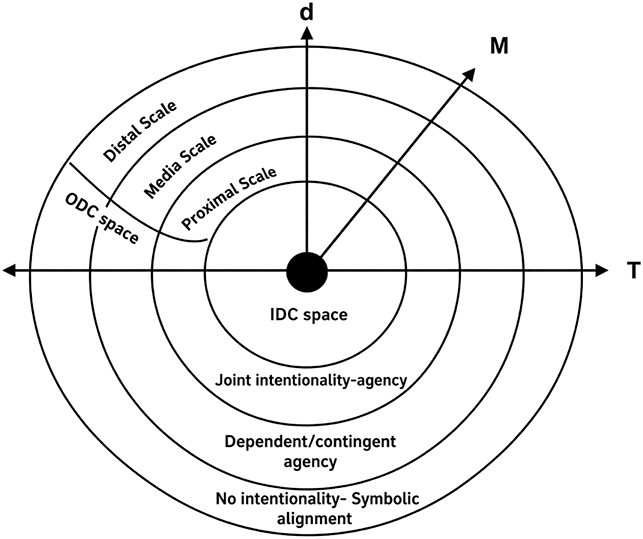
The analyses of George W. Bush’s inaugural speech (2001) and Barack Obama’s early presidential addresses (2009) illustrate how these thematic domains function discursively. Bush’s rhetoric established a conservative positive DC centred on the moral and historical identity of the US as a guardian of freedom, progress, and protection – an embodiment of identity and solidarity construction and moral legitimisation. In contrast, Obama’s discourse initially relies on achievement and self-reflection through a negative self-evaluation of national failures – economic, moral, and social – before repositioning the nation within a progressive, renewed, hopeful, and globally engaged DC. His emphasis on global cooperation and climate responsibility further illustrated strategic and geopolitical anchoring, expanding the DC spatially from a national to a transnational moral space, and temporally from the past into the future.
Together, these analyses demonstrate how the DC serves as the normative and cognitive ground upon which political actors construct, regulate, and reconfigure collective identity. The four thematic categories function as interpretive coordinates that reveal how leaders mobilise spatial cognition to stabilise values, legitimise authority, and align their audience within a shared ideological frame. The section thus establishes DC positioning as a central analytical tool in understanding how political discourse constructs and negotiates the boundaries of I/We identity and its relational Others.
4 Proximal Positioning
4.1 Introduction
Proximal positioning of discourse entities attributed to an ‘Us’ group is a cognitive construal operation through which certain discourse entities, events, values, and states of affairs are conceptually accommodated on a proximal spatio-temporal and modal distance to a specific reference point, that is, a DC or point of view, as shown in Figure 3.
Positioning scales in scalar deictic centre approach.
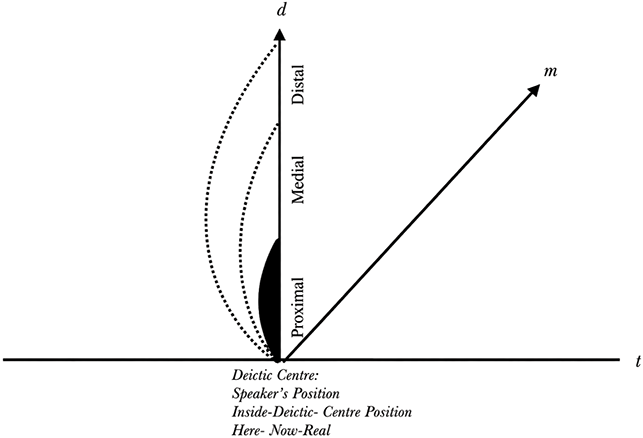
Proximal positioning is grounded in the construal of relations between various agencies, actions and purposes that follow the logic of collaborative attitudes and actions. This logic is activated by fundamental cognitive configurations. It is manifested through discursive strategies and represented by pragma-linguistic devices, thereby shaping the identity of the group to which the entities are assigned.
In the Example (4.1), President Zelensky discursively construct a proximal positioning between Ukraine, presented through the pronoun ‘We’, and the US. Through the use of the collaborative verb phrase ‘working with’, Zelensky aligns the two discourse entities within a shared Us-group characterised by cooperation and joint purpose. Activated via the merging image-schema, this alignment portrays both Ukraine and the US as involved in a partnership for a common struggle rather than as donor and recipient, thereby foregrounding equality in agency and coordinated effort. However, whilst the immediate benefit of this collaboration appears to favour Ukraine (securing the defence system), the discursive effect of proximal positioning extends further. By situating the US within the same sphere of action and purpose, Zelensky constructs an implicit mutual benefit: Supporting Ukraine also advances the US’s geopolitical interests by limiting Russian influence. Thus, the statement performs a dual function: on the one hand, it legitimises Ukraine’s reliance on support from the US whilst representing the partnership as one of the shared agencies and common strategic interest. Through this strategy of proximal positioning, Zelensky effectively redefines asymmetrical international relations as a symmetrical, collaborative alliance, masking potential hierarchies under the rhetoric of unity and joint purpose.
4.1 We are working with the United States to ensure that Ukraine still can receive the necessary number of Patriot systems. (Volodymyr Zelensky, 20 October 2025)
That said, proximal positioning is a construal operation of proximisation towards an explicit or oblique DC. The inward direction of proximal positioning forms the ground for constructing agencies, actions, and purposes of ‘other’ discourse entities vis-à-vis the DC, thus creating meaningfulness. This cognitive primacy of time and space positioning is fundamental to the analyses of how the construction of different discourse entities is coordinated, and how they may affect intentions for action. In other words, the discursive positioning of a discourse entity on the proximal scale is suggestive of a particular type of agency, action, and purpose. The proximal scale for ‘Us’ entities is a conceptual locus that assumes a strong relationship between the DC of the Speaker (speaker/DC) and the addressee, encouraging solidarity in sentiments, goals, and intentions for action. The construction of common ground on the basis of a time–space frame of common interests facilitates collaboration. It provides a space for consensus on mutual interests and shared purposes. Thus, the discursive positioning of a discourse entity in a proximal scale creates a foundation for collaborative action, agency and purpose in a common space as well as a temporal sense of urgency. It also primes volition for coordinated action.
4.2 A Discursive, Cognitive, and Linguistic Framework of Proximal Positioning
Proximal Us-positioning is a construal operation that accommodates selective discourse entities, events, and values at the closest conceptual distance from the speaker/DC in terms of relevance, such as affinity and commitment, collaboration, and shared interests. Positioning the in-group discourse entities on this scale signifies a strong, reciprocal, and impermeable relationship between the speaker and the discourse entities in political, strategic, and economic domains. It presents a sense of a common here-now-real whilst priming requirements for an action to secure the future. In addition, the speaker/DC and the proximally positioned discourse entity share similar or concordant values that lie at the heart of their ideological-epistemological systems. A key characteristic of this positioning is the portrayal of actions, events, and values as the outcome of coordinated and synchronised efforts carried out collaboratively by both speaker/DC and the positioned entities, resulting in a coalition of shared interests and benefits. This positioning has its roots in fundamental cognitive (image-schematic) structures that conceptualise collaboration and coordinated agency towards an action. The cognitive foundation, thus, activates a range of sociosemantic constructions, serving as discursive strategies, to illustrate how socio-political practices are formed. In the meantime, linguistic and cognitive tendencies perform rhetorical realisations of the discursive strategies.
The proximal position demarcates agency, action, and purpose. It highlights a selective range of political relationships that may motivate certain intentions for a joint action. Cognitively, proximal positioning activates a closeness, balance, and merging image schema, thus establishing politically and strategically motivated relations that are perceived and distinguished in terms of embodied and spatial cognition. Built on this cognitive configuration, sociosemantic constructions (or discursive strategies) involve creating a bidirectional, affinitive relationship, reinforcement of mutual interests and collaborative actions, and comprehensive commitment to fulfilling the interests and security of the coalition. However, the representation of proximal positioning involves a series of linguistic tendencies that illustrate how various collaborative relations become politically and ideologically meaningful. In this connection, different aspects of proximal positioning, including agency, positioning action/relation, and purpose, are articulated via a relevant lexico-grammatical repertoire.
Accordingly, the data indicate that agency is generally, but not necessarily, conceptualised in terms of the following tendencies:
Inclusive ‘We’ pronoun – referring to the speaker or an entity whom the speaker represents and a positioned entity: ‘We [UK and USA] stand shoulder to shoulder …’ (Keir Starmer, 6 November 2024)
and-coordinated noun phrase – referring to the construction of joint agency by the speaker, or an entity whom the speaker represents, and a positioned entity: ‘Finland and the US are close allies …’ (Alexander Stubb, 6 November 2024)
Positioning action and/or a relationship in the proximal zone accentuates alliances, friendship, partnership, or collaborative action with a joint purpose. This collaboration is conceptualised through a range of linguistic structures, including:
Relational structures – it describes the state in which the speaker or an entity whom the speaker represents is identified in terms of a particular type of relationship: ‘Finland and the US are close allies …’ (Alexander Stubb, 6 November 2024).
Transitive constructions – it refers to a material process through which the agent–featured with a coordinated agency– is involved in performing a certain kind of collaborative action. Action and process verbs are the main verb types that are used in these constructions: ‘… American and British forces launched strikes at terrorist camps’ (Bush, 13 October 2001)
Nominalisation – apart from a syntactic process, nominalisation refers to a rhetorical strategy that construes the proximal relationship between the speaker or entity whom the speaker represents and a positioned entity as an abstract, taken-for-granted state of affair: ‘… our longstanding alliance with Japan …’ (Republican Party Platform, 1 September 2008); ‘… the partnership of America and Russia … .’ (Bush, 25 May 2002).
The following sections will demonstrate how these linguistic categories contribute to construing and rhetorically realising different sociosemantic constructions.
4.3 Bidirectional Affinitive Relations
Bidirectional affinitive relations refer to the presentation of political, strategic, and economic connections between two or more discourse entities referring to the concepts of friendship, partnership, and alliance that are required for collaborative action. In political discourse, a speaker may place certain discourse entities on the proximal scale along the d-axis (space), identifying them as a part of the ‘Us’ camp due to close, affinitive bilateral relations with the speaker. This relationship is fundamentally grounded in the political, ideological, and strategic considerations of both parties.
The agencies of the speaker and the proximal discourse entities are defined by their relational identity, framed in terms of friendship, partnership, and alliance (van Leeuwen, Reference van Leeuwen2008). Their agencies in these affinitive relations are shaped by their shared intentions and goals, aiming to achieve mutually beneficial outcomes. Importantly, the level of intimacy between these entities can shift – either positively or negatively – depending on how effectively their political systems honour mutual agreements, interests, and coalitions. In SDS, proximal positioning based on affinitive relations is constructed through two types of proximisation construal: zero proximisation (deictic space concentricity) and in- and outward egocentric proximisation. These distinctions highlight not only how political discourses frame amicable interstate relations, but also the subtle political and strategic nuances involved in shaping the meaning of these relationships. The temporal aspect of this proximal positioning often suggests a stable and ongoing state of relations that suggests an idiosyncratic aspect of the connections between discourse entities.
4.3.1 Zero Proximisation
Zero proximisation is a construal through which the deictic spaces of the speaker and the intended discourse entity coincide in terms of a sense of shared Reality that does not bear an argument. It represents common interests, values, and properties to the extent that they establish a concentric shared deictic space that assumes a ‘We’ identity. The significance of studying zero proximisation in CDA (Critical Discourse Analysis) lies in its ability to reveal how the construction of solidarity and concealing unequal power dynamics are associated with constructing agency and role assignment for different discourse entities. In SDS, zero proximisation serves to anchor a common sense of solidarity and allegiance and motivates protection of security. This anchoring serves to indicate how bidirectional affinitive relationships and agency are co-constructed. Zero proximisation is the primary cognitive indicator of the construction of a relevant timespace and, in turn, it is the source indicator of constructions of common goals and synchronised agency. By synchronised agency we mean the emergence of unity and commitment of the entities involved in carrying out a synchronous action, assigning agency to the speaker/DC discourse entity and shared responsibility with the positioned participant entities (see Figure 4).
Concentricity of deictic spaces and synchronised agency.
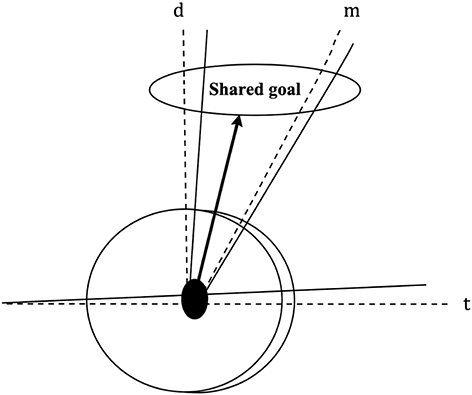
Zero proximisation can be analysed on the basis of (a) semantic constructions of ‘we’, (b) temporal and modal coordinates of frames of reference, and (c) lexical-grammatical perspectivisations that create an epistemic ‘here-now-real’ demarcation.
(a) Semantic indicators of synchronised agency that can be employed in discourse analysis are noun phrases, adverb phrases, the inclusive ‘We’ pronoun, and coordinated nouns, which together fulfil the semantic role of collective actor. Cognitively, synchronised agency is built upon merging image schemas through which two or more entities unite to form a single whole. This cognitive foundation of synchronisation of agency aligns perfectly with its linguistic realisation through nominalisation by which the relationship between two entities is reified as one single phenomenon.
Synchronised agency can build upon shared intention, interest or common purpose, which can be either interactive (affecting only people) or instrumental (affecting other types of entities) (van Leeuwen, Reference van Leeuwen2008, p. 60). The purpose is represented as an objectivated action, typically realised through nominalisation, process nouns, and noun phrases as in Examples (4.2) and (4.3). Zero proximisation obliquely supports the objectification of an (intention for) action and provides a sense of urgency and status of a discourse entity’s position within a deictic space.
4.2 The brotherly, cultural, and historical relations between the two nations of Iran and Tajikistan are a valuable support for expansive collaborations in different areas (M. Pezeshkian, 15 September 2025).
4.3 Today, the Prime Minister and I opened the third Defence Industries Forum – a forum that shows how much we can achieve together with our key partners for Ukraine’s security and for our collective security overall (V. Zelensky, 6 October 2025).
(b) Proximal positioning of an entity on the space–time–modality vectors affects the interpretation of both unmarked and marked temporal and modal aspects of proximisation. In SDS, the unmarked temporal-modal coordinates typically suggest that proximal positioning through concentric deictic spaces involves the alignment of the speaker’s DC with the coordinates of the discourse entity. The effect is that the alignment between the speaker’s DC and the audience’s DC creates a proximal status that is both persistent and factual.
(c) From a linguistic lexico-grammatical perspective, zero-proximisation is construed and realised mostly through nominalisation. This syntactic transformation becomes rhetorically accentuated in discourse since it reifies ideological and politically informed choices as an already-existing and natural entity. The use of the simple present tense conveys the temporal aspect of positioning events and participants on a proximal ‘now’ scale that primes a spatial sense of factuality and immediacy. Moreover, the construal of a DC relies on the simple aspect, which connotes the entity’s proximal status as habitual and characteristic of a specific period of time. Regarding modality, the proximal positioning of the intended discourse entity is conceptualised as a real state of affairs, conveyed through the absolute epistemic modality of factuality of the here and now. This epistemic stance results either from the historical context of bilateral relations or from a reassessment of political issues and affairs. The marked temporal-modal coordinates conceptualise the past or future state of a discourse entity’s position at a proximal scale, belonging to the ‘Us’ group. Importantly, the position of the intended discourse entity is construed implicitly, or is presupposed, in a context of certain events or states of affairs in the past or the future. Given this, the marked construal of the proximal position creates a counterfactual conceptual space where the envisioned position stands in contrast with the current temporal-modal status.
To give an example of the political aspects of zero proximisation, in congratulatory messages of Keir Starmer and Volodymyr Zelensky to Donald Trump’s second presidential term, political strategies of ‘alliance’ (4.4) and ‘partnership’ (4.5) are employed as anchor points for the two deictic spaces to proximise and form a synchronised agency for undertaking a preferred action.
4.4 As a closest of allies, we stand shoulder to shoulder in defence of our shared values of freedom … (Keir Starmer, 6 November 2024)
4.5 I recall our great meeting with President Trump back in September, when we discussed in detail the Ukraine–U.S. strategic partnership, the victory plan, and ways to put an end to Russian aggression against Ukraine (Volodymyr Zelensky, 6 November 2024)
The synchronised agency in these examples is highlighted through the adverbial phrase ‘as a closest of allies’ in depicting the relations between the UK and the US in (4.4), and through nominal phrases ‘the Ukraine–U.S. strategic partnership’ (4.5) regarding the relations between Ukraine and the US. In (4.4), highlighting the relationship through topicalising the adverbial phrase suggests that the alliance is well-established, taken-for-granted, and unquestionable – one so deeply ingrained in history and strategy that it doesn’t require explicit restatement. By framing this relationship as common knowledge, Starmer implicitly emphasises the strong historical and strategic ties that make such an assertion unnecessary. The pronoun ‘we’ assigns an activated agency to the two discourse entities (US–UK) in a collaborative and mutually supportive material action (‘… stand shoulder to shoulder …’), aimed at reinforcing a shared (‘our values’) security and ideological agenda between the two governments (‘… in defence of our shared values of freedom …’). Ultimately, this strategy presents the UK–US alliance as an unquestionable, firmly established fact in political discourse.
In (4.5), Zelensky constructs synchronised agency through the relational identity implied by the noun phrase ‘strategic partnership’, which presupposes mutual investment in a shared trajectory of action. As in previous examples, nominalisation plays a key role in reifying what are inherently dynamic and contested relationships. Terms like ‘strategic partnership’, ‘victory plan’, and ‘ways’ render collaborative efforts as objective, stable entities, taking for granted the proximity and agreement of the actors involved (Lemke, Reference Lemke1995). Particularly, ‘victory plan’ frames success as a predefined, collectively owned outcome, whilst ‘ways’ positions complex and uncertain alternatives as readily navigable paths. These discursive choices embed Zelensky’s narrative within a teleological, jointly managed framework of progress, thereby reinforcing synchronised agency not as a descriptive reality, but as a legitimating rhetorical strategy.
In Excerpts (4.6) and (4.7), the relationship between the speakers/DC entities (‘Finland’ (4.6) and ‘America’ (4.6)) is also framed in terms of ‘alliance’ which synchronises and activates the agencies of the discourse entities around strategic and security purposes.
4.6 Finland and the US are close allies on so many fronts, including security, technology and business … (Alexander Stubb, 6 November 2024)
4.7 America and Afghanistan are now allies against terror. We will be partners in rebuilding this country. (G. W. Bush, 29 January, 2002)
The coordination (‘Finland and the US’ and ‘America and Afghanistan’) equalises the agencies of the discourse entities involved in the terms and conditions of constructing alliance. Additionally, it activates the assumed agency of the positioned entity to perform an action or fulfil a certain state of affairs, thus accommodating the entity on the proximal scale to present a reality of common interest.
4.3.2 Inward and Outward Proximisation: Egocentric Reference Frames
An egocentric reference frame represents a proximal location of entities within the deictic space of both speaker and the intended discourse entity with respect to each other. In Figure 5, an egocentric reference frame provides the directions of positioning which can be determined by either inward or outward proximisations.
Inward egocentric proximisation is a construal operation through which a political speaker construes an entity as encroaching upon or having already settled in the proximal scale, around the speaker’s ontological and epistemological DC. As schematically shown in Figure 5, the deictic space belonging to the intended entity is depicted via a broken circle and vectors. In this cognitive configuration, the encroaching or intended entity is considered as the Figure, which is ‘the object to which is moving or located with respect to another object’ (Talmy, Reference Talmy1983, p. 232). The Figure is grounded in the DC of the speaker and their target audience. In this Figure-Ground relationship, the ‘the Figure’s site, path, or orientation receives characterisations’ (ibid.).
Inward egocentric proximisation.
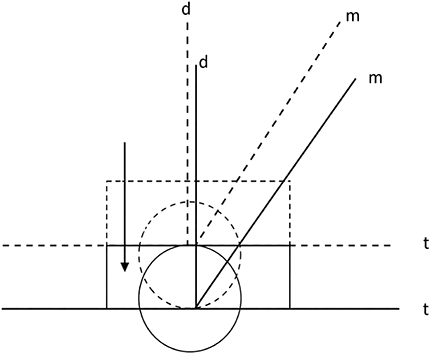
The egocentric proximisation of discourse entities belonging to the ‘Us’ group is intended to conceptualise a synchronised DC that forms the ground for agency, hinging on an affinitive feature to fulfil a commitment, carry out a course of actions, or to characterise a situation. Similar to zero proximisation construal operations, inward egocentric proximisation denotes the concept of an intimate strategic relationship between the speaker and the positioned entity. Manifested mostly through a relational structure, it also positions a discourse entity on the proximal scale to calibrate power or modal/attitude differentials (Werth, Reference Werth1999; Duranti, Reference Duranti and Duranti2004). Power calibration, as used in the SDS approach, refers to an intentionality that is embedded in discursive practices that serve to level out power differentials and asymmetries between the speaker and the positioned entity. Following Duranti (Reference Duranti2006, Reference Duranti2015) and Searle (Reference Searle2010), intentionality is understood as the ‘aboutness’ of our discursive practices and actions, meaning that they are designed to form coordinated agency for a collective action or purpose.
4.8 The UK is one of New Zealand’s oldest and closest partners … (Christopher Luxon, 24 October, 2024)
4.9 The United States is an important ally for the Netherlands, both bilaterally and in international contexts such as NATO (Dick Schoof, 6 November, 2024)
4.10 The US is Norway’s most important partner and ally (Jonas Gahr Store, 6 November, 2024)
4.11 Bahrain is a long-standing partner of the US (B. Obama, 19 May, 2011)
4.12 Israel is a strong ally of the United States (B. Obama, 26 January 2009).
In Examples (4.8–4.10), proximisation of the discourse entities is conceptualised via affinitive lexical lemmas such as ‘partner’ (4.8,4.11), ‘ally’ (4.10, 4.12), and ‘partner and ally’ (4.10). They suggest that they are not only on the same side (allies) but also willing to act as partners (collaborators). Spatially, these excerpts conceptualise the countries ‘New Zealand’ (4.8), ‘the Netherlands’ (4.9), ‘Norway’ (4.10), ‘the US’ (4.11), ‘the United States’ (4.12) as DCs. These political-actor units function as grounds towards which the discourse entities are construed as Figures (cf. UK (8) and USA (9 & 10)) that are proximised and located on the proximal scale.
Moreover, in these examples, the inward proximisation, provides political speakers to portray their own countries as an influential power resource and to enhance their status in world politics. With idiosyncrasy, politicians establish the status of the positioned entities in the proximal space they have created, thus building the ground for medial and distal projections. For example, in (4.8), the use of the quantity phrase ‘one of’ with superlative adjectives ‘oldest and closest’ signposts an idiosyncratic status in New Zealand’s relation to the UK, amongst other partners in New Zealand’s historic international relations. Likewise, in (4.10), an idiosyncratic position is given to the US through the superlative adjective ‘most important’, but unlike (4.8), the comparison is only implicitly activated to pinpoint the status of the US amongst the other partners and allies. However, in (4.9), the US is not construed as the idiosyncratic entity since its position is not conceptualised by a superlative adjective, but by a simple adjective ‘important’. Arguably, this might be mainly because the alliance between the USA and the Netherlands is specified here as bilateral relations and NATO (North Atlantic Treaty Organisation) affairs. Interestingly, unlike the former examples, the inward egocentric proximisation in Example (4.11) leads to adding to the power and credibility of the positioned entity. Enjoying more power resources and credits, the speaker adds to the power and credibility of the positioned entity to compensate for the power disequilibrium or any political challenges that may threaten the affinitive relations.
Outward egocentric proximisation, on the other hand, is a construal operation through which a political speaker can construe its DC either as approaching or having already settled in the nearest conceptual position, or to distance from a DC or from a deictic space located outside the speaker’s coordinate space. In this dynamic cognitive process realised through relational structures and action verbs of collaboration (e.g., work with), the speaker, or an encroaching entity, is considered Figure, whilst the DC that is located outside the speaker’s DC is the Ground. In political discourses, outward egocentric proximisation enables the speaker to distanciate from the ‘other’, at the same time, claim more power and authority by associating themselves with allied power resources. Through this construal, the positioned entity assumes associative power. In this study, associative power refers to a discursive strategy through which a speaker assumes the power of their allies as an enhancement of their own power and credibility.
Examples (4.13) and (4.14) indicate that the speakers frame the relationships between Switzerland and The US and between Iran and Russia are depicted in terms of a partnership (‘longstanding’ (4.13), ‘close and strategic’ (4.14)), thus conceptually proximising Switzerland and Iran towards the US and Russia, respectively, and positioning them on the proximal scale of the US and Russian deictic spaces.
4.13 … Switzerland is a long-standing and trusted partner of the United States … (Viola Amherd, 6 November 2024)
4.14 Our relation with Russia is close and strategic … (Masoud Pezeshkian, 11 October 2024)
Due to the predominant political role and status of the US and Russia in the world of politics and political equations, the speakers in Examples (4.13) and (4.14) assume that the US and Russia are the Ground by recourse to which they identify the status and position of Switzerland and Iran in relation to the political and international status of the US and Russia. In addition, the adjectives ‘trusted’ (4.13), ‘close and strategic’ (4.14) construe the quality of their partnership and alliance as well as Switzerland’s commitment to building trust with the US tendency to act strategically and share in Russia’s policies in international and bilateral relations. By and large, the function of these adjectives is to legitimise and sanction the status of Switzerland and Iran in the US’s and Russia’s political spheres.
Based on the construal in Examples (4.13) and (4.14), the DCs belonging to Switzerland and Iran proximise the deictic spaces of the US and Russia, respectively, as a partner, implying that Switzerland’s and Iran’s equal status allows sharing some of the power and influence of the US and Russia in the world. This outward proximisation grants associative power to the proximising discourse entity. Through this process, the proximising discourse entities (Switzerland and Iran) claim perceived or actual authority, credibility, or influence by aligning themselves peacefully and visibly with a recognised source of power, namely the US and Russia. This alignment presupposes power differentials between the entities but strategically repositions the less powerful discourse entities (Switzerland and Iran) within the proximal scale of the powerful entities (the US and Iran). This maximally simulates a power equilibrium that prompts the observer to attribute elements of the source’s authority to the associating entity, regardless of its intrinsic merit or actual status.
Quite similar to these examples, Example (4.15) suggests that the proximal position of Jordan in the deictic space of the US is construed via interstate partnership: Jordan’s historic partnership with the US and the common goal of peace and stability (4.15)).
4.15 Looking forward to working with you again to bolster Jordan’s longstanding partnership with the United States on services of regional and global peace and stability for all (Abdullah bin Al-Hussain, 6 November 2024)
Nonetheless, unlike the speaker’s use of an assertive speech act to represent Switzerland’s and Iran’s proximity to the US and Russia in (4.13) and (4.14), the political speaker in (4.15) construes Jordan’s conceptual position in the closest territory to the US DC via a noun phrase (longstanding partnership) as a factual feature of Jordan’s relationship with the US. This construal renders the interstate partnership between Jordan and the US as an unquestionable phenomenon (Billig, Reference Billig2008; Fairclough, Reference Fairclough2008; van Leeuwen, Reference van Leeuwen2008).
The construal of proximity as such implies that their interstate relations are so taken-for-granted and grounded that there is no need for overt assertion. Instead, what is expected is not only to assert, but to deepen and widen the extent of the interstate partnership to subsume global issues and affairs. In this connection, the claim about their long-standing partnership ‘… on services of regional and global peace and stability for all …’ (4.15) implies that bolstering the partnership in action will manifest itself in broadening Jordan’s political role and status to become a global player in world politics.
Highlighting agency and role attribution as such proves that associative power can be assumed not merely by emphasising the quality of a bilateral relationship, but also by claiming roles, responsibilities or actions that align with the agenda, values, or interests of the powerful entity. This includes self-proclaimed responsibilities, joint initiatives, or public actions (‘… on services of regional and global peace and stability for all …’) that symbolically or factually reflect shared agency. Whilst such positioning presupposes power relations, it strategically repositions the less powerful entity within the proximal scale of the more powerful entity. This simulated power equilibrium prompts observers to attribute elements of the factually more powerful entity to the less powerful one.
4.4 Collaborative Actions and Joint Agency
In socio-political contexts, cooperative communication is the basis of collaborative action, enabling social and political actors to coordinate their efforts, roles, and mindsets with a cooperative partner towards various shared objectives. In other words, joint action requires a number of agents to perform, or plan to perform, certain actions together in order to achieve their common goals (Miller, Reference Miller1995). Furthermore, these agents require a full-blown collective ‘We’-intentionality on the part of each individual to establish a common goal and to perform the entire action (Tuomela & Miller, 2003; Tomasello, Reference Tomasello2009; Searle, Reference Searle2010). In fact, collective goals, intentions and actions form a complex co-construction shaped by dialogical communication and consensus on shared goals (Tomasello, Reference Tomasello2014), or shared threats that urgently require action for security reasons (Entman, Reference Entman1993; Cap, Reference Cap2017). In principle, collaborative action requires the consent and, preferably, the acceptance of interdependence between social and political actors to perform actions that will fulfil their needs. This interdependence is intertwined with shared intentions and a sense of urgency to achieve the common goal. The resulting sense of solidarity encourages participants to perform cooperatively and for each participant to undertake their share voluntarily (Tomasello, 2015).
Nevertheless, it does not always work that way; for example, in authoritarian politics, volitional solidarity is overruled by repression. Cooperation requires an egalitarian division of responsibilities between social and political actors where roles can be interchangeably assigned amongst individuals. A condition for this construal is the presence of a synchronised sense of roles and agency between the actors. Moreover, to conceptualise the relationship between goal and action, participants need to be able to lean on strong We-intentionality and mutual trust, based on a history of joint action. Such intentional, volitional solidarity requires that participants are ‘engaging in joint action together than those performing a joint action together for the first time’ (Trần et al., Reference Trần, Cummings and Loehr2024, p. 2). In other words, the strength of solidarity relies on long-term, cultural experience with joint action in a shared proximal space, including repetition of coordinated actions, close relationships, and common objectives.
Volition, based on historically embedded trust, is fundamental to unite intentionality for joint action. Such commonly shared historical traces of joint action are ingrained in the conceptual proximal field of the here and now and paves the way for joint actions by linking the temporal vectors on which to position the political trajectory from past to present and from present to desired future. Moreover, the historic link between (known) past and present and projections of present into the future reinforces the epistemic certainty of doing the right thing together in a predictable field around the DC of the present, that is, in the proximal modal field.
4.4.1 The Conceptualisation of Joint Agency
In political discourse, ‘We’-intentionality is realised by suggesting or assuming shared objectives and constructing joint agency to achieve those objectives effectively. At the heart of this argumentation trajectory lies the fact that the position of the DC and the wider proximal frame of reference of the discourse entity form a subjective coordinate system that guides intentions for action. However, the success of actions based on such reasoning cannot be guaranteed, certainly not for all of the ‘We’-group. Lexicogrammatically, joint agency is extensively constructed via two linguistics preferences: the coordination of noun phrases, referring to the DC entity and the intended entity, and the use of inclusive We pronoun, referring to the semantic role of actor in the utterance. These linguistic constructs activate balance image schema, providing a framework necessary to coordinate actions and movements.
The analyses of our dataset suggest that the discursive representation of joint agency is carried out via the implication of coordinated intentionality and participation in action or purpose. Paying attention to such socio-temporal grounding of the argument towards joint desirability that builds up to intentions for action provides a critical approach to political discourse studies. It focuses on the primacy of spatial cognition as the source of politically biased arguments for collective action. Those who are convinced and share the relevance of the positioned DC in its temporal and spatial coordinates may then also be drawn into political intentions for action. However, the subjectivity of the point of view and the selective frame of reference restrict the scope of the argument whilst supporting the need and intentions for collective action.
Coordinated (Parallel) Intentionality
The analyses of our dataset demonstrate that the presentation of joint agency via coordinated (parallel) cooperation involves the activation of discourse entities as intentional agents. Intentional agency is marked by either active subject position in active and transitive constructions or via periphrastic constructions. In our approach, coordinated intentionality designates a mode of collective intentionality characterised by a balanced distribution of responsibilities amongst agents who share similar worldviews and needs, and who jointly form and act upon intentions directed towards fulfilling those needs. Key to coordinated intentionality or collaboration is the presentation of the speaker/IDC discourse entity (S), the proximally positioned discourse entity (P) as performing a joint action (A) through parallel constructions, which can be expressed as ‘S & P do A’ or ‘S, P1, & P2 do A’, as highlighted and italicised in Examples (4.16–4.18).
In our dataset, the presentation of political discourse entities occurs on a proximal scale that can range from institutional designation of actions to humanised actors’ collaborative action. In the Examples 4.16 and 4.18, the institutional actors are printed in boldface: ‘American and British forces’ (4.16); ‘the United States and France’ (4.17); ‘Germany and the US’ (4.18). The humanised actors are printed in italics (‘our men and women’ (4.16); ‘they’, ‘we’ (4.16, 4.18)). The humanised actors (‘we’) represent all the citizens as collective representatives of those nations, including the speaker, as equally involved in the actions and achievements. The possessive pronoun ‘our’ is employed to activate solidarity by emphasising the collective nature and force of their political agency.
4.16 On Sunday, American and British forces launched strikes at terrorist camps and Taliban military targets in Afghanistan. Our men and women in uniform are performing as they always do, with skill and courage. And they have achieved the goals of the first phase of our campaign. We have disrupted the terrorist network inside Afghanistan. We have weakened the Taliban’s military. And we have crippled the Taliban’s air defences (G.W. Bush, 13 October 2001).
4.17 The United States and France worked closely to pass U.N. Security Council Resolution 1559. This resolution demanded that … . free and fair elections be conducted without foreign influence (G.W. Bush, 05 March 2005).
4.18 For a long time, Germany and the US have been working together successfully promoting prosperity and freedom on both sides of the Atlantic. We will continue to do so for the Well-being of our citizens (Olaf Scholz, 6 November, 2024).
In these examples, the discourse entities are not activated and represented as intentional agents of specific actions. They simply report on the state of affairs. However, the coordination of joint agency can be instrumentalised by drawing attention to how certain features of agency are involved or effective in executing an action. In Examples (4.19–4.21), the agencies of the two discourse entities are objectivated, yet the coordination and unification of agency are achieved by instrumentalising the type of relations (‘special relations’ (4.19), ‘the partnership’ (4.20), ‘longstanding alliance’ (4.21)), which bind the discourse entities together and construct concentric deictic spaces. Within a force–dynamic framework (Talmy, Reference Talmy2000; Croft & Cruise, Reference Croft and Cruse2004), this unification generates a multiplication of forces: rather than opposing or neutralising one another, the entities mutually reinforce their intentional trajectories. The resulting configuration can be described as a mutual enablement schema, in which the energies of both participants converge and amplify each other towards a common goal. As in these examples, the nature of the relationships is presented as more important than the political actors themselves in carrying out joint actions successfully, emphasising the implementation of systemic or relational approaches in international relations towards prosperity (4.19), growth (4.20), and peace (4.21).
4.19 From growth and security to innovation and tech, I know that the UK-US special relationship will continue to prosper on both sides of the Atlantic for years to come … (Keir Starmer, 6 November 2024)
4.20 The partnership of America and Russia will continue to grow, based on the foundation of freedom and the values – the democratic values we hold dear. Free nations are more peaceful nations, and the spread of liberty strengthens America. (Bush, 25 May 2002)
4.21 Our longstanding alliance with Japan has been the foundation for peace and prosperity in Asia, and we look for Japan to forge a leadership role in regional and global affairs. (Republican Party Platform, 1 September 2008)
Overall, these examples demonstrate that coordinated intentionality for cooperation is realised discursively through both directional alignment and force dynamics. In terms of direction, the relations between discourse entities such as the US and the UK, Russia, or Japan are characterised by zero proximisation, where their DCs overlap, and their intentional trajectories converge. This convergence eliminates conceptual distance and positions the entities within the same deictic space, reflecting a shared purpose and equal participation in a joint action.
From a force dynamic perspective (Croft & Cruise, Reference Croft and Cruse2004), the unification of agency produces a mutual enablement schema, where the forces of individual participants combine and amplify one another, rather than opposing or constraining forces. These examples show synergistic force interactions, resulting in force multiplication directed towards a joint purpose. Therefore, coordinated intentionality operates as a cognitive-discursive configuration in which aligned directionality and mutually reinforcing construct a unified field of collective actions.
4.5 Participation in Action or Intention
The presentation of joint agency in participative action is cognitively grounded in inward or outward egocentric proximisation. Through these construal operations, the proximising discourse entity is depicted as joining or collaborating with another entity or group in a shared space, mostly conceptualised via verbs of action and collaboration (e.g., work with, join). It offers or executes certain actions in support of the ‘self’ or ‘other’ entities involved in the intention for action. In our approach, we believe that participation in an action often arises from commitments, alliances, partnerships, or sheer necessity. Regardless of whether the proximal positioning is conceptualised as inward or outward. The DC determines the identity of a discourse entity represented as a member of team working to materialise a shared objective. The participating entities are often distinguished by national, racial, ethnic, or institutional characteristics to emphasise their distinct identities and features of both participation and the team, as shown in the following Examples (4.22–4.25), focusing on collaboration in foreign affairs.
4.22 In many places, people live on little more than a dollar a day. So the United States will join with our allies to eradicate such extreme poverty in the next two decades by connecting more people to the global economy, by empowering women, by giving our young and brightest minds new opportunities to serve and helping communities to feed and power and educate themselves, by saving the world’s children from preventable deaths, and by realizing the promise of an AIDS-free generation, which is within our reach. (Obama, 12 February 2013)
4.23 In recent days, we’ve seen turmoil and tragedy around the world, from change in the Middle East and North Africa to the earthquake and tsunami in Japan. As I said on Friday, we will work with our partners in the region to protect innocent civilians in Libya and hold the Qadhafi regime accountable, and we will continue to stand with the people of Japan in their greatest hour of need. (Obama, 19 March 2011)
4.24 America has a window of opportunity to extend and secure our present peace by promoting a distinctly American internationalism. We will work with our allies and friends to be a force for good and a champion of freedom. We will work for free markets, free trade, and freedom from oppression. (Bush, 27 February 2001)
In the Examples 4.23 and 4.24, participation in an action or intention leads to the formation of collaboration amongst the involved entities around a specific purpose. This participatory action is conceptualised through collaborative verbs such as ‘join’ (Ex. 4.22) and ‘work with’ (Ex. 4.23 & 4.24) ‘our allies’, and other verbs related to intentions for action.
The performance of participatory action occurs through outward egocentric proximisation because the group being joined has already proclaimed the goal of action (‘… to eradicate such extreme poverty …’ (4.22), ‘… to protect innocent civilians in Libya …’ (4.23), ‘… to be a force for good and a champion of freedom …’ (4.24)). Consequently, the positioned entity (the US in this case) approaches partners outside its DC, positioning itself within that group to share agency and to collaborate in carrying out the intended purpose.
This type of positioning has an associative power which legitimises the approaching or proximising discourse entity, in this case, the US, by aligning it on the same scale as the target group outside the deictic space. On the one hand, collaborating with a group of ‘Other’ entities in the US camp for a universally credited value or purpose shapes the identity of the collaborator (the US in this case) by aligning that value, action, or purpose, as in Example 4.22 (‘be a force and a champion of freedom’). By presenting itself as a ‘force for good and a champion of freedom’ (4.22), the actions will also benefit its own global political status. On the other hand, participation in a global project means the collaborator shares in the group’s authority and agency to promote the value or to embark on a series of other actions under its name (‘We will work for free markets, free trade, and freedom from oppression’) for self-purposes. This emphasises that helping the Other discourse entities in the ‘Us’ camp does not necessarily imply that they should share responsibility for joint actions, but it does aim to pursue the fulfilment of individualistic purposes by virtue of collective intentionality. Despite this, the alignment reinforces the entity’s role within the collaborative action and strengthens its right to claim influence and participation in the shared purpose.
4.5.1 The Presentation of Actions ↔ Purposes
From an argumentation point of view, it may seem surprising that action is often presented prior to purpose, as in Examples (4.22)–(4.24). One would expect that the purpose legitimises the action, but, in these examples, the legitimisation follows the proposed action, giving more weight to the actions and its actors, thus taking an egocentric position in an allocentric act. In these examples, action plays a crucial role in the positioning of entities on the proximal scale, which affects their weight. The DC in the here-and-now functions as the anchor for future and more distant projections. Nevertheless, the DC is a dynamic space, constantly in dialogue with interpretations of the past and possible future scenarios. The presentation of intended action also involves the direction of proximal positioning in combination with the use of modal specifications to position a discourse entity on the PMD scale. The portrayal of purposes and the framing of social action as purposeful are in fact equally significant, as their relationship provides the rationale for the intention-for-actions, leading to proximal positioning.
SDS argues that the presentation (and justification) of political actions leads to the positioning of a discourse entity on the proximal scale so that it aligns with the political and strategic considerations of the speaker/DC. In view of the persuasive nature of political discourse, particularly in democracies, we may assume that it is often biased. Any substantial shift or difference in strategic, political, or ideological grounds is reflected in the way a discourse entity is portrayed in terms of agency, action, and purpose, as well as the speaker’s specific reflections. This underscores the claim that political ideologies are largely embedded in their discourse and language use, guiding, rather than persuading, the audience. As such, the analysis of the presentation of actions and purposes in political discourse sheds light on how power dynamics shape the construction of relationships, particularly in terms of Us/Other dichotomies, and also in terms of moral obligation, security and urgency.
Discourse analysis of proximal positioning reveals how joint or collective agency is presented and materialised to form the core of action and purpose. However, political discourse has two purposes: first to present their position from which their plans unfold for material action – with material purpose or effect on another entity (van Leeuwen, Reference van Leeuwen2008); and second to recruit support for their worldview, intentions and appropriate actions that require participative grounds for joint action.
4.5.2 Material Action
Material action refers to the presentation of political agents’ plans, agendas, or past-to-future deeds aimed at achieving a particular goal. Material actions involve performative behaviour, essentially, as van Leeuwen (Reference van Leeuwen2008) notes: ‘doing an action’ that leads to a tangible outcome or effect. In the proximal positioning of discourse entities within the ‘Us’-camp, material actions are represented as transactive, that is, they involve both an actor (the entity performing the action) and a goal (the target of the action). In this material framework, the actor’s position is often filled by a coordinated, joint actor, including both the speaker and the positioned entity. Together, they operationalise a course of action aimed at achieving a common goal.
In the presentation of material actions, the goal is represented both explicitly and implicitly. Explicitly, the goal is represented as a discourse entity, a situation, or a state of affairs which is directly affected by the construed collective actions (Ex. 4.26). In proximal positioning, the goal can be either interactive or instrumental, depending on the positioning procedure, political relations, and objectives. When the goal is construed as instrumental, it refers to a joint purpose or expresses the rationality behind the action, providing a reason why a joint material action should be carried out in order to achieve a higher goal. On the other hand, when the goal is interactive, the action affects people or humans. In Example (4.25), ‘global coalition’ embodies objectivised courses such as ‘sharing intelligence, cutting off terrorist finance …’ as a part of collaboration on anti-terrorist policies. Likewise, in (4.26), the main action encouraging collaboration takes place around ‘new defence packages’ whose instrumentalised goals will yield positive results to the Ukraine’s defence system and to Europe, confronting Russian threats (‘… that bolster our air defence system …’). However, in Example (4.26) ‘Iraqis’ is a discourse entity that is not in the coalition, but it is the recipient of support from an existing coalition (NATO) to defend their country against a third party that is obviously not a member of the coalition.
4.25 Today, the United States is joined by more than 90 nations in a global coalition against terrorism, sharing intelligence, cutting off terrorist finance and pursuing the terrorists … . (Bush, 23 November 2002)
4.26 We are working with our partners from the United States on new defence packages that bolster our air defence system. This is critical as we head into winter, facing ongoing Russian strikes. (Volodymyr Zelensky, 10 November 2024)
4.27 The United States and our coalition partners are helping prepare Iraqis for the defence of their own country, including through the work of the NATO mission to train Iraqi security forces. (Republican Party Platform, 30 August 2004)
Nevertheless, the specific target is not always mentioned or represented. Example (4.25) concerns ‘terrorism’, (4.26) points to a defence system, and (4.27) does not name a target at all. Instead, the targets are typically inferred through intertextual relations and cohesive ties within the discourse. In these cases, the target or recipient of the direct action is objectified in the construed purpose of the action. For example, in post-9/11 political discourse surrounding the war on terrorism, the main objective of the military operations carried out by the coalition forces led by the US is often presupposed and abstracted and can only be inferred from the discourse through knowledge of past events.
In Examples (4.28)–(4.30), the targets and receivers – represented as discourse entities such as ‘Iraqi regime’, ‘Iraqi people’, ‘nuclear weapons’, and ‘Saddam Hussein’ – are embedded within the purpose clauses, reflecting the objectives of the coalition forces’ actions. These examples show only one discursive strategy, but there are many more strategies to represent agency and purpose, depending on the illocutionary intention of the speaker. However, in the context of proximal positioning, the purpose is primarily represented in two ways: (a) as goal-oriented precautionary and constructive goals, and (b) as means-oriented functional executive goals. In the former, the goal represents an action with the purpose to prevent or pre-empt an undesirable state of affairs (as in Ex. 4.22, 4.23, 4.24). In the latter, the purpose is embedded within the action itself, meaning the action becomes both the means and the goal (Ex. 4.25, 4.26, 4.27).
4.28 The United Nations Security Council has unanimously affirmed that Saddam Hussein is a danger to his neighbours and to the peace of the world. The burden now is on Iraq’s dictator to disclose and destroy his arsenal of weapons. If he refuses, then for the sake of peace, the United States will lead a coalition to disarm the Iraqi regime and free the Iraqi people. (Bush, 28 December 2002)
4.29 Stopping the creation of new nuclear material for nuclear weapons. We will lead an international coalition to put an end to the production of new materials – highly enriched uranium and plutonium – for use in nuclear weapons. And we will reduce excess stocks of existing nuclear materials and weapons. (Democratic Party Platform, 27 July 2004)
4.30 The decision by the United States and our coalition partners to remove Saddam Hussein from power was a difficult decision, and it was the right decision. America and the world are safer today without Saddam Hussein in power. (Bush, 18 March 2006)
In these examples, the actor is primarily the US, but is not the positioned entity, rather, it is clear that the US is the DC who claims the power to act on behalf of a coalition. The US is presented here in proximal position by claiming that there is an impending threat and that the US has the power to fix the problem, which provides a strong argument for the proposed actions. It is important to note that positioning at the proximal scale conceptualises a sense of relative equality between the speaker and the positioned entity, that is, it is a joint action under the initiative of the US. The key idea is that the positioned entity is not responsible for the action, but rather is treated as equal in power to the positioned speaker/DC.
4.5.3 Participatory Action
In political discourse, participatory action refers to the presentation of a political discourse entity, such as a state, political party, or leader, joining or aligning with a coalition or group of political actors. The construction of the action itself is significant to the presentation of a form of participation amongst different discourse entities around a particular action with a specific purpose. The grounding of the discourse, however, lies not in the mechanical act of joining, but in the rhetorical framing of the purpose behind the participation. The concept of participation is conveyed indirectly through choice of verbs and verbal phrases, such as joining, contributing, collaborating, supporting, aligning, engaging, offering, committing, and directing. The action itself is represented as transactive (4.31) and (4.32), objectivated (4.33), and instrumentalised (4.34).
4.31 We will work closely with our coalition to deny terrorists and their state sponsors the materials, technology, and expertise to make and deliver weapons of mass destruction. We will develop and deploy effective missile defences to protect America and our allies from sudden attack. (Bush, 29 January 2002)
4.32 Together, we are leading an international coalition to help with immediate humanitarian relief, rehabilitation and long-term construction efforts. India, Japan and Australia have already pledged to help us coordinate these relief efforts, and I’m confident many more nations will join this core group in short order. (Bush, 1 January 2005)
4.33 Our great alliance has helped make possible the remarkable economic success of the Pacific region, which creates so much opportunity and so many jobs for Americans. (Bush, 16 February 2002)
4.34 With the help of a broad coalition, we will make certain that terrorists and their supporters are not safe in any cave or corner of the world. (Bush, 28 December 2002)
The concept of proximisation is critical in this context as it refers to the specific strategic alignment of a political discourse entity with other coalition members. In such discourses, proximisation of the speaker (or the political entity) to other agents is presented as a deliberate, meaningful and persuasive connection. The speaker/DC may stress shared values, goals, or objectives in order to frame the participation as both relevant and essential to achieving common goals (‘… to deny terrorists and their state sponsors …’ (4.31); ‘… to help with immediate humanitarian relief …’ (4.32), for instance). In this case, the political entity not only participates in the coalition, but frames the purpose as the driving force behind their action. The action of forming a coalition or joining a group becomes subordinate to the message that this purpose is both effective and aligned with the speaker/DC’s core principles. Thus, the direction of alignment and participation – whether it is represented inward, towards the speaker, or outward, towards another discourse entity – carries significant political, strategic, and ideological meaning.
Furthermore, the purpose of participation is often represented as a result or outcome of effective actions (van Leeuwen, Reference van Leeuwen2008). In these discourses, the purpose is not just a vague or abstract objective, but one that is portrayed as achievable and crucial for the political entity’s broader agenda. In such cases, according to van Leeuwen (Reference van Leeuwen2008), the purpose is represented as the outcome of an action as in ‘… to help with immediate humanitarian relief, rehabilitation and long-term construction efforts …’ (4.32); ‘… Our great alliance has helped make possible the remarkable economic success of the Pacific region …’ (4.33); ‘… we will make certain that terrorists and their supporters are not safe …’ (4.34).
4.6 The Conceptualisation of Comprehensive Commitment in Egocentric Reference Frames
A discursive strategy in political rhetoric is ‘comprehensive commitment’ whereby a political discourse entity, such as a state or political actor, articulates its complete and unwavering dedication to safeguarding the security and advancing the interests of another political entity. This commitment is framed as comprehensive, encompassing not only strategic or transactional support but also a sustainable, multifaceted pledge that transcends temporary or circumstantial alignment. This commitment is linguistically realised through the verbs of action and support. Besides, these constructions activate a force image schema which provides a basic framework for understanding political commitments in terms of physical support.
However, from a political point of view, the strategy of comprehensive commitment is employed to signal that the relationship between the discourse entities in question is characterised by a deep sense of solidarity and mutual obligation. The discourse positioning of this relationship emphasises a strong, reciprocal bond, often portraying it as transcending conventional political or national boundaries. By framing the relationship in such terms, political actors construct an image of profound support, suggesting that the commitment of one entity is not contingent upon immediate or tactical benefits but rather reflects a long-term, fundamental alliance. Rhetorically, the strategy operates to solidify the perception of an unbreakable, trustworthy bond between the parties, portraying them as more than mere allies or diplomatic partners. Instead, they are depicted as entities whose cooperation is deeply embedded in a shared narrative of trust, reciprocity, and moral commitment, elevating the relationship to a level of significance that surpasses conventional political or institutional ties.
The notion of comprehensive commitment implies the unwavering defence of security interests, the protection of shared values, and an enduring partnership that is not simply based on immediate political calculations but on an ideology of long-term interpersonal loyalty or strategic fidelity. The relationship, thus, becomes idiosyncratic in nature – unique to the political context and underscored by a narrative of exceptionality and irreplaceability of agency.
The DC entity is constructed as an active agent with full agency, whose responsibility is to safeguard security and advance the interests of the positioned entity, as we see from the Examples (4.35–4.38): ‘… America will always be a committed friend of Israel …’ (4.36); ‘… We remain committed to ensuring that Israel maintains …’ (4.36); ‘… We support Jerusalem as the undivided capital of Israel …’ (4.37); ‘… Supporting Palestine, the Intifada … . are fundamental pillars … of policies of the Islamic Republic’ (4.38). The act of commitment is framed as comprehensive, meaning it encompasses not just a short-term, transactional relationship, but an enduring, multifaceted pledge that implies ongoing support. As a result of this type of framing, the DC entity is represented as fulfilling an obligation that transcends circumstantial or opportunistic alliances, situating itself as a constant, reliable protector.
4.35 Israel, too, faces hard choices. America will always be a committed friend of Israel, and we recognize Israel’s right to defend itself against terror. (Bush, 06 April 2002)
4.36 We remain committed to ensuring that Israel maintains a qualitative edge in defensive technology over any potential adversaries. (Republican Party Platform, 30 August 2004)
4.37 We support Jerusalem as the undivided capital of Israel and moving the American embassy to that undivided capital of Israel. The U.S. seeks a comprehensive and lasting peace in the Middle East, negotiated between the parties themselves, without the imposition of an artificial timetable, and without the demand that Israel deal with entities which continue to pledge her destruction. (Republican Party Platform, 01 September 2008)
4.38 Supporting Palestine, the Intifada, and the struggle against Zionism and its supporters are fundamental pillars of the strategic policies of the Islamic Republic. (Ayatollah Khamenei, 4 April 2001)
The active agent in some of these examples is a rather unspecified ‘we’, the positioned entity is clearly identified and often represented as inactive, or at most, as a beneficiary of the DC entity’s commitment (Israel), receiving the benefits of support, without being portrayed as an active participant in the discourse of protection, security, or interest-advancement. The positioned entity’s role is relegated to that of a recipient rather than a co-agent in the relationship.
Linguistically, this distinction between recipient and co-agent is manifest in the verbal items and phrases that articulate this role-change. Terms such as ‘pledge,’ ‘guarantee,’ ‘secure,’ ‘support,’ ‘defend’, and ‘commit’ construct the DC entity as an active actor, undertaking the responsibility of securing or advancing the interests of the positioned entity. These phrases carry inherent connotations of agency and control, reinforcing the idea that the DC entity is the primary driver of the action. In contrast, the positioned entity is framed through passive constructions, such as ‘receiving support’ or ‘benefiting from protection’, which underline its passive role in the commitment.
4.7 Summary of the Section
Positioning int he proximal zone concerns taking position in a proximal time and space frame that shapes a here-and-now timespace. It forms the ground for the construal of the rationale of the bigger picture and for intentions for action as it establishes a DC for positioning on the medial and distal scales. The proximal scale grounds the modal positions of the actor and their allies and the recipients, by suggesting mutual interests that may prompt action. The scale ranges from suggestive mutual interest to full-blown allocentric, outward commitment, and collaborative action. The weakest strategy is the bidirectional, complementary affinities suggesting mutual interests. Zero-proximisation provides a midway backing towards action, suggesting common benefits of solidarity and the possibilities of close collaboration. Finally, ego- as well as allocentric proximisation are marked by intentions for action. Such proximisation can involve ways for the speaker/DC to support the ally, for the ally to support the DC, coordinated joint action and comprehensive formal commitment to the protection of mutual agreements to achieve their common goals by alignment and coordinated action. These preliminary ways of forming alliances create a rationale, secure ground for medial and distal positioning. It creates a more powerful ‘Us’ position against possible threat positions of Other, aside from social and economic consequences.
5 Medial Positioning
5.1 Introduction
The positioning of a group of discourse entities belonging to an ‘Us’ camp on the medial scale functions to establish power differentials between the speaker/DC and the medial scale discourse entities. Through this positioning (Figure 6), a political speaker establishes an ontologically persuasive continuity, achieved by structuring and (re)framing issues and participants to fit the ‘Us’ group’s ideological and strategic considerations and to gain public trust in the Speaker’s political stance and propositions.
Medial scale positioning.
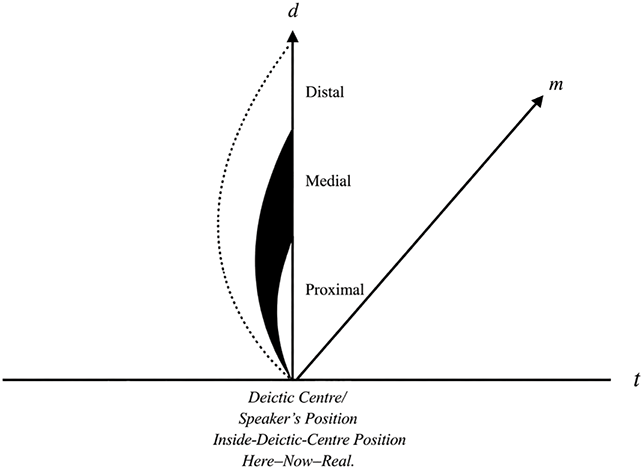
The medial positioning process is characterised by a significant power and agency asymmetry between the speaker/IDC and the discourse entity to be positioned in the medial zone. In this asymmetrical relation, the speaker/IDC entity is constructed by means of the semantic role of Actor who controls performing the action and agency ascription, whilst the positioned discourse entity is constructed via semantic roles of Receiver or Beneficiary. These semantic roles function as a primer to the emergence of asymmetry in power and agency. This is mainly because the medial discourse entities, despite their ideological compliance with the speaker/IDC, lack comparable power, authority, and influence; thus, the scheme relies on the active involvement of the speaker/IDC entity to perform certain actions and fulfil some requirements. Therefore, this asymmetry provides an argumentative ground for deliberation and persuasion towards a worldview that will trigger the speaker’s intentions for either bringing about a desirable situation for the medially positioned discourse entity or enabling it to take the responsibility of materialising a privileged condition or situation.
5.2 Discursive, Cognitive, and Linguistic Framework of Medial Scale Positioning
In the SDS approach, Medial positioning (Figure 6) is conceptualised through the sociosemantic (discursive) strategy of transitional empowerment. Medial positioning sets the scene in which the agency of the speaker/IDC entity is constructed in a way that enables the intended discourse entity to exercise agency and to pursue action. The intended medial discourse entities are depicted as characteristically passive and/or constrained in terms of agency; therefore, the power asymmetry between the speaker/IDC and the discourse entity in the medial zone can be bridged or balanced either by exposing the medial entity to favourable and privileged circumstances or by enabling and supporting it to take agentive roles and responsibilities to act for individual or joint interests. Accordingly, positioning on the medial scale presents its occupant discourse entity’s role in terms of a ‘requestive communication act’ (Tomasello, 2015), more than a static ‘reality’ which lacks any sort of agency. The pragmatic relationship between the aim, the cognitive configuration of action and desirability, and the linguistic tools of persuasion is as follows:
Discursive strategy
◦ Transitional empowerment
Cognitive configuration
◦ Enablement
◦ Removal of restraint
◦ Up-down
Linguistic tendency
◦ Transitive constructions
◦ Cause verbs
◦ Material action verbs
Positioning a discourse entity on the medial scale entails ‘transactive actions’ (van Leeuwen, Reference van Leeuwen2008) on the part of the speaker/IDC entity. This is, however, a unidirectional action which affects the status of the medial discourse entity by creating an alternative situation to the status quo or by empowering it to take responsibility in performing action. From a cognitive perspective, this empowerment is conceptualised through an enablement action schema (Hart, Reference Hart2014), in which the agency of the speaker/DC entity enables the positioned entity to have their needs fulfilled or to improve certain states of affairs.
The activation of the enablement image schema is accompanied by the removal of constraint schema. That is to say, the causal agency and intentionality of the speaker/IDC entity remove the barriers that would otherwise prevent the intended discourse entity from practising their agency in pursuit of goals. However, since no coordinated or joint agency emerges due to this contingent relation, the balance image schema is disrupted in the audience’s mental models. Instead, the metaphoric up-down image schema is activated, which provides a framework for understanding and legitimising power asymmetry between the speaker/IDC entity and the intended discourse entity. Through this configuration, the speaker/IDC entity is up due to privileged access to resources and power, whilst the intended entity is positioned as down because of its dependency. Such a cognitive configuration not only underlies identity and agency attributions, but more importantly, shapes alternative worldviews with regard to socio-political relations through spatial cognition. In so doing, political discourse aims to create an informative communicative act (Tomasello, Reference Tomasello2014, p. 50), where the speaker informs the public of a certain state of affairs that prompts actions to the benefit of the positioned entity. The presentation of dependence of the medial positioned discourse entity on the speaker/IDC entity is an underpinning factor in creating or exacerbating a power asymmetry.
Linguistically, sociosemantic constructions and image-schematic configurations are realised through transitive structures embedding causative verbs (e.g., help, make, allow, permit, bring about, and aid) as well as material action verbs (e.g., build, repair, rebuild, and remove). Moreover, these syntactic configurations are characterised by their causative meaning at both the sentence and discourse levels. At the sentence level, causation is realised through direct transitive and causative relations between discourse entities, whereas at the discourse level, causation extends into broader configurations of enablement, dependency, and agency attribution. Through such linguistic structures, the speaker/IDC entity is discursively represented as the source of action, support, or transformation, whilst the intended discourse entity is presented as contingently dependent upon that agency. Such causative configurations reinforce the enablement and removal of constraint schemas by positioning the speaker/IDC entity as capable of altering the conditions under which the intended discourse entity can exercise agency.
Given these considerations, medial positioning of a group of ‘Us’ entities is conceptualised as an enablement through the transactive action of the speaker/IDC entity. This conceptualisation entails multifaceted aspects of medial positioning in discourse, including the construction of relations between discourse entities, such as actors and agency, needs, desires, goals, and actions, thus creating an intentional mood that prompts force directions on the medial scale. The analysis of these representative discourse entities will shed light on how political discourses create nuanced distinctions in the representation of various intrinsically meaningful discourse entities – particularly ‘Us’ entities – to present their political, ideological, and strategic goals. Democratically, the assumption of a division of agency serves as a main hindrance to the pursuit of collective intentionality for a shared purpose. This indicates that the two discourse entities (speaker/IDC entity and the medial entity) will fail to engage with one another’s interests dialectically. Instead, the focus is solely placed on the interests of the positioned entity but not on possible solutions. This seems a hallmark of populism, where parties claim they can fix the discontent they extermination (Hall, Reference Hall2020; Katsambekis & Stavrakakis, Reference Katsampekis and Stavrakakis2020).
This medial zone in the analysis of the construction of political ideology is significant for CDA primarily because it reveals the reproduction and redistribution of power imbalances between political agents and the ‘Us’ subgroups, thus suggesting that the discourse entity has no real agency.
In the following paragraphs, we provide a detailed analysis of how enablement and transactive action are conceptualised by selective linguistic tools and structures that position discourse entities. We propose a framework for examining discourse entities – the representation of action and intentions and the concept of agency – that support the force and direction of action and possible consequences within the medial scale.
5.3 The Construction of Discourse Entities in Medial Positioning
The medial scale provides ideological, political, strategic, and real-world conditions that inform and shape the speaker’s worldview, encompassing spatial, temporal markers, and modal judgements and attitudes. The positioning within the medial scale involves constructing the identity and agency of the discourse entity through a transitive equation of action construal (Ex. 5.1). Constructed by semantic roles of receiver or benefactor, these medial entities are generally ascribed with passive or restrained agency, largely depending on the supportive agency of the speaker/IDC member in performing a depicted action or fulfilling their requirements and needs. This imbalanced state of agency is a hallmark of medial scale positioning. Unlike proximal scale positioning processes, medial positioning does acknowledge the construction of collective intentionality and joint agency between the speaker/IDC entity and discourse entity. However, power and agency asymmetry cannot be the sole reason for the inclusion of a specific discourse entity on the medial scale of the ‘Us’ group because it is the discursive consequence of the power and agency imbalance for the relationship between speaker/IDC and the discourse entity that determines inclusion in the medial zone.
5.1 The United States has helped Afghanistan avert mass starvation. We are repairing its roads and bridges. We are rebuilding its health clinics and schools. And in one week, with textbooks in hand, the young girls of Afghanistan will begin school. This will be a remarkable moment in the history of Afghanistan, and a proud moment for the people of America. (G. W. Bush, 16 March 2002)
As discussed in Section 1 (Ex. 1.2), Bush’s earlier positioning of Afghanistan was one of partnership, whereas here he positions Afghanistan as merely a recipient of US benevolence, thus shifting agency from shared agency to one-way agency. This representation strategically suppresses the substantial power asymmetry between the two states, thereby deactivating a balanced image schema that provides a fundamental framework for understanding shared agency. Consequently, Afghanistan is positioned within the proximal US scale. However, in later discourse (Ex. 5.1), Afghanistan is depicted as an actor whose ability to act depends on the US intention and assistance. This dependency disrupts the balance image-schema and instead activates up-down image schema, through which the power asymmetry becomes discursively explicit, and Afghanistan shifts to the medial Us band: still an in-group actor, but one whose agency is derivative rather than coequal. In this connection, the findings of Weng and Liao (Reference Weng and Liao2025) provide an important cross-domain parallel to power disparity proposed in the scalar organisation of the deictic space model. Their corpus-based analysis demonstrates that speakers’ choices in direct criticism are not simply determined by structural power relations but by the relational consequences of intimacy and power. Crucially, they show that equal-power interactions support both high-proximity (close) and high-distance (distant) behaviours depending on how the interlocutors interpret the interactional goals and potential face implications. This dynamic, consequence-based management of relational distance reflects the way political discourse constructs and reconstructs in-group actors within scalar bands.
The point is that the dynamic shift in positioning illustrates that power imbalance alone does not determine scalar in-group status. What matters is how the discourse frames and re-frames the consequences of that imbalance, whether it enables partnership (proximal positioning) or exposes dependency (medial positioning). This supports the broader insight, also reflected in Weng and Liao (Reference Weng and Liao2025), that the effect of power asymmetry – rather than the asymmetry itself – is what determines scalar positioning in discourse.
5.3.1 The Representation of the Agent and Agency in Medial Positioning
In medial positioning, the speaker/IDC entity represents the actor and the proposed action, which gives shape to the relationship between the speaker/DC and a specific discourse entity. The position of the actor (speaker/IDC entity) is an indicator of the degree of agency involved in executing the proposed action, revealing how unequal power relations influence the position of the discourse entity, as shaped by the supportive and enabling actions of the actor. In other words, medial positioning affects the portrayal of the actor and the attribution of their agency. From there, it positions the relationship with other discourse entities, which affects intentions for action. This does not diminish the importance of the discourse entity’s position on the medial scale. Instead, by activating the up-down image-schema, the presentation of the positioned entity plays a complementary role in the construction of power imbalances, dependency, and reliance on the speaker’s intentions for action. Overall, the representation of both entities jointly conceptualises the skewed power dynamics and the lack of coordinated agency between the speaker/IDC entity and the positioned entity. In the following, we will account for the representation of both entities in terms of lexical, syntactic, and discursive aspects.
Lexico-grammatically, the positioning operation is commonly conceptualised through transitive constructions, where the entity associated with the speaker and IDC occupies the role of the actor. Any nominal item that can assume the semantic role of the actor thus plays a pivotal role in constructing interpersonal or intergroup relations concerning ideological, political, and strategic actions between the positioned entity and the actor. Nevertheless, it is worth noting that the transfer of an effect or action from the actor to the positioned entity can be conceptualised through various syntactic structures. What stands out here is the pragmatic perception of transitive constructions, as they regulate the dynamics of interactions between two entities in an utterance, based on varying degrees of agency.
In all possible syntactic transitive structures, the agency of the speaker/IDC is constructed by drawing upon their background knowledge, intellectual properties, and the power resources associated with that position. Based on these considerations, the actor is generally represented either by the first-person singular pronoun (I), engaging in actions through individual intentionality, or by the collective pronoun ‘we’, representing collective agency and intentionality. The representation of individual or collective agency for the actor largely depends on the context of the situation, the status of the speaker and the type of action that is suggested.
The set of discourse entities embodying collective intentionality and agency can range from collaboration between the speaker and other IDC members to a coordination between IDC members and discourse entities positioned on the proximal scale. In either case, the function of the operation is to establish a sense of unified agency in the actor position. It is expressed as ‘We’-intentionality and ‘We’-agency and articulated by the speaker/IDC entity to enable and empower the positioned entity.
The representation of the actor with collective agency and intentionality reinforces the power asymmetry between the actor and the positioned entity. This is primarily enacted by subordinating the positioned entity to the actor or its members. For instance, in Example (5.2), the actor role is occupied solely by the collective agency of IDC members (‘We’), who will carry out a supportive and enabling course of action. Given the positioned entity’s lack of parallel or any agency, this representation contributes to its subordination, mainly because the processes of enablement and benefit flow unidirectionally from the Actor (We, the US) to the positioned entity (Georgia and Ukraine).
5.2 Now, I think the Russians ought to understand that we will support – We, the United States, will support the inclusion of Georgia and Ukraine in the natural process, inclusion into NATO. (Obama, 26 September 2008)
A similar conceptual process regarding power dynamics also occurs when the actor is represented as a collaborative entity comprising both IDC members and proximal-scale discourse entities. The key difference in this case is that the subordination process becomes multidirectional. In other words, the conceptualisation of multiple enabling agents results in a network of multidirectional subordinate relationships between the positioned entity and the various actor members. As illustrated in Example (5.3), this type of speaker/IDC representation constructs the positioned entity’s relationship with each individual member involved in supportive and empowering actions. Consequently, the collectivisation and diversification of actor members further reinforce the positioned entity’s disadvantaged power status and lack of parallel agency, reflecting its subordination in relation to each contributing Actor.
5.3 As a part of our coalition’s efforts to build a stable and secure Iraq, we are working to rebuild Iraq’s schools, to get the teachers back to work and to make sure Iraqi children have the supplies they need. (G. W. Bush, 18 October 2003)
In these examples, the actor is represented as assuming direct agency of ‘our coalition’ as well as causative force, bringing about action to affect the positioned entity favourably. Despite the central role accredited to the speaker or DC entity in the transfer of action to the positioned entity (Georgia, Ukraine, and Iraq), the enactment of power relations and dynamics is different as they conceptualise varying degrees of involvement and indirect agency in the construed positioning.
In the case of direct agency, the speaker and any IDC entity are directly and immediately involved in assuming full responsibility for performing the positioning action. Characterised by exerting complete control over the operationalisation of the positioning, the represented actor draws on full, direct, and immediate agency to bring about a new situation, thereby benefiting the positioned entity (Ex 5.4 & 5.5).
5.4 In Afghanistan, we removed the Taliban regime that harboured Al-Qaeda. (G. W. Bush, 13 September 2003)
5.5 In Iraq, we defeated a regime that sponsored terror and used WMDs. (G. W. Bush, 13 September 2003)
In these examples, the use of the pronoun ‘we’ represents the actor of the actions ‘removed’ and ‘defeated’ and constructs a collective agency/intentionality, enacting direct interference by undertaking certain military actions to the assumed benefit of the respective countries. In these construals, the positioned entities are not presented linguistically as agents (Taliban and Iraq), rather, they are presented as having zero agency and lack of role or influence on the performance of the action. On the other hand, the construction highlights the direct and unwavering control of the collective agency of speaker-affiliated (IDC-‘We’)) entities over the actions. In Examples (5.4) and (5.5), the use of the pronoun ‘we’ constructs a collective agency involved in fulfilling the assumed demands and requirements of the positioned entity, which is not explicitly mentioned in the quote, but it can be retrieved from the context that the construed actions affect the status of people in Afghanistan and Iraq. In this representation, the speaker/IDC entity implicitly depicts Afghanistan and Iraq as beneficiaries of the speaker/IDC entity’s action; thereby, they are positioned on the medial scale, as the speaker/IDC entity has taken on the entire individual or collective agency of the empowering action as a matter of fact.
In the following Examples (5.6) and (5.7), the speaker establishes an intentionality on the proximal scale, as work in progress. Entities or collaborations are intended to make haste to fill the needs of people and children in Afghanistan and Iraq, taking on responsibilities of their regimes, such as rebuilding schools and securing students’ attendance. The ‘we’ in these examples obviously excludes those regimes. In both examples, the positioned entities – the people of Afghanistan and Iraq – are represented as devoid of any agency or ability to fulfil their needs or influence the construed actions.
5.6 We will bring help directly to the people of Afghanistan by air drops … (G. W. Bush, 6 October 2001)
5.7 As a part of the coalition’s efforts to build and secure Iraq, we are working to rebuild Iraq’s schools and make sure Iraqi children have the supplies they need. (G. W. Bush, 18 October 2003)
This representation implicitly stresses the dependency of the positioned entity on the actor to fulfil their security demands and needs, and suggests superiority of the benefactor. Through cognitive medial positioning, the speaker or IDC member can also be represented as just a participant, rather than assuming the sole responsibility of implementing the construed action. In such cases, political discourses depict the speaker/IDC entity member as having only partial agency to undertake the action. Linguistically, partial agency can be conceptualised via the semantic structure of the transitive verb, implicitly indicating that the speaker/IDC entity’s role is only to provide encouragement of a discourse entity to undertake measures. In the case of two actors in one construction, the role of the speaker/IDC entity is conceptualised through a causative relationship wherein the speaker/IDC entity is the instigator who assumes a participatory role to encourage action for improvement in and by the positioned entity. We call this process causative agency, referring to the capacity and power of the speaker/IDC entity to cause or bring about an effect, change, or event through the construed actions.
Depending on the degree of direct involvement and the causation of a new state, the representation of causative agency of the speaker/IDC entity manifests itself through either situational causation or supportive causation in the following examples from US political statements. Situational causation refers to a process where the causative agency of an entity directly leads to the emergence of an event or state of affairs. The emphasis is on how an actor’s influence or actions bring about a new situation. Lexico-grammatically, the actor (the US) is the primary driver of the outcome, often appearing in an intransitive construction, with the caused situation or event represented through nominalisation procedures.
5.8 The US can contribute along with other friends of Afghanistan to the reconstruction and development of that troubled nation. (Bush, 6 October 2001)
5.9 We have helped to establish an independent Iraqi central bank … And we have helped restore Iraqi oil production capacity. (G. W. Bush, 11 October 2003)
5.10 Australian special forces entered Iraq with their American and British counterparts at the very beginning operations of Iraqi freedom. They helped to secure sites in Western Iraq that could have been used to launch Scud missiles. (G. W. Bush, 3 May 2003)
5.11 We help transform Iraq into an example of progressed democracy and freedom. (G. W. Bush, 13 September 2003)
5.12 As a part of our coalition’s efforts to build a stable and secure Iraq, we are working to rebuild Iraq’s schools, to get the teachers back to work and to make sure Iraqi children have supplies they need. (G. W. Bush, 18 October 2003)
Individual and collective agencies are assumed and suggest the appearance of an influential state for the positioned entity (Ex. 5.8–5.12). However, although the speaker/IDC entity may play only a partial role/agency in performing the actions as conceptualised by the verb semantics, the occurrence of the supporting situation seems implausible without the definitive influence of the speaker/IDC entity’s partial agency. In Example (5.8), Bush only suggests what can be done with other friends. It is important to note that these representations do not explicitly mention or depict the positioned discourse entity as direct receivers of support and help in the discourse. Instead, the role of the speaker/IDC entity is highlighted as affecting the emergence of this situation. In the Examples (5.8–5.10), the IDC entities (The ‘Us’, We, Australian special forces) are the only actors involved in bringing a new situation or state of affairs into reality (‘… the reconstruction and development of that troubled nation …’ (5.8) ‘… to establish an independent Iraqi central bank …’ (5.9); ‘… to secure sites in Western Iraq …’ (5.10); ‘… transform Iraq into an example of progressed democracy …’ (5.11); ‘… to rebuild Iraq’s schools, to get the teachers back to work …’ (5.12))
In addition to the linguistic exclusion of the positioned discourse entity as the passive receiver of help and support, such representations underscore the lopsided power relations and the positioned entity’s lack of adequate power for self-defence and the fulfilment of their requirements and demands.
In contrast to situational causation, supportive causation is based on enabling the positioned entity to carry out the construed actions. More specifically, it refers to situations where the causative agency of the speaker/IDC entities enables or supports the positioned entity to play a role in bringing about an event. In such representations, the first actor (the speaker/IDC entity) is not the direct causer but creates conditions to support the second actor’s action. The important point is that the agency and action of the speaker/IDC entity as the main actor are indirect and partial.
Supportive causation places emphasis on the enablement and creation of an operationalisable capacity in the agency of the positioned entity within the medial scale. However, the consequences of the action reveal the potency of the positioned entity and the propelling and supportive causation carried out by the speaker/IDC entity. In the Examples (5.13–5.15), the speaker/IDC entity (‘we’ (5.13 & 5.15) and ‘our efforts’ (5.15) perform certain actions that engages/enables the positioned discourse entity to take the responsibility of performing other actions (‘… to help Iraqis participate fully in the global economy …’ (5.13); ‘… help Iraq reclaim its proud heritage of learning …’ (4.15); ‘… to rebuild their economy …’ (4.16)). In such representations, the positioned entity (Iraq and Iraqis) is ascribed agency by the speaker/IDC entity to be able to carry out the suggested actions. This agency ascription, or supportive causation, renders the positioned entity fundamentally dependent upon the supportive agency of the speaker/IDC entity. More specifically, enablement by its very nature is supplied partly by ascribing agency and partly by a specific type of enablement determined by the semantic properties of verbs. Lexico-grammatically, enablement and agency attribution co-occur with increasing valency of verbs in causative constructions. As Frawley (Reference Frawley1992, p. 159) notes, causative constructions enable two events: namely, the precipitating event performed by the first agent, and the result, which is the consequence of the action performed by the second agent. In this connection, Dixon (Reference Dixon, Dixon and Aikhenvald2000, pp. 30–31) examines causative constructions in transitive verbs in terms of the interaction of agency and maintains that increasing the valency of a verb adds one or more argument to the verb, with one extra causer added to the original one. However, it is important to note that the original causer controls the entire action-performing procedure.
From a pragmatic perspective, valency increases and the addition of an extra agent (or causer) entails the attribution of power and capacity to the positioned discourse entity or second actor. It appears that when valency increases, the enablement process involves shifting responsibility, through which the positioned entity becomes activated in discourse. However, it is worth mentioning that the second actor is represented as less authoritative and more subject to the influence of the causer. In Examples (5.13–5.15), the supportive agency of the speaker/IDC entity engages the positioned discourse entity in doing an action by assigning responsibility and role to realise the designated prospective actions and objectives (e.g., ‘… participate fully in the global economy …’ (5.13)). These prospective actions not only shape the agency and identity of the positioned entity but also engage them in certain efforts to materialise a privileged view of the future (Dunmire, Reference Dunmire2011).
5.13 We intend to establish computer training and English language instructions and recreational programs to help Iraqis participate fully in the global economy. (G. W. Bush, 11 October 2003)
5.14 Our efforts will help Iraq reclaim its proud heritage of learning, and bring it into the family of nations. (G. W. Bush, 17 October 2003)
5.15 We are helping Iraqis to rebuild their economy after a long era of corruption and misrule. (G. W. Bush, 11 October 2003)
Another noteworthy point is that our perception of agency and valency is fundamentally pragmatic. This means that these two variables can appear in various syntactic constructions other than their unmarked causative form, such as peripheral propositional constructions. What is at stake in such syntactic diversity is the assumption of agency and increasing valency of enablement and support as a pragmatic, not syntactic, phenomenon, as shown in the following examples.
5.16 Under our strategy, Iraq will have an employment centre to help people find jobs. (G. W. Bush, 11 October 2003)
5.17 Today, with our help, the people of Iraq are working to create a free, functioning and prosperous society. (G. W. Bush, 13 September 2003)
5.4 The Representation of Action
In medial scale positioning, the represented actions are largely material involving doing something that has at least a material effect or purpose (van Leeuwen, Reference van Leeuwen2008, p. 59). In the Examples 5.4 and 5.15, the acts of ‘removing’ and ‘rebuilding’ an entity or a thing produce certain effects whose results can be evaluated or assessed. In these examples, the former represents a situation in which antagonistic forces and entities no longer exist, whilst the latter creates a situation where the economic system will be rehabilitated.
In medial positioning, material actions are often transactive; that is, actions that an actor performs for someone or something to achieve a goal, which can be a thing, an entity, or a process (van Leeuwen, Reference van Leeuwen2008, p. 60). The transactive variant of a material action best illustrates power imbalances between the speaker/IDC entity and the positioned entity. According to van Leeuwen (Reference van Leeuwen2008), a certain amount of power is required to transact and consequently affect a particular entity as a positioned entity. For instance, in Example (5.6), the verb ‘will bring help’ is a material transactive action that will benefit the ‘people of Afghanistan’. For this to happen, it is necessary for the actor (‘we’) to carry out the constructed action with the alleged quality. It suggests that the positioned entity lacks this amount of power required to carry out the action. The presented state of affairs of the proximal and medial scales together provides a pre-emptive direction towards the distal scale as to who is responsible, who is in need and who is prepared to act and where, when, how, and why.
5.5 Summary of the Section
This section theorises and demonstrates medial scale positioning as a key mechanism through which political discourse constructs internal power asymmetries within the Us group and how these positions are reconstructed over time. Positioned between proximal and distal zones, the medial scale is characterised by unequal distributions of agency and authority between the speaker/IDC and medially positioned discourse entities. Whilst these entities remain ideologically aligned with the speaker, they are discursively represented as dependent, constrained, or in need of enablement. Through this spatial cognitive positioning paired with cognitive-linguistic devices, speakers establish a persuasive narrative continuity that often masks the possibility of collective agency.
Drawing on cognitive, discursive, and sociosemantic frameworks, the section demonstrates that medial positioning is realised through transactive actions and enablement schemas, whereby agency flows unidirectionally from the speaker to the positioned entity. This process shifts between foregrounding dependency and joint intentionality and often suppresses the possibility of collective agency. The section further distinguishes between direct agency, situational causation, and supportive causation, showing how varying degrees of involvement and responsibility attribution reinforce hierarchical relations within the in-group. Empirically illustrated through political discourse examples, the analysis reveals that medial positioning does not merely reflect power imbalance but strategically frames its consequences. As such, the medial scale plays a crucial role in legitimising change of strategy and reproducing ideological control, legitimising intervention, and redistributing agency within political world-building, making it a significant analytical site for critical discourse analysis.
6 Distal Positioning
6.1 Introduction
The distal scale positioning is a construal operation through which a particular entity is conceptually accommodated at the most remote scale of the distance vector scale within the deictic space (Figure 7). The conceptualisation and discursive representation of the distal positioning are triggered by specific strategic considerations and priorities, which are enacted and enforced by the DC of the deictic space. In a similar vein, and consistent with proximal and medial construal operations, distal positioning is conceptualised and discursively represented through the representation and construction of actors and the construal of events. This representational mechanism is crucial, as it is only through the representation of actors or entities, and the contextual construction of their agencies, that one can meaningfully delve into how interpersonal relations are shaped and reshaped, and how power differentials – as well as strategic, ideological, and material considerations – influence the development of social and political relations and equations. It is precisely this dimension of representational work that constitutes the primary conceptual area distinguishing variation and change in scalar positionings.
Distal scale positioning.
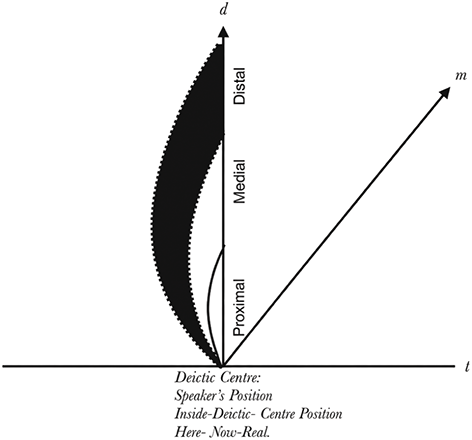
6.2 Discursive, Cognitive, and Linguistic Framework of Distal Scale Positioning
What makes distal scale positioning fundamentally distinct from both proximal and medial positioning construals of positioning is that the speaker/IDC entity is constructed as devoid of any material agency capable of altering or changing the status quo for the positioned entity. In other words, the agency constructed through the event-construal excludes the speaker/IDC entity from any material action undertaken in the interest of the positioned entity. This exclusion of material agency stems from the speaker/IDC entity’s lack of engagement in any material action for the positioned entity. Instead, in distal positioning, the speaker/IDC entity is construed as being involved in symbolic action (van Leeuwen, Reference van Leeuwen2008), solely to communicate (speculative) meaning and not intentions for action. It lacks any specific or significant purpose or material impact; it constitutes only a discursive and representational attempt to convey a particular meaning. Positioning at the distal scale can thus be understood as a form of meta-representation (van Leeuwen, Reference van Leeuwen2008). It operates solely by ascribing an identity to the positioned entity which conforms to the underlying identity-constructing value system and patterns emerging from a DC. Discursively, this algorithm subjectively selects and foregrounds certain semiotic resources (e.g., lexical choices, metaphors, deixis, or framing strategies) whilst omitting or backgrounding others. In the case of distal positioning, it ascribes identity not through material engagement or agentive involvement (as is the case with proximal and medial positionings) but through symbolic representation that aligns the positioned entity with a set of predefined roles, values, or statuses. This alignment reflects the DC’s value system – what it prioritises, marginalises, or silences.
Distal scale positioning is rooted in the sociosemantic construction of non-committal alignment, which can be further categorised into instrumental inclusion through shared opposition and moral inclusion. Instrumental inclusion through shared opposition occurs when the speaker positions the intended entity within the ‘Us’ space on the basis of shared antagonism towards a third party. In this configuration, inclusion is strategically motivated and remains contingent upon common opposition rather than coordinated agency or genuine solidarity. Moral inclusion, by contrast, involves the speaker offering moral, humanitarian, or semiotic support towards the intended discourse entity without engaging in material or transactive action.
Cognitively, these forms of non-committal alignment presuppose the activation of distance and separation image schemas. These fundamental cognitive structures provide the underlying framework for understanding the absence of engaging relations between the speaker/IDC entity and the intended discourse entity. In particular, the separation schema is activated to foreground the entity’s lack of belongingness to the proximal and medial scales of the DC, thereby reinforcing symbolic inclusion without practical engagement or coordinated agency.
Linguistically, distal positioning is conceptualised through verb phrases embedding verbs of perception (e.g., see), verbs of symbolic support (e.g., stand with), and reporting verbs (e.g., insist, declare) that do not denote engagement in material action. In this connection, the agency of the speaker is characterised by axiological and epistemic authority, whilst withdrawing from the enactment of causal or interventionist agency. Meanwhile, the agency of the intended entity in relation to its own affairs is syntactically construed through activation in verbal processes, whilst simultaneously being backgrounded through strategies of generalisation, metonymisation, and personification. Such linguistic configurations reinforce symbolic alignment whilst preserving relational and agentive distance between the speaker/IDC entity and the intended discourse entity.
6.3 Instrumental Inclusion through Shared Opposition
By adopting this discursive strategy, a political speaker conceptually locates an entity within the ‘Us’ camp on the distal scale, based solely on shared animosity or opposition towards a third party. This form of inclusion is conditional, symbolic, and non-committal, serving to amplify the speaker’s antagonism towards the target rather than affirm solidarity with the positioned entity. Cognitively, such a configuration is grounded in the distance image schema, through which the positioned entity is acknowledged within the symbolic ‘Us’-space whilst remaining interactionally and agentively remote from the speaker/IDC entity.
Distal positioning is a rhetorical operation of value-based alignment between the speaker/IDC entity and the positioned entity, yet it does not entail material support or formal alliance. Through such an oblique inclusion, the discursive practice is intended to undermine the legitimacy of the third party and deepens the rupture between the positioned entity and the third party, as shown in Example (6.1).
6.1 In Iran, we continue to see a government that represses its people, pursues weapons of mass destruction, and supports terror. We also see Iranian citizens risking intimidation and death as they speak out for liberty and human rights and democracy. Iranians, like all people, have a right to choose their own government and determine their own destiny – and the United States supports their aspirations to live in freedom. (G. W. Bush, 28 January 2003)
In this example, Distal inclusion operates as a strategic and instrumental discursive move. The political speaker constructs a binary opposition between the IRI and the Iranian people, framing the former as repressive and illegitimate, and the latter as engaged in active contestation against it. The IRI is described as a regime that ‘represses its people, pursues weapons of mass destruction, and supports terror’, whilst the Iranian citizens are depicted as ‘risking intimidation and death as they speak out for liberty and human rights and democracy’.
This oppositional framing enables a distal inclusion of Iranian citizens into the speaker’s ‘Us’-camp, not on the basis of shared moral values or genuine solidarity, but instrumentally – as a discursive tool to intensify antagonism towards the IRI. In the example, the Iranian people are included only insofar as they oppose their government, and their resistance is semiotically recruited to support the speaker’s broader foreign policy narrative. In this way, the speaker symbolically separates the people from the regime, portraying them as a distinct political identity yearning for freedom and democracy – values that are core to the speaker’s own national self-conception.
This type of inclusion remains non-committal, conditional, and symbolic. It does not imply any material support, formal alliance, commitment or genuine recognition of the Iranian people’s agency. Instead, their struggle is discursively appropriated to undermine the legitimacy of the IRI and to widen the representational and ideological rupture between state and society within Iran. The speaker, in turn, reinforces their own position as the defender of democratic values without taking responsibility for the included population. Through this instrumental distal inclusion, the Iranian people are not positioned as full subjects within a shared moral or political community, but rather as rhetorical assets – their protests functioning as evidence of the regime’s brutality and failure. The discursive strategy thus creates a tripartite positioning: the IRI as the delegitimised Other, the speaker as the moral authority, and the Iranian people as conditionally included Others whose opposition serves the speaker’s strategic ends. This configuration further activates the vertical schema, positioning the speaker/IDC entity as occupying a morally elevated position from which democratic legitimacy is evaluated and distributed.
6.4 Moral Inclusion through Semiotic Alignment
By appealing to moral values as a discursive strategy, a political speaker expresses discursive concerns, sympathy, or moral support for specific entities or causes without engaging in material action. Cognitively, this symbolic and non-committal alignment is grounded in the distance image schema, through which the included entities are acknowledged within the speaker’s moral horizon whilst remaining interactionally and agentively remote. This form of inclusion is ethical and symbolic, used to construct a moral identity and to demonstrate normative alignment without any concrete policy commitment. It primarily relies on passive or normalised expressions such as warnings or suggestions – for example, statements like ‘the violence must stop’ – and often occurs in contexts of humanitarian crises or politically sensitive zones. Similar to instrumental distal inclusion, moral inclusion maintains a non-committal stance whilst signalling a moral presence.
Moral distal inclusion refers to a discursive strategy whereby a political speaker expresses ethical concern, discursive sympathy, or normative support for distant entities, populations, or causes, typically situated in contexts of humanitarian crisis or political sensitivity. Crucially, such inclusion is not operationalised through material action or policy commitment; rather, it is axiologically constructed, drawing on values such as freedom, democracy, liberty, and human rights to establish a symbolic relationship that remains non-committal and representational. Through this strategy, the speaker simultaneously affirms their own moral identity whilst refraining from altering the material or political status of the included entities.
Examples (6.2–6.4) illustrate how this form of inclusion is discursively realised. In each case, the speaker recruits an axiological register to construct proximity with foreign populations whose political aspirations are represented as convergent with liberal-democratic values. For instance, in Example (6.2), the speaker declares: ‘we will stand with citizens as they demand their universal rights … we will insist on respect for the fundamental rights of all people’. Likewise, in (6.4), the utterance ‘we will advocate for those values that have served our own country so well’ positions the speaker as the guardian of a shared normative order, whilst simultaneously generalising the scope of inclusion through the invocation of ‘all human beings’. What emerges here is not a call for concrete engagement, but a semiotic gesture of alignment – a symbolic inclusion grounded in moral universals rather than in political commitments. This configuration activates the vertical image schema, whereby the speaker/IDC entity occupies a morally elevated position from which universal values are articulated and distributed.
6.2 In the Middle East, we will stand with citizens as they demand their universal rights and support stable transitions to democracy. We know the process will be messy, and we cannot presume to dictate the course of change in countries like Egypt, but we can and will insist on respect for the fundamental rights of all people. (B. Obama, 12 February 2013)
6.3 After 2014, we will support a unified Afghanistan as it takes responsibility for its own future. (B. Obama, 28 January 2014)
6.4 And whilst it’s ultimately up to the people of the region to decide their fate, we will advocate for those values that have served our own country so well. We will stand against violence and intimidation. We will stand for the rights and dignity of all human beings: men and women; Christians, Muslims, and Jews. We will support policies that lead to strong and stable democracies and open markets, because tyranny is no match for liberty. (B. Obama, 14 January 2012)
Modality plays a central role in this construction. Expressions in these examples, such as ‘we will stand with’, ‘we will support’ and ‘we will advocate’operate within a discursive register of normative reassurance, signalling ethical alignment whilst maintaining a deliberate vagueness regarding scope, scale, or consequence. These modal constructions foreground the speaker’s moral presence but abstain from articulating specific actions, intentions, or responsibilities. This allows the speaker to perform inclusion symbolically, without incurring the discursive or geopolitical costs associated with formal alliances or interventionist commitments. The distance schema is thus preserved by the deliberate absence of transactive or causative engagement which allows the speaker to maintain moral alignment whilst avoiding practical involvement.
The significance of this type of construal is that such moral inclusion does not primarily seek to empower the included populations; rather, it functions to reaffirm the speaker’s own ethical subjectivity. Such formulations activate the separation schema by informing about a clear boundary between symbolic support and material responsibility. As evidenced in (6.2), the speaker explicitly states: ‘we cannot presume to dictate the course of change in countries like Egypt’ – a formulation which, whilst ostensibly deferring to local agency, simultaneously marks the speaker’s discursive boundary: present, but non-interventionist; supportive, yet passive. This rhetorical positioning is similarly evident in Example (6.3), where the commitment to ‘support a unified Afghanistan’ remains abstract and undefined. Thus, the discursive construction of inclusion is maintained at the level of axiological discourse, instrumentalised not for the benefit of those symbolically included, but for the consolidation of the speaker’s normative authority.
Moral distal inclusion, then, operates through a logic of axiological recruitment, whereby the speaker selectively invokes values such as liberty and democracy to construct a symbolic ‘Us’ that includes distant others on a representational plane. However, this inclusion bears no tangible consequences or commitments for the speaker. It is, rather, a discursive performance of moral alignment, deployed to signal presence and care whilst upholding the speaker’s strategic detachment. Through this configuration, the speaker preserves a morally elevated position through the vertical schema whilst simultaneously preserving relational and agentive distance from the symbolically included entities. In this sense, moral inclusion resembles instrumental distal inclusion in its non-committal character, yet it diverges in its modality: it does not draw on shared opposition to a third party, but on shared adherence to abstract normative principles. Its function is less about oppositional framing and more about moral positioning, where inclusion becomes a means of staging the speaker’s ethical legitimacy without incurring obligations.
6.5 The Construction of Actors
In distal positioning, the ascription of agency to actors is crucial in specifying and distinguishing distal scale from proximal and medial scales. In distal positioning, however, the agency is not simply assigned; rather, it is schematically configured, grammatically modulated, and ideologically constrained. The discursive environment is marked by an asymmetrical allocation of agentive roles, wherein the speaker/IDC entity maintains axiological and epistemic authority whilst withdrawing from enactment of causal or interventionist agency. The speaker’s position is typically constructed as morally central but materially passive, allowing them to signal presence, support, or alignment without engaging in direct political or policy actions.
In contrast, the positioned entity – distant ‘Us’-entity – is frequently constructed within an agentive discursive environment. This role is discursively realised through a variety of semiotic resources, ranging from explicit activation to backgrounded or abstracted forms of agency. Drawing on van Leeuwen’s (Reference van Leeuwen2008) framework, we observe that agentive positioning operates along a continuum from activating agency into action.
6.5.1 Activated Agency via Verbal Process
In many cases, the positioned entity is represented as an activated actor through non-embedded or embedded verbal clauses.
6.5 We will stand with the nearly 12 million Iraqis who voted for their freedom. (G. W. Bush, 30 September 2006)
6.6 In the Middle East, we will stand with citizens as they demand their universal rights and support stable transitions to democracy. We know the process will be messy, and we cannot presume to dictate the course of change in countries like Egypt, but we can and will insist on respect for the fundamental rights of all people. (B. Obama, 12 February 2013)
In these two examples, ‘citizens’ and ‘nearly 12 million’ Iraqis are constructed as active actors involved in a political event via the verbal process ‘demand’ and ‘vote’. The speaker remains non-agentive via the verbs ‘stand with’ and ‘insist’ yet discursively aligns with the values underlying the positioned entities’ actions. Importantly, the positioned entity is legitimised only through value alignments whilst the action is recognised because it resonates with the speaker/DC’s axiological framework (e.g. ‘universal rights’, ‘their freedom’, ‘fundamental rights of all people’).
6.5.2 Backgrounded Agency via Objectivation and Assuming Possession
There are other instances in which agency is grammatically backgrounded. As for instance in Example (6.7), the democratic action of electing government is objectified, according to van Leeuwen (Reference van Leeuwen2008). It is realised not as an event but as a nominalised outcome of what people did in a democratic manner (‘elect’). However, the possessive pronoun ‘their’ presupposes an institutional democratic agency, rather than an actually performed or possible democratic agency. Semantically, this reduces ‘their’ political struggle to a semantic claim to ‘their’ agency.
6.7 The United States and our allies stand with the people of Georgia and their democratically elected Government. We insist that Georgia’s sovereignty and territorial integrity be respected. (G. W. Bush, 15 August 2008)
Generalisation/Specification of the Positioned Entity
Another recurring strategy is generalisation (van Leeuwen, Reference van Leeuwen2008), wherein specific groups are abstracted into typified representations. Consider Example (6.8):
6.8 We stand with the girl who yearns to go to school in Afghanistan, why we support the human rights of the women marching through the streets of Iran, why we advocate for the young man denied a job by corruption in Guinea. (B. Obama, 27 January 2010)
Though situated within localised contexts, these entities, school girls, women and young men, are construed as generic exemplars and not as individuals, but as representatives of types. This facilitates symbolic inclusion by enabling the speaker to align with values, rather than specific political actors. The discursive focus is not on their unique struggles but on what they typify: liberal aspirations that align with the speaker’s moral framework. Thus, generalisation contributes to value-based positioning whilst abstracting from the specificity of political realities.
Metonymisation and Personification
A related strategy is metonymisation, often involving the personification of geopolitical entities. In Example (6.9), ‘Afghanistan’ functions metonymically, substituting for its population and internal diversity. The nation state is personified as a singular actor, collapsing social complexity into a homogenised and governable actor. This allows the speaker to frame agency at the national scale, whilst eliding class, ethnic, or political distinctions within the country. It also permits morality without direct reference to specific agents or movements.
6.9 After 2014, we will support a unified Afghanistan as it takes responsibility for its own future. (B. Obama, 28 January 2014)
6.5.3 Temporal Projection and Conditional Agency
Finally, agency is sometimes cast into the future and made contingent upon ideological alignment. As in Example (6.10):
6.10 While it’s ultimately up to the people of the region to decide their fate, we will advocate for those values that have served our own country so well. We will stand against violence and intimidation. We will stand for the rights and dignity of all human beings: men and women; Christians, Muslims, and Jews. We will support policies that lead to strong and stable democracies and open markets, because tyranny is no match for liberty. (B. Obama, 24 January 2012)
This formulation foregrounds local agency and simultaneously marks it as a conditional – the discursive positioning within the speaker’s ‘Us’-camp becomes dependent on the political choices made by the other. Inclusion is not immediate or stable; it is projected and contingent, subject to alignment with the speaker’s normative commitments. This temporal projection enacts a future-oriented conditionality, where moral positioning is promised, but not yet granted. In other words, this inclusion and positioning conceptualise a type of privileged future (Dunmire, Reference Dunmire2011; Cap, Reference Cap2020).
However, unlike in proximal and medial positioning, where agency is ascribed to the speaker/IDC entity to actively exert and relocate an entity towards the DC, in distal positioning, agency is largely projected onto the positioned entity. This discursive shift makes a strategic recalibration in which the speaker foregrounds the agency of a distantly positioned entity whilst maintaining their own Moral/ideological authority. Such a configuration may suggest that agency, in these contexts, is not politically instrumental or beneficial to the speaker, or that engaging in material action is not feasible or desirable due to geopolitical sensitivities, contextual constraints, or strategic calculations. In such cases, the speaker abstains from operational agency and instead recruits a value-based, ideologically infused mode of support that is symbolic and non-committal. This semiotic action, whilst lacking policy consequences, performs the speaker’s ethical presence and moral alignment. As such, in distal scalar positioning, the representation of agency does not function to activate the speaker’s involvement but to legitimise the values with which the positioned entity’s actions are aligned. This enables the speaker to participate discursively without assuming responsibility, thereby sustaining a mode of inclusion that is ideologically voiced yet materially withdrawn.
6.5.4 Action Representation in Distal Scalar Positioning
In distal scalar positioning, the speaker/IDC entity’s action is discursively constructed as symbolic, non-committal, and predominantly semiotic, aimed not at material transformation but at reaffirming moral/ideological alignment. Unlike proximal and medial positioning, where action is often realised through transactive or goal-oriented processes (van Leeuwen, Reference van Leeuwen2008) – such as collaboration, alliance, or intervention – distal positioning favours interactional action: those that seek to shape political relations rather than alter material conditions. These actions are semiotic in nature, designed to construe affective or moral relations with the positioned entities, without crossing the threshold into formal commitment or geopolitical engagement.
Across data, such a semiotic action is discursively realised through modalised declarations of alignment or support. For instance, in (6.6), the speaker asserts ‘we will stand with citizens as they demand their universal rights and support stable transitions to democracy’. Here, the speaker’s actions (‘stand with’ and ‘support’) are non-transactive – it does not initiate cooperation, resource exchange, or policy intervention. Instead, it signals a discursive presence, aimed at recognising the agency and legitimacy of distant ‘Us’ entities. Similarly, in (6.10) the speaker announces: ‘we will advocate for those values that have served our own country so well’. The action here (‘advocate’, ‘stand with’) is again symbolic, targeting the normative landscape rather than the material situation. The speaker’s action becomes a gesture of solidarity, framed through moral universals such as freedom, dignity, and rights. Whilst these verbs suggest intention, they remain non-instrumental, producing no identifiable material effect.
This pattern is consistent across formulations that rely on generalised or future-oriented action. In Example (6.3), we read: ‘After 2014, we will support a unified Afghanistan as it takes responsibility for its own future’ (B. Obama, 28 January 2014): ‘support’ here is discursively contingent upon Afghanistan’s own action (‘as it takes responsibility’), reinforcing a logic of conditional alignment. The speaker’s role is reactive rather than generative, signalling that the burden of action rests with the positioned entity, whilst the speaker retains a discursively elevated yet materially passive stance.
These discursive actions can be further characterised as relational but not reciprocal. That is, they seek to cultivate moral closeness, the rhetoric of ‘we stand with …’ or ‘we support …’, but do not initiate bilateral cooperation or shared actions. The underlying interactional logic is one of semiotic positioning without political integration. In this sense, the speaker rehearses the affective language of solidarity whilst maintaining strategic distance, avoiding the discursive implications of obligation or alliance.
What emerges then is a distinctly spatial modality of action, one that performs ethical and/or discursive presence rather than political engagement. This allows the speaker to construct themselves as a moral actor without entering into transactional commitments. Such positioning is particularly useful in contexts where political, legal, or geopolitical constraints prevent more substantive involvement, and where discursive support is the only viable or desirable mode of participation.
6.6 Summary of the Section
In this section, we have examined distal scale positioning as a distinct construal operation within the SDS framework, through which discourse entities are located at the furthest conceptual distance from the DC whilst remaining symbolically aligned with the ‘Us’-camp. Unlike proximal and medial positioning, distal positioning is characterised by the absence of material agency on the part of the speaker or IDC. Instead, the speaker’s involvement is limited to semiotic action – discursive, symbolic, and axiological practices that communicate meanings without producing material or policy effects. Distal positioning thus operates as a form of meta-representation, in which identity is ascribed through symbolic alignment rather than agentive engagement.
The analysis of distal positioning identifies two principal strategies through which distal inclusion is discursively realised. The first strategy of instrumental inclusion through shared opposition recruits distant entities into the ‘Us’-camp solely on the basis of their antagonism towards a third party. This inclusion is conditional and non-committal, functioning primarily to delegitimise the targeted Other rather than to empower the included entity. The second strategy of moral inclusion through semiotic action relies on axiological alignment with universal values such as democracy, freedom, and human rights. In this strategy, political actors express ethical concern and normative support whilst deliberately withholding material commitment, thereby reaffirming their own moral authority.
The section further analyses how agency is strategically distributed in distal positioning. Whilst the speaker retains epistemic and axiological authority, agency is largely projected onto the positioned entity through activated, backgrounded, generalised, metonymised, or temporalised conditional representations. ‘Action’ in distal positioning is correspondingly symbolic and non-transactive, realised through modalised expressions of support, advocacy, or solidarity. Overall, the section demonstrates that distal positioning enables political actors to perform moral presence and ideological alignment whilst maintaining strategic detachment, revealing how power, responsibility, and legitimacy are discursively managed through distance rather than engagement. It can also reveal how discursive strategies change over time, depending on political developments.
7 Discussion and Conclusion
This Element presents a discourse approach that rethinks political discourse through the cognitive geometry of spatial positioning, advancing the Scalar Deictic Space (SDS) approach as a means of tracing how political actors construct identity, agency, legitimacy, and intentionality across dynamic discourse spaces. By foregrounding the primacy of spatial cognition and its scalar affordances, the analysis has demonstrated that political worldviews are not merely articulated through ideological labels, thematic frames of linguistic constructions, but are systematically (re-)configured through schematically shifting relations of proximity, dependency, and distance relative to a DC, whether Inside a DC or Outside the DC. One of the most consequential insights emerging from this framework is that the political in-group – the ‘Us’-category that is central to political persuasion – cannot be adequately understood as a homogeneous or stable entity. Rather, it is internally differentiated, hierarchically organised, and continuously recalibrated through scalar positioning practices that assign varying degrees of agency, responsibility, and moral worth.
Across the sections, the ‘Us’-group is shown to be constituted on a dynamic-spatial reconceptualisation rather than a binary one. Proximal positioning constructs relations of shared intentionality and joint agency, producing a sense of immediacy, familiarity, and mutual responsibility between the speaker and selected discourse entities. Medial positioning, by contrast, reveals how internal differentiation within the ‘Us’-camp is achieved through dependency framing and enablement schemas, whereby entities are included but positioned as contingent, supported, or reliant on the speaker’s authority and resources. Distal positioning extends this internal differentiation by allowing symbolic inclusion without material commitment, projecting moral alignment or shared values whilst withholding agency, obligation, or intervention. Together, these scalar configurations demonstrate that in-group membership is not a categorical status but a relational and dynamic outcome of discursive positioning. The ‘Us’- group thus emerges as a stratified space in which inclusion is graded, conditional, and strategically adjustable.
This dynamic-spatial reconceptualisation challenges long-standing assumptions in political discourse analysis that treat in-groups primarily as unified collectives opposed to a clearly demarcated Other. Whilst antagonistic othering remains a powerful discursive strategy, the SDS framework reveals that much of the persuasive work in political discourse occurs within the in-group itself. Political actors must not only construct external threats or adversaries but also manage internal relations of power, trust, and dependency. By positioning some ‘Us’-entities as partners, others as beneficiaries, and yet others as morally aligned but distant, speakers can distribute agency unevenly whilst maintaining an appearance of inclusivity and coherence. This internal stratification is particularly salient in democratic contexts, where overt exclusion or domination risks undermining legitimacy, and where consent must be continuously negotiated rather than imposed.
The analytical value of scalar positioning lies precisely in its capacity to make these internal dynamics visible. Unlike binary models of inclusion and exclusion, SDS captures the intermediate and often ambiguous positions that discourse entities occupy as political relations evolve over time. By integrating spatial, temporal, and modal dimensions, the approach allows analysts to trace not only where entities are positioned, but how those positions are evaluated, stabilised, or contested. Scalar positioning foregrounds directionality and force: entities can move closer to or further from the DC, acquire or lose agency, and shift from joint intentionality to dependency or symbolic alignment. Furthermore, as political landscapes change over time, the scalar configuration will adapt to change and this can be monitored with the Scalar Deictic Space approach. These movements are not incidental but reflect the underlying dynamics of strategic calculations, ideological priorities, and contextual constraints.
Crucially, SDS also demonstrates that scalar positioning cannot be reduced to objective power relations. Whilst material power asymmetries certainly shape political discourse, the analysis shows that it is the discursive framing of the consequences of these asymmetries that determines scalar placement. An entity with limited material power may be proximally positioned if framed as a partner or ally, whilst a materially powerful entity may be distanced if framed as ideologically misaligned or morally suspect. Conversely, dependency can be foregrounded not to reflect incapacity per se, but to legitimise intervention, enablement, or control. Scalar positioning thus operates at the intersection of cognition and ideology, translating structural relations into persuasive worldviews that appear ontologically coherent and morally justified.
Another central attribute of the SDS framework is its treatment of modality as an evaluative overlay rather than a derivative of spatial or temporal distance. Political discourse frequently combines proximal positioning with epistemic uncertainty, or medial and distal positioning with strong modal commitment. These non-isomorphic combinations are not anomalies but strategic resources. An important advantage of shifting position is that it allows speakers to test the ground for emerging alliances, project future-oriented goals, or maintain ambiguity in situations where commitment would be costly. By exposing and accounting for these configurations, SDS avoids deterministic mappings between distance and evaluation. By contrast, it offers a flexible model capable of capturing the rhetorical subtleties of political reasoning. The implications of this approach for political discourse analysis are significant. First, SDS provides a means of systematically analysing change over time. It investigates the cognitive ground on which linguistic formulations become meaningful in a dynamic context. Political relations are inherently dynamic and any framework that treats identities or alliances as static risks missing the trajectory of conceptual developments. The scalar model, with its emphasis on movement, direction, and reconfiguration, is particularly suited to diachronic and comparative studies. It enables researchers to track how discourse entities migrate across scales in response to shifting contexts, crises, or strategic realignments, and how such movements recalibrate the distribution of agency and responsibility within political worldviews. The trajectories of positioning over time can help to inform future projections.
Second, SDS could enhance critical studies by offering a cognitive grounding for the analysis of power that complements, rather than replaces, existing ideological and socio-political frameworks. Power is not only exercised through explicit commands, institutional authority, or material coercion, but also through the subtle management of temporal and spatial distance and proximity in discourse. By positioning some entities as dependently close and others as safely distant, political actors can normalise asymmetrical relations whilst presenting them as natural, necessary, or benevolent. Scalar positioning thus functions as a mechanism of soft power, operating through cognitive plausibility rather than overt domination. Making this mechanism analytically visible is a key contribution of the present Element.
Third, the framework has implications beyond the analysis of elite political discourse. Whilst the examples discussed here draw primarily on presidential speeches and party platforms, the underlying cognitive principles apply equally to media discourse, institutional communication, and public narratives. In an era of globalised communication and rapidly shifting political alignments, the ability to map how actors and issues are positioned across scalar spaces is crucial for understanding how legitimacy, urgency, and moral authority are constructed and contested. SDS offers a transferable analytical tool that can be adapted to different genres, languages, multi-modal communication, and political systems, precisely because it builds on the generic spatial properties of human cognition.
Finally, the SDS approach underscores the importance of rethinking critical discourse analysis itself as a field that must account for both structure and flexibility by also paying attention to background manoeuvres that shape positions, attitudes, and agency. Political discourse operates within constraints – historical, institutional, ideological – but it also exploits the malleability of cognitive frames to adapt to new circumstances. The SDS contributes to this tension by providing a systematic yet dynamic model, capable of capturing patterned variation without imposing rigid typologies. It does not seek to predict political outcomes or prescribe normative solutions, but to illuminate the cognitive scaffolding through which political reasoning is made persuasive and actionable.
In conclusion, it is argued that scalar positioning is not a peripheral rhetorical device but a fundamental mechanism of human communication and in particular in political discourse and ‘doing politics’. By rethinking in-group homogeneity, foregrounding the analytical value of scalar relations, and situating political communication within a dynamic cognitive geometry of space, time, and modality, the SDS framework advances our understanding of how political worldviews are constructed, maintained, and transformed. It reveals that persuasion operates not only through what is said, but through where entities are placed in relation to a DC that defines what counts as real, relevant, and actionable, as well as which way they are directed. In this way, SDS contributes to critical discourse studies by offering a theoretically grounded, methodologically flexible, and empirically applicable approach to analysing the dynamics of power, identity, and intentionality in contemporary political discourse.
AI Use Statement
AI-assisted tools were used in a very limited manner solely for copy-editing, proofreading, and improving the flow and readability of selected parts of the manuscript. No AI tools were used for generating the theoretical framework, developing the argument, selecting or analysing data, interpreting findings, or producing original scholarly content. All conceptual development, analytical claims, and final decisions remain entirely the authors’ own.
Luis Javier Pentón Herrera
VIZJA University
Luis Javier Pentón Herrera, Ph.D., is the 2024 TESOL Teacher of the Year, awarded by the TESOL International Association and National Geographic Learning. He is a Professor (Profesor uczelni, in Polish) at Akademia Ekonomiczno-Humanistyczna w Warszawie, Poland and Co-Editor of Tapestry: A Multimedia Journal for Teachers and English Learners. Further, he is a Fulbright and English Language Specialist with the U.S. Department of State. Previously, he served as the 38th President of Maryland TESOL from 2018 to 2019, and earned the rank of Sergeant while serving in the United States Marine Corps (USMC). Dr. Pentón Herrera’s current teaching and research projects are situated at the intersection of identity, emotions, and well-being in language and literacy education, social-emotional learning (SEL), autoethnography and storytelling, refugee education, and language weaponization. Originally from La Habana, Cuba, Dr. Pentón Herrera enjoys creative writing, playing with his two doggies, Virgo and Maui, and running.
Sender Dovchin
Curtin University
Sender Dovchin is a Senior Principal Research Fellow and an Australian Research Council Fellow at the School of Education, Curtin University. Previously, she was a Director of Research and an Editor-in-Chief of the Australian Review of Applied Linguistics journal and an Associate Professor at the University of Aizu, Japan. Her research pragmatically contributes to the second language education of migrants and Indigenous communities, providing a pedagogical view to accommodate the multiple co-existences of linguistic diversity in a globalized world. She was identified as the ‘Top Researcher in the Field of Language & Linguistics’ in The Australian’s 2021/2024 Research Magazine, and one of the Top 250 Researchers in Australia in 2021/2024 respectively. She was also identified as the world’s top 2% most-cited linguists between 2021–2024 by Stanford University List of the World’s Top 2% Scientists, published by Elsevier Data Repository.
Editorial Board
Anna Becker, Polish Academy of Sciences
Pramod K. Sah, The Education University of Hong Kong
Vander Tavares, University of Inland Norway
Serafín M. Coronel-Molina, Indiana University Bloomington
Shaila Sultana, BRAC University
Annelies Kusters, Heriot-Watt University
Huseyin Uysal, The Education University of Hong Kong
Nashid Nigar, Monash University
Michał Wilczewski, Akademia Ekonomiczno-Humanistyczna w Warszawie,
Ana Barcelos, Universidade Federal de Viçosa
Yasir Hussain, Quaid-i-Azam University
About the Series
This Elements series explores the profound influence of language as a source of power and its role in shaping social dynamics. It examines how language can unite and divide, harm and heal, while also shaping perceptions, constructing realities, and influencing relationships within and across individuals, communities, and languages. Importantly, the series is interested in exploring the empowering and oppressive dimensions of language from various, interdisciplinary perspectives.