

Introduction
Consumer focussed research into meat eating quality has shown that the sensory traits of tenderness, juiciness, flavour and overall palatability remain the most sought after attributes (Miller et al., Reference Miller, Carr, Ramsey, Crockett and Hoover2001). Tenderness is often considered to be the single most important component of beef quality identified by consumers. However, there is increasing evidence to suggest that where tenderness is less variable, it is likely that beef flavour increases in relative importance (Campo et al., Reference Campo, Nute, Hughes, Enser, Wood and Richardson2004). The most important factors known to influence the eating quality of beef are well established and include both pre- and post-slaughter events with many of the determinants interacting with each other (Ferguson et al., Reference Ferguson, Bruce, Thompson, Egan, Perry and Shorthose2001).
Using tightly controlled consumer sensory panels in accordance with Meat Standards Australia protocols (Watson et al., Reference Watson, Gee, Polkinghorne and Porter2008), a number of experiments were conducted to evaluate the role of pre- and post-slaughter factors such as gender, breed, hanging method, ageing, electrical stimulation/chilling, muscle and position within muscle on eating quality. The experiments focussed on factors affecting eating quality that could have an enhanced effect for Northern Ireland beef production. This paper reports selected results from three of these experiments.
Material and methods
Animals
Experimental design 1: Effect of pre-slaughter stress and gender on beef from bulls and steers
Two experiments were conducted to investigate the effects of both gender and stress on eating quality. The first experiment consisted of 28 bulls (two pens of eight and two pens of six (two farms)), all under 16 months old and 30 steers (two groups of eight and 14 (one farm)), 23 to 29 months old, which were either held in lairage overnight or slaughtered on the morning of arrival at the abattoir. In addition, half of the animals had soiled hair and dirt removed from their bellies by clipping or were left unclipped before slaughter.
Another experiment looked at the effects of physical stress (mixing and fasting) on beef eating quality. In total, 32 Holstein steers, 19 to 25 months old were penned indoors in groups of four and offered grass silage supplemented with 4-kg concentrate for a period of 100 days. Feed was withdrawn from two groups at 72 h before slaughter and a further two groups at 48, 24 and 0 h before slaughter. Animals had access to water at all times. On the morning of slaughter, two steers from each group were removed from their pen, mixed together in an open yard for a period of 1 h and loaded onto a lorry. The remaining two steers in the group were removed from their pen and loaded onto the lorry immediately before transport.
Experimental design 2: Effect of electrical stimulation, hanging method and ageing period
In total, 32 Charolais×Limousin cross heifers were assigned to two treatment groups using a split carcase alternate side design. High voltage electrical stimulation (HVES) was applied for 30 s to the left sides of 16 carcases, the right sides of these carcases acting as non-stimulated controls. The left sides of the other 16 carcases received 60 s of HVES with the right sides of these carcases acting as non-stimulated controls. The right and left sides of the split carcase were then alternatively suspended from the Achilles tendon (AT) or tenderstretched (TS) (suspension through the aitch bone tendon from 0.75 to 48 h postmortem), before chilling using the plants normal chilling regime.
pH and temperature was recorded in the carcase striploin every hour over a 3 to 5 h period post-slaughter, or until the pH had fallen below pH 6.0.
Experimental design 3: Effect of breed, hanging method and ageing period
An experiment was designed to study the effect of post-slaughter conditions (hanging method and ageing) on the eating quality of continental (Charolais) and dairy bred cattle (Holstein). A total of 40 steers, consisting of two genotypes, Holstein (100% Holstein) and Charolais (>75% Charolais) were offered grass silage ad libitum supplemented with 4.5-kg concentrate for 98 days before slaughter. After slaughter, one side of each carcass was randomly allocated to one of two hanging techniques, namely AT or TS.
Slaughter and meat samples
All animals were captive bolt stunned before slaughter with carcases hung by either the TS method or AT and subjected to a standard commercial chilling regime. Steaks (25-mm thick) were removed from the Longissimus et lumborum (LD) muscle and aged 7 and 21 days before consumer panel testing. Ultimate pH (pHu) was measured in the LD muscle 24-h post-slaughter.
Consumer tests
Steaks were cooked on a clam shell grill for assessment by consumer panel according to the Meat Standards Australia protocol (Watson et al., Reference Watson, Gee, Polkinghorne and Porter2008) but adapted to deliver a ‘well-done’ degree of cooking in accordance with the preference of Northern Ireland consumers. Steaks were scored using a line scale (0 to 100) for tenderness, juiciness, flavour liking, overall liking and their satisfaction rated using a four-point category scale. Each steak was evaluated by 10 different consumers and the average score used for statistical analysis. More than 6000 consumers tasted roast beef or grilled steak prepared from over 900 beef primals from 239 animals. Six different cuts of meat were assessed. This paper presents results from one cut only (striploin) and one cooking method (grill).
Data analysis
Data from all experiments was analysed using linear mixed modelling with the REML estimation method. Random effects fitted in all experiments were animal and animal side. Fixed effects were a factorial arrangement of ageing, sex, lairage and clipping with muscle cut as a main effect in the experiment on bulls v. steers with stress. A factorial arrangement of muscle cut, mixing and fasting were fixed effects in stress effects on the eating quality of beef from steers. Experiment 2 used a factorial arrangement of hang, electrical stimulation muscle cut and ageing as fixed effects, and in experiment 3 fixed effects fitted were a factorial arrangement of hang, cut, ageing and animal breed.
Results
Effect of pre-slaughter stress and gender
There were few significant effects of pre-slaughter stress and gender on meat quality in this experiment. A statistically significant (P=0.003) sex by lairage interaction for pHu was found. When held in lairage overnight, beef from bulls had a higher mean pHu value than that from steers (5.77 v. 5.56). Overall, there were no statistically significant effects of clipping on eating quality attributes or pHu values. No statistically significant overall effects of sex type (bull v. steer) on eating quality attributes were found. There was no statistically significant effect of either mixing or fasting on pHu values. There were two carcases with LD pHu values >5.8 (5.83, 0 h fasted, not mixed and 5.87, fasted 48 h, mixed) These samples were not considered as outliers and reflect the natural variation of pHu that can occur between animals. There were no other statistically significant effects of mixing or fasting on any of the eating quality parameters.
Effect of electrical stimulation, hang type and ageing
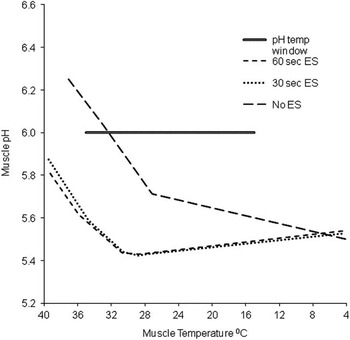
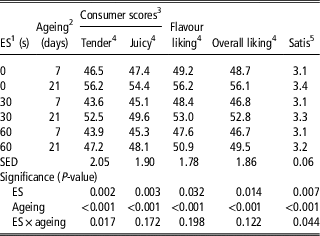
Loin temperature at pH 6.0 was significantly higher in stimulated sides (>40°C) compared with controls (32.2°C) (Figure 1). As expected, TS significantly improved eating quality over achilles hung (P<0.001) and ageing for 21 days significantly improved eating quality over 7 days (P<0.001). Table 1 describes a significant stimulation by ageing effect both for tenderness (P=0.017) and satisfaction (P=0.044). High voltage electrical stimulation for 30 or 60 s significantly and progressively decreased eating quality for 21-day-aged beef compared with 21-day-aged controls. Tenderness scores for 7-day-aged controls were similar to 21-day-aged 60-s HVES beef.
Mean pH temperature profiles of alternate carcase sides subjected to different levels of electrical stimulation (ES).

Interactions between electrical stimulation (ES) and ageing on consumer evaluation of grilled anterior striploin

1 Time in seconds of high voltage ES applied.
2 Days postmortem.
3 Eating quality scores.
4 Scored on a scale of 0 to 100, where 0=extremely tough, 100=extremely tender, etc.
5 Category scale: 2=unsatisfactory, 3=satisfactory everyday quality, 4=better than everyday quality, 5=premium quality.
Effect of breed, hang type and ageing period
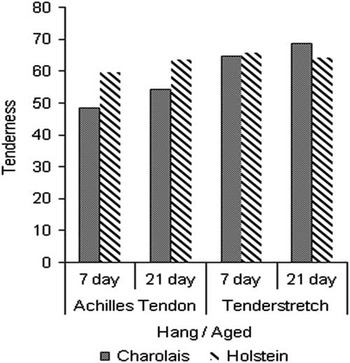
The effect of genotype, carcase hang type, ageing period and muscle cut on meat eating quality were assessed. The main effects of hang type, muscle cut and ageing were all very highly significant (P<0.001). The effect of breed was significant (P=0.011). A number of factors showed significant interactions including hang×aged (P=0.002), cut×breed (P=0.048), aged×breed (P=0.02), hang×cut×breed (P=0.024) and hang×cut×aged×breed (P=0.048). Figure 2 shows that when hung by the AT, the tenderness scores of the Holstein beef were higher than those of the Charolais. All sensory attributes increased when ageing was increased from 7 to 21 days. Genotype and hanging showed an interaction, with tenderness values significantly higher for Holstein than Charolais when hung AT but not when hung by the TS method (Figure 2).
Interaction between breed, hang type and ageing on consumer evaluation of grilled anterior striploin.

Discussion
Effect of gender and stress
When comparing sex type (bulls v. steers), no statistically significant overall effects on eating quality attributes were found within this experiment. The lack of a significant effect may be due to the relatively small number of animals in this experiment. Others have reported a significant effect: Mandell et al. (Reference Mandell, Gullett, Wilton, Kemp and Allen1997) reported that bulls were tougher than steers (in terms of shear force and sensory measures) but only for Simmental and not for Hereford cattle. Similarly, in a study of consumer eating quality data derived from a number of European studies employing MSA protocols, Bonny et al. (Reference Bonny, Hocquette, Pethick, Farmer, Legrand, Wierzbicki, Allen, Polkinghorne and Gardner2016) found that even after adjusting for different carcase traits, bulls had lower eating quality scores than samples from females and steers. Other workers have found no significant differences between the meat quality of bulls and steers (Gullett et al., Reference Gullett, Rowe and Jones1985). How much of the gender/sex type differences sometimes observed in meat quality is related to the interaction between carcase parameters, such as fat cover, carcase size and chilling rate, is not clear. When held in lairage overnight, beef from bulls had higher pHu (P=0.003) values than that from steers. Higher pHu values can arise from stress due to mounting activity, often seen in groups of bulls (Mohan Raj et al., Reference Mohan Raj, Moss, McCaughey, McLaughlan, Kilpatrick and McCaughey1991). In this study, mixing Holstein steers for 1 h before slaughter had no effect on pHu. No effects of fasting for up to 72 h were observed on any of the meat quality attributes measured. However, previous research has demonstrated that mixing of strange cattle generally results in fighting or mounting with a resultant depletion of muscle glycogen, particularly if entire bulls are present (Warriss, Reference Warriss1990). The absence of any effect in this experiment may be related to the relatively small numbers of animals tested and to the temperament of the cattle or a high nutritional status. In order to maintain their energy requirements, animals that are fasted will utilise body reserves such as body fat and other body tissues to supply this energy.
Effect of electrical stimulation
Although electrical stimulation had little effect on eating quality of beef aged for 7 days, it did reduce the improvement of consumer scores after 21-day ageing (Table 1). A possible explanation for the adverse effect of electrical stimulation is the partial denaturation of the enzymes involved in proteolysis and ageing due to the rapid pH decline at high temperatures (Warner et al., Reference Warner, Thompson, Polkinghorne, Gutzke and Kearney2014). Figure 1 shows that the pH of HVES-treated beef drops much faster against temperature than unstimulated beef and misses the recommended window for pH/temperature fall, thus increasing the risk of ‘heat shortening’. Further research would be needed to confirm this.
Effect of breed
An interaction between breed and post-slaughter processing (hang type and ageing) was observed in the study on the meat quality of purebred Charolais and Holstein steers. The eating quality scores of the Holstein beef were higher than those for Charolais. Bonny et al. (Reference Bonny, Hocquette, Pethick, Farmer, Legrand, Wierzbicki, Allen, Polkinghorne and Gardner2016) found that beef breeds including a large proportion of Charolais had lower eating quality scores than dairy breeds (mainly Holstein) and dairy crosses for a number of specific muscles tested. In this experiment, breed differences were greatest when hung by the AT and aged for 7 or 21 days; and diminished when hung by TS or aged for 21 days (Figure 2). When comparing the sensory quality of meat from dairy and beef breeds, Monson et al. (Reference Monson, Sanudo and Sierra2005) found a significant breed×ageing interaction with beef breeds showing optimum tenderness at short ageing periods and dairy breeds requiring longer ageing to achieve similar consumer acceptance. Results from this experiment clearly show an improvement in meat eating quality by using the TS technique and extending the ageing period. The interactions show that when comparing genotypes it is important to consider the post-slaughter protocol, as this will affect the magnitude of difference between genotypes. There have been conflicting reports in research literature on the quality of meat from dairy-origin animals. Dairy beef is regarded by the industry as of lesser quality than that from beef breeds. It is likely that these conflicting results could be due to differences in processing (e.g. hanging and ageing). Sinclair et al. (Reference Sinclair, Lobley, Horgan, Kyle, Porter, Mathhews, Warkup and Maltin2001) found no difference between the eating quality of Holstein and Charolais when hung by TS. Higher levels of intramuscular fat and dairy genetics are thought to contribute to the improved tenderness and flavour of beef from the dairy herd. Lizaso et al. (Reference Lizaso, Beriain, Horcada, Chasco and Purroy2011) found higher juiciness and flavour scores for the loins of Holsteins when compared with a beef breed.
Hanging method, breed, ageing and electrical stimulation have all been shown to affect the eating quality of Northern Irish beef. Though not described in this report, muscle type, position within muscle and cooking method also greatly impact on eating quality. Although many of the differences are small, they are often increased substantially by the many interactions between pre- and post-slaughter factors. Hanging method by breed and electrical stimulation by ageing are two examples of such interactions reported in this paper.
Acknowledgments
The authors wish to acknowledge the Department of Agriculture, Environment and Rural Affairs (formerly DARD) who provided funding for this project and also the Northern Ireland meat industry for their assistance and cooperation throughout the course of this study.