




No CrossRef data available.
Article contents
Rate of convergence for computing expectations of stopping functionals of an α-mixing process
Part of:Limit theorems
Published online by Cambridge University Press: 01 July 2016
Abstract
The shift method consists in computing the expectation of an integrable functional F defined on the probability space ((ℝd )N , B(ℝd )⊗N , μ⊗N ) (μ is a probability measure on ℝd ) using Birkhoff's Pointwise Ergodic Theorem, i.e.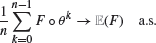
as n → ∞, where θ denotes the canonical shift operator. When F lies in L 2(F T , μ⊗N ) for some integrable enough stopping time T, several weak (CLT) or strong (Gàl-Koksma Theorem or LIL) converging rates hold. The method successfully competes with Monte Carlo. The aim of this paper is to extend these results to more general probability distributions P on ((ℝd )N , B(ℝd )⊗N ), namely when the canonical process (X n )n∊N is P-stationary, α-mixing and fulfils Ibragimov's assumption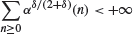
for some δ > 0. One application is the computation of the expectation of functionals of an α-mixing Markov Chain, under its stationary distribution P ν. It may both provide a better accuracy and save the random number generator compared to the usual Monte Carlo or shift methods on independent innovations.
Information
- Type
- General Applied Probability
- Information
- Copyright
- Copyright © Applied Probability Trust 1998
References
[1]
Alaya, M. B. (1992). Les théorèmes ergodiques en simulation. Ph.D. Thesis, Thèse de l'École Nationale des Ponts et Chaussées.Google Scholar
[2]
Alaya, M. B. (1993). On the simulation of expectations of random variables depending on a stopping time. Stoch. Analysis Appl.
11, 133–153.Google Scholar
[4]
Bouleau, N. (1990). On effective computation of expectations in large or infinite dimension. J. Comp. Appl. Math.
31, 23–34. North-Holland.Google Scholar
[5]
Bouleau, N. (1991). On numerical integration by the shift and application to Wiener space. Acta Appl. Math.
25, 201–220.Google Scholar
[6]
Bouton, C. and Pagès, G. (1994). Convergence in distribution of the one-dimensional Kohonen algorithms when the stimuli are not uniform. Adv. Appl. Prob.
26, 80–103.Google Scholar
[7]
Doukhan, P. (1994). Mixing, Properties and Examples. Lecture Notes in Statistics, volume 85. Springer, Berlin.Google Scholar
[8]
Doukhan, P., Massart, P. and Rio, E. (1994). The functional central limit theorem for stationary mixing processes. Ann. Inst. H. Poincaré Probab. Statist.
30, 63–82.Google Scholar
[9]
Duflo, M. (1990). Méthodes récursives aléatoires, Masson, Paris. (In English, Random Iterative Models, Springer, New-York, 1997.)Google Scholar
[10]
Fort, J. C. and Pagès, G. (1996). Symptotic behavior of a Markovian stochastic algorithm with constant step. To appear in SIAM J. Control Optimization.Google Scholar
[11]
Gàl, I. S. and Koksma, J. F. (1950). Sur l'ordre de grandeur des fonctions sommables. Indigationes Math.
12, 192–207.Google Scholar
[12]
Hall, P. and Heyde, C. C. (1980). Martingale Limit Theory and its Applications. Academic Press.Google Scholar
[13]
Krengel, U. (1985). Ergodic Theorems. de Gruyter Studies in Mathematics, Berlin, New York.Google Scholar
[14]
Lamberton, D. and Pagès, G. (1996). On the critical points of the 1-dimensional Competitive Learning Vector Quantization Algorithm. Proc. ESANN '96. Bruges (Belgium), pp. 97–102.Google Scholar
[15]
Pagès, G., (1993). Voronoï tessellation, space quantization algorithm and numerical integration. Proc. ESANN '93, ed. Verleysen, M.. Bruxelles, pp. 221–228.Google Scholar
[16]
Pagès, G., Numerical integration by space quantization. To appear in J. Appl. Comp. Math.Google Scholar
[17]
Philipp, W. and Stout, W. (1975). Almost sure invariance principles for partial sums of weakly dependent variables. Mem. Am. Math. Soc.
61.Google Scholar
[18]
Rio, E. (1995). The functional Law of the Iterated Logarithm for stationary strongly mixing sequences. Ann. Prob.
23, 1188–1203.Google Scholar
[19]
Robert, C. P.
Convergence assessments for Markov Chains Monte Carlo Methods. Technical Report INSEE no. 9347.Google Scholar