1.0 INTRODUCTION
In the management and organisation literature on culture, the prominent factor is the emergence and development of modern management and organisation models in western societies, which have the western culture properties (Ref. 1, pp 17–18). Using unquestioningly produced management knowledge in the western culture rarely reveals the truth (Ref. 2, p 6). For this reason, it is required to consider Turkey’s local context. Values, the most important elements of a culture, while abundantly discussed in different disciplines, still do not have a standard definition. The purpose of this study is to determine the values which provide reference to the daily actions and decisions taken by private airport operations managers in Turkey. As Drucker( Reference Drucker 3 ) stated, one of the responsibilities of a manager is to determine their values hierarchy. The importance of order values forms the values hierarchy of managers. The aviation sector is sensitive to risks, high exposures and external influences. For this reason, the critical decisions taken by managers have the potential to directly and suddenly affect the state of operations. Based on cultural relativism, this study adopted an emic approach which enables the discovery of culturally relevant characteristics with suitable scales for the purpose of research. These values differ based on social characteristics and organisational conditions in which the managers are trained. This research focuses on the individual values which are vital risks to the shaping of managerial behaviour.
2.0 THEORETICAL FRAMEWORK
As stated by Aycan et al( Reference Aycan, Kanungo and Mendonça 4 ) cultural context must be taken into consideration to become a global leader in the field. Organisations are developed through a certain historical process. Aycan et al( Reference Aycan, Kanungo and Mendonça 4 ) summarised this development as follows:
∙ Aycan et al( Reference Aycan, Kanungo and Mendonça 4 ) stated that the first development idea resulted from the opinion ‘the employees have to feed themselves’ and so the employees’ basic needs must be met.
∙ Second idea was a result of the opinion ‘the employees have hearts’ emphasising that employees emotions must be taken into account to further motivate them.
∙ The third idea was that ‘the employees have brains’. It claimed that the employees’ participation in the strategic decisions of the organisation would help the organisation attain its goals.
∙ The fourth development was based on the opinion ‘the employees have different cultural value, beliefs and behaviour patterns’, pointing to the fact that these must be taken into consideration to increase the chance of survival in the global competition.
The Values of Classical, Neo-Classical and Contemporary Management Theories: Mannerly changing managerial values from the birth of management theories
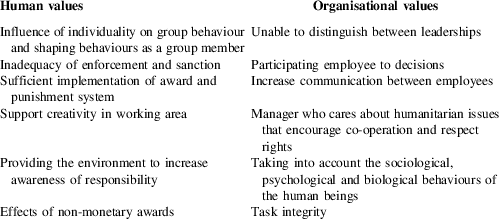
Kara (Ref. 5, pp 89–90) expressed the human and organisational values of classical management theory as shown in Table 1.
Human and organisational values in classical management theory

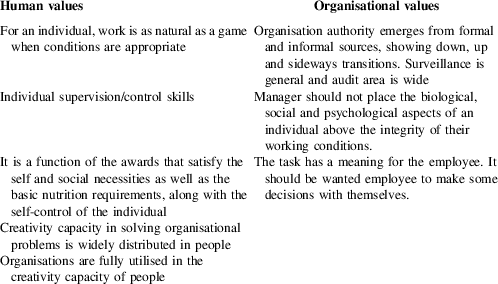
Kara (Ref. 5, p 99) expressed the human and organisational values of neo-classical management theory as shown in Table 2.
Human and organisational values in neoclassical management theory

Kara (Ref. 5, p 101) expressed the human and organisational values of modern management theory as shown in Table 3.
Human and organisational theory in modern management theory

2.1 Managerial Values
The values that constitute the culture are depicted as motives guiding the human behaviour( Reference Aldemir 6 ). The value definitions described by the theories discussed above seem to emphasise two distinct features: density and direction. Density shows the importance of a person and increased importance means enhanced density. Başaran (Ref. 7, p 390) defined belief as the quality and quantity that determines the benefit of a person, object, process, thought process and action, goodness, beauty, authenticity and desirability. Şişman (Ref. 8, p 4) defined value as giving importance and preference to culture. According to Social Psychology ( Reference Rokeach 9 ), value is enduring belief that a specific mode of conduct or end-state of existence is personally or socially preferable to an opposite or converse mode of conduct or end-state of existence. Value is used to separate the definition between bad and good, beautiful and ugly, normal and abnormal, rational and irrational in relation to ideas, opinions and behaviours (Ref. 10, p 291; Ref. 11, p 24; Ref. 12, p 51; Ref. 13, p 47).
According to SmithKline Beecham, the reasons that make the values important (Ref. 14, p 175):
∙ present a guide framework in relation to behaviours and decisions;
∙ help build ethical culture;
∙ have potential to effect the organisation’s success;
∙ are first degree motivators; and
∙ do not only hinder the managers from continuously giving inappropriate orders, but also prevent the employees from implementing such orders.
Values must be defined to understand the human behaviours in the organisation (Ref. 15, p 3; Ref. 16, p 152). Organisations may have human values. In order to become successful, there should be harmony between individual and organisational values (Ref. 3, p 13). Individuals in an interactive relation, which shares the common values, unite in a sense to defend the values against threats. This helps the organisation to be more efficient (Ref. 17, p 57). Values form one of the most important factors of dependency on the goals of a group or the system (Ref. 18, p 384). Culture defines the behaviour with the values it foresees, and manners represent the relationship between the culture and the values (Ref. 1, p 20). This system (culture) and/or subsystems (subcultures) can sometimes be contradictory to themselves and to each other. Some values that are important enough to be indispensable can be located at the top of the hierarchy, while others at the bottom. While the contradictions in the lower values do not affect a person much, the contradictions in the upper values can lead to serious disturbances (Ref. 5, p 257). Organisational arrangements and strategies are largely under the influence of the system of cultural understanding and values shared among the members of the organisation (Ref. 19, p 277). Ideas emerging within this framework can be placed in three groups. First idea assumes the industrialisation as an indicative factor in creating the management and organisation model, and defends that the managerial and organisational applications and values of industrialising countries will resemble each other in parallel with the industrialisation process. Second idea assumes that management and organisational values will differ owing to the local cultural features, and the third idea states that, unlike the exemplar country and local culture’s features, a hybrid of managerial and organisational values will appear (Ref. 20, p 659; Ref. 21, p 38; Ref. 22, p 11; Ref. 10, p 47; Ref. 23).
Determining the managerial value is important because it brings harmony, loyalty and organisational citizenship to an organisation. If organisational and individual values are in harmony, decisions can be made and implemented faster.
2.2 Classification of values
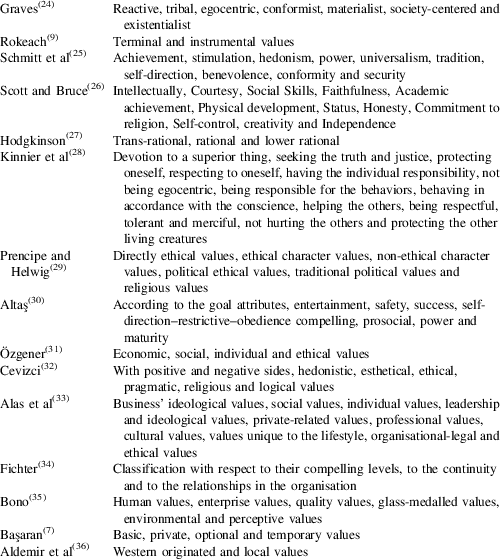
After determining the managerial values, classification of values in the literature is given in a time order in Table 4
Classification values in literature in time order.

.
Because of the fact that Aldemir et al( Reference Aldemir, Arbak and Özmen 36 ) categorized values as western originated and local values, it has been suitable for carrying out the study.
2.3 Literature review
Studies on managerial values generally focussed on cultural values in management and organisation field( Reference Hofstede 37 – Reference Trompenaars and Hampden-Turner 41 ). Some of these studies were based on Hofstede’s cultural dimensions (2001) which are masculinity-femininity, power distance, individualism-collectivism and avoidance of uncertainty. Later on, long–short-term normative orientation and indulgence-restraint were added to these dimensions. Hofstede’s cultural dimensions are suitable for cross-cultural research. Studies of Elenkov (1997), Reeves-Ellington (1998), Gordon and Irene (1999), Wallace et al (1999), Ralston et al (1999)( Reference Ralston, Thang and Napier 20 , Reference Elenkov 42 – Reference Wallace, Hunt and Richards 45 ) fall within these dimension scope. In addition to Hofstede, there are many studies( Reference Alas, Papalexandris and Niglas 46 – Reference Lenartowicz and Johnson 48 ) which embrace a scale developed by Rokeach. Rokeach’s scale is considered to be more suitable for western societies rather than eastern societies( Reference Bigoness and Blakely 49 ). One of the most cited studies belongs to Schwartz. Further studies include Ralston et al( Reference Ralston, Holt, Terpstra and Kai-Cheng 22 ), Schwartz and Boehnke (2004) and Alexashin and Blenkinsopp( Reference Alexashin and Blenkinsopp 50 ) with Schwartz’s scale.
Studies in Turkey show that the values are held as cultural dimensions. Aycan and Kanungo( Reference Aycan and Kanungo 51 ) included a scope of 10 countries and a sample size of 2003 managers. These countries are Canada, China, Germany, India, Israel, Pakistan, Romania, Russia, Turkey and USA. Further studies, e.g. Refs. 36,52,53, especially Ref. 54, p 698), involve upper-level managers and MBA students in İstanbul. It has been established that there are differences between students’ and managers’ values. Another study carried out with a sample size of business and economic school students figured that the individual values have an important role in understanding managerial behavior (Ref. 55, p 214). Süral Özer et al( Reference Süral Özer, Eriş and Timurcanday Özmen 56 ) studied Baby boomer, X and Y generation’s values within the context of Turkish culture with emic approach and emphasised that their study has importance in understanding and managing values. Pazarcık( Reference Pazarcık 57 ) studied the effects of selected educational institutions on the transaction of business of the graduates. The general opinion taken into account in the determination of the values adopted by managers is that the Turkish society has a binary culture structure, western-originated and local. For this reason, Aldemir et al’s scale was adopted in this study.
2.4 Research methodology
The purpose of this study is to determine the values which provide reference to daily actions and decisions taken by airport managers in Turkey. Work-mentality scale (58 items), developed by Aldemir, Arbak and Özmen, was implemented to private-airport operations managers in Turkey. The research sample consisted of middle- and upper-level managers who were decision makers. An online survey was sent to the managers. The number of participants who could be reached was 163, which is an adequate number for aviation sector in Turkey. The survey was shared through the corporate communication department. The data were analysed with the Statistical Package for the Social Sciences (IBM-SPSS 22). The factor analysis was used to determine the value groups of the region where the managers were located, the organisations they worked in and their own individual values. Ranking analysis was used to determine the level of adoption of values.
2.5 Private airport operations in Turkey
Airports are the places where all aviation activities take place (Ref. 58, p 99). In Turkey, both management of airports and controlling airspace are performed by the General Directorate of State Airports Authority (DHMI). There are 57 domestic and international airports in Turkey, 55 of which are open to passenger/cargo/business and other flights. 11 of which are operated by private airport business. 44 of them are operated by DHMI. In addition, airport’s management can be given to private businesses which, in most cases, are called as Build–Operate–Transfer (BOT). One of the examples of BOT is TAV Airports which maintains its leading position in the airport operations sector in Turkey and operates Istanbul Ataturk, Ankara Esenboga, Izmir Adnan Menderes, Gazipasa Alanya, Milas Bodrum and Antalya Airports( 59 ). A Joint venture of Fraport AG and IC İçtaş previously operated Antalya Airport terminals. However, in May 2018, TAV Airports purchased shares of İçtaş and became an equal partner with Fraport in the management of Antalya Airport. One of the partners, Içtaş, now operates Kütahya Zafer Airport. Istanbul Sabiha Gökçen International Airport (ISG), a company founded in partnership by Limak Holding, GMR Infrastructure Limited, and Malaysia Airports Holdings Berhad, has 20 years’ operation rights. As of 2014, ISG continued as MAHB partnership, as Limak and GMR groups transferred their shares to MAHB( 60 ). Zonguldak Özel Sivil Havacılık operates Zonguldak-Çaycuma Airport( 61 ). Hezarfen Havalimanı which got into service in 1992 as first private training airport operation in Turkey, presents pilot training, leasing aircraft and air taxi( 62 ). YDA Group, which is ATM Airport, has operated Dalaman International Airport International Terminal since 2006( 63 ). Eskişehir Hasan Polatkan Airport is operated by Anadolu University Rectorate( 64 ).
3.0 Results
This part presents the demographic information of participants, with 29% women and 71% men. The total number of participant was 163. About 59% of the participants were graduate students, with 36% having a postgraduate degree and 5% having PHD. There was only one manager who was a high-school graduate. About 35% of managers ranged between 35 and 40 years of age, with 8% being 51 years and above. While 39% of managers had work experience between 6 and 10 years, 26% had 15 and 20 years. Based on their total working time, 34% had 17–20 years of experience. About 46% of managers were found to have spent their first 15 years of life in İstanbul, followed by Ankara, Samsun and İzmir. About 44% of the managers were assigned as directors, 25% as managers, 15% as co-ordinators, 9% as experts/masters, 3% as general managers and 1% working as vice deans. Based on their social status perceptions, 66% of them considered themselves as upper class. In terms of parental background, 17% of the GM’s fathers were engineers, 14% were teachers, 11% were military personnel and 6% were employees. Educational background of their parents ranged from graduates to post graduates.
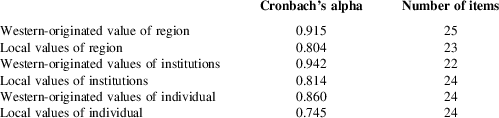
Table 5 provides the coefficients of Cronbach’s alpha to measure of scale reliability.
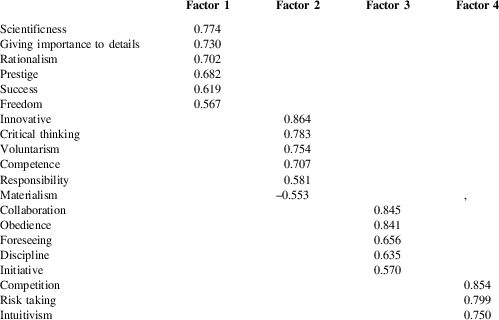
Factor analysis was used to reduce a set of western-originated and local values into a smaller set of dimensions. The Barlett test of sphericity should be significant (p<0.05) and the Kaiser Meyer Olkin index ranges from 0 to 1, with 0.50 considered suitable for factor analysis. Levene’s test is for homogeneity of variance. The results of factor analysis of western-originated values of regions where the managers live are given in Table 6.
Results of Cronbach’s alpha (region, institutions and individual)

Results of factor analysis of western originated values of region where managers live

*KMO = 0.584, **Sig. <0.001, ***total explained variance = 70.666%.
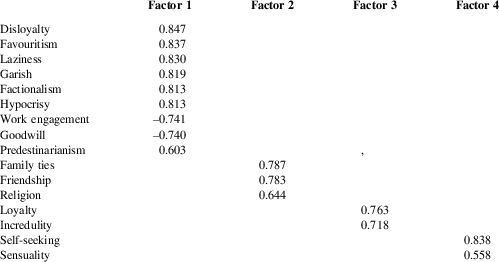
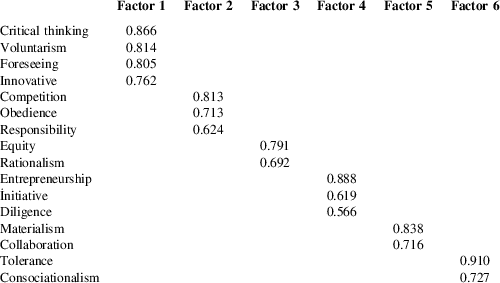
Factor analysis was performed with 23 items by varimax rotation method. The KMO index was 0.76. Four factors had eigenvalues over Kaiser’s criterion of 1 and in combination explained 74.56% of the total variance. Table 7 gives the results of factor analysis of local values of regions where managers live.
Results of factor analysis of local values of region where managers live

*KMO = 0.761, **Sig. < 0.001, ***Total explained variance = 74.566%
Table 6 and Table 7 show that TEV of local values (74.566) is higher than TEV of western values (70.666). It means that managers indigenise local values more in regions where they live. Table 8 gives the results of factor analysis of western-originated values of institutions where managers work.
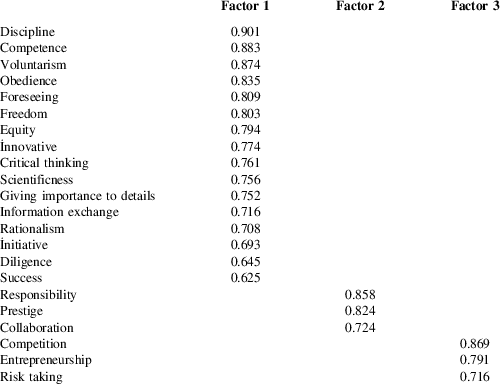
Results of factor analysis of western originated values of institution which managers work

*KMO =0.783, **Sig.<0.001, ***total explained variances = 76.074%.
Factor analysis was performed with 25 items by varimax rotation method. KMO index is 0.58. Four factors had eigenvalues over Kaiser’s criterion of 1 and in combination explained 70.66% of the total variance. The analysis was retained for four factors because of the large sample size and the convergence of the scree plot and Kaiser’s criterion on this value. Table 6 shows the factor loadings after rotation.
Factor analysis was performed with 22 items by Varimax rotation method. The KMO index was 0.78. Three factors had eigenvalues over Kaiser’s criterion of 1 and in combination explained 76.07% of the total variance.
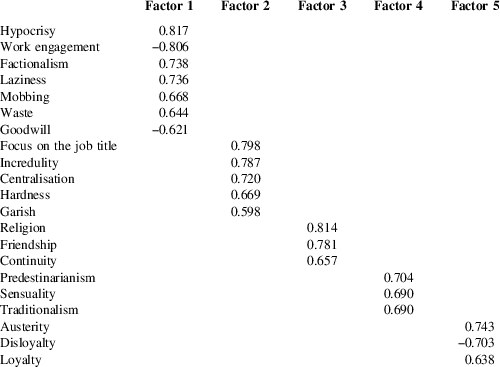
Factor analysis was performed with 24 items by varimax rotation method. The KMO index was 0.67. Five factors had eigenvalues over Kaiser’s criterion of 1 and in combination explained 70.88% of the total variance. Table 9 gives the results of factor analysis of local values of institutions where managers work.
Results of factor analysis of local values of institution which managers work

*KMO=0.672, **Sig. <0.001, ***total explained variances= 70.880%.
Table 8 and Table 9 show that some values have negative factor load. It means that values with negative factor load have negative correlations. It is seen that TEV of western-originated values (76.074) is higher than TEV of local values (70.880). It means that managers indigenise western originated values more in institution where they work.
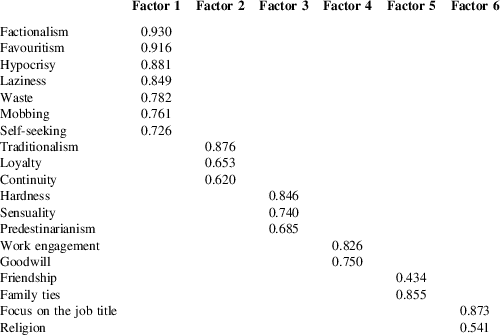
Factor analysis was performed with 24 items by varimax rotation method. The KMO index was 0.64. Six factors had eigenvalues over Kaiser’s criterion of 1 and in combination explained 74.30% of the total variance.
Table 10 gives the results of factor analysis of western-originated values of managers whom indigenise.
The results of factor analysis of western-originated values of managers whom indigenise

*KMO=0.644, ** Sig.<0.001, *** total explained variance=%74.307.
Factor analysis was performed with 24 items by varimax rotation method. The KMO index was 0.61. Six factors had eigenvalues over Kaiser’s criterion of 1 and in combination explained 71.91% of the total variance. Table 11 gives the results of factor analysis of local values of managers whom indigenise.
The results of factor analysis local values of managers whom indigenise

*KMO=0.619, **Sig.<0.001, ***total explained variance=71.919%.
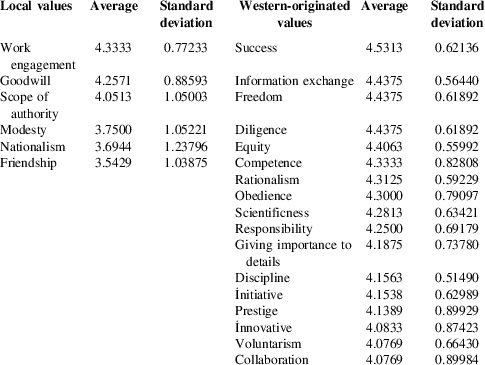
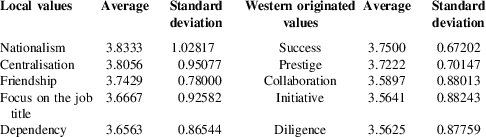
Reference Hofstede, Neuijen, Ohayv and SandersTable 10 and Table 11 show that TEV of western-originated values (74.307) is higher than TEV of local values (71.919). It means that managers indigenise western-originated values more. The results of ranking analysis of value average are given in Table 12. It includes only four and older average for individual and organisational values.
Ranking analysis of value average of adopted by managers (n = 163)

Table 13 shows that managers indigenise western-originated values more.
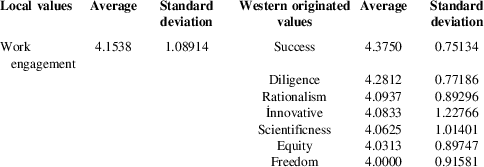
Ranking analysis of value average of institution which managers work (n = 163)

When the average of managers’ perceptions of perceived local values in the organisation was examined, the value of doing business better was found to be more important. It is shown that the values the administrators perceive about the institution are from western-originated. When we look at the average value of the region where the managers live, the average was less than four. Nevertheless, it is seen that the western-originated have lower average values (Table 14).
Ranking analysis of value average of region in which managers live (n = 163)

4.0 DISCUSSION AND CONCLUSION
Managing values help to understand managerial behaviours and conformity within the organisation. This conformity increases quality and organisational loyalty. The values hierarchy of managers need to be established to achieve sustainability. This study reveals the managerial and organisational values and managerial profiles in airport operations in Turkey.
This study was designed to determine the values which provide reference to the daily actions and decisions taken by airport managers in Turkey. It is also unique in terms of research, as there is no other available study focused on aviation sector managers in Turkey. It can be accepted as a reference for future studies in emerging aviation sector in Turkey. Further research in different countries will help make benchmarking values that have impact on managerial decisions, performances, etc. Values have a vital importance in increasing performance and quality, and retain sustainability in business. We assumed that values should be considered in both cases, while developing corporate strategies and achieving these corporate strategies, whether operating regionally or globally, and loyalty. Further research can be carried out in the problematic areas of managerial and organisational values.
According to findings of this research results of factor analysis show that sample’s values were essentially based on western-originated and local values. According to factor analysis, western-originated values of region where managers live retained four factors. Local values of region where managers live also retained four factors. Results of factor analysis of western-originated values of institution where managers work retained three factors, while local values retained five factors. Adopted western-originated values of managers retained six factors, while local values retained six factors. It can be seen that managers indigenise western-originated values more than local values. The result of ranking analysis shows that the number of western-originated values and values average are higher than local values. Airport operations managers indigenise success, information exchange, freedom, diligence, equity, competence, rationalism, obedience, scientificness, responsibility, giving importance to details, discipline, initiative, prestige, innovative, voluntarism and collaboration as western-originated values. They also indigenise work engagement, goodwill, scope of authority, modesty, nationalism and friendship as local values. However, western-originated values such as success, diligence, rationalism, innovative, scientificness, equity and freedom are indigenised as organisational values. Only work engagement value was indigenised as organisational value. It is seen that adopted values, i.e., individual/managerial values, include both western-originated and local values in institutions referring to organisational value. As a result, organisational and individual values sort together. This conformity brings to organisational success and loyalty. Further research can be carried out in the problematic areas of managerial and organisational values. Future research may include main fields such as organisational behaviour field, ethics and management.
Further research can be carried out in the values which affect the managerial performance while selecting best alternative personnel by human resource departments by determining personnel’s values are suitable for organizational values. In case of ethics field, the basic values for the sound sustainability of the ethical structure in enterprises can also be identified with future research. This study contributes to improving awareness on the effects of values in business management in both theory and practice, whilst also discussing their limitations.