Introduction
With this article we advance a critical discussion on the policy discourse regarding the digitalization of public services and older people. Specifically, we critically analyse the ways in which the application of digital technologies for the innovation of public services and the related opportunities and risks for the older population are discursively constructed in policy documents focused on public services digitalization.
While it can offer many opportunities for accessibility, the simplification of bureaucratic processes and the transparency of public administration, the digitalization of public services may also pose challenges for ageing societies, potentially introducing new risks of social exclusion. Indeed, the relationship between older adults and digital technologies is a complex one: if, on the one hand, it has been broadly demonstrated that digital technologies can provide opportunities for older adults’ inclusion, participation and wellbeing (Barbabella et al. Reference Barbabella, Melchiorre, Quattrini, Papa and Lamura2017; Caliandro et al. Reference Caliandro, Garavaglia, Sturiale and Di Leva2021), on the other hand, many barriers still exist to the use of digital technologies by this group of population. In particular, the digital divide tends to reproduce existing socio-economic inequalities, exacerbating exclusion risks for the most vulnerable individuals (Draulans and Lamura Reference Draulans, Lamura, Walsh, Scharf, Van Regenmortel and Wanka2021; Eruchalu et al. Reference Eruchalu, Pichardo, Bharadwaj, Rodriguez, Rodriguez, Bergmark, Bates and Ortega2021; Hirvonen et al. Reference Hirvonen, Tammelin, Hänninen and Wouters2021).
It has been demonstrated that macro-level factors, such as the policies, norms and values embedded in the digitalization process, can play an important role in limiting or reinforcing the risk of exclusion related to this process (Schou and Pors Reference Schou and Pors2019). At the same time, it has been shown that often the policy discourse, in various strands, and at the European and national levels, positions the older population as a problem and technological innovation as an easy and always effective solution, overlooking the complexities that are intrinsic to the relationship between ageing and technology (Neven Reference Neven2011; Neven and Peine Reference Neven and Peine2017; Whitfield and Hamblin Reference Whitfield and Hamblin2025).
Given this scenario, with this article we contribute to improving our knowledge on how institutions shape the ways in which ageing and technological innovation are framed, affecting the shared understanding of these processes and the related political solutions implemented at the transnational and national levels. We do so by conducting a critical discourse analysis (CDA) of public services digitalization programmes at the European and Italian levels. Italy represents an interesting case study, being one of the countries with the oldest population in Europe (and in the world) and at the same time characterized by a significant generational digital divide (Sala et al. Reference Sala, Gaia and Cerati2022). Moreover, the digital transition has been at the heart of Italy’s National Recovery and Resilience Plan (PNRR), and the digitalization of public services is considered fundamental to this process. The analysis shows that while at the European level older adults’ rights in relation to the digitization process are at least acknowledged, at the Italian level policies on digital public services (DPS) lack in awareness of the risks of exclusion for older people and, more in general, vulnerable groups of the population, with a focus shifted more towards technical or economic goals. Overall, the article shows that policy discourses on public service digitalization do not prioritize issues of inequality and social exclusion and, in particular, do not place emphasis on the relationship between ageing and technology, missing the opportunity to leverage the potential of the concept of ageing to generate new ideas and social change.
The article is organized as follows: after discussing the key insights from the literature on public services digitalization and the risks for older adults, and on the ways in which the relationship between ageing and technology is positioned in policy discourse, we introduce the methodology and research questions guiding our study. We then present and discuss the findings, and put forth some directions for further research.
Theoretical framework
Public services digitalization and risks of social exclusion
Digital technologies have progressively come to permeate every sphere of our individual and collective lives, from work to consumption, from entertainment to social relations. Over the last two decades, ‘the incentives and interests of the digital economy [have started to] manifest [also] in the welfare state and reconfigure the capacity of its public sector’ (Collington Reference Collington2022, 313). Public sector institutions and welfare agencies across European welfare states (albeit at different speeds) have thus taken the path of digitalization (Chini Reference Chini, Avgerou, Smith and van den Besselaar2008; Dunleavy et al. Reference Dunleavy, Margetts, Bastow and Tinkler2006; Fountain Reference Fountain2014; Margetts Reference Margetts2008) – as the huge economic investments in the field show (van Toorn et al. Reference van Toorn, Henman and Soldatić2024) – with the aim of improving efficiency and service quality, increasing transparency, improving the coordination across organizations (Layne and Lee Reference Layne and Lee2001), but also cutting costs. In this context, the Covid-19 pandemic has proven to be a significant turning point. It highlighted the risks associated with inefficiencies in the public sector during times of deep crisis, driving increased investment in the digitization of public services to enhance efficiency and coordination. Moreover, during the pandemic, digital technologies became the sole means of ensuring access to certain services. Their value was particularly evident for vulnerable groups, for whom these tools have since been promoted as the new standard in post-pandemic societies (Eruchalu et al. Reference Eruchalu, Pichardo, Bharadwaj, Rodriguez, Rodriguez, Bergmark, Bates and Ortega2021).
The literature shows that often public sector digitalization reforms have resulted in welfare state retrenchment: rather than focusing on the improvement of their data assets and digital capabilities, governments have tended to pursue a ‘welfare-economics driven approach’, transferring the responsibility for key infrastructures to private actors, in order to support digital economy industries (Collington Reference Collington2022, 313). The privatization of assets and capabilities linked to processes of digitalization has further pushed welfare budget cuts, rather than pursuing the interests of citizens.
This transformation has been reflected in a growing number of studies investigating how digital technologies transform the ways in which governments are organized and deliver public services (Fischer et al. Reference Fischer, Heuberger and Heine2021), as well as the outcomes for citizens and businesses. Specifically, public sector digitalization has been studied in areas such as design (Grimsley and Meehan Reference Grimsley and Meehan2007), channel choice (Ebbers et al. Reference Ebbers, Pieterson and Noordman2008), the digital divide (Ebbers et al. Reference Ebbers, Jansen and van Deursen2016; Helbig et al. Reference Helbig, Ramón Gil-García and Ferro2009), value creation (Nielsen and Persson Reference Nielsen and Persson2017) and the consequences of digitalization for the interaction between citizens and public officials (Lindgren et al. Reference Lindgren, Madsen, Hofmann and Melin2019). A recent systematic review of the literature underlines that most of the research in this field is technology-focused rather than adopting actor-centric approaches; moreover, studies are predominantly focused on beneficial, rather than negative (or critical), outcomes – such as increased state surveillance (Karakaya Polat and Pratchett Reference Karakaya Polat and Pratchett2014), inequalities or discrimination linked to automated decision-making (Schou and Pors Reference Schou and Pors2019) – and do not assess the long-term effects of the digitalization of the public sector (Haug et al. Reference Haug, Dan and Mergel2024). Moreover, as Schou and Pors (Reference Schou and Pors2019, 465) underline, often both ‘scholars and policymakers have tended to depoliticise digitalisation, turning it into a merely technical issue and downplaying its political contents and consequences …. This current neglect is especially pronounced in the context of social exclusion and marginalisation.’
With this work we intend to contribute to the exploration of public services digitalization from a critical perspective – that is, exploring the possible negative outcomes. Specifically, we focus on issues emerging at the intersection between public services provision and digital exclusion in relation to how policy discourses define these issues and make possible answers conceivable. We focus on a group of population whose risks of social exclusion could be potentially further exacerbated by digital means: the older adults. As highlighted by Sourbati (Reference Sourbati2009), older citizens represent a group of heavy users of public services – let’s think, for example, of health-care-related services; at the same time, they are the group that, as we will comment in the next paragraph, tend to engage less with new information and commuication technologies (ICTs) and who consequently are disadvantaged with regard to their participation in opportunities offered online. Thus, the process of digitalization of public services may result in critical consequences for older adults, especially in terms of exacerbated social exclusion risks. Indeed, according to Draulans and Lamura (Reference Draulans, Lamura, Walsh, Scharf, Van Regenmortel and Wanka2021, 136), exclusion from ‘services, goods, and mobility’ represents one of the domains of potential exclusion in old age and refers to ‘the condition (and the processes leading to it) involving the lack or refusal of services in old age, to a greater extent than might be considered “normal” for most people’ (p. 136); it may be associated with a negative impact at both individual and social levels.
In order to prevent public services digitalization from further exacerbating risks of social exclusion in old age, digital technologies should be conceived of as ‘a means to an end’, rather than the final goal of reform processes, and how to make internet access and use attractive to all, as well as how to support older people in obtaining the resources needed to access and use ICTs, should be at the core of policy interventions on public sector digitalization (Sourbati Reference Sourbati2009).
Older adults and digital technologies
A considerable body of research has explored the relationship between ageing and digitalization, showing the interactions between two processes that are profoundly changing contemporary societies. Digital technologies have been demonstrated to have a positive impact on older adults’ lives, in particular supporting their wellbeing, improving their sense of autonomy, their sense of social connectedness, their cognitive capabilities and their information capital, as well as providing opportunities for keeping and broadening their social networks (Caliandro et al. Reference Caliandro, Garavaglia, Sturiale and Di Leva2021; Sen et al. Reference Sen, Prybutok and Prybutok2022). Despite the potential beneficial outcomes, significant barriers still exist to the usage of digital technologies by the older population. Indeed, older adults, when compared to younger groups, show lower levels of internet use, a phenomenon usually referred to as ‘grey digital divide’ (Millward Reference Millward2003). The grey digital divide manifests at different levels: (1) the level of access (material/physical access to a computer or an internet connection; (2) the level of digital skills; and (3) the level of opportunities (referring to the link between digital inequalities and citizens’ participation in public life) (Alexopoulou et al. Reference Alexopoulou, Åström and Karlsson2022, p. 277; van Dijk Reference van Dijk2020). The third-level digital divide ‘presupposes that individuals able to use digital communication technologies will get more [opportunities] out of their encounters with state institutions (Van Deursen & Helsper, Reference Van Deursen, Helsper, Robinson, Cotten, Schulz, Hale and Williams2015) and will more effortlessly exercise their rights (“digital citizenship”; Mossberger et al., Reference Mossberger, Tolbert and Stansbury2003) than will the digitally disadvantaged’ (Alexopoulou et al. Reference Alexopoulou, Åström and Karlsson2022, 277) – and, thus, it is particularly important in relation to the digitalization of public services.
Of course, significant differences exist across countries and within the older adults’ groups. In fact, although we still tend to discuss internet usage in relation to anagraphic age, the relationship between ageing and ICTs usage is far more complex and calls into question a broad array of individual and structural variables – from socio-economic conditions, to prevailing digital cultures, to mention but a couple of them. Indeed, among older adults persist various layers of digital divide. Older people with more economic and educational resources have a higher degree of digital access and, on average, also more media devices. In addition, there is an evident negative relationship between age and physical access. The older population is also the one in which there are larger differences in digital skills, again associated with economic and educational resources, as well as negatively associated with age. Last, negative experiences with the use of digital technologies are more common among older users than in other groups (Olsson and Viscovi Reference Olsson and Viscovi2023).
Overall, the relationship between ageing, older adults and digital technologies is complex and affected by the interplay of a variety of factors, at the individual and societal levels – from education to health, as well as material resources and available opportunities. Moreover, both the increasing usage of technology by growing numbers of older individuals and innovation policies have been driving a profound transformation of the relationship between ageing and technology, which are increasingly becoming intertwined to the point where one shapes the other (Peine et al. Reference Peine, Marshall, Martin, Neven, Peine, Marshall, Martin and Neven2021). As Fleming et al. (Reference Fleming, Mason and Paxton2018, 2) state, ‘economic, social and cultural systems shape experiences with digital technology just as they do interactions and experiences in the offline world. Consequently, demographic and digital disruption are not just occurring side by side; they are likely to interact in their effects.’
Ageing and digital technology in policy discourses
The complexity that is intrinsic to this relationship and the fact that ageing and technology are co-constituted tend to be overlooked in public and policy debates, where population ageing is usually portrayed as a problem, older adults as a burden to society, and technological innovation – especially digital technologies – is positioned as ‘an easy and effective’ solution that can generate benefits at both the individual and the societal levels (Higgs and Gilleard Reference Higgs and Gilleard2022; Sætra and Selinger Reference Sætra and Selinger2024). Ageing has become a ubiquitous theme in various policy strands where it is mostly advocated as justification for policies aimed at stimulating economic growth and technological innovation (Lipp and Peine Reference Lipp and Peine2024). This way of representing the relationship between ageing, technology and the future has been defined as the ‘ageing-and-innovation discourse’ (Neven Reference Neven2011; Neven and Peine Reference Neven and Peine2017; Peine and Neven Reference Peine and Neven2019) – one that seems very attractive for policy makers. Indeed, as shown in a recent study, even European policies on old age stress the idea that technological innovation is our best resource to tackle major societal challenges related to population ageing, overlooking all the nuances intrinsic in the relationship between ageing and technology (Lipp and Peine Reference Lipp and Peine2024). The same logic is reproduced in policy discourses at the country level. For example, in a discourse analysis of policy documents on ageing and digital inclusion in Italy and the UK, Carlo and Sourbati (Reference Carlo and Sourbati2020) showed that, in general, old age is associated with fragilty, while technologies are presented as sources of economic, social and human development benefiting older adults and society as a whole. Regarding the digitalization of public services, which is interpreted as the best way to improve efficiency and cut costs, a high number of older non-users of digital technologies may represent an obstacle, and developing digital skills is interpreted as an individual responsibility. Thus, the authors highlight two prevailing narratives around ageing and older adults: one recalling the ‘ageing-and-innovation discourse’ (Neven Reference Neven2011; Neven and Peine Reference Neven and Peine2017; Peine and Neven Reference Peine and Neven2019), the other reminding of the ‘active ageing’ discourse, which places individual responsibility on older adults for maintaining their active participation in society as they age (van Dyk Reference van Dyk2014). Moreover, Whitfield and Hamblin (Reference Whitfield and Hamblin2025) demonstrated that political (and policy) discourses are imbued with the idea that technology is a ‘solution’ to ‘problems’ of social care in ageing societies.
Innovation and digitalization policies are important sources for the creation of certain definitions of technology and ageing, as well. As Peine and Neven (Reference Peine and Neven2019, 18) underline, policy discourse in this field ‘prioritize certain definitions of aging over others, for instance when they combine innovation, economic growth and the alleged costs of demographic aging to problematize older people (Marshall & Katz, Reference Marshall and Katz2016; Neven and Peine Reference Neven and Peine2017)’. In this regard, policy documents regarding more specific arenas of technological innovation, such as e-health, also tend to adopt a techno-enthusiast gaze when discussing the application of e-health for older adults, and to overlook the complexity of the care for older adults, which is linked to structural, relational, spatial and organizational factors – to mention just some of them (Valokivi et al. Reference Valokivi, Carlo, Kvist and Outila2023).
Taking a step back, as Whitfield and Hamblin (Reference Whitfield and Hamblin2025) highlight, on the one hand the social world is constructed based on discourses; on the other hand those holding power and resources might have a role in the process of shaping specific discourses. Policy discourses thus structure the way in which a certain issue, in this case technology, ageing and the relationships between them, is talked about: actors define the key features and challenges of these processes; moreover, it is in policy discourses that contemporary global challenges ‘are translated into local problems – problems that subsequently influence the scope and nature of political solutions (Hay & Rosamond, Reference Hay and Rosamond2002)’ (Marenco and Seidl Reference Marenco and Seidl2021, 392).
The centrality of population ageing and digitalization processes for the development of contemporary societies, as well as the complexity inherent to the relationship between the two, thus requires growing attention to the ways in which issues related to these processes are framed in the policy debate (Lipp and Peine Reference Lipp and Peine2024; Peine and Neven Reference Peine and Neven2019). Indeed, when digital technologies make a forceful entry into areas connected to citizens’ rights and quality of life, particularly for the most vulnerable, it becomes even more important to understand how their role is framed by policies, which should guide such processes. This is the case with the digitalization of public services, for which, to the best of our knowledge, no policy discourse analysis has yet been conducted focusing on the role of technology and the relationship between technology and ageing. Our work aims, therefore, to help bridge this knowledge gap.
Research questions and methods
Given the scenario described earlier, with this article we aim to critically examine how discourses on digitalization construct specific representations of digital technology, ageing-related issues and older adults within policy documents on digital public services. By employing a multi-level analysis, we seek to uncover how these discourses evolve across governance levels, European and national (Italian) – and over time – revealing the underlying assumptions, priorities, and ideological frameworks that shape problem definitions and proposed solutions. Specifically, our research questions are:
1. How is digital technology represented in policy documents regarding the digitalization of public services?
2. Are ageing-related issues addressed in such policy documents? If so, are these issues discussed differently at the two government levels (European and Italian)?
3. How are older adults represented in public services digitization policy programmes?
Approaching discourses on the digitization of public services and its relations with ageing, we critically examine the processes of problem construction within policies (Bacchi Reference Bacchi1999). Rather than focusing solely on the solutions proposed, our analysis emphasises how problems are identified, framed and legitimized within policy discourse. The solutions presented in policy documents often reflect and reinforce underlying assumptions about what constitutes a ‘problem’, thereby revealing the dominant values, priorities and ideological positions of policy makers (Askheim et al. Reference Askheim, Christensen, Fluge and Guldvik2017; Bacchi Reference Bacchi1999; Whitfield and Hamblin Reference Whitfield and Hamblin2025). By interrogating these representations, we aim to uncover how certain issues are elevated to the status of ‘problems’ that require intervention, while others are marginalized or ignored.
By adopting a CDA approach, we can systematically examine how language reflects and reinforces power dynamics, ideologies and social inequalities within policy discourses (Fairclough Reference Fairclough1992; van Dijk Reference van Dijk1993). Specifically, we recognize the value of CDA concepts of recontextualization and interdiscursivity. While the latter refers to the way discourses interact, overlap and borrow from one another within a given text or communicative event (Krzyżanowski Reference Krzyżanowski2010), recontextualization describes the process by which discursive elements are transferred and adapted from one context to another, often acquiring new meanings and priorities in the process (Bernstein Reference Bernstein1990; Krzyżanowski Reference Krzyżanowski2016). This concept is particularly pertinent in multi-level governance systems, where policy ideas articulated at a supranational level, such as those of the European Union, are subsequently modified to align with national agendas. These analytical lenses allow us to uncover not only the shifts in meaning that occur across governance levels but also the underlying ideological assumptions driving such shifts. They help identify how certain concepts, such as ‘efficiency’ and ‘inclusion’, are prioritized or marginalized, thus shaping the perceived scope of problems and their corresponding solutions.
For our analysis, we select policy documents on DPSs published between 2010 (publication of the Digital Agenda for Europe) and 2023. Adapting the inclusion/exclusion strategy implemented by Carlo and Sourbati (Reference Carlo and Sourbati2020) in their study, we employ the following criteria to select policy documents:
- policy relevance – our interest is policy programmes for the implementation and diffusion of DPS among the European and national population;
- public availability – we select public policy-oriented documents only, thus excluding documents for internal communication and promoting digital inclusion within organizations;
- online access – we select documents sourced online.
Carlo and Sourbati (Reference Carlo and Sourbati2020, 112) included ‘policy announcements, green and white papers and specialist studies commissioned by public sector organisations, independent agencies and private sector forms produced by organisations operating at different levels within each national administration’. We maintain the general framework employed by Carlo and Sourbati (Reference Carlo and Sourbati2020), by adapting it to our research focus – not documents for digital inclusion but policy documents on DPS, hence excluding green/white papers and specialist studies – and to our analytical levels: European and national. Since our work aims to uncover the dominant values, priorities and ideological positions of policy makers, the analysis includes only documents produced by official government departments/agencies/bodies. Specifically, in Table 1 we list all selected documents for the analysis, showing organizations publishing documents of interest for our sample (divided by analytical level and organization type).
Selected documents: analytical level, organization type, organization name, title of the document and URL

Following the initial selection and collection of documents as described earlier, we begin exploring the content through keyword extraction, supported by artificial intelligence (AI) tools (Reliablesoft and ChatGPT). This preliminary step provided some initial insights about the presence or absence of ageing as an issue within digitization policies across different documents and analytical levels. The keyword extraction also facilitated a secondary selection of documents, which were subsequently analysed using CDA: ten documents (out of the initial 29) resulted in showing at least three keywords that are relevant for our study aim and were selected for the CDA (see Table 2). Examples of relevant keywords are: ‘inclusion’, ‘equality’, ‘older people’, ‘digital divide’, ‘lifelong learning’, ‘digital citizenship’, ‘digital services’, ‘equal opportunities’ and ‘digital skills’. Then, CDA was conducted following two phases. An entry-level analysis of the documents was beneficial to understand the topics and to identify the main concepts related to discourses on digital technology, as well as to discourses on ageing. Although concepts and topics in the documents highly overlap, topics are meant to ‘summarize the text, and specify its most important information’ (van Dijk Reference van Dijk1993, 113), while with concepts we describe those ideas hiding policy-making practices and reflected in recognizable recurrent terms in policy discourse (Krzyżanowski Reference Krzyżanowski2010). Then, an in-depth analysis phase allowed us to focus on discursive strategies and their argumentations as justification of positive or negative attributions through topoi in the form of argumentation schema articulated as ‘premise, warrant, conclusion’ (Wodak Reference Wodak, Tracy, Sandel and Ilie2015).
Process of documents selection for the analysis

Findings
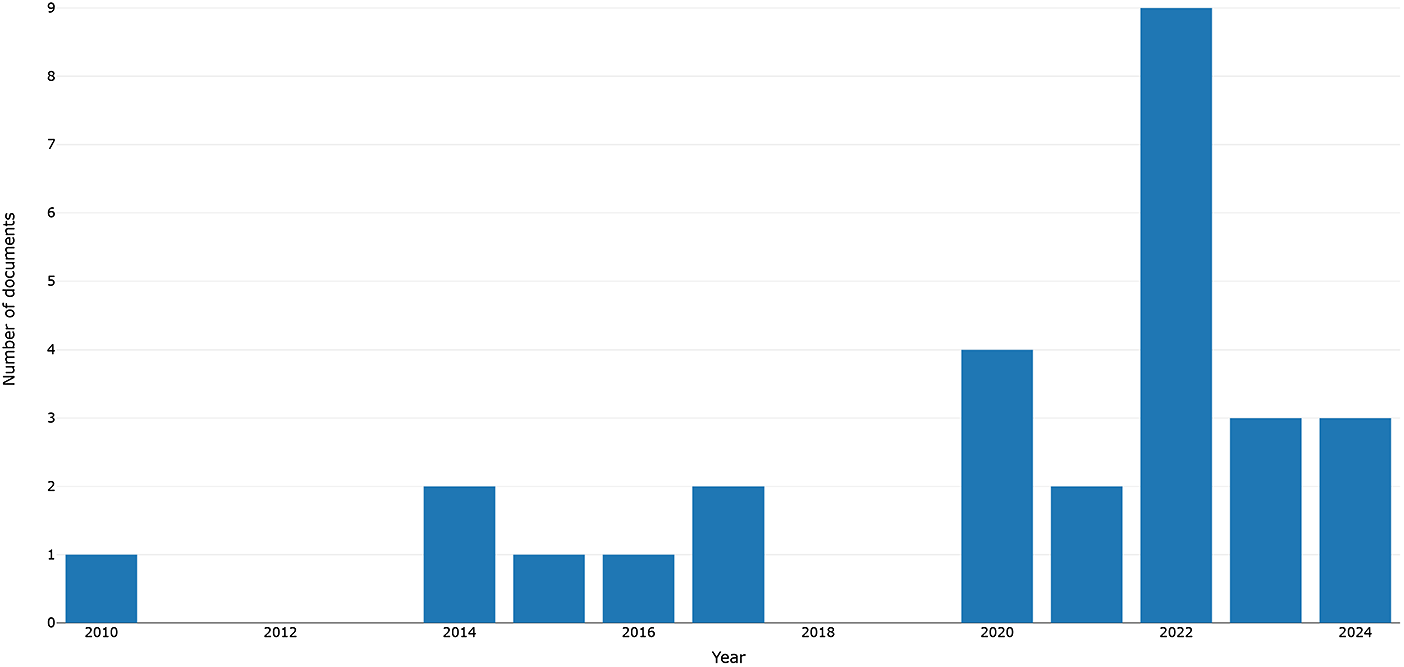
To provide an overview of the corpus of documents analysed in this study, we present the distribution of publications by year (Figure 1) alongside the keywords extracted using AI tools. The temporal distribution reveals notable patterns. Following the publication of the Digital Agenda for Europe in 2010, there is a four-year gap before the emergence of subsequent policy documents addressing the digitalization of public services. Another quieter phase is observed around 2018. A significant shift occurs in 2020, coinciding with the onset of the Covid-19 pandemic, which brought renewed and urgent attention to the theme of digitalization, as shown in the sharp increase in policy documents from that year onward, with 2022 marking the peak in frequency. This surge likely reflects the time required for the policy-making process to respond to and implement the digital transformations accelerated by the pandemic. This heightened focus on digital transformation is not only evident in the temporal distribution of the documents but also reflected in their content. The role of the Covid-19 pandemic as a catalyst for change permeates the policy texts, with implicit or explicit references to the application of digital technologies in areas where their adoption prior to the pandemic had been considerably limited. For example, the Council Conclusions on Human Rights, Participation and Well-Being of Older Persons in the Era of Digitalisation (Council of the European Union, 2020, 11) highlights how digital tools were leveraged to ‘enable remote participation in social, educational and cultural events’.
Frequency of selected documents by year.

Keywords extracted from documents offer valuable insights into the thematic focus of public services digitization policy. Specifically, they help to highlight the presence – or absence – of topics related to ageing and other vulnerable social groups. At the European level, several terms related to ageing emerge, largely due to the Human Rights, Participation and Well-Being of Older Persons in the Era of Digitalisation. By contrast, this focus on ageing is absent at the national level, where no comparable emphasis is observed.
Turning to the findings of the CDA, the initial entry-level analysis identified key discourse topics and core concepts at both levels of government (van Dijk Reference van Dijk1993). Notable differences in how digitalization is framed at the European and national levels are revealed, while also highlighting shared themes. Concepts such as ‘digital skills’, ‘digital inclusion’, ‘lifelong learning’ and ‘digital transformation’ are prevalent across both levels. However, distinctions emerge in their contextualization: at the European level, digitalization is closely linked to concepts such as ‘e-inclusivity’, ‘accessibility’ and ‘intergenerational solidarity’, reflecting a rights-based framework. This approach is reinforced by the presence of a document specifically addressing older persons’ rights, which introduces themes like ‘active and healthy ageing’, ‘life-cycle perspective’ and ‘intergenerational solidarity’.
Integrating older adults into the digital landscape through lifelong digital education and active ageing is emphasized as part of a comprehensive strategy. While the concept of active ageing adopts a positive perspective, it also reflects neoliberal discourse, entailing productivity and societal contribution (Carlo and Sourbati Reference Carlo and Sourbati2020; van Dyk Reference van Dyk2014).
At the national level, however, digitalization assumes a more technical and implementation-oriented connotation. Policy concepts such as ‘interoperability’, ‘cloud first’, ‘digital facilitation’ and ‘multi-stakeholder approach’ point to a focus on building infrastructure and operational strategies. National documents adopt a more generalized approach to digital exclusion than the European ones, addressing various vulnerable social groups without the specificity observed at the European level. This recontextualization process underscores how abstract principles are often reframed in technical or economic terms when translated into national policy making. However, moving from a rights-based approach to an implementation level may result in a lack of focus on vulnerable social groups, such as older adults.
Discourses on digital technology
With a closer look at the concepts, we identify different areas of origin for the recurrent concepts in texts, observing processes of recontextualization, as described earlier, and interdiscursivity. As shown in Table 3, besides concepts specifically related to the digitization process and to digital futures, several concepts associated with policy and planning language and discourses emerge from the analysis. Other concepts that are borrowed from various fields, such as the marketing and the web design area, can be identified. Finally, some technical concepts related to digital infrastructure emerge.
Main concepts that emerged from the analysis and related semantic fields

By integrating elements from different discursive fields, with an interdiscursivity process, policy documents reinforce their legitimacy while broadening their appeal to diverse audiences. This process helps to situate policy discourses within a broader matrix of societal values and priorities, revealing how issues are framed in relation to intersecting domains of knowledge and power (Gherardi Reference Gherardi2000). This is evident in how digitalization policies position themselves simultaneously as technical solutions and societal imperatives. For example, the emphasis on ‘digital skills’ and ‘digital citizenship’ highlights the human capital required for a digitally literate society, linking these goals to education and workforce strategies. Moreover, concepts like ‘user experience’ and ‘customer satisfaction’ borrow from corporate practices to frame public services as efficient, citizen-centred products. Hence, discourses around DPS are structured upon an interplay of technical priorities and societal aspirations, weaving together diverse expectations and values to legitimize digital transformation as a multi-faceted policy agenda.
Although prevailing concepts in the analysed texts are borrowed from an array of fields, the overarching framework (or rationale) consistently revolves around improving public administration services through digitalization, especially at the Italian level. The approach is user-centred, with an emphasis on enhancing their digital skills to transform them into fully informed and capable users, although with a language almost invariably steeped in technical jargon and/or business terminology. In many instances, the approach is limited to appending the term ‘digital’ – or ‘electronic’, often abbreviated with the ‘e’ prefix – to existing services (e.g. ‘electronic health record’). Apart from participatory decision-making processes, an absence of a specific lexicon that addresses the digital dimension of public services can be noted. In the context of e-government, however, the specificity of the digitization process is more apparent, particularly in relation to fostering openness and transparency in public administration. This aligns with the principles of openness as applied to open government, open data initiatives in the public sector and even concepts like ‘once only’, which ties digital practices to public administration operations. Such specificity, however, is not equally evident in the realm of public services provided to citizens. For instance, when it comes to rights, the concepts of digital citizenship and of digital sovereignty are often referenced, yet their definitions remain vague: how the online sphere impacts the rights and responsibilities of both citizens and the state is left opaque. Similarly, at the European level, while digital principles and digital rights are acknowledged, declination of ‘digital transformation’ within the public services framework does not appear explicitly. In general, the core concerns cover the issue of access to DPS, in terms of implementation from administrations, as well as regarding the accessibility for citizens. While the first is mostly described with a techno-economy approach, the second is rather reduced to internet accessibility issues.
The analysis of discursive strategies reveals the use of topoi as argumentation schemas to justify regulatory measures, reflecting an underlying worldview shaping the perception of societal challenges and delineates the problems deemed worthy of intervention (Askheim et al. Reference Askheim, Christensen, Fluge and Guldvik2017). In our case, the topos of techno-optimism is pervasive across policy documents, wherein digital technologies are framed as the cornerstone for addressing societal challenges and enhancing citizens’ quality of life. For instance, European-level documents frequently emphasize the transformative potential of digital innovation. A notable example states:
Wider deployment and more effective use of digital technologies will thus enable Europe to address its key challenges and will provide Europeans with a better quality of life through, for example, better health care, safer and more efficient transport solutions, cleaner environment, new media opportunities and easier access to public services and cultural content (European Commission 2010, 3).
Such language epitomizes an essentially utopian vision of digitalization, assuming inherent progressiveness and societal benefit. This optimism is further compounded by the conceptualization of digitalization as a self-sustaining cycle of development, wherein technological advances generate increasing demand and subsequent economic growth. As articulated in the Digital Agenda for Europe as well:
This great potential of ICT can be mobilised through a well-functioning virtuous cycle of activity. Attractive content and services … stimulate demand for higher speeds and capacity, which in turn creates the business case for investments in faster networks (European Commission 2010, 3).
This framing implicitly equates technological progress with socio-economic advancement, marginalizing critical perspectives on systemic inequalities or the potential for exclusion.
Despite the predominance of optimistic narratives, some documents acknowledge the necessity of situating digitalization within broader societal and democratic frameworks. For instance:
Digital technologies should contribute to achieving broader societal outcomes … the digital transformation should go hand-in-hand with improvements as regards democracy, good governance, social inclusion and more efficient public services (European Commission 2010, 16).
While still imbued with a techno-optimistic tone, this approach introduces critical awareness of digitalization’s potential pitfalls, such as exacerbating inequalities.
A parallel topos emerges in the tendency to shift the risks and responsibilities associated with digitalization to individuals. We define this as the topos of individualization of risk, as, aligning with neoliberal rationalities, the analysed documents tend to stress individual, over collective, solutions to potential problems arising from digitization. Individualization of risks is evident in the framing of digital competencies as prerequisite for participation in the digital era. Policy documents state:
Digital skills, basic and advanced, … are essential to speeding-up the adjustment of the Union industry to structural changes. It is intended that digitally empowered and capable citizens … take advantage of the opportunities of the Digital Decade (European Parliament and Council 2022, 11).
Here, the burden of overcoming digital exclusion is placed on individuals, particularly through skill acquisition, rather than addressing systemic barriers or infrastructural deficiencies.
Moreover, the call for intergenerational solidarity serves as a significant counterpoint to the techno-centric narrative. As European policy documents advocate for recognizing older adults’ contributions and facilitating their inclusion, this happens by advocating for initiatives aiming to ‘raise awareness among younger generations for the valuable contributions of older persons towards society, thereby strengthening intergenerational bonds and reducing ageism’ (Council of the European Union 2020, 10). This argument suggests a potential mitigation of the digital divide by leveraging the capacities of younger generations. While the digital divide is acknowledged as a ‘problem’, the responsibility for addressing it is depicted as resting not solely on governments and public institutions but also on individual citizens, in this case younger generations, who are called upon to play an active role in alleviating its effects.
Finally, a topos related to economic rationality emerges and it positions digitization as a mechanism for achieving fiscal savings, rather than a means to strengthen public infrastructure or equity. This is evident in particular from national policy discourses foregrounding efficiency and cost reduction as primary justifications for digital transformation. Nonetheless, at the European level, e-government services are also celebrated for their ability to ‘offer a cost-effective route to better service for every citizen and business … reducing costs and saving time for public administrations, citizens and businesses’ (European Commission 2010, 31).
Discourses on ageing and its relationship with digital technology
As anticipated while introducing the keywords, at the European level we identified the presence of the topic of ageing within digitalization policies, while at the Italian level the problematization of risks of exclusions dwells on vulnerable social categories more generally, without a specific focus on older people. Generally, while at the European level at least one document is specific on the issue of older persons and digital inclusivity, hence explicitly mentioning older persons and the ageing process, at the national level older persons are merely nominated among the various categories of population at risks of digital exclusion.
In the Italian context, the reference is frequently to the ‘digital inclusion/access of the elderly, unemployed women or women in particular circumstances, immigrants, people with disabilities, and disadvantaged categories in general, with low levels of education’ (Department for Digital Transformation, 2020, 39). The primary concern is framed as one of accessibility, with limited attention given to the specific and diverse needs of each category. Digital literacy initiatives are proposed for ‘disadvantaged individuals (including elderly people)’ (Department for Digital Transformation, 2020 , 40). Moreover, the notion of disadvantage is neither well-defined nor clearly articulated, often conflated with a general fragility to which older people are associated: ‘social and welfare services aimed primarily at elderly and fragile people may also be hosted’ (Italian Government 2021, 228). Although there is no explicit reference to older adults, representations of social inequalities focus less on the dimension of rights and more on economic growth and development. In other words, disadvantaged individuals need to be supported so that they do not represent an obstacle to the economic growth and development that can be supported through the digitalization of public services. For instance, the 5th National Action Plan for Open Government states: ‘The persistence of gender inequalities and the absence of equal opportunities constitute a significant obstacle to economic growth and social development’ (p. 32).
Despite being heavy users of digital public services, and despite many barriers still existing between older adults and digital technologies, issues related to the specific risks that public services digitalization may pose for this group of the population seem to be completely neglected in policy documents – in the explored field. Therefore, we specifically focus our inquiry on discourses on ageing mainly on the Council Conclusions on Human Rights, Participation and Well-Being of Older Persons in the Era of Digitalisation (Council of the European Union 2020).
Overall, ageing is framed in this document as a potential vulnerability in the context of accelerated digitalization of public services: older people are considered as a social category whose rights need to be protected and whose inclusion needs specific attention. The Council of the European Union (2020, 13) invites member states and the European Commission to
strive to ensure that digitalisation is an inclusive process improving access to services and that the European Accessibility Act (EAA) is implemented fully and in a timely manner, and take other measures to make digitalisation accessible to all; ensure through alternative means that those who cannot fully use digital technologies can enjoy the same rights as other groups of the population.
At the same time, digital technologies emerge as a strategy to support and assist older persons’ participation in social, economic and cultural life, with the potential to empower this social category ‘to maintain independence, well-being and higher quality of life’ (Council of the European Union 2020, 12). In some cases, digital technology is considered an aid to answer older persons’ care – and health-care – needs, as emerges from the passage, in which the Council of the European Union (2020, 11) invites member states and the European Commission to
shape digitalisation with regard to, in particular, such public services as health, social and long term care services, in such a way that these services are easily accessible, user friendly, and as barrier-free as possible, while ensuring that non-digital services are maintained. Special focus needs to be placed on the rights (including data protection rights) and needs of older persons, including older persons with disabilities.
Thus, we notice a dual framing of the relationship between digital technologies and ageing. On one hand, digitalization is celebrated as a solution to various challenges faced by older persons, promising enhanced independence, wellbeing and access to social, economic and cultural opportunities. Digital technologies are portrayed as tools that can empower older adults and address their care and health-care needs, but only if one condition is met: they must be designed as accessible and user-friendly. On the other hand, the risks of exclusion for older persons are explicitly acknowledged, with policies emphasizing the need to safeguard their rights and ensure their inclusion. This balance is reflected in the recognition that digital services should not entirely replace non-digital alternatives, which must be preserved to guarantee equitable access for all, particularly for those who cannot fully engage with digital technologies.
Moreover, we notice how the language used in the document is predominantly positive – for example, it encourages ‘the promotion of positive images of ageing, a focus on opportunities and challenges of ageing’ (Council of the European Union 2020, 9) – where opportunities come before challenges, while emphasizing the integration and active participation of older adults in the digital landscape. The focus on ‘positive ageing’ and on ‘ageing as an opportunity for societies and on how this can serve as an underlying basis for all further policy measures in this area’ (Council of the European Union 2020, 14) sets an optimistic tone for the entire document. However, this predominantly positive framing coexists with the acknowledgement of the barriers and inequalities that older adults may face in a rapidly digitalizing world. This duality reflects a balancing act within policy discourses, where the aspirational vision of ‘positive ageing’ must contend with the reality of structural inequalities, such as the digital divide and varying levels of digital literacy among older populations. Furthermore, the idea of ‘active ageing’ ties into broader discourses on the societal value of productivity, subtly aligning with narratives that encourage individuals to remain engaged and self-reliant, even in later life. While this framing positions older adults as valuable contributors to society, it may also risk overlooking those who are unable or unwilling to participate actively due to physical, cognitive or social barriers.
Ultimately, the analysis of the European document reveals two main discursive representations of older people. On the one hand, we identify a discourse that recognizes and values ‘the contribution that older persons make to social cohesion and the economy’ (Council of the European Union 2020, 9). This aligns with a logic of ‘active ageing’ that emphasizes the active participation and integration of older adults in processes of production and consumption (Carlo and Sourbati Reference Carlo and Sourbati2020). On the other hand, a discourse emerges that portrays older people as non-self-sufficient or disadvantaged, with a focus on their need for long-term care and health services. In this case, the discussion of older adults is primarily framed within a context of growing care needs related to the ageing process: they are a group needing technological interventions.
These contrasting discourses reflect the tension between portraying older adults as a resource to be leveraged and portraying them as a vulnerable group requiring protection and assistance. Such a polarized perspective risks oversimplifying the complexity of ageing and overlooking the diverse realities and experiences of older adults in the context of digitalization.
Discussion and concluding remarks
In this article, we explored the digitalization of public services and its implications for the older population, employing CDA to uncover underlying discursive patterns and narratives within policy documents on public services digitalization, at the European and national governance levels.
The optimistic belief in the transformative power of technology is evident in the policy rhetoric at both the levels, where, as in many other policy strands, technological advancements are often portrayed as a panacea for a range of social issues. However, when it comes to the relationship between ageing and technology, our findings reflect only partially what has been highlighted by other scholars. Despite the centrality of the older population in the context of public service digitalization – as heavy users (Sourbati Reference Sourbati2009) – the issue of ageing is addressed in a much softer way in policy documents on public service digitalization compared to other areas, where it is often used to justify investments in technology (Lipp and Peine Reference Lipp and Peine2024).
More precisely, as far as how the relationship between ageing and technology is portrayed, some differences emerge between the European and the Italian levels of analysis: while at the European level at least one document (Human Rights, Participation and Well-Being of Older Persons in the Era of Digitalisation – Council Conclusions) is dedicated to older adults’ rights in relation to the digitalization process, there is a complete lack of focus on the ageing issue at the national level, despite Italy having one of the oldest populations in Europe (and in the world).
This difference underscores a process of recontextualization (Krzyżanowski Reference Krzyżanowski2016) through which policy concepts are adapted to local priorities. This process plays a key role in reducing the inclusivity of digital policies (Bernstein Reference Bernstein1990; Krzyżanowski Reference Krzyżanowski2010). While the European Union promotes universal principles such as accessibility and inclusion, these are transformed at the national level into technical or economic goals, such as modernizing public services (Department for Digital Transformation 2020).
At the European level, in the only document in which older adults are brought into focus, the ageing-and-innovation discourse (Neven Reference Neven2011; Neven and Peine Reference Neven and Peine2017) is only partially invoked: ageing is not framed here as a burden/problem, nor is technology portrayed as the ultimate solution. Rather, there is no apparent awareness of the interconnectedness of these two processes – how they shape each other. The emphasis is limited to older adults as users of digital services, following the two dominant narratives about ageing: disengagement and active ageing (van Dyk Reference van Dyk2014).
Overall, in the analysed documents the ageing discourse appears to be completely absent (in particular, at the national level) or more blurred (e.g. older adults are mentioned alongside other vulnerable groups rather than representing a focus) than in other policy areas. Our analysis thus shows that the policy discourse on the digitalization of public services entirely misses the opportunity to advance new reflections on the relationship between ageing and technology and, in doing so, fails to leverage the potential of the concept of ageing to ‘alter political debates and rationalities’ (Lipp and Peine Reference Lipp and Peine2024, 1491) – that is, to generate new ideas and drive social change.
In our interpretation, the absence or blurriness of ageing-related issues may be interpreted as a consequence of a more generalized lack of attention in these documents to the risks of social exclusion associated with the digitalization of public services. Indeed, the documents tend to represent vulnerability in relation to digitalization processes – lack of adequate digital literacy or access to digital resources – as an obstacle to the process of public services digitalization and, in turn, to economic growth. This approach is evident in the frequent references to what we propose terming the ‘digitally engaged public services user’, borrowing from Lupton’s (Reference Lupton2013) ideal type of the ‘digitally engaged patient’. By this, we mean that the DPS user emerging from policy discourse is a citizen capable of identifying opportunities offered by public services based on their needs and accessing them independently. This user, empowered by digitalization, maximizes their access to new opportunities while contributing to the overall efficiency of the system, rather than representing an obstacle to the potentialities of digitalization for social and economic growth. The rhetoric underpinning this image often centres on the concept of empowerment.
To conclude, the digitalization of public services holds significant potential to enhance accessibility and efficiency but risks exacerbating existing inequalities if it fails to specifically address the needs of the older population. Current policy discourse, dominated by a technocentric outlook and somehow overlooking the relationship between technology and ageing, requires critical revision to ensure that digitalization serves as a genuine tool for social inclusion. Recognizing the interrelations between the two processes, as well as the agency, needs and aspirations of older adults as a multi-faceted category, is an essential step towards building a more equitable and inclusive digital future.
Our analysis focused on a limited sample of documents and employed a critical discourse methodology, which may not fully capture the practical implications of the policies examined. Future research could expand the scope by including empirical evaluations of the impact of digitalization policies on the daily lives of older adults. Comparative studies with other European countries could also offer broader insights into discursive dynamics and digital inclusion strategies (Valokivi et al. Reference Valokivi, Carlo, Kvist and Outila2023).
Author contributions
All authors made substantial contributions to the design and analyses of this study, as well as to drafting and revising this article, and have given approval for publication.
Financial support
This research was funded by the European Union (Next Generation EU), through the PRIN 2022 call.
Competing interests
The authors declare none.
Ethical standards
Ethical approval was not required for submission of this article.