

Introduction: developing guidelines
Methods and practices of guideline development have been most frequently considered in relation to clinical issues. There is an extensive literature that describes processes of consensus building (e.g. Moreira Reference Moreira2005), critiques these processes (e.g. Alonso-Coello et al. Reference Alonso-Coello, Irfan, Sola, Gich, Delgado-Noguera, Rigau, Tort, Bonfill, Burgers and Schunemann2010; Fernler Reference Fernler2015), evaluates the guidelines so produced (e.g. Brouwers et al. Reference Brouwers, Kho, Browman, Burgers, Cluzeau, Feder, Fervers, Graham, Steven, Hanna and Makarski2010), provides guidelines on how to develop guidelines (e.g. World Health Organisation 2014) and evaluates these (e.g. Ansari and Rashidian Reference Ansari and Rashidian2012). This literature tends to adopt a model of translation of evidence into practice that Nutley, Walter and Davies (Reference Nutley, Walter and Davies2007) suggest involves an assumption of a valid and reliable body of scientific evidence that simply requires translation to inform clinical practice. Nutley, Walter and Davies (Reference Nutley, Walter and Davies2007) identify that, from a social science point of view, translation processes are social processes, and therefore embedded in contexts in which knowledge may be contested, incomplete and influenced by stakeholders with different interests. Fernler's (Reference Fernler2015) critique echoes this point, emphasising that the production of guidelines inevitably involves hidden processes of contest and debate behind the apparently clear-cut routines and criteria presented as having generated them.
There is little literature reflecting on the development of non-clinical guidelines. In one example, Gould (Reference Gould2010) describes the processes of developing two sets of guidelines for social workers, one on parenting and one on dementia care, both for the English National Institute for Health and Clinical Excellence and the Social Care Institute for Excellence. These were informed by reviews of both quantitative and qualitative literature and the dementia guidelines also by consultation with stakeholders including practitioners in the field, a person with dementia and two carers. Harding et al. (Reference Harding, Pettinari, Brown, Hayward and Tayler2011) reflect that involvement of service users in guideline development can help to ensure that guidelines can be more readily applied, if they reflect the concerns of those receiving care. As Nutley, Walter and Davies (Reference Nutley, Walter and Davies2007) propose, this literature takes greater account of a wider range of stakeholder views than much of the clinical literature. In doing so, it reflects a value base which goes beyond a simple knowledge translation model and therefore engages with wider debates about how research can inform policy and practice.
In this paper, we review a research-based process of guideline development relating to the design of environments for people with dementia and sight loss. In doing so, we will explore in detail how the guidelines developed, and how drawing on the perspectives of a range of stakeholders influenced the interpretation of the knowledge on which the guidelines were based. We will examine the implications of this process for guideline development processes and reflect on how developers can draw on a value base – in this case person-centred care, dignity and independence – and ensure guidelines retain their evidence base and use it in a transparent way.
Background to the project
The stimulus for this project came from practice in support for people with dementia and people with sight loss. Particular issues regarding design for people affected by these conditions had arisen from reviewing existing guidelines, and a key purpose of the project was to understand some apparent contradictions in existing published work. Goodman and Watson's (Reference Goodman and Watson2010) comparative review for the Thomas Pocklington Trust considered selected sub-sets of the design guidance literatures for homes and environments for people with dementia and people with sight loss, respectively. The authors found ‘significant areas where [the two sets of selected design guidance] diverge or (for someone with both sight loss and dementia) actually conflict’ (2010: 23). In the light of this, the project reported here aimed to systematically revisit and evaluate those literatures and, by synthesising those findings and working with people with dementia and sight loss, carers and professionals with relevant expertise, provide practical guidance on how to negotiate the tensions.
More widely, the design of environments in which people live has become a focus of research relating to people living with various disabilities, including dementia. Whilst Barnes et al. (Reference Barnes2002) found little research, our own review (Bowes et al. Reference Bowes, Dawson, Greasley-Adams and McCabe2016) indicated a burgeoning literature. There are clear indications that design can make a difference: Kovach et al. (Reference Kovach, Weisman, Chaudhury and Calkins1997) found that care of people with dementia improved following design modifications and Parker et al. (Reference Parker, Barnes, McKee, Morgan, Torrington and Tregenza2004) found that better design in care homes could improve quality of life. Much research tends to focus on or prioritise one condition or type of disability (such as people with dementia or people with sight loss) and to explore possible adaptations that might be made to environments to enable people living with that condition or disability to live more independently. Other work has focused on environments which might support people across their lifespans, as the challenges they may face change, a notable example being the lifetime homes standard (Lifetime Homes 2010). There is little research which focuses on people experiencing combinations of conditions, such as sight loss and dementia, which are increasingly faced together as people age.
Most people will experience visual changes in later life. These commonly include: reduced visual acuity; increased need for light; increased sensitivity to glare; slower adaptation to changes in lighting; decreased contrast sensitivity; decreased depth perception; changes in colour perception; reduced peripheral vision; and blurring, light flashes or momentary distortions caused by changes in the vitreous humour (Alzheimer's Society 2013). In addition, they may experience sight deterioration or blindness due to disease. One in five people in the United Kingdom (UK) over the age of 75 are living with sight loss primarily caused by age-related macular degeneration, glaucoma, cataracts and diabetic retinopathy, rising to half of all people aged over 90 (Royal National Institute of Blind People 2015). Although it is increasingly recognised that in many instances sight loss is avoidable and that, in the context of ageing populations, avoidable sight loss is ‘a critical and modifiable public health issue’ (Department of Health 2012: 77), reduced visual ability will be a fact of life for most older people.
Some of the same people will be amongst the estimated one in 14 people over 65 years of age and one in six people over 80 years of age in the UK who have a form of dementia (Alzheimer's Society 2014). Impaired sight can often lead people to make ‘visual mistakes’ resulting from optical illusions, misperceptions and misidentifications. The consequences of such mistakes are more serious for people with dementia who, depending on the stage of their dementia journey, may not realise or remember that they have made a visual mistake or be able to rationalise or ‘reality check’ what they believe that they are seeing (Alzheimer's Society 2013). In addition to the challenges arising from difficulties in processing incomplete visual information as a result of dementia, some forms of dementia, including Parkinson's disease, Lewy body dementia, vascular dementia where strokes have occurred along or near the visual pathway, and the posterior cortical atrophy variant of Alzheimer's disease, have been linked with causing additional visual problems (Alzheimer's Society 2013).
Aim of the research
Against this background, the project aimed to assemble and review the research and practice evidence bases for designing living environments for people with dementia and sight loss and to use the review findings to develop user-friendly guidelines (our final product is referred to henceforth as ‘the Guidelines’). The approach taken entailed the involvement of potential users of the Guidelines from the outset and throughout the processes of research and development. User involvement helped to ensure that the Guidelines developed were responsive to the needs of people using and delivering designed environments, thus being practical and usable, as well as being based on the best evidence available. The project did not seek to compare guidelines in detail systematically: this would only have identified surface issues, rather than digging deeper into underlying matters of knowledge use and interpretation, and values relating to the nature of support.
This approach works in the tradition of seeking to ensure that interventions are evidence-based in the sense that there is research-based support for them, that they are practical in delivery and able to be implemented in real-world situations. The research base to which we refer in the paper derives partly from published sources and partly from stakeholder knowledge and experience, which was captured through the consultation processes. As we will demonstrate, the evidence base emerges as developing rather than definitive, and we will argue that there is nevertheless learning that can inform helpful advice for people with dementia and sight loss and those who support them. Our perspective, therefore, draws on the critiques of simple knowledge transfer approaches outlined earlier.
Research methods
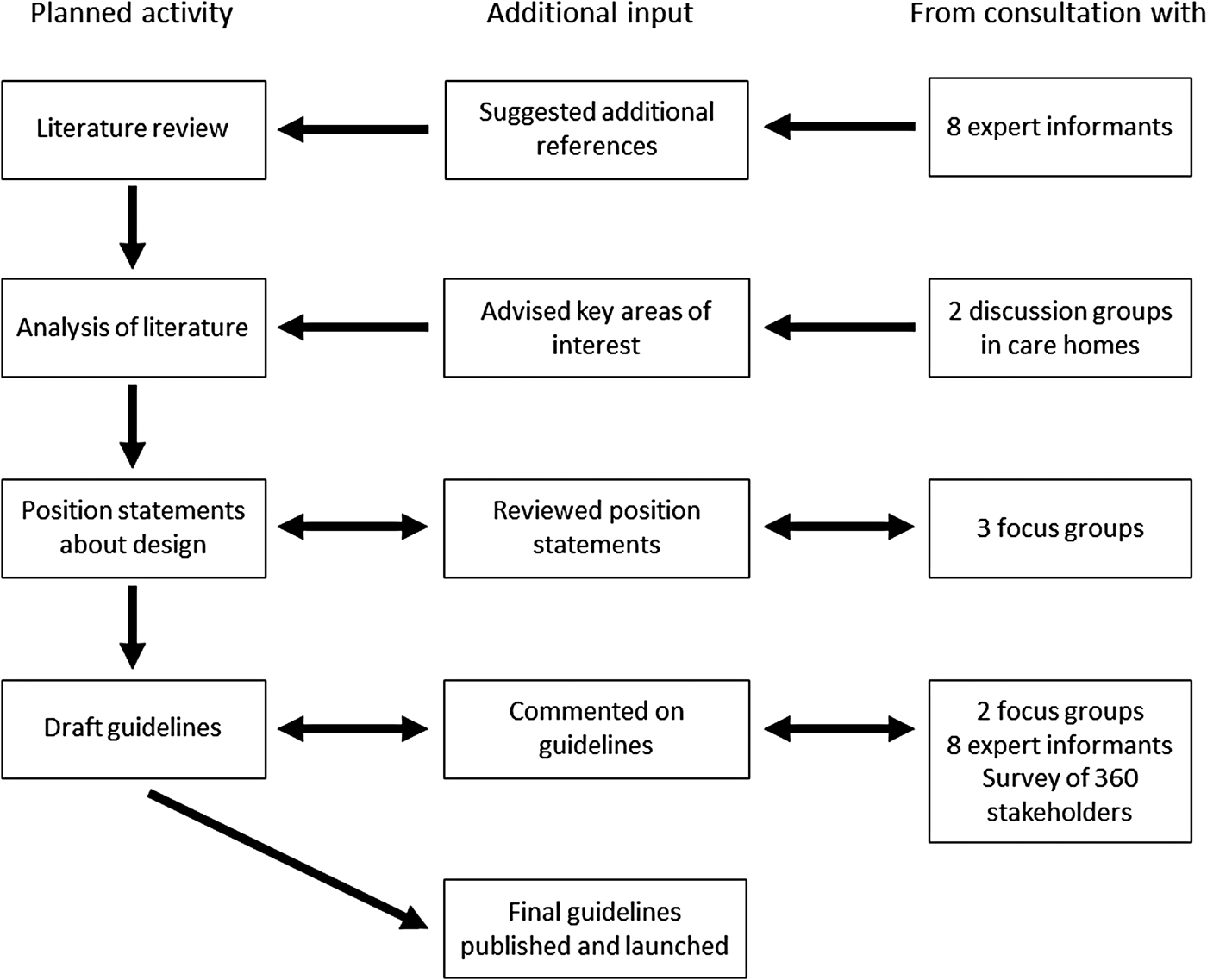
Figure 1 provides an overview of the stages of the work, illustrating the various tasks and the ways in which the consultation results were used.
Overview of activities and consultation inputs.

The first stage of the research was a structured literature review, complemented by consultation with eight experts in the field who were asked to identify literature that the searches might not have identified. The literature review involved systematic searching of selected bibliographic databases for literatures covering environmental design for people with dementia and people with sight loss, and quality assessment of identified literature using standard protocols.Footnote 1 The procedures and full results of the literature review are published elsewhere (Bowes et al. Reference Bowes, Dawson, Greasley-Adams and McCabe2016): here we will draw on examples of the results and explain how they became part of the iterative process of developing the Guidelines.
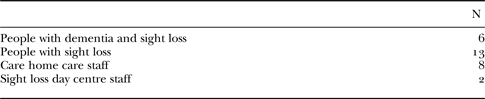
Alongside and following the literature review and as the Guidelines were developed, consultation meetings were held with people living with dementia and/or sight loss, including carers and care staff, to discuss their needs in regard to environmental design. Overall, three sets of consultation were carried out at different stages of the project, and Table 1 lists the participants and their characteristics.Footnote 2
Consultation participants living with dementia and/or sight loss

The first phase of consultation took place in two care homes, involved four people with dementia and sight loss, all of whom had capacity to give informed consent, and five staff members, and focused widely on the environments in which people were living, what made using them easier or more difficult, and where people saw scope for improvement. The residents were supported to participate by conducting the work in their familiar environment at their own pace, with plenty of time given to comment, and checking that they understood the process in which they were involved (after Dewing Reference Dewing2008).
The quality-assessed literature was then analysed to start identifying potentially useful design features, and collated according to headings derived from these consultation meetings, to ensure that the evidence could be presented in meaningful ways. The headings related to a range of design features, i.e. colour and contrast, lighting, fixtures and fittings, kitchens, bathrooms, entrances and exits, and outdoor spaces. The findings were used to generate a series of position statements about suggested desirable design features which formed the basis for discussion in the second phase of consultation.
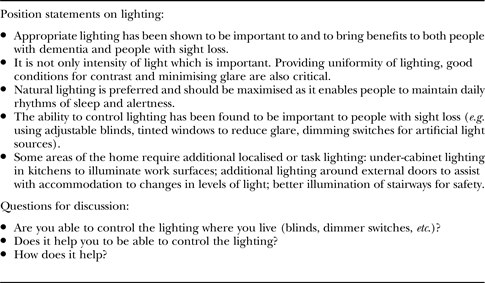
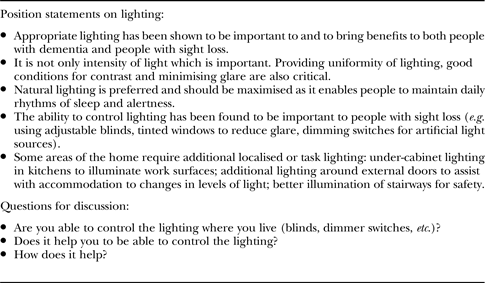
The second consultation phase used the position statements to generate discussion in three focus groups, two in the care homes included in the first phase and one in a day centre for people with sight loss. The care home participants at this stage were four residents and three staff; six service users and two staff took part at the day centre. For each of the position statements, a series of questions were developed and these were used as the basis of discussion in the focus groups. For example, the position statements on lighting generated from the literature were used to produce three key questions, as Table 2 shows. Throughout, the questions focused on the preferences and real experiences of people with dementia and sight loss.
Example of position statements and questions for discussion in focus groups (lighting)
The collated information was then used to generate draft recommendations for design that had a visible evidence base drawn both from the literature and from the consultations. These initial recommendations were then taken back to the care staff and older people, who were asked to comment on them specifically in terms of their comprehensibility and usefulness. Eight expert informants on the Advisory Group for the project were also asked for their comments at this stage. The initial Guidelines were then revised, following this advisory input.
The last stage of the work involved a survey of practitioners in dementia services, carers of relatives or friends, and interested parties on the University of Stirling Dementia Services Development Centre's and the Royal Blind's databases of contacts, which amounted to over 10,000 people. The survey invited respondents to comment on all or any aspects of the draft Guidelines, depending on their interests. It attracted 360 responses. The survey was designed to ‘sense-check’ the draft Guidelines, and informed their final revision before they were developed into a booklet and Web resource (available at http://dementia.stir.ac.uk/design/good-practice-guidelines). The Web resource includes the Guidelines in both visual and audio form; access to the research base, in the form of a review and evaluation summary and references for each section of the Guidelines; and comments from each element of the consultation processes (‘what people said’). The transparency of the evidence base for the Guidelines is, to our knowledge, unique and is intended to promote critical engagement with evidence from literature and from stakeholders by people using the Guidelines.
Findings
Literature review
The review included 33 publications which met the inclusion criteria of: focusing on how people engaged with built environments; describing or reviewing a number of research studies; and relating to people with dementia, people with sight loss and/or people with both. Five of the included items were recommended by the expert Advisory Group.
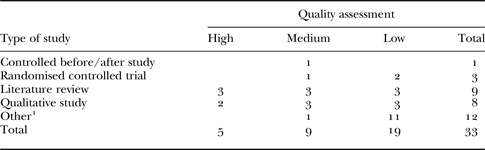
Table 3 indicates the approaches taken by the literature selected for full review and lists the quality assessments.
Included items and quality assessments

Note: 1. The ‘Other’ category includes one enquiry report, three practice guidelines, two case studies, one cross-sectional population study, one experiment, one ideas review, one product review, one study review and one expert view.
The quality of the research was not generally high, with only three literature reviews and two qualitative studies rating as high quality. We did not exclude the low-quality material at this stage, as, especially in a new field of enquiry, this may produce helpful indicative insights. In adopting this approach, we were informed by principles of realistic evaluation perspectives which admit consideration of various kinds of input (Pawson Reference Pawson2006). Throughout the process, we retained the quality assessments, and noted where evidence was relatively strong or relatively weak: this was eventually reflected in the final Guidelines produced.
Here, we summarise the main indications from the literature review in relation to, first, lighting and, second, colour and contrast, two areas which will provide illustrative examples in the paper. These elements have been selected as they were, firstly, a less popular topic which was nevertheless one of some contention (lighting, with 79 responses) and, secondly, the most popular topic for survey respondents (colour and contrast, with 145 responses).
There was an emphasis on adequate lighting where people with dementia are living (Brush, Meehan and Calkins Reference Brush, Meehan and Calkins2002; Calkins and Brush Reference Calkins and Brush2002; Kelly, Innes and Dincarslan Reference Kelly, Innes and Dincarslan2011; Marquardt Reference Marquardt2011; McNair et al. Reference McNair, Cunningham, Pollock and McGuire2010; van Hoof et al. Reference van Hoof, Kort, van Waarde and Blom2010), with a particular emphasis on the benefits of natural daylight (Bossen Reference Bossen2010; Marquardt Reference Marquardt2011; McNair et al. Reference McNair, Cunningham, Pollock and McGuire2010). Bright artificial light was also recommended by Marquardt (Reference Marquardt2011), Lawrence et al. (Reference Lawrence, Murray, Ffytche and Banerjee2009) and Kelly, Innes and Dincarslan (Reference Kelly, Innes and Dincarslan2011), with Van Hoof et al. (Reference van Hoof, Kort, van Waarde and Blom2010) amongst others suggesting that this could promote better nutrition, prevent falls and modify behavioural issues. Similarly, for people with sight loss, the literature recommended bright light, preferably daylight (Lawrence and Murray Reference Lawrence and Murray2009; Littlefair Reference Littlefair2010; Long Reference Long1995; Utton Reference Utton2009), with Torrington and Lewis (Reference Torrington and Lewis2011) highlighting the need to control glare from daylight. For people with sight loss, good lighting could improve safety (La Grow et al. Reference La Grow, Robertson, Campbell, Clarke and Kerse2006), but also quality of life (Brunnström et al. Reference Brunnström, Sörensen, Alsterstad and Sjöstrand2004). The literature on sight loss noted that people's preferences may vary (Littlefair Reference Littlefair2010; Long Reference Long1995), and research participants spoke of their need for controllable light (Long Reference Long1995; Unwin et al. Reference Unwin, Andrews, Andrews and Hanson2009). Where literature focused on people with both dementia and sight loss, the need to maximise natural light was again emphasised (Goodman and Watson Reference Goodman and Watson2010; Homes and Communities Agency 2009), whilst avoiding excessive contrast or glare.
The literature on colour and contrast frequently made specific recommendations, such as, for people with dementia, a need to avoid dark kitchen worktops (McNair et al. Reference McNair, Cunningham, Pollock and McGuire2010; Pollock et al. Reference Pollock, McNair, McGuire and Cunningham2007). There was some debate about appropriate colours, with some researchers suggesting that red, orange and yellow were especially appropriate for people with dementia (Marquardt Reference Marquardt2011; Utton Reference Utton2009), but Utton (Reference Utton2009) suggesting that actually contrast was more important than the use of particular colours. Contrast could be used to mark things that needed to be seen (Calkins Reference Calkins2002), e.g. for defining spaces (Goodman and Watson Reference Goodman and Watson2010) or for way-finding (Kelly, Innes and Dincarslan Reference Kelly, Innes and Dincarslan2011). Goodman and Watson (Reference Goodman and Watson2010) noted that using contrast, or lack of it, to deter people with dementia from opening doors (lacking contrast) or crossing thresholds (marked contrast) could be considered forms of restraint.
For people with sight loss, researchers also found contrast could be used for support by highlighting items such as light switches and chairs (Brunnström et al. Reference Brunnström, Sörensen, Alsterstad and Sjöstrand2004; Littlefair Reference Littlefair2010; Torrington and Lewis Reference Torrington and Lewis2011; Unwin et al. Reference Unwin, Andrews, Andrews and Hanson2009). There was a range of suggestions about lighting on stairs and ways of marking treads, with disputes regarding how helpful things could be, e.g. den Brinker et al. (Reference den Brinker, Burgman, Hogervorst, Reehorst, Kromhout and van der Windt2005) and Unwin et al. (Reference Unwin, Andrews, Andrews and Hanson2009) promote contrasting edges on stairs, but note that these could be visually misleading if not properly placed. For people with sight loss and dementia, the use of contrast was promoted as a way to help people find things they needed, such as crockery on a table (Lawrence and Murray Reference Lawrence and Murray2009).
These examples illustrate that the research base, as it stands, provides indications of measures that might be helpful for people with dementia and sight loss. It cannot be interpreted as providing clear evidence in many cases, especially given the examples of non-systematic disagreement identified. It is also the case that most of the literature focuses on addressing issues presented by one condition only, and that the interventions considered are often dealt with in isolation or under controlled conditions. The preferences of people with dementia and sight loss themselves are rarely considered. These issues alone suggest that the research evidence base is insufficient: there is clearly a need to consider the whole person, and shift away from the focus on a single condition, and there is also a need for a fuller appreciation of the contexts in which people actually live and work, which will vary, are likely to be less than ideal, may be shared with others with different needs and may be difficult to adapt. As we will argue, a genuinely person-centred approach to design will also necessitate consideration of the preferences of people with dementia themselves.
Furthermore, the literature review revealed a significant issue of values. For people living with sight loss, design recommendations overwhelmingly focused on promoting independence and supporting capacity, with this being the absolute default position. For people living with dementia, there was in addition a focus on control and containment, and less emphasis on capacity. We will return to this issue in the Discussion section.
Consultations
Initial consultations: identifying issues
The first stage of consultations was intended to test out what people with dementia and sight loss felt about the design of the environment they were living in, what they saw as helpful or less helpful in leading their everyday lives, and any ideas they had for making things better.
The care home residents spoke most readily about people – the staff in the care home and their relatives and friends – and found it more difficult to talk about the design of the home or particular design features. They did speak about getting around the home and finding places such as their rooms, toilets and the dining room. For one person, this was a matter of trial and error – walking about until she found the place she was looking for – whereas others used markers such as room numbers. They also spoke about personalising their own spaces, particularly about having familiar and personal items in their own rooms. They spoke of their enjoyment of the gardens attached to their homes, and reflected on how easy or difficult it was to get out into them.
The staff reflected on several aspects of the homes that they felt were helpful for people with dementia and sight loss, drawing on their experience of working there, none of them having received training about design specifically. They highlighted good security, including keys for bedrooms held by residents; accessible gardens; identifying signs on bedroom doors; spacious living areas making it easier to get around; quiet areas for people to use as they chose; keeping the furniture in the same place; personalising bedrooms with people's own items and choices of colour schemes (though one worker felt that if all the bedrooms were the same, people could be moved with less disruption and confusion); contrast used to highlight handrails and places to sit; smooth flooring; large televisions and games; and orientation cues such as white boards with clear lists of daily activities.
Difficulties identified by staff included lifts that were difficult for residents to use alone; small bedrooms, which made the use of equipment difficult; poorly designed doors that people could walk into and injure themselves; poor lighting and shadows; corridors with dead-ends or locked doors and a lack of quiet, communal spaces. Staff also had ideas about potential improvements, including bright colours that might improve people's mood; a quiet room; locating residents' rooms better so that people with reduced mobility had shorter distances to move to get to the dining room; thinking carefully about the placement of mirrors, which they had observed upset some people with dementia; and having circular corridors to avoid dead ends.
From the residents, there was a strong message about personal preferences, alongside some clear difficulties, especially with finding one's way about and being able to get where one wanted, such as into a garden. The staff generally recognised these issues, especially in terms of people being able to find their way about, and having more personalised bedrooms. The facilitators and barriers that the staff identified resonated with literature that focused on particular design features and, like the literature, were not particularly consistent. For example, personalising bedrooms was not necessarily compatible with having them all the same to make it easier to settle in people who were moved between rooms.
These initial consultations drew attention to the need for communication about design to be clear and appropriate to the audience, for it was not necessarily easy for people to think about it, and to the need to examine independence and personal choice. They suggested that personal preferences and strategies could differ markedly; that staff would be thinking both about what would be better for residents, as well as what might make their work easier; and that both residents and staff had learned from experience about several useful design features. The potential for decisions about design to be taken uninformed by an evidence base was also clear. The emphasis in the literature on single conditions and controllable environments was questioned further.
Second-stage consultations: reviewing research findings
The second phase of consultation involved discussion based on the position statements that were generated from the literature review and the early consultation. We highlighted above an example of the position statements and the discussion questions that were used in the focus groups. In the example identified, lighting, the care home participants reported that generally, they found light levels adequate and that they had some control over the lighting, especially in their own bedrooms. Whilst some of the literature had been quite prescriptive about lighting – going as far as to recommend exact light levels, for example (Marquardt Reference Marquardt2011) – it became clear that individuals needed and preferred different levels and kinds of lighting. For example, in communal areas, people doing puzzles or reading often needed additional light: staff were able to provide this by using small table lamps. It was clear that not all the care home residents wanted bright light, and that it was important for them to have control to set lighting at the level appropriate for them: one woman, for example, preferred to sit in near-darkness, which was more comfortable for her given the particular problems she had with her eyesight.
Several participants who were living in their own homes did express a preference for bright light. They discussed energy-saving bulbs in particular as having presented problems, because they could take time to ‘warm up’ and give the required level of light. Some literature had suggested that this should not be a problem, with improvements in energy-saving bulbs (e.g. McNair et al. Reference McNair, Cunningham, Pollock and McGuire2010). However, McNair et al. (Reference McNair, Cunningham, Pollock and McGuire2010) also noted that issues remain with domestic-style energy-saving bulbs in terms both of run-up time and significant drops in light emitted over the lifetime of the bulb. The realities of people living at home on tight budgets ‘using up’ long-lasting light bulbs bought some time ago illustrates a gap between the research literature ideal and the realities of home environments, including lack of awareness of alternatives.
The consultation illustrated the inventiveness and resourcefulness of people living with dementia and sight loss. For example, whilst the literature emphasises a need for handrails to contrast with the wall to be seen, one care home resident with little sight reported that she used the handrails as a tactile way-finding system. Those living at home used contrast as a way to help them find things so, for example, they had white tablecloths or black surfaces in their kitchen against which their phone or keys would be clearly visible. Another example was the use of plain-coloured bed covers so that they could find their glasses or other belongings.
The position statements focused on design features, however, the focus group participants again wanted to speak about their supporters. For all groups of participants with sight loss and/or dementia, the presence and help of other people was crucial. In the care homes the residents often relied on staff to help them find their way around the home and for several of the men with sight loss living at home, their wives were mentioned as very helpful.
I have a good wife, she keeps me right. (Man with sight loss)
There is always someone there to help. (Woman living in a care home with sight loss and dementia)
The findings in the second-stage consultation informed the draft Guidelines significantly. They highlighted the need for attention to be paid to individual preferences and needs, suggested that some of the literature was too prescriptive, and called attention to the role both of the individual and of their supporters in developing ways to live their own lives as they wished.
Third-stage consultations: developing the Guidelines
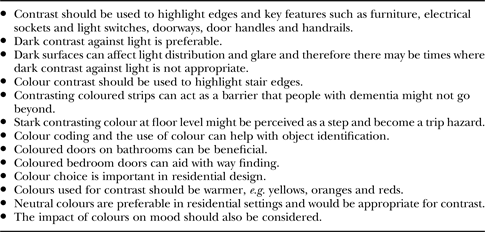
In the final stage of the consultations, the draft Guidelines were discussed and participants commented on the validity of the statements and their usefulness and relevance for everyday life. This was done in a focus group of people with sight loss, and was intended to complement the survey findings (discussed below). Participants commented through making connections between the statements in the draft and their own lives. An example of the draft Guidelines is given in Table 4, relating to the use of colour and contrast. It should be noted at this stage that the draft reflected a range of views from the literature and earlier consultation, and that some of these were not necessarily compatible. For example, the comments that coloured strips on stairs were desirable to aid using stairs versus the view that coloured strips might be perceived as a barrier that people with dementia might not go beyond.
Example of draft guideline: colour and contrast

In considering the statements about colour and contrast, participants generally agreed that contrast was more important than the actual colours used, and black/white or black/yellow were mentioned. Again, individual choice emerged: one person talked about trying out different options on their computer and finding that a dark blue background with white type and a black and yellow keyboard worked best for them. One man had a black saucer that he used for his pills as they were difficult to see on a lighter background. Special mats in different colours provided by a sight loss charity were also used for different activities in the kitchen by some participants. Participants explained changes that they had made themselves in their houses: for example, one man had installed a light switch with a red light that was operated by touch; another had a light switch that would respond to a clap, but stated that he did not use it much because he did not often bother to put the lights on.
The discussion suggested that many of the Guidelines were meaningful and potentially useful, though confirmed that some of them were unduly prescriptive, and that people needed information which supported them to manage their own challenges.
Survey
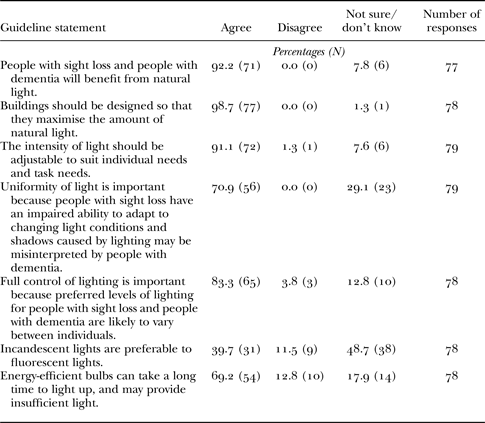
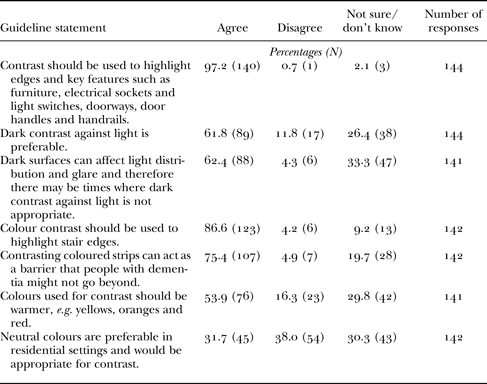
Like the final stage of the consultation, the survey used the draft Guidelines and respondents were invited to indicate whether they agreed with the statement or not, and to add comments. They were given the option to respond to the questions in their area of particular interest. We consider two examples here: lighting, in which 79 people responded and, of those, 22 people added additional comments, and colour and contrast, in which 144 people responded and 46 people provided additional comments. The survey results for an illustrative selection of statements are given in Tables 5 and 6.
Survey responses on lighting

Survey responses on colour and contrast

For the whole section of the survey on lighting, there was broad agreement with the suggested Guidelines: in Table 5, the first three recommendations about the benefit of natural light, the need to maximise it and the need for lighting to be adjustable to suit individual needs show a typical level of agreement. Respondents were less clear about uniformity of lighting, with 23 people expressing uncertainty: this is consistent with the general view (in the next statement) that light needs to be adjustable for individual needs. The comments on different types of lights and energy-efficient bulbs appeared contentious, with significant uncertainty, reflecting a lack of agreement in the literature, weakness of evidence and lack of up-to-date information.
In the comments they added, respondents elaborated on the areas of uncertainty and contention. Several contributed their own experience in terms of what types of light worked best for them, and these varied: e.g. one respondent explained that their mother had had periods of night wakefulness during her dementia journey, and felt that, had she been in the dark, this could have been dangerous; another described a bad experience with a ‘daylight’ bulb which ‘hurt my eyes' and had cost £12; others raised issues about energy-efficient bulbs again, some to highlight the drawbacks of the ‘warm-up’ time, and others to point out that more modern versions of the bulbs were available; another respondent urged us to ‘be more specific: ambient light should be 500 lux or more and task lighting 750 lux or more for seniors'. These comments echoed those that had come from the consultations, and emphasised the ‘real-world’ contexts in which people live and work, with the final comment reflecting a level of prescription and precision which both our evaluation of the literature and the consultation processes had questioned.
In the case of colour and contrast, as Table 6 shows, there was again a marked degree of agreement with the Guideline statements. Highlighting items using contrast was strongly supported. However, the statements about dark/light contrast elicited considerable uncertainty, as did the comments about using coloured strips for highlighting. The two comments on colours listed here elicited controversy, with many respondents disagreeing with them. These are areas where there is little high-quality evidence and where the consultations had suggested that personal taste could be significant.
In commenting, respondents presented a wide range of views, indicating some of the experiences and debates that lay behind some of the disagreements. Again, personal and professional experience were drawn on, e.g. there was dispute about using patterns on furnishings, with some suggesting they should be avoided as confusing, with others noting that people with dementia themselves often liked large floral patterns; several respondents believed that red, orange and yellow were good colours to perceive (and the literature had tended to support this; e.g. Marquardt Reference Marquardt2011; Utton Reference Utton2009), with others saying that red should be avoided; some supported neutral colours which they saw as calming, with another saying ‘get rid of magnolia and white’; some argued for the use of brighter colours, with others suggesting that too many colours could make care homes ‘look like nursery schools'. ‘Institutional’ was described both as ‘magnolia and white’ and as ‘brightly coloured’, whilst being seen consistently as a negative. In this area then, there are firm and differing views, and an implication that whilst the Guidelines on contrast perception were seen as useful, they would need careful presentation.
Developing the Guidelines
The iterative development of the Guidelines, which used both the evidence from literature and the input from stakeholders, helped inform not only the content, but also the approach taken in the final version. The approach needed to be flexible and capable of being used in different settings and for different people; it needed to address the issue of ‘contradictions’ in previous guidelines; the basis of the recommendations made needed to be clear, including some acknowledgement of the strength or otherwise of the evidence supporting recommendations, with particular reference to their usability; the existing gaps in knowledge needed to be acknowledged; and the value base of the recommendations needed to be clear. In all these respects, they would differ from a more prescriptive approach: these points reflect the contests about knowledge that we have identified and that knowledge exchange critiques highlighted.
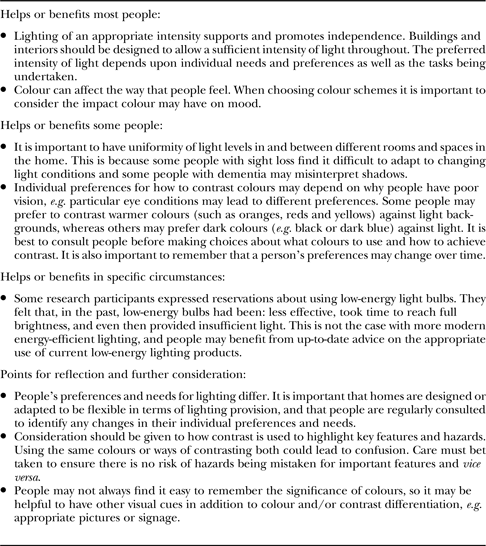
The value base was an orientation towards person-centredness, and included the key principles of recognising that people's capacities and needs vary, upholding people's dignity, supporting people's right to make their own choices and promoting people's independence. These principles lie behind all the recommendations. To address the need for flexibility, our Guidelines acknowledge, for example, the issues faced in different settings: they refer explicitly to these where relevant. They also provide suggestions rather than prescriptions, and encourage thinking about possibilities rather than following instructions. This moves them away from the more prescriptive recommendations and controlled conditions represented in much of the literature. To address the ‘contradictions’ initially perceived in the literature, the Guidelines acknowledge that preferences and needs may vary, and that what is right for one person at one time may change. To indicate the usability of the various recommendations, each was marked to indicate whether it ‘helps or benefits most people’, ‘helps or benefits some people’ or ‘helps or benefits in specific circumstances’: these response categories, derived from our quality assessments of the literature, were also informed by the consultation responses. Where aspects of design needed careful consideration before being adopted, questions and points for consideration were provided: these were areas where the evidence base was particularly weak or contentious and there had been debate in the consultation. Some examples from the guidelines focusing on lighting are given in Table 7.
Examples of guidelines

Note: The full guidelines are available at http://dementia.stir.ac.uk/design/good-practice-guidelines.
Discussion and implications
It is notable that the quality of evidence in this field as identified in the literature review is not generally very high. It was therefore important to retain, throughout the process of developing the Guidelines, recognition of this weakness. In a developing field such as this, where the quality of published research may not be high, or where the evidence is somewhat scattered, it is appropriate to use a range of sources to identify, corroborate and test findings. In this study, the consultations with stakeholders were particularly significant in the light of the weak evidence base in the literature, as they provided an additional element of experiential knowledge to the assessments and recommendations to inform the Guidelines, as well as exemplifying different views about design. However, issues with the evidence base go further than this: along with Pawson (Reference Pawson2006), we would argue that the pursuit of an evidence base via systematic review methodology in this field cannot deliver the idealised result. The limitations of the literature that we have identified are deeper than its quality per se. The very real challenges of completing controlled studies; the difficulties reflecting the real-world issues faced in communal settings in particular, but also in people's own homes; the speed of innovation and change in design and services for people with dementia; the need for a genuinely person-centred approach to delivery; the need for recommendations to be personalised and flexible; all constrain the pursuit of conventional evidence-based practice recommendations. These points echo Nutley, Walter and Davies's (Reference Nutley, Walter and Davies2007) emphasis on the social complexities of delivering knowledge translation. In communal settings, in particular, accommodating individual needs is a complex matter, when these can be so variable. In people's own homes, their own territory, the conduct of controlled studies is likely to be even more challenging. Ultimately, whilst there is certainly a necessity for high-quality evidence from research literature to provide a foundation on which to build, this is not a sufficient basis for improving services. We have argued, drawing on both literature and consultation, that an appropriate value base and the judgements and agency of people with dementia and sight loss, and those who support them, are also essential components of good practice.
There remain challenges in developing and improving the necessary evidence base for design for people with dementia and sight loss. As indicated, we doubt that an approach base on controlled studies such as randomised controlled trials is likely to be useful, given the multiple factors coming into play and the role of individual requirements, which we have identified throughout. It is likely, therefore, that methodologies such as realistic evaluation (Pawson and Tilley Reference Pawson and Tilley1997: 220) will have the most potential, addressing the questions of ‘what works for whom in what circumstances’ and adopting a realist approach to evidence assessment which recognises the untidiness and uncontrollability of real living situations and people's individual needs. The involvement of people with dementia and sight loss as stakeholders in developing the Guidelines described here was vital in highlighting several fundamental issues, such as the need for judgements in implementation and the significance of personal preference, and we would suggest this type of involvement of expert perspectives needs to become a feature of future research. As yet, there are few examples of work which has taken such an approach, two being the work of Astell et al. (Reference Astell, Alm, Gowans, Ellis, Dye and Vaughan2009), developing assistive technology that highlighted the potentially high costs of their recommended approach, and Sixsmith et al. (Reference Sixsmith, Gibson, Orpwood and Torrington2007), that succeeded in developing understanding of the preferences of people with dementia to inform the development of a music player.
There is a clear need for innovation in methodologies for understanding how complex delivering support for people with dementia and sight loss needs to be, and how we can develop improved, practical and applicable understanding. The recognition of complexity draws attention to the need to understand not only the person being supported but also the context in which they live, including their relationships with other people which, incidentally, were often the first topic our informants wanted to talk about. We know from our work that some topics – such as ‘design’ in the abstract – are not easy for people to discuss, and approaches to facilitating discussion need to have appropriate prompts to be effective: we found, for example, that people engaged more easily with the questions generated from the position statements than they did with the more general approach to discussion used earlier.
Methodological innovation also implies addressing certain underlying assumptions and questioning some paradigmatic positions about the status of knowledge and the contributions of certain types of data. The default position of the sight loss literature – promoting independence – is not yet fully embedded in the dementia literature; the perspectives of people with dementia and sight loss themselves have barely been considered; ways of ascertaining their views, which necessitate investment of time and skilled researchers who can support people to express them, have barely been touched.
The innovation we have suggested in the paper is to use research literature and to complement it with real-world perspectives, combining structured assessment and a more qualitative approach. In some respects, our consultations helped to support the research literature, and enabled clearer Guidelines with more confidence behind them to be developed: where the survey, for example, showed strong levels of agreement, recommendations resonated with stakeholders and appeared meaningful and practical. Where the consultations contended with the research literature, this was more difficult: sometimes, as in the case of some of the over-prescriptive literature, it was clear that flexibility should be the advice offered, due to individual variation. Where, as in the case of the contentions about low-energy light bulbs, there were issues of lack of knowledge complicated by real-life issues such as the costs of changing them, arriving at clear recommendations was more difficult: in this case, we highlighted the contention and the reasons for it, including caveats about the need for better information and the need to consider individual needs.
Our consultations were particularly important for highlighting the very individual aspects of supporting people with dementia and sight loss, that different strategies may work for and be preferable to different people, and that these may change over time. This is not, of course, a particularly surprising finding, as it emphasises the person-centredness that should be at the heart of support for people with dementia. Brooker (Reference Brooker2003) reminds us that ‘person-centred care’ is not simply about recognising the individual: it also comprises valuing the person with dementia, trying to look at the world from their point of view and providing a positive social environment. We would add that recognition of people with dementia and sight loss as active agents in processes of support and as social participants, interacting with others, is also fundamental. Several times in the paper, we have highlighted ‘contradictions’ between design guidelines that previous research had identified (Goodman and Watson Reference Goodman and Watson2010). These emerge as reflecting approaches which have sought to identify a ‘one-size-fits-all’ set of guidelines or recommendations, rather than recognising the variations in individual needs and wants and, most importantly, the need for judgement in the application of guidelines.
A further issue relating to the consultations concerns their reliability and validity. As in comparable studies such as Gould (Reference Gould2010), numbers of consultees are often small and can appear tokenistic. In assessing the validity of a process such as that described here, however, we draw on literature on reliability and validity in qualitative research such as Morse et al. (Reference Morse, Barrett, Mayan, Olsen and Spiers2002). They argue that in qualitative research, reliability comes from the use of multiple, cross-referencing data sources, iterative analytical processes, in-depth exploration of issues and structured interrogation of findings. Whilst samples of participants need to provide a range of response, such as in this case perspectives from a range of stakeholders, their number needs to be such as to reach a point where new information does not emerge: calculations of sample sizes such as might be used in quantitative research do not apply. The use of multiple consultation stages and methods in the current project enabled these tests of validity to be satisfied, and provided a reasonable level of confidence in their outcomes.
An important issue emerging from the literature review was that the default position for considering design for people with sight loss was one of promoting and supporting independence: none of the sources identified included references to control and constraint. Whilst much of the literature relating to people with dementia did focus on independence, there was still an emphasis on control, in the form of design features which would, for example, prevent ‘escape attempts’ or ‘wandering’. Despite the rhetoric of person-centred care, it appears that many researchers are not yet ready to take on its full implications. There is evidence that people with dementia are constructed by many of their supporters as inherently risky: Manthorpe (Reference Manthorpe, Innes, Archibald and Murphy2004: 149) has highlighted that the notion that people with dementia are ‘personifications of risk’ can promote more controlling types of support, and that there has to be a clearer debate in each case that is not dictated by that assumption. Her views are in tune with Thomas' (Reference Thomas1999) arguments regarding the social relational model of disability, which presents challenging questions about the interactions between impairments and social processes of disablement. People with dementia experience real cognitive impairment, but support arrangements can respond in different ways, which may be constraining and thus focusing on the impairment, or facilitating, thus focusing on the person's abilities and capacities and supporting them to live the life they desire. With a facilitating approach, the inventiveness and resourcefulness of people with dementia and sight loss and their supporters become integral to the design measures that are taken.
Conclusion
The project aimed to use research evidence and real experience to develop design Guidelines for living environments for people with dementia and sight loss. The Guidelines produced draw on the evidence to date, and on the experiences and views of people experiencing dementia and sight loss and also people working to improve their support. The work has raised challenging questions about the nature and expectations of the evidence base; effective and appropriate research methodologies; assumptions behind the development of design guidance; and characterisations of people with dementia and sight loss. Our work has not addressed all these questions, and it is doubtful that one project could do so fully, but we suggest they have wider resonance for future work considering the development of support for people who have dementia and other conditions.
Acknowledgements
We gratefully acknowledge the support of our funders, the Thomas Pocklington Trust, who took no part in research design, execution, analysis and interpretation of data, or writing of the article. We are also grateful to our research participants, who took part in interviews, focus groups, the survey and the provision of expert advice. Ethical approval for the study was given by the School of Applied Social Science, University of Stirling Ethics Committee in accordance with the Economic and Social Research Council (ESRC) Framework for Research Ethics. The corresponding author led the drafting of the article, using analysed data to which the whole team contributed. All authors reviewed and commented on the text and approved the final version. There are no conflicts of interest.