


Introduction
Age discrimination or ageism is ‘a process of systematic stereotyping and discrimination against people because they are old’ (Butler Reference Butler1969, 243). The need for policies to combat stereotypical attitudes towards older workers, as a barrier to paid employment, was highlighted in the UK more than 50 years ago (Walker Reference Walker1998) and recently the United Nations has labelled it a global challenge (WHO 2021). Despite numerous attempts to overcome ageism, including the Extended Working Lives (EWL) (Lain et al. Reference Lain, Horst and Vickerstaff2020; Ní Léime et al. Reference Ní Léime, Ogg, Raŝticová, Street, Krekula, Bédicová and Mandero-Cabib2020), Active Ageing (WHO 2002; Foster and Walker Reference Foster and Walker2015, Reference Foster and Walker2021) and Fuller Working Lives (DWP 2014) agendas, age discrimination persists within the UK labour market. Four out of five workers aged 55–64 said that age discrimination is common in their workplace (Small Business 2017) and 11 per cent of people aged 50 and over reported having personally experienced it (Thomson Reference Thomson2018). This is in the face of a changing UK policy context towards encouraging people to work longer (DWP 2014, Lain et al. Reference Lain, Horst and Vickerstaff2020).
This context emphasizes the need to deepen knowledge about how older workers perceive themselves and their role in the labour market and what their experiences mean for the EWL agenda. To that end, this research employed qualitative semi-structured interviews with 25 older workers (aged 55 and over) to explore their perceptions of ageism within the workplace. Five key themes were identified from the interview data: health pessimism, public perceptions, the generational contract, digitization and exclusion. These themes were shown to interact, serving to undermine the UK’s EWL agenda. These new findings demonstrate that both structural ageism, associated with the ‘laws, rules, social norms, policies, and institutions that unfairly restrict opportunities and systematically disadvantage people because of their age’ (WHO 2021) and internalized ageism, which occurs when an individual accepts and applies negative stereotypes about ageing to themselves (Levy et al. Reference Levy, Zonderman, Slade and Ferrucci2009), are pivotal in shaping how older workers plan their futures.
The article contributes to understanding age discrimination in the UK labour market by empirically demonstrating the iterative and self-sustaining cycle between structural and internalized ageism, as well as their overlaps. Building upon Palmore’s (Reference Palmore1999) dual framing of institutional and individual ageism, and Levy et al.'s (Reference Levy, Zonderman, Slade and Ferrucci2009) focus on internalized ageism, the study shows that structural ageism is not merely an external institutional force but is actively sustained by the internalized biases of individuals within those structures. It reveals that internalized ageism manifests not only as self-directed prejudice but also as bias held towards other adults of the same age group (Ayalon Reference Ayalon2025). It contends that structural ageism is not simply an external imposition; its embedded nature results in it being agentally reproduced through internalized biases of individuals, who can subsequently act as the (cognitive) scaffolding for institutional exclusion. It provides a novel theoretical advancement by asserting that this has arguably led to the emergence of recursive ageism, whereby internalized ageism can serve to legitimate structural ageism. This contributes to understandings of EWL policy measures, which require multifaceted solutions to address negative portrayals of older workers and to challenge discriminatory behaviour.
Initially, the article explores how ageism is framed before providing a brief explanation of employment trends in the UK. It then considers the roles and types of age discrimination in the UK labour market, before outlining the methods employed. The findings then present individuals’ views and experiences regarding their role in the labour market. These are organized around the five key themes emerging from the data. This is followed by a discussion of how the themes are linked to the framing of ageism, specifically structural and internalized ageism. Then policy implications are explored, before a short conclusion is provided.
Framing ageism
In this section we outline the ways in which ageism has been defined and understood. Butler (Reference Butler1969) was the first to define ageism (as quoted earlier), and later distinguished three aspects: prejudicial attitudes, discriminatory practices and institutional practices (Butler Reference Butler1980). Although Butler’s work remains seminal, it situated ageism within the realms of racism and sexism. Ageism is now recognized as distinguishable from other ‘isms’ in that everyone who grows old may experience it (Iversen et al. Reference Iversen, Larsen and Solem2009).Footnote 1 Furthermore, it does not serve to distinguish between prejudice (feelings) and stereotypes (beliefs). That said, it does stress the institutional nature of ageism, which is important for understanding the interaction between society at large (institutional practices) and the individual (Ayalon Reference Ayalon, Foster, Motel-Klingebiel and Luo2026). Palmore (Reference Palmore1999) categorized ageism as both institutional and individual, looking at the way ‘institutional patterns’ in the economy, government and family structures contribute to ageism. However, this focused on individual sources and, as with Butler’s work, drew heavily on racism to explore ageism as a character trait. While Palmore connected the two through the institutional influences that can contribute to individual perpetration of ageism, in this article the suggested framing focuses on connecting the two streams through an individual’s perspective.
Palmore’s (Reference Palmore1999) acknowledgement of positive forms of ageism, defined as ‘prejudice and discrimination in favour of the aged’, recognizes that not all ageism is harmful. However, positive ageism can be double-edged; while it has benefits such as cheaper transport and meals for older people, it can also serve to reinforce and impose stereotypes such as affluence, paternalism or kindness (Cuddy et al. Reference Cuddy, Norton and Fiske2005), suggesting that some positive ageism is born out of ageist stereotypes (Palmore Reference Palmore1999). This is also the case with ‘compassionate ageism’ (Arber and Ginn Reference Arber and Ginn1991).
Levy and MacDonald’s (Reference Levy and MacDonald2016) review of progress on understanding ageism suggests that all aspects of it are encompassed by stereotyping, prejudice and discrimination, a reframing of Butler’s earlier tripartite framework. This framing of ageism is valid and applicable to ageism in its broadest sense. However, in a post-Covid-19 pandemic labour market context, which has brought greater attention to intergenerational challenges and attitudinal characteristics (Office for Health Improvement and Disparities 2022; Zhong et al. Reference Zhong, Leung, Sun and Ng2023), presenting a dual framing of ageism closer to that of Palmore’s individual and institutional ageism is particularly pertinent, as reinforced by this research. Palmore hinted at interplay between individual and institutional ageism by suggesting that strategies to reduce ageist prejudice in the individual could serve to reduce discrimination within structures. That said, Palmore’s focus on ageism regardless of specific context meant that this has remained rather broad, with recommendations focused on how to be anti-ageist at an individual level (Palmore Reference Palmore1999, 183). Therefore, it is important to develop a more interconnected approach outlining the links between these two themes within the context of older workers.
Key studies on age discrimination were highlighted by Levy and MacDonald (Reference Levy and MacDonald2016), including Abrams et al.'s (Reference Abrams, Eller and Bryant2006) exploration of young versus old characteristics, and work by Shiovitz-Ezra et al. (Reference Shiovitz-Ezra, Ayalon, Brodsky and Doron2016) and Ramírez and Palacios‐Espinosa (Reference Ramírez and Palacios‐Espinosa2016) to measure ageism. They concluded that there is a need to further study individual perceptions of ageism to gain a deeper understanding of experiences of ageism. This is particularly important given changing notions of older workers’ employment and the increased emphasis on EWL (Lain et al. Reference Lain, Horst and Vickerstaff2020), as well as the challenges presented by the Covid-19 pandemic (UK Parliament 2022).
Older worker employment
Over recent decades there has been an increase in the number of older workers. By 2000 the UK had already exceeded the EU Lisbon 2010 target employment rate of 50 per cent of older workers (defined as people aged over 55) (Ivan Ungureanu and Marcu Reference Ivan-Ungureanu and Marcu2006). This upward trend for EWL has continued in the UK over the past two decades, attributed in part to pension eligibility changes for women (Lain Reference Lain2016; Crossdale et al. Reference Crossdale, Foster and Walker2025) and policies such as flexible working, mid-life career reviews and age at work leadership (DWP 2014, Wainwright et al. Reference Wainwright, Crawford, Loretto, Phillipson, Shepherd, Vickerstaff and Weyman2019). Others, such as Beach and Bedell (Reference Beach and Bedell2019), have questioned the level of impact of reforms pointing towards a range of other factors linked to EWL including a strengthening work orientation and improvements to health and education. The Covid-19 pandemic interrupted this trend, disproportionately affecting older people, with adults aged 60 and over accounting for 92 per cent of Covid-19 deaths in the UK (UK Health Security Agency 2023) (and 95 per cent of Covid-19 deaths in Europe (WHO Europe 2020)). This was emphasized by a decline in the number of people retiring at or after pension age (Eurostat 2022).
Although all age groups experienced job losses and redundancies, those in the over 50 age group were two and a half times more likely to be unemployed for at least two years than unemployed people in other age groups (Lewis Reference Lewis2021). Although younger workers were equally likely to experience redundancy or be furloughed at the start of the pandemic, many older workers exited the labour market entirely (Powell et al. Reference Powell, Francis-Devine and Clark2022). While some recovery is evident, participation rates among older workers are yet to recover to pre-pandemic levels (65.6 per cent of people aged 55–64 in employment in 2023 compared to 67.0 per cent in 2019) (ONS 2023).
The Covid-19 pandemic changed the landscape of the UK labour market (UK Parliament 2022). The promise of a ‘great unretirement’ suggested that many older workers who left the workforce during the pandemic are now able to return to work (Easton Reference Easton2022). However, this did not fully materialize (Centre for Ageing Better 2022b). The theory depended on the workplace being made more inclusive for older workers, including offering flexible working, training and support targeted at older workers (Easton Reference Easton2022). The current cost of living crisis is driving some older workers back into the labour market; however, it is unlikely that economic necessity alone will be enough for the number of over fifties in employment to recover to pre-pandemic levels (Centre for Ageing Better 2022a). The CIPD (2025) reported that twice as many employed people aged 50 and over than 18–24-year-olds believed it would be difficult or very difficult to secure a similar role if they became unemployed, indicating the perceived challenges to re-entering the labour market. The pandemic pushed many older workers out of the labour market permanently, often years before pension age (Foster Reference Foster2023), and ageist recruitment practices make re-entry challenging (Neumark Reference Neumark2019). Those older workers who left the labour market during the Coronavirus pandemic disproportionately came from high-paying, professional jobs. This suggests that many of these adults will be able to live comfortably in their early retirement, with government policy unlikely to prompt them to ‘un-retire’ (Murphy and Thwaites Reference Murphy and Thwaites2023). It is also suggested that the pandemic is likely to have a longer-term impact on health disparities among older people, given the unequal distribution according to existing co-morbidities and ageist practices associated with shielding (Addison Reference Addison2021).The pandemic also led to increased ageing anxiety among the general population and increased intergenerational tension (Zhong et al. Reference Zhong, Leung, Sun and Ng2023), with findings of age-based resource allocation and growing use of technology and social media increasing isolation among the older working population (Silva et al. Reference Silva, Silva, Bacurau, Francisco, Assumpção, Neri and Borim2021), with negative effects particularly felt by women (Tahmaseb-McConatha et al. Reference Tahmaseb-McConatha, Kumar, Magnarelli and Hanna2023).
Social relationships within the workplace can support or undermine EWL (Chen and Gardiner Reference Chen and Gardiner2019). Co-worker exclusion in the workplace can cause stress and tension for workers which is not mitigated by strong or positive support from the organization or from family and other relationships outside of the workplace (Scott et al. Reference Scott, Zagenczyk, Schippers, Purvis and Cruz2014). This feeling of exclusion is often exacerbated by part-time working, which is more common among older workers, especially older women (Hochlaf and Franklin Reference Hochlaf and Franklin2017).
Social relationships have been under strain since the Covid-19 pandemic. According to the English Longitudinal Study of Ageing (ELSA), pre-pandemic two-thirds of older workers (aged 50 and over) ‘never’ worked from home; however, half of these workers switched to working from home ‘sometimes, often, or always’ at some point during the pandemic (Coombs et al. Reference Coombs, McLeod and Storey2021). There is relatively little information available about UK older workers’ experiences of working from home during the pandemic and its consequences; however, given that older workers were advised to work from home longer than their younger counterparts (Office for National Statistics 2022), it is possible that the pandemic and work-from-home guidance exacerbated feelings of exclusion at work among older workers and contributed to a resistance to work beyond pension age.
Although the pandemic represented a setback to the EWL agenda, data suggests that, on the whole, policy changes have succeeded in delaying retirement. For instance, prior to the pandemic the average age of retirement rose by three and a half years between 2009 and 2019 (DWP 2019), although this change should be approached critically. Not all workers are able to follow the EWL agenda, with choice and opportunities distributed unevenly (Brown and Vickerstaff Reference Brown and Vickerstaff2011; Lain Reference Lain2016; Swain et al. Reference Swain, Carpentieri, Parsons and Goodman2020). Existing measures tend to lack a nuanced approach to understanding the factors and inequalities that limit some workers’ choices (Altmann Reference Altmann2015; Ní Léime et al. Reference Ní Léime, Ogg, Raŝticová, Street, Krekula, Bédicová and Mandero-Cabib2020).
Exit patterns from employment to retirement have become progressively more fragmented. New and more varied forms of work such as casualization via gig-economy and agency work have altered the later phases of working lives (Crouch Reference Crouch2019). These changes, in addition to EWL measures, tend to reinforce existing inequalities in paid employment, such as those experienced by women, low-skilled, blue-collar workers, lower educated, those with long-term ill health or disability, as well as many migrants, meaning that these groups are more likely to exit the labour market early and experience precarious employment (Pfaller and Schweda Reference Pfaller and Schweda2019; Krekula and Vickerstaff Reference Krekula, Vickerstaff, Ní Léime, Ogg and Madero-Cabib2020). Women, for example, owing to the still-dominant male breadwinner model that places the primary burden of unpaid care work on women, are more likely to be in precarious employment (Pensions Policy Institute 2024).
Age discrimination in the labour market
Age discrimination in the labour market is not a new phenomenon. Before the turn of the century, Taylor and Walker (Reference Taylor and Walker1998) stressed the need to target stereotypical attitudes towards older workers as a first step to removing age barriers in employment. Their research found that age was cited as a major barrier to promotion, recruitment, training and development, and changing careers. This ‘institutional ageism’ (Palmore Reference Palmore1999) continues to be pervasive, causing self-exclusion from promotion, training and paid work (Van der Horst Reference Van der Horst2019). Thus, it is not surprising that older workers often have a negative perception of their labour market position, which can subsequently influence expectations, behaviours and decision-making (Levy et al. Reference Levy, Zonderman, Slade and Ferrucci2009).
Ayalon (Reference Ayalon2013) found that ageism was the most prevalent type of discrimination, affecting over a third of participants in the European Social Survey. However, ageism manifests differently within different social, political and cultural contexts. In fact, although the term ‘ageism’ exists in English, there is not always an equivalent in other languages (Ayalon Reference Ayalon2020). As such, people may not necessarily identify with the concept of ageism in their frame of reference (Ayalon Reference Ayalon2025).
While this article shows that ageism is actively addressed in the UK, in Germany, for example, a country with a similar cultural and political profile to the UK, there is little acknowledgement of ‘age discrimination’ within the workplace for fear that use of the term will incite discrimination (Frerichs Reference Frerichs2009). Similarly, Poland, a late-mover to the EWL agenda with a fixed and comparatively low retirement age, has seen protections introduced for older workers in the run-up to retirement incentivize the dismissal of workers before this period (Perek-Białas et al Reference Perek-Białas, Saczuk, Stodolska, Varlamova and Urbaniak2025). In contrast, Sweden, with its strong welfare system, gradually increasing pension age (like the UK) and relatively high level of employment among the older population (Blomqvist and Palme Reference Blomqvist and Palme2020), would be expected to have lower levels of age discrimination within the labour market. However, it is only relatively recently that age discrimination has become openly discussed, with findings confirming the assumption that most cases go unreported (Abramson and Portacolone Reference Abramson and Portacolone2017). This is also the case in the US, with indirect discrimination persisting despite anti-age discrimination legislation (Adams and Neumark Reference Adams and Neumark2006; Neumark Reference Neumark2019).
Ageism is ‘not uniformly experienced by everyone of the same or similar age, nor will the consequences be the same’ (Van der Horst Reference Van der Horst2019, 27). For instance, older workers’ experience of cumulative inequality is well-documented through education level (Lim et al. Reference Lim, Jeong, Yoo and Yoo2018), gender (Pickard Reference Pickard, Kaufman, Stambolis-Ruhstorfer, Roberts and Ralph2024), health status (Chang et al. Reference Chang, Kannoth, Levy, Wang, Lee and Levy2020), caring commitments (Yeandle and Buckner Reference Yeandle and Buckner2017) and ethnicity (Gutterman Reference Gutterman2024), among other things. It is also an internalized experience (Robb et al. Reference Robb, Chen and Haley2002). Continuous exposure to age stereotypes over the life course can cause older people themselves to believe these stereotypes (Van der Horst Reference Van der Horst2019). This is particularly significant as self-directed ageism is linked to increased morbidity and mortality (Levy et al. Reference Levy, Zonderman, Slade and Ferrucci2009). There is evidence that institutional problems (such as access to resources) can be internalized and present as individual problems leading to disengagement from certain activities because of age (Minichiello et al. Reference Minichiello, Browne and Kendig2000). Such internalized stereotypes also extend beyond the individual and contribute to ageism towards others (Ayalon and Tesch-römer Reference Ayalon and Tesch-Römer2017). Ageist practices continue in the labour market (Age UK 2016) and negatively impact on retirement preferences and the EWL movement (Van der Horst Reference Van der Horst2019).
The relationship between later life and the labour market has fluctuated, including a wide acceptance of early labour force exit in the late 1970s and 1980s, initially encouraged by government (Lain Reference Lain2016). The early 2000s brought recognition of the need to address the demographic shift towards an ageing population (WHO 2021). At this point, EWL became a policy priority in addressing the need to reduce pension spending (Altmann Reference Altmann2015), inciting a wave of policy initiatives such as increased statutory pension age (SPA), allowing pensions to be drawn while working, and anti-age discrimination legislation in the Equal Opportunities Act (Phillipson et al. Reference Phillipson, Vickerstaff and Lain2016).
The UK’s EWL policy agenda was heavily influenced by its European Union (EU) membership up to January 2020. This is particularly evident in EU-level rights-based legislation governing the UK, such as the European Human Rights Commission and the European Employment Directive on Equal Treatment (BEIS 2019). These measures aim to combat both direct and indirect discrimination, including age discrimination (European Agency for Safety and Health at Work 2000). National-level EWL policies have been a mixture of carrot and stick initiatives, encouraging older workers to remain in the workforce through flexible or part-time working arrangements, and forcing older workers, who cannot afford to retire, to remain in the workforce through increases to SPA and withdrawal of previously generous retirement packages (Lain Reference Lain2016; Jandrić et al. Reference Jandrić, Airey, Loretto and Vickerstaff2019). However, little has been done to tackle age discrimination directly and this has been predominantly left to employers.
While most large employers have a strategy for gender, ethnicity and disability, development of comparable age equality strategies has been slow to follow (Beck and Williams Reference Beck and Williams2016). Research suggests that where policies do exist to tackle age discrimination, they are often weak or ineffective, unequally distributed and improperly evaluated (Ní Léime et al. Reference Ní Léime, Ogg, Raŝticová, Street, Krekula, Bédicová and Mandero-Cabib2020). Despite attempts at anti-age discrimination policies at EU (The European Commission 2021) and national (UK Government 2010) levels, discriminatory employment practices persist.
Research on ageism in the labour market
In terms of the workplace, a review by Cebola et al. (Reference Cebola, Dos Santos and Dionísio2023) found that most of the research has been on the perpetration of negative ageism of older workers. Most are quantitative in nature, predominantly looking at the prevalence of ageism (Loretto et al. Reference Loretto, Duncan and White2000; Duncan and Loretto Reference Duncan and Loretto2004; Drydakis et al. Reference Drydakis, MacDonald, Chiotis and Somers2017), types of ageism (Redman and Snape Reference Redman and Snape2002; Dixon Reference Dixon2012) and coping mechanisms (Unson and Richardson Reference Unson and Richardson2013; Worth Reference Worth2016). Qualitative studies have tended to focus on a single sector (Reid et al. Reference Reid, Allen, Riemenschneider and Armstrong2006; Clendon and Walker Reference Clendon and Walker2016; Kanagasabai Reference Kanagasabai, Keller, Littler and Winch2019), with qualitative methods often used within a mixed methodology to contextualize quantitative data (McMullin and Marshall Reference McMullin and Marshall2001; Iweins et al. Reference Iweins, Desmette and Yzerbyt2012; Clendon and Walker Reference Clendon and Walker2016).
The need to challenge ageist stereotypes has been recognized since the Second World Assembly on Ageing (Annan Reference Annan2002). Today, images of ageing are strongly influenced by an anti-ageing discourse (Warren and Richards Reference Warren, Richards and Ylänne2012). The proliferation of inappropriate or inaccurate representations of older people is seen to perpetuate negative stereotypical attitudes and expectations about older people in all age groups, including older people themselves (Ylänne Reference Ylänne2015). There is a wealth of research exploring the portrayal of older people in different media and how these depictions influence public perceptions of ageing (Robinson et al. Reference Robinson, Callister, Magoffin and Moore2007; Williams et al. Reference Williams, Wadleigh and Ylänne2010; Warren and Richards Reference Warren, Richards and Ylänne2012; Ylänne Reference Ylänne2015). The portrayal of older adults in the media, prioritizing youthfulness and physical fitness (Grogan Reference Grogan2021), promotes idealistic notions of an individual’s ability to manage the ageing process. This portrayal of older adults feeds into self-perceptions of ageing as the physical realities of ageing, such as weight gain and wrinkles, are perceived as incompatible with depictions of the same age group (Hurd Clarke and Bennett Reference Hurd Clarke, Bennett, Twigg and Martin2015).
A stereotype that persists in the workplace is that older workers are less motivated than younger workers (Abraham and Hansson Reference Abraham and Hansson1995) and are resistant to change (Weiss and Maurer Reference Weiss and Maurer2004; Altmann Reference Altmann2015). However, this stereotype has been refuted by research showing that younger employees often have greater resistance to change than older ones (Kunze et al. Reference Kunze, Boehm and Bruch2011).
The Covid-19 pandemic, ageism and inequalities on the labour market
The Covid-19 pandemic exacerbated the ‘oldering’ of those aged 60 and over by sparking an increase in ‘generationalized’ rhetoric, grouping generations by stereotypical behavioural reactions to the pandemic and its associated limitations (Rudolph and Zacher Reference Rudolph and Zacher2020). Across the world, governments used chronological age as a criterion for lockdown, exit, triage and vaccination strategies, arguably, at times, using chronological age as a criterion for the violation of older people’s human rights (Ayalon Reference Ayalon, Foster, Motel-Klingebiel and Luo2026). In the UK, advice for people aged 60 and over to continue to take preventative measures such as social distancing, mask wearing and limited public contact when younger people were encouraged to return to ‘normal’ presented a visual divide between generations and labelled older people ‘vulnerable’, a term usually reserved for people in need of ‘special care’ (Office for Health Improvement and Disparities 2022). This reinforced the idea that older age is synonymous with vulnerability.
The high mortality rate among people aged 60 and over caused derogatory terms such as ‘boomer remover’ to become associated with the virus (Whalen Reference Whalen2020). Extreme rhetoric such as this contributed to the perception that older generations should make sacrifices for the betterment of the younger generations (Rudolph and Zacher Reference Rudolph and Zacher2020). The same can be said for the idea that older workers are taking jobs from younger workers, or that they, in their current position, are holding back the progression of younger workers. This trope has previously been used to validate early retirement programmes and is predicated on the inaccurate assumption that there are a finite number of jobs at any one time – the ‘lump of labour’ (Munnell and Wu Reference Munnell and Wu2012). This fallacy was refuted countless times as the number of women in the workforce increased without a decline in the number of jobs for men (Munnell Reference Munnell2014; Easton Reference Easton2022).
The Covid-19 pandemic also served to exacerbate existing stereotypes linking older age and health. The idea that ageing goes hand in hand with poor health is a persistent stereotype, despite declining health being neither linear nor consistent and only loosely correlated with age (WHO 2022). This stereotype continues to be reproduced today. For example, Queen Elizabeth II’s death certificate cited ‘old age’ as the cause of death, perpetuating the ageist stereotype of old age as synonymous with disease, ill health and death (Walker Reference Walker2022).
There is a correlation between increased age and increased number of health problems (WHO 2022), and the most common age-related health conditions (hearing loss, cataracts, osteoarthritis, chronic obstructive pulmonary disease (COPD), diabetes and dementia) can be serious and life-altering (WHO 2022). However, many of these common health problems in older age are owing to unhealthy practices (e.g. smoking or diet), which may be less likely to affect future older generations (NHS 2019). Moreover, most of these health problems can be delayed, prevented and managed (National Institute on Aging 2019; NHS 2023). Socio-economic factors such as social class, relative deprivation, location and education are better predictors of health status in later life than age (WHO 2022).
In addition to Covid itself, some responses to the pandemic had a substantial impact on the health of older people. For example, (ageist) guidance regarding lockdowns and shielding had the effect of reducing physical activity levels, which served to increase the risk of loss of muscle and frailty (Addison Reference Addison2021) with implications for psychological health (D’angelo et al. Reference D’Angelo, Bloom, Ntani and Walker-Bone2024).
As well as poor health itself, prevention of poor health can also be a barrier to EWL. Pond et al.'s (Reference Pond, Stephens and Alpass2010) ‘maximization of life’ theory posits that older people want to use their retirement to fulfil life goals while still healthy to maximize the enjoyment of their remaining healthy lifespan. However, prevention of poor health can also act as a facilitator to EWL. Stable employment encourages good mental health (NHS 2019), and for those aged over 64 in positions of relatively low demand and high reward there is a connection between work and better health (Baxter et al. Reference Baxter, Blank, Cantrell and Goyder2021). However, the reverse is true for same-age workers in high-demand, low-reward positions; thus, later-life employment can contribute to widening health inequalities.
Despite the ageist assumptions regarding ageing and health, preferences or priorities of older age groups explain much of the increase in economic inactivity (Murphy and Thwaites Reference Murphy and Thwaites2023). These are influenced by the changing nature of work which makes staying in employment less appealing (Cribb et al. Reference Cribb, Waters, Wernham and Xu2021). For instance, since 2008 two-thirds of the growth in employment has been in ‘precarious’ forms of work, including agency work, self-employment and zero-hours contracts. Although such forms of employment might be beneficial in terms of flexible hours, they may also entail a poor-quality work environment, characterized by a lack of training and job satisfaction (Phillipson Reference Phillipson2023).
Digital skills are another area that is often a source of inequality and discrimination for older workers. With rising automation, digital skills are becoming near-universal requirements (Altmann Reference Altmann2015; Nania et al. Reference Nania, Bonelle, Restuccia and Taska2019) and digital skills was the most mentioned skills gap for older workers looking for work (Centre for Ageing Better, Work and Learning Institute 2020). The need for digital skills has risen because of the changing nature of work since the pandemic. The government’s Digital Strategy (Department for Digital Culture 2017) pledged to extend free digital training to all adults who need it; however, information resources aimed at older workers are in digital format (DWP 2017), thus limiting access to those already possessing technological know-how and those with access to the internet. Ogg and Raŝticová (Reference Ogg, Raŝticová, Ní Léime, Ogg, Rašticová, Street, Krekula, Bédiová and Madero-Cabib2020) suggest that digitization needs to be accompanied by social change and that policy changes prioritizing quality of life (including health), intergenerational learning and shared experience are the way forward, rather than the onus being on the learner to find, access and navigate resources.
So far, we have identified different conceptions of ageism, how older workers have been discriminated against in the labour market and the effective policy action in this area. We have also highlighted the need to further engage with individuals’ internalized perceptions of ageism in addition to the structural forces behind it. This is particularly important given the challenges presented by the Covid-19 pandemic (UK Parliament 2022). The following section details the original research on which the subsequent findings are based.
Methods
The following two research questions underpinned this research:
1. How do older workers perceive themselves and their role in the labour market?
2. What do older workers’ experiences of ageism within the labour market mean for the EWL agenda?
Semi-structured interviews have long been used within the study of ageism (Itzin and Phillipson Reference Itzin and Phillipson1994; Bowman et al. Reference Bowman, McGann, Kimberley and Biggs2017; Brodmerkel and Barker Reference Brodmerkel and Barker2019) for the ‘broad and overall’ picture (Krekula Reference Krekula2019, 2296) and rich, nuanced understanding of ageism they give (Ojala et al. Reference Ojala, Pietilä and Nikander2016). This research followed suit, using semi-structured interviews to allow participants the opportunity to express their own views in detail and to focus on themes of importance to them.
The 25 interviews with older workers were part of a larger project: Exclusion and Inequality in Late Working Life (EIWO). As such, age discrimination was not an explicit theme within the interview schedule (see supplementary file) but rather developed organically through a broader exploration of risks, turning points and coping strategies throughout working life, taking a lifecourse approach to individual perceptions of exclusion and inequalities for the broader EIWO project.Footnote 2 This is critical to understanding how decisions to exit, or remain in, the workforce are made in later life, as aspects such as health, income and social capital accumulate over the life course and contribute to perceptions of ageing and later-life experiences and decisions (Vickerstaff and Van der Horst Reference Vickerstaff and Van der Horst2021). The interview schedule was developed through collaboration with expert partners as part of a policy advisory group in the EIWO project team and underpinned by the programme’s theoretical perspectives (Naegele and Walker Reference Naegele and Walker2021) including life course theory.
The operational definition of ‘older workers’ included people aged 55 or over who were in paid employment at the time of interview. This boundary was chosen as it allowed for the inclusion of people nearing SPA and thus beginning to think in earnest about retirement planning. Participants were recruited through local organizations including Age UK, University of the 3rd Age (u3a) and the Women’s Institute (WI), as well as snowball sampling through participants and local contacts. This resulted in the recruitment of individuals who were potentially more socially engaged through their involvement in such organizations, as well as those who were not active members of organizations. No differences were identified in perspectives regarding older workers between these different sources of recruitment. The sample contained 11 men and 14 women. Of the 25 participants, only three had a minoritized ethnic or migrant background, meaning that any variance by ethnicity in these findings can only be indicative. Seven were working in retirement. Seven worked within the private sector, 14 within the public sector, and four were self-employed. Four participants were classified as high educated, 15 as educated and six as low educated.Footnote 3 A detailed exploration of the intersection between these factors and ageism would require a much larger sample size. It has been highlighted where there is indication of intersection in the findings from this study; however, these findings remain indicative and a detailed exploration of intersectionality is beyond the limits of this research.
The research received ethical approval prior to fieldwork from The University of Sheffield (UK). Participants gave fully informed consent (via an information sheet and consent form) prior to taking part, including consent for audio recording and transcription using pseudonyms. Consent was reconfirmed verbally at the start of each interview. There were no personal safety issues associated with this research for the researcher or participants. However, owing to the personal nature of the subject matter there was a risk of emotional or psychological distress to participants. To mitigate against this, in addition to being fully informed on the topics included, participants were able to pause or stop the interview at any time and had the right to decline to answer any question without judgement or pressure. Participants had the right to withdraw from the study at any point, without reason, up to one month after the interview. No participants withdrew from the study. The resulting data was stored in accordance with UK Data Protection Policy (Gov.uk, n.d.).
The interview schedule was piloted, and interviews took place in 2021. They were conducted online owing to the Covid-19 pandemic, which presented risks to both participants and researchers during this time. The fact that the interviews were conducted online only, although unavoidable, may have resulted in greater representation from older workers with access to the internet and a more digitally literate sample than the average among the older workforce. Interviews lasted 1–1.5 hours and were recorded and transcribed, with the transcripts subsequently anonymized and pseudonyms added. The interviews were analysed using thematic content analysis according to Kuckartz (Reference Kuckartz2019). A coding frame was developed using Fereday and Muir-Cochrane’s (Reference Fereday and Muir-Cochrane2006) hybrid coding. A preliminary deductive coding frame was developed in advance based on the themes of the interview schedule, using ‘ageism’ as a broad catch-all code. This was later added to with inductive sub-codes through regular reflection between colleagues across the programme as new themes were derived from the data (Fereday and Muir-cochrane Reference Fereday and Muir-Cochrane2006). Intercoder reliability was ensured through comparing independently coded data for consistency. Discussion of discrepancies deepened the analysis and enhanced the transparency and credibility of the coding process (O’Connor and Joffe Reference O’Connor and Joffe2020). New sub-codes included: technology, intergenerational, health, perceptions, and temporality. Owing to the sample size and strategy, theoretical saturation or generalizability cannot be assumed. The data are therefore illustrative rather than extensive.
Findings
To address the first research question, the study explored how participants talked about themselves and their role in the labour market. Five key themes emerged from the data: health pessimism, public perceptions, the generational contract, digitization and exclusion. These can be linked to the concerns of age discrimination identified in the literature.
Health pessimism
Brown and Vickerstaff (Reference Brown and Vickerstaff2011) state that ‘health pessimism’ speaks to the sense of impending and inevitable deterioration of health. Participants described feeling physically and mentally slower than younger workers, with a lack of energy and focus, and increased tiredness both day to day and longer term.
It’s just a matter of fact, you slow up, your thinking slows up. It’s difficult to maintain that high level of output that’s required of people. There was [a younger colleague] so much faster. (Chris, male, 55–59Footnote 4)
You just get tired. I’m weary. I think that’s what I tell people, my brain is weary. (Mary, female, 60–64)
This suggests a connection between ageism and health in line with Van der Horst and Vickerstaff’s (Reference Van der Horst and Vickerstaff2022) argument for ageism subsuming ableism. A deterioration in confidence in long-term health was noted, and declining health was talked about as an inevitable and irreversible side effect of ageing, perpetuating stereotypical connections between ageing and health.
If health changed, or when it does. (Yvonne, female, 55–59)
A lot of people’s activity, I’m observing more and more, understandably, is compromised by health. (William, male, 65–69)
This contributed both positively and negatively to EWL as participants often did not want to work longer and risk missing a proverbial ‘window’ in which they would be healthy enough to accomplish retirement goals such as travel, seeing family, volunteering and so on, in a similar vein to Pond et al.'s (Reference Pond, Stephens and Alpass2010) ‘maximization of life’. Conversely, staying in work past SPA was seen as key to preventing deterioration of the mind.
We will be doing as much as we can afford, and we’ll be doing as much as we can while we can. Because there’s going to come a point when we’re not necessarily going to be able to do it. (Mary, female, 60–64)
They’re not just [at work] for the money, they’re there for their minds, you know what I mean, their health. Getting up every morning … that’s what’s keeping them ticking. (Martin, male, 65–69)
This illustrates the importance of health as a facilitator as well as a barrier to EWL (Baxter et al. Reference Baxter, Blank, Cantrell and Goyder2021). Older workers described health as a prominent variable in their plans for both work and retirement, suggesting that expectations and thus decision-making about future working life are guided by the subjective perceptions of current and future health (Brown and Vickerstaff Reference Brown and Vickerstaff2011). These ideas about health are based on internal perceptions of one’s own ageing but also speak to the perceived ability of the labour market to be able to reconcile age-related ill health with employment.
Participants’ impending sense of declining health close to pension age is understandable given the correlation between increased age and increased number of health problems (WHO 2022). However, the extent to which participants expected their health to decline, so that they would be unable to work or to travel, appeared to be overly pessimistic considering the manageability and treatability of common age-related health conditions (National Institute on Aging 2019; NHS 2023).
Two participants disclosed their long-term health conditions and seemed to have a more detailed and realistic understanding of their personal health trajectory. This is indicative of a relationship between health pessimism and disability status: those with long-term conditions tend to be knowledgeable about their own health trajectory, already experienced at managing their own health and possibly less fearful of a sudden unpredictable health decline.
Our findings relating to health pessimism highlight the interconnection between different forms of ageism. For instance, individuals internalize perceptions of their current or future health and its implications for their productivity, as well as their capacity to EWL, but these are also framed within the context of a distinctly unequal and relatively inflexible employment system. On the one hand, work has an unequal impact on health while, on the other, the extent to which workplaces can accommodate poor health is a function of job sector and socio-economic status: the jobs most likely to damage health are the least likely to adapt to individual incapacity (TUC 2021).
Public perception
Public perception refers to the way people believe they are viewed by others. While there is no evidence that older workers are less productive than their younger counterparts (McSweeney Reference McSweeney2019), there is evidence that some employers think they are (European Commission 2011). Some participants believed that they were perceived by their colleagues at extremes of the positive/negative spectrum, revered for their experience but viewed negatively for their lack of a ‘youthful’ appearance. The fact that women are often classified by employers as ‘old’ at younger ages than men is well established (Itzin and Phillipson Reference Itzin and Phillipson1994; Calasanti and King Reference Calasanti and King2025); interestingly, this research showed equal concern from both men and women at ageist perceptions of their appearance.
Participants also noted consistently positive perceptions of themselves and older workers more generally, believing that older workers were seen to be respected, wise, experienced, credible and occupying a mentor role, demonstrating positive ageism (Palmore Reference Palmore1999).
[Older workers are] usually treated with some sort of respect, you’ve got years of knowledge behind you, and I think they realized that. (Chris, male, 55–59)
[a younger colleague] asks my advice about professional matters which I can offer as more of a … almost paternally … Sometimes with younger people, if you think, I’ve been there, I know what the issues are, I know where you are at the moment. (William, male, 65–69)
However, these positive perceptions were also linked to appearance:
[Business associates] were concerned that the staff were all youngsters, they wanted to see experience. (Yvonne, female 55–59)
When new clients come in one or two would ask ‘where are the white heads, where are the grey heads?’ (Chris, male, 55–59)
Higher-educated participants related this positive image to themselves, whereas educated and lower-educated participants tended to use it in relation to older workers more generally. This suggests that there could also be a link between socio-economic status and perceptions of ageism, given the clear link between education level and socio-economic class, with those from lower socio-economic groups more likely to have lower educational attainment into older age (Lain Reference Lain2016). Conversely, some felt that they did not have the right image for their employer, and that a younger image was preferable.
They wanted a youthful profile, and I don’t think my image was what they wanted. (Wendy, female, 65–69)
There was a clear link between appearance, age and health, because looking ‘old’ was seen as synonymous with health conditions.
I’ve seen condescending remarks to older people. It’s not really happened to me, but I probably come across as being quite well, not as frail as maybe others. (Carol, female, 60–64)
Older people can be seen as a drain on the public purse and on resources such as the NHS. (Yvonne, female, 55–59)
There was also a sense that older workers were perceived as change-averse, in line with one stereotype (Kunze et al. Reference Kunze, Boehm and Bruch2011), but participants did not believe that this was an accurate portrayal.
I’ve heard that argument … it’s the older generation who can’t accept new ways of doing things, rather than they’re doing something that works and has worked for a number of years. (Edward, male, 60–64)
It’s not anything like the same pace of change now, but we’ve seen quite a revolution in the workplace as well, in our time. (Peter, male, 65–69)
Some participants felt that they were perceived as being on a countdown to retirement regardless of whether they had a retirement plan. They noted feeling that they were seen as ‘running down the clock’ towards retirement and were therefore excluded both formally from decision-making and informally from the collegiate and social aspects of work.
I think there’s a picture of me as this unreconstructed white working-class male, who has a different set of values to the ones I actually hold. I think people do look at me and see this, kind of, white elderly man and assume that I’ve got perspectives that I don’t have. (Edward, male, 60–64)
This internalized perception is arguably structurally induced through the UK’s long history of fixed retirement ages, albeit recently abolished, which indicates the power of both structural and internalized ideas of retirement and labour-market exit. In addition, Edward alluded to the role of class in relation to negative attitudes towards his capabilities and assumptions regarding his ‘working-class male’ values, indicating the impact of multiple intersecting stereotypes on workplace experiences (Calasanti and King Reference Calasanti and King2025).
Despite older workers reporting that their age influenced perceptions of themselves and their abilities in the workplace, when asked outright if they had ever been discriminated against at work because of their age, most participants said that they had not. This may point to participants’ ideas of how they were perceived by their colleagues as stemming from internalized ageism, something which is developed through a lifetime of internalizing age stereotypes (Van der Horst Reference Van der Horst2019).
As with health pessimism, the internalization of age stereotypes is likely to be closely related to socio-economic status and gender. Indicative findings suggest that women feel negative perceptions of ageing more cumulatively than men. Women described the impact of more general, cultural or societal stereotypes on their working life, such as generational expectations (see next section) or the perception of older people as a drain on resources, whereas men tended to draw on experiences more directly related to their job or workplace, such as being excluded from decisions or being the oldest in a workplace.
Generational contract
Following the long-observed popular cultural narrative (Munnell and Wu Reference Munnell and Wu2012; Munnell Reference Munnell2014; Easton Reference Easton2022), participants often said that older workers were disadvantaging younger workers by remaining in employment.
If somebody wants to carry on working, you know, let them do so. I think the sad thing though is if it’s blocking someone else, then that’s pretty bad fallout. (Peter, male, 65–69)
This repeats the lump of labour fallacy and reflects structural notions of a generational contract in the labour market. This suggests that older workers have a responsibility for the advancement of younger workers (Rudolph and Zacher Reference Rudolph and Zacher2020), seen in participants’ expression that younger people were more deserving of the resources afforded to older workers, as younger workers could use these resources for a progression not needed by older workers.
I think the most negative [perception] is that older people are not up to their jobs, and they should make way for younger people, and that they are stealing employment from younger people. (Yvonne, female, 55–59)
I don’t want to be in the way of some younger one who wants to progress. (Martin, male, 65–69)
There is an indication of an intersection between education level and generational expectation. Lower-educated participants were more likely to express a pressure to ‘step aside’ to allow a younger person into their role, whereas those with higher education levels were less likely to express feeling this burden, instead feeling that their role evolved (or would evolve) into a supporting or mentor role for the younger generation, recognizing that their experience could not be directly replaced by younger workers. This suggests that socio-economic class could influence generational expectations as the findings from this study suggest that older workers in more vulnerable socio-economic positions could feel greater pressure of being replaced by, or to make way for, younger workers than those in more advantageous socio-economic positions.
Digitization
Within the sample, 13 participants reported a struggle with digitization within the workplace. There was no obvious correlation with gender, education or sector. They stated that the amount of technology required for their role had increased and continues to increase, as did the number of different forms of technology used within a single job. This is reflective of structural change in the rise in digital skills required in the labour market (Altmann Reference Altmann2015; Nania et al. Reference Nania, Bonelle, Restuccia and Taska2019) and the broader digital skills gap perceived by older workers (Centre for Ageing Better, Work and Learning Institute 2020). Participants spoke of a struggle with the fast pace of digital change and keeping up to date with the digital demands of their job day to day.
I think the job itself has changed dramatically, but also the way of doing it and the way of communicating the changes… a lot of things are on different systems, which I’m not always on top of. (Julia, female, 60–64)
Technology has moved on quite a lot and … sometimes I feel a little bit out of my depth. (Linda, female, 65–69)
This is directly linked to health pessimism and ageism more broadly as participants suggested that their ability to complete digital tasks was reduced because of their age. There are several possible explanations for this. First is an absence of tailored training as proposed by Ogg and Raŝticová (Reference Ogg, Raŝticová, Ní Léime, Ogg, Rašticová, Street, Krekula, Bédiová and Madero-Cabib2020), with this provision also differing according to the sectors people are employed in (CIPD 2025). This indicates an intersection between experiences according to age, education and class. Participants commented on the use of computer systems for training but were lacking in training on the computer systems themselves. Second is that participants could perceive themselves to have inferior ability compared to their younger counterparts owing to an internalized perception that someone of their age would have a lower aptitude for digital technology than younger workers, based on the relative frequency of technology use (Chen and Chan Reference Chen and Chan2011). However, older workers gave several clear examples of problems with either their speed or grasp of digital systems or the tasks, giving validity to perceived difficulties in relation to their younger counterparts.
As you get older, you don’t pick things up quickly. You’d need to go over them a bit more and a bit slower (Julia, female, 60–64)
It’s difficult to learn when you’ve not been brought up with it. (Susan, female, 60–64)
There was little interest in the forms of technology needed for job retention (due to little recognition or reward) based on the perception either that the task added little value to their day-to-day role or that the task was aimed at encouraging progression that they did not want.
Just feeling like you don’t know enough in terms of computers… and when you haven’t got a massive interest either… I think that holds people of my age back. (Susan, female, 60–64)
There’s changes every week at the moment. I use a computer and that at work but find that a lot of the new systems and technologies I don’t really understand. (Julia, female, 60–64)
This suggests a division not by age but by ambition, where workers aiming for progression have more of an investment in the tasks requiring digital technology, and therefore are more likely to embrace the systems needed to complete these tasks. This could contribute to a feeling of exclusion in relation to increased digitization in the workplace.
Technology was also seen as a barrier to older workers finding employment as there is often emphasis on a high level of digital skills in job applications (which are primarily online), emphasizing the need for evaluation of the government’s Digital Strategy (Department for Digital Culture 2017).
I do think, even now, that you get all that knowledge in your head and then you look at a job advertisement and you think, I can’t apply for that because they want me to have this, and they want me to have that; they want all sorts of knowledge of different types of systems, which I haven’t got. (Janet, female, 55–59)
These findings indicate that a self-fulfilling prophecy is in operation. Structural factors such as on-the-job training focused on job entry and early careers and not sustained over the work course exacerbate these issues (TUC 2021). This means that more older workers are predictably disadvantaged because their skills have not kept pace with technological change. This structured unequal access to training is related to both socio-economic status and job type, with those in the lowest skilled employment having the least access (CIPD 2025).
Exclusion
The previous four themes also contribute to the subjective experience of exclusion reported by participants. There appears to be a cumulative impact of ageism that feeds this sense of exclusion. This is reinforced by structural factors such as socio-economic status, job tenure and contracted hours. A further hypothesis concerns intersections with gender in certain occupations and, more generally, with ethnicity. Owing to limitations in the sample size, further research is needed to test this hypothesis.
Exclusion was expressed in terms of feeling left out by colleagues in the workplace. Many older workers in this research expressed a desire for social interaction in the workplace and felt that their age contributed towards a distancing from colleagues. Part-time workers (who had reduced from full-time) particularly felt the loss of the social side of being part of a team, echoing the results of the Timewise (2019) survey referred to earlier.
You’re just not part of the team, you’re not included as much. (Kathleen, female, 60–64)
I’ve certainly been excluded from decision-making quite often. (Edward, male, 60–64)
Similarly, some participants, like many other older workers, had chosen to reduce their working hours in the years leading up to SPA, meaning that working part-time (particularly when transitioning from full-time to part-time) could be partly responsible for the feeling of alienation from colleagues, particularly post-pandemic (Coombs et al. Reference Coombs, McLeod and Storey2021). This indicates the structural context of part-time work perpetuating exclusion. The prospects of undertaking part-time work are also gendered. In 2024, 43 per cent of women aged 50–64 were working part-time compared to 21 per cent of men (DWP 2024). Women are also more likely to reduce from full-time to part-time work in later working life owing to being disproportionately more likely to take on care responsibilities (TUC 2023).
Discussion
This article has presented new, empirical findings suggesting that ageism and negative attitudes towards ageing continue to play a significant part in decision-making when older workers consider their future. These findings offer a dual framing of ageism, as structural and internalized, when applied to older workers. Building on Palmore’s (Reference Palmore1999) institutional and individual distinction, and Levy et al.'s (Reference Levy, Zonderman, Slade and Ferrucci2009) internalized ageism, this research highlights structural ageism, referring to ‘explicit or implicit policies, practices, or procedures of societal institutions that discriminate against older persons’ (Butler Reference Butler2005, 85), going beyond institutions to include the actions of individuals as participants in these institutions. Internalized ageism is directed towards oneself, as well as biases held towards other adults of the same age (Ayalon Reference Ayalon2025). For example, a lack of interest in digitization was deemed to 'hold older people back’ more generally, not just in reference to themselves as individuals. That said, older workers also encountered structural ageism in relation to digitization, being more likely to be excluded from digital skills training and in-work social interaction. These concerns are not limited to the UK, with Lakomý et al. (Reference Lakomý, Šácha and Vystrčil2025) highlighting that these challenges exist across Europe. These two concepts, structural and internalized ageism, are discussed separately before exploring their interconnectedness.
Structural ageism
The older workers often provided examples of themselves as separated from their younger workplace colleagues. This research suggests that older workers are discriminated against within the workplace by structural factors that may not be directly exclusionary in nature but have this effect indirectly, given that they tend to be more targeted towards younger workers (or full-time workers who are more likely to be younger workers), such as digital technology, training opportunities and social events. This is a product not necessarily of direct discrimination by age but of systemic ageism connected to working conditions that are more likely to be associated with or experienced by older workers. These feelings of exclusion within the workplace are often compounded by and reinforce internalized ageism and older workers’ negative and sometimes unrealistic perceptions of themselves (and others) and their abilities.
Internalized ageism
The new findings presented suggest that public perceptions and generational expectations of older workers became internalized in older workers’ expectations of themselves, their abilities and their futures. Furthermore, work futures were often characterized by internalized health pessimism, often exacerbated by a lack of suitable (structural) ergonomic health measures throughout working life. It is possible that participants in this research internalized unrealistic notions of ageing, crediting themselves with lower value in the labour market. However, depictions of ageing are complex. On one side, ‘real’ older adults can be positioned as looking and feeling older than the depictions of their age group in the media (Hurd Clarke and Korotchenko Reference Hurd Clarke and Korotchenko2010), while negative portrayals of older people can reinforce age discrimination (Older People’s Commissioner for Wales 2020). Inaccurate portrayals of older age are gendered (Calasanti and King Reference Calasanti and King2025) with women aged 50–60 most affected (Warren and Richards Reference Warren, Richards and Ylänne2012).
Interconnections
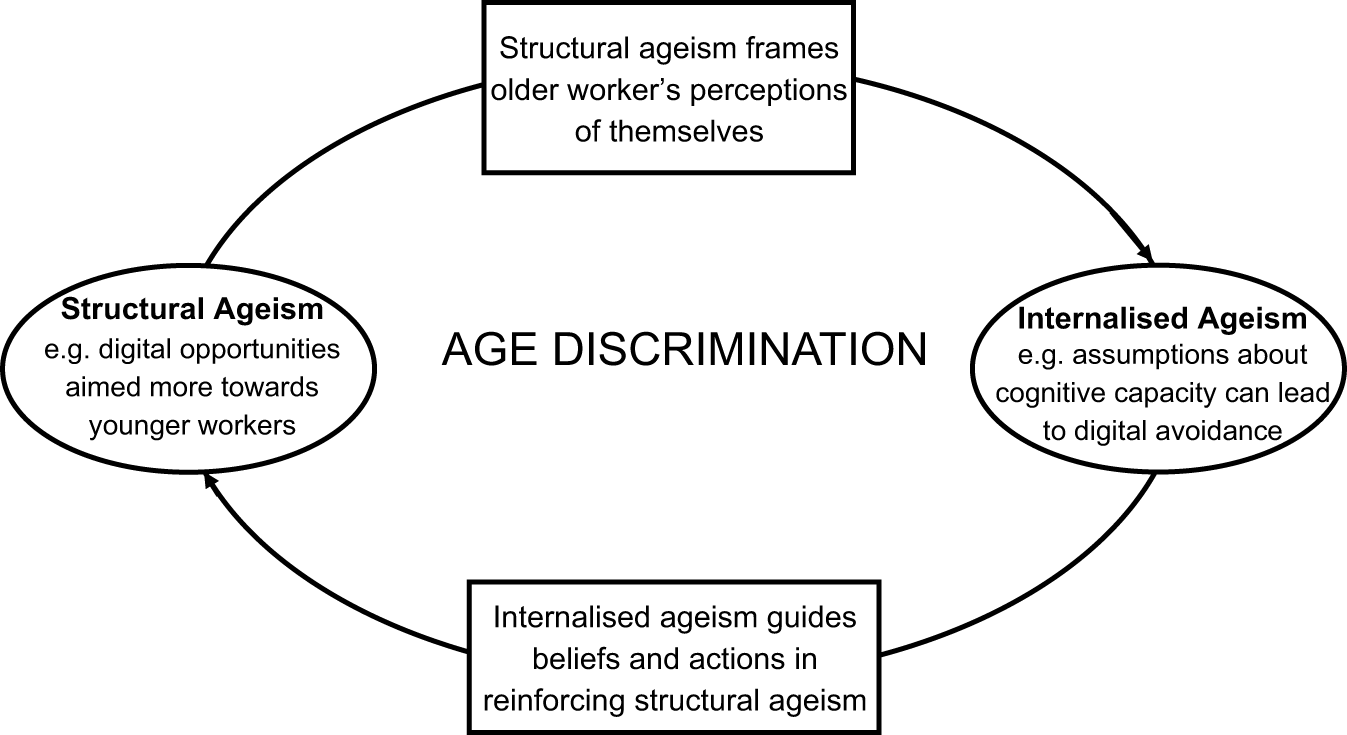
Structural factors and internalized ageism may be positioned heuristically as dichotomous – the external and internal factors feeding into ageism. However, these findings show that they are interrelated. The themes indicate that while age discrimination encompasses both structural and internalized dimensions, the two interact, with structural ageism feeding internalized perceptions and, in turn, internalized perceptions replicating and reinforcing structural ageism (Figure 1). Furthermore, these internalized perceptions also serve to influence attitudes towards other older workers. This may, in turn, contribute to organizational structures. For instance, an older employee with responsibilities for recommending digital skills training may have internalized negative perceptions of their own capabilities to learn digital skills, and also be less likely to provide opportunities for training for other older workers, in a sense perpetuating ageist structures. This can be seen as the emergence of an ageism feedback loop or recursive ageism whereby internalized ageism legitimizes structural ageism.
Conceptual map of age discrimination among older workers.

Structural factors such as the availability of social interactions and access to measures to enhance digital literacy help to frame older workers’ perceptions of themselves. For example, they can be excluded from certain digital content such as marketing or job adverts, and this digital discrimination then influences individual perceptions of what is ‘for them’ or ‘not for them’ (Levy Reference Levy2022a). The tendrils of structural ageism are so embedded that they have been shown to cause a reduction in physical activity through negative self-perceptions of ageing (Hooker et al. Reference Hooker, Mejia, Phibbs, Tan and Stevens2019). There are intersectional links here, as people from lower socio-economic groups are more likely to have a negative self-perception of their own ageing (Moser et al. Reference Moser, Spagnoli and Santos-Eggimann2011). Again, this indicates the powerful influence of structural factors on self-perceptions of ageing. Similarly, how older workers perceive themselves and their role within the workplace has an impact on their interaction with various structural factors as seen in Van der Horst’s (Reference Van der Horst2019) research which found that older workers excluded themselves from certain activities because of their age. While findings indicated that both men and women held negative perceptions of their ageing, there is evidence that this has a greater impact on women. Women’s internalized views of their own ageing have been shown to influence their retirement planning and preferred retirement age (Van der Horst Reference Van der Horst2019).
The findings of the new research presented in this article suggest a predominantly negative attitude held by older workers towards the workplace. However, respondents did note some positive features in terms of encouraging EWL and challenging ageism. For example, increased and tailored training, positive social interactions and coherent use of digital systems could foster a better working environment and in turn encourage more positive self-perceptions in later working life, reflecting a more positive outcome for the actions in Figure 1. Research on three cultures which regarded older people with varying levels of esteem found that the health of the older population was far better in the culture with the most positive age beliefs (Levy Reference Levy2022b). This effect is also seen in the UK, with different understandings of ageing and what it means to ‘age well’ seen across different racial groups (Fenton and Draper Reference Fenton and Draper2014). There is a clear need for countries to encourage age-positive campaigns which highlight ‘the strengths, benefits and opportunities of age diverse workplaces’ (Vodopivec et al. Reference Vodopivec, Finn, Laporšek, Vodopivec and Cvörnjek2019, 295), which can contribute to a climate conducive to employment and retention of older workers.
Conclusion
Increasing the participation of older workers in the labour market has been a long-standing policy priority (Crossdale et al. Reference Crossdale, Foster and Walker2025). Despite this, this research shows that both structural and internalized forms of ageism persist and were exacerbated by the pandemic (Ayalon Reference Ayalon2020; Evans et al. Reference Evans, Scott, Walker, Luszcz, Mazzucchelli, Wilton-Harding and Windsor2026). Ageism has been shown to have negative implications for EWL (Levy Reference Levy2022b). The persistence of structural ageism has been acknowledged by the WHO (2021, 5), which notes that institutionalized ageism often goes unrecognized because rules, norms and practices are ‘long-standing, have become ritualized and are seen as normal’. This normalization often makes ageism difficult to address.
The article has shown that structural and internalized ageism continue to play a significant part in the decision-making processes of older workers when considering their future. Moreover, the two interact in a mutually reinforcing relationship, with structural factors influencing personal perceptions and individual barriers such as disengagement and self-exclusion, which in turn reinforces structural ageism. By building on and empirically exploring existing critiques of ageism, particularly Palmore’s (Reference Palmore1999) institutional and individual framing and Levy et al.'s (Reference Levy, Zonderman, Slade and Ferrucci2009) focus on internalized ageism, this study contributes to understanding the operation and impact of age discrimination. Specifically, it shows how structural ageism transcends the behaviour of institutions to include the actions of individuals as participants in them. Internalized ageism was often self-directed in the findings from the new research in this article, but also manifested in biases held towards other adults of the same age. Therefore, ageism can be agentally reproduced through internalized biases of individuals. This represents a novel theoretical advance in the form of recursive ageism, whereby internalized ageism can serve to perpetuate and legitimize structural forms of ageism.
Policy and practice responses to understanding EWL must engage with structural and internalized aspects of ageism and navigate the complex associations between them, in a post-pandemic context. This requires individuals, policy makers and employers to recognize that chronological age represents a weak predictor of individuals’ capacities, and to challenge ageist and outdated normative patterns of the life course. Despite the removal of the default retirement age, long-standing negative perceptions of older workers and their capabilities are still internalized by older workers and influence employer practices. There is a need to establish more nuanced policies and practice to encourage EWL, which acknowledge diversity in opportunities and experiences (Scott Reference Scott2023). Policy which fails to adhere to these principles is likely to result in widening disparities between older people. It needs to emphasize variability in ageing and intersectionality to ensure sensitivity to social diversity (Kunkel and Settersten Reference Kunkel and Settersten2022; Calasanti and King Reference Calasanti and King2025).
To address the challenges of EWL, including structural and internalized ageism and the recursive ageism between structural and internalized factors, a multi-level strategy is required which incorporates a range of actions from government, employers and employees themselves (Phillipson Reference Phillipson2025). Policies need both to address the psychological barriers that lead individuals to self-exclude from the workforce and to remove structural barriers to EWL.
The government needs to move beyond simply raising the pension age and focus on creating a legal and social environment that makes working longer both viable and attractive. Government action is needed to strengthen the support offered to older workers, particularly on return to the workplace (Centre for Ageing Better 2022a) and for carers (ONS 2022). Current anti-age discrimination measures are insufficient to challenge the structural and internalized ageism necessary to promote EWL. Effective change requires actions at both the policy and the organizational levels. A new policy approach would recognize the embedded nature of ageism and comprise more stringent regulations against structural ageism, with public education campaigns to address its structural and internalized forms. These should reframe ageing as a period of ‘continued contribution’ rather than a period of ‘inevitable decline’, internalized in the health pessimism theme. Examples of effective legislation include Australia, Canada (Ontario) and the US, with public awareness campaigns and legal precedents. The enforcement of the 2000 Equal Treatment Directive varies across the EU. Germany’s strong legal response is partly reflected in the remarkable rise in labour force participation among older workers in recent years (Naegele Reference Naegele, Crossdale, Foster and Walker2025). However, such measures are only effective when accompanied by changes in workplace culture and practices. Thus, legal protection needs to be accompanied by proactive measures within organizations, such as age bias training and transparent recruitment and promotion processes. Furthermore, providing mid-life ‘MOT’ checkups – holistically reviewing wealth, work and wellbeing at age 45–55 – as a statutory right would encourage early intervention against the pervasive decline narrative before it becomes internalized. It could also assist in putting any necessary structural ergonomic measures in place to help counter the health pessimism narrative.
Employers represent the ‘gatekeepers’ of EWL, and their policies must go beyond passive non-discrimination to active ‘age positivity’. This can involve removing age cues in recruitment (such as referring to recent graduates), normalizing flexibility at all stages and not just linked to childcare (including compressed hours and remote work), and reverse mentoring and intergenerational teams. These are particularly effective in breaking down internalized stereotypes, reducing prejudice for both the individual and the organization (Ayalon Reference Ayalon2025). If individuals identify themselves as ‘too old’ to learn or adapt as a result of internalized ageism, they are less likely to engage with lifelong learning opportunities including digital upskilling. However, there are examples of good practice which represent policy learning opportunities. For instance, the OECD (2020) noted various effective measures including: provision of training vouchers (Netherlands, Singapore); paid educational leave (Austria); free access to vocational qualifications or ‘second chance’ education (Estonia, Hungary); and sector-based upskilling programmes (Italy, Netherlands).
In policy terms the CIPD (2025) emphasizes the need for a suite of complementary measures and interventions across different stages of the life course and targeted at multiple groups, including the unemployed and low-skilled individuals, who are most likely to find it challenging to engage with EWL. Presently EWL policy in the UK lacks a comprehensive life course approach, which would assist in tackling structural and internalized ageism. The evidence is clear: successful age management across the work course entails the coordination of national policies and organizational actions. This requires the active involvement of relevant stakeholders in both the design and the delivery of reforms, including older workers (CIPD 2025), with public sector support (including financial incentives) to embed these positive practices, particularly in small and medium-sized organizations.
Limitations
The interpretation of findings based on a sample of 25 interviews limits generalizability. For example, a full exploration of the intersection between factors such as education, gender or sector and ageism would require a much larger sample; however, indications of intersectionality have been highlighted in the original findings. It is also recognized that the recruitment strategy risked over-representing relatively active and engaged older adults. This could have influenced the exclusion findings in particular, as older people who are less engaged in workplace activities may perhaps feel the effects of exclusion less potently.
This effect was enhanced by the necessitation of online interviews owing to the Covid-19 pandemic. The use of online interviews expanded the geographic reach of this research, fostered inclusion for those less physically able, allowed research to continue safely and offered greater participant control (through a safe space in their own home and the ability to easily and immediately end the call). However, it also fostered digital exclusion in the sample for those without access or ability to participate online. As such, participation is skewed towards digitally abled older people. This will be reflected in participants’ experiences of and internalized ageism, as internalized ageism can manifest as a lack of confidence in technical ability and self-exclusion from digital activities. Thus, it is expected that the actual incidence of internalized ageism has a stronger and more prevalent effect than is reflected in this sample.
The difficulties in recruiting racially minoritized participants highlight broader difficulties in recruiting from marginalized groups, which could have impacted the new findings related to health, as racially minoritized groups can have different experiences with health-related services to their white counterparts. The empirical qualitative insights within this article could be complemented by a similar study with a more targeted approach to minoritized or marginalized groups. Similarly, mixed-methods research looking to match quantitative data on age discrimination factors with qualitative reasons for change could further contextualize these findings. An example of this would be analysing data on older workers reducing from full-time to part-time work and the reasons for this, or health data on retirees and whether health necessitated tangible change to retirement plans. While the authors favour a qualitative perspective, there may also be scope for solely quantitative contributions.
Supplementary material
The supplementary material for this article can be found at https://doi.org/10.1017/S0144686X2610097X.
Acknowledgements
The authors would like to acknowledge the support of colleagues within the EIWO programme.
Author contributions
All authors have made a substantial contribution to this article.
Financial support
This research received funding from the Swedish Research Council for Health, Working Life and Welfare (Forte), dnr. 2019-01245. The funder played no role in the design, execution, analysis and interpretation of data or in the writing of the study.
Competing interests
The authors declare none.
Ethical standards
Ethical approval was granted by the University of Sheffield ethical reviewers, reference number 040890.

 Open access

