1. INTRODUCTION
This paper is concerned with the mental capacity of certain organisms, like humans, to address design tasks. The ability to address design tasks has been approached and explained in many different ways. For example, design has been predominantly approached as a cognitive ability that is associated with a special form of information processing capacity (e.g., Stiny & March, Reference Stiny and March1981; Akin, Reference Akin1986; Goel & Pirolli, Reference Goel and Pirolli1989), or with a special form of logical reasoning (e.g., March, Reference March1976; Coyne, Reference Coyne1988; Takeda et al., Reference Takeda, Veerkamp, Tomiyama and Yoshikawa1990; Roozenburg, Reference Roozenburg1993). In other studies, the ability to design has been approached as a knowledge-level competence that requires certain types of knowledge (Brazier et al., Reference Brazier, Moshkina and Wijngaards2001; Smithers, Reference Smithers, Gero and Sudweeks1996, Reference Smithers, Gero and Sudweeks1998, Reference Smithers and Gero2002) or certain knowledge structures (Yoshikawa, Reference Yoshikawa, Sata and Warman1981).
Although design is often perceived as a mental skill or capacity, there is to date no theory that explicitly associates our understanding of design ability with theory of mind and the philosophical notion of intentionality. In order to address this gap, the paper focuses on the property of the mind to hold intentional states (i.e., its capacity of representing or reflecting existing and nonexisting realities), and the way that these mental states are constructed during design tasks. Despite the existence of many theories that contribute to understanding design at some level of observation (e.g., information processing level, logical reasoning level, knowledge level), there is no mathematical account able to express how intentional states are constructed during design tasks. This account would be useful as a basis for looking at the relationship between the mental activity of design and the structures and processes that characterize its realization at potentially different levels of observation. For example, although there is some empirical evidence that identifies certain neurological correlates of the ability to design (Goel & Grafman, Reference Goel and Grafman2000; Vartanian & Goel, Reference Vartanian, Goel, Martindale, Locher and Petrov2005; Alexiou et al., Reference Alexiou, Zamenopoulos, Johnson and Gilbert2009; Gilbert et al., Reference Gilbert, Zamenopoulos, Alexiou and Johnson2010), there is no theoretical and mathematical framework able to support hypotheses on how neurological structures and processes are linked with the mental capacity of constructing intentional states during design tasks. The same difficulty may apply to mapping the relationship between the construction of intentional states during design and the social structures and processes that underlie design activity (Alexiou, Reference Alexiou2007; Alexiou & Zamenopoulos, Reference Alexiou and Zamenopoulos2008). Thus, overall, the paper aims to develop a mathematical account on the type of structures and processes that are involved in the formation of intentional states during design tasks.
In this paper the philosophical notion of intentionality is approached from a complexity theoretic perspective. In general, complexity science aims to develop a set of methods and theories for understanding the organizational principles that underlie the creation of higher level functions or structures (see, e.g., Haken, Reference Haken1983; Badii & Politi, Reference Badii and Politi1997; Schuster, Reference Schuster2001; Boccara, Reference Boccara2004). Complexity science strives to identify whether there are certain common principles that govern how components as diverse as atoms, cells, animals, or humans organize themselves, and in doing so lead to the formation of macroscopic phenomena like chemical patterns, living structures, cognitive functions, social, or economic constructs. Part of this enquiry is the identification of the organizational structures and processes that lead to intentionality (Atlan, Reference Atlan1998). However, the potential of complexity science in understanding design as a mental capacity has not been explored fully, despite the increasing import of complexity in design studies. Complexity has been perceived and employed as a scientific approach for conducting design research, as a theoretical and methodological toolkit for addressing design tasks, and as a subject/problem of design practice (for a review, see Zamenopoulos & Alexiou, Reference Zamenopoulos and Alexiou2005a). Yet, complexity science also presents us with an interesting hypothesis about the nature of design: that the (mental) capacity to design can be perceived and studied by looking at the organizational structures and processes that govern the formation of intentional states during design tasks. Currently there are only tenuous links between design intentionality and organizational level notions usually encountered in complexity theory, such as self-organization, bifurcations, coordination, or phase transition. The aim of the paper is to develop a mathematical theory of the organizational complexity that characterizes the intentional states of a design-capable system during design tasks.
The paper is organized as follows. Section 2 discusses the nature of design phenomena and introduces the core premise of this study about design intentionality. Section 3 explicates the scope and meaning of intentionality theoretically, but also in relation to some fundamental mathematical expressions. The mathematical treatment is based on category theory. Section 4 develops some new mathematical structures that aim to capture variations in the complexity of intentional states. Section 5 brings together the proposed mathematical expressions with the theoretical discussion about design intentionality. Section 6 summarizes and discusses the contribution of the proposed mathematical and theoretical framework.
2. THE NATURE OF DESIGN PHENOMENA AND DESIGN INTENTIONALITY
In the most general sense, the phenomenon of design arises with the formation of organisms whose survival depends on their capacity to construct or adapt their own environment. For instance, the capacity of birds to build nests, beavers to dam ponds, or humans to construct hunting tools, can be perceived as primitive examples of design tasks. This capacity may be equally distributed within a society of individuals. For instance, the capacity of ants to build nests or people to create cities or virtual communities in the Internet may be perceived as examples where the ability to design is the product of the distributed activity of individuals. The capacity of an organism to change or adapt its environment may be contrasted to other logically distinct abilities or strategies: for example, the capacity of an organism to adapt itself to environmental changes, or the capacity to migrate to a new environment (Kirsh, Reference Kirsh1996). Overall, the phenomenon of design can be understood as the product of an evolutionary pressure that leads to the formation of organisms with the individual or collective capacity to create artifacts and as a result adapt their environments for their own benefit.
Although evolutionary pressure may explain the presence of design abilities in certain organisms, or the formation of species of design artefacts as a product of exosomatic adaptation (e.g., Steadman Reference Steadman1979), evolutionary theory in itself cannot describe what makes certain organisms, such as humans, capable of designing. A typical response to this quest is to assume that design requires cognition; a mind with the capacity to recognize the possibility of alternative environments and generate instantiations that fulfill the properties of these (imagined) environments. Design activity then arises in response to a problematic situation where there is a desire, need, or idea to construct a change in a certain environment, but the precise means and ends of this construction are not given. Although, this premise is commonly held in design research (i.e., see, Archer, Reference Archer and Cross1965; Mitchell, Reference Mitchell1990; Smithers, Reference Smithers and Gero2002), it can nevertheless take a number of different interpretations.
The above situation is often interpreted in relation to an information processing system (i.e., a cognitive designer) that faces a special type of problem solving task (e.g., Goel & Pirolli, Reference Goel and Pirolli1989). According to this perspective, a problematic situation arises with a problem statement or task environment that an information processing system needs to address. The hypothesis implies a distinction between an external environment that sets the problem, and an internal environment that represents the task environment (the problem space). The problem space is then a representation of a set of possible states, a set of legal operations, as well as an evaluation function or stopping criteria for the problem solving task (e.g., Ernst & Newell, Reference Ernst and Newell1969; Newell & Simon, Reference Newell and Simon1972). The peculiarity of the design task is that the means (i.e., the representation of the problem space and the possible operations over the problem space), as well as the ends (i.e., the evaluation function or the stopping criteria) are not given in the task environment but are part of the design process (Simon, Reference Simon1973; Goel & Pirolli, Reference Goel and Pirolli1989, Reference Goel and Pirolli1992).
Another interpretation postulates that a problematic situation in design arises from the reflective activity of a designer over an objective reality, that is, a professional, social, or operational environment that includes humans, tools, external representations, artifacts, and so forth (Schön, Reference Schön1983). According to this paradigm, design is not a characteristic of the task environment (i.e., of a problem statement), but a characteristic of the coupling or interplay between a subject (i.e., a designer) and an objective reality (i.e., the environment). A design situation then arises not as a problem, but as a mental state of a “reflective” agent. This view essentially conveys the idea that cognitive functions are not simply the product of an information processing system (an isolated mind); they are instead formed from the coupling between the mind, the body, and its environment. In design research, a number of different approaches have been proposed following this perspective: for example, seeing design as a hermeneutic act (Snodgrass & Coyne, Reference Snodgrass and Coyne2006), as a constructive act of a situated cognitive agent (e.g., Gero, Reference Gero, Grabowski, Rude and Grein1998), or as a self-organization process that involves the interaction between internal and external representations (Portugali & Casakin, Reference Portugali, Casakin, Durling and Shackleton2002). A more abstract approach sees design as a coevolutionary process between a problem and a solution space (e.g., Maher et al., Reference Maher, Poon, Boulanger, Gero and Sudweeks1996; Dorst & Cross, Reference Dorst and Cross2001).
In the following, the premise that design arises in response to a particular situation is approached in relation to the capacity of an organism to have intentionality or intentional states. Before we explain this premise, we briefly introduce the notion of intentionality.
Although the term intentionality has its origins in the writings of medieval Scholastic philosophers, the contemporary “technical” meaning of the term was reintroduced in philosophy of mind by Brentano in 1874 (republished in Reference Brentano1995). According to Brentano, intentionality aims to describe the very essence of the mind: the capacity to represent or reflect objects or states of affairs in the world, either existing or nonexisting. The capacity of a mind to represent an object or state of affairs in the world is intentional in the sense that mental states are “semantically evaluable” and therefore “refer to something,” or they are “about something” (Fodor, Reference Fodor and Guttenplan1995). In philosophy of mind it is generally assumed that there are two archetypical, logically distinct intentional states: beliefs about “what the properties of a certain reality are,” and desires about “what the properties of a certain reality ought to be.” Although it is analytically convenient to distinguish different types of intentional states, intentionality is generally perceived as a holistic or emergent property of the mind that is derived by a network of causally related intentional states; that is, a network of beliefs, desires or intentions.Footnote 1 It is worth noting that although intentionality is often approached as a unique characteristic property of the mind, mental states are not always intentional. Mental states such as pain, general anxiety, or elation are not intentional or semantically evaluable because they are not directed to an object or state of affairs in the world.
Based on these terms, the core premise of this study is that design activity arises in response to the appearance of conflicting or incomplete intentional states, which more specifically express inconsistencies between beliefs held about the past, current, and future states of the world, and desires regarding the state of the world. In response to this situation, the ability to design requires both the mental capacity to formulate intentional states about a desired reality and the mental capacity to formulate intentional objects that resolve inconsistencies or conflicts between intentional states (e.g., conflicting beliefs and desires). However, in order to explicate this general premise it is important to introduce a common theoretical background on intentionality.
3. THE STRUCTURE OF INTENTIONALITY: A CATEGORY THEORETIC APPROACH
As briefly discussed, beliefs, desires, hopes, or intentions are different types of intentionality with the common property that they are all directed to something. For instance, the belief that “it is raining” or the desire “to stay dry” refer to a specific state of affairs in the world. It is often suggested that intentionality is determined by two components (Searle, Reference Searle1983): the representational content or intentional object that describes the properties of an object or state of affairs in the world (e.g., “it is raining” or “stay dry”), and the attitude or psychological mode that determines the type of intentional state (e.g., belief, desire, or intention). This structure is often denoted as F(s), where F is the attitude and s is the representational content. Alternatively, Fodor (Reference Fodor1975, Reference Fodor1987) defines the attitude of an intentional state as a binary relation F between an organism O and its mental states/mental representations s; that is F(O, s). In this notation, s is a token, a syntactical physical entity, associated with an intentional object (e.g., “it is raining”).
According to Searle (Reference Searle1983), an attitude F (e.g., beliefs or desires) expresses the underlying assumptions regarding the relative independence of the world from the mind. These assumptions determine a direction of fit. More specifically, an attitude F expresses a direction of fit in the sense that any mismatch between the representational content (e.g., “it is raining,” or “stay dry”) and the world is resolved by either changing the mind in relation to the world, or changing the world in relation to the mind. Beliefs and desires are thus two archetypical intentional states that express two opposite directions of fit. A mind-to-world direction of fit assumes that an intentional object represents an independently existing world and therefore any mismatch between representation and the world must be followed by an adaptation of the representational content. A belief is either true or false in the sense that the correspondence between representational content and the world is evaluated against an independently existing world. A world-to-mind direction of fit assumes that an intentional object exists independently from the world and any mismatch between the representational content and the world must be followed by an adaptation of the world. A desire cannot be said to be true or false. A desire is satisfied or fulfilled in the sense that the correspondence between representational content and the world is realized when there is a change in the world in relation to the mind. In both cases, the representational content s of an intentional state determines the conditions of satisfaction of a certain intentional state. Based on these terms, intentional states are therefore defined as mental states that have certain conditions of satisfaction s with a certain direction of fit F in relation to an object or state of affairs in the world.
The core notion of intentionality refers to the capacity of the mind to hold representations of an existing or nonexisting reality. From this perspective, mental states have a semantic content. Moreover, intentional states are semantically evaluable: beliefs may be true or false, and desires may be satisfied or unsatisfied. However, existing theories of intentionality take different positions about the nature of mental representations, their semantic content, and their realization. Thus, in the following we review various approaches on (a) how mental representations can be understood and modeled, (b) what is the semantic content of mental representations and how it can be evaluated, and (c) how is intentionality realized (particularly the physical realization of mental states). These are outstanding questions also in domains like artificial intelligence, cognitive science and linguistics, but the focus here will be on philosophy of mind. In parallel to presenting the various approaches, the paper will aim to introduce some category theoretic notions and expressions that can capture basic aspects of intentionality. This will establish the mathematical language based on which the proposed hypothesis about design intentionality will be formally expressed.
3.1. Mental representations
How mental representations can be understood and modeled? There are three very broad traditions regarding the way the representational content s of an intentional state F is understood and ultimately modeled: as a linguistic (or symbolic), as a dynamical (or behavioral). and as a structural (or topological) entity. Let us briefly consider these traditions before we move on to a category theoretic (algebraic) formalization that to some extent is able to offer a unifying way of considering these different traditions.
3.1.1. Approaches regarding mental representations
The first approach starts with the hypothesis that mental representations can be understood and modeled as symbolic expressions that are generated by a mental language (Fodor, Reference Fodor1975; Pylyshyn, Reference Pylyshyn1984). Symbolic expressions of mental states are often referred to as propositional attitudes. According to this view, mental representations have a semantic content but also a syntax that constitutes the domain over which mental processes are applied. The underlying model is that the mind performs computations (i.e., logical operations) over mental representations that transform one mental state to another. These computations are defined as truth preserving operations: that is, operations that transform propositional attitudes (e.g., beliefs) that are true, into propositions that are also true under certain conditions (i.e., interpretations). In this sense, the mind is realized by a computational machine that evaluates the truth value of symbolic expressions. In other words, according to this approach, the semantic content of mental representations is specified by the relation between a language and the machine that realizes or evaluates this language.
The second approach starts with the hypothesis that mental representations can be understood and modeled as particular states of a dynamical system (e.g., Van Gelder & Port, Reference Van Gelder, Port, Port and Van Gelder1995). According to this tradition the attractors or bifurcations that characterize the dynamical behavior of an intentional system can be perceived as core entities that exemplify the meaning of mental representations. Mental processes are then modeled by differential equations and mental representations are reduced to their dynamical properties. The very existence of mental representations as a foundation of intentionality has been challenged in many different contexts (e.g., Dennett, Reference Dennett1987; Freeman & Skarda, Reference Freeman, Skarda, Mcgaugh, Weinberger and Lynch1990). For instance, Dennett (Reference Dennett1987) argues that intentionality is a behavioral disposition, so an organism has intentionality because someone takes an “intentional stance” that certain behavioral patterns are related to certain attitudes (e.g., beliefs or desires). In this sense, attitudes may exist without representations (for a critique, see Fodor, Reference Fodor1987).
Finally, the third approach starts with the hypothesis that mental representations can be understood and modeled as structures that are distinguished by their topological or geometrical features. One possible interpretation of this tradition can be found in Harnad (Reference Harnad and Harnad1987, Reference Harnad1990) or more explicitly in Gärdenfor (Reference Freeman, Skarda, Mcgaugh, Weinberger and Lynch2004). Gärdenfor (Reference Freeman, Skarda, Mcgaugh, Weinberger and Lynch2004) posits the hypothesis that mental representations are regions within an n-dimensional Euclidian space. The shapes, spatial, and topological relationships of these regions are the main representational tools for expressing properties and concepts. The view of mental representations as topological or geometrical properties is more formally interpreted as a set of operations that preserve these properties invariant. These operations express the representational content of an intentional state. To put it differently, the representational content of a mental state is understood and modeled as a structure preserving operation that captures the invariant properties of an existing or nonexisting reality.
3.1.2. Category theoretic account of mental representations
For the purpose of this paper, the hypothesis that mental representations are structure-preserving operations is more formally interpreted within the context of category theory. Category theory is a type of algebra that studies the behavior of structure preserving transformations or operations between different species of mathematical structures (called categories). One of the interesting features of category theory stems from the fact that the notion of category is a metastructure that can be used to express different types of mathematical structures: symbolic, dynamical, or topological. Although the use of category theory may imply the hypothesis that mental representations are structural properties of an intentional system, it also seems plausible to interpret the more abstract notions of category theoretic constructions as a unifying framework between the different approaches/levels. A detailed exposition of category theoretic concepts, methods and results can be found in Goldblatt (Reference Goldblatt1984), Barr and Wells (Reference Barr and Wells1985, Reference Barr and Wells1990), Lambek and Scott (Reference Lambek and Scott1986), Lawrere and Schanuel (Reference Lawrere and Schanuel1997), and Mac Lane (Reference Mac Lane1998). One of the first applications of category theory in design and planning can be found in Ho (Reference Ho1982).
The notion of category
As a mathematical entity, a category is defined by a graph structure G (i.e., a set of objects and arrows between objects) together with an operation that allows every different path of arrows within the graph G to be composed and as a result create new structures. More formally, a category C is defined as a graph structure that consists of a family of objects {a, b, c, …}, a family of arrows {f, g, h, …} and two additional operations identity and composition. For each object a the identity operation assigns an identity arrow 1 a: a → a and for each pair of arrows <g, f> that form a path a → b → c the composition operation assigns a new arrow g ° f: a → c that is called the composite. The composition of arrows must satisfy two general axioms. The first (axiom of associativity) posits that the composition of arrows is associative, namely, that h ° (g ° f) = (h ° g) ° f and the second (axiom of identity) posits that for every arrow f: a → b, f ° 1a = f and 1b ° f = f.
Because of the underlying graph structure, the notion of category has been extensively used to model structural properties of a system and their invariant characteristics. However, the categorical structure can be also seen as an algebraic expression of a formal language or theory. A common interpretation is to see the notion of a category as a formal theory or formal language where a set of formulas are expressed by objects {a, b, c, …}, deductions are expressed by arrows {f, g, h, …}, and rules of inference are expressed by compositions of arrows (e.g., Goldblatt, Reference Goldblatt1984; Lambek & Scott, Reference Lambek and Scott1986). The composition of arrows over an underlying graph structure is essentially the category theoretic way to express and study how the recursive application of rules of inference (i.e., compositions of arrows) generates new formal expressions and structures. For instance, according to this interpretation, a category C may be seen as an algebra of shapes or shape grammar (Stiny, Reference Stiny2006) where shapes are the objects of the category C and the shape rules are its arrows.
More generally, a category is an algebraic expression of a mathematical structure: for example, a formal language, a dynamical system, or a topological structure. In this sense, categories are often used to describe types, or species, of structures and processes. More specifically, it is a common practice to consider the structure of categories as a “metastructure” whose objects are mathematical structures (linguistic, dynamical, or topological structures) and whose arrows are operations that preserve certain structural qualities invariant.
Mental representations as functors
The arrows that preserve certain structural properties invariant are called functors, and they are defined as structure-preserving operations between two categories. More specifically, a functor F:B → W from a category B to a category W is a graph homomorphism that preserves the identity arrows and the compositions of arrows. The definition suggests that the notion of a functor has two aspects: first, the functor preserves properties of the underlying graph structure of the category B invariant in W, and second, the functor expresses how structures and compositions of arrows in category B can be used in order to model structural aspects of the category W.
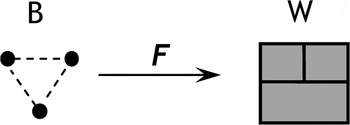
Following this definition and observations, mental representations can be formally expressed in relation to functors. More specifically, a mental representation is a linguistic, dynamical, or geometrical property expressed in category B (e.g., an organism's brain) that remains invariant in a certain world W. The functor F:B → W explicates the mathematical meaning and conditions of the invariance of B in W. In this setting, category B can be seen as a mental structure, whereas category W can be seen either as an external perceived reality or as a possible reality that corresponds to another mental structure. As a simple example, we can consider that the category B models the structure of an intentional system that expresses spatial relations. In Figure 1, category B has a graph structure that expresses spatial relations between activities or rooms. In the same figure, category W is the category of shape configurations whose objects are rectangular shapes and whose arrows are adjacency relations between shapes. For the purpose of this paper, category W can be equally thought as an inner (cognitive) representation of a shape or alternatively as an external representation (e.g., a drawing). The functor F:B → W is a mathematical notion that explicates the meaning of the structural invariance between spatial or topological relations and shape configurations.
An illustration of a functor F between topological relations and shape configurations. The notion of functor constitutes the basis of mental representations.

An important aspect of mental representations is that they construct abstractions. This aspect of representation is referred to as universality. In complexity science, a universal construction is the equivalent of an “order parameter” that enslaves the properties (structure and behaviors) of a family of objects (e.g., Haken, Reference Haken1983). Similarly in philosophy, a universal construction is a representation of properties that characterize a family of objects. The represented property is said to be a universal property and the objects are said to instantiate (or participate in) the universal property. In set theory, a universal property is captured by the notion of a set; a set is an abstract entity constructed by a collection of objects that have the represented property (they satisfy a membership relation). In contrast to set theory, in category theory the representation of abstract properties is given by concrete objects/structures. Given a family of entities, a universal construction is an archetypical object/structure that exemplifies a property in a universal way. In category theory the notion of universal construction is probably best explained by Ellerman (Reference Ellerman1988) as a concrete universal: a concrete universal is an archetypical object that represents a property in such a way that all other objects that hold this property resemble or participate in the archetypical object. More formally, universality is identified with the existence of a particular structure in category B. This structure is constructed by a unique arrow u in the same way that a set is constructed by a membership relation. The arrow u optimally represents the properties b of a family of objects d in W as follows:
Definition (universality)
Given a functor U:W → B and an object b in B, a universal arrow <r, u:b → U(_)> is an arrow of the form u:b → U(_) with an object r in W such that the following universal property is satisfied: for every d in W and f:b → Ud in B there is a unique arrow g:r → d such that the following diagram commutes:

■
The statement that the above diagram “commutes” essentially means that the equation f = U(_) ° u is solvable for a unique g (i.e., f = U(g) ° u). The universal construction shaped by the arrow u:b → U(r) is the “order parameter” for any equation f = U(_) ° u, in the sense that it determines the properties of structures g:r → d that participate in it. It also means that the arrow u is a “minimum representation” in the sense that any other representation (i.e., any other arrow f in B) can be uniquely constructed using the arrow u. Moreover, the object r is unique (or more precisely unique up to isomorphism) in the sense that any other object in W that has this universal property is isomorphic to r.
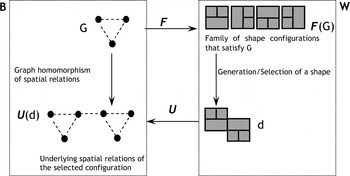
In category theory, the notion of universality leads to the idea of complementary representations (or complementary functors), which is mathematically expressed by the notion of adjunction between two categories. An example of adjunction is the relation between a computing machine and a language. The concept of machine alludes to an effective procedure that is specified by a language or program fed into the machine, whereas the concept of language alludes to a set of instructions that specify the behavior of the machine. The two constructions are complementary entities. It is a well-known result that this complementary relation can be formally expressed by the notion of adjunction (Goguen, Reference Goguen1973). A more concrete example can be given by looking at the functors between spatial rules (or spatial relations) and shape configurations (Fig. 2). Let us assume that B is the category of topological relations and W is the category of shape configurations. The notion of adjunction suggests the existence of two functors as follows. Let us take a particular graph structure G of topological relations in B and create a set F(G) of all possible shape configurations that satisfy the spatial relations expressed by G. This is achieved by a functor F:B → W (termed free functor). Similarly, let us take a particular shape configuration d in W and create a graph structure U(d) that represents the underlying topological relations of d. This is achieved by a functor U:W → B (termed underlying functor). The notion of adjunction in Figure 2 implies that the category F(G) generates a shape configuration d if and only if there is a graph homomorphism from G to U(d).
Definition (complementary representations or adjoint functors)
Given two functors F:B → W and U:W → B, an adjunction between B and W is the tuple <F, U, φ> where φ is a natural bijection φ:W(Fb, d) ≅ B(b, Ud) for every b in B and every d in W.■
An illustration of the notion of adjunction. The F functor generates a family of shape configurations that satisfy the topological relations in G. The U functor generates topological relations of shape configurations that can be deduced from G.

This definition entails that the notion of complementary representations or adjoint functors gives a universal arrow for every b in B and every d in W. More specifically, given two functors F:B → W and U:W → B:
• For every f:b → Ud in B there is a unique arrow g: Fb → d in W such that f = U(g) ° u b (i.e., for every b there is a universal arrow u b)

• For every g: Fb → d in W there is a unique arrow f:b → Ud in B such that g = ɛd ° F(f) (i.e., for every d there is a universal arrow ɛd).

3.2. Semantic aspects of intentionality
The notion of intentionality and the notion of semantics are inextricably related. As already discussed, the notion of intentionality alludes to mental states that are directed to some existing or possible reality. Intentional states are therefore mental representations that are characterized by their content, their meaning. According to Searle (Reference Searle1983), semantic phenomena must be understood in the context of intentionality and theory of mind. For Fodor (Reference Fodor1987), the relation between intentionality and semantics is even more intrinsic: if semantics is an indispensable component of a theory of language, then it should also be an indispensable component of a theory of “inner” language or “language of thought.” In this sense, a theory of mind should eventually converge into a theory of language and ultimately semantics. This section aims to lay out some basic issues regarding semantics as they relate to intentionality, in preparation of a more formal treatment in the next section.
3.2.1. Approaches regarding semantics
It is generally agreed that semantics allude to the capacity of an entity, whether a symbolic expression, dynamical, or structural entity in the mind, to hold and manipulate meaning. This is a view that is commonly held in philosophy of mind, linguistics, and logic. However, the identification of the “thing” that we call meaning (i.e., the ontology of meaning), but also the specification of the relation between expression and meaning (the specification of semantic relations) is a notoriously contentious problem.
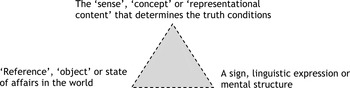
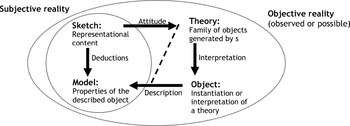
The predominant view is to perceive semantics as a referential relation. According to this view, semantic relations allude to the capacity of an expression, including a natural sign, a linguistic sign, or a mental state, to refer to an object or state of affairs in the world. There are two interrelated strategies for understanding meaning (Davis & Gillon, Reference Davis and Gillon2004). One strategy is to associate the term meaning with the specification of the properties of the objects or state of affairs in the world to which meaning is attributed. This specification is variously referred to as “sense,” “intension,” “connotation,” “universal property,” or “representational content.” Another strategy is to associate the term meaning with the very object(s) or state of affair(s) in the world that is attributed to an expression. The set of objects that satisfy the specification is variously referred to as “extension,” “denotation,” or “reference.” The specification of the properties of an object (i.e., the representation content) determines the truth conditions or conditions of satisfaction that evaluate the relation between a reference and an expression (Fig. 3). Thus, an expression refers to an object or state of affairs in the world because that object or state of affairs in the world has properties that satisfy the expressed truth conditions or conditions of satisfaction. Historically, this tradition has its origins in the work of Frege (e.g., Beaney, Reference Beaney1997) and in the work of Tarski (Reference Tarski1956) on model theory.
The semantic triangle. Different theories take different views on the relation and existence of these three basic terms.

In philosophy of mind and language these terms are discussed in relation to certain existential and ontological questions. For example, where is the locus of the conditions of satisfaction of an object? Are these conditions expressions of a mental state, or of an external world? Moreover, is the reference an entity that is located in the mind or in the external world?
In response to these questions, a conceptualist starts with the hypothesis that meaning is a mental structure. The view that a mental entity is associated with meaning implies that the reference of an expression is located in the brain (e.g., Jackendoff, Reference Jackendoff1976, Reference Jackendoff1990; Gärdenfors, Reference Gärdenfors2004) or that the conditions of satisfaction are expressions of a mental state (e.g., Searle, Reference Searle1983). In contrast, a realist rejects the idea that meaning is determined by a mental entity and defines the notion of meaning in relation to an object that is outside the mental state of an agent (e.g., Putnam, 1975). Within this tradition one approach is to postulate that the reference of an expression is determined by certain conditions located in the interactions and structure of the environment of a cognitive agent (Barwise & Perry, Reference Barwise and Perry1983). This approach gave rise to the notion of ecological realism where the “meaning arises out of recurring relations between situations.”
The referential approach to semantics, either realist or conceptual, is not the only way to define semantic relations. The fact that an expression means something, or refers to something, can be perceived as having to do with a purpose or the function of representing something (Dretske, Reference Dretske1995; Millikan, Reference Millikan2004). According to this approach, meaning is a functional entity (for a review, see Harder, Reference Harder1996). Hence, the functionalist or teleological view starts with the assumption that the formation of meaning is not derived from the representational content or from a reference in the external world, but from the function of representing a certain object or state of affairs in the world. More specifically, the meaning of an expression is determined by the intention to produce certain effects and by the purpose and principles of communication (e.g., Grice, Reference Grice1957). An expression is “false” or “not satisfied” because of its failure to represent or convey a particular meaning.
For the purpose of this study, it is assumed that the functionalist view of meaning does not necessarily reject the existence of referential relations. Semantic relations can be ultimately perceived as referential relations that are selected for their function (Millikan, Reference Millikan2004, p. 67). Therefore, the focus will remain on the referential structure of meaning. Moreover, because the objective of this section is to explicate the logical structure of semantic relations the locus of meaning will be treated both as a mental (subjective) and as an external (objective) entity.
3.2.2. Category theoretic account of the semantic content of intentionality
The formal specification of semantic relations has been part of mathematical logic and in particular model theory (Barwise, Reference Barwise1977). Model theory is concerned with the relation between a set of logical statements expressed in a language L and the mathematical structures that satisfy the postulated statements. The set of logical statements form a theory and the algebraic structures that satisfy the statements of the theory are called models. A theory is consistent if it has at least one model. Assuming the existence of a model, a theory is a set of truth conditions for that model. The distinction between theories and models is therefore the model theoretic way to explicate the formation of semantic relations as the interplay between “the specification of the properties of a family of objects” and “the set of objects that satisfy the properties of a specification.” Note that the terms theory and model are used in a different way than how they are used in science. For an application of model theory to design theory, see Mitchell (Reference Mitchell1990).
Another tradition to formal semantics is originated in Kripke's semantics and modal logic (Kripke, Reference Kripke1963; Goldblatt, Reference Goldblatt, Gabbay and Woods2006). Modal logic is concerned with formal expressions that assert the mode of truth: for instance, that something is “possibly” or “necessary” true in a given context. Semantics are defined in relation to a relational structure that captures interconnections between possible worlds within which an expression is true or false. In this context, a model alludes to relational or algebraic structure that represents the interconnectivity between possible worlds. Other similar forms of formal semantics have been defined by Hintikka (Reference Hintikka1961) and also Barwise and Perry (Reference Barwise and Perry1983).
An alternative way to explicate the formation of semantic relations can be found in category theory. Instead of employing symbolic expressions in order to specify semantic content (i.e., the truth conditions or conditions of satisfaction for a certain mental state), category theory uses diagrams of objects, arrows, and compositions of arrows. These diagrams are formally termed sketches. Sketches are therefore the category theoretic way of expressing the conditions of satisfaction for a certain intentional state: for instance, sketches may express aspects of a desired artefact such as proximity of rooms in a building layout or strategic knowledge on the appropriate interaction between different design tasks.Footnote 2 One of the advantages of the mathematical notion of sketch is that “of being independent of any particular presentation” (Wells, Reference Wells1994, p. 7). It thus makes it possible to capture the semantic content of intentional states at different levels of analysis: as dynamical, symbolic, or topological structures. The paper will use examples that emphasize the link with symbolic level representations, but the mathematical treatment applies generally to different types of structures.
A sketch generates a mathematical category in the same way that recursive rules or formal grammars generate a language. Based on this analogy, a category can be seen as an algebraic way to express the notion of a formal language. In category theory, the semantic evaluation of sketches is mathematically specified using the notion of functor between categories. A more detailed account of the correspondence between category theoretic formalizations and other traditions in formal semantics can found in Barr and Wells (Reference Barr and Wells1985, Reference Barr and Wells1990). For examples and literature on how sketches can capture dynamical processes, symbolic processes or topological transformations see also Lawrere and Schanuel (Reference Lawrere and Schanuel1997). Let us explore the formal characteristics of sketches in more detail.
The notion of sketch
A sketch generates a category by specifying some core syntactical aspects of the category theoretic structure. The core aspects of a category theoretical structure include the following: first, a graph structure that depicts structural properties of a category; second, diagrams that specify possible compositions or constraints in the compositions of arrows; and third, diagrams that specify universal properties. More formally, a sketch s = <Gs, Ds, Cs, Cos> is a graph Gs with a set of diagrams (graph homomorphisms) Ds that determine constraints on the composition of arrows over Gs; as well as a set Cs of cones and a set Cos of co-cones. A cone, as well as its dual concept of co-cone, is a special type of diagram (graph homomorphism) in Gs that defines the universal properties of the generated category. For instance, a cone may be a diagram that depicts how new objects may be created from the composition (product) of two other objects within a given category. Cones and co-cones are dual concepts: namely, they are diagrams with arrows in opposite directions. For the purpose of this paper, a formal definition of cones (and co-cones) is not necessary but it can be found in any textbook in category theory. For full details about the definition of sketches as a collection of graphs, graph homomorphisms and cones/co-cones the interested reader can look at Barr and Wells (Reference Barr and Wells1985, Reference Barr and Wells1990).
For each sketch determined by s = <Gs, Ds, Cs, Cos> it is possible to construct a category that has as an underlying graph the graph Gs; as commutative diagrams the set Ds; and as universal properties the types of cones and co-cones defined by Cs, Cos. The category generated by a sketch s = <Gs, Ds, Cs, Cos> is denoted by Th(s) or Ths, and is referred to as a theory or language generated by the sketch s. The generated theory Ths is a category of entities that satisfy the properties (structure, constraints, and abstractions) specified by a sketch. Equally, each category d has an underlying sketch, denoted by Ud = <Gs, Ds, Cs, Cos>, that specifies these properties. For a sketch s and for a theory of a sketch Ths there is a functor i:Ths → d that preserves the aforementioned properties of the theory, and as a result generates a possible instantiation of the theory in d. This functor is defined as an interpretation of the theory Ths. In the same way, a model of a sketch s is defined as a sketch morphism m:s → Ud from a sketch s to the underlying sketch Ud of the category d. A sketch morphism is a graph homomorphism that takes the set of diagrams Ds, cones Cs and co-cones Cos to a set of diagrams, cones and co-cones in Ud.
Based on this notation, semantic relations are defined in relation to the following universal property: for every sketch s and every model of a sketch m:s → Ud there is unique functor i:Ths → d for which the following diagram commutes (i.e., the two alternative paths of arrows are equal so, m = U(i) ηs):

This property states that there is a natural bijection between models of a sketch m:s → Ud and interpretations of a theory i:Ths → d (i.e., an adjunction between a theory functor Th and the underlying functor U), which is denoted by Mod(s, UCd) ≅ Int(Ths, d).
In sum, the category theoretic concept of sketch offers an alternative way to formalize semantics: the notion of theory or language is expressed by the category Ths, whereas the notion of model is expressed by the special type of arrow m:s → Ud.
How sketches express the semantic content of intentionality
These category theoretic concepts can be now used to explicate how an intentional state leads to the formation of semantic relations. To do this we make reference to Searle's terms. For Searle (Reference Searle1983), the formation of semantics involves two layers of intentionality: one that corresponds to a “sincerity condition” and one to “meaning intentions.” First, there is an intentional state to be expressed by an object (e.g., the desire to stay dry may be expressed by a drawing or sentence); second, there is an intention to express that intentional state. Meaning is therefore acquired because of the intention of the mind to associate an intentional state with a nonmental or physical expression. This association is realized because the intention to express an intentional state holds the same conditions of satisfaction as the expressed intentional state. In category theoretic terms Searle's ideas can be expressed as follows.
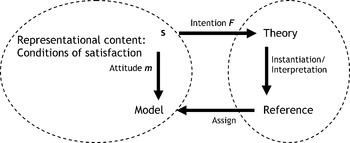
First, there is an intentional state expressed in an intentional mind B. This intentional state is explicated by the model m:s → Ud and has certain conditions of satisfaction s. This state essentially corresponds to the first layer of Searle's intentionality (Searle, Reference Searle1983, pp. 160–179). Second, there is an intentional state (in particular, an intention) that is realized by the functor F:B → W between two categories B and W. Here, B corresponds to a subjective reality and W to a language that expresses an objective (possible or observed) reality. The functor F explicates the intention to express something in a language W given certain conditions of satisfaction expressed by the sketch s in B. This essentially corresponds to the second layer of Searle's intentionality (Searle, Reference Searle1983). A representation of the semantic properties of intentional states is given in Figure 4.
A schematic representation of the semantic properties of intentional states. The category theoretic notion of sketch s is the representational content (or conditions of satisfaction) of an intentional state. The category generated by a sketch is the inner or outer language (a theory) used in order to express a specific intentional state m.

3.3. Realizations of intentionality
This last subsection on intentionality is concerned with the way intentional states as mental entities are related to a physical reality (e.g., the brain). Up to this point, the term intentionality has been discussed as a special mental capacity: a capacity that is inextricably related with the formation of semantic relations. However, what is the locus, body, or universe of intentionality? In other words, how is intentionality realized? Is the brain the only physical realization of an intentional mind? Do social entities have intentionality? In order to respond to such questions, the “problem” of intentionality must be placed in relation to the “mind–body problem.”
The mind–body problem concerns the relationship between mental states or processes and physical events. In contemporary philosophy and science, it is commonly held that mental phenomena are somehow linked to physical phenomena, although the exact nature of this relation is not clear. There are four main approaches regarding this relation (e.g., Harman, Reference Harman and Posner1989; Chalmers, Reference Chalmers and Chalmers2002).
One approach, behaviorism, associates mental states and processes with the behavioral dispositions or behavioral tendencies generated by the underlying physical processes of an organism. According to this view, the mind is a special aspect of the behavior of a physical system (e.g., Ryle, Reference Ryle1949; Dennett, Reference Dennett1987).
The second approach, identity theory, associates mental states and processes with physical states and processes. More specifically, identity theory claims that mental states are essentially physical states of the brain of an organism (e.g., Place, Reference Place1956; Smart, Reference Smart1959).
The third approach, functionalist theory, attributes mental states or processes to physical states or processes whose behavioral dispositions are distinguished for their functional role. A predominant interpretation of this approach postulates that mental states are functions of a computational machine (e.g., Putnam, Reference Putnam, Capitan and Merrill1973). The view of mental states as functional entities of a computational machine helped explain how the same mental states might take multiple physical realizations. Thus, for instance, animals and humans may both have a similar intentional state, but different neurological structures.
Fourth, and finally, a number of alternative studies on the relation between mind and body have brought to the fore the emergentist hypothesis that mental states are higher order/emergent properties of lower level (typically physical) states and process (e.g., McLaughlin, Reference McLaughlin, Beckermann, Flohr and Kim1992, Reference McLaughlin1997; Horgan, Reference Horgan1993). According to this approach, intentional states are emergent qualities that cannot be deduced from the principles of the components found at a lower level of abstraction. This relation (between higher order emergent properties and lower level states and processes) is specified in different ways: as ontological, logical, or epistemological relation (see Zamenopoulos, Reference Zamenopoulos2008). The emergentist view of the mind has been closely linked to the concept of “supervenience,” first introduced in the context of philosophy of mind by Davidson (Reference Davidson, Foster and Swanson1970). According to this view, the mind supervenes the physical states or processes of a brain: that is, although, the same mental states may have a different physical realization, identical physical states or processes specify identical mental phenomena.
The functionalist and the emergentist approaches in theory of mind both brought to the fore the hypothesis that intentional states can have many different realizations (e.g., Kim, Reference Kim1992). According to this hypothesis, intentionality can be said to be embodied in certain organizational structures and processes that are not necessarily realized in the physical structure of a brain. The hypothesis suggests the possibility to understand and study the notion of intentionality as a phenomenon that may arise across different levels: biological, cognitive, or social (Atlan, Reference Atlan1974, Reference Atlan1998). For the purpose of this study, the term intentionality or intentional state will be used for any organism or system that has the capacity to hold representations of an objective (existing or nonexisting/possible) reality. In this sense, this distinction between representation and the representing object marks the distinction between a subjective and an objective reality. The ontoloical status of these realities is not specified, but the logical properties of this coupling will be the main focus of the next sections.
4. THE ORGANIZATIONAL COMPLEXITY OF INTENTIONALITY
In Section 2, the phenomenon of design was approached as a mental capacity that arises in relation to a particular intentional state: when there are inconsistencies between beliefs held about the past, current, and future states of the world, and desires regarding the state of the world. Following this idea, Section 3 introduced some well-known category theoretic tools in order to capture the meaning and structure of intentionality. In particular, the notion of adjunction was introduced in order to explicate the semantic content and evaluation of intentional states. However, the introduced treatment precludes the expression of incomplete representations or the expression of conflicting intentional states. For this reason in this section the paper introduces some new mathematical entities in order to capture qualitative variations in the representational properties of intentional states, allowing the formal expression of inconsistencies.
These variations are essentially expressions of the organizational complexity of intentional states. As mentioned in the introduction, complexity science aims to understand the organizational processes and structures that underlie the creation of higher level functions or structures. In the context of this paper, the focus is placed on the organizational processes and structures that underlie the formation of intentional states. More specifically, the objective is to distinguish different qualities of mental representations independently from the actual content and attitude of intentional states. For that purpose, it is necessary to introduce a semantic/intentional theory of organizational complexity: a mathematical framework for expressing semantic aspects of complexity. A more detailed account of the proposed mathematical framework can be found in Zamenopoulos (Reference Zamenopoulos2008) and Zamenopoulos and Alexiou (Reference Zamenopoulos and Alexiou2007a).
We first briefly review some existing approaches to the development of mathematical descriptions of organizational complexity. One approach is to focus on ontological properties of organization, such as, for instance, the degrees of freedom and mutual information in the description of a system (e.g., Nicolis & Prigogine, Reference Nicolis and Prigogine1967; Atlan, Reference Atlan1974; Von Foerster, Reference Von Foerster1984). A second approach is to focus on the logical or computational properties of organization, such as the computational resources (the time or logical effort) needed in order to describe/compute a system (e.g., Kolmogorov, Reference Kolmogorov1965; Chaitin, Reference Chaitin1966, Reference Chaitin1997; Bennett, Reference Bennett and Pines1985), or the computability of a system (e.g., Langton, Reference Langton1990; Wolfram, Reference Wolfram1994). A third approach is to focus on the epistemological aspects of organization, such as, for instance, the characterization of the number of independent descriptions or models of a system (e.g., Rosen, Reference Rosen1991; Cariani, Reference Cariani, Langton, Taylor, Farmer and Rasmussen1991; Casti, Reference Casti1992).
For the purpose of this study, the focus is placed on the semantic aspects of organization. The proposition put forward is that variations in the notion of sketch can be used in order to describe the organizational complexity of a system. More precisely, the universal property of semantic relations (that is the adjunction that arises in the semantic content of intentional states) is employed as a tool for the characterization of organizational complexity. According to this perspective, an ordered organization is an organization that is described by a well-formed theory; a random organization is an organization that is characterized by the absence of a theory; and complex organization is an organization that is described by a notion of a weak theory. A weak theory can then be thought as the most general class of theories, which allows us to consider well-formed and random theories as special cases. On that basis, the organizational complexity of an intentional state can be thought to vary according to the type of sketches, theories, and models involved: from well-ordered intentional states that generate strong (or well-formed) theories, to complex intentional states that generate weak theories.
For the purpose of defining the notion of weak theory it is important to specify the notion of weak adjunction. More formally, the concept of weak adjunction between two categories B and W requires the existence of two functors F and U with the following properties.
Definition (weak adjunction)
A weak adjunction between two categories B and W is defined by a tuple <F, U, φ, θ, τB, τW>, where F:B → W and U:W → B are functors; the arrow τB is a (natural) transformation between any two arrows (functors) m:s → Ud and m′:s → Ud of the set B(s, Ud); the arrow τW is a (natural) transformation between any two arrows (functors) i:Fs → d and i′:Fs → d of the set W(Fs, d); and the arrows φ and θ make the following diagram commute naturally in s and d (i.e., φ · θ = τB and θ · φ = τW):

The two diagrams can be equally depicted as follows:

As usual, the condition of naturality for arrow φ (and similarly for θ) means that the arrow φ preserves the categorical structure as s and d vary. More formally, naturality suggests that the following diagrams commute for every arrow h:s′ → s in B and k:d → d′ in W:
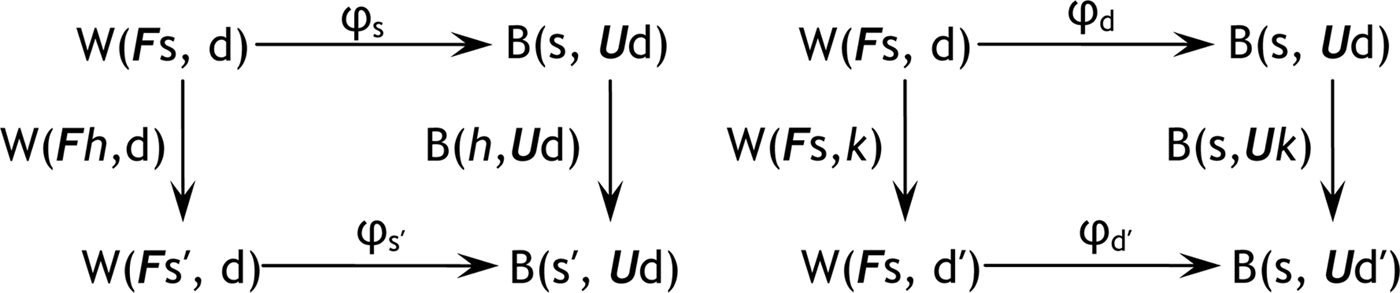
■
Based on this definition the following special cases can be defined:
• If there is an object s in B or d in W with τB = 1B(s,Ud) or τW = 1W(Fs,d), where 1B(s,Ud) and 1W(Fs,d) are identity arrows over B(s, Ud) and W(Fs, d), respectively, then for the objects s in B and d in W there is a universal arrow ηs:s → UFs and ɛd:FUd → d, respectively.
• If for every object s in B or d in W the arrows τB = 1B(s, Ud) or τW = 1W(Fs, d), that is, when the arrows τB and τW are identity arrows for every object in B or W, then θ and φ form a bijection that is natural in s and d (hence, the tuple <F, U, φ, θ> is an adjunction).
The above definition of weak adjunction is related with two important ideas in category theoretic algebra. First, the concept of weak adjunction implies that universal properties are applicable for some objects s in B or d in W, whereas the concept of strong adjunction implies that universal properties are applicable for every object s in B and d in W. Second, the concept of weak adjunction implies that the very meaning of universal construction is also weakened, in the sense that the arrows i and m are not required to be unique. The second aspect of weak adjunction has appeared in the literature in different forms (e.g., Maranda, Reference Maranda1964; Kainen, Reference Kainen1971; Mac Lane, Reference Mac Lane1998) but also in relation to higher dimensional or 2-categories (e.g., Seely, Reference Seely1979). In this paper, the proposed definition of weak adjunction covers both dimensions of “weakness,” but more importantly, it is formulated in a way that will naturally lead to the subsequent formal notions of weak theory and the complexity theoretic notion of phase transition in the intentional state of a system.
More specifically, based on this construction, a weak theory is defined as follows.
Definition (weak theory)
A weak theory is a category Ths that is constructed by a sketch s in B, and a functor Th such that a weak adjunction <Th, U, φ, θ, τB, τW> is defined; that is, the relation φ and θ between interpretations i of theories Ths in W and models m of a sketch s in B are determined by the following diagram:

Well-formed and random theories can be thought as special cases of weak theories in the following sense:
• A well-formed theory is constructed when for every object s in B or d in W the arrows τB = 1B(s, Ud) and τW = 1W(Ths,d), that is, when the arrows τB and τW are identity arrows for every object in B or W. In this case, the arrows θ and φ form a bijection that is natural in s and d, and the tuple <Th, U, φ, θ> is an adjunction.
• A random theory is constructed when there is no object s in B or d in W such that τB = 1B(s, Ud) or τW = 1W(Ths,d). In this case. the adjunction <Th, U, φ, θ> is broken.■
The notion of weak theory can now be used to build a mathematical construction that describes a qualitative change (a phase transition) in the organizational complexity of the mathematical structures that characterize an intentional state. A phase transition is perceived as a transformation of the properties and degree of complementarity between descriptions (theories) and their interpretations (models).
Definition (phase transition)
Given the arrows T s:s → s′ and T d:d → d′ shown below,

a phase transition is defined by the transformations T B = B(T s, UT d):B(s, Ud) → B(s′, Ud′) and T W = W(ThT s, T d):W(Ths, d) → W(Ths′, d′) that make the following diagram commute:

When the arrows τB′ and τW′ in the above diagram are identity arrows then the transition is a phase transition to universality. Let us now bring together all the introduced mathematical constructions in order to formalize an organizational level description of design intentionality.
5. ORGANIZATIONAL LEVEL DESCRIPTION OF DESIGN INTENTIONALITY
As discussed in Section 2, the core hypothesis of this study is that design activity arises in response to a situation where there are conflicting, inconsistent, or unsatisfied intentional states expressed in the brain, a social group or any other intentional system. This situation is now more precisely approached as an intentional state where desires about the world generate expressions of theories and/or models that do not follow the correspondence between theories and models as this is established by one's belief system. A design task requires forming an interpretation of this situation (and therefore constructing a vision about the world) together with an instantiation able to fulfill this vision. This section aims to mathematically characterize the organizational structures and processes of an intentional system that is capable to address such design tasks.
5.1. Core elements of design intentionality: An example
Let us first explicate the core elements of design intentionality using an example. The objective of this example is to provide one plausible interpretation of the mathematical structures and processes that characterize the formation of intentional states during design tasks. Note that the example is used in order to instantiate and clarify the main mathematical ideas rather than to demonstrate the scope of their applicability. As explained in Section 3.2.2, there are other possible ways to apply the notion of sketch that may focus on the underlying dynamical processes or topological structures. In any case the core elements and descriptions of the properties that underlie design intentionality would remain the same.
In this example the object of design activity and content of design intentionality is restricted to building layouts. It will be assumed that there is a need or desire for a building layout in which different activities are organized into separate wings. The task may also specify constraints reflected in the form and function of the building, for instance, that certain activities should not be adjacent, whereas certain others should be placed in closed proximity. The task may also express requirements about the style and overall form of the building layout, for example, the requirement that the overall configuration of the building forms an interesting jagged outline.
All these properties, requirements, or constraints are essential components of an intentional state (i.e., a desire) that may take different and possibly conflicting or incompatible interpretations. In other words, the organization of activities into wings, the requirement for an “interesting” or “jagged” morphology, but also the constraints regarding the proximity between activities, may all take a number of different interpretations and as a result represent conflicting intentional states. Responding to a design task requires the ability to generate a consistent interpretation of this situation and construct a vision about the meaning of all these terms. It is also requires the ability to instantiate this vision in a specific building configuration that satisfies the formulated interpretations. Building on this example, let us now revisit the main mathematical structures introduced in this paper and see how these mathematical entities realize the core elements of design intentionality.
5.1.1. The notion of a sketch
A sketch s is a mathematical expression of the organizational structure of an intentional system (e.g., brain or social group). This structure captures the content and conditions of satisfaction of intentionality. In the specific example, a sketch s may be thought to capture the desired properties of a family of built configurations: that is, the desired type of activities, the wing forms that compose the built configuration, as well as their spatial relations. In more formal terms, the notion of sketch in this example can be thought to capture a category of shape configurations in the same way that a shape grammar captures a language of desired designs. A sketch is specified by graphs, diagrams. and cones in the same way that a shape grammar is specified by shapes and shape rules, labels that constrain the application of rules, and an initial shape. The notion of a sketch here will be therefore explained as a mathematical formalism equivalent to grammars. However, sketches can also operate at a higher level of abstraction as a mathematical machinery for defining (shape) grammars and their operation. Let us explore this relation as a basis for exemplifying the notion of sketch.
A shape grammar is defined by a finite set V of shapes (i.e., a vocabulary of shapes), an initial shape I, and a finite set R of rules r1, r2, … , rn from V+, to V*, where V+ is the set of all possible shapes made up of the shapes in V and V* is the set V+ plus the empty shape. Shapes may also have labels L that guide or constrain the application of rules.
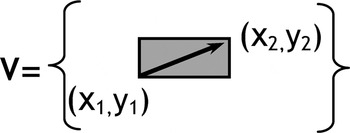
As discussed before, shapes and spatial relations in the sets V, V+, and V* can be specified by graphs. For instance, for the purpose of this example let us consider a vocabulary consisting of one rectangular shape. In Figure 5, the graph specifies the two diagonal corners of the rectangle.
A vocabulary of shapes V. It consists of a rectangle defined by a graph (x1, y1) → (x2, y2) that specifies its two diagonal corners.

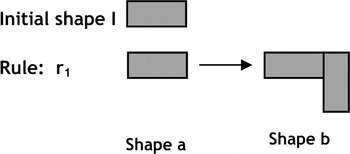
From a category theoretic perspective, the graph structure Gs of a sketch s is a mathematical structure that is used in order to represent not only shapes and spatial relations but also the set of shape rules R = {r1, r2, … , rn} of a grammar. This graph structure has n-arrows of the form r1, r2, … , rn:V+ → V*. For the purpose of this example we will assume a shape grammar that has only one rule of the form r1:a → b as Figure 6 suggests. In relation to this grammar, the graph Gs of the sketch s is simply a graph with two nodes (shapes a and b) and one arrow that constitutes the rule r1.
A simple shape grammar with one rule.

More generally regarding any grammar, the graph Gs of a sketch s captures the idea that a shape rule is constructed by two functions h:R → V+ and t:R → V* such that for each arrow (i.e.. rule) in R the function h assigns a shape at the head of the arrow, and the function t assigns a shape at the tail of the arrow. In this more abstract sense, the graph specifies the main types of entities R, V+, and V* involved in the definition of a shape rule and the basic form of the shape rule (how the rule is constructed) as follows:

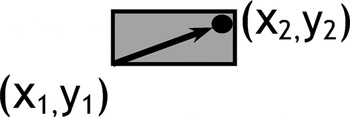
A shape grammar may also include a set of labeled points L. For instance, the end point (x2, y2) of the graph (x1, y1) → (x2, y2) may be labeled with a symbol • as Figure 7 suggests.
A labeled shape and the corresponding labeled graph (x1, y1) → (x2, y2).

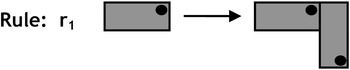
Shape rules are then of the form r1, r2, … , rn:(V, L)+ → (V, L)* where (V, L)+ denotes the set of labeled shapes made up of shapes in V and symbols in L, whereas (V, L)* also includes the empty labeled shape. The labeled points L that are assigned over shapes in V+, and V* (as shown in Fig. 8) break the shape symmetries and as a result constrain the application of shape rules.
A labeled shape rule.

The use of labeled points in a shape grammar corresponds to the use of diagrams in a sketch. More generally, diagrams for a labeled shape grammar are formed by functions f:V+ → L and g:V* → L such that f assigns labeled points on the left hand shape of a rule in R and g assigns labeled points on the right-hand shape of the rule in R as shown below:

Similarly, there is a correspondence between the use of an initial shape in a shape grammar and the use of cones in a sketch. The initial shape is an element of the set of possible shapes V+ with the unique property that all other shapes in the constructed language (or category) of shapes are derived from this shape. An initial shape can be perceived as the minimum shape of the language. Generally a cone determines operations such as products or sums that create new structures out of more primitive ones. In the specific example, a cone may specify an algebra of shapes (e.g., an object a ° b that is the product of two shapes a and b). A cone may also determine other universal constructions such as characteristic functions that determine a mechanism of choosing possible or desirable subshapes within observed spatial relations. In the specific example we will use only the initial shape as a cone of the sketch s.
5.1.2. The notion of a theory
In the same way that a shape grammar generates a language of shapes, a sketch generates a theory or category Ths of shapes that satisfy the conditions expressed in s. The core idea is that the functor Th takes a sketch s and generates a category of shapes (language) Ths where each arrow in the category Ths is a possible path of arrows (i.e., composition of rules) defined in GS under the constraints imposed by the diagrams (i.e., labeled points) of the sketch s. Hence, the category Ths has as arrows all possible applications of the rules in R and as objects all the labeled shapes from the sets (V, L)+ and (V, L)* generated by rules in R. In the specific example, the language or theory Ths is essentially a category of shapes such as in Figure 9. The picture presents a particular derivation of shape configurations within a category of shapes generated by s.
An example of a language or theory Ths of shapes. Ths is a category of shapes generated by the sketch s described in Figure 8. Note that the arrows in this picture are not shape rules but applications of shape rule r1.

5.1.3. Interpretations and models
A language of shapes Ths may take different interpretations. Interpretations are expressed in a certain language that describes these configurations in terms of purpose, function, form, or organizational characteristics (for a similar treatment in the context of shape grammars, see Stiny, Reference Stiny1981). In shape grammars such descriptions are specified by a function i:ThG → D that maps configurations expressed in the language/theory of shapes ThG generated by grammar G to descriptions in another set D. Similarly, in category theoretic terms interpretations are specified by a functor i:Ths → d that maps shape configurations in the category of shapes Ths into descriptions of another language d, preserving the structure of the shape language. For instance, we could envisage descriptions of shape configurations in terms of form types {I-shape; L-shape, U-shape, O-Shape, …}, type or number of wings {a, b, c, d, …}, number of courts, and a matrix that specifies spatial relations between wings. Hence, a sequence of descriptions of shape configurations (interpretations) can be formed that preserve the properties of the shape language Ths as Figure 10 suggests.
A language of shapes and their interpretations. Note how the sequence of descriptions of shape configurations corresponds to the sequence of shape configurations.

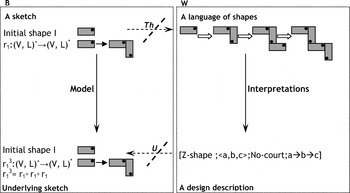
Any description d of a particular building configuration has an underlying sketch representation, denoted by Ud, which specifies the shape rules that generate the described configuration (i.e., underlying graph structure), but also the relations and constraints imposed in the application of spatial rules (i.e., diagrams). For instance the O-shape configuration in Figure 10 has an underlying sketch with one rule (the rule r1 as expressed in Fig. 8) and one diagram, which specifies that the building cofiguration is generated from rule r1 applied three times. Thus, the underlying sketch of an O-shape configuration has an arrow r13:(V, L)+ → (V, L)* and a diagram that equates the arrow r13 with the application of the rule r1 three times (i.e., r13 = r1 °r1 °r1).
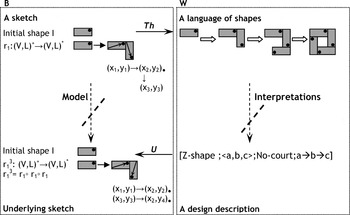
A model of a sketch or model of an intentional state s is a desired and/or possible specification of the properties of building configurations. This is mathematically expressed by a functor m:s → Ud, which maps the desired properties (expressed in s) into a design description Ud. A complementary relation between models and interpretations implies that a model m:s → Ud preserves the desired properties of the sketch s into the underlying sketch of the proposed design description Ud. For instance, in Figure 11, the sketch s generates a language of building configurations by applying the shape rule r1 for any number of times. A model of a building layout may express the desire for a configuration that forms courtyards. Building configurations with courtyards (i.e., O-shape configurations) are generated by applying rule r1 thrice (as discussed above). The underlying sketch of this configuration satisfies the model of an intentional state s because there is a functor m:s → Ud that can preserve the structure of s in the underlying sketch Ud of the proposed O-shape configuration. A building configuration with a courtyard is then created by the sketch s because there is a building configuration in the language Ths and an interpretation i:Ths → d that satisfy this model and make the diagram in Figure 11 commute.
An example of the adjunction between models of desired shape configurations and their interpretations.

5.1.4. The nature of models and their interpretations
Figure 11 is an illustration of the relation between sketches, theories, models, and interpretations. It is worth noting that in this study there is no commitment on the nature of semantic relations. As explained, a sketch s and its models (i.e., m:s → Ud) are mathematical expressions of the conditions of satisfaction of an intentional state that are realized in an intentional system. However, the category of shapes Ths and their interpretations i:Ths → d are mathematical expressions of an existing or possible world W that may be realized either as a cognitive structure (conceptualist view) or as an external representation (realist view). Because this paper does not make an explicit commitment to any one of these two views, it will be more abstractly said that the category B is a mathematical expression of the subjective reality realized in the “brain” of an intentional organism, and category W is a mathematical expression of an objective reality (observed or possible) realized in the brain or alternatively in the task environment of an intentional organism. A similar discussion on the distinction between subjective and objective reality can be found in Lawrere and Schanuel (Reference Lawrere and Schanuel1997).
5.2. The design task
Looking back at Figure 11, it is possible to envisage a number of possible conflicts or inconsistencies that may arise in the intentional states of an organism. First, a sketch may contain conflicting or incomplete information regarding an intentional object. For instance, it is possible to envisage the existence of diagrams that represent conflicting spatial relations regarding the room adjacency. Another possible situation is to envisage the existence of an inconsistent language. An inconsistent language of shapes Ths will generate shape configurations that have properties that conflict with the properties of shape configurations Ud described by the desired models. For instance, let us assume a language of shapes that generates Z-shape configurations while the sketch or intentional state s remains the same (Fig. 12). In this case, the sketch or intentional state s clearly has models that cannot specify the properties of this type of configurations.
The language of Z-shape configurations in W has properties that cannot be described by the models of the sketch.

It is equally possible to envisage an incomplete language of shapes or incomplete descriptions of building configurations. An incomplete language of shapes Ths will be a category of shapes that cannot generate certain desired configurations. For instance, let us assume a situation where there is a desire for Z-shape configurations expressed by the underlying sketch shown in Figure 13. In this case, any interpretation of shape configurations generated in Ths will not satisfy the description of the desired building configurations.
The language of shapes in W does not have the expressive power to generate configurations that would satisfy the underlying sketch of Z-shape configurations.

In all of these scenarios it is assumed that the elements of Figure 12 and Figure 13 are mathematical structures that are constructed or realized within an intentional system (e.g., a brain) somewhat independently from one another.
These examples illustrate the characteristic features of the situation that motivates design, as discussed in Section 2. More generally, in category theoretic terms, design intentionality appears when the developed theory Ths of desired objects/processes yields interpretations in W (i.e., i:Ths → d) whose underlying properties Ud cannot be (uniquely) derived by the sketch s (i.e., m:s → Ud). The need to design therefore arises when the theory and model functors contain, so to speak, ambiguity, noise, or errors; hence, there is no natural bijection between B(s, Ud) and W(Ths, d).
In this situation, there is conflicting intentionality (e.g., conflicting beliefs and desires) that generates a two directional freedom of fit: from world-to-mind and from mind-to-world (recall after Section 3.2.2). Namely, there is a mismatch between subjective B(s, Ud) and objective reality W(Ths, d) and both the subjective and the objective reality need to be adapted to each other. In this sense, a sketch s expresses the conditions of satisfaction of a desire that is fulfilled only when there is theory of a possible reality that satisfies its models. In contrast, a sketch s also expresses the conditions of satisfaction of a belief that becomes true (or false) only when there is a model of a possible world that validates the theory. To put it differently, design arises when the diagram in Figure 14 does not commute.
A design situation arises when there is no natural bijection between subjective B(s, Ud) and objective W(Ths, d) reality.

The following definition specifies the core hypothesis regarding the mathematical structures that characterize a design capable intentional system when faced with a design problem or design task.
Thesis 1 (design intentionality and the design task)
Design intentionality arises in relation to an intentional state s with a “two-directional freedom of fit” between a subjective B(_, U_) and an objective reality W(Th_, _), whose models (i.e., m:s → Ud) in B(s, U_) and interpretations (i.e., i:Ths → d) in W(Th_, d) are not complementary. Namely, design intentionality arises when there is a weak adjunction <Th, U, φ, θ, τB, τW> natural in s and d that makes the following diagram commute:

Given this intentional state, the problem of design or design task is to establish an adjunction B(s, Ud) ≅ W(Ths, d) by transforming both the subjective and the objective reality.■
5.3. The capacity to design
In response to this intentional state, the design task requires the mental capacity to make the diagrams in Figures 12, 13, and 14 commute. Namely, it requires the capacity to bring the conditions of satisfaction s and the generated model m:s → Ud of a desired reality into a complementary relation (i.e., adjunction) with the generated language Ths of design objects and their interpretations i:Ths → d. The main consequence of the above hypothesis is that the mental capacity to carry out design tasks (i.e., the capacity to make the diagrams in Figures 12, 13, and 14 commute) requires a type of phase transition in the organizational complexity of intentional states as described in Section 4. Let us explain further this result first in an informal and then a formal way.
Going back to the building configuration task example, the ability to design alludes to the capacity to generate an interpretation or vision of a desired building layout together with the capacity to generate a language of shape configurations that will instantiate this interpretation or vision. Let us for instance focus on the desired model and description for a “jagged layout.” In this context, the ability to design requires the capacity to transform the description of a “jagged layout” into a description for a Z-shape configuration, but also the capacity to identify certain spatial relations between the wings of the building that generate a language of Z-shape configurations. These transformations create a new interpretation of what is a jagged layout configuration, but also a new language of how this vision can be instantiated. More specifically, in Figure 15 we see that the desire for a jagged-shape configuration expressed by the description dD (bottom right of the figure) is part of an intentional state that expresses inconsistencies. The dashed lines denote that an adjunction between B(s, Ud) and W(Ths, d) cannot be formed given this description. A new interpretation of what is a jagged layout configuration dU, but also a new sketch (rule) rU and language of how this vision can be instantiated (see thick arrows) are needed in order to realize a transition to a universal state (an adjunction represented by solid lines).
An example of a phase transition. In the absence of an adjunction, a new interpretation of what is a jagged layout configuration dU, but also a new sketch (rule) rU and language of how this vision can be instantiated (see thick arrows) are needed in order to realize a transition to a universal state (solid arrows).

However, what are the organizational structures and processes that drive these mental transformations during a design task? The transformation of a sketch T s:s → sU (or more narrowly in this example the transformation of shape rules T R: r1 → rU), as well as the transformation of design descriptions T d:d → dU, are components of a transition that leads into a new relation between desired models, language of shapes, and interpretations. The core idea is that the adjunction corresponds to an organizational state that works as an attractor for these transformations. Thus, these transformations are defined in relation to a universal state (the codomains of the arrows are part of an adjunction) although the transformations are not universal arrows. In effect, these transformations can be understood as anticipatory representations of a transition to complementary relations between desired models and interpretations. The notion of anticipatory representation simply refers to the fact that both transformations express mental actions in preparation of a new language of shapes and a new model of the desired building that would make the diagram commute. Moreover, both transformations express mental actions that lead to significant changes in the organizational complexity of the intentional state (from a weakly universal to a universal state).
Let us explain the meaning and peculiarity of this phase transition, but also why this is a consequence of the very nature of design task. According to the proposed thesis on the nature of design tasks, design requires a transition from a situation that is characterized by a weak theory to a situation that is characterized by a universal construction. One important peculiarity of this transition is that it leads to universality. However, although this transition leads to a universal construction, there is no universal transition to universality. This is the very significance of the concept of phase transition. If the transformation Ts:s → sU (from a sketch s participating in a weak adjunction to a sketch sU participating in an well-defined adjunction) could be constructed through a universal arrow, then the theory Ths would be a universal theory. However, this would contradict the main premise behind the definition of the design task that demands the existence of a weak theory. In this sense, design necessitates the capacity of generating theories and models of a sketch in preparation of their adjunction, that is, before such correspondence is constructed. It is in this sense that the mental process of design is characterized as a phase transition to universality, a phase transition that requires the capacity to hold anticipatory representations of universal constructions (for more details on the mathematical conditions that explain the construction of anticipatory representations during design tasks, see Zamenopoulos & Alexiou, Reference Zamenopoulos and Alexiou2007b).
We now provide a more formal presentation of these ideas. The mental activity of design is a phase transition to universality and as a result requires the existence of transformations:

such that the following diagrams commute:

Given an intentional state s, the capacity to carry out design tasks alludes to the existence of transformations T S:s → sU in a subjective reality B(_, U_) and transformations T d:d → dU in an objective reality W(Th_, _) that are components of a phase transition to universality T = <T B, T W>. The transformation T s:s → su is a component of the transformation B(T s, UT d) = T B:B(s, Ud) → B(sU, UdU), and similarly the transformation T d:d → dU is a component of the transformation W(ThT s, T d) = T D:W(Ths, d) → W(ThsU, dU). It is informative to think that the transformation T s:s → su has a mind to world direction of fit, in the sense that any mismatch between a subjective B(_, U_) and objective reality W(Th_, _) is addressed by changing the properties of the sketch. Similarly, the transformation T d:d → dU has a world to mind direction of fit because any mismatch between the subjective and objective reality is addressed by changing the properties of the object.
In category theoretic literature, the notion of adjunction B(s, Ud) ≅ W(Ths, d) can be alternatively presented as a relation between two functors W(Ths, d):BopxW → Set and B(s, Ud):BopxW → Set that are naturally isomorphic. In this context, the theory Ths is said to be a representing object for the functor B(s, Ud). Similarly, the underlying sketch Ud of an entity d is said to be a representing object for the functor W(Ths, d). However, what can be said for the functors W(Ths, d) and B(s, Ud) that are not naturally isomorphic, that is when B(s, Ud) ≅ W(Ths, d)? In this case, the notion of an anticipatory representation is defined. The theory Ths generated by a sketch s is called an anticipatory representation of models in B(sU, UdU) if and only if the sketch s has models m and interpretations i that are components of a phase transition to universality T = <T B, T W>. The underlying sketch Ud is then called an anticipatory representation of interpretations in W(ThsU, dU). Based on this definition, the capacity to carry out design tasks is now identified as the capacity to hold anticipatory representations/interpretations of universality.
Thesis 2 (the capacity to design)
The capacity to design is the capacity of an intentional state s to hold models T s:s → sU and generate interpretations ThT s:Ths → ThsU that are components of a phase transition to universality. The capacity to design is therefore the capacity of a sketch s to generate theories Ths and sketches Ud of an object d that are anticipatory representations of a universal construction B(sU, UdU) ≅ W(ThsU, dU).■
Note that the models m and theories Ths that are derived from an intentional state s are specified in relation to a phase transition to universality. Such anticipatory representations are clearly distinct from representations where models and theories are specified in relation to a universal construction. The adjunction B(sU, UdU) ≅ W(ThsU, dU) characterizes an intentional state s in the sense that every model of s and interpretation of theories Ths are constrained by the specified phase transition to universality. However, the reverse is not true. The models of the sketch s are not universal representations of W(ThsU, dU). In this sense the adjunction B(sU, UdU) ≅ W(ThsU, dU) can be perceived as an “emergent” state of s.

6. SUMMARY AND CONCLUSIONS
This paper presented a mathematical theory that aimed to associate our understanding of design activity to a theory of mind and intentionality. The paper focused on the property of the mind to hold intentional states (that is, the capacity to represent or reflect existing and nonexisting realities) and on the way that these mental states are constructed during design tasks. The core objective was the development of a mathematical framework that would explicate a complexity theoretic hypothesis about the organizational structures and processes that govern the formation of intentional states during design tasks. The paper elaborated a mathematical framework regarding the organizational complexity of intentionality, which was then used in order to propose an organizational level description of design intentionality. This framework was based on the introduction and development of the category theoretic notion of weak theory.
There are two potential contributions of the proposed treatment. The first is related with the need (or ambition) of developing explanatory theories about the capacity to carry out design tasks. Such theories should be able to uniquely distinguish design (from nondesign phenomena) on the basis of certain underlying principles. Such principles may be identified at different levels of abstraction (e.g., at the level of neurological activity, information processing, knowledge level or social level). Although the present paper does not propose a “mechanism” to explain the capacity to carry out design tasks, it does propose a framework within which certain conditions (or mechanisms) may be identified. Overall, the main value of this study alludes to the rigorous formulation of the type or category of mathematical structures that underlie a design-capable intentional system (e.g., a brain). For example, the proposed mathematical framework can be used in the analysis of brain imaging data derived from functional magnetic resonance imaging methods for the purpose of identifying characteristic patterns in the structure as well as the effective and functional connectivity between brain areas during design tasks. As discussed in the introduction, although we can empirically collect data about the neurological structures and processes that partake in the completion of design tasks, we have no formal way of linking these structures and processes to the formation of mental intentional states. The potential of using the mathematical framework for exactly this purpose is explained in more detail in Zamenopoulos and Alexiou (Reference Zamenopoulos, Alexiou, Portugali and Meyer2011).
The second contribution is related to the need of developing theories in design that are informed by and are transferable to other domains. Although this is not an uncommon objective in design research in general, the proposed framework explicitly places the problem of design within the realm of complexity research and vice versa. The constitution of design as a universal capacity of complexity is a double contribution to complexity research as well as to design research, and makes it possible to transfer results between the two fields. In this sense, it is hoped that the proposed mathematical framework offers a plausible interpretation on how characteristic structures and processes of complex (neurological, social, or ecological) systems may be linked to higher level cognitive functions such as designing (Zamenopoulos and Alexiou, Reference Zamenopoulos and Alexiou2005b).
Theodore Zamenopoulos is a Lecturer in design at Open University. He attained a PhD in complexity science and design from University College London. Dr. Zamenopoulos has trained and worked as an architect. His research includes empirical studies of the neurological correlates of design cognition, as well as mathematical and computational models of mental and social processes involved in design tasks.