




No CrossRef data available.
Designing creative artificial systems
Published online by Cambridge University Press: 29 April 2005
Abstract
Can artificial systems be creative? Can they be designed to be creative on their own? What are the requirements of such creative artificial systems? To be able to support humans who are expected to deliver creative solutions, or to automate part of their tasks, this paper presents a proposal for creativity requirements that provide a basis for designing creative artificial systems.
Information
- Type
- Research Article
- Information
- Copyright
- © 2004 Cambridge University Press
1. INTRODUCTION
Creativity has been, and still is, a subject of scientific research in disciplines such as philosophy, information systems science, cognitive science, artificial intelligence (AI), and engineering. Boden has inspired many researchers in different disciplines with her work on the nature of creativity and the cognitive mechanisms and structures that play a role in creativity. Boden (1991) addresses the following four issues, called the Lovelace questions:
- (LQ-1) Can computational ideas help us understand how human creativity is possible?
- (LQ-2) Could computers ever do things that at least appear to be creative?
- (LQ-3) Could a computer ever appear to recognize creativity?
- (LQ-4) Could computers ever really be creative (i.e., not due to the human programmer)?
This paper concentrates on the second and the fourth of these questions. Abstracting from computers, the underlying question is whether a system can be designed to be creative on its own. This question is of interest not only for scientific reasons but for practical purposes as well. If a system could be designed to be creative, it would be able to support humans who are expected to deliver creative solutions, or to automate part of their tasks. Applications of creative artificial systems could prove valuable for domains such as industrial design and architecture.
However, in the past, little attention has been paid to the definition of requirements for creativity. This paper presents such creativity requirements. On the basis of related research on creativity, Section 2 postulates what a creative system is, and Section 3 presents our creativity requirements. Section 4 compares a number of creative systems reported in the literature, and Section 5 discusses the feasibility of creative artificial systems given our definitions. Finally, Section 6 discusses the results of this paper.
2. CREATIVE SYSTEMS
This section reviews a number of research papers on creativity, as the basis for our definition of creative system.
2.1. Related research on creativity
In disciplines such as philosophy, information systems science, cognitive science, AI, and engineering, researchers have defined and described creativity. The body of literature on creativity is far too large to discuss at length. This subsection discusses a selection of research papers.
In research literature, many definitions of creativity can be found. Boden (1991) has laid the ground for many of the views on creativity. She claims that creativity is “a matter of using one's computational resources to explore, and sometimes to break out of, familiar conceptual spaces.” She distinguishes psychological creativity (P-creativity), which occurs when a person has an idea that he or she could not have had before, and historical creativity (H-creativity), which occurs when someone has an idea that has not been recorded before. Boden further distinguishes exploratory creativity (E-creativity) and transformational creativity (T-creativity), for which Wiggins (2003) provides a logical formalization. In the context of design, Suwa et al. (2000) have added the notion of situated creativity (S-creativity), which occurs when a designer has an idea for a specific task, which is novel in that particular situation.
Edmonds and Candy (2002) define creativity as a process toward achieving an outcome recognized as innovative, and describe creative work as involving the generation and evaluation of new ideas, solutions, and artifacts. They state that the exceptional outcomes of creative work may be evaluated (and valued) by others, but that they are not necessarily recognized as exceptional outside the knowledgeable group (e.g., peers). Edmonds and Candy characterize outstanding creativity as that which has stood the test of time and has become recognized beyond the community of specialists.
Human creativity is diverse, leading both to differences in the degree of creativity and the style of creativity. Kirton (1976) distinguishes two creativity styles: adapters and innovators. Adapters improve things, are conforming and efficient, and like to deal with only a few ideas at a time. Innovators ignore or challenge systems, contribute radical proposals for change, are nonconforming and inefficient, and like ideas to proliferate. Talbot (1997) provides a definition of creativity, including both these styles of creativity: “making a change that sticks (for a while).” Where adapters generate evolutionary changes (to make things better), innovators are responsible for revolutionary changes (to make things different). This definition encapsulates a cyclic notion: a change is applied in the real world, accepted by interested parties for a certain amount of time because of its value, and later another change is applied, thereby repeating the cycle. Cohen (2002) supports this notion that creativity applies to continuous change.
Liu (2000) describes a framework for understanding creativity, which distinguishes personal creativity and social–cultural creativity, and their interaction. A proposed solution can become creative only when the creative person recognizes it as being a creative result, he or she proves it to the world, and the world accepts it. Dias de Figueiredo and Campos (2001) investigate the relation between serendipity (i.e., finding valuable things not sought for) and creativity. They introduce a logical formalism to describe serendipity, thereby aiming to distinguish serendipity from other manifestations of creativity.
A number of researchers regard motivation of humans and interaction and collaboration between humans as essential conditions for creativity. Fischer and Nakakoji (1997) state that, although creative individuals are often thought of working in isolation, the role of interaction and collaboration with other individuals is also critical. Similarly, cognitive scientists and system scientists observe that for human creativity it is important to create a stress-free, stimulating working environment with ample facilities for collaboration and exchange of ideas, and where making mistakes is allowed or even encouraged (e.g., Weatherall, 1998; Candy & Edmonds, 2000; Greene, 2002). Kletke et al. (2001) state that creativity occurs when the product has novelty and value; the thinking is unconventional, requiring modification, rejection, or synthesis of previous ideas; the thinking requires motivation, persistence, and high intensity over a period of time; or the initial problem is vague, or ill defined.
AI researchers and cognitive scientists add that learning and interaction with the environment are important or necessary aspects of being creative (e.g., Simon, 1969; Boden, 1991; Candy, 1997). According to Sim and Duffy (2000), learning may happen before the start of a design activity (provisional learning), in parallel with a design activity in progress (in situ learning), and after completion of a design activity (retrospective learning). In the field of design, Gero (2002) states that the interaction between the designer and the environment strongly determines the course of designing, which he calls “situatedness”: an interpretation process being governed both by an original experience and by what the current situation makes with it.
Assessing creativity is partly subjective, similar to art appreciation (e.g., Candy et al., 2002), humor (e.g., Gero, 1996), and intelligence (e.g., Stefik, 1995). The assessor's background, social influences, and individual characteristics all play a role (Csikszentmihalyi, 1999). Also, knowing the state of the art is influential: different assessors may disagree in their judgement of the same subject (e.g., Besemer & Treffinger, 1981; Boden, 1991; Finke et al., 1992; Gero, 1996; Pease et al., 2001; Edmonds & Candy, 2002; Macedo & Cardoso, 2002; Tang & Gero, 2002). Colton et al. (2001) state that, when assessing the creativity of computer programs, assessors should only consider those valuable novelties produced by a computer program that have not been included to instigate creative results, either preprogrammed or the result of fine-tuning the program.
Creativity has attracted the attention of many AI in design researchers. Goel (1997) claims that creativity in design can occur in degrees. He states that a design process is routine if the designer knows both the structure of the design space as well as procedures for systematically searching the space, innovative if the designer knows only the structure of the design space, and creative if the designer knows neither. Gero (2000) speaks of routine designing when all necessary design knowledge is available, innovative designing when the context that constrains the available ranges of the values for the variables is jettisoned so that unexpected values become possible, and creative designing when one or more new variables are introduced into the design. Dorst and Cross (2001) state that the creativity of the design is influenced by the design problem, the design situation, and the resources (time) available, as well as the designer's own goals. They claim that defining and framing the design problem is a key aspect of creativity, and that surprise is what keeps a designer from routine behavior.
Many researchers have made an effort to describe creative processes. Perkins (1981) claims that when an individual combines the elements of ideas generation, problem formulation, strategy selection, methods acquisition, and updating of expert knowledge (by using a network of contacts with experts in the field), in a unique way he or she may produce creative results.
Amabile (1983) distinguishes five stages of creative problem solving. In the problem or task presentation stage, a specific problem statement is formulated. In the preparation stage, recall of information and solution approaches that appear to be relevant to the problem at hand occurs. In the response generation stage, candidate solutions are produced, whereas in the response validation stage, candidate solutions are evaluated. In the outcome stage, a favorable solution is chosen, no acceptable solution is determined, or backtracking to a previous stage occurs.
Finke et al. (1992) introduce the Geneplore model, the heart of which is an interaction between generative processes and exploratory processes. In these processes, cognitive structures termed preinventive structures are produced and used, which represent novel visual patterns, object forms, mental models, verbal combinations, etc.
Ram et al. (1995) define five aspects of thought: inference mechanism, knowledge source, tasks, situation, and strategy. They state that creative thought involves processes of problem interpretation and reformulation, case and model retrieval, elaboration and adaptation, and evaluation. To produce ideas, the types of inferential mechanisms are applied in a flexible and highly opportunistic manner throughout the process, with their application heavily influenced by the other four aspects of thought.
Lawson (1997) describes a five-stage model of a creative process. In the first insight stage, the problem is formulated. In the preparation stage, a conscious attempt is made to reach a solution. The same is done in the incubation stage, but with no (apparent) conscious effort. In the illumination stage, suddenly an idea emerges, and in the verification stage, this idea is consciously developed to a solution. Lawson claims that human problem solvers can and do modify their process in response to the variability of the problem structure.
Shneiderman (2002) establishes a framework for creative work, consisting of four activities. The collection activity is to learn from previous works stored in different sources. The relation activity is to consult with peers and mentors. The creation activity is to explore, compose, and evaluate possible solutions. The donation activity is to disseminate the results and contribute to different sources. Shneiderman states that these four activities do not form a linear path: creative work may require a return to earlier phases and much iteration.
Santanen et al. (2002) describe the cognitive network model of creativity, which is based on the assumption that knowledge can be represented as complex bundles of information (frames) that are highly associative. By traversing the links that connect some activated frame to other frames within the network, activation of successive frames spreads through memory causing yet other frames to become primed for subsequent activation. Santanen et al. state that creativity emerges when two or more frames from areas not typically associated with one another are brought together in the context of the problem at hand.
2.2. Our definition of creative system
On the basis of the related research on creativity, this section defines our perspective on creative systems.
Definition 1 (Agent).
An agent is a human or artificial entity, who or which acts autonomously and proactively, and may exhibit social behavior and intelligence. █
Definition 1 is based on a prevailing perspective on agents formulated by, among others, Wooldridge and Jennings (1995). For an overview of agent technologies, application domains, and technological challenges, refer to, for example, Luck et al. (2003).
Definition 2 (Environment).
An agent's environment is everything outside the agent within which the agent is situated and of which the agent is part, which the agent can sense, and upon which the agent can act. █
Definition 2 is based on a common perspective formulated by, among others, Franklin and Graesser (1997).
Definition 3 (System).
A system is a whole of one or more agents. █
A system may consist of human agents (i.e., a human system), artificial agents (i.e., an artificial system), or a mix of human and artificial agents (i.e., a hybrid system). For example, a team of designers qualifies as a system, as does the combination of a human designer and his or her design support system.
Definition 4 (Creative Result).
A system's result is creative in the opinion of an assessor if the assessor recognizes the result as being new, unexpected, and valuable. █
Being creative applies in principle to all tasks and domains of application (e.g., architecture, management, music composition, and software development). Definition 4 is in line with Boden's (1991) definitions of P-creativity and H-creativity and Suwa et al.'s (2000) definition of S-invention. Note that according to this assumption, the system and the assessor may be the same entity, but to avoid confusion, this paper assumes that system and assessor are different.
Definition 4 shows that whether a result is creative or not is “in the eye of the beholder” and a question of scope. One assessor may judge a system's result to be creative, another not. The reasons for this may be a difference in background or expertise or a difference in what they know about the system. For example, two people may well disagree about whether or not the selected design for a new city hall is creative. This may be due, for instance, to the fact that one is a peer and the other is a layman, or one knows the architect's work well and the other does not, or one knows what the old city hall looked like and the other does not. The creativity assessment problem is described by Besemer and Treffinger (1981). They analyze possible creativity criteria by means of a creative product analysis matrix, involving three dimensions: novelty, resolution, and elaboration and synthesis. For each dimension, specific “measurable” criteria are distinguished.
Furthermore, Definition 4 implicitly refers to time. An assessor may now consider a result to be new and unexpected, but not valuable, and therefore, not creative. This may be due to the assessor's lack of understanding of the result: if the novelty is too radical for him or her, s/he cannot recognize the result as valuable. The same assessor may later consider the result to be creative after all, after s/he has acquired an understanding of it. This observation is consistent with the work of other researchers. Creative results are results that are similar to, yet different from, expected results (Gero, 1996; Saunders & Gero, 2002), and ideas that may first be viewed as “ridiculous, idiotic or outrageous” may be valued as “good” years later (Thomas et al., 2002).
Definition 5 (Creative System).
A system is creative in the opinion of an assessor if, according to the assessor, the system sufficiently often produces creative results. █
Definition 5 is again in line with the definitions of P-creativity, H-creativity, and S-creativity. This definition supposes that the creativity of a system is assessed on the basis of a number of (creative) results it produces. Coincidence and luck can never be ruled out as explanations for apparent creativity of a system; any system can, at least in principle, appear to be creative in a single case, but repeated creativity is harder to achieve (Fischer & Nakakoji, 1997).
The distinction between assessor and system raises issues regarding the “informedness” of the assessor with respect to the system and vice versa. An assessor who already knows the system has an expectation of the system's capabilities, which may result in a different assessment than that of an uninformed assessor. By contrast, a system that knows it will be assessed and by whom, may produce different results than when it would not know its assessor in advance. Assessors are not the main topic of this paper, and therefore will not be discussed further; it suffices to remark that automating creativity recognition (i.e., the third Lovelace question) is still an open research field (e.g., Boden, 1998).
3. CREATIVITY REQUIREMENTS
An artificial system that is meant to be creative must be designed in such a way that, when it is operational, it will produce enough creative results that are new, unexpected, and valuable in the eye of its assessors (e.g., customers, users, and other stakeholders). This section focuses on the creativity requirements of such an artificial system.
Definition 6 (Creativity Requirements). A creative system must be able to interact with its environment, learn, and self-organize (i.e., plan, execute, control, and change its process). █
A creative system must be able to interact with its environment, for that is the only way, in the long run, to acquire knowledge about the state of the art and current needs and, thus, about what would be new and valuable. Furthermore, a creative system must be able to learn, for that is the only way, in the long run, to absorb knowledge acquired through its interactions with the environment and through its own experiences. Finally, a creative system must be able to self-organize, for that is the only way, in the long run, to be unpredictable in its operations and, thus, to deliver unexpected results. Figure 1 shows a creative system to be a system that satisfies each of these three requirements.

Three requirements for creativity.
A system's ability to be creative is essential to finding solutions to problems it may encounter when trying to perform a given task. In this context, a problem is defined as a lack of knowledge to transform a system's specific state to some desired state (Thomas et al., 2002). Through communication, observation, and subprocesses such as recall of earlier experiences, analysis, and association (Gabora, 2002; Gero & Kannengiesser, 2002; Santanen et al., 2002), new knowledge can be generated that enables the mismatch to be solved.
To explain why a creative system must satisfy each of these three requirements, consider the following three cases. First, suppose there is a system that interacts with its environment but that does not learn or self-organize. As a consequence, given a similar task, this system will produce a similar result in the same way. Although this system can solve problems in a conventional sense, this is insufficient for creativity. Even if the result is assessed to be creative the first time round, it will not necessarily be assessed to be creative in a similar situation a second time round.
Second, suppose there is a system that interacts and learns but that does not self-organize. As a consequence, given a similar task, this system may produce a different result but always in the same way. Although this system can explore, this is insufficient for creativity. Even if a number of results are assessed to be creative, over time the assessor may gradually acquire an understanding of the way that the system works, hence be able to predict the outcome, and thus no longer be surprised by the results.
Third, suppose there is a system that interacts and self-organizes, but that does not learn. As a consequence, given a similar task, this system may produce a different result but according to a fixed procedure depending on the organization of the system. Although this system can adapt its behavior to a certain extent, this is generally insufficient for creativity. Even if a number of results are assessed to be creative, the system will (tend to) organize itself in a similar way in a similar situation, and thus produce similar results, and hence be predictable.
4. ANALYSIS OF SYSTEMS WITH REGARD TO CREATIVITY
Before discussing the combination of our three creativity requirements introduced in the previous section, it is important to investigate the feasibility of each individual creativity requirement. This section analyses systems reported in literature with regard to our creativity requirements of being able to interact, learn, and self-organize.
4.1. Interactive systems
An interactive system is a system that is able to interact with its environment when performing a task (such as diagnosis, designing, planning, or scheduling). Such a system is able to acquire knowledge through communication, and to act within its environment, for example, by asking questions, looking around, visiting external information sources, making drawings or schemas, and discussing opinions and proposals with stakeholders.
Humans are, of course, good examples of interactive systems, as are combinations of humans and software applications (e.g., a manager using a decision support system). Interactive artificial systems also exist, such as applications composed of many (mobile) software agents or robots. In a multiagent system, interaction with the environment may be delegated within the system to specialized communication agents, which accept information requests of other agents within the system and pass on acquired information from the environment to these agents using languages such as FIPA/ACL (for details, refer to www.fipa.org/repository/aclspecs.html).
4.2. Learning systems
A learning system is a system that is able to acquire new knowledge and to “forget” obsolete knowledge. Such a system is able to use its experiences, so that in similar future situations good practices are repeated and poor practices avoided.
Again, humans are good examples of learning systems, as are combinations of humans and software applications such as a knowledge engineer maintaining an expert system (e.g., Stefik, 1995). Artificial learning systems are available for many tasks and many domains of application. In design, examples of such systems are knowledge-based agents (e.g., Grecu & Brown, 1996), machine learning systems (e.g., Duffy, 1997), clustering mechanisms (e.g., Reffat & Gero, 2000), neural networks (e.g., Saunders & Gero, 2002), and genetic algorithms (e.g., Gero, 1996; Cho, 2002).
4.3. Self-organizing systems
A self-organizing system is a system that is able to organize and reorganize its own process, when needed, to achieve its task and produce good results. Such a system is able to make changes to its internal operations, in response to a changing environment or a problem encountered when trying to achieve its task.
Humans are able to self-organize, although this ability may be difficult to master. Habits, especially old ones, are hard to give up even if one knows better. Moreover, the more people are involved in a system, the more rigidly it operates; a small firm is usually quicker than a large company in adapting its organization to a changing market (Carley et al., 1998), and small projects are usually easier to redirect than large projects. Candy and Edmonds (2000) observe that creative people are notorious for resisting rigid approaches, and are not afraid to choose pathways fraught with risk and potential pitfalls.
In AI, the advent of multiagent systems has offered new perspectives for self-organizing artificial systems. The behavior of multiagent systems is analyzed in terms of the interactions between different agents, so self-organization and self-regulation are considered emergent properties of such interactions (Holland, 1995). Two approaches can be distinguished: the small-agents approach and the big-agents approach. The small-agents approach is inspired by biology (e.g., ants), where many small agents with individually simplistic behavior together yield surprisingly complex behavior (e.g., Bonabeau & Theraulaz, 2000). The big-agents approach is based on heterogeneous agents in a dynamic environment, where the challenge is to describe aggregate behavior of individually complex, rational agents (e.g., Ferber et al., 2004).
5. FEASIBILITY OF CREATIVE ARTIFICIAL SYSTEMS
A creative system, as defined in Section 3, is a system consisting of one or more human agents or artificial agents that is able to interact with its environment, learn, and self-organize. In this paper, artificial systems have our main interest, but this section also pays attention to systems that support humans to be creative.
5.1. Creativity support systems
For design, a number of systems exist that support (groups of) human designers. For example, Chaplin et al. (1994) and Bracewell and Sharpe (1996) describe an integrated design support tool called SchemeBuilder, aimed at supporting a multidisciplinary systems designer in the conceptual and embodiment stages of design. This tool provides guidance and suggestions, and allows the human designer to play a more active role in applying design judgments. Candy (1997) describes creativity support in design as the integration of functions for knowledge evaluation and extension; sketching, annotation, and other ways to present visual data; and collaboration among design team members. Candy describes a prototypical creativity support system (VPKSS), which aids designers at the conceptual stage of the automotive design process.
Fischer and Nakakoji (1997) and Fischer (2001) describe a framework for developing so-called domain-oriented design environments (DODEs), which support designers collaborating asynchronously in being creative. A DODE supports the retrieval of information relevant to the task at hand, and the modification and addition of information and functionality to the design environment, in particular externalizations that capture and articulate the task at hand. Aihara and Hori (1998) describe a system named En Passant 2, which aids the process of creative thinking by a scientist. Based on Finke et al.'s (1992) Geneplore model, the system stores the user's research notes and marks recognized features for the user, so that he or she may recall earlier research in the current context.
Reffat and Gero (2000) describe a system for situated learning in design (SLiDe), which supports designers in conceptual geometric design by providing alternative representations and maintaining the situation of the designer's focus. SLiDe learns the applicability conditions of architectural design knowledge by capturing the regularities of relevant relationships among architectural shapes across different design states, so that it can locate shapes that are relevant to the design situation at hand.
Shneiderman (2002) describes the support of human designers to consist of what-if tools for exploration as well as tools for composing artifacts that provide access to exemplars, templates, and blank artifact descriptions; suggest ways to transform the artifact description; and offer checking services and assessment of design results. Amigoni and Schiaffonati (2003) develop a multiagent system for the design of museum organizations or art exhibitions. Their system supports human creativity by facilitating the categorization of art objects, their allocation and visualization of their exhibit, according to user-specific guidelines. Users are thus alleviated from low-level tasks, and can focus on more abstract concepts, exploring more alternatives.
5.2. Nearly creative artificial systems
By their nature, autonomous interactive design systems have the potential of being creative artificial systems. Although none of the following autonomous interactive design systems meet the requirements of creative artificial systems, they show to have characteristics that go into the direction of being able to interact with the environment, learn, and self-organize.
Grecu and Brown (1996) describe a multiagent learning system for designing springs, which consists of single-function agents (SiFAs). Each SiFA is a small (knowledge-based) expert agent, which operates autonomously, negotiates bilaterally (using preprogrammed strategies) with other SiFAs to reach an agreement about a specific aspect of the spring design, and which learns to reduce the overhead of interagent communication.
Campbell et al. (1998) describe the A-Design framework for adaptive systems of interacting agents for creating and adapting conceptual engineering designs. This framework contains a detailed functional representation of the electromechanical domain, as well as agent strategies. To meet the objectives specified by a user, the agents compete and collaborate to constantly improve upon design alternatives. Throughout the iterative process and interactions between different types of agents, the manager agents make decisions about which designs are better and how the agents should be grouped, penalized, or rewarded for their past performance. Key design alternatives are retained to allow the concerned design system the flexibility to adjust to any changes in the design specifications made by the user throughout the design process.
Brazier and Wijngaards (2001) focus on how to design self-modifying agents, where self-modification applies to an agent's specific tasks as well as all processes within an agent except for the self-modification process itself. A self-modifying agent needs to monitor its own behavior, be able to decide when its behavior is not appropriate, and know what behavior is required and how to effectuate a modification to its own system. Brazier and Wijngaards describe a knowledge-level model of a self-modifying agent and apply it to a mobile information retrieval agent on the World Wide Web. In addition, Brazier and Wijngaards (2002) explain how to redesign software agents by using an agent factory to redesign and reactivate an agent on the basis of its current design, requirements provided by the agent and/or knowledge available within the agent factory. In the current implementations, the design process within the agent factory is relatively well defined. The resulting agents, however, may evolve in ways their designers could never have anticipated: their abilities can change substantially. This agent factory approach is also used in a different domain, namely Web services: needs of Internet end users form Web service requirements that lead to configurations of Web services (Richards et al., 2003).
Saunders and Gero (2001, 2002) study artificial creativity as an emergent property of the interactions between individual agents in an artificial society. In the Digital Clockwork Muse, they explore the role that an individual's search for novelty plays in socially situated creative systems. In this system, individual agents judge the potential creativity of artworks as they are produced. Each design agent includes a neural network to detect novelty, but different agents have different built-in preferences for novelty. The results of the simulations show that while an agent must innovate to be considered creative, it must do so at a pace that matches its audience to achieve recognition. To avoid being ignored, an agent must produce some significant novelty that sets its work apart from previous examples but not too far from those examples. The system itself, though, is not creative: because its process does not change, repeating a simulation with the same agents and same settings for preferred novelty yields (more or less) the same results.
Cohen (2002) developed the AARON artistic computer program, which is widely recognized as creative, yet not so considered by Cohen himself. Cohen argues that AARON may be considered creative when the program becomes more autonomous, so it can modify the criteria it uses to form knowledge, instead of only modifying its knowledge.
6. DISCUSSION
In this paper, a creative system is assumed to be a system consisting of one or more human or artificial agents, which acts purposefully and autonomously within an environment, and which (in the opinion of an assessor) sufficiently often produces results that are new, unexpected, and valuable. These definitions about creativity are compatible with those found in other research papers from disciplines such as philosophy, cognitive science, AI, AI in design, information systems science, and engineering.
Our proposal for creativity requirements states that a creative system must be able to interact with its environment, learn, and self-organize. These requirements provide a basis for designing new systems that are meant to be creative. Because these requirements are stated in generic terms, they apply to creative systems regardless of the task and the domain of application. Related research papers also identify interaction with the environment and learning as key aspects of creativity, but not often self-organization, perhaps because most research papers focus on specific tasks and domains of application.
The set of creativity requirements proposed in this paper may not be complete: a system that satisfies the requirements that it must interact, learn, and self-organize, may still not be creative. However, it is yet unclear if the proposed set of creativity requirements can be extended and how. Additional creativity requirements may be refinements of the three proposed requirements, for instance, by determining how interaction with the environment takes place, what is learned, and when the system's process is reorganized. This hypothesis will require further research.
The role of assessors also needs to be studied to a greater extent. On the one hand, creativity is a subjective concept, for it always depends on the assessors whether a system is judged to be creative or not. On the other hand, it is yet unclear what influence the goal of being creative has on the system, as is the possible influence on the system of knowing that it will be assessed and by whom.
Multiagent systems could be a kind of artificial system that can be creative. Further research is required to develop a multiagent theory that covers interaction of agents with an environment as well as learning and self-organization, whereas practical experiments will have to demonstrate the applicability and validity of such a theory.
ACKNOWLEDGMENTS
The authors thank the anonymous reviewers for their useful comments on this paper and for their suggestions for improvements. Furthermore, the authors are grateful to the NLnet Foundation (www.nlnet.nl) for supporting this research.
References
REFERENCES
Aihara, K. &
Hori, K.
(1998).
Enhancing creativity through reorganizing mental space concealed in
a research notes stack.
Knowledge-Based Systems
11(7–8),
469–478.Google Scholar
Amabile, T.M.
(1983).
The social psychology of creativity: A componential
conceptualization.
Journal of Personality and Social Psychology
45,
357–376.Google Scholar
Amigoni, F. &
Schiaffonati, V.
(2003).
The Minerva multiagent system for supporting creativity in museums
organisation.
Proc. IJCAI 2003 Workshop on Creative Systems: Approaches to
Creativity in AI and Cognitive Science, pp.
65–74,
Acapulco.
Besemer, S.P. &
Treffinger, D.J.
(1981).
Analysis of creative products: review and synthesis.
Journal of Creative Behavior
15,
158–178.CrossRefGoogle Scholar
Boden, M.A.
(1991).
The Creative Mind: Myths and Mechanisms.
London:
Weidenfeld and Nicolson.
Boden, M.A.
(1998).
Creativity and artificial intelligence.
Artificial Intelligence
103(1–2),
347–356.Google Scholar
Bonabeau, E. &
Theraulaz, G.
(2000).
Swarm smarts.
Scientific American
282(3),
72–79.CrossRefGoogle Scholar
Bostrom, R.P. &
Nagasundaram, M.
(1998).
Research in creativity and GSS.
Proc. 31st Annual Hawaii Int. Conf. System Sciences (HICSS),
Vol. 6, pp.
391–405.
Bracewell, R.H. &
Sharpe, J.E.E.
(1996).
Functional descriptions used in computer support for qualitative
scheme generation—”Schemebuilder.”
Artificial Intelligence for Engineering Design, Analysis and
Manufacturing
10(4),
333–346.Google Scholar
Brazier, F.M.T. &
Wijngaards, N.J.E.
(2001).
Designing self-modifying agents.
Computational and Cognitive Models of Creative Design V (Heron
Island '01), pp.
93–112.
Brazier, F.M.T. &
Wijngaards, N.J.E.
(2002).
Automated (re-)design of software agents.
Proc. Seventh Int. Conf. Artificial Intelligence in Design (AID
'02), pp.
503–520.
Campbell, M.I.,
Cagan, J., &
Kotovsky, K.
(1998).
A-Design: Theory and implementation of an adaptive, agent-based
method of conceptual design.
Proc. Fifth Int. Conf. Artificial Intelligence in Design (AID
'98), pp.
579–598.
Candy, L.
(1997).
Computers and creativity support: knowledge, visualisation and
collaboration.
Knowledge-Based Systems
10(1),
3–13.Google Scholar
Candy, L. &
Edmonds, E.A.
(2000).
Creativity enhancement with emerging technologies.
Communications of the ACM
43(8),
62–65.Google Scholar
Candy, L.,
Ferran, B.,
Mottram, J.,
Edmonds, E.,
Haworth, J., &
Pettigrew, J.
(2002).
Panel: Research into art and technology.
Proc. Fourth Conf. Creativity and Cognition, pp.
25–30.
Carley, K.M.,
Prietula, M.J., &
Lin, Z.
(1998).
Design versus cognition: The interaction of agent cognition and
organizational design on organizational performance.
Journal of Artificial Societies and Social Simulation
1(3),
1–19.Google Scholar
Chaplin, R.V.,
Li, M.,
Oh, V.K.,
Sharpe, J.E.E., &
Yan, X.T.
(1994).
Integrated computer support for interdisciplinary system
design.
Proc. Third Int. Conf. Artificial Intelligence in Design (AID
'94), pp.
591–608.
Cho, S.-B.
(2002).
Towards creative evolutionary systems with interactive genetic
algorithm.
Applied Intelligence
16(2),
129–138.Google Scholar
Cohen, H.
(2002).
A self-defining game for one player: On the nature of creativity and
the possibility of creative computer programs.
Leonardo
35(1),
59–64.Google Scholar
Colton, S.,
Pease, A., &
Ritchie, G.
(2001).
The effect of input knowledge on creativity.
Proc. ICCBR 2001 Workshop on Creative Systems: Approaches to
Creativity in Artificial Intelligence and Cognitive Science
(Bento & C.,
Cardoso, A., Eds.).
Washington, DC:
Naval Research Laboratory.
Csikszentmihalyi, M.
(1999).
Implications of a systems perspective for the study of
creativity.
Handbook of Creativity
(Sternberg, R.J., Ed.), pp.
313–335.
Cambridge, MA:
Cambridge University Press.
Dias de Figueiredo, A. &
Campos, J.
(2001).
The serendipity equations.
Proc. ICCBR 2001 Workshop on Creative Systems: Approaches to
Creativity in Artificial Intelligence and Cognitive Science
(Bento, C. &
Cardoso, A., Eds.).
Washington, DC:
Naval Research Laboratory.
Dorst, K. &
Cross, N.
(2001).
Creativity in the design process: Co-evolution of
problem-solution.
Design Studies
22(5),
425–437.Google Scholar
Duffy, A.H.B.
(1997).
The “what” and “how” of learning in
design.
IEEE Expert: Intelligent Systems and Their Applications
12(3),
71–76.CrossRefGoogle Scholar
Edmonds, E. &
Candy, L.
(2002).
Creativity, art practice, and knowledge.
Communications of the ACM
45(10),
91–95.Google Scholar
Ferber, J.,
Gutknecht, O., &
Michel, F.
(2004).
From agents to organizations: an organizational view of multi-agent
systems.
Proc. Fourth Int. Workshop on Agent-Oriented Software
Engineering (AOSE '03), Lecture Notes in Computer Science
2935
(Giorgini, P.,
Muller, J.P. &
Odell, J., Eds.), pp.
214–230.
Berlin:
Springer–Verlag.
Finke, R.A.,
Ward, T.B., &
Smith, S.M.
(1992).
Creative Cognition.
Cambridge, MA:
MIT Press.
Fischer, G.
(2001).
External and shareable artifacts as opportunities for social
creativity in communities of interest.
Computational and Cognitive Models of Creative Design V (Heron
Island '01)
(Gero, J.S. &
Maher, M.L., Eds.), pp.
67–89.
Sydney, Australia:
University of Sidney, Key Centre of Design Computing and
Cognition.
Fischer, G. &
Nakakoji, K.
(1997).
Computational environments supporting creativity in the context of
lifelong learning and design.
Knowledge-Based Systems
10(1),
21–28.Google Scholar
Franklin, S. &
Graesser, A.
(1997).
Is it an agent, or just a program? A taxonomy for autonomous
agents. In
Intelligent Agents III: Agent Theories, Architectures, and
Languages, Lecture Notes in Artificial Intelligence 1135
(Müller, J.P.,
Wooldridge, M.J. &
Jennings, N.R., Eds.), pp.
21–35.
Berlin:
Springer–Verlag.
Gabora, L.
(2002).
Cognitive mechanisms underlying the creative process.
Proc. Fourth Int. Conf. Creativity and Cognition, pp.
126–133.
Gero, J.S.
(1996).
Creativity, emergence and evolution in design: concepts and
framework.
Knowledge-Based Systems
9(7),
435–448.Google Scholar
Gero, J.S.
(2000).
Computational models of innovative and creative design
processes.
Technological Forecasting and Social Change
64(1),
183–196.Google Scholar
Gero, J.S.
(2002).
Computational models of creative designing based on situated
cognition.
Proc. Fourth Conf. Creativity and Cognition, pp.
3–10.
Gero, J.S. &
Kannengiesser, U.
(2002).
The situated function–behaviour–structure
framework.
Proc. Seventh Int. Conf. Artificial Intelligence in Design (AID
'02)
(Gero, J.S., Ed.), pp.
89–104.
Dordrecht:
Kluwer Academic.
Grecu, D.L. &
Brown, D.C.
(1996).
Learning by single function agents during spring design.
Proc. Fourth Int. Conf. Artificial Intelligence in Design (AID
'96), pp.
409–428.
Greene, S.L.
(2002).
Characteristics of applications that support creativity.
Communications of the ACM
45(10),
100–104.Google Scholar
Holland, J.H.
(1995).
Hidden Order: How Adaptation Builds Complexity.
Cambridge, MA:
MIT Press.
Kletke, M.G.,
Mackay, J.M.,
Barr, S.H., &
Jones, B.
(2001).
Creativity in the organization: the role of individual creative
problem solving and computer support.
International Journal of Human Computer Studies
55(3),
217–237.Google Scholar
Kirton, M.J.
(1976).
Adaptors and innovators: a description and measure.
Journal of Applied Psychology
61(5),
622–629.Google Scholar
Lawson, B.
(1997).
How Designers Think.
Oxford, UK:
Architectural Press.
Luck, M.,
McBurney, P., &
Preist, C.
(2003).
Agent Technology: Enabling Next Generation Computing—A Roadmap
for Agent Based Computing.
Southampton, UK:
Agent Link.
Macedo, L. &
Cardoso, A.
(2002).
Assessing creativity: The importance of unexpected novelty.
Proc. ECAI 2002 Workshop on Creative Systems: Approaches to
Creativity in Artificial Intelligence and Cognitive Science,
pp.
31–38.
Pease, A.,
Winterstein, D., &
Colton, S.
(2001).
Evaluating machine creativity.
Proc. ICCBR 2001 Workshop on Creative Systems: Approaches to
Creativity in Artificial Intelligence and Cognitive Science
(Bento & C.,
Cardoso, A., Eds.).
Washington, DC:
Naval Research Laboratory.
Perkins, D.N.
(1981).
The Mind's Best Work.
Cambridge, MA:
Harvard University Press.
Ram, A.,
Wills, L.,
Domeshek, E.,
Nersessian, N., &
Kolodner, J.
(1995).
Understanding the creative mind: A review of Margaret Boden's
Creative Mind [book review].
Artificial Intelligence
79(1),
111–128.Google Scholar
Reffat, R. &
Gero, J.S.
(2000).
Computational situated learning in design—Application to
architectural shape semantics.
Proc. Sixth Int. Conf. Artificial Intelligence in Design (AID
'00)
(Gero, J.S., Ed.), pp.
589–610.
Dordrecht:
Kluwer Academic.
Richards, D.,
van Splunter, S.,
Brazier, F.M.T., &
Sabou, M.
(2003).
Composing web services using an agent factory.
Proc. AAMAS 2003 Workshop on Web Services and Agent-Based
Engineering (WSABE '03), pp.
57–66,
Melbourne.
Santanen, E.L.,
Briggs, R.O., &
de Vreede, G.-J.
(2002).
Toward an understanding of creative solution generation.
Proc. Thirty-fifth Annual Hawaii Int. Conf. System Sciences
(HICSS '02), Vol. 8, pp.
221–230.
Saunders, R. &
Gero, J.S.
(2001).
Artificial creativity: A synthetic approach to the study of
creative behaviour.
Computational and Cognitive Models of Creative Design V (Heron
Island '01)
(Gero, J.S. &
Maher, M.L., Eds.), pp.
113–139.
Sydney:
University of Sydney, Key Centre of Design Computing and
Cognition.
Saunders, R. &
Gero, J.S.
(2002).
How to study artificial creativity.
Proc. Fourth Conf. Creativity and Cognition, pp.
80–87.
Shneiderman, B.
(2002).
Creativity support tools.
Communications of the ACM
45(10),
116–120.CrossRefGoogle Scholar
Sim, S.K. &
Duffy, A.H.B.
(2000).
Evaluating a model of learning in design using protocol
analysis.
Proc. Sixth Int. Conf. Artificial Intelligence in Design (AID
'00)
(Gero, J.S., Ed.), pp.
455–477.
Dordrecht:
Kluwer Academic.
Simon, H.A.
(1969).
The Sciences of the Artificial.
Cambridge, MA:
MIT Press.
Stefik, M.
(1995).
Introduction to Knowledge Systems.
San Francisco, CA:
Morgan Kaufmann.
Suwa, M.,
Gero, J.S., &
Purcell, T.
(2000).
Unexpected discoveries and s-invention of design requirements:
Important vehicles for a design process.
Design Studies
21(6),
539–567.Google Scholar
Talbot, R.J.
(1997).
Taking style on board (or how to get used to the idea of creative
adaptors and uncreative innovators).
Creativity and Innovation Management
6(3),
177–184.Google Scholar
Tang, H.-H. &
Gero, J.S.
(2002).
A cognitive method to measure potential creativity in
designing.
Proc. ECAI 2002 Workshop on Creative Systems: Approaches to
Creativity in Artificial Intelligence and Cognitive Science,
pp.
47–54,
Lyon.
Thomas, J.C.,
Lee, A., &
Danis, C.
(2002).
Enhancing creative design via software tools.
Communications of the ACM
45(10),
112–115.Google Scholar
Weatherall, A.
(1998).
Creative problem solving using GroupSystems.
Proc. 31st Annual Hawaii Int. Conf. System Sciences, Vol.
1, pp.
588–595.
Wiggins, G.A.
(2003).
Categorising creative systems.
Proc. IJCAI 2003 Workshop on Creative Systems: Approaches to
Creativity in Artificial Intelligence and Cognitive Science,
Acapulco.
Wooldridge, M.J. &
Jennings, N.R.
(1995).
Intelligent agents: theory and practice.
The Knowledge Engineering Review
10(2),
115–152.Google Scholar
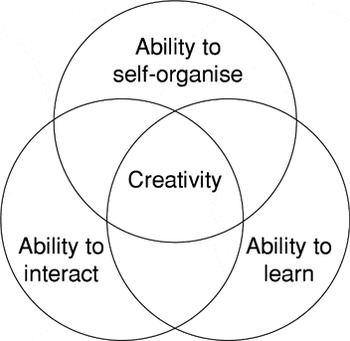
Three requirements for creativity.
 You have
Access
- 6
- Cited by