




No CrossRef data available.
Learning while designing
Published online by Cambridge University Press: 07 June 2005
Abstract
This paper describes how a computational system for designing can learn useful, reusable, generalized search strategy rules from its own experience of designing. It can then apply this experience to transform the design process from search based (knowledge lean) to knowledge based (knowledge rich). The domain of application is the design of spatial layouts for architectural design. The processes of designing and learning are tightly coupled.
Information
- Type
- Research Article
- Information
- Copyright
- © 2004 Cambridge University Press
1. INTRODUCTION
This paper describes the application of machine learning for automatically learning heuristics about a design process, gained during the process itself. The distinguishing feature of this work is that the learning and designing processes are tightly coupled with a strong interdependence on each other, which makes learning during designing a part of the design activity. The illustrative domain of application is the design of architectural layouts. Before learning, the design process is modeled as uninformed search; that is, there is little or no strategy information that can be used by the process to progress toward good designs and avoiding bad ones. After learning the search process becomes more informed, in the sense that the learned heuristics can be used to reject inappropriate design decisions and select appropriate ones. Rejection of inappropriate and selection of appropriate decisions ultimately lead to better design solutions. Learning takes place from both partial and complete design solutions, and is seamlessly applicable as additional strategy knowledge. During the computational design process, if learned heuristics match, they apply; otherwise, more heuristics are learned. The behavior of the design generator thus gradually changes from search based to knowledge based for both immediate and future design search.
The order of this paper is as follows. The terminology for the rest of the paper is defined first. Then, the closely coupled relationship between the design and learning process is described. Following this, the particular mechanism of learning is explained through a small example, after which a simple formalization is presented. Then, an architectural design problem is chosen and the ideas are applied. Experimental results with learning are then used to support the claims in this paper. The generality that may be achieved with the learning mechanism is also analyzed. Next, an evaluation of the method in terms of strengths, weaknesses, scalability, extensions, and distinction with past work is presented.
2. TERMINOLOGY
It is useful to define some terms that will be used in the rest of this paper. A pattern is defined to be a collection of one or more variables representing values, attributes or compositional parts of representational entities. The possible values of variables are constrained by relationships to values of other variables (Fig. 1). A pattern can be syntactically specified as a collection of object–attribute–value triplets, each of which can be a variable that can potentially match to data. A variable is identified by a symbol that is called its identifier. The value of a variable can be the identifier of another variable of the pattern. This introduces relations between the values of the variables. A pattern may match data to instantiate the values of each of the variables that define it. A pattern match results in an instantiated pattern; such a match is possible when every variable in the pattern has at least one instantiation that satisfies all the relations between its value and the values of other variables related to it. Without or before a pattern match, the pattern is an uninstantiated pattern. Whenever the term “pattern” is used without any additional qualification, it refers to an uninstantiated pattern.

An example of a pattern and its match in the context of a rule in the SOAR syntax (Laird et al., 1987).
A design feature is an instantiated pattern that can be semantically mapped onto a common human interpretation. This semantic component is the only difference between an instantiated pattern and a feature. For example, a square internal courtyard could be a feature of a building. A feature class is an uninstantiated pattern that is an abstract parametric conceptual description of some feature. A feature class when instantiated is a feature. The relation between a feature class and feature is exactly the same as the relation between a class and its instances.
The term design context (Fig. 2b) is the superset of all design information that includes the description of a given design alternative and all information that surrounds it from the point of its generation through its evaluation to its subsequent modification. In this paper, design context comprises a description of the design alternative, design requirements, the subsequent evaluation of the design alternative, and design process information. Design process information consists of the parent design context and generative choices for further transformation (elaboration/modification/refinement) of the design alternative from that point onward. Every design alternative thus has a design context associated with it.

(a) The design computation process mapped onto the state-operator paradigm and (b) the elements that comprise the design context.
Additional parts may be added to a design or existing designs may be transformed in different combinatorial ways by making generative choices. These combinatorial ways of design generation are referred to as design decisions (Fig. 2a). Design decisions are typically sets of rules that apply to a given design alternative and are considered as the knowledge units for design transformation. Each of these rules constitutes a pattern on its left-hand side (rule precondition) and a pattern on its right-hand side. The pattern on the right changes the design resulting in a new design when the pattern on the left matches the design context. The rule preconditions are the necessary conditions for a design transformation. When the design is subsequently evaluated, using design evaluation knowledge a new design context is created. Design evaluation knowledge usually is a feature class (or some formula) that associates parts of one or more feature classes whose presence/absence/(or evaluation of the formula) is an indicator of design quality.
A preference on a design decision is a flag (±) that can be used to prefer (+) or reject (−) design decisions from a set of possible design decisions that may be the choices for transforming a given design alternative. Such preferences are meaningful only under certain conditions. In this work the semantic equivalent of such conditions are design situations.
Structurally, a pattern that comprises a subset of the variables representing the design context is termed a design situation in this paper. Typically, this is a proper subset. A critical element of the learning process described in this paper is to extract a design situation from a given design context. Each design situation thus represents a class of possible patterns that could be extracted from different design contexts.
A heuristic is an association between a situation and a preference on a design decision. For a heuristic, a situation is a sufficient condition that ensures a given quality of solution [good (+) or bad (−)] resulting from the application of the given design decision. If such associative knowledge is available, then the process of preferring a decision on the match of its associated situation is useful as strategy knowledge to augment the process of design as search. A heuristic is said to match a design context when its situation matches the design context.
3. DESIGN COMPUTATION AND LEARNING-TIGHT COUPLING
3.1. Design computation process
Assume that design generation is formulated as a step by step combinatorial and constructive process of configuration of the parts of the design. At each step, for a given partial configuration, there are design decisions that are proposed. Transformation opportunities for a given design are combinatorial, that is, there is a tree of design alternatives, each of which will subsequently be the root to other trees emanating from it as a result of future design decisions. At each step of such a process a design decision may be selected and is applied, resulting in a new design. This new design is evaluated using design evaluation knowledge. Once a design alternative is evaluated some learning can be done. How this is done is explained in the next section.
At a lower level of abstraction, the design computation process may be mapped onto the traditional artificial intelligence (AI) state-operator paradigm of search (Fig. 2a), where operators match the state information to transform the existing state into a new state. In such a mapping operators map onto design decisions and states map to design contexts. The state-operator paradigm of search is used in a number of general problem solving architectures such as SOAR (Laird et al., 1987; Newell, 1990) and PRODIGY (Carbonell et al., 1991). The SOAR architecture was chosen to implement the ideas in this paper. SOAR is also an embodiment of a psychological theory of cognition (Newell, 1990), an architecture for general intelligence (Laird et al., 1987), as well a programming tool for AI. The general ideas used are best described at the knowledge level of computational designing rather than at the level of SOAR. However, two concepts, decision proposal and application, have been borrowed from SOAR.
Design experience is the historical trace of data that is generated during such a process. Because the entire computational design process is rule based, this data is an historical collection of instantiated patterns that matched and were replaced by new instantiated patterns during the process of decision proposal, application, and solution evaluation. This trace is the data that is utilized by the learning algorithm used in this paper.
3.2. Integrating learning in the design computation process
The model of learning is tightly coupled with design processes (Fig. 3). The notion of appropriateness of designs (absolute, e.g., satisfaction of constraints; relative, e.g., minimizing a global design variable) controls the design strategy and how learning is done. In this paper the focus of the demonstrative example is on the satisfaction of constraints. Such control is exercised because of the effects and side effects of a chain of events that happen as a generated design is evaluated. Evaluation of designs drives positive or negative credit assignment of design decisions. The credit assignment determines whether the consequent of a heuristic is about avoiding or preferring a design decision. Because the antecedent of the heuristic is expressed in terms of the representational space of the design context (see next section for details), the design context influences what is learned. As both of these are encapsulated in the derived heuristic, when the heuristic becomes applicable, it in turn, influences subsequent design generation and hence influences the resulting design description and its quality. The learned heuristic becomes a part of the generation control strategy, and in turn, influences future design generations in a similar situation by eliminating search effort. This is how learning incrementally changes the design process from being more search based to being more knowledge based. Every new unexplored path in the design solution space presents either an opportunity for learning or an opportunity for using what was learned.

The tight coupling between learning and designing. The arrows signify influences on the box at the head of the arrow and by the box at the tail of the arrow.
The heuristic applies for any arbitrary design context in which the extracted situation matches. If the heuristic is available at the time of proposal of the design decisions, the operator may not even be proposed if the heuristic predicts a bad solution. Therefore, these automatically derived heuristics act as strategy knowledge, just like the manually defined heuristics that are often used to prune the space of design alternatives.
3.3. Learning mechanism explained by simple example
The learning mechanism used in this paper can be better understood by initially reviewing the concept of explanation-based learning (EBL) in AI. One striking difference between EBL and other common forms of similarity-based learning is that the target concept definition already exists. The task of EBL is in reformulating it in terms of what is called operationality criteria. Operationality criteria define the space of representational terms that are allowed in the reformulated concept definition. Another difference is that learning is from a single example rather than a set of positive and negative examples. The learning mechanism used in this paper is the chunking method of SOAR, a variant of this method.
Let C1 be a training example for a target concept; here, we will use a cup. The features of C1 are the following: it is light and made of porcelain and it has a decoration, a concavity, a handle, and a flat bottom. Assume that the following five statements constitute a domain theory for the functional definition of a cup. A domain theory in EBL is a set of rules or facts that is used to determine the membership of an arbitrary instance to the target concept. In this context, let the domain theory statements be the following:
- if an object is stable and enables drinking, it is a cup;
- if an object has a bottom which is flat, it is stable;
- if an object carries liquids and is liftable, it enables drinking;
- if an object is light and has a handle, it is liftable; and
- if an object has a concavity, it carries liquids.
Can it be shown that C1 is a cup? In this case, C1 is indeed a cup. The flat bottom of C1 makes it stable, it is light weight and has a handle that ensures liftability, its concavity allows it to carry liquids, and the liftability and ability to carry liquids enables drinking. The above explanation is an informal proof tree of why the example is a cup. Thus, the relevant features of C1 that determine “cupness” are lightness, concavity, handle, and flat bottom. The rest of the description of the cup are often stated in the context of a cup but are immaterial/irrelevant in diagnosing a cup. The output of EBL is a new rule: if an object is light, has a concavity, has a handle, and has a flat bottom, then it is a cup. Note that the explanation is a set of chains; in each chain one or more initial structural features (facts) match domain theory rules to generate new intermediate assertions that ultimately imply some functionality of the cup. All these functionalities in combination represent the cup concept. In this case, the operationality criterion was the space of structurally observable features for the cup. To derive these relevant structural features, the proof tree may be also considered to be a trace of a set of inference chains. Traversing these chains backwards (backtracing) from the functional features of the cup to their originating features until all features satisfy the operationality criteria, yields the relevant elements that in the future can diagnose a cup. This is the basic task of any explanation-based or analytical learning algorithm. In practice, this is more complicated, as the left-hand side of the derived rule would be composed of patterns rather than constants.
3.4. Mapping learning concepts to the design process
We can map the components of the EBL example to the design process. The target concept is mapped onto the concept of a good (+) or bad (−) design solution. The training example, an instance of the target concept, is mapped onto a complete or partial design solution that is generated and subsequently evaluated during the search process. The domain theory is mapped onto the design evaluation knowledge that is used to make the evaluation. Then the proof tree or justification basis for the reformulation of the concept is the part of the design experience from the time the design decision was proposed through the application of the decision to the evaluation of the design alternative. The operationality criteria are mapped onto the representation space of the design context just at the point before the design solution is about to be generated by some design decision. If the above are the mappings of EBL concepts to the parts of the design process, then analogically an EBL backtracing procedure will result in an output rule that is an association between a relevant subset of the parent design context and a preference on the design decision that constructed it.
The role of learning, again, analogically, is to change the representation of the evaluative concept of the quality of a design to “what to do, when in order to achieve a good or eliminate a bad design solution,” or in other words, “what to do when” so that the presence or absence of an instance of the feature class that defined goodness or badness could be achieved. The term “what to do” is characterized in terms of preference on a design decision. The term “when” is characterized as a situation, a potential pattern that can match a wide variety of future design contexts. When such a heuristic is available and matches the design context, the quality of the design solution that a design decision is expected to generate is now predictable directly using the features of the design context that were there before the design is even generated. This makes the result of the concept rerepresentation directly applicable to the process of designing.
3.5. A more formal description
Using the previously described mapping between the proposed design computation process to the state-operator paradigm, we can now describe the designing and the learning process more formally, combining the levels of abstraction. A design generator recursively proposes design decisions (dk) to transform an initial partial design configuration (s0) to generate a tree of designs (Fig. 2a).
The generation of each design is followed by the evaluation of the design, thus creating a new design context. The process as a whole is thus a transformation of design context information (si → sj) (Fig. 2a), and details of a single decision application are shown in Figure 4. The additional input required for learning is the description of a design feature class (fj) and a flag to it identifying whether the feature class is bad (−) or good (+), an evaluator to determine the quality of the design. Learning can take place only when instances of one of these evaluator feature classes is present in the newly generated design. The process of learning is essentially constructing the association between what are the conditions (ci) under which the decision dk should be preferred (+)/rejected (−), that is, a rule ci → (+/−)dk, where ci ⊆ si ci, is found by backtracing each pattern-matched variable of fj from state sj to its originating elements in state si through the trace of design experience (Fig. 4). Tracing is defined as the process of maintaining a historical chain of instantiated patterns that were matched and replaced during the process of decision proposal, application, and evaluation of design alternative. This output of trace is the design experience. Tracing is done when a design alternative is constructed using uninformed search, that is, without the aid of a heuristic preferring an operator. The process of backtracing a given instantiated pattern, fj, is the process of traversing the historical chain of instantiated patterns from fj in a reverse direction to its generation to find which patterns were used to generate it. In this case, it is ci. Looking in a forward direction, ci is one or more instantiated patterns in si, which were transformed by the design decision dk to give rise to feature fj that was subsequently evaluated in sj to conclude about the quality of the design. The situation construction is denoted as ci ← fj, the reverse arrow signifying the backtracing operation. The process of learning from a single design generation and evaluation is termed in this paper as “single-step learning.”1
“Multistep learning” is an extension of this method proposed by Nath (2000), where learning is along a longer, if not a complete, solution path. However, this is not within the scope of this paper.

Learning from an instance of design generation and evaluation, the knowledge “If pattern ci matches some context sm then prefer(+)/avoid(−) dk.”
Once ci is obtained, the task is to turn it into a variable ci (also called variablizing) so that it can pattern match future design contexts. The process of variabilization is a direct consequence of using the chunking algorithm of SOAR (Laird et al., 1986) and its implicit generalization strategy. This corresponds to the same variable identifier replaced by the same variable and different identifiers by different variables.
3.6. Connection with SOAR
The main reason for using SOAR framework is that it allows a uniform representation space to be used for both learning and problem solving. With other systems there may be the issue of mapping the representation space of learned knowledge to that of a representation space for problem solving to use what has been learned.
SOAR uses a variant of EBL called chunking. Chunking results in rules known as chunks. The learning method described in the previous subsection is based on SOAR's chunking algorithm that has been specialized, reinterpreted, and applied in the context of computational design. Learned heuristics map onto SOAR chunks. The principle of chunking in SOAR is: whenever there is problem solving done within a subgoal, it can be bypassed the next time because of a chunk (rule) that captures an association between the results of the subgoal and the features of the supergoal that led to the result in the subgoal. But chunking is an abstract domain independent learning mechanism, applying it in the context of generic design tasks requires commitment on several aspects that chunking does not commit to, for example, the nature of subgoal generation, and nature of problem solving in design subgoals. This is equivalent to the addition of one knowledge level that captures the generic tasks involved in computational design and maps them to the domain general knowledge level of SOAR. Nath (2000) describes these in more detail and proposes extensions and variations to this method. The successful integration of learning and problem solving is also a direct consequence of using the SOAR architecture, as SOAR treats the learned chunks in the same way as human encoded rules.
4. APPLICATION
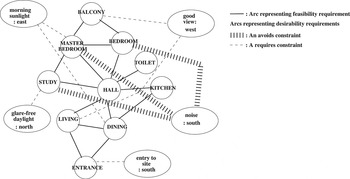
The application reported here uses the ideas of tightly coupled learning and problem solving to generate architectural layouts on a site. The difference with other layout design applications is essentially the method used to achieve the end, that is, the learning process automatically constructs heuristics that are profitably utilized by the search process. The architectural layout design problem is one where rooms are required to satisfy adjacency and cardinal direction constraints to fulfill their functions. For example, the master bedroom must have morning sunlight, which implies that “the master bedroom must face east” (requires constraints) or a bedroom must not face (avoids constraints) south because there is noise from the south. The adjacency and site constraints for the different rooms of the layout are depicted in Figure 5.

An adjacency and site constraints graph of a layout design problem.
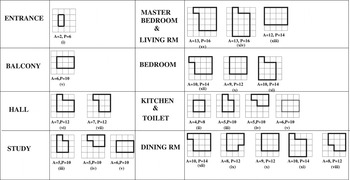
A rectilinear shape class is a compact abstraction that can be used to represent a set of possible rectilinear shapes. Each room when placed on the site is an instance of one of several allowable rectilinear shape classes, all of the same area. These shape classes for each room are shown in Figure 6. The area required for each of the rooms is specified as a part of design requirements.

A set of allowable shape classes for various design parts (rooms); A, area measured as the number of cells; P, perimeter measured as the length of the unit edges.
4.1. Shape representation
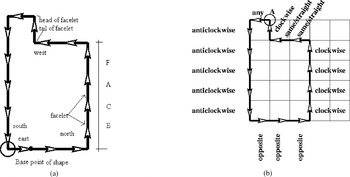
A shape (instance) is represented using an anticlockwise ordered sequence of directed unit edges called facelets from a base point.2
The shape representation bears some resemblance to the representation proposed by Rosenman (1996).
Figure 7b is the pictorial representation of an abstract shape class {base point, any − 5 × anticlockwise − 3 × opposite − 4 × clockwise − 2 × straight − 1 × clockwise}. Its base point is circled and labeled A and the facelet that has its tail at A is the starting facelet. The directional move sequence in this representation is a shape generation plan, where each move (viz., anticlockwise, opposite, clockwise, straight) is relative to the starting cardinal direction, “any,” to which the initial facelet can be instantiated. Numerals in this representation represent the number of consecutive times of application of the same relative move. Thus, the cardinal directions of nonstarting facelets can be instantiated to four possible directions depending on the instantiation of “any” to north, south, east, or west. This abstract representation with a given base point, suffices to encode four possible instantiations of the shape for a given starting base point. If the base point representation is also parametric, the set of possible shapes, which belong to this class, are multiplied by the number of possible base points. Figure 7a shows one instantiation of the shape class shown in Figure 7b with a given base point and the starting facelet pointing to west. Design evaluation knowledge and reasoning are on shape classes rather than their instantiations, so that the knowledge that it produces as a result of learning is more general.

The elements of representation of (a) a shape and (b) a shape class.
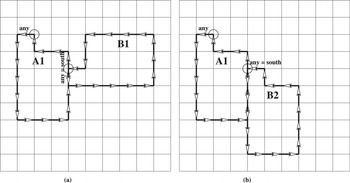
Adjacency between an already placed room A and B (being currently configured), is achieved by instantiating a given shape class such that B's starting facelet is equal in position (same end points as the joining facelet of A1) but opposite in the direction to any facelet of A. This is shown in Figure 8, and is the task of the design decisions. The combinatorics of the design alternatives (and design decisions) for a given room are defined by the choices of different allowable shape classes, the different facelets of room A that can be used as the instantiation seed for the initial facelet of room B, and the different shape generation plans.

The adjacency of design parts: representation.
4.2. Design evaluation criteria
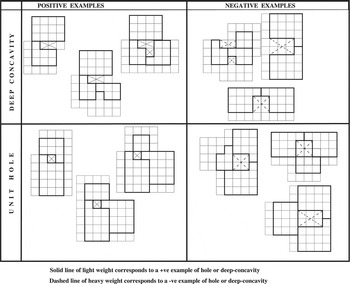
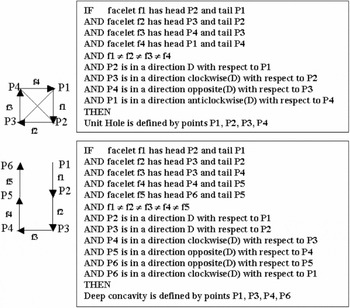
One evaluation criterion that often governs good layout designs is “efficient usage of space.” To demonstrate the effectiveness of the ideas, let us assume that the concept of efficient usage of space is defined as the absence of three feature classes: narrow deep (con)cavities (I-shaped and L-shaped) between two or more rooms, unit holes between two or more rooms, and too much edge overlap between two given rooms. Positive and negative examples of what is implied by the first two criteria and are shown in Figure 9. Two of the rules that identify typical unit holes and deep concavities are shown in Figure 10. The last criterion is formulated as follows: for two given rooms, the number of overlapping facelets of each of these rooms should be ≤2. The Hall being the one room with limited perimeter, which is adjacent to most rooms, cannot afford to have its perimeter edges consumed by a single room to satisfy adjacency criteria, because when the last few rooms are being configured with respect to the hall, there may not be enough perimeter length of the Hall left to satisfy the adjacency requirement of these later rooms. In that case, the program goes into costly backtracking operations.

Features that make layouts undesirable: deep (con)cavities and holes between rooms.

Typical rules that define one case of deep (con)cavities and unit holes.
These design evaluator features (labeled as bad) are described by reasoning about the facelets between rooms (Fig. 10). In this example, the task of learning is to rerepresent the concept of unit holes, deep concavities, and excess edge overlap in terms of a subset of patterns in the previous design context from which these features were generated, so that for the future those patterns could be used as a predictor of these types of bad features and thus be used to avoid decisions that will produce such features.
5. EXPERIMENTATION STRATEGY
The following strategy was adopted to evaluate the ability of the proposed model to learn knowledge to avoid infeasible designs.
- Generate two-roomed layout configurations (set S1) with learning turned off (assuming a given position of the first room to be configured), say, we have n1 solutions.
- Inspect and mark the infeasible solutions (set S2), with holes and deep concavities, say, these are n2 in number.
- Then, for the same position of the first room, we turn learning on and generate all possible configurations of the second room. If learning is successful, then the new set of designs (S3 = S1–S2) should not have any holes or deep concavities and the number of designs produced should be n1 − n2. The check n1 − n2 ensures that learned knowledge does not misclassify any feasible designs as infeasible.
Next, we add an extra evaluator feature: the excess edge overlap criterion. Steps 1 and 2 are performed again on set S3 and the infeasible solutions (S4) based on the new features were identified. This should result in additional learned knowledge for the new evaluator feature, while restricting the new solution set to S5 = S3–S4.
Next, the generality of learned knowledge, and hence its transferability is examined at both an intraproblem level and at an interproblem level. At the intraproblem level is the knowledge learned from laying out two rooms sufficiently abstract so that it can be transferred to other parts of the search tree? To determine this, the task of configuring the third room from the configurations in S4 was executed. The objective is to test, whether knowledge learned from the experience of configuring two-roomed layout configurations would be transferable between two-roomed configurations, where the shape classes were different. At the interproblem level, a different starting design configuration was chosen and examined as to whether the learned knowledge applied.
6. RESULTS
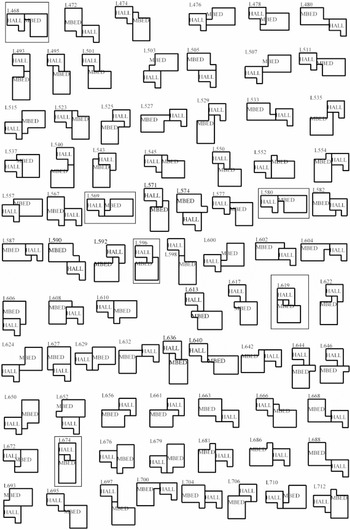
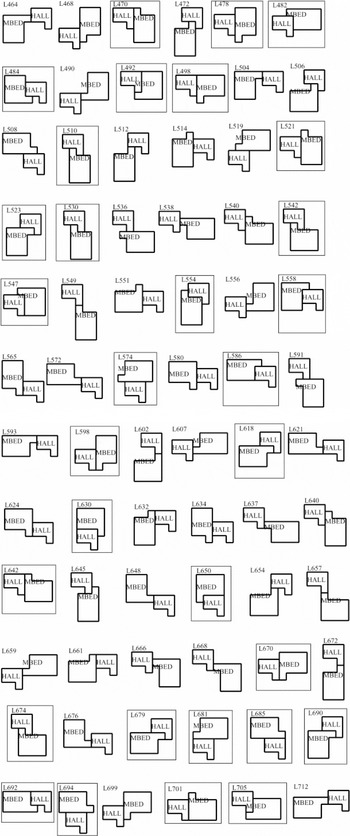
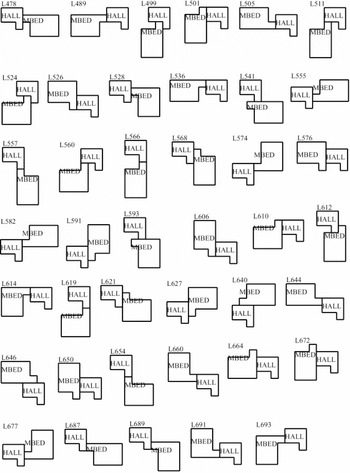
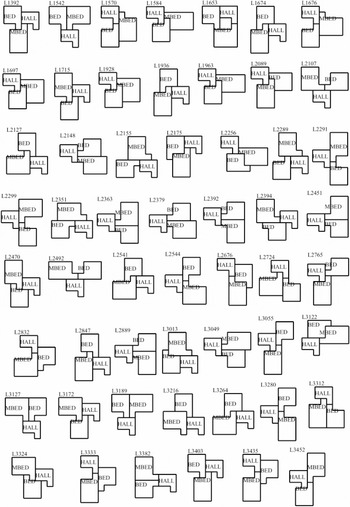
The solution set of Step 1 in the previous section with learning turned off for the features “deep (con)cavities and holes” is shown in Figure 11. There are 81 solutions, which comprise set S1. The nine boxed solutions that identify the designs, which contain deep concavities and holes, is set S2. Figure 12 shows set S3 (=S1–S2) that comprises exactly 81 − 9 = 72 solutions that do not contain deep concavities or holes. Thus, the learned heuristics do not seem to misclassify designs. Next, the additional feature of minimizing perimeter edge overlap was introduced. Applying the same experimental step, the designs in set S3 with this feature are box marked; there are 31 boxed solutions and they represent set S4. Figure 13 illustrates the solution set S5 (=S3–S4), where not a single solution was produced that had “too much edge overlap” or “holes and deep concavities.” This set also contains exactly 72 − 31 = 41 solutions, which again shows that the learned heuristics correctly identify bad designs.

The solution space of 81 two-roomed layouts with learning turned off. The nine boxed solutions show deep concavities and holes. Correct learning should not misclassify designs; this implies producing exactly 72 solutions, at the next iteration.
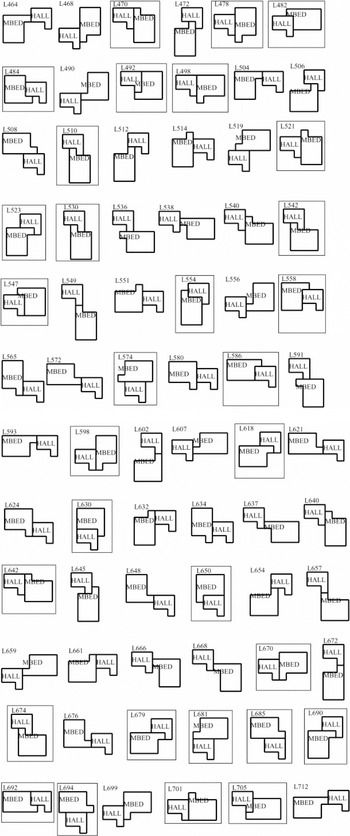
A solution space of exactly 81 − 9 = 72 layouts after learning heuristics about how to avoid deep concavities and unit holes. Not a single solution contains holes or deep concavities. The 31 boxed solutions show the “excess edge overlap” feature with the HALL. Correct learning implies producing exactly 72 − 31 = 41 solutions in the next iteration.

A solution space of exactly 72 − 31 = 41 layouts after using learned knowledge about how to avoid unit holes, deep concavities, and excess edge overlaps with the HALL. Note not a single solution that was produced contains these features.
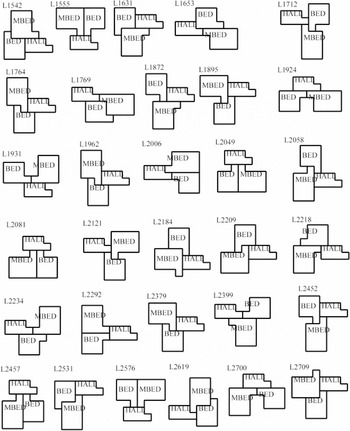
Figure 14 shows that what was learned from the configuration of two rooms could be applied to layouts with three rooms and the same principles that were learned were applied successfully. This is explained in detail in a later section. Figures 15 and 16 show that what was learned was transferable to other design problems that use the same representations, but where the initial configuration of the Hall was different. No deep concavities or holes, no excess edge overlap between the Hall and other rooms exist. Figure 17 shows how using the learned design knowledge, complete layouts produced demonstrate efficient packing of the rooms considering the protrusions and indentations in other rooms.

The heuristics learned while generating the solutions shown in Figures 11, 12, and 13 were general enough to eliminate such features, even for three-roomed designs.

The heuristics learned while generating the solutions shown in Figures 11, 12, and 13 were general enough to eliminate undesirable features in three-roomed designs, even when the initial configuration of the first room was different.

Another instance of the application of learned knowledge to generate successful three-roomed solutions with a different initial shape of the HALL. No undesirable features are present.

Complete layout configurations generated with learned knowledge. Note that the top leftmost solution has an internal hole but it is not a unit hole. The learned heuristics should only prevent unit hole generation, not larger holes. Thus, the heuristics have successfully allowed the desired generation.
7. LEARNED KNOWLEDGE AND GENERALITY
The main reason for effective knowledge transfer from a two-room situation to a three-room situation, was that the situation part of the heuristics reasoned about the relations between partial shape generation plans of the room being configured and the facelets of other rooms and not the individual cardinal directions. The rooms to which shape generation plans or existing facelets were variabilized. The abstract representation of the cardinal directions captured relationships between the directions instead of a commitment on the actual directions. Even though the global layout in which the learning was applied consisted of three rooms, often two rooms were involved whose facelets formed a unit hole or a deep concavity. In such cases, the learned knowledge could immediately apply. Figure 18 shows one of the many pieces of learned knowledge that avoids the generation of layouts with deep concavities. Figure 19 shows the chunk in SOAR for this. Similarly, Figure 20 shows one typical rule that avoids generation of unit holes. Figure 21 shows one of the chunks in SOAR for this. Figure 22 shows a richer knowledge set.

Three learned rules that prevent deep concavities in layouts.

One of the learned rules in SOAR syntax that prevent deep concavity generation.

Three learned rules that prevent unit holes in layouts.

One of the learned rules in SOAR syntax that prevent unit hole generation shows a richer knowledge set: learned heuristics that avoid the design generation to overstep site boundaries.

Learned heuristics that avoid the design generation that oversteps site boundaries.
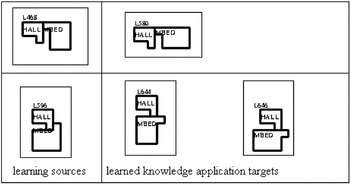
Figures 23 and 24 show how these patterns can match in different design contexts (different orientations and different shape generation plans) and allow reuse of the knowledge learned. When learned heuristics like these apply it eliminates infeasible design solutions. For example, Figure 20 shows how the same situation learned using the feature of “deep concavity” recurs for different design contexts. These are some layouts picked for explanation from Figure 11 for illustration. A similar recurrence of situations can be found in the marked solutions in Figure 12. Some of the heuristics learned were also more specific than the ones described above. Here, the entire shape generation plans formed part of the situations of these rules. Hence, these rules could only apply to preventing deep concavities or holes with specific shape classes; the reason is that it is the later facelets in the shape generation plans that define the deep concavity or the hole.

How the learned knowledge in Figure 15 matches various designs.

Two instances of partial layouts (with deep concavities) from Figure 10 from which learning was done (left column) and how learned situations match in other instances of layouts with deep concavities in Figure 12 (right column).
If more than two rooms were involved in forming a deep concavity or a hole, then the situation part of the learned heuristic from the two-room situation may not match; hence, learned knowledge may not be applicable. Every evaluated design solution is an opportunity to either learn knowledge or use learned knowledge. In such cases instead of using previously learned heuristics, new heuristics would be learned and the heuristics would cover holes or deep concavities that involved the facelets of more than two rooms. Similarly, these heuristics would be useful in eliminating potentially space-wasting design decisions. There is a wide variety of ways in which the concepts of space wastage occur in layout design, especially with the nonrectangular nature of the rooms.
In total around 560 rules of decision preference in different design contexts were learned although the space of design solutions was not completely explored. If it was completely explored then adding these heuristics would have resulted in no search, resulting in complete knowledge based activity guided by situation-directed prediction of the quality of a decision.
8. EVALUATION
8.1. Strengths of the method
There are many advantages in using this method. First, learning is dynamically driven by the requirements of the designing process to produce better solutions rather being than a passive process of classification of designs. This is the basis for a highly coupled interaction between learning and designing processes that results in a self-improving design search procedure. Second, the uniform representation space for learning and designing borrowed from the SOAR framework allows seamless transfer in both directions. Third, the learning method and the knowledge learned aid the design computation process in reasoning about regions of the search space rather than specific points. This is possible because the situations embedded as antecedents of learned heuristics encode in their patterns complex conditions that correspond to regions of the solution space. In addition, the knowledge engineer can control the level of generality desired in these learned heuristics. The more abstract, the evaluation reasoning, and the representation of the problem, the more general and applicable the learned knowledge will be. Fourth, sets of inappropriate solutions can be eliminated using a single learning session thus enabling rapid exploration of the solution space. This, of course, has a bearing on the level of abstraction employed in representation and reasoning of the domain. Fifth, costly processes are involved in domain-oriented knowledge engineering like elicitation of tacit knowledge and subsequent encoding of heuristics are eliminated. Only those heuristics are constructed by the program that are relevant to goal of satisfying the design requirements under consideration.
The experimentation strategy and the results showed that the heuristics did not fail, the situations embedded in the heuristics did not estimate a bad design solution as good, nor did it classify a good design solution as bad. The process uses an approach similar to EBL and performs a deductive compilation of the domain theory (design evaluation rules) based on operational criteria. This implies that the learned heuristics could only fail if the knowledge engineer incorrectly encodes the domain theories employed in evaluative reasoning. It is therefore important that the user of this method has precise definitions of what exactly constitutes a bad design and what is a good design. Because of this advantage, the embedded situations in the heuristics do not need any statistical evaluation to determine their success or failure. At the knowledge level, a correctly encoded evaluative domain theory will result in a correct concept rerepresentation, that is, correct heuristics.
Finally, the unlike many other works on learning, the learned knowledge can be inspected to have an understanding of the kind of learned knowledge generated and thus have greater control over it. The need for such inspection could be not only for the human designer or the researcher to experiment with their representations to best utilize a tool such as this to suit their goals, but also to understand the nature of tacit hard to explain knowledge that is captured as a result of learning. The tacit nature of this learned knowledge was explored in another work (Nath, 2003).
It is these advantages that should encourage computer-aided design system developers or researchers to incorporate such an approach in the design of their tools for designing. Practicing designers, who would be users of such a tool, would also gain these advantages.
8.2. Distinction from past work
The work that is presented here is distinct from learning from designs, on which there is a plethora of research. This work demonstrates learning and designing co-occurring in a coupled design process. Manfaat et al. (1996) have reported generalizations from a set of spatial layout designs. The form of learning reported here can also be viewed as one form of knowledge compilation (Mostow, 1990). Knowledge compilation has been applied by Brown and colleagues (Sloan & Brown, 1988; Brown & Spillane, 1991; Liu & Brown, 1991; Chabot & Brown, 1994; Brown, 1996) to learn design process knowledge, but these works were not in the spirit of the tight coupling between a learning and a designing process. Braudaway and Tong (1989) introduced a knowledge compilation-based system called RICK, which describes how an inefficient generate and test problem solver for a parametric building layout design problem, can adapt itself to the problem specific constraints. No heuristics are learned here; instead, a more efficient LISP program (constrained generators) for solving the particular problem is synthesized. Voigt and Tong (1989) describe an extension of RICK called MENDER, which reformulates the global design constraints as an evaluation function and derives “hill-climbing patchers” through knowledge compilation.
If one views this work as adaptive search, that is, tailoring a generic generative mechanism to produce desirable designs, there is research by Cagan and colleagues (Cagan & Mitchell, 1993; Reddy & Cagan, 1995; Shea & Cagan, 1997; Schmidt & Cagan, 1998), who apply simulated annealing to optimize grammatical design generation. In a similar stochastic spirit, there has been some recent applications by Vale and Shea (2003a, 2003b), which attempt to distinguish good sequences of design generation operators from the bad using search experience. The intention is to use scores on these sequences as strategies that allow good sequences to be preferred over the bad in design generation. Machine learning here is of the incremental parameter tuning variety (Samuel, 1959), where the parameter is a score that is calculated on the basis of changes in objective function over grammar rule sequences weighted by the probabilities assigned to sequences based on past experience and future utility. However, the relation between the problem conditions and when a sequence could be useful is not explicitly modeled, and it is not clear whether the probabilistic weights capture such a relationship implicitly.
Approaches to learning heuristics in design using the chunking method of SOAR has been reported by Modi et al. (1995a, 1995b) while using SOAR as a design problem solver in the design of chemical engineering distillation sequences. However, the focus of that work was not on learning heuristics for preferring good solutions to inferior ones, but on heuristics for choosing evaluation functions from a predefined set. The research presented in the current paper treats learning design process knowledge more generally.
8.3. Weaknesses of the method
The first weakness of the method is the inability to handle negated reasoning in its evaluative domain theory. This is more a consequence of the use of chunking algorithm of SOAR than the approach itself. The primary difference between chunking and EBL is that the backtracing of the concept in EBL takes place using the symbolic structure of the rules, rather than the instantiated rules. When instantiated patterns are used as the source for backtracing, the design experience as a result of tracing can account for the presence of instantiated patterns but cannot account for the absence of instantiated patterns. Hence, the resulting heuristics are likely to be overgeneral. It is in such situations that the heuristics may fail, despite a correct domain theory. But this problem can be overcome by using another analytical learning algorithm like the traditional EBL, which uses backtracing through uninstantiated patterns.
As the evaluative reasoning tends to get more complex with many cases of applicability and increasing number of reasoning chains, it can often seem like new strategy knowledge is generated. However, at the theoretical level, there no new knowledge (outside the bounds of what was given) is generated as a result of learning. All heuristic knowledge is within the deductive closure of the knowledge that was encoded a priori, although to the human it may seem like new knowledge.
8.4. Scalability issues
Analytical learning from experience is often designed to incrementally increase the performance of a search mechanism. So the learning mechanism in itself is a step toward future scalability in terms of efficiency of exploration of a space. The time taken to learn is not really the issue for scalability, whereas the ability to match learned knowledge to a future design context to apply it to some future design context is. In other words, scalability is more of an issue at the applicability time of the learned knowledge rather than at learning time.
At the knowledge level, the scalability of a heuristic at application time, in isolation, is related to the complexity of the situation that is embedded in the heuristic. The complexity of the situation depends on the number of unit representational entities (object–attribute–value triplets) and shared constraining interrelationships that have to be matched to a given design context. Sometimes such a heuristic with a large set of conditionals and many shared relationships could be very expensive to match (Tambe & Newell, 1988) with a large data set encapsulated in a design context, and as a consequence, that the system suffers a slowdown (Minton, 1988) after learning, contributing to what is called the utility problem. In general, the utility problem occurs for all systems that learn rules from experience. The main reason for such a slowdown, especially when production systems like SOAR are used, can be understood at the internal algorithmic level rather than at the design knowledge level. For SOAR, the greatest amount of computational resources are used in matching rules and the knowledge search (Tambe, 1991) for which rules apply to the given context. This is significant even though SOAR uses an efficient production match algorithm like RETE (Forgy, 1982) and rule firing is simulated to be in parallel. SOAR's chunking algorithm is well known to reduce the number of steps to solve a subproblem the next time, but when the utility problem occurs, the cost of matching the learned chunks becomes expensive as a result of the production match algorithm that offsets the benefit gained from the reduction in the number of problem solving steps. Ideally, the cost of using the learned rules should always be bounded by the cost of the problem-solving episode from which they are learned (Kim & Rosenbloom, 1996). The current solution is to design representations for data and reasoning in such a way that a larger number of cheaper chunks with smaller patterns is generated. A way in which the above could be possible is to trade off expressivity of representation for speed (Tambe & Rosenbloom, 1989). A related but different reason that could also contribute to the utility problem is what is known as the average growth effect (Doorenbos et al., 1992) of the knowledge base because of heuristics being learned continuously. Interaction across heuristics slows down the system even though the heuristics are not themselves expensive. Solutions to the average growth effect have already been proposed (Doorenbos et al., 1992; Doorenbos, 1993).
9. CONCLUSIONS
This paper has presented a method of learning while designing that utilizes design experience and design situations (Gero, 1998). It uses SOAR as its underlying framework. The method has been applied on an architectural design problem where learning and designing are tightly coupled. The main strength of this method is “intelligent control,” which is manifested as the automatic extraction, from experience, of design problem conditions under which certain generation strategies are useful and the use of these heuristics to drive future design generation toward requirements. In the past, various design computing researchers (Coyne, 1988; Akin, 1990; Smithers et al., 1990; Vancza, 1991; Mitchell, 1996; Muller & Pasman, 1996) expressed control mechanisms as an essential need in design search processes, be it in a computational context or otherwise; but there has been a paucity of design research in this area.
The learning principle could be extended over a series of design transformations. In that case, if we have the following sequence of states representing a solution path, s1 → s2 → s3 · · · → sn−1 → sn caused by application of decisions, d1 → d2 → d3 · · · → dn−1 → dn, and sn containing feature fn(+), then we have the following conditions constructed from fn as a result of backtracing: c1 ← c2 ← c3 ← · · · cn−1 ← fn, where ci ⊆ si. The process of learning, then, constructs the heuristic ci → (+)dk from a single design description in sn, such that ci ⊆ si. A series of rules can thus be learned from a single example. This forms a multistep learning process and is reported in more detail in Nath (2000).
ACKNOWLEDGMENTS
The research reported here was carried out at the Key Centre of Design Computing and Cognition, Sydney, Australia, as a part of the first author's PhD thesis, which was supported by an AUSAID fellowship. The authors also acknowledge the comments made by the reviewers of this Special Issue, which improved both the content and presentation of the ideas in this paper.
References
REFERENCES
Braudaway, W. &
Tong, C.
(1989).
Automated synthesis of constrained generators.
Proc. 11th Int. Joint Conf. Artificial Intelligence,
pp.
583–589.
Menlo Park, CA:
AAAI Press.
Brown, D.C.
(1996).
Knowledge compilation in routine design problem solving systems:
Research abstract.
Artificial Intelligence for Engineering Design, Analysis and
Manufacturing
10(2),
137–138.Google Scholar
Brown, D.C. &
Spillane, M.
(1991).
An experimental evaluation of some design knowledge compilation
mechanisms. In
Artificial Intelligence in Design'91
(Gero, J.S., Ed.), pp.
323–325.
Oxford:
Butterworth Heinemann.
Cagan, J. &
Mitchell, W.J.
(1993).
Optimally directed shape generation by shape annealing.
Environment and Planning B: Planning and Design
20,
5–12.Google Scholar
Carbonell, J.G.,
Knoblock, C.A., &
Minton, S.
(1991).
PRODIGY: an integrated architecture for Prodigy. In
Architectures for Intelligence
(VanLehn, K., Ed.), pp.
241–278.
Hillsdale, NJ:
Erlbaum.
Chabot, R. &
Brown, D.C.
(1994).
Knowledge compilation using constraint inheritance.
Artificial Intelligence for Engineering Design, Analysis and
Manufacturing
8(2),
125–142.Google Scholar
Doorenbos, B.
(1993).
Matching 100,000 learned rules.
Proc. 11th National Conf. Artificial Intelligence,
pp.
290–296.
Doorenbos, B.,
Tambe, M., &
Newell, A.
(1992).
Learning 10,000 chunks: what's it like out there?
Proc. 10th National Conf. Artificial Intelligence,
pp.
830–836.
Forgy, C.
(1982).
Rete: a fast algorithm for the many pattern/many object pattern
match problem.
Artificial Intelligence
19,
17–37.Google Scholar
Gero, J.S.
(1998).
Towards a model of designing which includes its
situatedness. In
Universal Design Theory
(Grabowski, H.,
Rude, S. &
Grein, G., Eds.), pp.
47–56.
Aachen, Germany:
Shaker Verlag.
Kim, J. &
Rosenbloom, P.
(1996).
Learning efficient rules by maintaining the explanation
structure.
Proc. 13th National Conf. Artificial Intelligence,
pp.
763–770.
Laird, J.,
Newell, A., &
Rosenbloom, P.
(1986).
Chunking in SOAR: the anatomy of a general learning
mechanism.
Machine Learning
1,
11–46.Google Scholar
Laird, J.,
Newell, A., &
Rosenbloom, P.
(1987).
SOAR: An architecture for general intelligence.
Artificial Intelligence
33,
1–64.Google Scholar
Liu, J. &
Brown, D.C.
(1991).
Generating design decomposition knowledge for parametric design
problems. In
Artificial Intelligence in Design'91
(Gero, J.S., Ed.), pp.
661–678.
Dordrecht:
Kluwer.
Manfaat, D.,
Duffy, A.H.B., &
Lee, B.S.
(1996).
Generalization of spatial layouts.
Workshop on Machine Learning in Design, Artificial Intelligence in
Design'96.
Stanford, CA:
Stanford University.
Minton, S.
(1988).
Quantitative results concerning the utility of explanation-based
learning.
Proc. Seventh National Conf. Artificial Intelligence,
pp.
564–569.
Modi, A.,
Newell, A.,
Steier, D., &
Westerberg, A.
(1995a).
Building a chemical process design system with SOAR—1: design
issues.
Computers and Chemical Engineering
19(1),
75–89.Google Scholar
Modi, A.,
Newell, A.,
Steier, D., &
Westerberg, A.
(1995b).
Building a chemical engineering process design system with
SOAR—2: learning issues.
Computers and Chemical Engineering
19(3),
345–361.Google Scholar
Mostow, J.
(1990).
Towards automated development of specialized algorithms for design
synthesis: knowledge compilation as an approach to computer aided
design.
Research in Engineering Design
1,
167–186.Google Scholar
Nath, G.
(2000).
A model of situation learning in design.
PhD Thesis. Sydney, Australia:
University of Sydney, Department of Architectural and Design
Science.
Nath, G.
(2003).
A computer program automatically acquiring some skills for a simple
design problem. In
Expertise in Design
(Cross, N. &
Edmonds, E., Eds.), pp.
323–329.
Sydney, Australia:
Creativity and Cognition Studios Press.
Newell, A.
(1990).
Unified Theories of Cognition.
Cambridge, MA:
Harvard University Press.
Rosenbloom, P. &
Laird, J.
(1986).
Mapping explanation-based generalization onto SOAR.
Proc. Fifth National Conf. Artificial Intelligence,
pp.
561–567.
Los Altos, CA:
AAAI Press.
Reddy, G. &
Cagan, J.
(1995).
An improved shape annealing algorithm for truss topology
generation.
ASME Journal of Mechanical Design
117(2),
315–321.Google Scholar
Rosenman, M.
(1996).
The generation of form using an evolutionary approach. In
Artificial Intelligence in Design'96
(Gero, J.S. &
Sudweeks, F., Eds.), pp.
643–662.
Dordrecht:
Kluwer Academic.
Schmidt, L.C. &
Cagan, J.
(1998).
Optimal configuration design: an integrated approach using
grammars.
ASME Journal of Mechanical Design
120(1),
2–9.Google Scholar
Samuel, A.L.
(1959).
Some studies in machine learning using the game of checkers.
IBM Journal of Research and Development
3,
210–229.Google Scholar
Shea, K. &
Cagan, J.
(1997).
Innovative dome design: applying geodesic patterns with shape
annealing.
Artificial Intelligence for Engineering Design, Analysis and
Manufacturing
11,
379–394.Google Scholar
Sloan, W. &
Brown, D.C.
(1988).
Adjusting constraints in routine design knowledge.
Workshop on AI in Design: Proc. Seventh National Conf. Artificial
Intelligence.
Menlo Park, CA:
AAAI Press.
Tambe, M.
(1991).
Eliminating conbinatorics from production match.
PhD Thesis,
Carnegie Mellon University.
Tambe, M. &
Newell, A.
(1988).
Some chunks are expensive. In
Proc. Fifth Int. Conf. Machine Learning
(Laird, J.E., Ed.), pp.
451–458.
San Mateo, CA:
Morgan Kaufmann.
Tambe, M. &
Rosenbloom, P.S.
(1989).
Eliminating expensive chunks by restricting expressiveness.
Proc. 11th Int. Joint Conf. Artificial Intelligence,
pp.
731–737.
Vale, C.A.W. &
Shea, K.
(2003a).
A machine learning-based approach to accelerating computational
design synthesis.
Proc. 14th Int. Conf. Engineering Design (ICED 03),
Stockholm.
Vale, C.A.W. &
Shea, K.
(2003b).
Learning intelligent modification strategies in design
synthesis.
Proc. AAAI Spring Symp. Computational Synthesis, pp.
247–254.
Palo Alto, CA.
Voigt, K. &
Tong, C.
(1989).
Automating the construction of patchers that satisfy global
constraints.
Proc. 11th Int. Joint Conf. Artificial Intelligence,
pp.
1446–1452.
Menlo Park, CA:
AAAI Press.
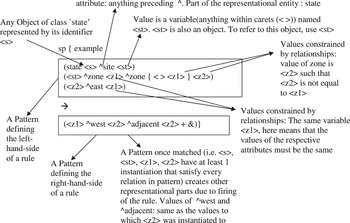
An example of a pattern and its match in the context of a rule in the SOAR syntax (Laird et al., 1987).
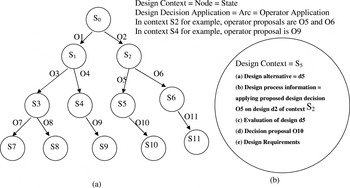
(a) The design computation process mapped onto the state-operator paradigm and (b) the elements that comprise the design context.
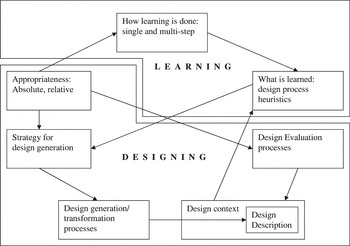
The tight coupling between learning and designing. The arrows signify influences on the box at the head of the arrow and by the box at the tail of the arrow.
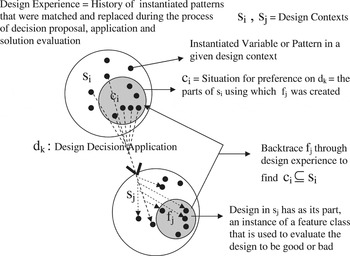
Learning from an instance of design generation and evaluation, the knowledge “If pattern ci matches some context sm then prefer(+)/avoid(−) dk.”
An adjacency and site constraints graph of a layout design problem.
A set of allowable shape classes for various design parts (rooms); A, area measured as the number of cells; P, perimeter measured as the length of the unit edges.
The elements of representation of (a) a shape and (b) a shape class.
The adjacency of design parts: representation.
Features that make layouts undesirable: deep (con)cavities and holes between rooms.
Typical rules that define one case of deep (con)cavities and unit holes.
The solution space of 81 two-roomed layouts with learning turned off. The nine boxed solutions show deep concavities and holes. Correct learning should not misclassify designs; this implies producing exactly 72 solutions, at the next iteration.
A solution space of exactly 81 − 9 = 72 layouts after learning heuristics about how to avoid deep concavities and unit holes. Not a single solution contains holes or deep concavities. The 31 boxed solutions show the “excess edge overlap” feature with the HALL. Correct learning implies producing exactly 72 − 31 = 41 solutions in the next iteration.
A solution space of exactly 72 − 31 = 41 layouts after using learned knowledge about how to avoid unit holes, deep concavities, and excess edge overlaps with the HALL. Note not a single solution that was produced contains these features.
The heuristics learned while generating the solutions shown in Figures 11, 12, and 13 were general enough to eliminate such features, even for three-roomed designs.
The heuristics learned while generating the solutions shown in Figures 11, 12, and 13 were general enough to eliminate undesirable features in three-roomed designs, even when the initial configuration of the first room was different.
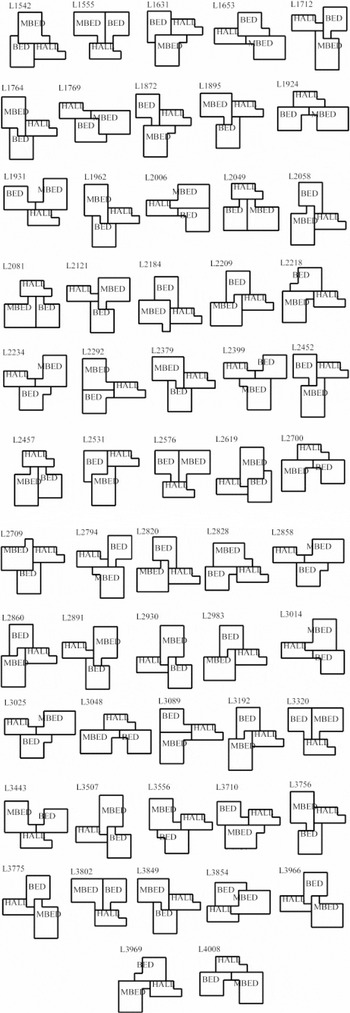
Another instance of the application of learned knowledge to generate successful three-roomed solutions with a different initial shape of the HALL. No undesirable features are present.
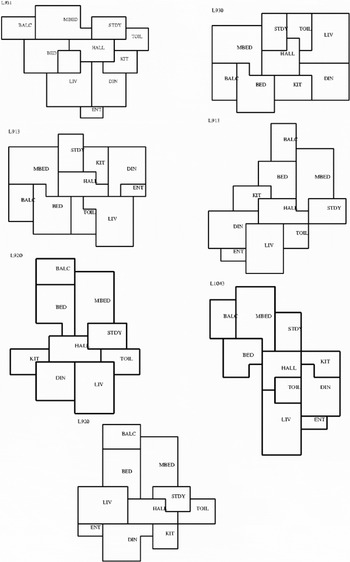
Complete layout configurations generated with learned knowledge. Note that the top leftmost solution has an internal hole but it is not a unit hole. The learned heuristics should only prevent unit hole generation, not larger holes. Thus, the heuristics have successfully allowed the desired generation.
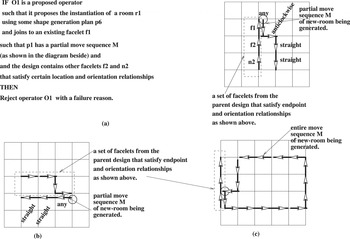
Three learned rules that prevent deep concavities in layouts.
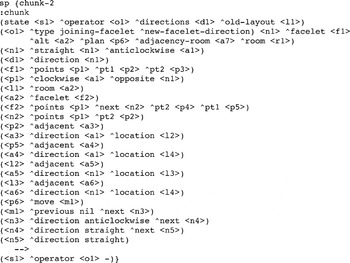
One of the learned rules in SOAR syntax that prevent deep concavity generation.
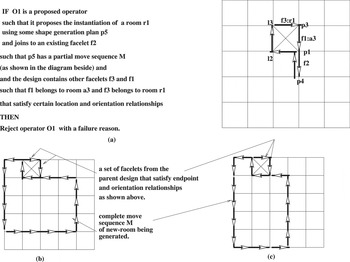
Three learned rules that prevent unit holes in layouts.
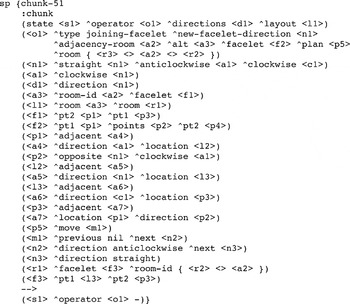
One of the learned rules in SOAR syntax that prevent unit hole generation shows a richer knowledge set: learned heuristics that avoid the design generation to overstep site boundaries.
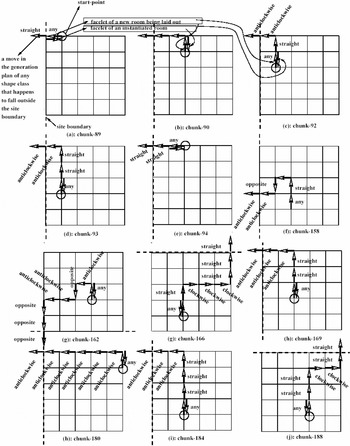
Learned heuristics that avoid the design generation that oversteps site boundaries.
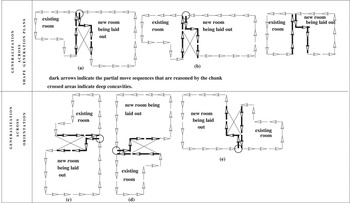
How the learned knowledge in Figure 15 matches various designs.
Two instances of partial layouts (with deep concavities) from Figure 10 from which learning was done (left column) and how learned situations match in other instances of layouts with deep concavities in Figure 12 (right column).
 You have
Access
- 5
- Cited by