1. INTRODUCTION
In the last decade, tangible interaction research has gained visibility within the human–computer interaction (HCI) community, showing promise to support activities such as learning, problem solving, and design. As the field matures, a growing worldwide community of researchers is actively exploring new application domains, technologies, and evaluation techniques. However, there is still relatively little discussion of how best to teach tangible interaction design to the next generation of practitioners.
Building a tangible user interface (TUI) is a complex process that encompasses multidisciplinary knowledge including engineering, art, and social sciences. Successful design depends on many factors including physical form, social settings, and aesthetics, in addition to well-designed software and electronics. In this paper we share our experiences teaching an interdisciplinary, project-based laboratory course over a period of 4 years at Tufts University. The course seeks to provide students with the foundations required for exploring the future of tangible interaction. Thus, it draws on a wide range of disciplines, providing students not only with technical skills required for building TUIs, but also with conceptual models and methodologies to support the synthesis of new ideas. The following four goals guided our design of the course: to facilitate hands-on learning, to reinforce the “big ideas” of HCI, to encourage innovation, and to promote interdisciplinary collaboration.
1.1. Facilitate hands-on learning
Education research emphasizes that learning often occurs when people are engaged in designing and building personally meaningful artifacts (Papert, Reference Papert1980; Resnick & Ocko, Reference Resnick, Ocko, Harel and Papert1991). Based on this constructionist approach, we engage students in designing and constructing TUIs of their own creation, while they acquire skills and knowledge in a diverse array of subjects.
1.2. Reinforce the big ideas of HCI
Several ideas are fundamental to the field of HCI, including iterative and user-centered design, interaction styles, and design principles such as simplicity, consistency, visibility, affordance, and feedback. By reinforcing these ideas through design exercises, critiques, and project work, the course provides students with a conceptual framework for understanding and evaluating TUIs within the broader context of HCI.
1.3. Encourage innovation
Tangible interaction is an emerging field of research, and building novel tangible interfaces requires not only applying existing concepts and practices but also exploring new ideas, domains, and techniques. To accomplish this goal, we encourage TUI Laboratory students to take risks and experiment with new ideas and technologies. We use structured brainstorming exercises throughout the first half of the course and encourage students to explore the boundaries of the tangible interaction paradigm. To focus and motivate students' design efforts, each year we choose a theme centered on a real-world application domain. For example, our most recent theme is interfaces for informal science learning.
1.4. Promote interdisciplinary collaboration
Designing and building TUIs requires cross-disciplinary knowledge. Thus, we encourage the enrollment of students from diverse backgrounds. In addition to a unique set of skills and individual creativity, every student brings field-specific terminologies and work practices to his or her team. In the course, we emphasize the importance of interdisciplinary communication, helping teams develop a cohesive vision while exploring a wide range of solutions across and between disciplines. In pursuit of these goals, the course is offered through the Computer Science department to students from a variety of disciplines.
Below we describe related courses from other institutions that inspired our course. Then, to give a sense of the scope of work accomplished by the students, we describe several resulting projects. Next, we describe the course itself and show how the methods applied in the course affected the resulting projects. Finally, we discuss lessons learned from students' evaluations and our own observations, and share our recommendations for implementing such a course in institutions with similar constraints and culture. We conclude with our vision for the course's future directions.
2. RELATED COURSES
Although inspired by the Physical Computing Studio taught in the Design Machine Group at the University of Washington (Camarata et al., Reference Camarata, Gross and Do2003) and the tangible interfaces class taught in the MIT Media Lab, our course was designed and taught under a different set of constraints and academic culture. First, our course was offered within an engineering department that is unfamiliar with the studio culture we sought to cultivate in this course. Several initiatives that foster studio culture in HCI and computing guided our efforts in this regard (Klemmer et al., Reference Klemmer, Ju and Verplank2005; Yi-Luen Do & Gross, Reference Yi-Luen Do and Gross2007; Turbak & Berg, Reference Turbak and Berg2002). Second, constraints such as the lack of a dedicated teaching lab and a limited budget led us to select implementation technologies that are portable, cross-platform, and open source. For example, although advanced development platforms for tabletop interactions such as Sensetable (Patten et al., Reference Patten, Ishii, Hines and Pangaro2001) are available to MIT Media Lab students, our students use computer vision techniques to implement tabletop interaction. The lack of a dedicated workspace for students also impacts the scale of students' projects. Rather than large artistic installation projects often seen in other courses (e.g., Camarata et al., Reference Camarata, Gross and Do2003), our students tend to produce projects that are portable and smaller in scale, as students need to physically move their projects from our lab to the classroom. Finally, another aspect that distinguishes our class from other offerings, such as the introduction to physical computing course offered in the ITP program at NYU or the physical computing class at the University of Washington (Camarata et al., Reference Camarata, Gross and Do2003), is the use of a heterogeneous set of implementation technologies for student projects. Our decision to use diverse technologies aims to allow students to explore a large subset of the tangible interaction design space. To increase knowledge transfer between students, each student works with at least three technologies that they present to the class in teams. These differences and the rationale behind them are the focus of this paper.
3. STUDENT PROJECTS
In this section, we briefly describe five innovative student projects: one from each semester the course was offered. These projects highlight the diversity of class projects, both in terms of implementation techniques and design concepts. The projects also illustrate potential benefits of tangible interaction for collaborative authoring and design activities. Students continued work on three of these five projects beyond the end of their class and published papers in the International Conference on Tangible and Embedded Interaction (TEI).
3.1. The Tangible Video Editor (TVE)
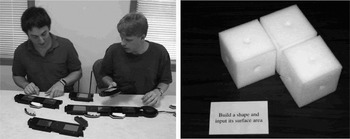
The TVE (Spring 2005) project is a design tool for collaborative editing of digital video (Fig. 1; Zigelbaum et al., Reference Zigelbaum, Horn, Shaer and Jacob2007). The project was inspired by traditional film editing studios where the task of cutting and splicing film into sequences for playback involved the use of physical tools such as cutting arms and taping stations. The TVE project was partly an attempt to capture beneficial aspects of both traditional and modern tools by blending the physical and the digital. However, unlike traditional tools, the TVE interface is aimed at facilitating collaborative editing of video by amateur users mainly for educational purposes.
(Left) The TVE system facilitates collaborative video editing, and (right) the Smart Blocks system allows users to explore concepts of volume and surface area.

The TVE project was innovative in its use of active physical tokens to represent individual video clips. These tokens, called clip holders, consist of hand-held computers with backlit, color displays embedded in custom-built cases. By chaining clip holders together with other tokens representing transition effects, users can easily create creative sequences of digital video. The TVE project involved numerous rounds of design and prototyping, employing materials such as clay, foam core, and laser cut acrylic. Each successive low-fidelity prototype explored aspects of the physical design of tokens and ways in which they could be combined and constrained. In addition, even though the underlying technology of the project was replaced multiple times throughout the design process (an early prototype used computer vision to track tokens combined with a video projector to augment passive tokens), the core design concepts persisted.
3.2. Smart Blocks
Smart Blocks (Spring 2006; Girouard et al., Reference Girouard, Solovey, Hirshfield, Ecott, Shaer and Jacob2007) is an augmented mathematical manipulative that allows users to collaboratively explore concepts of volume and surface area of three-dimensional objects (Fig. 1). Much like the digital manipulatives proposed by Resnick et al. (Reference Resnick, Martin, Berg, Borovoy, Colella, Kramer and Silverman1998) the project seeks to combine the benefits of physicality with the advantages of digital information in creating an educational manipulative. The Smart Blocks system consists of 3-in. cubes, 3-in. dowel connectors, and a set of question cards. Children can answer questions prompted by the system or experiment with different constructions and see the resulting surface area and volume immediately. To implement the system, the team used a multitag radio frequency identifier (RFID) reader, embedding RFID tags in each block and each dowel.
3.3. Marble Track Audio Manipulator (MTAM)
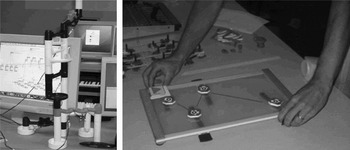
The MTAM (Spring 2007) project augments a popular children's toy to allow collaborative musical composition through constructive play (Fig. 2; Bean et al., Reference Bean, Siddiqi, Chowdhury, Whited, Shaer and Jacob2008). Children start by building towers and marble tracks. In the augmented system, marbles represent audio samples and colored tracks represent sound effects that can be applied to the samples. When a marble is dropped in the track at the top of the tower, the sampled sound that marble represents starts to play. As the marble rolls through tracks, various sound effects and filters are applied to the original sample. For example, a wavy track adds a delay, a funnel adds reverb, and a water wheel adds distortion. The system was implemented with gold plated marbles that close electrical switches as they roll through the tracks. The switches, in turn, trigger keyboard input into a Max/MSP audio generation program.
(Left) The Marble Track Audio Manipulator and (right) WaveTouch system are playful educational tools for exploring the properties of audio and waveforms.

3.4. WaveTouch
The WaveTouch (Summer 2007) project allows for collaborative and hands-on exploration of the properties of electromagnetic waves (Fig. 2). Users slide physical tokens on an interaction surface to adjust the frequency, amplitude, and form of a wave. The system responds in real time to user actions by projecting a waveform onto the interaction surface and by generating the corresponding audio signal. WaveTouch was developed for collaborative student exploration in classrooms and small learning situations to combine advantages of physical demonstrations and onscreen graphical simulations. It was implemented using the TopCodes computer vision library (http://hci.cs.tufts.edu/topcodes) and an overhead LCD top projector.
3.5. Traffic Flow Simulator
The Traffic Flow Simulator (Spring 2008) project was designed as a tool for children to learn about emergent properties of traffic flow through roadways. Children explore this phenomenon by connecting wooden sections representing various types of roadway and intersections. Traffic is introduced into the system using special source tokens, and flow is adjusted using a valvelike control. The system uses computer vision to track roadway sections on the interaction surface and an LCD projector to augment the roadway with images of cars, traffic lights, and accidents. Much like Zuckerman's FlowBlocks interface (Zuckerman et al., Reference Zuckerman, Arida and Resnick2005), the Traffic Flow Simulator encourages collaborative and playful experimentation with dynamic systems to help children develop an intuitive grasp of these concepts.
4. TUI LABORATORY
4.1. Course structure
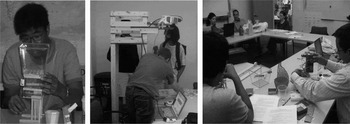
The TUI Laboratory is offered through the Computer Science Department to students from a variety of disciplines (Fig. 3). On average, the course enrolls 12 students, including advanced undergraduates and graduate students. Over the past 4 years, the course has drawn students from computer science, engineering, studio arts, art history, child development, human factors, education, and international relations. The course typically lasts one semester (14 weeks) meeting once per week for a 3-h session. We also successfully taught the course during a 7-week summer session meeting twice per week for a 3-h session (Summer 2007) and during a 14-week semester in which the course met twice weekly for 1.5 h (Spring 2008).
Students in the TUI laboratory course.

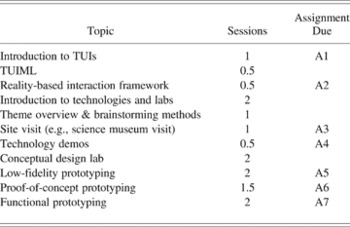
Similar to other HCI and computing courses in different institutions such as the University of Washington (Camarata et al., Reference Camarata, Gross and Do2003), Stanford University (Klemmer et al., Reference Klemmer, Ju and Verplank2005), and Wellesley College (Turbak & Berg, Reference Turbak and Berg2002), the course borrows from the studio art tradition, where creativity and hands-on learning are strongly promoted. The course emphasizes collaborative design and peer teaching as means to transfer knowledge between students from diverse backgrounds. We divide the course into two phases. In the first phase, students typically spend 6 weeks acquiring background knowledge and conceptual foundations of tangible interaction. They also begin to work with the tools and technologies necessary for designing and building TUIs. In the second phase, students work in interdisciplinary teams to design and build functional TUI prototypes. Teams are typically assigned by the instructors and include students with complementary skills. Tables 1 and 2 summarize the topics and assignments we cover.
TUI laboratory course topics covered in a 14-week course with 3-h sessions

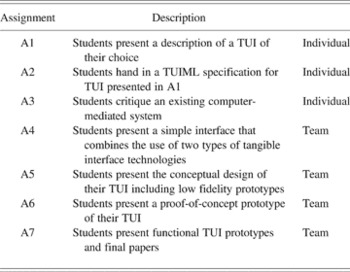
Student assignments for the TUI laboratory course

A practical challenge we face in offering the course is the lack of a dedicated laboratory space where students can design, build, and test their interfaces. Our solution involves dividing the course sessions between a conference room and our relatively small HCI research lab. The conference room allows for informal discussion and teamwork, while the minimal lab space enables students to store their artifacts and materials as well as to experiment with a variety of technologies. In addition, we encourage students to use their personal laptops for course projects.
4.2. Methods and techniques
In this section, we discuss methods and techniques that we apply throughout the course to facilitate hands-on learning, promote interdisciplinary collaboration, encourage innovation, and reinforce fundamental HCI concepts.
4.2.1. Conceptual foundations
As is common in evolving fields, researchers have not yet come to shared definition of tangible interaction. Thus, we begin each semester by discussing a variety of well-regarded TUIs in an attempt to bring the class to a consensus understanding of the nature of tangible interaction. Students are responsible for reading about and presenting an example interface to the class in one of the first sessions. Stressing traditional HCI concepts, this presentation includes a description of the design concept, use scenarios, interaction techniques, and implementation details. The interfaces we discuss include URP (Underkoffler & Ishii, Reference Underkoffler and Ishii1999), Designers' Outpost (Klemmer et al., Reference Klemmer, Newman, Farrell, Bilezikjian and Landay2001), Topobo (Raffle et al., Reference Raffle, Parkes and Ishii2004), Tern (Horn & Jacob, Reference Horn and Jacob2007), SenseBoard (Jacob et al., Reference Jacob, Ishii, Pangaro and Patten2002), Navigational Blocks (Camarata et al., Reference Camarata, Do, Gross and Johnson2002), and Illuminating Clay (Piper et al., Reference Piper, Ratti and Ishii2002). We introduce an interdisciplinary view of tangible interaction that includes perspectives from the arts and design disciplines, but our course focuses on the data-centered view (Hornecker & Buur, Reference Hornecker and Buur2006) of tangible interaction. This view is mainly concerned with physical representation and manipulation of digital data.
After this preliminary period of discussion, we introduce students to the reality-based interaction framework (Jacob et al., Reference Jacob, Girouard, Hirshfield, Horn, Shaer, Solovey and Zigelbaum2008), which serves to place tangible interaction in the broader context of emerging interaction styles. This framework emphasizes existing real-world knowledge and skills that users leverage when they interact with a computer system. The framework identifies four themes of reality as being especially important: naïve physics, body awareness and skills, social awareness and skills, and environmental awareness and skills. By virtue of its embodied nature, tangible interaction can take advantage of user skills in all these areas. We refer to these themes in brainstorming sessions throughout the course in order to generate ideas for novel tangible interaction techniques.
4.2.2. Brainstorming techniques
Following the establishment of conceptual foundations, we introduce students to multiple brainstorming techniques including random inputs, idea maps, unusual combinations, and story telling, with the goal of fostering innovation. Early in the semester, an instructor moderates a brainstorming session that is followed by individual and student teams brainstorming activities. For each cohort, we select a theme to serve as a seed for generating project ideas. These themes focus on areas that are relatively new application domains for tangible interaction and that emphasize collaborative authoring and design work. For example, in the past we have chosen themes such as digital libraries, end-user programming systems, and informal science learning. Each topic is introduced to students prior to the brainstorming activities. For example, in 2008 students visited the Boston Museum of Science and met with domain experts such as exhibit developers and production staff to learn about informal science learning. However, although we encourage students to focus their design effort around the theme, final projects are not limited to these topics. Rather, we provide students with an opportunity for creative expression and for working on a project that they are passionate about.
4.2.3. Modeling and specification techniques
As groups are formed in the second phase of the course, we expect each student to contribute a unique set of skills to their team. Although this diversity is critical for innovation, it can also be a source of difficulty and frustration for newly formed groups. In the first two cohorts of the TUI laboratory, all teams experienced communication and workload division problems. As one student explained “the division of labor problem cropped up partially because we were unable to come up with a clear specification of our system at first.” Another student wrote, “We didn't document well how different parts of the system will come together so this created a challenge when we put things together—communication is definitely the key.” To address these challenges of communication, specification, and documentation, as well as to provide students from different disciplines with a common ground for exploring tangible interaction, we introduced TUI Modeling Language (TUIML; Shaer & Jacob, Reference Shaer and Jacob2006), a visual modeling language for TUIs, starting the second cohort of our TUI Laboratory.
TUIML consists of an interaction model and diagramming techniques for describing the structure and behavior of TUIs in a high-level technology-independent manner. It is implemented as a visual language that combines iconic and diagrammatic approaches, drawing upon current practices of user interface and software design. To describe the structure and functionality of a TUI, TUIML uses a set of constructs (Shaer et al., Reference Shaer, Leland, Calvillo and Jacob2004) that extends across a broad spectrum of TUIs. This set consists of tokens, constraints, and tokens and constraints (TACs) elements. A token is a graspable physical object that represents digital information or a computational function in an application. A constraint is a physical object that limits the behavior of a token with which it is associated. Finally, a TAC is a relationship between a token and one or more constraints. Such relationship expresses to users the kinds of interactions that an interface can and cannot support. TAC objects are similar to widgets in graphical user interfaces because they encapsulate both the set of meaningful manipulations users can perform upon a physical object (i.e., behavior) and the physical relations between tokens and constraints (i.e., state). TUIML provides an iconic representation for token and constraints and captures the structure of a TUI as a set of TAC relationships using a diagramming technique called the TAC Palette. To describe the underlying behavior of TUIs, TUIML offers a two-tier interaction model that consists of a dialogue tier and a task tier. The dialogue tier consists of a set of high-level states and transitions, whereas the interaction tier provides a detailed view of each user interaction that represents a thread of functionality. TUIML is most effective at specifying data-centered tangible interaction styles such as Interactive Surfaces, Constructive Assemblies and, Token + Constraint systems (Ullmer, Reference Ullmer2002; Hornecker & Buur, Reference Hornecker and Buur2006). TUIML can also be used to specify aspects of other design perspectives of tangible interaction such as the space-centered view and the expressive-movement centered view (Hornecker & Buur, Reference Hornecker and Buur2006). As our course focuses students' design efforts around the data-centered view of tangible interaction, TUIML is capable of directly describing most student prototypes.
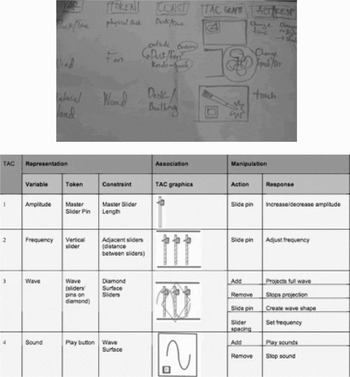
In the first part of the course we dedicate one lecture to TUIML. During this lecture students collaboratively construct TUIML diagrams to describe the seminal URP system (Underkoffler & Ishii, Reference Underkoffler and Ishii1999). Figure 4 shows a TAC palette for URP that was constructed by students. Students identified three TAC relationships in URP and used iconic graphical representations to depict these relationships. For each TAC relationship the students defined computationally meaningful user interactions. Later, each student is required to use TUIML to describe an existing TUI system, study its properties, and present their analysis to the class.
A TUIML TAC palette of (top) URP and (bottom) the WaveTouch system.

In the second part of the course, students use TUIML to model their conceptual design, compare alternative designs, and communicate their designs to the rest of the class. In general, introducing the TUIML language helped students to communicate within and outside their teams as well as to thoroughly study their system designs prior to implementing them. As one student who worked on the Marble Track Audio Manipulator project described, “It helped us think about the many physical constraints that we could use to guide users and it helped us ensure that all possible actions on objects were accounted for within our implementation . . .” Another student who worked on the WaveTouch project explained, “TUIML gave us a clear abstraction of how we wanted the users to interact with the system. This allowed us to focus on designing those pieces well for our prototype, rather than spending a lot of time on parts that weren't as crucial to the actual user interaction.” Figure 4 shows a TUIML TAC palette created by students for the WaveTouch system. The WaveTouch system uses token and constraints to guide users in exploring the concepts of frequency and amplitude. Tokens are not placed arbitrarily upon a surface. Rather they are placed on a slider. By sliding a token vertically, users change the amplitude of a waveform, and by sliding horizontally, users change the frequency of a waveform. These TAC relationships are captured in the TAC palette in Figure 4.
4.2.4. Low-fidelity prototyping
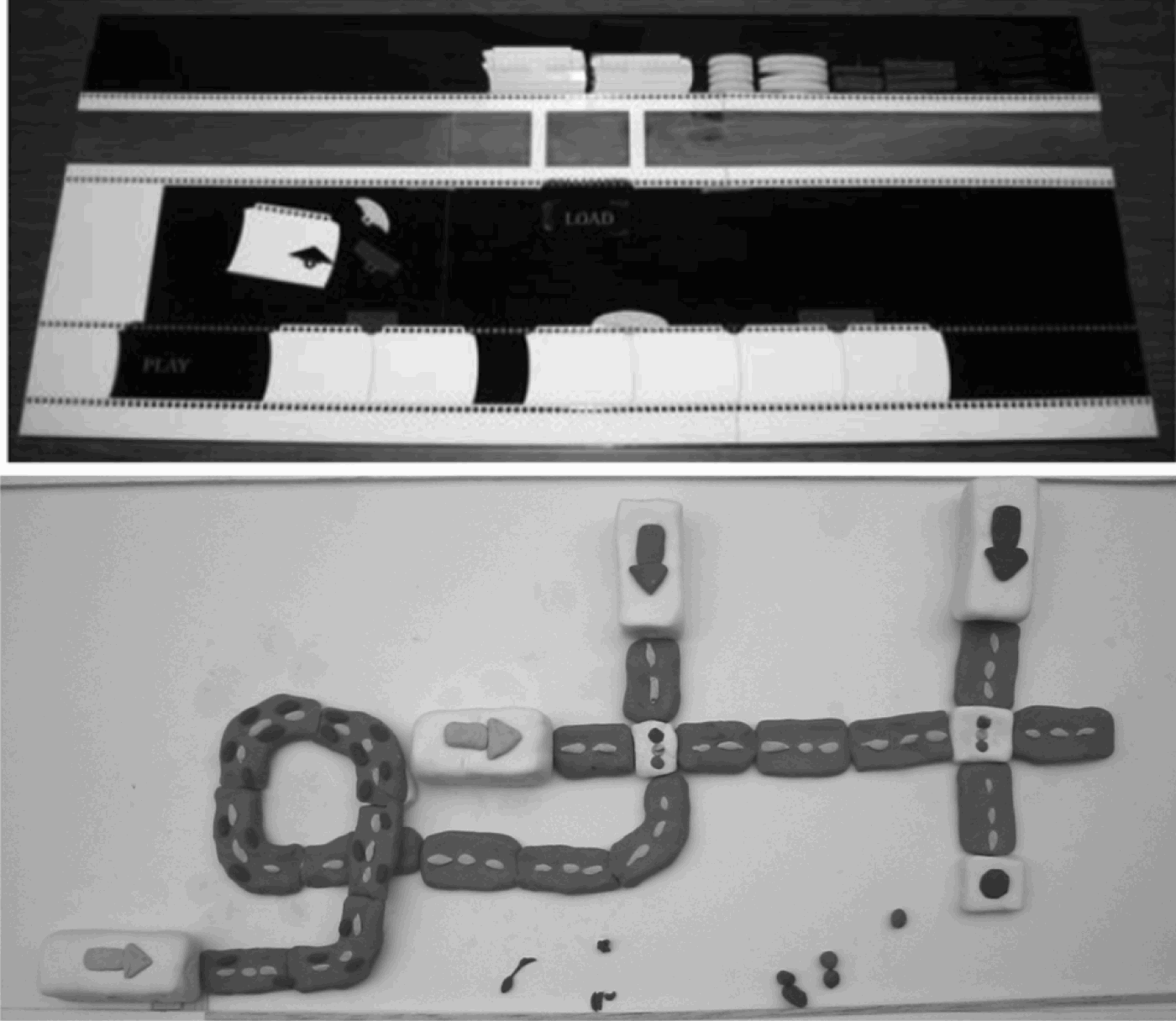
Prototypes are widely recognized as core means for exploring and expressing designs of interactive systems (Houde & Hill, Reference Houde, Hill, Helander, Landauer and Prabhu1997). We encourage students to create many design artifacts including sketches, low-fidelity prototypes, digital mockups, and interactive simulations. These design artifacts reinforce the concept of iterative design, while helping students to investigate open design questions regarding the function of a system, its look and feel, and alternative implementation techniques. The artifacts also help to facilitate the communication of ideas within the interdisciplinary teams. Throughout the course students create a series of artifacts, each representing a different aspect or view of the system. Students learn to create an effective storyboard to convey an interaction scenario, to use simple prototyping materials (such as prototyping clay, cardboard, and blue foam) to express ideas, and to build simple functional proof-of-concept prototypes. Figure 5 shows low-fidelity prototypes created to explore design considerations in two student projects. Both prototypes were built to investigate a design concept of surface-based interaction. By simulating the task and observing users interacting with these prototypes, the teams made significant modifications to their designs.
Low-fidelity prototypes of (top) the TVE system and (bottom) the traffic flow simulator (from laser cut acrylic and modeling clay).
4.2.5. Project technology
To translate low-fidelity prototypes into functional prototypes we introduce students to a selection of technologies that are portable, cross-platform, and open source. By necessity, we choose technology that fits within the budgetary and spatial constraints of our department, allowing students to use their own computers for development work.
Computer vision
Overall, computer vision has been the most popular technology choice for student projects. This is likely because many conceptual designs students create employ tabletop interaction techniques. One practical way to implement this style of interaction is to use computer vision to track the position of multiple objects on a two-dimensional surface while augmenting the surface with digital information using an LCD projector (e.g., Underkoffler & Ishii, Reference Underkoffler and Ishii1999). For software, we have found that fiducial-tracking toolkits tend to offer the easiest solution. These toolkits track objects tagged with various types of barcode-like symbols (fiducials). There are several good options available including TopCodes (http://hci.cs.tufts.edu/topcodes) and ARToolkit (http://www.hitl.washington.edu/artoolkit). Both systems are open source, well documented, and have been used in many student projects. Among the challenges involving the use of computer vision is that using fiducial-tracking toolkits requires some programming experience. Thus, this technology is less accessible to students who come from disciplines other than Computer Science, and, within our project teams, the task of implementing the computer vision component of a project is almost always the sole responsibility of students with programming backgrounds. From an educational point of view this limits knowledge transfer within a team. Furthermore, students almost always find the physical installation and calibration of a camera and an LCD projector above or below an interaction surface challenging and time consuming. To address these issues, we recommend installing a dedicated computer vision interaction surface if space is available.
Microprocessors and project boards
Building a project using a microprocessor emphasizes the embedded aspect of tangible interaction. Students in our class have used two different types of embedded technology: the Handy Board and the LEGO® MINDSTORMS® RCX. Both are cross-platform, easy to use, and provide excellent solutions for educational projects with limited input/output requirements. Two relatively new technology platforms are also now available, which we will incorporate into future classes. The first is the LEGO MINDSTORMS NXT kit, which has more sophisticated capabilities than its predecessor, including servo motor drivers and a variety of sensors such as a sonar range finder and a sound sensor. The second is the Arduino Diecimila (http://www.arduino.cc), an inexpensive, open-source prototyping platform that can be programmed directly through a USB cable using a PC or a Macintosh.
RFID
Introducing RFID technology to students is a provoking way to start discussion on both the power and potential ethical considerations of emerging HCI techniques. Student projects have made clever use of two different RFID systems in the course. The first is the OBID® i-scan RFID reader from FEIG Electronics. This device is capable of identifying multiple RFID tags at once, and can write a small amount of data to individual tags. The second is the Phidgets RFID reader (www.phidgets.com). This device is read-only and can only recognize one tag at a time; however, it is inexpensive, cross-platform, and easy to use.
Input–output (I/O) boards
I/O boards can be connected to a desktop or laptop computer through a USB cable and allow both digital and analog I/O. The Phidgets product line includes a number of useful I/O boards that are inexpensive and easily programmed on multiple platforms using the Phidgets API (www.phidgets.com). Keyboard emulators enable switch input to be easily read as keyboard events within any closed-source program. For example, the I-PAC arcade controller from Ultimarc is an input-only USB keyboard emulator that requires almost no programming experience, no driver installation, and can be used with a variety of operating systems. A minor shortcoming of keyboard emulation is that it inherits keyboard functionality such as key repeat events injected at the operating system level that is inappropriate for non keyboard use.
Sensing technology
A wide variety of sensors are available to allow embedded systems to react to users and changes in an environment. Igoe and O'sullivan (Reference Igoe and O'Sullivan2004) provide an excellent summary of devices that can be used with HandyBoards, Arduinos, or other microprocessors. There are also a variety of Phidgets products that provide the same capabilities for desktop or laptop computers.
4.2.6. Formal critique sessions
Art and architecture studio classes have a tradition of design critiques (crits) that serve as a form of evaluation of current ideas, exploration of future directions, and reflection. The conversation during a crit unveils the design rationale used during the design process. In our TUI Laboratory, we implement four formal crit sessions throughout the second part of the course as students develop their own interfaces. Instructors, students, guest domain experts, and expert interaction designers comprise crit panels. Our challenge as instructors is to create an atmosphere in which good ideas can surface while criticism can be openly discussed. Thus, we start each crit session by clearly defining goals and questions. Students then present their design and clarify their intentions, leading into an open discussion with the panel.
4.2.7. Reflection
Throughout the course we strongly emphasize reflection as means to promote long-term learning and sharing of knowledge. The structure of the course provides opportunities for students to face challenges, make mistakes, and reflect upon them. We implement several reflection techniques: blogging, retrospectives, and reflective questionnaires. All students are required to maintain a blog throughout the course, which serves as a design journal. Blogging enables students to reflect on their design process and decisions, communicate with the instructors and their peers, and share lessons learned with future course cohorts. Class retrospective sessions encourage students to share their experiences with other class members. In these sessions, held during the final stages of the project phase, each student shares her goals for the previous week, describes what went well, what went poorly, and why. These retrospective sessions allow students to learn from their peers and explore specific problems from multidisciplinary points of view. Finally, reflective questionnaires are given to students at the end of the course to allow for open reflection on their learning experience. Through their responses we learn about students' personal journeys throughout the course, about the challenges they faced, and about the insights they gathered.
5. COURSE RESULTS
In many ways, the TUI laboratory has exceeded our expectations. Students have created a wide variety of tangible interfaces that are outstanding for their creativity and innovation. Fourteen student projects were completed over the five semesters that the course was taught. Of these, 4 were extended into summer research projects involving a total of more than 10 students, and 3 resulted in publications in the Conferences on Tangible and Embedded Interaction (2007, 2008). In addition, 3 students continued on to pursue TUI research in doctoral studies both at Tufts and elsewhere, and 1 studio arts student developed an exhibit based on tangible interaction.
To determine the effectiveness of the course and of students' learning process, we rely on formal midterm and end of term course evaluations completed anonymously by students, and on informal evaluations such as reflective questionnaires, one on one conversations, and open discussions. In general, although some students had difficulty adjusting to the design studio approach, evaluations provided evidence that students found the course interesting, enjoyable, and motivating. Students immersed themselves in their projects with passion and enthusiasm. As one student described, “the project was something I was so excited about I wanted to do every part of it myself. I made a conscious effort to try not to step on anyone's toes. The only improvement I can think of would be meeting outside of class more . . .” Another student wrote, “this was my first “Studio” style class, and it was great. Lots of energy and enthusiasm. I would have liked to have had more classes between the start and finish.” Student feedback also helped us to refine the course structure and the topics it covers, as described in the following section.
5.1. Course evolution
Naturally, the course has evolved throughout the five semesters we have taught it. In this section we provide a brief description of the materials introduced and the challenges facing students in each cohort, as well as the adaptations we made in the course to mitigate these challenges.
5.1.1. Spring 2005
In our pilot semester we placed a stronger emphasis on the technological aspects of building tangibles than on the design aspects. We dedicated 4 weeks to introducing a variety of implementation technologies and to the completion of a team project aimed to demonstrate the use of implementation technologies. The technologies introduced included microcontrollers, RFID, and computer vision. Each team was assigned two technologies and successfully completed the task of demonstrating the use of these technologies in the context of tangible interaction. In the end, however, all student teams chose to implement their final project using computer vision. This choice of technology was influenced by a majority of computer science students who felt more confident using software-based implementation techniques than working with hardware. Furthermore, the choice of technology influenced the design space of student projects; all projects implemented an interactive surface style interface. Finally, to our surprise, despite the new technologies and implementation techniques learned, by the end of course, most students reported that they found the conceptual design part of their project as the most difficult. As one student described: “The biggest difficulties were conceptual. After deciding on the high-level concept, we struggled to refine the interaction techniques . . .” In addition, almost all students reported team dynamic challenges, specifically communication and work division problems.
5.1.2. Spring 2006
To mitigate the conceptual design challenges, we redesigned the course to devote more time to conceptual design and low-fidelity prototyping. We also introduced TUIML and incorporated it in two course assignments: the specification of an existing TUI and the specification and documentation of the final team project. Furthermore, we reassigned student teams for the final project. This way, each student worked with two different teams: one for the technology project and one for the final project of designing and building a TUI. These measures were reflected in the results of the end of course questionnaire. Students still found the conceptual design part of their project the most challenging; however, fewer students reported problems within their team. In addition, the students' final projects were considerably more diverse, both in terms of tangible interaction design and the implementation technologies used.
5.1.3. Spring 2007
Following students' feedback we revised TUIML and introduced a new version of the language that allowed students to use iconic representations to describe the structure of TUIs (see Fig. 4). We also presented the reality-based interaction framework and used it to discuss existing TUIs and to brainstorm. Furthermore, we introduced new implementation technologies and emphasized the use of tangible output in addition to tangible input. The course structure of Spring 2007 semester is described in Table 1. It reflects a shift of focus in the course from tangible implementation technologies (Spring 2005) to the design and implementation of novel tangible interactions. Student projects in this semester exhibited not only diversity but also considerable creativity and innovation. Two of the three projects implemented tangible output techniques, and another project made use of continuous interactions and improvised interactions. Students' feedback highlighted challenges that student faced in attempting to produce custom-made artifacts for their projects. Of interest, students still pointed to the conceptual design as the most difficult phase of their design process. This led us to further investigate the challenges inherent to tangible interaction design.
5.1.4. Summer 2007
We introduced to the curriculum rapid prototyping methods including silicon molding and the use of a laser cutter. This resulted in additional prototyping rounds and the production of well-designed custom-made artifacts for student projects. Team dynamics in this cohort were exceptional and led to the development of innovative and creative projects.
5.1.5. Spring 2008
We established a partnership with the Boston Museum of Science. Through this collaboration students were exposed to real-world design problems introduced by the museum staff and through visits to the museum. Museum staff attended four course sessions, brainstormed with the students, and critiqued finished projects. Although student projects were not ready for exhibition in the Museum by the end of the semester, we hope that students will choose to extend their projects with the possibility of exhibiting and evaluating them in the museum. Nevertheless, this collaboration motivated the students and resulted in high-quality projects that took into account the requirements unique to informal science learning in a museum environment.
6. CONCLUSION AND FUTURE WORK
Tangible interaction has shown promise to improve computer-mediated support for domains such as learning, problem solving, and design. However, designing tangible interaction is a complex process that encompasses multidisciplinary knowledge including engineering, art, and the social sciences. In this paper we shared our experiences teaching tangible interaction design in an interdisciplinary, project-based laboratory course over a period of 4 years at Tufts University. We designed our course to facilitate hands-on learning, reinforce the big ideas of HCI, foster innovation, and promote interdisciplinary collaboration. In doing so, we considered the particular constraints of our institution such as the lack of dedicated laboratory space and limited budget. We also confronted the need to cultivate a studio culture within a Computer Science department. We shared lessons learned over 4 years and provided recommendations for implementing tangible interaction courses in institutions with similar constraints.
We have two primary future goals for the course. First, we plan to teach this course in the Computer Science department at Wellesley College. This will require us to adapt the course for an undergraduate women's liberal arts college environment. We believe that the interdisciplinary nature of the course will attract students from a variety of disciplines, and thus will help introduce young women to computing through a nontraditional path. It will be interesting to see in what ways teaching this course in a single-gender college will differ from its current version in a coeducational environment. Second, we plan to strengthen our collaboration with the Boston Museum of Science, while emphasizing the topic of tangible interaction support for informal science learning. As tangible interaction offers potential benefits for learning such as support for colocated collaboration and tangible thinking, we believe that there is a strong basis for enhancing the collaboration between the course and the Boston Museum of Science. Students may assist exhibition designers develop new ideas and solutions, whereas the museum forum can provide students with inspiration for their projects as well as with potential showcase and opportunities to evaluate their projects with users in real-world environments.
ACKNOWLEDGMENTS
We thank Ken Camarata, Ellen Yi-Luen Do, and Mark Gross for inspiring us through their Physical Computing Studio and assisting us with the design of our first TUI laboratory course; the Department of Computer Science at Tufts University for supporting this nontraditional course; and Hiroshi Ishii and the Tangible Media Group at the MIT Media Lab for close collaboration and exchange of ideas and speakers. We are grateful to our guests Angela Chang and Jamie Zigelbaum from the MIT Media Lab; Daniel Dennett from the Tufts' Philosophy Department; Paul Lehrman from the Tufts' Music Department; and Erin Solovey, Audrey Girouard, and Leanne Hirshfield from the Tufts HCI research lab for their feedback and advice to the students. We also thank the Boston Museum of Science for fruitful collaboration, specifically Taleen Agulian, Lucy Kirshner, Dan Noren, Bill Rogers, Deb Souvinee, and Peter Wong for volunteering their time to meet with students and explaining the process of designing interactions to support informal science learning in museum settings. Finally, we thank the students of the TUI laboratory for sharing with us their enthusiasm, creativity, and insights. Support for our research in the area of tangible interaction was provided by NSF Grant EHR-0227879 on wireless networks and NSF Grant IIS-0414389 on reality-based interaction.
Orit Shaer is an Assistant Professor of computer science at Wellesley College. Orit received her PhD and MS in computer science from Tufts University. She was a Visiting Researcher in the Design Machine Group at the University of Washington and in the University College London Interaction Center. Dr. Shaer previously served as a System Engineer at Orbotech Ltd., where she led an interdisciplinary development team. Her research in HCI focuses on developing interaction techniques and software tools for next generation user interfaces.
Michael Horn is a PhD candidate in computer science at Tufts University. He also serves as a Faculty Associate in the Problem Solving With Discrete Mathematics Workshops for grade 5–9 teachers. Michael received an undergraduate degree in computer science from Brown University. As a graduate student he spent 2 years as an NSF GK-12 Fellow working in a local K–8 school. His research interests include exploring innovative ways to integrate appropriate and useful technology into K–12 classrooms. In particular, he is interested in educational programming languages and the opportunities created by TUI technology.
Robert Jacob is a Professor of computer science at Tufts University. He was also a Visiting Professor at the MIT Media Laboratory in the Tangible Media Group. Before coming to Tufts, he was in the Human–Computer Interaction Lab at the Naval Research Laboratory. He received his PhD from Johns Hopkins University. He was Papers Co-Chair of CHI 2001, Co-chair of UIST 2007, and Vice-President of SIGCHI. He was elected to the ACM CHI Academy in 2007. Dr. Jacob's research interests are new interaction media and techniques and user interface software.