


It is the custom of these natives—even of practically all the Christians—to bury their dead either within the dwelling-house or beneath the eaves just outside. The body, wrapped in mats and bark-cloth, is interred six feet or so beneath the surface of the soil. Since this is usually of a porous, sandy nature there appears to be no offence to the living and the custom is not so unhygienic as it seems at first hearing. Even with the coming of Christianity there are few cases of churchyard burial, and cemeteries as such have hardly begun to exist. This adhesion to the ancient custom is an indication of the strength of kinship sentiment [Firth Reference Firth1936:77–78].
As Raymond Firth (Reference Firth1936) observed nearly a hundred years ago, the colonization of the Pacific islands and the spread of Christianity eventually came to overpower traditions of burying people in and around the house. Today, neither the Tikopia nor a vast majority of communities around the world practice residential burial. Despite a great diversity of mortuary practices and ways of dealing with death (Williams et al. Reference Williams, Feinman and Ynoñán2022), residential burial—“the practice of burying the deceased in and around houses” (Adams and King Reference Adams and King2010:1)—is a global phenomenon attested mainly through archaeological evidence. For example, in addition to the well-known ethnographic cases of residential burials on the island of Sumba, Indonesia (Adams and Kusumawati Reference Adams and Kusumawati2010) and Tikopia in the Pacific (Firth Reference Firth1936), archaeologists also have documented the practice of residential burials among the late prehistoric and early Cherokee cultures of the Southern Appalachians (Sullivan and Rodning Reference Sullivan and Rodning2011), in Classic–Early Postclassic Oaxaca, Mexico (Adams and King Reference Adams and King2010; Feinman and Nicholas Reference Feinman and Nicholas2024), in prehispanic Honduras (Joyce Reference Joyce2010), in the late prehistoric highland Andes (Earle et al. Reference Earle, D’Altroy, Hastorf, Scott, Costin, Russell and Sandefur1987), during the Metal Age in Thailand (approx. 2100 BC; White and Eyre Reference White and Eyre2010), and in Neolithic and Bronze Age contexts in Anatolia (Cveček and Schwall Reference Cveček and Schwall2022; Cveček et al. Reference Cveček, Sabina, Özbal, Selim Erdal, Stefanović, Şimşek and Aydoğan2024; Helwing Reference Helwing, Restelli, Cardarelli, Di Nocera, Manzanilla, Mori, Palumbi and Pittman2020; Laneri Reference Laneri2011; Lichter Reference Lichter and Yalçın2016; Yıldırım et al. Reference Yıldırım, Hackley and Steadman2018), among many others.
Using cross-cultural ethnographic data, researchers have long relied on comparative approaches to interpret the social motivations behind mortuary practices, arguing that variation in funerary treatment reflects underlying social organization and cultural beliefs (Binford Reference Binford1971; Carr Reference Carr1995; Goldstein Reference Goldstein, Chapman, Kinnes and Randsborg1981; Saxe Reference Saxe1970). Comparative studies have suggested, for example, that formal cemeteries often emerge where descent or corporate groups use burial places to legitimize claims to land and resources (Goldstein Reference Goldstein, Chapman, Kinnes and Randsborg1981; Saxe Reference Saxe1970), and that funerary practices are shaped by cosmological beliefs about the soul and the afterlife as well as by social factors such as age (Carr Reference Carr1995). Underlying these approaches is the assumption that variability in the archaeological record can be interpreted through patterns observed in ethnography. Whereas systematic cross-cultural studies have largely focused on cemeteries (see Goldstein Reference Goldstein, Chapman, Kinnes and Randsborg1981; Saxe Reference Saxe1970), residential burials have received comparatively little attention and remain relatively undertheorized (see Semple and Brookes Reference Semple and Brookes2020).
In this article, we initially wanted to compare the frequency of residential burials in ethnographic and ethnohistoric contexts to assess whether residential permanence—the long-term occupation of a settlement or household, indicating limited mobility and sustained attachment to a particular place—impacted the practice of residential burials in different cultural contexts. This test is informed by anthropological theories linking mobility, placemaking, and mortuary practice, which suggest that long-term residence fosters stronger ties between households, ancestors, and specific locations (Binford Reference Binford1971; O’Shea Reference O’Shea1984; Parker Pearson Reference Parker Pearson1999; Tringham Reference Tringham2000; Ucko Reference Ucko1969). To test whether the degree of residential permanence influenced the occurrence of residential burial, we examined whether such burials appear more frequently in relatively sedentary contexts than in highly mobile ones. As our results will show, degree of residential permanence does not predict the likelihood of residential burial in either the ethnographic or archaeological samples. However, our ethnographic data suggest that the practice of residential burial may have been impacted by historical processes of colonialism and, specifically, by the adoption of Christianity and other monotheistic religions in many parts of the world. Nevertheless, practices other than residential burial as well as shifts from residential burials to external funerary placement in cemeteries both predate colonialism and monotheistic religions (see Gallis Reference Gallis1979; Hill Reference Hill, Tarlow and Stutz2013; Sheets and Sever Reference Sheets, Sever, Wiseman and El-Baz2007). The technique of using ethnographic and ethnohistoric records to generate middle-range models for investigating archaeological data remains a valid methodological practice, but the impacts of colonialism and globalization on accounts from the ethnographic present also need to be considered. We seek here to strengthen the relationships between ethnographic and archaeological research around common theoretical issues.
Research Questions and Methods
Through burial practice, it is believed that the living create, affirm, and transform social relationships with those who have passed (Adams and Kusumawati Reference Adams and Kusumawati2010; Firth Reference Firth1936; Hertz Reference Hertz1960; O’Shea Reference O’Shea1984; Parker Pearson Reference Parker Pearson1999). Interring the dead in settlements, sometimes even below house floors, makes ancestors enduring participants in daily life (Hodder and Cessford Reference Hodder and Cessford2004; Parker Pearson Reference Parker Pearson1999; Tringham Reference Tringham2000). Practices of residential burial establish continuities between generations, anchor memory in place, and inscribe kinship, power, inheritance, and ritual within the spaces where the living are situated. Residential burials do not mark biological death as an end to social bonds but indicate their reconfiguration, tying households and communities to both histories and futures in the making (Bloch and Parry Reference Bloch and Parry1982; Cveček et al. Reference Cveček, Sabina, Özbal, Selim Erdal, Stefanović, Şimşek and Aydoğan2024; Firth Reference Firth1936; Goody Reference Goody1962; Hertz Reference Hertz1960; Hodder and Cessford Reference Hodder and Cessford2004; Tringham Reference Tringham2000). Why, then, do some people bury their dead in or near residences and others do not? How might ethnography guide or obscure our interpretation of these intimate contexts in the archaeological record? These questions formed the starting point for our inquiry into residential burial on a global scale in the ethnographic and archaeological records.
To address these questions, we used information from 60 ethnographically documented cultures in the Probability Sample Files in the eHRAF World Cultures database (https://ehrafworldcultures.yale.edu/). The aim was to examine residential burial practices across these cases. However, given the limited occurrence of residential burial in those 60 case studies, we soon realized that the ethnographic record did not mirror the patterns familiar to archaeologists. Ethnographic descriptions tend to highlight changes in burial practice, often linked with the spread of monotheistic religions, such as those Firth (Reference Firth1936) observed in the early twentieth century among the Tikopia. As a result, our questions and interest shifted to how a systematic cross-cultural study of residential burial based on the ethnographic record compared to the archaeological record.
We then asked whether an archaeological sample would differ significantly from the ethnographic sample. Coding residential burial in 49 cultures made up a simple random sample (SRS) from eHRAF Archaeology (https://ehrafarchaeology.yale.edu/). A comparison of these two datasets revealed that residential burials were more prevalent in archaeological as opposed to ethnographic contexts. These findings have important implications for the use of ethnographic analogy when the aim is to understand mortuary (or other related) practices in the archaeological record.
Whereas ethnographic descriptions can help us understand the reasons for change in mortuary placement, the ethnographic record does not fully capture the more frequent occurrence of residential burial, which is apparent in the archaeological record. Therefore, instead of the more conventional use of ethnographic analogy for archaeological interpretation (i.e., for formulating hypotheses; see Ascher Reference Ascher1961; Binford Reference Binford1967, Reference Binford1980; Carneiro Reference Carneiro and Parkinson2002; Clark Reference Clark and Grimes1951; Cveček Reference Cveček2022; Cveček et al. Reference Cveček, Sabina, Özbal, Selim Erdal, Stefanović, Şimşek and Aydoğan2024; Earle Reference Earle1997; Ember and Ember Reference Ember and Ember1995; Feinman and Neitzel Reference Feinman, Neitzel and Schiffer1984; Peregrine Reference Peregrine2001; Spriggs Reference Spriggs2008; Wylie Reference Wylie1985), our study illustrates how archaeological insights can be used in conjunction with ethnography to develop and test sociocultural theories of permanent residence, kinship, and social structure. The ethnographic studies in our dataset, which derive mainly from the twentieth century, have only a small percentage of cases with residential burials. The more frequent occurrence of this practice in archaeological samples indicates that the archaeological record represents a broader array of different burial behaviors than those represented in the ethnographic record. Whereas contemporary peoples rarely bury ancestors at home, places such as houses, huts, and settlements were much more often where both the living and the dead coexisted—and felt at home—in the past.
We first discuss how traditions of funerary placement can be used to model social organization and reflect diachronic changes. Then, we discuss the role of ethnographic analogy in archaeological explanation and present results from the two datasets on residential burial, based on 60 ethnographic and 49 archaeological cases. These cases suggest a decline in the practice of residential burial at different points in the past while also highlighting a more recent global shift away from residential burial. These findings underscore the value of archaeological evidence, which can illuminate a diversity of burial practices that have decreased significantly in the ethnographic present but not fully disappeared. Our results have implications not only for our understanding of cross-cultural burial patterns and how they changed in response to other societal changes but also (more generally) for how archaeologists employ ethnographic data and analogy when interpreting the archaeological record.
Social Placement of the Dead
Why are burials so important? Funerary practice is ideal for cross-cultural, anthropological studies that combine ethnographic and archaeological data (Binford Reference Binford1971; Carr Reference Carr1995; Cveček et al. Reference Cveček, Sabina, Özbal, Selim Erdal, Stefanović, Şimşek and Aydoğan2024; Goldstein Reference Goldstein, Chapman, Kinnes and Randsborg1981; Parker Pearson Reference Parker Pearson1999; Saxe Reference Saxe1970; Ucko Reference Ucko1969). It is visible and broadly recorded in both research databases. More importantly, these ritual practices document how social organizations are created and materialized (Carr Reference Carr1995; Goldstein Reference Goldstein, Chapman, Kinnes and Randsborg1981; Saxe Reference Saxe1970; Ucko Reference Ucko1969). Burial is a socially and emotionally dramatic moment in individual life cycles—a moment of making, showing, and reaffirming relationships (Gillespie Reference Gillespie2002; Hodder and Cessford Reference Hodder and Cessford2004; Tringham Reference Tringham2000). Arguably, funerary rituals make kinship between the living and the dead, and the memory of the event, the spatial placement of the dead, and the physical markers (memorials) help those kinship relationships to endure (Bloch and Parry Reference Bloch and Parry1982; Cveček et al. Reference Cveček, Sabina, Özbal, Selim Erdal, Stefanović, Şimşek and Aydoğan2024; Feinman and Williams Reference Feinman, Williams, Williams, Feinman and Ynoñán2022; Goody Reference Goody1959, Reference Goody1962; Parker Pearson Reference Parker Pearson1999; Scheper-Hughes Reference Scheper-Hughes1992; Tringham Reference Tringham2000; Ucko Reference Ucko1969). By combining emotion, social ceremony, and reaffirmation, funerary practices are critical to institutional formation. Moreover, the relationship between settlement continuity and intramural interments aligns with the view of other scholars who suggested that residential burial does not merely tie the living to their ancestors but also links to a dwelling and the land it sits on (Gillespie Reference Gillespie2002; Hodder and Cessford Reference Hodder and Cessford2004; Tringham Reference Tringham2000). In many contexts, connections were affirmed and reaffirmed through the sequential reuse of mortuary contexts and the conduct of ritual activities adjacent to them (e.g., Middleton et al. Reference Middleton, Feinman and Villegas1998; Wrobel et al. Reference Wrobel, Alejandro López Pérez and Ebert2021).
Necrogeography—the use of the dead to structure, mark, and reinforce the taskscapes of the living—has been an integral aspect of both prehuman and human practices for thousands of years (Semple and Brookes Reference Semple and Brookes2020). The spatial relationship between the living and the dead can, however, also become a matter of political intervention. In the late nineteenth-century Ghanaian Gold Coast, colonial British law was revised six times to mandate and enforce the transition from residential interments to community cemeteries. Moving the resting place for ancestors to locations outside the house has implications beyond the spiritual: “the colonial state enforced cemetery burial because they realized Gold Coast people would never sell their land if it contained the remains of their elders; cemeteries were therefore a crucial tool in the transformation of land into private property for state dispossession” (Balakrishnan Reference Balakrishnan2022:1). Consequentially, the movement of the deceased to community cemeteries led to changes in interpersonal networks and the relationship of the community with the supernatural, their ancestors, and property. Even after some converted to Christianity, colonial-era Ghanaians initially resisted moving burial locations. Funerary customs can be a core extension of personal identity and connection to place so generally that they are not easy to change. Although the set of factors and circumstances that prompted householders to shift their funerary practices and reposition their ancestors outside their houses varied from one historical case to another, the behavioral ramifications in most contexts likely extended well beyond the spiritual to social networks and material possessions (for another example of wider implications related to burial practices, see Ojo Reference Ojo2017).
This connection between burial location and broader social organization has long been explored in anthropological and archaeological studies of kinship and descent groups. In particular, cross-cultural research has suggested that formal cemeteries frequently emerge where corporate groups use burial places to legitimize claims to land and resources (Goldstein Reference Goldstein, Chapman, Kinnes and Randsborg1981; Saxe Reference Saxe1970). However, kinship studies have a long history in anthropology with a particular salience for British social anthropologists who examined variability in structural forms that governed broader social practices (Radcliffe-Brown Reference Radcliffe-Brown1952). Implicit to understanding kinship is that the organization that it implies is essential to group and individual operations and survival. The approach of British social anthropology was fundamentally that of social science, looking for systematic patterning affecting group reproduction (Evans-Pritchard Reference Evans-Pritchard1940; Firth Reference Firth1961; Gellner Reference Gellner1960; Goody Reference Goody1990; Needham Reference Needham1971; Radcliffe-Brown Reference Radcliffe-Brown1941, Reference Radcliffe-Brown1952; Richards Reference Richards, Radcliffe-Brown and Forde1950). Although criticized for the functionalist logic of the social body, the approach can and should be reconceptualized as social networks in which active participants make kinship through blood or other means (Carsten Reference Carsten2000; Gzesh Reference Gzesh2022; Weston Reference Weston1991) as well as break kinship ties (Goldfarb and Bamford Reference Goldfarb and Bamford2025) for historical and strategic goals. This is captured in the concept of kinship making that recognizes dynamic ways in which different individuals, households, and larger social networks can coexist and evolve (Cveček Reference Cveček2022). Using the HRAF Collection of Ethnography (in paper, fiche, or online as eHRAF World Cultures), substantial comparative studies seek to understand variation in kinship patterns (Ember and Ember Reference Ember and Ember1983), and we hope that by looking at funerary practice, we can document dynamic moments when kinship is formed, given degrees of permanence, or reconstituted through memories and material marking. This is the basis for our comparative study, looking for regular patterns with implied causal relationships between burial practice and the degree of permanent residence. Whereas cross-cultural comparison in this article focuses exclusively on the link between residence permanence and residential burial, a follow-up study could explore the link between kinship and residential burial practices.
Why do the living care deeply about the dead and choose to place the dead systematically according to specific cultural practices? In some cases, they appear not to; in others, it is highly variable, and it often follows specific cultural rules. Humans deal with the dead in ways that vary across time and space (Hertz Reference Hertz1960; Scheper-Hughes Reference Scheper-Hughes1992; Semple and Brookes Reference Semple and Brookes2020; Ucko Reference Ucko1969; Weiss-Krejci et al. Reference Weiss-Krejci, Becker and Schwyzer2022; Williams et al. Reference Williams, Feinman and Ynoñán2022), and reasonably, this important moment in the life cycle engages both continuity and change in social relations, as especially manifest in kinship that funerary placement of the dead reflects. Thinking materially (which is so basic to social science reasoning), people care about the dead, especially because of inheritance—the social roles that the living take from the dead and that give them access to particular resources, including land and its productive potential (Goldstein Reference Goldstein, Chapman, Kinnes and Randsborg1981; Goody Reference Goody1962; Saxe Reference Saxe1970).
An Ethnographic Vignette: Courtyard Burial, House, and Inheritance
Across many societies, burial within domestic space links the dead to the continuity of the house, inheritance, and the reproduction of kinship across generations. To illuminate the social processes embedded in residential burial, we draw on one well-documented ethnographic case. Because such contextual information is rarely available in archaeological contexts, this vignette helps bridge ethnographic and archaeological perspectives. For example, among the LoWiili, Jack Goody (Reference Goody1962) documented the funerary placement of the grandfathers in front of the house that the deceased man had established. Except for the royal family, which followed matrilineal descent, given that the king was succeeded by his sister’s son, LoWiili followed patrilineal descent, and inheritance was traced through the male line. Goody (Reference Goody1962) observed that for the three days of the pre-burial rites, the grandfather remained with his back resting against the house he created, squatting on the same byre door or wooden bench where he as an old man had spent so large a part of his day. According to Goody, although the
LoDagaba do not differentiate a grandparent in this same manner, in both communities, he is accorded a special form of burial. He is not buried in the cemetery serving a group of houses—in the graves (mwo puo), as the LoDagaa say, that is, in the uncultivated land—but in a grave dug in the courtyard of his own home. For it is he who has successfully established that home by producing two generations of descendants, an achievement that is recognized by this distinctive treatment [Goody Reference Goody1962:79].
The LoWiili case wonderfully depicts the difference between kinship practices among the ruling elite (matrilineal) and the tracing of descent among the commoners (patrilineal), as well as the distinction between who is buried in residential burials and who is buried in cemeteries. For example, Goody noted that
In ordinary burials it is customary to dig a new grave (bo zio, a “red” grave) in the local cemetery for each group of full brothers, a long and arduous procedure. There is approximately one cemetery for each patrilineage, the members of which usually live close together. Burial is a matter of locality rather than of descent; husbands and wives and members of other lineages living in the same house are all buried in the neighbourhood cemetery, the location of which is determined partly by dislike of transporting a rotten corpse for any great distance and partly by the need for sufficient depth of soil in which to dig. Interment in a cemetery is known as burial in the bush, mwo puo [Goody Reference Goody1962:142; italics in original].
Based on Goody’s (Reference Goody1962) distinction between residential burials and graves in a cemetery among the LoWiili, we can draw an important distinction: whereas descent and inheritance play an important role in residential burial, burial in a cemetery is a matter of “locality [residence] rather than of descent” (Goody Reference Goody1962:142). Therefore, in ancient DNA studies, it is reasonable to infer residence patterns from cemeteries, whereas descent and inheritance appear to be more pronounced within residential burials. If individuals from different lineages lived together and were buried in a shared cemetery, ancient DNA would likely show a mix of unrelated individuals alongside clusters of genetic pedigrees, indicating a community-level burial space tied to place rather than a single descent group. At several Neolithic sites in Europe, unrelated males and females have already been found buried alongside biologically related individuals. For example, five genetically male and three genetically female individuals identified as “non-lineage” individuals were found at Hazleton North (Fowler et al. Reference Fowler, Olalde, Cummings, Armit, Büster, Cuthbert, Rohland, Cheronet, Pinhasi and Reich2022:Table 1), whereas nine genetically female and three genetically male individuals interpreted as “unlinked unrelated individuals” were identified at Gurgy (Rivollat et al. Reference Rivollat, Rohrlach, Ringbauer, Childebayeva, Mendisco, Barquera and Szolek2023:Table 1). Together, this evidence indicates that Neolithic burial communities incorporated individuals beyond a single biological lineage, pointing to more inclusive and socially defined forms of kinship and belonging, not exclusively structured by biological relatedness.
Evaluating the linkage between ethnographic and archaeological evidence, our goal is to understand how kinship patterns vary and are represented in funerary practice; therefore, the material significance of practices must be considered. Kinship cross-culturally functions to determine a person’s place in economic and sociopolitical networks, with their benefits and obligations. The relationship people have with the dead determines rights and obligations in things owned by the group and labor obligated to the group. For example, “the most prominent man-made feature of the Baegu landscape [in the Solomon Islands] and the physical focus of Baegu religious life is the shrine and sacred grove” (Ross Reference Ross1973:194). Here, the ancestors were buried and venerated with regular ceremonies. To be a member of a local clan and to claim rights to its land, an individual must be able to identify a linking ancestral kin buried in the sacred grove. Kinship materialized in burial determines inherited rights and obligations—the essential construction of social, economic, and political order that can be investigated cross-culturally.
Ethnographic Analogy and Archaeological Interpretation
A hallmark of the New Archaeology was an epistemological focus on making reasonable inferences about the past that were rooted in ethnography, ethnohistory, or experimentation. Binford’s (Reference Binford1967, Reference Binford1981; Binford and Binford Reference Binford, Binford, Sally R. and Binford1968) concept of “middle-range theory” relied on invoking precedent from the modern or historically documented world to make inferences that linked archaeological phenomena with dynamic cultural practices (see also Raab and Goodyear Reference Raab and Goodyear1984)—a sort of cultural uniformitarianism. Although some archaeologists (e.g., Wobst Reference Wobst1978) shared their concerns about the potential for a reliance on ethnographic datasets to limit the archaeological understanding of past societies, many adopted the use of ethnographic analogy, either explicitly or implicitly, into their methodology (Binford Reference Binford1962; Carr Reference Carr1995; Goldstein Reference Goldstein, Chapman, Kinnes and Randsborg1981; Parker Pearson Reference Parker Pearson1999; Saxe Reference Saxe1970; Ucko Reference Ucko1969). Interestingly, the vast majority of subsequent discussions about the use of ethnographic analogy in archaeology focused on hunting and gathering contexts (Hayter Reference Hayter1994); indeed, with a few exceptions, the nascent field of ethnoarchaeology focused almost exclusively on paleoanthropological and hunter-gatherer societies, especially highly mobile communities in the Arctic (e.g., Binford Reference Binford1978) or sub-Saharan Africa (e.g., Yellen Reference Yellen1977; see also Atherton Reference Atherton1983). Correspondingly, most archaeological models that were built explicitly on ethnographic analogy with modern societies focused on aspects of cultural practice that were important—and relevant—to archaeologists studying mobile hunting and gathering societies, including topics such as subsistence, trade, technology, and resource extraction.
Fewer ethnoarchaeological studies have focused specifically on sedentary, agricultural communities. There are some exceptions, such as Pétrequin and Pétrequin’s (Reference Pétrequin and Pétrequin2020) study of stone axe production in Irian Jaya, but, like that example, many ethnoarchaeological studies of sedentary, farming communities focus on specific technologies or aspects of economic or political organization (e.g., Hodder Reference Hodder1982). In the absence of holistic ethnoarchaeological studies, archaeologists frequently turn to the ethnographic and ethnohistoric records for establishing middle-range arguments about economic and political organization, as well as about other practices including residential patterns (e.g., Divale Reference Divale1974; Ember Reference Ember1973) and ritual traditions, including mortuary customs (Binford Reference Binford1962; Carr Reference Carr1995; Goldstein Reference Goldstein, Chapman, Kinnes and Randsborg1981; Saxe Reference Saxe1970; Ucko Reference Ucko1969).
Middle-range theory, however, is based on presumptions that traditions documented in ethnographic and ethnohistoric records are roughly representative of those represented in the archaeological record, and that for key practices, continuities would extend from the deep archaeological past to contemporary (descendant) communities. Yet, as we suggest here, some traditional practices such as mortuary behavior were impacted dramatically by processes of colonization, religious transition, and shifts in property rights, and these shifts must be taken into account (see Balakrishnan Reference Balakrishnan2022; Mukherjea Reference Mukherjea1962:26). The changes in burial practices likely also apply to other aspects of social organization that would have been affected by impacts of colonial contexts and the adoption of different religious traditions.
Residential Burials in a Cross-Cultural Perspective
This article is the first systematic, comparative study of funerary placement—in particular, residential burials—comparing archaeological and ethnographic datasets. We follow the definition of residential burials proposed by Adams and King (Reference Adams and King2010:3), who defined it as “burials within houses as well as burials in outdoor living areas, where everyday domestic activities occur and where a clear spatial relationship between the living area and the domestic structure.” This definition of residential burial is broader in scope than subfloor burial or intramural burial and is flexible enough to encompass a range of important variations (see also McAnany Reference McAnany2010).
Datasets
We compare funerary patterns from two distinct ethnographic and archaeological data samples. The first dataset consists of the 60 societies (largely nonindustrial) that comprise the Probability Sample Files (PSF) now included in the eHRAF World Cultures database (https://ehrafworldcultures.yale.edu/). The PSF was created using a stratified random sampling method. The world was divided into 60 cultural regions (strata), and one society from each region was randomly selected from a list of groups that met specific data quality standards—such as having at least 1,200 pages of ethnography on a community or another delimited focus, having material from two authors, at least one of whom is a trained professional anthropologist, and whose ethnographies are well reputed (HRAF Quality Control Sample Universe 1967; Lagacé Reference Lagacé1979; Naroll Reference Naroll1967). The chosen sample captures variation in residential burial in different ecological, sociopolitical, and economic settings as represented ethnographically.
The second dataset consists of 49 cases that, as of 2022, comprise the Simple Random Sample (SRS) in the eHRAF Archaeology database (https://ehrafarchaeology.yale.edu/). The SRS is drawn from the Outline of Archaeological Traditions, a comprehensive catalog of known prehistoric archaeological traditions compiled by Peter N. Peregrine (Reference Peregrine2010) with the advice from a board of advisors.
Search Strategy and Coding
Our eHRAF search strategy consisted of an advanced search for the ethnographic culture or the archaeological tradition in eHRAF along with “Burial Practices and Funerals” (764) in Subject Search or for any of the keywords or phrases “burial*,” “hut burial*,” “house burial*,” “intramural burial*,” and “subfloor burial*.”Footnote 1
For coding of residential burials from PSF entries in eHRAF World Cultures (Supplementary Material 4), we have considered paragraphs provided by selected authors and bibliography listed in the HRAF Cross-Cultural Concordance (https://hraf.yale.edu/cross-cultural-concordance/#/), a database that matches pertinent documents across 10 different cross-cultural samples. For this purpose, using “filter samples,” matches were identified between eHRAF World Cultures, the PSF, and the Ethnographic Atlas (Murdock Reference Murdock1967). The latter sample not only had coded data we planned to use to measure degree of residential permanence (a variable called Settlement Patterns) but also included a specific time and place for all coded variables. An important strategy for minimizing measurement error is to code all variables for the same foci (Ember and Ember Reference Ember and Ember2009). The Settlement Pattern data (variable EA030) were downloaded from D-PLACE (https://d-place.org/; Murdock et al. Reference Murdock, Textor, Herbert Barry III, Gray and Divale2024). Murdock’s (Reference Murdock1967) eight categories of residential permanence (what he calls “mobility”) were merged into three: nonpermanent (Murdock’s Nomadic), semipermanent (Murdock’s Seminomadic, Semisedentary, Impermanent), and permanent (Murdock’s Dispersed Homesteads, Hamlets, Village/Towns, and Complex Permanent [Supplementary Material 5]). Coding of Settlement Patterns (EA030) is therefore used as a proxy for residential permanence—ranging from nomadic camps to permanent villages—and closely reflects how frequently groups relocate their residence. For coding residential permanence for the Archaeology sample (Supplementary Material 5), the first author read the summaries of settlement patterns and other sections in the Encyclopedia of Prehistory (Peregrine and Ember Reference Peregrine and Ember2001) for each archaeological culture and coded nonpermanent, semipermanent, and permanent communities.
Three variations of residential burial were distinguished: (1) communities in which almost everyone was buried under a house/domestic structure, (2) communities in which some were buried under a house/domestic structure, and (3) communities in which some were buried inside a settlement, near a house/domestic structure, a hut, wall, or a midden.
Evidently, a community may practice multiple ways to dispose of the dead. Therefore, if some community members were buried according to the definition of the residential burial. whereas others either were not buried or were buried outside the settlement, it was coded as a community with residential burial of type (2) or (3). “Other Funerary Treatments” included cases in which (a) communities bury outside settlement in a single burial feature (barrow, kurgan, bush) or (b) bury outside settlement in a cemetery, burial ground, or burial mound away from the site. In cases when (c) communities practiced various mortuary traditions that did not include residential burial (e.g., burial in a cave and in the forest, or burial in a cave and burial ground), it was coded under “Multiple Traditions.” For the ethnographic record, cases that predominantly practiced cremation or exposure (the latter being invisible archaeologically but suggested by the lack of burial documentation) were considered type (d). See Supplementary Material 1 for the coding of ethnographic cases and Supplementary Material 2 for the coding of archaeological cases.
Results
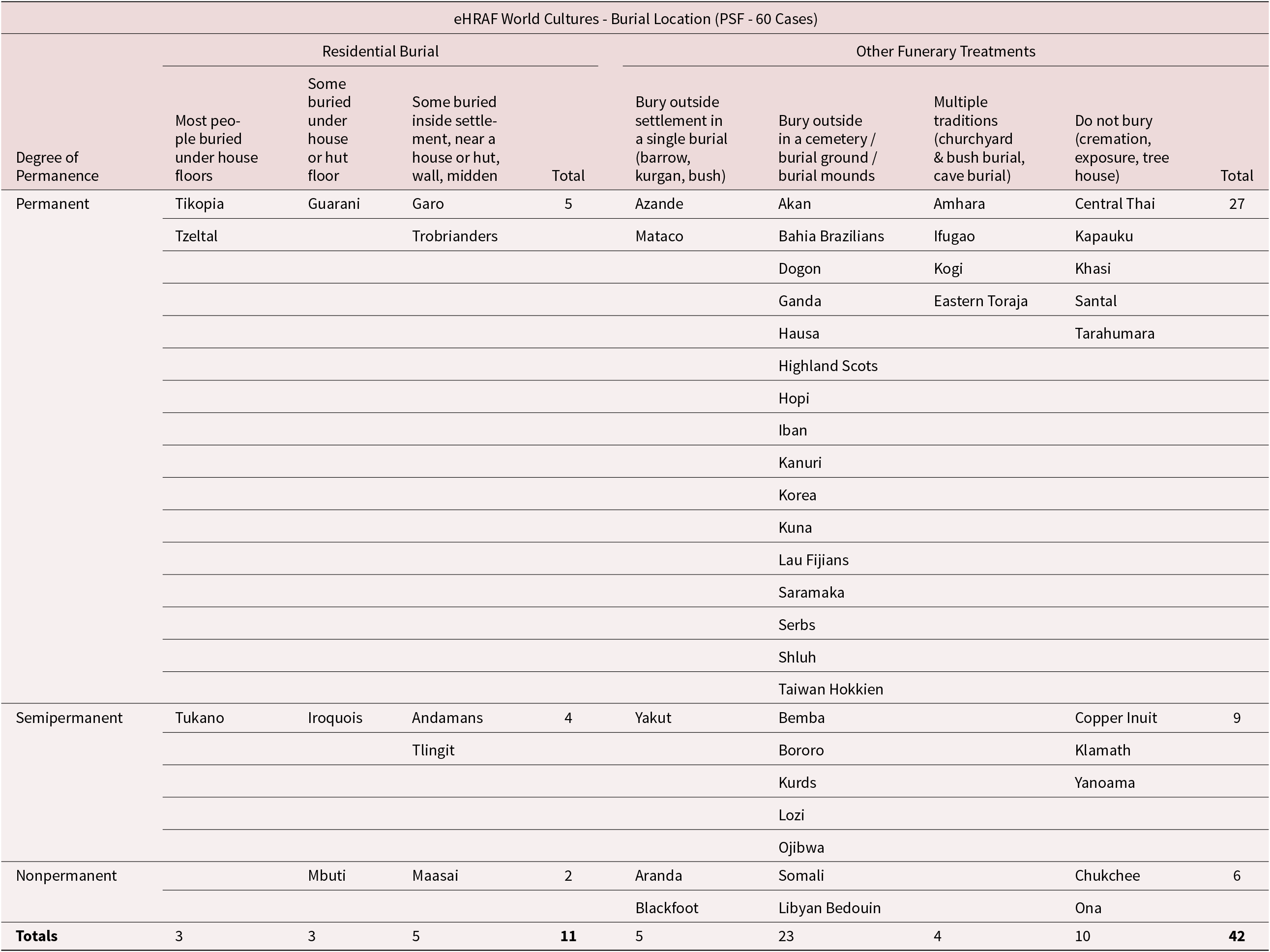
Comparing these samples, we found that residential burials are significantly more common in archaeological than in ethnographic datasets. For example, in the Ethnographic sample (Table 1), out of 53 communities for which the information on mortuary practice was coded, 11 communities (21%) practiced residential burial, and 42 communities (79%) practiced other mortuary treatments. In contrast, in the Archaeology sample (Table 2), mortuary practice was possible to code in 42 (of 49) of the traditions. Of the 42 cases, 18 (43%) practiced residential burial and 24 (57%) practiced other mortuary treatment. Based on a χ 2 test, the difference between the two samples is statistically significant (p-value of ≤0.020; see Table 3a). Consequently, our results suggest that residential burials are represented more frequently in the archaeological than in the ethnographic record.
Burial Location and Residential Permanence Based on 60 Cases in PSF in the eHRAF World Cultures Database.

Table 1 Long description
The table cross-tabulates 60 eHRAF culture cases by residential permanence (permanent, semipermanent, nonpermanent) and burial location/treatment, separating residential burials from other funerary treatments. Overall totals show 11 residential-burial cases versus 42 cases using other treatments. Within residential burials, counts are 3 where most people are buried under house floors, 3 where some are under floors, and 5 where some are buried inside the settlement near houses or features. Within other treatments, the most common category is burial outside the settlement in a cemetery or burial ground (23 cases), followed by not burying (10 cases), burial outside in a single burial (5), and multiple traditions (4). Permanent communities account for most cases and show 27 other-treatment cases versus 5 residential-burial cases. Semipermanent communities show 9 other-treatment cases versus 4 residential-burial cases, while nonpermanent communities show 6 other-treatment cases versus 2 residential-burial cases. Counts reflect coded availability in the source database and may omit some communities where burial descriptions were not available.
Note: Communities for which description and coding of burials were not available: Aymara, Chuuk, Pawnee, Sinhalese, Tiv, Wolof, and Saami.
Burial Location and Residential Permanence Based on 49 Cases in eHRAF’s Simple Random Sample (SRS) in eHRAF Archaeology Database as of 12/10/2024.

Table 2 Long description
The table cross-tabulates 49 archaeological cases by degree of residential permanence (permanent, semipermanent, nonpermanent) and burial location/treatment, split into residential burials versus other funerary treatments. Overall totals show 18 cases with residential burial practices (2 mostly under house floors, 7 some under floors, 9 some inside settlements near houses/walls/middens) and 24 cases with other funerary treatments (4 single burials outside settlements, 14 cemeteries/burial grounds/mounds, 5 multiple traditions). Permanent communities dominate the sample, with 13 residential-burial cases and 15 other-funerary cases. Semipermanent communities contribute 3 residential-burial cases and 6 other-funerary cases, while nonpermanent communities contribute 2 residential-burial cases and 3 other-funerary cases. Across all permanence levels, burial outside settlements in cemeteries/burial grounds is the most common non-residential category (14), exceeding single outside burials (4) and multiple-tradition cases (5). Residential burial is more often recorded as “some buried under floors” (7) or “some buried inside settlements” (9) than “most buried under floors” (2). Totals across the two main groupings (18 residential vs 24 other) do not sum to 49, indicating some cases are not represented in these coded categories or are otherwise missing from the table’s totals.
Note: Communities for which description and coding of burials were not available: Ganges Neolithic (4000–2500 BP), Tarya Neolithic (4000–2500 BP), Cascade (8000–5000 BP), Eastern Arctic Small Tool (4000–2700 BP), Late Tundra (8000–6000 BP), Middle Paleolithic Egypt (230,000–45,000 BP), and Paleo-Arctic (11,000–6000 BP). Dates are reported in radiocarbon years BP (Before Present). We retain the BP format because these dates are provided this way in eHRAF Archaeology, ensuring consistency with the original dataset.
Summary of Differences between Residential Burials and Other Mortuary Traditions in the Ethnographic and Archaeological Records.

Table 3 Long description
The table compares counts and percentages of residential burial (RB) versus other mortuary treatments (OMT) in ethnographic and archaeological datasets, and tests differences with chi-square statistics. Overall (3a), the ethnographic record has 11 RB (21%) and 42 OMT (79%), while the archaeological record has 18 RB (43%) and 24 OMT (57%); this difference is statistically significant (χ²=5.397, N=95, p≤0.020). When split by residential permanence (3b), ethnographic permanent groups show 5 RB and 27 OMT and semipermanent/nonpermanent groups show 6 RB and 15 OMT; archaeological permanent groups show 13 RB and 15 OMT and semipermanent/nonpermanent groups show 5 RB and 9 OMT, with no significant association in either record (p≤0.256 and p≤0.508). Using an alternate permanence grouping (3c), ethnographic permanent+semipermanent groups have 9 RB and 36 OMT versus nonpermanent 2 RB and 6 OMT; archaeological permanent+semipermanent groups have 16 RB and 21 OMT versus nonpermanent 2 RB and 3 OMT, again not significant (p≤0.748 and p≤0.890). In the merged dataset (3d), permanence categories also do not predict RB versus OMT (permanent: 18 RB, 42 OMT; semipermanent/nonpermanent: 11 RB, 24 OMT; p≤0.884; and permanent+semipermanent: 25 RB, 57 OMT; nonpermanent: 4 RB, 9 OMT; p≤0.984). Interpretation should note that the only statistically supported difference is the higher RB frequency in the archaeological record compared with the ethnographic record; permanence-based splits show similar RB/OMT patterns without significant differences.
Notes: Differences in mortuary practices based on residential permanence (3b–3c) and differences in mortuary treatments by residential permanence when both datasets are combined (3d). Although residential permanence does not predict residential burial (see 3d), the higher frequency of residential burial in the archaeological record compared to the ethnographic record is statistically significant (see 3a).
a RB = Residential Burial
b OMB = Other Mortuary Treatments
To test the idea that degree of residential permanence might have played a role in determining residential burials, we evaluated the relationship between the two conditions in a series of comparisons using χ 2 tests. We first compared the ratio of residential burial in communities coded as permanent against those coded as semipermanent and nonpermanent for both the Ethnographic and Archaeology datasets (see Table 3b). For both datasets, we also compared the ratio of residential burial in communities coded as permanent and semipermanent against those coded as nonpermanent (see Table 3c). These comparisons do not support the idea that the degree of residential permanence plays a role in whether residential burials are practiced or not. We also checked whether residential permanence significantly predicted funerary placement when merging the ethnographic and archaeological datasets (see Table 3d). Again, residential permanence does not predict residential burial; indeed, none of the results are significant at p-value ≤ 0.05.
Discussion
What might explain significant differences in residential burial frequency between the archaeological and ethnographic samples? The first step is to consider potential systematic biases in how the two disciplines have collected and recorded data. The prospect that archaeologists would inherently be more likely to find residential burials is not convincing. After all, household archaeology is a relatively new subfield in archaeology, only having become a common practice of excavation and analysis over the last five decades (e.g., Flannery Reference Flannery1976). Alternatively, the excavation of burials in monumental constructions, barrows, and cemeteries has a much longer history (more than a century) in archaeology, which still continues. Given that our ethnographic sample required at least a year of fieldwork by a trained anthropologist, it also seems unlikely that an ethnographer working in a community would not be present and document the proceedings when someone died. Death in a community is almost always met with a ritual response, affording the chance to observe or discover both burial customs and the location of interment. If bias was not the basis of the differences between the two samples, how can we account for the significant disparity?
The relatively low frequency of residential burials in the ethnographic dataset could plausibly be a result of the web of changes introduced by European colonialism, Christianization, and globalization—especially in the Western Hemisphere, where archaeological cases of residential burial are predominant in our sample (Table 2). The differences in burial practices between these two datasets serves as an indication that even core elements of cultural identity may shift markedly over deep time, and that attempts to employ analogy or direct historical approaches to read the past must be undertaken with caution. For example, out of 20 ethnographic cases for which changes in funeral practice were reported, eight were associated with the spread of monotheistic religions, and three others were associated with a change in governance (see Supplementary Material 3). Nevertheless, it is relevant to note that the syncretism of other world religions with Indigenous beliefs also can lead to an alteration of burial practices. For example, the adoption of elements of Hinduism among the Santal people of South Asia (Mukherjea Reference Mukherjea1962:26) prompted shifts in burial practices away from interment in dwellings. Likewise, in other historical sequences, residential burials ceased long before European colonial expansion or exposure to world religions. In Neolithic northern Greece, residential burial was common (Stratouli et al. Reference Stratouli, Triantaphyllou, Bekiaris and Katsikaridis2010), but by the later Mycenaean period, burial customs shifted so that residential burials were rare if practiced at all (Jones et al. Reference Jones, van der Plicht, Papazoglou-Manioudaki and Petropoulos2018). Likewise, in later Classical Athens, burial was generally forbidden inside the urban settlement (Shea Reference Shea, Neils and Rogers2021).
Given that neither European colonial encounters nor conversion or syncretism with global religions account for the full suite of historical cases in which residential burial practices shifted to other means of interment, can we refine our understanding of this practice by broadening our historical lens on the practice of residential burials? Although there is no significant relationship overall between residential permanence and residential burial, in several global regions, the earliest evidence for residential burial is coincident with increasing degrees of residential permanence and increasing duration of settlement occupation (e.g., Gallis Reference Gallis1979; Lichter Reference Lichter and Yalçın2016; Wrobel et al. Reference Wrobel, Alejandro López Pérez and Ebert2021). This presents something of a puzzle. Might the relationship hold in certain time periods or certain regions, or might it relate to different property regimes? Such an analysis would require larger samples and could be explored in future studies.
Conclusion
This article originated with the idea that a comparative study of the ethnographic record might help archaeologists explain what conditions predict residential burials. However, we soon discovered that residential burials were fairly uncommon in the ethnographic record. This meant that the ethnographic record was by itself not the best analog for the archaeological record. Therefore, we decided to compare comparative data from the two records explicitly—the ethnographic and the archaeological. Indeed, the two records present a very different picture. The archaeological record does have significantly more residential burials. What we do learn from the ethnographic record is that forces of globalization (such as colonization and missionization) may have influenced change in burial practices away from residential burials. For example, both Tikopia and Tzeltal communities practiced burial in houses and settlements during the early twentieth century but no longer do so today. Therefore, although 21% of ethnographic cases in our sample practiced residential burial, many of these communities no longer do so.
In contrast, archaeology documents mortuary placements under house floors, close to hearths and walls, within courtyards, or immediately adjacent to settlements much more frequently than the ethnographic record does. Archaeology has also provided extensive evidence for variability in mortuary practices and the shift away from residential burial in many different cultural contexts, such as among the Moche (Hill Reference Hill, Tarlow and Stutz2013), in Costa Rica (Sheets and Sever Reference Sheets, Sever, Wiseman and El-Baz2007), and in Neolithic Greece (Gallis Reference Gallis1979). These differences show how archaeology can illuminate the impact of modern changes on past cultural practices. It also broadens the sample of instances where the practice of residential burial ceased. In concert, the two disciplines can complement each other to document patterns of change and perhaps lead to a more comprehensive understanding. Although not considered here, archaeology’s deep-historical perspective provides a key evidential lens for evolutionary change in kinship as represented in the mortuary record.
More frequent occurrence of residential burial in the archaeological record offers important insight into how recent the seemingly permanent split between places for the living and places for the dead on a global scale is in human history. Although today we commonly do not bury our ancestors at home, settlements were, perhaps until recently, much more frequently places where both the living and the dead coexisted—and felt at home. Perhaps this shows how kinship and the practice of keeping physically dead ancestors socially alive through residential burial was fundamental to many of the societies that archaeology studies. Therefore, kinship should become a renewed focus of anthropology, given the new data offered by aDNA (Cveček Reference Cveček2024; Cveček and Gingrich Reference Cveček and Andre2026; Cveček et al. Reference Cveček, Sabina, Özbal, Selim Erdal, Stefanović, Şimşek and Aydoğan2024, Reference Cveček, Maanasa and Penny2026), because archaeology complements cultural anthropology in important ways by providing a unique body of evidence with time-depth that captures the diversity of human choices over time. The archaeological record can be used to complement the ethnographic record to better understand change in human social traditions over the long-term. This includes traditions that may not align with mainstream contemporary values but were nonetheless the values and choices of people who inhabited the world before us; the practice of residential burial is one such tradition.
Acknowledgments
Sabina Cveček is grateful to Carol R. Ember, Fiona Jordan, and Seán Roberts for the training received at the 2021 Summer Institute for Cross-Cultural Anthropological Research at Yale University, which was supported by the National Science Foundation through the Human Relations Area Files (BCS #2020156). Thanks to William A. Parkinson and the Field Museum of Natural History, this study was greatly supported through access to the eHRAF World Cultures and eHRAF Archaeology databases. The study also benefited from a research visit to the Human Relations Area Files at Yale University in May 2024, during which Sabina Cveček was kindly hosted by Carol R. Ember. The authors thank the three anonymous reviewers for their thoughtful comments and constructive feedback, which helped improve this manuscript. The authors gratefully acknowledge DeepL for assistance with the translation of the Spanish abstract and Luis Muro Ynoñán for valuable feedback and corrections.
Funding Statement
Sabina Cveček’s research was supported by the European Union under Marie Skłodowska-Curie Action [101108084] “X-KIN: Exploring Patterns of Prehistoric Kinship from Socio-Cultural Anthropological Perspectives.”
Data Availability Statement
Data used in this study are available within the eHRAF World Cultures database (https://ehrafworldcultures.yale.edu) and the eHRAF Archaeology database (https://ehrafarchaeology.yale.edu/).
Competing Interests
The authors declare none.
Supplementary Material
The supplementary material for this article can be found at https://doi.org/10.1017/aaq.2026.10208.
Supplementary Material 1. Coding of burial location and residential permanence based on 60 cases in PSF in the eHRAF World Cultures database (table).
Supplementary Material 2. Coding of burial location and residential permanence based on 49 cases in eHRAF’s Simple Random Sample (SRS) in the eHRAF Archaeology database as of 12/10/2024 (table).
Supplementary Material 3. Changes in funerary practice based on 60 cases in PSF in the eHRAF World Cultures database for which a description of funerary practices has been provided (table).
Supplementary Material 4. Coding of burial practices (text)
Supplementary Material 5. Coding of residential permanence (text).


 Open access

