Secrecy has long been a means through which social groups create value, particularly in contexts of culture contact and migration. As argued by Taussig (Reference Taussig1999) and Jones (Reference Jones and Borić2010), secrecy can generate sacred power, affording in-group members special skills that gain traction in different social settings. Such skill sets are particularly useful for socially disadvantaged migrants, who in some cases mobilize specialized knowledge to gain access to new communities (e.g., Cooper et al. Reference Cooper, Ferguson and Hill2025; Glick and Park Reference Glick, Park and White2016; Mills et al. Reference Mills, Clark and Peeples2016). Practitioners often control manufacturing techniques through a discursive process of display and concealment, whereby special objects (e.g., decorated pots) are circulated to establish value but contexts of production remain secretive (Dilley Reference Dilley and Coy1989, Reference Dilley2009; Jones Reference Jones and Borić2010).
By creating “public secrets” (e.g., Jones Reference Jones and Borić2010:205), practitioners establish a knowledge base that is seen and that has practical effects in the material world (e.g., pots) yet is understood by few. When applied to materials, controlling production in this way gives group members both horizontal and vertical social advantages, where experts selectively transmit knowledge only to those most likely to perpetuate the identity and interests of the group (Crown Reference Crown, Roddick and Stahl2016). Systems of technical knowledge built around secrecy therefore provide opportunities for high-ranking members to expand social groups by exchanging information while vertically controlling the pace at which apprentices learn trade secrets (e.g., Brandt Reference Brandt, Wills and Leonard1994; Crown Reference Crown, Roddick and Stahl2016; Dilley Reference Dilley2009; Weiner Reference Weiner1992:106). Secretive technical knowledge therefore also serves as a pathway to kinship, integrating previously unrelated individuals into tight-knit sodalities. This is evident among Senegalese Mabube weavers, for example, who are linked not only through motor habits but also through imagined identities anchored by culture heroes and primordial ancestors (Dilley Reference Dilley and Coy1989:181).
Further to this point, potters in the US Southwest formed trade guilds (Crown Reference Crown, Roddick and Stahl2016), in which Pueblo lineages controlled all aspects of potting practice, including (1) the use of high-quality clay resources, (2) the ritual prescriptions of production and manufacture, (3) surface decoration, and (4) vessel use in ceremony. To this effect, Brandt (Reference Brandt, Wills and Leonard1994:16) notes that “some religious societies functioned essentially as trade guilds, holding resource locations and manufacturing methods secret, and selling and trading [their products] to other communities.” Recipient communities further preserve the sanctity and authenticity of the trade guild by ostracizing imitators who, despite being skilled at potting, fail to follow ritual protocols during production (Crown Reference Crown, Roddick and Stahl2016:70). Consequently, to many Pueblo communities, manufacturing techniques (i.e., the potting “recipe”) are as socially valuable as the pots themselves—potentially more so.
That is not to say potting recipes or secrecy carry intrinsic value. Many potting recipes materialize through the nondiscursive practice of daily life and therefore carry little more than functional importance. However, there are certain scenarios in which suites of potting knowledge become eminently valuable. Perhaps the best documented cases of this derive from the post-Chacoan world, where migrants resettled new territory by developing ornate potting recipes that established demand among host communities (Crown Reference Crown1994; Mills Reference Mills2007; Mills et al. Reference Mills, Clark and Peeples2016).
Of course, the extent to which such practices serve secretive or integrative ends depends on social context. In the US Southwest, pottery production was eventually established as an integrative device, democratizing manufacture across communities (Crown Reference Crown1994; Mills et al. Reference Mills, Clark and Peeples2016). For that matter, the mutability of any material practice (e.g., mound building) is exemplified in the US Southeast, where Woodland communities encouraged social interaction by hosting communal activities on mound summits (e.g., Knight Reference Knight, Dietler and Hayden2001; Pluckhahn Reference Pluckhahn, Bandy and Fox2010; Sassaman et al. Reference Sassaman, Blessing, Goodwin, Jenkins, Mahar, Boucher, Barbour and Donop2020; Wallis Reference Wallis, Birch and Thompson2018). Several centuries later, however, mound summits grew increasingly secretive, as palisades shielded the activities of elites, creating distance between the “haves” and “have-nots” in society (e.g., Cobb and King Reference Cobb and King2005; see Cobb [Reference Cobb2003] for review).
To this end, we present multiple lines of evidence to suggest that northerly migrants gained social currency in Mississippian period (ca. AD 1000–1600) Tampa Bay by establishing a distinctive body of technical knowledge for producing decorated pottery, a process that relied on secrecy and the selective transmission of “heartland” potting recipes. We support this argument using complementary chemical and petrographic data from 58 sherds that highlight fundamental distinctions between coeval plain and decorated pottery. These distinctions are as follows: (1) grog tempering was reserved exclusively for decorated pottery; (2) multigenerational grog used in decorated vessels suggests differential access to ancestral temper caches; (3) decorated vessels exhibit an internally consistent recipe not observed among plain vessels; (4) plain vessels were molded, whereas decorated vessels were coiled; and (5) high-quality clays were reserved for decorated vessels. By combining these observations with a new radiocarbon model of 50 radiometric assays from across the Florida Gulf Coast, this article highlights fundamental distinctions in the potting infrastructure of Mississippian Tampa Bay. We ultimately argue that by distinguishing potting in this way, migrants successfully integrated into existing communities and charted a new course for the Mississippian social landscape.
Recipes, Relatedness, and Potting Knowledge
Concepts of identity and relatedness are foundational to anthropological inquiry on material culture. For much of the nineteenth and twentieth centuries, archaeologists tied identities to “culture areas”—normative and self-replicating entities that mapped neatly onto the material world. This was essential to V. Gordon Childe’s (Reference Childe1950) view of preindustrial Europe as a “mosaic of cultures,” whose identities became so coherent as to establish provincial pottery styles emblematic of cultural preference (Trigger Reference Trigger2006:237). The idea that “cultures” could be mapped in this way was linked to a mentalist view of the culture concept (Gosden Reference Gosden1999; Watson Reference Watson1995), where cognitive templates ordered the world to be diagrammatic both spatially and materially (Taylor Reference Taylor1948). During the late twentieth century, however, anthropologists increasingly scrutinized the relationship between objects and identity, reenvisioning “culture” as a relational and interactive process transcending the bounds of style or design (Watson Reference Watson1995; Wolf Reference Wolf1984). Countless studies followed suit, demonstrating the myriad ways in which pottery designs, for example, are shared by groups with little-to-no social affiliation (Stanislawski Reference Stanislawski and Gould1978).
Still, some envisioned a more active role for material culture in studies of identity, as exemplified by Wobst’s (Reference Wobst and Cleland1977) seminal work on style and information exchange. Although Wobst’s (Reference Wobst and Cleland1977) work identified some components of objects as vehicles of communication (e.g., social identity), their intended messages were highly contextual. For example, a swirl-and-cross motif may represent a social identity in one case and a generic cultural icon in others (e.g., Wobst Reference Wobst, Lock and Molyneaux2006). Consequently, if archaeologists were to track identity through design (e.g., surface treatment), they were left with the daunting task of “getting inside people’s heads” (sensu Barrett Reference Barrett1987:471).
Recognizing the limitations of the symbolic/communicative approach, archaeologists began to track relatedness through unconscious actions of the body (e.g., Crown Reference Crown2007, Reference Crown2014; Minar and Crown Reference Minar, C. and Crown2001; Roddick and Stahl Reference Roddick, Stahl, Roddick and Stahl2016; Sassaman and Rudolphi Reference Sassaman and Rudolphi2001), drawing primarily from the work of Mauss (Reference Mauss1936), Lemonnier (Reference Lemonnier1986, Reference Lemonnier1990, Reference Lemonnier1992), and Lave and Wenger (Reference Lave and Wenger1991). Proponents of what came to be known as a communities of practice approach emphasized that sequences of nondiscursive activities, perhaps somewhat counterintuitively, communicate social relatedness more clearly than outward expressions of style or design.
We refer to “sequences,” as many have, to emphasize that communities of practice engage a variety of tasks in the process of creating a finished object (Lemonnier Reference Lemonnier1986, Reference Lemonnier1990, Reference Lemonnier1992; Schiffer Reference Schiffer1975). In pottery production, these include clay selection, sieving, tempering, forming, finishing, surface decorating, and firing. Previous research has shown that although potters theoretically have a range of options for producing pottery, their approach—that is, their technological style—will be conditioned by social membership (e.g., Gosselain Reference Gosselain2000, Reference Gosselain, Roberts and Linden2011; Hegmon et al. Reference Hegmon, Nelson and Ennes2000). For instance, political competition can affect property rights, potentially limiting access to clay resources for some social groups (e.g., Fowles et al. Reference Fowles, Minc, Duwe and Hill2007). These types of social disputes can have cascading technical and historical effects, where potters must alter sieving, tempering, and forming practices to make suboptimal clays viable (e.g., Duke and Wallis Reference Duke and Neill2025; Duke et al. Reference Duke, Wallis, Bloch, Ann and Michael2023; Fowles et al. Reference Fowles, Minc, Duwe and Hill2007). Tempering recipes are also sensitive to social affiliation, because they represent low-visibility practices that cannot be easily mimicked. Instead, tempering operates within a nondiscursive knowledge system transmitted through intimate social connections and hands-on learning (e.g., Zedeño Reference Zedeño, Mills and Crown1995). This sequence of technical actions embeds residues of potting “recipes” within the vessels themselves, which can be traced using chemical and petrographic techniques, as explained below.
It is important to note that this article does not argue for a new theory of identity or a new method for identifying its archaeological correlates. Rather, we use compositional analysis to investigate how technical practices create and maintain social bonds in the context of migration, focusing specifically on secrecy. In many contexts, ornately decorated pottery serves as a public secret—an object or idea that is known about but not fully understood by most segments of the population (e.g., Jones Reference Jones and Borić2010; Taussig Reference Taussig1999). Secrecy is also necessarily twinned with concealment, whereby practitioners intentionally shield activities or materials from public view.
In some cases, concealment can be achieved through garb and mask (e.g., Taussig Reference Taussig1999). Within the world of handmade pottery production, corporate groups can maintain secrecy by concealing aspects of potting recipes. As defined by Crown (Reference Crown, Roddick and Stahl2016:68), “Secrecy is the practice of concealing knowledge from some individuals or groups, while sharing it with others.” Secrecy is therefore eminently valuable within potting communities, given that the acquisition of rare or specialized potting knowledge is often linked with kin-based political titles and ceremonial roles. Skilled potters preserve age-graded social ranking by selectively transmitting knowledge to apprentices most likely to perpetuate the interests of their community of practice. Not only will experts conceal knowledge to ensure titular succession within their community, but they also safeguard techniques from other social groups to enhance the value of their work (Dilley Reference Dilley and Coy1989).
It is important to acknowledge that secrecy is not always intentional, because lineage-based potting knowledge can be functionally circumscribed to allow for proper training and knowledge transmission (e.g., Crown Reference Crown2007, Reference Crown2014, Reference Crown, Roddick and Stahl2016). Aspiring potters can sometimes freely join specialist groups by conveying interest and aptitude in the craft. In these cases, the relationship between expert and apprentice becomes increasingly intimate as the learning process shifts toward gestures, postures, and textural preferences for paste (e.g., Zedeño Reference Zedeño, Mills and Crown1995). This process may carry the veneer of intentional concealment, but it is more a reflection of a social contract that carves space for specialists whose work is generally seen as socially valuable.
Politics and Secrecy in the Mississippian World
Although no canon currently exists for researching secrecy among Mississippian archaeologists, concepts of secrecy and concealment have been implicitly foregrounded in US Southeast archaeology for decades. Mississippianists have sought to investigate the transformation of social and material practices around AD 1050, focusing on how previously integrative relationships grew exclusionary (i.e., secretive), and by proxy, hierarchical (Cobb and King Reference Cobb and King2005; Pauketat Reference Pauketat1997; for reviews, see Blitz Reference Blitz2010; Cobb Reference Cobb2003; Wilson and Sullivan Reference Wilson, Sullivan and Wilson2017). Practices such as mound building, object exchange, and ceremony have deep ancestral roots in the US Southeast yet took on new meaning as societies grew competitive in search of arable land (Dye Reference Dye, Arkush and Allen2006, Reference Dye, Bondarenko, Kowalewski and Small2020). Woodland period (ca. 1000 BC–AD 1000) mounds—many comparable in scale and grandeur to Mississippian mounds—largely served integrative ends, providing space for communal feasting and ceremony (e.g., Knight Reference Knight, Dietler and Hayden2001; Pluckhahn Reference Pluckhahn, Bandy and Fox2010). However, Mississippians turned mound summits secretive by using fencing or palisades to conceal activities from other social groups (Cobb and King Reference Cobb and King2005; Lindauer and Blitz Reference Lindauer and Blitz1997; see also Pluckhahn and Thompson Reference Pluckhahn and Thompson2018:165).
Mississippians further transformed the participatory crafting of the Woodland period (e.g., Spielmann Reference Spielmann, Wells and McAnany2008) into a secretive enterprise accessed only by the most privileged segments of society. Although craft during the preceding Woodland period was at times ornate and specialized (e.g., Duke et al. Reference Duke, Wallis, Bloch, Ann and Michael2023), unskilled labor is sufficiently represented to suggest involvement from a broad swathe of communities attending ceremonial events, such as at Hopewell centers (e.g., Spielmann Reference Spielmann1998, Reference Spielmann2002, Reference Spielmann, Wells and McAnany2008). A stark contrast to Woodland communalism was presented by the “prestige goods model,” which was central to Mississippian research around the turn of the twenty-first century and served as a mechanism by which scholars could locate sources of chiefly power (e.g., Muller Reference Muller1997; Pauketat Reference Pauketat1997; Steponaitis Reference Steponaitis and Earle1991; Trubitt Reference Trubitt2000, Reference Trubitt2003). Prestige goods in their idealized form represent rare items, crafted by, and destined for, special people (e.g., chiefs, kings). However, it is important to establish that Mississippian crafting was often heterogeneous, encompassing a continuum of both decentralized (e.g., Cobb Reference Cobb2000; Knight Reference Knight, Steponaitis and Scarry2016; Marcoux Reference Marcoux2007) and highly centralized (e.g., Pauketat Reference Pauketat1997) forms of economic organization.
Drawing from Muller (Reference Muller1997), prestige goods doubled as display goods—items with mystical or sacred origins that were shown periodically to naturalize the political titles of their possessors (for reviews, see Cobb Reference Cobb2003; Duke et al. Reference Duke, Wallis, Bloch, Ann and Michael2023; Marcoux Reference Marcoux2007; Steponaitis Reference Steponaitis, Steponaitis and Scarry2016). The Mississippian prestige good is then conceptually aligned with Taussig’s (Reference Taussig1999) public secret, given that elites encouraged the general populace to “know what not to know”—that is, to understand which items can be seen but not possessed or fully articulated (e.g., Jones Reference Jones and Borić2010:105). When extended to esoteric knowledge, it is clear that public secrets were integral to Mississippian emergence more generally, as when ritual specialists at the Emerald Acropolis wielded astrological acumen to encourage migration to Cahokia (Baires Reference Baires2017; Pauketat et al. Reference Pauketat, Alt and Kruchten2017). Another example comes from Ramey Incised jars that conveyed powerful cosmological themes and elite ideology through their iconography, form, and fabric (Pauketat and Emerson Reference Pauketat and Emerson1991). These vessels were made at Cahokia, used for preparation of ceremonial Black Drink (Miller Reference Miller2015), and disseminated widely to be adopted and eventually emulated by communities far beyond the American Bottom (Azar Reference Azar2019; Friberg Reference Friberg2018). Although hybrid forms indicate local interpretations, every use of a Ramey-inspired vessel was an embodied experience that reproduced the essential features of a Cahokian ontology (Baltus Reference Baltus, Baltus and Baires2018).The point here is to emphasize that in searching for the Mississippian elite, archaeologists were also searching for the keepers of secrets—those possessing coveted knowledge to be revealed and concealed where appropriate.
The Emergence of Safety Harbor
As Florida’s largest bay, encompassing nearly 644 km2 (400 mi2; Figure 1), Tampa Bay and its surrounding landscape have been home to Indigenous societies for over 12,000 years. The region has often puzzled archaeologists in showcasing some “classic” Woodland and Mississippian traits, such as ramped platform mounds, and lacking others, such as maize agriculture. Archaeologists have therefore sometimes characterized Tampa Bay as a region of recipients—fringe communities developing through conceptual and material loans from the cultural heartland of the interior Southeast (for reviews, see Austin et al. Reference Austin, Mitchem, Weisman, Wallis and Randall2014; Mitchem Reference Mitchem, Ashley and White2012; Wallis et al. Reference Wallis, Duke, Luer and Glascock2025). Some of this is true. External influences on the region are clear from research that highlights the regular exchange of Woodland ceremonial pottery from sources in the Chattahoochee River valley to sites across Tampa Bay (Duke et al. Reference Duke, Wallis, Bloch, Ann and Michael2023). This research also indicates that Tampa’s potters sometimes emulated Mississippian designs and vessel forms from farther afield (Wallis et al. Reference Wallis, Duke, Luer and Glascock2025). Though found in small numbers at most sites, sherds from decorated vessels exhibit iconography and vessel forms that closely resemble those of Mississippian polities extending from the Middle Mississippi Valley (e.g., Holmes Reference Holmes1903:80–101) to the Tallahassee Hills (e.g., Griffin Reference Griffin1950).
Map of the study area and sampling sites. (Color online)

However, recent work complicates the view of Tampa Bay’s Mississippian manifestation—referred to as “Safety Harbor”—as strictly autochthonous or provincial (Duke et al. Reference Duke, Wallis, Bloch, Ann and Michael2023; Pluckhahn et al. Reference Pluckhahn, Jackson and Thompson2023; Wallis et al. Reference Wallis, Duke, Luer and Glascock2025). For example, Pluckhahn and colleagues (Reference Pluckhahn, Wallis and Thompson2020) make clear connections between the Late Woodland period (ca. AD 600–1000) dispersal of people south into the Florida Peninsula, and the subsequent diversification of Weeden Island pottery in the region. Other pottery provenance studies lend credence to the idea of southward migration around AD 700–900, as supported by the identification of nonlocal Late Woodland vessels in and around Tampa Bay (Duke et al. Reference Duke, Wallis, Bloch, Ann and Michael2023). Other recent work highlights the use of nonlocal heirlooms in ritualized potting practice, providing possible evidence of a migrant influx on the eve of the Mississippian period (Duke et al. Reference Duke, Wallis, Bloch, Ann and Michael2023; Wallis et al. Reference Wallis, Duke, Luer and Glascock2025).
Once maligned by archaeologists espousing adaptationist and evolutionary perspectives (e.g., Smith Reference Smith and Smith1990), migration has been increasingly recognized as a major driver of cultural change in archaeology, including in the US Southeast (e.g., Alt Reference Alt, Butler and Welch2006; Baltus et al. Reference Baltus, Baires, Malouchos and Mehta2020; Blitz and Lorenz Reference Blitz and Lorenz2006; Pauketat Reference Pauketat2003). Most prominent in this regard are investigations of the historical process of “Mississippianization,” which began with a sudden and substantial influx of migrants into a new center at Cahokia in the American Bottom during the eleventh century, followed by migrations out of this region to various parts of the Southeast and beyond (Pauketat Reference Pauketat2009, Reference Pauketat2013). Narratives of cultural replacement or mixing favored by earlier generations of culture historians (e.g., Childe Reference Childe1950; Ford and Willey Reference Ford and Willey1941) have been superseded by investigations of complex multicultural encounters generative of new traditions and cosmologies associated with various Mississippian societies (Alt Reference Alt2018; Blitz Reference Blitz2010; Cobb Reference Cobb2005; Cobb and Butler Reference Cobb, Butler, Butler and Welch2006).
An important conceptual starting point in recent studies of migration is that sustained culture contact among different groups of people promotes new social forms (Alt Reference Alt, Butler and Welch2006:291). Existing components of culture are combined in new ways, and entirely new practices and institutions are born through processes known variously as bricolage (Lévi-Strauss Reference Lévi-Strauss1966), creolization (Deagan Reference Deagan1996; Silliman Reference Silliman2005), and hybridity (Alt Reference Alt, Butler and Welch2006; Bhabha Reference Bhabha1994). Although the outcomes of intercultural encounters are shaped by a range of factors tied to specific times and places, we can be sure that significant innovations tend to emerge when diverse people sharing a locality experience and recognize differences between “us” and “them.”
Migration is therefore often a key factor in generating cultural change, and this was likely the case in Tampa Bay, where similarities to more northerly Mississippian sites abound. By the fifteenth century AD, there were at least 12 ramped platform mounds, many with relational orientations facing one another (Luer and Almy Reference Luer and Almy1981). Trappings of Mississippian culture are further evident at the Snead Island site (8MA17), which contains a “subsidiary platform” arranged similarly to iconic monuments, such as Mound A at Etowah, Mound B at Moundville, and Mound A at Ocmulgee (Luer and Almy Reference Luer and Almy1981:146). Linguistic diversity observed by Spanish explorers between Tocobaga settlements further highlights Safety Harbor as a coalescence of heterogeneous social groups with divergent origins and history (Mitchem Reference Mitchem1989:594; Pluckhahn et al. Reference Pluckhahn, Jackson and Rogers2022).
Available archaeological data suggest a corporate arrangement for the first few centuries of the Safety Harbor culture’s emergence, when autonomous social groups organized into ranked villages (Austin et al. Reference Austin, Mitchem, Weisman, Wallis and Randall2014; Duke et al. Reference Duke, Wallis, Bloch, Ann and Michael2023; Pluckhahn et al. Reference Pluckhahn, Jackson and Rogers2022; Wallis et al. Reference Wallis, Duke, Luer and Glascock2025). For instance, Pluckhahn and colleagues’ (Reference Pluckhahn, Jackson and Rogers2022) research indicates that Safety Harbor villages sought to circumscribe territory and estuarine resources—meaning that place may have been strongly tied to corporate identity. This model of social organization is therefore consonant with recent interpretations of premier Mississippian centers, such as Knight’s (Reference Knight, Steponaitis and Scarry2016) and Barrier’s (Reference Barrier2011) views of Moundville as politically pluralistic and competitive, as opposed to rigidly hierarchical. As Mitchem (Reference Mitchem1989) suggests, the top-down political leadership described by the Spanish may have arrived relatively late, given that colonial incursions destabilized extant social structures and carved paths toward more centralized rulership around the fifteenth and sixteenth centuries AD (e.g., Pluckhahn et al. Reference Pluckhahn, Jackson and Thompson2023). These recent syntheses highlight Mississippian Tampa Bay as a multicultural landscape in which identities were formed and contested among migrants and longtime residents.
New Insights from Radiometric Dating
Our understanding of the emergence of the Safety Harbor culture in the Tampa Bay area is further enhanced by a new kernel density estimation (KDE) model of assays derived from recent (unpublished) and previously published research (Austin and Woods Reference Austin and Woods1995; Austin et al. Reference Austin, Hardin, Piper and Piper1992, Reference Austin, Mitchem, Fradkin, Foss, Drwiega and Allred2008, Reference Austin, Mitchem, Weisman, Wallis and Randall2014; Jackson et al. Reference Jackson, Pluckhahn, Rogers, Wang and Thompson2023; Kolianos and Estabrook Reference Kolianos and Estabrook2010; Lambert Reference Lambert2006; Schwadron Reference Schwadron2000; Sears Reference Sears1971; Tykot Reference Tykot and Simpson1998; Wheeler Reference Wheeler2002; Williams Reference Williams1979), which includes dates spanning 2500 to 500 radiocarbon years BP from Woodland and Mississippian contexts (Supplementary Table 1). Altogether, the model compiles 50 assaysFootnote 1 from 18 sites near Tampa Bay; however, more than half of the dates come from just three sites: Harbor Key, Bayshore Homes, and Yat Kitischee. The OxCal v4.4 KDE model function (Bronk Ramsey Reference Bronk Ramsey2017) was used to analyze the compiled assays (Supplementary Code 1).
Summed probability densities are often interpreted as reflections of demographic fluctuations and the prevalence of cultural activity (e.g., Brown and Ames Reference Brown and Ames2021; Shennan et al. Reference Shennan, Downey, Timpson, Edinborough, Colledge, Kerig, Manning and Thomas2013). KDEs can be interpreted much the same way, but the technique also reduces distortions in distributions caused by the calibration curve, thereby improving display of the underlying distribution of events (McLaughlin Reference McLaughlin2019). The KDE model for Tampa Bay shows two broad peaks—one during the Middle Woodland period from circa AD 250 to 550, and another during the Mississippian period from roughly AD 1000 to 1450 (Figure 2). Between these peaks is a dramatic trough during the Late Woodland period that reaches its nadir at circa AD 750. In fact, only a single assay (Beta-26740, 1350 ± 110) gives a calibrated date range that includes the years between AD 650 and 775.
KDE model for Tampa Bay. The gray shaded area is the sampled KDE estimated distribution. The overlying solid blue line and shaded blue band show the mean and ±1σ, respectively. (Color online)

This dearth of Late Woodland occupations has been observed previously and ascribed to the destabilization of settlement patterns related to a period of shoreline regression during the Late Woodland period (Austin et al. Reference Austin, Mitchem, Weisman, Wallis and Randall2014). Along the Gulf Coast, the Late Woodland period saw dynamic environmental conditions and shifts in settlement that likely included large-scale migrations (e.g., Pluckhahn et al. Reference Pluckhahn, Wallis and Thompson2020; Wallis and McFadden Reference Wallis and McFadden2019). Notably, the apparent Tampa Bay population rebound postdates by several centuries that of sites farther north on the Gulf Coast, where migrants from Kolomoki and other inland sites are inferred to have settled during the AD 700s and 800s, bringing with them a novel tradition of Weeden Island pottery (Pluckhahn et al. Reference Pluckhahn, Wallis and Thompson2020:462, 486). Although this population incursion also reached Tampa Bay, as evidenced by the presence of Weeden Island wares, the KDE model indicates that population levels peaked only after AD 1000. The timing of this population climax is consistent with early Mississippian period migrations from inland, northern sites, such as Lake Jackson.
Grog tempering is nearly ubiquitous at Lake Jackson (Scarry Reference Scarry and King2007), a prominent agricultural center with clear political connections to the Etowah site of northern Georgia (Jones Reference Jones1982) and to the more proximate Chattahoochee chiefdoms described by Blitz and Lorenz (Reference Blitz and Lorenz2006). The grog tempering tradition of Lake Jackson stands in clear contrast to that of its Mississippian neighbors, as shell and grit temper are common to Pensacola and Fort Walton pottery traditions to the west (Milanich Reference Milanich1994:355–387), and sand- and spicule-tempered vessels populate late precontact middens of northeast Florida (Ashley et al. Reference Ashley, Wallis and Glascock2015). Given this distribution of potting traditions, the Tallahassee Hills area, where the Lake Jackson site and its cognates are located, is a likely area where Tampa Bay migrants may have originated. For this reason, the use of grog temper in the production of Tampa Bay pottery (a locally novel trait in ceramic technology) will provide further evidence of an influx of northern migrants.
Ceramic Sample
This study focuses on domestic contexts for two primary reasons. First, Safety Harbor domestic deposits (e.g., village middens) lack evidence for human burials, allowing the sampling strategy to avoid contexts that may contain Native American Graves Protection and Repatriation Act (NAGPRA) items or be sensitive to descendant communities. Second, analyzing domestic pottery affords the opportunity to investigate the extent to which migrants successfully assimilated into new communities. Although the presence of nonlocal pottery in ritual contexts may have resulted from only fleeting interactions between specialists and recipient communities (Duke et al. Reference Duke, Wallis, Bloch, Ann and Michael2023), changes in domestic technology are often indicative of the efficacy with which migrant practices gained traction among their hosts (e.g., Burmeister Reference Burmeister2000; Mills et al. Reference Mills, Clark and Peeples2016; Pluckhahn et al. Reference Pluckhahn, Wallis and Thompson2020). Consequently, recognizing differences in the potting recipes associated with decorated and plain Safety Harbor vessels will determine whether specialized knowledge related to pottery production was restricted to certain segments of society (i.e., a community of practice founded by migrants) or widely shared (i.e., no differences in potting recipes).
Recent studies have identified Pinellas Plain—the domestic ware common to Safety Harbor contexts—as compositionally and technologically distinctive from coeval decorated vessels (Duke and Wallis Reference Duke and Neill2025; Duke et al. Reference Duke, Wallis, Bloch, Ann and Michael2023; Figure 3). Such differences were further supported by the observation that decorated Mississippian-style pottery (e.g., Safety Harbor Incised, Fort Walton Incised, Point Washington Incised, Englewood Incised, and Lake Jackson Plain) almost ubiquitously contains grog temper, whereas Pinellas Plain does not (Duke and Wallis Reference Duke and Neill2025; Wallis et al. Reference Wallis, Duke, Luer and Glascock2025). Although this research initially suggested a sacred–secular dichotomy, given that ornate pottery was generally confined to mound assemblages, the work presented here complicates this view by noting the presence of grog-tempered decorated pottery in domestic village middens.
Examples of Mississippian vessels identified in the Tampa Bay region of Florida. All photographs are from nonfunerary contexts: (a) Fort Walton Incised (8MA17); (b) Point Washington Incised (8PI2); (c) Englewood Incised (8PI2); (d) Lake Jackson Plain (8CH10); (e) Pinellas Plain (8MA17). (Color online)

Sampling focused on three Safety Harbor sites that contain robust domestic assemblages and were integral in the development of Mississippian Tampa Bay (Figure 1). The Safety Harbor site (8PI2) serves as the namesake of the Safety Harbor period, once home to Chief Tocobaga, his lineage, and a large supporting village and platform mound (e.g., Pluckhahn et al. Reference Pluckhahn, Jackson and Thompson2023). The midden at Snead Island (8MA17) possibly represents an earlier fluorescence of Mississippian activity, when fledgling villages expanded to accommodate specialized craft production, among other activities (Duke et al. Reference Duke, Wallis, Bloch, Ann and Michael2023; see also Austin Reference Austin2000). Maximo Point (8PI19) has garnered considerable attention from archaeologists for possessing conspicuously Mississippian traits, particularly a flanked platform mound and decorated pottery. These sites are ideal for this study in serving as benchmarks for investigating the extent to which nonlocal (e.g., migrant) influences shaped the broader process of Mississippianization along the Florida Gulf Coast.
All available decorated vessels (n = 25) from midden contexts at 8PI2 (n = 16) and 8MA17 (n = 9) were sampled for neutron activation analysis (NAA) and petrography (Figure 1). It is worth noting that Lake Jackson Plain vessels were included in the “decorated” sample because the type is predicated on the presence of appliqués (e.g., strap handles, lugs) that are visually distinguishable from undecorated Pinellas Plain pottery. Furthermore, the appliqués are common to vessels recovered farther north in the agricultural heartland of the interior Southeast (e.g., Briggs Reference Briggs2016; Hally Reference Hally1986). These decorated samples were compared with an additional 33 plain vessels from 8PI2 (n = 11), 8PI19 (n = 20), and 8MA17 (n = 2).
Methods
Identifying potting recipes requires analytical techniques suitable to trace the sequence of events involved in pottery production. Clay selection and sieving represent the initial stages of potting, during which novices and apprentices often work in tandem, given that clay harvesting requires less motor skill than forming or surface treatment (Arnold Reference Arnold, Skibo and Feinman1999; Arnold et al. Reference Arnold, Wilson, Nieves, Pool and Bey2007; Gosselain Reference Gosselain, Roberts and Linden2011). The addition of aplastics to achieve the correct plasticity and workability of a clay body requires an additional degree of skill that comes with experience. Characterization methods, such as ceramic petrography and NAA, allow us to interrogate the paste recipes of ancient potters and understand the choices they made.
Petrographic Analysis
Petrographic analysis is ideal for observing and quantifying pottery’s three main constituents: clay, natural aplastic inclusions, and added tempers. More germane to this study, petrography is the premier technique for identifying and differentiating grog temper, specifically by focusing on inclusion type and angularity. Polarizing microscopy allows researchers to distinguish grog (crushed pottery) from naturally occurring clay nodules, because fired pottery possesses angular, well-defined borders when fragmented, whereas clay inclusions are rounded from weathering and plasticity (Quinn Reference Quinn2022:71–76; Rice Reference Rice2015:203; Sorresso et al. Reference Sorresso, Duke, Cobb, Lieb, Boudreaux and Krus2022:11). Previous research has also shown petrography to be particularly useful for identifying laminations indicative of molded pottery production within Safety Harbor contexts (Duke and Wallis Reference Duke and Neill2025).
Although chemistry is typically more precise than petrography in sourcing pottery in Florida and adjacent regions, mineralogical (i.e., petrographic) and chemical data tend to align at broad scales (Wallis et al. Reference Wallis, Gilmore, Cordell, Pluckhahn, Ashley and Glascock2015). Micas, for example, have been particularly useful in identifying nonlocal pottery in the Florida Peninsula, given that muscovite is strongly correlated with source locations in the Florida Panhandle and Chattahoochee River valley (Cordell Reference Cordell, Cordell and Mitchem2021; Duke et al. Reference Duke, Wallis, Bloch, Ann and Michael2023; Pluckhahn and Cordell Reference Pluckhahn and Cordell2011; Wallis et al. Reference Wallis, Gilmore, Cordell, Pluckhahn, Ashley and Glascock2015, Reference Wallis, Pluckhahn and Glascock2016). All samples were sorted by fabric and temper group, following a modified version of Cordell’s (Reference Cordell, Cordell and Mitchem2021) schematic, which emphasizes mineral and fossil content (Tables 1 and 2). Fabric analysis provided a frame of reference for point counting, a technique that collects data at 1 mm increments across the surface of a thin section. Quantitative petrographic data were generated using the Glagolev-Chayes point-counting method, which is commonly applied in archaeological research (e.g., Cordell Reference Cordell, Cordell and Mitchem2021; Stoltman Reference Stoltman1989, Reference Stoltman, Goldberg, Holliday and Ferring2001, Reference Stoltman2015). Raw data were then transformed into ternary diagrams following Graham and Midgley’s (Reference Graham and Midgley2000) triplot system. Forming techniques were assessed by recording the presence and orientation of laminations.
Fabric Groups Used to Categorize Petrographic Samples.

Table 1 Long description
Fabric groups Aa, Ba, Bb, and C are compared by mineral content and fossil content for petrographic samples. Aa contains mica, quartz, and feldspar and has no fossil content listed. Ba contains quartz and feldspar with no fossil content listed. Bb contains quartz and feldspar and includes rare to frequent sponge spicules. C contains quartz and feldspar and has common to abundant sponge spicules. Across the groups, mineral content is consistent in Ba, Bb, and C, while fossil content shifts from absent to increasingly abundant sponge spicules. Fossil entries marked as not applicable indicate no fossil content was recorded for those groups.
Temper Groups Used to Categorize Petrographic Samples.

Table 2 Long description
Temper groups for petrographic samples are categorized by the kind of inclusion present and the features used to identify it. Grog is intentionally added crushed pottery, recognized by angularity, particle habit, fabric type, and how sharply particle borders are defined. Nodules are naturally occurring ferric and phosphatic inclusions, distinguished by angularity, habit, color, sorting, and border definition. Fine sand consists mostly of fine to medium sands, identified by mineralogy, grain size, and angularity. Sand or grit consists mostly of medium to coarse sands, also identified by mineralogy, grain size, and angularity. A key caveat is that the nodule category is not temper in the strict sense because it is naturally occurring, but it is included because it is compositionally distinctive in many samples.
a The Nodule group consists of naturally occurring ferric and phosphatic nodules and is therefore not a “temper” category in the strictest sense of the term. Rather, the category was established to recognize nodules as a distinguishing compositional feature of many samples.
Patterns in the fabric and/or temper groups to which decorated and plain vessels are assigned will reveal information about the technological choices made by Safety Harbor potters. We already know that the introduction of grog temper and Mississippian-style vessel forms and iconography are likely innovations brought by migrants to Tampa Bay, but how consistent are the potting recipes used to produce decorated pottery? And which, if any, technological attributes (i.e., temper selection or forming techniques) are shared between decorated and plain vessels? We presume that highly consistent paste recipes and forming techniques among decorated vessels, especially if contrasting with the manufacturing attributes of undecorated vessels, would indicate a strong “boundary of practice” (Crown Reference Crown, Roddick and Stahl2016:85, citing Gowlland Reference Gowlland2012:368) for decorated pottery production organized by a tight-knit group of potters (e.g., Crown Reference Crown, Roddick and Stahl2016; Gosselain Reference Gosselain, Roberts and Linden2011; Zedeño Reference Zedeño, Mills and Crown1995).
Neutron Activation Analysis
NAA has proven useful in deciphering regional variation among clay sources used by Safety Harbor potters (Duke et al. Reference Duke, Wallis, Bloch, Ann and Michael2023; Duke and Wallis Reference Duke and Neill2025; Wallis et al. Reference Wallis, Gilmore, Cordell, Pluckhahn, Ashley and Glascock2015, Reference Wallis, Duke, Luer and Glascock2025). In fact, these studies have identified a distinctive chemical group local to Tampa Bay that is enriched in chromium and highly correlated with molded pottery production but not represented in pre-Mississippian samples. Furthermore, the Tampa Bay group is chemically distinct from Gulf 1 and Gulf 2 chemical-group clays, also used by Safety Harbor potters (Duke and Wallis Reference Duke and Neill2025; Wallis et al. Reference Wallis, Gilmore, Cordell, Pluckhahn, Ashley and Glascock2015, Reference Wallis, Duke, Luer and Glascock2025). Given this relatively high degree of chemical resolution among the clay resources of the Tampa Bay region, NAA serves as the primary means of deciphering clay resource use for this project. These data are compared to the fabric and/or temper groups identified petrographically, as well as to surface treatment (decorated or plain). Per Crown (Reference Crown, Roddick and Stahl2016), ownership of high-quality clays is one facet of corporate control over production. We therefore endeavored to determine if certain potting recipes are associated with different clay sources.
Methods employed in preparing and analyzing NAA samples and in interpreting results have been described previously by Glascock (Reference Glascock and Neff1992). In addition to these protocols, the calcium correction procedure of Cogswell and colleagues (Reference Cogswell, Neff and Glascock1998) was used to account for diagenesis associated with shell-midden contexts (Wallis Reference Wallis2011:92–95). Elemental concentrations in ppm were transformed using a base-10 logarithm, then reduced to principal components (PCs) and canonical discriminant functions (CDFs). Samples were assigned to previously identified chemical groups (Wallis et al. Reference Wallis, Pluckhahn and Glascock2016, Reference Wallis, Duke, Luer and Glascock2025) based on membership probabilities as established through Mahalanobis distance (Glascock Reference Glascock and Neff1992:18–19; Wallis et al. Reference Wallis, Duke, Luer and Glascock2025:12–14).
Results
Petrographic Analyses
Of the overall petrographic sample (n = 58), 20 (34%) vessels were grog tempered (Table 3). All grog-tempered samples were identified from contexts at either Snead Island or Safety Harbor—the only sources of decorated vessel samples. An additional 23 (39%) samples correspond to the clay nodule temper group, followed in abundance by fine sand (n = 8; 14%), and sand/grit (n = 7; 12%).
Frequencies of Temper Groups Represented among Petrographic Samples.

Table 3 Long description
Counts of petrographic samples are grouped by pottery type (decorated or plain) and temper group (grog, nodule, fine sand, sand or grit), with totals. Decorated pottery totals 25 samples, led by grog temper at 20, with 3 nodule and 2 fine sand, and no sand or grit. Plain pottery totals 33 samples, led by nodule temper at 20, with 6 fine sand and 7 sand or grit, and no grog. Overall, grog appears only in decorated pottery, while sand or grit appears only in plain pottery. Across all 58 samples, nodule temper is most common at 23, followed by grog at 20, then fine sand at 8 and sand or grit at 7. Results reflect frequencies in this sample set and may not represent broader production patterns beyond the analyzed specimens.
The nonmicaceous and nonfossiliferous Ba fabric group (n = 42; 72%) is by far the most common fabric represented among petrographic samples (Table 4). Fossiliferous Bb (n = 12) and C fabrics (n = 3) compose 21% and 5% of the overall petrographic sample, respectively. Only a single specimen from Snead Island corresponded to the micaceous Aa fabric group commonly associated with nonlocal Chattahoochee NAA groups.
Frequencies of Fabric Groups Represented among Petrographic Samples.

Table 4 Long description
Counts of petrographic samples are broken down by pottery type (decorated, plain) and fabric group (Aa, Ba, Bb, C), with totals. Fabric group Ba is most common overall with 42 samples, compared with 12 in Bb, 3 in C, and 1 in Aa. Plain pottery is dominated by Ba with 32 samples, while Bb appears only once and Aa and C do not appear. Decorated pottery is more mixed but still led by Ba with 10 samples, followed closely by Bb with 11, plus 3 in C and 1 in Aa. Overall totals are 25 decorated and 33 plain, for 58 samples combined. Results reflect frequencies in the sampled material and may not represent broader production or use beyond the analyzed set.
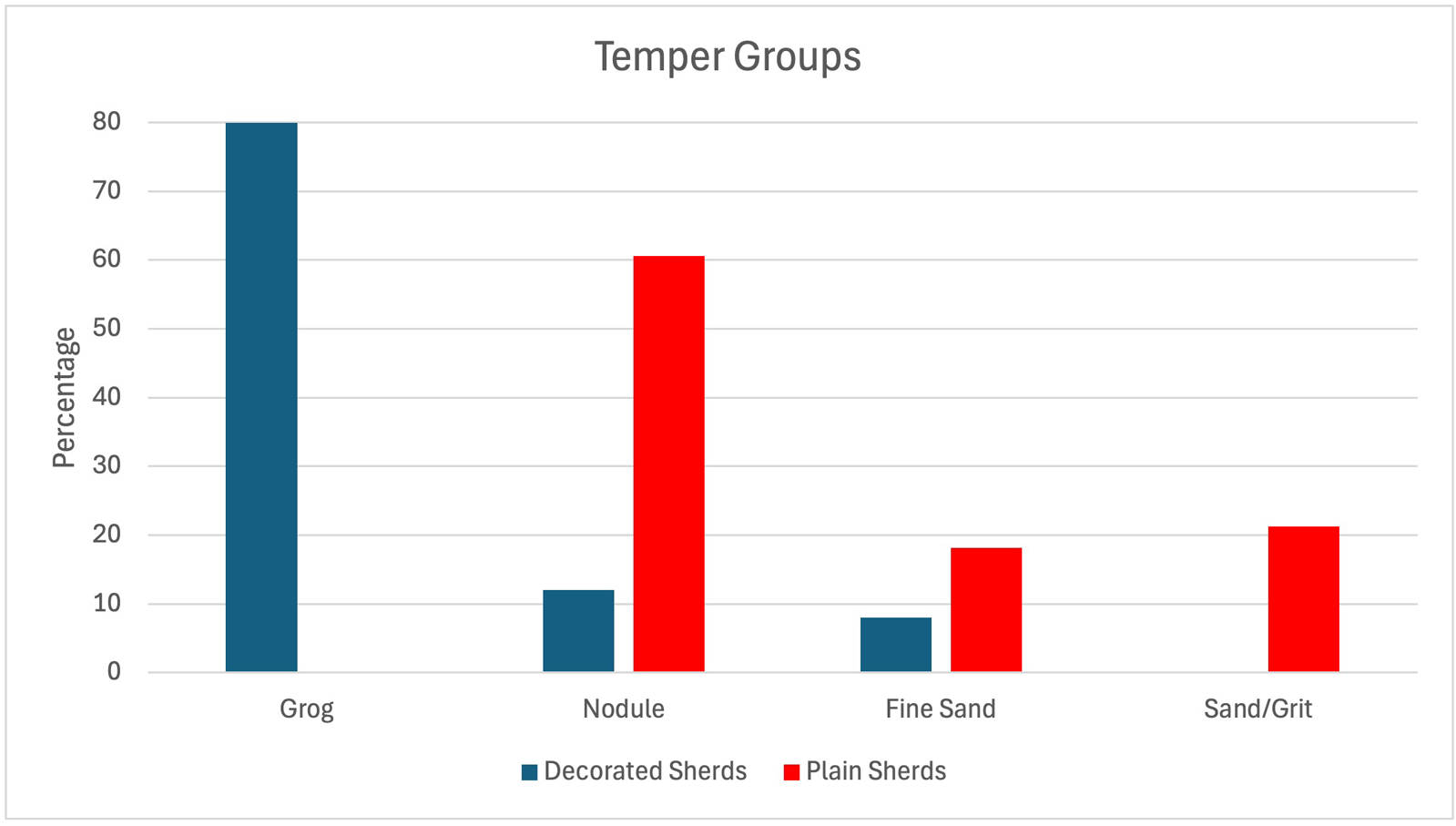
Petrographic analysis shows a strong association between grog tempering and surface decoration. Of the decorated samples, 80% (n = 20) are grog tempered; among plain samples (Figure 4), however, grog is absent. The remaining 20% of the decorated petrographic sample was distributed among nodule (n = 3; 12%) and fine sand (n = 2; 8%) fabric groups. All grog-tempered vessels contained at least one example of multigenerational grog—that is, a grog temper particle embedded within a larger grog temper particle (Figure 5a), the significance of which will be explained in the discussion. Plain samples were largely assigned to the nodule fabric group (n = 20; 60.6%), with some falling into fine sand (n = 6; 18.2%) and sand/grit (n = 7; 21.2%) groups (Figure 4).
Percentages of temper groups represented among decorated and plain samples. See Table 2 for descriptions of temper groups. (Color online)

Photomicrographs of petrographic thin sections showing (a) multigenerational grog temper, (b) nonlocal, micaceous (Aa fabric) grog temper, and (c–d) angularity and border definition as distinguishing features of grog temper (c) and clay nodules (d). (Color online)

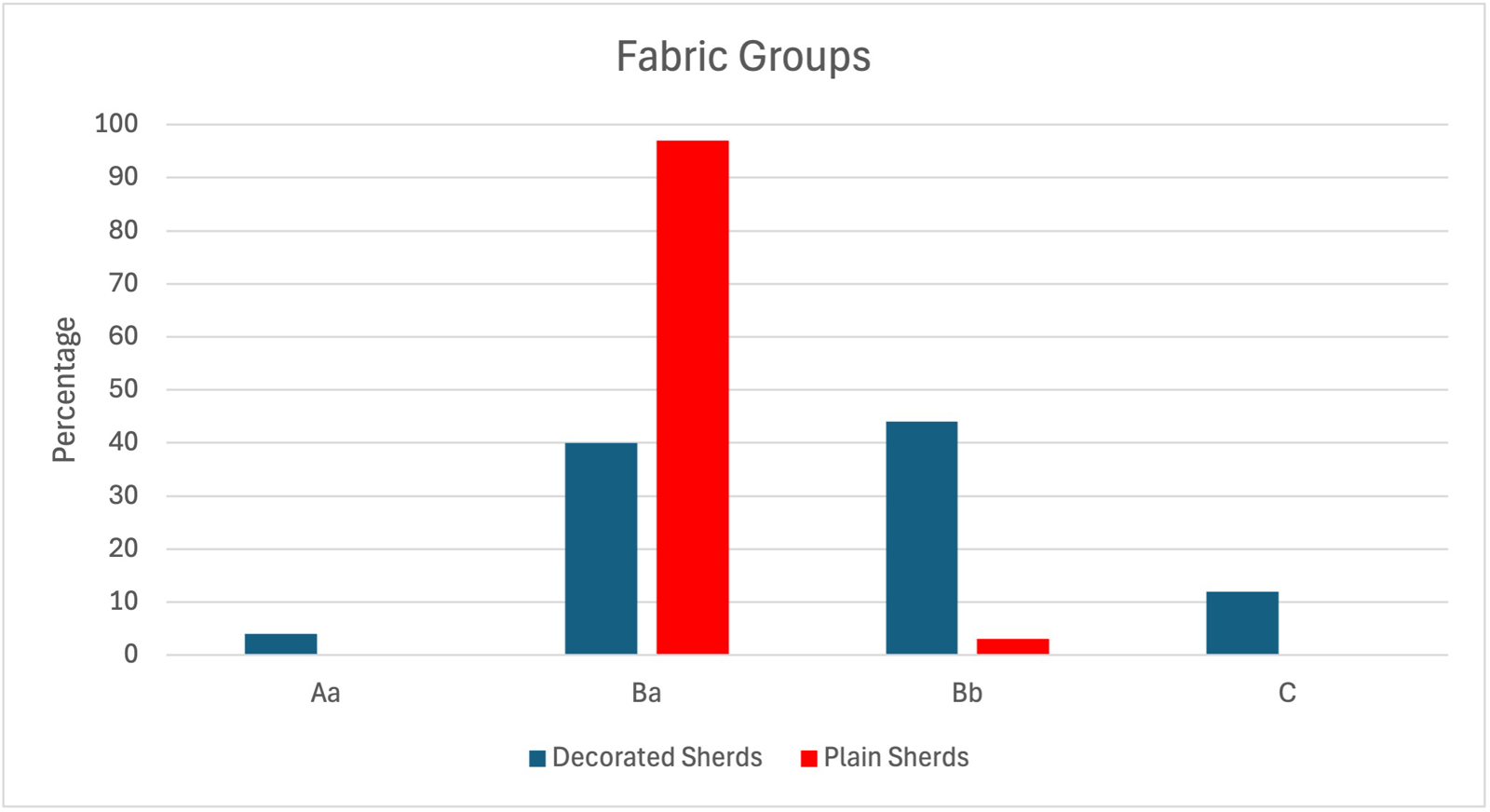
Fabric analysis highlights further distinctions between decorated and plain vessels (Figure 6). Decorated vessels are relatively evenly distributed among Ba and Bb fabrics, with 40% (n = 10) assigned to the former, and 44% (n = 11) to the latter. Plain vessels, however, were almost exclusively associated with Ba fabrics, as nearly all (n = 32; 97%) lacked spiculate fossils. One decorated vessel (4%) was assigned to the micaceous (and nonlocal) Aa group, and three (12%) corresponded to the heavily spiculate C group. No plain vessels were associated with the A or C groups. These trends align well with patterns in the chemical data, as explained below.
Percentages of fabric groups represented among decorated and plain samples. See Table 1 for descriptions of fabric groups. (Color online)

Further analysis of the grog temper group indicates preferences for certain grog temper combinations (Table 5)—that is, among those vessels tempered with grog, over half contain some combination of grog fragments consisting of Ba, Bb, and C fabrics. Four vessels (18%) contain nonlocal Aa grog fabrics (Figure 5b). Nonlocal grog fragments are also associated with complex temper recipes, given that all vessels with micaceous grog (Aa fabric) contain at least three distinct grog fabrics. Fragments of spiculate (C fabric) vessels are represented in nearly 40% of the grog-tempered pottery. Interestingly, both Aa and C fabrics are far more common in ancestral Weeden Island (e.g., Late Woodland) contexts in Tampa Bay, suggesting possible use of heirloom vessels as temper in nearly 60% of Mississippian decorated vessels. Also noteworthy is that the three grog-tempered vessels assigned to the Tampa Bay chemical group each contain only a single grog fabric.
Frequencies of Grog Fabric Combinations Represented among Decorated Vessels.

Table 5 Long description
Counts of decorated vessels are grouped by grog temper fabric combinations, listing which fabrics occur in each temper fabric group and how many vessels fall in each group. Grog 1, with fabrics Ba and Bb, is most common at 7 vessels. Grog 2, combining Ba, Bb, and C, follows with 6 vessels. Grog 5 includes only Ba and accounts for 4 vessels, while Grog 3 and Grog 4 each include Aa with Ba and Bb (and C in Grog 4) and have 2 vessels apiece. Single-fabric groups are rare: Grog 6 has only Bb with 1 vessel, and Grog 7 has only C with 1 vessel. Overall, combinations featuring Ba and Bb dominate, while Aa and C appear less often and usually within multi-fabric groups. Totals sum to 23 decorated vessels.
Petrographic point-count data highlight two clear differences between decorated and plain vessels related to bulk composition (Figure 7) and forming techniques. First, decorated samples cluster toward the center of the plot, owing to higher proportions of temper relative to matrix and naturally occurring aplastics. On the other hand, plain samples generally exhibit low quantities of temper grains and range from matrix rich to sand rich. These data show strong textural similarity within each group, with plain samples being nearly temperless, and decorated samples showing much higher concentrations of temper and more balance among matrix, temper, and aplastics. Second, 85% (n = 28) of the plain samples show internal laminations running parallel to the vessel wall, whereas 88% (n = 22) of the decorated samples exhibit contiguous, nonlaminated cross sections. This distinction supports previous research that noted the use of different forming techniques in relation to surface treatments (Duke and Wallis Reference Duke and Neill2025).
Bulk compositional ternary diagram displaying point-count data with matrix (clay), naturally occurring very-fine-to-fine sands (VFF), and medium-to-very-coarse sands and temper (MVC/temper) as end members. (Color online)

Neutron Activation Analyses
Analyzed specimens from the three sites are assigned to two previously defined chemical groups: Gulf 2 (n = 18), representing clayey sediments found throughout much of the peninsular Gulf coastline, and Tampa Bay (n = 33), associated with local calcareous and nodule-rich clays. Five specimens were left unassigned to either chemical group, including likely variants of the Tampa Bay and Gulf 2 chemical groups and two clearly nonlocal specimens. Although unassigned, the latter are characterized by enrichment of metals and transition metals and depletion of antimony (Sb), which is most similar to pottery from the Florida Panhandle (Wallis et al. Reference Wallis, Duke, Luer and Glascock2025).
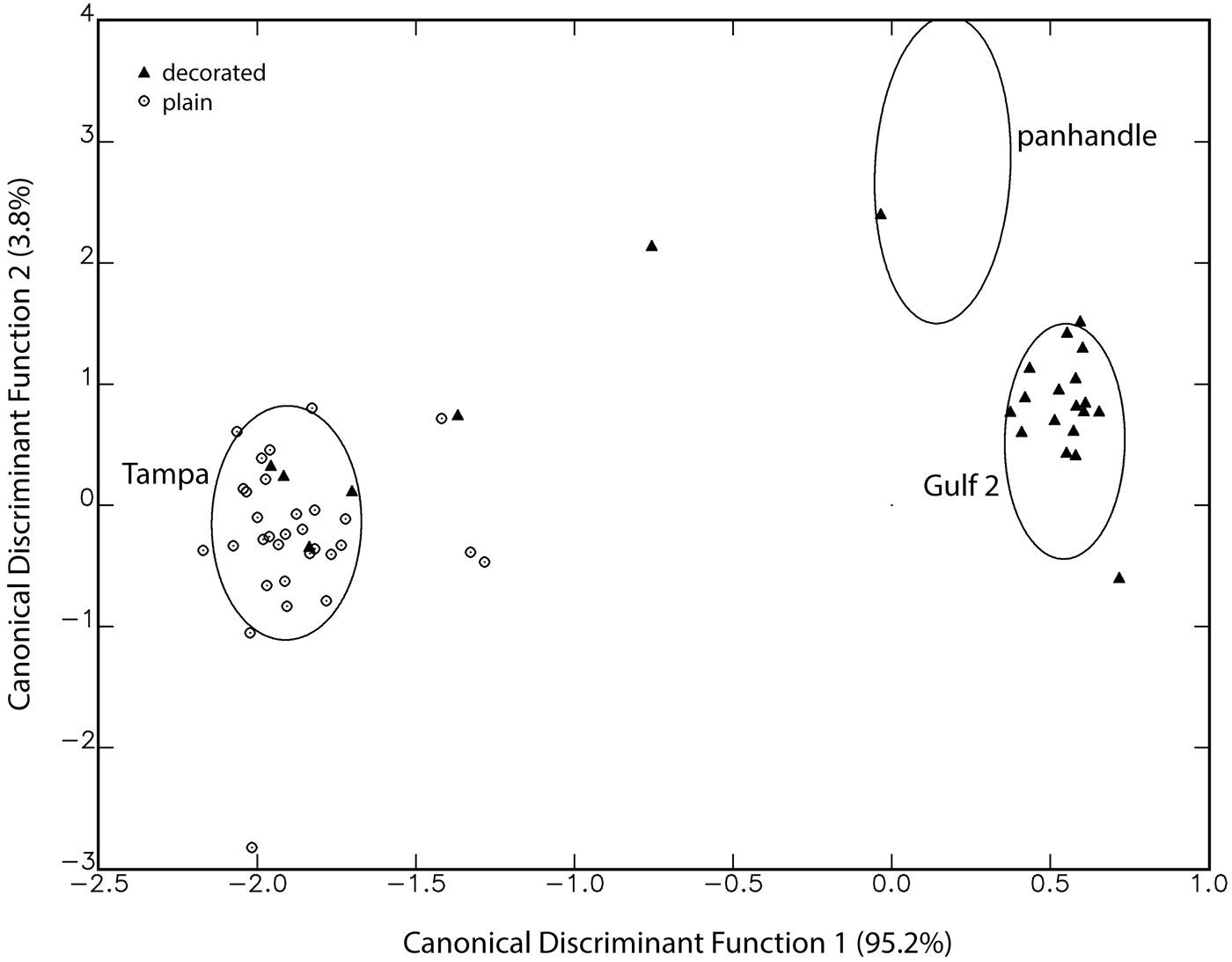
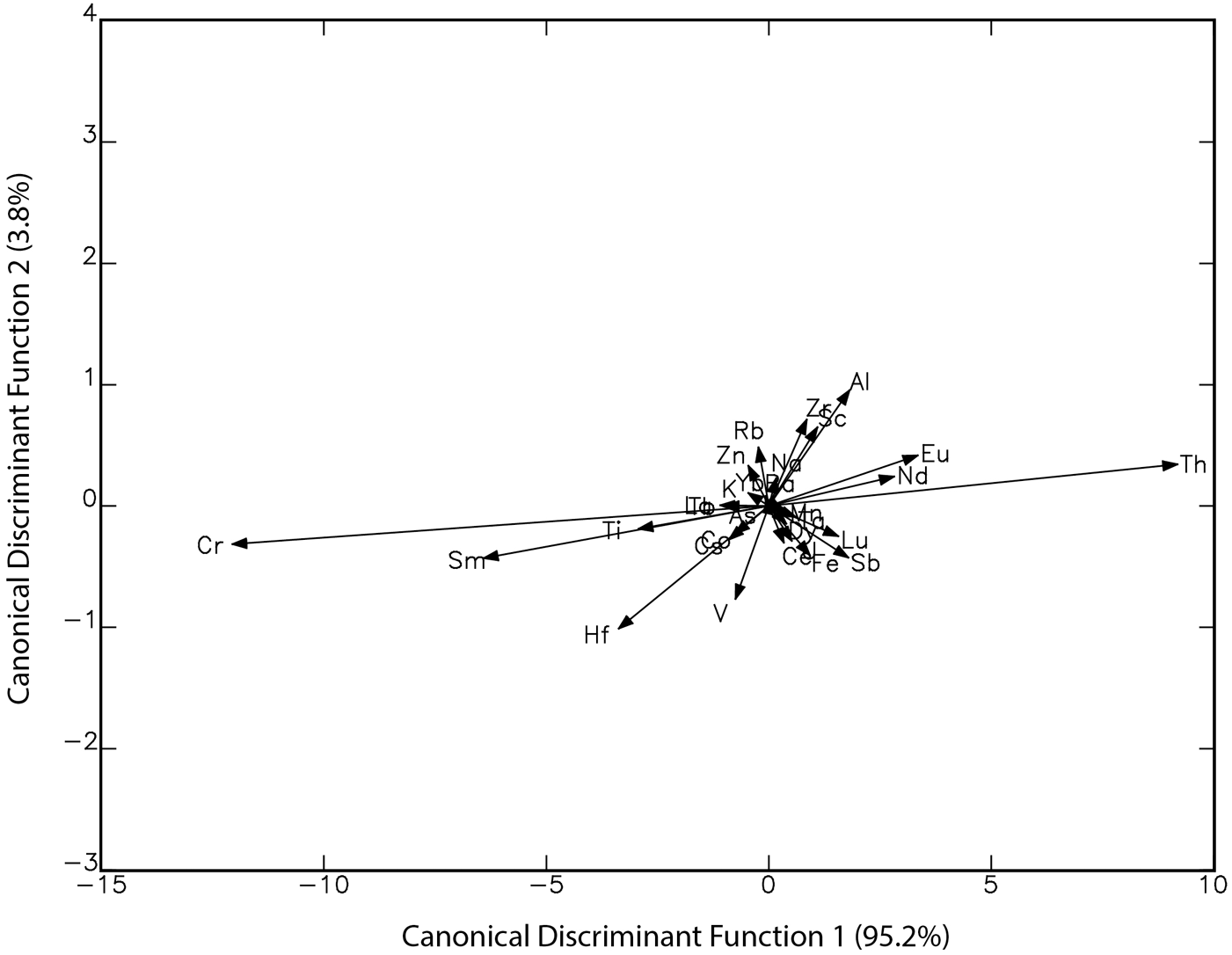
Chemical group assignment is highly correlated with pottery type classification (Figures 8 and 9), with decorated sherds comprising mostly Gulf 2 members (n = 18; 72%) and all but two plain sherds assigned to the Tampa Bay group (n = 29; 94%). Notably, none of the four decorated vessels that are Tampa Bay group members has multigenerational grog. No clay samples from around Tampa Bay are members of chemical groups consisting of pottery, but five calcareous and nodule-rich clays are similar to the Tampa Bay group in enrichment of chromium (Cr), rubidium (Rb), and Sb (Figure 10). Chemical groups show strong correspondence with fabric groups: Ba is mostly Tampa Bay group (n = 31; 78%), Bb is mostly Gulf 2 group (n = 10; 83%), C is entirely Gulf 2 group (n = 3), and Aa is an unassigned outlier.
Plot of CDF1 and CDF2 showing compositional groups (ellipses), and decorated and plain sherds. Ellipses indicate 90% probability of group membership.

Plot of CDF 1 and CDF 2 with vectors showing the relative influence of each elemental variable.

Figure 9 Long description
The scatter plot illustrates canonical discriminant function 1 on the horizontal axis, ranging from negative 15 to positive 10 and canonical discriminant function 2 on the vertical axis, ranging from negative 5 to positive 8. Vectors represent elemental variables such as chromium, rubidium and zinc, indicating their influence on the discriminant functions. The elements are densely clustered near the center, with some vectors like chromium and thorium extending outward, suggesting their significant influence. No distinct clusters or outliers are evident. The plot does not include a legend or color-coding, focusing solely on the vector directions and lengths to convey the relative influence of each element on the functions.
Bivariate plot of Rb and Cr for petrographic fabric groups and local clay samples. Ellipses indicate 90% probability of group membership. (Color online)

Figure 10 Long description
The scatter plot presents rubidium on the vertical axis and chromium on the horizontal axis, both in logarithmic scale base 10 parts per million. Different symbols represent petrographic fabric groups: Aa, Ba, Bb and C, along with calcareous and non-calcareous clays. The plot includes labeled ellipses indicating regions such as ′panhandle′, ′Gulf 2′ and ′Tampa′, suggesting groupings of the samples. The data points are distributed across these regions, showing the relationship between rubidium and chromium concentrations in the samples.
Discussion and Conclusion
The data presented here illustrate clear compositional and technological differences between coeval decorated and plain pottery in Mississippian Tampa Bay—namely, (1) grog tempering was reserved exclusively for decorated pottery; (2) multigenerational grog used in decorated vessels suggests exclusive access to ancestral and foreign temper caches; (3) decorated vessels exhibit an internally consistent recipe not observed among plain vessels; (4) plain vessels were molded, whereas decorated vessels were coiled; and (5) higher-quality clays were used for decorated vessels. Here, we review our findings to illustrate how migrant potters used their specialized knowledge to establish a “bounded” community of practice (sensu Crown Reference Crown, Roddick and Stahl2016:85) within Tampa Bay as a way to gain social standing in their new communities.
The first and most obvious distinction is that grog tempering was reserved for decorated vessels, whereas plain vessels were almost exclusively sand tempered and dense in ferric and phosphatic nodules. Grog tempering was virtually nonexistent in Tampa Bay prior to the Mississippian period, because sand tempering had been integral to the production of both decorated and plain pottery for the preceding three millennia, along with occasional tempers of sponge spicules and limestone (Austin et al. Reference Austin, Mitchem, Weisman, Wallis and Randall2014; Duke and Wallis Reference Duke and Neill2025; Duke et al. Reference Duke, Wallis, Bloch, Ann and Michael2023; Mitchem Reference Mitchem, Ashley and White2012; Wallis et al. Reference Wallis, Duke, Luer and Glascock2025). As we described above, grog tempering was ubiquitous at Lake Jackson and affiliated sites during the Mississippian period, so its use in pottery production near Tampa Bay suggests that migrants from the Tallahassee Hills preserved their homeland potting recipe on their journey south. The case for migration from this region is strengthened by chemical and petrographic data showing that potters with knowledge of distant Mississippian motifs applied the grog-tempering recipe to locally made vessels in Tampa Bay (see below).
Second, the prevalence of multigenerational grog further demonstrates that potters almost always incorporated older decorated vessels into the making of new ones. This signature suggests an affinity for ancestral Mississippian vessels that doubled as temper caches. Furthermore, groupings of grog fabrics represented within decorated vessels reveal clear preferences for certain temper combinations. Vessels containing nonlocal micaceous grog, for example, were associated with the most complex tempering recipes involving the use of at least three distinct vessels as temper. Given that vessels with micaceous grog (likely from the Florida Panhandle) also contain multigenerational temper fragments, it is clear that potters who used nonlocal grog as temper also had access to the widest variety of temper caches (i.e., ancestral Woodland and Mississippian vessels, many of which were brought to Tampa Bay from migrant homelands). Furthermore, the only decorated vessels assigned to the Tampa Bay chemical group were manufactured using atypical tempering recipes that either excluded grog entirely or consisted of only one grog fabric. This pattern likely traces the practices of unauthorized imitators who attempted to reproduce a secretive potting recipe without access to quality clays, temper caches, knowledge of production, and, ostensibly, kinship affiliation.
Third, our point-count data indicate strong textural similarity among decorated samples, implying that potters making these vessels used an internally consistent recipe. Plain samples, on the other hand, are so compositionally variable as to suggest the use of widely different recipes lacking some components (e.g., temper) typically required for pottery manufacture. Furthermore, decorated samples exhibit far more balance in the proportions of clay, temper, and aplastics, indicating refined knowledge of the potting process. This level of coherence among decorated samples is characteristic of a tight-knit potting community grounded in intimate social interaction and knowledge sharing (e.g., Crown Reference Crown2014, Reference Crown, Roddick and Stahl2016; Gosselain Reference Gosselain, Roberts and Linden2011). The variation in the plain samples highlights minimal oversight of the potting recipe, possibly stemming from the involvement of unsupervised novices in molded pottery production (Duke and Wallis Reference Duke and Neill2025).
A fourth distinction between vessel types is technological: decorated vessels were generally coiled, whereas plain vessels were molded. As described at length in previous research (Duke and Wallis Reference Duke and Neill2025), the internal lamination pattern ubiquitous among plain vessels is related to a massive technological shift predicated on the use of concave molds. The lamination pattern results from the successive layering of clay that is required to build the vessel wall using the simple molding technique (e.g., Sanger Reference Sanger2016). Laminations related to forming typically develop when clay begins to dry and forms air pockets in the paste as the potter prepares the exposed surface for an additional layer of clay—a process that is repeated until the potter achieves the desired wall thickness. These air pockets eventually become stratified as the potter adds additional layers and compresses the paste. Petrography has been particularly useful for identifying molding in Pinellas Plain pottery because the technique allows for tracing of each lamination across the entire thin section. This visual tracing solidifies that, for Pinellas Plain pottery, laminations are related to molding and layering, as opposed to natural variegation, for instance (Duke and Wallis Reference Duke and Neill2025). In contrast, decorated vessels exhibit the type of contiguous cross section commonly associated with the coiling method documented in most Mississippian assemblages.
A final and noteworthy discovery is evident in differential access to clay resources. NAA data show strong chemical distinctions among clays used for decorated and plain vessels, with the former corresponding to local Gulf chemical groups and the latter to a specific suite of marine clays that characterize the Tampa Bay chemical group. Therefore, access to higher-quality clay resources (i.e., Gulf chemical groups) appears to have been limited to those potters making decorated vessels. Gulf chemical-group clays are compositionally similar to ancestral sources used by Woodland communities of Tampa Bay, but there is no evidence for the use of Tampa Bay group clays prior to the Mississippian period (Duke et al. Reference Duke, Wallis, Bloch, Ann and Michael2023). This pattern most is likely due to the fact that Tampa Bay group sources are inclusion rich, poor in quality, and generally ill suited to pottery production. In this case, our assessment of quality is based on the high abundance of ferric and phosphatic nodules in Tampa Bay group clays, which increase the likelihood of vessel failure during manufacture, firing, and use (e.g., Rice Reference Rice2015:133). Previous clay sampling in the Tampa Bay region has identified the presence of nodule-bearing clays alongside relatively inclusion-free clays, and the former were rarely used for pottery production until the Mississippian period, likely due to differences in inclusion density (as proxies of clay quality and workability). It is possible, even likely, that Mississippian-era potters began utilizing Tampa Bay group clays to produce plainware pottery as an act of desperation amid population expansion that prompted a forceful drawing of social boundaries (e.g., Duke et al. Reference Duke, Wallis, Bloch, Ann and Michael2023; Fowles et al. Reference Fowles, Minc, Duwe and Hill2007). It follows that molding gained traction to make poor-quality clays viable for domestic pottery production.
These patterns together suggest that Mississippian migrants from the north used specialized knowledge as a pathway to gain acceptance and, eventually, social standing among Tampa Bay’s resident population. Following their migration into the area, these potters quickly developed a body of technical knowledge predicated on access to (1) high-quality clay resources, (2) coveted bodily and esoteric knowledge behind decorated potting recipes, (3) caches of decorated vessels to be used as temper, (4) forming techniques used to manufacture decorated pottery, and (5) the rights to execute and distribute Mississippian decorative motifs. This trend in nearly every way mimics Pueblo potting guilds that rely on secrecy not only to maintain social ranking but also to mediate the flow of knowledge between generations of potters (e.g., Brandt Reference Brandt, Wills and Leonard1994; Crown Reference Crown, Roddick and Stahl2016).
It is now worth considering the sequence of events that precipitated the migration and the subsequent formation of a tightly bound community of practice locally in Tampa Bay. It is clear from both contemporary and archaeological contexts that migrants are often socially disadvantaged and must highlight different skill sets to demonstrate value among host communities (Glick and Park Reference Glick, Park and White2016). Many Mississippians therefore found themselves navigating the “migrant paradox,” a phenomenon in which hosts see migrants as simultaneously disruptive and innovative (e.g., Clark et al. Reference Clark, Birch, Hegmon, Mills, Glowacki, Ortman and Dean2019). In many cases, however, hosts willingly and even enthusiastically accept migrants who display exceptional or rare skills, particularly those conveyed through potting practice. Such was the case in the US Southwest, where migrant potters went to great lengths to display their unique knowledge within recipient villages by making and distributing ornate pottery (Mills et al. Reference Mills, Clark and Peeples2016).
Similarly, migrants from the Tallahassee Hills area moved south in possession of potting recipes that stood out among Tampa Bay residents. There is evidence to suggest that, at times, social dynamics grew exclusionary at Lake Jackson (Marrinan Reference Marrinan, Ashley and White2012; Scarry Reference Scarry and King2007), possibly mirroring the increasingly hierarchical politics of its closest relative, Etowah (Brown Reference Brown and Beck2007; Cobb and King Reference Cobb and King2005). Although the novelty of agriculture and nucleated social life may have initially been attractive for Mississippians in the Tallahassee Hills area, it is likely that social inequality grew unsustainable for some over the long term. A prominent example of this can be seen at Cahokia, where communities eventually fled theocratic governance in search of autonomy (e.g., Pauketat et al. Reference Pauketat, Fortier, Alt and Emerson2013). The corporate arrangement of Tampa Bay settlements would have stood in stark contrast to the centralized politics emerging at more northerly Mississippian centers. Even as mound centers flourished in Tampa Bay after AD 1200, none grew so powerful as to subordinate all others in the region (e.g., Duke et al. Reference Duke, Wallis, Bloch, Ann and Michael2023; Luer and Almy Reference Luer and Almy1981; Mitchem Reference Mitchem1989), with a possible exception at the Safety Harbor site around the sixteenth century AD (Pluckhahn et al. Reference Pluckhahn, Jackson and Thompson2023). Consequently, those seeking relative political autonomy would have seen an opportunity along the central Florida Gulf Coast.
Secrecy appears to have been central to migrant potters achieving acceptance in Tampa Bay. Grog-tempered pottery bearing classically Mississippian motifs would have been commonplace in migrants’ homelands; that is to say, there was nothing intrinsically valuable about a grog-tempered Mississippian pot. However, these vessels and the recipes involved in their production would have been novel and therefore valuable among communities in Tampa Bay. To refer again to Taussig’s (Reference Taussig1999) concept of the public secret, the fact that these vessels were identified in domestic contexts suggests that migrant potters first established value for their work by selectively distributing items to be seen and used publicly. Although the details of paste recipes and production steps for making decorated vessels were evidently closely guarded by an exclusive group of potters, acquisition and use of these exotic-looking vessels was unrestricted and perhaps actively promoted by the potters, thereby creating a public secret visible to all. Compared to the pervasive and indistinguishable simple plain bowls that would have been familiar to every Tampa Bay household, Mississippian-style decorated vessels would have held an aura of uniqueness that could be observed but not fully understood. These vessels would have been a public secret, an example of “that which is generally known, but cannot be articulated” (Taussig Reference Taussig1999:5).
Here, we resist the temptation to attribute secrecy to exclusion or self-aggrandizing in noting that even tempering events may have been publicly attended. As required for all public secrets, the uninitiated in Tampa Bay would have been willing participants in “knowing what not to know” (Taussig Reference Taussig1999:2). Witnessing tempering events would have been an important opportunity to appreciate the extent of the secret. Unlike most other forms of temper, grog presented opportunities for enchainment linking ancestral Mississippians and the living community (sensu Chapman Reference Chapman, Dobres and Robb2000; Strathern Reference Strathern1988). The practice of making decorated pottery that collated fragments of vessels from distant people, times, and places was likely powerful socially and politically, establishing the potters’ skill sets as simultaneously integrative and extraordinary. Even if the potters’ intentions were initially to draw in disparate social groups to witness the integrative act of tempering, the potting recipe was concealed from public view following firing of the vessel. Having gained a limited glimpse of the decorated vessel manufacturing process, the uninitiated would have grasped the broad outlines of what made it different from that of more familiar plain pottery vessels, and they would have understood the scope of what they could not fully grasp. This process would have established decorated vessels and their recipes as public secrets to be witnessed but not fully understood by most segments of the population. In creating public secrets in this way, migrant potters may have successfully assimilated into new communities while embracing a decentralized political arrangement that stood in contrast to that of the Mississippian heartland.
Acknowledgments
This research was supported by many institutions and individuals, to whom we owe our sincere thanks and gratitude. Access to archaeological collections was facilitated by the Florida Museum of Natural History, the Florida Bureau of Archaeological Research, and the Alliance for Weedon Island Archaeological Research. We especially thank Ann S. Cordell, whose pioneering approach laid the foundation for archaeological applications of petrography in Florida.
Funding Statement
This research was funded by the National Science Foundation (No. 2052613), the Wenner-Gren Foundation (No. 9440), the Francis and Gertrude Levett Foundation, and the Florida Archaeology Professorship at the Florida Museum of Natural History.
Data Availability Statement
The neutron activation analysis data incorporated into this article are publicly available from the University of Missouri Research Reactor https://archaeometry.missouri.edu/murr_database.html. The OxCal code for the KDE model and a site inventory of radiocarbon assays used for the model are available as supplemental files (see Supplementary Material section).
Competing Interests
The authors declare none.
Supplementary Material
The supplementary material for this article can be found at https://doi.org/10.1017/aaq.2026.10227.
Supplementary Table 1. List of radiocarbon samples and corresponding sites used for the KDE.
Supplementary Code 1. OxCal code used for the KDE.