


%20--%3e%3c!DOCTYPE%20svg%20PUBLIC%20'-//W3C//DTD%20SVG%201.0//EN'%20'http://www.w3.org/TR/2001/REC-SVG-20010904/DTD/svg10.dtd'%3e%3csvg%20version='1.0'%20id='Layer_1'%20xmlns='http://www.w3.org/2000/svg'%20xmlns:xlink='http://www.w3.org/1999/xlink'%20x='0px'%20y='0px'%20width='64px'%20height='64px'%20viewBox='5.5%20-3.5%2064%2064'%20enable-background='new%205.5%20-3.5%2064%2064'%20xml:space='preserve'%3e%3cg%3e%3ccircle%20fill='%23FFFFFF'%20fill-opacity='0'%20cx='37.785'%20cy='28.501'%20r='28.836'/%3e%3cpath%20fill='%23595959'%20d='M37.441-3.5c8.951,0,16.572,3.125,22.857,9.372c3.008,3.009,5.295,6.448,6.857,10.314%20c1.561,3.867,2.344,7.971,2.344,12.314c0,4.381-0.773,8.486-2.314,12.313c-1.543,3.828-3.82,7.21-6.828,10.143%20c-3.123,3.085-6.666,5.448-10.629,7.086c-3.961,1.638-8.057,2.457-12.285,2.457s-8.276-0.808-12.143-2.429%20c-3.866-1.618-7.333-3.961-10.4-7.027c-3.067-3.066-5.4-6.524-7-10.372S5.5,32.767,5.5,28.5c0-4.229,0.809-8.295,2.428-12.2%20c1.619-3.905,3.972-7.4,7.057-10.486C21.08-0.394,28.565-3.5,37.441-3.5z%20M37.557,2.272c-7.314,0-13.467,2.553-18.458,7.657%20c-2.515,2.553-4.448,5.419-5.8,8.6c-1.354,3.181-2.029,6.505-2.029,9.972c0,3.429,0.675,6.734,2.029,9.913%20c1.353,3.183,3.285,6.021,5.8,8.516c2.514,2.496,5.351,4.399,8.515,5.715c3.161,1.314,6.476,1.971,9.943,1.971%20c3.428,0,6.75-0.665,9.973-1.999c3.219-1.335,6.121-3.257,8.713-5.771c4.99-4.876,7.484-10.99,7.484-18.344%20c0-3.543-0.648-6.895-1.943-10.057c-1.293-3.162-3.18-5.98-5.654-8.458C50.984,4.844,44.795,2.272,37.557,2.272z%20M37.156,23.187%20l-4.287,2.229c-0.458-0.951-1.019-1.619-1.685-2c-0.667-0.38-1.286-0.571-1.858-0.571c-2.856,0-4.286,1.885-4.286,5.657%20c0,1.714,0.362,3.084,1.085,4.113c0.724,1.029,1.791,1.544,3.201,1.544c1.867,0,3.181-0.915,3.944-2.743l3.942,2%20c-0.838,1.563-2,2.791-3.486,3.686c-1.484,0.896-3.123,1.343-4.914,1.343c-2.857,0-5.163-0.875-6.915-2.629%20c-1.752-1.752-2.628-4.19-2.628-7.313c0-3.048,0.886-5.466,2.657-7.257c1.771-1.79,4.009-2.686,6.715-2.686%20C32.604,18.558,35.441,20.101,37.156,23.187z%20M55.613,23.187l-4.229,2.229c-0.457-0.951-1.02-1.619-1.686-2%20c-0.668-0.38-1.307-0.571-1.914-0.571c-2.857,0-4.287,1.885-4.287,5.657c0,1.714,0.363,3.084,1.086,4.113%20c0.723,1.029,1.789,1.544,3.201,1.544c1.865,0,3.18-0.915,3.941-2.743l4,2c-0.875,1.563-2.057,2.791-3.541,3.686%20c-1.486,0.896-3.105,1.343-4.857,1.343c-2.896,0-5.209-0.875-6.941-2.629c-1.736-1.752-2.602-4.19-2.602-7.313%20c0-3.048,0.885-5.466,2.658-7.257c1.77-1.79,4.008-2.686,6.713-2.686C51.117,18.558,53.938,20.101,55.613,23.187z'/%3e%3c/g%3e%3c/svg%3e)
%20--%3e%3c!DOCTYPE%20svg%20PUBLIC%20'-//W3C//DTD%20SVG%201.0//EN'%20'http://www.w3.org/TR/2001/REC-SVG-20010904/DTD/svg10.dtd'%3e%3csvg%20version='1.0'%20id='Layer_1'%20xmlns='http://www.w3.org/2000/svg'%20xmlns:xlink='http://www.w3.org/1999/xlink'%20x='0px'%20y='0px'%20width='64px'%20height='64px'%20viewBox='5.5%20-3.5%2064%2064'%20enable-background='new%205.5%20-3.5%2064%2064'%20xml:space='preserve'%3e%3cg%3e%3ccircle%20fill='%23FFFFFF'%20fill-opacity='0'%20cx='37.637'%20cy='28.806'%20r='28.276'/%3e%3cg%3e%3cpath%20fill='%23595959'%20d='M37.443-3.5c8.988,0,16.57,3.085,22.742,9.257C66.393,11.967,69.5,19.548,69.5,28.5c0,8.991-3.049,16.476-9.145,22.456%20C53.879,57.319,46.242,60.5,37.443,60.5c-8.649,0-16.153-3.144-22.514-9.43C8.644,44.784,5.5,37.262,5.5,28.5%20c0-8.761,3.144-16.342,9.429-22.742C21.101-0.415,28.604-3.5,37.443-3.5z%20M37.557,2.272c-7.276,0-13.428,2.553-18.457,7.657%20c-5.22,5.334-7.829,11.525-7.829,18.572c0,7.086,2.59,13.22,7.77,18.398c5.181,5.182,11.352,7.771,18.514,7.771%20c7.123,0,13.334-2.607,18.629-7.828c5.029-4.838,7.543-10.952,7.543-18.343c0-7.276-2.553-13.465-7.656-18.571%20C50.967,4.824,44.795,2.272,37.557,2.272z%20M46.129,20.557v13.085h-3.656v15.542h-9.944V33.643h-3.656V20.557%20c0-0.572,0.2-1.057,0.599-1.457c0.401-0.399,0.887-0.6,1.457-0.6h13.144c0.533,0,1.01,0.2,1.428,0.6%20C45.918,19.5,46.129,19.986,46.129,20.557z%20M33.042,12.329c0-3.008,1.485-4.514,4.458-4.514s4.457,1.504,4.457,4.514%20c0,2.971-1.486,4.457-4.457,4.457S33.042,15.3,33.042,12.329z'/%3e%3c/g%3e%3c/g%3e%3c/svg%3e)
INTRODUCTION
In January 2022, Democratic New York City Mayor Eric Adams signed a law that would grant over eight hundred thousand noncitizens the right to vote in city elections. In the United States, local noncitizen suffrage is at the discretion of state and local governments, with immigrants currently voting in relatively high (e.g., city) and low (e.g., school board) salience elections in 18 jurisdictions.Footnote 1 While several Democratic leaders in New York City celebrated joining the ranks of these enfranchising localities, many Republican voters openly protested. Six months after the bill’s signing, the State Supreme Court—in response to a Republican voter-led lawsuit—ruled noncitizen suffrage unconstitutional.
This partisan tension on noncitizen suffrage plays out across the United States, with public opinion playing a critical role in determining who selects representation in American democracy. Noncitizen suffrage in many U.S. localities has been granted directly through public referendum, often in cities with Democratic leadership. In contrast, referendums in other states have endorsed a citizens-only model of electoral participation. Voters in seven, primarily Republican-led states, have banned noncitizen suffrage.Footnote 2 Florida is one of the latest states to ban noncitizen suffrage, with voters passing a constitutional referendum endorsed by state Republicans in 2020, altering the State Constitution to ensure that “only” (as opposed to “every”) U.S. citizen(s) are eligible to vote state-wide. The apparent partisan divide in (re)enfranchising noncitizens suggests that partisanship may determine American voter attitudes.
This study is the first, to the best of our knowledge, to explore partisanship’s impact on American public opinion of noncitizen suffrage.Footnote 3 Partisanship is a fundamental component of voters’ policy orientations: it influences information consumption (e.g., Zaller Reference Zaller1992), shapes social identities (e.g., Green, Palmquist, and Schickler Reference Green, Palmquist and Schickler2004; Huddy, Mason, and Aarøe Reference Huddy, Mason and Aarøe2015), and predicts political behavior, including vote choice (e.g., Campbell et al. Reference Campbell, Converse, Miller and Stokes1960). Partisanship is even more influential in determining voter preferences in the current polarized context. Immigration is at the core of this partisan divide (Hetherington and Rudolph Reference Hetherington and Rudolph2015), with Democrats often supporting open immigration policies and Republicans favoring more punitive policies (Abrajano and Hajnal Reference Abrajano and Hajnal2015; Fraga, Velez, and West Reference Fraga, Velez and West2024; Sides, Tesler, and Vavreck Reference Sides, Tesler and Vavreck2018). In this environment, Americans’ attitudes toward immigrant enfranchisement may be downstream of partisanship, with Democrats supporting and Republicans opposing noncitizen suffrage.Footnote 4
Yet American enfranchising attitudes may be more pragmatic. We argue that the partisan alignment between U.S. voters and noncitizens is consequential for voters’ support for noncitizen voting rights—with voters supporting suffrage conditionally on partisan alignment. Voters may view enfranchisement of co-partisans (or disenfranchisement of out-partisans) as an opportunity to increase their party’s political influence (see, e.g., Kayran and Nadler Reference Kayran and Nadler2022), even when noncitizen (dis)enfranchisement is opposed to their party’s value-based prescriptions. Thus, rather than a principled commitment or opposition to noncitizen enfranchisement, we argue support is driven by pragmatic preferences.Footnote 5
The literature on party behavior supports this argument. Women’s enfranchisement in the United Kingdom depended on “the alignment of interests between elected politicians and suffragists” (Teele Reference Teele2018, 6). Emigrant suffrage is also more likely when the diaspora supports the incumbent party (Umpierrez de Reguero, Yener-Roderburg, and Cartagena Reference Umpierrez de Reguero, Yener-Roderburg and Cartagena2021; Wellman Reference Wellman2021). Even right-wing parties in Europe (e.g., Ireland and France) have supported immigrant voting rights when the immigrants were perceived to be conservative. Further, although left party control predicts the timing of progressive noncitizen voting policies (Kayran and Erdilmen Reference Kayran and Erdilmen2020), these parties have opposed enfranchisement when it may benefit their political or economic opponents (Earnest Reference Earnest2006) despite party principles championing immigrant suffrage (e.g., Hammar Reference Hammar1990).
These pragmatic party considerations may manifest in public opinion. Specifically, Whitaker and Giersch (Reference Whitaker and Giersch2021) show that Republicans decrease their support for immigration into the U.S. mainland from the Commonwealth when informed that the vote of Commonwealth citizens could help a Democratic candidate win.Footnote 6 Still, we know less about Republican attitudes when their party could benefit from immigration and about Democrats’ attitudes when their party could be actually harmed by the vote choices of those immigrants.
Whether U.S. voters are principled or pragmatic about noncitizen suffrage remains an open question. If voters, like party elites, are pragmatic, both Democrats and Republicans would support the expansion of noncitizen voting rights for co-partisans but not for counter-partisans. Democrats would not systematically support and Republicans would not systematically oppose noncitizen enfranchisement. Instead, Republicans may be more likely and Democrats less likely to support enfranchising Republican-voting noncitizens.
We explore U.S. voters’ attitudes toward noncitizen local enfranchisement in two pre-registered survey experiments: one in Florida and a second with a national sample.Footnote 7 These experiments manipulate the partisan alignment between U.S. voters and noncitizens, framing noncitizens as either likely co- or counter-partisan voters. We find that American voters increase their support for noncitizen voting rights when noncitizens are framed as likely co-partisan voters.Footnote 8 U.S. voters, however, strongly decrease their support for this same policy when noncitizens are framed as counter-partisan voters. Republicans specifically increase while Democrats decrease their support for noncitizen enfranchisement when considering noncitizen Republicans, suggesting that voters are more pragmatic than principled.
This study contributes to two literatures. First, we contribute an account of public support of immigrant political rights to the immigrant and immigration attitudes literature (see, e.g., Dinesen and Hjorth Reference Dinesen and Hjorth2018; Hainmueller and Hopkins Reference Hainmueller and Hopkins2014, for reviews). We further add to existing migrant suffrage studies, which are mostly centered on elite behavior (e.g., Wellman Reference Wellman2021). We complement existing public opinion studies on the relationship between immigrant characteristics and noncitizen suffrage attitudes, finding that support increases when the noncitizen electorate is small, of high socioeconomic status (Koukal, Schafer, and Eichenberger Reference Koukal, Schafer and Eichenberger2021; Stutzer and Slotwinski Reference Stutzer and Slotwinski2021), or formally assimilated (Levy and Wright Reference Levy and Wright2020). By focusing on both immigrant and citizen characteristics, we elucidate one condition underscoring support for noncitizens’ voting rights: the alignment of their political identities.
Second, our findings highlight the consequences of heightened partisan identification in contemporary American democratic inclusion. New scholarship reveals that Americans rationalize democratic norms and restrictive public policies in accordance with their partisanship (Goodman Reference Goodman2022; Simonovits, McCoy, and Littvay Reference Simonovits, McCoy and Littvay2022; Whitaker and Giersch Reference Whitaker and Giersch2021). Our study extends this work, finding evidence that support for the cornerstone of electoral democracy—suffrage—may be constrained by the benefits to partisan opponents. This has implications for the success of other electorate-defining policies (e.g., gerrymandering and residency requirements), suggesting policy support depends partly on whether the population (e.g., felons and minors) becomes politicized. These findings thereby reveal a pernicious role of partisanship in democratic inclusion, compelling policymakers and scholars to consider the partisanship of policy beneficiaries in predicting American public opinion.
RESEARCH DESIGN
We explore the role of voter-noncitizen partisan alignment in two survey experiments using diverse samples of registered U.S. voters.Footnote 9 The first study (Florida Study) includes a sample from Florida’s public voter registration record. Florida is a relevant environment for questions of immigrant suffrage as it hosts an ideologically and demographically diverse immigrant population. The immigrant population and their suffrage are more salient for Florida voters than for voters in other states without recent political mobilization on the issue. This Florida Study was fielded from March 8 to April 17, 2022, resulting in 4,331 completed surveys from Democratic, Republican, and Independent registered voters.
Our second study (U.S. Study) uses the same experiment but expands our sample nationally. This study assesses the generalizability of the Florida Study’s results and measures U.S. voter-noncitizen partisan alignment effects separately for Democrats and Republicans. This national sample, therefore, includes only self-identified Democratic and Republican registered voters. Participants were recruited through CloudResearch. The survey was fielded between August 12 and 26, 2022, resulting in 3,617 completed surveys. Our convenience samples are comparable to representative samples of U.S. registered voters on key demographic characteristics and attitudes, including partisan strength and immigrant attitudes (see Table B.1 in the Supplementary Material).
All participants were randomly assigned to one of three vignettes, depicted in Figure 1: (1) a control vignette describing that noncitizens can and do vote in some local-level elections in the US, (2) a co-partisan vignette where participants also read that if noncitizens were allowed to vote in their state, experts expect many enfranchised noncitizens to vote for their party, and (3) a counter-partisan vignette where participants read that experts expect many enfranchised noncitizens to vote for the competing party if allowed to vote.Footnote 10
Experimental Conditions from the Perspective of a Floridian Democratic Participant
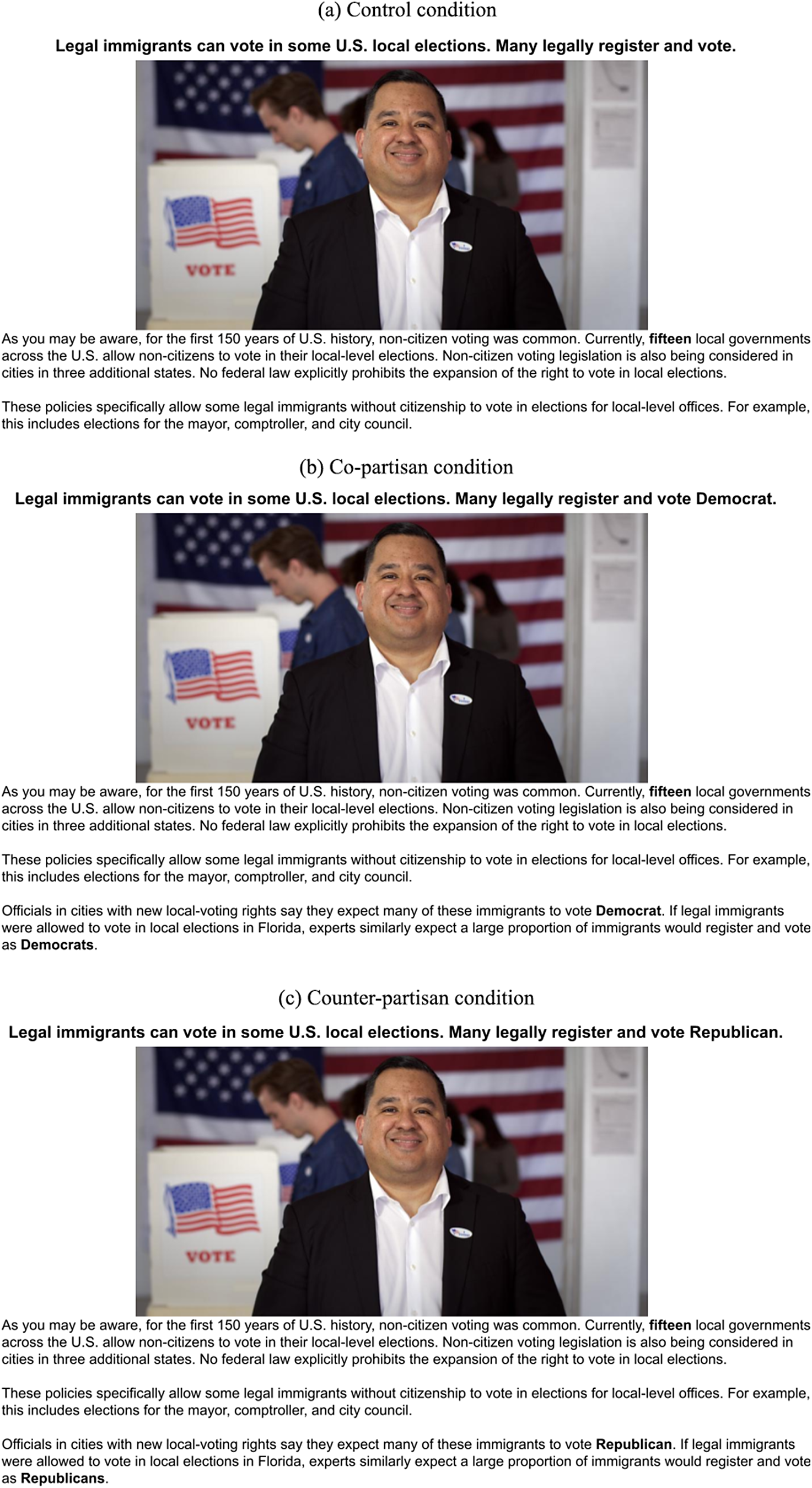
The vignettes’ content is based on opinions from experts in national and local media, local official and public statements, and expert interviews.Footnote 11 We use the same image across all experimental conditions to reduce measurement error. We chose an image of a self-identified Latino voter because Latinos represent the largest immigrant-origin group in the US, and they increasingly show variation in their partisan choice (Fraga, Velez, and West Reference Fraga, Velez and West2024). This choice improves the experimental design’s credibility and ecological validity.
We evaluate support for noncitizen voting rights with four outcome measures, capturing attitudes and behavior toward local noncitizen enfranchisement. Three 5-point scale attitudinal items on support for noncitizen enfranchisement: “would you support granting legal immigrants without citizenship the right to vote in U.S./your local-level elections?”, and “would you support allowing local [RESPONDENT’S STATE] governments to grant legal immigrants without citizenship the right to vote in their local elections?”, and one quasi-behavioral measure on willingness to acquire information about noncitizen suffrage: “would you like to learn more about noncitizen voting rights in another state?” Participants choosing “Yes” received a link to a website with information.
RESULTS
We present effect estimates using differences in means with two-sample t-tests. The results are consistent with ordinary least squares regression with control variables and robust standard errors (see Appendix D of the Supplementary Material), as pre-registered and described in Appendix C of the Supplementary Material.
Figure 2 presents means across treatment groups and the difference in means for our four outcomes. The co-partisan treatment increased support for noncitizen voting across the two studies and the three attitudinal outcomes. For example, for the first outcome (top-left, Pooled panel), support increased from an average of 2.71 in the control group to 2.83 in the co-partisan group (p = 0.007), a change equivalent to 0.07 standard deviations (SDs). This substantively small treatment effect is statistically significantly different from zero in the U.S. Study (an effect of 0.13 SDs, p = 0.0011) but not in the Florida Study (0.02 SDs, p = 0.4).Footnote 12 Conversely, the counter-partisan treatment decreased support for noncitizen voting from an average of 2.71 in the control group to 2.35 in the counter-partisan group (
 $ p<0.001 $
). This is equivalent to a change of 0.23 SDs, and substantively equivalent to a change from being indifferent to opposing noncitizen voting rights. This treatment effect is statistically significant in the Florida Study (0.18 SDs,
 $ p<0.001 $
) and U.S. Study (0.29 SDs,
 $ p<0.001 $
).
Support for Noncitizen Local Suffrage by Treatment Groups
Note: Displays mean responses by treatment group and 95% confidence intervals. Tables D.1 and D.2 in the Supplementary Material present OLS estimates.
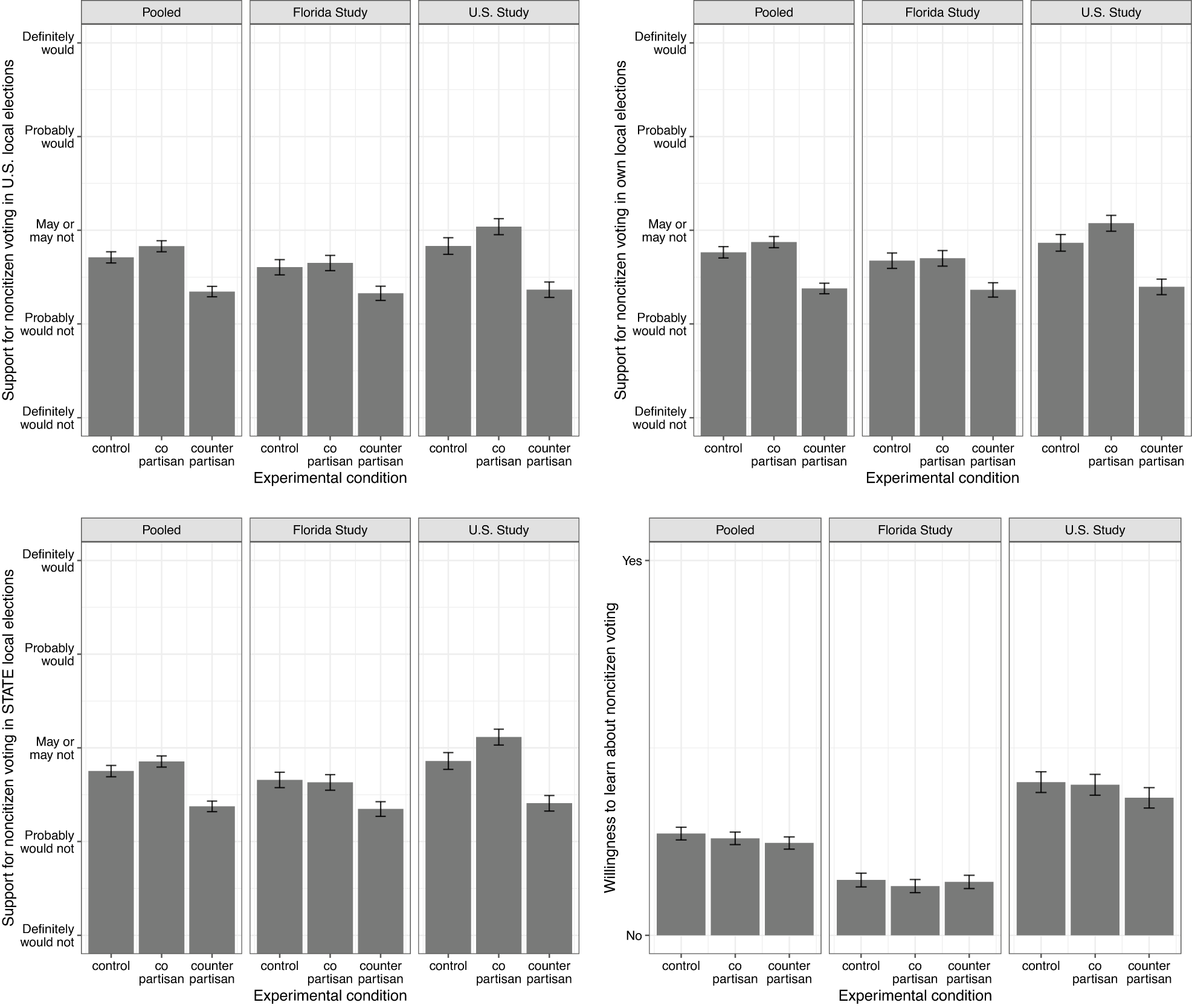
We do not find that the treatments affect the likelihood of seeing additional information on noncitizen suffrage (bottom-right in Figure 2). It is possible that measurement issues discouraged engagement with this outcome. The item did not emphasize support for noncitizen voting, and instead elicited willingness to learn about noncitizen suffrage in other states alongside announcing the end of the survey. It remains possible, however, that (de)alignment of U.S. voter-noncitizen partisanship motivates voters’ support for noncitizen enfranchisement, without (de)activating them to learn about enfranchisement policies.
These results show that U.S. voters increase their support for noncitizen local enfranchisement when noncitizens vote for their party, and decrease their support when noncitizens vote for the opposite party. Finding that these dynamics are present among both Democrats and Republicans would suggest that U.S. voters are more likely to be pragmatic than principled about extending the franchise to noncitizens. Specifically, when reading that many noncitizens vote Republican, Democrats may decrease and Republicans increase their enfranchisement support—counter to both parties’ ideologies.
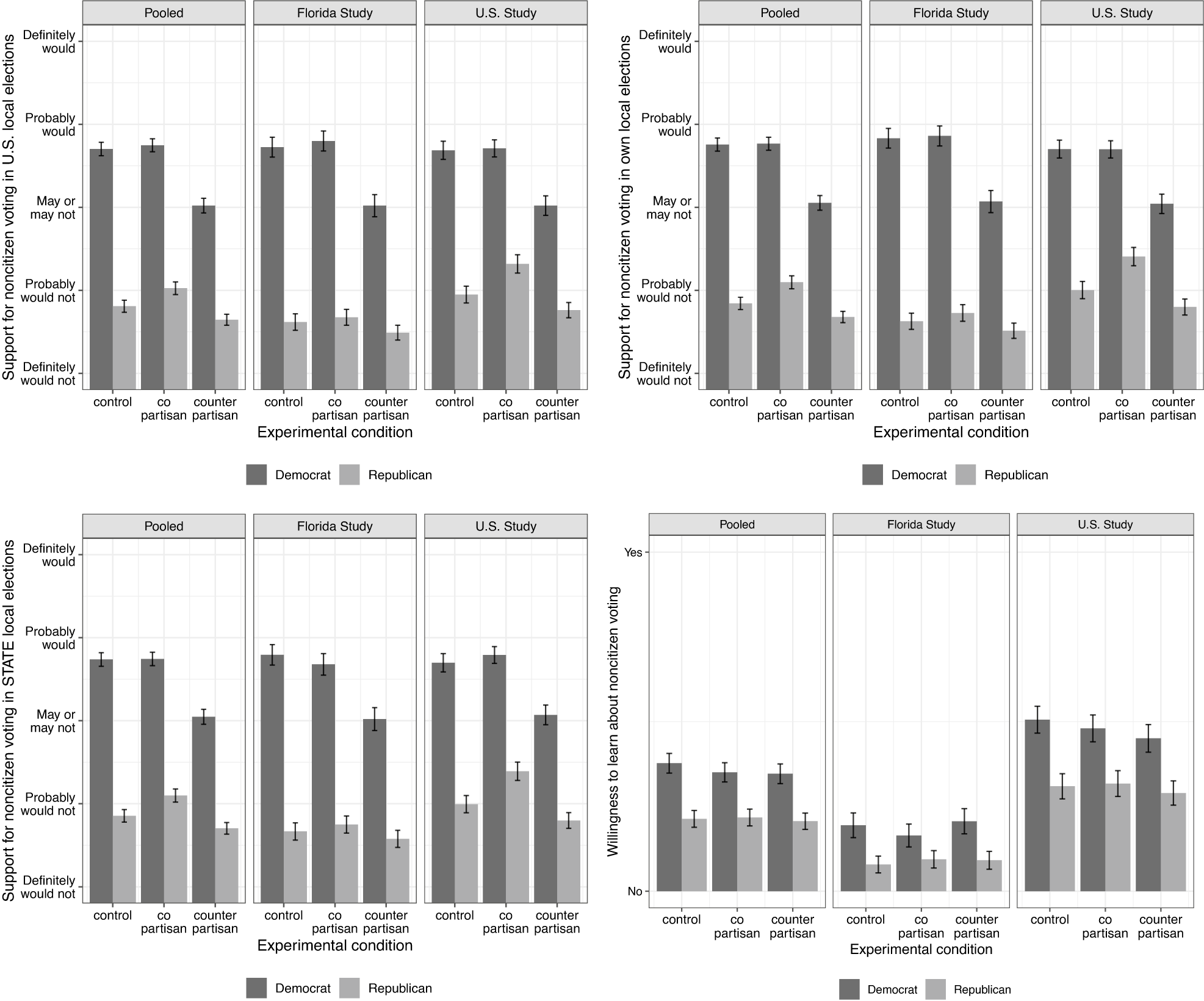
The difference in outcome means presented in Figure 3 suggests that this is indeed the case. Across studies and attitudinal outcomes, the counter-partisan treatment decreases Democratic support for noncitizen enfranchisement. Using the first outcome again as an example (top-left, Pooled panel), we observe Democratic support decreasing from an average of 3.70 in the control group to 3.02 in the counter-partisan group, equivalent to a change of 0.5 SDs (
 $ p<0.001 $
). Substantively, this corresponds to a change from support to indifference toward noncitizen enfranchisement. This treatment effect is statistically significant in both studies.Footnote 13 Conversely, the co-partisan treatment increases Republican support for noncitizen voting from an average of 1.81 in the control group to 2.03 in the co-partisan group, a change equivalent to 0.18 SDs (
 $ p<0.001 $
). This treatment effect is statistically significant in the U.S. Study, but not in the Florida Study.Footnote 14
Support for Noncitizen Local Suffrage by Treatment Groups across Democrats and Republicans
Note: Displays mean responses by treatment group and voter’s partisanship and 95% confidence intervals. Tables D.4–D.9 in the Supplementary Material present OLS estimates.
DISCUSSION AND CONCLUSION
Our findings suggest that U.S. voters are pragmatic about extending the local franchise to noncitizens. Although U.S. voters are, on average, indifferent toward local noncitizen suffrage, they oppose enfranchisement when noncitizens would vote for the opposing party. This runs contrary to party principles. Relative to the control condition, Democrats decreased and Republicans increased their support for enfranchising noncitizens who may vote Republican. We further find the decreased support among Democrats in the counter-partisan condition is slightly larger among voters who are more open to immigration relative to those holding less open immigration attitudes. Similarly, the increased support among Republicans in the co-partisan condition is larger among voters supporting less open immigration.Footnote 15 This provides further suggestive evidence of voters’ pragmatic preferences on noncitizen suffrage.
Importantly, our main results are not explained by a general dislike of immigrants. Of course, support for noncitizen voting is positively correlated with inclusionary immigration attitudes. However, neither the co-partisan nor the counter-partisan effect is systematically stronger among voters with pro- or anti-immigration attitudes.Footnote 16 This is consistent with Levy and Wright (Reference Levy and Wright2020) who show that many of the same people who broadly support legal immigration to the US nevertheless oppose noncitizen enfranchisement, possibly because voting rights are conceived as exclusive to citizens.
Although our analysis cannot adjudicate between mechanisms for our findings, our explanation is better aligned with a party competition than a group-centrist paradigm, as the vignette raises the electoral stakes of noncitizen suffrage. Nevertheless, our results may be explained in part by ingroup favoritism and outgroup derogation (i.e., a sense of self-enhancing explanation). Future work can untangle these two possible mechanisms by contrasting effects across weakly and strongly expressively identified partisans (e.g., Huddy, Mason, and Aarøe Reference Huddy, Mason and Aarøe2015), or by augmenting the number of experimental conditions. Moreover, assessing whether our findings are heightened among the broader American population—who may be to the ideological left of registered voters (Dassonneville et al. Reference Dassonneville, Feitosa, Hooghe and Oser2021) and are therefore more open to immigrant enfranchisement—would add to the understanding of pragmatic partisanship in enfranchising attitudes. Further, our study is not designed to inform variation in voter characteristics or state contexts in which American voters are more or less pragmatic about noncitizen enfranchisement. Future research can explore these dynamics and other determinants of attitudes toward noncitizen voting with larger samples of voters.
Our findings contribute to the existing literature on enfranchisement, presenting one of the first explorations of the role of voter-noncitizen partisan alignment on U.S. voters’ support for immigrant enfranchisement. As many enfranchising and constitutional restricting policies succeeded through public referendum and broader citizen mobilization, our study’s focus on public opinion specifically adds a critical piece to the enfranchising puzzle, revealing that partisan congruence with migrants—as seen among parties—is a relevant force motivating noncitizen electoral access. This conclusion provides significant implications for the study of immigrant inclusion and party polarization globally, elucidating the limits of ideological principles when in conflict with possible party electoral losses.
SUPPLEMENTARY MATERIAL
To view supplementary material for this article, please visit https://doi.org/10.1017/S0003055424000522.
DATA AVAILABILITY STATEMENT
Research documentation and data that support the findings of this study are openly available at the American Political Science Review Dataverse: https://doi.org/10.7910/DVN/9PWJ3Y. Limitations on data availability are discussed in the text and appendix.
ACKNOWLEDGMENTS
We thank Payton Capes-Davis and Ariane Cortes for their excellent research assistance. We also thank Patrick Egan, James Fahey, Victoria Finn, Sara Goodman, Efrén Pérez, and participants at the APSA meeting and UC Berkeley American Politics internal mini-conference for helpful comments on this article. We also wish to acknowledge financial support from the Haskell Faculty Research Award at the University of Florida and the Penn Development Research Initiative at the University of Pennsylvania.
CONFLICT OF INTEREST
The authors declare no ethical issues or conflicts of interest in this research.
ETHICAL STANDARDS
The authors declare the human subjects research in this article was reviewed and approved by the University of Florida and the University of Pennsylvania. Certificate numbers are provided in the Dataverse Appendix. The authors affirm that this article adheres to the principles concerning research with human participants laid out in APSA’s Principles and Guidance on Human Subject Research (2020).


 Open access


Comments
No Comments have been published for this article.