


Traditional international relations theory suggests states should and do balance against other states in the system. More recent deterrence theories suggest the same to ensure state survival. Meanwhile, study after study finds that equally capable states experience higher rates of conflict. Why, then, are war and even disputes incredibly rare events in the system? If balancing and parity are state goals, why are there so few conflicts?
There are other parity-conflict puzzles, too. For example, since 1945, only four wars have been fought between relatively equal states or coalitions—that is one-quarter the number of wars that started among preponderant states. Indeed, the United States alone has fought at least six preponderant wars during that time.Footnote 1 Consider, too, that capability differences rarely predict war outcomes. This can be explained away by arguing that resolve and other factors play substantial roles, but the lack of correlation between capabilities and victory should be troubling for the theories that rely on capability differences for ex ante information about likely conflict outcomes.
I argue that the central problem for most power-based theories of conflict is that state capabilities and dyadic capability differences are largely fixed for most states and dyads, but conflict often varies substantially across the international system, even among dyads at rough parity. A constant cannot explain a variable, of course, yet that is exactly what is expected when capability measures are used to predict militarized conflict. So, if we are to understand why conflict and parity correlate, we also need to incorporate the nature and development of state capabilities into our theories of conflict.
System entry processes can often explain why preponderant dyads tend to be peaceful but dyads at parity tend to be conflict-prone. Of the former, for example, are the dyads that include many former colonies, islands, and other small states; these are states without military capabilities that never contend with other states in the system. Peace has nothing to do with capability differences for these states—they would be peaceful when paired with other poor-capability states as well. Conversely, among dyads at parity are the states that enter the system with poorly defined borders. These few states engage each other constantly, and their rivalries encourage both parity and conflict. Absent the underlying competition, though, there would be no association between capabilities and conflict for these states. Indeed, the vast majority of dyads at parity are peaceful because outstanding issues in the dyad have been settled.
I demonstrate in this article that state capabilities rarely change from their relative position at state system entry; there have only been 83 year-to-year changes of any substance and all but two of the conflict-related cases occurred after war broke out. Too, since states enter the international system in geographic clusters, regional and temporal variables reinforce initial capability distributions. I find that a dyad’s initial capability distribution predicts all future distributions almost 80% of the time. Capabilities are static. The lone exception is the one-half of one percent of the dyads involved in rivalry. I show that capability differences do not predict rivalry, but the presence of rivalry causes dyadic distributions of capabilities to converge toward parity. Rivalry’s association with conflict then explains the parity-conflict correlation for these very few states in the system.
The largely static nature of dyadic capabilities has implications for the observation of conflict because large-N analyses predicting dispute onset with various measures of parity are quite prone to the effects of outliers. As I demonstrate, including a dummy variable for just three rival dyads (the US/USSR, USSR/China, and North Korea/South Korea) eliminates any statistically significant relationship between parity and dispute onset, even in incredibly large samples of the international state system. The relationship also disappears if a control is added for the presence of a weak, island state in the dyad. Even controls for the region and time in which the dyad entered the system eliminate the dispute relationship as well. These findings provide support for the argument that the parity-conflict correlation is largely a product of the geographic and temporal factors associated with state creation.
I test my argument based on how we currently measure parity, which is a measure we have used for more than forty years (Singer, Bremer and Stuckey Reference Singer, Bremer, Stuckey and Russett1972). Nevertheless, the state birth and state development or maturation processes I describe should apply to most other measures of state capabilities as well.Footnote 2 For example, the gross domestic product has often been substituted as a proxy for the power of the state (Organski Reference Organski1958, Organski and Kugler Reference Organski and Kugler1980), but wealth will of course be correlated with the geographic position of the state. Industrial capacity also tends to follow time-dependent cycles of industrialization and deindustrialization. Wars certainly affect economic position, too. These correlations imply a high bar for any attempt to dismiss the system-entry findings as consequences of measurement issues.
The implications of my argument are several. Foremost is the observation that a common correlate of conflict is both misspecified and misused. If parity does still affect the likelihood of conflict, we need a different way of identifying that relationship. I argue that paying attention to how, when, and where states enter the system provides a better explanation, and my tests support that argument. These findings imply conflict has other causes, which are likely to be unrelated to capability differences.
I begin the argument in the next section with a brief review of the literature on the parity-conflict relationship and follow with an outline of my argument for why state birth and state development control observations of state capabilities. I then use the predictions of this argument to explore the causes of parity in the dyad, how those causes affect the likelihood of militarized disputes, and the distributions of parity among war belligerents. The implications of these arguments and findings are numerous for the international relations literature, and I close by discussing these.
WHY PARITY IS SUPPOSED TO CAUSE CONFLICT
Early theories of state power focused on whether states balanced their power against rivals, either dyadically or in the system. This evolved substantially as empirical studies began to confirm a strong relationship between equal capabilities and militarized conflict. Then, at least two sets of theories emerged to explain the relationship between parity and war—one focused on the opportunity for conflict in the dyad while the other emphasized how power equality confounded diplomacy by increasing the level of uncertainty for both states in the dyad.
The opportunity-for-conflict argument began with the examination of the large system wars developed by Organski (Reference Organski1958). He argued that a power transition model of state development and capability growth best explained why there was a tendency to have substantial, system-altering wars every so often (see also Organski and Kugler Reference Organski and Kugler1980). As less-capable states industrialized, their power potential became realized, and their capability rank in the system began to change. If the capabilities of the rising state were great enough, then the state could challenge the status quo’s dominant power for the benefits that could be derived from hegemony. If the challenger was dissatisfied with the then current distribution of benefits in the system, then war became likely. If the challenger was satisfied, then it would likely assume the role of hegemon more peacefully.
This power transition theory was then used to explain why there was a strong link between parity and conflict in dyadic studies (Kugler and Lemke Reference Kugler, Lemke and Midlarsky2000). With this argument, an opportunity for conflict was thought to be present as states became equally capable (Wayman Reference Wayman, Kugler and Lemke1996). This could occur in either the region (Lemke Reference Lemke2002) or the dyad (Geller Reference Geller and Vasquez2000) as both would explain why the chances of conflict increased with moves toward parity. For rivals, or for any state with grievances, equality of power enabled the state to pursue revision of the status quo.
An uncertainty-based argument for the parity-conflict relationship was first systematically developed by Fearon’s (Reference Fearon1995) emphasis on the role of observables. When capability differences are large in a dyad, there is little ability to misrepresent, and differences in resolve have little import. The outcome of a possible conflict can easily be assumed by both parties based on capability differences, and this incentivizes the less-capable state to compromise—or, in Blainey’s (Reference Blainey1988) argument, the more powerful state can impose its will. For dyads at parity, however, compromises become less likely as private information about both state resolve and capabilities cannot easily be revealed. The risk of conflict becomes more attractive as an arbiter of each state’s capability and resolve to fight for the issue. Conflict is more likely as uncertainty increases.
Reed (Reference Reed2003) provides one of the most creative empirical tests of this argument. He argues that one way of understanding the role of uncertainty in a dyadic relationship is to focus on the number of observable misestimations made by states. These should increase with uncertainty, and, therefore, any heterogeneity in conflict behavior should be a function of the distribution of capabilities in the dyad (Reed Reference Reed2003, 638). Using a heteroskedastic probit model to estimate militarized dispute onset, he finds that the variance in the model is, in fact, correlated with the dyadic distribution of capabilities.
In many ways the progression of the empirical literature over the past forty-odd years has rendered the connection between parity and conflict a settled question in empirical studies of militarized conflict and war. A substantial minority of current studies focus directly on the role of capabilities in conflict while the remainder almost always controls for the presence of parity in the dyad as they test other empirical relationships. Nevertheless, there are at least a few reasons to doubt the existence of a strong connection between parity and conflict.
First, while including an indicator for dyadic parity is standard practice, the control seldom provides a substantive impact greater than or even approaching the relative importance of other variables in most models. For example, in Reed’s (Reference Reed2003) examination, capability differences provided one of the smallest effects of the variables tested, both before and after changing how the variance in the model was treated. Contiguity, joint democracy, and several other predictors have much larger substantive effects, as Bremer (Reference Bremer1992) pointed out some time ago.
More importantly, both explanations of the relationship assume that capabilities change substantially over time. In the opportunity model these changes enable the pursuit of revisionist preferences that had previously been stymied, and uncertainty-based theories use this assumption to explain the relative infrequency of conflict across the life of a dyad. However, if capabilities rarely change for states or dyads, then dynamic theories of capability-driven conflict are unwarranted (cf. Powell Reference Powell2006).Footnote 3 Again, constants have problems predicting variables.
There is also ample evidence that conflict drives capability changes rather than the reverse. Kadera (Reference Kadera2001), for example, provides a much more complicated power-conflict story than the one commonly portrayed by parity scholars. She combines models of balance of power and power transition and finds three separate conditions under which conflict between rivals are likely. Important for my argument, though, is that Kadera establishes a dynamic relationship between hostility and both capability changes and militarized conflict. There are situations in this dynamic during which the anticipation of conflict pulls the dyad closer to parity. Empirically, this associates dyadic capability differences with conflict at multiple times in the dyadic relationship even though parity is not leading the states to war. Important, too, is the focus on major rival dyads. As I demonstrate later, these are the only dyads capable of substantially changing their relative capabilities.
Finally, what is perhaps most perplexing is that we have numerous studies of state formation and state evolution but rarely incorporate these into our models of power and conflict. This omission is important because state capacity and how it is generated will play a substantial role for both. Indeed, our best explanations of state evolution believe that contestation creates state structures and, as rivals face off across borders, equilibria of capabilities develop in the dyad as stalemates are reached or states die out. Conversely, states entering without that contestation have diminished capacity and are often unable to launch international conflicts. In either case, we completely miss the effects of state system entry. In the next section, I discuss the most common definition of state power and its operationalization and show how much the measure depends on how, when, and where states enter the international system.
STATE BIRTH, CAPABILITY CHANGES, AND INTERNATIONAL CONFLICT
This section presents the core of my argument. First, I outline how power has been consistently defined and operationalized across studies of international conflict. A close examination of this definition reveals how difficult it is for states to change their relative capabilities in the international system. Next, I discuss how the processes of state-making and entry into the state system both encourage the clustering of dyads at rough parity when they enter the international system at the same time. The changes that do occur in capabilities are likely to be limited over time and affect geographically proximate states similarly, which again reinforces parity for these dyads.
We tend to correlate conflict with parity because of these state entry processes. Dyads may enter the system with ill-defined borders or try to extend their territorial control, and this competition drives both parity and conflict. Equal capabilities do not affect the likelihood of conflict but are instead a byproduct of state development. Conversely, imperial dissolution has brought the majority of states into the international system with relatively weak capabilities and an inability to contest well beyond their borders. Again, state system entry explains the correlation of preponderance with peace.
The Nature of Power
Hans Morgenthau (Reference Morgenthau1960, 115–84) was one of the first theorists to think systematically about what gives states power in the international system, and he differentiated between sources of national power that are relatively stable over time and those that change often. Foremost among the former category was geography. Morgenthau argued that the United States and Britain have had a privileged geographic position compared to states like the Soviet Union. Without large rivers or mountain ranges dividing its countryside from the rest of Europe, the Russians had endured a proneness to invasion since at least the
 $14{\text{th}}$
century. Britain is an island separated from the Continent, and the United States rested even farther away from the other major states. This geography protected both and augmented their power.
The usefulness of geostrategic location is difficult to define consistently across states in a nontautological way, which is likely why Morgenthau also noted several other geographic elements of power. These include the ability of a state to feed itself or the farm quality of its land, the iron ore and raw materials in the ground, and the size and location of its population. Together, these were the raw materials that could be transformed into economic power. For Morgenthau (Reference Morgenthau1960, 136–9), the industrial capacity of the nation was actually the defining element of a great power or superpower. Comparing India, the Soviet Union, and the United States, Morgenthau argued that each had the raw materials available to be powerful in the world, but only the latter two had the economic systems capable of utilizing its resource potential. Thus, industrial capacity translated resources into useable power which manifested as military preparedness—the size and quality of the state’s armed forces.
Singer, Bremer and Stuckey (Reference Singer, Bremer, Stuckey and Russett1972) used this discussion of power as a means of operationalizing and then quantifying a measure of state capabilities that could be used to test whether the balance of power or preponderance better predicted conflict in the international system. Their measure—the Composite Index of National Capabilities (or CINC score)—used six elements of Morgenthau’s discussion to code capabilities for each state-year. The long-term capabilities of the state were operationalized using the total population and the urban population of each country. Medium-term capabilities included iron and steel production and energy consumption, and short-term capabilities focused on the military using both the state’s military expenditures and its total personnel in the armed forces. The percentage of the world’s distribution of each resource possessed by the state then became a component score of its capability for that indicator. Singer, Bremer, and Stuckey computed the average of the six percentages and labeled it the state’s index of material capabilities, or CINC score.
This index provided a consistent method of comparing states across time, including even the first years of the Correlates of War (CoW) data collection from 1816 on. The measure also took seriously the important elements of military capabilities while also correlating strongly with economic indicators of power such as gross domestic product (Organski and Kugler Reference Organski and Kugler1980). Though the measure ignored the size and quality of nuclear arsenals, those states with nuclear weapons tend to be among the most capable in the international system according to the measure. In short, the measure was consistent across large spatial and temporal domains and had substantial face and content validity. This is why CINC scores have been one of the most widely used variables in international relations for the past forty years.
Of course, noteworthy for my argument is Morgenthau’s belief that the geography of power is relatively stable over time. Only military capabilities change often or substantially for most states in the international system. Change in state economic structures or shocks to population trends tend to be exceptions rather than the rule.
State Birth and Dyadic Capability Differences
States most often enter the international system in one of two ways: through an evolutionary process of state building or through imperial dissolution. As I describe here, both processes may actually encourage parity in states that enter the system at the same time.
The geography of state-building
The Tilly-inspired generalized model of state building is essentially a game of resource extraction from the population (Tilly Reference Tilly1975, Reference Tilly, Evans, Rueschemeyer and Skocpol1985, Reference Tilly1990). Power holders within society engage in conflict, but, to do so, they must extract from the population and accumulate wealth in order to wage war. The public trades taxation for protection, and the state becomes a byproduct of the bureaucracy that is established by the power holders to wage war, extract, accumulate wealth, and protect the population. Thus, the modern European state system develops as a series of contestations between and among states in the region.
Though this war-based model of state-building does not often travel well to other, non-European regions (see Centeno Reference Centeno2003), there are good reasons to expect that leaders in other parts of the world also engaged in state building using cross-border contestation. Rivalry, for example, was one mechanism by which the capabilities of states were built. As Thies (Reference Thies2005) argues and demonstrates, Latin American proto-states were ill-equipped to wage the type of wars Tilly associated with the European state system; however, the expectation of war through several interstate rivalries had the same overall effect. This implies predatory state building can affect the development of many states in the system, not just post-Westphalian Europe.
The dyadic consequences of this state-building-through-contestation process suggest a convergence at parity for the states involved, for several reasons. First, weaker states will die out of this system through conquest (Herbst Reference Herbst2000). Second, stronger states will prey upon these weaker states and contend with similarly capable states until checked. This generates a rough parity of capabilities across borders and in the region among those states that do survive. Power holders increase state capabilities to contend with their rivals, but their rivals do the same as well. As these conflicts build state structures, both domestic and international capability changes become endogenous to the rival relationship, and parity becomes the likely outcome.
Two more paths to system entry: former colonies and the death of empire
While Tilly’s model may explain Europe well, the vast majority of modern states have entered the international state system after a major state withdrew colonial control and granted independence.Footnote 4 This accounts for almost all of sub-Saharan Africa, Latin America, and the Middle East, as well as many other states in the international system. Of these, many countries were blocs of colonial holdings by the same major state that were arbitrarily demarcated for administrative purposes. The British holdings clumped together geographically, as did those of the French, Portuguese, Dutch, and Germans. Thus, many of the former colonies were immediately embedded with similar economic structures and industrial capacity. Given that the rationale for colonial holdings often turned on raw materials, the newly independent states also likely had similar resource extraction systems as well.
This same process holds true for empire death as well, as the states that comprised the Austro-Hungarian empire, the Ottoman Empire, or the Soviet Union, all had industrial capacities and economies that were more similar than they were different. As the empires died, those institutions carried on, and the economies often remained linked together. These connections have even been formalized several times, most recently with the alliances and trading pacts associated with the Commonwealth of Independent States, which followed the demise of the Soviet Union. Collectively, states born from state separation tend to be at or near parity with their neighbors, even though the process did not necessarily begin with a state-building mechanism of contestation.
For all states—not just former colonies or separated states—there are also general patterns of state birth that encourage similar capability structures within the state. The technological sophistication of both industry and the armed forces are likely to be time dependent, even across noncontiguous states. Inventions that aid wealth production tend to travel quickly. The science that produces technological innovation tends to be time dependent as similar inventions are developed at the same time, even without knowledge of the other’s invention. The stock of information in the world produces this effect, and that information grows over time. Thus, when states enter the international systems matters for the types of technologies they possess and the portion of the evolutionary path they follow.
State maturation and evolution reinforces initial dyadic capability distributions
State growth and maturity tend to follow a process. Organski’s (Reference Organski1958) power transition developed the potential political implications of state formation, power transition, and power maturity, but the key insight for my argument is that there is a natural cycle of state growth that is well documented. Developing nations tend to grow quickly and eventually mature. When we consider that many bordering states enter the international system at the same time, then these cycles of growth and maturity are likely to covary, at least in part, so parity in terms of economic development will covary as well. Together, these birth and change processes explain why recent studies have found that variation in governmental abilities to extract resources from the state are associated with neighborhoods and best predicted by contiguity (Thies, Chyzh and Nieman Reference Thies, Chyzh and Nieman2016). Institutions cluster together geographically.
Population growth patterns change similarly. Population growth was slow across the globe until 1950 and then rapidly accelerated until the mid-1960s. As Lee (Reference Lee2011) describes, population forecasters have demonstrated that country population sizes are influenced by two key variables—fertility and infant mortality rates—that follow patterns linked closely to economic development. Less-developed countries have higher fertility and mortality rates, but mortality declines as economic growth increases. Eventually, with an aging population, fertility declines as well, so developed countries tend to have low mortality rates and lower birth rates as well. Once again, these processes cluster across borders and in the same region since state development clusters regionally as well. This means that population ratios will remain similar across state pairs in the same general area, even though regional differences in development may occur.
Economic theory also points to an equilibrium in wages across countries (Krugman and Obstfeld Reference Krugman and Obstfeld2009), and this affects population trends through migration patterns. If one country’s local advantages predict higher wages because of its industrial capacity or resources, that country is likely to attract immigration from other countries with lower wages. This buys down the average wage until an equilibrium price for the wage is reached. Given the transaction costs associated with movement, these economic forces may not extend beyond the region, but individual-level incentives reinforce trends toward regional clustering of wages and population settlement patterns. The linkages also hint at the complex interrelationships that can be found among indicators of population size and distribution and economic capacity. Most of these data are highly correlated for a reason.
The joint observation of conflict and parity
The sum of my arguments so far points to a strong, status quo bias in initial measures of state capabilities and dyadic differences. Further, the processes that lead to changes in the state are likely to affect both states in the dyad similarly, making dyadic parity measures relatively invariant over time, even if state capabilities were to evolve. The next step is linking those observations with peace and conflict, and I do this with three observations.
First, not all states enter the international system with settled borders, and not all leaders may accept their existing boundaries at system entry. These states and leaders will continue to engage in the type of state-building that Tilly (Reference Tilly1975) and others have suggested. For Vasquez (Reference Vasquez2009), this is a territory-driven process: states mark their borders early and keep defending them until the borders are considered legitimate by both sides. That perhaps explains why over half of all rivalries begin when the dyad enters the system and another 25% begin within the first years of the relationship (Thompson Reference Thompson2001). Regardless of cause, though, there is an immediate association of these contentious dyads with both parity and conflict, but the causal arrow runs from the rivalry or the poor borders to both parity and conflict. The states continue to compete with each other in order to win the rivalry, and this encourages convergence at parity, just like the Tilly-inspired competition model would suggest. Of course, that same rivalrous competition produces hostility and militarized conflict, which associates parity with disputes for these particular dyads. Luckily, rivalries are relatively rare in the international system, numbering about one-half of one percent of the dyads in most samples.
Much more numerous are those states that enter the system as former colonies or emerge from dissolving empires. These types of state entry processes tend mostly to encourage similarly weak institutions and lack the state-capacity-building exercises associated with conflict. Their economies and militaries are not developed, and, without these capabilities, their average likelihood of initiating international conflicts is much lower than most other states in the system, especially when contending against states distant from their capitals. Since their capabilities are weak, they are overrepresented as the weaker partner among preponderant dyads, and the nature of their entry into the system correlates peace and preponderance. Preponderance is not causing peace in any significant way among these dyads—their leaders are not trying to engage in conflict but then reconsider because of the power of their potential rival. Rather, these less-capable states are unable even to contend against potential rivals.Footnote 5
Finally, I have argued that observations of parity are often a function of the spatial and temporal proximity of states entering the system. States cluster together with similar capabilities, and this encourages regional observations of parity. Of course, that same clustering also increases the likelihood of low-level conflicts due to both the close proximity among these states and their increased interactions (Starr Reference Starr1978). Thus, a country in sub-Saharan Africa is more likely to fight other countries in the region than any of the states in Latin America, and, since parity is at least partially determined by geography and time of entry, a correlation is again produced. Contiguity will be an important predictor of both conflict and parity, as we know well, but so will other factors that describe when and where states entered the international system.
The sum of my arguments imply a spurious correlation between parity and conflict for most dyads in the international system. The type and timing of state system entry predicts both the likelihood of parity in any given dyad and also that dyad’s propensity for conflict. I begin empirical tests of these arguments in the next section.
THE EMPIRICS OF STATE CAPABILITY CHANGE
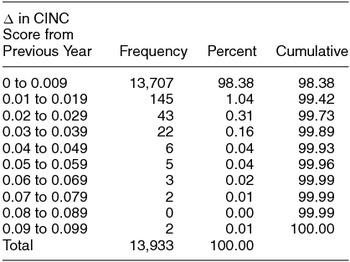
I argue that a state’s level of development prior to state system entry largely determines their relative capabilities thereafter. To demonstrate this, I calculated the absolute integer value of yearly changes in the Composite Index of National Capabilities data for the period 1816–2001. Table 1 provides the distribution of these changes. Over 98% of the state-years in the dataset do not have CINC scores that change more than 0.01 from one year to the next. Among the remaining 228 cases, only 83 move more than 0.02 in any given year.
Frequency of Yearly Changes in CINC Scores, by Magnitude

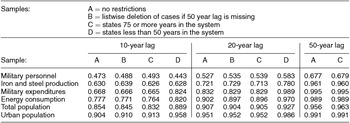
The lack of variation in the data maintains over time as well, with only the longest time periods able to produce substantive changes in a state’s overall CINC measure. Table 2 provides a correlation matrix for each of the six components of the CINC measure with its 10-, 20-, and 50-year lags. The table varies the sample of cases using data with (A) no restrictions, (B) listwise deletion of cases that had no 50-year lag data, (C) all states that had been in the system 75 or more years, and (D) all states in the system for less than 50 years. The different samples are used as robustness checks to ensure that the correlations in the unrestricted sample are not produced by small subsets of states.
Correlation Matrix of CINC Component Measures Over Time

The table sorts the correlations from least likely to be correlated with its lag to most likely to be correlated with its lag, for each component. The results are consistent across sample and lag used. Military personnel are least likely to correlate with lags of the variable but still do so at a high rate. Iron and steel production and military expenditures also correlate with their lags at a lower level; however, even these scores return to a near-perfect correlation within 50 years.Footnote 6
Yet another way of examining the stability of the CINC score data over time is to estimate the likelihood any given state has of changing their share of the world’s supply of each component. For example, the largest magnitude movements in the sample of all state-years uses the 50-year lag of each measure. The likelihood of substantially altering each state’s share of the total world population of the component is quite small, even over 50 years. Increasing (or decreasing) the state score by 1—a change from 2% to 3% of the world’s capabilities or from 10% to 11%, etc. . .—in 50 years only occurs in 34% of the state-years for military personnel and 33% for military expenditures. This type of change happens in 21% of the cases for iron and steel production, 19% for energy consumption, 34% for total population, and 35% for urban population. Those are incredibly small changes, especially over 50 years of state development.
For the vast majority of states in the system, the state’s share of each component does not change, and this makes the overall CINC scores stable over time as well. The mean change in CINC score over 10 years is − 0.0002 (
 $\text{sd}=0.01$
). Over 20 years, the mean increases in magnitude to − 0.0007 (
 $\text{sd}=0.02$
), and over 50 years the mean change is − 0.0012 (
 $\text{sd}=0.02$
). Finally, over the life of the state, the mean change is − 0.0044 (
 $\text{sd}=0.04$
), and a regression predicting current score with beginning score explains almost 50% of the variation in the CINC measure.Footnote
7
The simple fact is that CINC scores do not move much for any individual state.
When State Capabilities Do Change—The Effects of Wars
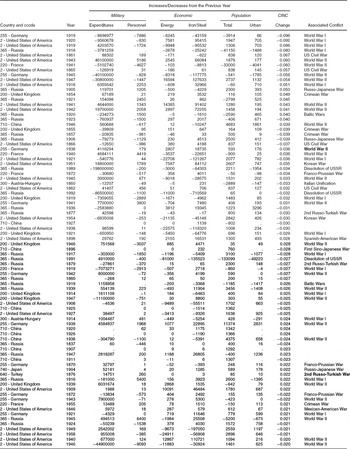
The above establishes well that state capability changes are rare, but consider, too, the few very large changes in the data. Of almost 14,000 state-years in my sample, only 83 state-years had CINC changes that moved that state’s system position more than 0.02. All of these changes were made by states that were then major powers or that had just fallen out of major power status. As might be expected, all but 19 of the change cases were also related to wars. However, only 2 of these 63 substantial state-year changes occurred prior to the associated war. State capabilities changed during or after the fighting.
Table 3 lists the component changes and associated wars for all state-years that had a CINC-score change of 0.02 or more from one year to the next. Columns 1 and 2 give the state and year, and then the following six columns list each component change from the previous year. Column 9 shows the actual change in CINC score, and then the final column associates the change with a particular war, if applicable. Two wars are bolded in the table. These are the only two cases in which the buildup occurred in a year prior to the start of the war. All of the other war-associated capability changes happened during or after the war.Footnote 8
Year-to-Year Changes in CINC Score Greater Than 0.02

Overall, only a handful of major states have been able to substantially alter their CINC scores, and, even in this group, only a smaller number of the most powerful states have changes greater than an absolute change of 0.02 in their CINC score. Further, the association between large-magnitude changes and wars is stark—of the 83 changes listed, 61 or 74% resulted from military buildups during war or drawdowns following a war. The largest changes were also most likely to be driven by system-wide wars, as eight of the ten largest magnitude changes were during the world wars. The other two large changes followed American buildups and drawdowns surrounding its civil war in the 1860s. These cases confirm that, while large changes in CINC are possible, they are (1) rare, (2) relegated to the major states in the system, and (3) overwhelmingly occur during or after major wars, not before.
THE GEOGRAPHY OF PARITY
The last section demonstrated that there is a substantial lack of variation in the CINC score data. To examine how this affects dyadic-level observations of parity, I constructed a sample of all non-directed dyad-years between 1816 and 2001. In my analyses of this data, I find, first, that there is a strong relationship between state system entry and contiguity. There are 748 dyadic cases of states entering the system at the same time, and 105 were contiguous according to data from Stinnett et al. (Reference Stinnett, Tir, Schafer, Diehl and Gochman2002). This is almost eight times the number of contiguous cases that would be expected by chance since the vast number of dyads in the system include states that do not border each other. Of contiguous dyads, one-quarter of the cases entered at the same time (105 of 399).Footnote 9
Second, I expect dyads that entered the system at the same time to be closer to parity than other dyads, especially the contiguous dyads with the same entry years. I use the stronger state’s share of CINC scores in the dyad as the measure of parity to confirm this since it seems to be the most widely accepted measure among recent studies. My predictions are again confirmed. There are 20,242 non-contiguous dyads that had different system entry dates but no prior interactions because one state entered the system later than the other state; the mean parity score of this group is 0.86. The 633 non-contiguous dyads with the same entry years had a mean parity score of 0.80. The 295 contiguous states with different state-entry years had a mean parity score of 0.81, and the 105 contiguous dyads with the same state-entry year had a parity mean of 0.75. Thus, having both contiguity and the same entry year produce scores closest to parity; having neither contiguity nor the same entry year produces scores closest to preponderance. Both of these categories are statistically different from each of the other categories at conventional significance levels (p < 0.001 in all difference of means tests). Each particular category is also statistically different from the overall mean of parity in the sample, which is 0.83.
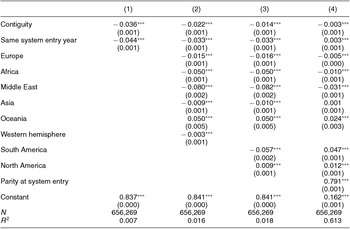
I also estimated several models predicting parity in the dyad using ordinary least squared (OLS) regression. These estimates are in Table 4. The first model is a simple prediction of parity in the dyad using only the presence of contiguity and a dummy variable for whether both states entered the international system in the same year. I include all dyad years after the initial system entry year, which makes the temporal domain for the analyses 1817–2001. The parity measure ranges from 0.5 (parity) to 1 (preponderance), so negative coefficients are associated with parity, and, as expected, both variables are negative and statistically significant. States entering the system at the same time and those that border each other are more likely to be near parity rather preponderance.
Geographic Determinants of Dyadic Parity, 1817–2001

Notes: OLS estimates using years after dyad system entry.
Standard errors in parentheses; * p < 0.05, ** p < 0.01, *** p < 0.001.
Model 2 adds estimates using CoW region definitions and demonstrates that geography determines at least a portion of the parity measure.Footnote 10 Europe, sub-Saharan Africa, Asia, and the Middle East are all more likely to have dyads that are closer to parity than the dyads from multiple regions. The exception is Oceania with a coefficient that suggests dyads are closer to preponderance in that region. Oceania is a loose collection of islands, with a strong Australia (relatively, in terms of CINC) compared with much smaller islands, and geographic similarities in population and economics are not likely to cross oceanic borders easily. Similarly, the mechanisms of state-building through conflict and rivalries are less prominent with such well-defined borders. The Western Hemisphere is similar in many ways to Oceania, considering the distribution of Caribbean island states in the region classification, but the presence of a dominant United States is the outlier here. Model 3 shows that this is the case because, once I separate the Western Hemisphere into North and South American regions, South America strongly predicts parity while North America predicts preponderance.
One additional note on the region-based estimates: There is some variation in the substantive effects of geography across regions. This variation corresponds roughly with those regions more likely to have former colonies. The African dummy predicts dyads that are 0.05 closer to parity than other states, which is substantively strong considering the parity measure ranges from 0.5 to 1. The Middle East has an even stronger substantive effect at 0.08, and South American is at 0.06. Compare these regional differences to Europe, which is 0.015 closer to parity, and there is some evidence confirming the mechanism of former colonial status predicting parity as well.
Finally, Model 4 adds the initial parity score of the dyad at the time it entered the international system to the model, and its effect is incredibly strong. The coefficient suggests that the initial parity score determines almost 80% of any future dyad-year’s parity score. Indeed, the R 2 for the overall model jumps from 0.02 to 0.61 with the addition of initial parity score, and this of course implies that the majority of variation in the parity score can be predicted at the time of dyad entry. All of this is consistent with the arguments that capabilities rarely change and initial distributions of capabilities control much of the dyadic capability relationship.
When Dyads Move toward Parity—The Effects of Rivalry
I demonstrated that the largest state capability changes most often occur during or after large wars. However, it is unclear how these large changes—or smaller changes that were also hostility induced—will affect dyadic distributions of capabilities. Many of the capability changes listed in Table 3 were large states losing conflicts, which would encourage preponderance in the dyad, but my theory argues that contestation over time should encourage moves toward parity as states compete with each other. The big-changes cases are exceptional, as I describe above, and should be exceptional, if most conflicts encourage state-to-state competition.
I examine the effects of competition by focusing on strategic rivalries. These are cases of contestation that include disputes and wars but also recognize periods of intense hostilities over extended time periods. Few disputes and wars last long enough to witness large capability changes in the state or especially the dyad, and, again, convincing outcomes in the very large wars may skew our understanding of the effects of prolonged competition. I use Thompson’s (Reference Thompson2001) perceptual definition of rivalry because it assures that both states are in contention.Footnote 11 If my argument is correct, the focused hostilities and competition against an enemy should drive both states away from their initial capability distributions and toward increased parity in the dyad.
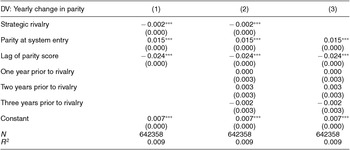
To test this argument, I estimated three OLS models that each predicted the change in parity score from the previous year, using the same data as described above, and report the results in Table 5. My last tests demonstrated well that much of the variation in parity scores is determined by the dyad’s initial distribution of capabilities, so I control for that measure. I also control for the previous year’s parity score in each model as well. Both are statistically significant across all tests, but neither affects the statistical significance or substantive understanding of the rivalry dummy variable. They are not correlated with rivalry in any substantial way, and omitting either or both variables does not change the results in any of the estimations.
Rivalry and Dyadic Parity, 1816–2001

Notes: Standard errors in parentheses; * p < 0.05, ** p < 0.01, *** p < 0.001.
The effects of rivalry are also consistent in Model 1 and Model 2. A dummy variable for the presence of a Thompson rivalry year moves the parity score the equivalent of a full 0.01 over the course of five years (− 0.002 each year) in both models. Since the average rivalry lasts about thirty-five years in my sample, that change is the equivalent of moving from, for example, a parity score of 0.77 to 0.70. Given how static these measures are that is a substantial change over time.
Rivalry includes conflict, and it could be the case that parity is increasing prior to rivalry, which becomes the cause of conflict. Models 2 and 3 explore this possibility by including dummy variables for each of the three years prior to the rivalry. Model 2 estimates the pre-rivalry years with the rivalry dummy while Model 3 excludes the rivalry dummy. The pre-rivalry years are not statistically significant in either model, and the sign of the estimates actually suggest moves toward preponderance prior to rivalry. These results do not change if I group the years into one dummy variable and/or if I include only the first three years of rivalry. In short, I find no evidence of moves toward parity prior to rivalry, but rivalry does consistently pull dyads closer to parity over time.Footnote 12 I explore the implications of these movements in the next section.
PARITY AND DISPUTE ONSET
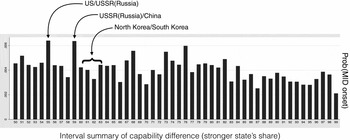
If state capability and parity scores are, except for rivals, largely static over time, then how does this affect our understanding of the causes of conflict? Figure 1 presents a bivariate plot of the parity-dispute relationship. The y-axis is the probability of a militarized interstate dispute (MID) at each level of dyadic capability ratio, measured using the stronger state’s share of dyadic CINC scores (Singer, Bremer and Stuckey Reference Singer, Bremer, Stuckey and Russett1972), which varies from 0.5 (parity) to 1 (preponderance). The x-axis lists the capability ratios—the stronger state’s share of capabilities in the dyad—at the interval level to ease presentation of the relationship. The sample includes all dyads, 1816–2001.
Relationship between Parity and Militarized Interstate Dispute Onset, 1816–2001

Obvious from the chart of conflict probabilities are several outliers. I label two of these cases—the United States and Russia (USSR) and Russia (USSR)/China. I also label the North Korea/South Korea dyad that spans the 0.60 to 0.63 capability ratio range. Together, these three rival dyads account for a tremendous number of disputes that cluster together on the parity scale. The US/Russia(USSR) rivalry produces nine disputes or 20% of the disputes at 0.55 on the capability scale. Russia (USSR)/China experiences 10 disputes at 0.59 and 0.60; that is one-eighth the total for those two capability ratios combined. Finally, the Korean rivalry produces 16% of the disputes—15 in all—for capability ratios ranging from 0.61 to 0.63. The average year-to-year change in parity for these outlier cases is also about half the average for the full sample. So, these rivalries sit on the parity measure continuum, have frequent disputes, and, as I will demonstrate below, produce the positive relationship between parity and dispute onset.
Another set of outliers rests near total preponderance. These are dyads with small, mostly island states that have capabilities that are so small that the next most capable state—São Tomè and Principe—has capabilities that dwarf these states by a factor of 10 or more.Footnote 13 These cases are the bulk of the zero-value capability cases described earlier, and these small states have had only a handful of militarized disputes with other states in the system. Indeed, of the 50,893 dyads that include at least one small or island state, only four disputes included one of these states, and only one was initiated by the island state—when its coast guard fired rifles at foreign fishermen.Footnote 14
The paucity of disputes for these cases has an incredibly strong substantive effect on the parity-conflict relationship. Since their capabilities are so small, including one island in any dyad brings the parity score of that dyad to near-complete preponderance for the other state. Their lack of capabilities render them unable to contest other states, and this concentration of peaceful dyads at preponderance skews the parity-conflict relationship. Again, state birth and development control this peaceful relationship. Each of these states entered the system as territorial states that completely encompassed island territory (or were territorial enclaves) and most often did not undergo the processes of state development through contestation. The states exist without military capabilities—really, without any capabilities to even launch a sustained defense of their homelands. Including them in dyads with militarily capable states distorts the concept of parity we are trying to assess. Peace is present not because of preponderance but because of the lack of a military or the ability to develop a military.
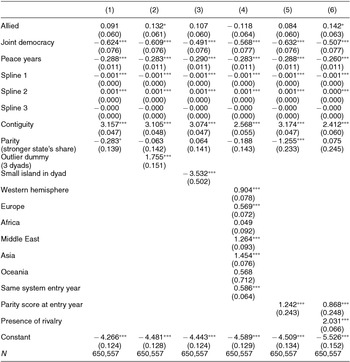
To more rigorously demonstrate that capability score may simply be identifying the relationship between specific dyads and conflict, like the island states or the rival outliers described above, I estimated a model of dispute onset for a sample of all nondirected dyad-years, 1816–2001, using several standard predictors of conflict: the presence of an alliance, joint democracy, contiguity, and corrections for temporal bias.Footnote 15 To this base model I added several dummy variables that identify the outliers discussed above as well as the parity-inducing, state-system-entry conditions noted in the last section. The results are in Table 6.Footnote 16
Logit Analyses of MID Onset, Using CINC Parity and Geographic Predictors of Parity

Notes: Standard errors in parentheses; * p < 0.05, ** p < 0.01, *** p < 0.001.
Model 1 provides the initial estimate of parity on conflict, with parity equal to the stronger state’s share of capabilities in the dyad. As convention suggests, higher shares of capabilities for the stronger state are associated with peace in the dyad, and this relationship is statistically significant at p < 0.05. A dummy variable controlling for the presence of one of the three rivalry outliers eliminates this relationship in Model 2. Once these dyads are identified separately, the coefficient of the parity measure becomes less than half its standard error, and the substantive effect is greatly diminished. The outliers predict conflict well, of course.
Model 3 controls for the presence of an island state or territorial enclave in the data. The dummy variable is positive if one or both of the states is an island country with no material capabilities (see text above), and the results following the addition of this variable mirror the findings in Model 2. The coefficient for parity is again less than half its standard error. Similarly, too, the dummy variable predicts conflict well—in this case, the island states are much more peaceful than would be expected by chance, which makes sense considering that these states have no military capabilities.
Model 4 introduces the regional and system-entry parity predictors I assessed in the last section.Footnote 17 Same-entry-year is a good predictor of the likelihood of conflict in a dyad, and regional controls are associated with conflict for all dyads but those in Africa and Oceania. Of course, these two regions have states that are more likely to be recent colonies and island states, each with state-development processes that differ from the rest of the sample.
The final two models analyze the effects of the initial capability distribution in the dyad. Recall that I previously demonstrated initial parity scores are largely stationary and predict well future parity scores in the dyad. Model 5 shows that controlling for these initial capability distributions restores the statistical significance of the current parity score, and its substantive effect is almost four times larger than what I found in Model 1. However, including both parity variables effectively renders the estimation to only identify the change in parity level since the dyad’s entry into the system.Footnote 18 Thus, large moves away from the initial distribution of capabilities, and toward parity, are associated with conflict. But what causes moves toward parity? As I demonstrated in the last section, rivalry predicts most dyadic changes, so Model 6 controls for whether the dyad is involved in a strategic rivalry (Thompson Reference Thompson2001). Adding this dummy variable eliminates the statistical significance of the current parity measure, and the substantive effect of the initial parity score in the dyad is also reduced.
Overall, these results demonstrate, first, how fragile the statistical support for a relationship between parity and conflict actually is. The addition of simple controls for the presence of three outlier dyads, the presence of an island state in the dyad, regional controls, or initial parity score coupled with rivalry-induced changes, each eliminates any statistically significant effect of parity on dispute onset. If we assume that many of those controls proxy state development processes at least in part, and also realize that state capabilities and dyadic distributions of these capabilities are largely static, then it becomes clear that parity is simply a proxy for the geographic conditions that affect state system entry and state development. In the end, I find no consistent evidence that parity or preponderance, as currently measured, is independently related to dispute onset.
CAPABILITY RATIOS AT WAR ONSET
The analyses above provide good evidence that parity is a circumstance of state system entry and not necessarily a cause of dispute onset, at least as parity is measured now. But that was dispute onset, and much of the theoretical literature focuses on wars. So, do states at parity describe well what we find in the war data?
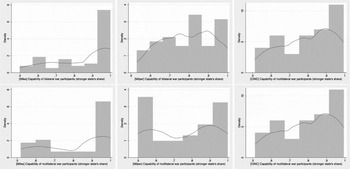
I begin an answer to that question by first examining the distribution of capabilities between and among belligerents when wars occur. I have already shown that disputes short of war are not predicted by parity, but it could still be possible that the bigger conflicts can be described as conflicts among equally matched states or coalitions. Nevertheless, they are not. Figure 2 demonstrates that, if any clustering is present in the war data, the trend is toward preponderance.
Capability Differences between Belligerent Parties in All Wars, 1816–2001

Figure 2 uses the same measure of capability differences as before—the stronger state’s share of dyadic capabilities—and sums the measure for war belligerents on both sides of the conflict.Footnote 19 The first part of Figure 2 provides data for military expenditures, the second provides data for military personnel differences, and the third provides CINC score differences. A kernel density plot of the data is superimposed across each distribution.
The first graph shows that capability differences as measured by military expenditures are predominantly clustered near preponderance—0.9 and above. Very few wars occur when expenditures are near parity. The second graph, which uses military personnel levels, is kinder to the parity to conflict relationship, but the clustering still remains at preponderance. More wars are fought between unequal parties than between equals. Finally, the third graph demonstrates a modest linear relationship in the data, but the relationship is negative for parity. Again, more wars have occurred between belligerents who possessed vastly unequal CINC scores.
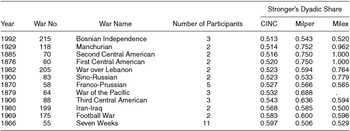
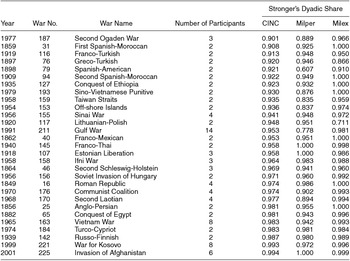
An examination of the actual war cases suggests several patterns as well. There are a total of 12 wars that have occurred between belligerents at parity in Table 7, identified as CINC score shares ranging from 0.5 to 0.6,Footnote 20 and only four of the wars started after World War II. Contrast this with the 29 wars that have occurred between belligerents with asymmetric capabilities in Table 8. There are more than twice as many wars between preponderant belligerents than between belligerents at parity, and about half of these cases are post–World War II cases. Asymmetric wars have become more common over time, but there were still plenty of wars among unequals prior to World War II as well. The trend in the data just highlights that the few symmetric conflicts in the data were more often found relatively early in the European state system, which is also early in the development process for these states.
Wars with Participants at or near Parity, 1816–2001

Wars with Participants at or Near Preponderance, 1816–2001

Overall, the war data provide yet another piece of evidence suggesting the long-assumed parity-conflict relationship is incorrect. Were we to randomly guess the capability distributions across war participants since 1816, we would be right much more often with a guess of preponderance.
Implications
I began this article by suggesting an incongruity in the scholarship on parity and conflict: States are supposed to balance against one another and parity is linked to conflict, but relatively few disputes and wars occur in the international system. What explains this? First, I argue and find that the relationship between parity and conflict is due mostly to omitted variable bias. Few studies control for how, when, and where states enter the international system, but separately adding proxies for state system entry do render meaningless the predictions of conflict by parity among all dyads, 1816–2001. This is true if a dummy variable for three rival states is included in the model; it is also true if a dummy variable for island states with no military capabilities is included. Region dummies and a variable for the same system entry year also have similar effects. The sum of these findings demonstrates that parity is set at system entry and correlates with conflict due to proximity, the presence of a few rivalries, or the prevalence of states with no conflict capabilities among preponderant states. The war data confirm these observations in a different way, as I point out that the vast majority of wars, both bilateral and dyadic, do not occur in dyads with equal capabilities. Preponderance tends to be a much better descriptor of the war data we observe.
The focus on parity as a predictor of conflict has obscured the importance of territoriality and territorial conflict among new and emerging states in the international system. How states enter the international system strongly controls their material capabilities. States that evolve through conflict with neighbors tend to be more capable than former colonies and states that form out of dissolving empires, and this evolution also tends to witness an increase in the likelihood of conflict until borders and the states are settled. Even states that do not emerge through contention with neighbors are likely to be at rough parity with neighbors. The nature of system entry encourages temporal and spatial clustering of similar states, and this largely controls the level of parity in the dyad—from system entry through maturity. What we witness, then, is correlation among parity and conflict, but the implied cause of that correlation is actually the set of unresolved conflict issues associated with system entry among neighboring states.
My findings demonstrate that the capability measure we most often use—the CINC score—is incredibly stable over time. Very few changes occur for states from one year to the next, and those changes that do occur are almost always small and affect contiguous and proximate countries similarly. This causes dyadic distributions of capability to vary infrequently as well. Indeed, almost 80% of any given dyad-year’s parity score can be predicted by the first year distribution of capabilities for that dyad. The exceptions to stability are the relatively small number of dyads engaged in rivalry. The average rivalry is able to produce moves in the parity score of about 20% of the parity-preponderance continuum, but that change is over the course of 35 years. Competition is the driving force for capability change. Conflict does produce a few large capability changes in certain states, but those changes occur during or after the conflict. Thus, capability changes are responses to conflict rather than a possible cause.
The implications of this research are numerous, but three should be especially highlighted. First, theories of conflict based on rapid movements of capabilities have little empirical purchase. Capabilities, as measured by CINC, just do not change quickly—and rarely change much over time. It could still be the case that CINC is a poor measure, but the measure does correlate highly with alternative measures and has been an accepted proxy for material power for over 40 years. Second, these findings extract capabilities as a mechanism from many or even most of the information-based conflict theories. If uncertainty over capabilities increases the likelihood of conflict or somehow shapes bargaining positions, then that uncertainty is not concentrated among dyads at parity.
Finally, my results suggest that including common measures of parity may introduce model misspecification when predicting militarized conflict. This will be especially harmful for estimating the effects of variables that correlate with the capabilities of the state or dyadic distributions of capabilities. Put differently, we are not understanding the true effect of geographic variables such as contiguity and region—whether the actual cause of conflict is territory, proximity, or interaction. We are also not properly considering the effects of state maturation over time. A focus on rivalrous competition and peaceful dyadic evolution exert more of an effect on conflict.
SUPPLEMENTARY MATERIAL
To view supplementary material for this article, please visit https://doi.org/10.1017/S0003055416000514.




Comments
No Comments have been published for this article.