INTRODUCTION
The Classic Maya collapse corresponds to the end of divine kingship in the Maya lowlands and is associated with the disentanglement of socioeconomic networks and the abandonment of urban centers. The collapse has traditionally been studied through epigraphy, whereas monuments bearing long-count dates stopped being erected during the Terminal Classic (a.d. 810–900), providing a terminus post quem date for the demise of royal courts (Bove Reference Bove1981; Ebert et al. Reference Ebert, Prufer and Kennett2012; Lowe Reference Lowe1985; Neiman Reference Neiman1997; Premo Reference Premo2004). More recently, interdisciplinary approaches have brought scholars to postulate increasingly complex models for framing the Classic Maya collapse (Douglas et al. Reference Douglas, Pagani, Canuto, Brenner, Hodell, Eglinton and Curtis2015; Golitko et al. Reference Golitko, Meierhoff, Feinman and Williams2012; Iannone et al. Reference Iannone, Yaeger, Hodell and Iannone2014, Reference Golitko, Meierhoff, Feinman, Williams, Iannone, Houk and Schwake2016; Medina-Elizalde and Rohling Reference Medina-Elizalde and Rohling2012; Turner and Sabloff Reference Turner and Sabloff2012).
Despite these intellectually stimulating data, studying abandonment in the field remains challenging. While most Classic Maya settlements were obviously abandoned, the question of how this process occurred is vexingly complicated to answer. A contributing factor to this issue is competing terminologies for the correlates of abandonment behaviors (Clayton et al. Reference Clayton, Driver and Kosakowsky2005; Stanton et al. Reference Stanton, Brown and Pagliaro2008). Consequently, confusion tends to arise and, sometimes, debates revolve around terminology instead of interpretations. We believe we must endeavor to adopt a shared interpretative framework and terminology to achieve a better understanding of Classic Maya settlement abandonment. Abandoning the concept of “problematic deposit” (Aimers et al. Reference Aimers, Hoggarth and Awe2020) may be a productive first step towards this goal.
Major proxies for settlement abandonment behaviors are abandonment-related artifacts, predominantly consisting of on-floor assemblages. On-floor assemblages are sets of artifacts found in direct association with a preserved plaster or tamped earth floor, a step landing, or with an identified occupational layer. Interestingly, these assemblages occur in every architectural context, from palaces to humble houses, and reflect distinct, discernible abandonment behaviors (Lamoureux-St-Hilaire et al. Reference Lamoureux-St-Hilaire, Macrae, McCane, Parker and Iannone2015; Pagliaro et al. Reference Pagliaro, Garber, Stanton, Brown and Stanton2003; Stanton et al. Reference Stanton, Brown and Pagliaro2008). In this paper, we study abandonment-related assemblages through the lenses of a behavioral-contextual analytical framework centered on: (1) the vertical and horizontal architectural contexts of artifacts, and (2) the nature of reconstructible vessels and associated artifacts (following Lamoureux-St-Hilaire [Reference Lamoureux-St-Hilaire2011]). Through this replicable approach, we propose a systematic terminology accounting for gradual and rapid abandonment, abandonment with anticipated return, and mundane and ritual abandonment practices. We contextualize this approach with two southern Maya lowland case studies, the regal palace of La Corona (northwest Peten, Guatemala) and a peripheral agrarian household group from Minanha (west-central Belize). These case studies emphasize gradual and organized abandonment scenarios, corresponding to the predominant settlement abandonment pattern associated with the Classic Maya collapse.
BEHAVIORAL-CONTEXTUAL TERMINOLOGY
The proposed interpretative framework was refined by Lamoureux-St-Hilaire (Reference Lamoureux-St-Hilaire2011, Reference Lamoureux-St-Hilaire2018) but stems from the contextual taxonomy developed by Iannone (Reference Iannone, Iannone, McParland, Menzies and Primrose2000) for the Social Archaeology Research Program (SARP), itself rooted in Schiffer's (Reference Schiffer1972, Reference Schiffer1976, Reference Schiffer1985, Reference Schiffer1987) behavioral approach. Beyond formation processes, we follow Inomata and Webb's (Reference Inomata, Webb, Inomata and Webb2003) two broad gradual and organized abandonment and rapid and unplanned abandonment categories. We also recognize abandonment with anticipated return as a sub-category of gradual and organized abandonment (Plunket and Uruñuela Reference Plunket, Uruñuela, Inomata and Webb2003; Simms et al. Reference Simms, Parker, Bey and Negron2012). Beyond these temporally contingent abandonment categories, we also distinguish between mundane and ritual abandonment behaviors (Lamoureux-St-Hilaire Reference Lamoureux-St-Hilaire2011). While differentiating between sacred and mundane in the archaeological record is proverbially difficult, we use mundane to refer to behaviors apparently dictated by practicalities rather than ritual prescriptions. Finally, we recognize that once there is evidence for return to abandoned places, such as pilgrimages, abandonment scenarios become blurred, making our methodological framework harder to apply. We do not discuss this topic, which deserves more attention than can be devoted in this short paper (but see Navarro-Farr [Reference Navarro-Farr, Iannone, Houk and Schwake2016] and Stanton and Magnoni [Reference Stanton and Magnoni2008]).
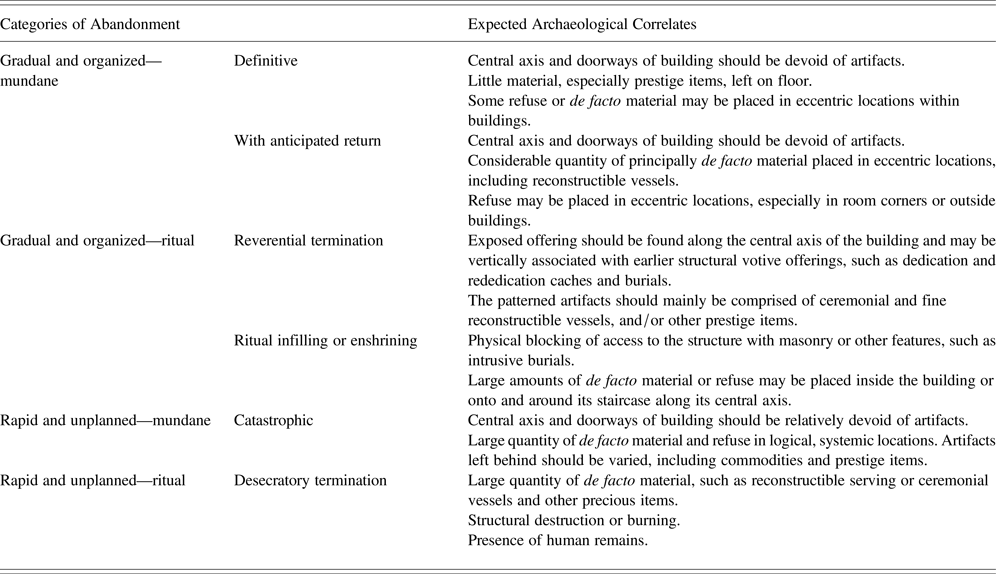
Our behavioral-contextual terminology provides a set of specific archaeological correlates that can be used to reconstruct abandonment scenarios (Table 1). While this model will always yield the potential to be refined, we believe it is a useful heuristic tool to help with some challenges of lowland Maya archaeology.
Summarized behavioral-contextual model for abandonment-related assemblages.

Behavioral-Contextual Categories
We propose five behavioral-contextual categories as a middle-range framework for abandonment-related artifacts, which can be associated with six distinct abandonment scenarios. These are detailed below and summarized in Table 1.
(1) De facto material corresponds to artifacts left in their use-space (or systemic context; Schiffer Reference Schiffer1972) by abandoners. De facto material does not apply to refuse, which, through discard, was removed from the systemic record; the term de facto “refuse” is thus a misnomer. Artifacts in de facto contexts should not be overly fragmented and, if spared by formation processes, may be fairly intact. De facto material is typically found, stratigraphically, in on- or above-floor contexts. The related category of secondary material refers to material left in situ, but that was displaced by formation processes. A good example is material left in storage, such as in wooden shelves, that fell from its original location following a building's collapse. Secondary material should be represented by reconstructible but broken artifacts, and be found in fall or above-floor stratigraphic context.
(2) Primary refuse corresponds to discarded artifacts that were left in their original discard location. Having never been relocated, primary refuse should be less fragmented than other refuse categories. Thanks to a generalized practice of maintaining clean occupational surfaces (Chase and Chase Reference Chase and Chase2000; Hayden and Cannon Reference Hayden and Cannon1983), ancient Maya primary refuse is either rare or very small (i.e., microartifacts), having avoided relocation to a midden.
(3) Secondary refuse is far more common, corresponding to discarded artifacts once-transposed from their original discard location (i.e., provisional discard; Deal Reference Deal1983). Secondary refuse is found in provisional discard loci (or secondary middens), relatively close to activity areas. Secondary refuse should be fragmented, but not in the same eroded, jumbled state characterizing tertiary refuse.
(4) Tertiary refuse corresponds to discarded artifacts that were transposed more than once to an area designed as the final receptacle for trash, a tertiary midden (i.e., discrete dump; Deal Reference Deal1983), and should be highly fragmented and eroded. Tertiary middens are located away from activity areas, used over a long period, intermixed with soil, and may not be cogently stratigraphically organized.
(5) An exposed offering is a type of primary deposit, referring to material that was removed from its systemic context and placed in a staged context. Both on-floor (exposed offerings) or structural primary deposits (caches or burials) reflect episodic ceremonial behaviors, not daily activities. Structural offerings found within fill should be fairly complete and well-preserved. Exposed offerings, however, were likely disturbed by natural or cultural formation processes, such as erosion or scavenging (Schiffer Reference Schiffer1985), but may be protected by an architectural fall layer. Artifacts from exposed offerings typically include reconstructible serving or ritual vessels and other valuable items.
RECONSTRUCTING ABANDONMENT SCENARIOS
Gradual and Organized Abandonment—Mundane
Gradual and organized mundane abandonment occurs when abandoners planned their departure and is the most common abandonment scenario. This category may be subdivided into definitive abandonment and abandonment with anticipated return, qualifying cases where abandoners believed they would return, but never did (Plunket and Uruñuela Reference Plunket, Uruñuela, Inomata and Webb2003). As “organized abandoners” would have left through doorways, these subcategories share that the central axis of buildings should be mostly unobstructed, with most abandonment-related material found in eccentric locations, especially the corners of rooms or outside buildings.
Since occupants likely avoided accumulating belongings before an anticipated abandonment and carried most of their valuables away—i.e., processes defined as “draw-down” and “curate behaviors” by Schiffer (Reference Schiffer1985:26–27)—little abandonment-related material is expected. This material, deemed expendable by abandoners, should exclude valuables and consist of bulky or broken artifacts kept for recycling or never relocated in a midden. Abandonment with anticipated return, however, should create more de facto or secondary material (Simms et al. Reference Simms, Parker, Bey and Negron2012).
Anticipation of abandonment impacted the (dis)entanglement between people, their things, and their architectural and natural landscapes (following Hodder [Reference Hodder2016]), creating a pre-abandonment period (also see Deal [Reference Deal1983]). During pre-abandonment, occupants possibly used decommissioned architecture for discard, creating middens in atypical locations. These pre-abandonment middens may range from small, eccentric clusters of secondary refuse to large tertiary middens resulting from years of use.
Gradual and Organized Abandonment—Ritual
Gradual and organized ritual abandonment behaviors—i.e., reverential termination rituals—are performed by abandoners detaching from their landscape and likely reflect a broader ceremony addressing the stress resulting from abandoning ideologically salient places (Fay Brown Reference Brown, Stanton and Magnoni2008:277; Lamoureux-St-Hilaire Reference Lamoureux-St-Hilaire2011:139–140; Lamoureux-St-Hilaire et al. Reference Lamoureux-St-Hilaire, Macrae, McCane, Parker and Iannone2015:554; Mock Reference Mock1998; Palmer and Jankowiak Reference Palmer and Jankowiak1996:240–244). Reverential termination rituals have been recognized at many Maya sites (see Lamoureux-St-Hilaire [Reference Lamoureux-St-Hilaire2011:34]), having been first reported by Garber [Reference Garber1983] and more recently by Tsukamoto [Reference Tsukamoto2017]). Despite variation, termination rituals follow the ceremonial principle of releasing or terminating architectural life-energy, or ch'ulel, an animistic force imparted to buildings during dedication ceremonies inscribed in a pan-Maya “philosophy of life regeneration” (Chase and Chase Reference Chase, Chase and Houston1998:301; McAnany Reference McAnany1995:162; Mock Reference Mock1998:9–10; Pagliaro et al. Reference Pagliaro, Garber, Stanton, Brown and Stanton2003:76–77; Stanton et al. Reference Stanton, Brown and Pagliaro2008:237; Walker Reference Walker and Mock1998:96–97). Abandonment-related termination rituals should not be confused with structural offerings terminating a previous construction phase during renovation, as defined by Coe (Reference Coe1958, Reference Coe and Willey1965; see Newman [Reference Newman2019] for an example of confusion). This distinction is certainly complicated by widely variable ancient Maya religious behaviors, but the coexistence of these termination labels remains heuristically conflictive. Potential terminological solutions include rigorously differentiating structural from abandonment terminations or else using the term “rededication rituals/offerings” for the renovation category (Lamoureux-St-Hilaire Reference Lamoureux-St-Hilaire2011:13–42).
Reverential termination rituals have been associated with architectural dismantling following the placement of patterned, exposed offerings along their central axis, either inside or on their fronting platform or staircase, thus symbolically or physically hindering access to buildings (Lamoureux-St-Hilaire Reference Lamoureux-St-Hilaire2011). Considerable doubt has justifiably been raised about the ceremonial significance of exposed offerings (Stanton et al. Reference Stanton, Brown and Pagliaro2008). We argue that, to be most convincing, termination rituals should be associated with structural primary deposits, tying all offerings within a localized ritual cycle (Lamoureux-St-Hilaire et al. Reference Lamoureux-St-Hilaire, Macrae, McCane, Parker and Iannone2015).
In addition to exposed offerings, gradual and organized abandonment may also result in ritual infilling or enshrinement. This ritual behavior has been variously interpreted, but generally follows the same principle of deactivating a building's ch'ulel. Enshrinement or infilling may result in the burial of entire structures under soil or white marl (Iannone Reference Iannone2005:34; Michelet and Arnauld Reference Michelet, Arnauld, de Léon, Rivera and Ruiz2006:76; Trachman Reference Trachman2010:105–109), in the closing of doorways with masonry features, the placement of intrusive burials or caches, and in the deposition of refuse inside decommissioned buildings (Lamoureux-St-Hilaire Reference Lamoureux-St-Hilaire2011:95–98; Lamoureux-St-Hilaire et al. Reference Lamoureux-St-Hilaire, Canuto, Barrientos, Bustamante, Lamoureux-St-Hilaire and Macrae2020; Zehrt Reference Zehrt, Iannone, Seibert and Seguin2006).
Rapid and Unplanned Abandonment—Mundane
Rapid and unplanned abandonment caused fleeing abandoners to leave most of their belongings behind in their systemic context. Rapid abandonment results in a great quantity of de facto and secondary material within and around buildings, along with refuse in eccentric locations. Since abandoners had to use doorways for daily activities, these should be left unobstructed. While incredibly informative about the archaeological past, rapid abandonment is exceptional, typically resulting from a natural catastrophe, as for Ceren, El Salvador, which suffered a devastating volcanic eruption (Sheets Reference Sheets2002, Reference Sheets2006). It may also result from a military invasion, as for Aguateca, Peten (Inomata Reference Inomata, Inomata and Webb2003), or Mixco-Viejo, in the Guatemala highlands, which was invaded by conquistadors in the Colonial period (Fauvet-Berthelot Reference Fauvet-Berthelot1986).
Rapid and Unplanned Abandonment—Ritual
In some cases, rapid and unplanned abandonment may be followed by desecratory termination rituals resulting from antagonistic, military behaviors. This type of behavior is quite variable, and may have occurred quickly—during sacking—or be reflective of great care. Desecratory termination rituals symbolically or physically hinder access to buildings, include exposed offerings and de facto material (including prestige items), involve structural destruction or burning, and feature human remains in informal, near-surface contexts (Golden et al. Reference Golden, Scherer, Kingsley, Houston, Escobedo, Iannone, Houk and Schwake2016:121; Lamoureux-St-Hilaire Reference Lamoureux-St-Hilaire2011). Desecratory termination rituals likely aimed at deactivating and profaning the ch'ulel of enemy architecture through pillage, destruction, and death. For example, desecratory termination rituals have been documented at Aguateca (Inomata Reference Golitko, Meierhoff, Feinman, Williams, Iannone, Houk and Schwake2016; Inomata and Ponciano Reference Inomata, Ponciano, Inomata and Triadan2010), Piedras Negras (Golden et al. Reference Golden, Scherer, Kingsley, Houston, Escobedo, Iannone, Houk and Schwake2016), Yaxuna (Suhler and Freidel Reference Suhler, Freidel, Inomata and Webb2003), Xunantunich (Yaeger Reference Yaeger, LeCount and Yaeger2010), and Hershey (Harrison-Buck et al. Reference Harrison-Buck, McAnany, Storey, Tiesler and Cucina2007).
CASE STUDIES FROM LA CORONA AND MINANHA
We now contextualize our behavioral-contextual model with two distinct case studies of gradual and organized abandonment dated to ca. a.d. 900. While the regal palace of La Corona was seemingly left in a predominantly mundane fashion, the agricultural household Group MRS15 of Minanha was ritually abandoned.
Pre-abandonment and Gradual Abandonment at La Corona
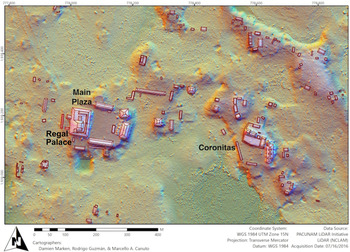
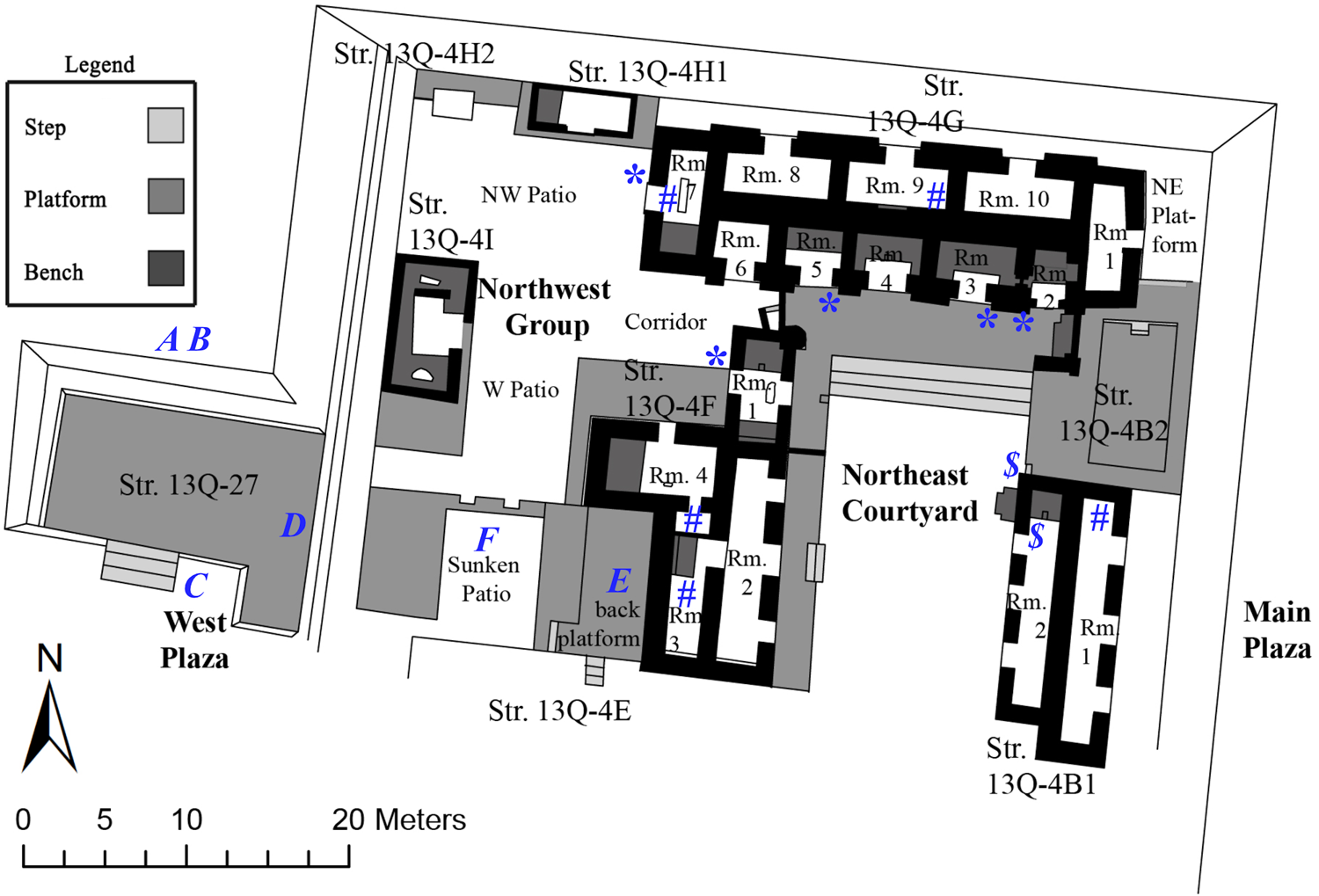
La Corona (Figure 1) was a Classic Maya center of modest size located in northwest Peten, Guatemala (Canuto and Barrientos Reference Canuto and Barrientos Q2013). La Corona's Main Plaza is most notable for the palatial acropolis on its west flank, dwarfing all other constructions on site. This acropolis measures 80 by 55 m and seven to 12 m in height and, as the regal palace, was the political heart of La Corona (Lamoureux-St-Hilaire Reference Lamoureux-St-Hilaire2018). Late transformations in this palace, especially its north half (Figure 2), indicate the La Corona royal court reduced its political-economic activities during the ninth century (Lamoureux-St-Hilaire Reference Lamoureux-St-Hilaire2018; Lamoureux-St-Hilaire et al. Reference Lamoureux-St-Hilaire, Canuto, Barrientos, Bustamante, Lamoureux-St-Hilaire and Macrae2020). This change in regime was discernible by the progressive decommissioning of pathways stemming from the Northwest Group, an area dedicated to ancillary activities such as food preparation and craftwork (Lamoureux-St-Hilaire Reference Lamoureux-St-Hilaire2018). First, the path leading to Structure 13Q-27 was obstructed, followed by the access points to the Southwest Group and Structure 13Q-4E. These decommissionings were embodied by the accumulation of large secondary and tertiary middens over activity areas. This process, suggesting a trend away from orthodox palatial practices, reflects a changing relationship between a downsized royal court and its then oversized palace (Lamoureux-St-Hilaire Reference Lamoureux-St-Hilaire2018).
Map of the La Corona Site Core. Map courtesy of Proyecto Regional Arqueológico La Corona (PRALC).

Map of the northern half of the Tucán-phase La Corona palace, with location of abandonment-related material indicated with distinct symbols: middens with their associated letter; de facto material on front platforms with asterisks; on- and above-floor assemblages in storage with pound signs; exposed offerings with dollar signs. Map by Lamoureux-St-Hilaire.

Pre-abandonment Middens
A total of seven middens (Middens A–F) were found in association with the Northwest Group (Lamoureux-St-Hilaire Reference Lamoureux-St-Hilaire2018). While the tertiary Middens A and B were located in predictable loci, the tertiary Middens D and F were respectively accumulated over Structure 13Q-27 and the Sunken Patio, while the secondary Middens C and E obstructed activity areas.
The secondary middens contained fairly fragmented and well-patterned artifacts—sets of artifacts that were closely associated—while the tertiary middens were comprised of highly fragmented and jumbled artifacts. The impressive variability in the composition of Middens C–F corresponds to what one would expect for the principal middens of a palace, including many crafting implements and a wide range of Terminal Classic diagnostics from the Chablekal, Tres Naciones, Altar Orange, and Balancán Orange fine-gray and fine-orange ceramic groups (Lamoureux-St-Hilaire Reference Lamoureux-St-Hilaire2018:303–362).
Detailed ceramic data indicate that the pre-abandonment middens resulted from a century-long process of disentanglement and, consequently, that the La Corona royal court remained active until the abandonment of its palace (Lamoureux-St-Hilaire Reference Lamoureux-St-Hilaire2018:323–362; Lamoureux-St-Hilaire et al. Reference Lamoureux-St-Hilaire, Canuto, Barrientos, Bustamante, Lamoureux-St-Hilaire and Macrae2020). Pre-abandonment middens, reflecting gradual and organized abandonment, should not be confused with deposits from isolated ceremonial events. Unlike occupational middens, ceremonial ones should consist of well-patterned, secondary refuse reflecting ritual feasting and be located near public spaces (Awe et al. Reference Awe, Ebert, Hoggarth, Aimers, Douglas, Helmke and Stemp2020).
De facto and Secondary Material and Exposed Offerings
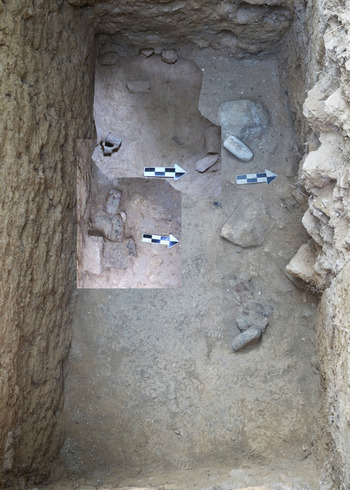
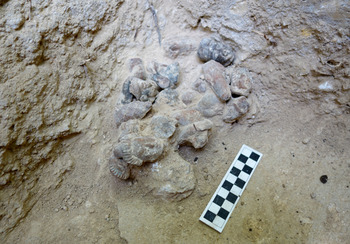
A combination of ceramic evidence and radiocarbon dating indicates the La Corona palace was finally abandoned around a.d. 900 (Lamoureux-St-Hilaire Reference Lamoureux-St-Hilaire2018:274). This abandonment is reflected by three types of assemblages left in and around buildings in the Northeast and Northwest Groups (Figure 2): (1) bulky pot-stands on frontal platforms (Figure 3), (2) various artifacts in storage (Figure 4), and (3) two discrete exposed offerings in eccentric locations (Figure 5; Lamoureux-St-Hilaire Reference Lamoureux-St-Hilaire2018:239–362).
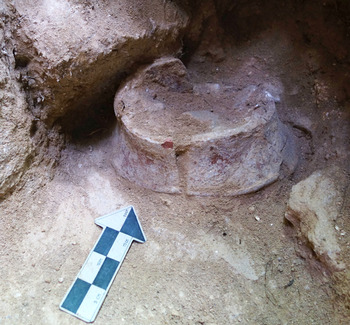
A jar mouth reutilized as a pot-stand found next to the doorway of Room 5 of Structure 13Q-4G. Photograph by Lamoureux-St-Hilaire.

The large on- and above-floor assemblage found in the closet of Room 4 of Structure 13Q-4F. Photomosaic by Lamoureux-St-Hilaire.

The on-floor figurine fragments assemblage (i.e., exposed offering) found next to the exterior bench of Structure 13Q-4B1. Photograph by Lamoureux-St-Hilaire.

First, pot-stands left on the front platforms of Structures 13Q-4G and 13Q-4F were likely used for holding rounded-bottom jars for collecting rainwater running off the roofs of buildings (Figure 3; Lamoureux-St-Hilaire Reference Lamoureux-St-Hilaire2018:257). These expendable, recycled broken vessels were simply abandoned there.
Second, quantities of de facto and secondary materials were found in Structures 13Q-4B1, 13Q-4F (Figure 4), and 13Q-4G, in distinct storage contexts. These assemblages were mostly comprised of reconstructible Terminal Classic vessels and lithic artifacts and were found in thick above-floor layers, suggesting they were stored in wooden furniture (Lamoureux-St-Hilaire Reference Lamoureux-St-Hilaire2018). The quantity and quality of these assemblages suggest the royal abandoners likely planned to return one day.
Third, two discrete, unusual, exposed offerings were found in association with Room 2 of Structure 13Q-4B1. The first one consisted of a burned offering— including Provincia Plano-Relief fine-orange sherds, faunal, and macrobotanical remains—placed inside the niche of the room's bench. The second one consisted of 25 figurine fragments “cached” under unslipped sherds placed on the floor, next to the room's exterior bench (Figure 5). These unorthodox, seemingly reverential, exposed offerings unlikely reflect a concerted termination ritual and were perhaps created by a single individual.
Summary
While none of the presented individual contexts reflects a general trend, the scale of the La Corona palace excavations (more than 300 m2), codirected by Canuto and Barrientos, allowed for the reconstruction of a complex abandonment scenario. This scenario, informed by assemblages ascribed to four distinct behavioral-contextual categories, can be labelled as a gradual and organized abandonment with anticipated return.
Reverential Termination at Minanha
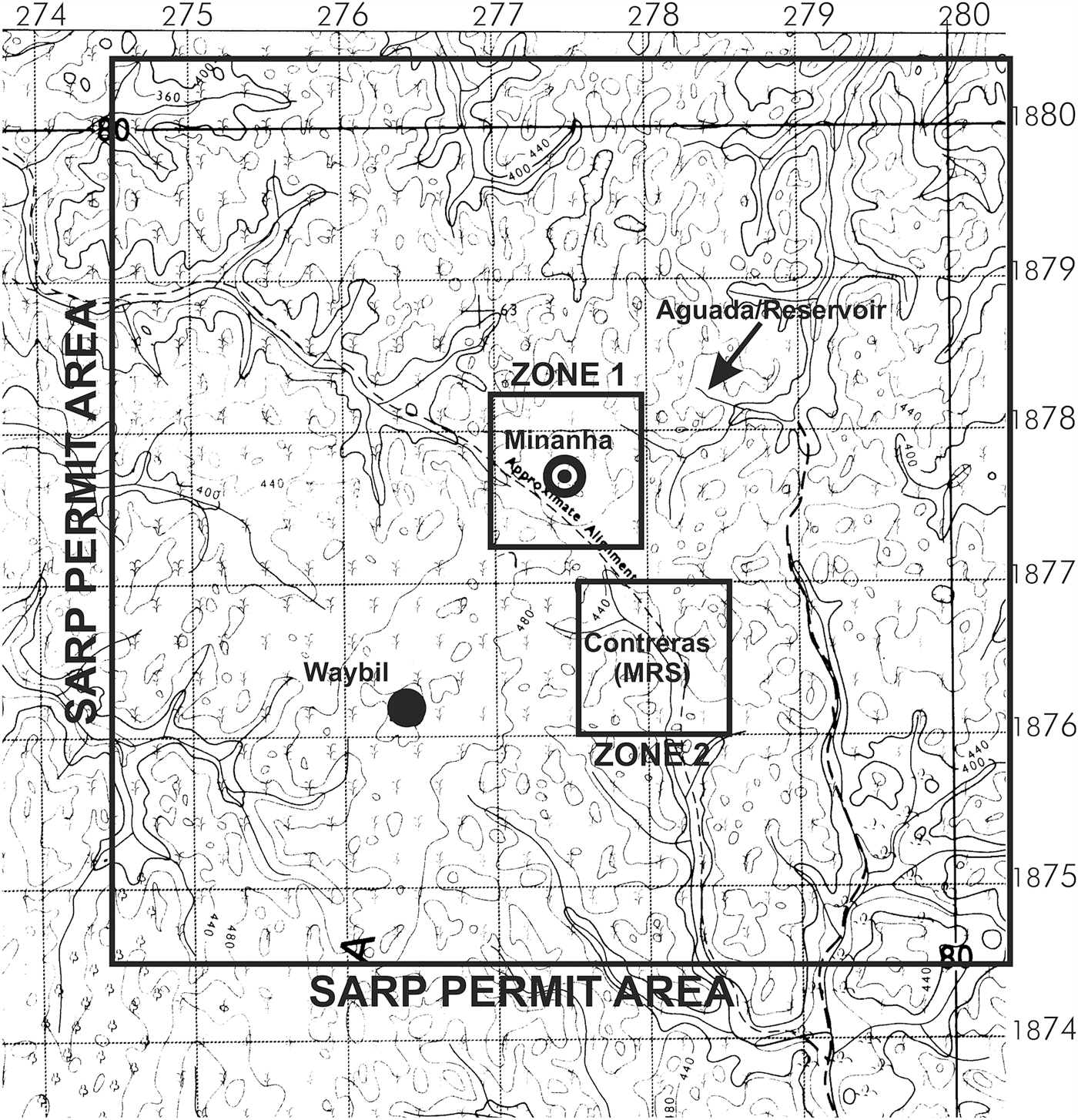
Minanha was a Classic Maya center of medium size situated in the Vaca Plateau, in west-central Belize (Iannone Reference Iannone2005; Reeder et al. Reference Reeder, Brinkmann and Alt1996). The Minanha epicenter was surrounded by many sizable household groups (Iannone Reference Iannone2005). Of particular relevance is the Contreras Valley, a densely settled community of agriculturalists located one km southeast of the site-core, which reached its peak occupation during the heydays of the Minanha royal court (Figure 6; Macrae Reference Macrae2010; Macrae and Iannone Reference Macrae, Iannone, Iannone, Longstaffe and Macrae2009). The Contreras community was progressively abandoned during the Terminal Classic in a way that left exposed offerings in 20 percent of its 98 household groups (Lamoureux-St-Hilaire Reference Lamoureux-St-Hilaire2011:66–67; Lamoureux-St-Hilaire et al. Reference Lamoureux-St-Hilaire, Macrae, McCane, Parker and Iannone2015).
Map of the Social Archaeology Research Program permit area, situating the Contreras Valley in relation to the Minanha site-core. Map courtesy of the Social Archaeology Research Program.

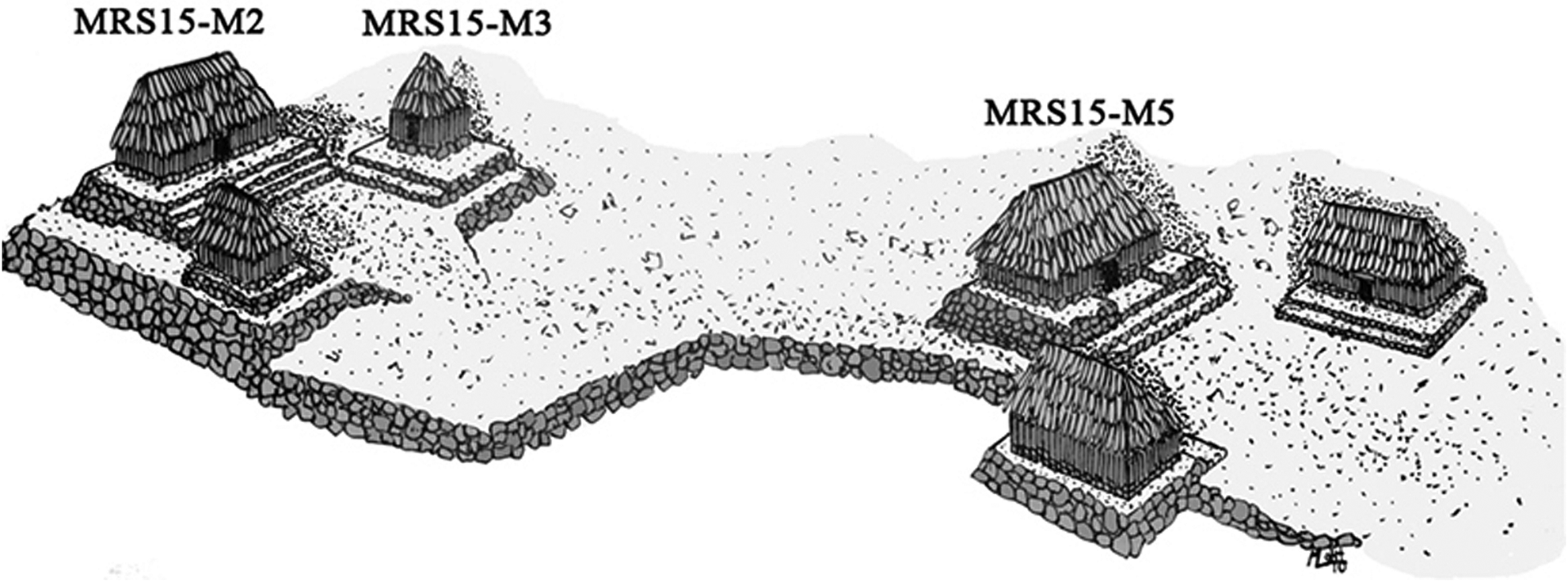
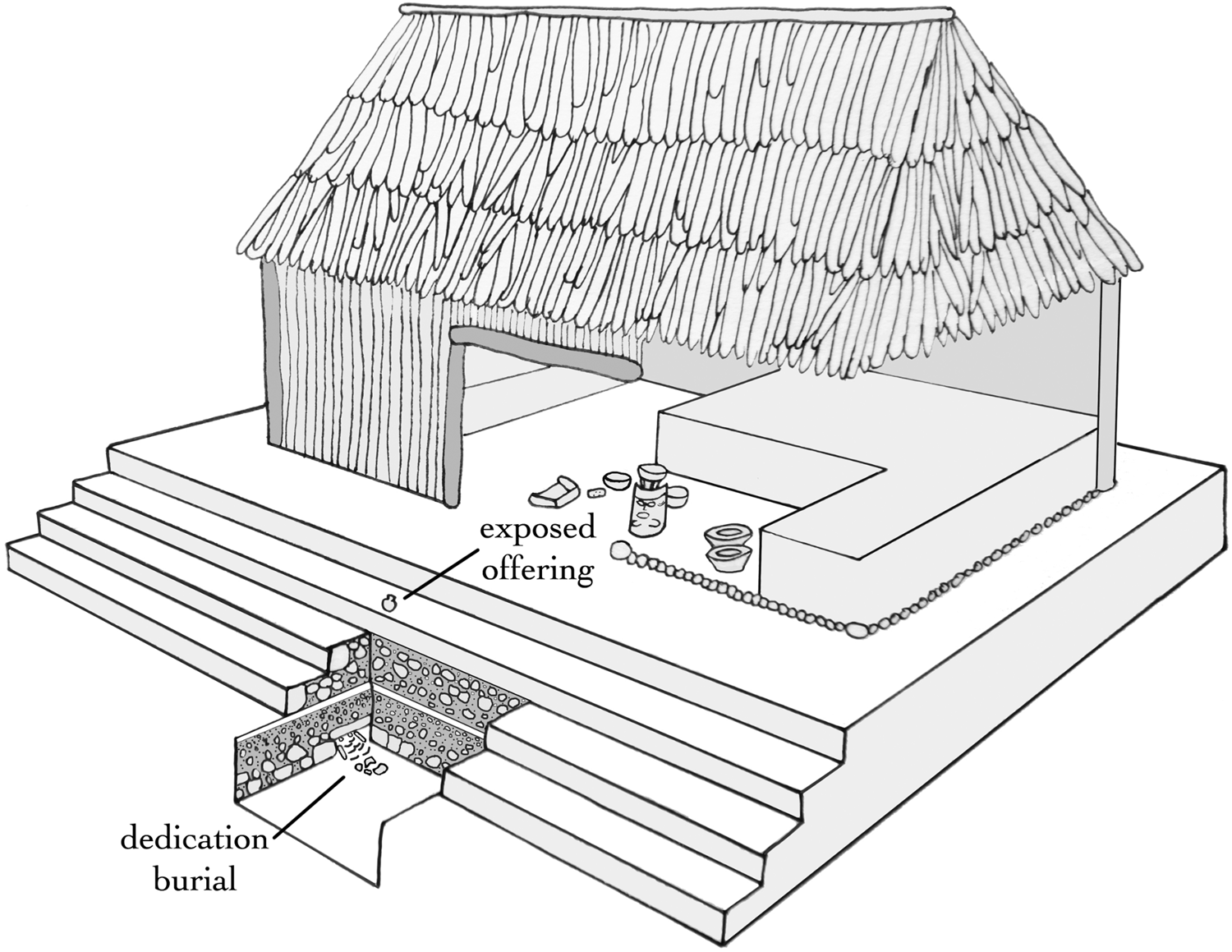
The most explicit reverential termination occurred in Group MRS15, a household group composed of two adjoining patios and six structures, all of which had either residential or ancillary functions (Figure 7; McCane et al. Reference McCane, Hills, Snetsinger, Longstaffe, Iannone, Longstaffe and Macrae2009). Three buildings from Group MRS15 revealed correlated on-floor assemblages, reflecting a well-orchestrated termination ceremony for the household group dated, through ceramic chronology, to a.d. 900–950 (Lamoureux-St-Hilaire Reference Lamoureux-St-Hilaire2011:102–113). Structures MRS15-2, MRS15-3, and MRS15-5 revealed on-floor assemblages, with Structures MRS15-2 and MRS15-5, the group's two largest houses, yielding well-patterned offerings along their central axis (Lamoureux-St-Hilaire and Iannone Reference Lamoureux-St-Hilaire and Iannone2012). A halved Platon Punctated-Incised serving dish was found in the center of the front staircase of Structure MRS15-M5 and five, partial, scored-incised censers were found in an above-floor context (Lamoureux-St-Hilaire Reference Lamoureux-St-Hilaire2011:74–75, 103–113; McCane et al. Reference McCane, Hills, Snetsinger, Longstaffe, Iannone, Longstaffe and Macrae2009). Meanwhile, several reconstructible vessels were found in the doorway and on the staircase of Structure MRS15-2, under which a dedication burial was unearthed (Figure 8). This ceramic assemblage comprised an elaborate portable composite brazier, a slipped bowl, a scored-incised censer, a miniature tobacco snuff bottle, and a roller-stamp (Lamoureux-St-Hilaire Reference Lamoureux-St-Hilaire2011:71–73, 103–113; Lamoureux-St-Hilaire et al. Reference Lamoureux-St-Hilaire, Macrae, McCane, Parker and Iannone2015; McCane et al. Reference McCane, Hills, Snetsinger, Longstaffe, Iannone, Longstaffe and Macrae2009).
Artistic reconstruction of Group MRS15, looking southeast. Illustration by Lamoureux-St-Hilaire.

Artistic reconstruction of the on-floor, exposed offering found in Structure MRS15-M2. The location of the dedicatory burial is indicated to emphasize the offerings' vertical relationship. Illustration by Lamoureux-St-Hilaire

Both of these assemblages, composed of fine vessels and valuables, would have symbolically obstructed doorways, and the vertical relationship between Structure MRS15-2's exposed offering and its dedication burial ties them in a localized ritual cycle (Figure 8). This termination ritual was apparently performed by a household detaching from its home, which was both ideologically rich, as expressed by the ancestral burial, and economically crucial, as represented by the surrounding agricultural landscape (Lamoureux-St-Hilaire et al. Reference Lamoureux-St-Hilaire, Macrae, McCane, Parker and Iannone2015).
Summary
We presented a case of gradual and organized abandonment embodied by the ritual termination of an agrarian household group. This account was made possible by careful contextual excavations of six buildings of Group MRS15 by the SARP team directed by Iannone. These excavations recovered interrelated exposed offerings, which, if taken individually, would have remained problematic. These subtle on-floor assemblages were related to a structural dedication burial and to an above-floor assemblage intermixed with a humus layer, which could both have gone unnoticed. These abandonment-related data emphasize the importance of careful contextual and stratigraphic consideration while investigating abandonment behaviors.
CONCLUSION
We have proposed a behavioral-contextual terminology for on-floor assemblages and a set of six possible settlement abandonment scenarios with the objective of increasing shared taxonomy. Given variability in both the nature of Classic Maya regimes and the sociopolitical and environmental contingencies that led so many lowland polities to collapse, a single methodology could hardly ever account for all abandonment-related correlates. Yet, we hope our case studies reflect how the proposed middle-range terminology may be useful for both local and comparative purposes. These two abandonment case studies are characterized by gradual and anticipated abandonment and both occurred at the end of the Terminal Classic period. Most likely the predominant Classic Maya settlement abandonment scenario, gradual and organized abandonment, may only leave subtle traces, lacking the exceptional finds associated with rapidly abandoned sites.
While interpretations “at the trowel's edge” may be uncertain or preliminary, the care and concern dictated by our proposed approach can help detect subtle, near-surface contexts. Thus, our behavioral-contextual terminology is not designed to be crystalized in the field; rather, it serves to illuminate problematic contexts. Once out of the field, and if provided with a good horizontal and vertical understanding of an architectural structure or group, this approach can help analyze abandonment-related assemblages. Yet, when reconstructing an abandonment scenario, we must also remember that distinct sections of a site may have been abandoned differentially (Lamoureux-St-Hilaire Reference Lamoureux-St-Hilaire2011). Finally, when reporting and publishing archaeological data, we believe it is more productive to strive to decipher ancient contexts and behaviors rather than to simply label them as problematic.
RESUMEN
En este articulo presentamos un método conductual-contextual para el estudio de conjuntos de artefactos asociados con el abandono de sitios arqueológicos mayas con el fin de reconstruir escenarios de abandono. Ese método examina los contextos verticales e horizontales de conjuntos y el carácter de vasijas reconstruibles e otros tipos de artefactos. Este método puede reconstruir cinco categorías de escenarios de abandono: gradual, rápido, mundano, ceremonial, y con anticipación de regreso. Los aventajes principales de ese modelo son su replicabilidad y su proposición de un vocabulario taxonómico compartido, cual se aleja del concepto de “depósitos problemáticos.” Contextualizamos el método con la presentación de dos estudios de casos distintos de las tierras bajas mayas del sur: el acrópolis palaciego de La Corona (Petén, Guatemala) y un grupo residencial agrícola en la periferia del sitio de Minanha (Cayo, Belice).
El acrópolis palaciego de La Corona fue abandonado durante un periodo de 150 años, entre 750 y 900 d.C. Ese largo proceso dejo unos conjuntos de artefactos en distintos contextos: (1) Basureros de pre-abandono cuales cancelaron estructuras y patios; (2) Material de facto sobre las plataformas frontales de algunos edificios; (3) Material de facto y secundario y basura secundaria en contexto de almacenamiento; (4) Dos ofrendas expuestas “sobre piso” en ubicaciones excéntricas. Juntos, esos conjuntos reflejen un proceso de abandono gradual, sin orquestación ceremonial, y con el intento de regresar un día.
El valle de Contreras, una zona agrícola en la periferia de Minanha, contaba con mas de cien grupos residenciales y fue abandonado durante el clásico terminal, entre 810 y 900 d.C. El grupo residencial MRS15 contaba con seis edificios. Durante la excavación de tres de estos se encontraron conjuntos sobre pisos. Dos de estos fueren ofrendas expuesta, con vasijas de servicio y ceremoniales y otros tipos de artefactos de lujo, ubicados en el eje central de las casas abandonadas. Además, se encontró un entierro dedicatorio debajo de uno de estos conjuntos, el cual indica que se trata de un ciclo ceremonial localizado. La calidad y el contexto de estos rasgos indica que este grupo residencial fue abandonado de una manera planificada y durante una ceremonia de terminación coordinada.
Aunque distintos, ambos estudios de casos reflejen el hecho que la mayoría de las ciudades mayas fueron abandonadas de manera gradual y anticipada durante el colapso maya del clásico terminal. Estos dos casos de abandono gradual permiten demostrar el potencial de replicabilidad del método conductual-contextual y su vocabulario taxonómico representa un paso potencial para abandonar el concepto de “depósitos problemáticos.”
ACKNOWLEDGMENTS
We would like to thank Jim Aimers, Julie Hoggarth, and Jaime Awe for the opportunity to partake in their engaging electronic symposium at the 83rd annual meeting of the Society for American Archaeology and for the opportunity to contribute to this special issue. The directors of the two archaeological projects behind the presented case studies must be acknowledged for their continuous support: Marcello A. Canuto and Tomás Barrientos (Proyecto Regional Arqueológico La Corona) and Gyles Iannone (Social Archaeology Research Program). We also thank the governments of Guatemala (Instituto de Antropología e Historia) and Belize (Institute of Archaeology) for their support to these distinct projects. Excavations in the La Corona palace were funded by a National Science Foundation-Doctoral Dissertation Improvement Grant (Award ID: 1623787), Tulane University, Patrimonio Cultural y Natural Maya, the Alphawood Foundation, and the Louisiana Board of Regents. Excavations at Group MRS15 were funded by Social Sciences and Humanities Research Council and the Alphawood Foundation. The first version of this paper was written while the first author was a 2017–2018 Junior Fellow at the Dumbarton Oaks Research Library and Collections, while its final version was prepared when he was a 2018–2019 George Stuart Residential Scholar at the Boundary End Center—both institutions are acknowledged for their support and resources.