One of the healthiest trends in Mesoamerican studies in the past two or thee decades has been the recognition that the pre-Columbian cultures of west Mexico were full participants in the Mesoamerican world-system. Long past are the days when west Mexico was excluded from consideration as part of Mesoamerica because of seemingly exotic features such as shaft tombs and round pyramids. Another problem that distanced west Mexico conceptually from greater Mesoamerica was the lack of good chronologies which precluded an understanding of interaction between west and central Mexico. In the introduction to another recent special section, more extensive comments were offered on the history of research in west Mexican archaeology and especially the tension between the fascination with the exotic and the need to develop archaeological research programs based on both chronological and anthropological concerns (Fowler et al. Reference Fowler, Beekman and Pickering2006).
In a similar vein, Pollard (Reference Pollard1997) cited the dominance of culture-historical models in west Mexican archaeology that had restricted research in west Mexico as a tool for illuminating central Mexican prehistory. She lauded the implementation of new models and the initiation of what was then still new research testing theoretically generated hypotheses. Chief among her concerns was the need to study west Mexico and its constituent cultures on their own terms, and to elucidate local temporal phases, as both noteworthy cases and as members of the larger Mesoamerican world-system.
While Pollard's focus was west Mexico in general, research on the Late Postclassic Tarascan state in particular has greatly matured since then. Over 20 Mexican, French, and American researchers are currently engaged in aspects of Tarascan studies. This maturity was evident in a recent symposium, “Social Complexity in Michoacan: Tarascan State Formation,” organized by Karin Rebnegger and Amy J. Hirshman, and presented at the 72nd Annual Meeting of the Society for American Archaeology in 2006. There, twelve papers discussed Tarascan political and economic development from diverse perspectives, leading to the state and culminating with empire formation.
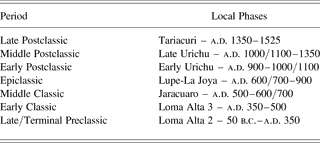
The seven papers included in this special section, flowing from the symposium and written by established and emerging scholars, address a cross section of Tarascan concerns: political and market economies (Maldonado, Darras, Hernández and Healan, and Hirshman), social identity (Hernández and Healan, Begun, Haskel, and Pollard), and culture change (especially Pollard). The chronology for the Tarascan region is represented in Table 1.
Central Michoacan chronology

Veronique Darras contrasts the diverse organization of obsidian production in the Zacapu region during the Epiclassic, Early Postclassic, and Middle Postclassic periods with the simplification of production that occurred in the Late Postclassic period associated with the rise of the Tarascan state. Blanca Maldonado and Amy J. Hirshman both discuss the role of craft production within the Tarascan state apparatus and the mixture of economic tactics used by the political elites. Maldonado presents a model for the interest that Tarascan elites had in controlling metallurgical production outside of the Tarascan core and the difficulty that they faced in these efforts, as well as their varied strategies for controlling finished products. Hirshman argues that, unlike elite strategies for controlling metallurgy, the production and distribution of ceramics within the Tarascan core responded to longstanding marked economies.
Through a reassessment of the ceramic chronology of northeast Michoacan, Christine L. Hernández and Dan M. Healan argue for long-term cultural continuity in the region, and they also refine the timing and nature of ethnic enclaves in the region and of cultural contact with central Mexico. They clarify the probable reasoning for early Tarascan expansion into the region, both as an economic strategy to capture control of the Ucareo-Zinapecuaro obsidian source, and as defense against growing aggression from the Valley of Mexico.
Erica Begun focuses on continuity in social identity in the Lake Patzcuaro Basin and throughout Michoacan through a provocative study of figurines. This pan-Michoacan identity contrasts with the active manipulation of social identity by emerging political elites suggested by David L. Haskell. In pursuit of political legitimacy, Haskell argues, the elite promoted the foreign “Chichimec” category, supporting it through the control and gifting of status markers.
Finally, drawing upon decades of research, and living up to her own directive, Helen Pollard also discusses the role of identity in state formation. Moreover, she presents a larger conceptual model of why, when, and how this first Michoacan state appeared. Interestingly (especially in light of earlier culture-historical research emphasizing the central highlands), emerging elites certainly drew upon the larger Mesoamerican world. But they acted and interacted within their own localized context to create the unique Tarascan state.
The submission of this special section was coordinated by Amy Hirshman. Primary editorial assistance was provided by Arik Ohnstad and Carrie Dennett.