
Hostname: page-component-7b7567c8c-tnkh4 Total loading time: 0 Render date: 2026-11-17T19:16:43.032Z Has data issue: false hasContentIssue false

The narrative structure of Hengest's revenge in Beowulf

Published online by Cambridge University Press:  26 September 2008

John F. Vickrey
Affiliation:
Lehigh University, Pennsylvania

Extract

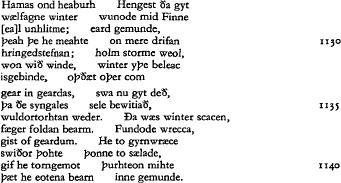
Although Beowulf scholars have now generally accepted Frederick Klaeber's emendation … Finne / [ea]l unblitme (1128b–9a), the meaning of unblitme has remained in some doubt. Professors Dobbie and Rosier have held that unblitme means literally ‘without casting of lots’ and by extension ‘without choice”, Dobbie explaining that Hengest, ‘having no choice, was forced to remain with Finn’ and Rosier affirming that he did so ‘entirely with lack of choice’. Their view of unblitme has for some time gone unchallenged. But lately Professor Fry has dissented, contending briefly that ‘“without casting of lots” should produce just the opposite of “having no choice”. Casting lots throws the result up to chance, and so un-blitme should logically mean “not by chance”, that is “voluntarily”.’ There can be little question, I think, that Fry is right in rejecting the older view of unblitme. To take unblitme to mean ‘having no choice’ is to equivocate on the word ‘choice’. Any hlitm, ‘casting of lots’, would imply ‘choice’ in the sense ‘decision pursuant to lots and not to one's desires’. But the translation ‘having no choice’ means much more than this; it means ‘unwillingly‘free choice, choice pursuant to one's desires‘.

Information

Type
Research Article
Copyright
Copyright © Cambridge University Press 1977

Access options

Get access to the full version of this content by using one of the access options below. (Log in options will check for institutional or personal access. Content may require purchase if you do not have access.)

Article purchase

Temporarily unavailable