INTRODUCTION
We often set out to improve education by changing something about how language is used in it. Many such policy efforts aim for the inclusion of minoritized students by more fully including their languages in schooling, and they are met with resistance that is not so much about language but more about identity. For example, in 1996 the Oakland, California, Ebonics policy generated an infamous controversy. The Oakland school board's planned policy to improve African American students’ achievement by using pedagogical strategies for second language learners and recognizing their proficiency in African American English was met with intense opposition grounded largely in long-standing associations between African American English and racialized identities (Hill, Reference Hill, Dueñas González and Melis2000). This is to say that the process of social identification is implicated in efforts to change language use in education. Both, in fact, are social phenomena, and if we are to understand how the two come together in educational language policy success or failure, we must analyze how stability and change are produced in each. We know that this requires attention both to widespread, macro-level patterns and to localized, micro-level practices. But explaining the process of change is not as simple as two categories.
An account of a social phenomenon with only two major categories or scales—micro-level instantiation of macro-level categories and micro changes shaping macro structures—does not adequately explain sociocultural change and stability. Our focal phenomenon here is educational language policy implementation, specifically how social identification and language use change in an evolving policy context. We argue that the change and stability in educational language policy implementation—and other social phenomena—cannot be explained without an account of social identification that describes how heterogeneous resources from multiple timescales become relevant in establishing and changing social identities. We review scholarship drawing on timescales to understand social processes like identification and policy implementation. We then illustrate this kind of scalar account with data from a case study of the social identification of one student in Paraguay at a moment when a major national educational language policy change was underway. We show how a person's identification as a new kind of minority language speaker involved heterogeneous resources from spatiotemporal scales. We argue that analysis of the heterogeneous resources and scales entailed in social identification is essential to understanding the role that these processes play in cultural, pedagogical, and language change.
HETEROGENEOUS RESOURCES FOR IDENTITY AND EDUCATIONAL LANGUAGE POLICY
We take a linguistic anthropological approach to conceptualizing processes of both social identification and language policy. In such an approach, we focus on how linguistic signs come to have meaning in interaction through links to context, both immediate and broad, especially to more widely circulating models of language and the social world. In the case of identity and identification, signs of identity like the speaking of a minoritized language such as Guarani, a language of indigenous origin in Paraguay, come to have meaning in a particular interactional moment as they index widely circulating cultural models of identity—like a patriotic Paraguayan, for example. Repeated over time and space, these indexical regularities help individuals to be identified as a particular social type of person and help circulating models of identity to seem stable. In the case of language policy, the language of official policy itself—like “instruction . . . shall be in the official language that is the mother tongue of the student” (Paraguay, 1992)—or the linguistic signs used in a particular moment of instruction come to have meaning as they are contextualized in interaction: a process in which participants and analysts pick out which elements of an indefinitely large context are relevant (Silverstein, Reference Silverstein, DiLuzio and Auer1992; Silverstein & Urban, Reference Silverstein, Urban, Silverstein and Urban1996).
This approach builds upon linguistic anthropological work that examined typical speech events, describing how certain events recur among and characterize a group of speakers or social location (Heath, Reference Heath1983; Philips, Reference Philips1983; Schieffelin & Ochs, Reference Schieffelin and Ochs1986) and showing patterns that seem stable over time and space—the macro. It also builds upon work that focused on the emergence of events over interactional time and space as interlocutors enact sometimes-unexpected (Duranti & Goodwin, Reference Duranti and Goodwin1992; Erickson & Schultz, Reference Erickson and Schultz1982; Ochs, Schegloff, & Thompson, Reference Ochs, Schegloff and Thompson1996)—the micro. Subsequent work shows how social identification involves links to meanings established on both macro and micro levels. In the process of reading who people are, models of identity circulating on the macro-level regiment perceivable signs of identity in a particular moment, organizing and contextualizing them so that they take on a certain shape and not others (Silverstein, Reference Silverstein and Lucy1993; Wortham, Reference Wortham2005, Reference Wortham2006). But these models themselves are not static, as they can be both replicated and changed in interaction. They come to include new signs of identity and exclude others through the process of entextualization and recontextualization (Silverstein & Urban, Reference Silverstein, Urban, Silverstein and Urban1996; Urban, Reference Urban, Silverstein and Urban1996) or the dialectic of norm and trope (Agha, Reference Agha2007). In this process, what are seen as macro-level models of identity are applied in various micro-level interactions, but inevitably in ways that both replicate and improvise upon the model.
Scholarship taking this kind of approach has contributed to our understanding of both identity (Agha, Reference Agha2007; Agha & Wortham, Reference Agha and Wortham2005; Holland & Lave, Reference Holland and Lave2001; Wortham, Reference Wortham2005, Reference Wortham2006) and policy (Johnson, Reference Johnson2009; McCarty, Reference McCarty2011; Shore & Wright, Reference Shore, Wright, Shore and Wright1997; Sutton & Levinson, Reference Sutton and Levinson2001) as contingent, as practice, and as process. Practice theory criticizes macro-level determinism, pointing out that widely circulating ideas and recurring actions are transformed in practice and that we cannot know out of context what a macro pattern will mean for any individual or situation. Holland and Lave's (Reference Holland and Lave2001) concept of “history in person” describes how widely circulating patterns are contextualized in particular lives and events. They argued for the mutually constitutive nature of enduring social struggles and particular events through practice. Anthropological approaches to language policy (Hornberger & Johnson, Reference Hornberger and Johnson2007; Johnson, Reference Johnson2009; McCarty, Reference McCarty2011; McCarty & Warhol, Reference McCarty, Warhol, Levinson and Pollack2011) and educational policy (Levinson & Sutton, Reference Levinson, Sutton, Sutton and Levinson2001; Levinson, Sutton, & Winstead, Reference Levinson, Sutton and Winstead2009; Shore & Wright, Reference Shore, Wright, Shore and Wright1997) have taken up the practice frame, in which policy implementation is characterized as a process of appropriation: “a kind of taking of policy and making it one's own” (Levinson & Sutton, Reference Levinson, Sutton, Sutton and Levinson2001, p. 3). This frame accounts for the roles of both actors’ agency and larger political and social structures in the implementation of policy, and it helps to reveal the simultaneous emergence and constraint—change and stability—of cultural patterns in the process.
Work in this vein has thus incorporated attention to both what are seen as macro-level, larger scale phenomena and micro-level, smaller scale phenomena. Folk ideologies about identity and policy tend to focus on just these two levels, however, and miss important connections and scales of phenomena in between. People are generally aware that there are social types of people—stereotypes—and that there are interactional moments when stereotypes are applied to an individual or when someone flouts a stereotype. People are generally aware that there is such a thing as ideal or official policy and that there are moments of “implementation” or moments when actors’ practices seem to go against policy. What these lay accounts—and some academic accounts—obscure are multiple, heterogeneous resources and timescales beyond just the two abstractions of macro and micro. Recent work has made clear that a simple two-part process—sometimes called the micro–macro dialectic—in which events create structures and structures are created in events is not sufficient (Wortham, Reference Wortham2012). Agha (Reference Agha2007) provided a useful alternative conceptualization, arguing that all cultural models that link signs with typifications of people and events have a domain. They are recognized only by a subset of any community, and this subset changes as signs and models move across space and time. There is no one macro set of models or ideologies, universal to a group. Instead, there are models that move across social domains ranging from pairs, to local groups, all the way up to global language communities. In analyzing language and social life, we must describe various relevant resources—models drawn from different spatial and temporal scales—that facilitate a phenomenon of interest, and we must describe how models move across events (Agha, Reference Agha2007; Agha & Wortham, Reference Agha and Wortham2005; Wortham, Reference Wortham2005, Reference Wortham2006). Instead of simply connecting micro-level events to macro-level structures (e.g., connecting the identification of an individual to a circulating stereotype, or connecting a classroom language practice to an official policy), we must explore heterogeneous domains and scales of social organization relevant to understanding meaningful social action.
These scales of organization are what Lemke (Reference Lemke2000) called timescales—the characteristic spatiotemporal envelope within which a process happens. Events at very short or small timescales occur over fractions of a second or in very small social space—just once, for example—while others occur over days, months, years, decades, or centuries or across social groups of various sizes. They form a continuum from the very short/small to the very long/large. More than one timescale will be required to make sense of any specific case, and that configuration of resources will vary from case to case. Blommaert (Reference Blommaert2007, Reference Blommaert2010), showed how regularities of indexical relationships to these timescales, or sociolinguistic scales, help to create power in interaction. To understand a social phenomenon like social identification or language policy implementation, we must attend to the range of resources from various timescales that are made relevant in any given case. Drawing on Agha (Reference Agha2007), Silverstein (Reference Silverstein, DiLuzio and Auer1992, Reference Silverstein and Lucy1993), and Latour (Reference Latour2005), Wortham and Rhodes (Reference Wortham and Rhodes2012, Reference Wortham and Rhodes2013) showed how a variety of resources—like material objects, models of identity, embodied dispositions, geopolitical relations—from a variety of timescales—moments, years, centuries—become relevant to the identification of one girl as a good reader.
Recent language policy research has also used analysis of scales to make manifest patterns of indexical relationships that connect interactional practices with official and unofficial policies of various timescales. Hult (Reference Hult2010) showed how the concept of scale can be used to identify what he calls fractal discourses—or patterns of discourses that are repeated at different timespace scales—in language policy activity in Sweden. While placing national-level legislation and classroom-level interaction on the same plane, thereby disrupting the macro–micro distinction, scales still account for the differences in impact that these interactions may have. Collins's (Reference Collins2012) analysis of language use by Latino migrant schoolchildren shows how understanding educational language policy and its relationship to social reproduction, particularly in the context of migration and globalization, requires attention to intermediate scales where constraint and emergence are also taking place. Mortimer (Reference Mortimer2013, Reference Mortimer2014, Reference Mortimer2015) used analysis of how heterogeneous resources and timescales are made relevant in the contextualization of Paraguayan language policy for bilingual education to reveal the emergence of unexpected patterns of language use and implementation.
To adequately explain and account for social identification and educational language policy, like other sociocultural practices, we must explain how processes and resources from heterogeneous scales work together to explain both change and stability. Here we illustrate how various resources from multiple timescales became relevant in the social identification of one minority-language-speaking child in the context of a changing educational language policy. Identifications like this are important to efforts to more fully incorporate minority languages in schools.
IDENTITIES AND EDUCATIONAL LANGUAGE POLICY IN PARAGUAY
Though a majority of Paraguayans speak both Spanish and Guarani (Paraguay DGEEC, Reference Paraguay2002), and despite the consistent use of the autochthonous language in daily life throughout Paraguayan history, Guarani was prohibited in education until 1992. That year a new constitution mandated mother tongue and Spanish/Guarani bilingual education for all students throughout the country. In a context where adult generations had mostly known only intense censure of Guarani in schools, and many, especially in urban areas, had known strong ideologies marginalizing Guarani in public life, the possibilities of not only using Guarani in formal schooling but also actively cultivating students’ proficiency through its instruction and use as a medium of instruction represented major changes—both in policy and in sociolinguistic practice.
Evaluations of Guarani had also always been complex and often contradictory, with the language sometimes exalted as the essence of national identity and other times disparaged as a sign of ignorance and incivility. Conflicting models of Guarani-speaking identity gained wide circulation over relatively long timescales. One negatively valued model of the Guarani speaker connects the speaking of Guarani with ruralness, ignorance, poverty, and rudeness; many people recognize this model with the term guarango/a. In circulation since at least the 19th century (O’Donnell, Reference O’Donnelln.d.), this type of person is still widely recognized among adults in urban and peri-urban places (Mortimer, Reference Mortimer2012), and ongoing concentration of Guarani speakers in rural areas with restricted access to education (Nickson, Reference Nickson2009) has reinforced the association. Also over a centuries-long timescale, however, a contrasting positively valued model of Guarani-speaking identity has developed and circulated. This model equates Guarani with the essence of national identity and deep historicity, going back as far as independence from Spain in 1811. It continues to circulate widely and to pervade public performances of Paraguayanness in schools and everyday discourse (e.g., Canese Caballero, Reference Canese Caballero2008; Mortimer, Reference Mortimer2012; Nickson, Reference Nickson2009; Zajícová, Reference Zajícová2009). It is broadly used to rationalize the 1992 policy for universal Spanish/Guarani bilingual education and the need for instruction of Guarani in schools. Both this positively valued model and the negatively valued guarango/a model of identity were relevant in how people made sense of and practiced the new policy (Mortimer, Reference Mortimer2013).
There are not, of course, just two models of Guarani-speaking identity—these are two that have developed over long and large timescales, still enjoying large social domains. But there are others developed over shorter timescales and with smaller social domains. One is a contemporary, well-educated speaker of academic GuaraniFootnote 1 who also speaks Spanish (Mortimer, Reference Mortimer2012), embodied in the Guarani teacher, the Guarani scholar (guaraniólogo), and in a few media personalities seen as Guarani specialists—a model of social identity only made possible for wide circulation since the 1992 mandate that all students learn (and learn in) Guarani.
As a way to illustrate how heterogeneous resources from multiple timescales become relevant in establishing and changing social identities, we draw on data from an ethnography of educational language policy implementation in Paraguay (Mortimer, Reference Mortimer2012). We describe how these various Guarani-speaking identities were made relevant in the identification of one student, Manuel, who was widely identified as a Guarani speaker. His identification was both made possible by new circulating associations between Guarani and education and also helped to constitute those associations. As Manuel was identified as a Guarani speaker, signs of identity that were traditionally part of the negatively valued, larger scale model—ruralness and poverty—were made relevant, and yet Manuel was not actually identified as a guarango type of person. Instead, he was identified as two other kinds of people—a good student and a good speaker of (academic) Guarani. While these two social types were also of relatively long and large timescales and with significant constraining power, their signs were recombined into an emergent, more local, and positively valued model of Guarani-speaking identity. In the process, despite some signs of the guarango identity being salient, the most negatively valued signs—rudeness and ignorance—were irrelevant.
Manuel was widely identified in his urban elementary sixth grade as a speaker of Guarani. All students in the class, including Manuel, were fluent Spanish speakers. He was one of a small handful of students who regularly used Guarani in conversation with peers in the classroom. In addition to his display of language, other signs were made relevant: in particular, his ruralness, his family's lower socioeconomic status, their traditional activities, and their lower levels of formal education. Using resources and signs such as the location of his home in a rural area, his parents’ low-wage employment, and his parents’ personal histories of limited formal education, Manuel's teacher, his classmates, his classmates’ parents, his mother (and even he himself) identified him as having many of the characteristics that often cohere in the negatively valued guarango model of Guarani-speaking identity. Yet in none of these events of identification was that model made relevant by any other contextual clues. The regular indexical links between Guarani speaking and ruralness, poverty, traditional culture, and low levels of formal education developed over centuries. Manuel's classmates’ identifications of him occurred over the course of their six elementary school years together, while the teacher's identification of him occurred over the course of the 9-month sixth grade school year.
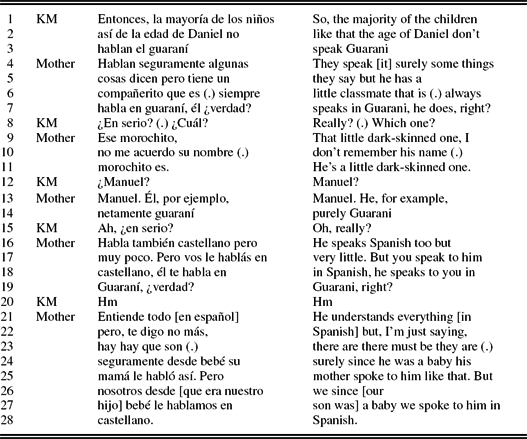
Manuel's Guarani speaking was not evaluated negatively, nor was he identified as rude or ignorant. In the instance coming closest to a negative evaluation, the mother of a classmate, Daniel, was describing who spoke what languages in the community, and she described children Daniel's age as, in general, not speaking much Guarani. She then cited Manuel as an exception (see Excerpt 1).
Manuel as a speaker of little Spanish.

She makes several indexical links between Manuel's Guarani speaking and other signs of identity.Footnote 2 For her, he is a Guarani speaker and a speaker of little Spanish (lines 16–17). The association between these two qualities developed over centuries; Daniel's mother would have known Manuel for several years, and while we do not know what timescale her reading of him as a Guarani speaker and a non-Spanish speaker developed over, it would have been months to years. She also identifies his parents as different from parents like her, who speak Spanish to their children (lines 24–28). Like others—classmates, the teacher, Manuel's mother—she identifies Manuel as speaking a lot of Guarani. Though her evaluation of this sign leans toward a negative evaluation, it does not include rudeness or ignorance, perhaps the hallmarks of the guarango/a model.
According to folk accounts of the guarango/a model in these data, the simple sign of Guarani speaking in decades past was enough to trigger one's identification as that sort of person—people said nowadays Guarani speaking was no longer seen that way. Yet, we know that everyday metapragmatic accounts of language change render important details invisible to users (e.g., see Paulston, Reference Paulston1976), and in this case a number of participants affirmed that not only was the threat of being identified as ignorant or rude in speaking Guarani still present, but it was cited as a major reason for the demise of the bilingual program design using Guarani as the primary language of instruction (described in Mortimer, Reference Mortimer2013). What, then, were the resources and timescales recruited that, in effect, prevented Manuel from being identified negatively for his Guarani speaking? What enabled his identification instead as a positively valued, in fact admired and celebrated, educated Guarani speaker?
Other resources and timescales were recruited into Manuel's identification as a good student and, specifically, very good in Guarani as a subject in school. That he was identified as these kinds of people is important to both his own evasion of being identified as guarango/a and also to the process of change in use of Guarani in his school. His sixth grade class was seen as a smart, cohesive, well-behaved group of good students, a pattern developed over the years-long timescale of their schooling. And among these good students, Manuel was singled out for being one of the best. His teacher cited him as one of a handful of students in the class with the highest grades. His grades were a resource that had developed over a months-long timescale. He was recognized at the end of the year as one of a few mejores alumnos (best students), a category of students who bore the flags and wore special sashes at their graduation ceremony, and Manuel was one of two invited to speak at the ceremony. The category of mejores alumnos was of a longer timescale, while a particular instance of Manuel's embodiment of that sort of person occurred over the course of a little more than one hour at the end of the year. Resources developed over the course of his lifetime formed part of how Manuel's mother identified him: as being naturally intelligent, as enjoying studying, and as earning high grades. She contrasted him with her husband and herself saying, “We always tell him, his father and I, that if he doesn't want to work like we do, he has to study so that he has a profession.” They cast him over some years’ time as on a trajectory different from their own, one that involved more academic and professional practices.
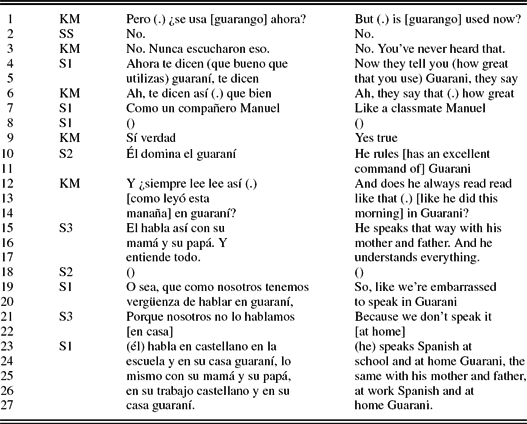
Beyond being identified as a good student type of person, Manuel was recognized as good at one subject in particular: Guarani. His mother reported that he specifically knew a lot of academic Guarani. The idea of widespread Guarani literacy has only been possible since 1992, and thus a potential resource for identification drawn from a decades-long timescale. Manuel's own literacy is a resource developed over his six years of schooling. He was also recognized officially by the teacher and by the school for his skill in academic Guarani when he received a first prize in a school wide Guarani reading contest. A final strong endorsement of Manuel's command of academic Guarani came when he was selected as a mejor alumno and delivered his graduation speech in Guarani. Perhaps the most significant event of identification for this analysis occurred during a group interview of four sixth graders, Manuel's classmates. They had been asked if they had ever heard the term guarango, which coincidentally had appeared in a reading passage used in the classroom that morning. They all said no, they had not heard it except for in that reading. This also happened to be the same morning when they prepared for the schoolwide reading contest in Guarani. Manuel had received explicit praise from the teacher for his reading and especially enthusiastic applause from the class. That afternoon Mortimer asked his classmates if the pejorative term guarango was still used; their responses are shown in Excerpt 2.
Manuel as a contemporary, highly competent speaker of Guarani.

Just before the transcript begins and in line 1, we draw on a concept of relatively long timescale but one whose social domain is shifting—aging with the adult generations and not expanding to include the children in school. That morning a single reading had provided the children with exposure to the model. In line 4 a student refers to what people do “now,” while in line 19 another refers to what they themselves do. In lines 10 and 15 they describe what Manuel does. All of these are patterns of at least ontogenetic timescales, developed over the course of these students’ lifetimes and embodied in the events of that day's morning (the reading mentioning guarango, as well as the in class reading contest)—over the course of one day several different resources were drawn from decades-long, years-long, and a day-long timescale to identify Manuel as a highly competent user of academic Guarani, different from his peers, and different from the guarango/a model of history. Within the span of a few hours, the students encountered in the reading passage a type of person who is mocked for speaking Guarani; they observed and affirmed Manuel's performance of high-level academic Guarani literacy; they rejected the veracity of the guarango/a model as a contemporary type of person; and they offered Manuel as an example of who a Guarani speaker is. Manuel's observable proficiency/performance in academic Guarani (and concomitant Spanish proficiency) was critical in the way he was read. Still, the students did not specifically identify him as another type of person in particular. Rather, Manuel embodied a type of person that was not yet in wide circulation.
The availability of a positively valued (academic) Guarani-speaking identity made it more possible for these students to see Manuel as an admirable kind of person and to see his language proficiency as something desirable. It made more possible for Manuel to escape being seen as guarango. Similarly, Manuel's embodiment as a non-guarango, but still rural and low socioeconomic status speaker of (academic) Guarani made it more possible for his classmates and teacher to conceive of such a person.
CONCLUSION
We have illustrated here how analysis of the heterogeneous resources involved in social identification is essential to understanding the role that these processes play in the cultural, pedagogical, and language changes implicated in policy implementation. In the process of changing how a minoritized language like Guarani is used in education, the possibility that speakers might be identified more positively, as Manuel was, is critical. Understanding how to make that happen requires attention to the variety of resources from multiple timescales that get recruited into construing his Guarani speaking in a more positive way. Signs of identity that were traditionally part of a negatively valued type of person were made relevant—ruralness and lower socioeconomic status—while others that were part of that same long-standing model—rudeness and ignorance—were treated as irrelevant. Manuel's display of proficiency in academic Guarani was important in his being read as an emergent type of Guarani speaker, in producing the possibility of change in how children like him might be identified.
Research on educational language policy must move beyond micro and macro. Any focal phenomenon—like the social identification of Manuel in this school, or the implementation of national language policy in actual classrooms—takes shape only through contributions from multiple resources from heterogeneous scales. We have illustrated how processes ranging from centuries-long histories of colonialism and language contact in Paraguay, to decades-long policy implementation, to months-long ontogenetic development within one classroom, to specific classroom events, were all crucial to the production of a student as a new kind of Guarani speaker. In order for us to provide an adequate account of how social phenomena work—and in particular identification and language policy change together—we must look across scales and include multiple heterogeneous resources in our analyses.