




No CrossRef data available.
APTITUDE AND SECOND LANGUAGE ACQUISITION
Published online by Cambridge University Press: 21 July 2005
Abstract
Recent second language acquisition (SLA) research into the cognitive abilities implicated in implicit, incidental, and explicit learning, and in learning and performance on tasks differing in their information processing demands has prompted new theoretical frameworks for conceptualizing L2 aptitude. This research is reviewed and related to measures of abilities operationalized in existing aptitude tests, as well as to measures of abilities that are the focus of more recent research in cognitive psychology. Finally, prospects for developing aptitude tests to serve the purposes of predicting both early and advanced level language learning success are discussed in the light of the SLA findings and aptitude frameworks reviewed.
Information
- Type
- FUNDAMENTAL ISSUES IN LANGUAGE LEARNING
- Information
- Copyright
- © 2005 Cambridge University Press
This review focuses on contemporary research into instructed second language acquisition (SLA), and the extent to which its constructs, procedures, and findings can inform theoretical models of aptitude and further development of measures of abilities administered during aptitude tests. Second language (L2) learning aptitude is characterized as strengths individual learners have—relative to their population—in the cognitive abilities information processing draws on during L2 learning and performance in various contexts and at different stages. Theoretical frameworks for aptitude research, characterized in this way, have been proposed recently (Robinson, 2001c; Skehan, 2002; Sternberg, 2002). It is also now possible to ‘look down’ (see Deary, 2000, p. 4) from cognitive abilities for information processing to the subcomputational, physical level at which neural differences underlying abilities (see e.g., Garlick, 2002) and SLA processes (see, e.g., Chee, Soon, Lee, & Pellier, 2004; Tokowitcz & MacWhinney, in press) can be described.1
The extent to which the computational, information processing level characterization of aptitude offered in this review “supervenes” on (see Kim, 1993) the physical level at which individual differences and SLA processes can be described is an issue “emergentist” explanations of SLA (N. Ellis, 2003; O' Grady, 2004) and neurolinguistic research are both addressing (Chee, Soon, Lee & Pallier, 2004; Schumann, Crowell, Jones, Lee, Schuchert, & Woods, 2004). Integrating computational and biological perspectives has been a recent concern of individual differences research (Plomin, 2002) and future explanations of individual differences in L2 aptitude will likely also integrate computational and biological accounts.
Specifically the research reviewed in this chapter focuses on the effects of individual differences in cognitive abilities on learning prompted by intervention and manipulation at three levels of pedagogic context: (a) the level of learning condition, and the relative effectiveness of implicit, incidental and explicit processing of L2 input (see studies in Hulstijn & DeKeyser, 1997; Hulstijn & R. Ellis, 2005; and DeKeyser, 2003, N. Ellis, in press, for review); (b) the level of focus on form (FonF), and the effectiveness of a variety of techniques for inducing learner attention to language form during communicative activity (see Doughty & Williams, 1998, for review); and (c) the level of pedagogic task, and the effects of different dimensions of task demands on L2 learning and performance (see R. Ellis, 2004; Robinson, 2001b, 2003b, in press a; Skehan, 1998, 1999, for review).
Research into these areas has often sought to identify differences in the relative effectiveness of particular learning conditions, FonF techniques, or task manipulations, by using pre-posttest, whole group designs, and then comparing gain scores and effect sizes (Rosenthal, Rosnow, & Rubin, 2000) resulting from learning taking place under each. A smaller body of research has additionally measured individual differences in cognitive abilities hypothesized to facilitate, or inhibit, cognitive processes drawn on during L2 learning under these conditions, from these techniques, or on these tasks. An assumption underlying much of this, and other non-SLA ‘interactionist’ research (see Ceci, 1996; Clark, 1997; Corno et al., 2002; Kyllonen & Lajoie, 2003; Sternberg, 2002; Sternberg & Wagner, 1994; Snow, 1987, 1994) is that learning contexts (see, e.g., Collentine & Freed, 2004), the pedagogic interventions taking place within them (see e.g., DeKeyser, in press; R. Ellis, 1999; Long, in press; VanPatten, 2004), and the cognitive processes they implicate (see e.g., Doughty, 2001; N. Ellis, 2001; Robinson, 1995b, 2001d; 2003a; Schmidt, 2001; Segalowitz & Freed, 2004), all have the effects they do in interaction with the patterns of abilities learners bring to those contexts. Some learners, that is, may be especially suited to learning under one condition, from one technique, or on one task, versus others. Consequently, this research can not only contribute to the development of aptitude measures suitable for assessing the global ability to profit from contemporary approaches to L2 instruction—it can also be used to guide decisions about how to match learners to the learning contexts and options to which they are most suited.
Early Developed Measures of Aptitude
The last three decades have each seen the appearance of an edited collection evaluating, and reconceptualizing the theory, measurement, and use of L2 learning aptitude tests (Diller, 1981; Parry & Stansfield, 1990; Robinson, 2002a). Traditionally L2 learning aptitude tests have been developed to predict differences in the rate at which L2 learning takes places (Carroll, 1981, 1990; Skehan, 1998; Spolsky, 1995), when starting “from scratch” (Carroll, 1990), and during instructed exposure to the L2 in programs which initially shelter learners from complex naturalistic input, and the processing and other performance demands learning from, and responding to it entails. They were not developed to predict the very high levels of attainment some selected candidates can continue to make progress towards after exiting instructional programs, or to measure their ability to profit from incidental L2 exposure, as it occurs in either instructed or uninstructed settings. Contemporary aptitude research is therefore addressing the issues of whether traditional measures can predict very high levels of attainment, and also the ability to profit from incidental exposure to the L2, and if not, what additional measures are needed to help ensure this.
An important design constraint on traditional language aptitude tests has been convenience (of both the length and format) of test administration, to groups of test-takers at one sitting. Such tests were designed to meet the paper-and-pencil methods of test administration common in the 1950s through 1970s, when they were developed and first administered. Predominantly, aptitude test-developers adopted this purpose, and accommodated this constraint, so that their tests could provide a basis for selection of those candidates for L2 instruction with the potential for relatively optimum success, usually in the U.S. government-funded learning programs which invested in the original test development and research (see Reed & Stansfield, 2004; Spolsky, 1995). With this goal in mind, selection was made on the basis of total aptitude test scores, as they resulted from performance on the limited (and so administratively feasible—at one sitting) number of subtests each test involved.
Prediction of rate, and feasibility of administration, with the goal of selection into programs (and subsequent assignment to languages of different levels of difficulty), were therefore the main purpose, constraint, and objective which the Modern Language Aptitude Test (MLAT; Carroll & Sapon, 1959), the Defense Language Aptitude Battery (DLAB; Peterson & Al Haik, 1976), and also VORD (a test of an artificial language) (Parry & Child, 1990) were funded and developed to meet. Closely related to the MLAT, PLAB and VORD in format and measurement scope is Pimsleur's Language Aptitude Battery (PLAB; Pimlseur, 1966), which differs mainly in that it was developed to be administered to a younger population than the postpuberty, teenage, and young adult population for which the MLAT, DLAB, and VORD were developed. Additionally, a version of MLAT for elementary level school-learners (EMLAT) was also developed in the 1960s. The DLAB and VORD measures are protected tests, administered only to United States government personnel, but MLAT has been more widely distributed and has been extensively used (sometimes in various translated versions) in SLA research.
These tests have served both SLA research and SL pedagogy well: Scores on them have often correlated quite highly with instructed language learning success in a variety of institutional contexts (see Dörnyei & Skehan, 2003; Ehrman, Leaver, & Oxford, 2003; Sawyer & Ranta, 2001; Skehan, 1989, 1998, 2002, for review), and have been useful in predicting some areas of learning difficulty in the early stages of SLA (see Ehrman, 1996, 1998; Grigorenko, 2002; Sparks & Ganschow, 2001, for review). Additionally versions of MLAT (DeKeyser, 2000) and PLAB (Harley & Hart, 1997, 2002) have been used to show that learners with a postcritical period age of L2 learning onset are much more dependent on the analytic abilities measured by these tests than pre-critical period child L2 learners. As Spolsky has noted, in summarizing results of the early phase of aptitude test development, “in seeking to make further advances in the field, it is unwise not to build on the work of our predecessors” (1995, p. 338).
Four Issues for Research and Development of Traditional Aptitude Tests
Useful as these test have been, it is not difficult build on this early work. Carroll himself, the developer of the MLAT, made some proposals in 1990 about areas of further research that could inform the further development of existing aptitude tests. Four of these areas, together with Carroll's proposals for research into them, are summarized here:
1. How do the cognitive abilities measured in aptitude tests facilitate learning under different conditions of instructional exposure?
In 1990 Carroll was well aware that in the thirty years that had passed since the MLAT was developed and piloted considerable research had taken place within an information processing framework in cognitive psychology (see, e.g., Baars, 1986; Pellegrino & Glaser, 1979; Sternberg, 1977), and that this research could inform a clearer understanding of how mental abilities interacted with conditions of learning to promote SLA. In urging aptitude researchers to examine the cognitive processes contributing to performance on aptitude tests Carroll had this to say:
An ability describes a special relation between characteristics of individuals and the characteristics of the tasks they perform with varying degrees of success … [there should be] a closer focus on similarities and differences between the mental operations required in an aptitude test and those required in foreign language learning (Carroll, 1990, pp. 25–26).
Current SLA research, summarized below, has addressed this issue by examining the extent to which individual differences (IDs) in cognitive abilities— some measured by traditional aptitude tests—contribute to implicit, incidental, and explicit learning, as well as to learning from various techniques for focus on form.
2. What are the aptitude components that predict the ability to learn, and perform successfully on different types of pedagogic tasks?
Current SLA research has also been concerned to identify the information processing demands of tasks contributing to their cognitive and performative complexity and to study the effects of these on L2 learning. Although this research was not available to Carroll in 1990, he observed the following about the componential analysis of task demands and their potential relationship to cognitive abilities: “Further research in foreign language aptitude would require a more refined analysis of foreign language learning tasks in terms of the different cognitive abilities they call upon. I am not aware that much has been done in this direction” (Carroll, 1990, p. 26). As had been argued in the 1970s and 1980s for other areas of the school curriculum (see, e.g., Fleishman, 1978; Fleishman & Quaintance, 1984; Snow, 1987, 1994), Carroll saw that different language learning tasks may require different sets, or combinations, of abilities to be successfully performed. Matching individual differences in abilities to the information processing demands of different L2 tasks is also an area that is also now beginning to be systematically researched.
3. How different are aptitudes for early and advanced language learning?
By 1990, there was also concern that whereas traditional tests such as MLAT were effective in predicting initial progress in language learning, they were seen to be less effective at predicting success at more advanced stages. Carroll was aware of this:
In most of my research on foreign language aptitude, the criterion has been, essentially, rate of learning a language “from scratch”… it is possible that… an individual might be an excellent translator or a facile simultaneous interpreter by virtue of special abilities that do not come into play in early language learning stages but that do come into play at later stages. This immediately suggests that research might focus on abilities that would possibly be relevant in the later stages of foreign language attainment (Carroll, 1990, pp. 24–25).
This issue is also the focus of current speculation and is prompting exploratory empirical research that raises interesting theoretical questions: For example, how continuous, and how discontinuous are the predictive influences of ability factors across early and later stages of SLA? Is it possible that there are distinct combinations of abilities that predict L2 learning success at different stages of development?
4. What are the aptitude components that predict acquisition of pragmatic abilities?
Of course, by 1990 Carroll was aware that since the MLAT was initially developed a much heavier pedagogic emphasis was being placed on the development of communicative ability, and success in using language, than had been the case in the audiolingual classrooms of the late 1950s and 1960s where the MLAT was first piloted and then used to predict achievement in language programs. With this in mind Carroll commented:
One promising direction is to develop tests that would exemplify language learning tasks that are not covered in existing batteries (e.g., tasks requiring the learning of novel linguistic pragmatic rules, such as, the rules concerning forms of address that depend on social or family status). (Carroll, 1990, p. 26.)
Once again, this issue—linked to the nature of aptitude for advanced level language learning—is beginning to be conceptualized and researched.
Aptitude and Current SLA Research
Current SLA research into the measurement of aptitude seeks to build on, but go beyond, traditional tests, both in conceptualization of the theoretical construct and in delivery of assessment measures. Much of the research into issues Carroll raise earlier has used traditional measures of aptitude, particularly the MLAT, but additionally it has investigated the influence of other individual difference variables not measured directly by MLAT, such as phonological working memory (WM) capacity (see Baddeley, 2000; Chee et al., 2004; N. Ellis, 2001; McLaughlin, 1995; Miyake & Friedman, 1998; Williams & Lovatt, 2003). There have also been proposals to integrate WM measures into a much broader battery of aptitude subtests than operationalized in MLAT and other traditional tests. One argument in support of this has been that abilities are not dissociated in their effects on SLA, but have their effects in combination or “complexes” (Robinson, 2001c, 2002b; cf. Snow, 1987) which jointly facilitate processing and learning in a specific instructional context.
Figure 1 identifies ten basic cognitive abilities (in the inner circle, e.g., PS, processing speed) and their contribution to higher order aptitude factors (in the second circle, e.g., NTG, noticing the gap) important to processing and learning from input during the early stages of SLA. An example of how these abilities, and the higher order factors they contribute to, combine to make a joint contribution to SLA is the “aptitude complex” drawn on during the processing of information available in recasts (Doughty, 2001). Processing speed (PS; Anderson, 1992) and pattern recognition (PR; Sasaki, 1996) combine to enable learners to “notice the gap” (NTG; Schmidt & Frota, 1986) between their own, and an interlocutor's utterance during L2 communication. But fast analytic abilities alone are not enough. In addition, phonological working memory capacity (PWMC) and speed (PWMS) contribute to individual differences in the factor memory for contingent speech (MCS) which enables the two utterances to be maintained in WM long enough for the analytic cognitive comparison (Nelson, 1987) to be made. Learning from recasts is jointly enabled by the abilities contributing to the notice the gap and memory for contingent speech factors. Other such complexes have been proposed (Robinson, in press c) and are beginning to be operationalized and researched.

Aptitudes, development, and learning contexts: Changes in the relative contribution of aptitude factors to different aspects of L2 learning. (Inner two circles: initial input-based learning; third circle: output practice and complex task performance; and outer circle: transfer of task performance to real-world interactive settings.)

Similar arguments for a broader battery of SLA process-sensitive aptitude subtests come from Skehan (2002; Dörnyei & Skehan, 2003) who argues that aptitude batteries should capture the abilities drawn on at different stages of L2 processing—broadly defined as the input, central processing, and output stages. These include the phonetic sensitivity, grammatical sensitivity (GS) and paired associates, rote memory (RM) abilities measured by MLAT, but also include abilities drawn on in effectively lexicalizing learned L2 grammatical patterns, and automatically accessing these during fluent L2 production (see also Segalowitz, 2003; Segalowitz & Freed, 2004). Innovations in online, computerized delivery and scoring of mental tests (e.g., Sands, Waters & McBride, 1997) have made the administration of larger test batteries (to individuals, over time, not whole groups at a single sitting) a very feasible prospect, with many advantages (to the test taker and test user) over traditional paper-and-pencil aptitude test administration procedures. Whether such larger batteries add any incremental validity to the predictive power of earlier, more parsimonious tests is an empirical issue. Certainly, if early and later stages of language learning draw on different abilities, or combinations of abilities, then larger batteries will be necessary to inform selection, and also diagnosis and pedagogic use of aptitude profiles. Similar issues are prompting renewed efforts to theorize and research the relationships between aptitude, achievement and pedagogy in other areas of instruction (see Kyllonen & Lajoie, 2003; Shavelson & Roeser, 2002; Sternberg & Grigorenko, 2003).
Finally, although some current aptitude studies still use intact classes to examine the influence of aptitude on learning, as assessed by tests of achievement following a variety of instructional programs over extended periods of time (see, e.g., Harley & Hart, 1997; Ranta, 2002)—a procedure Carroll and Sapon also followed in originally validating the MLAT—many studies now also adopt experimental designs and random selection and allocation of participants to learning conditions, with the aim of investigating the interaction of individual differences variables with specific learning processes in both the shorter (de Graaff, 1997; Robinson, 1997a, 1997b; Williams, 1999; Williams & Lovatt, 2003) and longer term (Robinson, 2002c, in press b). Both kinds of research strategy are, of course, necessary in clarifying the extent of the influence of individual differences in cognitive abilities on instructed SLA, and in further identifying the ability-structure of language learning aptitude.
Aptitude and Awareness: Implicit, Incidental, and Explicit Learning
The first area of SLA research and aptitude test development, described previously, concerns the relationship of cognitive abilities to learning under different conditions of instructional exposure. This research aims to identify relationships between the information processing demands of different ‘instructional sets’ to the L2 learning targets (for example +/− awareness of targets, +/− intention to learn targets, and +/− explicit metalinguistic information about the ‘form’ of targets), and the extent of the influence of these instructional sets on learning (de Graaff, 1997; de Jong, in press; DeKeyser, 1995, 1997; N. Ellis, 1993; Robinson, 1996a, 1997b, 2002c, in press b; Robinson & Ha, 1993; Williams, 1999). DeKeyser (1995), Robinson (1996a), and de Graaff (1997) all found that L2 learning in explicit conditions, involving some degree of metalinguistic awareness and instruction, was at least as effective as learning in implicit conditions where the stimulus domain was complex—and was, on the whole, much more effective where the L2 stimulus domain was simple. In addition, de Graaff (1997), Robinson (1997a), and Williams (1999) all found individual differences in aptitude (measured by subtests of traditional tests, such as the MLAT) and memory ability influenced learning across implicit and explicit conditions. This suggests that adult L2 learning under all conditions of exposure is fundamentally similar (Robinson, 1996b, 2001c) because differences in the extent of learning in these conditions are affected by individual differences in the conscious information processing abilities measured by the aptitude and memory tests. Further, where strengths in patterns of abilities, or aptitudes, match the processing demands of specific instructional sets, this research has suggested, such patterns of abilities additionally facilitate L2 learning. These findings stand in opposition to Krashen's (1982) claim that implicit learning, or “acquisition” is fundamentally different from explicit “learning” because (Krashen argued) the former (in contrast to the latter) draws on unconscious processes, outside of executive control, and is insensitive to individual differences in the abilities measured by traditional aptitude tests such as MLAT.
If “noticing” and awareness are necessary for SLA (as Schmidt, 2001, has claimed) then an issue for aptitude research is to identify individual differences in abilities that promote it—across a range of pedagogically relevant conditions of exposure to the L2. With this in mind Robinson (1996a, 1997a) studied the effects of four conditions (implicit, memorize examples only; incidental, process examples for meaning; rule-search, try to find rules; and instructed, apply a rule explanation to examples) on the acquisition of simple, versus complex L2 structures. Implicit learners in the study, in general, learned poorly. However, for implicit learners in particular, there was a strong link between one measure of L2 aptitude (the grammatical sensitivity subtest of the MLAT), posttest L2 learning success, and awareness (assessed by self-reports of looking for regularities in the input, and ability to verbalize partial rules about the structure of the input). Learners in the implicit learning condition with high aptitude were found to be those most likely to attest to having looked for rules, and also to be able to verbalize rules. This aptitude subtest, therefore, positively predicted awareness during implicit L2 exposure, and awareness led to more learning for implicit learners. Aptitude correlated significantly and positively with learning in all conditions, except, however, the incidental condition.
Krashen (1982) would take this latter finding as some support for his claim that incidental learning while processing for meaning (“acquisition”) is insensitive to IDs in aptitude. However, the two MLAT subtests used (RM, rote memory and GS, grammatical sensitivity) were less likely to have matched the specific processing demands of this condition than other conditions (memorize examples, search for rules, or apply learned rules to examples). In a subsequent study (Robinson, 2002c) these measures of aptitude were similarly found to be poor predictors of incidental learning, but a measure of working memory for text, based on Daneman and Carpenter's (1980) reading span test, was significantly and positively correlated with incidental learning. This is understandable because processing input for meaning during incidental learning creates no opportunities for rote memorization or for the intentional application of explicit metalinguistic knowledge to input (see Hulstijn, 2001, 2003; Smith, Nobe, Robinson, Strong, Tani, & Yoshiba, 2004). However, it does draw on the ability to process for meaning while simultaneously switching attention to form during problems in semantic processing—an ability strongly related to working memory capacity (Arrington & Logan, 2004: Baddeley, 2000; Logan, 2004). One conclusion to be drawn from these studies, then, is that whereas conventional measures of aptitude are suitable for predicting successful learning during some conditions of exposure they also need to be supplemented by other measures (such as working memory), especially where the instruction involves processing for meaning alone, with no intentional focus on form.
Aptitude, Attention, and Focus on Form (FonF) Techniques
Related to the laboratory research previously described is classroom research into the effects of different kinds of intervention that aim to direct learner attention to L2 form during activities which have a primary focus on meaning and the achievement of communicative goals (see, Doughty, 2004; Doughty & Williams, 1998). The degree of attention to, and awareness of, form during classroom L2 processing has been manipulated via use of various focus on form (FonF) techniques such as input flooding (a minimally intrusive technique for directing attention to form during input processing, see e.g., White, 1998); input enhancement (see Leeman, Arteagoita, Fridman, & Doughty, 1995; Robinson, 1997b); recasting (Doughty & Varela, 1998; Leeman, 2003; Lyster, 2004; Philp, 2003); and structured input processing with and without rule explanation (Benati, 2004; Farley, 2004; VanPatten & Cadierno, 1993)—the latter studies often adopting increasingly more communicatively intrusive, and attentionally demanding (and so message-content distracting) FonF techniques.
Findings for research into less communicatively intrusive FonF techniques have produced mixed results to date, with some studies showing input enhancement and recasting to have an effect on subsequent L2 learning, but not others. One reason for this may be that, in any studied population some L2 learners' aptitudes, or sets of abilities, are more suited to learning from one FonF technique versus another. Two studies to date indicate this may be so with regard to recasting. Mackey, Philp, Egi, Fujii, and Tatsumi (2002), using students at a range of levels in a foreign language EFL program, found significant positive relationships between measures of phonological working memory capacity and noticing of information targeted by recasts (features of wh-question formation) delivered on three consecutive days during communicative L2 interaction. However, learners at lower developmental levels showed this relationship more clearly than those at higher developmental levels. Similarly, Robinson and Yamaguchi (Robinson, 1999; Robinson & Yamaguchi, 1999) found high significant positive correlations of measures of phonetic sensitivity and also rote memory (using Sasaki's Language Aptitude Battery for the Japanese, LABJ, 1996), with learning from recasts by university-level, nonlanguage majors, during task-based interaction over a five-week period. Learning was measured by pre- and posttest gain scores on an elicited imitation measure of relative clause production, the form targeted in the study.
The findings for a positive relationship between phonetic sensitivity, memory ability and learning from recasts in Robinson and Yamaguchi's (1999) study, and phonological working memory capacity and noticing of recast information in Mackey et al. (2002) suggest that these abilities are positively implicated in aptitude for learning from the recasting FonF technique. However, as with the finding for incidental learning in Robinson (1997a), reported earlier, in Robinson and Yamaguchi (1999) there were nonsignificant correlations of learning of relative clauses during task-based interaction (supplemented by targeted recasts) and the grammatical sensitivity aptitude subtest. These findings therefore allow an inference across contexts (laboratory studies of incidental learning, and classroom studies of focus on form during task-based learning) about the noninfluence of individual differences in grammatical sensitivity on incidental learning during processing for meaning. As with the laboratory research described previously, then, these findings suggest that learners may differ in their aptitude(s) for learning from one FonF technique versus another.
Aptitude, Task-based Learning, and Task Design
The second issue for SLA-informed research into aptitude test development concerns the relationship of aptitude to the information processing demands of different task types. Design features of L2 tasks hypothesized to impose differential information processing demands (e.g., single versus dual task; +/− reasoning, +/− planning time for the task, or +/− prior knowledge of the task domain) have been studied in recent years for their effects on the accuracy, fluency, and complexity of L2 production, and also on the amount of interaction, and uptake from task relevant input (see e.g., Bygate, 2001; R. Ellis, 2004; Foster & Skehan, 1996; Hardy & Moore, 2004; Ortega, 1999; Rahimpour, 1999; Robinson, 1995a, 2001a, 2003b; Robinson, Ting & Urwin, 1995; Skehan, 1998, 1999). This research has begun to show that some features of L2 task design, such as the complexity of cognitive demands, do have effects on L2 performance. Broadly in line with the claims of the Cognition Hypothesis, that increasing the cognitive and functional demands of tasks has effects on production and learning (Robinson, 2001b, 2003b, in press a), on complex versions of tasks there is less fluency, but sometimes greater accuracy (Gilabert, 2004; Iwashita, Elder, & MacNamara, 2001; Rahimpour, 1997; Robinson, 1995a), as well as more interaction (Hardy & Moore, 2004; Robinson, 2001a), and more extensive uptake and incorporation of premodified input (Robinson, 2003b, in press a) compared to simpler versions. Task repetition (Bygate, 2001), and the provision of planning time (R. Ellis, in press; Foster & Skehan, 1996; Ortega, 1999) are two ways in which the demands of a task can be reduced, and these have been shown, in a number of cases, to positively affect the fluency of L2 production, with potentially important consequences for the effects of task practice, and task preparedness on automatizing access to known material.
Although there are few findings to date, as with the FonF research, task research is now beginning to theorize and research the influence of IDs on learning and performance as it takes place on specific tasks during task-based L2 learning. This includes individual differences in the use of learning styles and strategies (Cohen, 2003; Oxford, Cho, Leung, & Kim, 2004), and motivation (Dörnyei, 2002, in press), as well as aptitude (Robinson, 2001b, 2003b, in press a; Skehan, 1998). This is important for the same reasons given earlier. That is, individual differences in cognitive abilities (and other factors) may also interact with L2 task characteristics to systematically affect speech production, uptake and learning, such that one type of learner may be systematically more fluent, more accurate, or notice and use more new information provided in the task input, on one type of task versus another. These are important issues for the development of theoretically motivated and researched L2 task-aptitude profiles that can be used to maximize on-task practice, and learning opportunities for learners.
Related to this issue, Niwa, (2000) has shown that as L2 tasks increase in complexity so IDs in cognitive abilities increasingly differentiate performance. This relatively greater sensitivity of complex task performance and learning to individual differences in relevant abilities has been demonstrated in many previous studies of aptitude-treatment interactions outside the domain of SLA (see, e.g., Ackerman & Ciancolo, 2002; Fleishman & Quaintance, 1984; Lohman, 2000; Snow, Kyllonen, & Marshalek, 1984). In her study, Niwa (2000) assessed the influence of individual differences in working memory, aptitude, and intelligence on L2 production during narrative tasks performed at four different levels of reasoning complexity. The strongest pattern of significant correlations was found for individual differences in intelligence (using a short form of the Wechsler Adult Intelligence Scale) L2 learning aptitude (using Sasaki's LABJ) and working memory (using a measure of reading span) on the accuracy, and particularly fluency of speaker production on the most complex version of the narratives. This suggests that individual differences in cognitive abilities do lead to increasingly differentiated L2 speech production by learners on complex versions of tasks high in their reasoning demands.
A further study of the effects of increasing reasoning demands of L2 narrative tasks (Robinson, 2003b, in press a) has also found that, as tasks increase in complexity, so learners increasingly incorporate premodified L2 input available in the task materials into their own production. Related to this, Nagata, Aline, and Ellis (1999) found that learners higher in MLAT measures of aptitude benefit more from provision of premodified input during listening comprehension activities (as measured by the extent of pre-posttest gain in relevant vocabulary retention) than learners lower in MLAT aptitude. It remains to be seen whether findings for greater uptake and learning from premodified input on complex relative to simple versions of tasks found in Robinson (2003b, in press a) may also be related to individual differences in cognitive abilities, and thereby contribute to aptitude for task-based learning. It seems likely that they will be, but also that the ability variables predicting this will differ according to the cognitive dimension along which the information processing demands of the task are made complex; for example individual differences in reasoning ability (see Ayala, Shavelson, & Yin, 2002; Lohman, 2000; Stanovitch & West, 2000) in the case of the reasoning demands dimension, versus attention control and the ability to ‘switch’ attention (see Arrington & Logan, 2004; Pashler, 2000; Segalowitz, 2003; Segalowitz & Freed, 2004) to simultaneously competing task demands in the case of the single to dual task dimension. The third circle in Figure 1 describes some of the dimensions along which task demands can be varied from simple to complex. Identifying individual differences in cognitive abilities that contribute to learning and performance of complex tasks along these dimensions will be important to predicting which learners have the capacity for optimal success in both the later stages of instructed language learning, as well as in transfer of learned L2 ability to the contexts of work related real-world language use.
Aptitude and the Development of Advanced Level Language Ability
Throughout this review I have assumed that what an aptitude test measures does not fall on one side of distinctions between competence and performance, implicit “acquisition” and explicit “learning,” or knowledge of language and ability for use. An optimal L2 aptitude test should predict development of all of these. Whether it does is both a theoretical question SLA research of the kind I have reviewed can address and be informed by. At the same time, it is a question of great consequence to the decisions learners, teachers, and program administrators make on the basis of aptitude test scores, that is, whether to select one versus another area of career specialization, how to optimize instruction for learners, and how to select candidates for costly language training programs, respectively (see Sackett, Schmitt, Ellingson, & Kabin, 2001). Future SLA research into the issues raised in this review is essential to the development of aptitude tests that can be confidently used by each of these groups of consumer. Such confidence is particularly needed when learners, teachers and administrators have to make decisions about whether they, their students, or their clients can reach the highest levels of L2 ability—where the likelihood of success is lowest, and the costs of failure (personally, practically, and financially) are often considerable. It is also at this “high-end” of real-world L2 use to accomplish job goals, and life pursuits, that achievement and relative success are most starkly, and validly, defined.2
Changing a course grade from a C to a B because a student “tried hard” in class, or did a make-up assignment is something that may have happened more than once in the programs where the MLAT and other early L2 aptitude tests were piloted and validated by scores on achievement tests in the 1960s. These options won't keep you employed if you are working for a foreign company, and performing unsuccessfully in doing sales pitches in an L2—regardless of your reputation for, and ability in, doing sales pitches in your L1.
Will Cognitive Abilities Alone Predict Advanced Level Language Learning?
Advanced level fluency, comprehensibility, and appropriately organizing the discoursal delivery of, e.g., a sales pitch, are some hallmarks of the acquisition of high level L2 ability. These can, to a large extent, be learned and assessed before exit from language programs. Other hallmarks of high-level L2 ability (using the sales pitch example) are perceiving and responding appropriately to the intended illocutionary force of questions and statements about the product or service that is being described (Bardovi-Harlig, 2001; Baron-Cohen, 1995; Langdon, Coltheart, Ward & Catts, 2002; Levinson, 1995); use of appropriate discourse markers, address forms and register shifts (Archer, 1983; Kasper & Rose, 2002; Yoshimi, 2001); and the integration of these with accommodative behavior, and interactional routines specific to the foreign culture (Bandura, 1986; Chapin, 1967; Goffman, 1967; Goldin-Meadow, Alibali, & Church, 1993; Liddicoat & Crozet, 2001; Rosenthall, Hall, Rogers & Archer, 1979). Measures of abilities used in current aptitude tests were chosen to predict predominantly grammatical and lexical development, as it was assessed by achievement tests used to validate them in the 1960s and 1970s. It is not clear whether they could predict acquisition, or execution of these pragmatic aspects of L2 knowledge.
Research into the acquisition of L2 pragmatics, and its susceptibility to instruction (see Rose & Kasper, 2001) is beginning to address the role of noticing and awareness, and individual variation in the extent of this, in the way research reviewed earlier is exploring the influence of individual differences in abilities on learning under different conditions of exposure, from FonF techniques, and on different task types. But it is likely that the substantial variance in success in developing the pragmatic hallmarks of advanced L2 ability will not be reducible to variance on measures of individual differences in the cognitive abilities illustrated in the center of Figure 1 (or those assessed by traditional aptitude tests such as MLAT) alone. Figure 1 proposes that cognitive abilities are influential on the early input-based stages of language learning. Subsequently, as learners attempt and become proficient in complex L2 pedagogic task performance, individual differences in the abilities drawn on along the task dimensions illustrated in the third circle additionally become predictive. What these individual difference measures for predicting advanced task performance are is as yet unclear, and an important issue for future research. The outer circle of Figure 1 describes pragmatic and interactional abilities such as nonverbal sensitivity, and interactional intelligence that are drawn on to help ensure further learning and development outside L2 classrooms. Aptitude-personality trait complexes of the kind Ackerman (1999, 2003) has described need to be researched and—if identified—used to guide development of measures predicting individual differences in these areas, and which may add incremental validity to predictions based on measures of cognitive abilities (cf. Sternberg, 2004).
Conceivably, therefore, aptitude tests predicting success in early and later learning in language programs will look somewhat different. Carroll (1990) was well aware of this, stating (as cited previously) “an individual might be an excellent translator or a facile simultaneous interpreter by virtue of special abilities that do not come into play in early language learning stages but that do come into play at later stages” (Carroll, 1990, p. 24). This suggests that selection decisions for entry into advanced high level language training programs may need to be made both on initial entry, and at a subsequent later stage. The notion that aptitude(s) are dynamic, and that abilities contributing to them reconfigure as learners reach higher levels, and shift to different contexts of practice and exposure, is one which Snow (1994) and others (see Corno et al., 2002; Dai & Sternberg, 2004; Sternberg & Grigorenko, 2003) have also put forward. But aptitude tests for early and later attainment, if not the same, should be continuous. It is possible that some core abilities drawn on during the early stages of L2 learning (such as those contributing to noticing, and incidental learning) will continue to be robust predictors of the fast registration, analysis, and learning of pragmatic, collocational, and formal-informal register features of the L2 as they become available to advanced level users in the workplace, while they are using the L2 on the job. After exiting from instructional programs learners high in these core abilities should then continue to develop—perceiving, adapting to, and profiting from steady exposure to features of L2 form and function not available in classrooms. Time, and future research, will tell us if that is true, and if so, what those core abilities are.
ANNOTATED BIBLIOGRAPHY
Corno, L., Cronbach, L., Kupermintz, H., Lohman, D., Mandinach, E., Porteus, A., & Talbert, J. (2002). Remaking the concept of aptitude: Extending the legacy of Richard E. Snow. Mahwah, NJ: Erlbaum.
This book describes Richard Snow's theoretical model of aptitude and its implications for instructional design and teaching practice. Snow was concerned throughout his career with aptitude for schooled instruction—not specifically with aptitude for language learning. There is little discussion of language learning aptitude, but the book is worth reading for those interested in the relationship between cognitive abilities, and affective and conative factors, and the contributions of all of these to success in various instructional contexts. Snow wrote extensively on how measures of abilities alone may underdetermine aptitude for school learning, and how aptitude may profitably be seen as a person-in-situation transaction. To this extent it is an interesting counterpoint to the work of Carroll who focused on the role of cognitive abilities, and their factor structure, in his own work. (see Carroll, 1993). Carroll's work is described, and work in mainstream educational psychology, and cognitive psychology, are also described. The chapters, differently authored, lack some cohesion, but it is worth considering how personality, and motivational factors might with interact with abilities to promote instructed L2 learning, and also how this interaction may take place in real-world contexts of language use, outside language programs. The edited collections by Shavelson and Roeser (2002) and Kyllonen and Lajoie (2003) containing empirical studies, operationalizing many of Snow's ideas, can also be read as a supplement to this.
DeKeyser, R. M. (2000). The robustness of critical period effects in second language acquisition. Studies in Second Language Acquisition, 22, 499–533.
The issue of age-related changes in the abilities contributing to aptitude is of theoretical importance to our understanding of SLA, and also of great practical importance for the development of aptitude tests appropriate to child and adult learners. In this article, DeKeyser reports the results of a partial replication of an earlier study by Johnson and Newport. Consistent with the earlier study, he finds that very few adult Hungarian-speaking immigrants to the United States scored within the range of child arrivals on a grammaticality judgment test of English. Moreover, for adult (but not child) arrivals there are strong significant positive correlations of grammaticality judgment scores, and scores on a modified version of the words in sentences MLAT measure of grammatical sensitivity. This article complements the similar findings of Harley and Hart (1997, 2002) for differences in the extent to which language analytic abilities contribute to aptitude for post versus precritical period learners in Canadian immersion programs. Interestingly, Harley and Hart (1997) additionally found individual differences in memory abilities contributed more to aptitude for precritical, than postcritical period L2 learning in their program. Readers might want to consider whether similar measures might also have correlated significantly and positively with performance on the grammaticality judgment test by child arrivals in DeKeyser's study.
Mackey, A., Philp, J., Egi, T., Fujii, A., & Tatsumi, T. (2002). Individual differences in working memory, noticing of interactional feedback and L2 development. In P. Robinson (Ed.), Individual differences and instructed language learning (pp. 69–93). Amsterdam: Benjamins.
What are the measures of cognitive abilities that predict uptake and learning from the various FonF techniques that have been proposed? Is one consistently predictive across a range of techniques? Working memory capacity is a good candidate for such a basic, core ability that can contribute to language learning aptitude at early, and later stages. In this study Mackey et al. report some evidence that phonological working memory capacity (measured by nonword recall and listening span measures) is predictive of the ability to notice information about mismatches between their own L2 production and recasts of it provided during interaction. Aspects of wh-question formation were the targeted form, and learners were identified as being at one of two developmental stages prior to the treatment, based on their ability to produce these question forms. Learners at lower developmental levels were more likely to notice information available in recasts than learners at higher developmental levels. The small number of subjects, and the short length of treatment are limitations of this study, but it raises interesting issues for future research to consider and build on.
Robinson, P. (2001). Individual differences, cognitive abilities, aptitude complexes and learning conditions in second language acquisition. Second Language Research, 17, 368–392.
This article describes a theory of the cognitive abilities contributing to aptitude for instructed SLA, which explains why learners profit from different kinds of instruction. It also explains why some learners learn well from any kind of instruction, and why some learn poorly from any kind of instruction. Four interlocking hypotheses underpin the theory. The Aptitude Complex Hypothesis claims abilities have their effects on learning in specific combinations, and that these complexes of abilities promote SLA under L2 learning conditions, and from focus on form techniques, that draw on them. Four such “complexes” of ability factors are illustrated. The Ability Differentiation Hypothesis claims some learners have very differentiated strengths in abilities contributing to aptitude complexes, and that instruction especially needs to match the ability profiles of these learners. The Fundamental Difference Hypothesis claims aptitudes prior to, and following the critical period draw on different abilities—as the findings of DeKeyser (2000) and Harley and Hart (1997) show. Finally, the Fundamental Similarity Hypothesis claims adult (not child) learning under any condition of exposure draws on abilities implicated in explicitly processing input, and ‘noticing’ features of it. Most learners need to be matched to the conditions of instructional exposure that match their abilities to explicitly process, and notice elements of the L2, as the first hypothesis claims. Exceptional learners are those with strengths in all abilities, who can learn from any kind of instructional exposure. Disabled learners are those with strengths in no abilities. This is an interactionist theory of aptitude (see Snow, 1994), motivated by findings from SLA research, as well as frameworks, and constructs in educational and cognitive psychology.
Skehan, P. (2002). Theorising and updating aptitude. In P. Robinson (Ed.), Individual differences and instructed language learning (pp. 69–93). Amsterdam: Benjamins.
One of the most consistently insightful commentators on the role of individual differences in SLA, Skehan proposes in this paper a framework for researching the abilities contributing to aptitude for SLA, which is motivated by findings from SLA research and by research into L2 comprehension and speech production. Skehan proposes that components of aptitude be conceptualized as contributing to different stages of L2 processing. These include the stage at which L2 input is initially ‘noticed’; the stage at which input is ‘patterned’ and elaborated into a plan at a higher level of abstraction; the stage at which the plan becomes ‘controlled’ and automatically accessed in production; and the stage at which the plan becomes variably lexicalized, and the basis of a larger repertoire of linguistic expressions. Skehan relates his model to subtests of existing aptitude tests, such as MLAT, pointing out where additional measures of abilities need to be developed to assess potential for L2 processing and learning at each stage. What these measures are is not described in operational detail, but Skehan gives a functional account of what they should measure, and this can be used as a blueprint by those interested in developing psycholinguistically motivated tests of the abilities contributing to aptitude for SLA, at each of the processing stages Skehan describes.
Williams, J. N., & Lovatt, P. (2003). Phonological memory and rule learning. Language Learning, 53, 67–121.
As Carroll himself noted in 1990, the most likely way in which the predictive power of the MLAT could be improved is by adding additional memory measures to the paired associates measure of rote memory. The theory and operationalization of memory measures has changed considerably since the 1960s when traditional aptitude tests were developed and piloted. There is now an extensive literature on working memory and implicit memory not available then. Experimental studies of the extent to which measures of memory predict successful learning of L2 stimuli are important to deciding which candidate memory measures to choose to include in aptitude batteries. This is an example of such research. Two experiments examined the contribution of individual differences in phonological memory to the ability to learn rules for determiner-noun agreement in semiartificial microlanguages. Williams and Lovatt conclude from their study that both memory and nonmemory factors influenced learning and that explicit learning processes contributed to this: Rules do not emerge simply from phonological memory for input sequences. They limit the scope of their claim by noting that the rules to be learned depended on forming associations between phonological forms: they were not rules that depended on making form-meaning associations.
References
Ackerman P. L.
1999.
Traits and knowledge as determinants of learning and individual differences: Putting it all together.
In P. L. Ackerman,
P. Kyllonen, &
R. Roberts (Eds.),
Learning and individual differences: Process, trait and content determinants
(pp. 437–
462).
Washington, DC:
American Psychological Association.
Ackerman P. L.
2003.
Aptitude complexes and trait complexes.
Educational Psychologist,
38,
85–
93.Google Scholar
Ackerman P. L. &
Ciancolo A.
2002.
Ability and task constraint determinants of complex task performance.
Journal of Experimental Psychology: Applied,
8,
194–
208.Google Scholar
Anderson M.
1992.
Intelligence and development: A cognitive theory.
Oxford:
Blackwell.
Archer D.
1983.
The encoding of meaning: A test of three theories of social interaction.
Sociological Enquiry,
50,
393–
419Google Scholar
Arrington C. A., &
Logan G. D.
2004.
The costs of a voluntary task switch.
Psychological Science,
15
9
610–
616.Google Scholar
Ayala C. C.,
Shavelson R. J.,
Yin Y., &
Schultz S. E.
2002.
Reasoning dimensions underlying science achievement: The case of performance assessment.
Educational Assessment,
8,
101–
122.Google Scholar
Baars B.
1986.
The cognitive revolution in psychology.
New York:
Guilford.
Baddeley A.
2000.
Working memory and language processing.
In B.E. Dimitrova &
K. Hyltenstam (Eds.),
Language processing and simultaneous interpreting
(pp. 1–
16).
Amsterdam:
Benjamins.
Bandura A.
1986.
Social foundations of thought and action.
Englewood Cliffs, NJ:
Prentice-Hall.
Bardovi-Harlig K.
2001.
Evaluating the empirical evidence: Grounds for instruction?
In K. Rose &
G. Kasper (Eds.),
Pragmatics in language teaching
(pp. 13–
32).
New York:
Cambridge University Press.
Baron-Cohen S.
1995.
Mindblindness: An essay on autism and theory of mind.
Oxford:
Oxford University Press.
Benati A.
2004.
The effects of structured input activities and explicit information on the acquisition of the Italian future tense.
In B. Van Patten (Ed.),
Processing instruction: Theory, research and commentary
(pp. 207–
226).
Mahwah, NJ:
Erlbaum.
Bygate M.
2001.
Effects of task repetition on the structure and control of oral language.
In M. Bygate,
P. Skehan, &
M. Swain (Eds.),
Researching pedagogic tasks: Second language learning, teaching and testing
(pp. 23–
48).
Harlow:
Longman.
Carroll J. B.
1981.
Twenty-five years of research on foreign language aptitude.
In K. C. Diller (Ed.),
Individual differences and universals in language learning aptitude
(pp. 83–
118).
Rowley, MA:
Newbury House.
Carroll J. B.
1990.
Cognitive abilities in foreign language aptitude: Then and now.
In T. Parry &
C. Stansfield (Eds.),
Language aptitude reconsidered
(pp. 11–
29).
Englewood Cliffs, NJ:
Prentice Hall.
Carroll J. B.
1993.
Human cognitive abilities: A survey of factor-analytic studies.
New York:
Cambridge University Press.
Carroll J. B., &
Sapon S. M.
1959.
The Modern Language Aptitude Test.
Washington, DC:
Second Language Testing Incorporated.
Ceci S. J.
1996.
On intelligence… more or less: A bio-ecological treatise on intellectual development.
Englewood Cliffs, NJ:
Prentice Hall.
Chapin F. S.
1967.
The social insight test.
Palo Alto, CA:
Consulting Psychologists Press.
Chee M. W.,
Hon N.,
Lee H. L., &
Soon C. S.
2001.
Relative language proficiency modulates BOLD signal change when bilinguals perform semantic judgements.
Neuroimage,
13,
1155–
1163.Google Scholar
Chee M. W.,
Soon C. S.,
Lee H. L. &
Pallier C.
2004.
Left insula activation: A marker for language attainment in bilinguals.
Proceedings of the National Academy of Sciences,
101
2
15265–
15276.Google Scholar
Clark A.
1997.
Being there: Putting brain, body and world together again.
Cambridge, MA:
MIT Press.
Cohen A. D.
2003.
The learner's side of foreign language learning: Where do styles, strategies and tasks meet?
International Review of Applied Linguistics in Language Teaching,
41,
279–
292.Google Scholar
Collentine J., &
Freed B. F. (Ed.).
2004.
Language context and its effects on second language acquisition [Special issue].
Studies in Second Language Acquisition,
26, 2.
Costa P. T., &
McCrae R. R.
1985.
The NEO Personality Inventory manual.
Odessa, FL:
Psychological Assessment Resources, Inc..
Dai D. Y., &
Sternberg R. J. (Ed.).
2004.
Motivation, emotion, and cognition: Integrative perspectives on intellectual functioning and development.
Mahwah, NJ:
Erlbaum.
Daneman M., &
Carpenter P. A.
1980.
Individual differences in working memory and reading.
Journal of Verbal Learning and Verbal Behaviour,
19,
450–
466.Google Scholar
de Graaff R.
1997.
Differential effects of explicit instruction on second language acquisition.
The Hague:
Holland Institute of Generative Linguistics.
de Jong N.
(in press).
Is listening enough for grammar acquisition? The effect of an aural training on reception and production in a second language.
Studies in Second Language Acquisition,
27,
2.
Deary I. J.
2000.
Looking down on human intelligence: From psychometrics to the brain.
Oxford:
Oxford University Press.
DeKeyser R. M.
1995.
Learning second language grammar rules: An experiment with a miniature linguistic system.
Studies in Second Language Acquisition,
17,
379–
410.Google Scholar
DeKeyser R. M.
1997.
Beyond explicit rule learning: Automatizing second language syntax.
Studies in Second Language Acquisition,
19,
195–
221.Google Scholar
DeKeyser R. M.
2003.
Implicit and explicit learning.
In C. Doughty &
M. H. Long (Eds.),
Handbook of second language acquisition
(pp. 313–
348).
Oxford:
Blackwell.
DeKeyser R. M. (Ed.)
(in press).
Practice in second language learning: Perspectives from applied linguistics and cognitive psychology.
New York:
Cambridge University Press.
Diller K. C. (Ed.)
1981.
Individual differences and universals in language learning aptitude.
Rowley, MA:
Newbury House.
Dörnyei Z.
2002.
The motivational basis of language learning tasks.
In P. Robinson (Ed.),
Individual differences and instructed language learning
(pp. 137–
158).
Amsterdam:
Benjamins
Dörnyei Z.
(in press).
Individual differences and second language learning.
Mahwah, NJ:
Erlbaum.
Dörnyei Z., &
Skehan P.
2003.
Individual differences in second language learning.
In C. Doughty &
M. H. Long (Eds.),
Handbook of second language acquisition
(pp. 589–
630).
Oxford:
Blackwell.
Doughty C.
2001.
Cognitive underpinnings of focus on form.
In P. Robinson (Ed.),
Cognition and second language instruction
(pp. 206–
257).
Cambridge:
Cambridge University Press.
Doughty C.
2004.
When PI is focus on form it is very, very good; but when it is focus on forms ….
In B. VanPatten (Ed.),
Processing instruction: Theory, research and commentary
(pp. 121–
132).
Mahwah, NJ:
Erlbaum.
Doughty C. &
Varela E.
1998.
Communicative focus on form.
In C. Doughty &
J. Williams (Eds.),
Focus on form in classroom second language acquisition
(pp. 114–
138).
New York:
Cambridge University Press.
Doughty C., &
Williams J.
1998.
Pedagogical choices in focus on form.
In C. Doughty &
J. Williams (Eds.),
Focus on form in classroom second language acquisition
(pp. 197–
262).
New York:
Cambridge University Press.
Ehrman M. E.
1996.
Understanding second language learning difficulties.
Thousand Oaks, CA:
Sage.
Ehrman M. E.
1998.
A study of the Modern Language Aptitude Test for predicting learning success and advising students.
Applied Language Learning,
9,
31–
70.Google Scholar
Ehrman M. E.,
Leaver B., &
Oxford R.
2003.
A brief overview of individual differences in second language learning.
System,
31,
313–
330.Google Scholar
Ellis N. C.
1993.
Rules and instances in foreign language learning: Interactions of explicit and implicit knowledge.
European Journal of Cognitive Psychology,
5,
289–
318.Google Scholar
Ellis N. C.
2001.
Memory for language.
In P. Robinson (Ed.),
Cognition and second language instruction
(pp. 34–
68).
Cambridge:
Cambridge University Press.
Ellis N. C.
2003.
Constructions, chunking and connectionism: The emergence of second language structure.
In C. Doughty &
M. H. Long (Eds.),
Handbook of second language acquisition
(pp. 63–
103).
Oxford:
Blackwell.
Ellis N. C.
(in press).
At the interface: How explicit knowledge affects implicit language learning.
Studies in Second Language Acquisition,
27
(2).
Ellis R. (Ed.).
1999.
Learning a second language through interaction.
Amsterdam:
Benjamins.
Ellis R.
2004.
Task-based teaching and learning.
Oxford:
Oxford University Press.
Ellis R. (Ed.)
(in press).
Planning time and second language learning.
Amsterdam:
Benjamins.
Farley A.
2004.
Processing instruction and the Spanish subjunctive: Is explicit information needed?
In B. VanPatten (Ed.),
Processing instruction: Theory, research and commentary
(pp. 227–
240).
Mahwah, NJ:
Erlbaum.
Fleishman E. A.
1978.
Relating individual differences to the dimensions of human tasks.
Ergonomics,
21,
1007–
1019.
Fleishman E. A., &
Quaintance M. K.
1984.
Taxonomies of human performance: The description of human tasks.
New York:
Academic Press.
Foster P., &
Skehan P.
1996.
The influence of planning and task type on second language performance.
Studies in Second Language Acquisition,
18,
299–
324.Google Scholar
Garlick D.
2002.
Understanding the nature of the general factor of intelligence: The role of individual differences in neural plasticity as an explanatory mechanism.
Psychological Review,
109,
116–
136.Google Scholar
Gilabert R.
2004.
Task complexity, planning and L2 oral narrative production.
Unpublished Ph.D dissertation.
Department of Applied Linguistics, University of Barcelona, Spain
Goffman E.
1967.
Interaction ritual: Essays in face-to-face behavior.
Chicago, IL:
Aldine.
Goldin-Meadow S., Alibali M. W., &
Church C.
1993.
Transitions in concept acquisition: Using the hand to read the mind.
Psychological Review,
100,
279–
297.Google Scholar
Grigorenko E. L.
2002.
Language-based learning disabilities.
In P. Robinson
Individual differences and instructed language learning
(pp. 95–
113).
Amsterdam:
Benjamins.
Hardy I., &
Moore J.
2004.
Foreign language student's conversational negotiations in different task environments.
Applied Linguistics,
25,
340–
370.Google Scholar
Harley B., &
Hart D.
1997.
Language aptitude and second language proficiency in classroom learners of different starting ages.
Studies in Second Language Acquisition,
19,
379–
400.Google Scholar
Harley B., &
Hart D.
2002.
Age, aptitude and second language learning on a bilingual exchange.
In P. Robinson
Individual differences and instructed language learning
(pp. 301–
330).
Amsterdam:
Benjamins.
Hulstijn J. H.
2001.
Intentional and incidental second language vocabulary learning: A reappraisal of elaboration, rehearsal and automaticity.
In P. Robinson
Cognition and second language instruction
(pp. 258–
286).
Cambridge:
Cambridge University Press.
Hulstijn J. H.
2003.
Incidental and intentional learning.
In C. Doughty &
M. H. Long (Eds.),
Handbook of second language acquisition
(pp. 349–
381).
Oxford:
Blackwell.
Hulstijn J. H., &
DeKeyser R. M.
1997.
Second language acquisition research in the laboratory: Special Issue.
Studies in Second Language Acquisition,
19,
2
Hulstijn J. H., &
Ellis R. (Ed.)
2005.
Implicit and explicit second language learning: Special issue.
Studies in Second Language Acquisition,
27,
2.
Iwashita N.,
McNamara T., &
Elder C.
2001.
Can we predict task difficulty in an oral proficiency test? Exploring the potential of an information processing approach to task design.
Language Learning,
51,
401–
436.Google Scholar
Kasper G., &
Rose K.
2002.
Pragmatic development in a second language.
Malden, MA:
Blackwell.
Kenyon D. M., &
MacGregor D. (Eds.).
2004.
Final report of the Defense Language Aptitude Battery II project.
Washington, DC:
Center for Applied Linguistics.
Krashen S. D.
1982.
Principles and practice in second language acquisition.
Oxford:
Pergamon.
Kim J.
1993.
Supervenience and mind.
Cambridge:
Cambridge University Press.
Kyllonen P. C., &
Lajoie S.
2003.
Reassessing aptitude: Introduction to a special issue in honor of Richard E. Snow.
Educational Psychologist,
38,
79–
83.Google Scholar
Langdon R.,
Coltheart M.,
Ward P., &
Catts S.
2002.
Disturbed communication in schizophrenia: The role of pragmatics and poor theory-of-mind.
Psychological Medicine,
32,
1273–
1284.Google Scholar
Leeman J.
2003.
Recasts and second language development: Beyond negative evidence.
Studies in Second Language Acquisition,
25,
37–
64.Google Scholar
Leeman J.,
Artegoitia I.,
Fridman B., &
Doughty C.
1995.
Integrating attention to form with meaning: Focus on form in content-based Spanish instruction.
In R. Schmidt
Attention and awareness in foreign language learning
(pp. 217–
258).
Honolulu, HI:
University of Hawai'i Press.
Levinson S. C.
1995.
Interactional biases in human thinking.
In E. Goody
Social intelligence and interaction
(pp. 221–
260).
Cambridge:
Cambridge University Press.
Liddicoat A., &
Crozet C.
2001.
Acquiring French interactional norms through instruction.
In K. Rose &
G. Kasper (Eds.),
Pragmatics in language teaching
(pp.125–
144).
New York:
Cambridge University Press.
Logan G. D.
2004.
Working memory, task switching and executive control in the task span procedure.
Journal of Experimental Psychology: General,
133,
218–
236.Google Scholar
Lohman D. F.
2000.
Complex information processing and intelligence.
In R. J. Sternberg
Handbook of intelligence
(pp. 285–
340).
New York:
Cambridge University Press.
Long M. H.
(in press).
Recasts: The story so far.
Problems in SLA.
Mahwah, NJ:
Erlbaum.
Lyster R.
2004.
Differential effects of prompts and recasts in form-focused instruction.
Studies in Second Language Acquisition,
26,
399–
432.Google Scholar
Mayer J. D.,
Salovey P., &
Caruso D.
2000.
Models of emotional intelligence.
In R. J. Sternberg (Eds.),
Handbook of intelligence
(pp. 396–
420).
New York:
Cambridge University Press.
McLaughlin B.
1995.
Aptitude from an information-processing perspective.
Language Testing,
12,
370–
387.Google Scholar
Miyake A., &
Friedman N.
1998.
Individual differences in second language proficiency: Working Memory as language aptitude.
In A. Healy &
L. Bourne Jr. (Eds.),
Foreign language learning: Psycholinguistic studies on training and retention
(pp. 339–
364).
Mahwah, NJ:
Erlbaum.
Nagata H.,
Aline D., &
Ellis R.
1999.
Modified input, language aptitude, and the acquisition of word meanings.
In R. Ellis (Ed.)
Learning a second language through interaction
(pp. 133–
150).
Amsterdam:
Benjamins.
Nelson K.
1987.
Some observations from the perspective of the rare event, cognitive comparison theory of language acquisition.
In K. Nelson & A. vanKleek (Eds.),
Childrens' language
(pp. 289–
331).
Norwood, NJ:
Erlbaum.
Niwa Y.
2000.
Reasoning demands of L2 tasks and L2 narrative production: Effects of individual differences in working memory, intelligence and aptitude.
Unpublished master's dissertation,
Department of English, Aoyama Gakuin University,
Japan
O' Grady W.
2004.
Syntactic carpentry.
Mahwah, NJ:
Erlbaum.
Ortega L.
1999.
Planning and focus on form in L2 oral discourse.
Studies in Second Language Acquisition,
20,
103–
135.Google Scholar
Oxford R.,
Cho Y.,
Leung S., &
Kim H.
2004.
Effect of the presence and difficulty of task on strategy use.
International Review of Applied Linguistics,
42,
1–
48.Google Scholar
Parry T., &
Child J.
1990.
Preliminary investigation of the relationship between VORD, MLAT and language proficiency.
In T. Parry & C. Stansfield (Eds.),
Language aptitude reconsidered
(pp. 30–
66).
Englewood Cliffs, NJ:
Prentice Hall.
Parry T., &
Stansfield C.
1990.
(Eds.)
Language aptitude reconsidered.
Englewood Cliffs, NJ:
Prentice Hall.
Pashler H. E.
2000.
Task switching and multitask performance.
In S. Monsell & J. Driver (Eds.),
Attention and performance XVIII: Control of cognitive processes
(pp. 277–
308).
Cambridge, MA:
MIT Press.
Pellegrino J., &
Glaser R.
1979.
Cognitive correlates and components in the analysis of individual differences.
In R. J. Sternberg &
D. Detterman (Eds.),
Human intelligence: perspectives on its theory and measurement
(pp. 61–
88).
Noorwood, NJ:
Ablex.
Peterson C. R., &
Al Haik A. R.
1976.
The development of the Defense Language Aptitude Battery (DLAB).
Educational and Psychological Measurement,
6,
369–
380.Google Scholar
Philp J.
2003.
Constraints on “Noticing the Gap:” Nonnative speakers' noticing of recasts in NS-NNS interaction.
Studies in Second Language Acquisition,
25,
99–
126.Google Scholar
Pimsleur P.
1966.
Pimsleur Language Aptitude Battery (PLAB).
Washington, DC:
Second Language Testing Incorporated.
Plomin R.
2002.
Individual differences research in the postgenomic era.
Personality and Individual Differences,
33,
909–
930.Google Scholar
Rahimpour M.
1997.
Task complexity and variation in oral L2 narrative discourse.
Unpublished Ph.D. disseration,
CLTR, University of Queensland
Australia.
Rahimpour M.
1999.
Task complexity and variation in interlanguage.
In N. O. Jungheim &
P. Robinson (Eds.),
Pragmatics and pedagogy: Proceedings of the Third Pacific Second Language Research Forum,
Vol. 2
(pp. 115–
134).
Tokyo:
PacSLRF.
Ranta L.
2002.
The role of learners' analytic abilities in the communicative classroom.
In P. Robinson (Ed.)
Individual differences and instructed language learning
(pp. 159–
180).
Amsterdam:
Benjamins.
Reed D., &
Stansfield C.
2004.
An interview with John B. Carroll: The story behind the Modern Language Aptitude Test.
Language Assessment Quarterly,
1,
21–
38.Google Scholar
Robinson P.
1995a.
Task complexity and second language narrative discourse.
Language Learning,
45,
99–
140.Google Scholar
Robinson P.
1995b.
Attention, memory and the ‘noticing’ hypothesis.
Language Learning,
45,
283–
331.Google Scholar
Robinson P.
1996a.
Learning simple and complex second language rules under implicit, incidental, rule-search and instructed conditions.
Studies in Second Language Acquisition,
18,
27–
67.Google Scholar
Robinson P.
1996b.
Consciousness, rules and instructed second language acquisition.
New York:
Lang.
Robinson P.
1997a.
Individual differences and the fundamental similarity of implicit and explicit adult second language learning.
Language Learning,
47,
45–
99.Google Scholar
Robinson P.
1997b.
Automaticity and generalizability of second language learning under implicit, incidental, enhanced and rule-search conditions.
Studies in Second Language Acquisition,
19,
223–
247.Google Scholar
Robinson P.
1999.
Second language classroom research in Japan: Issues, studies, and prospects.
In T. Fujimura,
Y. Kato &
R. Smith (Eds.),
Proceedings of the 10th IUJ Conference on second language research
(pp. 93–
116).
Tokyo:
International University of Japan.
Robinson P.
2001a.
Task complexity, task difficulty, and task production: Exploring interactions in a componential framework.
Applied Linguistics,
22,
27–
57.Google Scholar
Robinson P.
2001b.
Task complexity, cognitive resources, and syllabus design: A triadic framework for investigating task influences on SLA.
In P. Robinson
Cognition and second language instruction
(pp. 287–
318).
Cambridge:
Cambridge University Press.
Robinson P.
2001c.
Individual differences, cognitive abilities, aptitude complexes, and learning conditions in SLA.
Second Language Research,
17,
368–
392.Google Scholar
Robinson P.
2001.
(Ed.).
Cognition and second language instruction.
Cambridge:
Cambridge University Press.
Robinson P.
2002a.
(Ed.).
Individual differences and instructed language learning.
Amsterdam:
Benjamins.
Robinson P.
2002b.
Learning conditions, aptitude complexes and SLA: A framework for research and pedagogy.
In P. Robinson
Individual differences and instructed language learning
(pp. 113–
133).
Amsterdam:
Benjamins.
Robinson P.
2002c.
Individual differences in intelligence, aptitude and working memory during adult incidental second language learning: A replication and extension of Reber, Walkenfeld, and Hernstadt (1991).
In P. Robinson (Ed.)
Individual differences and instructed language learning
(pp. 211–
266).
Amsterdam:
Benjamins.
Robinson P.
2003a.
Attention and memory during SLA.
In C. Doughty & M. H. Long (Eds.),
Handbook of second language acquisition
(pp. 631–
678).
Oxford:
Blackwell.
Robinson P.
2003b.
The Cognition Hypothesis, task design and adult task-based language learning.
Second Language Studies,
21
(2),
45–
107.Google Scholar
Robinson P.
(in press a).
Cognitive complexity and task sequencing: A review of studies in a Componential Framework for second language task design.
International Review of Applied Linguistics in Language Teaching,
43
(1).
.
Robinson P.
(in press b).
Cognitive abilities, chunk-strength and frequency effects in implicit Artificial Grammar and incidental L2 learning: Replications of Reber, Walkenfeld, and Hernstadt (1991) and Knowlton and Squire (1996) and their relevance for SLA.
Studies in Second Language Acquisition,
27
(2).
Robinson P.
(in press c).
Aptitude, abilities, contexts and practice.
In R. M. DeKeyser (Ed.)
Practice in second language learning: Perspectives from applied linguistics and cognitive psychology.
New York:
Cambridge University Press.
Robinson P., &
Ha M.
1993.
Instance theory and second language rule learning under explicit conditions.
Studies in Second Language Acquisition,
15,
413–
438.Google Scholar
Robinson P.,
Ting S.C-C., &
Urwin J.
1995.
Investigating second language task complexity.
RELC Journal,
26,
62–
79.Google Scholar
Robinson P., &
Yamaguchi Y.
1999.
Aptitude, task feedback and generalizability of focus on form: A classroom study.
Paper presented at the 12th AILA World Congress,
Waseda University,
Tokyo,
August.
Rose K., &
Kasper G.
2001.
Pragmatics in language teaching.
New York:
Cambridge University Press.
Rosenthal R.,
Rosnow R., &
Rubin D.
2000.
Contrasts and effect sizes in behavioral research: A correlational approach.
New York:
Cambridge University Press.
Rosenthall R.,
Hall J.,
Rogers P. L., &
Archer D.
1979.
Sensitivity to nonverbal communications: The PONS test.
Baltimore, MD:
Johns Hopkins University Press.
Sackett P.,
Schmitt N.,
Ellingson J., &
Kabin M.
2001.
High-stakes testing in employment, credentialing, and higher education: Prospects in a post-affirmative action world.
American Psychologist,
56,
302–
318.Google Scholar
Sands W.,
Waters B., &
McBride J.
1997.
(Eds.)
Computerized adaptive testing: From inquiry to operation.
Washington, DC:
American Psychological Corporation.
Sasaki M.
1996.
Second language proficiency, foreign language aptitude, and intelligence.
New York:
Lang.
Sawyer M., &
Ranta L.
2001.
Aptitude, individual differences and instructional design.
In P. Robinson
Cognition and second language instruction
(pp. 319–
353).
Cambridge:
Cambridge University Press.
Schumann J. H.,
Crowell S.,
Jones N.,
Lee N.,
Schuchert C., &
Woods L.
2004.
The neurobiology of learning: Perspectives from second language acquisition.
Mahwah, NJ:
Erlbaum.
Schmidt R.
2001.
Attention.
In P. Robinson
Cognition and second language instruction
(pp. 1–
32).
Cambridge:
Cambridge University Press.
Schmidt R., &
Frota S.
1986.
Developing basic conversational ability in a second language: A case study of an adult learner of Portuguese.
In R. Day
Talking to learn: Conversation in second language learning
(pp. 237–
322).
Rowley, MA:
Newbury House.
Segalowitz N.
2003.
Automaticity and second language acquisition.
In C. Doughty & M. H. Long (Eds.),
Handbook of second language acquisition
(pp. 382–
408).
Oxford:
Blackwell.
Segalowitz N., &
Freed B. F.
2004.
Context, contact, and cognition in oral fluency acquisition: Learning Spanish in at home and study abroad contexts.
Studies in Second Language Acquisition,
26,
201–
226.Google Scholar
Shavelson R. J., &
Roeser R. W.
2002.
(Eds.)
A multidimensional approach to achievement validation [Special Issue].
Educational Assessment,
8,
2.Google Scholar
Skehan P.
1989.
Individual differences in second language learning.
London:
Arnold.
Skehan P.
1998.
A cognitive approach to language learning.
Oxford:
Oxford University Press.
Skehan P.
1999.
Task-based language instruction.
Annual Review of Applied Linguistics,
18,
268–
286.Google Scholar
Smith D. L.,
Nobe S.,
Robinson P.,
Strong G.,
Tani M., &
Yoshiba H.
2004.
Language and comprehension: Perspectives from linguistics and language education.
Tokyo:
Kuroshio Publishing.
Snow R. E.
1987.
Aptitude complexes.
In R. E. Snow &
M. J. Farr (Eds.),
Aptitude, learning and instruction, Vol. 3: Conative and affective process analysis
(pp. 11–
34).
Hillsdale, NJ:
Erlbaum.
Snow R. E.
1994.
Abilities in academic tasks.
In R. J. Sternberg &
R. K. Wagner (Eds.),
Mind in context: Interactionist perspectives on human intelligence
(pp. 3–
37).
New York:
Cambridge University Press.
Snow R. E.,
Kyllonen P. C., &
Marshalek B.
1984.
The topography of ability and learning correlations.
In R. J. Sternberg (Ed.)
Advances in the psychology of human intelligence
(pp. 47–
103).
Hillsdale, NJ:
Erlbaum.
Sparks R., &
Ganschow L.
2001.
Aptitude for learning a foreign language.
Annual Review of Applied Linguistics,
21,
90–
111.Google Scholar
Spolsky B.
1995.
Prognostication and language aptitude testing, 1925–62.
Language Testing,
12,
321–
340.Google Scholar
Stanovitch K., &
West R.
2000.
Individual differences in reasoning: Implications for the rationality debate.
Behavioral and Brain Sciences,
23,
645–
665.Google Scholar
Sternberg R. J.
1977.
Intelligence, information processing and analogical reasoning: The componential analysis of human abilities.
Hillsdale, NJ:
Erlbaum.
Sternberg R. J.
2002.
The theory of successful intelligence and its implications for language aptitude testing.
In P. Robinson
Individual differences and instructed language learning
(pp. 13–
44).
Amsterdam:
Benjamins.
Sternberg R. J.
2004.
Comments on the ‘Summary of the DLAB 2 project.’
In D. M. Kenyon,
& D. MacGregor (Eds.),
Final report of the Defense Language Aptitude Battery II project,
(Appendix I,
pp.1–
14).
Washington, DC:
Center for Applied Linguistics.
Sternberg R. J., &
Grigorenko E. L.
2003.
(Eds.)
The psychology of abilities, competencies and expertise.
New York:
Cambridge University Press.
Sternberg R. J., &
Wagner R. K. (Eds.)
1994.
Mind in context: Interactionist perspectives on human intelligence.
New York:
Cambridge University Press.
Tokowitcz N., &
MacWhinney B.
(in press).
Implicit and explicit measures of sensitivity to violations in second language grammar: An event-related potential investigation.
Studies in Second Language Acquisition,
27,
2.
VanPatten B.
2004.
(Ed.)
Processing instruction: Theory, research and commentary.
Mahwah, NJ:
Erlbaum.
VanPatten B. &
Cadierno T.
1993.
Explicit instruction and input processing.
Studies in Second Language Acquisition,
15,
225–
243.Google Scholar
White J.
1998.
Getting the learners' attention: A typographical input enhancement study.
In C. Doughty & J. Williams (Eds.),
Focus on form in classroom second language acquisition
(pp. 85–
113).
Cambridge:
Cambridge University Press.
Williams J. N.
1999.
Memory, attention, and inductive learning.
Studies in Second Language Acquisition,
21,
1–
48.Google Scholar
Yoshimi D.
2001.
Explicit instruction and JFL learners' use of interactional discourse markers.
In K. Rose & G. Kasper (Eds.),
Pragmatics in language teaching
(pp. 223–
247).
New York:
Cambridge University Press.
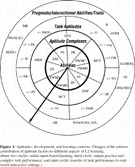
Aptitudes, development, and learning contexts: Changes in the relative contribution of aptitude factors to different aspects of L2 learning. (Inner two circles: initial input-based learning; third circle: output practice and complex task performance; and outer circle: transfer of task performance to real-world interactive settings.)
 You have
Access
- 185
- Cited by