In the 1980s and 1990s, many scholars were noting the revolutionary potential of new information and communication technologies for transforming human communication and production of knowledge (see, e.g., Harnad, Reference Harnad1991). However, even by the late 1990s, the Internet was not yet accessed by the majority of the population in any country (National Telecommunications and Information Administration, 1999; United Nations Development Programme, 1999). Fewer people still were able to publish online, as that required specialized software and/or skills that were not widespread at that time (see discussion in Warschauer, Reference Warschauer2003). The Web was thus developing more as a tool for accessing information created by small numbers of people, rather than for creativity and collaboration on content contributed by the broad public (e.g., see the critique by Berners-Lee, Reference Berners-Lee1999, who is widely credited with having invented the Web.)
Less than a decade later, the situation has changed dramatically. Today, 50% or more of the population has access to the Internet in 35 countries (Miniwatts Marketing Group, 2007). Equally important, barriers to online publishing, collaboration, and creative production have fallen dramatically. Widely available software and sites allow computer users of all types to interact through blogs, collaborate through wikis, play multiplayer games, publish podcasts and video, build relationships through social network sites, and otherwise shape the content of the Web through feedback and evaluation mechanisms (Coiro, Knobel, Lankshear, & Leu, Reference Coiro, Knobel, Lankshear and Leu2007).
The constellation of features that allow these new types of online communication is often referred to as Web 2.0, meaning the second generation of the World Wide Web (see O'Reilly, Reference O'Reilly2007). There is some debate as to the accuracy of the term, since many of the technical capacities of Web 2.0 have been present in the Web all along, even if they were previously more difficult to access (Wikipedia, 2007a). However, when approaching the question from a social rather than technical perspective, there is little doubt that the ways people make use of the Web have qualitatively changed in the last few years.
What Is Web 2.0?
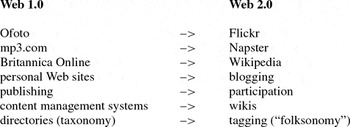
Though the term suggests a new version of Web technology, it refers instead to changes in the communicative uses of the underlying Web platform. O'Reilly, who popularized the term in 2003, used a series of examples to characterize what he saw as the differences between the first- and second-generation Web (O'Reilly, Reference O'Reilly2007; see Table 1 here). Probably the key distinction among these is that between publication and participation. The earlier Web allowed people to publish content, but much of that online material ended up in isolated information silos. The new Web's architecture allows more interactive forms of publishing (of textual and multimedia content), participation, and networking through blogs, wikis, and social network sites. These participatory sites enable and rely on user-generated tagging of content, which itself can be aggregated into a user-generated taxonomy known as a folksonomy. Sites such as Flickr, Napster, and Wikipedia thus allow users to generate, link, evaluate, and share a wide variety of online content.

These differences between Web 1.0 and 2.0 were summarized by Wesch (Reference Wesch2007) as an evolution from the linking of information to the linking of people. The way that both information and people are linked on Web 2.0 has deep significance for the field of applied linguistics. In particular, the types of interaction on Web 2.0 raise questions about what it means to exercise authorship, communicate with an audience, and produce a text or multimodal artifact. We first review how these three concepts have evolved in major applied linguistics traditions. We then examine how they are potentially reshaped through interaction on Web 2.0.
Authorship, Audience, and Artifact in Language Studies
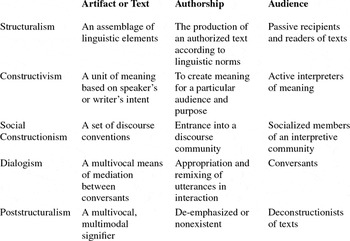
Language studies can be characterized by five major historical traditions, which can be labeled structuralism, constructivism, social constructionism, dialogism, and poststructuralism (see Graddol, Reference Graddol, Graddol and Boyd-Barrett1994; Nystrand, Greene, & Wiemelt, Reference Nystrand, Greene and Wiemelt1993). Though a detailed review of these traditions is beyond the scope of this article, we will explore what each of these has to say about texts or artifacts, audience, and authorship (for a summary, see Table 2.)
Artifact, Authorship, and Artifact in Language Studies

Structuralism assumes that the meaning of language lies in its constituent entities, whether phonemes, morphemes, and clauses for oral language, or words, sentences, and paragraphs for written texts (Nystrand et al., Reference Nystrand, Greene and Wiemelt1993). The concept of authorship first emerged from this model of language and referred to the authority granted by institutions, such as the Church or the Academy, to produce authorized versions (Kramsch, A'Ness, & Lam, Reference Kramsch, A'Ness and Lam2000). According to this tradition, an author must follow carefully prescribed traditions—such as the standard five-paragraph essay form—to ensure that structural norms are met. The audience of a text has little role, except to receive and study it.
Constructivism, which was promoted with the process-writing perspective of the 1970s, views texts as units of meaning based on authentic communication (see Nystrand et al., Reference Nystrand, Greene and Wiemelt1993). Constructivism emphasizes authorship as a mental process that involves active planning, progressing through iterative stages (e.g., prewriting, writing, revision), and seeking to get a point across to a particular audience and for a particular purpose (Zamel, Reference Zamel, Long and Richards1987). A good author actively conjures up an audience in order to move from writer-based prose to reader-based prose (Flower, Reference Flower1979), and the audience actively interprets what it reads to discover the author's meaning.
Social constructionism, associated with the genre approach that began in the 1980s, views texts as representing socialized discourse conventions (Barrs, Reference Barrs, Stierer and Maybin1994). Authorship involves not only writing for an audience but also, in essence, joining an audience by entering into a community of practice and acquiring its norms of discourse competence (Bizzel, Reference Bizzel1992). An audience is thus not only a set of meaning-making interpreters but also rather socialized members of a discourse community.
Dialogism, based on the early 20th-century work of Soviet linguist Bakhtin, views language as “a continuous generative process implemented in the social-verbal interaction of speakers” (Volosinov, Reference Volosinov1929, p. 98). From this perspective, any utterance, whether spoken or written, is based on “echoes and reverberations of other utterances to which it is related by the communality” of communication (Bakhtin, Reference Bakhtin1986, p. 91). The unique communicative experience or authorship of individuals is shaped through constant interaction, as “words, intonations, and inner-word gestures that have undergone the experience of outward expression” acquire “a high social polish and lustre by the effect of reactions and responses, resistance or support, on the part of a social audience” (Volosinov, Reference Volosinov1929, p. 92). The audience thus becomes a conversant with the author.
Poststructuralist views of language emerge from media and cultural studies and emphasize the broader semiotic landscape of which language forms part (Kramsch et al., Reference Kramsch, A'Ness and Lam2000). A text, in this view, is actually a multimodal artifact that encompasses a broad array of signifiers, including typographical conventions, layout, photographs, graphs, diagrams, and other media (see Graddol, Reference Graddol, Graddol and Boyd-Barrett1994). Authorship loses significance due to the unstable, partial, and multiple forms of meaning embedded in multivocal, multimodal artifacts (Nystrand et al., Reference Nystrand, Greene and Wiemelt1993), and readers are thus left to deconstruct the meaning of text independent of what an author may have intended.
With this as a backdrop, we will now examine linguistic and semiotic interaction in three of the most popular types of Web 2.0 media—blogs, wikis, and social network sites—with particular attention to how they reshape concepts of audience, authorship, and artifact.
Blogs
A blog (originally short for weblog [Web log]) is, at its simplest, an online diary posted in reverse chronological order (for an overview of blogging, see Gurak, Antonijevic, Johnson, Ratliff, & Reyman, Reference Gurak, Antonijevic, Johnson, Ratliff and Reyman2004). Such online diaries could be constructed previously in Web 1.0, based on laborious editing and republishing of Web pages, but specialized software popularized in 1999 made the process remarkably simple (for an early history, see Blood, Reference Blood2000). Later free versions of blogging software accelerated the growth of weblogs. By early 2006, approximately 39% of teenage and adult Internet users in the United States were reading blogs (Lenhart & Fox, Reference Lenhart and Fox2006). By mid-2007, the blogging search engine, Technorati (http://technorati.com/), was tracking 85 million blogs around the world (Technorati, 2007), collectively known as the blogosphere. Standard blog software today allows for posting of images as well as text, links to other material within or outside the blog, and responses to blog entries by others (referred to as comments).
Genre Analysis of Blogs
Blogs fall within a range of categories, each with its own antecedents in other media (for an overview, see Miller & Shepherd, Reference Miller and Shepherd2004). As Chesher (Reference Chesher2005) noted, the majority appear to fall within two general types. First, there are personal journals, which fall within the pre-Internet tradition of diaries and personal letters. They largely describe people's personal thoughts, feelings, and day-to-day experiences, and serve the dual purpose for the writer of keeping friends or family informed and reflecting on one's identity through writing. A second type of blog falls within the tradition of the newspaper column or pamphlet. It seeks to inform, agitate, and persuade, most frequently on political topics.
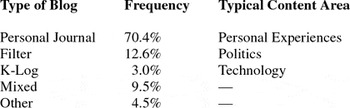
Herring and colleagues carried out content and genre analyses of several hundred randomly selected blogs in a series of studies published in 2004–2006 (Herring, Kouper, Scheidt, & Wright, Reference Herring, Kouper, Scheidt, Wright, Gurak, Antonijevic, Johnson, Ratliff and Reyman2004; Herring, Kouper, et al., Reference Herring, Kouper, Paolillo, Scheidt, Tyworth and Welsch2005; Herring & Paolillo, Reference Herring and Paolillo2006; Herring, Scheidt, Bonus, & Wright, Reference Herring, Scheidt, Bonus and Wright2004; Herring, Scheidt, Bonus, & Wright, Reference Herring, Scheidt, Bonus and Wright2005; Herring, Scheidt, Kouper, & Wright, Reference Herring, Scheidt, Kouper, Wright and Tremayne2006). They found that personal journals constituted 70.4% of their sample (Herring, Scheidt, et al., Reference Herring, Scheidt, Bonus and Wright2005). The next largest group, constituting 12.6% of the sample, was what they called filter blogs, because of the fact that they often filtered news and information from the broader Web (see Blood, Reference Blood and Rodzvilla2002, for original use of the term). These filter blogs primarily contained observations and analyses of external, typically public, events, and tended to correspond to the informational or agitational purpose already described. A third type of blog was identified that sought to provide information and observations on a topic, project, or product; this category, referred to as k-log (knowledge log), constituted 4.5% of the blogs they examined.
Though Herring and her colleagues did not match blog purpose with blog topic in their analyses, the sample blogs they chose as illustrations for each of the three main purpose categories match exactly with the topical categorization suggested by Stone (Reference Stone2004), with personal journal blogs typified by personal experience topics, filter blogs typified by political topics, and knowledge blogs typified by technology topics (see Table 3).
Taxonomy of Blogs

Sources: Herring, Kouper, et al. (Reference Herring, Kouper, Paolillo, Scheidt, Tyworth and Welsch2005), Stone (Reference Stone2004)
There is wide variation in blog structure, from single-author blogs with few links to external sites, few if any comments, and infrequent updates, to complex multiauthor blogs with extensive linking and tagging, constant updates, and voluminous commenting. The majority of blogs analyzed by Herring's group fell on the simple side. A total of 90.8% of the randomly selected blogs they analyzed were single authored, and blogs in their sample were updated on an average of every 2.2 days. The typical blog entry contained 0.65 link to other material, and only 43% of blogs allowed comments by others. A total of 9.2% of blog entries contained images (Herring, Scheidt, et al., Reference Herring, Scheidt, Bonus and Wright2005).
However, what is typical in a random sample of blogs is quite different from what is typical in people's experiences with blogs. That is because the majority of blogs are rarely visited, while a small number of a-list blogs dominate the traffic on the blogosphere (Herring, Kouper, et al., Reference Herring, Kouper, Paolillo, Scheidt, Tyworth and Welsch2005; Shirky, Reference Shirky2003). Many of these high-traffic blogs feature complex networking features that enable highly innovative forms of communication and advocacy. For example, Daily Kos (http://www.dailykos.com/), a left-of-center activist political blog, has a main editor and 15 contributing editors who write front-page postings known as stories; hundreds of people who write additional postings linked from the front page known as diaries; thousands of people who write threaded comments on stories and diaries; extensive linking to other blogs and Web sites from within comments, stories, diaries, and user signature lines; tagging of all diaries and stories to create a folksonomy of blog topics; a search mechanism to find stories, diaries, or comments by tag, content, or author; an elaborate user recommendation system so that the most highly recommended diaries rise to the top of the list, while the most negatively rated comments disappear; a hierarchical system of participants so that those who receive the most positive comments achieve greater privileges than negatively rated others; a main blogroll linking to other like-minded blogs on the front page and distinct blogrolls on other pages created by users; and a collaboratively edited political encyclopedia (Kos Media, 2007). Launched by a Salvadoran immigrant in 1982, Daily Kos now has more than 125,000 registered users (Kos Media, 2007), receives nearly a half-million daily visits (The Truth Laid Bear, 2007), and has established itself as a major force in U.S. politics (Chait, Reference Chait2007).
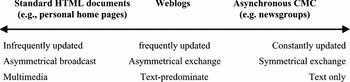
Examining the overall blogosphere, Herring and her colleagues suggested that blogs fill an intermediary role within online genres, about midway between standard HTML documents, such as personal home pages, and asynchronous computer-mediated communication (CMC), such as newsgroups, bulletin boards, or e-mail discussion lists (see Figure 1; Herring, Scheidt, et al., Reference Herring, Scheidt, Bonus and Wright2005). They are more frequently updated, include more exchange among people, and have a higher percentage of text (as opposed to multimedia) than standard Web pages. But the exchanges on them tend to be more asymmetric (i.e., dominated by main authors) and less frequently updated (with sites such as Daily Kos an exception) than CMC sites such as newsgroups.
Weblogs as a Bridging Genre
Source: Herring, Scheidt, et al. (2005)

Herring and her colleagues have also begun to examine whether gender differences exist in the language used on weblogs, as they do in other written texts. Their initial research suggests that within particular blog genres, little differences exist between males' and females' use of language, with both men and women using more formal, typically “male” language on filter blogs and more typically “female” language on personal journal blogs (Herring & Paolillo, Reference Herring and Paolillo2006). However, because filter blogs are mostly written by men and personal journal blogs are mostly written by women (Herring et al., Reference Herring, Kouper, Scheidt, Wright, Gurak, Antonijevic, Johnson, Ratliff and Reyman2004; Herring & Paolillo, Reference Herring and Paolillo2006), the overall use of language in the blogosphere is still gendered.
Authorship and Audience on Blogs
Scholars have just begun to explore authorship and social participation in the blogosphere (for a discussion of some research questions, see Lankshear & Knobel, Reference Lankshear and Knobel2006). A number of initial reports have examined the motivations and personal experiences of bloggers, either from a third-person (e.g., Nardi, Schiano, & Gumbrecht, Reference Nardi, Schiano and Gumbrecht2004; Nardi, Schiano, Gumbrecht, & Swartz, Reference Nardi, Schiano, Gumbrecht and Swartz2004) or first-person perspective (e.g., Davies & Merchant Reference Davies, Merchant, Knobel and Lankshear2007; Krause, Reference Krause2004).
Chesher (Reference Chesher2005) analyzed authorship on blogs, comparing the conventions of authorship in the blogosphere to those in other electronic or print genres. Authorship in blogs tends to be strongly identified with a real or pseudonymous person through a user name or display name for each blog and blog entry, or through an “about” or profile section that gives more information about the writer. In contrast, older Web documents, such as standard Web pages, often lack this information. The visual consistency of a blog, compared to a Web 1.0 page, also highlights personal ownership and authorship, and the reverse chronological order and specific time stamp on postings create a temporal link between author and reader. Blogs that are most successful, whether in reaching out to a few readers or hundreds of thousands, tend to have a strong authorial voice. In most cases, this personal voice is more easily achieved in blogs than in print journalism, such as newspapers, because blogging encourages an informal, idiosyncratic style and content. In addition, the sheer ease of publishing a blog, as compared, for example, to either setting up and maintaining a frequently revised standard Web site or becoming a writer for a print newspaper or magazine, makes authorship accessible to a greatly expanded number of people. Chesher concluded that the “death of the author,” which was originally predicted by poststructuralists (Barthes, Reference Barthes1977), and which was supposedly going to be hastened by the decentered and collaborative nature of hypertext (Landow, Reference Landow1992; Poster, Reference Poster1990), is greatly exaggerated. As he stated, “the author is alive and well, and has a blog” (first paragraph).
At the same time, the relationship between author and audience on blogs is quite different from that in other media. A blog author must be aware of both an immediate audience, those who he is most trying to reach with his or her message, and an essentially unlimited audience, composed of anyone with a Web browser who could accidentally or intentionally come across a blog posting. This duality can create complications both for the famous (such as Moulitzas of Daily Kos, whose comment about U.S. contractors in Iraq deserving to die stirred passion among his readers, but caused advertisers and politicians to back off; see Howard, Reference Howard2005) and the humble (such as a student who reveals embarrassing details about his life, only to have them located by a potential employer conducting a Web search). Many blogs allow a high degree of interactivity between audience and author, as seen, for example, in the fierce debates that take place on Daily Kos and many other political blogs. These kinds of highly polemical exchanges make possible the kinds of dialogic interchange portrayed by Bakhtin and Volosinov in ways previously unattainable in print.
Blogs in Language Education and Research
Not surprisingly, educators are beginning to exploit blogs as a potential tool for the teaching of L1 and L2 writing (see, e.g., Krause, Reference Krause2004; Lowe & Williams, Reference Lowe, Williams, Gurak, Antonijevic, Johnson, Ratliff and Reyman2004; Walker, Reference Walker2005). A particularly relevant example for applied linguists is presented by Bloch (Reference Bloch2007), who described the use of blogging to promote critical literacy and academic writing in a university ESL composition class. Bloch's account focused on the experiences of Abdullah, a Somali student who had immigrated to the United States from East African refugee camps as a teenager. Like many generation 1.5 immigrants, Abdullah felt most comfortable with vernacular English, but had difficulties with academic writing. Bloch described and illustrated how blogging served as a useful vehicle for Abdullah to bridge a more colloquial style of writing with a more academic style, and how his style shifted over the course of a semester. He also explained how blogging can be a helpful tool for discussing topics that require personal reflection from students, such as plagiarism, and for rhetorical exchange with others in ways that are not usually facilitated by academic writing. (For a discussion of other ESL students' electronic writing on the same topic, see Warschauer, Reference Warschauer1999). Bloch concluded that blogging should be seen as not only a pathway to academic writing for students but also as an important new literacy act in its own regard, enabling students to become “contributors and not just consumers of information on the World Wide Web” (p. 138).
Bloch's conclusions are echoed by Oladi (Reference Oladi2005), who introduced blogging into EFL (English as a foreign language) instruction at Tehran University. Students in her class participated in both a course blog as well as preexisting public blogs. Oladi's study documented how students achieved greater confidence in their authorship throughout the academic year. For example, a student named Beatrice began the year by sharing the poems of others on the class blog; over time, though, she progressed to sharing poetry that she had written herself. Oladi concluded that the use of blogging in her instruction “presented learners with an exceptional opportunity to express their ‘voice’ to the public and move beyond the constraints of the classroom.” (p. 147)
Beyond teacher-assigned blogging, the large amount of extant blogging that occurs in a second language, as well as the interaction on blogs between L1 and L2, provides vast material for applied linguistics research. The kinds of experiences noted by Bloch and Oladi are likely shared by many bloggers around the world who make use of a second language to communicate their stories and advocate their opinions. Other bloggers may have less positive experiences with struggling to make their voice heard in a second language. Case studies of individual bloggers, longitudinal analyses of bloggers' writing, and examination of interactive blogging discourse can help illuminate the language and literacy practices of culturally and linguistically diverse learners on the blogosphere.
Wikis
Wikis are simply Web sites that any visitor can contribute to or edit (Richardson, Reference Richardson2006). They thus help fulfill the original version of Web inventor Berners-Lee (Reference Berners-Lee1999), who sought to create a tool that allowed the average user not just to access information, but to create and publish it as well.
Though there is no authoritative listing or account of the number of Wikis, they are surely far fewer than blogs. They have been principally established so that groups of people can contribute their knowledge and writing skills to collaboratively create informational documents. For example, some of the largest wikis (based on statistics from S23, 2007) include Richdex (an open source directory on a wide range of topics—http://www.richdex.org/index.php?title=Main_Page), WowWiki (an information source about the World of Warcraft (http://worldofwarcraft.com/index.xml) online game—http://www.wowwiki.com/Main_Page), and wikiHow (a collaborative how-to manual—http://www.wikihow.com/Main-Page).
By far, the largest wiki, and one of the 10 most visited Web sites in the world (for listing, see Alexa, 2007), is Wikipedia (http://www.wikipedia.org/). This open-source encyclopedia exists in more than 190 languages (Holloway, Božicevic, & Börner, Reference Holloway, Božicevic and Börner2007). Its English version alone includes more than 1,800,000 articles totaling some 609 million words, about 15 times as many as are in the next largest English language encyclopedia, the Encyclopaedia Britannica (http://www.britannica.com/) (Wikipedia, 2007b). Most remarkably, there have been some 236 million edits to Wikipedia since its inception in 2001 made by 5.77 million contributors (Wilkinson & Huberman, Reference Wilkinson and Huberman2007).
Textual Analysis on Wikis
Most of the textual analysis of wikis has been directed at Wikipedia, with much of the research focus on its accuracy. Its breadth of content, ease of access, free cost, and links to external material make Wikipedia potentially highly useful to a vast online audience. The foremost question for casual users and researchers alike has been whether the collaborative process that welcomes the participation of novices as well as experts can produce satisfactorily accurate results. In a widely cited study on this topic, Nature (Giles, Reference Giles2005) had a panel of experts compare content from 42 entries of approximately the same length on scientific topics from Wikipedia and the Encyclopaedia Britannica. The experts identified 162 errors in the Wikipedia content (four of which were serious) and 123 in the Encyclopaedia Britannica content (four of which were serious), thus suggesting that neither encyclopedia is infallible and that the 6-year-old open source Wikipedia is only slightly less accurate than the 237-year-old professionally edited Britannica. In a related study, Chesney (Reference Chesney2006) had 258 research staff judge the credibility of two Wikipedia articles, one in their area of expertise and one chosen randomly. In general, the researchers found the articles to be credible, and even more so in their own area of expertise.
Though anyone can accidentally or purposely introduce errors into Wikipedia, they are usually found and corrected quickly by the site's large number of volunteer editors. In one experiment, a professor of communication intentionally introduced 13 errors, some obvious and some subtle, in a range of Wikipedia articles. He checked back on the articles 3 hours later, and all 13 had been corrected (Read, Reference Read2006).
Focusing on linguistic features rather than accuracy, Bell (Reference Bell2007) compared articles in Wikipedia and the online version of Encylopaedia Britannica on three measures: readability, syntax (specifically nominal vs. verbal nature), and use of fact statements vs. value statements. He found the two encyclopedias roughly comparable on all three measures. A similar study by Elia (Reference Elia2007a), focusing on lexical density, use of formal nouns and impersonal pronouns, and average word length, concurred that the language in Wikipedia “shows a formal and standardized style similar to that found in Britannica” (p. 18), even though its articles were twice as long on average and had far more hypertextual links.
Authorship and Audience in Wikis
If blogs served to suggest that the author is well and alive, wikis fulfill the prophecy of authorship fading away. In essence, the distance between the author and audience is eliminated when the audience can directly edit the author's work. In many Wikipedia articles, it is difficult to discern a principal author. For example, a review of the history (posted with each article) for the Wikipedia entry on the innocuous topic of asparagus indicates it has been edited hundreds of times by dozens of people over the last 5 years.
Wikipedia provides a fruitful source for researching the nature of collaborative authorship and editing. A study by Wilkinson and Huberman (2007) analyzed the impact of cooperation among editors on Wikipedia on article quality. Specifically, when controlling for age and visibility of articles, they found that both the numbers of edits and numbers of editors were strongly correlated with article quality. On the one hand, this seems intuitive, in that more attention should result in higher quality. However, the authors point out that in other areas, such as software development, industrial design, and cooperative problem solving, large collaborative efforts are known to produce ambiguous results.
Ravid (Reference Ravid2007) analyzed how this collaboration worked, and how it differed between featured articles (which are generally recognized as being higher quality) and nonfeatured articles. Using a variety of social network analyses, he compared structures of dominance and heterogeneity among contributors in 432 featured articles and 410 nonfeatured articles in the Hebrew language Wikipedia. In general, he found a greater degree of inequality of participation in the featured articles. In other words, both featured and nonfeatured articles had large numbers of contributors, but a smaller circle of presumably more expert authors contributed a larger portion of the articles selected for their high quality.
Do processes of collaborative editing differ across languages? Pfeil, Zaphiris, and Ang (Reference Pfeil, Zaphiris and Ang2006) used content analysis methods to examine articles on the same topic on the French, German, Japanese, and Dutch Wikipedia Web sites. Correlations were investigated between patterns of contributions and the four dimensions of cultural influences proposed by Hofstede (power distance, collectivism versus individualism, femininity versus masculinity, and uncertainty avoidance; see Hofstede, Reference Hofstede1991). The analysis revealed cultural differences in the style of contributions across the cultures investigated, some of which are correlated with the dimensions identified by Hofstede. For example, participants from countries known to have a high level of power differential (e.g., France) made deletions while editing Wikipedia less frequently than participants from countries known to have a lower level of power differential (e.g., the Netherlands).
Wikis in Education
Much of the discussion regarding the use of Wikis in education has focused on the suitability of Wikipedia as a source for student research. The founder of Wikipedia, Jim Wales, provides the most commonsense answer to this, suggesting that although Wikipedia can help provide an overview of issues and a starting point for identifying primary sources, students are better off using primary sources as definitive sources in their research. “For God's sake, you're in college; don't cite the encyclopedia,” Wales told one college student (Wikipedia Founder, 2006).
A more interesting question is how writing for wikis in language, composition, and other courses can affect the learning process. The potential of wikis for teaching and learning is hinted at by Ward Cunningham, inventor of the wiki, who commented that “The blogosphere is a community that might produce a work, whereas a wiki is a work that might produce a community.” Cunningham's statement illuminates a central contradiction of CMC since its inception: It has served as a powerful medium for exploring identity, expressing one's voice, airing diverse views, and developing community, yet has proven a very unsuitable medium for accomplishing many kinds of collaborative work due to the inherent difficult of arriving at decisions in groups dispersed by space and time. (See the meta-analysis comparing face-to-face and computer-mediated decision making by Baltes, Dickson, Sherman, Bauer, & LaGanke, Reference Baltes, Dickson, Sherman, Bauer and LaGanke2002).
Wikis turn traditional CMC activity around in several respects. Whereas e-mail and chat, the most traditional CMC genres, facilitate informal, author-centric, personal exchange, writing on a wiki facilitates more formal, topic-centric, depersonalized interaction. Each edit makes a concrete contribution to a collaborative written product, with authorships relegated to a separate page that only the most serious of readers are likely to notice. Wikis are thus an especially powerful digital tool for knowledge development, and thus for education. The principal author of this article, for example, found the wiki format to be more motivating than conventional writing assignments when he gave a wiki assignment to an undergraduate class on literacy and technology; students worked with tremendous vigor, attention, and excitement to collaboratively complete and flesh out a dictionary of key terms and concepts in the field of literacy and technology. The contributor-tracking facility of wiki software also solved the problem of individual assessment in group-project assignments; using wikis, the instructor can see the exact contributions of each individual in a group.
Though a number of educators are beginning to report on their experiences, publications to date mostly consist of lists of suggestions or summaries of experiences by practitioners (see, e.g., a collection edited by Mader in Reference Mader2007). A report on wiki collaboration in an English as a second language (ESL) teacher-training workshop is provided by Elia (Reference Elia2007b). LeLoup and Ponterio (Reference LeLoup and Ponterio2006) described how the existence of Wikipedia in so many languages may prove useful for foreign language educators. Fissaha Adafre and de Rijke (Reference Fissaha Adafre and de Rijke2007) have done some initial work toward creating parallel corpora of similar sentences in different language versions in Wikipedia, which could prove useful second language education as well as research.
Finally, a Simple English Wikipedia (http://simple.wikipedia.org/wiki/Main_Page) has been created to ensure greater access to information learners of English, people with learning difficulties, and children (Simple English Wikipedia, 2007b). Contributors to this new version are encouraged to use more basic vocabulary and grammatical structures, avoid idioms and jargon, and write shorter articles (Simple English Wikipedia, 2007a). This simplified Wikipedia can serve as a research site for beginning and intermediate learners of English, a place to contribute meaningful writing for more advanced students, and a site where prospective teachers of English can practice communicating to ESL audiences.
Social Network Sites
Social network sites are so plentiful and diverse, including sites for personal networking (e.g., MySpace [http://myspace.com/], Facebook [http://www.facebook.com/]), sharing of media (e.g., Flickr [http://flickr.com/], YouTube [http://youtube.com/]), and ranking diverse online content (e.g., Digg [http://digg.com/], del.icio.us [http://del.icio.us/]), that a full discussion of their characteristics is not possible in an article of this length. We thus restrict ourselves to discussing two points about these sites that are closely related to the topic at hand and consider one example of a site relevant to literacy development.
First, the ease of posting, locating, viewing, responding to, and ranking multimedia on many of these sites is transforming long-established patterns of social interaction by making many-to-many communication via video and other forms of multimedia commonplace for the first time in human history. As an illustration, let us briefly consider the work of Wesch (Reference Wesch2007), who argued that Web 2.0 links people rather than information. Though Wesch is an assistant professor of anthropology at Kansas State University, the work by him that is cited here is not an academic paper, but rather a video he published on YouTube. Word of the video spread rapidly on the blogosphere, and it was eventually viewed more than 2.5 million times, with more than 5,000 viewer comments left in the first four and a half months after its posting.
As Bolter (Reference Bolter and Nunberg1996) explained, photographs and moving pictures have a “natural correspondence to what they depict.” They can thus “satisfy more effectively than prose the desire to cut through to a ‘natural’ representation that is not a representation at all” (pp. 265–266). However, this “desire for the natural sign” (p. 264) was inhibited by the dominance of script literacy, especially following the development and diffusion of the printing press (see also Kaplan, Reference Kaplan1995; Warschauer, Reference Warschauer1999). Television, film, and the World Wide Web all enhanced people's opportunity to view moving pictures, but it is only now through Web 2.0, and the diffusion of inexpensive digital video cameras and editing software, that large numbers of people are able to widely share self-produced video.
A second point we wish to highlight is the semiotics of ranking and tagging mechanisms on these sites. Our reference to emergent semiotics in the title of this article was purposefully ambiguous. On the one hand, it refers to the emergence of broad new forms of meaning-making, through, for example, blogs, wikis, and social networking, that will force us to rethink concepts of “copyright, identity, aesthetics, rhetorics, governance, privacy . . . [and] ourselves” (Wesch, Reference Wesch2007). On the other hand, emergent semiotics refers to the way that the meaning of a particular page or site may only emerge through automated filtering and synthesis of the input of many people. For example, what shows up on the home page of Digg, del.icio.us, YouTube, or Google News (http://news.google.com/) is determined not by the conscious editorial decisions of an individual or group, but rather by the clicks of thousands of people around the world.
Combining both these notions of emergent semiotics—vast changes in the means of communication, and the interaction of computer algorithms with human-produced input—one can only imagine how large-scale ranking, linking, and evaluation mechanisms might eventually be deployed to shape the unfolding of content in games, films, or other online genres. Kelly (Reference Kelly2005) suggested they may even foster a new form of collective intelligence. As he explained,
When we post and then tag pictures on the community photo album Flickr, we are teaching the Machine to give names to images. The thickening links between caption and picture form a neural net that can learn. Think of the 100 billion times per day humans click on a Web page as a way of teaching the Machine what we think is important. Each time we forge a link between words, we teach it an idea. Wikipedia encourages its citizen authors to link each fact in an article to a reference citation. Over time, a Wikipedia article becomes totally underlined in blue as ideas are cross-referenced. That massive cross-referencing is how brains think and remember. It is how neural nets answer questions. It is how our global skin of neurons will adapt autonomously and acquire a higher level of knowledge.
The human brain has no department full of programming cells that configure the mind. Rather, brain cells program themselves simply by being used. Likewise, our questions program the Machine to answer questions. We think we are merely wasting time when we surf mindlessly or blog an item, but each time we click a link we strengthen a node somewhere in the Web OS [operating system], thereby programming the Machine by using it. . . . There is only one time in the history of each planet when its inhabitants first wire up its innumerable parts to make one large Machine. . . . You and I are alive at this moment.
Social Networking for Language and Literacy Development
A particularly interesting social network site for language and literacy development is FanFiction.net (http://www.fanfiction.net/), where thousands of people, including large numbers of second language learners, contribute original works of fiction related to their favorite books, cartoons, comics, games, movie shows, animation, or other media. FanFiction.net is distinct from some of the sites described earlier in two ways. First, the works posted on the site are texts, rather than multimodal products; however, many of the fictional works that are written about involve diverse modalities, and writers thus must translate across media and genre (e.g., from video games or anime to poetry or short stories) in developing their fiction. Second, there are no ranking mechanisms involved; instead, readers submit written reviews of fiction that is posted, thus providing a more detailed and intimate form of feedback to contributors.
Black (in press) carried out a yearlong ethnographic study of English language learners on the site to identify how they exploited the social, textual, and technological elements of the networked community to scaffold and promote their reading and writing development. She found that the peer-review practices of the site tempered critique of form with enthusiasm for content and rhetoric, discouraged hostile feedback, and attended to authors' needs as communicated in authors' notes or communication between writers and reviewers. All of this, according to Black, allowed English learners to develop a strong sense of audience, understand the social nature of writing, explore their identity as writers, and master multiple modes of representation to achieve their rhetorical intent.
Black concluded by exploring ways that pedagogical principles of this site could be incorporated into similar environments for ESL students in schools. Educators interested in creating social network sites for their students may now do so using Ning (http://ning.com/), a new site for creating, customizing, and sharing social networking spaces. A social network site within Ning, Classroom 2.0 (http://classroom20.ning.com/), has been set up for teachers to interact about teaching and learning with Web 2.0.
Critical Perspectives
The new forms of Web semiotics have attracted diverse criticisms. News-related and politically oriented blogs have been criticized as less careful about authenticating their sources than the newspapers that they are supplanting in readership (e.g., Regan, Reference Regan2003). Wikipedia has been criticized as potentially defamatory (e.g., Seigenthaler, Reference Seigenthaler2005) and only selectively open, with editing of sensitive topics controlled by a small behind-the-scenes group (e.g., Wikitruth, 2007). Social network sites and some blogs surround user-generated content with advertising messages carefully targeted to select audiences, thus exploiting user creativity for commercial gain. Because Internet access correlates with social-economic status (Warschauer, Reference Warschauer2003), participation in the new forms of online community is still disproportionately enjoyed by privileged groups. And the amount of Web 2.0 content in English still exceeds that available in other languages.
Though space prevents us from in-depth discussion of these critiques, each of them is serious and deserves careful consideration. Research on Web 2.0 communication will benefit from a critical perspective that takes into account the complex ways it takes place in particular sociocultural contexts.
Conclusion
Blogging is creating tens of millions of authors and connecting them to audiences in ways previously unseen. Wikis are empowering collaborative multiauthored writing to better harness collective knowledge. Social networking sites are enabling both the many-to-many distribution from authors to audiences of multimodal artifacts and the automated presentation of user-selected content.
Interestingly, each of these three Web 2.0 technologies seems to correspond to distinct analytic traditions within language studies. Blogging, with its viral spreading of messages, dense remixing of words, and sharp give and take both within and across sites, appears to be a perfect example of dialogic interaction. Wikis, which allow large groups to collaboratively edit works according to community standards, exemplify social constructionism. And social network sites, which allow the emergence of symbolic artifacts in ways that blur the original authors' intents and the boundaries between language and other signs, match a poststructural perspective. This suggests that there is not one way of understanding the semiotics of Web 2.0, but that diverse approaches are both necessary and complementary.
Although the contrasts between Web 2.0 and Web 1.0 are striking, from a broader historical perspective they represent a continuation of much older trends from plain text to multimedia, from static to dynamic content, from authorship by an educated elite to mass authorship, and from high costs of entry into the public sphere to low ones. The torrid pace of development and participation in new online genres is likely to present applied linguists with ever-new challenges for understanding how humans communicate via digital media.