Over the past few decades, corpora, corpus tools, and corpus evidence have not only revolutionized linguistic research but have also had an impact on second language learning and teaching—probably a use that “the compilers [of corpora] may not have foreseen” (Johansson, Reference Johansson, Hidalgo, Quereda and Santana2007, p. 17). John Sinclair's work with COBUILD (Collins Birmingham University International Language Database),Footnote 1 Tim Johns's data-driven learning (DDL), and Dieter Mindt's empirical grammar research can be considered particularly groundbreaking developments in the context of pedagogically oriented English corpus linguistics in the 1980s (see Johns, Reference Johns1986, Reference Johns, Johns and King1991; Mindt, Reference Mindt, Kunsmann and Kuhn1981, Reference Mindt1987; Sinclair, Reference Sinclair1987, Reference Sinclair1991). In the field of applied linguistics, more and more researchers and practitioners value what corpus linguistics has to offer to language pedagogy, and the number of publications on related topics has increased steadily. (See, e.g., Ädel, Reference Ädel2006; Aijmer, Reference Aijmer2009; Aston, Reference Aston2001; Braun, Kohn, & Mukherjee, Reference Braun, Kohn and Mukherjee2006; Campoy, Belles-Fortuño, & Gea-Valor, Reference Campoy, Belles-Fortuño and Gea-Valor2010; Gavioli, Reference Gavioli2006; Granger, Hung, & Petch-Tyson, Reference Granger, Hung and Petch-Tyson2002; Kettemann & Marko, Reference Kettemann and Marko2006; Lombardo, Reference Lombardo2009; Reppen, Reference Reppen2010; Römer, Reference Römer2005; Scott & Tribble, Reference Scott and Tribble2006; Sinclair, Reference Sinclair2004a; and the proceedings of the first seven events in the Teaching and Language Corpora [TaLC] conference series: Aston, Bernardini, & Stewart, Reference Aston, Bernardini and Stewart2004; Botley, Glass, McEnery, & Wilson, Reference Botley, Glass, McEnery and Wilson1996; Burnard & McEnery, Reference Burnard and McEnery2000; Frankenberg-Garcia, Flowerdew, & Aston, Reference Frankenberg-Garcia, Flowerdew and Aston2011; Hidalgo, Quereda, & Santana, Reference Hidalgo, Quereda and Santana2007; Kettemann & Marko, Reference Kettemann and Marko2002; Wichmann, Fligelstone, McEnery, & Knowles, Reference Wichmann, Fligelstone, McEnery and Knowles1997).Footnote 2 Also, there is now a wide range of fully corpus-based reference works (including dictionaries and grammars) available to learners, and a number of dedicated researchers and teachers have made concrete suggestions on how concordances and exercises directly derived from corpora could be used in the second language (L2) classroom.
I would, however, still be hesitant to say that corpora and corpus tools have been fully implemented in pedagogical contexts and would argue that much work still remains to be done in bridging the gap between research and practice. The practice of English language teaching (ELT) to date, at least, seems to be only marginally affected by the advances of corpus research, and comparatively few teachers and learners know about the availability of useful resources and get their hands on corpus computers or concordances themselves (see Mukherjee, Reference Mukherjee, Connor and Upton2004). In addition, current language-teaching materials still differ considerably from actual language use as captured in corpora (e.g., Römer, Reference Römer2005). Despite the obvious and recognized strengths of corpus use in a pedagogical context, for example that corpora highlight what lexical items and collocations are typical in the language, and that they provide us with large amounts of natural language examples (see Hunston, Reference Hunston2002; Römer, Reference Römer2005), it seems that there is still a lack of awareness of corpora and, in some cases, resistance toward corpora from students, teachers, and materials writers.
The aim of this article is to provide an overview of pedagogical corpus applications and to review recent publications in the area of corpus linguistics and language teaching. It aims to illustrate how both general language corpora, such as the British National Corpus (BNC) or the Corpus of Contemporary American English (COCA), and specialized corpora, such as the Michigan Corpus of Academic Spoken English (MICASE) or the International Corpus of Learner English (ICLE), can be used in these applications. This article also discusses how much has been achieved so far in the field and points toward future research in applied corpus linguistics.
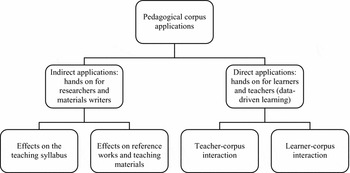
When we refer to applications of corpora in L2 teaching, this includes both the use of corpus tools, that is, the actual text collections and software packages for corpus access, and corpus methods, that is, the analytic techniques that are used when we work with corpus data. In classifying pedagogical corpus applications, that is, the use of corpus tools and methods in a language teaching and language learning context, a useful distinction (going back to Leech, Reference Leech, Wichmann, Fligelstone, McEnery and Knowles1997) can be made between direct and indirect applications (see Figure 1). This means that, indirectly, corpora can help with decisions about what to teach and when to teach it. Indirect corpus applications thus have an effect on the teaching syllabus and the design of teaching materials. Corpora can also be accessed directly by learners and teachers in the L2 classroom, and so “assist in the teaching process” (Fligelstone, Reference Fligelstone1993, p. 98). Direct applications mainly affect how something is taught and learned. They actively involve the learner and teacher in the process of working with corpora and concordances. The following sections will feature a few important lines of research and developments in both areas as presented in Figure 1. As the figure shows, we can identify different types of direct and indirect applications, depending on whom or what is affected by the use of corpus methods and tools. In the discussions below, I will consider these distinctions and refer throughout to the pedagogical uses of general corpora as well as specialized corpora. The focus will be on applications of English language corpora with occasional reference to studies which use corpora of other languages. This reflects the current state of the art where considerably more corpora of English than other languages are publically available and used in pedagogical contexts.
The use of corpora in second language learning and teaching.

INDIRECT APPLICATIONS OF CORPORA AND CORPUS RESEARCH IN SECOND LANGUAGE TEACHING
As Barlow (Reference Barlow1996) observed, “[t]he results of a corpus-based investigation can serve as a firm basis for both linguistic description and, on the applied side, as input for language learning” (p. 32). This implies that corpora and the evidence derived from them can greatly affect course design and the content of teaching materials. Existing pedagogical descriptions are evaluated in the light of “new evidence” (Sinclair, Reference Sinclair2004c, p. 271), and new decisions are made about the selection of language phenomena, the progression in the course, and the presentation of the selected items and structures (cf. Mindt, Reference Mindt, Kunsmann and Kuhn1981; Römer, Reference Römer2005).
Corpus Research and Selecting What to Teach
Corpora have proven to be an invaluable resource in the design of language teaching syllabi that emphasize communicative competence (see Hymes, Reference Hymes, Pride and Holmes1972, Reference Hymes and Pütz1992) and give prominence to those items that occur frequently in the language and that learners are hence most likely to encounter in real-life communicative situations. In the context of computer corpus-informed ELT syllabi, the first and probably most groundbreaking development was the design of the Collins COBUILD English Course (CCEC) (Willis & Willis, Reference Willis and Willis1989), an offshoot of the pioneering COBUILD project in pedagogically oriented lexicography (see Sinclair, Reference Sinclair1987). The contents of this new, corpus-driven “lexical syllabus” are “the commonest words and phrases in English and their meanings” (Willis, Reference Willis1990, p. 124). With its focus on lexis and lexical patterns, the CCEC responds to some of the most central findings of corpus research, namely, that language is highly patterned in that it consists of an immense degree of repeated word combinations, and that lexis and grammar are inseparably linked. Also worth mentioning is a much earlier attempt to improve the teaching of English vocabulary that was made long before the advent of computers and electronic corpora. In 1934, Michael West organized a conference “to discuss the part played by corpus-based word lists in the teaching of English as a foreign language” (Kennedy, Reference Kennedy and Svartvik1992, p. 327). About 20 years later, West's (Reference West1953) General Service List of English Words (GSL) was published and has since then exerted great influence on curriculum design (cf. Kennedy, Reference Kennedy and Svartvik1992; Willis, Reference Willis1990). As the title indicates, West's GSL suggests a syllabus that is based on words rather than on grammatical structures. It is also based on frequently occurring words rather than on rare ones. Of course, frequency of occurrence is not the only criterion that should influence decisions about the inclusion of items in the teaching syllabus; there are other relevant criteria, such as “range, availability, coverage, and learnability (Mackey, 1965, p. 188)” (Kennedy, Reference Kennedy and Svartvik1992, p. 340; see also Nation, Reference Nation1990), but it is certainly an immensely important one (see also Leech, Reference Leech, Wichmann, Fligelstone, McEnery and Knowles1997). It can be safely assumed that learners will find it easier to develop both their receptive and productive skills when confronted with the most common lexical items of a language (and the patterns and meanings with which these items typically occur) than when the language-teaching input they get gives high priority to infrequent words and structures that the learners rarely encounter in real-life situations.
Another current strand in applied corpus research, which aims to inform the teaching syllabus and stresses the importance of frequency of occurrence, examines language items in actual language use and compares the distributions and patterns found in general reference corpora (of speech and/or writing) with the presentations of the same items in teaching materials (course books, grammars, and usage handbooks). The starting point for these kinds of studies usually includes language features that are known to cause perpetual problems for learners—for example, for German, discourse particles (Jones, Reference Jones, Wichmann, Fligelstone, McEnery and Knowles1997), modal verbs (Jones, Reference Jones, Lewandowska-Tomaszczyk and Melia2000), the passive voice (Jones, Reference Jones, Lewandowska-Tomaszczyk and Melia2000), and prepositions (Jones, Reference Jones, Wichmann, Fligelstone, McEnery and Knowles1997); and, for English, future time expressions (Mindt, Reference Mindt1987, Reference Mindt, Wichmann, Fligelstone, McEnery and Knowles1997), if-clauses (Römer, Reference Römer, Aston, Bernardini and Stewart2004a), irregular verbs (Grabowski & Mindt, Reference Mindt1995), linking adverbials (Conrad, Reference Conrad and Sinclair2004), modal verbs (Mindt, Reference Mindt1995; Römer, Reference Römer and Sinclair2004b), the present perfect (Lorenz, Reference Lorenz, Kettemann and Marko2002; Schlüter, Reference Schlüter2002), progressive verb forms (Römer, Reference Römer2005, Reference Römer, Teubert and Krishnamurthy2007), and reflexives (Barlow, Reference Barlow1996). For all these phenomena, researchers have found considerable mismatches between naturally occurring German and English and the type of German or English that is put forward as a model in the examined teaching materials. They have, as a consequence, called for corpus-inspired adjustments in the language-teaching syllabus (particularly as far as selection and progression are concerned) and for revised pedagogical descriptions that present a more adequate picture of the language as it is actually used. A case in point here is the misrepresentation of the functions and contextual patterns of English progressive forms in EFL (English as a foreign language) teaching materials used in German schools. Progressives that refer to repeated actions or events, for example, are considerably more frequent in authentic English than in textbook English, where the common function of repeatedness is neglected and the focus is on single continuous events (cf. Römer, Reference Römer2005, pp. 261–263).
Specialized corpora, for example, those capturing a particular language for special or specific purposes (LSP), can also influence syllabus design for LSP courses. As Gavioli (Reference Gavioli2006) pointed out, in English for specific purposes (ESP), “working out basic items to be dealt with is a key teaching problem” (p. 23). A keyword analysis based on a corpus that contains the specific text or discourse type in question (e.g., English business letters, medical research articles, or newspaper editorials) can help solve this problem and assist teachers in “focus[ing] their efforts in terms of selection of language contents” (Pérez-Paredes, Reference Pérez-Paredes2003, p. 1). An important issue for ESP teachers (who may or, what is more likely, may not be experts in the specific discourse they teach) is that they should give priority to teaching those words and expressions that their learners will need later on to be able to handle texts in their subject area. For instance, having access to a corpus of biology readings and lectures, to give just one example of a science course in English described by Flowerdew (Reference Flowerdew1993), can enable teachers to successfully address this issue and make informed decisions about item and text selection for their course. Another example of how corpora can impact general EAP (English for academic purposes) teaching is Coxhead's (Reference Coxhead2000) Academic Word List (AWL). The AWL, based on a corpus of academic writing, contains the vocabulary items that are most relevant and useful to EAP learners. Simpson-Vlach and Ellis (Reference Simpson-Vlach and Ellis2010) have taken Coxhead's idea from word to phrase level and devised an Academic Formulas List (AFL), which consists of word combinations that occur significantly more often in academic than in nonacademic speech and writing. Both studies (AWL and AFL) take an indirect approach to using specialized corpora in language teaching and contribute to improving the teaching of EAP through informing syllabus design, for example, by helping with the selection of items to be included in the course.
Studies on learner corpora, that is, systematic computerized collections of the language produced by language learners, are also highly relevant for syllabus design (cf. Aston, Reference Aston, Burnard and McEnery2000; Granger, Reference Granger, Granger, Hung and Petch-Tyson2002, Reference Granger and Aijmer2009) since they provide insights on “the needs of specific learner populations” (Meunier, Reference Meunier, Granger, Hung and Petch-Tyson2002, p. 125) and help to test teachers’ intuitions about whether a particular phenomenon is difficult or not (Granger, Reference Granger, Granger, Hung and Petch-Tyson2002, p. 22). Nesselhauf (Reference Nesselhauf2005), for example, identified unidiomatic verb-noun collocations in German learner English (e.g., reach an aim, drive a bike), indicating that combinations such as achieve an aim or ride a bike may deserve particular attention in teaching materials designed for learners with first language (L1) German.
Corpus Research and Designing Teaching Materials
The results of the comparisons between corpora and course books mentioned earlier not only inform the language-teaching curriculum but also help with decisions about the presentation of items and structures in reference works and teaching materials. Corpora research has exerted a huge influence on reference publishing and has led to a new generation of dictionaries and grammar books. Nowadays, “people who have never heard of a corpus are using the products of corpus research” (McEnery, Xiao, & Tono, Reference McEnery, Xiao and Tono2006, p. 97). In the context of ELT, the publications in the Collins COBUILD series constitute a major achievement. Based on real English and compiled with the needs of the language learner in mind, the COBUILD dictionaries, grammars, usage guides, and concordance samplers (see Capel, Reference Capel1993; Carpenter, Reference Carpenter1993; Goodale, Reference Goodale1995; Sinclair, Reference Sinclair1990, Reference Sinclair1992, Reference Sinclair2001) offer teachers and learners more reliable information about the English language than any of the more traditional reference grammars or older non-corpus-based dictionaries. Two major advantages of the COBUILD and other corpus-based reference works for learners (e.g., Biber & Conrad, Reference Biber and Conrad2009; Biber, Leech, & Conrad, Reference Biber, Leech and Conrad2002; Bullon, Reference Bullon2006; Carter & McCarthy, Reference Carter and McCarthy2006; Hornby, Reference Hornby2005; Peters, Reference Peters2004; Rundell, Reference Rundell2007) are that they incorporate corpus-derived findings on frequency distribution and register variation, and that they contain genuine instead of invented examples. Particularly worth mentioning here is the student version of the entirely corpus-based Longman Grammar of Spoken and Written English (Biber et al., Reference Biber, Leech and Conrad2002). The importance of presenting learners with authentic language examples has been stressed in a number of publications (e.g., Fox, Reference Fox and Sinclair1987; Kennedy, Reference Kennedy and Svartvik1992; Römer, Reference Römer, Aston, Bernardini and Stewart2004a, Reference Römer2005; Sinclair, Reference Sinclair1991, Reference Sinclair, Wichmann, Fligelstone, McEnery and Knowles1997). Kennedy (Reference Kennedy and Svartvik1992), for instance, cautioned that “invented examples can present a distorted version of typicality or an over-tidy picture of the system” (p. 366), and Sinclair (Reference Sinclair1991) called it an “absurd notion that invented examples can actually represent the language better than real ones” (p. 5). Thanks to the corpus revolution, language learners can today choose from a range of reference works that are thoroughly corpus-based and that offer improved representations of the language they want to study. While course books and other materials used in the language teaching classroom have long been lagging behind this development and have been rather unaffected by advances in corpus linguistics (at least as far as the English as a foreign language market is concerned), the first attempts are now being made to produce textbooks that draw on corpus research and are fully based on real-life data, that is, on language that has in fact occurred (e.g., Barlow & Burdine, Reference Barlow and Burdine2006; Carter, Hughes, & McCarthy, Reference Carter, Hughes and McCarthy2000; McCarthy, McCarten, & Sandiford, 2005). Some particularly innovative developments are currently taking place in Japan, where Yukio Tono of the Tokyo University of Foreign Studies hosts the world's first corpus-based English conversation program on television (watched by a million Japanese language learners) and publishes a series of accompanying textbooks that have become best sellers in Japan (Tono, Reference Tono, Frankenberg-Garcia, Flowerdew and Aston2011). Each unit of the program focuses on one of 100 keywords (selected from a BNC frequency list) and its most common collocation patterns. Model skits and exercises illustrate the use of these collocations.
Another branch of general corpora research that has exerted some influence on the design of reference works and, to a lesser extent, teaching materials is the area of phraseology and collocation studies. Scholars like Biber, Johansson, Leech, Conrad, and Finegan (Reference Biber, Johansson, Leech, Conrad and Finegan1999); Hunston and Francis (Reference Hunston and Francis2000); Kjellmer (Reference Kjellmer, Aarts and Meijs1984); Lewis (Reference Lewis1993, Reference Lewis1997, Reference Lewis2000); Meunier and Gouverneur (Reference Meunier, Gouverneur, Hidalgo, Quereda and Santana2007); Nattinger (Reference Nattinger1980); Pawley and Syder (Reference Pawley, Syder, Richards and Schmidt1983); and Sinclair and Renouf (Reference Sinclair, Renouf, Carter and McCarthy1988) have emphasized the importance of recurring word combinations and prefabricated strings in a pedagogical context because of their great potential in fostering fluency, accuracy, and idiomaticity. Although corpus-based collocation dictionaries (e.g., Benson, Benson, & Ilson, 2010; Hill & Lewis, Reference Lewis1997; Lea, Reference Lea2002) are available, and although information on phraseology (i.e., about the combinations that individual words favor) is implicitly included in learner dictionaries in the word definitions and the selected corpus examples—and sometimes even explicitly described, for example, in the grammar column in the COBUILD dictionaries and in the COBUILD Grammar Patterns reference books (e.g., the “V over n” pattern for the verb argue; Francis, Hunston, & Manning, 1996, 1998)—such information and exercises on typical collocations are as yet largely missing from language-teaching course books (or they are inadequate; cf. Meunier & Gouverneur, Reference Meunier, Gouverneur, Hidalgo, Quereda and Santana2007). Like Hunston and Francis (Reference Hunston and Francis2000), I see a necessity in and “look forward to [more] information about patterns being incorporated in language teaching materials.” (p. 272)
It has also been demonstrated in recent publications (e.g., Aijmer, Reference Aijmer, Granger, Hung and Petch-Tyson2002; Altenberg & Granger, Reference Altenberg and Granger2001; Herriman & Boström Aronsson, Reference Herriman, Boström Aronsson and Aijmer2009; Leńko-Szymańska, Reference Leńko-Szymańska, Hidalgo, Quereda and Santana2007; Nesselhauf, Reference Nesselhauf2005) how the findings of studies based on learner corpora such as the ICLE can “enrich usage notes” in learners’ dictionaries (Granger, Reference Granger, Granger, Hung and Petch-Tyson2002, p. 24), or how they “can provide useful insights into which collocational, pragmatic or discourse features should be addressed in materials design” (Flowerdew, Reference Flowerdew, Ghadessy, Henry and Roseberry2001, pp. 376–377).
DIRECT APPLICATIONS OF CORPORA AND CORPUS RESEARCH IN SECOND LANGUAGE TEACHING
While the indirect approach centers on the impact of corpus evidence on syllabus design or teaching materials and is concerned with corpus access by researchers and—although to a lesser extent—materials designers, the direct approach is more teacher- and learner-focused. Instead of having to rely on the researcher as mediator and provider of corpus-based materials, language learners and teachers get their hands on corpora and concordance tools themselves and find out about language patterning and the behavior of words and phrases in an “autonomous” way (Bernardini, Reference Bernardini, Kettemann and Marko2002, p. 165). Tim Johns, who pioneered direct corpus applications in grammar and vocabulary classes at the University of Birmingham (UK) in the 1980s, suggested to “confront the learner as directly as possible with the data, and to make the learner a linguistic researcher” (Johns, Reference Johns, Kettemann and Marko2002, p. 108). Johns (Reference Johns, Wichmann, Fligelstone, McEnery and Knowles1997) also referred to the learner as a “language detective” and formulated the motto “Every student a Sherlock Holmes!” (p. 101). This method, in which there is either an interaction between the learner and the corpus or, in a more controlled way, between the teacher and the corpus, is now widely known under the label data-driven learning (DDL; see Johns, Reference Johns1986; 1994).
Examples of Direct Pedagogical Corpus Applications
Following Johns's example, a number of researchers have discussed ways in which corpora and concordances can be used by language learners. Bernardini (Reference Bernardini, Kettemann and Marko2002), for example, described the positive effects of what she calls corpus-aided discovery learning with the BNC, and described corpora as “rich sources of autonomous learning activities of a serendipitous kind” (p. 165; see also Bernardini, Reference Bernardini, Burnard and McEnery2000b; 2004a). She envisioned the learner in the role of a “traveller instead of a researcher” (Bernardini, Reference Bernardini, Burnard and McEnery2000a, p. 131; italics in original), and was less “interested in the starting or end point of a learning experience” than in what the learner experiences in between, on her or his journey (Bernardini, Reference Bernardini, Burnard and McEnery2000a, p. 142). Kettemann (Reference Kettemann1995), too, stressed the exploratory aspect of DDL and considered concordancing in the ELT classroom “motivating and highly experiential” for the learner (p. 30).
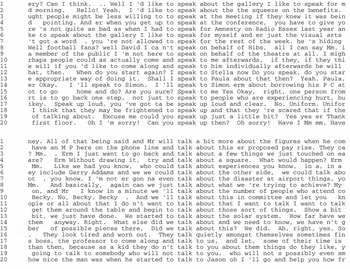
To give a concrete example of a possible DDL task, learners could be asked to compile concordances of a pair of near-synonyms (such as speak and talk; see concordance samples in Figure 2) and work out the differences in the collocational and phraseological behavior of these words. Further examples of DDL activities are described in Aston (Reference Aston, Wichmann, Fligelstone, McEnery and Knowles1997, Reference Aston, Burnard and McEnery2001, Reference Aston and Lombardo2009); Bennett (Reference Bennett2010); Fligelstone (Reference Fligelstone1993); Gavioli (Reference Gavioli and Aston2001, Reference Gavioli2006); Hadley (Reference Hadley2001); Johns (Reference Johns, Johns and King1991, Reference Johns, Kettemann and Marko2002); Kaszubski (in press); O'Keeffe, McCarthy, and Carter (Reference O'Keeffe, McCarthy and Carter2007); Oksefjell-Ebeling (Reference Oksefjell-Ebeling and Aijmer2009); Reppen (Reference Reppen2010); Sripicharn (Reference Sripicharn, Aston, Bernardini and Stewart2004); and especially in Tribble and Jones (Reference Tribble and Jones1997). Also worth mentioning are some materials and tools for the creation of DDL exercises that are available online, for example, exercises based on MICASE (see http://micase.elicorpora.info/, links to “ESL/EAP Teaching Materials” and “ESL Self-Study Activities”), Tom Cobb's “Compleat Lexical Tutor” (http://www.lextutor.ca/), a tool collection “[f]or data-driven language learning on the web” (Web site blurb), and a module on “Using concordance programs in the modern foreign languages classroom” of the Information and Communications Technology for Language Teachers, http://www.ict4lt.org/en/en_mod2–4.htm.
Concordance samples of “speak” and “talk,” based on the spoken part of the BNC.

The DDL method of using learner-centered activities with the teacher as a facilitator of these activities has, up to now, mainly been discussed with reference to ELT and English language corpora. Some of the few studies that deal with other languages include Whistle (Reference Whistle1999) and Chambers (Reference Chambers2005), who report on introducing DDL activities to the teaching of French in order to supplement other CALL (computer-assisted language learning) tasks; Dodd (Reference Dodd, Wichmann, Fligelstone, McEnery and Knowles1997) and Jones (Reference Jones, Wichmann, Fligelstone, McEnery and Knowles1997), who show how corpora of written and spoken German can be exploited “to give students a richer language-learning experience in the foreign language environment” (Dodd, Reference Dodd, Wichmann, Fligelstone, McEnery and Knowles1997, p. 131); and Kennedy and Miceli (Reference Kennedy and Miceli2001, Reference Kennedy, Miceli, Kettemann and Marko2002, Reference Kennedy and Miceli2010) who suggest corpus consultation for learners of Italian.
The Effectiveness of Direct Pedagogical Corpus Applications
Advantages of corpora work with learners have been suggested by scholars like Sinclair (Reference Sinclair, Wichmann, Fligelstone, McEnery and Knowles1997), who noted that, for the learner, “[c]orpora will clarify, give priorities, reduce exceptions and liberate the creative spirit” (p. 38). Likewise, many researchers and teachers in the TaLC tradition are convinced that DDL can empower learners to find out things for themselves, that a data-driven approach raises the learners’ language awareness, and that corpora have great pedagogic potential. The effectiveness of DDL has actually been indicated in studies on the teaching and learning of grammar and vocabulary by Boulton (Reference Boulton2009); Cobb (Reference Cobb1997); Cresswell (Reference Cresswell, Hidalgo, Quereda and Santana2007); Granath (Reference Granath and Aijmer2009); Johns, Hsingchin, and Lixun (Reference Johns, Hsingchin and Lixun2008); and Yoon (Reference Yoon2008). As Yoon (Reference Yoon2008) observed in a study on the influence of corpora use on L2 academic writing, “students assumed more responsibility for their writing and became more independent writers” (p. 31). On a similar note, Johns et al. (Reference Johns, Hsingchin and Lixun2008) found that “CALL activities [including DDL] did have a positive impact on students' English learning” (p. 503), and Boulton (Reference Boulton2009) noted that in his empirical study “corpus samples led to more successful results than traditional pedagogical resources” such as bilingual dictionaries or usage manuals (p. 50). Concordancing has not only been shown to be a useful way “to mimic the effects of natural contextual learning” (Cobb, Reference Cobb1997, p. 314), but researchers have recently also highlighted its use and usefulness in translation teaching (Bernardini, Reference Bernardini and Malmkjaer2004b; Kübler, Reference Kübler, Frankenberg-Garcia, Flowerdew and Aston2011) and for error correction in foreign or second language writing (cf. Bernardini, Reference Bernardini and Malmkjaer2004a; Chambers, Reference Chambers2005, Reference Chambers, Hidalgo, Quereda and Santana2007; Gaskell & Cobb, Reference Gaskell and Cobb2004). These descriptive empirical studies demonstrate that corpora nicely complement existing reference works, and that they may provide information that a dictionary or grammar book may not provide. They are based on experiments in which groups of students use corpora, corpus-derived exercises, and/or concordances in the classroom, while control groups of students use traditional teaching materials.
Although according to Granath (Reference Granath and Aijmer2009), “advanced students definitely benefit from working with corpora” (p. 59), it is not clear whether this is also the case for beginning learners of a foreign language. Dealing with concordances based on large collections of native-speaker conversations, newspaper texts, research articles, or novels that contain many unknown words and complex sentence constructions may be too challenging a task for beginners, and not all learners may feel comfortable working with computers in language learning. A further limitation may be that it initially takes time for teachers to familiarize themselves and/or their students with online corpora or offline corpus tools. However, once they have been given basic training in corpus use, teachers should be able to create simple concordance exercises tailored to their learners’ needs and access information about collocation and language patterning. Teachers could, for example, access the COCA interface (http://www.americancorpus.org/) to search for a word or phrase and retrieve concordance samples and lists of collocations for this word or phrase. As a recent survey on teachers’ needs has shown (see Römer, Reference Römer2009a), teachers of a language that is not their L1 often require native-speaker advice on language points. Computer corpora that have been described as “tireless native-speaker informant[s], with rather greater potential knowledge of the language than the average native speaker” (Barnbrook, Reference Barnbrook1996, p. 140), can offer help in such situations.
UNRESOLVED ISSUES AND DIRECTIONS FOR FUTURE DEVELOPMENT
Despite the progress that has unquestionably been made in the field of applied corpus linguistics, there is still considerable room for development. A number of tasks can be formulated to enhance pedagogical corpus applications and help corpora make a stronger contribution to improving language learning and teaching. The tasks and future developments I envisage are grouped under three topics and discussed in turn in the following paragraphs: (a) focusing on learner and teacher needs, (b) fostering indirect uses of corpora in L2 teaching, and (c) fostering direct uses of corpora in L2 teaching.
While many corpus researchers (including myself) claim that corpus linguistics has an immense potential to help improve language pedagogy, I would argue that they do not always make sufficient efforts to reach practitioners with what could be called the corpus mission and to find out about what teachers actually want and need. My suggestion would therefore be to focus our attention more on language teachers and their needs and see how we could support them in their work. A survey of 78 practicing English language teachers (Römer, Reference Römer2009a) brought to light that a number of wishes and everyday problems of German EFL teachers could actually be addressed by applied corpus linguists. Among the things the teachers who participated in this survey called for were, for example, better teaching materials, support in creating materials, and native-speaker advice. One possible response to these wishes would be to introduce more teachers to corpus resources that are already freely available online. If teachers received basic training in working with corpora and had access to computers with a good Internet connection and hence to online corpora (e.g., COCA, MICASE, and MICUSP [Michigan Corpus of Upper-Level Student Papers]),Footnote 3 they could design the required materials themselves whenever they needed them—for example, a worksheet on the most frequent nouns in the newspaper subsection of COCA or an exercise around a concordance of the common phrase on the other hand in the academic student papers included in MICUSP. They would also see that corpora, as large collections of native or expert speaker/writer output, can replace, for example, the “always available native speaker informant” they asked for, and that questions like “What prepositions go with that verb?” can easily be answered by looking at a right-sorted concordance of the verb in question.
Another task on our list should be to pay more attention to the needs of learners and consider which groups of learners may profit most from which type of materials. Related to this issue are questions centering around the learners’ willingness and ability to deal with computer corpora, online search interfaces, and concordance exercises prepared by their teachers. DDL may work well with the computer-savvy student who is ready to explore larger amounts of language data, but it may not be the best solution for the techno-phobic student who prefers a teacher-centered, controlled type of instruction. For the latter type of learner, a good compromise solution may be an approach to DDL without computers. Boulton (Reference Boulton2010), for example, described the benefits of using paper-based DDL materials and called for more DDL worksheets that are readily downloadable for teachers from Internet sources. The needs of learners will probably also vary considerably not only by learner type but also by learner level, course type, and learner objectives. As discussed earlier, working with large corpora that capture complex material with long sentences and low-frequency vocabulary items might intimidate beginning or intermediate learners who have a limited vocabulary. Two ways of addressing this problem could be to use a corpus of children's literature (see Johns et al., Reference Johns, Hsingchin and Lixun2008) or a corpus consisting of “graded reader texts which contain a limited number of headwords” (Allan, Reference Allan2009, p. 25). Depending on whether we are dealing with intermediate or more advanced learners, for instance, our focus in designing corpus-derived materials may shift to more specialized vocabulary and its preferred patterns of usage. Similarly, participants in a business English class or international students of mechanical engineering will probably profit most from working with materials that are tailored to their specific needs and discourse in their field of study. That means that when making decisions on what to teach and how to teach it, it is important to consider the learners’ language background and what discourse community they eventually want to be a member of and be able to communicate with.
In terms of fostering indirect uses of corpora in language learning and teaching, more work probably has to be put into the creation of reliable corpus-based language descriptions for learners and teachers, especially descriptions of specialized discourses, such as academic English or business English. This implies that there is a need for more large specialized corpora that can be used as bases for creating dictionaries, usage guides, and grammars tailored to the needs of different groups of learners. Also, most available corpora consist predominantly of written language material—which does not come as a surprise given the amount of work that goes into transcribing and encoding speech data for computer-based analysis. In terms of helping learners develop their communicative competence, spoken corpora may, however, be the better basis of pedagogical language descriptions. Generally, I see more scope for research activities that are inspired by the needs of learners and teachers and that take the learners’ communication needs and common learning problems into account. For example, language points that tend to be particularly difficult for learners could be identified through comparative analyses of corpora capturing learner (or novice) and native-speaker (or expert) performance data, or through contrastive linguistic analyses based on parallel corpora of the learners’ native and target languages (e.g., Granger, Reference Granger, Connor and Upton2004). Further comparative studies of lexical-grammatical features in corpora and course books (as already described) could also provide valuable insights into mismatches between real language and school language that need to be remedied. In selecting language points worth analyzing, I would suggest a shift in focus from individual words or empty grammatical structures to phraseological items (e.g., formulas, n-grams, phrase-frames, lexical bundles). Recent research in corpus linguistics has provided massive evidence for the inseparability of lexis and grammar (see, e.g., Biber, Conrad, & Cortes, Reference Biber, Conrad and Cortes2004; Hoey, Reference Hoey2005; Hunston & Francis, Reference Hunston and Francis2000; Meunier & Granger, Reference Meunier and Granger2008; Römer, Reference Römer2009b, Reference Römer2010; Römer & Schulze, Reference Römer and Schulze2009; Sinclair, Reference Sinclair1991, Reference Sinclair2004d; Stubbs, Reference Stubbs2001), so it appears only reasonable to provide learners with a more integrated perspective and offer them a view on the language that highlights frequently used phrases that function as important meaning-carrying units in the discourse.
In terms of fostering direct uses of corpora in language learning and teaching, corpus researchers would do well to help create more DDL exercises and corpus-derived teaching materials in general. In the future, I would hope to see more publications (similar to Tribble & Jones [Reference Tribble and Jones1997] or Barlow & Burdine [Reference Barlow and Burdine2006]) that contain ready-made exercises based on authentic speech and writing from different text types and language varieties and focused on language items that are of central importance and/or troublesome for learners. Another important step we need to accomplish if we want DDL to gain more ground is create a DDL-friendly environment that encourages learner and teacher involvement. Teachers and learners have to be provided with access to corpora that are available on the Internet or to offline corpora and easy-to-use software packages for corpus analysis. A popularization of corpora and their pedagogical use also requires some basic training in accessing corpora and in working with concordances or collocation lists. Such training is crucial because concordance output, at first glance, may seem hard to handle, and because “a corpus is not a simple object, and it is just as easy to derive nonsensical conclusions from the evidence as insightful ones” (Sinclair, Reference Sinclair2004b, p. 2). The good news is that, in most cases, only a few hours of orientation are required before learners and teachers can “enter the world of the corpus” and start exploring language patterns (Sinclair, Reference Sinclair2004c, p. 297).
CONCLUSION
This article has focused on the relationship between corpus research and L2 teaching. It has discussed a range of developments in the emerging field of applied corpus linguistics and sketched avenues for future research activities that may positively impact L2 teaching. I hope to have shown that corpus resources and methods have great potential to improve pedagogical practice and that corpora can be used in a number of ways, indirectly to inform teaching materials and reference works and directly as language learning tools and repositories for the design of data-intensive teaching activities. I have also tried to make clear that a lot still remains to be done in research and practice before corpora will eventually arrive in the classroom. Communication between corpus researchers and practitioners has to be improved considerably so that teachers and learners get the support they need and deserve.
In a questionnaire he sent out to language teachers, teacher educators, and applied linguistic researchers in 2008, Christopher Tribble referred to the (direct) use of corpora in language teaching as “a minority sport.”Footnote 4 One purpose of this article was to describe the potential of pedagogical corpus applications and to provide ideas on what can be done to foster direct and indirect corpus use in L2 teaching and to bring corpora and corpus tools to a larger group of learners and teachers. If we take up some of the ideas mentioned here, and if we are successful in improving communication among researchers, teachers, and materials designers, we can get more people involved in DDL and related activities and thus perhaps make applied corpus linguistics more of a majority sport.