China is a multiethnic country, with ethnic Han forming the largest group (91.11% of the total population). As one of the linguistically and ethnically diverse areas, the Xinjiang Uyghur Autonomous Region (XUAR) is located in the northwestern border area of China, one of the economically underdeveloped regions, with Uyghurs constituting the largest minority group. Their language, Uyghur, is recognized as an official regional language, along with Chinese as the national language. However, like many other ethnic minority-populated areas, XUAR lags behind Han-dominated regions (mostly in Central and East China) and is poorly resourced (Tsung & Cruickshank, Reference Tsung and Cruickshank2009), which has resulted in inequitable educational opportunities for Uyghur students. However, we have little knowledge of how Uyghur students are positioned in relation to educational inequities, nor do we know much about how they negotiate their minoritized identities over time during their language learning experiences. This gap is further amplified by the fact that ethnic minority students are often marginalized in the mainstream Chinese education system (e.g., Han et al., Reference Han, De Costa and Cui2016). It is against this complex sociolinguistic backdrop that this study is situated.
Language Learning and Identity Construction
Drawing on Bourdieu's (Reference Bourdieu1991) notion of capital, Norton (Reference Norton2013) proposed the construct of investment, arguing that learners acquire a new language to enhance their future prospects. The notion of imagined identity (Norton, Reference Norton2013) is thus useful for understanding the intricate relationship between language learning and identity construction. In addition, Darvin and Norton (Reference Darvin and Norton2015) posit that the learning of additional languages often reflects the invested learners’ desire to expand their range of identities and to reach out to wider worlds. The convertibility of different types of capital, which include economic, cultural, social, and symbolic capital, helps facilitate desired identity expansion. Relatedly, De Costa, Park, and Wee (Reference De Costa, Park and Wee2016) argued that a neoliberal turn in education has also resulted in a reconceptualization of language learners as neoliberal subjects, or more specifically, as linguistic entrepreneurs who thus feel a moral obligation to acquire more languages in order to enhance their self-worth in society. As a result, individuals who speak languages that are accorded higher social value are often cast as elite multilinguals (De Costa, Reference De Costa2019).
Research on Ethnic Multilingual Learners
Within the context of China, several studies have focused on identity construction on internal migrants within the country (e.g., Dong & Blommaert, Reference Dong and Blommaert2009; Gu, Reference Gu2010), with specific attention given to ethnic multilingual learners in mainstream higher education (e.g., Cui & De Costa, Reference Cui and De Costa2021; Guo & Gu, Reference Guo and Gu2016a, Reference Guo and Gu2016b; Han et al., Reference Han, De Costa and Cui2016, Reference Han, De Costa and Cui2019). These studies, which focused on Uyghur college students’ identity construction, revealed that Uyghur students located in more economically advanced parts of the country were able to successfully negotiate multilingual and multicultural memberships for themselves and thus develop an “educated elite” trilingual (Chinese, English, and Uyghur) identity. Importantly, these students were also able to contest negative stereotypes associated with their Uyghur ethnicity, which helped facilitate adaptation to the dominant Han community. This study builds on this growing body of work by examining how one Uyghur student, who moved from XUAR to coastal cities in China, engaged in complex identity negotiation work by drawing upon her multilingual repertoire.
Methodology
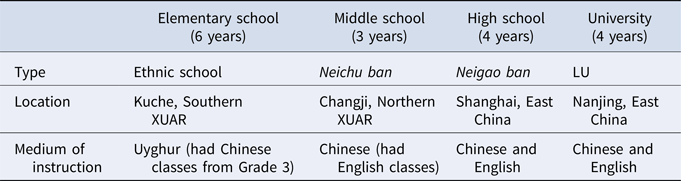
This case study is part of a larger ethnographic project involving six Uyghur students conducted at a public university, Lake University (LU, a pseudonym), in Nanjing, a coastal Chinese city. In this paper, I focus on one female Uyghur, Maria (a pseudonym), who was twenty-four years old at the time of data collection. Maria attended an ethnic elementary school in XUAR where the medium of instruction was Uyghur, with Chinese classes offered from Grade 3 onward (see Table 1). She was then admitted to a Neichu ban program—middle schools within XUAR, established by the central government to provide free quality education for Uyghur peasant families—in Changji, a more developed area in northern XUAR. It was in middle school that Maria started to learn English. After middle school, she was admitted to a high school in Shanghai (2,772 miles away from her hometown) that offered a Neigao ban program. In 2013, she was admitted to LU in Nanjing to study Chemical Engineering.
Maria's language learning trajectory

Multiple data sources (e.g., audio-recorded interviews, reflective journals, online conversations, social media postings, artifacts, observations) were collected from November 2016, when she was about to graduate from LU and return to XUAR, to December 2019, when she started a new job in Tianjin, an eastern coastal city far from XUAR. During this period, I visited LU and conducted three face-to-face, in-depth, semistructured interviews with Maria. During Maria's transitions from Nanjing to XUAR and to Tianjin, I kept regular contact with her through WeChat (a Chinese social media app). Retrospective interviews (ranging from 62–136 minutes) were conducted in Chinese and later translated into English for iterative qualitative analysis.
Findings
Tracing Maria's Chinese and English Learning Experiences
Maria's parents are academics and can speak fluent Chinese. They used to live in a military camp where she formed close relationships with many Han children, which allowed her to develop her oral Chinese proficiency along with the support that she received from her parents. Maria's outstanding Chinese proficiency guaranteed her admission to a Neichu ban program in a reputable middle school. Given her stronger Chinese proficiency over her struggling Uyghur peers, Maria often served as the interpreter for her teachers. After middle school, Maria moved to Shanghai for high school. Immersed in a Chinese-speaking environment, her speaking and listening skills significantly improved; moreover, she started to appreciate the beauty of Chinese literature, which greatly contributed to her Chinese literacy development:
Excerpt 1 (Journal 1, December 5, 2016):
I used to think that Chinese is merely a communication tool; however, my high school Chinese teacher told me, as an educated Chinese, we should learn to appreciate the beauty of written Chinese.… When teaching Chinese poems, he always pointed us to the most delicately written parts.
At university, Maria made many Han friends because she often had in-depth discussions with them and shared her understanding of Chinese literature and films. She attributed such opportunities for interaction to the confidence gained from her prior high school reading experience. The sum of these experiences enabled Maria to successfully negotiate the identity of a legitimate Chinese speaker.
Maria also had an early informal exposure to English at elementary school:
Excerpt 2 (Journal 2, April 1, 2017):
I remember one day, my uncle went outside to answer a phone call [in English] …. I just thought my uncle was so cool. … He told me that I had to learn this language [English] well because it is an international language, and that it can open a whole new world for me. … I didn't really understand what ‘international language’ meant, I just wanted to become someone like him.
Inspired by her uncle, Maria was intrigued by the idea that English is an “international language” that could “open a whole new world,” although such a concept seemed vague to her when she was young.
Despite a desire to establish a strong foundation in English, Maria still fell short in terms of English vocabulary and comprehension skills compared to Han students at her high school. As Maria disclosed, the first year in Neigao ban was very challenging because she had to deal with the pressure associated with dislocation and the stress from her studies. Nevertheless, Maria's love for English did not subside; rather, she continued investing in learning English by giving her full attention in class, prioritizing the English-related assignments, and investing extra time expanding her English word bank by reading Pride and Prejudice, a novel she checked out of her school library. Although it took Maria two years to finish reading the book due to the linguistic and cultural barriers, she gradually expanded her English vocabulary and learned to appreciate the beauty of the writing along the way. In fact, Maria agentively took advantage of the resources at her high school—the library and a language lab—and subsequently excelled in learning English.
Although Maria stopped taking additional English courses from LU during her sophomore year because she wanted to better focus on her other coursework, her passion for English learning persisted. Having missed the times when she read English novels in high school and regretting that she failed to make full use of her English ability, Maria decided to take the International English Language Testing System (IELTS) to prepare for studying abroad after graduation. Impressively, she made a great investment in the test preparation process:
Excerpt 3 (Interview 1, January 5, 2017):
Maria: When all my Uyghur friends went back home, I stayed alone on campus for the whole summer, which was extremely difficult!
Author: How?
Maria: The [English] tutoring center was very far from our school. I had to leave my dorm at 6:30 am every day …. I got back around 8 pm, and I had to finish the assignments and review the lectures after eating some fruits for dinner …. I almost gave up by the first week, but it was my own choice, so I won't complain. I want to study abroad!
Despite all the challenges involved in the process, what Maria gained was more than just good IELTS scores (7.0) and an offer from an Italian university. In addition, she got the chance to “explore [her]self along the way” (Interview 1). On this personal journey, Maria envisioned her future self as a competent English speaker who could use the language to travel around the world and to communicate with different people. It was not until then that she began to understand what her uncle meant by English as “an international language” (Excerpt 2). Maria was very well aware of the essential role that English played in realizing her imagined self and was therefore strongly invested in learning English. Although she ended up not going abroad because she was denied a passport due to her ethnicity, her imagined identity was found to be key to her investment in learning English (Norton, Reference Norton2013). Essentially, Maria perceived herself as a competent trilingual and imagined herself as an “elite” individual within the social hierarchy on the grounds of her multilingualism (De Costa et al., Reference De Costa, Park and Wee2016, Reference De Costa2019, Reference De Costa, Park and Wee2021). She considered Chinese and English as bearing higher linguistic value than Uyghur, which could empower her to imagine a pathway to a better life and to conceive of alternate identities. This finding echoes with previous research (e.g., Darvin & Norton, Reference Darvin and Norton2015; Norton, Reference Norton2013), illustrating that competence in the language of a higher status often brings advantages in symbolic terms and opportunities for a successful possible future.
Negotiating an Elite Multilingual Identity
While Maria refashioned herself and prioritized the acquisition of prestigious languages (Chinese and English), her native language, Uyghur, was somehow delegitimized (De Costa, Reference De Costa2019). Convinced by her parents, Maria opted to take the Civil Servant Exam and move back to XUAR after graduation. She took the exam in Chinese to receive an additional ten-point bonus, which made her a top candidate for the position. However, she was extremely depressed and unhappy with her work and battled a series of personal struggles:
Excerpt 4 (WeChat conversation, February 5, 2018):
Maria: I wanted to apply for graduate study, but my parents were strongly against this idea …. I'm extremely unhappy here. I don't belong to here. I feel if I stay here for any longer, my life would be dull. I don't want to waste what I've learned in college, and I want to learn international commercial law in which I can use English.
Author: Yes. English is one of your advantages.
Maria: English is useless here [in XUAR] … a total waste! …. I really miss Nanjing! I can't talk to the people here. We are just different.
Maria eagerly wanted to return to Nanjing, of which she had fond memories and experiences. Moreover, despite the prevalent neoliberal discourse of English language learning that posits a direct connection between English proficiency and economic returns (Kubota, Reference Kubota2011), the highly valued linguistic capital that Maria earned did not seem to be economically rewarded in XUAR.
Fortunately, Maria was offered a new job as a student affairs administrator at a university in Tianjin. As an active social media user, Maria frequently posted on WeChat. A quick glimpse of Maria's WeChat postings shows a stark contrast in her attitudes toward her previous and current job: she mostly complained about her previous job but shared positive experiences regarding the current job.
Excerpt 5 (WeChat conversation, September 20, 2019):
I really like my job here! …. The [Uyghur] students are cute and my colleagues [mostly Han] are very nice …. Although I still have a lot to learn, I feel that my past experiences did help me. I just feel that I have more to talk with my colleagues.
More importantly, different from her previous resistant attitude toward Uyghur culture, she started to value her Uyghur identity because she often needed to interact with Uyghur students on campus, which allowed her to draw on her past experiences as a Uyghur student who left home and successfully navigated the Chinese mainstream education system. In short, Maria was able to exploit her elite Uyghur identity to serve as a pivotal cultural broker at her workplace.
General Discussion and Conclusion
In moving from her less developed hometown to major cities, Maria enriched her repertoire of communicative resources to effect more powerful social memberships. By investing in learning Chinese and English in various ways outside the formal classroom, Maria cast herself as a linguistic entrepreneur (De Costa et al., Reference De Costa, Park and Wee2016) and negotiated an elite multilingual identity, which enhanced her self-worth and facilitated her upward social mobility (Darvin & Norton, Reference Darvin and Norton2015). She accomplished this feat by appropriating the repertoire of linguistic resources afforded by the host community as well as the abundant communication opportunities that were generally unavailable to local Uyghurs. Significantly, by engaging in such skillful identity work, Maria was able to reduce the power inequality between Uyghur and Han students when it came to learning a prestigious language (in this case, English), a finding that is consistent with that of Guo and Gu (Reference Guo and Gu2016b).
In closing, this study adds to the conceptualization of identity and transnationalism (Duff, Reference Duff2015) by including intranational migration in the broader intellectual conversation by allowing for a richer and deeper understanding of identity construction in relation to how languages are shaped by socioeconomic processes. Further studies involving ethnic minority students at other institutions in different locations will help us better understand the complex dynamics surrounding multilingual development during the internal migration process.