INTRODUCTION
Social class is a curious construct. In the discipline where it has traditionally been most at home, sociology, there has been a constant flow of commentary over the years on its demise and, indeed, its death (e.g., Beck, Reference Beck1992; Castells, Reference Castells1996; Gorz, Reference Gorz1982; Pakulski & Waters, Reference Pakulski and Waters1996; Touraine, Reference Touraine2007). For example, in his work spanning three decades, Ulrich Beck (Reference Beck1992, Reference Beck2013) has put forth individualization as the key construct to understanding social beings in contemporary societies, arguing that social class has become a zombie category (Beck & Beck-Gernsheim, Reference Beck and Beck-Gernsheim2002), no longer as relevant as it perhaps once was, but nonetheless kept alive by some sociologists. Similarly, Alain Touraine (Reference Touraine2007) wrote that “class conflicts, if they can be called that, are now situated at the level of overall and especially financial management, rather than at the level of work and the organization of production” (p. 24), thus considerably narrowing any class-based approach to the analysis of society. However, to paraphrase Mark Twain, the death of social class has been greatly exaggerated. On the one hand, a careful examination of publications in the social sciences and humanities over the past several decades shows how it is more a recurring theme (sometimes appearing with greater intensity, sometimes with lesser intensity) than a theme that was once alive and then at some point died. On the other hand, and from a Marxist perspective, one can say that class has always existed, independent of epistemological shifts in these areas of inquiry.
In applied linguistics, the situation is somewhat different. To be sure, there has been a degree of social class denial, although this has been more by default and not with explicit arguments that class is no longer relevant. What there has been, to be more precise, is social class erasure, as social class has tended to receive little or no attention in publications that deal with issues around identity and social life. And where it actually is introduced into the equation, this is almost always done in a very cursory, partial, and superficial way (see Block, Reference Block2014, for a discussion). Nevertheless, research examining the interrelationship between social class and language has endured, at least to some extent, particularly in sociolinguistics. In this article, I provide a review of social class in applied linguistics, focusing primary on the period 2000–2014. First, however, I include a quick snapshot of class-based research carried out from the 1960s to the 1990s. I deem the inclusion of the latter discussion necessary mainly because it is difficult to understand the second period of social class research without first considering the first period. It is always a good idea to define a construct before using it in a discussion, so I begin this article with a consideration of how we might understand social class in 21st-century societies. I conclude the article with some thoughts about future directions.
THE NATURE OF THE CONSTRUCT: WHAT IS SOCIAL CLASS?
In a series of recent publications (Block, Reference Block2012, Reference Block2014; Block, Gray, & Holborow, Reference Block, Gray and Holborow2012), I have devoted a fair amount of space to defining social class. In this article I will dispense with such detail, referring the reader to more elaborate treatments in the cited publications. Nevertheless, I still think it worthwhile to provide a working definition of class before getting on with a review of class-based research in applied linguistics in recent years. In addition, it is also worthwhile to preface this short discussion with an explanation of how social class is different from, though no doubt interrelated with, other commonly cited and operationalized identity dimensions such as gender, race, ethnicity, nationality, sexuality, and religion.
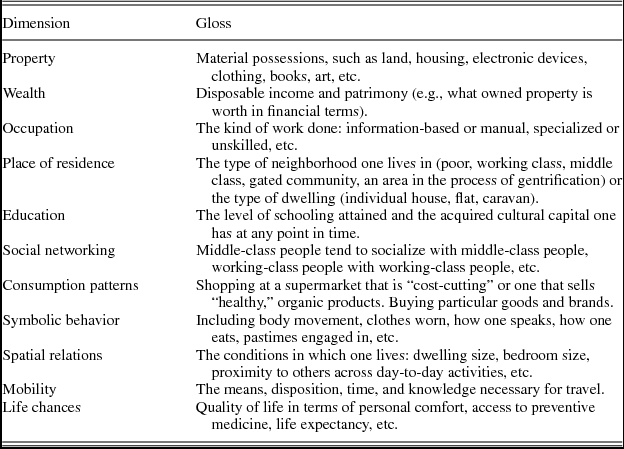
As Nancy Fraser has explained, the latter dimensions of social class fall into the realm of “recognition” and respect for differences in increasingly multicultural societies around the world, or what she has on occasion called “identity politics.” Recognition is about “an ideal reciprocal relationship between subjects in which each sees the other as an equal and also separate from it” (Fraser & Honneth Reference Fraser and Honneth2003, p. 10). Meanwhile, social class is in the realm of what Fraser calls “redistribution,” that is, the experiences of “collective subjects of injustice [who] are classes or class-like collectives, . . . defined economically by a distinctive relation to the market or the means of production” (Fraser & Honneth Reference Fraser and Honneth2003, p. 14). Fraser did not argue that activists and researchers must choose between focusing exclusively on recognition or exclusively on redistribution. However, she did note that the overwhelming emphasis on the former has, in effect, syphoned attention away from the latter in recent years, and that the consequent collective inattention to material issues has helped pave the way for a general acquiescence to the rise of neoliberalism as the dominant ideology from the 1970s onwards. For Fraser, what is needed is research and activism that is transformative, that is, “aimed at correcting inequitable outcomes precisely by restructuring the underlying generative framework” (Fraser, Reference Fraser and Olsen2008, p. 28) in terms of both recognition and redistribution, while developing effective understandings of how recognition and redistribution interrelate. The main point here is that social class is unlike dimensions of identity like gender, race, ethnicity, nationality, sexuality, and religion in that it is first and foremost about the distribution and redistribution of material resources. However, notwithstanding this base in the material world, social class is about a wide range of experiences in the day-to-day lives of people. Some of these are shown in Table 1.
Key dimensions of class (based on Block, Reference Block2012, Reference Block2014)

This list was distilled from longer discussions developed elsewhere (Block, Reference Block2012, Reference Block2014, Block et al., Reference Block, Gray and Holborow2012) of how social class as a construct has evolved through the classic work of Karl Marx (e.g., Reference Marx1867/1976) and Max Weber (Reference Weber1922/1968) to more recent conceptualizations by E. P. Thompson (Reference Thompson1963/1980) and Pierre Bourdieu (Reference Bourdieu1984), and still more recent work by Mike Savage, Fiona Devine, and others (e.g., Bennett et al., Reference Bennett, Savage, Silva, Warde, Gayo-Cal and Wright2009; Savage et al., Reference Savage, Devine, Cunningham, Taylor, Li, Hjellbrekke and Miles2013). It contains elements of both class in itself and class for itself (Marx, Reference Marx1844/1988), where the former refers to real, lived class experiences, such as work conditions, standard of living, financial situation, spatial relations and life chances, and the latter refers to “class consciousness,” or “the subjective awareness people have of their class interests and conditions for advancing them” (Wright Reference Wright and Wright2005, p. 22). This view of class has its base in the materialism of Marx, who stated that “in so far as millions of families live under economic conditions of existence that separate their mode of life, their interests and their culture from those of other classes, and put them in hostile opposition to the latter, they form a class” (Marx, Reference Marx and Tucker1852/1972, p. 515). However, it also incorporates elements of Weber's notion of status, as “the effective claim to social esteem in terms of positive or negative privileges . . . , [which] is typically founded on (a) style of life . . ., (b) formal education, which may be . . . empirical training or . . . rational instruction, and the corresponding forms of behavior, . . . and (c) hereditary or occupational prestige” (Weber, Reference Weber1922/1968, pp. 305–306), to say nothing of Bourdieu's notions of how relative taste and necessity are the hallmarks of class position made through the prosaic acquisition and display of objects in modern societies (see also Veblen, Reference Veblen1899/2007).
In short, Table 1 constitutes a constellation of dimensions model that embraces the notion, now fairly well accepted in sociological circles, that “social class is a multi-dimensional construct . . . [and] that classes are not merely economic phenomena but are also profoundly concerned with forms of social reproduction and cultural distinction” (Savage et al., Reference Savage, Devine, Cunningham, Taylor, Li, Hjellbrekke and Miles2013, p. 223). This view of class will be the reference point for the discussion that follows of research on social class in applied linguistics. I begin with the beginnings of this research in the 1960s.
SOCIAL CLASS IN APPLIED LINGUISTICS, 1960–1990
William Labov is perhaps the best known exponent of bringing class into sociolinguistic analysis, most notably in his classic The Social Stratification of English in New York City (Labov, Reference Labov1966). Labov's understanding of what constituted social class was derived from questionnaire-based research common in the 1950s and 1960s. Specifically, he drew on Joseph Kahl's (Reference Kahl1957) breakdown of the American class system, which proposed five class categories: upper class, upper middle class, lower middle class, working class, and lower class. From the establishment of an individual's class position, Labov followed the reasoning that one's social class position led to particular speech patterns, and this allowed him to argue that one can identify people as working class or upper middle class via how they speak. This research was ground-breaking, and there was a wave of scholars who followed Labov's approach to linguistic variation not only in the United States but also in Britain, where perhaps the best known follower was Peter Trudgill (Reference Trudgill1974), who studied the English spoken in Norwich. Trudgill was then followed in different ways by a long list of researchers such as Milroy and Milroy (Reference Milroy, Milroy and Trudgill1978) and Cheshire (Reference Cheshire and Trudgill1978).
Meanwhile, in the United Kingdom, Basil Bernstein (Reference Bernstein1971, Reference Bernstein1973, Reference Bernstein1975) worked from a stronger sociological base than Labov, framing the interrelationship between social class and language in terms of social structures in society and a theory of socialization, according to which children come to master different ways of communication in their day-to-day interactions in family settings, interactions among peers, and in formal education. Bernstein proposed that there were two different types of families:
1. position-oriented, more working class, and structured around unquestioned parental authority and rigidness in role realization
2. person-oriented, more middle class, and structured around dialogue and role flexibility
He also developed the contrast between elaborated code, associated with middle-class families and the institutionalized discourses of education, and restricted code, associated with working-class families and a lack of affiliation to institutionalized discourses of education. This distinction was deemed by many to be an apology for deficit educational linguistics (see Labov, Reference Labov and Giglioli1972), which caused Bernstein a good deal of grief over several decades of critique and response. However, as Bernstein himself noted, “the code theory accepts neither a deficit nor a difference position but draws attention to the relations between macro power relations and micro practices of transmission, acquisition and evaluation and the positioning and oppositioning to which these practices give rise” (Bernstein, Reference Bernstein1990, pp. 118–119).
Throughout the 1980s and 1990s social class appeared from time to time in ethnographic studies. Often its presence was somewhat oblique, as in Shirley Brice Heath's (Reference Heath1983) classic Ways with Words, in which the author compared and contrasted the language socialization practices of the residents of two communities in the southeastern part of the United States: Roadville residents were European Americans who for generations had worked in the mills and constituted an upwardly mobile working class, while Trackton residents were African Americans who were new to the mills, having worked previously in agriculture, and who constituted something of an emergent, though still inchoate, working-class community. Heath made mention of this intraworking class difference, as well as references to the practices of townspeople, who were the more established middle class or local elite. However, Heath never developed a full-blown, class-based analysis, treating issues around race and ethnicity as far more central. Elsewhere, Penny Eckert's (Reference Eckert1989) Jocks and Burnouts is, like Heath's study, and oft-cited and much-celebrated ethnography. And similar to Heath, Eckert did not provide as much class-based analysis as she might have done. Still, she did make an excellent point when she glossed the two principal groups in the higher school where she carried out her research as follows:
The . . . Burnout came from a working class home, enrolled primarily in general and vocational courses, smoked tobacco and pot, took chemicals, drank beer and hard liquor, skipped classes, and may have had occasional run-ins with the police; the Jock was middle class and college bound, played sports for the school, participated in school activities, got respectable grades, and drank beer on weekends. The Jock had a cooperative, the Burnout an adversarial relationship with the school. (Eckert, Reference Eckert1989, p. 3)
The work of Labov, Trudgill, Heath, Eckert, and others was significant in that social class was in evidence as a key construct, even it was more explicit on some occasions than others. Nevertheless, in the broader scheme of things, in applied linguistics writ large, there was never a consolidated group of researchers focusing on social class over a long period of time. An early comment to this effect can be found in an article by Robert Politzer, in which he lamented the marginalization of social class in research on bilingualism:
In many educational outcomes affecting bilinguals, social class rather than bilingualism per se may be the factor of primary importance.. . . Findings concerning bilingualism and the effects of bilingual education are not necessarily transferrable across social class boundaries. (Politzer, Reference Politzer1981, pp. 3–4)
A decade later, M. A. K. Halliday made the following comment in a state-of-the-art article about applied linguistics, circa 1990:
It is acceptable to show up sexism—as it is to show up racism—because to eliminate sexual and racial bias would pose no threat to the existing social order: capitalist society could thrive perfectly well without sexual discrimination and without racial discrimination. But it is not acceptable to show up classism, especially by objective linguistics analysis . . . because capitalist society could not exist without discrimination between classes. Such work could, ultimately, threaten the order of society. (Halliday Reference Halliday1990, p. 17)
In line with Fraser's views on recognition and redistribution cited above, both Politzer and Halliday highlighted how, up to the year 1990, applied linguistics had followed trends in society at large, whereby the political and academic left had abandoned its traditional concern with the shortcomings of capitalism and the need for socialism/communism as a system better able to distribute the economic and other resources of society. Instead, activists and academics alike had embraced “identity politics” and the attack on inequality through a recognition and respect agenda as the only ways to achieve a more just society. The option of combining a concern with identity politics and distribution, made difficult by the fact that the former primed equality based on the differences between people while the latter primed equality based on what human beings have in common, did not seem to be on the table. And now some 15 years into the 21st century, it seems that matters have not moved on very much, with the exception of the work of scholars like Ben Rampton (Reference Rampton2006).
SOCIAL CLASS RESEARCH IN APPLIED LINGUISTICS, 2000–PRESENT
Ben Rampton and linguistic ethnography
Either they introduce social class into their discussions with absolutely no indication of what it might mean, or they follow fairly limited frameworks derived from questionnaire based sociological work, with the listing of the general indicators income, occupation and educational level sufficing as an explanation. (Block, Reference Block2014, p. 93)
This is my assessment of what most sociolinguists (and indeed, applied linguistics) had done or did with social class at the time that I was writing Social Class in Applied Linguistics in late 2012 and early 2013. And it is a view that I have not changed since that time. Indeed, I would still maintain my conclusion that Ben Rampton (Reference Rampton2003, Reference Rampton2006, Reference Rampton2010) seems to be the only scholar who has not only used social class as a key variable in his work but has done so after previously making clear in great detail what he means by class. This is especially the case in his 2006 book, Language in Late Modernity, in which he developed an informed and in-depth discussion of class in four chapters (6–9). Rampton's model of social class brings together the thinking of a range of scholars, including, Valentin Vološinov (Reference Vološinov1973), Michel Foucault (Reference Foucault1980), Raymond Williams (Reference Williams1977), E. P. Thompson (Reference Thompson1963/1980), and Bourdieu (Reference Bourdieu1977). Echoing Marx's distinction between class in itself and class for itself, he outlined two levels at which class is a phenomenon:
1. material conditions, ordinary experience, and everyday discourses, activities and practices—the “primary realities” of practical activity that are experienced differently by different people in different times, places and networks
2. secondary or “meta-level” representations: ideologies, images, and discourses about social groups, about the relations of power between them, and about their different experiences of material conditions and practical activity. (Rampton Reference Rampton2006, pp. 222–223)
Rampton also made clear his lineage as a sociolinguist (or linguistic ethnographer, to be more precise), which goes back to Labov and proceeds through Hymes, Bernstein, and Heath. From Labov, he took an interest in variation and attention to patience and detail when examining data. From Hymes, he took a concern with situating sociolinguistics socially as well as linguistically. From Bernstein, he took a concern with language socialization processes in educational settings, though not, it should be added, the latter's lack of interest in fieldwork. Finally, from Heath, he took a pedigree as an ethnographer, given that detailed fieldwork is the key to capturing social class as it is made in ongoing communication.
The research discussed in Language in Late Modernity (Rampton, Reference Rampton2006) involved the description and analysis of the everyday communicative activity of London secondary school students, based on recordings of lessons as they unfolded. These adolescents generally spoke what Cheshire, Kerswill, Fox, and Torgersen (Reference Cheshire, Kerswill, Fox and Torgersen2011) called “Multicultural London English,” understood as “the overall range of distinctive language features used in multiethnic areas of London,” (p. 154), which come from traditional Cockney, as well as the Englishes of the Caribbean, South Asia, and the United States. Rampton (Reference Rampton2006) was most interested in the Cockney features produced by the students in his study, particularly when these were done in an exaggerated manner, and he contrasted this performed Cockney with performances of “posh English” in an equally exaggerated manner. The latter is not so much the Queen's English or received pronunciation, but any English deemed by adolescents to be educated and, at a minimum, middle class (see also Harris, Reference Harris2006; Preece, Reference Preece2010). For Rampton, the students performed Cockney (and mock Cockney) to convey working-class youth subjectivities, and they used mock posh to voice the other, as something akin to an anonymous middle or upper class that is far away from their lives both in material and discursive terms. However, Rampton also noted how the adolescents in question did not readily or explicitly position themselves in terms of their working class identities, and that issues round race, ethnicity and gender seemed more salient to them. This left Rampton with little evidence of class for itself, but he retained class in itself as an underlying social structure that does not go away just because it is not acknowledged or overtly invoked in activities in which class may be said to be constituted (see Collins, Reference Collins2006, for a similar conclusion about sociolinguistics research in the United States). The way forward, it seems, is to work intersectionally (see Block & Corona, Reference Block and Corona2014), examining the interrelationship between class and identity dimensions such as race, ethnicity, and gender in ongoing material and discursive practices (more on this below).
One significant aspect of Rampton's (Reference Rampton2006) work is the way it is inserted into a larger current of thought and research in sociolinguistics today, namely, the move away from a focus exclusively on the linguistic to a focus on multimodal repertoires, where multimodality is about “approaches that understand communication and representation to be more than about language, and in which language is seen as one form of communication . . . among other modes such as image, gesture, gaze, posture, and so on” (Jewitt, Reference Jewitt and Jewitt2009, p. 14). According to Julia Snell, this turn to repertoires brings with it at least two advantages:
The first point . . . is that repertoire refers to the set of resources that a speaker actually commands rather than to abstract linguistic models. In this way, it can account for speakers who draw upon and mix resources associated with a range of linguistic varieties. Secondly, the use of repertoire invokes Hymes’ . . . notion of “communicative competence” in that it links linguistic resources with knowledge of how to use these resources. (Snell, Reference Snell2013, p. 115)
A third advantage to using repertoire is that it articulates well with two relatively new constructs in sociolinguistics: style and stance (e.g., Coupland, Reference Coupland2007; Jaffe, Reference Jaffe2009). “Style” and “stylization” were terms used by Weber in his analyses and discussions of late 19th- and early 20th-century societies to refer to social positions and activities that related to class markers such as recognized legitimate heritage, the neighborhood where one lived, the type of dwelling one lived in, and a range of modes of behavior. More recently, Nik Coupland (Reference Coupland2007, p. 1) defined style as a way doing something that emerges from among alternatives as a sociohistorically situated meaning and is specific to particular domains or fields of social activity (Bourdieu, Reference Bourdieu1993). In research on style, Eckert noted that “speakers [are seen] not as passive and stable carriers of dialect, but as stylistic agents, tailoring linguistic styles in ongoing and lifelong projects of self-construction and differentiation” (Eckert, Reference Eckert2012, pp. 97–98). Meanwhile, stance is understood as “a person's expression of their relationship to their talk (their epistemic stance, e.g., how certain they are about their assertions), and a person's expression of their relationship to their interlocutors (their interpersonal stance, e.g., friendly or dominating)” (Kiesling, Reference Kiesling and Jaffe2009, p. 172).
Researchers like Snell and Emma Moore have combined their interest in linguistic variation, multimodal repertoires, and stylization and stance with an interest in social class, focusing on adolescent speech patterns and forms in Teesside, in northeast England, and Bolton, in northwest England, respectively. In her work, Snell posed a very interesting question about the performance of working-class identity: “Does habitual use of a particular kind of interactional stance . . . construct a particular kind of working-class identity (e.g., characterised by humour, playfulness, the policing of social boundaries), or at least an aspect of that identity, which can be contrasted with . . . [a] middle-class identity?” (Snell, Reference Snell2010, p. 649). Here there is a link between working-class subjectivities, culture and behavior, which Paul Willis (Reference Willis1977) found in his oft-cited study of working-class adolescent males in the English Midlands in the 1970s. As the title of his book suggests, Willis was interested in “how and why it is that [White] working class lads come to accept working class jobs through their own apparent choice” (Willis, Reference Willis1977, p. 185), in other words, why they did not succeed in school, which came to function more as a training ground for their eventual lives as factory workers than as a mediator of upward mobility. Sensitive to social class as a living and breathing cultural phenomenon (Thompson, Reference Thompson1963/1980), Willis found in his informants what was, in essence, the emergence of a working-class habitus (see Bourdieu, Reference Bourdieu1977), which consisted of a set of dispositions to think and act in ways which facilitated the reproduction of their class position. Although he did not include many references to multimodal repertoires or language, and had little to say about what would today be understood as stylization and stance, Willis was interested in the in situ and in-the-moment making of class, and in this sense he was on the same wavelength as Rampton, Snell, and Moore.
Meanwhile, in line with this interest in working-class culture, Moore noted an interesting finding in Snell's research, as well as her own. First, she rejected the notion that “working-class speakers and . . . middle-class speakers . . . are simply doing the same thing in different ways . . . [since] it may be that the ‘variants’ are not equally socially loaded.” (Moore, Reference Moore2012, p. 71). Thus, a working-class marker like “possessive ‘me’ is not simply an alternative to another less vernacular form, [as] it is employed to fulfil specific interactional goals above and beyond its referential content.” (Moore, Reference Moore2012, p. 71). This means that “working-class speakers—far from being impoverished users of language—are employing shrewd sociolinguistic strate-gies which differ from those used by the middle-class speakers.” (Moore, Reference Moore2012, p. 71). The important point here is about how working-class speech and culture may be seen, not just as an alternative to middle-class speech, but as embodying fundamentally different ways of being and communicating. The latter are embedded in very real cultural differences arising from very different material conditions, which working-class people share among themselves but not with middle- or upper-class people. This notion of working-class culture was developed in the work of Thompson (Reference Thompson1963/1980) and Williams (Reference Williams1977), writing about class in Britain, and it is consistent with the way in which Friedrich Engels (Reference Engels1845/2009) wrote about class differences as cultural differences in his discussion of the conditions of the English working class in the mid-19th century.
Part and parcel of Snell and Moore's research is their activism against what they see as discrimination and even demonization against working-class children via attacks on their way of speaking. In this sense, the two authors situate themselves in the tradition of Labov and his advocacy on behalf of African American Vernacular English some four decades earlier (e.g., Labov, Reference Labov and Giglioli1972). Nevertheless, as I noted elsewhere (Block, Reference Block2014), it is hard to see what this advocacy hopes to achieve if it is dealing with social class as if it were a dimension of identity like gender, race, ethnicity, or nationality. Indeed, following Fraser, it is worth reminding ourselves that social class is a phenomenon and lived experience inherent to inequality in capitalism and is therefore related to maldistribution rather than misrecognition or simply a lack of respect for cultural difference. Elsewhere, with reference to this advocacy on behalf of working-class speech, I posed the following question: “What would this achieve as regards the material-based deprivation and poverty which serve as the base-level shaper, not only of ways of speaking and communicating in general, but also of every other index of social class in socioeconomically stratified societies?” (Block, Reference Block2014, p. 104). As Andrew Sayer (Reference Sayer2005) has noted, the poor do not wish to have their poverty and poor living conditions affirmed, legitimized, and validated by mainstream middle-class and upper-class members of society. What they want is the abolishment of class differences, or more modestly their own individual escape from the relative deprivation and underprivilege in which they live. In this case, recognition and respect are not enough. Thus while Snell and Moore are to be commended for carrying out class-focused research that has produced interesting findings about working-class culture, they perhaps need to think about where these findings lead. The same advice applies to the research to be discussed in the next section.
LANGUAGES IN CONTACT CONTEXTS
I use languages in contact here as a term of convenience (as opposed to a term of precision) to refer to a range of situations in which speakers of one language come into contact with speakers of another language either through education or simply through a change in the environment in which they are living. Much of the research I classify in this admittedly very broad way would fall into the categories of World Englishes and bi- and multilingualism. In this section I will review what I see as the most exemplary work in these areas in terms of how they move social-class-based research forward. I begin with studies about English in the world.
Alastair Pennycook has highlighted in his work the way that English as an international language (or lingua franca) on the world stage is not an innocent prospect that has become a reality. He notes that “this thing called English colludes with many of the pernicious processes of globalisation, deludes many learners through the false promises it holds out for social and material gain, and excludes many people by operating as an exclusionary class dialect, favouring particular people, countries, cultures and forms of knowledge” (Pennycook, Reference Pennycook2007, p. 101). In this sense, English is not the cause of inequality in the world (we can leave that status to the logic of capitalism), but it does mediate inequality and, as a result, the reproduction of class hierarchies in those societies where it has become the center of debate in education. In these contexts, knowledge of English is generally framed as must-have for all citizens if the nation is to prosper. I will not engage in a discussion of how exaggerated—or even wrong—this viewpoint might be, but I will focus on the issue of how English mediates inequality.
In a range of studies in East Asia, we see how in locations such as China (Butler, Reference Butler2013, Gao, Reference Gao2010, Reference Gao2014; Zou & Zhang, Reference Zou, Zhang and Feng2011), Japan (Kanno, Reference Kanno2008), and South Korea (Park, Reference Park2009, Reference Park2010, 2011; Shin, Reference Shin2012, Reference Shin2014), English fever (Park, Reference Park2009) has taken hold, which has meant that many parents (in particular, middle-class parents) engage in a wild scramble to ensure that their children learn English. This might mean extracurricular tuition, but in more extreme cases such as the Korean phenomenon of wild geese families (Shin, Reference Shin2012), the breadwinner of a well-off family (usually the father) stays in Seoul (for example) while the mother and one or two children live in Toronto (for example), where the children are educated in English. Obviously, such a lifestyle option is only within the reach of a minority of the population, but it would be unwise to underestimate the lengths to which normal middle-class families will go to acquire English for their children, for example, paying a lot of money for after-school English language instruction. Nevertheless, as Park noted, “Koreans’ belief in the promise of English . . . is not of the blind and naïve kind.. . . They are clearly cognizant of the fact that one's class background, for example, will significantly influence one's chances of acquiring better English language skills, as greater economic capital will open up opportunities not available to those who lack it, such as studying English overseas or enrolling in expensive English language schools with ‘native speaker’ teachers” (Park, Reference Park2011, p. 447). As for the class-based experiences of young Korean nationals who move away from Korea with their families, Shin's (Reference Shin2012, Reference Shin2014) research offers much food for thought. Shin noted how in response to the declassing, racism, and social exclusion that they experienced, her informants “constructed themselves as new transnational subjects . . . who are wealthy, modern, and cosmopolitan, distinguishing themselves from both long-term immigrants in local Korean diasporic communities and Canadians by deploying (as stylistic resources) revalued varieties of Korean language and culture” (Shin Reference Shin2014, p. 101).
In China, we see the extremely rapid rise of inequality; hundreds of millions have risen to middle-class status and millions to upper-class status, while leaving the vast majority of the population behind in class positions ranging from the working class to the poor. This inequality has also led to major changes in a range of institutions, education being one of the more important ones (Shi Li, Sato, & Sicular, (Reference Shi, Sato and Sicular2014). Fuhui Tong & Qing Shi (Reference Fuhui and Qing2012) made the point that “for developed metropolitan cities in mainland China, including Shanghai, Beijing, and Guangzhou, bilingual education becomes a form of elite education which is associated with family income, hence, privileged to higher social classes” (p. 168). Thus, as Butler (Reference Butler2013) has noted, we are beginning to see a correlation between class position and individuals' access to and success in English language learning. Elsewhere, in research on middle-class and wealthy Chinese nationals studying in the United Kingdom, Feng Gao noted how their “senses of . . . middle-class or upper-class identities were reinforced during their English language journeys in Britain” and how “when they perceived new behaviour and attitudes associated with middle class or upper class in Britain, they tended to adjust themselves socioculturally” (Gao, Reference Gao2010, p. 76). Gao's work is important as it not only uncovers a degree of class for itself among his informants but it also taps into the issue of how individuals maintain (or not) their home class positions when they travel. As confident, well-educated, and situated elites, these individuals seem to manage this feat with relative ease.
Meanwhile, in bilingual and immersion education programs in North America, we see the materialization of a key notion in Bourdieu's work over the years (e.g., Bourdieu, Reference Bourdieu1993), namely, that (notable exceptions notwithstanding) middle and upper-class parents manage to obtain for their children the best education while the remainder of the population is left to get by as best they can (Bourdieu, Reference Bourdieu1984, Reference Bourdieu1993; Lareau, Reference Lareau2011). Heller (Reference Heller2006) noted the class conflict evident when the French immersion school that she studied in Ontario was founded. While the Anglophone middle-class parents saw French as extra cultural capital for their children, Francophone working-class parents were in the bind of wanting to conserve French but wary of the prospect of little or no English-medium instruction for their children. Not surprisingly, the middle-class parents got their way, and from its inception in 1968 until the 1990s, the school evolved an official, idealized middle-class Quebecois French culture and language, marginalizing what was conceivably the more authentic Quebecois working-class culture and language.
In the context of two-way English-Spanish immersion programs in the United States, there are further examples of how middle-class parents generally get their way. As Tatyana Kleyn and Sharon Adelman Reyes (Reference Kleyn and Reyes2011) noted in their discussion of Spanish bilingual schools in New York, there is delicate balance between the needs of “students from poor, immigrant and Spanish speaking homes [who] are often viewed as needing bilingual education as a remedial program” and how “two-way programs are also viewed as enrichment education by many middle- to upper-class English monolingual parents” (p. 215). Meanwhile, in an ethnographic study of classrooms in two-way Spanish-English bilingual school in California, Deborah Palmer (Reference Palmer2009) showed how middle-class children, like their parents, know how to make the educational system work for them. Specifically, Palmer focused on how these children (usually White Anglophones) came to capture a disproportionate amount of their teachers’ time and in general were able to make the schoolwork benefit them, but to the detriment of the vast majority of their working-class Latino classmates. This occurred because of their more developed knowledge of how to use educational opportunities to their advantage.
In recent years, English language immersion programs have become popular across Europe and South America. And once again, there is a correlation between middle- and upper-class positions in society and greater access to and success in learning English. This is as much the case with bilingual English-Spanish schools in Madrid (Martín Rojo, Reference Martín Rojo2010) as it is with English-medium schools in Colombia (de Mejia, Reference de Mejia2002) or English language instruction in mainstream schools in Mexico (López-Gopar & Sughrua, Reference López-Gopar and Sughrua2014). In countries with a postcolonial relationship with English, social class is likewise embedded in issues around access to and acquisition of English. A good example is Vaidei Ramanathan's (Reference Ramanathan2005) work on English-medium instruction in higher education in India. Ramanthan noted how English is always interrelated with a series of other material and symbolic markers: from the quality of educational facilities to clothing and modes of behaviors. Meanwhile, in sub-Saharan African contexts, from South Africa to Tanzania, English has become marker of a global citizenship that divides populations into those who can aspire to this status (an exiguous minority in most cases) and those who cannot (Blommaert, Reference Blommaert2010).
Another language contact context of interest from a class perspective is bi- and multilingual societies, in which two or more languages are in regular use and where speakers tend to self-position as Language A–preferent or Language B–preferent, and so on. For example, in Catalonia, where I live, there is an interesting dynamic and tension around Catalan and Spanish and the social class positions of preferent speakers of both. There is a recently arrived immigrant working class, which is almost exclusively Spanish speaking. There is an older working class, composed of migrants from other parts of Spain in the 1950s and 1960s, which is primarily Spanish-preferent, although the children of this generation have in many cases become Catalan-preferent speakers as they have experienced a degree of upward mobility. Meanwhile, there is a middle class composed mainly of Catalan-preferent speakers and an upper class that has always been split between Catalan-preferent and Spanish-preferent speakers. All of this, added to the fact that Catalan is the official language of education and other domains of Catalan society, leads to a situation in which Catalan has symbolic value as middle-class linguistic capital and that positioning oneself as a Catalan speaker is to a great extent to align with mainstream Catalan society (Frekko, Reference Frekko2013; Woolard, Reference Woolard and Blot2003).
Elsewhere, in Singapore, Singlish, the local Singaporean variety of English, is now positioned as the language of the economically less well-off in society (Tupas, Reference Tupas and Feng2011). This has come about as standardized varieties of English have been embraced by the middle and upper class as more valued linguistic capital (Bourdieu, Reference Bourdieu1991) and a marker of distinction (Bourdieu, Reference Bourdieu1984). And in the United States, we see how among African Americans, there are tensions running through affiliations with varieties of African American Vernacular English and varieties of standard American English, which often are played out against a backdrop of social class differences (Fought, Reference Fought2006).
CONCLUSION AND A WAY FORWARD
The upshot to this discussion of social class in applied linguistics is that while individuals and collectives have tended to be documented in terms of race, ethnicity, gender, nationality, and so on, they have not generally been situated in terms of their material lives in increasingly unequal societies (Dorling, Reference Dorling2011; Piketty, Reference Piketty2014). In my view, it is difficult to study linguistic variation of any kind without linking it to larger social structures, something which Hymes (Reference Hymes1974) argued for long ago. What sense does an analysis of language socialization make if no link is made to how all social phenomena are linked to the economic base of society (e.g., the means of production, in Marxist terms)? How can one analyze immersion education without considering how it intersects with the division of society along class lines? And, is it even possible to develop a thorough understanding of the apparent choices made by people with regard to speaking one language or another, or speaking one variety or another, without acknowledging and exploring how ongoing communication is always enmeshed in the material existences of those making these choices? These questions, of course, emerge from my particular mind-set and way of seeing the world though the guise of political economy. However, if the arguments I have developed elsewhere, both on my own (Block, Reference Block2014) and with colleagues (Block et al., Reference Block, Gray and Holborow2012), make any sense, then perhaps the suggestions that follow, as a way forward, are worth taking on board.
First, there is my overall assessment of research on social class in applied linguistics, which is that while some authors, such as those cited here (I apologize for those whom I have left out), do bring class into their discussion, they do it in a partial and undertheorized way. As I indicated above, the exception is Rampton's work, where his notion of class is explained, and he showed how class is made in context. More recently, Stephanie Vandrick (Reference Vandrick2014) is one of the few authors to offer a definition, although it is an introduction to a special issue and is, therefore, short. More class-based conceptual work needs to be done.
In areas of applied linguistics such as language learning and teaching, there is, as I noted elsewhere (Block, Reference Block2012, Reference Block2014), a dearth of class-based research. To be sure, a good proportion of second language learning research focuses on the linguistic, cognitive, and sociocultural aspects of the process, but where research examines second language learning experiences, more could be done. For example, foreign language students, in both their home and study-abroad contexts, embody class positions that can and do mediate and impact on their language learning experiences (Block, Reference Block2007; Kinginger, Reference Kinginger, Pavlenko and Blackledge2004; Vandrick, Reference Vandrick1995, Reference Vandrick2011). Regarding language teachers, Ramanathan and Morgan (Reference Ramanathan, Morgan and Sharifian2009) have lamented the class blindness that they have found in critical pedagogies in TESOL, and John Gray and I have written about the way teachers are disempowered in teacher training and education (Block & Gray, in press; Block et al., Reference Block, Gray and Holborow2012). There is even scope for class-based analysis of language teaching materials, as we see in Gray and Block (Reference Gray, Block and Harwood2014).
However, it is perhaps in research that more directly examines language in society issues, from schools-based research on dialect, to bi- and multilingualism research, where there is the greatest scope for more class-based work. In schools-based research, there has been a strong tendency in Anglophone contexts to focus almost exclusively on gender, race, and ethnicity in identifying students. In this regard, researchers might consider Pia Pichler's (Reference Pichler2009) work in London secondary schools, where she was able to focus on these dimensions of identity, while also including a class-based focus. Block and Corona (Reference Block and Corona2014) have more recently discussed a class-based intersectional approach (Crenshaw, Reference Crenshaw1989), examining the experiences of adolescent Latinos in Barcelona, which are framed in terms of racial phenotype and hard masculinities as well as being working class. Elsewhere, in a study focusing on adolescent Filipinos in Vancouver schools, Norton and Darvin (Reference Norton and Darvin2014) examined how transnational subjectivities intersect with class-based subjectivities. Meanwhile, in work that examines adult migration experiences, there is again space to bring class to the fore. For example, the work of Norton (Reference Norton2013), Block (Reference Block2006), and Menard-Warwick (Reference Menard-Warwick2008) contains some class-based analysis in the authors' explorations of migrant experiences in Toronto, London, and California, the most interesting aspect being their references to the ways that individuals are declassed and then reclassed in host societies, depending on their relative command of the host-community language.
Finally, there is a strand of critical language education research in North America worth mentioning here, which for reasons of space I have not explored in this article. I refer to work by scholars such as Auerbach and Wallerstein (Reference Auerbach and Wallerstein2004), whose pedagogical proposals for adult immigrants are based on a firm understanding of inequality, as well as research by Benesch (Reference Benesch2008), Cummins (Reference Cummins2000), and others, where the focus is on how bilingual children from poor and working-class backgrounds suffer something like a multiple penalty when they enter mainstream education. This penalty is based on the assumptions that their English is deficient and that they lack the proper family support for education in the home, as well as the fact that they live their lives embedded in the racist structures of society at large, in which they do not have the right (White European) phenotype. While such research does not take on class issues as explicitly as it might (Block, Reference Block2014), it does deal with many of the same inequality issues that would be integral to a more overtly class-based analysis. Certainly, there is space for more bridge building in this regard.