Second language (L2) learners in secondary schools are quite diverse, as they come from different linguistic and cultural backgrounds, have varying levels of proficiency, and differ in the knowledge of school subjects they have developed in their first languages. But regardless of their backgrounds, they are expected to engage with challenging school subjects across a range of disciplines. This means that the language they most need to develop is what is referred to as academic language, the language through which school subjects are taught and assessed. While researchers debate definitions of academic language and even raise questions about the value or utility of this construct (for different perspectives, see, Bunch, Reference Bunch2006; Cummins & Man, Reference Cummins, Man, Cummins and Davison2007), the fact that secondary students need to engage with a range of registers—oral and written, formal and informal, in a range of subject areas—means that second language learning presents great challenges for this population. Our definition of academic language comes from work in systemic functional linguistics (SFL), a linguistic theory that enables language forms to be linked with their contexts of use (e.g., Halliday & Matthiessen, Reference Halliday and Matthiessen2004). Description of academic language focuses on the discourse, lexical, and grammatical challenges of the tasks students are asked to engage in across school subjects (Schleppegrell, Reference Schleppegrell2004; Snow & Uccelli, Reference Snow, Uccelli, Olson and Torrance2009). Learning to read, write, and interact using academic language requires support for language development that assists students in engaging with the communicative and literacy demands of disciplinary learning.
Many secondary-level language learners continue to struggle with academic language and academic subjects even after several years in the new language environment. Newly arrived immigrants of secondary school age with little or no proficiency in the L2 need intensive support for language development and are often served in classrooms specially dedicated to their instruction. In many cases, however, adolescent students who are still developing proficiency in the language of instruction are placed directly in mainstream classrooms for most subject-area learning.Footnote 1 This has major implications for the contributions that applied linguists and language teachers can make in regard to this population, as much of these students' language learning will take place in mainstream classrooms without continued support from language specialists. Teachers in all disciplinary areas need to be supported in providing opportunities for continuing language development for their L2 students, many of whom may speak the second language with colloquial fluency even while they still have much work to do to develop the reading, writing, and academic language needed for full participation and success in academic subject areas. This means that applied linguists and L2 educators need to engage more closely with content-area teachers and develop new paradigms for L2 instruction in secondary school, with greater attention to preparing teachers to support L2 development across school subjects.
To prepare this review, we surveyed research published in English over the past 5 years to identify work that reports on teaching and learning academic language in L2 secondary contexts. Several recent research reports have synthesized recommendations for instruction in academic language for L2 students at the secondary level, and we begin our review with a summary of these reports. In general, the empirical research in this area is sparse. Most of the research on academic language in secondary schooling uses qualitative methods such as ethnography and discourse analysis to report on case studies and small-scale interventions.Footnote 2 In the latter part of this article we draw on these studies to describe instructional approaches that exemplify recommended practices.
Our focus is on secondary school settings where students are learning English in English-speaking contexts, and we do not review work from foreign language instruction contexts, such as CLIL (content-and-language integrated learning) in Europe (but see Dalton-Puffer, Reference Dalton-Puffer2011–this volume) or foreign language instruction in English-speaking contexts (see Paesani, Reference Paesani2011–this volume). We do not discuss research pertaining to the identities of adolescent ELLs (English language learners) and literacy practices or instruction that does not specifically address academic language development.
RECOMMENDATIONS FROM RESEARCH SYNTHESES FOR INSTRUCTION IN ACADEMIC LANGUAGE AT THE SECONDARY LEVEL
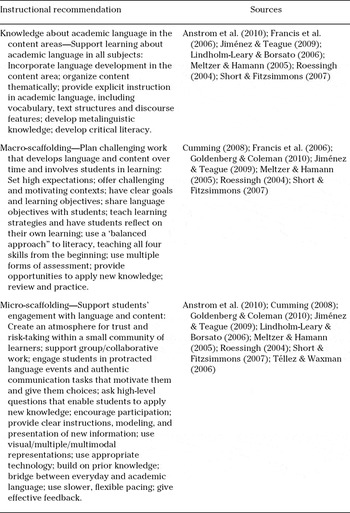
Several recently published reviews help us summarize current recommendations for instruction that supports the development of academic language at the secondary level. Roessingh (Reference Roessingh2004) developed a synthesis and meta-analysis of 12 studies of effective high school English as a second language (ESL) programs over two decades in Canada and the United States. Meltzer and Hamann (Reference Meltzer and Hamann2005) surveyed the research literature on adolescent learners of English and synthesized research-based literacy strategies for this population. Téllez and Waxman (Reference Téllez, Waxman, Norris and Ortega2006) completed what they called a “meta-synthesis” of the results of 25 studies of effective teaching practices for ELLs, including some studies at the secondary level. Although not specifically focused on the secondary context, Lindholm-Leary and Borsato (Reference Lindholm-Leary, Borsato, Genesee, Lindholm-Leary, Saunders and Christian2006) synthesized recommendations from five studies of instructional strategies for teaching content, a focus relevant to secondary teaching. Francis, Rivera, Lesaux, Kieffer, and Rivera (Reference Francis, Rivera, Lesaux, Kieffer and Rivera2006) synthesized findings from a range of research reports to suggest what newcomers require for effective instruction. Short and Fitzsimmons (Reference Short and Fitzsimmons2007) reviewed research studies on adolescents learning English, convened a panel of experts to offer instructional recommendations, conducted site visits to three programs that they deemed promising, and synthesized recommendations from these activities. Cumming (Reference Cumming2008) presented a review of recommendations from five recent books on literacy development in secondary contexts, and Jiménez and Teague (Reference Jiménez, Teague, Morrow, Rueda, Lapp and Gordon2009) reviewed seven studies of secondary-age students learning English over the past 10 years. Finally, although they did not focus specifically on adolescent students, we include the recommendations of Anstrom et al. (Reference Anstrom, DiCerbo, Butler, Katz, Millet and Rivera2010), who reviewed literature on academic English teaching practices in U.S. K–12 contexts, and Goldenberg and Coleman (Reference Goldenberg and Coleman2010), who presented a synthesis of research-supported instructional practices for academic instruction in a second language. Table 1 summarizes the recommendations from these reports.
Recommendations from Recent Research Syntheses on Instruction in Academic Language at the Secondary Level

The research summarized in Table 1 highlights three points: that all teachers need knowledge about academic language in their content areas (foundational knowledge), that they need to build in support for students' L2 development at the planning stages (macro-scaffolding), and that they need strategies for engaging students in robust ways in exploring language and content in the moment-to-moment unfolding of instruction in the classroom (micro-scaffolding). In particular:
• Language instruction at the secondary level should be situated in the subject areas, supported by teachers with deep understanding of the language challenges of their content areas. With such understanding, teachers can support language learning in content instruction and develop students' metalinguistic awareness about how language works in the disciplinary contexts. As we discuss later, this implies the development of teachers' knowledge about language in ways that currently rarely occur and that offer new opportunities for applied linguists to contribute to teacher preparation.
• Embedding language instruction in a challenging and motivating curricular context with high expectations for students' performance requires careful planning over a unit of instruction and over the school year. This planning should consider how the content and language will be developed simultaneously over time, as well as how individual lessons will present and scaffold new knowledge and provide practice. It needs to address oral and written language development, teaching strategies that involve students in their own learning.
• Academic language instruction occurs in the moment-to-moment work of teaching, and students need to support engagement with content in multiple ways. Teachers can support this by connecting with the language students bring to school, whether from first language contexts or from contexts of informal interaction that draw on everyday registers, and by creating classroom contexts where all students are able to participate in cognitively challenging work. In addition, academic language development requires flexible pacing that responds to students' needs and growth in both language and content, and students need regular feedback that focuses on meaning as well as form.
These key recommendations from research syntheses are stated in very general terms in Table 1. In the next sections we report on studies that illustrate what implementation of these recommendations looks like in L2 secondary settings.
RESEARCH ON FOUNDATIONAL UNDERSTANDING OF LANGUAGE IN THE CONTENT AREAS
One way to improve instruction for secondary L2 learners is to prepare their teachers with greater knowledge about language in their content areas and strategies for supporting language development as students learn new content. It may seem obvious, in light of decades of applied linguistics work on content-based teaching (e.g., Mohan, Reference Mohan1986; Stoller, Reference Stoller2004), that instruction in secondary schools should be content-embedded. However, this recommendation has tremendous implications for teacher development that have not yet been realized. The culture of secondary school positions teachers as disciplinary experts, leading them in many cases to resist taking on instructional responsibility for issues such as language development that may seem to fall outside of their disciplinary mandate (for discussion, see, Arkoudis, Reference Arkoudis2006,). In a recent review of programmatic issues for ESL in secondary social studies classrooms, Duff (Reference Duff and Hinkel2005) noted:
Explicitly combined [language and content] instruction is less frequently found in mainstream content courses unless major reforms initiated by ESL specialists have been successfully implemented, often because of a lack of coordination between ESL and content specialists, little or no applied linguistics training among the latter, and the (misguided) notion that ESL students' needs are not the responsibility of content specialists, even though they may constitute more than half the students in a course. (p. 49)
Secondary teachers are, understandably, highly focused on teaching their subject areas. At the same time, as the academic language that students must master becomes increasingly complex and specialized, and as L2 learners are increasingly served in mainstream classrooms, content-area teachers are best positioned to provide effective instruction in the uses of language specific to the disciplines. This means that research on effective ways to do this and to prepare teachers for this work is a current imperative. It is essential for teachers to develop an understanding of the language demands of common genres and tasks in their subject areas as well as to learn strategies for making that knowledge available to students.
A current focus of research is to provide support for teachers by developing their understanding about how language works in their subject areas. A major theoretical framework informing this research on discipline-specific language features is SFL. Systemic functional (SF) linguists have analyzed and described the features of language in secondary content areas across disciplines (for a review, see Christie & Derewianka, Reference Christie and Derewianka2008; Unsworth, Reference Unsworth2000), and currently many researchers are using this framework to enable teachers to understand the challenges of disciplinary language in their fields.
One such context is work in the California History Project, where SF linguists worked with teachers to develop what was called a literacy in history approach to professional development (e.g., Schleppegrell, Reference Schleppegrell, Christie and Maton2011). Teachers learned about linguistic features of the language of history and prepared teaching activities that engaged students in analysis of texts, linked with a grade-level California history standard and supported by a guiding question that became a focus of discussion. Students worked in groups to analyze the ways their textbooks and primary source documents used language in presenting historical content, followed by whole-class discussion of the language and meaning and individual writing tasks that enabled students to try out new ways of writing about what they had learned.
Schleppegrell and de Oliveira (Reference Schleppegrell and de Oliveira2006) described California History Project workshops in which mainstream teachers with large numbers of students learning English in their classrooms engaged in analyses of the ways that historians used different language choices to represent historical actors, position an actor as agentive, and report on causes and effects. The teachers then designed instructional units to engage in similar activities with their students, breaking down sentences into meaning-based elements that facilitated examination of “what happened, who did it and to whom, and under what circumstances” (p. 259). The authors reported that teachers found that their students gained a greater understanding of the texts' embedded meanings—in other words, of the content—through this guided deconstruction, and also gained deeper understanding about how English works in presenting knowledge about history. Achugar, Schleppegrell, and Oteíza (Reference Achugar, Schleppegrell and Oteíza2007) and Schleppegrell, Greer, and Taylor (Reference Schleppegrell, Greer and Taylor2008) offered further descriptions of this work in action in the classroom with teachers' comments on the ways it supported their students' learning. (For background on functional language analysis for secondary school instruction across disciplines, see Fang & Schleppegrell, Reference Fang and Schleppegrell2008, Reference Fang and Schleppegrell2010).
Another SFL-based professional development program was designed by Aguirre-Muñoz, Park, Amabisca, and Boscardin (Reference Aguirre-Muñoz, Park, Amabisca and Boscardin2008), who worked with 21 mainstream middle school English language arts teachers in California to improve their understanding of academic language. In particular, they helped teachers analyze and respond to students' academic writing about literature, using SFL concepts to consider how protagonists/antagonists and events in the texts are described, how authors ascribe attributes to and evaluate characters, and how cohesion is achieved across a text. The researchers analyzed how training in recognizing the linguistic features that enable students to accomplish these goals influenced the teachers' evaluation of student work and its impact on instructional practices. They reported that “the training helped to support and develop teachers' understanding of the linguistic features of academic language in a manner that focused their analysis of ELL writing on meaning and providing feedback and instruction to students centered on developing their linguistic resources for improving clarity in their writing” (pp. 14–15). Specifically, teachers provided more genre-specific feedback on features of academic language and were better able to scaffold expansion of noun groups, effective use of conjunctions and transitions, and greater sentence variety. Through enhanced knowledge about the linguistic features of academic writing in language arts, teachers were able to give their students more explicit instruction about language to support their disciplinary goals.
Mohan and Slater (Reference Mohan and Slater2006) illustrated how linguists, using a functional perspective, can identify how effective teachers use language to present disciplinary concepts and interact with students in ways that develop their subject-area knowledge. Reporting on a ninth-grade mainstream science class with diverse learners, they tracked the learning path from the teacher's introduction of concepts and new language through students' use of that language in problem-solving activities that gave students practice. They suggested that work that analyzes what effective teachers do is needed to help all teachers engage students more effectively in linking theory and practice in science.
A key implication of this functional linguistics research is that although secondary teachers may not initially see language instruction as their purview, they can be motivated to learn to talk about discipline-specific language tied to achieving their broader instructional goals, and when they do so, they are able to offer their L2 students opportunities to learn language and content simultaneously. Helping students understand historians' interpretations of historic events and actors and see how authors construe agency in language, helping students learn how to present and evaluate characters in a literary review, or helping students develop and use technical language in science are key goals of secondary teachers. Greater understanding of language and how to use it to scaffold learning offers teachers new ways of accomplishing these goals.
RESEARCH ON MACRO- AND MICRO-SCAFFOLDING OF STUDENTS' LANGUAGE AND CONTENT DEVELOPMENT
The research summarized in Table 1 highlights the need for teachers to consider L2 development both at the planning stage, as they take into account students' developmental trajectories over time (macro-scaffolding); and in the moment-to-moment unfolding of instruction in the classroom (micro-scaffolding). While we present these as distinct considerations, in successful classrooms they tend to function together as part of a comprehensive instructional approach. Several studies have described instructional practices that enrich understanding of these recommendations.
One study that exemplifies the kind of comprehensive approach to instruction for secondary-level English learners called for in the recommendations outlined in Table 1 is Kramer-Dahl, Teo, and Chia (Reference Kramer-Dahl, Teo and Chia2007), who presented a case study of an upper secondary social studies teacher in Singapore who participated in professional development through their expanding textual repertoires (ETR) framework. ETR is based on the principles of intellectual quality, connected learning, and explicit instruction: dimensions of an overarching belief that higher order academic learning, in contexts where the majority of students do not come from English-speaking backgrounds, is contingent upon focused and coherent instructional talk. Among the instructional practices highlighted as effective was macro-scaffolding that considered the whole sequence of lessons that make up a unit, helping the teacher develop coherence across activities and lessons and build in recursivity through review and practice. Teachers who participated in an intervention project planned ways of moving students from relating to content on the basis of everyday experience to acquiring and using the specialized knowledge and language of the subject area. Specifically, lesson sequences were designed to foster the use of literate talk, “planned, elaborated language in which the students engaged constructively and critically with each others' and their teachers' ideas and developed principled, deep understandings of the concepts and skills taught” (p. 169).
This macro-scaffolding then provided a framework for the micro-scaffolding that occurs in the “moment-by-moment unfolding of the classroom talk” (p. 179), as the focal teacher supported linguistic and cognitive growth through structuring of in-class discussions. Transcripts of classroom interaction showed that the teacher regularly encouraged students to give more information, make deeper connections, and actively participate in the class's collaborative construction of knowledge. In this way the students' academic language was developed through regular practice coupled with the teacher's use of modeling and scaffolding.
A prominent approach to teaching language in content areas that addresses both the macro- and micro-scaffolding needs is the Sheltered Instruction Observation Protocol (SIOP) model (Echevarria, Vogt, & Short, Reference Echevarria, Vogt and Short2000). Developed in conjunction with an observation instrument (for the latest iteration, see Echevarria, Vogt, & Short, Reference Echevarria, Vogt and Short2007), the SIOP model focuses teachers on specific practices that they can build into their lesson plans to support language learning in subject-area teaching. These practices include explicitly specifying language objectives, slower pacing, connecting with students' background knowledge, making language comprehensible, and supporting interaction, among others. Echevarria, Short, and Powers (Reference Echevarria, Short and Powers2006) reported on a study in which middle school teachers were trained in SIOP strategies and given feedback on how they engaged in these activities in practice. When compared with students of teachers who were not trained in SIOP techniques, students of the intervention teachers achieved greater improvement in their writing.
This dual focus on scaffolding at the macro- and micro-levels is a prominent feature of other reports on effective discipline-specific secondary school language teaching. Hammond (Reference Hammond2006), for example, described instruction in a seventh-grade English literature classroom in Australia where academically gifted ESL students were taught in a class designed to provide ongoing language-learning support. Drawing on SFL and Vygotsky's sociocultural theory, the teacher designed a unit on Romeo and Juliet that had both curricular and language goals: to develop understanding and appreciation of the text as well as to support students' learning of the language features that would enable their full participation in the English curriculum. As the class studied the Shakespeare play over 8 weeks, their reading was supported by frequent discussion of and about language, including the rhetorical structures and language features of written genres that the teacher used to engage them in analysis of the text, attention to abstract concepts such as voice, and support for students to shift between informal and specialist registers. The teacher assisted the students in developing metalanguage that they used to talk about writing as well as abstract technical terms commonly used in the specialist domain of literary analysis. Hammond described this approach as “high challenge, high support” (p. 269) and argued that the purposeful interweaving of content and academic language offered a positive alternative to well-meaning teachers' inclination to accommodate the needs of their English-learning students by modifying the curriculum to make it less challenging.
Spycher (Reference Spycher2007) presented a case study that reported on explicit teaching of academic language to 11th-grade students with early intermediate proficiency in an English language development class. As the classroom teacher, Spycher drew on an SFL framework to identify language features that students were attempting to use in their expository writing, but found challenging. These included establishment of an authoritative stance through nominalization, modality, and less use of “I”; use of conjunctions to concede points relevant to the developing argument; and effective use of lexical, rather than pronominal, reference. She reported on a focal student's development of proficiency in persuasive writing, both organizationally and in the use of specific language features, through a cycle of explicit teacher modeling and explanation about how to deconstruct text, practice in deconstructing, and opportunities for peer collaboration and independent practice. Spycher's approach departed from the conventional wisdom that says students need to control foundational skills before engaging with more advanced language features, as she employed supportive scaffolding techniques to engage the learners in high-level academic writing tasks.
Both written and oral academic language development need to be supported in secondary classrooms. Zwiers (Reference Zwiers2006) reported on an action research study carried out with the 60 seventh- through ninth-grade English learners who were his students in a 5-week history-based English language development summer program. His course emphasized the development of historical thinking and academic language, culminating in the writing of a persuasive essay. Scaffolding at the macro-level included the design of mini-lessons built around each of the six historical thinking dimensions (background knowledge, cause, effect, bias, empathy, and application). Careful planning around multiple micro-level supports was also evident. The class discussed and practiced perspective-taking and the use of academic transitions through spoken language that served as a bridge to more formal oral language and then academic writing. Students studied professional models of persuasive essays, identifying and discussing the important features and the functions they served, and then drafted and revised their own essays, using graphic organizers and peer and teacher feedback. Reporting on his analysis of the essays, classroom audio recordings, student logbooks, and his own notes, Zwiers concluded that modeling and scaffolding and frequent informal assessment had played important roles in encouraging historical thinking and academic language use, and that authentic communication tasks that fostered genuine desire to communicate ideas were essential in motivating students to use the more academic features of language.
Bunch (Reference Bunch2006) highlighted the need to focus on academic language in the spoken language tasks that secondary students engage in. He reported on a social studies curriculum developed to engage students in linguistically and academically heterogeneous classrooms in intellectually challenging tasks as they worked with authentic historical documents. Students participated in a series of group work tasks that enabled them to draw on their more informal oral registers as they developed more academic language for the presentations they were preparing. Bunch suggested that our understanding of academic language needs to be enhanced through more research on the role of oral language in developing academic language proficiency, and in a recent study (Bunch, Reference Bunch2009), he described the particular features students used in their classroom presentations, including the self-mention and engagement markers used to present information to multiple audiences and verbal frame markers used to transition between phases of their presentations.
Gibbons (Reference Gibbons, Cummins and Davidson2007) also identified and illustrated what students are doing when they engage in highly demanding intellectual practices, drawing on her research in seventh-grade English, science, and history classrooms with linguistically and culturally diverse students. Key practices included engaging students with the ideas and concepts of the discipline, engaging them in transforming what they learned into a different form or presenting it to a different audience, helping them move between concrete and abstract knowledge, engaging in substantive conversation about what they were learning, making connections between the spoken and written practices and the semiotic artifacts of the discipline, and problematizing knowledge and questioning accepted wisdom. Based on her extensive ethnographic work in science classrooms with language learners (e.g., Gibbons, Reference Gibbons and McKay2006a), Gibbons (Reference Gibbons and McKay2006b) offered three principles for curriculum planning: use of authentic curriculum contexts, assignment of tasks that are intellectually and cognitively challenging, and provision of support through scaffolding. She urged that teachers analyze the language demands of each topic, select focus language on this basis, and design activities to teach the focus language. Drawing on SFL, she illustrated how this is done by focusing first on the larger context: moving from the text to specific language features, from meaning in context to language form, and from what is known to what is new.
CONCLUSIONS
Our research review suggests that effective instruction for L2 students at the secondary level takes shape along three dimensions—it is grounded in teachers' understanding of how language functions in a particular content area; supported by macro-level curricular planning; and implemented through effective micro-level, moment-to-moment interactions during challenging curricular tasks. Taking into account the combined implications of the studies discussed in this article, we can conclude that effective teachers of ELLs at the secondary level draw on knowledge about how language is used to achieve the specific purposes of discourse in their disciplines to integrate language and content in their teaching, have a long-term plan for development of academic language proficiency over time, have high expectations for their students, build bridges between students' prior knowledge and experience and what is being learned, scaffold students' moves from simple to complex understanding and expression of ideas, emphasize higher order thinking, and promote the use of related academic language through meaningful tasks that engage students in content and language learning simultaneously.
We are still far from this goal, as secondary-level teacher preparation seldom helps teachers learn about the linguistic challenges of their content areas. Content-area teachers need to understand the language demands of the genres of their subject and learn to analyze the texts, assignments, and assessments they plan to use with this understanding in mind. They also need to develop the metalanguage that enables them to discuss language features with their students. In implementing this knowledge and metalanguage, they need to offer their L2 students a challenging and motivating curriculum. This may mean modifying prepackaged curricula in light of the needs of a particular group of students without reducing the cognitive demand of the curriculum. As teachers consider the developmental trajectories of their students' learning over time, their planning should take into account not only individual lessons but also how a sequence of lessons can be constructed to support the meeting of specific language and content goals over time. Teachers need strategies for involving and engaging students in protracted, high-level written and oral exchanges with their instructors as well as their peers. These strategies should include specific discussion about language itself and the development of metalinguistic awareness about the demands of the subject area, as the teacher uses a variety of scaffolding techniques to build on students' prior knowledge and bridge between everyday and academic language (e.g., see Walqui, Reference Walqui2006). L2 students in English-speaking contexts are often learning in mainstream subject-area classrooms where many of their peers also need to develop academic registers, and so preparing teachers to focus on language can benefit not only these learners but also other students who struggle to engage with the specialized content of secondary school subjects. Despite the potential for both ELLs and non-ELLs to benefit from teachers' increased attention to discipline-specific academic language demands, however, we caution against reducing these recommendations to a matter of “just good teaching” (de Jong & Harper, Reference de Jong and Harper2005, p. 102).
Although many mainstream content-area teachers do not see themselves as language teachers, at the secondary level it is they who are likely to have the deepest content-area knowledge and who are therefore best positioned to support students' academic language development. Unfortunately, teacher education programs currently seldom prepare teachers to assume that role, and in-service teachers are unlikely to receive ongoing support for working with L2 learners at the secondary level (Lucas & Grinberg, Reference Lucas, Grinberg, Cochran-Smith, Feiman-Nemser, McIntyre and Demers2008; Maxwell-Jolly, Gándara, & Méndez Benavídez, Reference Maxwell-Jolly, Gándara and Méndez Benavídez2007). Without adequate preparation, teachers may be limited to instruction in vocabulary or decontextualized language features. Teachers need strategies embedded in a rich curricular context in order to adequately address the complexities of language learning and teaching in secondary school subjects; vocabulary instruction, while necessary for academic language development, does not provide enough support for learning in the secondary content areas (Bruna, Vann, & Escudero, Reference Bruna, Vann and Escudero2007; Zwiers, Reference Zwiers2007). Applied linguists can make major contributions by identifying the particular challenges of different secondary subject areas and developing support for teachers to help students make sense of what they read and help them participate in the spoken and written language tasks that they are asked to do.
Of course, classroom instruction is only one aspect of the experience of secondary school students. Various reports suggest that language minority students are often provided with inferior academic opportunities and are positioned as marginal participants in secondary schools (Callahan, Reference Callahan2005; Coulter & Smith, Reference Coulter and Smith2006; Haneda, Reference Haneda2008; Reeves, Reference Reeves2006), and that addressing their instructional needs calls for systemwide efforts. It also calls for understanding the complexity of the designation English language learner and addressing the identity issues that are even more complex for these students than for the average adolescent (Harklau, Reference Harklau, Cummins and Davison2007).
More research in a range of contexts is needed to inform these issues. In particular, we call for increased dialogue between applied linguists and education researchers. Work being done by the educational research community on adolescent literacy and disciplinary literacy teaching (see, e.g., Fagella-Luby, Ware, & Capozzoli, Reference Fagella-Luby, Ware and Capozzoli2009; Moje & Speyer, Reference Moje, Speyer, Hinchman and Sheridan-Thomas2008) has the potential to inform and enhance research on how best to serve adolescent ELLs. Such dialogue can support a comprehensive approach to these students, who, despite their additional language-based educational needs, are still shaped and inspired by the same forces affecting their native-speaking peers.