




No CrossRef data available.
Article contents
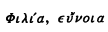 and Greek Interstate Relations
Published online by Cambridge University Press: 08 May 2015
Extract
The ways of emotions are difficult to track, and yet positive affects, such as goodwill and affection, play an important part in both self-definition and social interactions. In western societies popular conception generally considers emotions to be universal spontaneous reactions, but in fact the nature of emotion is an issue debated by both psychologists and cultural theorists. In this paper I wish to investigate the role of positive affects (encapsulated to some degree in the Greek term  , which could range in meaning from benevolence and goodwill to affection, and for which a more precise translation depends on context) in Greek interstate relations. I will argue that was a socially constructed emotion which was implicated in
 -relationships, and therefore that the terminology of contained the expectation of an affective content (whether or not any given -relation in reality contained any positive emotion).
Information
- Type
- Research Article
- Information
- Copyright
- Copyright © Australasian Society for Classical Studies 1997
References
1 See esp. Rosaldo, M.Z., ‘Toward an anthropology of self and feeling’, in Shweder, R.A. and LeVine, R. (eds), Culture Theory: Essays on Mind, Self and Emotion (Cambridge 1984) 137-57Google Scholar.
2 I am using the term ‘positive affect’ throughout in its technical sense of a positive emotional response, whether this was as strong an emotion as ‘affection’ suggests, or something weaker like ‘goodwill’. It should be noted that an ‘affective’ relationship is not necessarily an affectionate one, but that it is simply a relationship which gives rise to emotions of one kind or another. I prefer to use this term instead of other more cumbersome phrases, firstly, because it is a convenient shorthand and, secondly, because it has a legitimate technical usage in the anthropological/psychological literature on this subject.
3 Any study of this kind must be prefaced with a warning: the range of emotions and relationships encapsulating loving, liking, and befriending are very ill-defined within our own culture and as a consequence the problem of trying to pin down Greek concepts such as friendship and affection is exacerbated by the endemic looseness of terminology within our own conceptual frameworks. What, for instance, do we mean by the term ‘affection’? Is it more than liking, but less than love (which are another two terms we have difficulty defining)? Is it something between the two (or both, but at different times) or something else entirely? As a result we are using what is in itself an unstable vocabulary (and there are layers upon layers of difficulties here) to try to locate terms from another language and culture which do not equate exactly with our own concepts, let alone vocabulary. The case is by no means hopeless, but great care must be exercised throughout to ensure that when moving between languages one is not also distorting concepts to fit words with unstable, or at least shifting, meaning.
4 Adkins, A.W.H., ‘“Friendship” and “self-sufficiency” in Homer and Aristotle’, CQ2 13 (1963) 36Google Scholar; cf. id., ‘Homeric gods and the values of Homeric society’, JHS 92 (1972) esp. 11-13; although on the distinction in Homer between  ‘dear’ and ‘one's own’, note also Hooker, J., ‘Homeric
 ' Gioita 65 (1987) 44–65Google Scholar (who sees the sense ‘one's own’ as a later development from ‘dear’, in contrast to Adkins who argues that the two in fact reflect the same usage and demarcate those things on which the Homeric
 relies, whether limbs, tools, weapons or people, ‘in a largely hostile or indifferent world’; cf. Millett, P., Lending and Borrowing in Ancient Athens [Cambridge 1991] 120-1CrossRefGoogle Scholar) and Robinson, D., ‘Homeric . Love of life and limbs, and friendship with one's
 ’, in Craik, E.M. (ed.), Owls to Athens. Essays on Classical Subjects Presented to Sir Kenneth Dover (Oxford 1990) 97–108Google Scholar (who argues that in Homer never has a possessive sense; cf. Konstan, D., Friendship in the Classical World [Cambridge 1997] 29–31CrossRefGoogle Scholar). See also Hands, A.R., Charities and Social Aid in Greece and Rome (London 1968) 33Google Scholar.
5 Goldhill, S., Reading Greek Tragedy (Cambridge 1986) 82CrossRefGoogle Scholar. Compare also Dover, K.J., Greek Homosexuality (London 1978) 49Google Scholar: ‘Philia is “love” in general; the verb is philein, the adjective philos is “dear (to …)”, shading into “own”, “close (to …)”, and when philos is used as a noun it is “friend” (anything on a scale from casual but agreeable acquaintance to intimacy of long standing) or “relative”, one of the “loved ones” or “nearest and dearest” with whom one is regarded as having a nexus of exceptional obligations and claims.’
6 Price, A.W., Love and Friendship in Plato and Aristotle (Oxford 1989) 159-60Google Scholar.
7 Millett (n.4) 109-26.
8 Osborne, C., Eros Unveiled. Plato and the God of Love (Cambridge 1994) 142-7Google Scholar (quotation from 143-4); contra Vlastos, G., ‘The individual as an object of love in Plato’, Platonic Studies (second printing with corrections) (Princeton 1981) 4–5Google Scholar: ‘“Love” is the only English word that is robust and versatile enough to cover  and . Nor is there any difficulty in seeing why Aristotle should undertake to define “love” in order to elucidate the meaning of “friendship”: he thinks of friendship as a special case of interpersonal love.’
9 Konstan, D., ‘Greek friendship’, AJP 117 (1996) 88Google Scholar; id. (n.4) 12, 23. See also Foxhall, L., ‘The politics of affection: emotional attachments in ancient Athens’, in Cartledge, P., Millett, P. and von Reden, S. (eds), Kosmos: Order, Individual and Community in Classical Athens (Cambridge, forthcoming)Google Scholar.
10 Konstan (n.9) 71-94; id., ‘Philosophy, friendship, and cultural history’, in Golden, M. and Toohey, P. (eds), Inventing Ancient Culture. Historicism, Periodization, and the Ancient World (London 1996) 70Google Scholar; id. (n.4) 9-12, 53-6.
11 Konstan (n.9) esp. 88. Compare the use of  and
 at Lysias 13.19: ‘This man Theocritus was and to Agoratus.’ Although and here amount to virtually the same thing, the different words act as a unit to give two different shadings to the relationship, here perhaps emphasising the political colour and the personal, although the range of both words is such that the opposite is also possible.
12 On the various usages of  and
 see Eemstman, J.P.A.,
 : Bijdrage tot de Kennis van de Terminologie der Vriendscnap bij de Grieken (Diss. Utrecht 1932)Google Scholar.
13 Konstan (n.4) 63-4.
14 Konstan (n.4) 83.
15 See also Arist, . Nic. Eth. 8.1155b27–1156a5Google Scholar; cf. Xen, . Mem. 2.6.28Google Scholar; Arist, . Nie. Eth. 8.1156a8, 1157b28-31Google Scholar.
16 Compare also Nie. Eth. 8.1155b33-4Google Scholar (cited below), where Aristotle says that  only becomes when it is reciprocated. It is also worth noting that the elements in the exchange do not have to be material or tangible: see Mitchell, L.G., Greeks Bearing Gifts: The Public Use of Private Relationships in the Greek World, 435–323 B.C. (Cambridge, forthcoming), esp. 18–21Google Scholar.
17 See Millett (n.4) ch. 5; Mitchell (n.16) esp. 4-8.
18 Mitchell (n.16) 3-9.
19 See Price (n.6) 103-30; Osborne (n.8) 139-52.
20 Brunt, P.A., ‘Amicitia in the late Roman Republic’, in The Fall of the Roman Republic and Related Essays (Oxford 1988) 352Google Scholar. As Brunt points out, the similarities between Cicero's amicitia and Aristotle's are not surprising, since Cicero himself must have been drawing on Greek philosophy, just as it would be surprising if Cicero's explication of amicitia was ‘totally irrelevant to the actualities of Roman life as he knew them’ (see esp. 351-61).
21 Cf. Nic. Eth. 9.1166b30-2Google Scholar.
22 Cf. Isoc. 1.2. Note also Whitehead, D., ‘Cardinal virtues. The language of public approbation at Athens’, C&M 44 (1993) 55–74Google Scholar for the development of as a ‘cardinal virtue’ in democratic Athens.
23 I wish to thank Dr I.G. Spence for drawing my attention to this passage, and Prof. R.G. Osborne for discussing it with me.
24 This looks very much like patronage, although not exactly the formal patronus/cliens relationship known from the Roman world. Recent anthropology has tended to disassociate patronage from friendship (contra Pitt-Rivers, J., The People of the Sierra2 [Chicago and London 1971] 140Google Scholar, who described patronage as ‘lop-sided friendship’), since, it is claimed, the essence of patronage is power, not exchange (Gellner, E., ‘Patrons and clients’, in Gellner, E. and Waterbury, J. [eds], Patrons and Clients [London 1977] 1–6Google Scholar; cf. Davis, J., People of the Mediterranean [London 1977] 147-8Google Scholar; Weingrod, A., ‘Patrons and polities’, in Gellner, E. and Waterbury, J. [eds], op. cit. 42Google Scholar). Nevertheless, in this passage Xenophon is clearly using the language of and exchange to describe this relationship, and some very interesting points can be made about the way in which Xenophon describes the relationship and how he shifts between the language of equality and the language of subordination. As already noted, the relationship is described in terms of , which in itself implies a power balance and equality (cf. Arist, . Nie. Eth. 8.1157b33-1158a1, 1158b1Google Scholar), and the suggestion is made, whatever the real situation, that Diodorus and Hermogenes are social equals (which is not surprising given the democratic ideology of equality in Athens: see Brock, R., ‘The emergence of democratic ideology’, Historia 40 [1991] 160-9Google Scholar). This is reinforced by the attributes of such . He will be willing, well disposed, steadfast, and will search out ways to help his , all qualities one would look for in any ‘companionable’ (compare the relationship between Orestes and Pylades: e.g., Eur. Or. 802-6). And yet, despite all the indications that this is at least a notionally equal relationship, this kind of is described as a  (unequivocally indicating his subordination), who will do as he is told (although this is immediately qualified with the statement that he will also be able to think for himself and act independently), and who can be ‘bought’ (and cheap at half the price!). This is indeed a relationship about power—Diodorus does go out and ‘buy’ Hermogenes—but the ideology and rhetoric of also seek to conceal this power relation (compare also the use of amicus and amicitia to disguise patronage relationships: see Brunt [n.20] 361, and esp. id., ‘Clientela’, in The Fall of the Roman Republic and Related Essays [Oxford 1988] 394-5)Google Scholar.
25 See esp. Mitchell (n.16) 9-14.
26 For this passage as evidence for the Stoics' doctrine of the common kinship of all mankind, see also Garnsey, P., Ideas of Slavery from Aristotle to Augustine (Cambridge 1996) 144Google Scholar.
27 Earp, F.R., The Way of the Greeks (Oxford 1929) 32-3Google Scholar.
28 Dover, K.J., Greek Popular Morality in the Time of Plato and Aristotle (Oxford 1974) 273-8Google Scholar.
29 Blundell, M.W., Helping Friends and Harming Enemies. A Study in Sophocles and Greek Ethics (Cambridge 1989) 39–49CrossRefGoogle Scholar.
30 That  could be hereditary is surely the inference of Homer, Iliad 6.213-31Google Scholar (despite Konstan [n.4] 36-7), and is certainly implied at Lysias 18.10-11; cf. Isoc. 1.2.
31 See K.J. Dover (n.28) 180-4; Blundell (n.29) esp. 26-31; Goldhill (n.5) 79-106. On polarity as a form of argumentation, see Lloyd, G.E.R., Polarity and Analogy. Two Types of Argumentation in Early Greek Thought (Cambridge 1966), Part IGoogle Scholar.
32 See Brunt (n.20) 361-7.
33 See Mitchell, L.G. and Rhodes, P.J., ‘Friends and enemies in Athenian polities’, G&R 43 (1996) esp. 13–14Google Scholar.
34 See also p. 32 above.
35 See, e.g., [Dem.] 58.39-40.
36 Mitchell (n.16) ch. 10.
37 See esp. Mitchell (n. 16) ch. 2.
38 = Osborne, M.J., Naturalization in Athens (Brussels 1981-3) D22 (in vol. 1)Google Scholar.
39 For the award of citizenship to Satyrus and Leucon (which was passed on as a gift to Spartocus and Paerisades: Dem. 20.29-35 [where the granting of citizenship is again described as the giving of  ]): Tod 167; Osborne (n.38) 3.41-4.
40 Hornblower, S., Commentary on Thucydides (Oxford 1991–1996) 1.306-7Google Scholar.
41 Cf. Hooker, J.T., ‘ and
 in Thucydides’, Hermes 102 (1974) 164-9Google Scholar, contra Missiou, A., The Subversive Oratory of Andokides. Politics, Ideology and Decision-making in Democratic Athens (Cambridge 1992) 114-21Google Scholar.
42 Giovaninni, A., ‘Greek cities and their commonwealth’, in Bulloch, A., Gruen, E.S., Long, A.A. and Stewart, A. (eds), Images and Ideologies: Self-definition in the Hellenistic World (Berkeley 1993) 274Google Scholar.
43 See esp. Homblower (n.40) 2.61-80.
44 On in Isocrates, see de Romilly, J., ‘Eunoia in Isocrates or the political importance of creating good will’, JHS 78 (1958) 92–101CrossRefGoogle Scholar.
45 Curty, O., Les Parentés légendaires entre cités grecques. Catalogue raisonné des inscriptions contenant le terme SUGGENEIA et analyse critique (Geneva 1995) no. 4Google Scholar.
46 Isoc. 8.21: 


 .
47 = Tod 178; Osborne (n.38) D16 (in vol. 1); the grant was probably renewed for fighting with the Athenians at Chaeronea (Aeschin. 3.98, 256: see also Osborne [n.38] 2.84).
48 Although not all  were hereditary; for the kinds of and the methods of appointment, see Mitchell (n.16) 28-37.
49 = Walbank, M.B., Athenian Proxenies of the Fifth Century (Toronto 1978) no. 1Google Scholar.
50  Xen, . Hell. 6.4.24.Google Scholar His father had also been a
 to the Thebans. For Jason's motives, see Tuplin, C.J., The Failings of Empire. A Reading of Xenophon Bellenica 2.3.11-7.5.27 [Historia Einzelschriften, 76] (Stuttgart 1993) 118Google Scholar.
51 = Tod 160; see also Tod's commentary to the text. For the Tenedians' loyalty to the Athenians: Tod 175.
52 = ML 47.
53 = Tod 68.
54 [Arist] Ath. Pol. 23.5.Google Scholar
55 On the Athenians’ Thracian policy, see Mitchell (n.16) ch. 7.
56 Cf. Dem. 23.114; [Dem.] 12.8-9. Note also that although Demosthenes suggests that those granted Athenian citizenship ought to move to Athens, this was not practical for a number of honorands (such as the Thracian kings). Nevertheless, as part of his rhetoric, it is effective, since one of the expectations inherent in the naturalisation process was that new citizens would participate in the Athenian state, whether in fact they did or not: see Mitchell (n.16) 37-9.
- 6
- Cited by