History of Discussion
‘Sr. Panciera told me kindly that the inscription cannot be found right now in Rome.’ Such was the report to Valentin Kockel in the early 1990s as he drew together portrait reliefs from Roman gravesites of the late republic and early imperial periods.Footnote 1 Certainly there is no photograph or sketch attached to CIL 6.16019 in the vast collection assembled in the Clauss-Slaby Epigraphik-Datenbank.Footnote 2 Kockel was compelled substantially to rely on the description provided by Friedrich Matz and F. von Duhn from over a century earlier,Footnote 3 even if he felt drawn to somewhat different conclusions. Previous notices date back to the late seventeenth century and locate the inscription (with or without mention of the relief) consistently in relation to the Villa Nobilis/Spada and the Porta Aurelia (a third century construction), sometimes mentioning the church of San Pietro in Montorio. At that time, the housing structures were sparse, with most of the land being given to agriculture.
Given the propensity of necropoleis to be positioned adjacent to main thoroughfares in late Republic and Imperial times,Footnote 4 these funerary panels are most likely to have been wrested from grave structures alongside or near the Via Aurelia. This is the nearest ancient main road to the recorded positions,Footnote 5 even allowing that stones can, at times, wander significant distances.Footnote 6 The Via Aurelia, dating from 241 bce,Footnote 7 connected the Janiculum hill with its fortifications (the Arx Ianiculensis)Footnote 8 and other key delineations (the Ara Fontis, the Pagus Ianicolensis, for example)Footnote 9 to the ancient walled city via the Pons Sublicius.Footnote 10 From there, the Via Aurelia ran initially to the west and then north up the coast, eventually securing access to Gaul. The roadway, especially close to the city (and cities to the north) was therefore an ideal place for the display of graves, outside the city wall (the pomerium) as required by the foundational Twelve Tables,Footnote 11 and yet positioned to maximize the display of status-packed memorialization of the dead.Footnote 12 Even with the shift in elite fashion to garden areas slightly away from roadways during Augustus’ reign,Footnote 13 access remained critical. The roadway also provided the avenue for the funeral procession for the deceased and for anniversary visitations by interested successors.Footnote 14
The text of the inscription appears to have been first recorded by Carlo Malvasia (in 1690) who placed it in the vineyards of the Nobilis near San Pietro in Montorio,Footnote 15 that is, on the Janiculum Hill. He provided puncts for lines 1 and 4 only. Raphael Fabretti adjusted the location to indicate that it was actually in the property of the Villa Nobilia that came to belong to the Spada family in 1689 and which was near the Porta Aurelia.Footnote 16 It should be noted that the Aurelian Walls were built later than this inscription and relief, that is, in the third century ce, so the reference ought not to be construed anachronistically. The estate itself may go back to the eleventh century but early renaissance maps of Rome show few habitations, the bulk of the land being given to farming. This adds weight to the intimations of a necropolis located here in the early principate, probably associated with the so-called Columbarium of Bartoli located in proximity (‘fuori la Porta Aurelia’) to the designated find-spot for this inscription.Footnote 17 Neither Malvasia nor Fabretti mentioned an accompanying relief panel, though it should be recognised that the concentration in such compilations was on the inscription rather than the relief – there is no indication, for example, of the moulding surrounding the inscription (though Pietro Bartoli was attuned to such observations in his work). The content of inscriptions was privileged. Nevertheless, giving the same location, a letter of Johannes Christophorus Amadutius, published in 1740 mentioned a relief in association with the inscription: cui superstant duo capita Viri, & Mulieris.Footnote 18 It is clear that Amaduzzi understood the inscription and relief as belonging together.Footnote 19
A fuller notice of the relief itself was provided by Friedrich Matz and F. von Duhn in 1881, who added that the Villa Spada was, in their time, known as the Villa Wedekind, an indication of the changes and building additions that impacted the area in the second half of the nineteenth century:Footnote 20
L. [Links] Brustbild einer Frau, in guten Jahren, aber noch nicht ältlich, das Obergewand über den Kopf, die Haare einfach gescheitelt, die r. [rechte] Hand vor der Brust aus dem Gewande kommend; r. [rechts] Brustbild eines ältlichen Mannes, die r. [rechte] Hand ebenso vor der Brust; breite flache Stirn, das Haar in traianischer Weise geschnitten. Augensterne sind noch nicht angegeben. Beide Köpfe sind einander leicht zugewandt. Die Nasen waren ergänzt und fehlen jetzt.Footnote 21
They interpreted the two panels as a unit, noting that the inscribed stone was ‘from the same marble and has the same dimensions’.Footnote 22
The Corpus Inscriptionum Latinarum entry (6.3.16019) abbreviated this relief description to protome mulieris | protome viri imberbis but more recently Hans Frenz and then Valentin Kockel returned to Matz/von Duhn’s material.Footnote 23 It is clear that neither had seen the relief and inscription themselves.Footnote 24 However, on the basis of their brief description, and by reference to stylistic features derived from other reliefs that he had viewed, Kockel decided that the woman’s hairstyle did not necessarily fit a Trajanic period, that the shift of description of location from the Church of San Pietro di Montorio to the Porta Aurelia meant a shift of location for the stone/stones, that the marble and finish of the panels were likely different and, hence, that the two panels were likely originally separate – all this without having viewed the panels.
The Panels
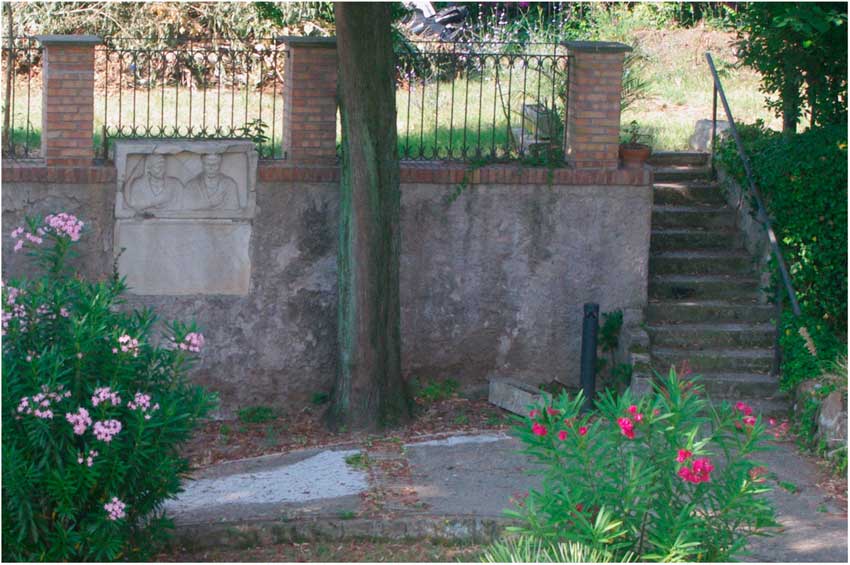
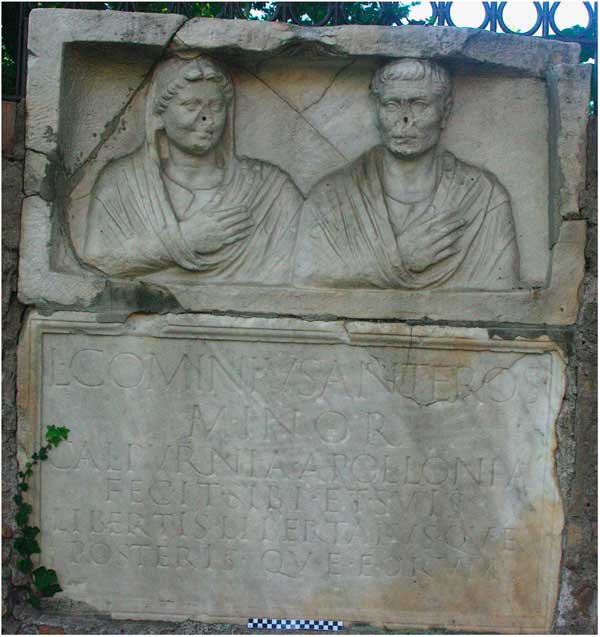
The two panels, one inscribed, one with relief, were found set into a garden retaining wall (Figure 1) in the grounds of the Rome Campus jointly operated by the Catholic University of America and the Australian Catholic University in Trastevere, Rome.Footnote 25
The two panels set into a garden retaining wall at the Rome Centre of the Catholic University of America and Australian Catholic University, Trastevere, Rome.
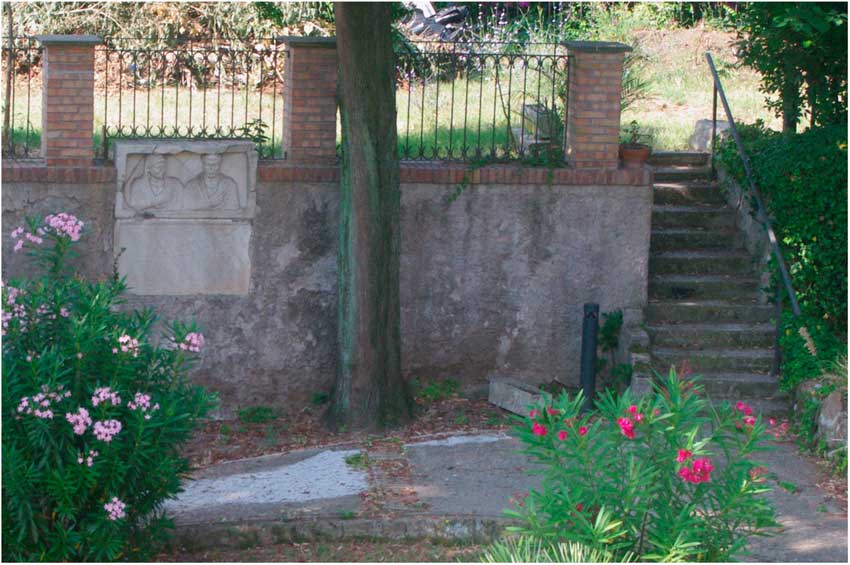
Some damage to both panels (especially the upper) has been sustained over time with concrete used to deliver rough repairs ensuring that the panels remain relatively intact. A new iron balustrade, sectioned by brick columns, has been added in the recent past, specially designed to accommodate the upper panel that rises above the upper ground level. The panels cannot be assumed to have belonged, originally, to the same monument on the basis of their current common location or their collation noted by Amaduzzi in the eighteenth century (see above). Consequently, issues of dating must be approached separately for each panel.
The Upper Panel
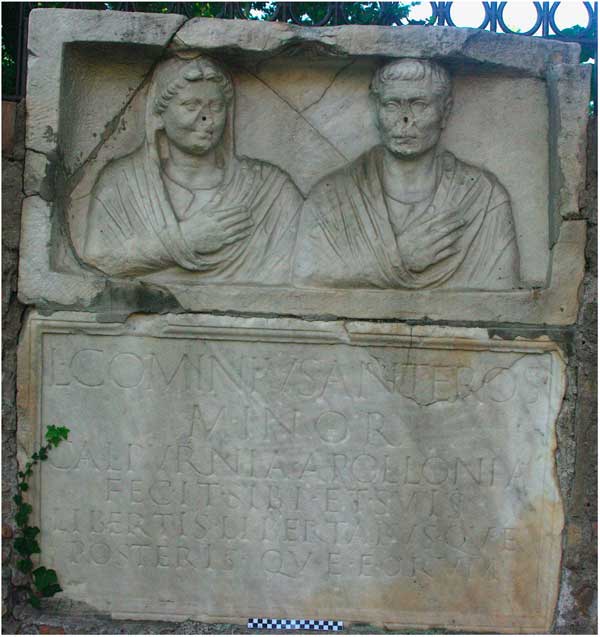
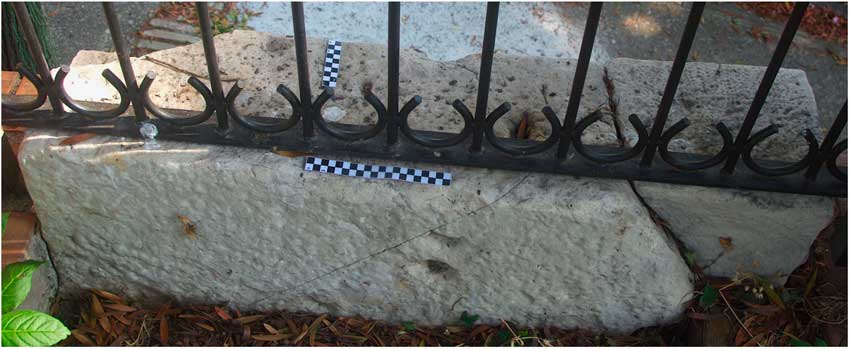
The deeply set relief (Figure 2) presents two figures, female and male, whose faces are turned towards each other, the woman at greater angle towards the male. Both have their right hands extended across their chest, with arms covered by their garments.Footnote 26 The female, at the left, has a section of her palla across the back half of her head as a veil, with a fringe of short curls visible. The male, at the right, is beardless and has short-cropped hair with a simple fringe. A gentle furrowed brow is apparent. The noses of both figures are missing and show evidence of some attempt at past repair. Some chipping is visible on the chins of both faces. The panel at front and rear betrays significant cracks; it is only held in position by its securing with cement and by its positioning within the retaining wall. A section of stone is missing at the right rear (Figure 3), but the existing rear section appears roughly chiselled rather than fractured. The fractures around the left side of the female figure at the front (Figure 2) suggest that the narrower depth of stone visible at the top of the panel runs down the entire width, suggestive of a significant later repair designed to restore the frame. The chiseling strikes on this section of the frame are different from the larger section. The loss of the woman’s elbow is corroborative.
The two panels.
The top and rear of the upper panel.
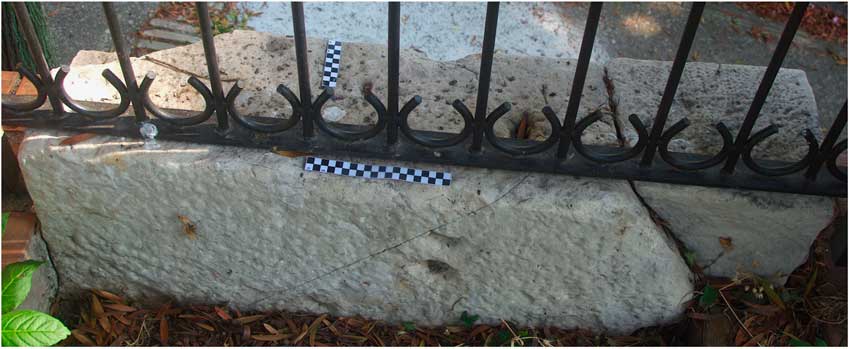
The frame and background to the figures have not been fine-smoothed (as compared to the lower panel). Dowel marks are visible in the section of the rear of the stone extending above ground level. These (and the cracks) indicate that the panel has been removed from its original placement.
H: 0.65; W: 1.20; D: 0.27.
The presentation of the two figures of the relief is typical of a married couple, though there is nothing within the relief to seal this judgment made by Amadutius in 1740 (see above). But the evocation of conventionality alone is suggestive of compliance with the Augustan moral revolution that coloured the first century. The sobriety of the male figure, with public face meeting the gaze of the viewer, is accented by the wrinkled lines of his forehead and by the controlled hair-style with its locks carefully placed in a horizontal line across the forehead (neither slightly unkempt in the pseudo-Alexandrian fashion of some Augustus portraits nor accenting the temple through the curvature of the frontal hair-line). The combed-forward strands of hair at the right side of the face further reduce the appearance of the temples – a feature that Diana Kleiner saw as characteristic of the late Republic male hair-style.Footnote 27 A similar stylistic presentation is found on coins of Gaius Caesar (Agrippa’s son), Germanicus (Caligula’s father) and even of Claudius,Footnote 28 though there are parallels on some reliefs from mid-Augustan times.Footnote 29 But what is clear is the measured, considered placement of the hair, the temperate address of the public and the careful folds of the toga.
The conventionality of the woman’s position in the inscription (second after the male and diminished in letter size) is paralleled in the relief. Her head is turned more pronouncedly towards her husband than his towards her – ‘giving him visual supremacy’.Footnote 30 The positioning of his head combines an acknowledgment and reinforcement of their relationship with a stance yet towards the world – the proper combination of responsibilities factored for the paterfamilias, according to Pliny the Elder.Footnote 31
Her veil is a strong indication of piety and probably an indication of her matronly position. Coin legends leave no doubt that pietas is the particular association to be given to such iconographic representation.Footnote 32 The positioning of the veil covering approximately half the hair is an inflection found elsewhere as well. Terracotta votive figures from the Sanctuary of Fortuna Primigenia similarly cover half the head, thus combining both the (haired) glory and the (covering) piety of the woman.Footnote 33 Some coins and gems present a similar feature. Livia, for example, is veiled over the back half of her head, allowing the curled fringe to be clearly visible, almost accented by a stephane / vitta hair band.Footnote 34 It is not quite clear whether the female in the relief wears a stephane as well as her veil. But the hairstyle is closer to that of Livia than to the raised and tightly-curled coiffure – albeit still veiled – that became fashionable at the end of the first and beginning of the second century ce,Footnote 35 or to the more ostentatious nodus style gathering at the front of head that also appears on sculpted heads of Livia. Certainly, the curled locks, symmetrically twisted gently away from a central parting, is strongly reminiscent of a number of reliefs dated to the time of Augustus.Footnote 36 Accordingly, the relief can be dated with some confidence to the first half of the first century ce and, probably, to the Augustan period.
The Lower Panel
The lower panel is carefully polished with a simple moulded frame. There is a shear fracture at the upper right part of the stone but it appears to be held secure by its position in the retaining wall and by the upper panel. The Latin inscription of six lines is complete.
H: 0.65 W: 1.20; D: ?
The letter sizes vary. The letters of line 1 are 0.075 with the first two letters 0.08. The letters of line 2 are 0.07; those of line 3 are 0.06. Lines 4-6 are 0.050 (0.055 for extended I).
The text reads:

Translation: Calpurnia Apollonia erected the memorial for L. Cominius Anteros Minor, for herself and for her freedmen and women and their descendants.Footnote 37
In the absence of any specific calendrical reference, any dating based on letter forms must be tentative. Other elements sometimes deployed – formulae and onomastics – offer little here: the formula of ll. 4-6 is ubiquitous over a long period of time; the names Anteros and Apollonia are Greek names frequently found in Latin inscriptions. The Greek name Ἀντέρως occurs 95 times in the LGPN Footnote 38 with little hint of servility. However, the editors of the volume covering southern Italy and Sicily,Footnote 39 made a decision to include occurrences known from Latin inscriptions. In fact, all the 23 instances they provide are in Latin. The inclusion of these Latin names as evidence for ‘Greek personal names’ is accompanied by a noticeable entrance of servility among the bearers (with five instances given as likely freed). The trend increases markedly once under the ambit of Rome, providing a regional accent not found elsewhere.Footnote 40 Heikki Solin lists 190 instances, the majority slaves or freedmen (136/137) but, with 53 examples judged uncertain (including this instance), the possibility of free status for the two recorded in 16019 remains,Footnote 41 even if servility is strongly intimated. Ἀπολλωνία is even more frequent (190 times in the LGPN) but less so in Italy and Sicily (only 9 instances, with 7 given in Latin). Solin records 61 instances, over half of which he gives as status-uncertain, including, again, this inscription.Footnote 42 Earlier writers were less reserved; Maximilian Lambertz, for example, readily saw a raid on minor Greek deities such as Anteros for slave names in Rome.Footnote 43 ‘Most slaves bore Greek names,’ according to Kajanto,Footnote 44 but this did not mean that only slaves (or freed) bore Greek names.
So, to the epigraphical style itself. The single column inscription is carefully formed, with the lines centred and descending in size (a masonic reinforcement of hierarchy). The letters of line 1 are 0.075 with the first two letters 0.080. The letters of line 2 are 0.070; those of line 3 are 0.060. Lines 4-6 are 0.050 (0.055 for I longa). Serifs are ubiquitous on finials and sweeping tails are given for the Q and R; there are three instances of I longa (in SVIS in l.4, the second I in LIBERTIS in l.5; the I in POSTERIS in l.6), but the irregular application suggests either mere adornment for a final syllable or casual accenting. Puncts are used to divide words, including the suffix que (ll. 5, 6).Footnote 45 Only one abbreviation occurs, for the praenomen in the first line, even though other epitaphs frequently abbreviate various of the elements in ll. 4-6.Footnote 46 These inscribed features are all common in the monumental style of the first century, particularly from the time of the emperor Tiberius.Footnote 47 Joyce and Arthur Gordon found a predominance of the long I in the period from Augustus to Nerva but with sufficient occurrence in the following century and a half as to render it, alone, doubtful as evidence of date; however the long tail of the letter Q seemed ‘most often found in the period Tiberius-Nero’.Footnote 48 The absence of Diis manibus is supportive but not conclusive.Footnote 49 Solin simply listed the inscription as belonging to the first century ce,Footnote 50 though he did point out that the name Anteros reached a peak incidence in Rome during the period Augustus-Nero.Footnote 51
Conclusion
The re-discovery of a relief and inscription first attested in the seventeenth century but whose whereabouts had been lost amidst the rapid urbanization of the Janiculum Hill in the late nineteenth century, has restored two significant artefacts to scholarship. Detail about the various elements, not previously recorded, is now able to be provided – dimensions, condition and repair, details of epigraphical style. The substantial question of whether the two panels originally belonged together or whether some ‘rescuer’ in the distant past decided that the inscription was fittingly expressed visually by the relief has not been decided. The dating for both panels does carry some overlap but the date range is broad. If anything, the relief might be dated earlier than the inscription. The Greek names given in the inscription in citizenship formula might as a default position point to freed status but Henrik Mouritsen warns us that the late Republic and early Imperial periods witness a striking range of status in the bearing of Greek names.Footnote 52 Certainly both Anteros and Apollonia are carried by slave, freed and possibly free-born. The ‘Minor’ of Anteros’s name does suggest a succession of some kind (whether father to son or between brothers, less likely of identically named slaves within an elite household), though again without conclusively pin-pointing status origins. The relationship between Anteros and Apollonia again cannot be conclusively decided, though, the intimation of a marriage must be one relationship to be weighed. That intimation is stronger in the visual presentation of the relief but, similarly, requires further evidence to confer confidence. At least now, a provenience and photographs have yielded a more secure foundation for research than the reliance on older records.Footnote 53