In one of his longer hexametrical fragments, Empedocles addresses his protégé Pausanias, predicting or promising that he will learn pharmaka, a word that is usually understood to mean herbal ‘drugs’ or ‘remedies’ for disease, an interpretation that in turn seems to have been encouraged by a modern understanding that Empedocles was an empirically minded medical doctor.Footnote 1 To be sure, the metaphorical extension of the word from ‘medicine’ or ‘remedy’ to ‘charm’ or ‘spell’ is a natural one,Footnote 2 but there is more at stake here, because Empedocles’ pharmaka seem to have a protective, rather than curative function and they seem to have the power to control the weather and summon souls from the underworld. An alternate interpretation is suggested, then, by the recently published Getty Hexameters which use the word pharmaka several times to refer to hexametrical incantations that will protect a group of houses or a city from danger. These hexameters, moreover, are inscribed on a lead tablet of late classical date that most probably came from the Sicilian city of Selinus, a date and a provenance that put its composition in close proximity to Empedocles himself.
The argument below begins with a close reading of the fragment in question (D-K 111) and the related passages in the Getty Hexameters, before proceeding in two movements: in the first, I will show that fragments of Empedocles’ biographical tradition, two of which go back at least to third-century BCE Sicily (Timaeus and Satyrus), reveal him to be a performer of sorcery or incantations aimed at protection; and in the second, I will add further support to the argument that the Empedoclean pharmaka are ‘incantations’, rather than ‘drugs’, by adducing some crucial, but neglected evidence, from Plato's Laws and from Gorgias’ Encomium of Helen. I should also say at the outset that the debate set in motion by the publication of the Strasbourg papyrus concerning the number or titles of Empedocles’ poems need not detain us, because in what follows I give a close reading of only two fragments of his poetry, without any discussion of their place in his corpus.Footnote 3
Empedocles’ Pharmaka and the Getty Hexameters
We begin with D-K B111:Footnote 4
Diels admitted that one could sum up the contents of this fragment as ‘magic’ and then he proceeded to bury it at the very end of his edition; others have followed suit.Footnote 6 Van Groningen, for his part, described it as ‘pure magie’, and he even declared it a forgery.Footnote 7 And at least one ancient author designated such activities as ‘magic’: the author of the Hippocratic diatribe On the Sacred Disease condemns ‘magicians, purifiers, charlatans, and quacks’ (μάγοι τɛ καὶ καθάρται καὶ ἀγύρται καὶ ἀλαζόνɛς, Morb. sacr. 4.1) who ‘profess to know how to bring down the moon, to eclipse the sun, to make storm and sunshine, rain and drought, the sea impassable and the earth barren, and all such wonders’.Footnote 8 Empedocles's boasts, then, are in partial accord with those of other itinerant ‘sorcerers’ of the fifth century BCE.Footnote 9
The syntax of the fragment deserves closer scrutiny. Empedocles begins this passage by claiming that the addressee of his poem, who is elsewhere named Pausanias (literally ‘He who stops grief or troubles’),Footnote 10 will learn pharmaka, an important word, as its placement emphasizes at the very start of the passage. Translators and commentators, taking their cue from Homeric usage and relying on a somewhat limited modern view of Empedocles as a doctor or physician dispensing medicinal herbs, usually translate pharmaka as ‘potions’ or ‘remedies’, to take a recent example: ‘All the potions, which are a defense against evils and old age, you shall learn.’Footnote 11 According to this approach, the word pharmaka refers only to the first two verses and the deictic pronoun τάδɛ at the end of the second line, refers back to the pharmaka mentioned in the preceding verse. But it is unclear how these ‘potions’ or ‘drugs’ can be protective, rather than curative, because the word ἄλκαρ at the end of the first verse never means ‘cure’ in Greek, but rather ‘protection’ or ‘defense’.Footnote 12 A better approach, I suggest, is to understand that τάδɛ πάντα looks forward, rather than backwards: ‘since for you alone I shall accomplish these (i.e. the following) things’. In this case the pronoun refers, as it is translated above, to all of the activities that follow, which are therefore to be accomplished by means of pharmaka.Footnote 13 The traditional reading also does not explain why Empedocles composed lines 3–9 as a complete unit bounded by ring composition:Footnote 14 the first and last actions are concerned with manipulating the μένος of the winds (3) and the μένος of a dead man (9), a parallel that is underscored by the repetition in the same line position of the words καταφθινύθουσιν (4) and καταφθιμένου (9).
Empedocles, then, posits a general category of pharmaka that are ‘a defense against evils and old age’ and then he lists a number concrete examples of evils (destructive winds, drought, and floods) in the verses that follow as well as the puzzling reference to leading up the strength of a man who has perished. We might have expected Empedocles to boast in line 1 that his teaching will overcome death, in addition to old age, and indeed scholars have noted how this verse seems to challenge the claim made by the composer of the Homeric Hymn to Apollo (192–93), that mortals are unable to find ‘a cure for death or a defense against old age’ (θανάτοιό τ’ ἄκος καὶ γήραος ἄλκαρ).Footnote 15 The problem in our text at the end of the preceding verse (8) may hint, in fact, that something dropped out at this point, a common enough occurrence in lists. In the final verse, modern scholars have, in fact, seen a specific reference to the story that Empedocles revived a woman after thirty days in a coma, but it is clear that Pausanias will learn pharmaka not to revive nearly dead people, but rather to lead up from Hades a person ‘who had (i.e. already) died’.Footnote 16
But if Empedocles does indeed teach herbal pharmaka, how might Pausanias use them to control the weather or return the dead to the living? The Hippocratic diatribe mentioned earlier describes some people who ‘by acting as a magos and sacrificing’ (μαγɛύων καὶ θύων) could ‘bring down the moon, eclipse the sun, and create both storm and calm’ (σɛλήνην καθαιρήσɛι καὶ ἥλιον ἀφανιɛῖ καὶ χɛιμῶνα καὶ ɛὐδίην ποιήσɛι, Morb. sacr. 4.31–32). It is, of course, difficult to imagine accomplishing any of these actions by means of drugs or potions, a herbal understanding of Empedocles’ pharmaka has in the past been encouraged by Homeric usage, where pharmaka are always herbal, described either as ‘helpful’, in which case we understand them to be curative drugs or remedies, or as ‘baneful’, in which case they are ‘poisons’. Homer, moreover, says they were the expertise of the god Paean, who on different occasions cured Hades and Ares by ‘smearing on pain-killing pharmaka’ (Il. 5.401 and 900), and who, in the description of the powerful drug (pharmakon) given to Helen by an Egyptian woman named Polydamna, is said to have been the ancestor of the people of Egypt, where everyone is a skilled healer (Od. 4.227–32).Footnote 17
This traditional understanding of both pharmaka and the god Paean was, however, recently upended by the Getty Hexameters, a series of protective incantations preserved in dactylic hexameters on a lead tablet of late fifth-century date, which is presumed to come from Selinus.Footnote 18 The different incantations are divided by refrains or rubrics clearly referring to Paiēōn (i.e. Paean) as the creator of verbal, rather than botanical, pharmaka, which are primarily used to protect, rather than heal:Footnote 19
Paiēōn—(I invoke your name) becauseFootnote 20 you send protective incantations in every direction, after indeed you utteredFootnote 21 the following immortal verses for the sake of mortal men (followed by a hexametrical incantation, lines 8–20)
[Paiēōn,] for you yourself send protective incantations! (followed by a hexametrical incantation, lines 24–31)
Each of these refrains, then, claims Paean as the composer of the incantatory verses (pharmaka) that follow. This is especially clear in the first instance, where the added verse says specifically that he did so after he ‘uttered the following immortal verses (τάδɛ φωνήσας ἔπɛ’ ἀθάνατα) for the sake of mortal men.’ Here again, we see the common deictic use of τάδɛ that looks forward to the dactylic hexameters that follow. These refrains also explain that these pharmaka are (like Empedocles’) generally protective, not curative: in three cases, they are described as ἀλέξιμα, a word which means ‘protective’ or ‘aversive’ and implies that they ward off dangers and troubles when spoken aloud or inscribed on an amulet. In the third case Paean himself is described differently as an excellent ‘bringer of cures’ (ἀκɛσσφόρος), suggesting that in this case, at least, the text that follows was curative.
These verses dramatically alter, of course, our traditional thinking about Paean, who as we saw earlier is closely aligned with herbal pharmaka. But as Rutherford has stressed, Paean is also a patron and an embodiment of an early genre of protective compositions, sometimes in hexameters, that ask Apollo to protect young men in times of plague and other disasters.Footnote 22 The Getty Hexameters, then, encourage us to pursue the idea that the pharmaka that Empedocles promised to teach Pausanias were indeed verbal pharmaka or ‘incantations’, perhaps accompanied by some ritual action, as we saw in the case of those condemned by the Hippocratic author, who accomplished similar marvels by ‘acting as a magos and sacrificing’ (μαγɛύων καὶ θύων). It is important to note as well that the hexametrical form of the incantations preserved in the Getty Hexameters is the same form that Empedocles composed all of his poetry.Footnote 23 The early biographical tradition, as we will see below, supports this claim, when it describes Empedocles himself performing similar acts of sorcery and links these descriptions closely to the poet's boasts in D-K 111.
Empedocles the Sorcerer in the Earliest Biographies
Because of the practice in critical editions of separating biographical information from Empedocles’ actual fragments, scholars sometimes miss the fact that some of Empedocles’ ancient biographers understood that the pharmaka in D-K 111 were indeed incantations and they were able to cite episodes from the poet's life to back up these assertions, episodes that (they claimed) were also narrated in his poems. Indeed, just before Diogenes Laertius quotes the fragment in full, he reports the following:
φησὶ δὲ Σάτυρος ἐν τοῖς Βίοις ὅτι καὶ ἰατρὸς ἦν καὶ ῥήτωρ ἄριστος. Γοργίαν γοῦν τὸν Λɛοντῖνον αὐτοῦ γɛνέσθαι μαθητήν, ἄνδρα ὑπɛρέχοντα ἐν ῥητορικῇ καὶ Τέχνην ἀπολɛλοιπότα· . . . . τοῦτόν φησιν ὁ Σάτυρος λέγɛιν ὡς αὐτὸς παρɛίη τῷ Ἐμπɛδοκλɛῖ γοητɛύοντι. ἀλλὰ καὶ αὐτὸν διὰ τῶν ποιημάτων ἐπαγγέλλɛσθαι τοῦτό τɛ καὶ ἄλλα πλɛίω, δι᾿ ὧν φησι· “φάρμακα δ᾿ ὅσσα γɛγᾶσι κακῶν καὶ γήραος ἄλκαρ …”
Diog. Laert. 8.58–59 [ = Satyr. fr. 12 FHG 3.162]Satyrus in his Lives says that he (i.e. Empedocles) was also a healer and an excellent orator: at all events Gorgias of Leontini, a man pre-eminent in oratory and the author of a treatise on the art, had been his pupil. . . . Satyrus quotes this same Gorgias as saying that he himself was present when Empedocles performed goēteia. Nay more: he contends that Empedocles in his poems lays claim to this power and to many more, when he says: “all the pharmaka, that are a defence to ward of ills and old age …”
Translation by Hicks (Reference Hicks1925), slightly modified.It seems clear, therefore, that as early as the third century BCE, the Peripatetic biographer Satyrus believed that in D-K 111 Empedocles ‘proclaims’ (the verb is ἐπαγγέλλɛσθαι) his expertise in sorcery. It is impossible to know from this passage precisely what kind of sorcery Gorgias watched Empedocles perform. The Greek verb γοητɛύɛιν is cognate with the lament (γόος) for the dead and some have argued that γοητέια originally referred to incantations and rituals designed to either placate the spirits of the dead or to raise them up and use them for cursing or prophecy.Footnote 24 Although by the end of the fifth century BCE γοητέια was also used as blanket term, sometimes derogatory, for sorcery or magic, it seems possible, nevertheless, that Gorgias claimed to have seen Empedocles performing necromancy, which is yet another way to interpret the very last promise that Empedocles makes to Pausanias in D-K 111: that he will ‘lead out from Hades the strength of a dead man.’Footnote 25
The biographical tradition encourages us to look at another of the procedures that Empedocles promises to teach Pausanias—the control of the winds—because there is, in fact, much evidence that the Greeks did attempt such things with sympathetic actions, prayers, and incantations.Footnote 26 More importantly, Diogenes Laertius, directly after quoting D-K 111 cites the third-century BCE historian Timaeus, himself also a Sicilian, for the popular anecdote that Empedocles himself was thought to have ‘prevented’ dangerous winds in similar fashion:Footnote 27
καὶ γὰρ ἐτησίων ποτὲ σφοδρῶς πνɛυσάντων ὡς τοὺς καρποὺς λυμῆναι, κɛλɛύσας ὄνους ἐκδαρῆναι καὶ ἀσκοὺς ποιɛῖσθαι πɛρὶ τοὺς λόφους καὶ τὰς ἀκρωρɛίας διέτɛινɛ πρὸς τὸ συλλαβɛῖν τὸ πνɛῦμα· λήξαντος δὲ κωλυσανέμαν κληθῆναι.
Timaeus FHG 1.215–16 apud Diog. Laert. 8.60For, when the Etesian Winds were once blowing violently enough to blight the crops, he commanded that asses be flayed and bags (askoi) be made (i.e. from the skins) and he distended them along the hills and ridges in order to capture the pneuma (i.e. of the winds). And after it ceased, he was called “He who prevents the winds”.
Translation by Hicks (Reference Hicks1925) loc. cit.Some scholars suggest that the biographers fabricated this incident from the boast in D-K 111 that Pausanias will master the winds,Footnote 28 but the final two words in Satyrus’ account κωλυσανέμαν κληθῆναι would have nicely filled the second half of a dactylic hexameter and suggest that Empedocles himself may have described this incident elsewhere in his poetry. It also may be significant that Nicomachus of Gerasa preserves, as an alternate version of the Empedocles’ title κωλυσανέμας, the title ‘He who averts the winds’ (ἀλɛξανέμας), which is metrically very similar and suggests that in the oral or manuscript tradition at least two different versions of the episode survived.Footnote 29
The process that Empedocles deploys in this anecdote is not at all clear.Footnote 30 Some modern commentators, relying on the older understanding of Empedocles as an early scientist, suggest a kind of massive engineering project, which involved stretching an untold number of donkey-skins as a physical barrier to prevent the winds from reaching the agricultural crops,Footnote 31 but this is not, in fact, what the passage says: the ass-skins were fashioned into ἀσκοί, a kind of sack that was commonly used as a wine-skin, and we are never told that these sacks were then stitched together as a continuous barrier or wall. Therefore, when Timaeus says that Empedocles ‘distended’ the bags (the verb is διατɛίνɛιν) along the hills, he probably means that the bags were set up on hills in such a way that the wind filled them up with air, somewhat like the ‘wind-socks’ used at modern airports to test wind direction. Such wine-skins would not, of course, physically prevent the winds from reaching the crops of Akragas and it seems that Empedocles was credited with some kind of metonymic ritual that was also apparently known in Homeric times and later. In the Odyssey, for example, we hear of a mortal man named Aeolus, who gave Odysseus a leather askos to control the winds:Footnote 32
Empedocles, I suggest, had this passage in mind when he boasted to Pausanias: ‘You will stop (παύσɛις) the power of the weariless winds … and again, if you want (ἢν ἐθέλῃσθα), you will lead the winds back.’ In this case, Aeolus binds Euros (East Wind), Notos (South Wind) and Boreas (North Wind), in order to allow Zephyros (West Wind) alone to carry Odysseus’ ship homeward. And like Empedocles, Aeolus creates his askos out of a special leather (the skin of a nine-year old ox) and he also receives an important title: ταμίης ἀνέμων (‘Controller of the winds’). At an earlier point in the wanderings, Athena, because she wished to move Odysseus’ ship in a different direction, bound (the verb is again κατέδησɛ) many other winds and commanded them to stop (παύσασθαι), but exempted Boreas.Footnote 33 These Homeric passages suggest, then, two possibilities for restraining contrary breezes, in order to help people traveling on ships:Footnote 34 (i) that a mortal could acquire special knowledge about trapping a wind metonymically within an askos made of the skin of a special animal; or (ii) he could pray to a divinity like Athena, who could perform the same benefit without an askos.
According to much later sources, Greek farmers, worried like Empedocles about their crops, also bound destructive winds in effigy in a consecrated sack of the same type (askos tetelesmenos) that was made in this case from the skin of a dolphin.Footnote 35 Here the use of a special skin—like Empedocles’ ass-skins—that had been ‘consecrated’ points again to some kind of ritual action aimed at metonymically restraining the wind and thereby preventing it from damaging the crops. None of these ancient sources explicitly mentions, however, the mortal use of incantation or prayer with these wine-skins, but it is extremely likely that, in addition to his metonymic action, Aeolus also employed some kind of speech act directed against the winds, and indeed we do hear elsewhere of prayers or incantations used for protection against similar dangers. Aristophanes, for example, refers to a special prayer that Samothracian initiates knew, by which they ‘turned aside’ dangerous storms at sea,Footnote 36 and Pausanias (2.34.3) mentions persons at Methana, who try to avert hailstones from crops with sacrifices and incantations (ἐπωιδαί). We also find brief notices in the lexicographers to clans or hereditary priesthoods at Athens, Eleusis and Corinth, whose names, Heudanemoi (‘Those who lull the wind’) and Anemokoitai (‘Those who put the wind to sleep’) suggest that they also pacified the winds by some kind of soothing chant. In light of these titles, we can better understand the monikers mentioned earlier: ‘Controller of the winds’ given by Zeus to Aeolus and ‘He who prevents the winds’ given to Empedocles, presumably by the people of Akragas. Nor is it difficult to connect the Corinthian ‘Wind-lullers’ with the secret rituals performed annually at Corinth in Pausanias’ time at the Altar of the Winds, on which ‘the priest sacrifices to the winds one night in every year … [and] performs other secret rites (ἀπόρρητα) at four pits, soothing the fury of the blasts; and he chants, they say, Medea's spells (ἐπωιδαί).’Footnote 37 Here the four pits were probably oriented to the four points of the compass and allowed for individualized treatment of the winds, as we saw in the Odyssey, restraining some, so others could blow more freely. The multiplicity of the Corinthian pits may also explain why Empedocles used more than one askos and set them up at different locations.
Finally, there is a very late reference to another action of Empedocles that also seems to have been accomplished by incantation. According to an anecdote preserved by Iamblichus, Empedocles was once in the midst of performing some other kind of song at the home of his friend Anchitos, when suddenly an angry young man burst into the room:Footnote 38
Ἐμπɛδοκλῆς δὲ σπασαμένου τὸ ξίφος ἤδη νɛανίου τινὸς ἐπὶ τὸν αὐτοῦ ξɛνοδόχον Ἄγχιτον, ἐπɛὶ δικάσας δημοσίᾳ τὸν τοῦ νɛανίου πατέρα ἐθανάτωσɛ, καὶ ἀίξαντος, ὡς ɛἶχɛ συγχύσɛως καί θυμοῦ, ξιφήρους παῖσαι τὸν τοῦ πατρὸς καταδικαστήν, ὡσανɛὶ φονέα, Ἄγχιτον, μɛθαρμοσάμɛνος ὡς ɛἶχɛ τὴν λύραν καὶ πɛπαντικὸν τὸ μέλος καὶ κατασταλτικὸν μɛταχɛιρισάμɛνος ɛὐθὺς ἀνɛκρούσατο τὸ “νηπɛνθές τ᾿ ἄχολόν τɛ, κακῶν ἐπίληθον ἁπάντων” κατὰ τὸν ποιητὸν, καὶ τὸν τɛ ἑαυτοῦ ξɛνοδόχον Ἄγχιτον θανάτου ἐρρύσατο καὶ τὸν νɛανίαν ἀνδροφονίας.
Iambl. VP. 113Empedocles, when a certain youth indeed drew his sword against his host Anchitos, because, as a judge, he (i.e. Anchitos) had publicly condemned the youth's father to death, and when he (i.e. the youth) with sword in hand rushed—since he was confused and angry—to strike his father's condemner, as if he were a murderer, he (i.e. Empedocles), as he was holding his lyre, changed the mode, administered a soothing and sedating strain, and immediately began the “soother of grief and wrath, oblivion of all ills” (Od. 4.221) as the Poet has it (i.e. Homer) and he rescued his host Anchitos from death and rescued the young man from committing murder.
Traditionally scholars have either assumed that Empedocles is quoting a single Homeric verse as an incantationFootnote 39—a habit that only begins in the Roman periodFootnote 40—or that Iamblichus, here in the midst of a discussion of Pythagoras’ use of different musical strains to affect the emotions, is only describing Empedocles’ lyre-playing and not the words he performed, an interpretation that yields strained translations such as: ‘Empedocles … struck up what Homer calls “pain-dissolving, anger-reducing” music “which makes one forget everything bad.”’Footnote 41 Nowhere, however, do the ancients discuss the lyre-playing talent of Empedocles, but only his hexametrical verses. The Homeric verse quoted by Iamblichus was, moreover, the incipit of the famous description of the herbal pharmakon that Helen mixed into the wine of Telemachus and Menelaus to stay their grief, a reference that presumably explains why Empedocles deploys it against the angry and grief-stricken youth who attempts to kill Anchitos. But how can we understand the effect of Empedocles ‘quoting’ Homer's verses at this point? Are we to believe that in quick succession the murderous young man recognized the Homeric source of the quote, remembered the noble Telemachus and suddenly became ashamed over what he was about to do? It is more likely, I suggest, that Empedocles, at this dangerous moment in time, simply recalled a well-known hexametrical charm, which began, as did the description of Helen's pharmakon with the words: ‘soother of grief and wrath, oblivion of all ills’.
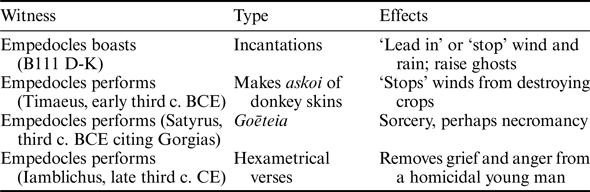
We have seen, then, that the boasts of Empedocles in fragment D-K 111 coincide well with three performances described in the biographical tradition:
Empedocles' boasts and performances

It is notable, moreover, that two of the three incidents from the biographical tradition are from relatively early and local Sicilian sources and that all three depict Empedocles performing actions that in one way or another seem to illustrate his claims in D-K 111, either by some kind of sympathetic action (restraining the wind in askoi), by performing hexameters, or perhaps by bringing up the ‘strength of a dead man’ for necromancy.
Explaining the Difference: Verbal vs. Herbal Pharmaka
Now we might be tempted to dismiss Empedocles and the Getty Hexameters as sources of a local Sicilian meaning of the word pharmakon unattested elsewhere in the Greek world, but in fact we see this same definition in an extraordinary, but neglected passage in Plato's Laws, in which one of his characters, the ‘Athenian Stranger’, wrestles with two very different concepts of criminal ‘pharmacy’:Footnote 42
A division in our treatment of pharmacy (φαρμακɛῖα) is required by the fact that, following the nature of mankind, they are of two distinct types. The type that we have now expressly mentioned (i.e. poisoning) is that in which injury is done to bodies by bodies according to nature. Distinct from this, is the type which, by certain means of sorceries, incantations, and binding spells (μαγγανɛίαις τέ τισι καὶ ἐπῳδαῖς καὶ καταδέσɛσι), as they are called, not only persuades (πɛίθɛιν) those who attempt to cause injury that they really can do so, but also persuades their victims that they certainly are being injured by those who possess the power to bewitch (γοητɛύɛιν).
Pl. Leg. 933a. Translations of Plato's Laws adapted from Bury (Reference Bury1942)The Athenian Stranger, then, begins his disquisition on pharmacy by claiming that material pharmaka, such as drugs or poisons, act according to nature when they attack the physical body of the victim, but he does not go on to say (as we might expect) that verbal pharmaka attack some other, non-physical human part, such as the mind or the soul. But he does imply something of this sort when he says that the power of this second kind of pharmaka lies in the persuasion of both the performer and his victim.Footnote 43
After describing these two very different kinds of crimes concerned with pharmaka, the Athenian Stranger quite naturally suggests two kinds of punishment:
So this statement shall stand as the law about pharmacy: whosoever shall use pharmaka (ὃς ἂν φαρμακɛύῃ) against any person so as to cause an injury not fatal either to the person himself or to his employees, or so as to cause an injury fatal or not fatal to his flocks or to his hives, if the agent be a doctor, and if he be convicted of pharmacy, he shall be punished by death. … And if it be held that a man is acting like an injurer by the use of binding-spells or attraction-spells or incantations (καταδέσɛσιν ἢ ἐπαγωγαῖς ἤ τισιν ἐπῳδαῖς) or any such mode of pharmacy, if he be a prophet or diviner (μάντις ὢν ἢ τɛρατοσκόπος), he shall be put to death …
Pl. Leg. 933d–eHere the focus of the verbal pharmaka on the non-corporeal elements, as opposed to the bodily, is made clear by the notice that physical pharmaka can harm herd animals and bees, but the verbal pharmaka apparently cannot, presumably because they are unable to be persuaded by human language. Plato's Athenian Stranger would, moreover, condemn to death doctors who cause injury with material pharmaka, as well as seers and diviners, if they commit the same crimes with various sorts of verbal pharmaka. The general goal of this imaginary law is, of course, a sound one from a legal point of view, because it punishes those who have professional expertise in each of these very different kinds of pharmacy, if they should misuse their special knowledge to injure or kill.
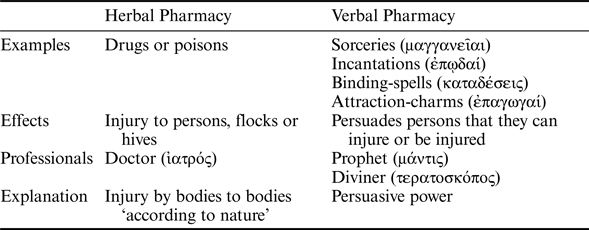
Plato, thus, divides his ‘pharmacy’ into two distinct categories:
Plato's pharmacy

Plato suggests, moreover, that in the fourth century, at least, ‘prophets’ and ‘diviners’ were thought to specialize in magical incantations, as well as their usual trade in oracles and divination.
In his rhetorical set-piece, the Encomium of Helen, Gorgias, the younger Sicilian contemporary of Empedocles mentioned earlier, uses similar verbs to describe the power of incantations and, although he does not use the word pharmaka, Gorgias seems to know a two-fold division of drugs and incantations similar to that of the Athenian Stranger:
[10] For inspired incantations (ἔνθɛοι … ἐπῳδαὶ) by means of words are the “leaders-in” of pleasure (ἐπαγωγοὶ ἡδονῆς) and “leaders-away” of grief (ἄπαγωγοὶ λύπης), because the power of the incantation (ἡ δύναμις τῆς ἐπῳδῆς), by affecting (lit. “conversing with”) the opinion of the soul, charms and persuades and transports it by means of sorcery (γοητɛίᾳ).
[14] The power of speech over the arrangement of the soul (πρὸς τὴν τῆς ψυχῆς τάξιν) is analogous to the power of drugs (τῶν φαρμάκων) over the nature of the body. For, just as different drugs lead out (ἐξάγɛι) different humors from the body and some stop (παύɛι) it from being ill and others (i.e. stop it) from being alive, so, too, some words cause sorrow, some pleasure, some fear, some confidence for the listeners, and others—by means of a harmful kind of persuasion—thoroughly enchant and bewitch (ἐξɛφαρμάκɛυσαν καὶ ἐγοήτɛυσαν) the soul.
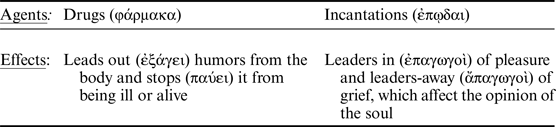
Gorg. Hel. 10 and 14In these passages, as we can see more schematically below, Gorgias makes explicit the parallel that was implicit in Plato. Just as herbal pharmaka physically affect the body, spoken charms persuasively affect the soul:
Gorgias' comparison of drugs and incantations

Although Gorgias does not use pharmaka to refer, as Plato does, to both drugs and incantations, he nevertheless theorizes the differences between the two in a similar manner. More importantly, perhaps, he describes their effects in ways that recall the language of Empedocles’ boasts. As we can see in the right-hand column, he begins with the general term for incantations (ἐπῳδαι), which he then subdivides as ‘leaders-in’ and ‘leaders-out’ of human emotions. These awkward translations are crafted to highlight that fact that Gorgias is using nouns that are cognate with the compound verbs ‘to lead in’ (ἐπάγɛιν) and ‘to lead away’ (ἀπάγɛιν), language similar to Empedocles’ boast that Pausanias ‘will lead in the winds’ (111.5: πνɛύματ᾿ ἐπάξɛις) or ‘lead’ the strength of a dead man ‘out of Hades’ (111.9: ἄξɛις δ᾿ ἐξ Ἀΐδαο). And also on the left-hand side of the chart, note that, when Gorgias claims that ‘drugs lead out (ἐξάγɛιν) humors from the body and they stop (παύɛιν) the body both from being ill and alive’, he seems again to echo Empedocles’ antithesis of stopping the force of the winds (111.3: παύσɛις δ ̓ … ἀνέμων μένος) and then leading them back again (111.5: παλίντιτα πνɛύματ ̓ ɛ̓πάξɛις). It would seem that we are dealing with similar models for understanding the human body and the cosmos as comparable organisms in which various forces—for example, violent storms or bodily humors—can be led in and out or simply stopped by using drugs on the body and incantations on the soul. In this light, it is interesting that the Epicurian philosopher Philodemus, in a recently recovered passage of his On Wealth, uses a prose paraphrase of D-K 111 in a way that suggests he saw a moral allegory about quieting stormy emotions and achieving peace of mind.Footnote 44
In the passage from the Laws quoted above, Plato suggested that the prophets or diviners were the professionals likely to engage in verbal pharmaka and this is not, in fact, an isolated claim in the Platonic corpus, because Adeimantus expresses a similar idea in the Republic:Footnote 45
Wandering priests and prophets (ἀγύρται δὲ καὶ μάντɛις) approach the doors of the wealthy and persuade them that …, if anyone wishes to injure any enemy of his, for a small outlay he will be able to harm the just and the unjust alike with certain attraction-spells and binding-spells (ἐπαγωγαῖς τισιν καὶ καταδέσμοις), because (i.e. in both cases) they are persuading the gods, so they say, to serve their ends.
Pl. Re sp. 364b–cIn both passages Plato uses the same technical terms, ‘attraction-spells’ (ἐπαγωγαί) and ‘binding spells’ (κατάδɛσμοι), which like the pharmaka of Empedocles are designed either to impel action or prevent it, and in both passages he also implicates ‘prophets’ as possible performers, a crossover that is easy to explain if Plato is thinking about these prophets as people who can chant both oracles and incantations in dactylic hexameters.
We find a similar combination of prophecy and incantation in another well-known autobiographical fragment of Empedocles:Footnote 46
Empedocles claims, in short, that to a large degree his fame lies in his mastery of two kinds of speech-acts: prophecies and the ritual ‘utterance that is good for healing’ (ɛὐηκέα βάξιν). Those who in the past imagined Empedocles as a traditional physician have suggested that ɛὐηκέα βάξιν refers to medical diagnoses and other advice that Empedocles gave to the sick wherever he traveled.Footnote 47 The word βάξις, however, is quite rare in Greek and refers primarily to ritual speech, often in verse, such as oracles, prayers, or incantations. The phrase, in short, is best translated (as above) as a ‘ritual utterance’ (βάξις) that is ‘good for healing’ (ɛὐήκης),Footnote 48 and when combined with ἐπὶ νούσων may in fact be a poetic periphrasis for the most common Greek word for incantation (ἐπαοιδή), which is literally a song sung ‘over’ (ἐπί) a sick person or a diseased part. According to Empedocles, then, crowds of people in different cities expected two kinds of speech-acts from him—oracles and curative incantations—both of which were traditionally sung in dactylic hexameters, the same meter, of course, in which all of his poetic fragments are composed.Footnote 49
Conclusions
It goes without saying that D-K B111 is a difficult text, but the new evidence of the Getty Hexameters has allowed us to see that Empedocles’ pharmaka were most probably incantations composed in dactylic hexameters, the poetic medium in which all of his extant fragments are composed. Closer examination of a second fragment, D-K B112, and the early and local Sicilian biographical traditions has, moreover, shown that he was thought to have used these verbal pharmaka to accomplish some of the deeds that he promises to teach Pausanias. And finally, we saw, as well, how both Plato and Gorgias made use of an apparently traditional division between verbal and herbal pharmacy, a division that gives equal weight to the physical power of material pharmaka as well as to the persuasive power of incantations. Judging from the programmatic importance of D-K 111 and 112, it is clear that the verbal pharmaka were central to his calling both as a poet and as a sorceror.
Acknowledgements
This essay first took flight as a keynote lecture at the conference Poetry, Philosophy and Science in the Archaic Age, held at the University of South Florida in March 2016, where I benefited especially from the comments and questions of Andrew Gregory, and at the Workshop on Ancient Societies, held at the University of Chicago in May 2016, where, as usual, the argument was much improved by my colleagues. And I am especially thankful to the two anonymous readers of this journal who did much to improve this article.