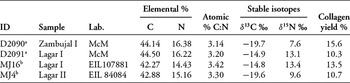
In 1994 we published the unexpected result of an extreme Mesolithic stable isotope signal from a Neolithic context (Lubell et al. Reference Lubell, Jackes, Schwarcz, Knyf and Meiklejohn1994; Table 1). The sample, identified as Gruta de Lagar I, was from one of two caves at the site of Melides, near the Atlantic coast of Portugal between Sines and Setúbal. A sample from the second cave at Melides, Cerca do Zambujal, gave results consonant with our Neolithic samples from north of the Tagus River. Lagar I, on the other hand, had stable isotope values similar to Cabeço da Arruda N, a Late Mesolithic individual from the Muge Valley to the north-east of Melides. Arruda N, with bone chemistry indicating the highest dietary intake of marine/estuarine resources at Muge, was around 1000 years older than Gruta de Lagar I.
Results of analyses of Melides rib samples curated in the Museu Geológico, Lisbon.

a Collagen extraction and stable isotope analyses by H.P. Schwarcz, McMaster University, 1990.
b Collagen extraction by S. Garvie-Lok, University of Alberta, and stable isotope analyses at Environmental Isotopes Laboratory, University of Waterloo: MJ4 in 2004 and MJ16 in 2005.
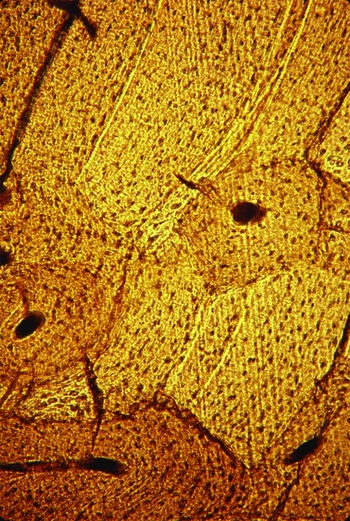
Given the unexpected results, it was important to establish that the Melides ribs were well preserved and that the stable isotope data from Melides were reliable. The Gruta de Lagar I rib was thin sectioned in order to observe the microstructure. The bone was in excellent condition (Figure 1), without the calcite intrusion and the slight cracking along cement lines that was seen in the Zambujal I rib. Cortical density in Melides mid-femoral samples (mean = 1.884, sd = 0.364, n = 16) was significantly higher than the equivalent figures for 72 shell midden and 24 limestone cave samples from Portugal, indicating lower levels of bacterial activity overall and reduced collagen removal (Jackes et al. Reference Jackes, Sherburne, Lubell, Barker and Wayman2001). Judging from the high collagen yield and the low atomic % C:N ratios, the sandy-floored Melides caves provided a stable, dry environment. The sandy nature of the burial environment was confirmed by analysis of the fine fraction of soil associated with Zambujal bone, using both X-ray diffraction and EDAX elemental analysis by energy dispersive X-ray analysis.
Lagar I rib, endosteal, undecalcified, unstained thin section, ×100, demonstrating the perfect preservation of microstructure in much of the rib cortex.

A further Lagar rib was analysed as Lagar II and produced Neolithic-type stable isotopes (Table 1). The decision was then made to re-analyse the Lagar I sample, as reported by Hillier et al. (Reference Hillier, Boaventura, Jackes and Richards2008a). Collagen extraction was done by S. Garvie-Lok, who characterised Lagar I as having “excellent sample quality” (pers. comm.). The distinction between the two Gruta de Lagar samples is important because the disarticulated remains excavated from the cave cannot be identified as to individual: ribs from ossuaries are not a perfect choice for analysis.
Hillier (pers. comm. 7 January 2007) initiated collaboration on Melides regarding the choice of skeletal element for sampling and statistical analyses for determining sex assignment. Based on a Melides bone inventory and measurements recorded in 1985 (Jackes et al. Reference Jackes, Lubell and Meiklejohn1997; Jackes & Lubell Reference Jackes, Lubell and Thévenin1999a), together with information from a Portuguese sample of known sex (e.g. Themido Reference Themido1927) and our Muge data, the decision was made to give most emphasis to the epicondylar breadth of humeri for sex discrimination, especially because distal humeri provide satisfactory ossuary sample sizes. Hillier re-measured, sampled and analysed adult left humeri for stable isotopes: no clear differentiation of diet bysex was evident. Two Zambujal individuals (strictly speaking of indeterminate sex, but one probably a male) had a greater marine input, suggesting that Lagar I, although an extreme outlier, was not completely anomalous. Hillier's stable isotope data for these humeri from the Zambujal burial cave demonstrated that there was a zone of overlap with the very heterogeneous Mesolithic site of Cabeço da Arruda. Overlap was also demonstrated with Mesolithic Sado burials (Hillier et al. Reference Hillier, Jackes, Umbelino and Richards2008b).
Table 1 allows us to confirm that the Lagar I sample provided reliable results. There can be little doubt that some Neolithic-period individuals in the coastal region south of the Tagus and Sado Rivers might retain a Mesolithic-style stable isotope signal. Two Mesolithic samples, Arruda N and Samouqueira H2 (Jackes & Lubell Reference Jackes, Lubell and Thévenin1999b: 29; Lubell et al. Reference Lubell, Jackes, Sheppard, Rowley-Conwy and Bicho2007: 212), with severe traumatic changes limiting mobility, warn us, however, that outlier stable isotope values may result from specific factors for which Lagar I cannot be assessed.
Acknowledgements
Denis Carmel, Oral Biology, University of Alberta, undertook extensive experimentation on how to thin section archaeological bone. Thanks to Charles Schweger, Anthropology, University of Alberta, for the 1990 access to equipment for viewing and photographing thin sections. Miguel Magalhães Ramalho, Coordenador, Museu Geológico, Laboratório Nacional de Energia e Geologia, Lisbon, permitted our study of Melides material. Thanks are also due to Sandra Garvie-Lok, Department of Anthropology, University of Alberta, Edmonton, who undertook collagen extraction for us.