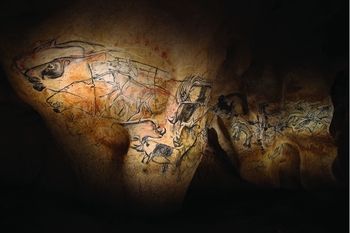
As radiocarbon dates were announced, the wall paintings and engravings in Chauvet Cave, France, were hailed as fine art far earlier than any recognised before: here was the ‘Dawn of art’ (Figure 1; Chauvet et al. Reference Chauvet, Brunel Deschamps and Hillaire1996). Soon after discovery, in 1994, the cave was closed to protect the images from chemical and microbial damage. In 2014, it was added to the World Heritage List. Then, in April 2015, replicas of the most striking imagery were opened at a purpose-built site, the Caverne du Pont d'Arc.
Detail of the Lions panel in the Caverne (© Patrick Aventurier).

Assuming that preservation of Chauvet Cave is, indeed, the top priority, how should we appraise the Caverne from the visitor's point of view? That depends, in turn, on two sets of questions, the first technical, the second ethical.
First, can replication compensate for closing an archaeological site? Can Palaeolithic pictures—or an ancient farm or urban quarter—be reproduced so as to let visitors recognise, understand or experience something of the ancient way of life and thought? How much of the cave—a landscape, an insula—has to be replicated to achieve that? Or can a limited sample be enhanced by supplementary presentations such as a site museum?
Second, does replication distract or detract from the original? Or is the project of presenting the past or explaining the evidence for it hindered, more fundamentally, by anachronistic assumptions and the social contexts in which visitors enjoy a ‘simulacrum’? These questions vexed us a generation ago, in the West, as the ‘heritage industry’ boomed: sundered from each other by the Late Modern economy and fascinated by artifice, were we misconstruing both present and past (Hewison Reference Hewison1987; Baudrillard Reference Baudrillard and Poster1988; Carman Reference Carman2002: 170–72)? Carman (Reference Carman2002: 17–19) helps to clarify the issue for archaeology by distinguishing inference to the record of the past from our resources of evidence for it and from public awareness of that ‘heritage’. However faithful to the original, a replica is ‘heritage’, not an archaeological resource. Responding, then, to replicas, do we ‘consume’ presentation of the past uncritically or without recognising its implications?
The French are familiar with these questions from the experience of running Lascaux ‘II’, a replica of the Palaeolithic art in Lascaux Cave, opened in 1983 to spare the cave from disturbance. At the Caverne du Pont d'Arc, however, the number of visitors far exceeded expectations at once. The Caverne illustrates issues also arising for Stonehenge's new visitor centre in regard to visitor numbers and siting, design and interpretation (Chippindale et al. Reference Chippindale, Gosden, James, Pitts and Scarre2014).
Replication
As with illustrated books or films—we have both for Chauvet Cave—replication is a kind of reproduction. Most replicas are intended either as entertainment à la Disney or for education. Most archaeological replicas are of features or finds that are susceptible to disturbance but thought to be of special interest for visitors. Whether replication does compensate for closing or removing the original depends on what the visitors expect or are deemed to need. The following thoughts are on replicas for preserving original finds, features or sites.
An archaeological replica is an exact three-dimensional copy at full scale. The principle is ancient. Casts were critical for the development of Classical archaeology; and, of course, many of the Roman statues cast for modern collections were themselves copies of Greek works. Facsimiles, by the same token, replicate manuscripts. Accuracy depends both on technique and on decisions about whether the copy should show the original's condition as first found and cleaned (Mortensen Reference Mortensen and Silverman2006: 59). To various degrees, replicas provide an experience of seeing, handling or inhabiting the artefact or site. Since 2012, the travelling exhibition, Lascaux ‘III’ (from France to America, and now back in Europe before going to the Far East), has shown how a replica can be brought to many more admirers.
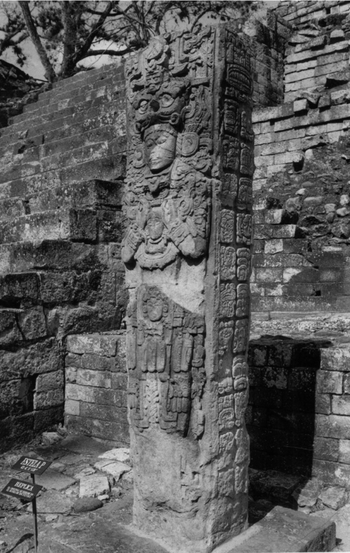
The basic issue is about the integrity of the original artefact or site. There are two considerations. First, is it more valuable to know that the resource is preserved or is it more important, considering that perpetual preservation cannot be guaranteed, that visitors should enjoy the ‘real thing’ while it does survive? Whatever the theoretical ideal, the matter usually depends on funds and political will. For Chauvet Cave, the decision was that the site must be preserved by closing it to the public. Second, how strongly mediated is the presentation? Restoration or reconstruction normally entails interpolation or interpretation, as witnessed, for example, at the reconstructions of ‘Colonial Williamsburg’, in Virginia, or the medieval street and quay at the Jorvik Centre, York. Not that replication is free of interpretation: while a replica is as close to the original as conceptually or practically feasible, the decision on how much to replicate is interpretive in itself. It is all the more important to distinguish it from the original (Figure 2).
Replica of Copán's Stela P, marked ‘replica’ by the label; consolidated masonry in the background (photograph: N. James).

The British Museum displays Victorian casts of Classic Maya stelae from Copán, in Honduras. Yet replication makes best sense at the original location. Now that so manytourists visit Copán, and its jungle cover has been cleared to reveal the ruins, certain stelae have been removed to the site museum for protection and replaced in situ by replicas (Mortensen Reference Mortensen and Silverman2006). Stela P is doubly interesting in that the building behind it has been cleared, consolidated and restored: the ‘visitor experience’ here is strongly mediated by management for preserving architectural form if not also the fabric (Figure 2). Copán also depends on replication to ensure preservation in situ: the museum's principal exhibit is the replica of one phase in the development of the main pyramid, which has been investigated but remains hidden beneath later phases of building (Mortensen Reference Mortensen and Silverman2006).
Lascaux II goes much further by presenting the paintings selected as Lascaux's most spectacular, replete with their settings. In a buried structure built a little downhill from the cave, a large sample of the most detailed paintings is shown in a passage that replicates Lascaux's walls, ceilings and uneven floors. The temperature is kept low, the atmosphere slightly clammy and the lighting suggestively dim. Visitors are led through the display by guides with electric torches to focus on particular images as though experiencing a première découverte (compare Mortensen Reference Mortensen and Silverman2006: 60). The influence of Lascaux II is obvious at the Caverne du Pont d'Arc.
Context is critical, we do always say. Museums have long presented historical and ethnographic rooms or street scenes, but most of those are generic reconstructions. To replicate an open-air settlement could be extremely expensive. Caves lend themselves to replication as the settings for wall paintings; but the replica of a cave then begs the question as to how the ancient site related to its landscape.
Whatever the answer for Lascaux, it is now falling victim to its replica's success, as fumes from Lascaux II's car park are jeopardising the cave. So a more extensive replica (‘Lascaux 4’!) is under construction in the valley below and scheduled to open late this year. The Caverne du Pont d'Arc avoids polluting Chauvet Cave, but that solution has produced another problem in turn.
Chauvet Cave
Chauvet Cave overlooks the River Ardèche near the Pont d'Arc, a striking arch or ‘bow’ where the river has cut through the limestone. In its present form, the cave stretches some 225 metres back from the entrance. It comprises four main groups of chambers and galleries. They are marked with stalagmites, stalactites and other dramatic effects of seepage. Animals left their prints and tracks in the clay, and bears scratched the walls, damaging some of the pictures. Some bears failed to awaken from hibernation and one haunting find was a bear's skull placed on a boulder. Other finds included hearths, soot marks on the walls from torches, and stone tools.
All but the biggest of the chambers and galleries were decorated. Thirty-five panels of painting or scored outlines have been distinguished (Clottes Reference Clottes2003: 13, 62–148). The motifs range from dots and apparently abstract marks to more than 400 fluent depictions of animals, from deer to mammoth, with the forms of the cave's walls exploited for thrilling compositions of horse, bison, aurochs and lion. Whether or not they are the work of only a few painters (Clottes Reference Clottes2003: 149), the imagery suggests a stirring world outside and a search within for an order to it all.
On grounds of style and iconography, the art was first assigned to the mid and later Upper Palaeolithic. Then radiocarbon samples yielded two sets of dates to contradict that assessment: most from between about 32000 and 30000 BP and the others from some 5000 years later (Clottes Reference Clottes2003: 32–4; Pettitt & Bahn Reference Pettitt and Bahn2015: 543). The claim, then, is that most of the pictures are Aurignacian; but Pettitt and Bahn (Reference Pettitt and Bahn2015) now argue that they must be later than that after all.
The pictures are evidently superb, whatever their dates and cultural affiliations; and there, under the ground, they would be all the more striking, as we know from caves, such as Pech Merle, that can be visited. The film ‘Cave of forgotten dreams’ was praised, on release, as our best chance to admire Chauvet's art (for an excoriating and hilarious assessment of how ‘heritage’ obscured it, see Carver (Reference Carver2011: 328–29)); but the Caverne's audience will be much larger.
The Caverne
The Caverne du Pont d'Arc complex sits by the edge of the plateau above the Ardèche, presumably because the valley is too narrow to accommodate thousands of visitors and their vehicles. It is about a kilometre from Chauvet Cave and a few minutes’ drive from the village of Vallon. Close to the Rhône valley, Vallon was a pioneer of tourism. Visitors are drawn by the scenery, especially the Pont d'Arc (prompting the village's new name, Vallon-Pont-d'Arc, c. 1950). Hiking and canoeing are popular, but already promoters are exploiting the cave's animal imagery as another icon. Ironically, the Caverne's site gives no view of the arch.
The complex comprises three parts. The first is devoted to services for visitors, including a space for temporary exhibitions; second is the replica; and, thirdly, visitors are directed to the Aurignacian Gallery, which offers background information about how the putative artists lived. The replica, the ‘caverne’ itself, is in a round building. Consciously monumental, the exterior is a composition of angled planes, perhaps inspired by the karst landscape. Close to, we discover that they are ornamented with samples of the digital patterns produced in scanning Chauvet Cave's walls for the replica. (The Caverne's website is very informative (Caverne du Pont d'Arc 2015).
Somewhat less than 40 per cent of the Cave has been replicated. The fabric is cement. The selection has favoured the more spectacular paintings and engravings (Figure 1). Like Lascaux II, the light is low and the atmosphere cool and damp. The walking surface here is flat, but parts of the floor beside it have been moulded to show bear hollows, animal bones and tracks, and the Cave's few human foot prints. The building's plan and size misrepresent the Cave's topography, but the focus is on the pictures. They are set out so as to show simpler designs first and, at the end, the mesmerising and stirring ‘Panel of the Lions’, from the back of the Cave (Figure 1).
As at Lascaux II, visitors are led through the replica by guides. Parties number up to about 25 in busy seasons. The tours take up to an hour. They are in French or English (with audio guides in those languages and German and Dutch). They begin with instructions that heighten anticipation, including prohibitions on photography and touching the fragile walls. The guides use torches to emphasise particular designs; but with parties coming through at intervals of five minutes, the sound and sight of other groups precludes the romantic sense of discovery offered by some other sites.
As at Lascaux II and at ‘original’ caves in France, the guiding is very good. Commentary does dwell on the pictures, not the topography, and that seems to satisfy visitors. The guides are evidently briefed to emphasise how much care was taken to copy the Cave and about how one part of the Caverne was revised for greater accuracy: the replica, we are assured, is authoritative. The guides explain a lot of the archaeology, including cautions about the limits of inference. They allow that some of the art is probably later but they do emphasise the Aurignacian; and they draw the implication that modern mentality appeared very early on and suddenly—‘Le Big-Bang de la création’, as the publicity declares.
Parties emerge from the replica through the mock-up of a rockshelter, where their guides take questions and conclude. The present reviewer found that, maintaining their earnestly attentive mood inside, the tone and the content of visitors’ remarks and queries showed serious engagement. In itself, the Caverne du Pont d'Arc is a success.
Present and past
A single visit soon after it opened suggests that the Caverne allays most doubts about the efficacy of replication. Visitors do not confuse the Caverne with the Cave; they tacitly accept that the Cave should remain sealed off; and it was clear that they found the Caverne engrossing and rewarding. In principle and for the interpretive purposes of the Caverne in its own terms, it does also look as though the Aurignacian Gallery supplements the replica effectively. We have techniques for evaluating that more accurately and, no doubt, the Caverne is doing so already. We do not yet, however, have methods to assess whether their own social and cultural conditions prevent visitors from recognising the implications of evidence for an utterly different way of life.
The worry is that fascination with the ‘art’ prevents visitors from considering its place in the life of the time. That must be why we are ushered to the Aurignacian Gallery only after admiring the replica: accepting the preoccupation with which most visitors probably arrive, the aim is to explain something of the ancient context for the art, the people and the wildlife of the time, and the technology. We are encouraged also to visit the new ‘Prehistory City’, a few miles away, at Aven d'Orgnac.
Were the chronology to be revised, of course, the emphasis on the Aurignacian would have to be changed. The Caverne would remain the principal attraction of its kind in eastern France, but, with less surprising dates, there would be less specific need to explain the Cave's cultural and ecological context. Yet social and economic conditions affect our sensibility (Baudrillard Reference Baudrillard and Poster1988). So some version of the Gallery would still be necessary to expose the assumptions that separate ‘heritage’ from the quality of critical appraisal that modern life demands. In stressing context, both the Aurignacian Gallery and the guides show how presentations at other caves, such as Pech Merle, could be improved. Will Lascaux 4 take its opportunity?
More specifically, however, the Gallery cannot compensate for separating the Caverne from the valley below and a view of the Pont d'Arc. If, just as we are surely at one with them in appreciating the art, that view captivated Palaeolithic people as it does us, then the Caverne's location is a telling compromise between their way of living and our own.
Acknowledgements
The Caverne's press office courteously arranged for my visit and provided Figure 1. I am grateful to Shirley Senot for discussing technical issues with me.