Refugees are defined by the United Nations High Commissioner for Refugees as persons who are residing outside their country and cannot return due to well-founded fear of persecution on the basis of race, religion, nationality, political opinion, or membership in a particular social group (United Nations High Commissioner for Refugees, 2002). Following the outbreak of armed conflict in 2011, an estimated 6.3 million Syrians fled their country (Statistics Canada, 2019). By July 2018, nearly 60,000 Syrian nationals had settled as refugees in Canada (Immigration, Refugees, Citizenship Canada, 2018). Permanent residence status was extended to all upon arrival. Families with children were prioritized for resettlement. Consequently, approximately 44% of Syrian refugees in Canada are school-aged children (Statistics Canada, 2019). The majority of Syrian refugees reported speaking neither English nor French, Canada’s two official languages (Statistics Canada, 2019).
Among Western countries, Germany has received the greatest number of displaced Syrian nationals. Over 480,000 claims were filed by Syrian asylum seekers in Germany between 2012 and 2016 (Bundesamt für Migration und Flüchtlinge, 2016). Asylum seekers are individuals who request refugee status while in a country other than their own but whose claim has not yet been adjudicated (United Nations High Commissioner for Refugees, 2002). Asylum seekers are offered only temporary protection and have no guarantee of permanent asylum. In addition, over 40,000 Syrians were admitted into the country through humanitarian programs between 2013 and 2016 (Grote, Bitterwolf, & Baraulina, Reference Grote, Bitterwolf and Baraulina2016). Currently, Syrian refugees represent 25% of the total refugee population in Germany (Bundesamt für Migration und Flüchtlinge, 2019). In 2016, 30% of all refugees in Germany were children 15 years of age and under (Bundesamt für Migration und Flüchtlinge, 2016). As a result, Arabic has become the most frequently reported minority language in the German educational system (Ait Ramdan, Reference Ait Ramdan, Fäcke and Meißner2019).
People forced to leave their home country are confronted with the challenge of acculturating to life in a receiving country that may bear little resemblance to their home country. Acculturation in individuals is the process of change in cultural identity (i.e., in beliefs, values, and behaviors) that occurs as a result of cross-cultural contact (Berry, Reference Berry, Sam and Berry2006; Gibson, Reference Gibson2001). In this study, we examined the acculturation experiences of Syrian refugee families in two contexts: Toronto, Canada, and Munich, Germany. Our study focused on language, a domain that is highly subject to acculturative change (Arends-Tóth & van de Vijver, Reference Arends-Tóth, van de Vijver, Sam and Berry2006; Kang, Reference Kang2006; Unger, Ritt-Olson, Wagner, Soto, & Baezconde-Garbanati, Reference Unger, Ritt-Olson, Wagner, Soto and Baezconde-Garbanati2007). Specifically, using qualitative methodologies, we described the linguistic environment of Syrian refugee children in Toronto and Munich 2 years postmigration. Our objective was to examine acculturation orientation through the lens of parent and child minority (Arabic and Kurdish) and majority (English and German) language use and preferences within the context of the home and school/workplace.
The process of acculturation
The work of Berry (e.g., Reference Berry1997, Reference Berry2005) offers a framework to conceptualize the process of acculturation. It incorporates two independent dimensions associated with cross-cultural contact: the degree to which heritage culture is maintained and the degree of participation in the receiving culture. The model delineates four acculturating orientations that reflect relative degree of identification with the heritage and receiving culture: integration, assimilation, separation, and marginalization. Integration results when the acculturating individual identifies with the receiving culture while maintaining the heritage culture identity. Assimilation is the result of decreased identification with the heritage culture as it is gradually replaced by the receiving culture. Individuals who do not identify with the receiving culture but retain their heritage culture identity are separated, whereas those who identify with neither culture are marginalized. Adaptation is the outcome of acculturation (Sam, Reference Sam, Sam and Berry2006; Ward, Fox, Wilson, Stuart, & Kus, Reference Ward, Fox, Wilson, Stuart and Kus2010). Positive adaptive outcomes are associated with integration and, to a lesser extent, assimilation, whereas nonadaptive outcomes are associated with separation and marginalization (Berry, Reference Berry2005; Dow, Reference Dow2011; Sheikh & Anderson, Reference Sheikh and Anderson2018).
The acculturation process is impacted by multiple individual and contextual factors including motivation for migration (Berry, Reference Berry2001; Silove, Steel, & Waters, Reference Silove, Steel and Waters2000), length of residency in the host country (Birman & Trickett, Reference Birman and Trickett2001; Tsai, Ying, & Lee, Reference Tsai, Ying and Lee2000), degree of similarity (actual or perceived) between the heritage and receiving cultures (Rudmin, Reference Rudmin2003); immigrant education levels and premigration socio-economic status (Colic-Peisker & Walker, Reference Colic-Peisker and Walker2003; Dow & Woolley, Reference Dow and Woolley2011), extent of social networks with members of the host and heritage cultures (Dow, Reference Dow2011; Yagmur & van de Vijver, Reference Yagmur and van de Vijver2012), and predominant attitudes toward immigrants of the receiving culture (Arends-Tóth & van de Vijver, Reference Arends-Tóth, van de Vijver, Sam and Berry2006; Haase, Rohmann, & Hallman, Reference Haase, Rohmann and Hallman2019; van Oudenhoven, Reference van Oudenhoven, Sam and Berry2006). An individual factor influencing acculturation that is relevant for the current study is age of migration. We know that children are likely to acquire receiving culture practices—including language—with greater ease than their parents and that they may shed home culture practices more readily (Berry, Reference Berry1997; Birman & Trickett, Reference Birman and Trickett2001; Costigan & Dokis, Reference Costigan and Dokis2006; Portes & Rumbaut, Reference Portes, Rumbaut, Rumbaut and Portes2001). This differential in rates of acculturation has been termed the acculturation gap (Birman, Reference Birman2006). Variations in child versus parent exposure and openness to host and heritage cultural influences are theorized to underlie the acculturation gap (Costigan & Dokis, Reference Costigan and Dokis2006; Phinney, Ong, & Madden, Reference Phinney, Ong and Madden2000).
An acculturation gap in the domain of language has two notable outcomes. First, studies indicate that it may have a detrimental impact on the quality of parent–child relationships (Birman, Reference Birman2006; Buki, Ma, Strom, & Strom, Reference Buki, Ma, Strom and Strom2003; Phinney et al., Reference Phinney, Ong and Madden2000; Portes & Rumbaut, Reference Portes, Rumbaut, Rumbaut and Portes2001; Tseng & Fuligni, Reference Tseng and Fuligni2000, Ying & Han, Reference Ying and Han2008; but see, for example, Costigan & Doki, Reference Costigan and Dokis2006; Telzer, Reference Telzer2010). For example, Birman (Reference Birman2006) found that among Russian immigrant families living in the United States, gaps in parent–child first language (L1) proficiency significantly predicted parent report of parent–child disagreements, with larger gaps predicting more frequent disagreements. Second, an acculturation gap in the domain of language may result in the practice of language brokering (i.e., translation and interpretation) by children for less proficient members of the family, including parents. While there is some disagreement in the literature as to the consequences of language brokering, research evidence suggests that it may increase child stress (Antonini, Reference Antonini2010; Shen & Dennis, Reference Shen and Dennis2019) as it is most frequently practiced in the early postmigratory period when children are least able to assume the broker role (Jones & Trickett, Reference Jones and Trickett2005).
Language and acculturation orientation
Language is one of the most important components of ethnic identity (Kang, Reference Kang2006). Research reveals three dimensions of language that are sensitive vectors of change due to acculturation, and as such serve as indicators of acculturation orientation: language competence, language use, and language preference (Acton & Walker de Felix, Reference Acton, Walker de Felix and Valdes1986; Arends-Tóth & van de Vijver, Reference Arends-Tóth, van de Vijver, Sam and Berry2006; Birman & Trickett, Reference Birman and Trickett2001; Hammer, Reference Hammer2017; Kang, Reference Kang2006). Findings derived from usage-based theories (e.g., Behrens, Reference Behrens2009; Ellis, Reference Ellis2006) and empirical evidence examining individual differences in additional language learning (Paradis, Reference Paradis2011; Paradis, Rusk, Sorenson Duncan, & Govindarajan, Reference Paradis, Rusk, Sorenson Duncan and Govindarajan2017) suggest that quantity and quality of input in social interactions are determinants of competence. These social interactions take place in what Birman and Trickett (Reference Birman and Trickett2001) refer to as the private (i.e., at home, with friends, and on social media) and public domains (i.e., neighbourhood, school, and workplace). Language practices across domains, including use and preference, reflect personal choices made by the acculturating individual vis-à-vis adaptation to the receiving culture and maintenance or shedding of the heritage culture (Acton & Walker de Felix, Reference Acton, Walker de Felix and Valdes1986; Zane & Mak, Reference Zane, Mak, Chun, Organista and Marin2003). For newcomer children, interactions within the two domains may favour use of either the majority or minority language, promoting competence in each (Oppedal, Reference Oppedal, Sam and Berry2006).
Minority language maintenance and majority language acquisition are associated with positive acculturation outcomes (e.g., Phinney, Reference Phinney, Chun, Organista and Marin2003; Ward et al., Reference Ward, Fox, Wilson, Stuart and Kus2010). Phinney (Reference Phinney, Chun, Organista and Marin2003) reports that majority language proficiency has been shown to be a key predictor of overall functional competence in immigrants. Heritage language proficiency, in contrast, contributes to heritage enculturation, a sense of unity and belonging with family and heritage community members (Jia, Gottardo, Koh, Chen, & Pasquarella, Reference Jia, Gottardo, Koh, Chen and Pasquarella2014; Park & Sarkar, Reference Park and Sarkar2007; Tseng & Fuligni, Reference Tseng and Fuligni2000). Research indicates that sense of belonging is key to well-being (Salant & Lauderdale, Reference Salant and Lauderdale2003; Whitlock, Reference Whitlock2007) and that it may facilitate successful adaptation to the host country (Jia et al., Reference Jia, Gottardo, Koh, Chen and Pasquarella2014; Ward et al., Reference Ward, Fox, Wilson, Stuart and Kus2010).
The Canadian and German contexts
Syrian refugees who resettled in Canada arrived as government-assisted refugees (GARs), privately sponsored refugees (PSRs), or blended visa office-referred refugees (BVORs; Immigration, Refugee, and Citizenship Canada, 2018). Initial resettlement of GARs, including assistance in finding permanent accommodation, is supported by the federal government through Immigration, Refugee, and Citizenship Canada-funded service providers for up to 1 year. Resettlement of PSRs is initiated by volunteer Canadian citizens who support the resettlement process for a period of 1 year with no government assistance, whereas support in resettling BVORs is the shared responsibility of the federal government and private sponsors. Housing for PSRs and BVORs is generally arranged by the sponsor(s) prior to the family’s arrival in Canada. All refugees, regardless of sponsorship program, are granted permanent resident status upon arrival in Canada and are immediately eligible to work. Within our sample, two families were PSRs and the remaining three families were GARs.
In Canada, adult English language classes are offered on a full-time or part-time basis through the federally funded Language Instruction for Newcomers to Canada (LINC) program (Citizenship and Immigration Canada, 2010). The LINC program targets skill development in speaking, listening, reading, and writing. It runs year-round and is free of charge to learners. In addition, childcare is provided in all LINC sites at no cost, and eligible participants benefit from reimbursement of travel costs to and from school. Of the 10 adults who participated in our study in Toronto, 9 had attended LINC classes, if only for a short period of time.
English as a second language (ESL) programming for school-aged children varies from province to province in Canada. In Toronto, children with little or no knowledge of English are immediately enrolled in ESL programs when they enter the public-school system. ESL programs offer intensive English-language support, focusing specifically on vocabulary, grammar, spelling, and reading (Toronto District School Board, 2014). Initially, children spend the bulk of the school day in an ESL classroom with a dedicated ESL teacher, joining their mainstream peers for only short periods of time. As English proficiency increases, ESL class time decreases until students are able to fully transition into age-appropriate classrooms. All children who participated in our study were enrolled in ESL classes upon arrival in Canada.
The status and living conditions of Syrians in Germany are quite different. Refugee status is requested by asylum seekers upon arrival in Germany. If granted, refugees are able to stay for a period of 3 years; an extension is possible if the conditions supporting the refugee claim remain in place. Until their case is adjudicated, most live in collective accommodation centres with limited personal space and a small allowance to cover basic living expenses. Regulations governing the issuing of work permits differ from federal state to federal state. In Bavaria, the federal state of which Munich is the capital, refugees living in collective accommodation centers may begin the process of applying for work after 3 months. They should demonstrate German language skills commensurate with the job for which they are applying. Moreover, if granted refugee status—as was the case for the families in our study—access to individual housing is not guaranteed due to a shortage of affordable housing in the metropolitan areas in Germany. The families in our study were living in collective accommodation centres 2 years after their arrival.
With respect to German-language support for adult newcomers, the Federal Office of Migration and Refugees is among the agencies that offer courses in German language and culture. The courses are 600–1200 hr in duration. Basic-level instruction consists of three consecutive courses offered over 9 months. Of the six adults in Munich who participated in our study, four attended a German course for some period of time but none completed the three basic level courses.
Various models of publicly funded elementary school programming have been developed to meet the needs of newcomers to Germany, and the models vary across German federal states (Massumi et al., Reference Massumi, von Dewitz, Grießbach, Terhart, Wagner, Hippmann and Altinay2015). In Bavaria, children enter a 2-year transitional program that focuses on German language instruction. These classes do not afford children the opportunity to interact with German peers. Children are automatically enrolled into mainstream classes after 2 years. It is possible, however, for younger children (6–8 years) to be immediately integrated into mainstream German classes. Small-group homework support, often supervised by a volunteer, is offered after regular school hours, either in school or in collective accommodation centres. Six of the 11 subjects in the German group attended a transition program. The others were enrolled directly into primary school.
The current study
Parental attitudes with respect to language use and preference—indicators of acculturation orientation—play an important role in shaping child language competence and ethnic identity (Birman & Trickett, Reference Birman and Trickett2001; Phinney, Romero, Nava, & Huang, Reference Phinney, Romero, Nava and Huang2001; Zane & Mak, Reference Zane, Mak, Chun, Organista and Marin2003). With this in mind, we focused on both parent and child minority and majority language use and preferences within the private (home) and public (school or workplace) domains with the goal of examining acculturation orientation through the lens of language. We did so within two contexts, Toronto and Munich, using semistructured interviews with Syrian refugee families. Our research questions were as follows: What were the majority and minority language practices reported by Syrian refugee families in the home (parent–child interactions, interactions among siblings) and workplace/school in Toronto and Munich? What do these practices suggest with respect to familial acculturation orientation?
Method
Participants
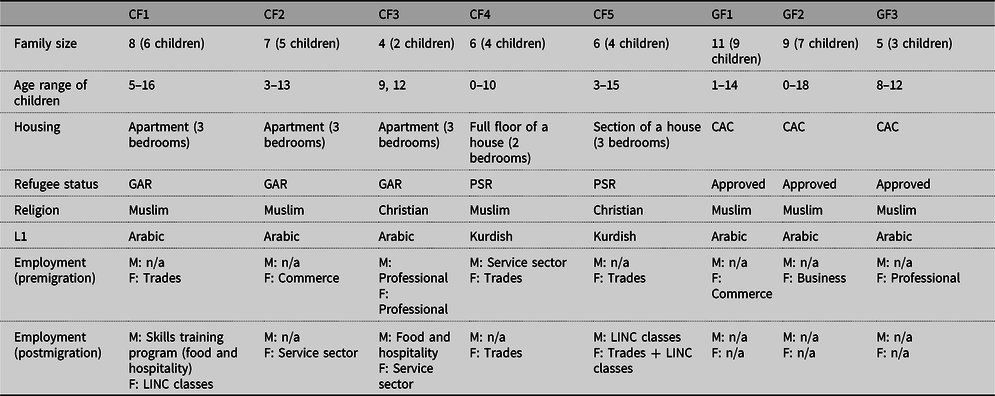
The present study adopted a qualitative design. A total of 15 Syrian refugee children aged 9–15 years and their parents (n = 13) participated in a semistructured interview. The interviews generated data regarding language practices (use and preferences) in the home and school/workplace. They were conducted in the family home in the spring of 2018 and were approximately 90-min in duration. The children and their families had resided in their host cities (Toronto and Munich) since 2016 and all of the children had been enrolled in public schools since their arrival. Four of the children in Toronto spoke Kurdish as the L1, Arabic as the second language (L2) and English as the third language. The other children spoke Arabic as the L1 and English or German as the L2. Table 1 summarizes demographic information for all families.
Summary of demographic information for families in Toronto and Munich

Note: CF, Canadian Family (1–5). GF, German family (1–3). M, mother. F, father; CAC, Collective Accomodation Centre. GAR, Government Assisted Refugee. PSR, Privately Sponsored Refugee. L1, first language. LINC, Language Instruction for Newcomers to Canada.
Nine children (five girls) came from five families in Toronto. Three of the five families were of Islamic faith; of these, two were L1 Arabic, and one was L1 Kurdish. Only the L1 Arabic families maintained active ties to a Muslim faith community. The remaining two families were Christian, one L1 Arabic the other L1 Kurdish. Both maintained active ties to a faith community in which services were held in Arabic. The child participants in Toronto were between 9 and 15 years of age. All nine children had been enrolled in ESL classes upon arrival in Canada; at the time of the interview, however, only four were continuing to receive ESL support. Of these, three were receiving support for short periods of time during the day but were otherwise integrated in a mainstream classroom. The fourth, a 15-year old boy, was enrolled in a full-time intensive program geared exclusively to English language arts. During the interviews, all children responded directly to the interviewer’s questions in English with the exception of the oldest child who relied heavily on support from the interpreter. Parent interviews were conducted through an interpreter although in one family, the mother chose to respond to some questions directly in English. The interviews conducted in Arabic were transcribed and subsequently translated into English by the interpreter.
In Munich, six children (three girls) from three families were interviewed. All were L1 Arabic speakers and all were Muslim. The child participants were between 11 and 14 years of age. All children were enrolled in transition classes upon arrival in Germany; two had been integrated into a German mainstream classroom by the time of the interview. For the most part, the children responded directly to the interviewer’s questions in German. The interviews with the parents were conducted in the presence of an Arabic–German interpreter. One father and two mothers answered a few questions in German. The excerpts included in this text are English translations of parents’ and children’s responses. They were translated by the first author in consultation with the interviewer.
Measure
Semistructured qualitative interviews
Parents and children aged 9–15 years took part in a semistructured interview in which they were asked open-ended questions about their pre- and postmigration experiences. The interview followed a standard question-and-answer format, and the coding scheme used in the analyses was developed on the basis of participants’ responses. Following Fylan (Reference Fylan, Miles and Gilbert2005), the interview protocols for parents and children were finalized after pilot interviews with newcomer families. All interviews were conducted in the family home by, or in the presence of, a native speaker of Arabic who served as interpreter and cultural broker.
Data analysis methods
The interviews were transcribed verbatim and, when necessary, translated into English or German by a native speaker of Arabic in Toronto and Munich. The transcripts were then analysed using thematic analysis (Braun & Clarke, Reference Braun and Clarke2006). Thematic analysis is a method used to identify, analyze, and report patterns within data. Our analytical approach was theoretical, progressing from description (i.e., organization of data according to patterns in semantic content), to interpretation of the significance of these patterns in relation to previous literature related to acculturation. During the descriptive phase of the analysis, the first two authors met to read through the transcripts. Content that made reference in any way to minority or majority language was identified. Common patterns were detected in the Canadian and German data that allowed us to narrow our focus to language practices within the home, school, and workplace. A coding scheme was created, and codes were organized into themes and subthemes supported by relevant excerpts. The coding scheme was reviewed by all authors.
The accuracy of findings was validated using a member checking approach (Creswell & Guetterman, Reference Creswell and Guetterman2019). The two interpreters who had participated in the interviews were asked to read and critique the results obtained in relation to the families whose interviews they had facilitated. Overall, the interpreters validated the accuracy of our findings. In addition, in Toronto, two members of the Syrian refugee community who had not participated in the study (a mother and her 11-year-old daughter), but who had resettled 2 years previously, were asked to provide feedback on the extent to which reported results meshed with their acculturation experience. The interpreter facilitated the discussion. Again, our findings were validated.
Results
In what follows, we present the Canadian and German findings in relation to home language practices first, followed by the Canadian and German school/workplace findings. In the excerpts below, speakers were identified as follows: CF = Canadian family (1–5), GF = German family (1–3), M = mother, F = father, C = child (1, 2), I = interviewer.
Language practices in the home
Parent-child interactions (Toronto)
In Canada, the parents of all five families articulate a language policy prioritizing use of the L1 at home, be it Arabic or Kurdish. Among all L1 Arabic speakers, the policy is strictly enforced by parents and children comply. An L1 Arabic mother clearly states her reasoning for enforcing such a policy:
It’s very important that [the children] speak Arabic at home with us and with each other at all times […]. I’m guaranteed that [the children] will learn the English language but not ensured that they will learn the Arabic. It’s important that they don’t forget their home language. (M, CF1; via interpreter)
This mother had completed a skills training program that she found to be immensely beneficial. Yet she opted not to look for work afterward because her presence in the home is essential for the maintenance of Arabic among her children. Her family is among the two L1 Arabic families who are practicing Muslims. For them, maintenance of Arabic in the home is imperative for religious reasons. As another mother plainly states:
You need the language to read Qur’an. (M, CF2; via interpreter)
However, insistence on the use of Arabic in the home plays an additional role in these two families. Both express concern that their children’s integration in Canadian society, a likely outcome with increased use and proficiency in English, will lead them to engage in behaviors that they consider to be inconsistent with Muslim values:
[…] One of the things they’re concerned about […] is that they’re afraid that when [the children] are out interacting with people and integrating into the Canadian society that they often pick up the bad qualities and not the good of this culture […] Sometimes they worry that that might affect their upbringing. (Interpreter for parents of CF1)
Kurdish parents also placed considerable value on maintenance of the Kurdish language in the home. English is used very occasionally in one of the two families. One mother expresses concern that loss of the L1 would result in a language divide within the family because her English language skills lag behind those of her children:
If I speak to my kids in English, they will forget the Kurdish. And if they forget the Kurdish, I’d [sic] would have lost those kids because I can’t communicate the same way as my kids, you know? […] (M, CF4; via interpreter)
At the same time, the Kurdish families actively encourage the use of Arabic in the home, if only for pragmatic reasons. They see Arabic as having greater currency than Kurdish:
I hope they can learn Arabic […] Because with Arabic they can get a job with that. Arabic is actually a lot more useful than Kurdish. Kurdish is only useful inside my home and amongst my family only. Kurdish is not useful for the future. (M, CF4)
Parent–child interactions (Munich)
The pragmatic attitude toward language learning expressed by the Kurdish families in Canada was in evidence among the German parents. In all three families, children are encouraged to speak both Arabic and German in the home. However, parents prioritize German as it is essential for resettlement in Germany:
It is more important that [the children] learn German. Because they live here. [….] It is more important that they speak German than Arabic because German is the language here with which they will get ahead. (F, GF2; via interpreter).
While parents address their children primarily in Arabic in the home, none of them adheres to a strict language policy. For example, one mother sometimes inserts German words in Arabic utterances to facilitate communication with her children. Like all parents interviewed, she is aware that her children may have forgotten Arabic words.
They have really forgotten [many words], because they cannot name the colors in Arabic, the children, in Syrian Arabic. […] The mother has to say it always in German. (M, GF2; via interpreter)
Another mother allows her children to speak German among themselves in her presence. Unable to attend formal German classes because she has to care for young children, she hopes to improve her own German through exposure to the language in her home.
I: [you speak] German with your siblings.
C: Yes, with everybody. With mama … she understands now a little German. We speak only German. She has said that we should speak only German. So that she can understand more. (C, 14 years, GF1).
Nevertheless, it is clear that parents are concerned that their children be able to read and write Arabic. For one father, in particular, reading and writing is associated with the need to maintain written contact with family:
I would like that people hold on to their language, also to keep Arabic.
[…]
I would like them [the children] to be able to read and write just in case mail arrives and he has to read it. (F, GF3; via interpreter)
The same father, a practicing Muslim, also stresses the importance of maintaining Arabic for the purpose of reading the Qur’an and for the maintenance of Arabic culture in their home. He describes his efforts to continue the tradition of oral storytelling handed down to him from his grandmother, a practice that allows him to share Arabic stories with his children despite their limited understanding of Standard Arabic:
I am used to telling them a bedtime story every day. […] In the past, I used to read stories in standard Arabic from the internet, but they weren’t able to understand them. (F, GF3; via interpreter)
Whereas parents largely address their children in Arabic, there is a divide among the children growing up in Germany in terms of the language in which they prefer to respond to their parents. The older children across families respond most often in Arabic. These children generally describe themselves as more competent speakers of Arabic than German and their parents describe them as more proficient in Arabic than their younger siblings. The younger children, in contrast, express a preference for German, as they grow increasingly proficient in the language. L1 shedding among these children is particularly evident in one family where the older siblings act as language brokers for their younger sister and brothers in conversations with their parents:
Sometimes they say words to my parents but they do not understand because they are not so good. […] Then [the parents] call me so that I say it to them in Arabic […] Yes, [the children] say it in German and I tell [the parents] in Arabic. (C, 12 years, GF1)
Interactions among siblings (Toronto)
In Canada, English is the preferred language of communication among the children in all but one family despite parents’ insistence that they use the L1 in the home at all times. The children indicate that this is a source of some tension in the family. For example, when asked about the language in which he speaks to his sister, one child responds:
[…] I speak sometimes Arabic to my sister, because my mom’s like, “Talk Arabic!” (C, 12 years, CF3)
The preference may be associated with an increase in English conversational fluency. Some children indicate that English is replacing the L1 as their dominant language:
I: Why do you like [watching television] in English more?
C: Because I understand more. Like, it’s easier for me. Like, half my day I’m talking in English, and then when I come [home], I have to talk Arabic. Like, I’m used to English more than Arabic. (C, 13 years, CF1)
Parents persist, nonetheless, in their attempts to maintain the L1 as the language of communication between their children. One mother does not hesitate to intervene when her children converse in English:
They [the children] speak less in Kurdish so I tell them to change the topic, try to say it in Kurdish so you don’t forget it. (M, CF4; via interpreter)
Interactions among siblings (Munich)
In Germany, all families report that the preferred language of communication among the children is German. For instance, all children regardless of age, use German while playing with one another but do switch between German and Arabic in their conversations. However, in two families the oldest child chooses to address younger siblings in Arabic either to ensure the younger ones learn Arabic (GF2) or because the child’s own oral language skills are stronger in Arabic than in German (GF3).
School and workplace-based language practices (parents, Toronto and Munich)\
All fathers living in Toronto had attended formal ESL classes through LINC at one time or another since their arrival in Canada. At the time of the interview, one was attending full-time ESL classes and a second was attending evening classes after his day at work. However, three of five fathers describe the workplace—not the classroom—as the place where the brunt of their language learning occurs and where opportunities for social interaction in English most often present themselves. One woman speaks about the language learning opportunities inherent in the workplace when she says:
In schools they teach you grammar or the language but outside of the school, interacting and conversing with people teaches you how to communicate with people, how to interact with people. (M, CF5; via interpreter)
One father refers to the workplace as “another school.” However, whereas he shared an ESL classroom with a number of Syrians with whom he conversed in Arabic, his co-workers speak a variety of L1s, so “we are all forced to speak in English” (F, CF2; via interpreter). As a result, he is growing confident in his ability to speak English:
When someone used to speak to me in English, I would run away from him. Now we get into arguments (joking). Now there’s more confidence when speaking in English. (F, CF2; via interpreter)
Another father is employed by a fellow Kurd, yet communication between employer and employee is strictly in English. Despite his limited competence, this father insists on an English-only policy at work. He and his wife see learning English as a means to create opportunities for social promotion:
My husband wants to become better in English because we feel like the better we are at it, the more opportunities we’ll have. (M, CF4; via interpreter)
Only one of five mothers (CF5) was attending ESL classes at the time of the interview. One mother spent her first year in Canada studying English through LINC but discontinued her studies when she became pregnant with her fourth child (CF2). A third mother (CF1) completed a 2-month skills training program that included a practicum during which she prepared food for the homeless and elderly in a community centre. She describes the “forced interaction” through program participation as invaluable in helping her overcome her fear of the people and culture of her new home.
This mother is, however, one of three mothers who articulated tensions between the need to attend to their young children’s needs and their desire to develop their English language skills. One mother in particular describes the resettlement process as difficult “because of the language.” As primary caregiver to six children, she sees limited opportunity to participate in language learning opportunities outside of the home. Of note, she cites her lack of English proficiency as a factor that prevents her from attending ESL classes:
Every time I work, work, work in the home so I don’t even have time to learn […] I would really love to learn. I don’t have the courage to go to school though because I don’t know English. (M, CF2; via interpreter)
Yet another mother (CF3) obtained employment in a commercial bakery following a month spent in ESL classes. Several co-workers are Arabic speakers, and she communicates with them in Arabic. She sees this as an impediment to her learning English. Her other co-workers are L2 English speakers of varied L1 backgrounds. With them, she has the opportunity to improve her English.
In Germany, all adult refugees are expected to attend German language classes. Four of the six parents interviewed had attended classes, but none of them completed the three basic level courses. None of the parents was employed.
School-based language practices (children, Toronto)
For their part, the children in Toronto recognize that learning English in school continues to be challenging 2 years into resettlement. Reading, writing, and content area vocabulary (mathematics and science) are most frequently mentioned as presenting difficulties, as the following excerpt illustrates:
C: I have a lot [of hard subjects], social studies, math and science.
I: Why are they hard?
C: Sometimes you don’t really understand […], like I don’t understand some words.
I: Like you haven’t learned them yet?
C: Yeah, like they say long words that have like 13 letters and it’s hard to read and understand. (C 9 years, CF4)
Another child, struggling to acquire English content area vocabulary, recognizes that her limited academic English surpasses her academic Arabic, not surprising given the 7-year interruption in schooling she experienced after the war broke out in Syria:
Like you know, like stuff like polygon in math? I don’t know what that would be in Arabic. (C, 13 years, CF1)
There is awareness in some families that interrupted schooling is impacting the academic achievement of children in Canada. One father compares the situation of his two oldest children, a boy who had some schooling in their homeland and a girl who had none:
So, like in his case, at least he learned Arabic, and he can translate Arabic to English. But it’s like she can’t, she doesn’t know, so like she can’t translate from one language to another. There is no basis, no fundamentals. (F, CF2; via interpreter)
Thus, children with limited schooling prior to resettlement find themselves in the position of struggling to gain competency in academic English, in some part because their Arabic-language skills are inadequate to support their learning.
Teachers, and ESL teachers in particular, are cited by all nine children as having played an integral role in their language learning. It is evident that they are held in high regard by all.
Yeah, so my, that ESL teacher, she was a drama teacher. So, she would actually, like if I don’t understand the answer, she would act it and like go around and find something to show me what it means. (C, 13 years, CF1).
The role of teachers is not restricted to providing direct language instruction, however. Teachers are perceived by children as facilitators of social integration, leading in turn to English language learning opportunities. This is articulated by the following 9-year-old girl:
She [ESL teacher] helps me to make more friends […] She says whenever you want to be friend with a girl or a boy […] first say your name, second ask “What’s your name?” and third ask if you want to be friends, by steps. (C, 9 years, CF4)
School friends are an important part of the children’s lives, but they are more than playmates or companions. Peer relationships are perceived by the children as being instrumental to learning English. When asked what advice she would give a newly arrived Syrian child in Canada, one child responded:
[…] maybe like read more or something? I don’t know, play with English friends […] cause you gotta speak, they won’t understand the language that you speak, you gotta speak English, the more you speak English, the more you learn English. (C, 12 years, CF3)
The children we interviewed clearly count on the support of friends and classmates in the areas of language and literacy. For example, when asked what a bad day at school involved, one child responded:
Bad day? Like no, like, I’m not happy when my friend is not coming with me, like they not helping me with the reading. (C, 10 years, CF4)
Another child, a 15-year-old girl who attended school for the first time upon arrival in Canada, makes clear how hard it has been for her to learn English and the extent to which she relies on the support of her classmates to meet the language demands of the classroom:
Like when, when I write, when I read, it is hard for me. I need help, like when we’re like doing work, I need someone to sit with me and to help me do it more. Someone to teach me more and more everyone there do and I says, I don’t understand how to do it, and they help me understand […] When I speak English, I am proud of myself. (C, 15 years, CF2)
The difficulty encountered learning English is a recurrent theme across parent and child interviews in the Canadian context.
School-based language practices (children, Munich)
Overall the children express a preference for speaking with their classmates in German, despite the high proportion of children from Arabic-speaking countries in their classrooms:
Some [speak] Kurdish, some Arabic. But I speak only German with them. I do not want to speak Arabic. I like it but I want to learn more, for example when [classmate] talks to me in Arabic then I say I don’t hear it. You have to speak German.” (C, 12 years, GF1).
All children report that their favorite teachers were the transition teachers because they were kind and explained difficult words. For children in German mainstream classes, there is also a support group of volunteers who serve the noon meal and afterward assist small groups of children with homework. In addition, the children benefit from support by volunteers who come into the collective accommodation centers daily for 2 hr. Some children also receive support on an individual basis. One child makes clear the benefit of this support:
[…] I can write better and read […] and think, when I go to this other teacher and I learn with her for instance one hour but this one hour is quite good learning. […] and I think that I can write better sentences and I think and write better sentences in my head. (C, age 12, GF2).
Two girls (C, 12 years, GF1; C, 11 years, GF3) cite German as their favorite subject in school and claim to be good readers and writers of German. Both even report that they keep a diary in German. However, most of the children speak of the difficulties they experience in German. For example, a 12-year old says that if he cannot express himself in German, he prefers to “keep his mouth shut” (GF3). A 14-year old mentions that whereas he is comfortable using German with his friends, he fears not understanding in school (GF1). For most children, in particular the oldest children, reading, writing, and spelling in German are fairly problematic.
I cannot write well in German. […] I forget the h and so on. I mix up the t [with d] and the e [with i][….] “sch […] and ch.” (C, 12 years, GF3)
Four of the children assert that they are good in mathematics but that reading can hinder comprehension of word problems:
[The tasks] were easy but I had to read them first then I had to answer. That was a bit difficult. Then I did not […] didn’t do it. (GF2, age 12)
Summary of results
Taken together, the reported language practices of Syrian refugee families resettled in Canada and Germany suggest slight differences in acculturation orientation. Overall, language practices in Canada tended to suggest an integration orientation. The majority of parents made a concerted effort to maintain use of the minority language in the home while working to improve their own English skills in language classes and/or in the workplace. This was the case for both the Arabic- and Kurdish-speaking families. Moreover, the Kurdish speakers placed considerable value on maintenance of Arabic. However, whereas Muslim parents demonstrated openness to learning English, they expressed concern that majority language acquisition leave their children susceptible to Canadian cultural influences that were inconsistent with their values. Their children received formal Arabic instruction on a regular basis to ensure they learn to read the Qur’an. The children in all families complied with the Arabic/Kurdish-only policy in interactions with their parents but demonstrated a preference for English when speaking with one another in the home. Moreover, they were highly motivated to learn English in order to establish friendships with schoolmates.
The reported practices of families living in Germany were not indicative of a clear acculturation orientation. Parents espoused a pragmatic attitude with respect to language. While they preferred to use Arabic in interactions with their children, they did not insist that their children use the language when communicating among themselves. Parents allowed children to speak German in the home in their presence so that they themselves would be exposed to the language and interspersed German words in Arabic utterances when necessary to facilitate communication with their younger children. As a result, German was beginning to replace Arabic as the preferred language in all communication in the home among the younger children. There was evidence among the German families of considerable language loss among the youngest children; oldest children were recruited to act as language brokers to facilitate interactions between their parents and siblings. Thus, our language practice data may reveal a tendency toward assimilation among the younger children. At the same time, contextual factors (suboptimal housing conditions or unemployment) restricted parents’ participation in the majority culture, leading to a significant acculturation gap between parents and their younger children.
Discussion
In this study, we investigated the acculturation experiences of Syrian refugee families in two contexts (Toronto, Canada, and Munich, Germany) 2 years postresettlement. Specifically, we examined acculturation orientation through the lens of parent and child minority and majority language use and preferences within multiple contexts through semistructured interviews. The language practices described by Syrian refugee families in Canada were clearly suggestive of an integration orientation. Those of families living in German were less indicative of a clear orientation; contextual factors mitigated against parental participation in the majority culture, while the youngest of their school-aged children tended toward assimilation. Moreover, there was evidence of a significant acculturation gap (Birman, Reference Birman2006) between parents and all but the oldest children in Germany.
The interview data reveal that, in Canada, all parents espoused a clear preference for the use of the L1, be it Arabic or Kurdish, in parent–child and child–to–child interactions in the home. That is not to say that parents failed to recognize or downplayed the importance of their children learning English; there was a sense among parents that over time, their children were guaranteed to learn the majority language. In contrast, the minority language had to be actively maintained if it was to remain a viable language. Our data suggest that mothers seemed to bear the brunt of responsibility for language maintenance in their roles as primary caregivers of young children, corroborating a finding reported among Arabic migrants living in the United States (Turjoman, Reference Turjoman2013).
Implicit in the guarantee that children acquire proficiency in the majority language, however, was the threat that it replace the minority language as the children’s dominant language. The concern was clearly greatest for younger school-aged children whose grounding in the L1 was most tenuous and whose days were spent in school immersed in English. Children’s growing proficiency in the majority language, coupled with their parents’ limited knowledge of the language, was perceived by parents to threaten parent–child communication, leaving them without a common language in which to express themselves with ease. L1 maintenance offered families a means to avert an intergenerational divide in language practices.
Whereas all parents in Toronto espoused use of the L1 in the home, differences emerged across families in terms of the rationale for imposing a L1-only language policy. These differences were rooted in the varied religious and ethnic identities of the Syrian families we interviewed. Among practicing Muslims, use of Arabic in the home was deemed essential for maintenance of religious identity. Parents cited the desire to ensure their children acquire the language skills necessary to read the Qur’an, a touchstone in the lives of practicing Muslims, as the key to their preference that Arabic be the sole language of communication in the home. This need further prompted parents to ensure their children receive language and literacy instruction in Modern Standard Arabic, the formal Arabic of the Qur’an. Our findings in Canada are consistent with research conducted among voluntary migrants of Arabic descent indicating that L1 maintenance for the purpose of perpetuating religious tradition is a core value among Muslims (Abdelhadi, Reference Abdelhadi2017; Gogonas, Reference Gogonas2011; Gomaa, Reference Gomaa2011; Turjoman, Reference Turjoman2017).
A more subtle belief espoused by Muslim parents in the two L1 Arabic families was the belief that Arabic in the home represented a protective buffer against majority culture influences that were incompatible with their values. These parents articulated concern that as their children grew more at ease in their interactions with Canadians, an outcome of increasing proficiency in English, they would be more susceptible to “bad” influences and adopt behaviors that were inconsistent with the Muslim upbringing the parents wished for their children. Maintaining Arabic in the home appeared to be one of the means employed by parents to counter these unwelcome influences and inculcate traditional Muslim values in their children. Active membership in a faith community was another means employed to achieve this end.
Maintenance of the L1 in the home was also endorsed by all Kurdish parents in Toronto. Parents consistently spoke to their children in the L1 and, for the most part, expected that their children use the L1 when conversing with one another. Preservation of cultural identity was cited as the rationale behind the L1-only policy. That Kurdish Syrians should prioritize ethnic identity is not unexpected considering their minority status in their home country. Syrian Kurds comprised only 9% of the Syrian population before the outbreak of the war in 2011 and have been refused the right to be educated in their home language for decades, learning instead to speak, read, and write in school in the majority Arabic (Albarazi, Reference Albarazi2013; Drwish, Reference Drwish2017). Yet their language remained viable, suggesting that L1 maintenance was valued and practiced well before resettlement in Canada. At the same time, Kurdish parents recognized the limited currency of their L1. Motivated by pragmatic concerns, all encouraged the use of Arabic in the home through their interactions with the children.
Whereas children were compliant with their parents’ wishes that they speak Arabic or Kurdish in parent–child interactions, they were less inclined to speak to one another in their L1 in the home. The preference for English extended to the majority of children interviewed, indicating that they were acquiring conversational fluency in English with greater ease than their parents and were shedding the L1 more readily in interactions with one another. An acculturation gap between parents and children may be in evidence among the Syrian families living in Canada. However, children merely suggested (rather than openly reported) tensions between themselves and their parents with respect to the use of Arabic in their interactions with siblings, and they were able and willing to respond in Arabic to their parents. Thus, there is no clear evidence of a detrimental impact on the quality of parent–child relationships due to differences in rate of acculturation.
The home language environment of Syrian refugee children growing up in Germany differs somewhat from that of their Canadian counterparts. In Germany, parents espoused a home language policy that favored, but did not strictly enforce, use of Arabic among family members. Parents were tolerant—even encouraging—of their children’s use of German in the home. Like the Kurdish speakers in Canada, their attitudes with respect to language practices were driven primarily by pragmatic concerns. Despite the value they clearly placed on maintaining Arabic, parents saw learning German as a priority for their children to secure a future in Germany. Furthermore, some parents looked to their children as a source of German input to mitigate isolation from the majority language. Consequently, the Syrian families living in Germany expressed an openness to the use of German in the home that contrasted with a parallel lack of openness toward the use of English among families in Canada.
All families living in Germany identify as Muslim; however, religion seemed to play a somewhat less prominent role in their homes than in it did in the homes of the Arabic-speaking Muslim families in Canada. As a result, insistence on Arabic language maintenance for the purpose of perpetuating religious traditions was a less pervasive theme in the interviews conducted in Germany although it did not go without mention. Ties with a faith community were limited and few children received formal Arabic language and literacy instruction. Without a strongly held belief in the imperative to preserve religious identity, and sustained ties to a faith community, the Muslim families in Germany were less compelled than their counterparts in Canada to enforce an Arabic-only language policy in the home.
Given the lenient language policies in place in their homes and their daily immersion in German in school, it is not surprising that the youngest of the school-aged children expressed a preference for German in their interactions with all family members. German was becoming their dominant language. This finding, which contrasts with findings emerging from the Canadian data, suggests that the age of migration effect in acculturation (e.g., Birman & Trickett, Reference Birman and Trickett2001) may be felt most acutely in homes in which L1 maintenance is not prioritized. Unlike their younger siblings, the oldest children used some Arabic in the home, aware that they were more proficient speakers of the L1 than the L2 and more proficient in Arabic than their siblings. As a result, these children acted as language brokers to facilitate communication between their parents and younger brothers and sisters. An acculturation gap is clearly in evidence in the German homes between parents and all but their oldest children.
Whereas differences in home language practices are apparent across the Canadian and German contexts, data related to practices within the school setting are fairly consistent. It is clear from the interview data that all Syrian children were highly motivated to learn the majority language. They saw it first and foremost as a means of establishing friendships with their schoolmates, on whom they depended for support in language learning. All children appeared to have achieved a level of conversational fluency that permitted informal interactions with their peers (and allowed them to directly answer interview questions). This was not surprising; previous research suggests that a functional level of fluency is typically acquired by L2 learners to a peer-appropriate level within approximately 2 years in a total immersion setting (Cummins, Reference Cummins, Street and Hornberger2008). In Canada, ESL teachers were cited as instrumental in supporting children’s language learning while in Germany, support systems offered outside of school hours were particularly helpful.
A notable difference in the Canadian and German contexts was the level of participation in the majority culture afforded parents by the right to access employment. In Toronto, workplace interactions granted members of the Syrian refugee community the opportunity to use English in order to develop proficiency. The workplace was judged to be a superior language learning environment than the LINC classroom. Moreover, parents describe positive relationships with their co-workers, some of whom were referred to as friends. Without the possibility of employment, and in light of their limited uptake of German language classes, opportunities for Syrian refugees in Germany to develop even a functional level of German were severely curtailed.
Thus, differences in acculturation orientation as evidenced in language practices of Syrian refugee parents in the two countries may be largely attributable to differences in status in Canada and Germany. The families interviewed in Toronto were permanent residents of Canada and enjoyed the broad range of rights that status entails. In addition to employment, all families had procured adequate housing. As a result, they experienced a level of security that granted them leeway to maintain heritage culture practices while progressively immersing themselves in the receiving culture. The Syrian refugee families we interviewed in Germany did not share this sense of security. Approval of their refugee claims guaranteed residence for a period of only 3 years, and all families continued to live in less than optimal conditions on a small government allowance. Moreover, these families were relatively isolated from the majority culture. Determined to make a future for their children in Germany, parents focused largely, although by no means exclusively, on German language acquisition among their children. This focus compromised the robustness of Arabic in the home.
Conclusion
Our study revealed the diversity of the Syrian refugee population and unveiled specific factors (religion, ethnic status in the home country, and immigration status in the host country) that influence acculturation orientation in this population. Despite their diversity, however, Syrian refugee families in both Canada and Germany expressed a common desire to successfully navigate the resettlement process. Motivation to maintain the home language while acquiring the majority language was evident among all parents; however, contextual factors made the balance considerably more difficult to achieve in Germany. Paradoxically, the findings of our study tentatively suggest that providing opportunities to facilitate newcomer participation in the receiving culture leads not only to acquisition of the majority language but also gives parents “permission” to prioritize L1 maintenance in the home. The Canadian data indicate that access to employment appears to be especially effective in promoting adaptation among adults, as do programs focused on work-related skills training. As for the children, both the Canadian and German data indicate that majority language learning is both a priority and a challenge. Literacy and content vocabulary, in particular, are cited as a source of difficulty. However, it is clear that the children value their relationships with teachers and fellow students, alike. Finally, we must acknowledge that acculturation orientation is complex and is best conceptualized and measured along its multiple dimensions (Sam, Reference Sam, Sam and Berry2006). While our study focused narrowly on language, future research needs to include broader measures of acculturation and expand the range of factors under study to achieve deeper insight into the refugee experience. Moreover, research monitoring academic outcomes among Syrian refugees over time is much needed so that we may gain a more complete understanding of their acculturation experiences.
Acknowledgment
The study was financed by the Child and Youth Refugee Research Coalition (CYRRC; http://cyrrc.org). Principal investigator was Xi Chen. Members of the Canadian team were Anna Yamashita, Fatema Isam, and Kathleen Hipfner-Boucher. Members of the German team were Mohcine Ait Ramdan, Verena Beschinsky, Jessica Lindner, and Wadieh Zerkly.