Recent research suggests that native speakers quickly adapt to the surrounding language context, be it to an interlocutor’s accent, vocabulary, or syntactic structures (e.g., Bock, Reference Bock1986; Brennan & Clark, Reference Brennan and Clark1996; Brennan & Hanna, Reference Brennan and Hanna2009; Kraljic, Samuel, & Brennan, Reference Kraljic, Samuel and Brennan2008; Wells, Christiansen, Race, Acheson, & MacDonald, Reference Wells, Christiansen, Race, Acheson and MacDonald2009). For instance, after repeated exposure to a nonpreferred syntactic structure such as a reduced relative clause (e.g., The soldiers warned about the dangers conducted the midnight raid), readers show a decrease in processing difficulty for that structure (Farmer, Fine, Yan, Cheimariou, & Jaeger, Reference Farmer, Fine, Yan, Cheimariou and Jaeger2014; Fine & Jaeger, Reference Fine and Jaeger2013; Fine, Jaeger, Farmer, & Qian, Reference Fine, Jaeger, Farmer and Qian2013). Readers may even show a preference reversal in that the initially nonpreferred structure (e.g., a reduced relative clause) becomes easier to process than the initially preferred structure (a main clause structure in this case; Fine et al., Reference Fine, Jaeger, Farmer and Qian2013). Syntactic adaptation can also be observed in production as an increased tendency to use a particular structure after this structure has been repeatedly encountered in the recent context (Hartsuiker & Westenberg, Reference Hartsuiker and Westenberg2000; Kaan & Chun, Reference Kaan and Chun2018; Kaschak & Borreggine, Reference Kaschak and Borreggine2008; Kaschak, Loney, & Borreggine, Reference Kaschak, Loney and Borreggine2006). Adaptation can be conceptualized as the adjustment of one’s linguistic knowledge to accommodate features of the language variety used in the context. Adaptation to a speaker’s accent, word choice, or syntactic structures may not only facilitate communication but also pertain to language learning (Chang, Dell, & Bock, Reference Chang, Dell and Bock2006). Given the ubiquity and importance of adaptation, the current study further explores factors driving adaptation by comparing native English speakers and second language (L2) learners of English.
One mechanism that has been proposed to underlie adaptation is error-based implicit learning (Chang et al., Reference Chang, Dell and Bock2006). According to this approach, listeners or readers make implicit predictions regarding upcoming input. When these predictions are not met, the internal knowledge is adjusted, such that future predictions are more likely to be borne out given the context. Evidence for this view is the inverse frequency effect: priming and adaptation effects are stronger for structures that are infrequent, especially for structures that are infrequent given the particular verbs or nouns used, or given other aspects of the context (“surprisal”; Bernolet & Hartsuiker, Reference Bernolet and Hartsuiker2010; Hale, Reference Hale2001; Jaeger & Snider, Reference Jaeger and Snider2013; Levy, Reference Levy2008). When an infrequent structure is encountered, the deviance (error) between the actual input and what is expected is larger than when a frequent structure is seen or heard. This larger error will result in a larger adjustment of the knowledge representation. Inverse frequency and surprisal effects have also been observed in children (Peter, Chang, Pine, Blything, & Rowland, Reference Peter, Chang, Pine, Blything and Rowland2015), giving support to the idea that error-based learning is a general, life-long learning mechanism for at least some aspects of language (Kaan, Reference Kaan2015).
Alternatively, adaptation can take place through an activation-based mechanism (Reitter, Keller, & Moore, Reference Reitter, Keller and Moore2011). In this view, structural representations are stored in long-term memory and receive a boost in activation each time they are encountered, leading to a change in the level of resting-state activation. Inverse-frequency effects can be accounted for by assuming that structures that are less frequent have a lower resting-state activation than structures that are more frequent. Exposure to an infrequent structure may lead to a larger boost in activation than exposure to a structure that already is frequent. This leads to larger priming and adaptation effects for less frequent structures. It is not clear how this approach captures finer-grained surprisal effects, however (Fine & Jaeger, Reference Fine and Jaeger2013).
According to both error-based and activation-based approaches to adaptation, the main factor driving adaptation is frequency. When a sentence is continued in an unexpected, infrequent way, the adjustment of activation of long-term representations will be greater. These approaches predict that, in general, adaptation to an infrequent, nonpreferred structure is larger than to its more frequent alternate. Under this approach, one would expect L2 speakers to show larger adaptation effects to infrequent structures than native speakers. This is based on the assumption that L2 and native speakers have different experiences with the alternate structures. First, the relative frequencies with which the alternates are encountered in the L2 learning environment may be different from those experienced by native speakers. It is known that L2 speakers avoid difficult constructions in their own production (Kleinmann, Reference Kleinmann1978a, Reference Kleinmann1978b), and have alternates that do not occur in the target variety of the L2 (e.g., preposition drop as an alternate to preposition stranding in wh-questions; Bardovi-Harlig, Reference Bardovi-Harlig1987; Conroy & Antón-Méndez, Reference Conroy and Antón-Méndez2015; Klein, Reference Klein1995, Reference Klein2003). The relative frequency of a less frequent construction compared with a more common alternate may therefore be lower in the language experience of a nonimmersed L2 speaker than in that of a native speaker. Second, the absolute frequency with which the alternates are encountered is different between L2 and native speakers. L2 learners will have had less lifetime exposure to L2 structures and their alternates. The effects of frequency on processing are typically logarithmic: a difference in absolute frequency between low-frequency items has a higher impact on language processing than that same absolute difference on the higher end of the frequency scale (Howes & Solomon, Reference Howes and Solomon1951). Furthermore, structures that are encountered more often may be more “entrenched” and easier to process than structures that are encountered less frequently in the absolute sense (Schmid, Reference Schmid2007). Differences in absolute frequency between alternate constructions may therefore impact L2 learners more than native speakers, even when the relative frequency between the alternates is comparable for native and L2 exposure. L2 learners may therefore perceive larger differences in frequency between a common syntactic structure and a less common alternate compared with native speakers, and may therefore experience a larger “error,” between the initially preferred analysis and the alternate structure, which may lead to stronger adaptation.
However, differences in frequency between the expected and actual structure, and experiencing an “error,” may not be sufficient for adaptation. It is likely that factors such as the ease of obtaining the target structure or the ability to reject the incorrect structure may affect adaptation to the target structure. If this is the case, we can expect that L2 learners will not adapt to nonpreferred structures as easily as native speakers. Adaptation to an initially nonpreferred structure may not take place if the reader has difficulties inferring what caused the error and what the target structure is. For instance, if a reader is not able to easily revise The soldiers warned about the dangers conducted… into a reduced relative, the reader may not adapt to the reduced relative structure. Some nonpreferred continuations of structures are easier to process than others, depending on the semantic and syntactic cues available (Fodor & Inoue, Reference Fodor and Inoue2000), the relative frequencies of the alternative analyses, or in the case of L2 learners, transfer from the native language (Dussias & Cramer Scaltz, Reference Dussias and Cramer Scaltz2008; Pajak, Fine, Kleinschmidt, & Jaeger, Reference Pajak, Fine, Kleinschmidt and Jaeger2016). In addition, L2 learners may experience more difficulty or even break down when reanalyzing sentences due to their processing being less automatic. For instance, Roberts and Felser (Reference Roberts and Felser2011) report that Greek learners of English successfully revised “easy” garden paths such as The inspector warned the boss would destroy very many lives. Here, the boss is initially interpreted at the direct object of warned, but needs to be reanalyzed as the subject of the embedded clause at would. However, the L2 learners broke down in cases such as While the band played the song pleased all the customers. Here the song is initially taken as the direct object of the verb played, but needs to be revised into the subject of the main clause at pleased. This revision entails a more drastic change of the thematic structure of the sentence. If the ease of obtaining the target structure affects adaptation, readers, and especially L2 readers, are expected to adapt to a lesser extent to a target structure if it is less frequent or otherwise hard to obtain.
Related to the above, another factor that may affect adaptation is the ability to reject the initial parse. Even if a reader successfully activates a reduced relative structure in The soldiers warned about the dangers conducted…, the reader needs to ignore the initial reading according to which the soldiers were the ones giving out the warnings. Native speakers have been shown to keep the initial, incorrect interpretation activated even after successfully obtaining the target structure. For instance, in a study by Kaschak and Glenberg (Reference Kaschak and Glenberg2004), one group of readers was exposed to the unfamiliar needs+Verb construction, such as the car needs washed. After exposure, participants showed a decrease in reading times for this construction. However, they also showed facilitation for the modifier construction (This meal needs washed vegetables) relative to a participant group that was not trained on the needs+Verb construction. This suggests that during exposure also the initially preferred (modifier) interpretation was activated, and that this structure remained activated above baseline levels even after revision to the target structure (cf. Christianson, Hollingworth, Halliwell, & Ferreira, Reference Christianson, Hollingworth, Halliwell and Ferreira2001). In addition, initial, but ultimately incorrect interpretations have been shown to lead to priming effects even in cases in which readers successfully obtained the target structure (van Gompel, Pickering, Pearson, & Jacob, Reference van Gompel, Pickering, Pearson and Jacob2006). Research on L2 learners suggests that learners have more problems rejecting initial, incorrect interpretations (Jacob & Felser, Reference Jacob and Felser2016; Pozzan & Trueswell, Reference Pozzan and Trueswell2015, Reference Pozzan and Trueswell2016), or suffer more from interfering materials in general than do monolinguals (Cunnings, Reference Cunnings2017). If the initial structure lingers, this may affect the processing of the next item with a similar ambiguity, which in turn may affect adaptation. If L2 readers have more problems rejecting the initially preferred interpretation than native speakers, adaptation to the nonpreferred reading may be weaker in L2 readers.
The factors mentioned above are strongly interrelated, and the present study was not aimed at distinguishing among them. The goal of the present study was to test whether native and L2 speakers differed in their adaptation to nonpreferred structures and whether this was affected by the type of structure. We tested adaptation in English speakers and Spanish L2 learners of English to two different syntactic structures that differed in the ease with which the target structure could be obtained, based on frequency, transfer, and/or revision cues. If adaptation is mainly based on frequency, adaptation to an infrequent, nonpreferred structure should be larger in L2 learners than in native speakers, as the L2 learners have had less absolute and relative exposure to such structures and hence will experience a larger “error” if a sentence no longer continues in the preferred way. However, if the ease of obtaining the target structure and of rejecting the incorrect structure factors in as well, L2 learners are expected to adapt to a lesser extent to nonpreferred structures than native speakers, especially for those structures that are harder to obtain.
THE PRESENT STUDY
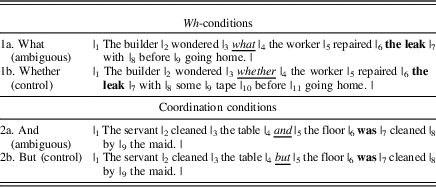
In the present study we tested two kinds of nonpreferred structures: one in which we expected it to be rather hard to obtain the target reading (filled-gap constructions in wh-clauses), and one in which we expected it to be easier to obtain the target reading (and coordination ambiguities resolved toward a clausal coordination). The experimental conditions are illustrated in Table 1. Even though the wh- and the coordination conditions were presented in the same experiment, they were two different between-item manipulations, and were therefore constructed and analyzed separately.
Experimental conditions

Note: “|” indicates segmentation during the presentation; subscripted numbers indicate word position. The underscored word indicates the start of the ambiguity in the a-conditions; bold indicates the disambiguating critical regions. These markings are for the purpose of illustration only and did not appear in the actual materials.
The first type of experimental conditions were the wh-conditions. Examples are given in (1) in Table 1. The intended interpretation of what in (1a) is that it is the complement of the stranded preposition with. However, when reading the sentence from left to right, readers have a strong tendency to initially interpret what in (1a) as the direct object of the verb repaired. This holds for native English speakers (e.g., Crain & Fodor, Reference Crain and Fodor1985; Omaki et al., Reference Omaki, Lau, Davidson White, Dakan, Apple and Phillips2015; Stowe, Reference Stowe1986) as well as L2 learners of English (e.g., Aldwayan, Fiorentino, & Gabriele, Reference Aldwayan, Fiorentino and Gabriele2010; Dallas, Reference Dallas2008; Felser, Cunnings, Batterham, & Clahsen, Reference Felser, Cunnings, Batterham and Clahsen2012; Omaki & Schulz, Reference Omaki and Schulz2011; Víquez, Reference Víquez2012; Williams, Möbius, & Kim, Reference Williams, Möbius and Kim2001). This preference can be explained by frequency (wh-phrases are more frequently an object than a complement of a stranded preposition; Atkinson & Omaki, Reference Atkinson and Omaki2016), as well as by processing strategies that reduce memory load (Frazier & Clifton, Reference Frazier and Clifton1989; Gibson, Reference Gibson1998, Reference Gibson2000): assuming that it is costly to have nonintegrated information in memory, the parser seeks to integrate a wh-phrase as soon as possible. When the direct object position appears to be filled by an overt noun phrase (the leak in [1a]), an increase in reading times is seen starting at this noun phrase compared with the same noun phrase in a sentence without what, as in (1b). This effect is known as the filled-gap effect (Crain & Fodor, Reference Crain and Fodor1985; Stowe, Reference Stowe1986). The intended interpretation of what is that it is the complement of a following preposition (with in [1b]). However, this intended representation may be relatively hard to obtain or activate at the leak in (1a), as there is no information provided by the error as to what the correct analysis is. The only information that can be inferred is that the leak, and not what, is the direct object of repair; no cues are given as to the intended interpretation of what (Fodor & Inoue, Reference Fodor and Inoue2000). If the ease of obtaining the target interpretation affects adaptation, we expected smaller adaptation effects in L2 speakers. We expected that Spanish L2-learners of English, who have been less exposed to this construction in English than native English speakers, and who do not have preposition stranding in their native language, would initially have difficulty activating this intended interpretation. We therefore expected both native speakers and L2 speakers to show longer reading times at the critical noun for the what versus whether conditions, replicating other studies; however, we expected that this difference in reading times would decrease in the native speakers as they encountered more filled-gap items such as (1a) in the study, but remain more prominent in the L2 speakers. In contrast, if frequency differences and experiencing an error are sufficient for adaptation, L2 speakers were expected to show a larger decrease in the size of the disambiguation effect (larger adaptation) than native speakers. Preposition stranding is less expected for L2 speakers, which should lead to a larger error and stronger adaptation.
The second type of experimental condition was the coordination construction illustrated in (2) in Table 1. When reading the and condition (2a) from left to right, readers may initially interpret and as coordinating the two noun phrases following the verb (the table and the floor). The verb was is unexpected under this interpretation, leading to an increase in reading time at this verb position in (2a) versus the same verb in the unambiguous control (2b; Frazier, Reference Frazier1987; Hoeks, Vonk, & Schriefers, Reference Hoeks, Vonk and Schriefers2002). In contrast to the critical noun phrase in the filled-gap constructions (1a), the disambiguating verb was in (2a) provides clear information as to what the correct analysis should be: the verb was needs a singular subject, and it is an easy fix to undo the noun-phrase coordination and make the singular noun phrase the floor the subject of was, retaining the syntactic and thematic structure of the first clause. In addition, Spanish is similar to English in the ambiguity of and (y in Spanish), in that and can coordinate noun phrases as well as clauses. We therefore expected that both native English speakers and L2 learners quickly adapted to this structure: both participant groups were predicted to show a smaller difference in reading times at was for (2a) versus (2b) as they encountered more constructions like (2a) in the experiment.
METHOD
Participants
The native English group consisted of 40 native speakers of American English recruited at the University of Florida, USA (31 women, 9 men; age 18–27, mean age 20.5). The L2 group consisted of 39 Spanish learners of English recruited at the University of Valladolid, Spain (29 women, 9 men, 1 not indicated; age 18–36, mean age 21.5). All participants indicated to have been monolingually raised, to have normal or corrected-to-normal vision, and to have no dyslexia or reported reading problems. The protocol was approved by the University of Florida Institutional Review Board, and the Ethics Board at the University of Valladolid. Most of the native English participants received course credit for participation; participants at the University of Valladolid received no compensation. Most of the L2 participants indicated to have been learning English since the age of 5, which is common in the contemporary Spanish school and daycare system. Twelve of the L2 speakers indicated to have spent time in an English-speaking country. Most of them had spent 2 months or less abroad; one had 9 months of immersion experience, two had 2 years, and one participant had 3 years of English immersion experience. The L2 participants indicated to be currently using English 32% percent of the time (SD=13.5) and rated their own English speaking, listening, and reading proficiency as 7.1 (SD=1.0), 7.9 (SD=1.0), and 8.1 (SD=1.0) out of 10, respectively, where 10 is native proficiency. All participants completed the LexTALE task (Lemhöfer & Broersma, Reference Lemhöfer and Broersma2012). Performance on this lexical decision task highly correlates with other language proficiency measures (Lemhöfer & Broersma, Reference Lemhöfer and Broersma2012). The native English group had a significantly higher score on the LexTALE task than the L2 group (Native English: mean 92.2, range 71–100; L2: mean 72.4, range 55–100), T (77)=9.68, p<.0001. Of the native English speakers, 38 scored within the advanced range on the LexTALE task (score of 80–100), and 2 in the intermediate range (60–80). Of the L2 group, 9 scored in the advanced range, 27 in the intermediate, and 3 in the low range (score of 59 or lower).
Stimuli
Thirty-six pairs of sentences were constructed of type (1) in Table 1 (wh-conditions), and another 36 pairs of type (2) in Table 1 (coordination conditions). In the wh-conditions, the question word (what) was intended as the complement of a preposition. The verb in the embedded clause was always followed by a noun phrase in order to elicit the filled-gap effect. In the control condition, whether replaced what, and a noun phrase followed the preposition. The critical position was therefore the noun phrase after the embedded verb (underscored in Table 1 for the purpose of illustration). Here we expected an increase in reading times for the what versus whether condition, especially at the start of the task. In the coordination conditions, the two noun phrases were separated by and in the and coordination condition (2a) and by but in the control condition (2b). The latter is not very likely to indicate a coordination between two noun phrases. The critical word was the verb (was) following the second noun phrase, signaling that the second noun was the subject of a new clause, and that the correct analysis in (2a) was one in which and coordinates two clauses rather than two noun phrases. In all experimental items, the critical word was in the sixth presentation frame, followed by at least three segments. Experimental items were divided into two counterbalanced presentation lists, such that a participant only saw one version of each experimental item pair, and each list contained 18 different items for each of the four experimental conditions. Within and across lists, the items in the what and whether condition were matched in the length in number of characters, and word form frequency as determined by the Corpus of Contemporary American English (Davies, Reference Davies2008–) of the verb preceding the critical noun phrase, and of the noun in the critical position; items in the and condition were matched with those in the but condition on the length and frequency of the noun preceding the critical verb.
In addition to the experimental items, we constructed 72 distractor sentences that had other syntactic structures. The distractor sentences consisted of a main and an embedded clause. The embedded clause either was the complement of the main clause verb (e.g., The pilot saw that the weather was too stormy for the plane to take off), and started with that (18 items), when, how, or why (6 each), or was an adjunct clause (e.g., The baby played on the blanket while the grandmother sipped her coffee). Adjunct clauses either followed (18 items) or preceded the main clause (18 items). To avoid unintended effects on adaptation, distractor materials never contained and, but, what, or whether; other noun phrase coordinations; or sentences with stranded prepositions. A complete list of materials is included in the online-only Supplementary Materials. The order of the 72 experimental items and the 72 distractors was automatically pseudorandomized for each participant, such that items from the same experimental main type (wh or coordination) were separated by at least one distractor item or experimental item of a different main type.
To encourage participants to pay attention to the sentences, two-thirds of the experimental items and one-third of the distractors (50% of all items in total) were followed by a yes/no comprehension question. The correct answer was “no” in half of the questions and “yes” in the other half. Questions mainly probed which antagonist did what. We did not systematically probe incorrect or target interpretations of the ambiguous structures; however, the coordination conditions had seven comprehension questions that probed the lingering of the initial reading. For instance, the sentence The dog buried the bone and the stick was left behind the doghouse was followed by the question Did the dog bury the stick? A “yes” answer to this question suggests that the reader still entertained the reading in which the bone and the stick are both direct objects of the verb bury. We will discuss performance on these questions separately in the Results section.
Procedure
Each participant was randomly assigned to only one presentation list. Sentences were presented in a noncumulative moving window self-paced reading paradigm controlled by Linger (developed by Doug Rohde, http://tedlab.mit.edu/~dr/Linger/). Each trial started with a sentence contour: all words and spaces were replaced by dashes. Participants controlled the presentation of the words using the space bar. Each time they pressed the space bar, a new word was presented, and the previous word was replaced with dashes. At the end of the sentence, the next trial was displayed, or a comprehension question was presented. Participants answered the question by pressing the “f” or “j” key, corresponding to the letters Y and N displayed at the left and right side on the screen, respectively. Participants were instructed to read at a normal pace. They received five practice items (two followed by questions) that contained a main clause and an embedded clause, but otherwise did not resemble the experimental items. A short break was automatically enforced in the middle of the self-paced reading experiment. The self-paced reading task was followed by the LexTALE lexical decision task (Lemhöfer & Broersma, Reference Lemhöfer and Broersma2012), and a language background questionnaire.Footnote 1
ANALYSIS AND RESULTS
Reading times
Analysis
Following experimental conventions, we first omitted reading times that were too short or too long to reflect reading processes, and then transformed the data to approximate a normal distribution (Baayen & Milin, Reference Baayen and Milin2010). We omitted data points longer than 5000 ms and shorter than 100 ms. This procedure affected less than 0.01% of all data points in either group. Next, we omitted data points that were longer than the mean plus 2.5 SD for each participant. This affected 2.5% and 2.9% of the data points in total for the native English and L2 groups, respectively. Restricted to the critical word positions of our experimental conditions, these cutoff procedures affected, in the what condition, 5.8% for the native English, and 3.4% for the L2 group; in the whether condition, 3.3% and 2.8%; in the and condition, 1.5% and 0.6%; and in the but condition, 0.7% and 0.6%. We then log-transformed the reading times (natural logarithm) to adjust for the skewedness of the distribution. The Box–Cox procedure (Box & Cox, Reference Box and Cox1964) confirmed that a log transformation was appropriate (smallest λ was –0.6). For the native and L2 groups separately, we calculated residual reading times based on a linear mixed-effects model on all data (experimental items as well as distractors), with the length of the word in the number of characters, and the (natural) log-transformed position of the trial in the experiment as fixed effects. Random effects included by-participant intercepts and by-participant slopes for word length and the log of the trial position. We included trial position as a factor to control for overall effects of the duration of the experiment, regardless of the distribution of the experimental conditions. The main analyses were conducted on the residual log reading times thus obtained. Word length, the overall position of the trial in the experiment, and overall reading speed of each participant are all strong predictors of reading times, and it is standard in analyses of reading times to use residual rather than raw reading times to reduce these effects.Footnote 2 Because the two experimental manipulations (wh- and coordination conditions) involved different lexical items and different constructions, they were not directly comparable. We therefore analyzed these sentence types separately. For each main type, we analyzed the residual log reading times at the critical position using a linear mixed-effects model in R, version 3.4.3 (R Core Team, 2015), using the lme4 package, version 1.1-15 (Bates, Maechler, Bolker, & Walker, Reference Bates, Maechler, Bolker and Walker2015). Fixed effects were language group (deviation coded, with L2 coded +0.5), condition (ambiguous/nonambiguous, deviation coded with ambiguous coded +0.5), and the number of preceding temporarily ambiguous items seen of the type under investigation (centered). Previous studies (Fine et al., Reference Fine, Jaeger, Farmer and Qian2013; Kaschak & Glenberg, Reference Kaschak and Glenberg2004) suggest that adaptation can take place within a few trials. To better capture the early part of the study, we used a (natural) log-transformation of the number of preceding ambiguous structures seen.Footnote 3 We augmented the number by 1 before transformation to avoid taking the log of 0. Results were not qualitatively different when a nontransformed number was used. We first estimated models with a maximal random effects structure. When these models did not converge, we removed the correlations between the random slopes and intercepts (Barr, Levy, Scheepers, & Tily, Reference Barr, Levy, Scheepers and Tily2013).Footnote 4 We first conducted an analysis with native and L2 speakers combined. As the main aim of the study was to explore to what extent native and L2 speakers adapt, we also analyzed the participant groups separately. The analysis of the L2 data included as fixed effects the factor proficiency (LexTALE score) and its interactions with condition and the number of what or and items seen. P values were estimated using lmerTest, version 2.0-36 (Kuznetsova, Brockhoff, & Christensen, Reference Kuznetsova, Brockhoff and Christensen2016), which bases degrees of freedom on Satterthwaite approximations.
Wh-conditions
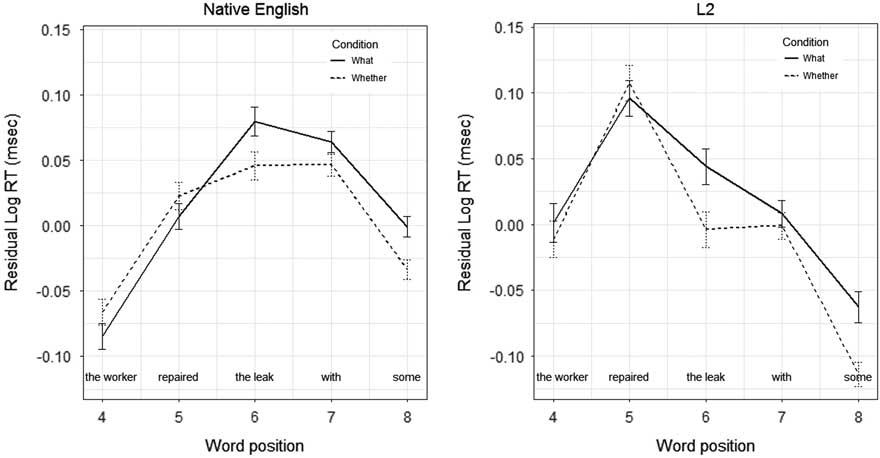
Mean residual log reading times for the what and whether sentences for the native English and L2 groups are given in Figure 1. Replicating prior studies, reading times were longer at the noun phrase following the verb (position 6) in the what than in the whether conditions, when it became clear that what could no longer serve as the direct object of the verb (e.g., Aldwayan et al., Reference Aldwayan, Fiorentino and Gabriele2010; Crain & Fodor, Reference Crain and Fodor1985; Dallas, Reference Dallas2008; Felser et al., Reference Felser, Cunnings, Batterham and Clahsen2012; Omaki et al., Reference Omaki, Lau, Davidson White, Dakan, Apple and Phillips2015; Omaki & Schulz, Reference Omaki and Schulz2011; Stowe, Reference Stowe1986; Víquez, Reference Víquez2012; Williams et al., Reference Williams, Möbius and Kim2001).
Mean log residual reading times for the what and whether sentences. Word position 6 corresponds to the critical noun phrase, see Table 1. Left panel: Native English speakers; Right panel: L2 group.

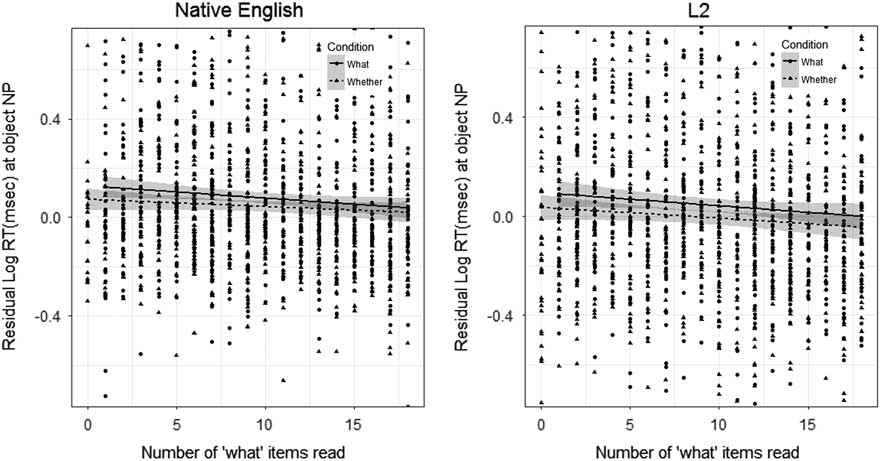
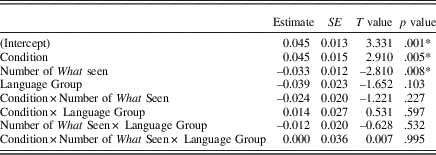
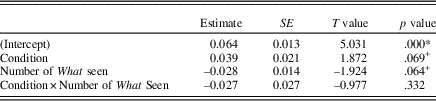
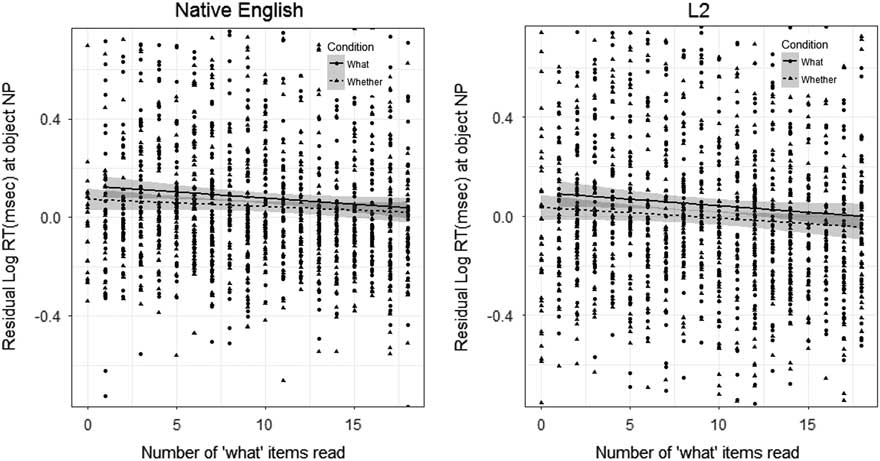
Figure 2 shows the change of the reading times at the critical noun phrase (position 6 in Table 1) as a function of the number of what constructions encountered. Results from the linear mixed-effects model on the reading times at the postverbal noun phrase, comparing the two participant groups, are given in Table 2. For all participants taken together, the what condition was read more slowly than the whether condition (effect of condition, Table 2); however, there was no effect of adaptation: the difference between what and whether did not decrease as more what conditions had been encountered (no interaction of condition by number of preceding what sentences seen).
Mean log residual reading times for the what and whether conditions at the critical noun phrase as a function of the number of what sentences seen in the study. Left panel: Native English speakers; Right panel: L2 group.
Results from the linear mixed-effects model for critical word position, wh-conditions

Note: Number of What seen, number of preceding what sentences seen, log transformed. Condition, whether vs. what. Language group, Native English vs. L2. Model, LogRTresidual~Condition×Number of What Seen×Language Group+(1+Condition×Number of What Seen | Subject)+(1+Condition×Number of What Seen | Item); 79 subjects; 36 items; Log-Likelihood: –691.0. For this model and the models presented in following tables, p values were determined by LmerTest. *p<.01.
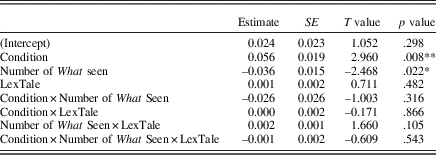
Even though no interaction with language group was significant, we nevertheless conducted separate analyses for each of the two participant groups, to see if both participant groups showed the same pattern of effects. Table 3 lists the results for the native English group; Table 4 lists the results for the L2 group. The difference in reading times between the what and whether conditions at the critical position failed to reach significance for the native English group. The L2 group showed significantly longer reading times at the direct object for the what versus whether condition, suggesting they experienced difficulty when the gap-position was filled. However, the difference in reading time between the conditions was not affected by the number of what conditions seen. L2 proficiency as measured by the LexTale score had no effect.
Results from the linear mixed-effects model for the native English group, wh-conditions

Note: Number of What seen, number of preceding what sentences seen, log transformed. Condition, whether vs. what. Model: LogRTresidual~Condition×Number of What Seen+(1+Condition×Number of What Seen | Subject)+(1+Condition×Number of What Seen | Item); 40 subjects; 36 Items; Log-Likelihood: –206.4. *p<.01. + p<.1.
Results from the linear mixed-effects model for the L2 group, wh-conditions

Note: Number of What seen, number of preceding what sentences seen, log transformed. Condition, whether vs. what. Model: LogRTresidual~Condition×Number of What Seen×LexTale+(1+Condition×Number of What Seen || Subject)+(1+Condition×Number of What Seen || Item); 39 subjects; 36 Items; Log-Likelihood –459.8. *p<.05. **p<.01.
Coordination conditions
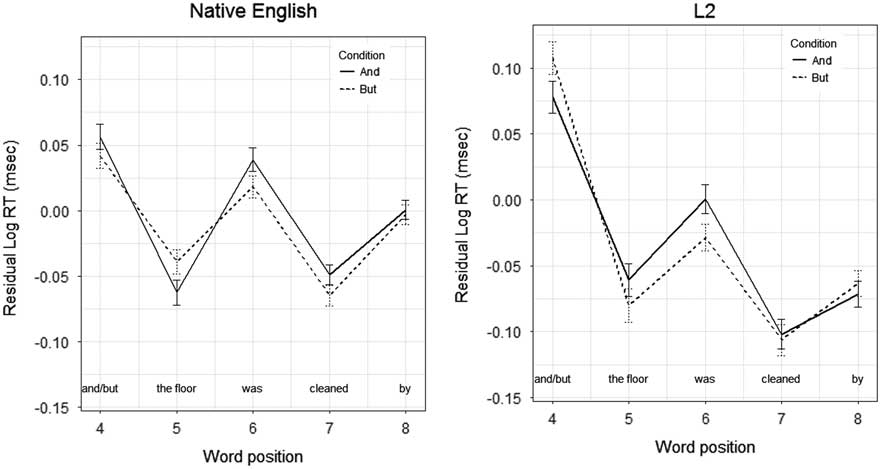
The mean reading times for the coordination conditions are given in Figure 3. As expected, both participant groups showed a longer reading time at the disambiguating finite verb in the ambiguous and condition versus the but control condition. This suggests that both participant groups had a preference for a noun phrase coordination and experienced processing difficulty when this analysis was no longer compatible with the incoming information.
Mean log residual reading times for the and and but sentences. Word position 6 corresponds to the critical verb, see Table 1. Left panel: Native English speakers; Right panel: L2 group.

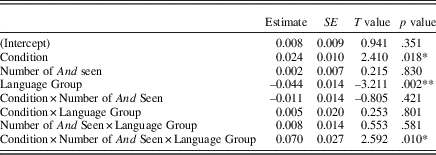
Results from the linear mixed-effects model on the reading times for the disambiguating verb are given in Table 5. Critically, there was a main effect of condition, and a three-way interaction between language group, condition, and number of preceding and sentences seen.
Results from the linear mixed-effects model, coordination conditions

Note: Number of And seen, number of preceding and sentences seen, log transformed. Condition, but vs. and. Language group, Native English vs. L2. Model: LogRTresidual~Condition×Number of And Seen×Language Group+(1+Condition×Number of And Seen | Subject)+(1+Condition×Number of And Seen | Item); 79 subjects; 36 items; Log-Likelihood: –107.0. *p<.05. **p<.01.
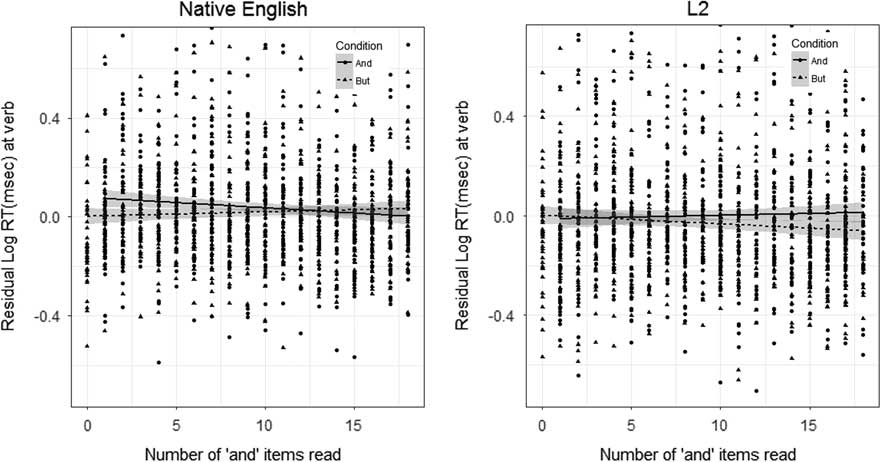
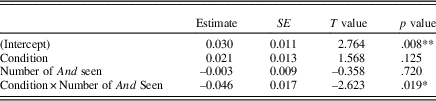
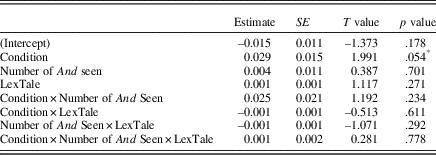
Separate analyses for the native and L2 groups for the disambiguating position (position 6) are given in Tables 6 and 7. The native English group showed a significant interaction of condition and number of preceding and sentences: the difference in reading times between the and and but conditions became smaller as more and structures had been seen (see Figure 4a). The L2 learners, in contrast, showed a numerically larger difference between the two conditions as they had read more items with and (Figure 4b); however, there was no interaction between condition and the number of and sentences seen (Table 7). Again, we did not see any effect of proficiency as measured by the LexTale score. In sum, the results suggest that the significant three-way interaction in the overall analysis is due to the native English group showing a significant two-way interaction between condition and trial number, while this two-way interaction is absent in the L2 group.
Mean log residual reading times for the and and but condition at the critical verb as a function of the number of and sentences seen in the study. Left panel: Native English speakers; Right panel: L2 group.

Results from the linear mixed-effects model for the native English group, coordination conditions

Note: Number of And seen, number of preceding and sentences seen, log transformed. Condition, but vs. and. Model: LogRTresidual~Condition×Number of And Seen+(1+Condition×Number of And Seen || Subject)+(1+Condition×Number of And Seen || Item); 40 subjects; 36 Items; Log-Likelihood: 77.1. *p<.05. **p<.01.
Results from the linear mixed-effects model for the L2 group, coordination conditions

Note: Number of And seen, number of preceding and sentences seen, log transformed. Condition, but vs. and. Model: LogRTresidual~Condition×Number of And Seen×LexTale+(1+Condition×Number of And Seen || Subject)+(1+Condition×Number of And Seen || Item); 39 subjects; 36 Items; Log-Likelihood: –168.4. *p<.1.
Comprehension questions
Two-thirds of the experimental items were followed by a comprehension question. We used the accuracy on the questions (a) to probe further differences between the groups, and more specifically, (b) to explore whether the groups differed in the lingering of the initial interpretation of the ambiguous and sentences.
Differences between native and L2 speakers
Mean accuracy to the comprehension questions in the study is given in Table 8. The lower performance in the whether condition for both groups can be due to the ambiguity of some of the questions in this condition. For instance, the question Did the worker repair the leak? has no obvious correct answer following The builder wondered whether the worker repaired the leak with some tape before going home. The whether condition was therefore dropped from further analysis of the question data.
Mean accuracy (SD) on the comprehension questions across the experimental conditions

We conducted logistic linear mixed-effects analyses on the response accuracy of the questions following the experimental items as a function of condition and language group. We analyzed the what condition and the coordination conditions separately. The L2 group responded less accurately than the native group in both the what (Estimate=–0.61; SE=0.25; z value=–2.46; p<.05) and the coordination conditions (Estimate=–0.34; SE = 0.17; z value=–2.03; p<.05). No effects of condition were found, suggesting that overall performance on the questions was not affected by ambiguity.
Lingering of the initial interpretation
Although the current experiment was not designed to systematically test whether readers had difficulty rejecting the initial interpretation of the ambiguous structures, the coordination condition had seven comprehension questions that probed the lingering of the initial reading. This is the interpretation in which the noun phrase after and was the object of the preceding verb. Mean accuracy for these questions in the native English group was 0.80 (SD 0.30) for and, and 0.92 (0.15) for but. Mean accuracy on these questions in the L2 group was 0.82 (0.20) for and, and 0.85 (0.19) for but. A paired t test on the ambiguous versus unambiguous conditions suggests that the native English speakers performed worse on the questions probing the lingering interpretation in the ambiguous and versus unambiguous but condition, T (39)=2.74, p<.01, but that the L2 group showed no difference, T (38)=0.80, p=.43. In addition, six questions in the coordination conditions probed the target interpretation of the noun phrase after and (e.g., The boy rolled up the carpet and the rug was moved by the girl. Did the girl move the rug? Correct answer “yes”). Both groups responded to the same level of accuracy, with no difference between the and and the but conditions (L2 group: mean accuracy and=0.90, SD=0.18; but=0.90, SD=0.18; T<1; native English group: mean accuracy and=0.92, SD = 0.16; but=0.93, SD=0.12; T<1). We therefore have no evidence that the L2 group had specific difficulties with obtaining or reconstructing the correct interpretation in the ambiguous and condition, or with rejecting the initial interpretation in this condition.
DISCUSSION
The aim of the present study was to test syntactic adaptation in native and L2 speakers. We presented native English and Spanish L2 English readers with two different syntactic structures that differed in the ease with which the intended nonpreferred reading could be obtained: coordination and wh-constructions. If frequency differences and experiencing an “error” (i.e., a deviation from an expected structure) are sufficient for adaptation, adaptation to an infrequent, nonpreferred structure should, in general, be larger in L2 learners than in native speakers: L2 learners have had less relative and absolute exposure to such nonpreferred structures, and would therefore experience a larger “error” when the structure continues as the nonpreferred alternate, resulting in a larger adjustment to this nonpreferred alternative over the course of the experiment. However if, in addition or instead, the ease of obtaining the target structure or the lingering of an incorrect interpretation affects adaptation, we expected L2 speakers to show weaker adaptation than the native speakers, especially for the what conditions, which did not have a structural equivalent in Spanish, and in which the disambiguating position did not contain any direct cues as to the intended, target representation.
Our results suggest that frequency differences between the typical and target structure, and experiencing an “error” are not sufficient for adaptation. For both coordination and wh-constructions, longer reading times were observed at the critical, disambiguating position. This suggests that both groups had a preference for interpreting what as the direct object of the verb, and for taking and as a coordination of two noun phrases, and that both groups experienced processing difficulty (“error”) when the preferred, expected analyses could no longer be pursued. However, we found evidence of adaptation only in the native English group and only to the and coordination condition: the more and items had been encountered that were resolved toward the initially nonpreferred clausal coordination, the smaller the difference in reading times at the point of disambiguation versus the unambiguous but control sentences. We do not have evidence for adaptation to either the and or the what condition in the L2 group. We also did not find adaptation to the what condition in the native English speakers, at least not in the analysis reported in the main text. The latter finding is rather surprising given previous reports of adaptation to complex constructions in native speakers. Of course, we may just not have had enough power, or may not have used a long enough study to obtain adaptation effects in these cases. Below we will discuss other potential reasons why we did not observe adaptation effects in our what conditions, and why L2 speakers may not have adapted to the and conditions whereas our native speakers did.
Failure to find adaptation to the what conditions in native speakers
We did not find adaptation effects for the filled-gap (what) conditions, not even in our native speakers. This is in contrast to previous studies reporting decreases in garden path effects in rather complex structures such as reduced relatives and object relatives (Farmer et al., Reference Farmer, Fine, Yan, Cheimariou and Jaeger2014; Fine & Jaeger, Reference Fine and Jaeger2013; Fine et al., Reference Fine, Jaeger, Farmer and Qian2013; Wells et al., Reference Wells, Christiansen, Race, Acheson and MacDonald2009), but see Harrington Stack, James, and Watson (Reference Harrington Stack, James and Watson2018) for a recent failure to replicate adaptation effects. The difference in outcomes between the current and prior studies may be due to differences in the design of the experiment, and in the way outliers in the data are treated. Most studies reporting adaptation have not used many distractor items, or none at all during an exposure phase (e.g., Experiment 2 in Fine et al., Reference Fine, Jaeger, Farmer and Qian2013). Myslín and Levy (Reference Myslín and Levy2016) report that adaptation is stronger when critical structures are blocked. The fact that in our study the what items were interleaved with distractor items and coordination conditions, and consisted only of 12% of the items in the study, may therefore have hindered adaptation especially of a complex construction such as our what conditions.
Another difference between previous studies and the current study is the treatment of outliers in the data. Previous studies typically only omitted response times longer than 2000 ms (e.g., Fine et al., Reference Fine, Jaeger, Farmer and Qian2013), without removing outliers on a by-participant basis as we did in the analyses reported above. When we analyzed our data using cutoff criteria similar to those used in previous studies, the adaptation effect for the what versus whether condition was significant in the native English data, but not in the L2 data (see online-only Supplementary Materials C). The cutoff procedure used in the analysis reported in the main text above resulted in a loss of 5% of the native data at the filled-gap position versus 0.5% in the analysis using a liberal cutoff procedure. The adaptation effect observed in the latter analysis was, therefore, driven by only a small number of extreme data points. It is, therefore, possible that adaptation effects reported in prior studies using less stringent cutoff procedures were driven by outliers and thus were not very robust.
Ease of obtaining the target structure
The observation that our native speakers adapted more robustly to the and coordination condition than to the what condition needs explanation. As discussed above, it may have been harder to obtain the target structure in the filled-gap (what) conditions than in the coordination conditions. In the filled-gap condition, the presence of an overt object noun phrase after the verb indicates that the preferred interpretation (what as the direct object) is incorrect. However, the noun phrase carries no cues as to what the intended structure is; in contrast, the disambiguating verb in the coordination condition does provide cues as to how the initial coordination between two direct objects would need to be revised (Fodor & Inoue, Reference Fodor and Inoue2000). Readers may, therefore, be less likely to adapt to the target structure if it is harder to infer the target structure at the point of the error.
L2 speakers, being less familiar with the target structures, may have had more difficulty obtaining the target interpretation, and may have therefore been even less likely to adapt to the target structures; this in spite of the fact that they noticed at the point of disambiguation that the preferred analysis could no longer be pursued, and that they were eventually successful in obtaining or reconstructing the target structure when answering the comprehension questions (our L2 learners performed with 90% accuracy on questions probing the target interpretation in the coordination conditions). The fact that our L2 speakers showed effects of disambiguation at the same word position as the native speakers suggests that the lack of adaptation in the L2 group cannot be due to the L2 speakers delaying their processing (Dekydtspotter, Schwartz, & Sprouse, Reference Dekydtspotter, Schwartz and Sprouse2006), assigning only a shallow representation to the sentence (Clahsen & Felser, Reference Clahsen and Felser2006), or not predicting (Hopp, Reference Hopp2015; Kaan, Kirkham, & Wijnen, Reference Kaan, Kirkham and Wijnen2016; Lew-Williams & Fernald, Reference Lew-Williams and Fernald2010; Martin et al., Reference Martin, Thierry, Kuipers, Boutonnet, Foucart and Costa2013).
Note that our findings are not incompatible with an error-based learning approach. If the intended parse cannot be easily identified, the deviance between the initially pursued structure and the target structure cannot be easily calculated, leading to a noisier error signal, which in turn leads to weaker adaptation. Assuming that error signals experienced by L2 processers are more inconsistent or noisier than in native speakers, the failure for the L2 speakers to adapt even with respect to the and conditions can be accounted for.Footnote 5
Lingering initial interpretations
Above we mentioned the lingering activation of the initial, incorrect reading as another potential factor affecting adaptation. After encountering the critical noun phrase (filled-gap) in the wh-conditions, or the critical verb in the and coordinations, the initial analysis must be rejected and a new analysis activated or built. The initial analysis may however linger and lead to priming of the direct object interpretation of a fronted what phrase, and of the noun phrase coordination (cf. van Gompel et al., Reference van Gompel, Pickering, Pearson and Jacob2006, for priming by lingering interpretations). This may in turn hinder adaptation to the intended structures. Results from the small number of questions that probed the lingering representation in the coordination condition suggest that, if anything, our native speakers had more difficulty rejecting the initial and coordination interpretation than our L2 speakers. The L2 speakers’ overall worse performance on the questions, and the fact that their response accuracy was not different to critical questions following and compared to but sentences, suggests that they may have problems with interfering information in general, not specifically restricted to interference of lingering readings (Cunnings, Reference Cunnings2017). Adaptation is, therefore, probably not much affected by the lingering of the initial, incorrect, interpretation.
Task demands and other factors
The ease of obtaining the intended target interpretation is likely not the only factor affecting adaptation. Numerically, the L2 speakers showed a trend toward an anti-adaptation effect in the coordination conditions: the difference in reading times between the nonpreferred and preferred conditions became numerically larger as more and coordinations had been encountered. Although speculative at this point, we suggest that also task demands may affect adaptation. In our study, more than half of the questions following the coordination sentences explicitly probed the noun phrase following and. Participants may have noticed this and may therefore have started paying more attention to the point of disambiguation (Swets, Desmet, Clifton, & Ferreira, Reference Swets, Desmet, Clifton and Ferreira2008), leading to longer reading times at the critical position in this condition as the experiment progressed. Recall that the native speakers rapidly adapted to the clausal and coordinations. The difference between the L2 and native speakers could be attributed to a difference in sensitivity to task demands between the two groups. The L2 group may have felt more pressured to do well on the task than the native group. L2 speakers may have processed the sentences more strategically, counteracting implicit learning effects that would give rise to adaptation (Kaschak & Glenberg, Reference Kaschak and Glenberg2004; Traxler & Tooley, Reference Traxler and Tooley2008). This explanation can be tested in future experiments in which task demands are varied.
We also like to point out that our L2 and native groups differed in the testing environment, school system, and many other factors that were beyond our control, which may also have contributed to the differences found between the groups, and which may have made the groups hard to compare (Dekydtspotter et al., Reference Dekydtspotter, Schwartz and Sprouse2006). To further explore what factors affect adaptation, future studies should therefore test L2 groups with similar language and educational backgrounds and in the same location, but with, for example, a wide range of proficiency levels.
Conclusion
Our results suggest that differences in frequency and experiencing an error are not sufficient to adapt to a non preferred syntactic structure: both native and L2 speakers showed garden path effects, but only native speakers showed adaptation effects and only in one of the conditions. Adaptation may therefore be affected by various factors, such as the ease of obtaining the target structure and task demands. Future research should be directed toward further identifying these factors, investigating how adaptation can be boosted, and exploring the relation between adaptation and longer term retention.
SUPPLEMENTARY MATERIAL
To view the supplementary material for this article, please visit https://doi.org/10.1017/S0142716418000437
ACKNOWLEDGMENTS
The authors would like to thank Patricia Aziz for the preparation of the stimulus materials, Andrea Dallas for feedback on the project, and Devin McCann and Sara Levy for their help collecting data. This research was supported in part by a 2016–2017 University of Florida University Scholars Program (awarded to C.F.), and by the Castile and León Regional Government Education Division (Spain) and FEDER [VA009P17].