Language aptitude is a complex construct that comprises cognitive and perceptual abilities that predispose individuals to learn well or rapidly (Carroll, Reference Carroll and Diller1981; Doughty et al., Reference Doughty, Campbell, Mislevy, Bunting, Bowles, Koeth, Prior, Watanabe and Lee2010). Its relevance to second language acquisition (SLA) has been consistently shown by an increasingly large number of studies in naturalistic and instructed learning contexts that have recently made aptitude research a revitalized area of study (e.g., Bylund, Abrahamsson, & Hyltenstam, Reference Bylund, Abrahamsson and Hyltenstam2010; Granena, Reference Granena2013a; Granena & Long, Reference Granena and Long2013; Yilmaz, Reference Yilmaz2013). Although the componential nature of language aptitude was already discussed by J. B. Carroll in the 1950s, recent developments in cognitive and educational psychology have reinforced the idea of multiple aptitudes for language learning (e.g., for a review, see DeKeyser & Koeth, Reference DeKeyser, Koeth and Hinkel2011) and have led SLA researchers to revisit and update the components proposed by Carroll (Reference Carroll1964) with special emphasis on construct validity.
Tests such as the Modern Language Aptitude Test Battery (MLAT; Carroll & Sapon, Reference Carroll and Sapon1959), the Pimsleur Language Aptitude Battery (Pimsleur, Reference Pimsleur1966), and, more recently, the LLAMA (Meara, Reference Meara2005), loosely based on the MLAT, have in common the fact that they tap cognitive abilities in the domain of explicit and attention-driven cognitive processes such as explicit inductive learning ability, rote memory ability, and analytical ability. These are cognitive abilities that are especially relevant to learn a language intentionally through reasoning, deliberate hypothesis testing, and memorization. Evidence for this claim can be found in a number of instructed SLA studies, which have shown that abilities in this domain of explicit cognition, such as grammatical sensitivity (or language analytical ability; Skehan, Reference Skehan1989), correlate with outcomes under explicit learning conditions. For example, in the area of corrective feedback, Li (Reference Li2010), Sheen (Reference Sheen2007a, Reference Sheen and Mackey2007b), and Yilmaz (Reference Yilmaz2013) found quite or very strong correlations between learning outcomes under explicit feedback conditions (either explicit or metalinguistic correction) and analytical ability.
Similarly, in the area of instruction, analytical ability has been shown to correlate with outcomes in explicit deductive or explicit inductive learning conditions (de Graaff, Reference de Graaff1997; Erlam, Reference Erlam2005), processing instruction in German when preceded by explicit information (VanPatten, Collopy, Price, Borst, & Qualin, Reference VanPatten, Collopy, Price, Borst and Qualin2013), and intentional learning conditions (rule search or rule presentation; Robinson, Reference Robinson1997). In contrast, correlations with learning outcomes under implicit learning conditions, implicit feedback (recasts) or implicit instruction, have been less consistent. Several studies have failed to find a significant relationship (Li, Reference Li2010; Sheen, Reference Sheen and Mackey2007b; Yilmaz, Reference Yilmaz2013), while others that have reported significant correlations (de Graaff, Reference de Graaff1997; Robinson, Reference Robinson1997; Sheen, Reference Sheen2007a; Trofimovich, Ammar, & Gatbonton, Reference Trofimovich, Ammar, Gatbonton and Mackey2007) cannot completely discard explicit learning during the treatment or explicit processing during testing. For example, Williams (Reference Williams1999) pointed out that the extent to which the implicit and explicit instruction conditions in de Graaff (Reference de Graaff1997) led to different types of learning is not clear, because both groups knew they were going to be tested and received both the correct answer and feedback concerning the correctness of their response. In addition, Robinson (Reference Robinson1997, Reference Robinson and Robinson2002) interpreted the correlation between aptitude and learning in the implicit condition in his two studies as showing that participants had consciously analyzed, searched for, and found the rules underlying the sentences.
In addition to aptitudes that may be more relevant for conscious, deliberate, and reflective (i.e., explicit) language learning, recent proposals on language aptitude (Doughty et al., Reference Doughty, Campbell, Mislevy, Bunting, Bowles, Koeth, Prior, Watanabe and Lee2010; Granena, Reference Granena, Granena and Long2013b; Linck et al., Reference Linck, Hughes, Campbell, Silbert, Tare and Jackson2013) have also incorporated cognitive aptitudes for implicit language learning, following calls for new aptitude constructs in educational and cognitive psychology (e.g., Kaufman et al., Reference Kaufman, DeYoung, Gray, Jimenez, Brown and Mackintosh2010; Woltz, Reference Woltz2003). Unlike work with a primarily psychometric orientation, these new proposals use cognitive ability tests that measure mental processes in laboratory experiments using reaction times, error rates, and other indicants. Aptitude for implicit learning includes abilities in the general domain of implicit cognitive processes (e.g., implicit memory and implicit inductive learning ability) that are hypothesized to be relevant for implicit language learning, understood as learning “in the absence of 1) conscious intention to learn, 2) conscious awareness of the fact that we are learning, and 3) conscious attribution of any noticed change to the effects of learning” (Jiménez, Reference Jiménez and Jiménez2002, p. 62).
The recent language aptitude test battery by Linck et al. (Reference Linck, Hughes, Campbell, Silbert, Tare and Jackson2013), the Hi-LAB, which aims at identifying cognitive predictors of successful learning at the most advanced stages of SLA, distinguishes between constructs hypothesized to tap explicit learning aptitude, such as explicit induction and rote memory, and constructs hypothesized to tap implicit learning aptitude, such as primability and implicit inductive learning ability, as measured by semantic priming and serial reaction time (SRT) tasks, in addition to other measures of memory and perceptual acuity. Granena (Reference Granena, Granena and Long2013b) also made a distinction between aptitudes for implicit and explicit learning based on the results of a factor analysis, which showed that scores on the LLAMA aptitude test and a general intelligence test loaded together onto a common factor, separately from scores on a probabilistic SRT task. These results were interpreted as suggesting two different types of aptitude constructs, explicit and implicit, because the LLAMA test and general intelligence tests rely heavily on explicit, analytic processing, whereas SRT tasks have been hypothesized to rely on implicit processing (Destrebecqz & Cleermans, Reference Destrebecqz and Cleeremans2001; Kaufman et al., Reference Kaufman, DeYoung, Gray, Jimenez, Brown and Mackintosh2010) and have been dissociated from IQ measures (e.g., Kaufman et al., Reference Kaufman, DeYoung, Gray, Jimenez, Brown and Mackintosh2010; Reber, Walkenfeld, & Hernstadt, Reference Reber, Walkenfeld and Hernstadt1991).
In addition to calls for aptitude for implicit learning as a valid construct, recent empirical research supports its relevance to account for variation in language learning outcomes. In first language acquisition, individual differences in an artificial grammar task, considered by some researchers as a measure of implicit learning, have been shown to be related to reading comprehension (Misyak & Christiansen, Reference Misyak and Christiansen2012) and to sensitivity to word predictability in speech perception (Conway, Bauernschmidt, Huang, & Pisoni, Reference Conway, Bauernschmidt, Huang and Pisoni2010). Furthermore, learning in SRT tasks, another measure of implicit learning, has been found to be disturbed in clinical cases of language-impaired individuals (e.g., Tomblin, Mainela-Arnold, & Zhang, Reference Tomblin, Mainela-Arnold and Zhang2007), suggesting a connection between language learning and SRT learning, despite the nonverbal nature of the SRT task. In second language (L2) acquisition, individual differences in SRT learning have been significantly related to educational attainment in foreign languages (Cherry & Stadler, Reference Cherry and Stadler1995; Kaufman et al., Reference Kaufman, DeYoung, Gray, Jimenez, Brown and Mackintosh2010; Pretz, Totz, & Kaufman, Reference Pretz, Totz and Kaufman2010) and to sensitivity to grammatical agreement violations in naturalistic language learners (Granena, Reference Granena2013a). Finally, SRT learning has been shown to contribute to explain high-level L2 attainment in reading and, especially, listening, suggesting that it is a potential cognitive predictor of successful learning to advanced proficiency levels (Linck et al., Reference Linck, Hughes, Campbell, Silbert, Tare and Jackson2013).
COGNITIVE STYLES AND LANGUAGE APTITUDE
The distinction between cognitive aptitudes for explicit and implicit language learning is consistent with dual-process theories of cognition that claim that individuals operate using two separate systems: a conscious, analytical, effortful, rule-governed, and slower system (explicit); and a nonconscious, holistic, effortless, associative, and faster system (implicit; e.g., Epstein, Reference Epstein and Pervin1990, Reference Epstein, Plessner, Betsch and Betsch2008; Witteman, van den Bercken, Claes, & Godoy, Reference Witteman, van den Bercken, Claes and Godoy2009). Skehan (Reference Skehan1998) argued that the analytic–holistic contrast in the cognitive style literature was akin to the analytic–memory contrast in language aptitude, thus suggesting the existence of potential connections between individual differences in language aptitude and cognitive style (see also Dörnyei & Skehan, Reference Dörnyei, Skehan, Doughty and Long2003).
According to Skehan's proposal (Reference Skehan and Cook1986), which aimed at identifying cognitive styles that are language-dependent and relevant for L2 acquisition and use, some L2 learners would be more analysis oriented, whereas others would be more memory oriented. High-analysis learners search for rules, develop rule-based representations of language, and strive for accuracy. They would correspond to Scovel's (Reference Scovel2001) notion of “grammarians” (p. 105). High-memory learners do not analyze, but store exemplars and associate language clusters with particular meanings or situations. They would correspond to Scovel's (Reference Scovel2001) notion of “chunkers” (p. 105). This does not mean that learners cannot have capacities in each of these areas, or that one profile would have to exist at the expense of the other, but that there would be a predisposition to process information more frequently in one way than another. Similarly, in the cognitive psychology literature, research has demonstrated that individuals do report preferences for one modality of thought (analytic/holistic) over the other and that they use their preferred modality when they are trying to learn new information (Witteman et al., Reference Witteman, van den Bercken, Claes and Godoy2009; see also Sternberg & Grigorenko, Reference Sternberg and Grigorenko1997, p. 700).
Dichotomies based on a dual-coding approach to cognition in order to characterize language learners became popular in the SLA field through Witkin's (Reference Witkin1962) constructs of field dependence and field independence. Field-independent learners were described as being more likely to analyze language (search for rules) and learn systematically, whereas field-dependent learners were described as more likely to deal with language in a “gestalt” fashion, learning holistically from input via memorization and by communicative language use (i.e., contextualized practice). The field dependence–independence is the cognitive style with the longest research tradition in SLA (e.g., Chapelle & Green, Reference Chapelle and Green1992). Johnson, Prior, and Artuso (Reference Johnson, Prior and Artuso2000), for example, found that field-dependent L2 learners had higher communicative abilities and, as a result, argued that field dependence fosters holistic learning of patterned formulas and expressions.
Research on cognitive styles has also been conducted in cognitive psychology in relation to a variety of bipolar dimensions (e.g., analytical vs. holistic; reflective vs. impulsive; rational vs. experiential), all of which capture the distinction between individuals who tend to look for the big picture, read between the lines (intuiting), and rely on memory and associations, and individuals who prefer analyzing and thinking logically. Findings have revealed dissociations between these cognitive styles (or personality types in some cases, given that cognitive style cuts across cognitive, personality, and social domains) and other cognitive abilities. Specifically, analytical, reflective, and rational profiles have been shown to be positively related to cognitive abilities in the domain of explicit cognition, whereas holistic, impulsive, and experiential profiles have been shown to be positively related to cognitive abilities in the domain of implicit cognition. For example, in several studies, preference for an analytical cognitive style was positively correlated with scores on psychometric intelligence, explicit associative learning, and working memory (Kaufman et al., Reference Kaufman, DeYoung, Gray, Jimenez, Brown and Mackintosh2010; Pretz et al., Reference Pretz, Totz and Kaufman2010; Woolhouse & Bayne, Reference Woolhouse and Bayne2000). Witteman et al. (Reference Witteman, van den Bercken, Claes and Godoy2009) further showed that rationality scores on the Rational-Experiential Inventory (REI) indicating preference for and/or self-reported ability in rationality (an analytical–rational style) were strongly and significantly correlated with performance on a series of logical problems, vignettes, and the jelly bean task. In contrast, experientiality scores indicating an intuitive–experiential style were negatively correlated. Similarly, impulsivity was found to be negatively correlated with psychometric intelligence and working memory (Kuntsi et al., Reference Kuntsi, Eley, Taylor, Hughes, Asherson and Caspi2004; Shamosh et al., Reference Shamosh, DeYoung, Green, Reis, Johnson and Conway2008; Shamosh & Gray, Reference Shamosh and Gray2007). Woolhouse and Bayne (Reference Woolhouse and Bayne2000) further showed that participants with a more intuitive style learned covariations in an implicit learning task more accurately and without being explicitly aware of the rules. Finally, self-reported preference for intuition on the Myers–Briggs Type Indicator (MBTI; Myers, McCaulley, Quenk, & Hammer, Reference Myers, McCaulley, Quenk and Hammer1998) and for openness to experience, a related construct, in the NEO personality inventory (Costa & McCrae, Reference Costa and McCrae1992) were both significantly and positively correlated with implicit learning in a probabilistic SRT task (Kaufman et al., Reference Kaufman, DeYoung, Gray, Jimenez, Brown and Mackintosh2010).
These results indicate that rational–analytical and experiential–intuitive cognitive styles are differentially related to implicit and explicit cognitive abilities. An experiential–intuitive cognitive style, the tendency to rely on intuition and holistic thinking as an approach to information processing, has been shown to be more related to implicit cognitive processes and abilities, whereas a rational–analytical style, the tendency to rely on logic and analysis as an approach to information processing, has been shown to be more related to explicit cognitive processes and abilities.
Although these cognitive style dimensions as conceptualized in the field of cognitive psychology are language independent (i.e., they characterize thinking modes or approaches to process information in general), one could consider language learning as part of this broader cognitive system and, therefore, as influenced by individual predispositions to process information in a particular manner. Building on the idea that language aptitude and cognitive style have some degree of relationship (Dörnyei & Skehan, Reference Dörnyei, Skehan, Doughty and Long2003), the present study set out to investigate whether the rational–analytical and the experiential–intuitive cognitive styles are related to explicit and implicit language aptitude, respectively. This is related to, but not identical with, Dörnyei and Skehan's hypothesized connection, because the present study builds on different, more recent conceptualizations of language aptitude and dual-process models of perception.
Research on correspondences between constructs as measured by different tests, including behavioral and self-reported data, can inform about the nature of those constructs and provide converging evidence of the theoretical links hypothesized by researchers. In the case of language aptitude and the hypothesized distinction between aptitudes for implicit and explicit learning, investigating any correspondences between measures of these two types of aptitude and individuals’ preference for analytical or intuitive information processing could provide support for the validity of the constructs proposed.
The importance of investigating connections among these individual differences variables is both theoretical and practical. Theoretically, it is necessary to establish the theoretical construct validity of measures hypothesized to tap into explicit and implicit language aptitude. At a practical level, and as argued by Skehan (Reference Skehan1998), different cognitive style preferences and aptitude profiles could have different advantages in language learning, for example, to learn systematically analyzing linguistic material or to learn by engaging in communicative language use (“talk to learn” approach). Therefore, establishing theoretical construct validity would help tailoring L2 instruction successfully to match learners’ cognitive strengths.
RESEARCH QUESTIONS
Based on the above considerations, the following two research questions were posed:
1. Is preference and/or ability for rationality (i.e., a rational–analytical cognitive style) related to explicit language aptitude?
2. Is preference and/or ability for experientiality (i.e., an experiential–intuitive cognitive style) related to implicit language aptitude?
METHODOLOGY
Participants
Participants were 82 Chinese first language–Spanish second language speakers (65.9% females and 34.1% males) with ages between 19 and 41 (M = 26.7, SD = 6.6). They were long-term residents in Spain and had started learning Spanish between the ages of 11 and 23. All of them had an educational level of no less than high school, a requirement to participate in the study. Most of them (62.4%) had college education or were pursuing a degree at the time of data collection in business, economy, engineering, marketing, education, or social work. Regarding the career profile of the rest (37.6%), they worked in business-related, administrative, and clerical jobs. Participants were recruited by e-mail, web postings, flyers, and word of mouth. Participation in the study, which was part of a larger research project, was compensated with $70.
Materials and procedure
The test materials consisted of three computer-delivered tests: the LLAMA aptitude test (Meara, Reference Meara2005), a probabilistic SRT task, and the REI (Pacini & Epstein, Reference Pacini and Epstein1999), which were administered as part of a larger test battery. Each participant was tested individually by the researcher, and all the tests, except for the LLAMA, were created and administered using the SuperLab Pro experiment software (Cedrus, 2003). All the tests were administered on a laptop computer. The order of administration of the tests was randomized for every participant. The LLAMA test took approximately 25 min. The probabilistic SRT task took 15–20 min, and the REI took 15 min, approximately.
LLAMA aptitude test
The LLAMA (Meara, Reference Meara2005) is a computer-based aptitude test battery developed at the University of Wales, Swansea. Although largely based on the MLAT, it is a language-independent test battery. The tests rely on picture stimuli and verbal materials adapted from a British Columbian indigenous language and a Central American language.
The LLAMA includes four subtests, described as exploratory: LLAMA B, a test of vocabulary learning that requires learning associations between pictures and words; LLAMA D, a test of sound recognition that requires previously heard sound sequences to be identified in new sequences; LLAMA E, a test of sound–symbol associations that requires forming novel sound–symbol associations; and LLAMA F, a test of grammatical inferencing that requires inducing the rules governing a set of phrases in an unknown language. With the exception of sound recognition (LLAMA D), the subtests include default study phases that last between 2 and 5 min. Testing phases following study phases are untimed. The score for each of the LLAMA subtests ranges either between 0 and 100 (LLAMA B, E, and F) or between 0 and 75 (LLAMA D). Tests are automatically scored for every test taker, and feedback is provided after each response in the form of an acoustic signal. The overall reliability coefficient for internal consistency of the test (Cronbachs α) was 0.77 (k = 90), specifically, 0.76 for LLAMA B, 0.64 for LLAMA D, 0.63 for LLAMA E, and 0.60 for LLAMA F.
Given that the LLAMA test battery is largely based on the MLAT and that three of the tests give test takers time to rehearse materials, focus on language forms, and use problem-solving strategies, Granena (Reference Granena, Granena and Long2013b) argued that the battery is weighted in favor of explicit cognitive processes involving analytical ability. Test instructions create learning conditions that are closer to explicit induction (i.e., intentionally figuring out rules and relations) than to implicit induction (i.e., exposure to a set of instances resulting in facilitation and nonintentional learning of patterns). Overall, the LLAMA involves forming associations consciously and intentionally and working out relations in data sets. Therefore, it can be expected to draw on explicit learning processes.
Probabilistic SRT task
A probabilistic SRT task was used as a measure of implicit language aptitude.Footnote 1 A deterministic version of this task is also included in the Hi-LAB aptitude test battery as a measure of implicit inductive learning ability (Doughty et al., Reference Doughty, Campbell, Mislevy, Bunting, Bowles, Koeth, Prior, Watanabe and Lee2010; Linck et al., Reference Linck, Hughes, Campbell, Silbert, Tare and Jackson2013). In the probabilistic version used in the present study, adapted from Kaufman et al. (Reference Kaufman, DeYoung, Gray, Jimenez, Brown and Mackintosh2010), participants saw a visual cue (an asterisk) appear at one of four prescribed locations on a computer screen. The four locations were four horizontally arranged boxes in the middle of the screen. Participants were instructed to press a key corresponding to the location of the asterisk on the screen as fast and accurately as possible by placing their middle and index fingers of each hand on the keys marked “z,” “x,” “.,” and “/,” respectively. No instructions to memorize the series or look for underlying patterns were provided.
The asterisks played out a sequence of positions that followed a probabilistic order. Two 12-element sequences were used to generate either training or control trials. The two sequences used to generate training (A) and control (B) trials were balanced for simple location and transition frequency (Reed & Johnson, Reference Reed and Johnson1994). The target sequence chosen was 1-2-1-4-3-2-4-1-3-4-2-3 (Sequence A), while the alternate sequence was 3-2-3-4-1-2-4-3-1-4-2-1 (Sequence B). Each location (i.e., 1, 2, 3, 4) occurs three times in each sequence, and each possible transition (e.g., 1-2, 1-3, 1-4) occurs once. For contexts made up of a single trial, that is, a single asterisk location (e.g., 1), the possible successors are the same in the two sequences (e.g., 1-2, 1-3, 1-4). In other words, each location and first-order transition appears with the same likelihood. The two sequences, however, differ in the second-order conditional information that they convey. This means that two consecutive locations lead to a different prediction (i.e., successor) for every sequence. For example, in Sequence A, 1-2 is always followed by 1, whereas in Sequence B, it is always followed by 4. Stimuli were congruent with the target sequence (Sequence A) 85% of the time and intermixed with the alternate sequence (Sequence B) 15% of the time. At any given trial, there was a 85% chance of the next stimulus conforming to sequence A and a 15% chance of it conforming to sequence B. This probability was computed at each given trial (stimulus). For example, because participants were trained in Sequence A, the most likely successor after 4-3 was 2, but on some trials the successor was instead 1, which is the successor of 4-3 in Sequence B. Learning about this second-order conditional information leads to a difference in responding to training and control trials. Participants typically demonstrate faster response times on trials in which location follows the probable pattern, and slower response times on trials in which location follows the less probable pattern.
The SRT task started with a practice block that included 14 trials where congruent and incongruent transitions had the same probability. After the practice block, participants completed eight training blocks of 120 trials each (960 in total, 15% control and 85% training trials). In every task block, training trials were interspersed with control trials. There was a 1-min break between blocks. The task did not include intertrial intervals. All trials were initially randomized within each block and then presented in the same fixed order. According to Kaufman et al. (Reference Kaufman, DeYoung, Gray, Jimenez, Brown and Mackintosh2010), this procedure maximizes “the extent to which individual differences reflect trait differences rather than differences in item order” (p. 326).Footnote 2
The reliability of the SRT task, using split-halves with Spearman–Brown, was 0.44. This estimate was obtained by splitting response times into halves. The first half corresponded to the first four blocks and the second half to the remaining four blocks. A measure of learning performance was calculated (i.e., difference scores), and a correlation was computed between the respective measures for the two halves across participants. It should be noted that splitting blocks or trials into halves is essentially arbitrary, and therefore, different estimates of split-half reliability can be obtained for the same response time data, depending on how trials are divided. An alternative approach is the odd–even method, which is argued to compensate for potential biases such as item difficulty, which may increase/decrease in the second half of a test; fatigue or concentration, which may respectively increase or decrease in the second half; or differences in the content of items. Because the SRT task used was a probabilistic version, where each individual block included both control and training trials, these potential biases were not considered a threat, and the odd–even method was not used. However, an anonymous reviewer pointed out that correlating the mean of odd-numbered blocks with the mean of even-numbered blocks instead would have given a more accurate reliability estimate, which could have been underestimated by the alternative method employed.
A reliability index of 0.44 is low when compared to indices of measures of explicit learning, but it is in the range of the indexes reported in studies of implicit learning. Kaufman et al. (Reference Kaufman, DeYoung, Gray, Jimenez, Brown and Mackintosh2010) also reported a reliability of 0.44 and considered it standard for probabilistic SRT tasks, on the basis of the reliability of implicit learning in the literature (Dienes, Reference Dienes1992; Reber et al., Reference Reber, Walkenfeld and Hernstadt1991; Robinson, Reference Robinson1997). Reber et al. (Reference Reber, Walkenfeld and Hernstadt1991) and Robinson's (Reference Robinson1997) replication study reported split-half reliabilities of 0.51 and 0.52, respectively, also using the Spearman–Brown correction.
For this task, accuracy and RT in milliseconds were recorded. Error responses were discarded (0.9% of trials), as well as outlier responses that were ±3 SD from each individual participant's block mean (1.68% of trials). These procedures accounted for 2.59% of the data. Degree of learning was quantified as the average difference in RT between correct responses to congruent (training) and incongruent (control) trials (incongruent RT – congruent RT).
REI
The REI (Pacini & Epstein, Reference Pacini and Epstein1999) was used as a measure of cognitive style. Epstein (Reference Epstein and Pervin1990) developed the REI to measure preference for and self-reported ability in each of the two independent processing modes that characterize dual theories of cognition: rational (explicit) and experiential (implicit). The rational style is characterized by concrete rules, reasoning, and conscientiousness. It is slow and nonemotional, and it develops through actively seeking knowledge. The experiential style is characterized by intuitive, holistic thinking. It is fast, primitive, associated with emotionality and creativity, and it develops through life experiences (Epstein, Reference Epstein1994, Reference Epstein, Plessner, Betsch and Betsch2008).
The REI is a validated survey that consists of two main scales, each with two subscales, and 40 items, 10 for each of the four subscales: rational ability, rational engagement, experiential ability, and experiential engagement (see Appendix A). Engagement refers to preference for that mode of thought, while ability indicates a belief or confidence in one's personal ability to successfully use that mode. Rational ability denotes a high level of ability to think logically and analytically (e.g., “I have no problem thinking things through carefully”). Rational engagement refers to reliance on and enjoyment of thinking in an analytical, logical manner (e.g., “I enjoy thinking in abstract terms”). Experiential ability denotes a high level of ability with respect to one's intuitive feelings (e.g., “I can usually feel when a person is right or wrong, even if I can't explain how I know”). Experiential engagement refers to reliance on and enjoyment of feelings and intuitions in making decisions (e.g., “Intuition can be a very useful way to solve problems”). Responses were given on a 5-point Likert scale (disagree strongly, disagree a little, neither agree nor disagree, agree a little, and agree strongly).
Pacini and Epstein's (Reference Pacini and Epstein1999) validation studies, including factor analyses of the items and the correlation of the main scales with each other, showed that rationality and experientiality were two independent scales, in line with the assumption of the existence of two independent information processing modes. In addition, the four subscales exhibited discriminant validity, as indicated by their independent contributions to the prediction of other variables.
The reliability of the measure, in terms of internal consistency and according to Cronbach α, for the sample of 82 participants was 0.82 (rational ability), 0.77 (rational engagement), 0.72 (experiential ability), and 0.83 (experiential engagement). For this measure, means on each subscale were calculated.
RESULTS
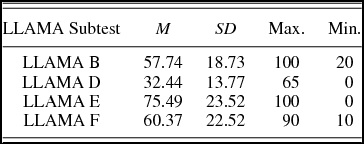
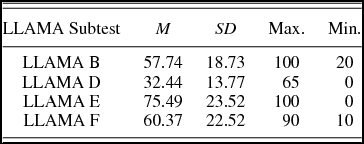
Table 1 shows the descriptive statistics (mean, standard deviation, and maximum and minimum values) for each of the four subtests in the LLAMA aptitude test. The four variables were normally distributed according to Kolmogorov–Smirnov tests (p > .05). Participants scored the highest on the sound–symbol association subtest, and scores on this subtest were significantly higher than the rest, according to Bonferroni-adjusted pairwise comparisons (p < .000). Participants scored the lowest on the sound recognition test (LLAMA D), and these scores were also significantly lower than the rest (p < .000). Finally, there were no significant differences between vocabulary learning (LLAMA B) and grammatical inferencing (LLAMA F; p = 1.000). As an anonymous reviewer pointed out, score differences among the tests are not truly informative unless the tests are on the same scale. Given that LLAMA D had a maximum score of 75, the descriptive data in Table 1 are not truly informative. However, Bonferroni-adjusted pairwise comparisons with a linear transformation of LLAMA D scores ([score × 100]/75) yielded the same results: participants scored significantly lower on this test than on the rest (p < .000).Footnote 3
Descriptive statistics for the LLAMA subtests
The descriptive statistics for the probabilistic SRT task were a mean of 12.06, a standard deviation of 12.25, a maximum of 49.26, and a minimum of –13.00. The average amount of learning in the task was the result of the reaction time difference in milliseconds between correct responses to congruent trials (i.e., trials following the target sequence) and incongruent trials (i.e., trials following the alternate sequence). SRT learning scores were normally distributed, according to a Kolmogorov–Smirnov test (p = .928).
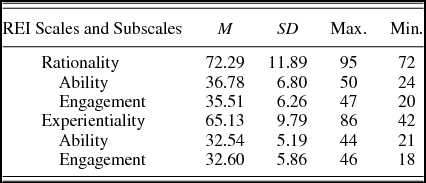
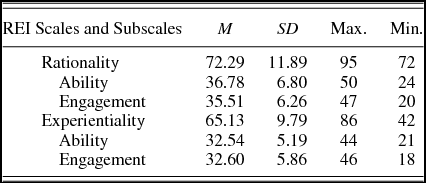
Finally, Table 2 displays the descriptive statistics for each of the (sub)scales in the REI. Scores on each of the subscales were normally distributed (p > .05). Each of the four subscales, the two measuring rational/experiential ability, and the two measuring rational/experiential engagement, with 10 items each, had a maximum possible score of 50. Responses to negatively keyed items (e.g., “I don't have a very good sense of intuition”) were reverse-scored. Overall, participants’ degree of agreement was higher on items measuring rational favorability (e.g., “I have a logical mind,” “I prefer complex problems to simple problems,” and “I enjoy solving problems that require hard thinking”) than on items measuring experiential favorability (e.g., “I often go by my instincts when deciding on a course of action,” “I tend to use my heart as a guide for my actions,” and “I can usually feel when a person is right or wrong, even if I can't explain how I know”). This difference was statistically significant, t (81) = –4.896, p < .001, suggesting that the participants sampled for this study preferred to engage in analytical thinking and to solve problems through logic, rather than to rely on intuition.
Descriptive statistics for the Rational-Experiential Inventory (REI) scales and subscales
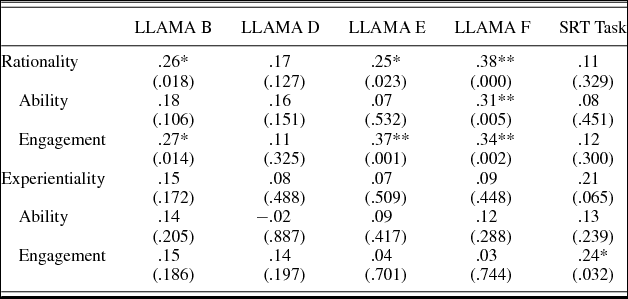
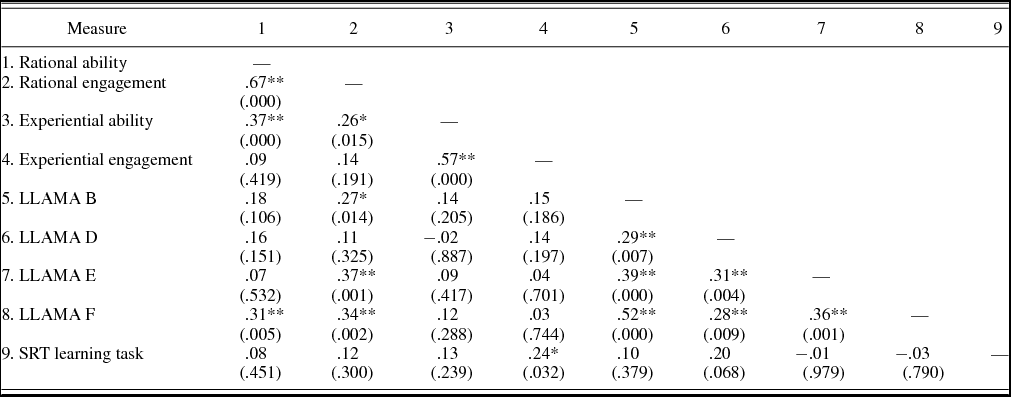
In order to explore the linkages between aptitude and self-reported preference for a rational or an experiential cognitive style, correlations were first computed between all the aptitude variables and either rationality or experientiality (see Table 3). Table 4 displays the full correlation matrix. The aptitude variables included the probabilistic SRT and the four LLAMA subtests. As can be seen, the rational–analytical cognitive style was positively and significantly related to three of the four LLAMA subtests (B, E, and F). The relationship was weak to moderate. The correlation between the rational–analytical cognitive style and LLAMA D was not significant. In terms of subscales, both rational ability and rational engagement were significantly related to LLAMA F. However, overall, it was rational engagement, rather than ability, that correlated significantly with the LLAMA scores. This suggested a positive link between performance on the LLAMA test and both reliance and enjoyment of thinking in an analytical, logical manner, as well as self-reported ability to think logically and analytically.
Correlations between rational and experiential scales and subscales and aptitude variables

Note: The values in parentheses are p values. SRT, Serial reaction time.
*p < .05. **p < .01.
Full correlation matrix
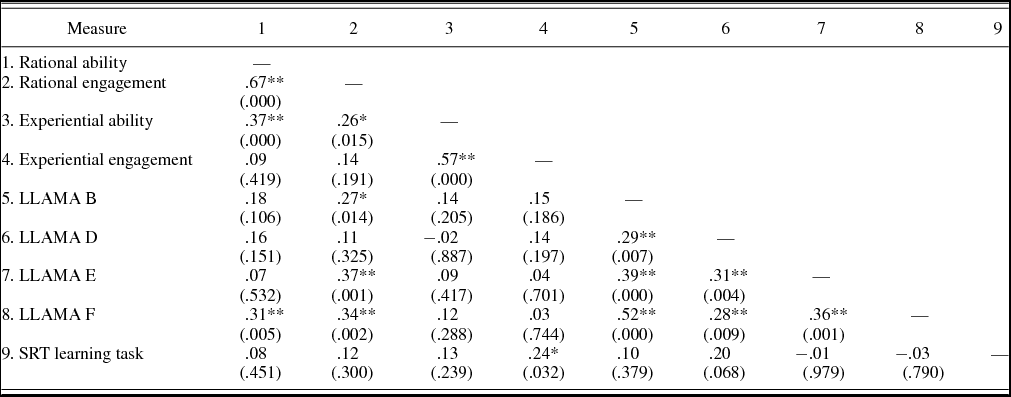
Note: The values in parentheses are p values. SRT, Serial reaction time.
*p < .05. **p < .01.
In contrast, the experiential–intuitive cognitive style was not related to performance on the LLAMA aptitude test, but significantly related to learning in the probabilistic SRT task. Specifically, the relationship, which was moderately weak, was between the experiential engagement subscale and SRT learning. This could suggest a positive link between reliance on and enjoyment of feelings and intuitions in making decisions and probabilistic sequence learning. However, this result should be interpreted with caution, due to the potential for Type I error in multiple comparison analyses.
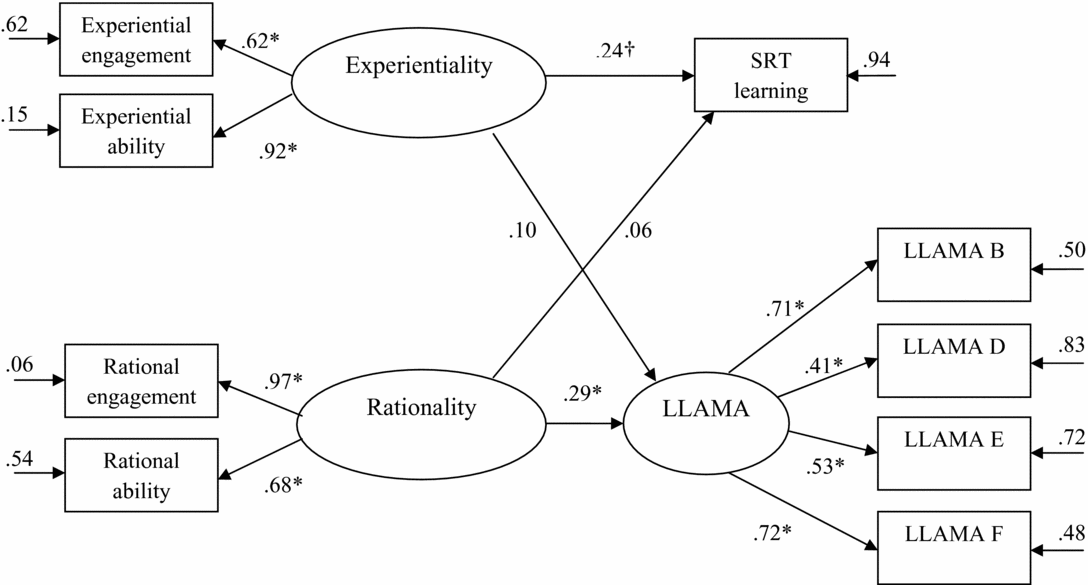
To further assess the relationships among the variables, latent factors were constructed using LISREL 8.72 and maximum-likelihood estimation procedures (Jöreskog & Sörbom, Reference Jöreskog and Sörbom2004). The primary goal of this structural equation modeling methodology is to explain correlations between various observed variables by means of a relatively few underlying latent variables. Unlike other statistical techniques, both the observed variables and the errors associated with the measurement of the variables are taken into consideration in constructing latent factors. In addition, employing this type of modeling technique, one can model structural relations between latent, as well as observed, variables.
The model that was tested is graphically represented in Figure 1. The coefficients reported are all standardized. Path loadings that were significant at the .05 level (i.e., associated with a z value of <–1.96 or >+1.96) are indicated by means of an asterisk. When squared, this value is the percentage variation in the observed measure that can be explained by the factor. Independence of error terms was assumed in the model in order to avoid greater cost in terms of degrees of freedom. The circles in Figure 1 represent the unobserved latent factors, and the boxes the represent observed measures. Finally, the lines pointing from the factors to the observed measures represent the factor loadings, and the shorter lines pointing to the observed measures represent the measurement error.
Experientiality-rationality model. *p < .05. †Marginally significant.
As can be seen, two main latent variables were formed (rationality and experientiality) to determine which of them explained more variance in SRT learning, an observed variable, and LLAMA aptitude, a latent variable. These two main latent variables were not allowed to correlate, based on previous claims of their independence in the literature and in order to maximize the covariance between the dependent variables and their predictors.
Rationality and experientiality accounted for more variance (target values of ≥0.50) in the REI subscales than in the SRT learning task and the LLAMA aptitude test. However, evidence of a weak double dissociation between rationality and experientiality in predicting SRT learning and LLAMA aptitude could be observed. Rationality significantly predicted LLAMA aptitude, while experientiality did not. Specifically, rationality accounted for about 10% of the variance in aptitude. Further, while the path between experientiality and SRT learning was marginally significant (z = 1.83), the path between rationality and SRT learning was not (z = 0.50). The overall goodness of fit of the model was only fair, according to Hu and Bentler's (Reference Hu and Bentler1999) criteria and on the basis of the value of the root mean square error of approximation (best if less than or equal to 0.05) and the nonnormed fit index (acceptable if over 0.90). The root mean square error of approximation, a measure of discrepancy between the observed correlations and the correlations predicted by the model, was 0.06. The nonnormed fit index, a measure of relative fit over a baseline model after adjusting for degrees of freedom, was 0.89.
Other fit indices, commonly used in studies reporting structural equation modeling techniques (e.g., Kaufman et al., Reference Kaufman, DeYoung, Gray, Jimenez, Brown and Mackintosh2010), revealed close fit (Hu & Bentler, Reference Hu and Bentler1999). The chi-square (χ2) statistic was not significant, χ2 (24, N = 82) = 31.29, p = .14, indicating that the model was statistically likely to occur. The ratio between the χ2 statistic and degrees of freedom (χ2/df) was 0.85, also indicating a minimally plausible model (the χ2/df ratio is considered best if less than 2.0). Finally, the comparative fit index was 0.96, indicating that the hypothesized model was better than a null model (the comparative fit index is considered best if higher than 0.95).
Although most of the path loadings were significant, which means that the latent variables were able to account for an amount of variance in the measured variables that was significantly different from zero, several error terms were extremely high (>0.50), which casts doubts on the model. The error variance associated with SRT learning was >0.80. Error variance typically corresponds to a combination of measurement error and variance that is not explained by the latent factor (Kline, Reference Kline2005). Given the low reliability of the SRT learning task, the high residual variance was probably due to noise in the reaction time data.
DISCUSSION
The purpose of this study was to examine the connections between individual differences in language aptitude and cognitive style. Two types of language aptitude (aptitude for implicit learning and aptitude for explicit learning) and two cognitive approaches to information processing (rational–analytical and experiential–intuitive) were investigated. The first research question asked whether preference for and/or ability to utilize the rational–analytical processing modality would be related to explicit language aptitude, as measured by the LLAMA aptitude test. Results from simple bivariate correlations indicated a connection between both self-reported analytical ability and preference for analytical thinking and LLAMA aptitude test scores. Specifically, significant correlations were observed between rational engagement (reliance on and enjoyment of thinking in an analytical, logical manner) and three of the LLAMA subtests: LLAMA B (vocabulary learning), LLAMA E (sound–symbol correspondence), and LLAMA F (grammatical inferencing). The strongest relationship was between LLAMA F and both rational engagement and rational ability (ability to think logically and analytically).
This suggests that the LLAMA aptitude test, except for LLAMA D (sound recognition), may draw on participants’ analytical skills and could be, therefore, considered a measure of explicit language aptitude, tapping cognitive abilities such as explicit inductive ability, explicit associative learning ability, and rote learning ability. These are cognitive abilities that can be expected to play a role in inducing rules behind a set of examples in an unknown language (LLAMA F) and in the learning of associations acquired consciously and intentionally between drawings and word strings or between sounds and symbols (LLAMA B and E). Unlike LLAMA B, E, and F, which provide participants with study time to rehearse and memorize materials, LLAMA D gives no time to study test materials. Participants listen to a series of sound strings only once and then take a recognition test where they have to discriminate between old and novel items. Based on the lack of significant correlations between rational ability/engagement and performance in LLAMA D, one could argue that this LLAMA subtest does not seem to draw on participants’ analytical problem-solving abilities.
The finding that performance in an aptitude test hypothesized to tap explicit language aptitude correlates with a rational–analytical (conscious and rule-based) cognitive style is in line with cognitive psychology studies that reported a relationship between rationality or intellect as measured by scales such as the REI, Big Five, or MBTI and cognitive tasks and abilities involving explicit cognitive processes: psychometric intelligence (Kaufman et al., Reference Kaufman, DeYoung, Gray, Jimenez, Brown and Mackintosh2010), explicit associative learning (Kaufman et al., Reference Kaufman, DeYoung, Gray, Jimenez, Brown and Mackintosh2010), working memory (DeYoung, Peterson, & Higgins, Reference DeYoung, Peterson and Higgins2005; DeYoung, Shamosh, Green, Braver, & Gray, Reference DeYoung, Shamosh, Green, Braver and Gray2009), and performance on logic problems such as the jelly bean task (Witteman et al., Reference Witteman, van den Bercken, Claes and Godoy2009). Similarly to the results in these studies, where measures of experientiality or intuition did not correlate with explicit cognitive tasks and abilities, explicit language aptitude as measured by the LLAMA test was not related to experiential processing preferences and abilities in the present study.
However, experientiality was significantly related to implicit language aptitude, operationalized in this study as probabilistic SRT learning, even though the magnitude of the relationship was very weak. This result supported a tentatively affirmative answer to the second research question, which asked whether preference for and/or ability to utilize the experiential–intuitive processing modality would be related to implicit language aptitude. Specifically, the relationship was observed between probabilistic SRT learning and experiential engagement, defined as reliance on and enjoyment of feelings and intuitions in making decisions (e.g., “I like to rely on my intuitive impressions”). This result could suggest that individuals who prefer to rely on intuition and on a more holistic (i.e., a nonanalytical) approach to information processing may be better at learning complex patterns or hidden covariations in the environment implicitly. As Kaufman et al. (Reference Kaufman, DeYoung, Gray, Jimenez, Brown and Mackintosh2010) argue, these individuals “may be more open to implicit learning since their selective attention will focus on a wider variety of stimuli, and thus be more likely to capture relevant associations” (p 336). This could include acquiring patterns in the input unintentionally when exposed to the L2, gradually accumulating associations between frequently co-occurring features, and developing a sense of intuition, knowledge that is difficult to express but that individuals rely on.
The study by Kaufman et al. (Reference Kaufman, DeYoung, Gray, Jimenez, Brown and Mackintosh2010) also found that probabilistic SRT learning significantly correlated with openness to experience of the Revised NEO Personality Inventory, based on the Five Factor model, and the intuition facet of the MBTI. The same intuition facet was also related to implicit learning in a task involving hidden covariation detection in Woolhouse and Bayne (Reference Woolhouse and Bayne2000), where participants had to judge the job suitability of a series of candidates based on a personality profile, where suitability was determined by a nonsalient rule concerning the scores.
In addition to the pattern of correlations, the pattern of path loadings reported in the present study as part of a structural equation modeling analysis suggested a possible double dissociation between rationality and experientiality. While measures of aptitude hypothesized to tap more explicit cognitive processes were associated with rationality, the probabilistic SRT learning task was associated with experientiality. Although these results have to be interpreted with extreme caution due to the small sample size in the study and the high error variance associated with some of the measures, a similar dissociation with similar loadings was reported by Kaufman et al. (Reference Kaufman, DeYoung, Gray, Jimenez, Brown and Mackintosh2010) with a sample of 153 participants. In their study, intellect, a construct that included the rational subscales in the REI, predicted performance in cognitive tasks associated primarily with an intellectual cognitive style, but did not predict learning in a probabilistic SRT task like the one used in the present study. Similarly, whereas openness to experience, which included subscales measuring intuitive cognitive traits, predicted learning in the probabilistic SRT task, it did not predict performance in cognitive tasks measuring explicit associative learning or working memory.
Kaufman et al. (Reference Kaufman, DeYoung, Gray, Jimenez, Brown and Mackintosh2010) interpreted their findings in support of dual-process theories of higher cognition, including intelligence, personality, skill learning, complex cognition, and language acquisition. According to these theories, there may be two architecturally and evolutionarily distinct cognitive systems involving two different modes of processing, automatic and controlled (e.g., Epstein et al., Reference Epstein, Pacini, Denes-Raj and Heier1996; Evans & Frankish, Reference Evans and Frankish2009; Sloman, Reference Sloman1996; Stanovich & West, Reference Stanovich and West2000), which presumably can be mapped onto neurologically distinct systems (Lieberman, Reference Lieberman, Forgas, Williams and von Hippel2003). Much of the work on implicit and explicit learning in SLA draws heavily on these theories, especially on Reber's studies (Reber, 1993; Reber et al., Reference Reber, Walkenfeld and Hernstadt1991), which investigate the independence of these two types of learning. For example, Ullman (Reference Ullman2001, Reference Ullman2004) proposed a declarative memory system, in charge of the explicit learning of information, including lexical knowledge, and a procedural memory system, in charge of the implicit acquisition of motor skills and routines, including syntactic, morphological, and phonological knowledge. Although the idea of two completely independent systems of learning has been considered quite debatable, and alternative theories have been defended, especially for adult learners (e.g., DeKeyser, Reference DeKeyser, VanPatten and Williams2007), findings such as Kaufman et al.'s and those reported in the present study suggest the existence of covariation between more explicit cognitive abilities and styles independently from cognitive abilities and styles considered more implicit and holistic.
Although the present study found a significant correlation between experiential engagement and probabilistic SRT learning, the correlation was weaker than the correlations observed between the rational subscales and LLAMA scores. In addition, the loading onto a hypothesized common factor underlying experiential engagement, experiential ability, and probabilistic SRT learning did not reach significance. One possibility is that such weak results were a statistical artifact, due to either the low reliability of the task (reaction time data tend to be noisy) or a Type I error. Another possibility is that individuals may lack the ability to introspectively analyze and self-report their intuitive/experiential abilities, partly because they have never had access to objective information about the quality of their experiential ability, such as IQ or college entrance examination scores for rational ability (Pacini & Epstein, Reference Pacini and Epstein1999). As a result, they may be more able to use metacognition to assess analytical rather than intuitive thinking processes and abilities, especially when required to assess when they use each form of processing and how accurate they are, as in the REI scales. Some evidence for this claim can be found in the implicit learning literature (Dienes & Scott, Reference Dienes and Scott2005; Hamrick & Rebuschat, Reference Hamrick, Rebuschat, Rebuschat and Williams2012; for a review, see Rebuschat, Reference Rebuschat2013), which shows that participants often believe they are guessing when making grammaticality judgments based on implicit knowledge, despite performing above chance level. This suggests that while learning took place and participants developed some structural knowledge, as evidenced by objective measures, they were unable to distinguish whether they were guessing or relying on intuition in subjective measures, a response bias that, among others, could be the result of a lack of metacognitive awareness of intuition.
Furthermore, the sample analyzed in this study was largely formed by individuals with college education, participants who either held a college degree or were pursuing one at the time of data collection. Therefore, the sample could have been slightly biased toward rational–analytical individuals, as suggested by the higher scores participants obtained on average on the rational ability and rational engagement subscales compared to the scores on the experiential ability and experiential engagement subscales. This could have resulted in a loss of power in the measurement of experiential cognitive styles, which could in turn explain the lack of stronger links between the variables.
Overall, the results of this study suggest a connection between cognitive aptitudes for language learning and broader thought processing preferences and abilities, in line with Skehan's (Reference Skehan1998) proposal. The findings can also be interpreted as support for the two hypothesized types of language aptitude, implicit and explicit, and for the qualitatively different types of cognitive processes underlying each of them: nonconscious, associative, holistic, and effortless in the case of implicit aptitude; and conscious, logical, analytical, and effortful in the case of explicit aptitude.
Limitations and further research
A number of caveats should be noted that limit the generalizability of the findings in this study. First, the use of self-report measures to assess different types of processing has been questioned by many researchers, due to participant response bias and because some cognitive processes may not lend themselves easily to introspection. Second, dual-process theories have been challenged by researchers who propose a single-system continuum of thought requiring different levels of consciousness from explicit to implicit (e.g., Osman, Reference Osman2004). In addition, from a methodological point of view, the sample size in the study, even if large enough for correlational analyses, was below the standards recommended for structural equation modeling techniques (i.e., sample sizes greater than 100 and at least 10 participants per model parameter; Kline, Reference Kline2005). Therefore, the structural equation modeling results reported should be considered tentative at best. Third, although the model tested was fair, it may not be the best explanatory structure, because no competitive models were considered. Fourth, the present study only included a single measure of implicit aptitude, the reliability of which was only barely acceptable, casting doubt on any of the significant and nonsignificant relationships found. In addition, it has been argued that any given task presumably requires some amount of explicit learning (see Destrebecqz & Cleeremans, Reference Destrebecqz and Cleeremans2001), and, therefore, the SRT learning task may not be a process-pure measure of implicit learning.
Further research should consider investigating design features to increase the reliability of probabilistic SRT learning tasks, as well as more implicit aptitude measures (e.g., priming), and participants with no college education to avoid the bias toward analytical thinking that characterizes college student populations. Research is also needed that connects individual differences in rational/experiential information-processing styles and cognitive aptitudes, on the one hand, with L2 outcomes under implicit and explicit learning conditions, on the other hand, in order to find out whether and how these profiles are associated with success in L2 learning. It has been proposed that in complex domains, such as language learning, an experiential, holistic, and implicit approach can have its advantages (Chapelle, Reference Chapelle and Reid1995; Kaufman et al., Reference Kaufman, DeYoung, Gray, Jimenez, Brown and Mackintosh2010). This could be a promising venue for future research in SLA.
Conclusion
This study extended recent work on language aptitude (e.g., Linck et al., Reference Linck, Hughes, Campbell, Silbert, Tare and Jackson2013) by investigating whether aptitudes for implicit and explicit learning are differentially related to the two main information-processing styles proposed by dual-process theories in cognitive psychology: rational–analytical (conscious and rule based) and experiential–intuitive (fast and holistic; Pacini & Epstein, Reference Pacini and Epstein1999). Results showed a significant positive correlation between scores on the rational–analytical scale and explicit aptitude as measured by the LLAMA aptitude test and between scores on the experiential–intuitive scale and implicit aptitude as measured by a probabilistic SRT task. Structural equation modeling further showed that the proposed model had acceptable fit. However, relationships were stronger between rationality and explicit aptitude than between experientiality and probabilistic SRT learning, which was interpreted as the outcome of a lack of metacognitive awareness of experiential–intuitive thinking. Overall, these findings support that the LLAMA aptitude test and the probabilistic SRT task draw on qualitatively different cognitive processes. While the LLAMA engages more analytical (explicit) processing, the probabilistic SRT task engages more holistic (implicit) processing.
APPENDIX A
REI items (k = 40)
The following is the Rationality Scale:
I try to avoid situations that require thinking in depth about something.
I’m not that good at figuring out complicated problems.
I enjoy intellectual challenges.
I am not very good at solving problems that require careful logical analysis.
I don't like to have to do a lot of thinking.
I enjoy solving problems that require hard thinking.
Thinking is not my idea of an enjoyable activity.
I am not a very analytical thinker.
Reasoning things out carefully is not one of my strong points.
I prefer complex problems to simple problems.
Thinking hard and for a long time about something gives me little satisfaction.
I don't reason well under pressure.
I am much better at figuring things out logically than most people.
I have a logical mind.
I enjoy thinking in abstract terms.
I have no problem thinking things through carefully.
Using logic usually works well for me in figuring out problems in my life.
Knowing the answer without having to understand the reasoning behind it is good enough for me.
I usually have clear, explainable reasons for my decisions.
Learning new ways to think would be very appealing to me.
The following is the Experientiality Scale:
I like to rely on my intuitive impressions.
I don't have a very good sense of intuition.
Using my gut feelings usually works well for me in figuring out problems in my life.
I believe in trusting my hunches.
Intuition can be a very useful way to solve problems.
I often go by my instincts when deciding on a course of action.
I trust my initial feelings about people.
When it comes to trusting people, I can usually rely on my gut feelings.
If I were to rely on my gut feelings, I would often make mistakes.
I don't like situations in which I have to rely on intuition.
I think there are times when one should rely on one's intuition.
I think it is foolish to make important decisions based on feelings.
I don't think it is a good idea to rely on one's intuition for important decisions.
I generally don't depend on my feelings to help me make decisions.
I hardly ever go wrong when I listen to my deepest gut feelings to find an answer.
I would not want to depend on anyone who described himself or herself as intuitive.
My snap judgments are probably not as good as most people’s.
I tend to use my heart as a guide for my actions.
I can usually feel when a person is right or wrong, even if I can't explain how I know.
I suspect my hunches are inaccurate as often as they are accurate.
ACKNOWLEDGMENTS
I thank Jared Linck and three anonymous reviewers for their helpful comments. The final responsibility for any errors remains my own.