It is well known that linguistic experience including first language (L1) has a profound impact on the processing and subsequent learning of nonnative languages (for a review, see Strange, Reference Strange1995). Even though a learning mechanism may allow humans to overcome initial difficulty (Maye, Weiss, & Aslin, Reference Maye, Weiss and Aslin2008), adult language learners typically do not match native speakers in their ability to process, in particular, phonetic aspects of the target languages after many years of learning (Flege, MacKay, & Meador, Reference Flege, MacKay and Meador1999). We often witness varying degrees of “foreign accent” in the adult learners of foreign languages. Piske, MacKay, and Flege (Reference Piske, MacKay and Flege2001) examined a wide variety of factors that affect a degree of perceived foreign accent and identified age of second language (L2) learning and amount of continued L1 use to affect how foreign accentedness is perceived.
Various age-related effects arise, possibly because adults have a more robust L1 than do children. In other words, adults' long-term cognitive representations are more firmly established and more resistant to change than that of children's (Flege, Reference Flege and Strange1995, Reference Flege, Meyer and Schiller2003). One might question if adults with a firm native phonology are capable of utilizing the L1 knowledge (e.g., sensitivity to phonemic length or quantity) to their advantage in processing unknown languages. If the answer is yes, speakers of quantity-sensitive languages such as Japanese or Thai, which use segmental duration contrastively, might be expected to process vowel length contrasts in other languages such as Arabic or Finnish better than speakers of quantity-insensitive languages such as Mandarin or Spanish, which do not use duration contrastively. Thus, the objective of this study is to compare the perception of vowel length contrasts in Arabic and Japanese by three groups of listeners who differ in their L1 backgrounds, that is, Arabic, Australian English, and Japanese. Below is a brief description of the role of vowel duration in Arabic, English, and Japanese.
ROLE OF VOWEL DURATION IN ARABIC, ENGLISH, AND JAPANESE
Arabic and Japanese have three (/iau/) and five (/ieaou/) phonemic vowels, respectively, and vowel length is contrastive in both (e.g., Alghamdi, Reference Alghamdi1998; Hirata, Reference Hirata2004a; Hirata & Tsukada, Reference Hirata and Tsukada2009; Mitleb, Reference Mitleb1984; Nasr, Reference Nasr1960; Thelwall & Sa'Adeddin, Reference Thelwall and Sa'Adeddin1990; Vance, Reference Vance1986). In both languages, duration is the primary acoustic correlate for the length contrasts (Alghamdi, Reference Alghamdi1998; Hirata & Tsukada, Reference Hirata and Tsukada2009). Although some cross-dialectal differences in vowel quality have been reported in Arabic, phonemic short and long vowels in different dialects are clearly differentiated durationally (e.g., Alghamdi, Reference Alghamdi1998; Cowan, Reference Cowan1970; de Jong & Zawaydeh, Reference de Jong and Zawaydeh2002; Drozdík, Reference Drozdík1973; Tsukada, Reference Tsukada2009a). Depending on different phonetic contexts, the durational ratio of short to long vowels roughly ranges from 0.4 to 0.65 for Arabic (Alghamdi, Reference Alghamdi1998; Mitleb, Reference Mitleb1984) and from 0.32 to 0.42 for Japanese (Hirata, Reference Hirata2004a; Tsukada, Reference Tsukada1999), suggesting a cross-language difference in the separation of short and long vowels (for a comparison of length contrasts in Swedish, Finnish, and Estonian, see Engstrand & Krull, Reference Engstrand and Krull1994). In other words, how a phonological feature “length” is phonetically realized is likely to be language-specific and the demand for strict control over the length contrast may not be equivalent in Arabic and Japanese.
The effect of vowel length on vowel quality has been investigated in a few studies (e.g., Alghamdi, Reference Alghamdi1998; de Jong & Zawaydeh, Reference de Jong and Zawaydeh2002; Hirata & Tsukada, Reference Hirata and Tsukada2009). Phonemic long vowels were shown to occupy a more peripheral portion of the acoustic vowel space than their short counterparts in both Arabic and Japanese. Although longer vowels tend to be more peripheral than shorter vowels in many languages, the extent to which vowel quality difference is involved in encoding a length contrast appears to be language specific (Engstrand & Krull, Reference Engstrand and Krull1994; Tsukada & Roengpitya, Reference Tsukada and Roengpitya2008).
Whether vowel length contrasts are primarily signaled by variations in vowel duration or a combination of vowel quality and duration, they may be highly salient and accessible to L1 listeners as demonstrated by young infants' accurate discrimination of vowel length contrasts in various studies (e.g., Dietrich, Swingley, & Werker, Reference Dietrich, Swingley and Werker2007; Mugitani et al., Reference Mugitani, Rons, Fais, Dietrich, Werker and Amano2009; Sato, Sogabe, & Mazuka, Reference Sato, Sogabe and Mazuka2010). In fact, young Japanese infants (at 9.5 months but not at 7.5 months), for whom vowel length is phonemic, were shown to discriminate /mana/ and /maːna/ accurately. This is in contrast with difficulty nonnative adult learners face in perceiving Japanese vowel length contrasts (e.g., Hirata, Reference Hirata2004a, Reference Hirata2004b; Hirata & Kelly, Reference Hirata and Kelly2010; Hirata, Whitehurst, & Cullings, Reference Hirata, Whitehurst and Cullings2007; Tajima, Kato, Rothwell, Akahane-Yamada, & Munhall, Reference Tajima, Kato, Rothwell, Akahane-Yamada and Munhall2008).
As for English, the role duration plays in the identification of vowels is reported to vary among different varieties. In American English (Strange, Bohn, Nishi, & Trent, Reference Strange, Bohn, Nishi and Trent2005; Strange, Bohn, Trent, & Nishi, Reference Strange, Bohn, Trent and Nishi2004), both spectral and durational information is used by listeners to differentiate /ɪ/ from /i/. The two vowels do differ in duration, but the ratio of the short /ɪ/ to the long /i/ is as high as 0.77 to 0.84 (Hillenbrand, Gerry, Clark, & Wheeler, Reference Hillenbrand, Gerry, Clark and Wheeler1995; Strange et al., Reference Strange, Bohn, Trent and Nishi2004, Reference Strange, Bohn, Nishi and Trent2005). On the other hand, acoustic phonetic research on Australian English shows that duration may be crucial for the identification/discrimination for some vowel pairs such as /a-ʌ/ and /ɪ-i/ (e.g., Cox, Reference Cox2006; Cox & Palethorpe, Reference Cox and Palethorpe2007; Harrington & Cassidy Reference Harrington and Cassidy1994; Ingram & Park Reference Ingram and Park1997). The /ɪ/-to-/i/ ratio is much lower at approximately 0.55 (or lower) compared to American English (for a review, see Tsukada, Reference Tsukada2009b). Thus, reliance on duration for the vowel identity may be larger in Australian English than in American English.
PRIOR LINGUISTIC EXPERIENCE IN CROSS-LANGUAGE SPEECH PERCEPTION
Recent studies on cross-language perception of word-final stops showed that Australian English listeners were less accurate in discriminating unreleased Thai place contrasts (e.g., /t/ vs. /k/, which is phonetically [t˺] vs. [k˺]) than native Thai listeners even though final stops can be released or unreleased in English (e.g., Tsukada, Reference Tsukada2006, Reference Tsukada2007, Reference Tsukada2008; Tsukada & Ishihara, Reference Tsukada and Ishihara2007; Tsukada & Roengpitya, Reference Tsukada and Roengpitya2008). In other words, unreleased Thai stops are not expected to be completely foreign to Australian English listeners. They were, as expected, very accurate in discriminating their L1 English final stop contrasts. Native Thai listeners, in contrast, discriminated stop place contrasts accurately in both English and Thai. Following Abramson and Tingsabadh (Reference Abramson and Tingsabadh1999), the Australian English listeners' nonoptimal discrimination of Thai stops could be attributed to their limited experience in decoding the information contained in the formant transitions for the Thai stops that may be used to compensate for the absence of release. It is important to point out, however, that although Australian English listeners' discrimination of Thai stops was not optimal, they were more accurate compared to native Japanese listeners whose experience with final stops is even more limited in their L1. It was tentatively concluded that not just experience with specific phonetic characteristics (i.e., unreleased stops) but exposure to native phonetic contrasts that include detailed acoustic characteristics may be needed to develop the capacity to discriminate subtle phonetic contrasts as truly native listeners.
Another study on approximants in English and French (Hallé, Best, & Levitt, Reference Hallé, Chang and Best1999) showed that native French listeners have some perceptual difficulties with the English /r/ even though their L1 French phonology has /r/ in its inventory. This finding was attributed to marked articulatory-phonetic differences between the English and French /r/ (i.e., phonetically realized as a central approximant in English and a uvular fricative in French). Of the three contrasts tested (/w/–/j/, /r/–/l/, /w/–/r/), the French listeners had most difficulty with /w/–/r/ and tended to hear the English /r/ as /w/-like.
In the area of native versus nonnative tone perception, Wayland and her colleagues showed that previous experience with a tone language (i.e., Mandarin) was beneficial for the processing of other unfamiliar tone language (i.e., Thai) and resulted in a greater effect of training for Mandarin than English speakers (Wayland & Guion, Reference Wayland and Guion2004; Wayland & Li, Reference Wayland and Li2008). Further, Lee, Vakoch, and Wurm (Reference Lee, Vakoch and Wurm1996) demonstrated that, among the tone language speakers (e.g., Cantonese and Mandarin), generalization of nonnative tone perception depended on the listeners' L1 and Cantonese listeners processed Mandarin tones more accurately than Mandarin listeners processed Cantonese tones. Another study on cross-language perception of tones (Hallé, Chang, & Best, Reference Hallé, Chang and Best2004) compared Taiwanese and French listeners' discrimination and identification of Mandarin tones. It was observed that, despite not having lexical tones in their L1, French listeners were not entirely tone “deaf.”
Of particular relevance to the present study, McAllister, Flege, and Piske (Reference McAllister, Flege and Piske2002) found that, of the three (Estonian, English, and Spanish) groups of learners of Swedish with comparable language learning experience, only the Estonian learners whose L1 uses duration contrastively showed perception and production accuracy for quantity-based contrasts, which was indistinguishable from that of native Swedish speakers'. This was taken as evidence that Estonian subjects' “attunement to subsegmental “features” transfers from the L1 to an L2” (McAllister et al., Reference McAllister, Flege and Piske2002, p. 245). By examining the phonological length, a feature “shared” between Arabic and Japanese, we could explore whether the benefit of prior experience with authentic, native input can be extended to vowel length perception for individuals with no experience with the target languages. In sum, the present study addresses the role of L1 or prior linguistic experience in individuals' abilities to extract and generalize phonological features across languages.
When listening to an unknown language, listeners may find some foreign vowels more similar or dissimilar to their L1 vowels than others. It is possible that listeners' discrimination accuracy varies according to the cross-linguistic phonetic (dis)similarity between the L1 and foreign vowels. In other words, there may be an effect of vowel type on how listeners process a new language. For example, would Arabic listeners discriminate the Japanese vowel length contrasts more poorly when the context vowels are /e/ or /o/ than when the context vowels are /i/, /a/ or /u/, because the former do not have a phonemic status in Arabic? Thus, the secondary interest of the study was to determine if listeners' discrimination accuracy for vowel length contrasts depends on certain vowels that they hear.
METHODS
Speech materials
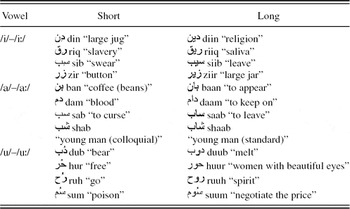
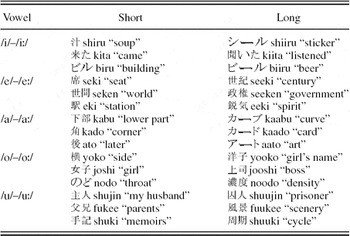
The specific Arabic and Japanese words recorded for this study are shown in Table 1 and Table 2, respectively.
Arabic words used in this study

Japanese words used in this study

Speakers read consonant–vowel–consonant (C1V1C2) words in Arabic and C1V1C2V2 words in Japanese. Although this discrepancy is not desirable, the occurrence of the CVC sequence is quite limited in Japanese unlike Arabic. Furthermore, given that vowel length is neutralized in open syllables including the word-final position (Thelwall & Sa'Adeddin, Reference Thelwall and Sa'Adeddin1990), it was not an option to use CVCV words in Arabic to match the syllable structure across the two languages. The syllable structure is fairly simple in Japanese (predominantly V or CV where V is a vowel and C is a consonant). Japanese uses two rhythmic units, that is, mora and syllable. Although all the Japanese test words have two syllables, the test words containing a short vowel have two mora and the test words containing a long vowel have three (or four) morae. The intended pitch pattern for the Japanese test words was HIGH on the first syllable for a majority of items and LOW on the second syllable.
Test words (all real words) were presented visually to each speaker on the computer screen one word at a time. All words were written using appropriate Arabic or Japanese script that explicitly encodes vowel length in the standard orthography, so there was no ambiguity as to how each word should be read by mature, proficient native speakers. The speakers were asked to read the target words naturally at their normal speaking rate. All speakers read the target words twice in isolation and once in a short carrier sentence.Footnote 1 The recorded speech materials were digitized at 44.1 kHz using CoolEdit, and the target words were segmented and stored in separate files. Prior to the presentation in the perception experiment, each sound file was normalized to 50% of the peak amplitude following the procedures used in previous research (Aoyama, Flege, Guion, Akahane-Yamada, & Yamada, Reference Aoyama, Flege, Guion, Akahane-Yamada and Yamada2004; Flege & MacKay, Reference Flege and MacKay2004; Guion, Glege, Akahane-Yamada, & Pruitt, Reference Guion, Flege, Akahane-Yamada and Pruitt2000). The mean durational values of the short and long vowels in the stimulus tokens presented to the listeners were 95 and 213 ms (short/long ratio = 0.45) for Arabic and 74 and 175 ms (short/long ratio = 0.42) for Japanese, respectively.
Speakers
Native speakers of Arabic and Japanese participated in the recording sessions lasting between 45 and 60 min. The Arabic group consisted of nine (six male, three female) speakers with a mean age of 40.8 years. They were all born in Arabic-speaking countries and have lived in Sydney, Australia, for 12 years on average at the time of recording. The Arabic speakers' dialectal backgrounds were Lebanese (n = 5), Egyptian (n = 1), and Saudi (n = 3). Vowel length is phonemic in all these varieties of Arabic. They were recorded in the Audio-Visual recording studio and the Centre for Language Sciences recording studio at Macquarie University, Sydney.
The Japanese group consisted of eight (four male, four female) speakers with a mean age of 25.4 years. With the exception of one participant who has lived in the United States for 11 months, none of them has lived overseas for an extended period of time. They were recorded in the sound-treated room in the Department of Linguistics, University of Kobe, Japan. These speakers primarily came from the Western part of Japan including Ehime, Fukuoka, Hyogo, Kagawa, Kanagawa, and Tottori prefectures. Vowel length is phonemic to all these speakers.
All speakers reported normal hearing and had no history of language problems in their L1s. They were paid $30 (or the equivalent amount in Japanese yen) for their participation.
Listeners
Three groups of listeners participated. The first was a group of 7 native Arabic (NA) speakers (3 males, 4 females), the second was a group of 15 native Japanese (NJ) speakers (2 males, 13 females), and the third was a group of 17 native Australian EnglishFootnote 2 (OZ) speakers (5 males, 12 females) who do not know either Arabic or Japanese. The NA and OZ listeners were recruited from the student and staff population at Macquarie University. The majority of the NJ listeners were postgraduate students in the MA in the Translation and Interpreting course at Macquarie University. According to self-report, all listeners had normal hearing and did not have any language deficiency in their L1s. Participants were tested individually in a session lasting between 30 and 40 min in the Speech Perception Lab in the Department of Linguistics or in a quiet room in the Department of International Studies, Macquarie University. All the speakers were paid $20 for their participation.
Procedures
The participants' perception of vowel length contrasts in Arabic and Japanese was assessed in a categorial AXB test, a method frequently employed in previous speech perception research (e.g., Harnsberger, Reference Harnsberger2001; Højen & Flege, Reference Højen and Flege2006; Wayland & Guion, Reference Wayland and Guion2003, Reference Wayland and Guion2004). The stimuli were presented in triads (i.e., “A” followed by “X” followed by “B”) via the high-quality headphones (e.g., Bose Quiet Comfort 2 acoustic noise canceling headphones) at a self-selected comfortable amplitude level using a notebook or desktop computer. The interstimulus interval in all trials was 0.5 s.Footnote 3 This interval has been used in previous studies and is claimed to trigger a phonetic level of processing which is void of native language interference (Wayland & Guion, Reference Wayland and Guion2003, Reference Wayland and Guion2004; Wayland & Li, Reference Wayland and Li2008). The tokens produced in a sentence were used as stimuli. This was to include tokens that reflect natural variation in speech sounds.
In the AXB test, the first (“A”) and third (“B”) tokens always come from different categories and the listeners need to decide whether the second token (“X”) belongs to the same category as “A” (e.g., “sit2”-“sit1”-“seat3”) or “B” (e.g., “hit3”-“heat1”-“heat2;” where the subscripts indicate different talkers). Within a trial, three tokens were always spoken by different speakers of the same sex. Thus, “X” was never physically identical to either “A” or “B.” This was to ensure that the listeners focus on relevant phonetic characteristics that group two tokens as members of the same category without being distracted by audible but phonetically irrelevant within-category variation (e.g., in voice quality). All possible “AB” combinations (i.e., “AAB,” “ABB,” “BAA,” and “BBA”) were tested.
The stimuli were blocked by language (Arabic, Japanese) and the order of presentation was counterbalanced across listeners. A total of 100 trials for Arabic and 125 trials for Japanese were presented. The first 4 and 5 trials in each language were for practice and were not analyzed. The listeners had up to 3 s to respond and were asked to guess if uncertain. Each trial was played only once.
Analysis
Two-way repeated-measures analysis of variance (ANOVA) with listener group (NA, NJ, OZ) as a between-subjects factor and stimulus language (Arabic, Japanese) as a within-subjects factor was conducted in order to compare listeners' discrimination accuracy for vowel length contrasts in the two languages. The dependent variable was the percentage of correct discrimination. As mentioned in the Introduction, the effect of vowel type was also of interest. This was examined in Listener Group×Vowel ANOVA for each language.
RESULTS
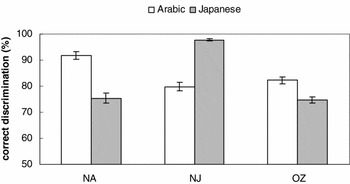
Figure 1 shows listeners' discrimination accuracy for the Arabic and Japanese vowel length contrasts. It can be clearly seen in Figure 1 that both NA and NJ listeners were more accurate in discriminating vowel length contrasts in their L1 than nonnative listeners. Both native groups made very few mistakes when they heard vowel length contrasts in their own languages. The NJ listeners hardly made any mistakes when they heard the Japanese length contrasts (98% correct), but they were less accurate in discrimininating the Arabic contrasts (80% correct). The NA group showed almost an exact mirror image of the NJ group's response pattern (Japanese 75% vs. Arabic 92%). The OZ group was more accurate in discriminating length contrasts in Arabic (82%) than in Japanese (75%). It was not surprising that they were clearly less accurate than the native listeners of each language in their discrimination of length contrasts, but their accuracy was much higher than the chance level (50%).
Mean discrimination scores for Arabic and Japanese vowel length contrasts by three groups of listeners. The brackets enclose ±1 standard error.

The main effect of listener group and a two-way interaction were significant: listener group, F (2, 36) = 28.2 p < .001; Listener Group×Stimulus Language, F (2, 36) = 115.5, p < .001, but the main effect of stimulus language narrowly missed reaching significance, F (1, 36) = 4.1, p = .051. The significant interaction arose, apparently due to the exactly opposite pattern of results for the NA and NJ groups. The simple effect of stimulus language was significant for all three groups: NA, F (1, 6) = 134.6, p < .001; NJ, F (1, 14) = 107.7, p < .001; OZ, F (1, 16) = 31.3, p < .001. As is clearly seen in Figure 1, both NA and NJ groups were much more accurate in discriminating length contrasts in their L1 than in the unknown language.
Arabic contrasts
The simple main effect of listener group was significant for Arabic, F (2, 56) = 15.5, p < .001, in Listener Group×Stimulus Language ANOVA. The NA listeners were significantly more accurate than both the NJ and OZ listeners, who did not differ from each other, in discriminating vowel length contrasts in their L1 Arabic. Thus, despite their experience with vowel length contrasts in their L1 Japanese, the NJ listeners were not better able than the OZ listeners to generalize the L1 knowledge in processing the Arabic length contrasts. The OZ listeners' mean score (82%) was slightly (albeit nonsignificantly) higher than the NJ listeners' (80%).
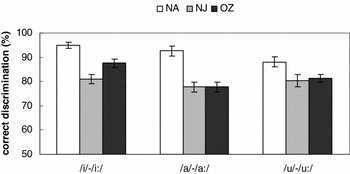
As mentioned in the introductory section, listeners may exhibit different discrimination patterns in a way that reflects their respective L1 vowel systems. Figure 2 shows listeners' discrimination accuracy for the Arabic vowel length contrasts as a function of vowel type. The effect of vowel type was assessed in Listener Group×Vowel ANOVA. The main effects of listener group and vowel were significant: listener group, F (2, 36) = 11.2, p < .001; vowel, F (2, 72) = 7.4, p < .01; and so was the two-way interaction, F (4, 72) = 2.5, p < .05. The simple effect of listener group showed a different pattern of results according to the vowel type. For /i/ and /a/, but not for /u/, the simple effect of listener group was significant, F (2, 73) = 8.4, p < .001, for /i/, F (2, 73) = 11.3, p < .001, for /a/. Although the NA listeners showed the most accurate discrimination for all vowel types, it can be inferred that the between-group difference was the least for the /u/ vowel. The simple effect of vowel reached significance only for the OZ listeners who showed the highest discrimination accuracy for the /i/ vowel, F (2, 72) = 11.6, p < .001. These results are captured in Figure 2. It is not entirely clear why the OZ listeners showed a significant vowel effect. To better understand their perceptual behavior, it is necessary to examine how they perceptually assimilate Arabic vowels to their L1 English vowels. Data collection in cross-language vowel categorization is currently in progress.
Mean discrimination scores for Arabic vowel length contrasts as a function of vowel type by three groups of listeners. The brackets enclose ±1 standard error.

Japanese contrasts
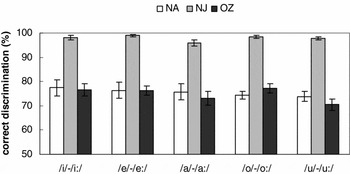
The simple main effect of listener group was significant for Japanese, F (2, 56) = 102.8, p < .001, in Listener Group×Stimulus Language ANOVA. The NJ listeners were significantly more accurate in discriminating vowel length contrasts in their L1 Japanese than both the NA and OZ listeners who did not differ from each other. Again, this was despite the expected positive L1 transfer because the NA listeners have experience with vowel length contrasts in their L1 Arabic. As mentioned above, the NJ listeners hardly made any discrimination errors (three NJ listeners made no errors and the lowest score was 94%) and their variability was minimal as shown in the very small standard errors in Figure 1 and Figure 3. It is interesting to note that what is unmistakably contrastive to one group of listeners may not necessarily be distinctive to other listeners depending on their L1 backgrounds.
Mean discrimination scores for Japanese vowel length contrasts as a function of vowel type by three groups of listeners. The brackets enclose ±1 standard error.

Figure 3 shows listeners' discrimination accuracy for the Japanese vowel length contrasts as a function of vowel type. Only the main effect of listener group was significant in Listener Group×Vowel ANOVA, F (2, 36) = 159.1, p < .001. Neither the main effect of vowel nor two-way interaction reached significance. Thus, the NA listeners did not show extra discrimination difficulty when the Japanese words included /e-eː/ or /o-oː/, i.e., vowels which do not have a phonemic status in Arabic, and all three groups of listeners showed comparable discrimination accuracy across five vowel contexts.
In sum, neither the NA nor NJ listeners showed any advantage over the OZ listeners in their perceptual discrimination of vowel length contrasts in a language with which they are unfamiliar.
DISCUSSION
This study compared how listeners differing in their first language (L1) backgrounds discriminate vowel length contrasts in Arabic and Japanese. A major finding was, even for those listeners of quantity-sensitive languages who are experienced with vowel length contrasts in their L1, the knowledge from the L1 did not positively transfer to the processing of vowel length contrasts of an unknown language. Nor did it give them an advantage over listeners who have more limited experience with vowel length contrasts in their L1. In other words, listeners' L1 phonology overestimated their cross-language perception accuracy. This partially agrees with the findings for consonant perception reported in previous research (Hallé et al., Reference Hallé, Best and Levitt1999; Tsukada, Reference Tsukada2006, Reference Tsukada2007, Reference Tsukada2008; Tsukada & Ishihara, Reference Tsukada and Ishihara2007; Tsukada & Roengpitya, Reference Tsukada and Roengpitya2008). Possibly, just like in consonant perception, it may be that specific phonetic experience with vowel length contrasts (or the phonological feature “length”) is not sufficient to achieve the nativelike level of discrimination accuracy.
However, the results for vowel length discrimination in this study differed from those of stop place discrimination in an important way. In stop perception, even though Australian English listeners who have experience with unreleased word-final stops in their L1 English showed poorer discrimination accuracy for unreleased Thai stop contrasts than native Thai listeners, they still showed an advantage over native Japanese listeners who have a negligible amount of experience with word-final stops in their L1 Japanese (Tsukada & Ishihara, Reference Tsukada and Ishihara2007). In other words, L1 experience still mattered and resulted in differentiating Australian English listeners from Japanese listeners in their perception of Thai stop place contrasts. A similar finding was obtained which shows the benefit of prior experience with a tone language, Mandarin, in the perception of another tone language, Thai (Wayland & Guion, Reference Wayland and Guion2004; Wayland & Li, Reference Wayland and Li2008). In vowel length discrimination, on the other hand, there was no evidence that the OZ listeners whose L1 does not use duration contrastively perceived vowel length in unknown languages differently from the NA or NJ listeners whose L1 does use duration contrastively.
Nevertheless, the role of duration in the identification of vowels cannot be dismissed in Australian English (Cox, Reference Cox2006; Cox & Palethorpe, Reference Cox and Palethorpe2007). Although the extent to which vowel duration is used contrastively in Australian English is likely to be more limited than in Arabic or Japanese, having a minimal pair such as “hut” versus “heart,” which is primarily differentiated by vowel duration, may still have sensitized the OZ listeners to vowel length contrasts in unknown languages and boosted their discrimination accuracy.
Alternatively, there is the possibility that auditory salience (or psychoacoustic robustness) of the cues encoded in vowel length contrasts may be responsible for above-chance performance of the OZ listeners.Footnote 4 This may be analogous to above-chance discrimination of within-category variation reported in Hallé et al. (Reference Hallé, Chang and Best2004). As Hallé et al. (Reference Hallé, Chang and Best2004) pointed out in the perception of lexical tones in Mandarin, French listeners, for whom lexical tones are not contrastive, were not “deaf” to tonal variations. Similarly, the OZ listeners in this study did not suffer from “duration deafness.” It may be the case that the OZ listeners were simply demonstrating perceptual sensitivity to durational variations (beyond just noticeable differences) that any listener may possess regardless of his/her L1 background. It is necessary to test English-speaking listeners from other varieties such as American English, in which vowel duration is known to play a less prominent role than in Australian English (Strange et al., Reference Strange, Bohn, Trent and Nishi2004, Reference Strange, Bohn, Nishi and Trent2005) or native Catalan or Spanish listeners whose L1 does not use vowel length contrastively (Cebrian, Reference Cebrian2006).
It is interesting to note that young children acquiring American English have been shown to make relatively few vowel-length errors even though their L1 utilizes vowel duration only partially to encode vowel length contrasts (Kehoe & Stoel-Gammon, Reference Kehoe and Stoel-Gammon2001). Perhaps this early acquisition suggests that vowel length is relatively accessible and easy to acquire.
Given “the availability of duration even to learners whose L1 has no duration contrasts” (Cebrian, Reference Cebrian2006, p. 372) or overreliance on the duration cues by such learners (Bohn, Reference Bohn and Strange1995), it remains to be explained why Arabic and Japanese listeners who have experience with the contrastive use of duration in their L1s did not take advantage of this experience in cross-language vowel perception.
It is possible that the reason why neither Arabic nor Japanese listeners outperformed Australian English listeners may be related to the experimental task used in this study. In an AXB test, listeners may be engaged in an online processing mode and simply make perceptual decisions on the spot as they process incoming speech signals. In other words, the task used in this study may be tapping onto listeners' ability to weigh fine-grained acoustic information available from short-term memory as opposed to more abstract cognitive representations stored in long-term memory.Footnote 5 This, coupled with a relatively weak demand placed on the listeners' working memory by short interstimulus interval of 0.5 s (Wayland & Li, Reference Wayland and Li2008), may have resulted in underestimation of the discrimination abilities of the Arabic and Japanese listeners on the one hand and overestimation of the abilities of the Australian English listeners on the other hand. In order to explore this issue further, identification experiments are currently underway. More graded perceptual behaviors may be observed across different listener groups depending on whether they have firmly established short versus long vowel categories in their native phonology.
In the present study, both Arabic and Japanese listeners were naïve to each other's language and were, thus, fundamentally different from the participants in previous studies that examined the role of prior linguistic experience in the acquisition of L2 sound contrasts. The Arabic and Japanese listeners may still positively transfer their experience with the phonological “length” feature and show an advantage of their respective L1 over OZ listeners once they start learning each other's language (e.g., McAllister et al., Reference McAllister, Flege and Piske2002; Wayland & Guion, Reference Wayland and Guion2004; Wayland & Li, Reference Wayland and Li2008). That is, Arabic and Japanese listeners may have less learning difficulty than OZ listeners.
It needs to be pointed out that durational variations are used for various purposes including nonlinguistic ones (e.g., emphasis) in any language and cannot be regarded as being irrelevant to any listener. Length contrasts that are primarily signaled by durational variations may be low in categoricity in a way similar to vowel or tone contrasts (Hallé et al., Reference Hallé, Chang and Best2004). If that is the case, compared to a consonantal contrast such as /l/-/r/, length contrasts may be in a way harder to discriminate and categorize, as they are relative and susceptible to various factors such as speaking rate (Hirata, Reference Hirata2004a; Hirata & Tsukada, Reference Hirata and Tsukada2009). Even though native speakers who provided speech materials spoke at their “normal” rate, there were considerable individual variations across speakers in their speaking rate. This may be another reason why between-group differences that reflect their L1 characteristics did not emerge.
It is also plausible that the Arabic and Japanese listeners were not entirely engaged in the phonetic mode of processing when they listened to their L1, because all the stimulus words were real, meaningful words, and perhaps the lexical effect was too large. Although the task was intended to be a test of perceptual discrimination ability of length contrasts that exist in both native and nonnative languages, knowing the meaning of the test words may have been a determining factor. It would be useful to examine the perception of native listeners of quantity-sensitive languages (such as Finnish or Thai) who are used to vowel length contrasts in their L1 but to whom lexical meaning of the stimuli is not available. Their response patterns would also help to understand if vowel length contrasts are more discriminable in Arabic than in Japanese or vice versa.
It is not entirely inconceivable that the Arabic and Japanese listeners' discrimination accuracy was nonoptimal as a result of negative L1 transfer.Footnote 6 Neither Arabic nor Japanese listeners would have been attuned to detailed phonetic characteristics of the length categories in each other's language. Whether a “short” Arabic vowel (95 ms on average), which is slightly longer than a “short” Japanese vowel (74 ms on average), is assimilated to a short or long category by the NJ listeners needs to be determined empirically. Likewise, significance of a smaller between-category durational difference for Japanese (101 ms) than for Arabic (118 ms) stimuli deserves further acoustic–phonetic investigation. If Arabic short (or long) and Japanese short (or long) vowels are not linked in the listeners' perceptual systems due, possibly, to subtle cross-language phonetic differences, realignment of category boundary needs to take place and their existing categories may interfere with the processing of unfamiliar length categories.
CONCLUSION
This study compared discrimination accuracy for Arabic and Japanese vowel length contrasts by native and nonnative listeners. Native Arabic and Japanese listeners clearly made more discrimination errors when they responded to nonnative contrasts. There was no evidence for a positive L1 transfer effect in their cross-language speech perception. It may be that, not just for discrimination of stop place contrasts examined in previous research, but also for vowel length contrasts, experience with specific phonetic contrasts in their L1 is not sufficient. Rather, experience with authentic, native phonetic realization may be crucial for truly accurate discrimination of phonetic contrasts.
ACKNOWLEDGMENTS
This study was funded by Macquarie University New Staff Grant 9200800377 and Macquarie University Research Development Grant 9200900585. I thank Professor Aydin Durgunoğlu and anonymous reviewers for their help with this manuscript.